Johannes Fernedill
c 1352 to c 1425
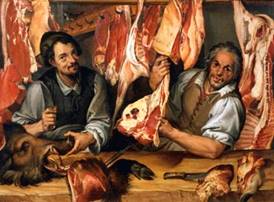
Butcher and freeman of York
FAR00048A
|
Return to the Home Page of the Farndale Family
Website |
The story of one family’s journey through two
thousand years of British History |
The 83 family lines into which the family is divided.
Meet the whole family and how the wider family is related |
Members of the historical family ordered by date of
birth |
Links to other pages with historical research and
related material |
The story of the Bakers of Highfields, the Chapmans,
and other related families |
Dates are in red.
Hyperlinks to
other pages are in dark
blue.
Headlines are in brown.
References and
citations are in turquoise.
Context and local
history are in purple.
1352
Johannes Fernedill might have been born in about 1352, probably
the son of Johannes De Farndall (FAR000035). Johannes Fernedill was probably the
grandson of Johannes de Farnedale who had arrived in York in about 1340 to set
up a saddle making business.
The evidence for
the York Line of the Farndale family, which supports John’s family linkage, is
explored in another
webpage.
The Scottish campaigns
under Richard II
1383 to
1385
There was a medieval soldier who fought in Scotland between 1383
to 1389 variously called John Farondell, John Farnham, John Farendon and
John Farodell, this seems likely to have been John Farndale, consistent
with the chain of John Farndales of York.
John Farondell, John Farnham, and John
Farodell was an archer who appeared in lists of medieval
soldiers at this time (British Library, Cotton
Roll XIII.8, m2, The National Archives, E101/39/38, m3d and E101/40/5, m2).
He served variously under Sir William Fulthorpe, Henry Percy (d. 1408) Earl of
Northumberland, and John of Gaunt (d. 1399) Duke of Lancaster and patriarch of
the Lancastrians.
John, Henry
and William Farndale were probably brothers, the sons of Johannes de
Farndall, freeman of York.
John
Farondell, John Farnham, John Farendon and John Farodell was
an archer and in one muster roll a man at arms in expeditions and standing
forces in Scotland between 1383 and 1385 and again in June 1389. He appears in lists of medieval soldiers
at this time. He served variously under Sir
William Fulthorpe, Sir Henry Percy (1364 to 1403)
Earl of Northumberland known as Harry Hotspur, John of Gaunt (1340 to 1399) Duke of Lancaster and Thomas Mowbray (1366 to 1399) Duke of
Norfolk.
Also serving
in the June 1389 campaign were Henry Farendon and William Faryndon or Farnham,
who were almost certainly John’s brothers. Henry was a man at arms and William
was an archer.
John served
under the overall command of John of Gaunt on 1 February 1384, and the
captaincy of Henry Percy. John of Gaunt was the
Lancastrian patriarch, whose son Henry Bolingbroke seized the throne from
Richard II in 1399 after landing with a small force at Spurn near Humber in
1399 and marching to his Pickering Castle, rallying supporters including the
Nevilles from Sheriff Hutton and
Kirkbymoorside. In the 1380s, he was still loyal to the Crown, the King’s
uncle, but with growing tension between John of Gaunt and the King.
John served
under the overall command of Henry Percy between 1383 and 1385 and directly
under his captaincy on 1 February 1384. Henry Percy,
Harry Hostpur was an English knight who fought in several
campaigns against the Scots in the northern border and against the French
during the Hundred Years' War. The nickname Haatspore or "Hotspur" was given to him by the Scots as a tribute to his
speed in advance and readiness to attack. The heir to the leading Percy family
in northern England (rivals to the Nevilles of Sheriff Hutton), Hotspur was one of the earliest
and primary movers behind the deposition of King Richard II in favour of Henry
Bolingbroke in 1399. He gave his nickname to Tottenham Hotspur FC.
The three brothers John, Henry and William served under
Thomas Mowbray in June 1389. The Mowbrays were still feudal overlords of the
lands of Kirkbymoorside and Farndale, John’s ancestral home, though effective
control of those lands had long passed to the House Stuteville. Thomas Mowbray was banished by
Richard II after his rivalry with Henry Bolingbroke, in 1399, but died soon
afterwards in Venice.
Tensions
between Richard II and John of Gaunt had been increasing over the approach to
the war in France. While the King and his court preferred negotiation, Gaunt
and Buckingham urged a large scale campaign to protect
English possessions. However Richard II chose to send
a so-called crusade led by Henry le Despenser, Bishop
of Norwich, which failed miserably. Faced with this setback on the continent,
Richard turned his attention instead towards France's ally, the Kingdom of
Scotland.
As part of
an agreement that brought the Second War of Independence to an end in 1357, the
English had been allowed to occupy significant portions of southern Scotland,
known as the English pale. However, during the 1370s, encouraged by
Edward III's deteriorating health and English military reverses in France, the
Scots had begun to gradually recover much of this territory, often through fairly violent means. The Scottish government's standard
diplomatic line was that this was the work of over-mighty magnates that were
not under control of the Scottish Crown. In reality the
Scottish Crown were probably coordinating attacks on English-held territory. By
the early 1380s the over-mighty magnates excuse was wearing increasingly
thin, and in 1384 the Scots, whose confidence had been boosted by a decade and
a half of military ascendancy, finally dropped all pretence of peaceful
intention and began open war with England.
In February
1384, a Scottish force led by Archibald Douglas the Grim, Lord of
Galloway, and supported by his cousin William, Earl of Douglas, and George
Dunbar, Earl of March, captured Lochmaben Castle. The
force was probably composed of men from the south-west, which would make sense
given the location of Lochmaben. With Lochmaben, the English lost Annandale, the seat of the
Scottish line of the House Brus,
their last remaining possession in the west of Scotland. Thus
they could no longer let Scottish military activity go unanswered and John of
Gaunt's expedition was hurriedly organised.
On 3 April 1384, an English army entered into Scotland under the command of John of Gaunt, in direct response the fall of Lochmaben Castle.
John of
Gaunt's army moved up the east coast and reached Leith, which was burned along
with Haddington. However, the Scots had become adept at a scorched earth policy
whenever the English invaded, and Gaunt's men seem to have struggled to find
ways to overcome the Scots in any meaningful way. John of Gaunt himself seems
to have shown some reticence in causing damage. He is known to have spared the
abbeys of Melrose and Holyrood from destruction. In 1381 John of Gaunt had
briefly fled to Scotland to escape the Peasants' Revolt, and this might have
given him some sympathies within Scotland. During this time, John of Gaunt
seems to have resided mostly at Holyrood, hosted by John, Earl of Carrick, the
future Robert III of Scotland.
John of
Gaunt is also known to have extracted a hefty sum of money from the denizens of
Edinburgh to spare the town from harm, and this agreement may have included
Holyrood as well. John of Gaunt had also been considered as a possible
successor to David II of Scotland back in the 1360s, and in 1384 he may still
have harboured vain hopes of some
day pressing his claim to be King of Scots.
In all, the
English spent less than three weeks in Scotland, and by 23 April 1384 Gaunt was
in Durham handing responsibility for the defence of the marches to his rival
Henry Percy, the Earl of Northumberland.
Later in
1384, the Scots resumed their aggressive policy towards England, this time with
the earl of Douglas bringing Teviotdale back under Scottish control.
In 1385, the King himself led a punitive expedition to the north. The English King had only recently come of age, and it was expected that he would play a martial role just as his father, Edward the Black Prince, and grandfather Edward III had done.
On 8 July 1385 a force of French knights had marched south from Edinburgh wearing black surcoats with white St Andrew's crosses sewn on, alongside 3,000 Scottish soldiers. However the Scots hosts were not so cooperative with the French and relations deteriorated between them. The threat was repulsed by a counterattack from Henry Hotspur.
On 11 August
1385 the English army entered Edinburgh, which was deserted by then. Three days
earlier Richard had received news from London that his mother, Joan, Countess
of Kent, his principal mentor, had died the previous day. Most of Edinburgh was
set alight, including St Giles' Kirk. According to the contemporary chronicler
Andrew of Wyntoun the English army was given free and uninterrupted play for
slaughter, rapine and fire-raising all along a six-mile front. The only
reason Holyrood Palace escaped similar treatment was that John of Gaunt himself
ordered it not to be touched. However there was indecision amongst the
English military command whether to proceed or withdraw and the campaign came
to nothing. The army had to return without ever engaging the Scots in battle.
Meantime the
French threatened an invasion of southern England.
John of
Gaunt remained in the north after the King returned to England to oversee the
new truce with Scotland, but the relationship between the Lancastrian John of
Gaunt and Richard II was worse than it had ever been.
The
relationship between Richard and his uncle John of Gaunt was at an all time low after the military failure, and Gaunt left
England to pursue his claim to the throne of Castile in 1386.
In 1388,
Richard was aged 21 and starting to establish some authority when the north of
England fell victim to a Scottish incursion. The
Battle of Otterburn took place on 5 August 1388 as part of the continuing
border skirmishes between the Scots and English. A Scottish attack on Carlisle
Castle was timed to take advantage of divisions on the English side between Ralph Neville, 1st Earl of Westmorland
and Henry Percy, 1st Earl of Northumberland who had just taken over defence of
the border and partly in revenge for King Richard II's invasion of Scotland
three years previously. Henry Percy sent his two sons Harry Hotspur and Sir
Ralph Percy to engage with the Scots, while he stayed at Alnwick to cut off the
Scottish retreat. Despite
Percy's force having an estimated three to one advantage over the Scots,
Froissart records 1,040 English were captured and 1,860 killed whereas 200
Scots were captured and 100 were killed. The Westminster Chronicle estimates
Scottish casualties at around 500. Hotspur's rashness and eagerness to engage
the Scots might have added to the tiredness of the English army after its long
march north.
The Scottish
ballad, the Battle of Otterburn mocked, It
fell about the Lammas tide, When the muir-men win their hay, The doughty Earl
of Douglas rode Into England, to catch a prey.
|
The
Scottish Ballad which mocked the English. |
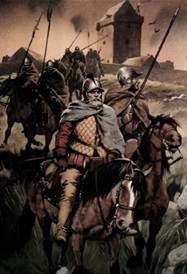
In retort,
the English Ballad
of Chevy Chase told of Percy’s hunting party or Chase in the Cheviot
hills, as an allegory to his chevauchée into Scotland.
John of
Gaunt returned to England in 1389 and settled his differences with the King,
after which the old statesman acted as a moderating influence on English
politics. Richard
assumed full control of the government on 3 May 1389, claiming that the
difficulties of the past years had been due solely to bad councillors. He
promised to lessen the burden of taxation on the people significantly. Richard
ruled peacefully for the next eight years, having reconciled with his former
adversaries.
Thomas
Mowbray had been with
Richard II during the Scottish invasion of 1385, but his friendship with the
young King was waning. Richard had a new favourite, Robert de Vere, and Mowbray
became increasingly close to Richard Fitzalan, Earl of Arundel. The King
already distrusted Arundel, and Mowbray's new circle included the equally
estranged Thomas of Woodstock, Duke of Gloucester. Together they plotted
against the King's chancellor, the Duke of Suffolk who was impeached, and a
council was appointed to oversee the king. However
Mowbray gradually became disillusioned with his comrades and by 1389, he was
back in the king's favour.
Mowbray
returned to the King’s favour in early 1389 when he had his estates restored to
him and was pardoned for having married without the King's licence.
In March
1389, Thomas Mowbray was appointed warden of the East March and castellan of
Berwick Castle, receiving wages of £6,000 in peacetime and twice that in time
of war. This was the context wherein John, Henry and William Farndale were part
of the standing force in the East March of Scotland.
However
Thomas Mowbray’s appointment was not a success and he
fell out with the traditional lord of the north, Henry Percy. Mowbray held no
lands in the north and had few contacts among the gentry, upon whom he needed
to rely to raise his army. Mowbray's tenure in the
East March was effectively doomed from the start.
His
ineffectiveness became obvious in June 1389, when a Scottish incursion ravaged
the north of England and, with little opposition, went as far south as
Tynemouth. Mowbray, the Westminster Chronicle reports, refused the Scottish
offer of a pitched battle and retreated to Berwick Castle.
This was a period after
John of Gaunt’s marriage to Constance of Castile in 1372, which led to his
claim of the Kingdom of Castile in 1379, which kept Gaunt away from England for
some time. It was shortly after the Peasant’s Revolt of 1381, after which the
still immature Richard II had remarked peasants you are and peasants you shall
remain, a period of high tension between an ambitious new mercantile
class and the old order.
In 1385 Richard II was still only 18 when in Summer 1385 he led
an expedition to oust French garrisons from Scotland. What followed was a
fiasco. Richard marched north withy an army inclouding
almost the entire nobility, all the English baronets and around 14,000 men.
When they reached the Scottish border, he marked the occasion by raising Edmund
Langley from earl of Cambridge to duke of York, and Thomas Woodstock from earl
of Gloucester to duke of Gloucester … As his army advanced, so the Scots
declined to give battle. They retreated into the hills, wasting the countryside
as they went. It was the same tactic that had reduced Edward III to tears of
frustration in 1328. The English reached Edinburgh in mid
August, found that they were starving and had no one to fight, and fell
b ack to Westninster within thee weeks., It was a feeble expedition, which
achieved nothing (The Plantagenets, Dan Jones, 2013, page 545).
Henry Percy was nicknamed Harry Hotspur by his Scottish enemy,
for his boldness and speed, later to rebel and die in battle at the hands of
Prince Hal at Shrewsbury in 1403. In the reign of Henry IV, Shakespeare
imagined a report of his deeds in Scotland: On Holy-rood day, the gallant
Hotspur there, Young Harry Percy and brave Archibald, That ever-valiant and
approved Scot, At Holmedon met, Where they did spend
a sad and bloody hour, As by discharge of their artillery, And shape of
likelihood, the news was told; For he that brought them, in the very heat And
pride of their contention did take horse, Uncertain of the issue any way.
William Fulthorpe was a fellow Yorkshireman, born in
about 1367 in Thirkelby,
near Thirsk.
Perhaps Calais
1386
A
John Farnham served at Calais under Simon Burgh and Sir William Hoo (The National Archives C76/70, m 9 and Calendared: CPR
1385-89, p. 203). This may have been him.
Sir
William was a great warriour and a man of figure in
his time, serving in the French wars many years, being one of the favourites of
John Earl of Somerset, governour of the garrison at
Calice, under whom he served (Francis Blomefield, Hundred
of Humble-Yard: Mulbarton, an Essay Towards A Topographical History of the
County of Norfolk: Volume 5. London: W Miller, 1806. 75-83, British History
Online). In 1386, Sir William Hoo was captain of the castle of Oye, in
Picardy, in which post he appears to have encountered bureaucratic impediments
(Close Rolls, Richard II, February 1386). He
also served as captain of Hammes Castle in the Pas-de-Calais.
Roxburgh Castle and
the Scottish Marches
1388
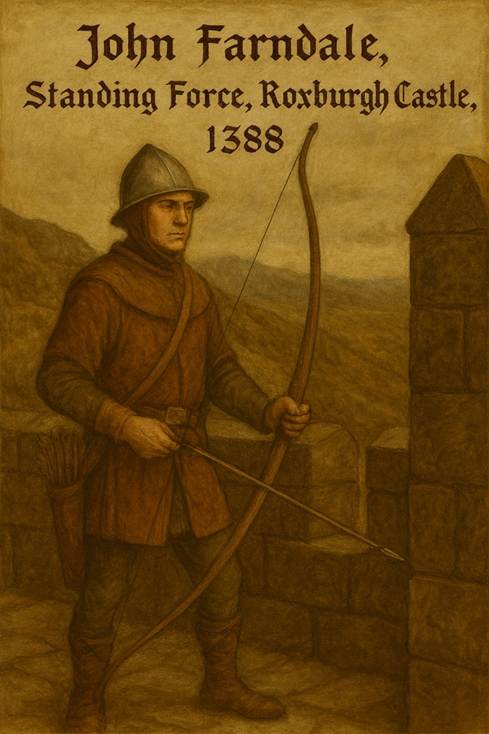
John
Farnham then served at Roxburgh Castle in the Scottish Marches (the border
country with Scotland) when recorded in Letters of Protection on 16 February
1388, serving under Sir Thomas Swinburne (1357 to 1412)(The National Archives, C71/67, m 4 and Calendared: CPR
1385-89, p. 450).
Roxburgh Castle overlooks the Tweed in the border area with
Scotland. On 19 February 1314, it had been taken by Sir James Douglas (the
"Black Douglas"), in a night attack. The castle was captured by the
forces of Edward III of England in 1334. Alexander Ramsay and his men
recaptured Roxburgh Castle for the Scots on 30 March 1342 by means of a daring
night escalade. It was retaken by the English shortly after the Battle of
Neville's Cross in October 1346.
Sir Thomas Swinburne was joint keeper of Roxburgh castle, in
Northumberland from 28 February 1385 to 24 February 1386, and keeper from 24
February 1386 to 12 July 1388. He was later bailiff of the duke of York's
lordship of Tynedale until about February 1390. He was later a lieutenant of
Henry Percy, earl of Northumberland, as constable of England until about July
1403.
In June 1389 John Farendon was listed in the
Retinue Roll as part of the Standing Force in the East Marsh of Scotland,
serving under Thomas Mowbray (the
family who once owned the lands which included Farndale),
the Duke of Norfolk (The National Archives
E101/41/17, m1 and m2).
Thomas Mowbray, one of the more
cautious appellants against the King’s favourites in 1387, later to fall out
with Henry Bolingbroke, and banished by Richard II in 1398, had been appointed
Earl Marshall of England. When the King regained sole control of government
around in May 1389, Mowbray attended a royal council meeting in Clarendon
Palace in September, demonstrating the gulf that existed by then between him
and his ex appellant
comrades.
In March, Thomas Mowbray was
appointed warden of the East March and castellan of Berwick Castle, receiving
wages of £6,000 in peacetime and twice that in time of war (C Fletcher, Richard II: Manhood, Youth, and Politics
1377–1399, 2008,. Oxford Historical Monographs,
Oxford University Press, page 185). His
appointment was not a success; he alienated the traditional lord of the north,
Henry Percy, Earl of Northumberland, who retired to court. Mowbray held no
lands in the north and had few contacts among the gentry, upon whom he needed
to rely to raise his army. Mowbray's tenure in the
East March was effectively disabled from the start (A King, Pur Salvation
Du Roiaume: Military Service and Obligation in
Fourteenth-century Northumberland, 2002 in C Given-Wilson, and N Saul, eds,
Fourteenth Century England. Woodbridge: Boydell Press page 29). Mowbray's ineffectiveness to highlighted in June that
year, when a Scottish incursion ravaged the north of England and, facing little
opposition, went as far south as Tynemouth. Mowbray, the Westminster Chronicle
reported, refused the Scottish offer of a pitched battle and retreated to
Berwick Castle (A Goodman, Introduction,
1992, in War and Border Societies in the Middle Ages, London, Routledge,
page 19 and 20).
See also England
and Scotland at War, 1296 to 1513, Andy
King, Border Fury, England and Scotland
at War, 1296 to 1568, John Sadler,
Border
Bloodshed, Scotland and England at War 1369 to 1403, Alastair J Macdonald.
Makerstoun in
Roxburghshire was raided in 1389 by English forces (Border
Bloodshed, Scotland and England at War 1369 to 1403, Alastair J Macdonald, page 115).
Also serving in with Thomas Mowbray in the
East Marsh at the same time were Henry Farendon (FAR00035B) and
William Faryndon or Farnham (FAR00035C), who are likely to have been his brothers.
1400
John Fareneham or Farnham was an archer and man at arms under Lord
William Ferrers of Groby and Sir Harry Ferreys on 14 June 1400 on another
Scottish expedition (The National Archives
E101/41/1, m57 and E101/42/16, m40, m44). There is a possible but
unlikely link with John Farngdon who served with the navy as an archer and man
at arms under Thomas Berkeley on 28 June 1404 (The
National Archives E101/43/32, m2 and m5) who also served as an archer in
the Agincourt campaign in 1415 (The National
Archives E101/45/13, m2).
I suspect that this was not him, but is
listed here for completeness.
By 1408 Johannes Fernedill was a freeman butcher in York and we
might imagine that it was in about 1400 that the soldier returned to York,
perhaps to use skills learnt from his military career, to adopt his new trade.
1408
Johannes Fernedill, boucher, was
made a Freeman of York in 1408. He might have been about thirty at the time (1408-09 Admission Register of Freemen of the City of York). It seems likely that John, the
soldier, veteran of Scottish campaigns, returned to York, perhaps in about
1390.
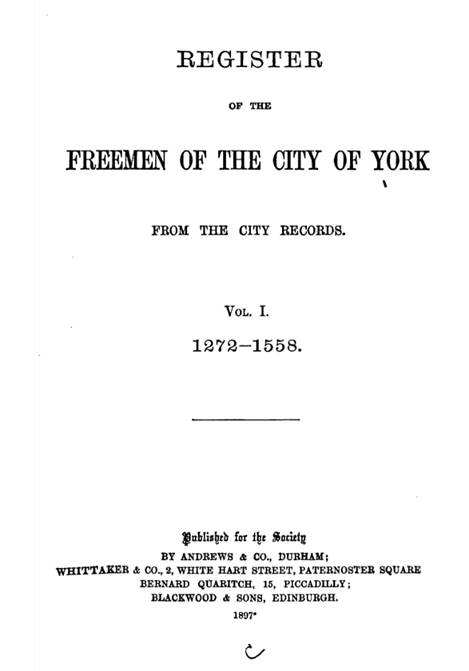
https://archive.org/details/registerfreemen01collgoog/page/n136/mode/2up
|
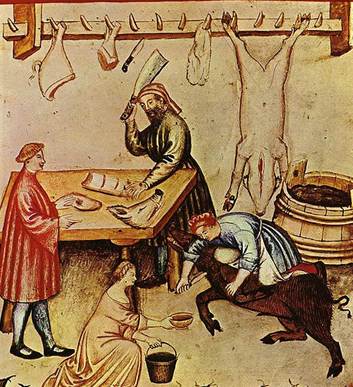
A
reenactment of a medieval butcher at work. |
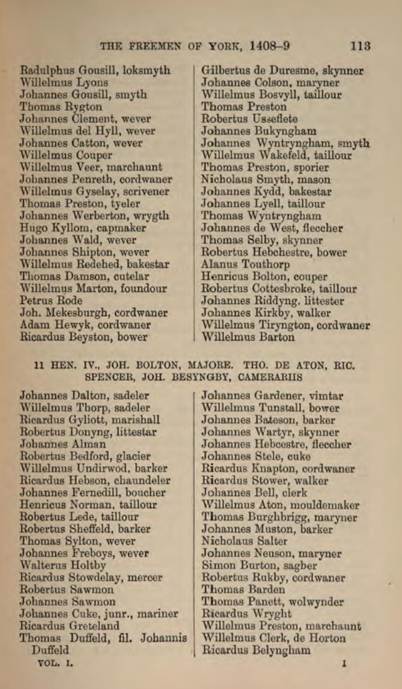
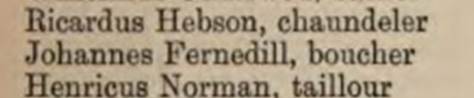
The List of the Freemen of York for 1408 to 1409
included Johannes Fernedill, boucher (II HEN IV JOH. BOLTON. MAJORE THO DE ANTON RIC SPENCER, JOH
BESYNGBY CAMERARIIS, Freemen of
York Records)
The trade of its residents was the lifeblood
of medieval York… Most of what we know about the city
workers comes from the Register of Freemen that started in 1272. Becoming a
freeman allowed residents to exploit the growing autonomy of the city as it
allowed them to set up shops and trade in the city, exempt from the tolls
levied on non free traders. The Register lists the
trade and initially the place of origin of some of the residents and at first
the freedom was purchased, but soon other ways to acquire the freedom of the
city developed. This included apprenticeships and inheritance (the son of a
freeman became a freeman) and before 1300 being a freeman was probably more of
a privilege than a necessity; by the fifteenth century it was an obligation
imposed as part of the control of fiscal power by the urban elite…. Street
names reflect the importance of the food trades: Shambles (butchers), Ketmongergate (flesh sellers), Fishergate (fishermen), Swinegate (swine street) and Noutgeil
(a cattle lane, now known as George Street). (Medieval
York, Gareth Dean, 2009, The History
Press, page 105,
107,
131).
One of the main problems was rubbish from
tradesmen such as butchers, fishmongers and tanners. The Corporation banned the
butchers and fishmongers from throwing offal into the river … Sewers, known as
the King’s Ditches, were far more prominent than they are today and formed an
important part of the topography of the city … one ran from the Deanery via Goodramgate to St Andrewgate.
There it joined another ditch that started near the Merchant Taylors Hall and
then ran to Colliergate, passing under thye eorad in a culvert, to run
between Colliergate and the Shambles. (Medieval York, Gareth Dean, 2009, The History Press, page
40).
Food was sold throughout the week, as it was
perishable… The markets were the point of sale for all manner of goods, including
foodstuffs, craft products, raw materials and livestock. As markets developed they also became specialised, with products either
sold in specified areas or on specific days … York’s two principal marketplaces
were Pavement and Thursday Market (Medieval
York, Gareth Dean, 2009, The History
Press, page
149 to 153).
The Medieval Shambles
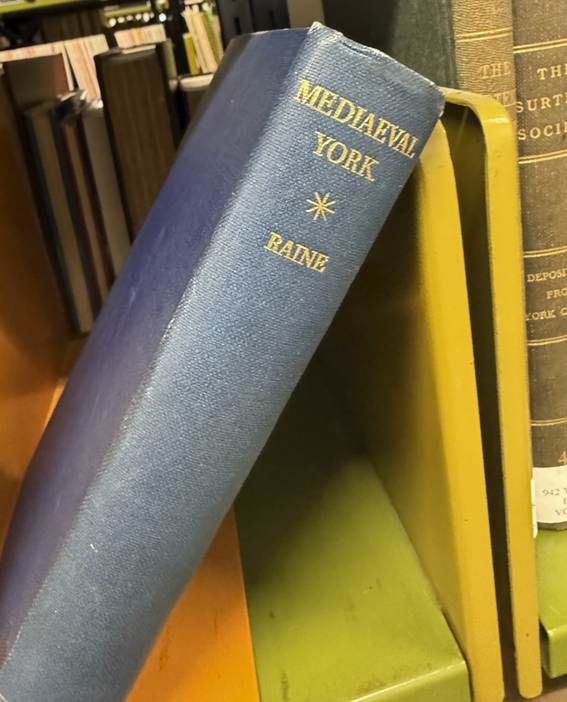
… (Mediaeval York: A Topographical
Survey Based on Original Sources, Angelo
Raine, 1955).
Johannes
became a butcher and it is likely that he worked in the street of butchers,
known as the Shambles.
The term Shambles is a medieval usage and refers to a meat market, or an
open-air slaughterhouse where butchers would kill and prepare animal meat to be
sold. Several urban centres in England have Shambles, including York, Swansea,
Manchester, and Worcester. The Shambles of York is a narrow street, with many
timber-framed buildings with jettied floors that overhang the street by several
feet. By 1426 it was known as the Great Flesh Shambles, probably from the
Anglo-Saxon Fleshammels, literally
flesh-shelves, the word for the shelves that butchers used to display their
meat.
The rears of
the shops were slaughterhouses and since the buildings shaded the narrow street
from direct sunlight, the meat on display could stay fresh for longer. When
butchering took place, the guts, offal and blood were thrown into the street
runnels that had a natural slope which helped it wash away after rain. These
butchering practices long predated modern standards of hygiene and the street
would have been unhygienic. The last butcher shops on the street closed in the
early 20th century and although the butchers have now vanished, a number of the shops on the street still have meat-hooks
hanging outside and, below them, shelves on which meat was displayed.
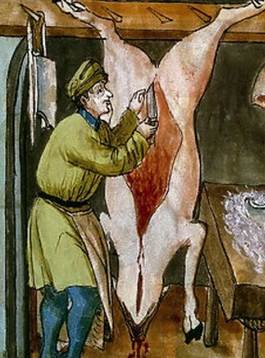
John
probably worked at a butcher’s shop with a slaughterhouse at the back of the
property, to help provide fresh meat. With little regulation of sanitation, the
offal was washed out into the street where raised pavements helped to channel
to blood and gore down the street and away.
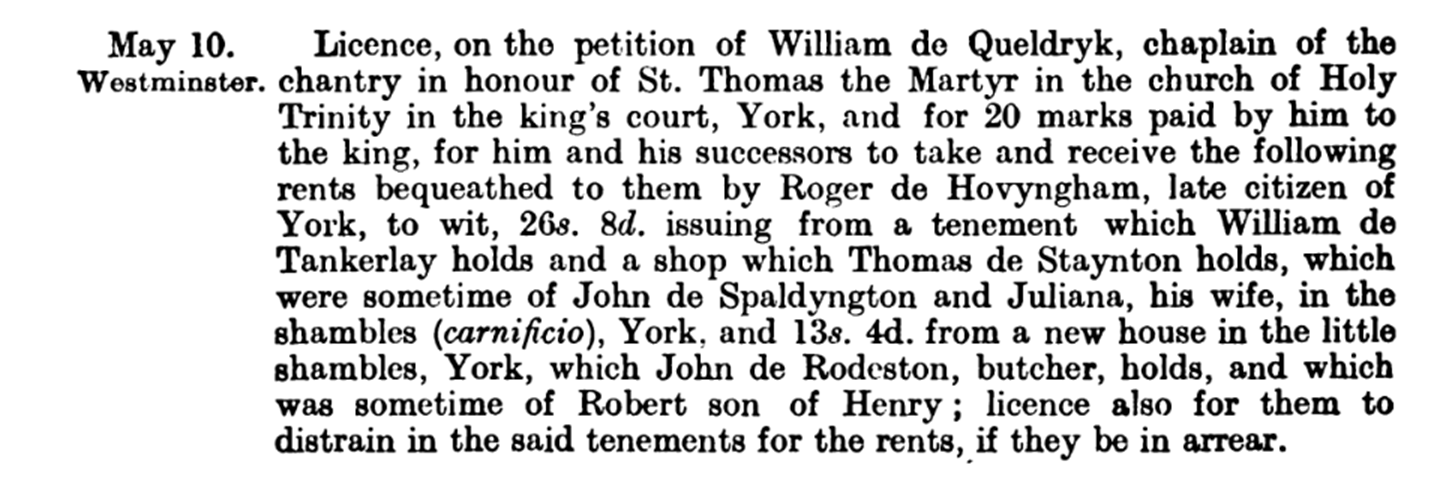
(Patent Rolls of the reign of Edward III,
1367 to 1370, page 404)

(Patent Rolls of the reign of Edward III,
1367 to 1370, page 319)
1448
If he was born in 1378, then if he lived to 70,
he might have died in about 1448.
|
How do John, Henry and William relate
to the modern family? It is not possible to be accurate about the early family tree,
before the recording of births, marriages and deaths in parish records, but
we do have a lot of medieval material including important clues on
relationships between individuals. The matrix of the family before about 1550
is the most probable structure based on the available evidence. If it is accurate, John, Henry and William were
related to the thirteenth century ancestors of the modern Farndale family,
and part of the York Line whose
uncles settled in Doncaster from where the modern Farndales
might descend. |