William Faryndon
c 1356 to c 1416
FAR00035C
|
Return to the Home
Page of the Farndale Family Website |
The story of one
family’s journey through two thousand years of British History |
The 83 family lines
into which the family is divided. Meet the whole family and how the wider
family is related |
Members of the
historical family ordered by date of birth |
Links to other pages
with historical research and related material |
The story of the
Bakers of Highfields, the Chapmans, and other related families |
Dates are in red.
Hyperlinks to
other pages are in dark
blue.
Headlines of
Kate’s life are in brown.
References and
citations are in turquoise.
Context and local
history are in purple.
Geographical
context is in green.
1356
William Faryndon was probably a son of Johannis de Farendale (FAR00035) and brother of John
Fernedill (FAR00048A).
The evidence for
the York Line of the Farndale family, which supports William’s family linkage,
is explored in another
webpage.
1384
William Farndon
referred to as a knight ransomed for 1,400 francs of gold, was no doubt someone
else (Close Rolls of the reign of Richard II, 1381 to 1385, page
368).
1389
In June 1389 William Faryndon or Farnham was listed in the Retinue
Roll as part of the Standing Force in the East Marsh of Scotland, serving under
Thomas Mowbray
(the family who once owned the lands which included Farndale),
the Duke of Norfolk (The National Archives
E101/41/17, m5).
Thomas Mowbray, one of the more cautious appellants against
the King’s favourites in 1387, later to fall out with Henry Bolingbroke, and
banished by Richard II in 1398, had been appointed Earl Marshall of England.
When the King regained sole control of government around in May 1389, Mowbray
attended a royal council meeting in Clarendon Palace in September,
demonstrating the gulf that existed by then between him and his ex appellant comrades.
In March, Thomas Mowbray was appointed warden of the
East March and castellan of Berwick Castle, receiving wages of £6,000 in
peacetime and twice that in time of war (C
Fletcher, Richard II: Manhood, Youth, and Politics 1377–1399, 2008,.
Oxford Historical Monographs, Oxford University Press, page 185). His appointment was not a success; he alienated the
traditional lord of the north, Henry Percy, Earl of Northumberland, who retired
to court. Mowbray held no lands in the north and had few contacts among the gentry,
upon whom he needed to rely to raise his army. Mowbray's tenure in the East
March was effectively disabled from the start (A
King, Pur Salvation Du Roiaume:
Military Service and Obligation in Fourteenth-century Northumberland, 2002
in C Given-Wilson, and N Saul, eds, Fourteenth Century England. Woodbridge:
Boydell Press page 29). Mowbray's
ineffectiveness to highlighted in June that year, when a Scottish incursion
ravaged the north of England and, facing little opposition, went as far south
as Tynemouth. Mowbray, the Westminster Chronicle reported, refused the Scottish
offer of a pitched battle and retreated to Berwick Castle (A Goodman, Introduction, 1992, in War and
Border Societies in the Middle Ages, London, Routledge, page 19 and 20).
See also England and Scotland at
War, 1296 to 1513, Andy King, Border Fury, England and Scotland at War, 1296 to 1568, John Sadler, Border
Bloodshed, Scotland and England at War
1369 to 1403, Alastair J Macdonald.
Makerstoun in
Roxburghshire was raided in 1389 by English forces (Border
Bloodshed, Scotland and England at War
1369 to 1403, Alastair J Macdonald, page 115).
Also serving in with Thomas Mowbray in the East Marsh at the same
time were John Farendon (FAR00048A) and Henry Farendon
(FAR00035B),
who are likely to have been his brothers.
|
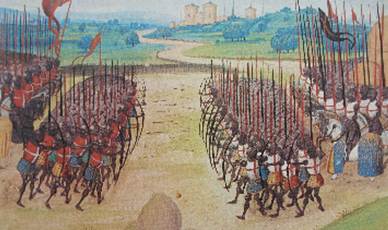
Tales of archers and men at
arms who fought with Richard II, Henry IV and Henry V and an observation post
in the home of the Nevilles and Richard III from which to view the Wars of
the Roses |
1395
William Fyndell was an archer with a
Standing Force in Ireland, under command of Sir Peter Holt, Sir Thomas Vale and
Sir John Braine and Sir Stephen Scrope listed in the
Roll of Payments on 25 April 1395 (The National
Archives E101/41/39, m3i, m6i, m7, m8i).
Stephen Scrope, Second
Baron Scrope of Masham and Upsale
(1345–1406) faught in Edward III's French wars, and
oversaw the activities of the local King's Bench of the West Riding. He went on
pilgrimage in the Middle East and was knighted in Alexandria in 1365. He fought
at the Battle of Nájera, part of England's involvement in the Castilian Civil
War in 1367. He inherited his father's estate, which consisted of the manors of
Masham, Upsall and Eccleshall and others in
Nottinghamshire, in 1391, when he was around forty years old. Later, in 1399 he
accompanied Richard II on his expedition to Wales.
In 1394 Richard led a seven
month expedition to Ireland, taking numerous young nobles and 7,000 men, to
achieve what he called in a letter ‘the punishment of our rebels there and to
establish good government and just rule over our faithful lieges.’ The venture
was highly successful. Richard achieved more in Ireland, in the short term at
least, than any king since Henry II (The Plantagenets,
Dan Jones, 2013, page 563). On 15 May 1395
Richard II left Ireland after the defeat of the Leinster Irish under Art Mór Mac
Murchadha Caomhánach, King of Leinster and submission of nearly all Irish and
rebel English chiefs to the King.
1416
If William lived to about 60, he might have died in about 1416.