Act 10
Medieval Warfare

The story of our soldier ancestors,
Archers and Men and Arms of the fourteenth and fifteenth centuries, who joined
the armies of Richard II, Henry IV and Henry V
|
Orson
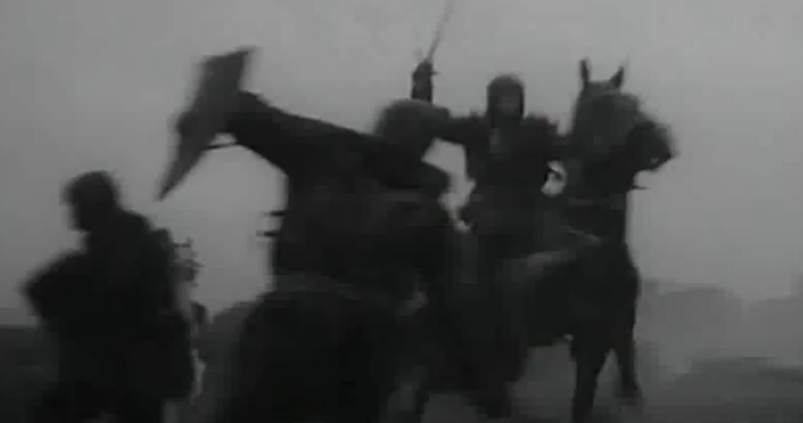
Welles takes us to the heart of medieval warfare in one of the epic medieval
battle scenes of cinema. |
Scene 1 – The Wars under Richard II
Domestic
tensions and open hostility with France and Scotland
When Edward,
the Black Prince, died at Westminster on 8 June 1376, after long illness, he
left his widow, Joan the Fair Maid of Kent, descendant of House Stuteville, the Farndale overlords, to protect
their young son Richard, second in line to the throne and still only nine years
old. When Edward III died a year later on 21 June 1377, Joan was left to
manoeuvre through complex interests, to ensure her son’s coronation as Richard
II on 16 July 1377.
Edward III
had left an inheritance of instability in three potentially rival houses
amongst the proud Plantagenet descendants. The Crown passed to the senior royal
house of Richard II, protected by Joan. The House of York was a dormant threat
to the primary line, still to be awoken. The powerful House of Lancaster, whose
patriarch was John of Gaunt, was not so dormant. An uneasy truce during Richard
II’s minority ensued.
|
The dynastic struggles of the
Plantagenets, leading to the Wars of the Roses, the events of which our
ancestors were direct witnesses |
|
The Hundred
Years War had become embedded in the national psyche as permanent struggle with
France and their ally Scotland, since 1337, but after Crecy
and Poitiers,
the Treaty
of Bretigny of 1360 had marked an end to the
first phase of the struggle.
In 1369, on
the pretext that Edward III had failed to observe the terms of the treaty, the
king of France had declared war once again. By the time of the death of the
Black Prince in 1376 and the death of Edward III in 1377, English forces had
been pushed back into their territories in the southwest, around Bordeaux[1].
By 1383,
tensions between Richard II and John of Gaunt had been increasing over the
approach to the war in France[2]. While the King and his court
preferred negotiation, Gaunt and Buckingham urged a large scale campaign to
protect English possessions. However Richard II chose to send what he called a crusade
led by Henry le Despenser, Bishop of Norwich, which
failed miserably. Faced with this setback on the continent, Richard turned his
attention instead towards France's ally, the Kingdom of Scotland.
The last
round of hostilities with Scotland had ended in 1357, with an agreement
resulting in English occupation significant portions of southern Scotland,
known as the English pale. However by the time of Edward III's
deteriorating health and English military reverses in France in the late 1370s,
the Scots had begun gradually to recover much of this territory. The Scottish
government's standard diplomatic line was that this was the work of over-mighty
magnates who were not under control of the Scottish Crown. In reality the
Scottish Crown were probably coordinating attacks on English-held territory. By
the early 1380s the over-mighty magnates excuse was wearing a bit thin,
and lost all credibility when in 1384 the Scots, whose confidence had been
boosted by a decade and a half of small scale successes, turned to open war
with England[3].
In February
1384, a Scottish force led by Archibald Douglas the Grim, Lord of
Galloway, and supported by his cousin William, Earl of Douglas, and George
Dunbar, Earl of March, captured Lochmaben Castle, the former Annandale stronghold of
the House Brus. With Lochmaben, the English lost Annandale, the seat of the
Scottish line of the Bruce family, their last remaining possession in the west
of Scotland.
|
A family tree of the House
Brus, the Lords of Skelton and Annandale, and the family relationship to the
Kings and Queens of England and Scotland |
|
The Scottish Royal
Family Tree The relationships that
bound Scotland and England and the Brus family |
This
Scottish military activity could no longer go unanswered and an expedition by
John of Gaunt was organised in some haste.
Farndale
soldiers in the Scottish Wars
On 3 April
1384, an English army entered into Scotland under the command of John of Gaunt,
in direct response to the fall of Lochmaben Castle.
On the retinue roll on 18 January and 1 February 1384 was John Farndale
(variously spelt Farondell, Farnham and Farodell), of the line of Farndales who had settled in
York. He served under John of Gaunt’s overall command, and under the
captaincy of Henry Percy, Sir William Fulthorpe and Walter FitzWalter.[4]
|
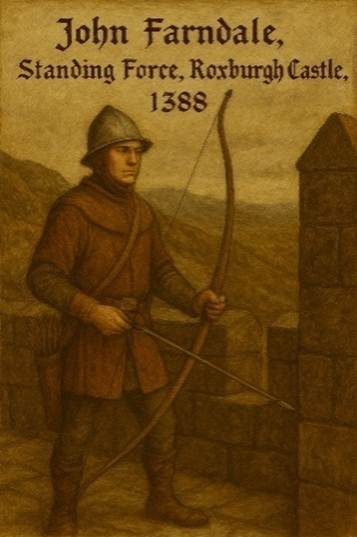
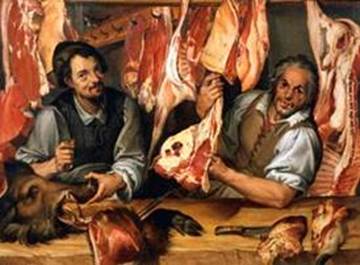
c 1352 to c 1425
John Farndale, and his brothers Henry and William, were archers
and men at arms called to fight in Scotland in 1389
John was later a butcher made freeman of York in 1408 |
John of
Gaunt (1340 to 1399) was the Lancastrian patriarch, whose son Henry Bolingbroke
seized the throne from Richard II two decades later. In the 1380s, the
Lancastrians were still loyal to the Crown. Gaunt was the King’s uncle, and he
felt responsibility for success of his nephew after his brother, the Black
Prince’s premature death. Yet he was growing increasingly frustrated at
everything his nephew did and tensions were growing between John of Gaunt and
the King.
Henry Percy
(1364 to 1403), known as Harry Hotspur was an English knight who fought in
several campaigns against the Scots on the northern border and against the
French during the Hundred Years' War. The nickname Haatspore or Hotspur was given to him
by the Scots as a tribute to his speed in advance and readiness to attack. The
heir to the leading Percy family in northern England, rivals to the Nevilles of Sheriff Hutton, Hotspur
was to be one of the earliest and primary movers behind the deposition of King
Richard II in favour of Henry Bolingbroke in 1399. His nickname was later
adopted by Tottenham Hotspur FC.
Walter
FitzWalter (1368 to 1406) came from the noble FitzWalter family, with estates
in Essex and elsewhere.
John
Farndale was part of John of Gaunt's army as it marched up the east coast,
burning Haddington and then Leith. The Scots had become adept at a scorched
earth policy whenever the English invaded, and John of Gaunt's men seem to have
struggled to find ways to overcome the Scots strategically. John of Gaunt
himself showed reticence in causing damage. He is known to have spared the
abbeys of Melrose and Holyrood from destruction. In 1381 John of Gaunt had
briefly fled to Scotland to escape the Peasants' Revolt, and this might have
given him some sympathies within Scotland. At that time, John of Gaunt seems to
have resided mostly at Holyrood, hosted by John, Earl of Carrick, the future
Robert III of Scotland. John of Gaunt had been considered as a possible successor
to David II of Scotland back in the 1360s, and in 1384 he may still have
harboured vain hopes of some day pressing his claim
to be King of Scots. Nevertheless, John of Gaunt extracted a hefty sum of money
from the citizens of Edinburgh to spare the town from harm, and this agreement
may have included the condition for Holyrood’s safety.
In all, the
English spent less than three weeks in Scotland, and by 23 April 1384 Gaunt was
in Durham handing responsibility for the defence of the marches to Henry Percy
(1341 to 1408), the First Earl of Northumberland, Harry Hotspur’s dad.
Later in
1384, the Scots resumed their aggressive policy towards England, this time with
the Earl of Douglas bringing Teviotdale back under Scottish control.
In 1385, the King himself led a punitive expedition to the north. John Farndale was probably a soldier in this second expedition[5], probably directly under Harry Hotspur’s command. The English King had only recently come of age, and it was expected that he would play a martial role just as his father, Edward the Black Prince, and grandfather Edward III had done.
On 8 July 1385 a force of French knights had marched south from Edinburgh wearing black surcoats with white St Andrew's crosses sewn on, alongside 3,000 Scottish soldiers. However the Scots hosts were not so cooperative with the French and relations deteriorated between them. The threat was repulsed by a counterattack from Henry Hotspur. John might have been involved in that counter attack.
On 11 August
1385 the English army entered Edinburgh, which was deserted by then. Three days
earlier Richard had received news from London that his mother, Joan, Countess
of Kent, his principal mentor, had died the previous day. Most of Edinburgh was
set alight, including St Giles' Kirk. According to the contemporary chronicler Andrew
of Wyntoun in his Cronykil of Scotland[6], the English army was given free
and uninterrupted play for slaughter, rapine and fire-raising all along a
six-mile front. However there was indecision amongst the English military command whether to
proceed or withdraw and the campaign came to nothing. The army had to return
without ever engaging the Scots in battle.
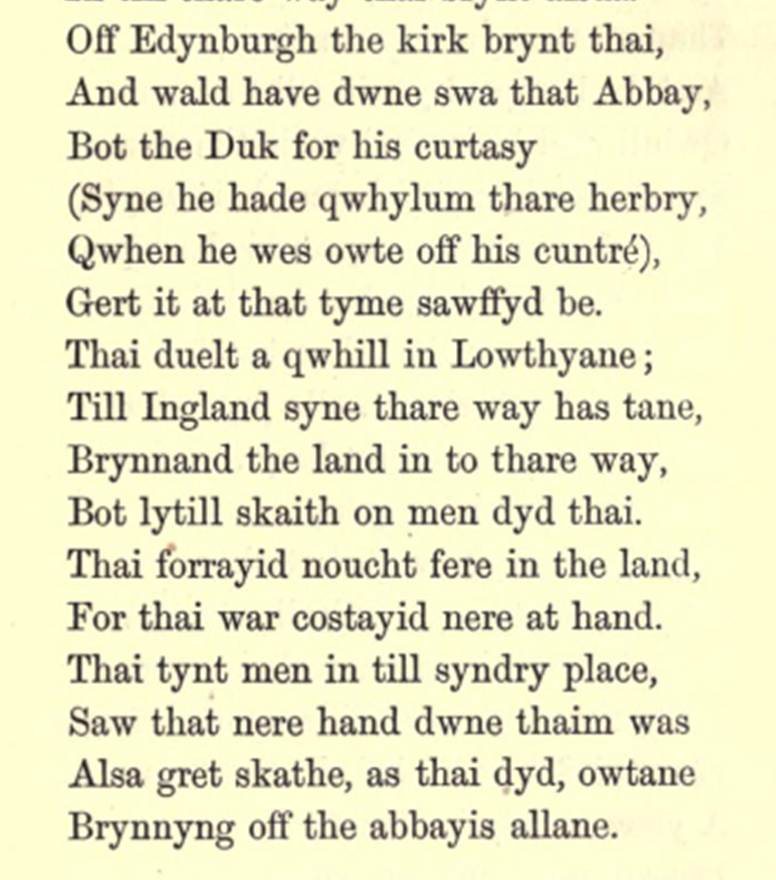
From the Cronykill of Scotland
Meantime the
French threatened an invasion of southern England.
John of
Gaunt remained in the north to oversee a new truce with Scotland, after the
King returned to England, but the relationship between the Lancastrian John of
Gaunt and Richard II was worse than it had ever been. In 1386 John of Gaunt
left for the Continent to pursue his claim to the throne of Castile, which
efforts would come to nothing.
Two years
later, in 1388, Richard II was aged 21 and starting to establish some authority
when the north of England fell victim to another Scottish incursion. The Battle of Otterburn took place on
5 August 1388[7] as part of the continuing border
skirmishes between the Scots and English. A Scottish attack on Carlisle Castle
was timed to take advantage of divisions on the English side between Ralph Neville, 1st Earl of Westmorland
and Henry Percy, 1st Earl of Northumberland who had just taken over defence of
the border and partly in revenge for King Richard II's invasion of Scotland of
1385.
Henry Percy
Senior, the First Earl, again sent his sons Harry Hotspur and Sir Ralph Percy
to engage with the Scots, while he stayed at Alnwick to cut off the Scottish
retreat. Despite Percy's
force having an estimated three to one advantage over the Scots, Froissart
records 1,040 English were captured and 1,860 killed whereas 200 Scots were
captured and 100 were killed. The Westminster Chronicle estimates Scottish
casualties at around 500. Hotspur's rashness and eagerness to engage the Scots
might have added to the exhaustion of the English army after its long march
north.
The Scottish
ballad, the Battle of Otterburn mocked, It fell about the Lammas
tide, When the muir-men win their hay, The doughty Earl of Douglas rode Into
England, to catch a prey.[8]
|
The Scottish Ballad which
mocked the English. |
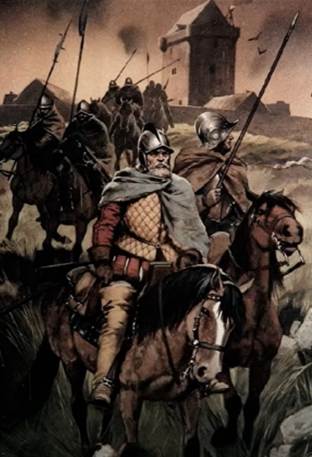
In retort,
the English Ballad of Chevy Chase[9] told of Percy’s hunting party or Chase
in the Cheviot hills, as an allegory to his chevauchée into Scotland.
John of
Gaunt returned to England in 1389 and settled his differences with the King,
after which the old statesman acted as a moderating influence on English
politics. Richard
assumed full control of the government on 3 May 1389, claiming that the
difficulties of the past years had been due solely to bad councillors. He
promised to lessen the burden of taxation on the people significantly. Richard
ruled peacefully for the next eight years, having reconciled with his former
adversaries.
John Farndale with his two brothers, Henry Farndale and William Farndale had another venture into Scotland in June 1389 when they
served under Thomas Mowbray[10]. The Mowbrays were still nominally
feudal overlords of the lands of Kirkbymoorside and Farndale, John’s ancestral
home, though effective control of those lands had long passed to the House Stuteville, the family
from which the Fair Maid of Kent, Richard II’s mum, descended.
Thomas Mowbray had been with Richard II during the
Scottish invasion of 1385, but his friendship with the young King was waning.
Richard had a new favourite, Robert de Vere, and Mowbray became increasingly
close to Richard Fitzalan, Earl of Arundel. The King already distrusted
Arundel, and Mowbray's new circle included the equally estranged Thomas of
Woodstock, Duke of Gloucester. Together they plotted against the King's
chancellor, the Duke of Suffolk who was impeached, and a council was appointed
to oversee the king’s increasingly distrusted administration. However Mowbray
gradually became disillusioned with his comrades and by 1389, he was back in
the king's favour. In early 1389 Mowbray’s estates were restored to him by the
King and he was pardoned for having married without the King's licence.
In March
1389, Thomas Mowbray was
appointed warden of the East March and castellan of Berwick Castle, receiving
wages of £6,000 in peacetime and twice that in time of war. This was the
context wherein John, Henry and William Farndale were part of the standing
force in the East March of Scotland.
However
Thomas Mowbray’s appointment was not a success and he fell out with the
traditional lord of the north, Henry Percy. Mowbray held no lands in the far
north of England and had few contacts among the gentry, upon whom he needed to
rely to raise his army. Mowbray's tenure in the East March was effectively
doomed from the start.
His
ineffectiveness became obvious in June 1389, when a Scottish incursion ravaged
the north of England and, with little opposition, went as far south as
Tynemouth. Mowbray, the Westminster Chronicle reports, refused the Scottish
offer of a pitched battle and retreated to Berwick Castle.
Thomas Mowbray was later banished by
Richard II after his rivalry with Henry Bolingbroke, in 1399, but died soon
afterwards in Venice.
Richard
Farndale and War with France during the reign of Richard II
Richard
Farndale (c 1357 to 1435) was the son of William and Juliana Farendale and was probably born at Sheriff Hutton, the
heart of the Neville lands, in about 1357, assuming that he was about 78 when
he died[11] and 40 when he was an executor and
beneficiary of his father’s will.[12]
|
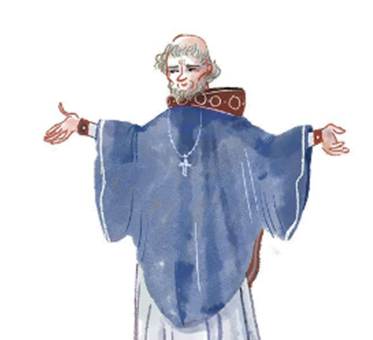
William Farndale of Sheriff Hutton c1332 to c 1397
A chaplain of Darley near Harrogate, pardoned for the death of
John de Spaldington, he later moved to Sheriff Hutton where his family found
themselves in Neville lands during the Hundred Years War and the Wars of the
Roses |
|
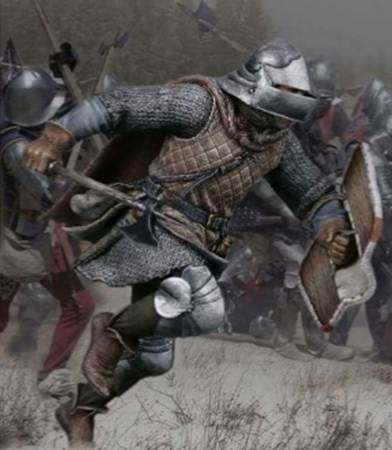
c 1357 to 20 December 1435
A veteran soldier of the armies of Richard II, Henry IV and Henry
V who fought in the French and Scottish Wars |
|
The
History of Sheriff Hutton to 1500
A history of Sheriff Hutton
which will take you to the lands of the Nevilles and Richard III during the
Wars of the Roses |
|
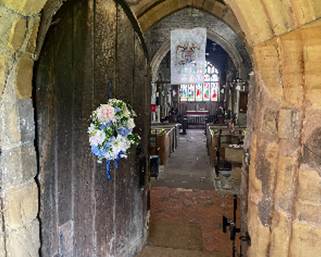
The
Church of St Helen and the Holy Cross and the Chapel of St Nicholas, the
heart of the Neville lands, and place of the alabaster effigy of the young
son of Richard III |
When he died
in 1435, he left his own will[13]. His first bequest was that his
impressive collection of military equipment was to be used as his mortuary
payment. He left three daughters and no sons.
This
military bequest included a grey horse with saddle and reins and his armour,
comprising a bascinet, a breast plate, a pair of vembraces
and a pair of rerebraces with leg harness.

Extract
from Richard Farndale’s will of 1435
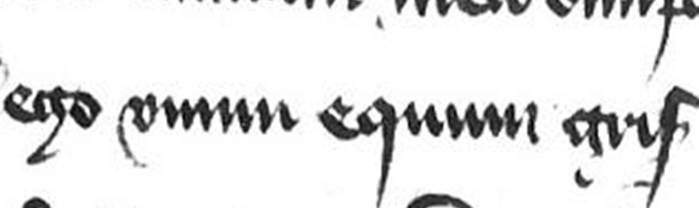
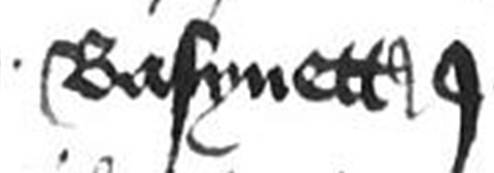
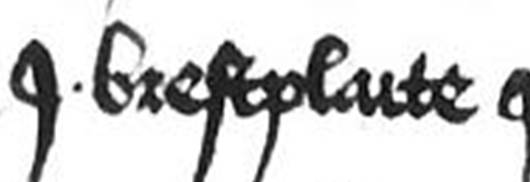
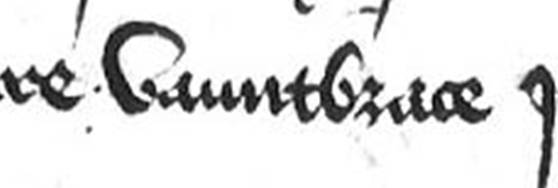

His grey
Horse
His bascinet
His breastplate
His vambraces His
rerebraces
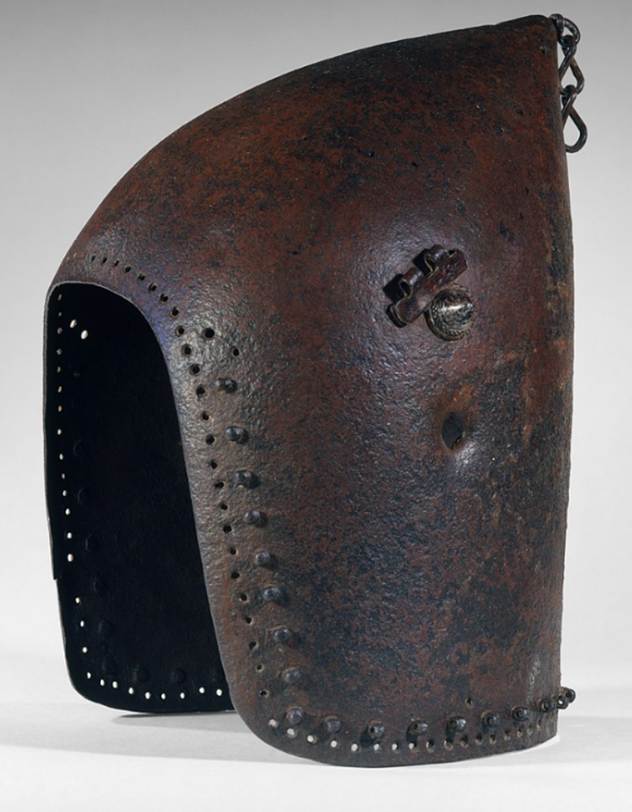
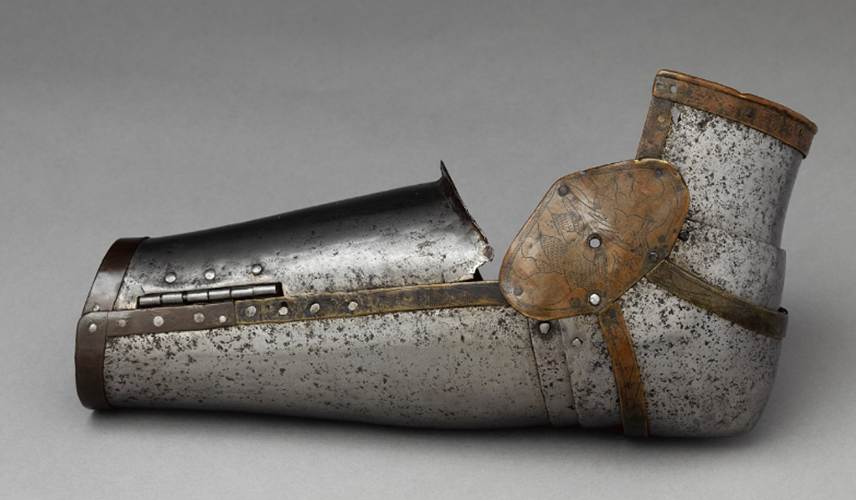

A
bascinet was a medieval combat helmet Vembraces
or vambraces were armoured forearm guards
A rerebrace was a piece of armour designed to
protect the upper arms (above the elbow)
Richard was
impressively armed for military service when he died, so it seems certain that
he pursued a military career. He was a veteran soldier.
The Hundred
Years War with France lasted from 1337 to 1453. Before the Hundred Years War,
warfare was rooted to the principles of chivalry, which focused the exploits of
the nobility. By the 1320s experienced soldiers fought on foot alongside
commoners. Ideas of feudal service were supplemented by professional soldiers,
who undertook operations contrary to the chivalric code including ambush,
siege, raids, looting, burning, and rape. The archers were the prime example of
new commoners’ forces, firing arrows which could easily penetrate knights’
armour, upsetting an ancient equilibrium. The commoners were given
opportunities to accumulate significant wealth through war booty, and ransoms,
as well as their pay.
There was a
Richard Farnham or Farneham, listed in records of medieval
soldiers, who joined an expedition to France as an archer on 28 June 1380
under the captaincy of Sir William Windsor, and the command of Thomas of
Woodstock, Duke of Gloucester[14]. It is not certain that this was
him, because the spelling of the surname is different, but this was a time of
fluidity in surname spellings. Given his military equipment listed in his will,
55 years later, it seems likely that Richard would have started a military
career at about this time. He would have been about 23 at this time. Whilst we
cannot be certain, it is possible, perhaps even quite likely, that this was
Richard in his early military exploits in France.
1380 was in
the midst of a crisis in the French Wars in the time of Richard II. The
Peasant’s Revolt of 1381 arose due to high taxes required to fund the French
Wars. The cost of these French wars were not welcomed at home.
Richard’s
commander, Thomas of Woodstock had been in command of a campaign in northern
France that followed the War of the Breton Succession of from 1343 to 1364.
During this campaign John IV, Duke of Brittany had tried to secure control of
the Duchy of Brittany against his rival Charles of Blois. John returned to
Brittany in 1379, supported by Breton barons who opposed the risk of annexation
of Brittany by France. An English army was sent under Thomas Woodstock to
support the Duke of Brittany. Due to concerns about the safety of a longer
shipping route to Brittany itself, the army was ferried instead to the English
continental stronghold of Calais in July 1380.
As Thomas
Woodstock marched his 5,200 men east of Paris, they were confronted by the army
of Philip the Bold, Duke of Burgundy, at Troyes. However the French had learned
from the Battle of Crécy in 1346 and the Battle of Poitiers in 1356 not to
offer a pitched battle to the English. Eventually, the two armies simply
marched away. French defensive operations were then thrown into disarray by the
death of King Charles V of France on 16 September 1380.
Woodstock's
army engaged in a chevauchée, a practice
common during the Hundred Years War, comprising an armed raid into enemy
territory leading to destruction, pillage, and demoralisation, generally
conducted against civilian populations. The English army chevauchéed
westwards largely unopposed, and in November 1380 the army laid siege to Nantes
and its vital bridge over the Loire towards Aquitaine. However, the army did
not succeed in establishing an effective stranglehold, and urgent plans were
put in place for Sir Thomas Felton to bring 2,000 reinforcements from England.
By January, though, it had become apparent that the Duke of Brittany was
reconciled to the new French King Charles VI, and with the alliance collapsing
and dysentery ravaging his men, Woodstock abandoned the siege.
So in 1380 Richard Farndale engaged in a spot of chevauchée
in France and may well have benefitted financially from doing so.
A
possible Irish campaign
There was a Richard Farnworth or Farnysworth who served in a standing force in Ireland under Sir John Stanley and mustered on 21 October 1389[15], and it is very probable that this was the veteran soldier of the French Wars. Richard II had assumed full control of the government on 3 May 1389, and this was a period of fragile peace.
Sir John
Stanley KG (c 1350 to 1414) of Lathom, near Ormskirk in Lancashire, was
Lord Lieutenant of Ireland. John Stanley had been appointed as deputy to Robert de Vere, Duke of
Ireland in 1386 after an insurrection created by friction between Sir Philip
Courtenay, the English Lieutenant of Ireland, and his appointed governor James
Butler, 3rd Earl of Ormond. Stanley led an expedition to Ireland on behalf of
de Vere and King Richard II to quell it. He was accompanied by Bishop Alexander
de Balscot of Meath and Sir Robert Crull. Butler joined them upon their arrival
in Ireland.
Because of
the success of the expedition, Stanley was appointed to the position of Lord
Lieutenant of Ireland, Alexander was appointed to Chancellor, Crull to be
Treasurer, and Butler to his old position as Governor. In 1389 Richard II
appointed Stanley as Justiciar of Ireland, a post he held until 1391. Stanley
was heavily involved in Richard II's first expedition to Ireland in 1394 to
1395. It is possible that Richard Farndale was involved in these campaigns in
Ireland in 1389.
First
signs of the peril of Richard II’s dynasty
Seventeen
years after the French campaign in which Richard Farndale likely took part, Ralph Neville, Lord of Sheriff Hutton,
supported Richard II's proceedings against Richard’s former commander Thomas of
Woodstock in an early sign that the King’s rule was unsafe. By way of reward
Ralph Neville was created Earl of Westmorland on 29 September 1397. However
Ralph had married the daughter of the Lancastrian John of Gaunt, and by the end
of the century the Nevilles had switched to oppose Richard II and to support a
new Lancastrian dynasty.
The soldier,
Richard Farndale was also an inhabitant of Sheriff Hutton in the
lands of Ralph Neville, and he and his family were front seat witnesses to the
dynastic duels about to unfold.
Richard’s
father, William Farndale died in 1398 and Richard was an executor with his
mother, Juliana and beneficiary of his father’s will made on 23 February 1398[16]. He received a legacy of £4 and,
with his mother and sister Helen, the residue of his father’s estate. He was
probably about 40 years old. It might have been with these inherited funds that
he bolstered his military armoury.
Richard must
have married at about this time, perhaps in about 1400. We don’t know the name
of his wife, as she is not mentioned in his will and might have died before he
did. Mysteriously Richard bequeathed a substantial sum of 40s and his bed to a
lady called Joan Brantyng in his will in 1435. It might be possible that Joan
was his wife and later remarried. Perhaps this was a more recent acquaintance
after his wife had died. We can read
whatever we like into Richard’s relationship with the mysterious Joan Branting.
Richard had
three daughters, Margorie
perhaps born in about 1409, Agnes
born in about 1411 and Alice
born in about 1413[17]. They would each witness the Wars of the
Roses from the heart of the Neville lands.
Scene 2 – Fighting under the
Lancastrians
Regime
Change
The
relationship between Henry Bolingbroke and Richard II came to a crisis in 1398[18]. A remark about Richard's rule by Thomas de Mowbray, 1st Duke of
Norfolk, was interpreted as treason by John of Gaunt’s son, Henry Bolingbroke,
who reported it to the king. The two dukes agreed to undergo a duel of honour
at Gosford Green near Caludon Castle, Mowbray's home
in Coventry. However before the duel could take place, Richard II decided to
banish Henry from the kingdom to avoid further bloodshed. It was claimed that
this was with the approval of Henry's father, John of Gaunt. It is not known
where he spent his exile. Mowbray was also exiled for life, and died soon
afterwards in Venice.
|
The Family Tree of
the House Lancaster The
genealogy of the Lancastrian estate |
|
|
The Duchy of Lancaster and the Honour and
Forest of Pickering The surprising association of our
early family history with the House of Lancaster |
In William
Shakespeare’s historical play Richard II, Henry Bolingbroke mourned his
sentence of exile. How long a time lies in one little word! Four lagging
winters and four wanton springs end in a word. Such is the breath of kings[19].
The breath
of Kings would now rock the lands of England, and particularly the ancestral
Neville lands, and the lives of the Farndale family, for generations.
Richard II’s
rule was increasingly arbitrary and unpopular. In Shakespeare’s depiction, as
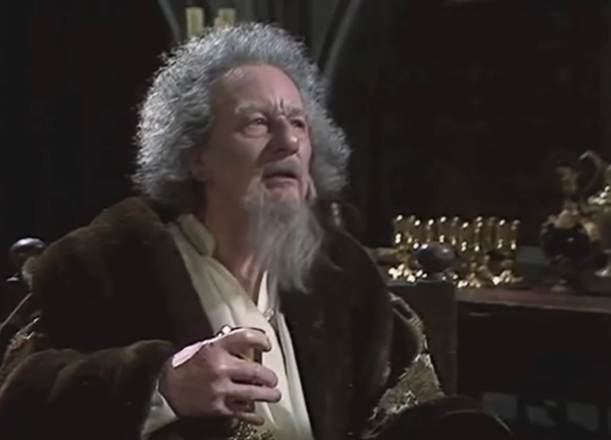
the Lancastrian John of Gaunt lay dying in 1399, he mourned where Richard had
taken his Kingdom[20].
|
The Lancastrian Patriarch’s lament for this sceptred
isle. |
The tension
came to a head when Richard II was campaigning in Ireland, perhaps with Richard
Farndale in his army. His banished cousin, son of the recently dead John of
Gaunt, Henry Bolingbroke, Duke of Lancaster, landed with a small force at the
Spurn peninsula, then the since eroded Ravenspurn, at
the mouth of the Humber in 1399. He marched to his Pickering Castle, rallying supporters
including the Nevilles from Sheriff Hutton and
Kirkbymoorside. He claimed that this was ostensibly to reclaim his lands and
uphold the rules of succession. Richard II was soon captured and taken to
Pontefract castle. Pontefract was within the geographical ambit of the Farndales of Doncaster,
who had their home there at this time. William
Farndale had become the vicar of Doncaster in 1397[21]. He was crowned Henry IV, to start a
new dynasty of the House of Lancaster.
Henry
Bolingbroke’s return from exile and his seizure of the Crown in 1399 was a bold
power grab, an invasion from France in a struggle for the Crown, unseen since
the invasion of William the Conqueror in another succession struggle between
Normans and Godwinsons.
As the events
of 1066, the coup of 1399 was also played out across the same lands that had
been associated with the Farndales for generations. In Shakespeare’s version of
the story, Richard II was left to tell sad stories of the death of Kings[22].
|
The son of the Fair Maid of
Kent, proprietor of the Farndale lands, laments that the King after all is
the same as his subjects. |
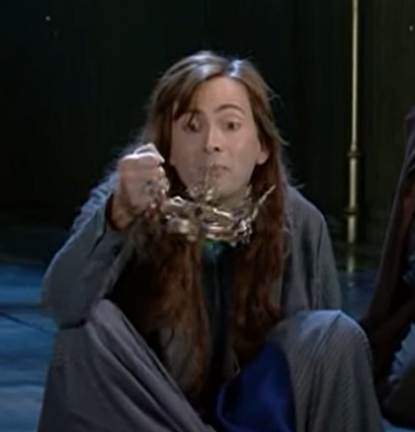
Shakespeare
depicted the scene of Edmund Duke of York handing the Crown to Henry. Great
Duke of Lancaster, I come to thee, from plume-plucked Richard, who with willing
soul adopts thee heir, and his high sceptre yields to
the possession of thy royal hand[23]. Richard II had given up the
Plantagenet Dynasty. With mine own tears I wash away my balm. With mine own
hands I give away my crown[24].
This assault
on the stability of the rules of succession which protected the nation from
chaos, was a concern to the elite classes. Henry Bolingbroke’s seizure of the
throne was precarious from the start. Uneasy lies the head that wears a
Crown[25]. However Richard had become too
problematic as King, and by then was controlling the nation as a tyrant. The
nobility therefore reluctantly supported Henry. The main support for Henry came
from the great northern family, the Percys.
|
This history of the family who
influenced the Wars of the Roses in whose seat our ancestors lived |
|
The Family tree of the House
Neville and its relationship to the King Makers and royal dynasties of the
later Middle Ages |
|
The Houses of
Lancaster and York 1399 to 1485
England during the reigns
of Henry IV, Henry V and the Wars of the Roses |
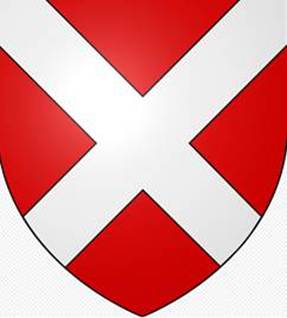
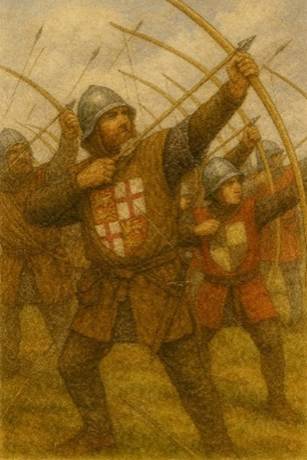
The Percys
and the Nevilles, the elite
families of the lands of our Farndale ancestors, were rivals and key players in
the nation’s story of the fifteenth century.
The Epiphany
Rising in late 1399 was an attempt to seize Henry IV during a tournament, kill
him, and restore Richard II to the throne, but it failed. The rebellion
convinced Henry IV of the threat posed by Richard while deposed and imprisoned
but still alive. Richard would come to his death by means unknown in
Pontefract Castle by 17 February 1400.[26]
In order to
cement support for his new dynasty, Henry IV was forced to make concessions,
and hint at and end to the heavy taxation which was a strong element of Richard
II’s unpopularity, and that he would uphold property rights and respect the
peoples’ will. He delivered his claim to the throne in London in English, to be
understood by all. His claim had to be rooted in public support because his
claim under the traditional rules of succession was so tentative. That would
prove a millstone for Henry IV, as a modern political party bound by its
manifesto promises.[27]
As Henry
IV’s reign became increasingly threatened, particularly by the challenges of Owen Glyndwr and Gwilym
ap Tudur in Wales and by the Earl of Douglas
in Scotland, his rule was not easy, but his strength of character was
sufficient to find a route to somehow keep things together and his iconic
heroic son Henry V was then able to bind the nation together after his
successes in France.
The
depiction of the young Prince Hal enjoying the taverns of London with Falstaff,
while Harry Hotspur of the Percy family gallantly protected the nation from
their foes provided an amusing side plot for Shakespeare, who suggested he
envied Percy’s Harry over his own Plantagenet Harry.
Yea,
there thou makest me sad and makest
me sin in envy that my Lord Northumberland should be the father to so blest a
son, a son who is the theme of honour's tongue; amongst a grove, the very
straightest plant who is sweet Fortune's minion and her pride, whilst I, by
looking on the praise of him, see riot and dishonour stain the brow of my young
Harry. O that it could be proved that some night-tripping fairy had exchanged
in cradle-clothes our children where they lay, and call'd
mine Percy, his Plantagenet! Then would I have his Harry, and he mine.[28]
It was not
historic reality however, not least because the future Henry V was still a
young teenager and would soon be active in the Wars in Wales, whilst Henry
Percy (1364 to 1403) was in his thirties, a contemporary of Henry IV, not his
son, and would soon turn against the Lancastrian dynasty.
Nevertheless,
at this point Harry Hotspur was the heroic knight. Tom Holland and Dominic
Sandbrook jested that He’d love rugby. He’d love going to rugby, and
cheering on England at Murrayfield. He’s a brilliant fighter against the
Scots, and it’s actually the Scots who were the first to call him hotspur[29].
The
Lancastrian dynasty had thus begun and the Percys and Nevilles had supported
its rise. The Farndales were soon dragged in to the fortunes of the new
dynasty. The winds from the breath of Kings were felt by our ancestors
as they tried to follow their own paths.
Henry IV’s
military focus was in his struggles against the freedom fighters of Wales led
by Owen Glyndwr, and the flurries into England from Scotland, particularly as
the English armies came under threat from both Wales and Scotland. Wales had
been subject to an apartheid of the native Welsh since draconian laws by Edward
I, and this was a point when that cauldron bubbled over. Owen Glyndwyr claimed to be the Prince of Wales in direct
challenge to Prince Hal’s title.
Another
flurry into Scotland under the new dynasty of Henry IV
There was a
Richard Farendon who was archer and man at arms in a Scottish Expeditionary
Force who appeared in Retinue Lists on 24 June 1400[30]. This was almost certainly a record
of Richard Farndale’s next military exploit, perhaps freshly armed with funds
from his father’s will. By this time he would have been in his early forties.
It seems likely that he became an experienced soldier who may have joined a
series of campaigns. The Nevilles were key players in national affairs, so it
seems likely that he would have been encouraged from his Sheriff Hutton home to
join national armies when called to do so.
The English
invasion of Scotland of August 1400 was the first military campaign undertaken
by Henry IV of England after deposing his cousin Richard II[31]. Henry IV urgently wanted to defend
the Anglo-Scottish border, and to overcome his predecessor's legacy of failed
military campaigns.
Although
Henry had announced his plans as soon as the November 1399 parliament, he did
not attempt a winter campaign, but continued with negotiations though became
increasingly frustrated by the Scottish response. Parliament was not keen on
the forthcoming war, and, since extravagance had been a major complaint against
Henry's predecessor, Henry was probably constrained in requesting a tax
subsidy. The general feeling was that a French invasion might be a more
imminent threat.
In June
1400, the King summoned his Duchy of Lancaster retainers to muster at York, and they in turn brought their
personal feudal retinues. At this point, with the invasion being obvious to
all, the Scots attempted to re-open negotiations. Although Scottish ambassadors
arrived at York to meet the king on about 26 June, they returned to Scotland
within two weeks.
Although the
army was summoned to assemble at York on 24 June 1400, it
did not approach Scotland until mid August. This was
due to the gradual arrival of army supplies. There were supply delays. The
King's own tents, for example, were not dispatched from Westminster until mid July. Henry must have realised how these logistical
delays would impact on his campaign. At some point before the army left for
Scotland, the muster was met by the Constable of England, Henry Percy, Earl of
Northumberland, and the Earl Marshal, Ralph Neville, Earl of Westmorland. Individual
leaders of each retinue present were then paid a lump sum to later distribute
in wages to their troops. Men-at-arms received one shilling a day, archers half
that, but captains and leaders do not appear to have been paid at a higher
rate.
Richard
Farendale of Shyrefhoton came from Sheriff Hutton in
the lands of Ralph Neville, so it is likely that this was the same person as
Richard Farendon who joined these Scottish Wars.
The army
left York on 25 July 1400 and reached Newcastle-upon-Tyne four days later. It
continued to suffer shortages of supplies, particularly food, of which more had
had to be requested before even leaving York. As the campaign progressed, bad
weather exacerbated the problem of food shortages.
It has been
estimated that Henry's army was around 13,000 men, of which 800 men-at-arms and
2,000 archers came directly from the Royal Household. This was one of the
largest raised in late medieval England. Whilst it was smaller than the
massive army assembled in 1345 at the Battle of Crécy, it was larger than most
that were mustered for service in France. The English fleet also patrolled the
east coast of Scotland in order to besiege Scottish trade and to resupply the
army when required. At least three convoys were sent from London and the
Humber, the first of which delivered 100 tonnes of flour and ten tonnes of sea
salt to Henry's army in Scotland.
Henry
crossed the border in mid August. He took care to
prevent his army from ravaging the countryside on their march through
Berwickshire and Lothian in contrast to previous campaigns when for instance
Richard II had devastation wreacked in the
campaign of 1385. This may well have been because the lands they marched
through belonged to the Earl of Dunbar, who had joined the army.
Even so, the
King probably envisaged some confrontation or such a chevauchée that the
Scots would be eager to negotiate. In the event, they offered no resistance as
the English army marched through Haddington.
However,
Henry's army never progressed further than Leith. Not only was no pitched
battle attempted, but the king did not try and besiege Scotland's capital,
Edinburgh nor its castle where the Duke of Rothsay was ensconced. Henry's army
left at the end of the summer after only a brief stay, mostly camped near
Leith, near Edinburgh, where it could maintain contact with its supply fleet.
Henry took a personal interest in his convoys, at one point even verbally
instructing that two Scottish fishermen fishing in the Firth of Forth were to
be paid £2 for their unspecified assistance.
The campaign
ultimately accomplished little except to deplete the king's coffers, and is
historically notable only for being the last one led by an English king on
Scottish soil.
By 29 August
1400, the English army had returned south of the border.
Although the
1400 campaign ended the Wars directly into Scotland, the Scottish Wars
continued with encounters south of the Border. Shakespeare’s play Henry IV Part
1 opens with word brought to the King in about 1402, a few years into the new
Lancastrian dynasty of the Wars with Wales and Scotland. Here is a dear, a
true-industrious friend, Sir Walter Blunt, new lighted from his horse, stained
with the variation of each soil Betwixt that Holmedon
and this seat of ours, and he hath brought us smooth and welcome news. The Earl
of Douglas is discomfited; ten thousand bold Scots, two-and-twenty knights,
balked in their own blood, did Sir Walter see on Holmedon’s
plains. Of prisoners Hotspur took Mordake, Earl of Fife and eldest son to
beaten Douglas, and the Earl of Atholl, Of Murray, Angus, and Menteith. And is
not this an honorable spoil? A gallant prize? Ha,
cousin, is it not?[32] The Battle of Homildon
Hill[33] was a battle between English and
Scottish armies on 14 September 1402 in Northumberland.

Jamie
Farndale, descendant of the medieval soldiers of the English armies of Henry IV
and Henry V, fighting for the Scots six hundred years later
A later
Shakespearean legend painted the death of Harry Hotspur in 1403, at the hands
of the young Prince Hal, future Henry V after the Percy rebellion against Henry
IV. He was wrongly portrayed as the same age as his rival, Prince Hal, by whom
he was slain in single combat. O Harry, thou hast robb’d
me of my youth! I better broke the loss of brittle life than these proud titles
thou hast won of me. They wound my thoughts worse than sword my flesh.[34]
Scene 3 – Fighting with Henry V
Richard
the veteran soldier in the armies of Henry V, the soldier King
Henry V was
crowned in 1413.
Richard
Farndale appeared in the military records again in 1417, after the Agincourt
campaign, but it is possible that, as a veteran soldier, Richard might also
have fought in Henry V’s Agincourt campaign of 1415. By this time he was in his
late fifties.
I haven’t
yet found him in the list of known soldiers at Agincourt[35]. In a Roll of the men at arms at
Agincourt[36], there is no Richard Farndale
listed. But to these lists of named individuals were unnamed lists of lancers
and archers, so he could have been amongst these ordinary unlisted soldiers.
Living firmly within the Neville
lands, it seems likely that he would have fought in the King’s battles with
France. The family also originated from the lands of Joan of Kent, wife of the
Black Prince and the lands of the
Stutevilles and the Mowbrays.
It is
possible that he participated in the main Agincourt campaign, as an archer or
man at arms. It is also possible though that, as an old veteran, he was
recruited after the Agincourt campaign, when reinforcements were required from
the older ranks.
After the
Norman Conquest, the Dukes of Normandy, subjects of the King of France were
also King of England. That was tricky. The Dukes of Normandy were frequently in
dispute with their neighbours, including the Dukes of Brittany. By the
thirteenth century, the French noble lines were eager to drive out the English
from their Norman lands. During King John’s reign, the English lost their
Norman lands, and from the reign of Henry III, there was a desire to win back
the Norman lands. Edward III died in 1377 having failed to do so, his son the
Black Prince having died in 1376, leaving Richard II as King, to be overthrown
by Henry IV of the Lancastrian line, whose reign was marred by campaigns in
Wales and Scotland.
When Henry V
became King in 1413, his ambitions were to restore English interests in France,
which would in turn unite the warring factions at home.
In 1415, the
29 year old Henry V launched his invasion of Normandy. He landed in Normandy,
reinforcing his ambitions to restore the lands which the English believed to be
theirs. He landed with an army of 12,000 men.
A quarter of
those were men at arms, who wore heavy armour and had a horse. Men at arms were
paid 1s to 2s a day, depending on their status.
Three
quarters of the force were archers, paid only 6d a day. They were cheaper and
acted as a force multiplier. They were armed with the longbow. They could fire
at rapid rates, from 12 to even 20 arrows a minute, accurately over long
distances.
Richard Farndale might have been an archer or a man at arms within that army,
but we can’t be sure. He was certainly at Harfleur two years after its siege.
Henry’s army
initially besieged the town of Harfleur[37], which is modern day Le Havre, at
the mouth of the Seine, the launch site of previous Viking raids on Paris.
There was a long siege at Harfleur, and Henry V directed the siege himself,
using artillery effectively against the walls. The inhabitants of Harfleur
eventually surrendered.
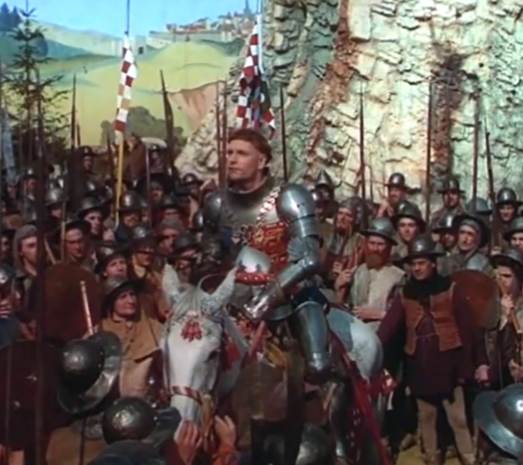
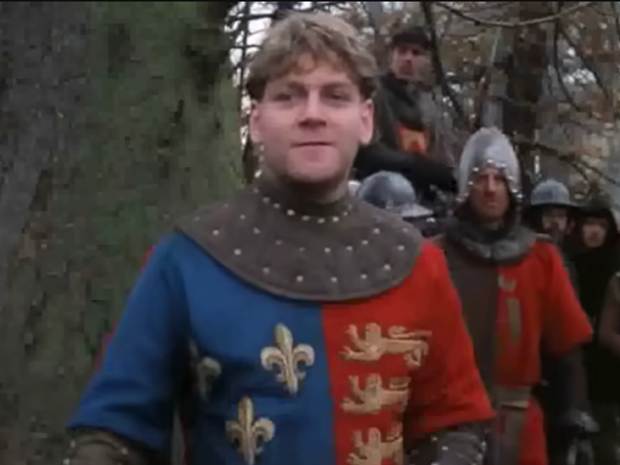
It was at
the Gates of Harfleur that Shakespeare depicted Henry V’s rally[38]. Might
Richard Farndale have been witness to such a speech?
|
Henry V inspires his army
before Harfleur |
The siege of
Harfleur ended in September as the campaigning season was coming to an end.
However Henry V decided to march home through Normandy via Calais, perhaps to
demonstrate his new hold on Normandy[39]. He challenged the rather pacific
Dauphin to single combat, which was declined. Henry left perhaps 1,200 men to
garrison Harfleur and had lost perhaps 2,000, so he had perhaps 8,000 left.

The French
army blocked the English advance on the Somme, but the English crossed. Having
already portended the D Day invasion of 1944, the Agincourt campaign next found
itself in the
battlefields of 1916.
The armies
eventually met around 45 miles south of Calais, at Agincourt on 25 October 1415[40]. Henry placed his bowmen in a V
shape on either flank. The longbowmen were a known threat to the French. A
tradition evolved after the battle that the French threatened to cut off the
middle two fingers of any bowmen captured to stop them firing again, and the
archers responded to the French with the defiant V sign.
Did Richard
Farndale flick the V sign to the French that day?
Shakespeare
imagined Henry V’s next stirring speech before Agincourt[41].
|
Henry V’s rally at Agincourt. |
Could Richard Farndale have been amongst the happy few, the
band of brothers? If he was not, he must have known those who were, and later
joined them on the fields of France.
The French
planned to overcome the archers with their cavalry, but Henry ordered his
archers to take the initiative and to advance until they were in range and then
fire into the French horses and soldiers, depriving them of the opportunity[42].
The French
lost perhaps 10,000 whilst the English were said to have lost only 100 to 200.
Amongst the dead was Richard Duke of York, father of Richard of York who would
become to nemesis of the Lancastrians, but at this stage the Yorkists were
loyal to the King.
After the
victory, Henry marched to Calais and besieged the city until it fell soon afterwards,
and the king returned in triumph to England in November and received a hero's
welcome.
Henry V
paraded like a Roman Emperor. The brewing nationalistic sentiment among the
English people was so great that contemporary writers described first hand how Henry was welcomed with triumphal pageantry
into London upon his return. These accounts also describe how Henry was greeted
by elaborate displays and with choirs following his passage to St Paul's
Cathedral.
Support for
the King mean that Parliament eagerly voted new taxes to fund further campaigns
against the French. Agincourt also fomented support for the new Lancastrian
dynasty.
The
victorious conclusion of Agincourt, from the English viewpoint, was only the
first step in the campaign to recover the French possessions that Henry felt
belonged to the English crown. Agincourt also presented an opportunity that
Henry's pretensions to the French throne might be realised. Henry V returned to
France in 1417 to establish his reconquest of Normandy. In this second
campaign, Richard Farndale was firmly back in the records.
It is
tempting to think that Richard might have participated in the wider campaign
from 1415 to 1421. If he was indeed a semi professional
soldier, this seems likely. On the other hand, he may have joined the post
Agincourt campaign in 1417. It might be that after the losses sustained during
the 1415 campaign, older veteran soldiers were called upon to fill gaps in the
ranks, which might make sense of Richard forming part of the post Agincourt
garrison at Harfleur.
What we do
know is that Richard Farndale was part of Henry V’s army by 1417.
Richard
Farndale was descended from the poachers of
Pickering Forest only a hundred years previously. It was such men who
certainly inspired the stories of Robin
Hood and whose archery skills would foresee the bowmen of ordinary folk who
would one day fight at Agincourt. Richard’s own father had partaken in a
poaching expedition to take fish, deer, hares, partridges and pheasants from
Pickering Forest in 1367, for which Thomas Mowbray’s father, John Mowbray had
brought him to justice.
Outlawry and
military heroism were not so far apart.
Richard
might have been about 58 years old by this stage, so if he was part of a
medieval army, he would have been an old soldier. However if it was he who had
fought in France in 1380 and in Scotland in 1400, it is likely that this old
soldier had become a campaign warrior. His impressive armoury which he left at
his death in 1435 suggests an old campaigner who had risen to possess the
armoury of a man at arms. He seems to have alternated between or perhaps
progressed from being an archer to a man at arms.
The
principal consolidated source for participation in the Agincourt campaign is
the University of Southampton databases on the English Army in 1415[43] in their data on the Soldier in
Medieval England. Amongst the candidates for Farndale
ancestors amongst medieval armies, there was a Richard Farndon who was an
archer mustered in the Garrison at Harfleur under Thomas Beaufort, Earl of
Dorset and Duke of Exeter in 1417[44]. After the Siege of Harfleur from 17
August to 22 September 1415, the town would have been garrisoned in the
following years. It was at the gates of Harfleur that Henry V had delivered his
inspiring speech in 1415.
The 1417
record of Richard Farndon at Harfleur suggests that Richard Farndale was an old
veteran fighting in those campaigns, either part of the 1415 Agincourt campaign[45] and continuing in the wars that
followed, or joining the English force after Agincourt in their subsequent
campaign up to 1421.
The victory
at Agincourt inspired and boosted English morale, while it caused a heavy blow
to the French as it further aided the English in their conquest of Normandy and
much of northern France by 1419. The French, especially the nobility, who by
this stage were weakened and exhausted by the disaster, began quarrelling and
fighting among themselves. This quarrelling also led to a division in the
French aristocracy and caused a rift in the French royal family.
By 1420, a
treaty was signed between Henry V and Charles VI of France, known as the Treaty
of Troyes[46], which acknowledged Henry as regent
and heir to the French throne and also married Henry to Charles's daughter
Catherine de Valois.
In 1421,
Richard Farendon or Farndon appeared again in the list of medieval
soldiers, as part of a Standing Force in France as a foot soldier or Man at
arms and as an archer, under Richard Woodville the elder (1385 to 1441) and
Richard Baurchamp, Earl of Warwick[47].
1421 was the
year of the Battle of Baugé[48], the defeat of the Duke of Clarence
and his English army by the Scots and French army of the Dauphin of France. The
battle took place on 22 March 1421. The Duke of Clarence, King Henry V’s
younger brother commanded the English army. The Earl of Buchan commanded the
Franco-Scottish army. The English army numbered around 4,000 men, of whom only
around 2,500 men took part in the battle. The Franco-Scottish army comprised
5,000 to 6,000 men.
Richard
Woodville or Wydeville, later the First Lord Rivers
and father of Elizabeth Woodville later wife of the Yorkist Edward IV, under
whom Richard Farendon served, was granted various domains, lordships and
bailiwicks in Normandy in 1419 and 1420, culminating in 1421 with appointment
as Seneschal of the province of Normandy.
Richard
Beauchamp, 13th Earl of Warwick held high command at sieges of French towns
between 1420 and 1422, at the sieges of Melun in 1420, and of Mantes, to the
west of Paris, in 1421-22. The more significant siege was of Meux to the east
of Paris.
In 1420 the
town of Melun in France surrendered to King Henry V. The siege had rumbled on
since June and had been fairly dramatic at times, with close combat taking
place literally beneath the walls as the besiegers and the garrison dug mines
and countermines in an attempt to bring the siege to an end. James I of
Scotland (1397 to 1437, crowned 1424) was present at the siege, brought to
France in 1420 as Henry's trump card against the Scots serving on the
Continent.

Siege of
Melun from a late 14th century manuscript
The siege of
Meaux was fought from October 1421 to May 1422. Paris was threatened by French
forces, based at Dreux, Meaux, and Joigny. The king
besieged and captured Dreux quite easily, and then went south, capturing Vendôme and Beaugency before
marching on Orléans. Henry then marched on Meaux with an army of more than
20,000 men. The town's defence was led by the Bastard of Vaurus,
by all accounts cruel and evil, but a brave commander. The siege began on 6
October 1421. Mining and bombardment soon brought down the walls.
The English
also began to fall sick rather early into the siege, and it is estimated that
one sixteenth of the besiegers died from dysentery and smallpox while thousands
died thanks to the courageous defence of the men at arms inside the city. As
the siege continued, Henry himself grew sick, although he refused to leave
until the siege was finished.
News reached
Henry from England that on 6 December 1421, Queen Catherine had borne him a son
and heir at Windsor.
On 9 May
1422, the town of Meaux surrendered, although the garrison held out. Under
continued bombardment, the garrison also surrendered on 10 May 1411, following
a siege of seven months. The Bastard of Vaurus was
decapitated, as was a trumpeter named Orace, who had once mocked Henry. John
Fortescue was then installed as English captain of Meaux Castle.
It seems
likely that Richard Farndale took part in some or all of these siege campaigns
around Paris in 1421.
Richard
Farndale of Sheriff Hutton appears to have been an old soldier
who campaigned with Henry V, and perhaps built up his small wealth on campaign.
Henry V died
in 1422 and left a nine month old baby son, Henry VI. The inter noble rivalry
would soon pick up again.
Davy
Farndale and the Maid of Orléans
Davy Farndale
was possibly a son of John
Farndale of York. David Farindon was a man at arms garrisoned at Harfleur
under the command of Thomas Beaufort in 1417 at the same time as his cousin,
Richard Farndale[49]. Like Richard, it is possible that
Davy had been at the siege in 1415 and had stayed there, as part of the
garrison. On the other hand, he may have joined the post Agincourt campaign in
1417. David Faryndon was
a man at arms, a foot soldier, still garrisoned at Harfleur under Thomas
Beaufort in 1418[50].
Davy
Farendon, Faryndon or Farndon was a man of arms in
the Standing Force in France under Richard Woodville in 1421[51]. It seems likely that Davy took part in some or all of the
siege campaigns around Paris in 1421 and 1422.
Then, during
the early reign of Henry VI, David Farndon was a man of arms at the Garrison of
Gisors under Sir Richard Merbury, listed in the
Muster Roll of 30 December 1423[52]. Chateau de Gisors is a castle in in
Normandy, about half way between Paris and Rouen, a key fortress of the Dukes
of Normandy. In 1419, Gisors Castle was taken by
Thomas of Lancaster, 1st Duke of Clarence, for the English. Although it has
been estimated that the bailey could have housed 1,000 soldiers, in 1438 the
English garrison numbered just 90. The English were expelled for the last time
in 1449.
In the last
week of April 1429, Joan of Arc set out from Blois as part of an army carrying
supplies for the relief of Orléans. She arrived there on 29 April and met the
commander Jean, the Bastard of Orléans and future Count of Dunois. Orléans was
not completely cut off, and the Bastard of Orléans got her into the city, where
she was greeted enthusiastically. She was initially treated as a figurehead to
raise morale, flying her banner on the battlefield. However she quickly gained
the support of the Armagnac troops and always seemed to be present where the
fighting was most intense.
On 4 May
1429, the Armagnacs went on the offensive, attacking the outlying bastille de
Saint-Loup. Once Joan learned of the attack, she rode out with her banner to
the site of the battle, a mile east of Orléans. She arrived as the Armagnac
soldiers were retreating after a failed assault. Her appearance rallied the
soldiers, who attacked again and took the fortress. Joan sent letter to the
English warning them to leave France and had it tied to a bolt, which was fired
by a crossbowman. The Armagnacs resumed their offensive on 6 May, capturing
Saint-Jean-le-Blanc, which the English had deserted. The Armagnac commanders
wanted to stop, but Joan encouraged them to launch an assault on les Augustins, an English fortress built around a monastery.
After its capture, the Armagnac commanders wanted to consolidate their gains,
but Joan again argued for continuing the offensive. On the morning of 7 May,
the Armagnacs attacked the main English stronghold, les Tourelles. Joan was
wounded by an arrow between the neck and shoulder while holding her banner in
the trench on the south bank of the river but later returned to encourage the
final assault that took the fortress. The English retreated from Orléans on 8
May, ending the siege.
At Chinon,
Joan had declared that she was sent by God. At Poitiers, when she was asked to
show a sign demonstrating this claim, she replied that it would be given if she
were brought to Orléans. The lifting of the siege was interpreted by many
people to be that sign. Prominent clergy such as Jacques Gélu, Archbishop of
Embrun, and the theologian Jean Gerson wrote treatises in support of Joan after
this victory. The English saw the ability of this peasant girl to defeat their
armies as proof she was possessed by the devil. A campaign to clear the Loire
towns began on 11 June when the Armagnac forces led by Alençon
and Joan arrived at Jargeau and forced the English to
withdraw inside the town's walls. Joan sent a message to the English to
surrender. They refused and she advocated for a direct assault on the walls the
next day. By the end of the day, the town was taken. The Armagnacs later took Beaugency and pursued an English relieving force to their
defeat at the Battle of Patay. The Armagnacs went on to retake Troyes and
Reims, where Charles the Dauphin was crowned. However the Armagnacs failed to
take Paris.
By the end
of that year, Davy Farondon, Farendon or Faurudon was a man at arms at the gates of the Garrison of
Rouen under Richard Beauchamp, Earl of Warwick, appearing on muster rolls on 10
November and 18 December 1429 and 3 February 1430[53].
On 23 May
1430, Joan accompanied an Armagnac force which sortied from Compiègne
to attack the Burgundian camp at Margny. The attack
failed, and Joan was captured. After an attempt to escape, she was transferred
to Beaurevoir Castle. She made another escape attempt
while there, jumping from a window of a tower and landing in a dry moat; she
was injured but survived. In November, she was moved to the Burgundian town of
Arras. The English negotiated with their Burgundian allies to pay Joan's ransom
and transfer her to their custody. The final agreement called for the English
to pay 10,000 livres tournois to obtain her from Luxembourg. After the English
paid the ransom, they moved Joan to Rouen, their main headquarters in France.
David
Farndyn was a man at arms at the gates of the Garrison of Rouen under Richard
Beauchamp, Earl of Warwick, appearing on muster rolls on 28 May 1430[54] and 1 July 1430[55]. He may have watched as Joan was
taken into the city.
Davy’s
commander, Richard Beauchamp, 13th Earl of Warwick (1382 to 1439) was an
English medieval nobleman and military commander. He was given responsibility
for the education of the infant Henry VI. He acted as superintendent of the
trial of Joan of Arc[56]. He played a significant role in
Joan of Arc's trial and execution as the superintendent and gaoler during her
imprisonment. He was tasked with overseeing her captivity in Rouen and ensuring
her presence at the trial, which ultimately led to her conviction for heresy
and subsequent burning at the stake.[57]
Davy
Farndale may have been a guard under the orders of Richard Beauchamp during
Joan of Arc’s trial.
David or
Davy Farindon, Farendon, or Farindon
was a man at arms at the gates of the Garrison of Rouen under Richard
Beauchamp, Earl of Warwick, appearing on muster rolls on 31 December 1430, and
9 February, 1 August, 17 October and 28 November 1431[58].

Might Davy,
by then in his thirties, have witnessed the martyrdom of Joan of Arc?
Four years
later, David Farndon was a man at arms at the Garrison of Meulan
under Sir Richard Merbury and John of Lancaster, Duke of Bedford listed on the
muster rolls of 16 February and 29 March 1434[59]. David Farundon was an archer at the Garrison of Pontoise under Sir Richard Merbury on the muster roll on 12
August 1435[60]. Davy or David Farndon, Farinton or Farendon was a man at arms at the Garrison of Chateau
Gaillard under Richard Curson and John Stanlaw, David Faringdon and Geoffrey
Hilton, on 28 February and 12 October 1438 and 13 March 1441[61]. Château Gaillard is a medieval castle now ruined which
overlooks the River Seine. Château Gaillard had been besieged for a year before
it was surrendered to the English in December 1419. All the resisting castles
except Mont Saint-Michel eventually fell, and Normandy was temporarily returned
to English control. Étienne de Vignolles, a mercenary
or routier known as La Hire, recaptured Château
Gaillard for the French in 1430. However, the English were revived by the
capture and execution of Joan of Arc, and although by then the war was turning
against them, a month later they captured Château Gaillard again. When the
French gained ascendancy again between 1449 and 1453, the English were forced
out of the region, and in 1449 the castle was taken by the French for the last
time.
Scene IV – The Wars of the Roses
The Wars of
the Roses loom
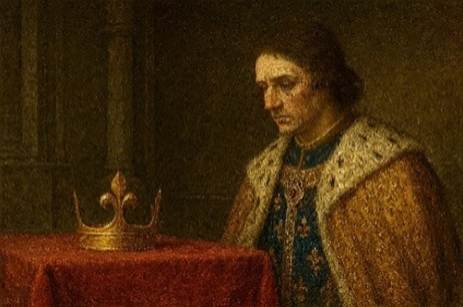
Henry VI had
no father to guide him to Kingship and he relied on his advisors. He became
timid and passive. At this point in history, the nobility needed strong
leadership to control their ambitions. After the expensive battles in France,
financial resources were depleted. The young king was easily controlled by the
rival noble families.
This
unpopularity would ferment displeasure with the Lancastrian dynasty, which
under Henry V had been so popular, and would stir up a Yorkist uprising.
In time the
Yorkist cause came to be supported by the Nevilles of Sheriff Hutton. Cecily
Neville married Richard, Duke of York, the main protagonist of the Yorkist
cause. Their son, Edward IV would found the Yorkist royal dynasty in 1461.
Richard Neville, Earl of Warwick, the Kingmaker, was the main political
strategist to the Yorkist cause, in the early stages of the Wars of the
Roses.
|
A Family tree to explain
the Lancastrian usurpation and the Wars of the Roses |
|
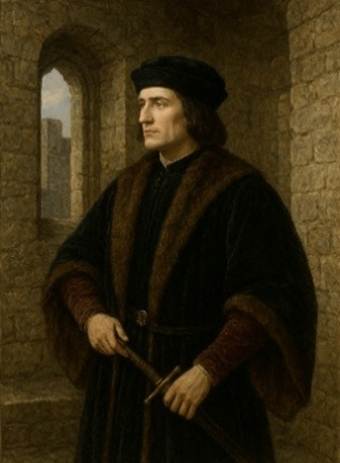
Richard
of Gloucester’s Northern Interests
The future Richard III’s
interests in Yorkshire and northern Britain |
Richard Farndale was about 65 by this time, too old perhaps to take an active
role himself. However he lived in Sheriff Hutton, at the
heart of the cauldron that started to bubble amongst the Yorkists. As a proud
old soldier of Henry V he was likely to have been appalled at the failures of
Henry VI, stirred on no doubt by his landlords, the Nevilles. In the last dozen
years of his life, we can imagine Richard over dinner with his daughters
spitting with rage at where things had got to under Henry VI, and yearning for
the new glamour of the Yorkist cause. In an old chest in his bedroom perhaps,
his armour of bascinet, breastplate and arm and leg fittings must have lain.
His grey horse rested in the stables. He probably would have put them on and
rode out with the Nevilles if he had been asked to do so.
However at
this stage Henry VI was just a young King, not yet a hopeless adult one and the
Wars of the Roses did not kick off until 1455, twenty years after Richard Farndale’s
death. He would leave his three daughters to live through the years of Yorkist
and Lancastrian rivalry. We only know their names. Perhaps they were passive
witnesses to the events which would follow. Perhaps their husbands and their
sons engaged in those Wars. We don’t know.
Richard’s
armour was bequeathed to the church, to pay for his funeral. Perhaps when the
civil war kicked off, they were taken by some other man at arms who likely
fought with the Yorkists, under the Neville banner.
Richard
Farndale died in 1435, exhausted from his life of adventure and chevauchée.
His will was proved at Sherifhoton on 21
December 1435[62].
In the
name of God Amen, 8th December 1435. I Richard Farndell being of sound mind
make my will in this manner. Firstly, I bequeath and Commend my soul to God
Almighty, My Creator, and my body to be buried in my said Parish Church.
Item. I
bequeath a grey horse with saddle and reins and my armour, viz: a bascinet, a
breast plate, a pair of vembraces and a pair of rerebraces with leg harness as my mortuary payment. And I
bequeath 3 lbs of wax to be burned around my body on the day of my burial.
Item. I
bequeath to the Vicar of my Parish Church 6s 8d and to every chaplain taking
part in my burial service Mass, 4d.
And I bequeath
26s 8d for mending a service book for the use of the parish church.
And to
the fabric of the Cathedral Church of St Peter York, 12d.
And I
bequeath to my daughter Margorie at her marriage 10 marks, if she live to be
marriageable age. And if she die before she arrives at her years of discretion,
I wish the said 10 marks to be divided equally between my daughters Agnes and
Alice.
And I
bequeath to Joan Brantyng 40s and a bed.
And to
the four orders of friars mendicant of York 20s and two quarters of corn to be
divided in equal portions.
And to
John Pyper 2s.
And as
regards the rest of my funeral expenses, I wish them to be paid at the
discretion of my executors.
The rest
of my goods, not bequeathed above, my debts having been paid, I bequeath to the
said Margorie, my daughter, to be divided among them in equal parts.
And I
make the said Thomas Robynson and John Couper and Margorie my daughter, my
executors, faithfully to implement the terms of my will.
Witnesses;
Robert, Vicar of the Church of Hoton, William Huby of
the same, John Burdley of the same and many others.’
Administration
granted to Thomas and John on 21st December 1435 with rights reserved for
similar administration to be granted to Margorie.
(Translated
from Latin text of Will held at York).
Richard
Farndale therefore died between 8 and 21 December 1435.


The History of Sheriff Hutton
picks up the story of the Wars of the Roses, seen through the prism of the town
of the Sheriff Hutton line
of the Farndale family
When Duke of
Gloucester, Richard later Richard III, alleged murderer of his nephew princes
in the tower of London, married Lady Anne Neville of Middleham and Sheriff Hutton, they
had a son, Edward Prince of Wales who died aged only 11 in 1484 in Middleham
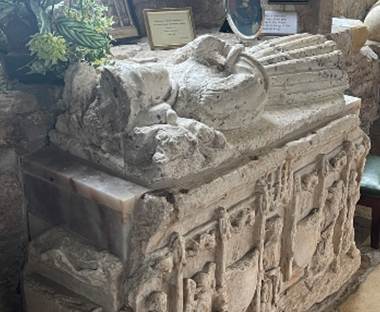
and his tomb effigy lies in the church of Sheriff Hutton.
Richard’s Council of the North held court in Sheriff Hutton.
Richard III
sent his niece, Elizabeth of York, sister of the brothers in the tower, future
Queen of England and wife of Henry VII, along with other prominent members of
the royal household, to Sheriff Hutton. Elizabeth was believed to have taken
walks at the Neville Oak, a prominent tree in the deer park, within sight of
the castle.

Richard III
visited the chapel and authorised payment of £5 to William Sympson chauntry prest of our Lady
Chapelle beside the church of Shiriefhotone to
content him for his over due half year’s stipend and
£10 a year as his salary.
Richard
Farndale’s daughters lived within the events of the Wars of the Roses in the
lands of the Nevilles and Richard III.
|
How do the medieval warrior Farndales
relate to the modern family? It is not possible to be accurate about the early family tree,
before the recording of births, marriages and deaths in parish records, but
we do have a lot of medieval material including important clues on
relationships between individuals. The matrix of the family before about 1550
is the most probable structure based on the available evidence. If it is accurate, Richard Farndale
was related to the thirteenth century ancestors of the modern Farndale
family, and was part of
the Sheriff Hutton Line.
He was related to the original family who lived in the dale and then left for
new lands. He was possibly a second cousin of the Doncastrian
Farndales, from whom the modern family probably descends. John, Henry and William Farndale
were part of the York Line of
Farndales. Their father, Johannis
de Farndell, was probably the brother of William and Nicholas
Farndale of Doncaster, from whom the modern family probably descend. All these soldiers were kin of the modern family. |
Go Straight
to Act 11 – The Vicar of Doncaster
or
|
This
is a new experiment. Using Google’s Notebook LM, listen to an AI powered
podcast summarising this page. This should only be treated as an
introduction, and the AI generation sometimes gets the nuance a bit wrong.
However it does provide an introduction to the themes of this page, which are
dealt with in more depth below. |
|