The
Great Cowcher of the Duchy of Lancaster
|
Return to the Home Page of the Farndale Family
Website |
The story of one family’s journey through two
thousand years of British History |
The 83 family lines into which the family is divided.
Meet the whole family and how the wider family is related |
Members of the historical family ordered by date of
birth |
Links to other pages with historical research and
related material |
The story of the Bakers of Highfields, the Chapmans,
and other related families |
General
The National Archives DL42 References are
a collection of Cowchers and Cartularies. Medieval
coucher books, also spelt cowcher books, were large, elaborate
registers or cartularies used to record land transactions, legal agreements,
and other important documents related to a specific institution, such as a
monastery or duchy. They served as a comprehensive record of land ownership, rights,
and privileges.
The
National Archive’s DL42/1, the Great cowcher or caret regum, comprises
evidence
of title for the Duchy of Lancaster. It focuses on land and property
transactions, including details about the landscape and the nature of tenure
across the duchy's estates.
This volume also consists of transcriptions relating to
forest pleadings of Lancaster and Pickering dated 8 Edward III to 12 Edward III
(that is, 1334 to 1340). This was an itinerant eyre court held in Pickering in the
1330's looking back to previous offences dating back as far as the 1280s.
For further details of the Cowcher and the Lancastrian
estates see R F Somerville, History of the Duchy of
Lancaster, 2 vols (London, 1953-1970) – for instance
at Volume 1 page 8.
All these records are in Latin, but the National Archives
have produced a spreadsheet translation in excel form of the contents, which
they have kindly shared with me.
Farndale Entries
9 July 1288
On 9 July 1288 Adam, son of Simon the miller of Farndale,
and Richard,
son of John the miller, with three other unknown men, came into
Pickering Forest in a place called Petroneldel, and
took two deer. When they had been proclaimed by the forester, they sent away
one deer, which the foresters carried to the castle of Pickering, but the
wrongdoers carried away the other deer with them and thereupon did their will.
They do not come to a hearing on 3 October 1334 and the sheriff was ordered to
apprehend them. Later, Adam and Richard came before the justices and asked to
pay for licence to make concord for their offence so that they could be
redeemed. Adam paid 26s 8d and Richard paid 40s for this licence, and they
found mainpernors (or guarantors) for these amounts (The Great Cowcher of
the Duchy of Lancaster, The National Archives, DL42/1 Folio 217).
Under the Pleas of the Forest there was a hearing on the
Monday next after Michaelmas 8 Edw. III (1334 to 1335). Michaelmas is 29
September each year. The next Monday in 1334 was 3 October 1334.
Adam, son of Simon the miller of Farndale, and Richard,
son of John the miller were the alleged offenders.
It is presented that they and three unknown
men, on Friday next after the feast of the Translation of St Thomas 17 Edw. I
(1288 to 1289), came in the said forest in a place called Petroneldel,
and there took two deer. And when they had been proclaimed by the forester,
they sent away one deer, which the foresters carried to the castle of Pikeryng [Pickering], and another deer the wrongdoers
carried away with them and thereupon did their will. They do not now come, but
it is witnessed that they are staying in the country. Therefore the sheriff is
ordered to make them come.
The Feast of the Translation of St. Thomas refers to the
celebration of the moving of Thomas Becket's relics from his tomb in the crypt
to a new shrine in Canterbury Cathedral's Trinity Chapel on 7 July 1220. This
event is commemorated annually on July 7th and is distinct from his martyrdom,
which is celebrated on December 29th. The relevant Friday was therefore 9 July
1288.
Afterwards Adam and Richard came before the
justices and upon this sought licence to make concord, and they are redeemed, namely
Adam at 26s 8d and Richard at 40s. And they found mainpernors,
etc.
In the same hearing Roger Drye, Richard Drye, John
Sumpter, abbot of Whiteby [Whitby], Henry le Parker, Peter de Acclom
[Acklam], Peter, his groom, William de Elredby, John Paulyn, groom of the said
Peter, and Walter le Hunter were alleged on Friday next before the feast of
St Thomas the Apostle in the said year, they came with bows and arrows and five
greyhounds, three of which were of the abbot of Whiteby
[Whitby], in the said forest in a certain place called Yarnolfbek,
and they took there one four-year-old stag (sourum),
and they carried it away with them and did their will thereupon. They do not
now come, nor were they previously attached, but it is witnessed that they are
staying in the country. Therefore the sheriff is ordered to cause them to come.
1301
The male taxable inhabitants of Farndale at the turn of
the fourteenth century were listed in the lay subsidy of 1301.
These were the inhabitants of Farndale.
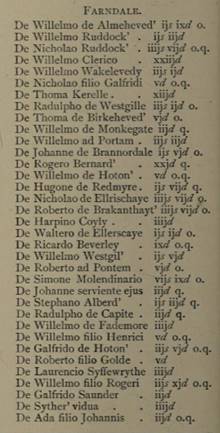
De Simone Molendinario (the
miller) paid 7s 9d and De Johanne serviente ejus (‘his servant’,
referring to Simon the miller) paid 3d
De Nicholao Ruddock paid 4s 7d
De Roberto de Brakanthayt
paid 4s 7d
De Nicholao de Ellrischaye paid 4s 7d
De Willelmo filio Rogeri, paid 3s
11d
De Galfrido de Hoton paid 3s 6d
De Willelmo ad Portam
(literally, ‘to the gate’, perhaps living at an important gate or entrance to
Farndale) paid 3s 3d
De Willelmo Wakelevedy paid 3s 2d
De Radulpho de Westgille paid 3s
2d
De Johanne de Brannordale paid 2s 6d
De Hugone de Redmyre paid 2s 6d
De Willelmo Westgil paid 2s 6d
De Willelmo de Almeheved paid 2s 9d
De Willelmo Ruddock paid 2s 3d
De Stephano Alberd paid 2s 3d
De Waltero de Ellerscaye paid 2s 2d
De Willelmo Clerico (the clerk, but perhaps the priest)
paid 23d
De Rogero Bernard paid 21d
De Thoma Kerelle paid 13d
De
Ricardo Beverley paid 9d
De Thoma de Birkeheved paid 6d
De
Roberto ad Pontem (literally, ‘to the bridge’,
perhaps living at the bridge) paid 6d
De Nicholao filio Galfridi paid 5d
De
Roberto filio Golde paid 5d
De Willelmo de Hoton paid 5d
De Willelmo filio Henrici paid 5d
De Harpino Coyly paid 4d
De
Laurencio Syffewrythe (Latin for ‘suffocation’) paid
4d
De
Syther' vidua paid 4d
De Willelmo de Monkegate paid
3d
De Radulpho de Capite (literally
‘from the head’) paid 3d
De Willelmo de Fademore paid 3d
De Galfrido Saunder paid
3d
De Ada filio
Johannis paid 3d
In Rosedale (Raysedale):
De Abbate de Rywaus paid 16s 4d
De Waltero de Bildesdale paid 2s 7d
De Thoma le Hyrde paid 18d
De Nicholao del Seves paid 16d
De Johanne filio Galfridi paid 8d.
De Hugone Fox paid 5d
De Willelmo Forestario paid 5d
In Danby (Daneby):
De Willelmo
Bere paid 8s 2d
De Waltero
filio Willelmi paid 6s 7d
De Johanne le Hyrd paid 6s
5d
De Liolpho
de Vall paid 6s
De Lyolpho
filio Uttredy paid 5s 3d
De Willelmo
Brun paid 5s
De Willelmo
filio Walteri paid 4s 7d
De Ricardo filio Stephani paid 4s 7d
De Willelmo
le Parcour paid 4s 1d
De Rogero Pees paid 4s
De Roberto filio Rogeri Clerici paid 3s 10d
De Willelmo de Monte paid 3s 7d.
De Roberto Patricke paid 3s
7d
De Johanne del How paid 3s
4d
De
Ricardo de Lelom paid 3s 3d
De Johanne de Staynton paid 3s 2d
De Thoma
filio Emme paid 3s 1d
De Willelmo de Farendale paid 3s
De Stephano fabro de Stayngate paid 2s 8d
De Willelmo Waude paid 2s 3d
De
Roberto de Tuphirst paid 2s
2d
De Willelmo del Grene paid 2s 1d
De
Roberto Arkel paid 2s 1d
De Alano del Twayt paid 2s
De Willelmo filio Stephani paid 2s
De Hugone
del Bottem paid 2s
De Willelmo
filio Gregorii paid 23d
De Waltero
Waude paid 21d
De Thoma
Forestario paid 19d
De Johanne de Goldeburgh paid 17d
De Hugone
filio Willelmi paid 17d
De Stephano Paytevin paid
17d
De Roberto Forestario paid
13d
De
Johanne filio Alani paid
13d
De Hugone del Herdwyke paid 12d
De
Johanne Kempe paid 12d
De Stephano filio Nicholai paid 12d
De Willelmo de Herdwyke paid 12d
De
Alano filio Ede paid 12d
De Rogero filio Lyolphi
paid 12d
De Stephano filio Walteri paid 11d
De
Alano le Nayle paiud 10d
De
Johanne filio Thome paid 10d
De
Willelmo filio Maye paid 9d
De
Roberto filio Thome Fabri paid 8d
De
Willelmo de Roston paid 7d
De Rogero de He(r)dwyke paid 5d
De Stephano garcione Willelmi Bruri paid 3d
De
Thoma filio Alicie paid 3d
De Rogero Lagan paid 3d
Egton
(Eggeton cum Lecerigge et Westingby et Cokewalde)
De Willelmo de Lellom
paid 8s 7d
De Willelmo Pecche paid
4s 10d
De domino Retro de Malo lacu
pro maneriode Cukewalde paid 4s 9d
De Alano le Rous paid 4s 9d
De
Rogero Cementario paid 4s 7d
De Waltero filio Thy paid 4s 3d
De Lyolpho filio Laurencii paid 3s
11d
De
Roberto Bernarde paid 3s 10d
De
Roberto Patrike paid 3s 7d
De Hugone de Thorningtwayt paid 3s
7d
De Hugone Baty paid 3s 7d
De Alano de Daneby paid 3s 6d
De
Petro Wyles paid 3s 6d
De Willelmo filio Laurencii paid 3s
4d
De
Roberto filio Willelmi filio Thy paid 3s 3d
De Thoma Venatore paid 3s 2d
De
Johanne filio Ugtredi paid
3s 2d
De
Gilberto filio Liolphi paid
3s 2d
De Thoma Wyndegge paid 3s
De
Alano Pecche paid 3s
De
Ricardo del Huntersty paid 3s
De
Johanne Morolf paid 3s
De Thoma Been paid 2s 11d
De Willelmo de Maulay paid 2s 11d
De Roberto de Hoton
paid 2s 11d
De Roberto de Valle
paid 2s 11d
De Rogero de Botten
paid 2s 10d
De Johanne de Ryswarp paid 2s 10d
De Henrico Hersaunt paid 2s 9d
De Rogero filio Ugtredi paid
2s 7d
De Thoma Ducke paid 2s 7d
De Lyolpho de Brigholme paid 2s 6d
De Rogero Nuncio paid 2s 4d
De
Henrico filio Johannis Utting paid 2s 4d
De Thoma de Glasdale paid 2s 3d
De Liolpho Marsigalle paid 2s 3d
De Willelmo filio Thome paid 2s 3d
De Radulpho Stulpy paid 2s 3d
De
Johanne Pecche paid 2s 2d
De
Alano filio Thome paid 2s 2d
De
Stephano filio Juliane paid 2s 1d
De
Alano Tockman paid 2s
De
Juliana Carpentario paid 23d
De
Johanne de Farendale paid 22d
De
Gregorio Hert paid 20d
De Ada Venatore paid 20d
De Willelmo Fraunceys paid 20d
De Domo
de Grauntmoun paid 17d
De
Alano Sutore paid 15d
De
Roberto Natour paid 14d
De
Henrico Forestario paid 13d
De Thoma filio Walter paid 12d
De Petro filio
Presbiteri paid 11d
1310 to 1311
·
Robert the Smith of Farndale had one oxen and two stirks, worth 7s
4d;
·
Walter, son of Robert the Smith of Farndale had 5 oxen, worth 20s;
·
John, son of Simon of Farndale had 3 oxen, worth 12s;
·
Hugh Leverok of Farndale had one cow and one stirk, worth 4s 8d;
·
William Stibbyng of Farndale had 6 oxen, which were of worth 24s;
·
William de Waldehus of Farndale had 5 oxen, 4 cows and 4 stirks, worth
38s 8d;
·
John, son of Walter of Farndale had 4 oxen and one stirk, worth 17s 8d;
·
Alice daughter of Roger had one cow, worth 3s;
·
Henry, son of Hugh of Farndale had 6 oxen, 2 bullocks and 2 beasts of
burden, worth 38s;
·
Nicholas, son of Adam of Farndale had 6 oxen and one cow, worth 27s;
·
Hugh del Radmire of Farndale had 6 oxen, worth 24s;
·
William ad Portam of Farndale had 5 oxen, worth 20s;
·
John the shepherd of Farndale had 9 oxen, one cow and one stirk, worth
41s 8d;
·
Roger, the groom of John the shepherd of Farndale had one bullock, worth 4s;
·
Nicholas de Harland of Farndale had one ox and one bullock, worth 7s;
·
Alan de Wrelton of Farndale had 4 oxen and two cows, 19s;
·
Stephen son of William had 2 bullocks and one ox, worth 12s
·
John son of Helewise had 4 oxen, 3 bullocks, one cow, 2 beasts of burden and
one stirk, worth 38s 8d
(The Great Cowcher of the Duchy of Lancaster, The National
Archives, DL42/1 Folio 273, 273v).
In
respect of the taking of draught-beasts within Pickering Forest there was a
hearing on the Monday next after Michaelmas 8 Edw. III (1334 to 1335).
Michaelmas is 29 September each year. The next Monday in 1334 was 3 October
1334.
They
present that, in 4 Edw. II (1310 to 1311), two oxen, which were of Nicholas the
parker of Kirkeby Morset [Kirkbymoorside], worth 8s; and 6 oxen and 3 stirks,
which were of William in le Hirne, worth 29s; and 4
oxen and 2 stirks, which were of William Cundy of the same, worth 19s 4d; and
one ox and 3 beasts of burden, which were of Thomas son of Constance of the
same, worth 13s; and two cows, which were of Stephen Brounyng of the same,
worth 6s; and one beast of burden, which was of Thomas Blank of the same, worth
3s; and one stirk, which was of William son of Adam, of the same, worth 20d;
and one cow, which was of Thomas son of Lawrence, of the same, worth 3s; and
one ox, which was of Alan de Werdale of the same,
worth 4s; and one stirk, which was of Alan Bagot of the same, worth 20d; and
one stirk, which was of Roger Tan of the same, worth 20d; and 11 oxen, which
were of John the forester of Gillyngmor [Gillamoor], worth 44s; and one oxen and two stirks,
which were of Robert the smith of Farndale, worth 7s 4d; and 5 oxen,
which were of Walter, son of the same Robert, of the same, worth 20s; and 3
oxen, which were of John son of Simon of the same, worth 12s; and one
cow and one stirk, worth 4s 8d, which were of Hugh Leverok of the same; and
4 oxen and 3 stirks, which were of Simon Cundy of Kirkeby Morset
[Kirkbymoorside], worth 21s; and 6 oxen, which were of William Stibbyng of Farnedale [Farndale], worth 24s; and 5 oxen, 4 cows
and 4 stirks, which were of William de Waldehus of the same, worth 38s 8d;
and 4 oxen and one stirk, which were of John, son of Walter of the same,
worth 17s 8d; and one cow which was of Alice daughter of Roger, worth 3s;
and 6 oxen, 2 bullocks and 2 beasts of burden, which were of Henry, son of
Hugh of the same, worth 38s; and 6 oxen and one cow, which were of
Nicholas, son of Adam of the same, worth 27s; and 6 oxen, which were of
Hugh del Radmire of the same, worth 24s; and 5
oxen, which were of William ad Portam of the same,
worth 20s; and 9 oxen, one cow and one stirk, which were of John the
shepherd of the same, worth 41s 8d; and one bullock, which was of Roger,
his groom, worth 4s; and one ox and one bullock, which were of Nicholas
de Harland of the same, worth 7s; and 4 oxen and two cows, which were of
Alan de Wrelton of the same, worth 19s; and 2
bullocks and one ox, which were of Stephen son of William, worth 12s; and 4
oxen, 3 bullocks, one cow, 2 beasts of burden and one stirk, which were of John
son of Helewise, worth 38s 8d; and one cow, which was of Maud la Huntere,
worth 3s; and 6 oxen, which were of Adam de Marton, worth 24s; and 4 oxen,
which were of the parson of Northmanby [Normanby],
worth 16s; and 2 oxen, which were of Richard de Calthorn
[Cawthorn], worth 8s; and one calf, which was of Thomas Tendant, worth 16d; and
one stirk, which was of Agnes, daughter of William the clerk, worth 20d; and
one stirk, which was of Thomas Sitewell, worth 20d; and one ox, which was of NIcholas, son of Richard de Kirkeby, worth 4s; and one
stirk, which was of Walter del Wode, worth 20d; and two oxen, which were of
Robert son of Lyolf, worth 8s; and one ox and one cow, which were of William de
Merston, worth 7s; and two oxen, which were of Peter Wyles of Egton, worth 8s;
and one stirk, which was of Theobald de Cropton, worth 20d, were found in the
said forest there by the watch, and they were forfeited to the lord at the said
price. Therefore each of them is to answer for the price of his beasts. Sum
total forfeited, £30.
Afterwards
Thomas [Wake], lord of Lydel [Liddle] came,
and he says that Robert the parker and all the others, except for the
said parson of Northmanby [Normanby], Richard de Calthorn [Cawthorn], Thomas Tendant, Agnes, daughter of
William the clerk, and Thomas Sitewell are his men and tenants, and for
himself and them he says that immediately after the said beasts were forfeited
by this watch, the said men and their tenants paid the said money at the said
price to John de Dalton, then constable of Thomas, then earl of Lancaster,
brother of the present earl, whose heir he is, of the said castle, and to the
keeper of the said forest, and to Roger le Long, then clerk of the same
constable. And this he is ready to verify by all the ministers of this
forest. And he seeks that John and Roger, then constable and clerk, come
to him and his tenants to be discharged in this matter. And Roger, being
present in court, well acknowledges that he had received the said money
in the name and by the order of John de Dalton, then master and constable of
the said castle, as clerk of the same John, to the use of Earl Thomas, and
thereupon he calls John. Which same John, present in court, not acknowledging
the receipt of the said money for himself and Roger, says that the said money
were computed in the account of the then reeve of Pikeryng
[Pickering] before the auditors of the account of Earl Thomas in 4 Edw. II, allowance for which, and for
other issues of the bailiwick of Pikering [Pickering]
the reeve possessed. And as to this he calls the record of the rolls of the
said account before the said auditors. They are to have them here at the next
session, etc.
John de Farndale was a sub tenant of Thomas Wake in 1314,
who in turn held the land of the King. John held 6 acres of land near the vill of Cropton, at the head of Rosedale. He grew 5 acres
with oats, which had been grown every year between about 1314 and 1334 and 1
acre was wasteland. It is not clear for how long John Farndale continued to sub
lease the land from Thomas Wake and whether he still held it in 1334 (The Great Cowcher of the Duchy of Lancaster, The National
Archives, DL42/1 Folio 248).
He
doesn’t appear to have been listed in the taxable tenants of Rosedale in 1301 (De Johanne filio Galfridi is an unlikely fit), so presumably moved from
Farndale to Rosedale after 1301 and before 1314.
In
respect of the Regard of the forest of Henry, earl of Lancaster, of Pikeryng [Pickering], there was a hearing on the Monday
next after Michaelmas 8 Edw. III (1334 to 1335). Michaelmas is 29 September
each year. The next Monday in 1334 was 3 October 1334.
John
de Farndale held 6 acres of land in Rosedale adjacent to the vill of Cropton.
Twenty
years ago, John made a certain close in Roscedale
[Rosedale] in the fee of Thomas Wake, and contains in itself six acres of land,
and it pertains to the vill of Cropton, whereof 5
acres grow crops of oats 20 times, the price of each acre 12d a year, and the
sixth acre is waste and worth 4d a year. Sum total £5 6s 8d. For which Thomas
Wake and Roger del Wyrkheued, now the tenants of the
same, will answer, and the land is to be taken into the hands, etc, and Thomas
and Roger are in mercy, etc.
So
land was held in or about 1314.
Afterwards
Thomas and Roger came and they rented the said 6 acres, namely each acre at
1½d, payable yearly at the two terms of the year, Michaelmas and Easter, in
equal portions, and they are granted to them. Therefore they are to have and
hold them at the said rent.
On
24 June 1325 John, son of Richard de
Westgil of Farndale, and Robert, his brother came into Pickering Forest in a certain
place called Soterlund, with one mastiff, and bows
and arrows, and they took there one fawn and carried away the game with them
and thereupon did their will. They were ordered to appear at a hearing of the
matter on 3 October 1334, but although they were living in the country, they
did not appear. Therefore the sheriff was ordered to apprehend them. Afterwards
John and Robert came before the justices, and asked to pay for a licence to
make concord, in order that they would be redeemed. They both paid 30s and they
found mainpernors (guarantors) for the fines. It was
acknowledged that from henceforth they would not forfeit anything in the said
forest (The Great Cowcher of
the Duchy of Lancaster, The National Archives, DL42/1 Folio 218v)
Under
the Pleas of the Forest there was a hearing on the Monday next after Michaelmas
8 Edw. III (1334 to 1335). Michaelmas is 29 September each year. The next
Monday in 1334 was 3 October 1334.
John,
son of Richard de Westgil of Farndale, and Robert,
his brother were
the alleged offenders.
It
is presented that, on Sunday the eve of the Nativity of St John the Baptist 18
Edw. II (1324 to 1325), they came in the said forest in a certain place called Soterlund, with one mastiff, bows and arrows, and took
there one fawn and carried away the game with them and thereupon did their
will. They do not now come, nor were they previously attached, but it is
witnessed that they are staying in the country. Therefore the sheriff is
ordered to cause them to come.
The
Nativity of St John the Baptist is observed annually on 24 June. Sunday, on the
eve of that feast was 24 June 1325.
Afterwards
John and Robert came before the justices, and upon this sought licence to make
concord, and they are redeemed, namely both at 30s. And the found mainpernors for their redemption, and from henceforth they
will not forfeit anything in the said forest.
17 to 19 June 1332
On or about Monday to Wednesday 17 to 19 June 1332, Roger
son of Emma, John de Bordesden, Robert Moryng, John, son of William
the Smith of Farndale, Robert Stybbyng, and William Bullok
had some involvement in offences at Pickering Forest when
·
One deer and one calf were taken at Rutmoor;
·
One deer calf with one black dog of Thomas de
Hamptwhait and one dun dog of William de Langwath,
were taken at Raindale;
·
One deer was taken at Rawcliffe;
·
One four-year-old stag was caught at at Lesehowe with bows and arrows
and greyhounds;
·
One stag with one black dog were taken at Leshowe; and
·
One stag was hunted at Hartoft and game was
carried away.
(The Great Cowcher of
the Duchy of Lancaster, The National Archives, DL42/1 Folio 224).
Under the Pleas of the Forest there was
a hearing on the Monday next after Michaelmas 8 Edw. III (1334 to 1335).
Michaelmas is 29 September each year. The next Monday in 1334 was 3 October
1334.
Roger son of Emma, John de Bordesden,
Robert Moryng, John, son of William the Smith of Farndale, Robert Stybbyng, and
William Bullok were the alleged offenders.
It is found that, around the feast of St
Botolph 10 Edw. [III] (1336 to 1337), they came in the
forest in a place called Rotemir [Rutmoor],
and took there one deer and one calf, and carried away that game. And that Hugh
de Yeland [Yealand], Ralph
de Yeland [Yealand], John
de Yeland [Yealand], Thomas
de Hamptwhait [Hampsthwaite],
William de Langwath, Peter, son of Henry le Yong
[Young], William de Hemingham, forester of Spaunton,
William Burcy, Robert de Miton, serjeant of Normanby, and six unknown men, on Monday
next after the quindene of St John the Baptist, came
in this forest in the place called Lesehowe with bows
and arrows and greyhounds, and took there one deer calf with one black dog of
Thomas de Hamptwhait and one dun dog of William de
Langwath, and let the dogs run at Rayndale [Raindale], and caught one deer below Rouclif
[Rawcliffe]. And that on Tuesday following, there came all those aforesaid at
Rawcliffe and they let them run and they caught one four-year-old stag. And
that Peter, son of Henry le Yong, on Tuesday next
after the octave of St John at Leshowe, came in this
forest and took one stag with one black dog. And that Thomas de Hampwhait and the said Peter, on Wednesday next after the
feast of St John the Baptist, came in this forest in a place called Hartoft and
hunted there one stag, and carried away that game. They do not now come, nor
were they previously attached, and they are staying in the country. Therefore
the sheriff is ordered to cause them to come.
St Botolph’s Day is celebrated on 17
June in England. This suggests that the offence occurred on or about Monday 17
June 1336. The following Tuesday when the subsequent offence occurred was
therefore 18 June 1336. This can’t be right since the hearing was in 1334.
Given the other offences recorded in this folio, it is believed that the
alleged offence occurred in June 1331 or 1332.
Afterwards John de Bordesden
(10s), Hugh de Yeland (1 mark), John de Yeland (half a mark), Thomas de Hampwhait
(20s), William Curcy (1 mark), Peter, son of Henry (2 marks), William de
Langwath (20s) and William Honigham (half a mark) came before the justices and
upon this sought licence to make concord, and they are redeemed at the amounts,
as appears after their names. And the mainpernors of
Roger son of Emma, Robert Moryng, Robert Stibbyng and William Bullok appear
elsewhere. And as for Robert de Miton and John, son of William the smith, the
sheriff returned that they are not found, nor do they have anything, but they
have withdrawn themselves. Therefore they are to be exacted, etc.
On
24 September 1332 Roger Sturdy, Thomas de Hippeswell, Robert, son of Simon de Farndale, John le Caluehird
and Peter son of Henry came in Pickering forest in a place called Flaskes and hunted a stag and took it away with them. They
were ordered to appear at a hearing of the matter on 3 October 1334, but
although they were living in the country, they did not appear. Therefore the
sheriff was ordered to make them come. Afterwards four of the offenders found mainpernors to guarantee their good behaviour, but Robert
de Farndale was to be exacted (The Great Cowcher of
the Duchy of Lancaster, The National Archives, DL42/1 Folio 204v).
Under
the Pleas of the Forest there was a hearing on the Monday next after Michaelmas
8 Edw. III (1334 to 1335). Michaelmas is 29 September each year. The next
Monday in 1334 was 3 October 1334.
Roger
Sturdy, Thomas de Hippeswell, Robert, son of Simon de Farndale, John le Caluehird and Peter son of Henry were the alleged
offenders.
It
is presented that, on Thursday next before Michaelmas 6 Edw. III (1332 to
1333), they came in the said forest in a place called Flaskes
and there hunted one stag and took it away with them. They have not now come,
nor were they previously attached, but it is witnessed that they are living in
the country. Therefore the sheriff is ordered to make them come.
The
Thursday immediately before Michaelmas in 1332 was 24 September 1332.
Afterwards
Roger, Thomas, John and Peter came before the justices and they seek licence to
make concord upon this. Afterwards they are redeemed, namely Roger at 10s,
Thomas at 5s, John at 10s, and Peter at one mark. And they found mainpernors, as appears elsewhere, that they shall behave
well from now on, and Robert is to be exacted, as appears elsewhere.
An
eyre hearing picking up cases from 1288 to 1334 took place at Pickering.
At a
hearing on 3 October 1334, after Richard, son of John
the miller of Farndale,
and Adam, son of Simon the
miller of Farndale had
trespassed and hunted in Pickering Forest, others including Adam, son of Nicholas de Farndale, and John, son of John the miller and John Wraghby of Farndale mainperned (provided guarantees) for their
appearance (The Great Cowcher of the
Duchy of Lancaster, The National Archives, DL42/1 Folio 227, 227v).
Regarding
Trespassers of the hunt and their mainpernors, who
were sent away and do not come, there was a hearing on the Monday next after
Michaelmas 8 Edw. III (1334 to 1335). Michaelmas is 29 September each year. The
next Monday in 1334 was 3 October 1334.
Richard,
son of John the miller of Farndale, and Adam, son of Simon the miller of
Farndale were the alleged offenders.
It
is found by the same rolls (ie the rolls of the verderers of this forest) that,
after they trespassed about hunting in this forest, Richard and Adam were sent
away by the mainprise of Nicholas de Repynghale [Rippingale], Adam, son of Nicholas de Farndale, Nicholas
Laverok, John, son of John the miller, Nicholas de Brakenthwayt [Brackenthwaite[, Alan de Wraghby
[Wragby] and John Wraghby of Farndale, who mainperned
to have them on the first day of the eyre, and they so not now have them, etc.
Afterwards
the said mainpernors came and each of them made a
fine by himself, as appears in the rolls of estreats,
except for Nicholas de Repynghale [Rippingale], who has died. Therefore nothing further is to
be done about him.
The
offence was clearly many years before as one or more of the mainpernors
had died.
At a
hearing on 3 October 1334, after John, son of Richard de
Westgille of Farndale had trespassed and hunted in Pickering
Forest, others including William le Smyth of
Farndale, Richard de Westgill, John le Shepherd of Farndale, John
Alberd of the same, Nicholas, son of Walter of the same, John
del Heued of the same,
and Robert de Westgill mainperned (provided guarantees) for their appearance (The Great Cowcher of the Duchy of Lancaster, The National
Archives, DL42/1 Folio 228v).
Regarding
Trespassers of the hunt and their mainpernors, who
were sent away and do not come, there was a hearing on the Monday next after
Michaelmas 8 Edw. III (1334 to 1335). Michaelmas is 29 September each year. The
next Monday in 1334 was 3 October 1334.
John,
son of Richard de Westgille of Farndale was the
alleged offender.
It
is found by the same rolls (ie the rolls of the verderers of this forest) that,
after he trespassed by hunting in this forest, John was sent away by the
mainprise of William le Smyth of Farndale, Richard de Westgill, John le
Shepherd of Farndale, John Alberd of the same, Nicholas, son of Walter of the
same, John del Heued of the same, and Robert de Westgill, who mainperned to have him on the first day of the eyre, and
they do not now have him, etc.
Afterwards
William, John, John and Robert came and each of them made a fine, as appears in
the rolls of estreats. And the other mainpernors have died. Therefore nothing further is to be
done about them.
The
offence was clearly many years before as one or more of the mainpernors
had died.
At a
hearing on 3 October 1334, after Robert, son of Richard
de Westgill of Farndale had trespassed and hunted in Pickering
Forest, others including William le Smyth of
Farndale, John, son of Walter of the same, John Alberd of the same, and Nicholas, son of Walter of the same, mainperned (provided guarantees) for their
appearance (The Great Cowcher of
the Duchy of Lancaster, The National Archives, DL42/1 Folio 228v).
Regarding
Trespassers of the hunt and their mainpernors, who
were sent away and do not come, there was a hearing on the Monday next after
Michaelmas 8 Edw. III (1334 to 1335). Michaelmas is 29 September each year. The
next Monday in 1334 was 3 October 1334.
Robert,
son of Richard de Westgill of Farndale was the
alleged offender.
It
is found by the same rolls (ie the rolls of the verderers of this forest) that,
after he trespassed by hunting in this forest, Robert was sent away by the
mainprise of William le Smyth of Farndale, John, son of Walter of the same,
John Alberd of the same, and Nicholas, son of Walter of the same, who mainperned to have him on the first day of the eyre, and
they do not now have him, etc.
Afterwards
William le Smyth, John le Shephird, John Alberd and John, son of William came
and each of them made a fine, as appears in the rolls of estreats.
And the other mainpernors have died. Therefore
nothing further is to be done about them.
The
offence was clearly many years before as one or more of the mainpernors
had died.
At a
hearing on 3 October 1334, after John son of Abba had trespassed and hunted in
Pickering Forest, others including Roger,
son of Alfred de Farndale, Roger, son of Gilbert of Farndale, Richard
de Beverley of Farndale, William Kyng of Farndale, John
de Hoton of Farndale, mainperned (provided guarantees) for their
appearance. Roger, son of Gilbert, John de Hoton, had paid the fine due. Roger,
son of Alfred of Farndale, Richard de Beverley of Farndale, and William Kyng of
Farndale had since died. (The Great Cowcher of
the Duchy of Lancaster, The National Archives, DL42/1 Folio 229v).
Regarding
Trespassers of the hunt and their mainpernors, who
were sent away and do not come, there was a hearing on the Monday next after
Michaelmas 8 Edw. III (1334 to 1335). Michaelmas is 29 September each year. The
next Monday in 1334 was 3 October 1334.
John
son of Abba was the alleged offender.
It
is found by the same rolls that, after he trespassed by hunting in this forest,
John was sent away by the mainprise of Roger, son of Alfred de Farndale, Roger,
son of Gilbert of the same, Richard de Beverle [Beverley] of the same, William
Kyng of the same, John de Hoton of the same, Thomas
Makand, Hugh the clerk of Cropton, William de Birkheued
of Hartoft, Henry del Tung, Peter son of Gervase, Hugh Broun [Brown], smith,
and William Hare, who mainperned to have him on the
first day of the eyre, and they do not now have him, etc.
Afterwards
Roger, son of Gilbert, John de Hoton, Thomas Makand, Henry del Tung and Peter
son of Gervase came and each of them made a fine, as appears in the rolls of estreats. And the other mainpernors
have died. Therefore nothing further is to be done about them.
The
offence was clearly many years before as one or more of the mainpernors
had died.
At a
hearing at Pickering before Justices Richard Willoughby and John de Hambury on 3 October 1334, a long list of offenders
including Robert, son of Simon of
Farndale, Roger del Milne of Farndale, Robert,
son of Peter de Farndale, Walter Blachose, Ralph del Heued, were ordered for apprehension by the
sheriff by Easter 1335 (The Great Cowcher of
the Duchy of Lancaster, The National Archives, DL42/1 Folio 276v to 277v).
In respect of Pleas held at Pikeryng [Pickering] before Richard Wylughby [Willoughby]
and John de Hambury, justices, etc. on
the Monday next after Michaelmas 8 Edw. III (1334 to 1335). Michaelmas is 29
September each year. The next Monday in 1334 was 3 October 1334.
Justices of the Common Pleas were a
later judicial position within the Court of Common Pleas of
England and Wales, under the Chief Justice. The Common Pleas was the
primary court of common law within England and Wales, dealing with
common pleas (civil matters between subject and subject).
Sir Richard Willoughby (c.1290-1362)
was the son of Sir Richard Willoughby of
Willoughby-on-the-Wolds, a lawyer, who served as Chief Justice of the Bench in
Ireland from 1323-1325. Richard attended Parliament in 1324 and inherited the
estate from his father the following year. Richard was a successful lawyer and
increased his wealth greatly by his legal career. He was appointed one of the
justices of Common Pleas in 1328 and served between 6 March 1328 to 22 December
1330; 9 October 1340 to November 1341; and 20 November 1343 to 1357. He was one
of the justices of King's Bench in 1330. He was briefly Chief Justice between
1338-1340, but was demoted and charged with corruption. He threw himself on the
King's mercy and was pardoned on payment of 1200 marks. In 1343 he was
re-appointed as a justice, and served until 1357. Sir
Richard was buried at Willoughby-on-the-Wolds, where there is a monumental
effigy.
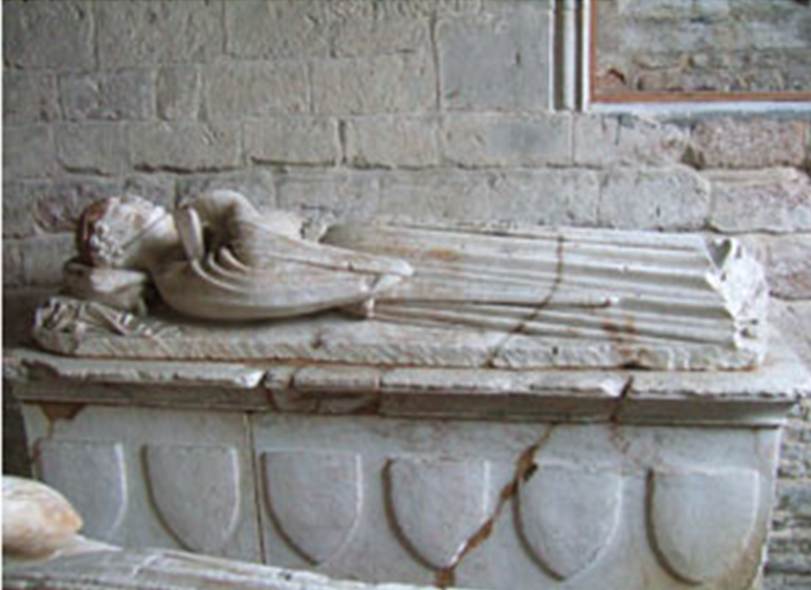
The monument to Sir Richard Willoughby
Robert
de Chibourn, William le Archer, John de Stokesle
[Stokesley], John Stubbyng, John de Landemote, John de Sutton, John de Metham,
Robert de Saltmerssh [Saltmarshe], William de Tonton,
chaplain, Walter de Dyngelby, John de Dyngelbye, Robert, son of Simon de Farnedale [Farndale], Peter, son of Henry del Tung,
Robert del Clos of Lesteryk, Richard de Richemound
[Richmond], shoemaker of Whiteby [Whitby], William
Freman, John Blere, Robert de Hampton, parson of the church of Midelton
[Middleton], John, son of Henry del Tung, Walter de Saynton, Robert, brother of
Thomas de Bossale [Bossall],
William Page, woodward of Aton [Ayton], William Rome,
Thomas le Wodeward of Staynton
[Stainton], Richard Wrote, woodward, William, son of
Ralph the miller, William, son of William Jurour, Thomas de Collum, Robert
Porcioun, William de Eton of Hakeneys [Hackness], John Phelip, Lawrence Mody, John, son of William
Maynhermer, Richard Wyther, Adam Mabbe, Robert de Hartoft, John de Boyngton,
Roger Prisoun, Ingram le Forester, Ralph Roke, Geoffrey, brother of Marmaduke
de Acclom [Acklam], Ralph Wacklyn, Adam son of
Thomas, Hugh Prudhomme, Geoffrey Maucovenaunt, Hugh le Barker of Whiteby [Whitby], Thomas Bene of Riswarp
[Ruswarp], John, son of John de Seton [Seaton] of Hilderwell, Ralph Durhem, Henry de Fissheburn [Fishburn],
Peter the clerk, Henry de Percy, Martin le Palfreyman, Robert, son of Roger de
Birkschowe, Robert, son of Thomas on the Grene of Staynton
[Stainton], Geoffrey de Lepyngdon, Robert de Acclom
[Acklam], John, son of Robert de Acclom [Acklam],
Geoffrey, son of Robert de Acclom [Acklam], Roger de
Barneby, Roger Peresparker of Maulay, Alan the hunter
of the abbot of Whiteby [Whitby], Roger Rabuk,
Bartholomew the smith of Hakenesse [Hackness], Walter Foun of Silfou
[Silpho], Roger Burheued of
Saldene [Sawdon], John de Hamelton, Mariskin the hunter of John de Hamelton, and Robert,
brother of the same Mariskin, John Malkynsone,
William, son of Thomas son of Stephen, William de Haverdale, John de Carleton,
William de Rikhale [Riccall] upon Calethorne
[Cawthorn], Matthew Sturmy, Nicholas Sturmy, John de Lonnesdale
[Lonsdale], John de Vescy, Alan, son of John de Thornton, Ralph, son of Peter
de Marton, Robert de Westerdale, John Calpipanne, groom of Roger Haldan, Peter
Sleveles, Alexander Pape of Halden, Richard, son of William de Eton, Robert,
son of William Spayne of Brumpton [Brompton], Roger, son of Cib
of Birschou, Peter de Neuton
[Newton], John, son of Patrick de Westerdale, John Burheued
of Saldene [Sawdon], Nicholas de la Lex, Adam Scot,
Roger de Lokton [Lockton], Geoffrey de Everle
[Everley], Nicholas de Levesham [Levisham], groom of
the same Geoffrey, Roger de Barneby, Thomas, son of Stephen de Asseby, John de Marton, John, lord of Berghby,
William Duk, forester of the abbot of Rievall
[Rievaulx], William de Fissheburn [Fishburn], William de Seteryngton
[Settrington], woodward of Levesham
[Levisham], Robert Spynk, John called Prester Johan,
John de Brigham, William de Shupton [Shipton], forester of the abbot of St Mary
of York, William de Askeby, William, son of Robert Todde, Peter, groom of Peter
de Acclom [Acklam], John Paulyn, groom of the same
Peter, Walter le Hunter, William Page of Aton [Ayton], William, son of Ralph de
Roston [Ruston], William de Boythorp, Thomas Dauneour, Simon, son of Alan de Scardeburgh [Scarborough], Adam de Lundon of Repilton, Gilbert de Bulmere, staying in Harewod [Harwood], Thomas de Hoton, James de Bulford,
Robert, brother of William Touchepryk, John Male, forester, John, groom of
Edmund de Hastynges [Hastings] the younger, William
Rufait, Ralph de Yeland [Yealand],
Thomas, son of William de Dales, John de Mora, Ralph Skynner, John Humet,
Herbert de Yeland [Yealand],
John Kempe, Roger de Harewod, William Couper of Scardeburgh
[Scarborough], Roger, servant of the same William, William de Rosels, Adam
called Proud Adam, William de Dales, Roger Grymet, Robert le Veutrer, Robert de
Doumfremlyn [Dunfermline], William, son of William de Fissheburn [Fishburn],
John Morolf, Alexander Pyper, Adam de Helperthorp [Helperthorpe], and Robert his brother, William Lyard,
Robert, son of Alan le Caretter, John Munkeman, John, son of Thomas le Salter,
William de Fifele, Henry le Lang of Scardeburgh [Scarborough], Michael Rosels, Nicholas
Pykstan, Adam le Spicer, John, son of John son of Augustine de Pikeryng [Pickering], Alan, son of John le Neuthird of Farmanby, Hugh
Savage, William de Thornyngtwayt, Thomas le Harpour
of Cumberhalle, Hugh de Eland, Ralph de Sheffeld of
Kildale, John Egton of Danby, John Wyles, Walter le Tournour,
John, servant of John de Bordesden, Henry Man of Men, Edmund de Waghere, John
Fichet, William, son of Roger de Pert, John Cruel and Edmund, his son, William
le Parcour, John called Jak Hare, William, son of Thomas del Hunthous, William de Everle [Everley], John de Daneby [Danby], John le Stalker, William, son of Thomas the
miller of Dalton, William de Kirkeham [Kirkham], woodward,
Thomas son of Alberd, Roger, son of Alan le Carter, and William, his brother,
Robert de Helperthorp, John le Munkeman, William, son
of Roger le Carter, John, son of Roger at Cross, William, son of Lygard, and
Reginald, his brother, Thomas the shoemaker of Scardeburgh
[Scarborough], Walter Fonne, Anselm de Leycet, Thomas de Blishton, John,
servant of Robert de Percy, Richard de Sulby, William Fossard, John de
Calveton, Robert, son of John de Scalby, John, servant of William de Nafferton,
vicar of the church of Scalby, Richard, son of Henry Herre, William son of
Henry, Adam, son of Henry Rappat, John Abbotsone of Roscedale
[Rosedale], Robert de Myton, servant of Normanby, Richard de Spofford
[Spofforth], Jordan de Aleyntoftes, Richard de Shupton [Shipton] of Raskele [Raskelf], William, son
of Roger le Carter the younger, Robert Cut, John de Gosnarth
[Goosnargh], forester, Richard Russell, Richard Moryn
of Roscedale [Rosedale], William Trotan
of Spaunton, Roger del
Milne of Farnedale [Farndale], Robert, son of Peter de
Farndale, Walter Blachose, Ralph del Heued, and William de Ergom [Argam], chaplain were the alleged offenders.
The sheriff
is ordered to cause the aforesaid people to come before the justices here on
this day to make satisfaction to the earl about their redemption for trespasses
of hunting made in this forest, whereof they are convicted before the said
justices by the foresters, verderers and other ministers. And they have not
come.
And
the sheriff returned that Robert de Chibourn and the
others are not found, nor do they have anything in his bailiwick, by which they
can be attached. Therefore the sheriff is ordered to take them, etc, in such a
way that he has their bodies here before the said justices on Monday next after
the month of Easter, etc.
In
other words they were to be apprehended by Easter 1335.
On 3
October 1334 Thomas Wake was summoned to account for fines for straying animals
at Middleton on an unknown date. He claimed that the fines had already been
paid. John de Farndale gave his pledge in the matter. (The Great Cowcher of the Duchy of Lancaster, The National
Archives, DL42/1 Folio 314v).
Under
the Pleas of claims of liberties and quittances at Pikeryng
[Pickering] before Richard de Wylughby [Willoughby], Robert de Hungerford and
John de Hambury, justices itinerant assigned for pleas of the forest in the
forest of Henry, earl of Lancaster, of Pikeryng
[Pickering], Monday next after Michaelmas 8 Edw. III (1334 to 1335), Thomas
Wake of Lydell [Liddel] was summoned. Michaelmas is 29 September each year. The
next Monday in 1334 was 3 October 1334.
Thomas
claims to have fines in his court from straying animals from foreign woods not
being agisted by the lord of the forest, taken by the
ministers of the same Thomas within the metes of the barony of Midelton
[Middleton], if they take them before the foresters of the lord of the forest
and make any taking or attachment in them. And he says that he and all his
ancestors and those holding the barony, from time out of mind, took fines in
their court from these kinds of straying animals within the metes of the said
barony as if pertaining to their manor of Midelton [Middleton]. And he seeks
that it is inquired into, etc.
The
foresters, verderers and regarders say upon their oath that Thomas and all his
ancestors and those holding the said barony, from time out of mind, had their
fines in their court from these kinds of straying animals in the moors and
woods only within the metes of the said barony and not in arable land, as
Thomas claims above. Therefore it is considered that, as regards having his
fines from the said straying animals in the woods and moors only within the
metes of the said barony, he is to have and enjoy that to him and his heirs
forever. And as regards the rest of the said claim, it is similarly considered
that Thomas will take nothing, but be in mercy for his false claim. Afterwards
there came Nicholas Repyngale, his attorney, to claim his liberties, and he
seeks that admission to make fine for the mercy of his lord in this regard, and
he is admitted by fine of half a mark, by the pledge of John de Farndale
and Peter son of Gervase.
On 3
October 1334, as mainpernor (guarantor) for John, son
of Albe, indicted for hunting, Roger, son of Gilbert
Farndale was
fined 20d because John did not turn up (The
Great Cowcher of the Duchy of Lancaster, The National Archives, DL42/1 Folio
336).
In
respect of Fines, amercements and issues of forfeitures at Pikeryng
[Pickering] before Richard de Wylughby [Willoughby], Robert de Hungerford and
John de Hambury, itinerant justices assigned to take the pleas of the forest of
Henry, earl of Lancaster, of Pickering on Monday next after Michaelmas 8 Edw.
III (1334 to 1335). Michaelmas is 29 September each year. The next Monday in
1334 was 3 October 1334.
Roger,
son of Gilbert de Frandale [Farndale], was one of the
mainpernors of John, son of Albe, indicted of
hunting.
He
is fined 20d, because he did not have him, by the pledge of Nicholas de Repyngale [Rippingale].
On 3
October 1334, as mainpernor (guarantor) for John, son of Richard de Westgill, indicted for hunting, Robert Westgyll was fined 40d because John did not turn up on the
evidence of Nicholas de Farndale (The
Great Cowcher of the Duchy of Lancaster, The National Archives, DL42/1 Folio
336 to 336v).
In
respect of Fines, amercements and issues of forfeitures at Pikeryng
[Pickering] before Richard de Wylughby [Willoughby], Robert de Hungerford and
John de Hambury, itinerant justices assigned to take the pleas of the forest of
Henry, earl of Lancaster, of Pickering on Monday next after Michaelmas 8 Edw.
III (1334 to 1335). Michaelmas is 29 September each year. The next Monday in
1334 was 3 October 1334.
Robert
Westgyll, another mainpernor of John, son of Richard
de Westgill, indicted of hunting.
He
is fined 40d, because he did not have him, by the pledge of Nicholas de
Farndale.
On 3
October 1334, as mainpernor (guarantor) for John, son of Richard de Westgill, indicted of hunting, John le Shephirde of Farndale was fined 40d because John did not turn
up (The Great Cowcher of
the Duchy of Lancaster, The National Archives, DL42/1 Folio 336v).
In
respect of Fines, amercements and issues of forfeitures at Pikeryng
[Pickering] before Richard de Wylughby [Willoughby], Robert de Hungerford and
John de Hambury, itinerant justices assigned to take the pleas of the forest of
Henry, earl of Lancaster, of Pickering on Monday next after Michaelmas 8 Edw.
III (1334 to 1335). Michaelmas is 29 September each year. The next Monday in
1334 was 3 October 1334.
John le Shephirde of
Farndale,
one of the mainpernors of John, son of Richard de
Westgill, indicted of hunting.
He
is fined 40d, because he did not have him, by the pledge of Nicholas de Repingale [Rippingale].
On 3
October 1334, as mainpernors (guarantors)
· for Richard, son of John de Farndale, indicted of hunting, Alan, son of Nicholas de Farndale was fined 40d because Richard did not
turn up.
· Alan, son of Nicholas
de Farndale was
also fined 40d as mainpreneur for the hunting
offences of Adam, son of Simon the
miller of Farndale.
· Nicholas
Laverock was fined 20d as mainpernor of John de Farndale, also indicted for hunting.
· Nicholas
Laverock was also fined 20d as mainpernor of Adam, son of Simon the miller, also indicted for hunting.
· John, son of John the
miller was
fined 2s as mainpernor of Richard, son of John the miller of Farndale, also indicted for hunting.
· John, son of John the
miller was
also fined 2s as mainpernor of Adam, son of Simon the miller, also indicted for hunting.
· William le Smyth of
Farndale was
fined 2s as mainpernor of Robert, son of Richard de Westgill, also indicted for hunting.
· William le Smyth of
Farndale was
also fined 2s as mainpernor of John, son of Richard de Westgill, also indicted for hunting.
· John, son of John the
miller was
fined 2s as mainpernor of Richard, son of John the miller of Farndale, also indicted for hunting.
· John, son of John the
miller was
also fined 2s as mainpernor of Adam, son of Simon the miller, also indicted for hunting.
· Nicholas
Brakenthwayt was fined 2s as mainpernor of Richard, son of John the miller of Farndale, also indicted for hunting.
· Nicholas
Brakenthwayt was also fined 2s as mainpernor of Adam, son of Simon the miller, also indicted for hunting.
· Alan
de Braghby was fined 3s as mainpernor
of Richard, son of John
the miller of Farndale,
also indicted for hunting.
· Alan
de Braghby was fined 2s as mainpernor
of Adam, son of Simon the
miller,
also indicted for hunting.
· John
de Braghby was fined 20d as mainpernor of Richard, son of John the miller of Farndale, also indicted for hunting.
· John
de Braghby was also fined 20d as mainpernor of Adam, son of Simon the miller, also indicted for hunting.
(The Great Cowcher of the Duchy of Lancaster, The National
Archives, DL42/1 Folios 336v and 337).
Under
medieval forest law, mainpernors were individuals who
acted as guarantors for others, ensuring they appeared in court to answer for
alleged offenses against forest law. These offenses primarily involved the
king's hunting rights and the protection of forest resources like timber and vegetation.
Mainpernors essentially vouched for the accused's
future appearance in court, preventing them from fleeing justice within the
forest jurisdiction.
In
respect of Fines, amercements and issues of forfeitures at Pikeryng
[Pickering] before Richard de Wylughby [Willoughby], Robert de Hungerford and
John de Hambury, itinerant justices assigned to take the pleas of the forest of
Henry, earl of Lancaster, of Pickering on Monday next after Michaelmas 8 Edw.
III (1334 to 1335). Michaelmas is 29 September each year. The next Monday in
1334 was 3 October 1334.
Alan,
son of Nicholas de Farndale, one of the mainpernors
of Richard, son of John de Farndale, indicted of hunting.
He
is fined 40d, because he did not have him, by the pledge of John Alberd.
The
same Alan, son of Nicholas de Farndale, one of the mainpernors
of Adam, son of Simon the miller of Farndale, indicted of hunting.
He
is fined 40d, because he did not have him, by the pledge of John Alberd.
Nicholas
Laverok, one of the mainpernors of Richard, son of
John de Farndale, indicted of hunting.
He
is fined 20d, because he did not have him, by the pledge of Walter de Shaghe.
The
same Nicholas Laverok, one of the mianpernors of
Adam, son of Simon the miller, indicted of hunting.
He
is fined 20d, because he did not have him, by the pledge of John, son of Walter
de Shaghe.
John,
son of John the miller, one of the mainpernors of
Richard, son of John the miller of Farndale, indicted of hunting.
He
is fined 2s, because he did not have him, by the pledge of William le Smyth.
The
same John, son of John the miller, one of the mainpernors
of Adam, son of Simon the miller, indicted of hunting.
He
is fined 2s, because he did not have him, by the pledge of William le Smyth.
William
le Smyth of Farndale, one of the mainpernors of
Robert, son of Richard de Westgill, indicted of hunting.
He
is fined 2s, because he did not have him, by the pledge of Nicholas de Farndale.
The
same William le Smyth of Farndale, one of the mainpernors
of John, son of Richard de Westgill, indicted of hunting.
He is
fined 2s, because he did not have him, by the pledge of Nicholas de Repyngale [Rippingale].
John,
son of John the miller, one of the mainpernors of
Richard, son of John the miller of Farndale, indicted of hunting.
He
is fined 2s, because he did not have him, by the pledge of William le Smyth.
The
same John, son of John the miller, one of the mainpernors
of Adam, son of Simon the miller, indicted of hunting.
He
is fined 2s, because he did not have him, by the pledge of William le Smyth.
Nicholas
Brakenthwayt, one of the mainpernors of Richard, son
of John the miller of Farndale, indicted of hunting.
He
is fined 2s, because he did not have him, by the pledge of Nicholas de Repyngale [Rippingale].
The
same Nicholas Brakenthwayt, one of the mainpernors of
Adam, son of Simon the miller, indicted of hunting.
He
is fined 2s, because he did not have him, by the pledge of Nicholas de Repyngale [Rippingale].
Alan
de Braghby, one of the mainpernors of Richard, son of
John the miller of Farndale, indicted of hunting.
He
is fined 3s, because he did not have him, by the pledge of John de Braghby.
The
same Alan de Braghby, one of the mainpernors of Adam,
son of Simon the miller, indicted of hunting.
He
is fined 2s, because he did not have him, by the pledge of John de Braghby.
John
de Braghby, one of the mainpernors of Richard, son of
John the miller of Farndale, indicted of hunting.
He
is fined 20d, because he did not have him, by the pledge of Alan de Braghby and Ralph de Cropton.
The
same John de Braghby, one of the mainpernors of Adam,
son of Simon the miller, indicted of hunting.
He
is fined 20d, because he did not have him, by the pledge of Alan de Braghby and Ralph de Cropton.
On 3 October 1334, as mainpernor
(guarantor) Richard, son of John,
and Adam, son of Simon the miller of Farndale, Nicholas de Rippingale was fined 5s because
they did not turn up.
(The Great Cowcher of
the Duchy of Lancaster, The National Archives, DL42/1 Folios 342v).
In respect of Fines, amercements and
issues of forfeitures at Pikeryng [Pickering] before
Richard de Wylughby [Willoughby], Robert de Hungerford and John de Hambury,
itinerant justices assigned to take the pleas of the forest of Henry, earl of
Lancaster, of Pickering on Monday next after Michaelmas 8 Edw. III (1334 to
1335). Michaelmas is 29 September each year. The next Monday in 1334 was 3
October 1334.
Nicholas
de Repyngale [Rippingale],
one of the mainpernors of Richard, son of John, and
Adam, son of Simon the miller of Farndale, indicted of hunting.
He
is fined 5s, because he did not have them, by the pledge of Walter Trusseleygh.
On 3
October 1334, John, son of William le
Smyth of Farndon became
mainpernor (guarantor) of 4 individuals.
(The Great Cowcher of the Duchy of Lancaster, The National
Archives, DL42/1 Folios 342v).
In
respect of Mainpernors of those indicted and
convicted of trespass of hunting in this forest that they will behave well from
now on and will not do wrong in the said forest on Monday next after Michaelmas
8 Edw. III (1334 to 1335). Michaelmas is 29 September each year. The next
Monday in 1334 was 3 October 1334.
John,
son of William le Smyth of Farndon.
His mainpernors are John del Clyf of Hartoft, Alan de Neuton [Newton], Nicholas de Repynghale
[Rippingale], and Ralph de Morton.
On 2
January 1335, Richard Moryn of Rosedale, acting on the behalf of the abbot of
St Mary, William Trotan of Spaunton,
Roger the Miller of Farndale, Robert,
son of Peter of Farndale, Walter Blakhous of Farndale, and Ralph de Heued of Farndale
came into Pickering
Forest at an unknown place with bows and arrows and killed one four-year-old
buck and hunted one stag and carried away with them the game and thereupon they
did their will. They were ordered to appear at a hearing of the matter on 3 October
1334, but although they were living in the country, they did not appear.
Therefore the sheriff was ordered to make them come. However the Sheriff failed
to apprehend them, since they had withdrawn into hiding, and so the search was
continue while meantime they were declared to be outlaws (The Great Cowcher of the Duchy of Lancaster, The National
Archives, DL42/1 Folio 222).
Under
the Pleas of the Forest there was a hearing on the Monday next after Michaelmas
8 Edw. III (1334 to 1335). Michaelmas is 29 September each year. The next
Monday in 1334 was 3 October 1334. This needs some reconciling since the
hearing seems to have been earlier than the offence.
Richard
Moryn of Rossedale [Rosedale] on the behalf of the
abbot of St Mary, William Trotan of Spaunton, Roger del Mulne of
Farndale, Robert, son of Peter of the same, Walter Blakhous
of the same, and Ralph de Heued of the same were the alleged offenders.
Molendinarius is Latin for Miller, so this was Roger
the Miller of Farndale.
It
is presented that, on Monday next after the feast of the Epiphany, they came in
the forest in an unknown place with bows and arrows and killed one
four-year-old buck and hunted one stag and carried away with them the game and
thereupon did their will. They have not now come, etc. Therefore the sheriff is
ordered to cause them to come.
The
feast of the Epiphany is celebrated on 6 January. Since no separate year is
given for the offence, it is assumed to have been in early 1335. The Monday
before 6 January that year was 2 January 1335.
Afterwards
the sheriff returned that they are not found, not do they have anything, but
they have withdrawn themselves. Therefore they are to exacted, until they are
outlawed, etc.
In a case last heard on 3 October 1334, at a hearing at
Pickering, again before Justices Richard Willoughby and John de Hambury at
Easter 1335, a long list of offenders including Robert, son of Simon of
Farndale, Roger del Milne of
Farndale, Robert, son of Peter de
Farndale, Walter Blachose, Ralph del Heued,
had still not been apprehended and were ordered for apprehension by the sheriff
by the Tuesday three weeks after Michaelmas 1335 (ie
by Tuesday 17 October 1335)(The Great Cowcher of the Duchy of
Lancaster, The National Archives, DL42/1 Folio 277v to 278v).
In respect of Pleas held at Pikeryng [Pickering] before Richard Wylughby [Willoughby]
and John de Hambury, justices, etc. on the Monday next after the month of
Easter 9 Edw. III (1335 to 1336). So this was a hearing in April 1335.
The alleged offenders included the same
long list of individuals as in 1334, which included Robert, son of Simon de Farnedale [Farndale], Roger del Milne of Farnedale [Farndale], Robert, son of Peter de Farndale,
Walter Blachose, and Ralph del Heued.
The
sheriff is ordered to cause the aforesaid people to come before the justices
here on this day to make satisfaction to the earl about their redemption for
trespasses of hunting made in this forest, whereof they are convicted before
the said justices by the foresters, verderers and other ministers. And they
have not come.
And
the sheriff returned that Robert de Chibourn and the
others are not found, nor do they have anything in his bailiwick by which they
can be attached. Therefore the sheriff is ordered to take them, etc, in such a
way that he has their bodies here before the said justices on Tuesday next
after three weeks of Michaelmas, etc.
17 October 1335 and 10 February 1337
In a
case last heard in April 1335, at a hearing at Pickering, again before Justices
Richard Willoughby and John de Hambury at Easter
1335, a long list of offenders including Robert,
son of Simon of Farndale, Roger del Milne of Farndale, Robert,
son of Peter de Farndale, Walter Blachose, Ralph del Heued, had still not been apprehended. As a
follow up, on 10 February 1337, the original judicial panel of Richard
Willoughby and John de Hambury were to be replaced by
the King by a new judicial panel comprising two of Richard de la Pole, Richard,
Robert de Hungerford and John de Hambury (The Great Cowcher of the Duchy of Lancaster, The National
Archives, DL42/1 Folio 279 to 280v).
William
de la Pole (c.1290-1366) and his brother Richard (d.1345) built a wool business
in Hull, Yorkshire. From there they became closely connected with the Royal
court, lending large amounts of money which delivered interest as high as 22%.
In
respect of Pleas held at Pikeryng [Pickering] before
Richard Wylughby [Willoughby] and John de Hambury, justices, etc. on the
Tuesday next after the three weeks of Michaelmas 9 Edw. III (1335 to 1336). So
this was a hearing on 17 October 1335.
The
alleged offenders included the same long list of individuals as in 1334, which
included Robert, son of Simon de Farnedale
[Farndale], Roger del Milne of Farnedale [Farndale],
Robert, son of Peter de Farndale, Walter Blachose, and Ralph del Heued.
The
sheriff is ordered to cause the aforesaid people to come before the justices
here on this day to make satisfaction to the earl about their redemption for
trespasses of hunting made in this forest, whereof they are convicted before
the said justices by the foresters, verderers and other ministers. And they
have not come.
On
which Thursday at Pikeryng [Pickering], before John
de Hambury, only Richard de la Pole came and he produced a writ of the king
[recited], stating that, whereas lately the king, at the request of Henry, earl
of Lancaster, appointed Richard de Wylughby [Willoughby], John de Shardelowe,
Robert de Hungerford and John Hambury, etc, to be justices itinerant for pleas
of the forest of the same earl of Pikeryng
[Pickering] from the time when Edmund, late earl of Lancaster, father of the
said Henry, whose heir he is, last held pleas of the forest in the same forest
by virtue of a grant made to him by Edward I, and as John de Shardelowe cannot travel to do the premises, as the king
has heard, the king appoints in John's place Richard de
la Pole, together with the said Richard, Robert and John de Hambury, two or
one of them. The writ is witnessed by the king at Knaresburgh
on 10 Feb 10 Edw. III (1336 to 1337). And upon this the king sent Richard de
Wylughby, Robert de Hungerford and John de Hambury, two or one them, his writ
close [recited], commanding them to admit Richard de la Pole and to be
attentive in this matter, which said writ is dated at Knaresburgh
on 10 Feb 10 Edw. III. By virtue of which writ John de Hambury
admitted Richard in the place of John de Shardelowe
as his fellow to do the premises.
17 to 19 June 1332
On or about Monday to Wednesday 17 to 19 June 1336, Roger
son of Emma, John de Bordesden, Robert Moryng, John, son of William the Smith of
Farndale, Robert Stybbyng, and William Bullok had some
involvement in offences at Pickering Forest when
·
One deer and one calf were taken at Rutmoor;
·
One deer calf with one black dog of Thomas de
Hamptwhait and one dun dog of William de Langwath,
were taken at Raindale;
·
One deer was taken at Rawcliffe;
·
One four-year-old stag was caught at at Lesehowe with bows and arrows
and greyhounds;
·
One stag with one black dog were taken at Leshowe; and
·
One stag was hunted at Hartoft and game was
carried away.
(The Great Cowcher of the Duchy of Lancaster, The National
Archives, DL42/1 Folio 224).
Under the Pleas of the Forest there was a hearing on the Monday next after Michaelmas 8 Edw. III (1334 to 1335).
Michaelmas is 29 September each year. The next Monday in 1334 was 3 October
1334.
Roger son of Emma, John de Bordesden, Robert Moryng,
John, son of William the Smith of Farndale, Robert Stybbyng, and William Bullok
were the alleged offenders.
It is found that, around the feast of St
Botolph 10 Edw. [III] (1336 to 1337), they came in the
forest in a place called Rotemir [Rutmoor],
and took there one deer and one calf, and carried away that game. And that Hugh
de Yeland [Yealand], Ralph
de Yeland [Yealand], John
de Yeland [Yealand], Thomas
de Hamptwhait [Hampsthwaite],
William de Langwath, Peter, son of Henry le Yong
[Young], William de Hemingham, forester of Spaunton,
William Burcy, Robert de Miton, serjeant of Normanby, and six unknown men, on Monday
next after the quindene of St John the Baptist, came
in this forest in the place called Lesehowe with bows
and arrows and greyhounds, and took there one deer calf with one black dog of
Thomas de Hamptwhait and one dun dog of William de
Langwath, and let the dogs run at Rayndale [Raindale], and caught one deer below Rouclif
[Rawcliffe]. And that on Tuesday following, there came all those aforesaid at
Rawcliffe and they let them run and they caught one four-year-old stag. And
that Peter, son of Henry le Yong, on Tuesday next
after the octave of St John at Leshowe, came in this
forest and took one stag with one black dog. And that Thomas de Hampwhait and the said Peter, on Wednesday next after the
feast of St John the Baptist, came in this forest in a place called Hartoft and
hunted there one stag, and carried away that game. They do not now come, nor
were they previously attached, and they are staying in the country. Therefore
the sheriff is ordered to cause them to come.
St Botolph’s Day is celebrated on 17 June in England.
This suggests that the offence occurred on or about Monday 17 June 1336. The
following Tuesday when the subsequent offence occurred was therefore 18 June
1336. This can’t be right since the hearing was in 1334. Given the other
offences recorded in this folio, it is believed that the alleged offence
occurred in June 1331 or 1332.
Afterwards John de Bordesden
(10s), Hugh de Yeland (1 mark), John de Yeland (half a mark), Thomas de Hampwhait
(20s), William Curcy (1 mark), Peter, son of Henry (2 marks), William de
Langwath (20s) and William Honigham (half a mark) came before the justices and
upon this sought licence to make concord, and they are redeemed at the amounts,
as appears after their names. And the mainpernors of
Roger son of Emma, Robert Moryng, Robert Stibbyng and William Bullok appear
elsewhere. And as for Robert de Miton and John, son of William the smith, the
sheriff returned that they are not found, nor do they have anything, but they
have withdrawn themselves. Therefore they are to be exacted, etc.
On
30 November 1336, before Justices Richard de Willoughby and John de Hambury, John, son of William Knyth of
Farndale was fined
half a mark for a trespass of hunting (The Great Cowcher of the Duchy of Lancaster, The National
Archives, DL42/1 Folio 364).
In
respect of Fines at Pikeryng [Pickering] before
Richard de Wylughby [Willoughby] and John de Hambury
on the first Monday after the feast of St Andrew 10 Edw. III (1336 to 1337).
In
1336, the Feast of St. Andrew in England was celebrated on 30 November 1336, as
it is every year.
John,
son of William Knyth of Farndale was fined half a
mark for a trespass of hunting, by the pledge of John del Clyff
of Haretoft [Hartoft], Alan de Neuton
[Newton], Nicholas de Repinghale [Rippingale]
and Ralph de Morton.
Also
on 30 November 1336, before Justices Richard de Willoughby and John de Hambury,
Thomas Wake of Lydell [Liddel] was fined 6s 8d for an amercement, which befell
on him for his false claim of buying and taking of all draught beasts taken
without agistment within his barony of Middleton on the evidence of John de Farndale and Peter, son of Gervase. (The Great Cowcher of the Duchy of Lancaster, The National
Archives, DL42/1 Folio 365v).
In
respect of Fines at Pikeryng [Pickering] before
Richard de Wylughby [Willoughby] and John de Hambury
on The first Monday after the feast of St Andrew 10 Edw. III (1336 to 1337).
In
1336, the Feast of St. Andrew in England was celebrated on 30 November 1336, as
it is every year.
Thomas
Wake of Lydell [Liddel] was fined 6s 8d for an amercement, which befell on
him for his false claim of buying and taking of all draught beasts taken
without agistment within his barony of Midelton [Middleton], by the pledge of
John de Farndale and Peter, son of Gervase.
In a
case last heard on 17 October 1335, at a hearing at Pickering, before Justices
John de Hambury and Richard de la Pole on 13 February
1337, a long list of offenders including Robert,
son of Simon of Farndale, Roger del Milne of Farndale, Robert,
son of Peter de Farndale, Walter Blachose, Ralph del Heued, had still not been apprehended. The
King ordered at Leicester on 1 October 1337 that a fresh writ be issued by
Monday next after the feast of St Andrew the Apostle (The feast is on 30
November) with an adjourned hearing to Wednesday next after Ascension (39 days
after Easter) 10 Edw. III (The Great Cowcher of
the Duchy of Lancaster, The National Archives, DL42/1 Folio 280v to 282).
In
respect of Pleas held at Pikeryng [Pickering] before
John de Hambury and Richard de la Pole, justices,
etc. on Thursday next after the octave of the Purification of the Blessed Mary
10 Edw. III (1336 to 1337).
Candlemas
is the Christian festival on February 2 commemorating the occasion when the
Virgin Mary, in obedience to Jewish law, went to the Temple in Jerusalem both
to be purified 40 days after the birth of her son, Jesus, and to present him to
God as her firstborn. The octave is the eight-day celebration following the
feast, would include the following seven days after February 2nd, concluding on
February 9th. The first Thursday after the Octave of Candlemas 1337 was
therefore 13 February 1337.
The
alleged offenders included the same long list of individuals as in 1334, which
included Robert, son of Simon de Farnedale
[Farndale], Roger del Milne of Farnedale [Farndale],
Robert, son of Peter de Farndale, Walter Blachose, and Ralph del Heued.
The sheriff
is ordered to cause the aforesaid people to come before the justices here on
this day to make satisfaction to the earl for their redemption for trespasses
of the hunt made in this forest, of which they are convicted before the said
justices by the foresters, verderers and other ministers. And they have not
come.
On
which day the said pleas and processes remained without day by the absence of
all the said justices at the king's command. Upon which the king afterwards
sent his writ close to the said justices [recited], directed to Richard de
Wylughby [Willoughby], Robert de Hungerford, John de Hambury
and Richard de la Pole. Whereas, at the request of Henry, earl of Lancaster,
the king appointed them, three and two of them, as justices itinerant for pleas
of the forest of the earl of Pikeryng [Pickering]
from the time when Edmund, late earl of Lancaster, last held pleas there, etc.,
and subsequently understanding that John de Shardelowe
cannot travel together with Richard de Wylughby, Robert and John, two or one of
them, to do [the premises], the king appointed Richard de la Pole in his place,
etc, and the king, having consideration and wishing that the same pleas and
processes do not perish, etc, commanded the said justices to give the king's
writ under their testimony to Richard de Wylughby, the sheriff of Yorkshire, in
mandates that the said pleas and processes [should be] before them, three or
two of them, at Pikeryng [Pickering] at some certain
day which they consider should be assigned for this, in the same state as they
were on Wednesday next after Ascension, and also that the parties which those
pleas and processes concern should be resummoned and reattached, and that they
hold the said eyre on that day and carry out all the said pleas and processes
and any other things, etc. The writ is witnessed by the king at Leycestre [Leicester] on 1 Oct 10 Edw. III. By pretext of
which writ the sheriff of Yorkshire caused Robert de Chibourn
and the others convicted of trespasses of the hunt to come on Monday next after
the feast of St Andrew the Apostle to make satisfaction to the earl, in such a
way that the said pleas and processes are then there in the same state in which
they were at Pikeryng [Pickering] on Wednesday next
after Ascension 10 Edw. III, where they were adjourned. On which day the said
pleas and processes remained without day by absence both of John de Hambury and Richard de la Pole and also of Richard de
Wylughby and Robert de Hungerford, justices, being then elsewhere at the king's
command.
1 December 1337
In a
case last heard on 13 February 1337, at a hearing at Pickering, before Justices
John de Hambury and Richard de la Pole on 1 December
1337, a long list of offenders including Robert,
son of Simon of Farndale, Roger del Milne of Farndale, Robert,
son of Peter de Farndale, Walter Blachose, Ralph del Heued, had still not been apprehended. (The Great Cowcher of the Duchy of Lancaster, The National
Archives, DL42/1 Folio 282 to 283v).
In
respect of Pleas held at Pikeryng [Pickering] before
Richard Willoughby and Richard de la Pole, justices, etc. on Monday next after
the feast of St Andrew the Apostle 10 Edw. III (1336 to 1337).
The
feast of St Andrew the Apostle is on 30 November, and the first Monday after
that date was 1 December 1337.
The
alleged offenders included the same long list of individuals as in 1334, which
included Robert, son of Simon de Farnedale
[Farndale], Roger del Milne of Farnedale [Farndale],
Robert, son of Peter de Farndale, Walter Blachose, and Ralph del Heued.
The
sheriff is ordered to cause the aforesaid people to come before the justices
here on this day to make satisfaction to the earl about their redemption for
trespasses of hunting made in this forest, whereof they are convicted before
the said justices by the foresters, verderers and other ministers. And they
have not come.
16 March 1338
In a
case last heard on 1 December 1337, at a hearing at Pickering, before Justices
Richard Willoughby and John de Hambury on 16 March
1338, a long list of offenders including Robert,
son of Simon of Farndale, Roger del Milne of Farndale, Robert,
son of Peter de Farndale, Walter Blachose, Ralph del Heued, had still not been apprehended. (The Great Cowcher of the Duchy of Lancaster, The National
Archives, DL42/1 Folio 283v to 284v).
In
respect of Pleas held at Pikeryng [Pickering] before before Richard Willoughby and John de Hambury, justices,
etc. on Monday in the second week of Lent 11 Edw. III (1337 to 1338).
In
1338, Lent started on Thursday 12 March and ended on 24 April. This was based
on the traditional calculation of Lent, which begins on Ash Wednesday and lasts
for 40 days (excluding Sundays) leading up to Easter Sunday. The Monday in the
second week of Lent was therefore 16 March 1338.
The
alleged offenders included the same long list of individuals as in 1334, which
included Robert, son of Simon de Farnedale
[Farndale], Roger del Milne of Farnedale [Farndale],
Robert, son of Peter de Farndale, Walter Blachose, and Ralph del Heued.
The
sheriff is ordered to cause the aforesaid people to come before the justices
here on this day to make satisfaction to the earl about their redemption for
trespasses of hunting made in this forest, whereof they are convicted before
the said justices by the foresters, verderers and other ministers. And they
have not come.
21 September 1338
In a
case last heard on 16 March 1338, at a hearing at Pickering, before Justices
Richard Willoughby and John de Hambury on 21 or 28
September 1338, a long list of offenders including Robert, son of Simon of Farndale, Roger
del Milne of Farndale, Robert, son of Peter de Farndale, Walter
Blachose, Ralph del Heued, had still not been apprehended. (The Great Cowcher of the Duchy of Lancaster, The National
Archives, DL42/1 Folio 284v to 286).
In respect
of Pleas held at Pikeryng [Pickering] before Richard
Willoughby and John de Hambury, justices, etc. on Monday next after the feast of St
Matthew the apostle 11 Edw. III (1337 to 1338).
The
Feast Day of St. Matthew, Apostle and Evangelist, is celebrated on 21
September. This day is dedicated to honouring the life and legacy of St.
Matthew, one of the Twelve Apostles of Jesus and the author of the first
Gospel. 21 September 1338 was a Monday, so the hearing took place on either 21
or 28 September 1338.
The alleged offenders included the same long list of
individuals as in 1334, which included Robert, son of Simon de Farnedale
[Farndale], Roger del Milne of Farnedale [Farndale],
Robert, son of Peter de Farndale, Walter Blachose, and Ralph del Heued.
The
sheriff is ordered to cause the aforesaid people to come before the justices
here on this day to make satisfaction to the earl about their redemption for
trespasses of hunting made in this forest, whereof they are convicted before
the said justices by the foresters, verderers and other ministers. And they
have not come.
5 April 1339
In a
case last heard in September 1338, at a hearing at Pickering, before Justices
Richard Willoughby and John de Hambury on 5 April
1339, a long list of offenders including Robert,
son of Simon of Farndale, Roger del Milne of Farndale, Robert,
son of Peter de Farndale, Walter Blachose, Ralph del Heued, had still not been apprehended. (The Great Cowcher of the Duchy of Lancaster, The National
Archives, DL42/1 Folio 286 to 287).
In
respect of Pleas held at Pikeryng [Pickering] before
Richard Willoughby and John de Hambury, justices, etc. on Monday next before the feast of Palm
Sunday 12 Edw. III (1338 to 1339).
In
1339, Palm Sunday was on 3 April. Palm Sunday is always the Sunday before
Easter, and in 1339, Easter was on 10 April. The Monday after Palm Sunday was 5
April 1339.
The
alleged offenders included the same long list of individuals as in 1334, which
included Robert, son of Simon de Farnedale
[Farndale], Roger del Milne of Farnedale [Farndale],
Robert, son of Peter de Farndale, Walter Blachose, and Ralph del Heued.
The
sheriff is ordered to cause the aforesaid people to come before the justices here
on this day to make satisfaction to the earl about their redemption for
trespasses of hunting made in this forest, whereof they are convicted before
the said justices by the foresters, verderers and other ministers. And they
have not come.
14 or 21 September 1339
In a
case last heard on 5 April 1339, at a hearing at Pickering, before Justices
Richard Willoughby and John de Hambury on 14 or 21
September 1339, a long list of offenders including Robert, son of Simon of Farndale, Roger
del Milne of Farndale, Robert, son of Peter de Farndale, Walter
Blachose, Ralph del Heued, had still not been apprehended. Exacerbated at the lack
of progress in apprehending the gang, the sheriff was ordered to hunt for them
from county to county and if they were still not found, they were to be
outlawed (The Great Cowcher of
the Duchy of Lancaster, The National Archives, DL42/1 Folio 287 to 289v).
In
respect of Pleas held at Pikeryng [Pickering] before
Richard Willoughby and John de Hambury, justices, etc. on Tuesday next after the feast of the
Exaltation of the Holy Cross 12 Edw. III (1338 to 1339).
The
Feast of the Exaltation of the Holy Cross is celebrated annually on 14
September, regardless of the year, including 1339. This feast commemorates the
discovery of the True Cross by Saint Helena and the dedication of churches
built on the site of the Holy Sepulchre. The feast also commemorates the
restoration of the True Cross to Jerusalem by Emperor Heraclius after its
capture by the Persians. 14 September was a Tuesday so the hearing was on 14 or
21 September 1339.
The
alleged offenders included the same long list of individuals as in 1334, which
included Robert, son of Simon de Farnedale
[Farndale], Roger del Milne of Farnedale [Farndale],
Robert, son of Peter de Farndale, Walter Blachose, and Ralph del Heued.
The
sheriff is ordered to cause the aforesaid people to be exacted from county to
county, until, etc, they are outlawed, if they do appear. And if they do
appear, he is then to take them, in such a way that he has their bodies here at
this day to make satisfaction to the earl about their redemption for trespasses
of hunting whereof they are convicted before the said justices by the
foresters, verderers and other ministers.