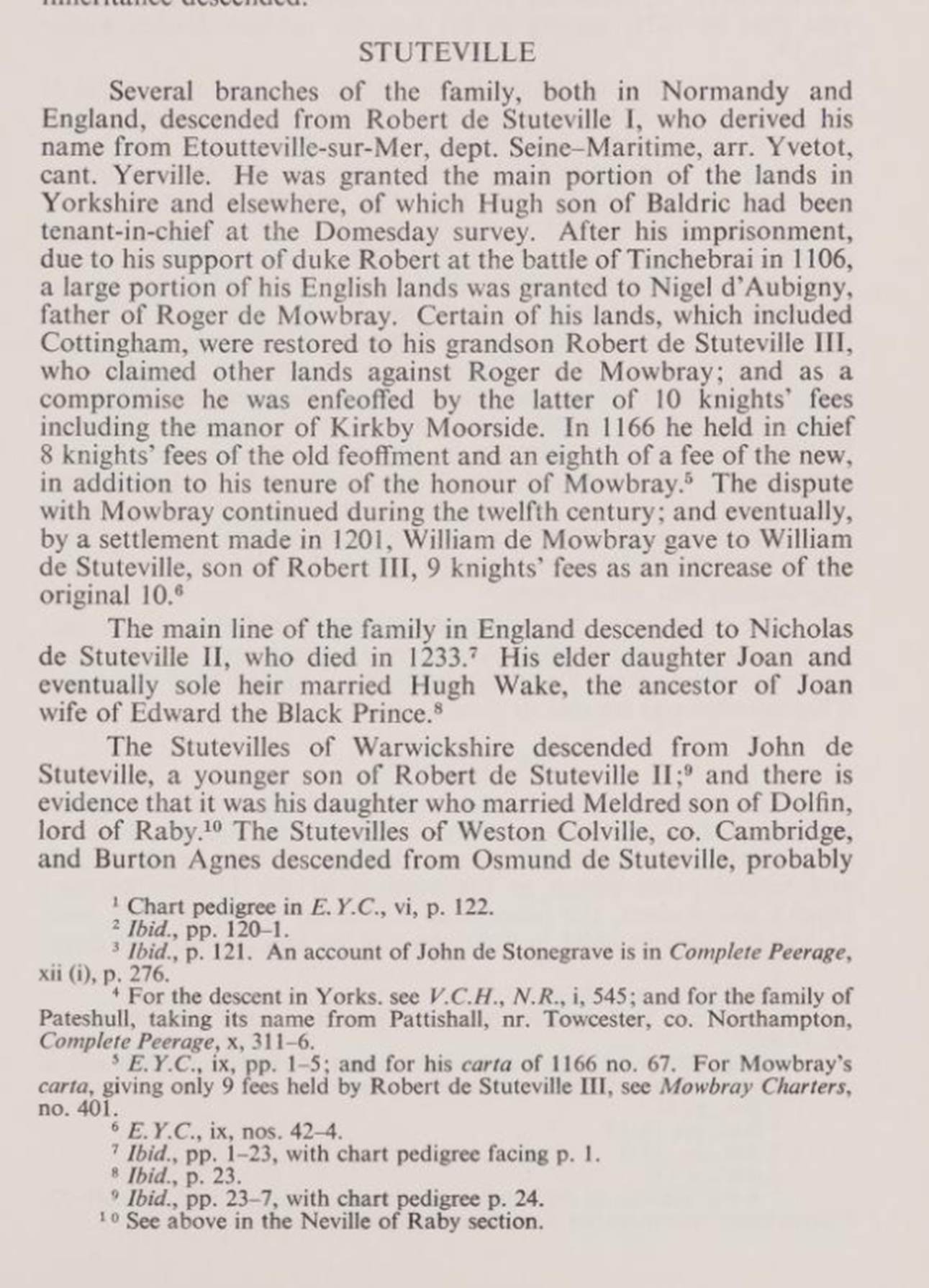
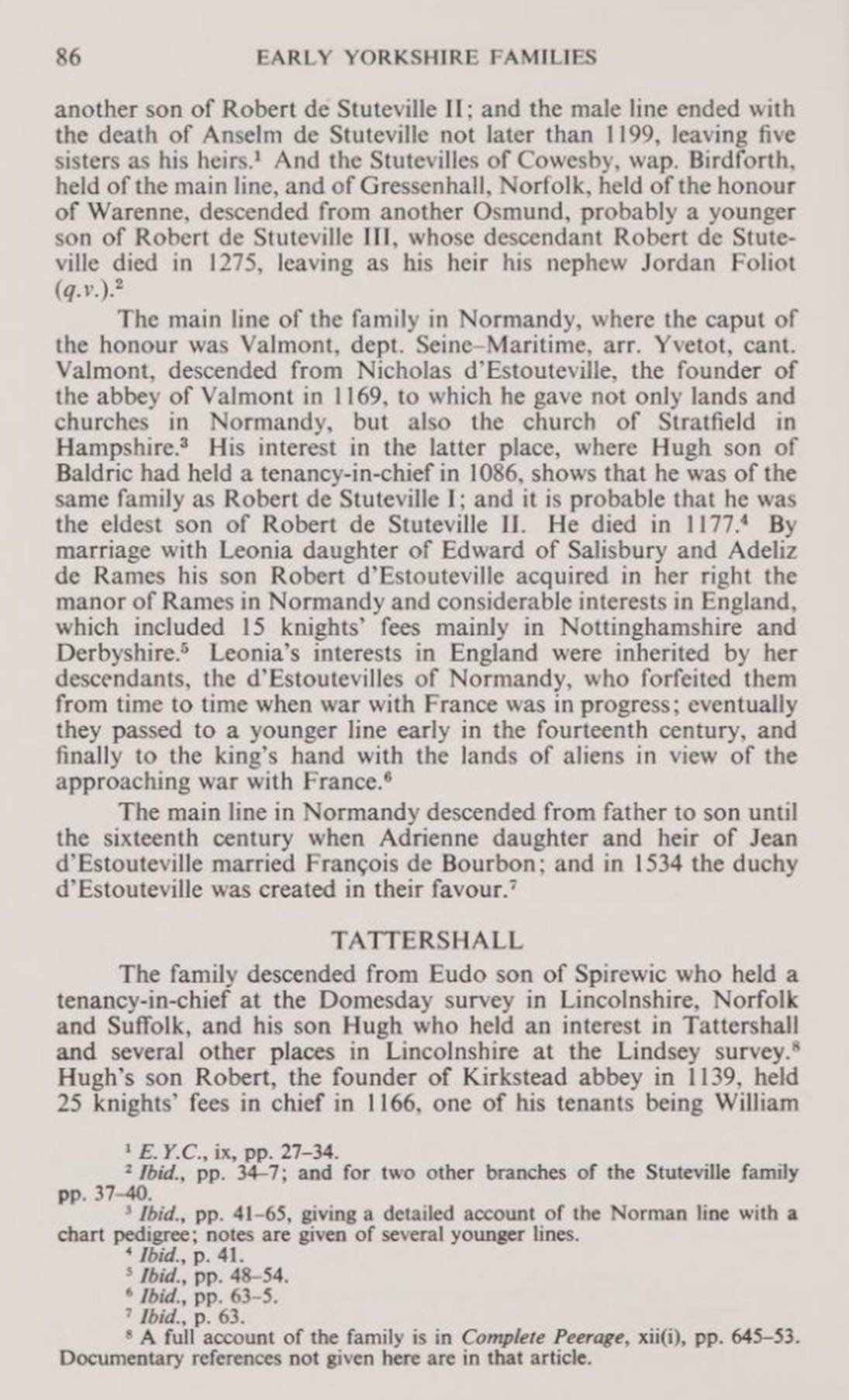
House Stuteville
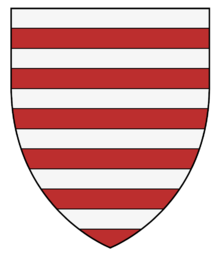
The descendants of Robert de
Stuteville who defined our family’s lives in the eleventh and then from the
late twelfth century
|
Return
to the Home Page of the Farndale Family Website |
The
story of one family’s journey through two thousand years of British History |
The 84
family lines into which the family is divided. Meet the whole family and how
the wider family is related |
Members
of the historical family ordered by date of birth |
Links to
other pages with historical research and related material |
The
story of the Bakers of Highfields, the Chapmans, and other related families |
The
Time Traveller’s Journey through North Yorkshire
The History of the North York Moors,
Ryedale, York, Cleveland and beyond |
The
line of Stuteville succession is in brown.
Dates
are in red.
Hyperlinks
to other pages are in dark
blue.
References
and citations are in turquoise.
Context
and local history are in purple.
Geographical
context is in green.
|
The Genealogy of House Stuteville
A Family Tree of the De Stuteville Family
in Yorkshire |
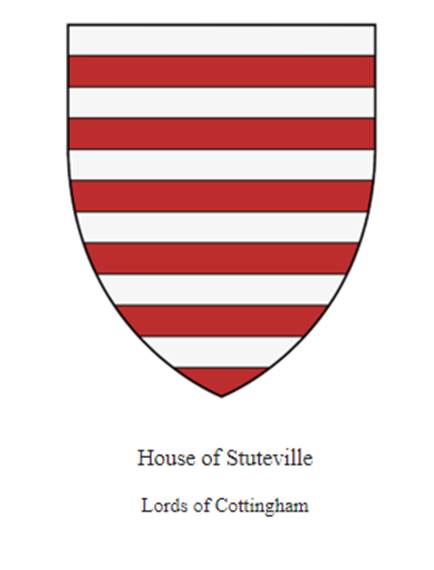
After
the Norman Conquest, the political history of Yorkshire was largely focused on
the Barons.
By the time
of the Domesday Book, William had redistributed the ancient Anglo Saxon estates
to his supporters. There was a new aristocracy of Norman, Breton and Flemish
landowners.
Hugh Fitz Baldric
1045
Hugh Fitz
Baldric, Hugh the son of Baldric, was born in about 1045 in Cottingham,
Yorkshire, now part of Hull.
It is not
known which Norman family he came from, if indeed he was Norman (John Marwood’s History of Gilling, Chapter 8: After the Saxons: The Ettons of Gilling).
1050
He married
Emma de Lascelles in 1050.
1067
It has been
suggested that he was a German archer in the service of William the Conqueror.
Before 1067 he witnessed a charter of Gerald, granting the Nuns of St. Amand
in Rouen the church of his fief of Roumare.
1069
Immediately
after the capture of York by William in September 1069, Hugh Fitz Baldric
appears to have been made Sheriff of the County of York by the King which
office he held until around 1080. He succeeded William Malet in that office.
1075
Hugh and
Emma had a daughter Erneburga Fitz Baldric, born in born 1075. Domesday Book records that Walter de Rivere and
Guy of Croan were sons in law of Hugh.
1086
By the time of The Domesday Book, William had
redistributed the old estates to his supporters and there was a new aristocracy
of Norman, Breton and Flemish landowners.
Hugh Fitz Baldric was an important
tenant-in-chief in Yorkshire, and to a smaller extent in Lincolnshire; he also
held two manors in Nottinghamshire, single holdings in Wiltshire and Berkshire,
and interests in four holdings in Hampshire. In Yorkshire Hugh son of Baldric
held about 50 manors with many berewicks and sokeland, assessed
at approximately 410 carucates. In Yorkshire he was given estates which included those held
in the Anglo-Saxon era by Kofsi, Arnketil, Thorr, and
Orm Gamalson. The manor and estate
of Chirchebi, later Kirkbymoorside,
had passed to High Fitz Baldric.
Hugh's
tenure of the estate at Cottingham in Yorkshire has been interpreted to mean
that he was a feudal baron.
One of
Hugh's holdings included the village of Bossall in
the hundred of Bulford. In 1086, there were 19
residents and a priest, as well as a church, in the small community. This
property produced an annual income of £3 in 1086; £2 10s in 1066.
Katharine
Keats-Rohan suggested
that Hugh lost his lands after the conclusion of Domesday Book in 1086,
probably for supporting Robert Curthose as king against William Rufus after the
death of William the Conqueror. However I J Sanders
suggested that Hugh's lands were divided after his death and does not
mention any forfeiture of the lands.
It is
possible that the Hugh Fitz Baldric who witnessed a charter of Robert
Curthose's in 1089 is the same person as the former sheriff.
Hugh gave
some of his English lands to Préaux Abbey in Normandy
and St Mary's Abbey in York.
Of
what Norman family Hugo filius Baldrici (Hugh) came
is not known, nor who Baldric, his father, was. There is, however, one record
of him before he crossed the channel. Hugh fitz
Baldric witnessed the charter Gerold, styling himself soldier of Christ
granting to the nuns of St Amand at Rouen the church of his fief of Rouraare.
We
do not know whether he was at the battle of Hastings.
He probably was not and came over when there was more certainty of success,
with Hugh Lupus, William de Perei, and others, who were in time only to share
in the lands in the north, not already allotted. No doubt he was in the
northern campaign of 1068, and at the submission of York. Immediately after the
recapture of the city, in September 1069, from the 4 Hanes, who had taken it
and made the sheriff, William Malet, prisoner, and whilst they still kept him,
it seems Hugh fitz Baldric was appointed to this
important office by the king ; proving thus the great trust he had in him, for
there was at the time no earl of the county nor any one acting in that
capacity. He, no doubt, was a person experienced in the duties of this
office, and may have been under sheriff to William Malet, or previously to the
viscount of Arques in Normandy. His jurisdiction
seems to have extended over Nottinghamshire as well.
In
the Survey we read (folio
298) that William de Perei affirmed that “Hugh the sheriff, the year
after the destruction of the castle (1070).
We
find by the Survey he was then farming the royal manor of Great Casterton in
Rutland. He had obtained in Notts two manors; in Lincolnshire six manors in Bon
by and fourteen others.. fourteen manors in the neighbourhood of Coxwold and
fifteen in Craven and the North Riding, in all fifty-two. At Coxwold and
Cottingham were his chief residences apparently. In the city of York he had
four mansions and twenty-nine small inns or lodging-houses, (‘minuta hospitia’) also the church of S. Andrew which he
bought.
Hugh
gave to S. Mary’s abbey, York, before 1088 9, lands in Hoton
(presumably Hutton le Hole at the entrance to Farndale), Normanby, and
Kirkby-Misperton, and his charter is printed in the Monasticon
(iii 551)
Nothing
more is recorded of him or his descendants, if he had any. Wido, his
son-in-law, has not been identified. As his lands, or most of them, were
afterwards possessed by the Mowbrays, he probably lost them, by being on the
side of duke Robert, in the rebellion of 1106, as they were granted to Nigel de
Albini.
(Biographical Notes on the Yorkshire Tenants named in
Domesday Book, Yorkshire Archaeological
Journal, Volume 4, 1876, page
237)
But
Hugh Fitz Baldric died at his hometown of Cottingham, Yorkshire in 1086 aged
about 41. Hugh was memorialized in the liber
vitae of Thorney Abbey.
The greater
part of his holdings passed, presumably by royal grant, to Robert de
Stuteville. The estates of Hugh son of Baldric, Domesday lord of Cottingham,
were divided after his death and the bulk of his lands in Yorkshire passed to
Robert I de Stuteville. (Ivor John Sanders,
English Baronies: A Study of Their Origins and Descent 1086-1327).
No member
of the Stuteville family appears among the tenants-in-chief, nor with any
certainty among their undertenants, in the Domesday survey. But shortly
afterwards a considerable number of holdings had passed to Robert de Stuteville
I. Of his holdings in Yorkshire a large proportion had been held by Hugh son of
Baldric in 1086. (Early Yorkshire Charters, Volume 9, Stuteville, C T Clay,
1952, page
70).
Robert I de
Stuteville Robert le Grandbois d’Estouteville
(c 1040 to c 1106), Lord of the Stuteville Estates 1086 to 1106
The greater
part of the estates of Hugh Fitz Baldric, Domesday Lord of Cottingham, were
divided after his death. The bulk of his lands in Yorkshire including
Kirkbymoorside passed to Robert I de Stuteville, presumably by royal grant. So
the lands which included the Kirkbymoorside estate were held shortly after the
Conquest by the House Stuteville, but not for long.
The origin
of the Stutevilles was Estouteville-en-Caux,
Normandy, later Esteville, northeast of Rouen, the
family's demesne prior to the Norman Conquest.
Robert
I de Stuteville was born in or about 1040. Robert’s
parents are not known but Robert I d'Estouteville
(Stuteville) was the brother of Nicolas Stuteville and Emma (Estouteville) de Grentmesnil. In
about 1056, Robert I d'Estouteville was governor of
the Castle of Ambriegrave, and stoutly defended it
against Geoffrey Martel until relieved by the approach of Duke William. Robert I Granbois was one of the
knights accompanying William the Conqueror in the Norman conquest in 1066.
He
married Béatrice Rieux on an unknown date and Robert II de Stuteville was born
in about 1084 in Yorkshire. The Liber Vitæ of Durham recorded
Robertus de Stuteville, Beatrix uxor eius, Robertus, Graulfus,
Willelmus filii eorum, Emma
Robertus and in a later passage the same names with the last two replaced
by Emme uxor Rodberti, Rodbertus filius eius.
He
may have married Erneburga Fitz Baldric perhaps on assumption of the Fitz
Baldric estates.
1106
Battle
of Tinchebrai
In the royal dynastic
dispute between the new King Henry I (1100 to 1135) from 1100 and Robert
Curtose, Robert I and his son Robert chose to support the Curtose
claim.
Robert
I was captured at St Pierre-sur-Dive shortly before the battle of Tinchebrai. Henry I defeated his elder brother and rival
Robert Curthose at the Battle of Tinchebrai. After his victory he visited York and Pickering.
Henry I redistributed land from Robert Curtose’s supporters, including Robert de Stuteville to his new men, including Nigel d’Albini, ancestor of the Mowbray
family and Robert de Brus. Robert de Stuteville was
taken captive and kept in prison for the rest of his life.
The
de Stutevilles were deprived of the estate in 1106 when it was granted to Nigel d’Aubigny, one of Henry
I’s new men.
Robert II de Stuteville, Fronteboeuf
d’Estouteville (1084 to c 1138)
Robert’s
son, Robert
II of Stuteville was born in about 1084 in Yorkshire. He married Jeanne de Tallebot and their children were Burga, Nicholas, Alice,
Osmund, John, Patrick and Robert.
1138
During the
reign of King Stephen (1135 to 1154), Robert was one of the northern barons who
commanded the English at the battle of the Standard in August 1138
Robert died after 1138 aged about age
54 in Cottingham, Yorkshire.
In the
reign of King John, William de Stuteville had the command of Northumberland,
Cumberland and Westmorland with all their castles; and in the reign of Stephen,
Robert de Stuteville was present at the celebrated Battle of the Standard
fought near Northallerton, A.D. 1138 (History of Kirkdale and
Vicinity, Part III, Kirkbymoorside, Tom
Parker, Ryedale Historian, Volume 11, 1982, page 13).
Shortly afterwards
a dispute arose between the families as to the right of possession, and the
Henry II restored the barony of Kirkbymoorside to the Stutevilles. It remained
with the Stutevilles and then, through Joan, the daughter and heiress of
Nicholas Estoteville (ie Stuteville), to Hugh de
Wake.
Roger de
Mowbray was a supporter of King Stephen, with whom he was captured at Lincoln
in 1141.
Robert III de
Stuteville Baron of Cottingham (c 1110 to 1186), reclaiming the Stuteville
estates from 1154
1154
Roger de Mowbray,
son of Nigel d’Aubigny, grantee of the Stuteville
lands, was holding Kirkbymoorside.
Robert
III de Stuteville, grandson of the
first Robert, laid claim to the barony. In 1154, Roger de Mowbray gave him Kirkbymoorside for ten
knights’ fees in satisfaction of his claim. This arrangement however was not
ratified in the King’s courts.
1158
Robert III de Stuteville was witness
to a charter of Henry II of England on 8 January 1158 at Newcastle-on-Tyne.
1166
The Stutevilles favoured the
Benedictine monks of Saint Mary's Abbey, York, and their own small House of
nuns founded at Keldholme, near Kirkbymoorside. Rievaulx Abbey was unable to
sustain its claim to the Farndale property and a little before 1166 Robert De
Stuteville granted to Keldholme Priory timber and wood in Farndale, together
with a vaccary, pasture and cultivated land in East Bransdale. This implies
some earlier settlements, but not very much. The Keldholme property in
Bransdale, which can still be identified in the survey of 1610, never amounted
to more than 40 or 50 acres at Cockayn at the head of the valley. At about the
same time Robert gave to Saint Mary's Abbey, who held the nearby Manor of
Spaunton, as much timber and wood as they required together with pasture and
pannage of pigs in Farndale. All the documents mentioned so far clearly
indicate that Farndale was regularly primarily as a resource of timber and
pasture in the mid 12th century, with little evidence of settlement.
1170
He was a justice itinerant in the counties
of Cumberland and Northumberland in 1170–1171, and High Sheriff of Yorkshire
from Easter 1170 to Easter 1175.
Robert de Stuteville was probably
brother of the Roger de Stuteville who was sheriff of Northumberland from 1170
to 1185, and defended Wark on Tweed Castle against William the Lion in 1174.
1172
Henry
the Young King allied himself with the King of Scotland in 1172 and rebelled.
Some of the sokemen of Pickering were
fined for their involvement. Bernard de Balliol and Robert de Stuteville
captured the Scottish King at Alnwick and imprisoned him at Richmond Castle.
Roger
Mowbray of Thirsk joined the rebels and he was
attacked by royal forces. He was defeated on two occasions around
Northallerton.
1173
The Great
Revolt
In 1173,
Henry II, following the controversial death of Thomas Becket in 1170, faced the
Great Revolt, an uprising by his eldest sons and rebellious barons, supported
by France, Scotland and Flanders.
The
Stuteville rival, Roger de Mowbray
supported the Revolt and fought with his sons, Nigel and Robert, but they were
defeated at Kirkby Malzeard, a castle held by the
Mowbray family.
1174
The King's
Knaresborough Castle and Appleby Castle were in Robert de Stuteville’s custody
in April 1174, when they were captured by David of Scotland, Earl of
Huntingdon. Stuteville, with his brothers and sons, was active in support of
the King during the war of 1174, and he took a prominent part in the capture of
William the Lion at Alnwick on 13 July 1174 where Robert and Bernard de Balliol
captured the Scottish King at Alnwick and imprisoned him at Richmond Castle. (Rog. Hov. ii. 60)
From 1174 to
1181 Robert was constantly in attendance on the king, both in England and
abroad.
1175
By 1175 the
revolt had ended and Robert de Stuteville supervised the building of new
castles at Edinburgh and Scarborough.
Roger de Mowbray was compelled to hand
back Kirkbymoorside to the de Stutevilles along with many other fees.
The
rising Stuteville family recovered much of the old estate forfeited by their
ancestors, including Kirkbymoorside.
Robert III
de Stuteville married Helewise de Murdac. They had
two sons William and Nicholas and two daughters, Burga and Helewise. He may have also had sons Robert, Eustace and
Osmund.
1177
He was one of the witnesses to the
Spanish award on 16 March 1177.
He is the probable founder of the
nunneries of Keldholme and Rosedale, Yorkshire, and was a benefactor of
Rievaulx Abbey.
Robert founded
the nunneries of Keldholme and Rosedale, Yorkshire, and was a benefactor of
Rievaulx Abbey.
1186
He seems to have died in the early
part of 1186. He claimed the barony, which had been forfeited by his
grandfather, from Roger de Mowbray, who by way of compromise gave him Kirby
Moorside.
William de
Stuteville (c 1140 to 1202), Lord of the Stuteville Estates 1186 to 1202
William
de Stuteville was the eldest son of Robert de Stuteville and Helewise de Murdac.
In Easter
1173 William had been appointed as governor of Knaresborough and Aldborough
Castles and other estates in northern England. He was governor of Topcliffe
Castle during the revolt of 1173 to 1174 and was part of the force that
captured King William I of Scotland at the Battle of Alnwick. William was
appointed governor of Roxburgh Castle in Scotland in 1177.
1189
He was a
justice itinerant in Yorkshire in 1189.
1190
William was
sheriff of Northumberland in 1190.
William was
sent by William de Longchamp to arrest Hugh de Puiset
in April 1190.
1191
William was appointed
sheriff of Lincolnshire in 1191.
1193
In March
1193, William joined with Hugh Bardulf in preventing Archbishop Geoffrey of
York from besieging Tickhill Castle, near Doncaster
on the side of Prince John.
1194
Reconciled
with Richard I, he was appointed in 1194 as one of the commissioners to settle
the dispute between Archbishop Geoffrey and the canons of York. He held the
wardship of William de Greystoke, when he served with during a campaign in
Normandy in 1194.
1199
He arranged
the marriage of his sister Helewise to William de Greystoke. On the accession
of John, William received charge of the counties of Northumberland and
Cumberland. He received grants of fairs at Buttercrambe
and Cottingham and by his influence at court was able to obtain a settlement of
his dispute with William de Mowbray.
1200
A dispute broke out again between
William de Stuteville, son of Robert de Mowbray, grandson of Roger.
Finally William de Mowbray confirmed
the previous agreement and gave 9 knights’ fees in augmentum.
Henceforward Kirkbymoorside was held of the Mowbrays by the heirs of the Stutevilles until the
end of the 14th century.
By 1200 the
Stutevilles had built a moated
manor house known as Vivers Hill Castle. It lies
to the east of the church and all that remains today is some evidence of a deep
moat, which is marked on the Ordnance Survey map.
1201
King
John stayed overnight at William de Stuteville’s Cottingham Castle in 1201 and
William de Stuteville bought the office of sheriff of Yorkshire.
1203
William died
in 1203. His son Robert had died in his minority without issue so William’s
brother Nicholas was their heir.
Nicholas I de Stuteville,
Lord of Lidell (1142 to c 1218), Lord of the Stuteville Estates 1203 to 1218
William de Stuteville was succeeded by
his brother Nicholas de Stuteville, the second son of Robert III de Stuteville
and Helewise Murdac.
Nicholas’s
wife was Gunnora d'Aubigny daughter of Raoul de
Aubigny and Sybil de Valgones. Their sons were Robert
de Stuteville (who died in 1213 having married Sibyl de Valognes, but they had
no children) and Nicholas de Stuteville.
1216
Nicholas
de Stuteville was one of the barons who
met at Stamford in 1216.
1217
Nicholas
was captured at the Battle of Lincoln on 20 May 1217, by William Marshall and
paid 1,000 marks for his release. He bound his manors of Kirkbymoorside and
Lidell to pay the 1,000 marks ransom.
1218
Nicholas
died in 1218.
Nicholas II de
Stuteville (c 1191 to 1233), Lord of the Stuteville Estates 1218 to 1233
Nicholas
II de Stuteville married Dervorguilla the
daughter of Lochlann of Galloway. Their daughters were Joan and Margaret (who
married William de Mustac).
From about 1230
Assarting was clearly proceeding apace
in the middle decades of the 13th century, since Lady Joan de Stuteville
successfully prosecuted the Abbot of Saint Mary's, York, for exceeding her
rights of taking wood in Farndale by actually assarting 100 acres of land.
1232
Nicolas II de Stuteville quitclaimed
common of pasture of Farndale to the Abbot of St Mary’s, York in 1232.
1233
Nicholas II de Stuteville died, leaving
two daughters as co-heirs - Joan wife of Hugh Wake and Margaret, whose married
to William de Mastac.

Joan de Stuteville,
the Lady of Liddell (1216 to 6 April 1276), Lady of the Stuteville Estates 1233
to 1276
Joan de Stuteville, heiress of
Cottingham was born in 1216, the daughter of Nicholas II de Stuteville and Devorguilla of Galloway.
She had married Hugh Wake, feudal Lord
of Bourne, Chief Justice of England, on or about 29 May 1229 aged 13.
1235
By Margaret was dead, and Joan had
taken possession her lands. Joan already held the manor of Kirkbymoorside.
1241
Hugh Wake died in or about 1241, and
Joan obtained the custody of his heirs until their full age. She married, as
her second husband, Hugh le Bigod, but as a
widow was known as Joan de Stutville.
He died in
or about 1241 in the Holy Land, and Joan obtained the custody of his heirs
until their full age. Their sons were Nicholas
Wake, Hugh
Wake; and Baldwin Wake.
1244
Married Hugh
le Bigod on or about 5 February 1244. As a widow she continued to be known as
Joan de Stuteville. She also became known as the Lady of Liddell. During
the baronial war between Henry III and Simon de Montfort, Bigod supported the
King and strengthened the defences of Pickering and Scarborough.
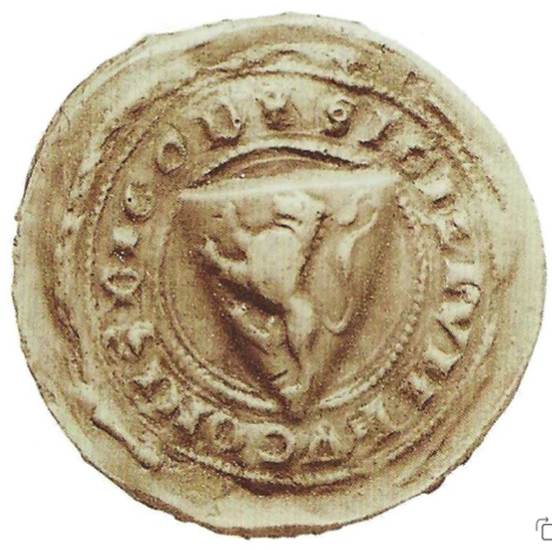
Hugh le
Bigod’s seal, British Library
The
impression of her seal (Seal of Joan de Stuteville,
c.1265-75, Cotton Ch XXIX 63) bore the device of a lady riding on
horseback sideways, a style which she is said to have been the first to adopt.
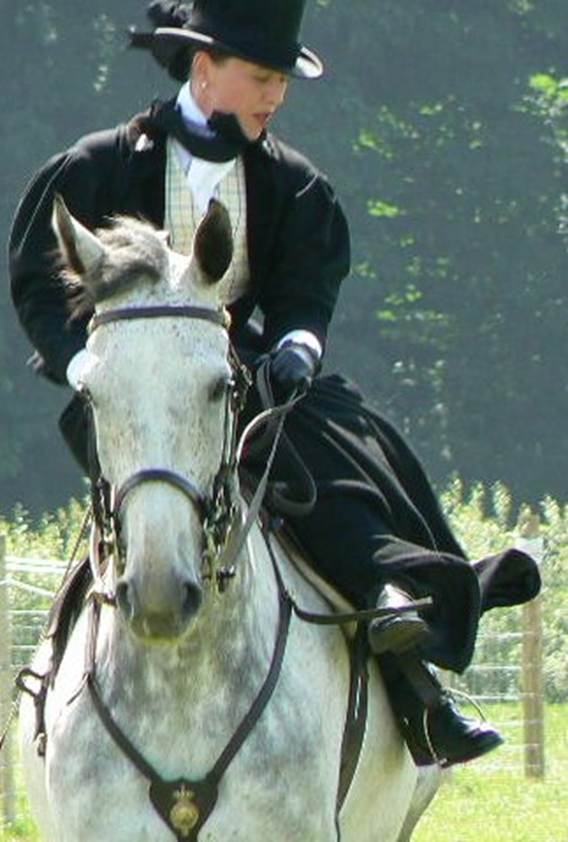
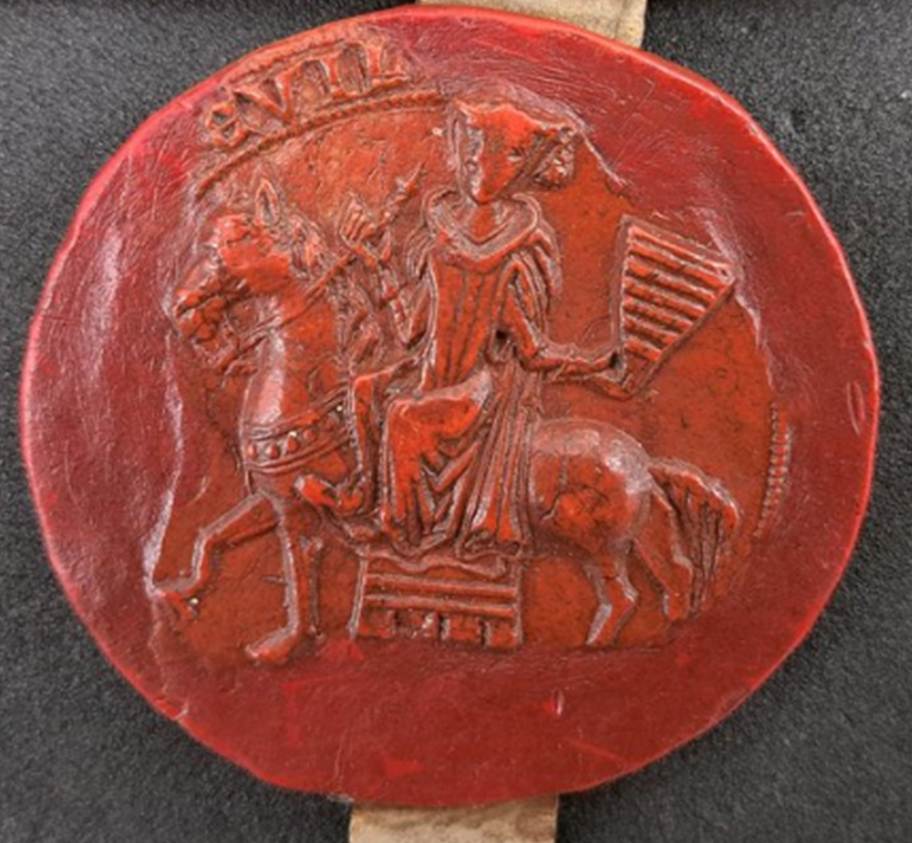
Joan
Stuteville of Kirkby Moorside, who married Hugh Bigod after the death of her
first husband Hugh Wake, and secured the market, had a lady riding side saddle
on her seal and is credited with inventing the habit (The
History of Ryedale, John Rushton, 2003, page 103).
The manor
of Hessle (near
Hull) was formerly a possession of the Stutevilles, and Joan Stuteville
carried the estates to Hugh de Wake. This lady was the first to introduce the
custom of females riding sideways on horseback, and the device on her seal
exhibits a lady in that posture, holding the bridle in her right hand (Gazetteer of East Yorkshire, 1823).
Some
castles saw military action in 1261 when Simon de Montfort led the baronial
opposition against King Henry III. Significant barons, with the custody of
local castles, including Hugh Bigod, Baldwin Wake and John de Vescy, actively
campaigned elsewhere in the country in these struggles (The
History of Ryedale, John Rushton, 2003, page 103).
1255
In 1255 Pickering Castle was handed to the
custody of Hugh Bigod, the justiciar.
Lady Joan de Stuteville successfully
prosecuted the Abbot of St Mary’s York, for exceeding his rights taking wood
from Farndale and as she did so she cleared 100 acres of land.
1276
By her death
in 1276 she was taking rent of
£27 for 545 acres of cultivated land in Farndale. Assarting was clearly
proceeding apace in the middle decades of the 13th century.
Joan de
Stuteville died on or about 6 April 1276. Her Inquisition
Post Mortem recorded her landholdings at her death.
Before Joan’s death she had enfeoffed
in the manor of Kirkbymoorside her son Baldwin Wake. Baldwin took homage of the
King as her heir in 1276.
Baldwin Wake III,
Lord of Bourne (c 1236 to 5 February 1282), Lord of the Stuteville-Wake Estates
1276 to 1282
Baldwin
Wake took homage of the King as her heir in 1276.
Baldwin Wake
continued the clearing of new land, including in Farndale, for cultivation,
begun by his mother. By his death in 1282, only six years after his mother’s
death, the
cultivated acreage in Farndale had increased to 768 acres, giving the
Stutevilles a rent of £38. In Bransdale about 188 acres had been cultivated
giving a rent of £5. There were 90 bondsmen in Farndale 25 bondsmen in East
Bransdale.
Baldwin Wake
married Hawise de Quincy, who was the daughter of Elen ferch
Llywelyn (descended from Llewelyn of Gwent, Prince of Gwynedd) and Sir Robert
de Quincy and they had two sons, John and Thomas and a daughter, Margaret.
1282
Baldwin Wake
died in 1282 and was succeeded by his son and heir John, who was summoned to
Parliament as Lord Wake by Edward I. Another Inquisition
Post Mortem on Baldwin’s death recorded his holdings.
John Wake, 1st Baron
Wake of Liddell (1268 to 10 March 1300), Lord of the Stuteville-Wake Estates
1282 to 1300
John
Wake was born around 1268, the son of Baldwin Wake and Hawise de Quincy.
1291
He married
Joan de Fiennes by 24 September 1291. She was the daughter of William de Fenes
and Blanche de Brienne. They had three children, John Wake (died before 1349),
Thomas Wake (1297 to 1349) and Margaret Wake (1300 to 1349).
John Wake
took part in military campaigns in Gascony from 1288 to 1297 and against the
Scots from 1297 to 1300.
1295
In 1295 John
Wake was made baron by writ.
1297
He was
appointed Joint Captain of March of Scotland in Cumberland and Westmoreland in
1297. He fought at the Battle of Falkirk in 1298.
1298
John enfeoffed the king of his lands in
1298, and they were regranted to him and his wife Joan in fee simple in the
same year.
1300
John Wake
died around 4 October 1300. He was succeeded by his son Thomas Wake.
Thomas Wake, 2nd
Baron Wake of Liddell (1297 to 31 May 1349), Lord of the Stuteville-Wake
Estates 1300 to 1349
Joan de Fiennes outlived her husband,
and was lady of Liddell during the minority of her son Thomas Wake.
The custody of this boy was granted to
Henry de Percy, who transferred it to the Society of the Ballardi of Lucca.
This was not ratified by the King, but later not recollecting the
confirmation of the grant, he caused the manor, then in the hands of the
merchants, to be taken into his hands, and he delivered it with fees &c,
who since he has held the said manor has received £340 out of the issues
thereof, for which Henry de Percy has made supplication to the King to caused
satisfaction to be made to the merchants for his exoneration.
John’s
widow, Joan died around 1303 to 1304 (Calendar of Inquisitions Post
Mortem, Volume 4, (Edward I,
1300 to 1307), page
123 (Item 196)).
1317
Among Thomas
Wake's guardians were Piers Gaveston and Henry, Earl of Lancaster, whose
daughter Blanche (died 1380) he married before 1317. Blanche the niece of
Thomas, Earl of Lancaster, and her husband was therefore of the House
Lancaster, but he did not follow Thomas of Lancaster in the proceedings which
led to his death in 1322.
1326
Thomas
Wake’s distaste for the favourites of Edward II, led him to join Queen Isabella
in 1326 and he was a member of the small council which advised the young king,
Edward III. Soon, however, he broke away from the queen and her ally, Roger
Mortimer, and in conjunction with his father-in-law, now earl of Lancaster, he
joined the malcontent barons.
1330
He was
possibly implicated in the plot which cost his brother-in-law, Edmund of
Woodstock, 1st Earl of Kent, his life in 1330, and he fled to France, returning
to England after the overthrow of Isabella and Mortimer.
Edward III
made him governor of the Channel Islands and he assisted Edward Balliol to
invade Scotland, being afterwards sent on an errand to France.
1341
In 1341 he
incurred the displeasure of the king and was imprisoned, but he had been
restored and had been employed in Brittany and elsewhere when he died
childless.
1349
Thomas Wake remained in possession of
the relevant lands including Kirkbymoorside until he died in 1349.
By 1349, merchant ships transported
rats carrying the black death to Britain. The black death soon swept through
the villages in the south and then the north of Britain. Soon it swept through most villages in Britain.
His estates
passed briefly to his sister Margaret, who died later in 1349, widow of Edmund
of Woodstock, Earl of Kent, then to her son John, who died in 1352, and later
to her daughter Joan who became 4th Countess of Kent.
Margaret Wake, 3rd
Baroness Wake of Liddell, Countess of Kent (20 March 1297 to 29 September
1349), Lady of the Stuteville-Wake Estates 31 May to 29
September 1349
Margaret
Wake succeeded her brother Thomas when he died in May 1349. She was Lady of
the Stuteville-Wake Estates for a very short time from 31 May to 29 September
1349.
However her
life prior to her assumption of the Stuteville estate impacted on the direction
of the line. So we now travel back in time, to follow her journey in the
preceding years.
1312
Margaret had
married John Comyn (1294 to 1314) in about 1312.
1314
John died at
the Battle of Bannockburn in 1314 and their only child, Ayme Comyn, died in
infancy.
1325
In 1325 she
married Edmund of Woodstock, 1st Earl of Kent (1301 to 1330), the youngest
surviving son of Edward I of England and Margaret of France. By marrying into
the Plantagenet line, she was punching above her weight.
Edmund
Woodstock was the sixth son of King Edward I of England by his second wife,
Margaret of France, daughter of King Philip III of France. Edward I had
intended to make substantial grants of land to Edmund, along with 8,000 marks a
year, but when the King died in 1307, Edward II refused to respect his father's
intentions, mainly due to his favouritism towards Piers Gaveston. According to
the chronicle Vita Edwardi Secundi, this act
was a grave insult to the king's younger brothers.
Gaveston was
killed during a noble rebellion against Edward in 1312, while Despenser was
hated by the English nobility.
However
Edmund, who was only six when Edward I had died, remained loyal to his brother.
As Edmund came of age, he became an important member of the circle around his
brother. In 1318, the Treaty of Leake was drafted as an effort to reconcile the
opposing parties, and Edmund, as his first public act, was among the witnesses
to sign this treaty. In 1320 Edmund joined his brother Edward II in Amiens,
where Edward was paying homage to the French king. In October 1320, Edmund
attended his first parliament
In 1321 he
was created Earl of Kent. He played an important part in Edward's
administration as diplomat and military commander and in 1321 to 1322 helped
suppress a rebellion. Edward made his youngest brother Lord Warden of the
Cinque Ports in place of Badlesmere.
In the
Scottish Wars, the English were routed by the Scots, led by Robert the Bruce,
at the
Battle of Old Byland on 14 October 1322, close to Rievaulx Abbey and the Farndale
lands. Edward II himself had to flee the battlefield to avoid capture, and
Edmund was with him as the royal army retreated to York.
Meanwhile,
the English king's possessions in France were coming under threat from the
French king. In April 1324, Edmund and Alexander de Bicknor, Archbishop of
Dublin, were sent to France on a diplomatic mission. Some historians have
criticised Edmund for his failure to reach a diplomatic settlement, but these
were difficult circumstances. When diplomacy failed, Edmund was appointed
Edward's lieutenant in Aquitaine on 20 July 1324. In the short war that
followed, the English lands were quickly overrun by the French, and Edmund was
besieged at La Réole. Here he held out until 22
September, at which point he was forced to surrender and agree to a six-month
truce.
Discontent
against the King grew reinforced by Edward's preference for his favourites,
Hugh Despenser the Younger and his father. Edward was also unpopular with the
ordinary folk with repeated demands for unpaid military service in Scotland.
Yet none of his campaigns there were successful, which caused trouble with the
nobility. In 1322 he executed his cousin Thomas, Earl of Lancaster, and
confiscated the Lancaster estates.
This
distrust of Edward was shared by his wife, Isabella of France, who believed
Despenser responsible for poisoning the King's mind against her. In September
1324 Queen Isabella was publicly humiliated when the government declared her an
enemy alien, and the King repossessed her estates.
Historian
Chris Given-Wilson wrote that, by 1325, the
nobility believed that no landholder could feel safe under the regime.
It was in
1325 that Edmund married Margaret Wake.
Edmund and
Margaret had a son Edmund who briefly became the Second Earl of Kent.
1326
In 1326 they
had a daughter, Joan, who for her beauty came to be known as the Fair Maid of
Kent.
In France,
Isabella conspired with the exiled Roger Mortimer to have Edward II deposed. To
build up diplomatic and military support for the venture, Isabella had her son,
Edward III, engaged to the twelve-year-old Philippa of Hainault.
In these
circumstances in 1326, Edmund, who had previously been steadfast in his support
for his half-brother, joined a rebellion led by Queen Isabella and her lover
Roger Mortimer. He distrusted Mortimer, but he despised the Despensers.
1327
An invasion
of England was launched and Edward II's forces deserted him completely.
Isabella and Mortimer summoned a parliament, and the King was forced to
relinquish the throne to his son, who was proclaimed king in London on 25
January 1327. The new king was crowned as Edward III (1327 to 1377) at
Westminster Abbey on 1 February at the age of 14.
For his
participation in the coup, Edmund received a reward of land belonging to the
Despensers, and the Earl of Arundel, who was also executed as a supporter of
Edward II.
The new
administration soon encountered its own unpopularity with the central position
of Mortimer at court, who was now the de facto ruler of England.
Mortimer used his position to acquire noble estates and titles, and his
unpopularity grew with a humiliating defeat by the Scots at the Battle of
Stanhope Park in County Durham, and the ensuing Treaty of
Edinburgh–Northampton, agreed with the Scots in 1328.
1328
The young
king Edward III came into conflict with his guardian and Mortimer knew that his
position in relation to the King was precarious and subjected Edward to
disrespect. The King married Philippa of Hainault at York Minster on 24 January
1328, and the birth of their first child, Edward of Woodstock, on 15 June 1330
increased tension with Mortimer.
Edmund grew
disillusioned and in the autumn of 1328, Edmund and his brother Thomas joined
Henry of Lancaster in a conspiracy against Isabella and Mortimer. However it
soon became apparent that the plot would fail, and the two brothers abandoned
the venture.
1330
After
participating in the planned rebellion, Edmund became less popular at court. He
was still allowed to accompany the king's wife Philippa to her coronation in
February 1330, but his appearances at court became less frequent. At about this
time he became involved in another plot against the court, when he was
convinced by rumours that his brother was still alive. It later emerged that
Roger Mortimer himself was responsible for leading Edmund into this belief, in
a form of entrapment. The plot was revealed, and in the parliament of March
1330 Edmund was indicted and condemned to death as a traitor.
The
condemned Edmund pleaded with Edward III for his life, offering to walk from
Winchester to London with a rope around his neck as a sign of atonement, but
leniency was blocked by Mortimer and the queen.
It was
almost impossible to find anyone willing to perform the execution of a man of
royal blood, until a convicted murderer eventually beheaded Edmund in exchange
for a pardon. Edmund was executed on 19 March 1330 by the orders of Roger
Mortimer, 1st Earl of March just three weeks before the birth of their son
John.
Edmund's
body was initially buried in a Franciscan church in Winchester, but it was
removed to Westminster Abbey in 1331.
The
execution of a royal prince was a great provocation to the seventeen year old
Edward III, who had not been involved in the decision, and it probably
contributed to the king's decision to rise up against his protector.
The widow
Margaret and four children, including Joan, who was only two years old at the
time, were placed under house arrest in Arundel Castle, Sussex, which had been
granted to Edmund in 1326 by his half-brother the King following the execution
of the rebel Edmund FitzAlan, 9th Earl of Arundel.
Margaret’s
brother Thomas Wake, 2nd Baron Wake of Liddell was also accused of treason but
later pardoned.
It was a
time of great strain for the widowed Countess of Kent and her four children.
Although up
until now Edward III had kept a low profile, it is likely that he increasingly
suspected that Mortimer's behaviour could endanger Edward's own life. This was
exacerbated by his execution of Edward's uncle Edmund. Contemporary chroniclers
suspected, too, that Mortimer had designs on the throne, and it is likely that
it was these rumours that encouraged Edward to act against him and his mother,
who supposedly maintained a close relationship with Mortimer.
Aided by his
close companion William Montagu, 3rd Baron Montagu, and a small number of other
trusted men, Edward took Mortimer by surprise and captured him at Nottingham
Castle on 19 October 1330. Mortimer was executed and Edward's personal reign
began. Among the charges against Mortimer was that of procuring Edmund's death,
and the charges against the late Earl of Kent were annulled. The historian Mark Ormrod argued that at this point Edward had
had little instruction in the art of kingship.
The widowed
Margaret and her family then received respite after the new king, Edward III,
Joan's half-first cousin, reached adulthood and took charge of affairs. He took
on the responsibility for the family and looked after them well.
1331
The
attainder of his father was reversed and Edmund’s son, also called Edmund
inherited the earldom, but Edmund Plantagenet died in October 1331, aged only
5, so John succeeded to the title also as an infant.
Margaret is
a supporting character in the Karen Harper
historical fiction novel The First Princess of Wales, which gives
a fictional depiction of her daughter Joan of Kent's life at the English court.
She is also a character in the 2014 novel A
Triple Knot by Emma Campion which primarily focuses on her daughter
Joan of Kent's struggle to validate her secret marriage to Thomas Holland after
her family forced her into a marriage with William Montacute, and her close,
often uncomfortable relationship with her cousin and future husband Edward,
Prince of Wales.
1349
Margaret
died of the plague within a few months of inheriting the Stuteville-Wake
estates. The plague might explain the deaths of Thomas, Margaret and then John
in close proximity.
John Wake, 3rd Earl
of Kent (7 April 1330 to 26 December 1352), Lord of the Stuteville-Wake Estates
1350 to 1352
John Wake
was born on 7 April 1330 at Arundel Castle, Sussex. He was the youngest son and
posthumous child of Edmund of Woodstock, Earl of Kent, and Margaret Wake. He
was therefore a grandson of Edward I and cousin of Edward III.
John took
part in the campaign that culminated in the battle of Crécy in 1346, probably
in the retinue of Duke Henry of Lancaster, but there is no record that he took
part in the Battle of Crécy itself.
In 1347 the
King granted him his entire inheritance, making him independent of his mother
at the age of seventeen. He owned estates, including 43 manors and 30
advowsons, in seventeen counties, as well as various rents and knight's fees in
a further six counties. His annual income was over £6,000 at a time when £1,000
was considered sufficient to maintain the lifestyle of an earl.
On 3 April
1348, John had married Isabella, also known as Elizabeth (1330 to 1411),
daughter of William V, Duke of Jülich.
His heir
throughout his life was his elder sister, Joan.
1350
John took
possession of the Stuteville-Wake estates in February 1350 and received livery
of all his lands from the King on 10 April 1351, having come of age three days
earlier.
1352
John was at his
favourite manor in Woking, when, on 23 December 1352, he granted the manor of Ryhall to Bartholomew de Burghersh. Shortly after, he fell
ill. He did not recover and died on 26 December 1352. He was buried next to his
father in the church of Greyfriars at Winchester. His titles passed to his only
surviving sister Joan who became the 4th Countess of Kent, and the 5th Baroness
Wake of Liddell.
His
promising career was cut short by an untimely death at the age of twenty-two.
John's widow
was still being titled Countess of Kent, however, as late as 1396. She entered
Waverley Abbey after John's death, and before her own death she requested that
she be buried next to him at Greyfriars.
The story of Joan is told on a separate
webpage.
|
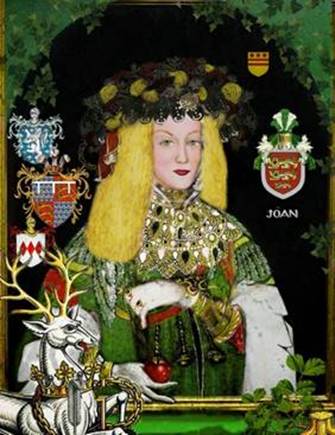
en son temps la plus belle de tout la roiaulme d'Engleterre et la
plus amoureuse The
most glamorous owner of Farndale |
The
Stuteville-Wake-Kent Line after Joan
1397
In 1397
Thomas Holland Earl of Kent died and his wife Alice was left in possession for
life. Of Alice’s sons, Thomas the Elder was beheaded as a traitor in 1399 and
his brother Edmund died before his mother in 1408, when the earldom of Kent
fell into abeyance.
The
Stuteville-Wake line therefore ended in three co-heiresses, one of whom,
Elizabeth Holland, married John Neville, Earl of Westmoreland, who succeeded to
the barony of Kirkbymoorside, and it remained in the possession
of the Nevilles until 1570.
|
The
Genealogy of the House Neville
Follow the Kirkbymoorside
interest through the Nevilles after Elizabeth Holland married John Neville in
the Neville genealogy |
|
The
Genealogy of House Stuteville
Alternatively follow the Kirkbymoorside
interest through the Nevilles after Elizabeth Holland married John Neville in
the Stuteville genealogy |
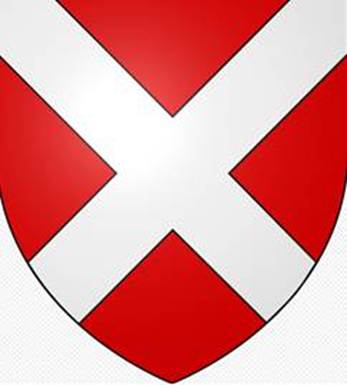
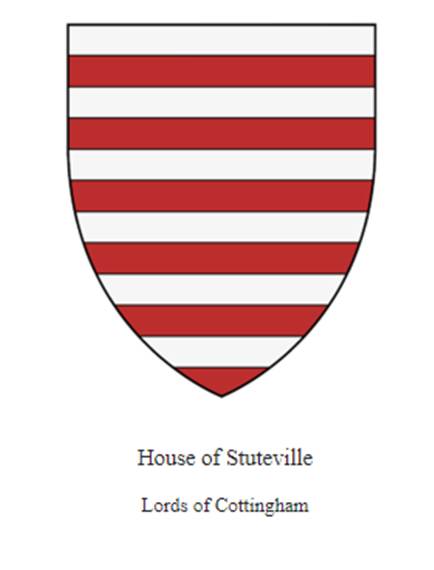
Bibliography
Early
Yorkshire Charters, Volume IX, the
Stuteville Fee.
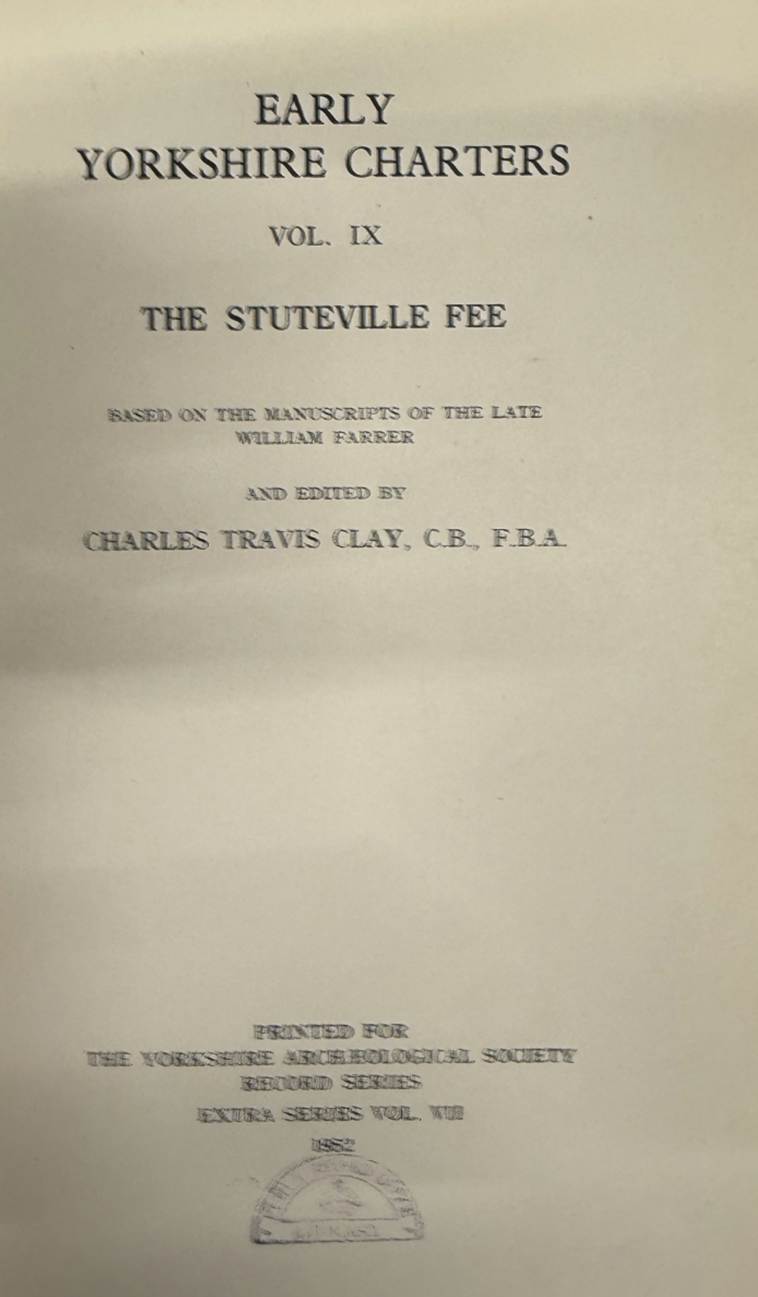
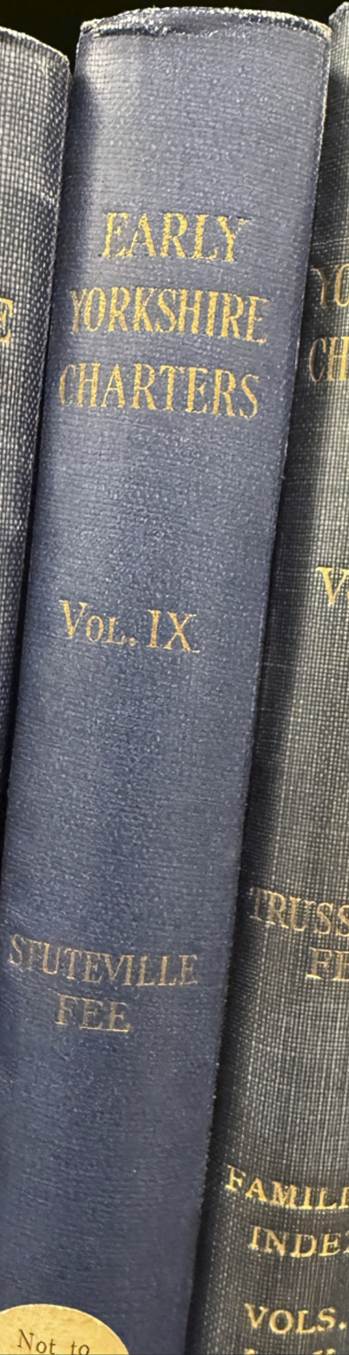
Early Yorkshire
Families and Illustrative Documents, 1973,
Yorkshire Archaeological Society