Ontario
A History of Ontario from about 1870, with a focus on the
locations associated with two branches of the Farndale family
|
Return to the Home Page of the Farndale Family
Website |
The story of one family’s journey through two
thousand years of British History |
The 83 family lines into which the family is divided.
Meet the whole family and how the wider family is related |
Members of the historical family ordered by date of
birth |
Links to other pages with historical research and
related material |
The story of the Bakers of Highfields, the Chapmans,
and other related families |
Introduction
Dates are in red.
Hyperlinks to
other pages are in dark
blue.
Headlines of the
history of Ontario are in brown.
References and
citations are in turquoise.
Contextual
history is in purple.
This webpage about
Ontario has the following section headings:
· The Farndales of
Ontario
· Ontario, an overview
· Particular locations
associated with the Farndale family
·
Ontario
Timeline
·
Bibliography
The Farndales of Ontario
The Ontario
1 Line are the descendants of John
George Farndale (FAR00337)(1836
to 1909) who served about 1853-56 in the Crimea in the 28th of Foot a Yorkshire
Regiment, and emigrated to Ontario (possibly via Australia) in about 1870.
The Ontario
2 Line are the descendants of Samuel Kirk Farndale (FAR00512), born
1871 who emigrated to Oshawa, Ontario in 1895.
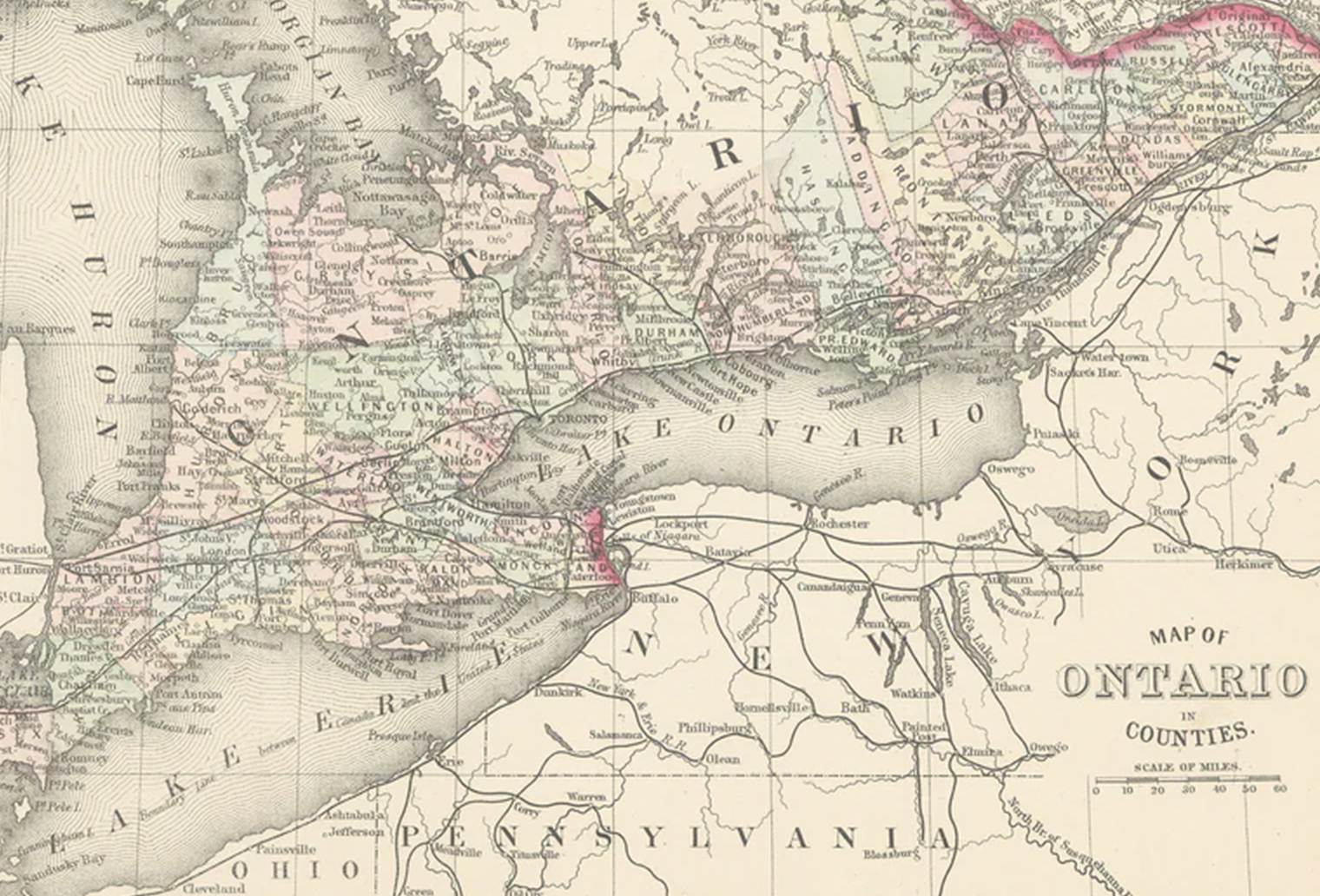
Ontario, an overview
Between 1825 and 1842, the
population of Upper Canada tripled to 450,000, and by 1851 it had doubled
again. Most of the immigrants came from the British Isles, made up roughly of
20 per cent English, 20 per cent Scottish and 60 per cent Irish immigrants.
Settlement generally spread from south to north, moving away from the lakes as
land along them became settled.
In the 1850s, Ontario’s economy
was primarily agricultural, particularly wheat growing. The balance gradually
shifted to dairy, fruit and vegetable farming.
Urban and industrial growth
increased from the 1850s through the 1860s with the development of textiles and
metalworking, farm implements and machinery.
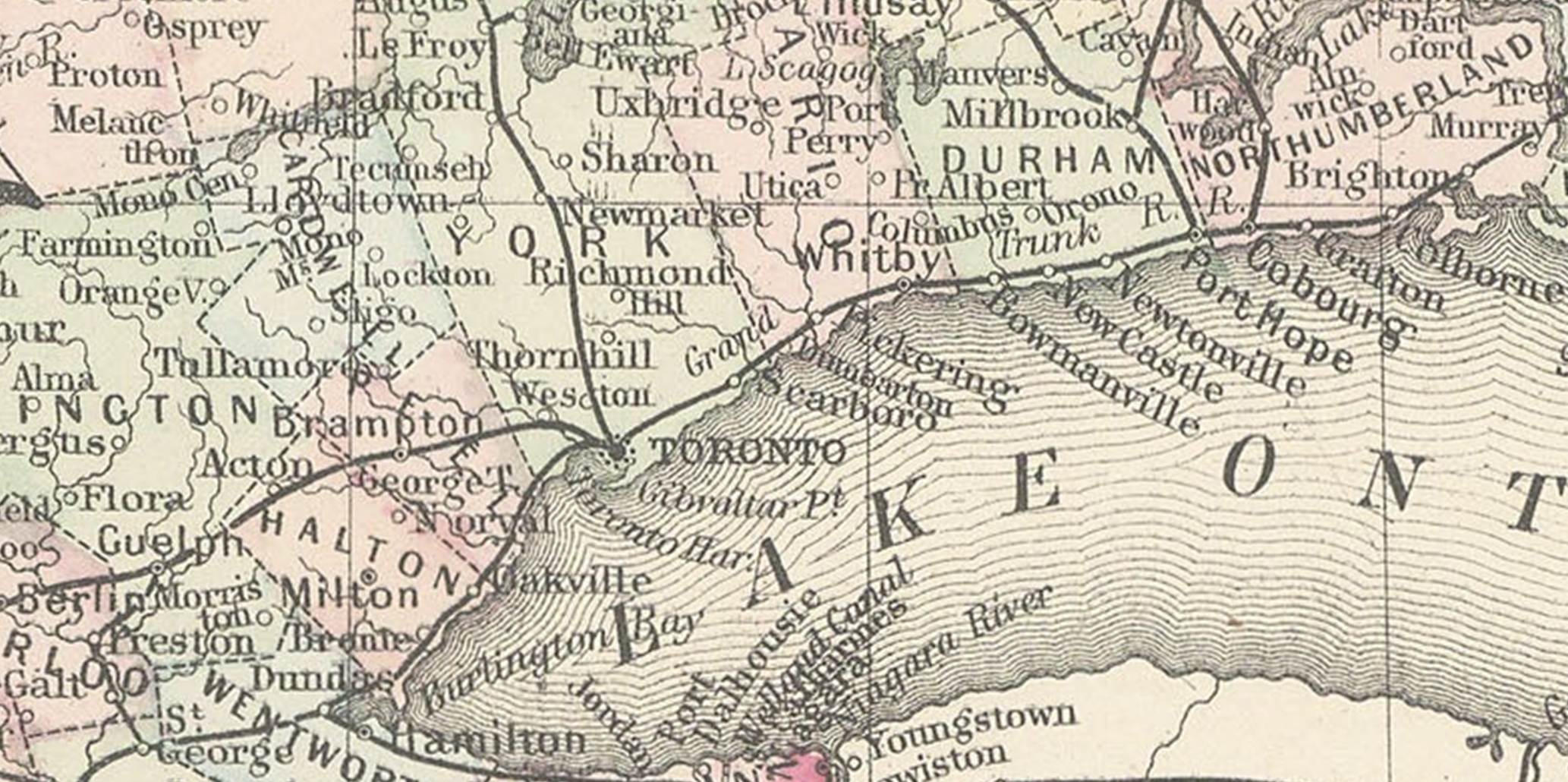
Toronto grew as both a railway and
manufacturing centre, and as the provincial capital.
Particular locations
associated with the Farndale family
Oshawa, Ontario
Etobicoke,
Ontario
Etobicoke is
today part of Toronto. On March 18, 1797, Sergeant Patrick Mealey received the
first land patent for a plot on the west side of Royal York Road on Lake
Ontario. This was part of the First Military Tract, or "Militia
Lands". The Crown was providing land to Loyalists in compensation for
property they left behind in the U.S. and to veterans of the American
Revolution in payment for service. In other parts of Ontario, the Crown granted
land to the Iroquoian First Nations who had served as allies during the war and
were forced to cede most of their land in New York to the state.
The census of
1805 counted 84 people in the township of Etobicoke. In 1806, William Cooper
built a grist mill and saw mill on the Humber river's west bank, just south of
Dundas Street. The 1809 census counted 137 residents. The Dundas Street bridge
opened in 1816, making the township more accessible.
The township of
Etobicoke was incorporated on 1 January 1 1850. In 1850, the township's
population was 2,904. By 1881, the population of Etobicoke township was 2,976.
In 1911, the
community of Mimico was incorporated on land taken from Etobicoke township. New
Toronto was incorporated on 1 January 1913. Early on, there was talk of merging
Mimico and New Toronto. A 1916 referendum on amalgamating the two communities
was approved by the residents of Mimico, but rejected by residents of New
Toronto. In 1917, Mimico became a town and in 1920, New Toronto became the Town
of New Toronto.
Peel, Ontario
Peel is a
regional municipality in the Greater Toronto Area, Southern Ontario, Canada. It
consists of three municipalities to the west and northwest of the city of
Toronto: the cities of Mississauga and Brampton, and the town of Caledon, each
of which spans its full east–west width. The regional seat is in Brampton.
The area was
first settled in the early 1800s after being divided into townships in 1805.
County of Peel was formed in 1851. It was named after Sir Robert Peel, the
nineteenth-century Prime Minister of the United Kingdom.
The townships
that would eventually constitute Peel were initially part of York County in the
Home District, and were designated as the West Riding of York in 1845.
In 1867, Peel
officially separated from York County. Peel County was dissolved in 1974.
Brampton, Ontario
Brampton was
virtually a village in 1834. The only building of consequence at the corner of Hurontario (now Main) and Queen Streets, today the centre
of Brampton, was William Buffy's tavern. In fact, at the time, the area was
referred to as "Buffy's Corners". All real business in Chinguacousy Township took place one mile away at Martin
Salisbury's tavern. By 1834, John Elliott laid out the area in lots for sale,
and applied the name "Brampton" to the area, which was soon adopted
by others.
Chiguacousy Township,
Ontario
Chinguacousy Township is a
former municipality and present-day geographic township in the Regional
Municipality of Peel, Ontario. Several villages were once located within Chinguacousy Township. In most cases only small remnants
like churches and cemeteries of many of these former villages exist.
Pickering,
Ontario
Beginning in the
1770s, the area was settled by primarily British colonists. An increase in
population occurred after the American Revolutionary War, when the Crown
resettled Loyalists and encouraged new immigration. The township was originally
called "Edinburgh" but in 1792 was renamed after Pickering, North Yorkshire. Pickering Village, now
part of Ajax, emerged as the major population and commercial centre of the
Pickering Township in the early 19th century. The conversion of a local trail
into the Kingston Road in 1799 contributed greatly to the increased settlement
in the area. In 1807, Quakers led by Timothy Rogers settled in the area, and by
1809, the population of Pickering Township consisted of 180 people, most of
whom lived along the Duffins Creek. In 1811, the
Pickering Township became a separate municipality. Several sawmills,
gristmills, taverns, and other businesses operated in the area. During the War
of 1812, the maintenance of the Kingston Road improved because of the increased
military traffic and further contributed to the development of the area. In
1851, the Pickering Township was severed from the York County, and became a
part of the newly established Ontario County.
In the later
decades of the 19th century, a fall in the demand for wheat led to economic
decline in the primarily-agricultural township. The township lost over 40% of
its population in the second half of the 19th century, and the decline
continued in the first half of the 20th century.
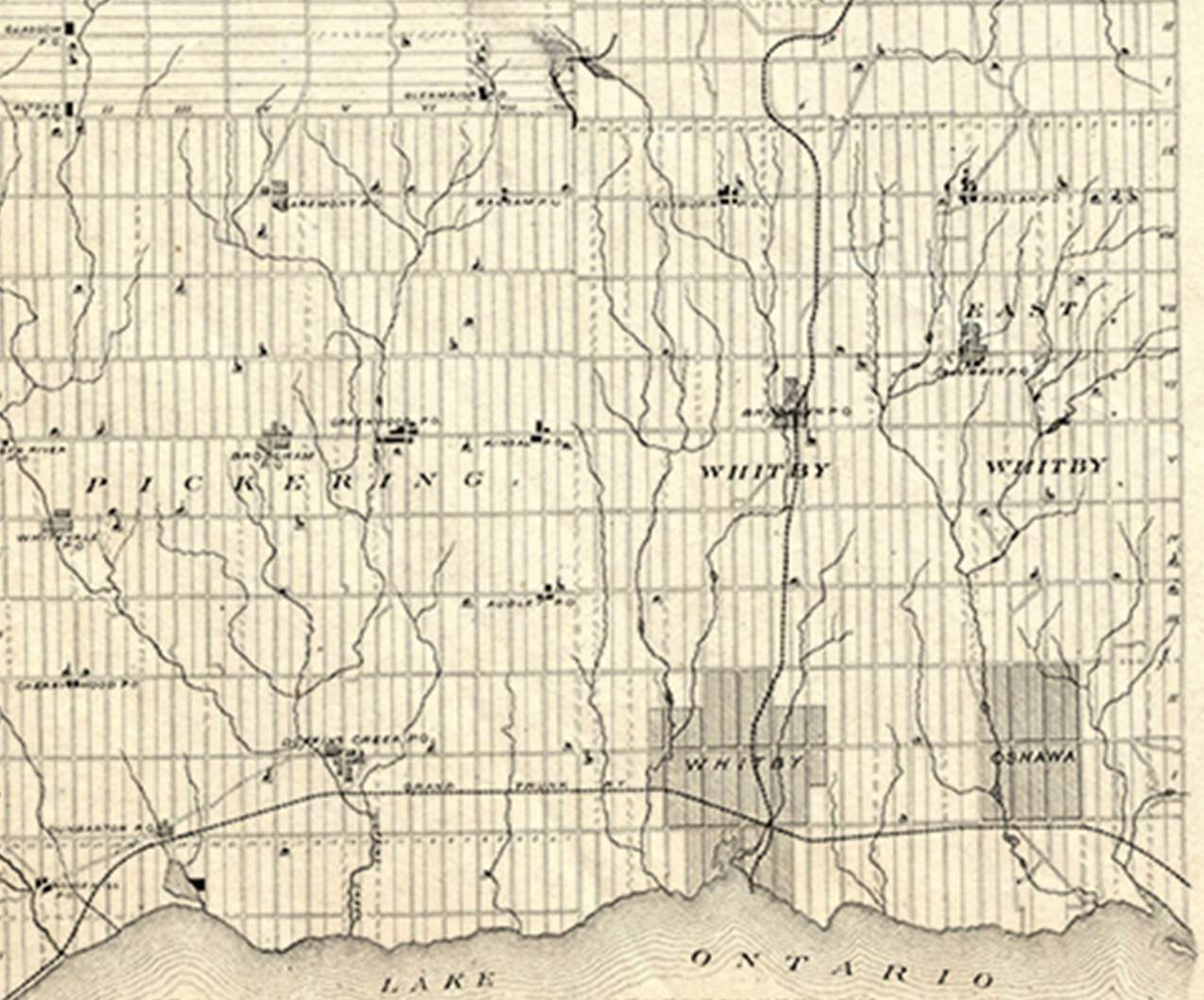
Ontario 1877
Whitby, Ontario
Whitby Township
was established in 1792 as part of what was then York County. Whitby Township
was one of five townships along Lake Ontario named for towns in northeast
England (York, Scarborough, Pickering, Whitby and Darlington). In 1852, the
Township became part of the newly formed County of Ontario. In 1855, the Town
of Whitby was incorporated as a separate municipality in the southern portion
of the Township and in 1858, the Township of East Whitby was formed from the
eastern portion of the municipality near Oshawa.
Kinsale, Ontario
Part of Pickering
and Oshawa.
Sarnia, Ontario
Sarnia is a city
in southwestern Ontario, Canada, and had a 2016 population of
71,594. It is the largest city on Lake Huron and in Lambton
County. Sarnia is located on the eastern bank of the junction between the Upper
and Lower Great Lakes where Lake Huron flows into
the St. Clair River, which forms the Canada–United States border,
directly across from Port Huron, Michigan. The city's natural harbour
first attracted the French explorer La Salle, who named the site "The
Rapids" on 23 August 1679. This was the first time anything other than a
canoe or other oar-powered vessel had sailed into Lake Huron, and La
Salle's voyage was thus germinal in the development of commercial shipping on
the Great Lakes.
Located in the natural
harbour, the Sarnia port remains an important centre for lake
freighters and oceangoing ships carrying cargoes of grain and petroleum
products. The natural port and the salt caverns that exist in the
surrounding areas, together with the oil discovered in nearby Oil
Springs in 1858 led to the massive growth of the petroleum industry
in this area. Because Oil Springs was the first place in Canada and
North America to drill commercially for oil, the knowledge that was acquired
there led to oil drillers from Sarnia travelling the world teaching other
nations how to drill for oil.
The township was surveyed
in 1829, and in the early 1830s, there were many Scottish immigrants to this
area. After its foundation, Port Sarnia expanded throughout the nineteenth
century. On 19 June 1856, Parliament passed An Act to Incorporate the Town of Sarnia and the name Port Sarnia was
officially changed to Sarnia, effective 1 January 1857. The Act mentioned 1,000
inhabitants in three wards at that time. The wealth of adjoining stands of
timber supported the lumber industry at a time of development throughout this
Great Lakes area.
Oil was discovered in
nearby Oil Springs in 1858 by James Miller Williams. The Great Western
Railway arrived in 1858 and the Grand Trunk Railway in
1859. The rail lines were later linked directly to the United States by
the opening of the St. Clair Tunnel under the St. Clair River
at Sarnia in 1890, by the Grand Trunk Railway. This was the first railroad
tunnel ever constructed under a river.
Canada Steamship
Lines formed in 1913 from many previous companies that plied the waters of
the St. Clair River. One of these companies was Northwest Transportation
Company of Sarnia, which was founded in 1870. By 20 April 1914, when
Parliament passed An Act to Incorporate
the City of Sarnia, the population had grown
to 10,985 in six wards. Sarnia officially became a city as of 7 May 1914.
Ontario Timeline
11,000 year ago
The first residents of
present-day Ontario arrived during the last ice age, approximately 11,000 years
ago. As the ice retreated, Paleo-American inhabitants moved into the northern
region of the province. For many years, Indigenous people probably lived by
fishing and hunting; deer, elk, bear and beaver could be found in the south,
and caribou in the north.
1000 BCE
By 1000 BCE, pottery had
been introduced, and archaeological sites show a far-flung trading system with
importations from as far as the Gulf of Mexico.
800 CE
By 800 CE, certain tribes
living south of the Canadian Shield, including the Wendat and the
Haudenosaunee, were well-established farmers, growing primarily corn, beans and
squash. The known inhabitants of the Ontario region before the arrival of
Europeans included the Iroquoian-speaking agricultural Huron, Tionontati, and Erie peoples of the south and the
Algonquian-speaking hunting Algonquin, Ojibwa, and Cree peoples of the north.
1610
French explorer Étienne
Brûlé surveyed part of the area in 1610–12.
1611
The English explorer Henry
Hudson sailed into Hudson Bay in 1611 and claimed the area for England, but
Samuel de Champlain reached Lake Huron in 1615. In their effort to secure the
North American fur trade, the British and the French established a number of
fur trading forts in Ontario during the 17th and 18th centuries; with the
former establishing a number of forts around Hudson Bay, and the latter
establishing forts throughout the Pays d'en Haut
region.
1763
Control over the area
remained contested until the end of the Seven Years' War, when the 1763 Treaty
of Paris awarded the colony of New France to the British.
1774
The Quebec Act of 1774
established Ontario as part of an extended colony ruled from Quebec.
1791
Following the American
Revolutionary War, the province saw an influx of loyalists settle the area. In
response to the influx of loyalist refugees, the Constitutional Act of 1791 was
enacted, splitting the colony of Quebec into Lower Canada (present day southern
Quebec) and Upper Canada (present day southern Ontario).
John Graves Simcoe, the
first lieutenant governor of Upper Canada, supervised the introduction of
English legal and local government practices, laid out the land-granting
pattern, supported the construction of trunk roads, and fixed the capital at
York (now Toronto).
1812
Simcoe’s policy of
welcoming massive immigration from the United States was a source of tension
between the newcomers and the established anti-U.S. loyalists, a rift that
deepened during the War of 1812.
After the war and
throughout the nineteenth century, immigrants came mainly from Ireland and
Great Britain, with large numbers from Scotland.
1815 to 1840
From 1815 to 1840 the
province was dominated by a conservative oligarchy known as the “Family
Compact,” alleged to be an elite tied together by family relationships. Even
when this group lost its majority in the elected legislative assembly, as
happened twice, it continued to control the governing bodies. The oligarchy
favoured the Anglican Church and the Crown and Clergy Reserves but also rapid
economic growth. Its commitment of public funds, borrowed in Great Britain, to
private infrastructure projects, such as the construction of the Welland Canal to bypass Niagara Falls, led to mounting
opposition as costs rose. Reformers demanded “responsible government,” by which
they meant that the government should enjoy the confidence of a majority of
members of the elected assembly.
1840
The Canadas were reunited
as the Province of Canada by the Act of Union 1840.
1857
Ottawa became the capital
of the Province of Canada.
1867
On July 1, 1867, the
Province of Canada, New Brunswick, and Nova Scotia were united to form a single
federation. The Province of Canada was split into two provinces at
Confederation, with the area east of the Ottawa River forming Quebec, and the
area west of the river forming Ontario.
1872
The lawyer Oliver
Mowat became Premier of Ontario and remained as premier until
1896. He fought for provincial rights, and sought to weaken the power of
the federal government in provincial matters. His battles with the
federal government greatly decentralized Canada, giving the provinces
far more power than John A. Macdonald had intended.
He consolidated and
expanded Ontario's educational and provincial institutions, created districts
in Northern Ontario, and fought to ensure that those parts of Northwestern
Ontario not historically part of Upper Canada (the vast areas north and west of
the Lake Superior-Hudson Bay watershed, known as the District of Keewatin)
would become part of Ontario. This was embodied in the Canada (Ontario
Boundary) Act, 1889.
He also presided over the
emergence of the province into the economic powerhouse of Canada. Mowat was the
creator of what is often called Empire Ontario.
1875–1885
The construction of
the Canadian Pacific Railway through Northern Ontario and
the Canadian Prairies to British Columbia.
Mineral exploitation
accelerated in the late 19th century, leading to the rise of important mining
centres in the northeast, such as Sudbury, Cobalt and Timmins.
The province harnessed its water power to generate hydro-electric power and
created the state-controlled Hydro-Electric Power Commission of Ontario,
later Ontario Hydro. The availability of cheap electric power further
facilitated the development of industry.
1879
Sir John A.
Macdonald's National Policy in 1879
Ontario manufacturing and
industry flourished.
1893
Population increase slowed
after a large recession hit the province in 1893.
Many newly arrived
immigrants and others moved west along the railway to the Prairie Provinces and
British Columbia, sparsely settling Northern Ontario.
1904
The Ford Motor
Company of Canada was established in 1904.
1912
In July 1912, the Conservative government
of Sir James Whitney issued Regulation 17 which severely
limited the availability of French-language schooling to the province's
French-speaking minority. French Canadians reacted with outrage,
journalist Henri Bourassa denouncing the "Prussians of
Ontario". The regulation was eventually repealed in 1927.
1916
Influenced by events in
the United States, the government of Sir William
Hearst introduced prohibition of alcoholic drinks in 1916 with
the passing of the Ontario Temperance Act. However, residents could distil
and retain their own personal supply, and liquor producers could continue
distillation and export for sale, allowing this already sizeable industry to
strengthen further. Ontario became a hotbed for the illegal smuggling of liquor
and the biggest supplier into the United States, which was under
complete prohibition.
1918
General Motors
Canada was formed in 1918. The motor vehicle industry became the most
lucrative industry for the Ontario economy during the 20th century.
1927
Prohibition in Ontario
came to an end in 1927 with the establishment of the Liquor Control Board
of Ontario under the government of Howard Ferguson.
Bibliography