Wakefield
Historical and geographical information
|
Return to the Home Page of the Farndale Family
Website |
The story of one family’s journey through two
thousand years of British History |
The 83 family lines into which the family is divided.
Meet the whole family and how the wider family is related |
Members of the historical family ordered by date of
birth |
Links to other pages with historical research and
related material |
The story of the Bakers of Highfields, the Chapmans,
and other related families |
Dates are in red.
Hyperlinks to
other pages are in dark
blue.
Headlines are in brown.
References and
citations are in turquoise.
Contextual
history is in purple.
This webpage
about the Wakefield has the
following section headings:
·
Farndale
family history and Wakefield
· Wakefield,
overview
· Timeline of
Wakefield history
· Bibliography
The Farndales of Wakefield
The Wakefield
1 Line are the descendants of Thomas
Farndale (FAR00344)
1839 to 1919 who was an innkeeper in Wakefield (Smith's Arms) and also the
descendants of Robert Farndale (FAR00606).
Thomas Farndale’s son Joseph Farndale CBE KPM (FAR00463) became
Chief Constable of Margate, York and later of Bradford.
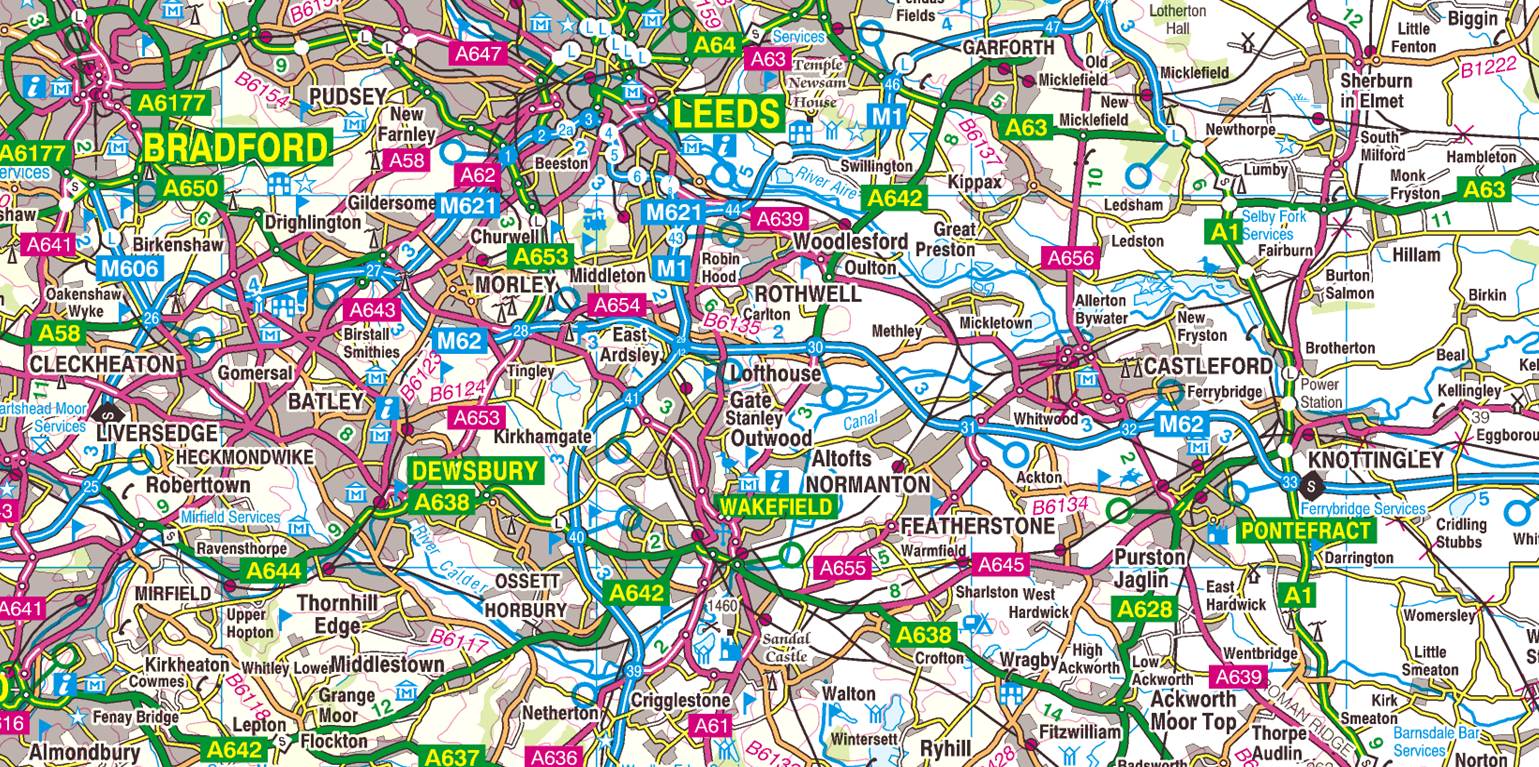
Wakefield
Wakefield is a
cathedral city in West Yorkshire on the River Calder and the
eastern edge of the Pennines, which had a population of 99,251 at the 2011
census. The name Wakefield may
derive from "Waca's field" – the open land belonging to
someone named "Waca" or could have evolved from the Old English word wacu,
meaning "a watch or wake", and feld, an open field in which a
wake or festival was held.

Wakefield Timeline
Prehistoric
Flint and stone
tools and later bronze and iron implements have been found at Lee Moor and Lupset in the Wakefield area showing evidence of human
activity since prehistoric times.
43 CE
This part of
Yorkshire was home to the Brigantes until the Roman occupation in 43 CE. A
Roman road from Pontefract passing Streethouse, Heath
Common, Ossett Street Side, through Kirklees and on to Manchester crossed the
River Calder by a ford at Wakefield near the site of Wakefield Bridge. A large
group of coin moulds, the Lingwell Gate coin moulds,
representing Romano-British coin forgery were found at Lingwell
Gate between 1697 and 1879.
Fifth
century
Wakefield was
probably occupied again, this time by the Angles, in the 5th or 6th century.
876 CE
After 876 CE
Wakefield was controlled by the Vikings who founded twelve hamlets or thorpes around Wakefield. They divided the area into
wapentakes and Wakefield was part of the Wapentake of Agbrigg.
The settlement
grew near a crossing place on the River Calder around three roads, Westgate,
Northgate and Kirkgate.
1066
Before 1066 the
manor of Wakefield belonged to Edward the Confessor and it passed to William
the Conqueror after the Battle of Hastings.
1069
After the
Conquest Wakefield was a victim of the Harrying of the North in 1069 when
William the Conqueror took revenge on the local population for resistance to
Norman rule.
1086
The settlement
was recorded as Wachfeld in the Domesday Book
of 1086, and covered a much greater area than present day Wakefield, much of
which was described as "waste".
The manor was
granted by the crown to William de Warenne, 1st Earl of Surrey whose
descendants, the Earls Warenne, inherited it after
his death in 1088.
The Domesday Book
recorded two churches, one in Wakefield and one in Sandal Magna. The Saxon
church in Wakefield was rebuilt in about 1100 in stone in the Norman style and
was continually enlarged until 1315 when the central tower collapsed. By 1420
the church was again rebuilt and was extended between 1458 and 1475.
Twelfth
century
The construction
of Sandal Castle began early in the 12th century. A second castle, Wakefield
Castle, was built at Lawe Hill on the north side of the Calder but was
abandoned.
Wakefield and its
environs formed the caput of an extensive baronial holding by the Warennes that extended to Cheshire and Lancashire. The Warennes, and their feudal sublords,
held the area until the 14th century, when it passed to their heirs.
Norman tenants
holding land in the region included the Lyvet family
at Lupset.
1203
In 1203 William
de Warenne, 5th Earl of Surrey received a grant for a market in the town.
1204
In 1204 King John
granted the rights for a fair at the feast of All Saints, 1 November.
1258
In 1258 Henry III
granted the right for fair on the feast of Saint John the Baptist, 24 June. The
market was close to the Bull Ring and the church. The townsfolk of Wakefield
amused themselves in games and sports, the chief sport in the 14th century was archery
and the butts in Wakefield were at the Ings, near the river. Wakefield was
dubbed the "Merrie City" in the Middle Ages.
1460
The Battle of
Wakefield took place in the Wars of the Roses. The battle took place in
Sandal Magna on 30 December 1460. It was a major battle of the Wars of the
Roses. The opposing forces were an army led by nobles loyal to the captive King
Henry VI of the House of Lancaster and his Queen Margaret of Anjou on one side,
and the army of Richard, Duke of York, the rival claimant to the throne, on the
other. For several years before the battle, the Duke of York had become
increasingly opposed to the weak King Henry's court. After open warfare broke
out between the factions and Henry became his prisoner, he laid claim to the
throne, but lacked sufficient support. Instead, in an agreement known as the
Act of Accord, he was made Henry's heir to the throne, displacing from the
succession Henry's and Margaret's 7-year-old son Edward, Prince of Wales.
Margaret of Anjou and several prominent nobles were irreconcilably opposed to
this accord, and massed their armies in the north. Richard of York marched
north to deal with them, but found he was outnumbered. Although he occupied
Sandal Castle, York sortied from the castle on 30 December. His reasons for
doing so have been variously ascribed to deception by the Lancastrian armies,
or treachery by some nobles and Lancastrian officers who York thought were his
allies, or simple rashness or miscalculation by York. He was killed and his
army was destroyed. Many of the prominent Yorkist leaders and their family
members died in the battle or were captured and executed.
1643
Wakefield was
a Royalist stronghold in the Civil War. The capture of Wakefield
occurred in March 1643 during the First English Civil War when a
Parliamentarian force attacked the Royalist garrison of Wakefield. The
Parliamentarians were outnumbered, having around 1,500 men under the command of
Sir Thomas Fairfax, compared to the 3,000 led by George Goring in Wakefield.
Despite being outnumbered, Parliamentarians successfully stormed the town,
taking roughly 1,400 prisoners.
1699
In 1699 an Act of
Parliament was passed creating the Aire and Calder Navigation which provided
the town with access to the North Sea. The Aire and Calder and Calder and
Hebble Navigations and the Barnsley Canal were instrumental in
the development of Wakefield as an important market for grain and more was sold
here than at any other market in the north.
Wakefield became an
important market town and centre for wool, exploiting its position on
the navigable River Calder to become an inland port.
Eighteenth
century
In the
eighteenth century, Wakefield traded in corn, coal mining and textiles.
Nineteenth
century
By the early
nineteenth century Wakefield was a wealthy market town and inland port
trading in wool and grain.
Large warehouses were
built on the river banks to store grain
from Norfolk, Cambridgeshire and Lincolnshire to
supply the fast-growing population in the West Riding of Yorkshire.
When cloth dealing
declined, wool spinning mills using steam power were built by the river. There
was a glass works in Calder Vale Road, several breweries including
Melbourne's and Beverley's Eagle Breweries, engineering works with strong links
to the mining industry, soapworks and brickyards in
Eastmoor, giving the town a diverse economy. Boats
and sloops were built at yards on the Calder.
1810
The first civic building
in Wood Street, the court house, was built in 1810.
1816
The West Riding
Pauper ‘Lunatic’ Asylum was built at Stanley Royd, just outside the town
on Aberford Road in 1816.
During the
19th century, the Wakefield Asylum played a central role in the
development of British psychiatry, with Henry Maudsley and James
Crichton-Browne amongst its medical staff. Most of it is now demolished.
1820
The Mechanics Institute
containing an Assembly Room, public library and newsroom supported by
subscription was built in Wood Street in 1820-1821 in the Classical
style with Ionic details.
Wakefield Literary Society
ran there from 1827 until the 20th century and its Geological Society left
artefacts to Wakefield Museum.
1831
On the outskirts of the
town, coal had been dug since the 15th century and 300 men were employed
in the town's coal pits in 1831.
1837
Up to 1837 Wakefield
relied on wells and springs for its water supply; water from the River Calder
was polluted, and various water supply schemes were unsuccessful
until reservoirs on the Rishworth Moors and a service reservoir at
Ardsley were built providing clean water from 1888.
1840
The railways arrived in
Wakefield in 1840 when Kirkgate station was built on
the Manchester and Leeds Railway.
1847
The old House of
Correction of 1595 was rebuilt as Wakefield Prison in 1847.
1853
Wakefield Union
workhouse was built on Park Lodge Lane, Eastmoor in 1853
1854
Clayton Hospital was built
in 1854 after a donation from Alderman Thomas Clayton .
1857
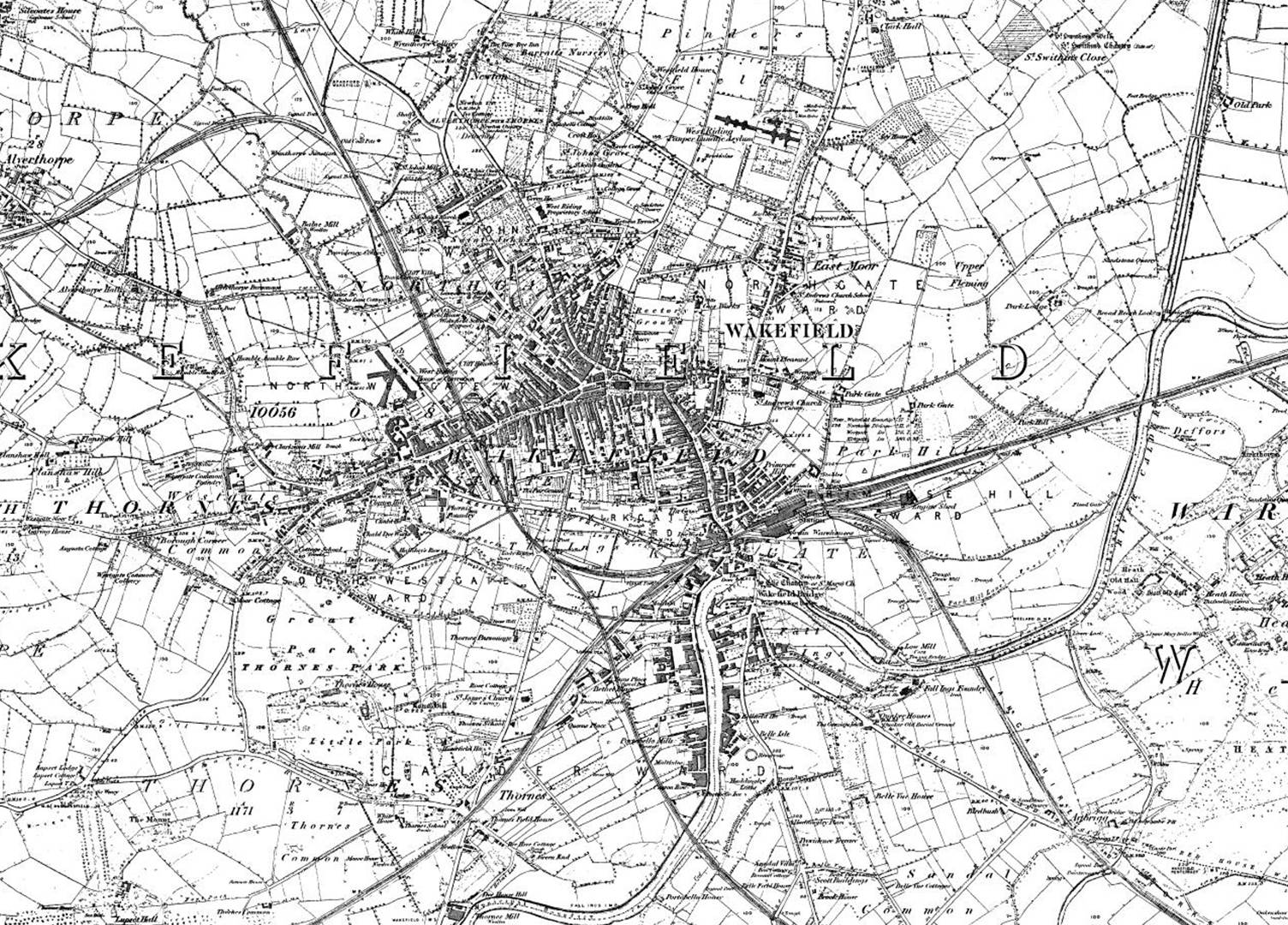

1869
During the
19th century more mines were sunk so that there were 46 small mines
in Wakefield and the surrounding area by 1869. The National Coal
Board eventually became Wakefield's largest employer with Manor Colliery
on Cross Lane and Park Hill colliery at Eastmoor surviving until 1982.
Between 1870-1885
improvements were made on the north side of town around St John's Church now
a conservation area.
1885
Great quantities of barley
were grown in the neighbourhood and in 1885 more malt was made in
Wakefield "than in any district of equal extent in the kingdom".
The market developed in
the streets around the Bull Ring, and the cattle market between George Street
and Ings Road grew to be one of the biggest in the country.
Road transport
using turnpiked roads was important. Regular mail
coaches departed to Leeds, London,
Manchester, York and Sheffield and the 'Strafford Arms' was
an important coaching inn.
By 1885 the streets of the
town were paved and flagged and lit with gas supplied by a company incorporated
in 1822.
1888
In 1888 Wakefield’s parish
church acquired cathedral status.
1889
Wakefield became
the county town of the West Riding of Yorkshire and was the seat of
the West Riding County Council from 1889 until 1974, when the county
and council were abolished, and of the West Yorkshire Metropolitan
County Council from 1974 until its dissolution in 1986
1906
On 2 June
1906, Andrew Carnegie opened a new Wakefield Library on Drury Lane
which had been built with a grant of £8,000 from the Carnegie Trust.
Bibliography