Historical
and geographical information
|
Return to the Home
Page of the Farndale Family Website |
The story of one
family’s journey through two thousand years of British History |
The 83 family lines
into which the family is divided. Meet the whole family and how the wider
family is related |
Members of the
historical family ordered by date of birth |
Links to other pages
with historical research and related material |
The story of the
Bakers of Highfields, the Chapmans, and other related families |
Introduction
Dates are in red.
Hyperlinks to other pages are in dark blue.
Headlines of the history of the Newcastle are in brown.
References and citations are in turquoise.
Contextual history is in purple.
This webpage
about the Newcastle has the following section headings:
·
The
Farndales of Newcastle
·
Newcastle
· South Shields
· Jarrow
The Farndales of Newcastle
The following
Farndales were associated with Newcastle and South Shields: Jane Ellen Farndale
(FAR00458);
John Willie Farndale (FAR00591);
Albert Farndale (FAR00604);
Georgina Farndale (FAR00679);
John Arthur Farndale (FAR00723);
Thomas Farndale (FAR00732);
Joseph Farndale (FAR00739);
Elizabeth Farndale (FAR00758);
William Farndale (FAR00770);
James Farndale (FAR00784);
Emily Farndale (FAR00802);
William A J Farndale (FAR00829);
Margaret L Farndale (FAR00838);
John W Farndale (FAR00854);
Catherine Farndale (FAR00864);
George T Farndale (FAR00871);
Barbara Farndale (FAR00877);
William Farndale (FAR00893);
Janet Farndale (FAR00906);
George H A Farndale (FAR00926);
John H Farndale (FAR00940);
John Farndale (FAR00978);
William Farndale (FAR01013);
Denise Farndale (FAR01020);
John Anthony Farndale (FAR1021);
James Farndale (FAR01022);
John W Farndale (FAR01023);
Janet C Farndale (FAR01025);
Joseph W Farndale (FAR01026);
Maron Farndale (FAR01028);
Margaret E Farndale (FAR01039);
George W Farndale (FAR01040);
and George William Farndale (FAR01209).
The South Shields 2 Line are a
large family who descended from John Willie Farndale (FAR00591)
who settled from Barrow in Furness in the South Shields area (especially
Jarrow) by about 1905. The South
Shields 1 Line was a small family who settled in South Shields in about
1933.
Farndale Master Mariners operating out of Whitby regularly traded coal out of Newcastle in the
nineteenth century.
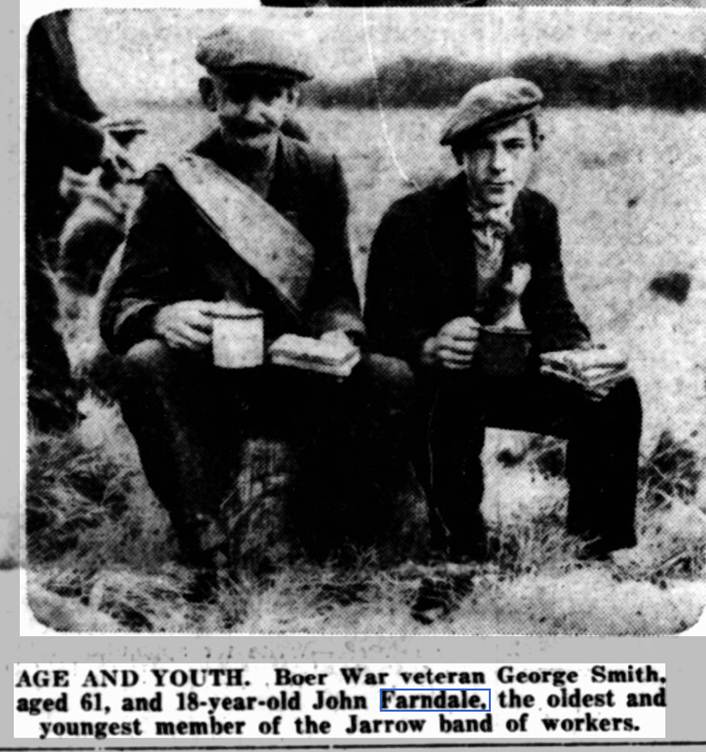
Between 5 and 31 October 1936, John William Farndale was the youngest
member of the 185 men who set off on the Jarrow marches. See his webpage for
more about the Jarrow marches and John’s involvement.
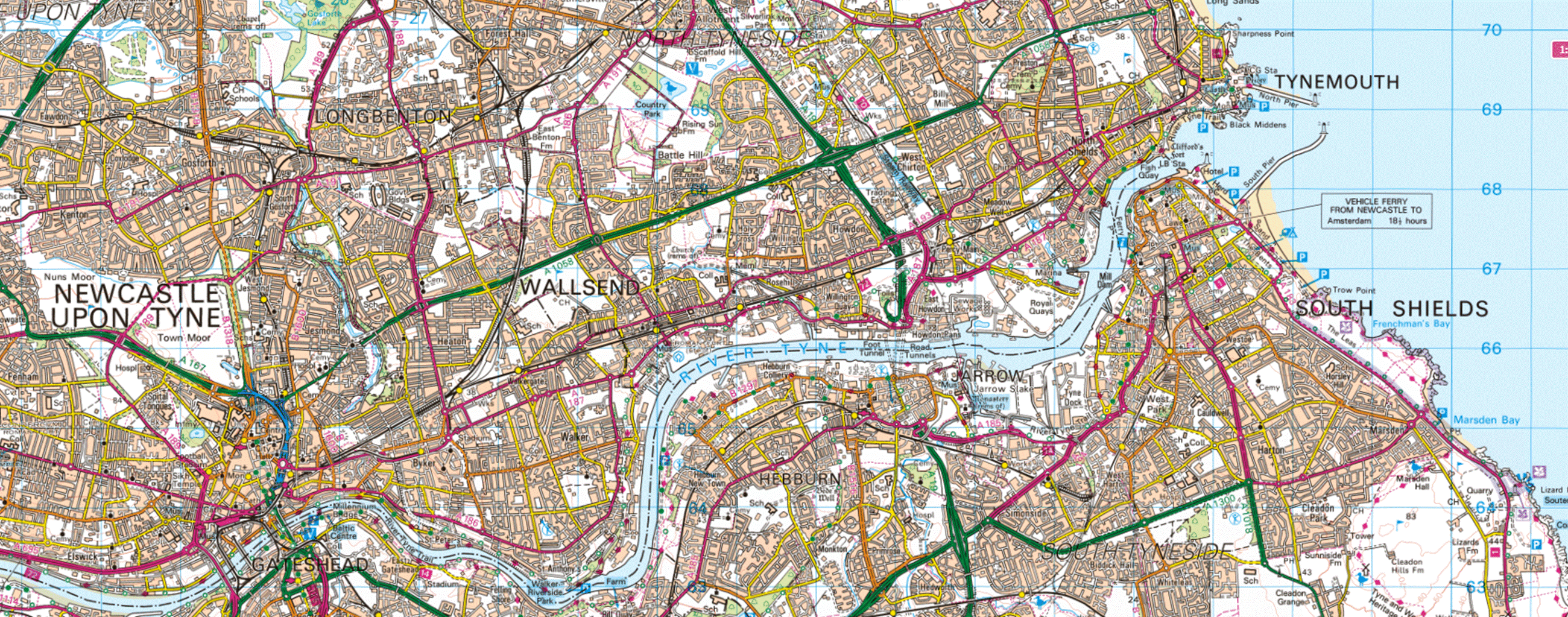
Newcastle
Newcastle upon
Tyne, commonly known as Newcastle, is a city in Tyne
and Wear, North East England, 103 miles south of Edinburgh and
277 miles (north of London on the northern bank of the River Tyne,
8.5 miles from the North Sea. Newcastle is the most populous city in
the North East, and forms the core of the Tyneside conurbation, the
eighth most populous urban area in the United Kingdom.
Newcastle was
part of the county of Northumberland until 1400, when it became
a county of itself, a status it retained until becoming part of Tyne
and Wear in 1974. The regional
nickname and dialect for people from Newcastle and
the surrounding area is Geordie. Newcastle also
houses Newcastle University, a member of the Russell Group,
as well as Northumbria University.
Roman
The city
developed around the Roman settlement Pons Aelius.
1080
Newcastle was
named after the castle built in 1080 by Robert
Curthose, William the Conqueror's eldest son.
Fourteenth
century
The city grew as
an important centre for the wool trade in the 14th century, and later
became a major coal mining area.
Sixteenth
century
The port
developed in the 16th century and, along with the shipyards lower down
the River Tyne, was amongst the world's
largest shipbuilding and ship-repairing centre
1530
From 1530, a
Royal Act restricted all shipments of coal
from Tyneside to Newcastle Quayside, giving a monopoly in the
coal trade to a cartel of Newcastle burgesses known as the Hostmen. This
monopoly, which lasted for a considerable time, helped Newcastle prosper and
develop into a major town.
1538
The
phrase taking coals to Newcastle was first recorded contextually in
1538. The phrase itself means a pointless pursuit.
In the 18th
century, the American entrepreneur Timothy
Dexter, regarded as an eccentric, defied this idiom. He was
persuaded to sail a shipment of coal to Newcastle by merchants plotting to ruin
him; however, his shipment arrived on the Tyne during a strike that had
crippled local production, allowing him to turn a considerable profit.
In the Sandgate
area, to the east of the city, and beside the river, resided the close-knit
community of keelmen and their
families. They were so called because they worked on the keels, boats that
were used to transfer coal from the river banks to the waiting colliers, for export to London and elsewhere.
1636
In the 1630s,
about 7,000 out of 20,000 inhabitants of Newcastle died of plague, more
than one-third of the population. Specifically within the year 1636, it is
roughly estimated with evidence held by the Society of
Antiquaries that 47% of the then population of Newcastle died from the
epidemic. This may also have been the most devastating loss in any British city
in this period.
1644
During
the English Civil War, the North declared for the King. In a bid to
gain Newcastle and the Tyne, Cromwell's allies, the Scots, captured
the town of Newburn.
In 1644, the Scots then captured the reinforced fortification on the Lawe
in South Shields following a siege and the city was besieged for
many months. It was eventually stormed "with roaring drummes" and sacked by Cromwell's allies. The
grateful King bestowed the motto "Fortiter Defendit
Triumphans" ("Triumphing by a
brave defence") upon the town. Charles I was imprisoned in Newcastle by
the Scots in 1646–7.
Eighteenth
century
In the 18th
century, Newcastle was the country's fourth largest print centre after
London, Oxford and Cambridge, and the Literary and Philosophical Society of
1793 with its erudite debates and large stock of books in several
languages, predated the London Library by half a century.
Newcastle also
became a glass producer with a reputation for brilliant flint glass.
1806
A permanent
military presence was established in the city with the completion of Fenham Barracks in 1806.
1817
In 1817 the
Maling company, at one time the largest pottery company in the world, moved to
the city.
1842
The Victorian
industrial revolution brought industrial structures that included
the 2 1⁄2-mile (4 km) Victoria Tunnel, built in 1842,
which provided underground wagon ways to the staithes.
1832
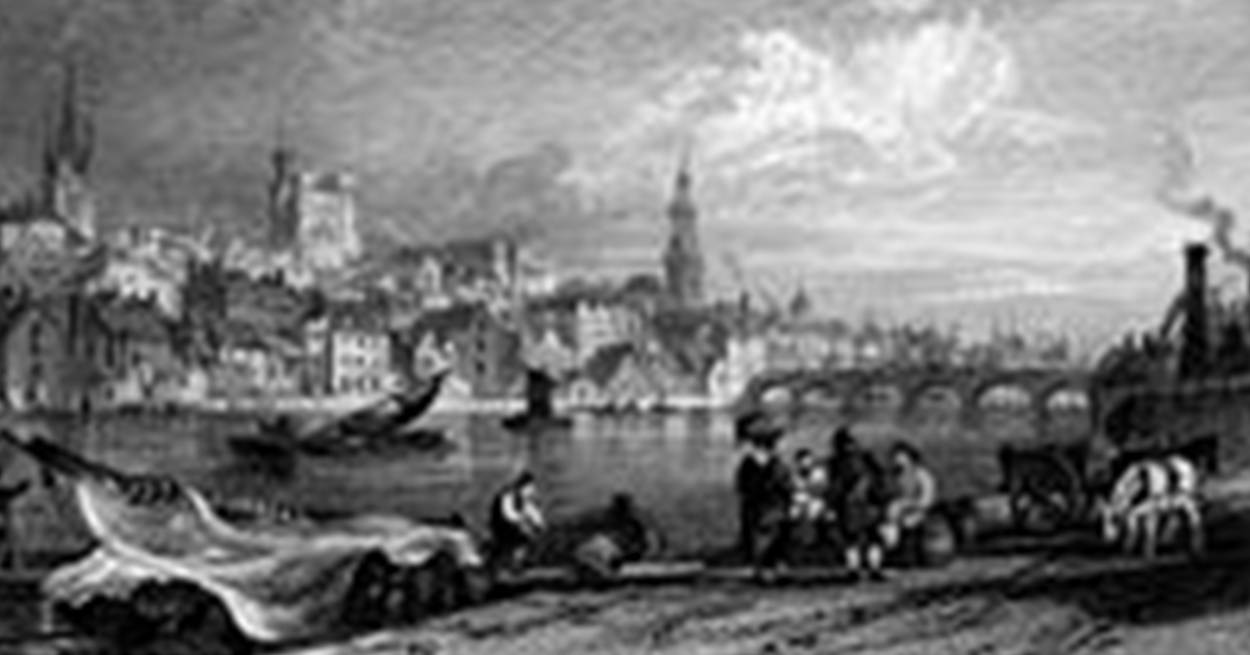
An engraving
by William Miller of Newcastle in 1832
1854
The Great
fire of Newcastle and Gateshead was a tragic and spectacular series of
events starting on Friday 6 October 1854, in which a substantial amount of
property in the two North East of England towns was destroyed in a series of
fires and an explosion which killed 53 and injured hundreds.
1879
On 3 February
1879, Mosley Street in the city, was the first public road in the world to be
lit up by the incandescent lightbulb. Newcastle was one of the first
cities in the world to be lit up by electric lighting. Innovations in
Newcastle and surrounding areas included the development of safety
lamps, Stephenson's Rocket, Lord Armstrong's
artillery, Be-Ro flour, Joseph Swan's electric
light bulbs, and Charles Parsons' invention of the steam
turbine, which led to the revolution of marine propulsion and the production
of cheap electricity.
1882
The status of
city was granted to Newcastle on 3 June 1882.
In the nineteenth
century, shipbuilding and heavy engineering were central to
the city's prosperity and the city was a powerhouse of the Industrial Revolution. This
revolution resulted in the urbanisation of the city.
In 1882,
Newcastle became the seat of an Anglican diocese, with St. Nicholas'
Church becoming its cathedral.
1886
Based at St
James' Park since 1886, Newcastle United
F.C. became Football League members in 1893. They have won
four top division titles (the first in 1905 and the most recent in 1927),
six FA Cups (the first in 1910 and the most recent in 1955) and
the Inter-Cities Fairs Cup in 1969. They broke the world
transfer record in 1996 by paying £15 million for Blackburn
Rovers and England striker Alan Shearer, one of the most
prolific goalscorers of that era.
1901
Newcastle's
public transport system was modernised in 1901 when Newcastle Corporation
Tramways electric trams were introduced to the city's streets, though
these were replaced gradually by trolley buses from 1935, with the tram service
finally coming to an end in 1950.
With the advent
of the motor car, Newcastle's road network was improved in the early part of
the 20th century, beginning with the opening of the Redheugh
road bridge in 1901 and the Tyne Bridge in 1928.
1904
The city acquired
its first art gallery, the Laing Art Gallery in 1904, so named after
its founder Alexander Laing, a Scottish wine and spirit merchant who
wanted to give something back to the city in which he had made his fortune.
Another art gallery, the Hatton Gallery (now part of Newcastle
University), opened in 1925.
1917

Newcastle city
centre, 1917
1920
Council
housing began to replace inner city slums in the 1920s, and the process
continued into the 1970s, along with substantial private house building and
acquisitions.
1930s
Unemployment hit
record heights in Newcastle during the Great Depression of the 1930s.
1934
Efforts to
preserve the city's historic past were evident as long ago as 1934, when the
Museum of Science and Industry opened, as did the John G Joicey Museum in
the same year.
1939
During the Second
World War the city and surrounding area were a target for air raids as heavy
industry was involved in the production of ships and armaments. The raids
caused 141 deaths and 587 injuries. A former French consul in Newcastle called
Jacques Serre assisted the German war effort by describing important targets in
the region to Admiral Raeder who was the head of the German Navy.
1956
The city's last
coal pit closed in 1956, though a temporary open cast mine was opened in
2013. The temporary open cast mine shifted 40,000 tonnes of coal, using
modern techniques to reduce noise, on a part of the City undergoing
redevelopment. The slow demise of the shipyards on the banks of
the River Tyne happened in the 1970s, 1980s, and 1990s.
View northwards
from the Castle Keep, towards Berwick-on-Tweed in 1954
1960s
The public sector
in Newcastle began to expand in the 1960s. The federal structure of
the University of Durham was dissolved. That university's colleges in
Newcastle, which had been known as King's College, became the University of
Newcastle upon Tyne (now known as Newcastle University), which was founded
in 1963, followed by a Newcastle Polytechnic in 1969; the latter received
university status in 1992 and became the Northumbria University.
1983
Further efforts
to preserve the city's historic past continued in the later twentieth century,
with the opening of Newcastle Military Vehicle Museum in 1983
and Stephenson Railway Museum in 1986. The Military Vehicle museum
closed in 2006. New developments at the turn of the 21st century included
the Life Science Centre in 2000 and Millennium Bridge in
2001.
South Shields
South
Shields is a coastal town in the North East of England at the
mouth of the River Tyne, about 3.7 miles
downstream from Newcastle upon Tyne. Historically part
of County Durham, it became part of Tyne and Wear in 1974.
According to the 2011 census, the town had a population of 76,498, the third
largest in Tyneside after Newcastle and Gateshead. It is part of
the metropolitan borough of South Tyneside which includes
the towns of Jarrow and Hebburn. The demonym of
a person from South Shields is either a Geordie or
a Sand dancer.
Pre
historic
The first
evidence of a settlement within what is now the town of South Shields dates
from pre-historic times. Stone Age arrow heads and an Iron
Age round house have been discovered on the site of Arbeia Roman Fort.
160 CE
The Roman
garrison built a fort here around 160 CE and expanded it around 208 CE to
help supply their soldiers along Hadrian's Wall as they campaigned
north beyond the Antonine Wall. Divisions living at the
fort included Tigris bargemen from Persia and modern day Iraq, infantry from
Iberia and Gaul, and Syrian archers and spearmen.
Fourth
century CE
The fort was
abandoned as the Roman Empire declined in the 4th century CE. Many
ruins still exist today and some structures have been rebuilt as part of a
modern museum and popular tourist attraction.
Post
Roman
There is evidence
that the site was used in the early post-Roman period as a British settlement.
It is believed it became a royal residence of King Osric of Deira; records
show that his son Oswin was born within 'Caer Urfa', by which name the fort is
thought to be known after the Romans left.
647 CE
Bede records
Oswin giving a parcel of land to St Hilda for the foundation of a
monastery here in c.647; the present-day church of St Hilda, by the
Market Place, is said to stand on the monastic site.
Ninth
century CE
In the 9th
century, Scandinavian peoples made Viking raids on
monasteries and settlements all along the coast, and later conquered the
Anglian Kingdoms of Northumbria, Mercia and East Anglia. It is said in local
folklore that a Viking ship was wrecked at Herd Sands in South Shields in its
attempts to disembark at a cove nearby. Other Viking ships were uncovered in
South Shields Denmark Centre and nearby Jarrow.
1245
The current town
was founded in 1245 and developed as a fishing port. The name South
Shields developed from the Schele or 'Shield', which was a small
dwelling used by fishermen.
Another industry
that was introduced, was that of salt-panning, later expanded upon in the
fifteenth century, polluting the air and surrounding land.
1642
In 1864, a Tyne
Commissioners dredger brought up a nine-pounder breech-loading cannon; more
cannonballs have been found in the sands beside the Lawe; these artifacts
belonged to the English civil war. At the outbreak of the war in 1642,
the North, West and Ireland supported the King;
the South East and Presbyterian Scotland supported
Parliament. In 1644 Parliament's Scottish Covenanter allies, in
a lengthy battle, seized the town and its Royalist fortification, the
fortification was close to the site of the original Roman fort. They also
seized the town of Newburn. These raids were done to aid their
ongoing siege of the heavily fortified Newcastle upon Tyne, and in a bid to
control the River Tyne, and the North, and the Shields siege helped cause their
battalions to manoeuvre south to York; this may have also led to a brief winter
skirmish on the outskirts of Boldon, though the topography is not
favourable for a battle.
Nineteenth
century
In the 19th
century, coal mining, alkaline production and glass making led to a boom in the
town.
1801
The population
was 12,000 in 1801
1832
With the Great
Reform Act, South Shields and Gateshead were each given their own
Member of Parliament and became boroughs, resulting in taxes being paid to the
Government instead of the Bishops of Durham.
The rapid growth
in population brought on by the expansion of industry made sanitation a
problem, as evident by Cholera outbreaks and the building of the now-listed
Cleadon Water Tower to combat the problem.
1850s
'The Tyne
Improvement Commission' began to develop the river, dredging it to make it
deeper and building the large, impressive North and South Piers to help
prevent silt build up within the channel. Shipbuilding (along with coal
mining), previously a monopoly of the Freemen of Newcastle, became another
prominent industry in the town, with John Readhead &
Sons Shipyard the largest.
1861
The population
had increased to 75,000, bolstered by economic migration
from Ireland, Scotland and other parts of England.
1916
During World
War I, German Zeppelin airships bombed South Shields in 1916.
1939
During World
War II, the German Luftwaffe repeatedly attacked the town and caused massive
damage to industries which supported the war effort, killing many innocent
residents. Particularly, a bomb shelter in the market place of South Shields,
where the deceased were commemorated in a cobblestone of the British flag.
Twentieth
century
Gradually
throughout the late 20th century, the coal and shipbuilding industries were
closed during the Thatcher political era, due to competitive pressures from
more cost effective sources of energy and competitive shipbuilding in Eastern
Europe and in South East Asia.
Jarrow
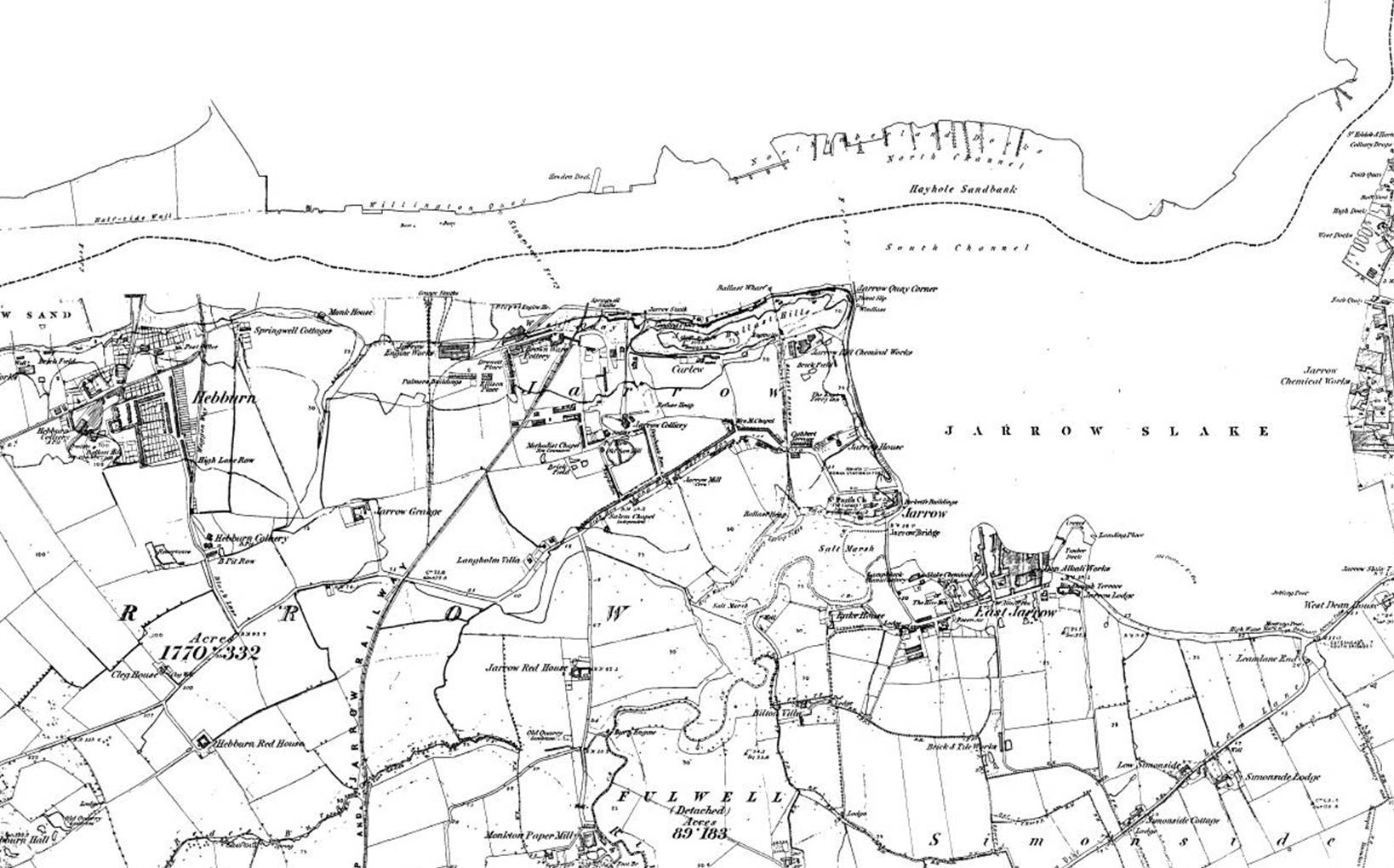
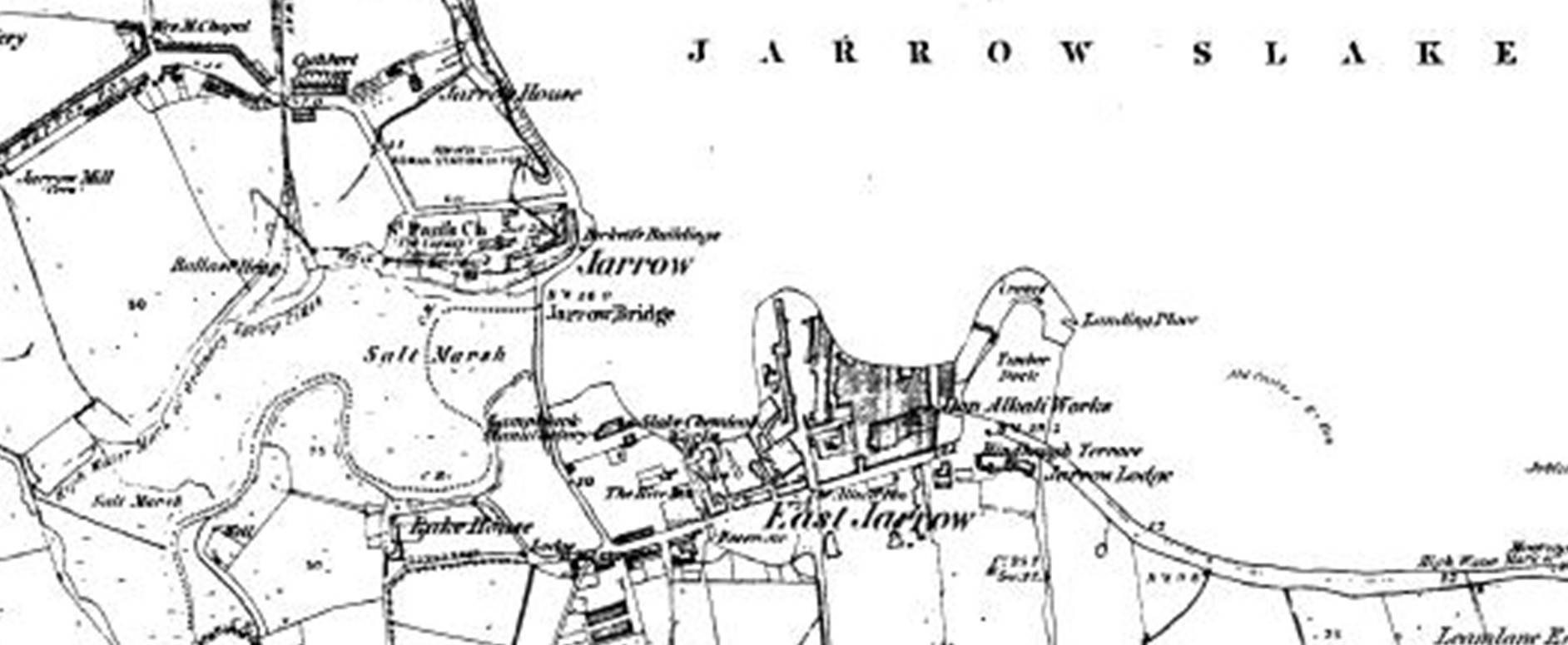
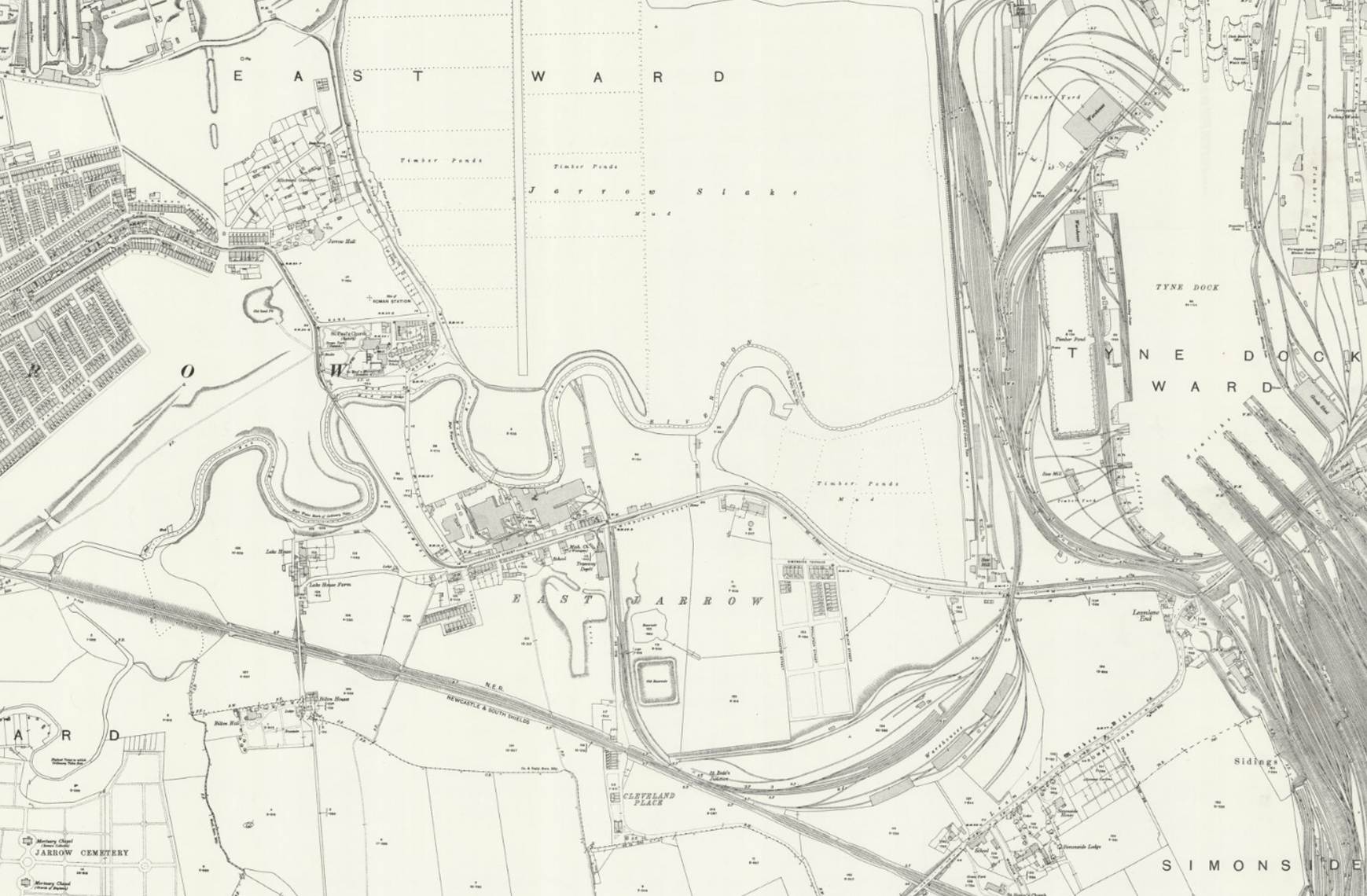
Jarrow is a town
in South Tyneside in the county of Tyne and Wear, England. It is on the south
bank of the River Tyne, about 3 miles from the east coast.
731 CE
In the eighth
century, the monastery of Saint Paul of Tarsus in Jarrow (now Monkwearmouth,
Jarrow Abbey) was the home of The Venerable Bede, who is regarded as the
greatest Anglo-Saxon scholar and the father of English history. Bede’s whose
most notable works include Ecclesiastical History of the English People
and the translation of the Gospel of John into Old English. Along with the
abbey at Wearmouth, Jarrow became a centre of learning and had the largest
library north of the Alps, primarily due to the widespread travels of Benedict
Biscop, its founder.
750 CE
The town's name
is recorded around 750 CE as Gyruum, from Old
English Gyrwum " the marsh
dwellers", and from gyr meaning
"mud" or "marsh". Later spellings are Jaruum
in 1158, and Jarwe in 1228. In the
Northumbrian dialect it is known as Jarra.
794 CE
In 794 Jarrow
became the second target in England of the Vikings, who had plundered
Lindisfarne in 793.
Nineteenth
century
From the middle
of the 19th century until 1935, Jarrow was a centre for shipbuilding.
Jarrow remained a
small mid-Tyne town until the introduction of heavy industries such as coal
mining and shipbuilding.
1852
Charles Mark
Palmer established a shipyard, Palmer's Shipbuilding and Iron Company, in 1852
and became the first armour-plate manufacturer in the world.
John Bowes, the
first iron screw collier, revived the Tyne coal trade, and Palmer's was also
responsible for the first modern cargo ship, as well as a number of notable
warships.
Around 1,000
ships were built at the yard, they also produced small fishing boats to catch
eel within the River Tyne, a delicacy at the time.
1857
1904
Jarrow Town Hall
was erected in Grange Road and officially opened in 1904.
1915
The Jarrow rail
disaster was a train collision that occurred on the 17 December 1915 at the
Bede junction on a North Eastern Railway line. The collision was caused by a
signalman's error and seventeen people died in the collision.
1918
1920s
Although the First World War
caused an economic boom in Britain, it masked a slow industrial decline from
the country's Victorian heyday. As wartime demands gradually fell away, these
failings again came to the fore and during 1920 Britain was plunged into an
economic slump accompanied by high levels of unemployment and poverty.
1929
The situation was made far worse
by the world-wide recession of 1929 and, having remained relatively constant,
though high, at 10% throughout the 1920's, unemployment peaked at 22% in 1932.
Britain's traditional industries
were particularly hard hit meaning that the North of
England, Wales and Scotland, which had economies heavily dependent
upon manufacturing, were disproportionately affected by the slump. This meant
that these regions actually suffered far higher levels of
unemployment than those suggested by the national average. And the effects were
long-lasting, rather than following a regular economic cycle of prosperity and
recession.
During the 1920's, the National
Unemployed Workers' Movement (“NUWM”) organised a serious of 'hunger marches'
to London in the hope that these would force the Government to radically
rethink its economic policies. The term 'hunger march' was a recent one, first
coined to describe a march by London's poor in 1908. The marches achieved
nothing, however, the official view being that they were
being high-jacked to serve the aims of their 'Communist' organisers.
1932
The end of the world-wide
recession in 1932 allowed Britain to begin a slow path to recovery.
1936
By 1936, economic growth had
reached 4% and mini-booms were being seen in housing and consumer
spending. The recovery was badly uneven, however, with those areas which had
seen their traditional employers devastated during the slump slow to see any
improvement.
The town of Jarrow, lying on the
southern bank of the River Tyne, had undergone a massive period of
expansion during the Victorian era. However its economy was based on
precisely those industries - iron, steel, shipbuilding - which were so badly
hit by the recent depression. Charles Mark Palmer, the so-called 'King of
Jarrow', had created an industrial empire in the town but gradually each of
these businesses failed in turn. Unemployment stood at 3,300 in 1930 (75% of
the working population) and at 6,793 in 1932 (80% of the insured population).
When Palmer's Shipyard failed in 1934, the town lost its last purpose for
existing. As the town's newly elected MP, the firebrand 'Red Ellen' Wilkinson,
so forcefully pointed out in the Commons in December,1935: "The years
go on and nothing is done ... this is a desperately urgent matter and something
should be done to get work to these areas which, heaven knows, want work."
The hunger-march had become an
accepted form of protest and in July 1936 the town's political
leaders set in progress plans to mount a march from Jarrow to deliver a
petition to Parliament calling for the opportunity to work.
Over 1,200 men came forward to
take part, but it was decided to limit numbers to the 200 fittest and hardiest
to make the logistics manageable. A fund was started to pay for supplies
and equipment and this would continue to collect donations as the men
marched south. Rallies were scheduled for the march's overnight stops to spread
the word of what it was trying to achieve. As one marcher put it: "We
were more or less missionaries of the distressed areas, [not just] Jarrow."
On Monday, 5 October, the date set
for the start of the March, the Marchers received the blessing of the Bishop of
Jarrow at a dedication service in Christ Church. This gained the venture a
boost in credibility, but the service was condemned by Hensley Henson, the
Bishop of Durham, who was unflinchingly opposed to the Trades Union movement
and Socialism. Henson condemned the hunger marches as a whole
as nothing but a vehicle for the Labour Party and his colleague in Jarrow,
James Gordon, was later obliged to state that the service was not intended to
condone the March. To add injury to insult, the Marchers later discovered that
their dole had been stopped as the March had made them unavailable for work!
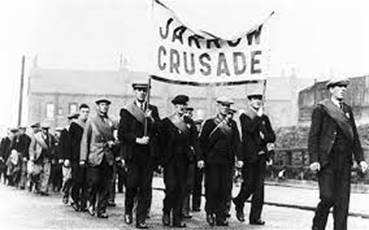
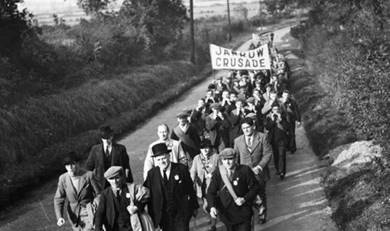
Immediately after the service, the
Marchers assembled at Jarrow Town Hall and made their last preparations before
setting off. Although 200 men had been accepted for the venture, only 185 made
it to the start-line due to sickness, changes in personal circumstance, etc.
Around half of those taking part were veterans of the First World War and the
Marchers walked in step and in military ranks to show their discipline and
proclaim their past service. They took a 10-minute break every hour, in the
military manner, and a harmonica band encouraged the singing of popular songs
of the day to keep their spirits up. Before them they carried a blue-and-white
banner proclaiming the ‘Jarrow Crusade’ though in Jarrow it was never known as
anything other than ‘The March’. Again in the military tradition,
behind them followed a bus with a field kitchen, a medical facility, and
camping equipment for when beds were not available.
It would be a mistake to think
that the Jarrow March took place in isolation. The sixth National Hunger March
was setting off from 6 regional centres and these were due to unite in London a
week after the arrival of the Jarrow men. Meanwhile, a group of blind veterans
were marching in protest at the treatment of the nation’s 67,000 registered
blind persons. The National Marches were seen as hostile and confrontational,
and this undoubtedly aided the high level of publicity given to the Jarrow
March which, by contrast, was recognised for its moderation and quiet dignity.
Ellen Wilkinson temporarily left
the march at its first stopping point, in Chester-le-Street,
to attend the Labour Party's annual conference in Edinburgh. Although it was
proclaimed to be non-political, the Jarrow March was very much a product of the
town’s Labour Council and she may have hoped to gain some support
from her colleagues. In this she was to be disappointed, however. The
Parliamentary Labour Party (“PLP”) was a minority part of the National
Government of the time and anxious to distance itself from any accusations of
‘Communism’. So, neither this nor the Trade Union Congress (“TUC”) would offer
its endorsement. David Riley, the Chairman of Jarrow
Borough Council and a leading light in the organisation of the March,
later complained that they felt that they had been "stabbed in the
back".
As they moved south, the reception
extended to the Marchers varied from indifferent to warm and welcoming. Local
accommodation was secured in a series of Schools, Church Halls or
other spacious buildings, and often gifts were made of food and clean clothing.
What soon became clear was that the reception received bore no link to the
political affiliation of the local Councils and the organisers of the March
were at pains to avoid any action that might alienate any political body. Often
the weather was bad, cold with driving rain.
Very quickly the March began
attracting wide publicity and the Government in London, afraid that it was
gaining Royal attention, acted to limit sympathy for it, claiming that such
Marches only resulted in “unnecessary hardship for those taking part in them”.
Wilkinson continued to push for an official reception for the Marchers,
but received no encouragement from Prime Minister Stanley Baldwin during
heated exchanges in the Commons. In truth Baldwin was in an impossible
position, for opening Parliament’s doors to the Jarrow Marchers would have set
a dangerous precedent.
The March reached Edgware in
northern London on Friday, 30 October, leaving a relatively short 8-mile walk
to Marble Arch the following day. It had been denied permission to deliver its
petition to Parliament and so Ellen Wilkinson had to make the last stage of the
journey alone. The original petition, calling for Government aid for the Town,
had 11,000 signatures and was carried in an oak box. An additional petition had
been made available to those who had wanted to sign on the way.
A new session in the House of
Commons was convened on 3 November – the March had been timetabled to take
advantage of this – and next day the Petition was presented. A (very) brief
discussion followed after which the House returned to its normal
business.
The March garnered a lot of
publicity, a lot of soft words, but achieved little real change. This was not
lost on the marchers themselves and the return journey home by train was a
sombre affair.
1939
Not until the outbreak of the
Second World War in 1939 did the Town start to recover from its long period of
depression. When ‘Red Ellen’ published her history of Jarrow that same year she
titled it: "The Town that was Murdered”.
Bibliography