The Mariners of Whitby
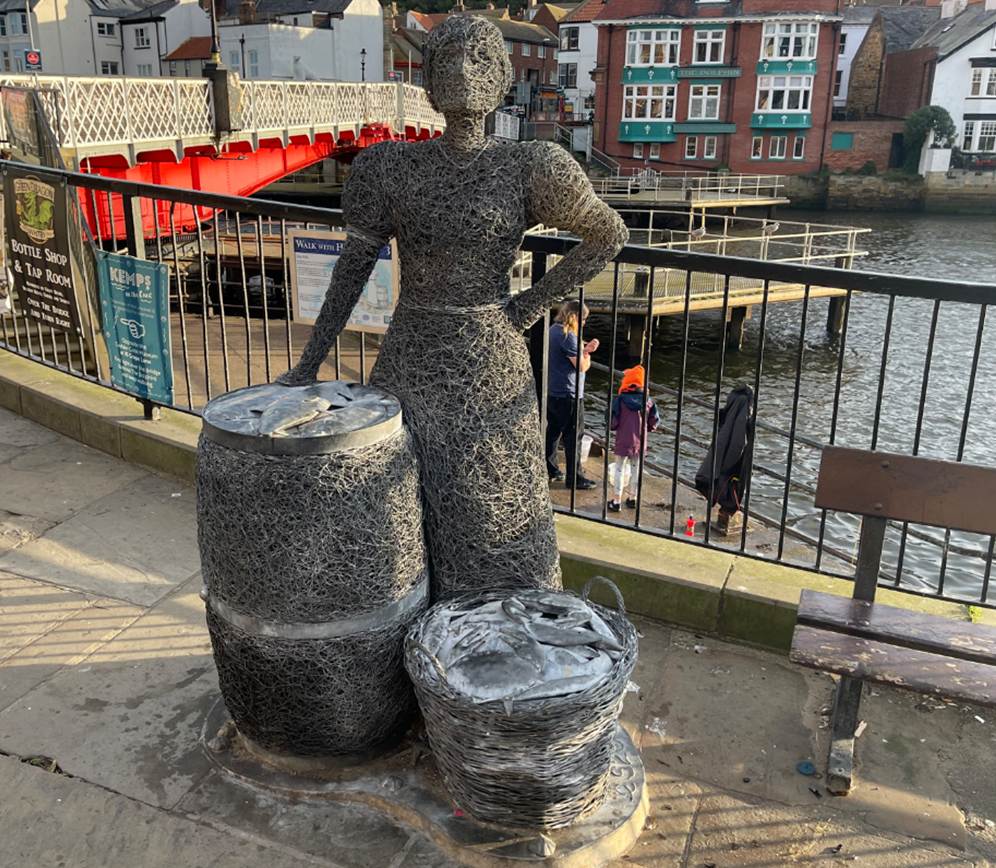
The story of the Whitby Farndales and
their maritime adventures
|
As a mood setter, you
might enjoy some music before you read this page. |
Orientation
Having
arrived in Cleveland the family settled in Kirkleatham
and Skelton and became
associated with small towns such as Moorsholm
and Liverton. We have met two family hubs
who then settled for six or seven generations in Kilton, Brotton
and Loftus and more widely across
Cleveland.
Now we will
meet the third hub, those who were drawn to the thriving port of Whitby.
In the
seventeenth and eighteenth centuries Cleveland was a rural landscape, like the
lands south of the moors which the family had left. So over time, there was
adventure to be had by leaving the farmland of Moorsholm,
Liverton, and later Kilton to find new opportunities in the
thriving port of Whitby.
We will meet
several master mariners in this Act. A master mariner held an unlimited license
to serve as the master of a merchant ship of any size, of any type, operating
anywhere in the world, and it reflected the highest level of professional
qualification amongst mariners and deck officers. The term master mariner has
been in use at least since the thirteenth century. In guild or livery company
terms, such a person was a master craftsman in this specific profession,
equivalent to master carpenters, master blacksmiths and other such people. In
the British Merchant Navy a master mariner who had sailed in command of an
ocean going merchant ship was titled Captain, although a professional seafarer
who held a restricted or limited master's certificate who had sailed in command
of a ship also tended to be referred to as a captain. Where the movements of
ships were recorded in the shipping news and other media, the name of the ship
was followed by the name of the Captain.
Scene 1 – Of Carpenters, Weavers and
Sailors
The time
has come, the Walrus said, to talk of many things, of shoes and ships and
sealing-wax, of cabbages and kings and why the sea is boiling hot and whether
pigs have wings[1].
|
1636 to 1832 Whitby and around |
|
1711 to
1827 Whitby and
around |
The first of
the family to appear in the records in Whitby
was John
Farndale (1637 to 1712) who married Alice Peckock of Whitby on 19 November 1661[2].
He was probably the son of Rychards and Emmie ffarnedayle
(1604 to c1685) of the Liverton 1
Line who we met in Act 12.
Poor Alice died only two years after she married John, and she was buried in Whitby on 28 November 1663[3].
A decade later John
married Margarita Herd in Whitby on 25
November 1673[4].
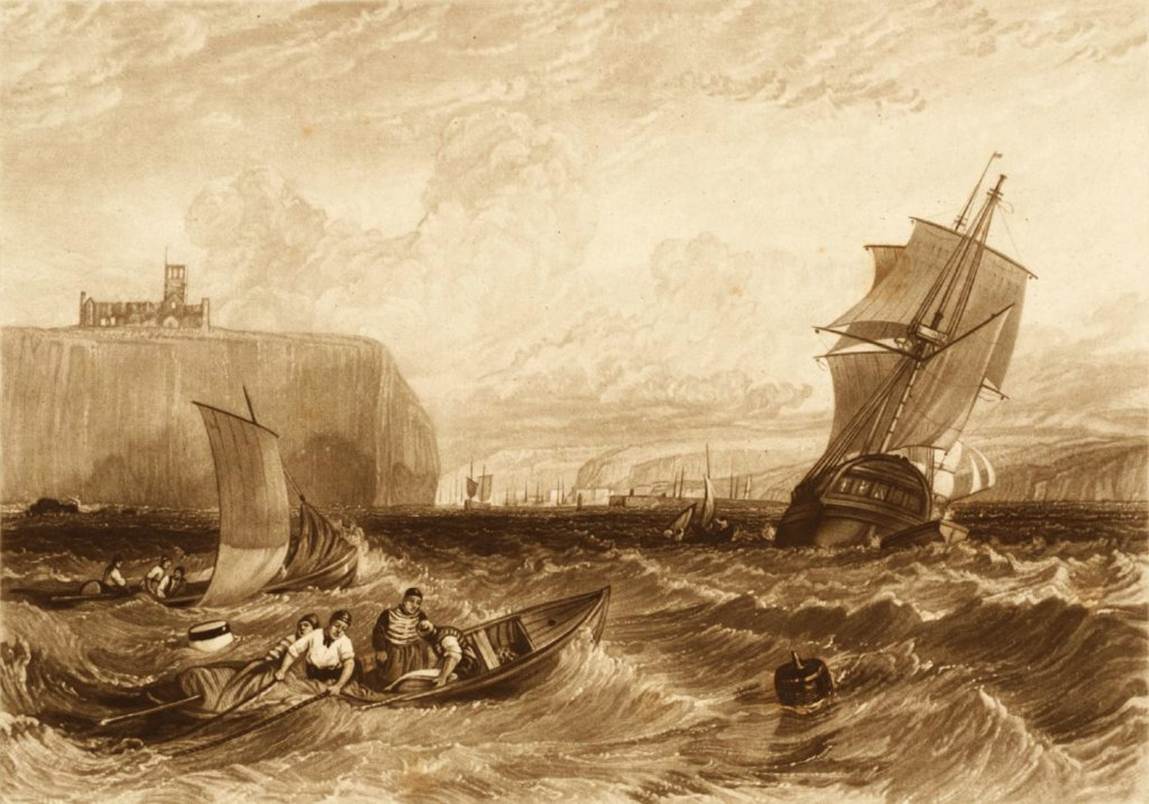
In the
1660s, Whitby was a developing port town, heavily reliant on the growing alum
trade and coal, with a natural harbour divided by the River Esk. The iconic,
ruined Whitby Abbey stood on the East Cliff, overlooking a town with narrow,
winding streets and red-tiled roofs. Whitby was connected to the world by its
maritime activities and developing fishing and whaling fleets, a port ready for
future growth.
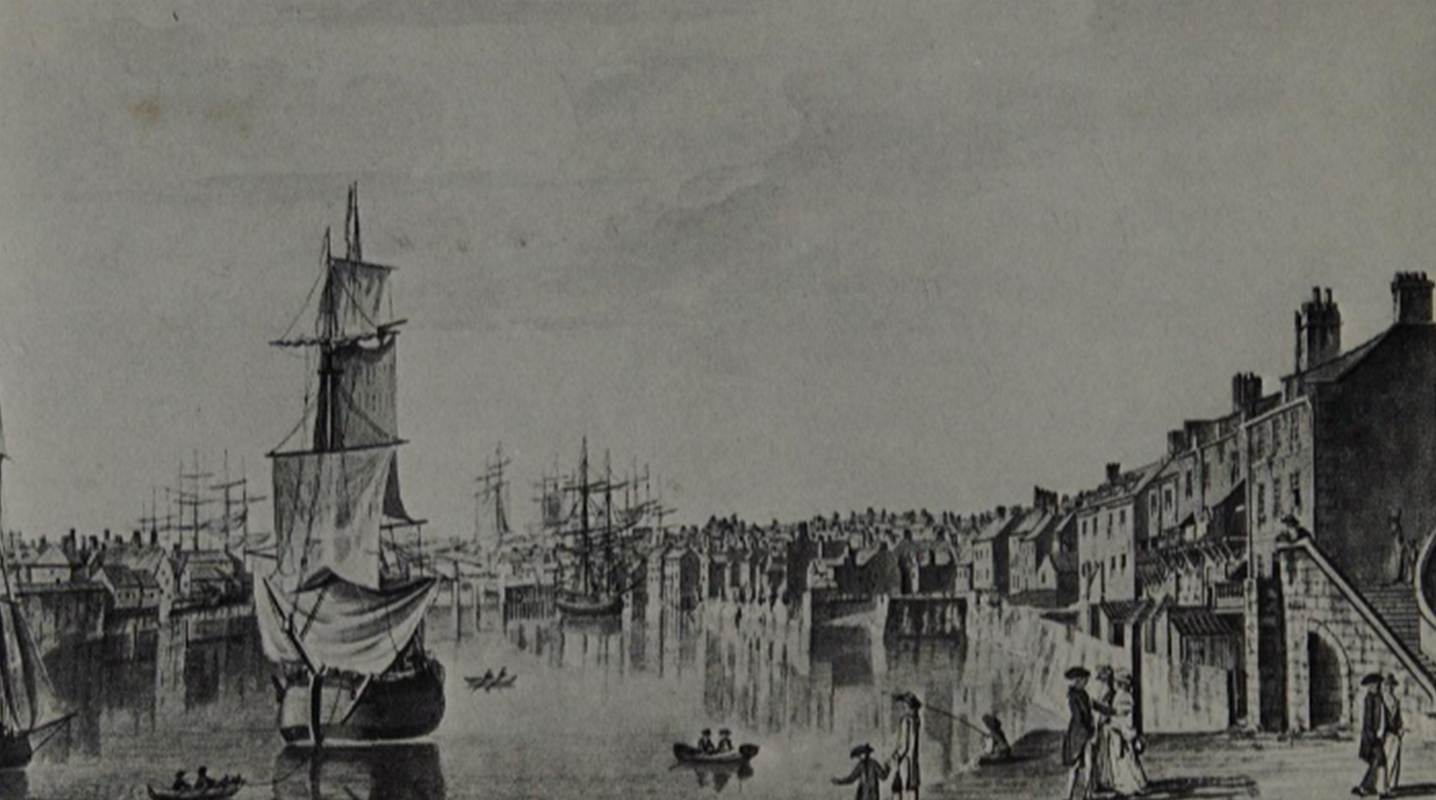
Whitby soon
became a centre for wooden shipbuilding. By the 1790s Whitby had become the
third largest producer of merchant ships in England. The town's shipyards
produced sturdy, flat-bottomed coal cat barks, designed to carry bulky
goods like coal and capable of beaching without a quay or dock. These were the
types of vessels that would later be used by Captain James Cook for his famous
voyages, including the HMS Endeavour.
The port
expanded its activities to include whaling. The first whaling ship set sail for
Greenland from Whitby in 1753, beginning an industry that would become dominant
in the town.
Whitby
developed a reputation for training skilled and disciplined seamen. Young men,
including Cook in 1746, arrived to apprentice with Quaker shipowners like John
and Henry Walker. The lack of a traditional grammar school meant education was
commercially and mathematically oriented, honing the skills of navigators and
cartographers.
Taxes levied
on ships using the port helped fund the improvement and extension of the town's
piers, which enhanced the harbour and allowed for further trade increases. This
commercial success led to significant population growth, the building of grand
houses for the wealthy merchants, and an influx of apprentices and workers.
The
eighteenth century was a golden age for the maritime prosperity of Whitby.
|
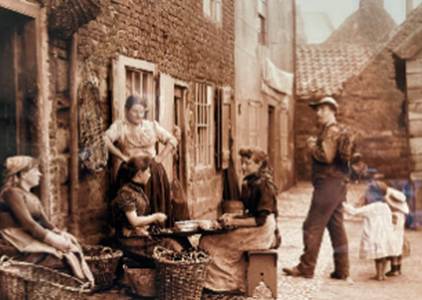
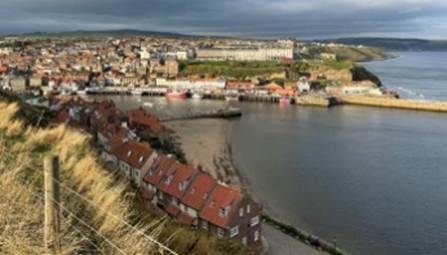
A history of Whitby at the
height of its maritime power in the eighteenth and nineteenth century, home
to several large Farndale families. A look back to the Anglo Saxon
history of Whitby in the time of Celtic and Roman Christianity |
|
The
place of Dracula inspiration where many Farndales have been buried, provides
a vantage point over Whitby, and its maritime activity |
|
|
John and Margarita
had a daughter, also called Margarita,
and five sons. Their family were the
Whitby 1 Line.
The Naval
Officer’s family
John and
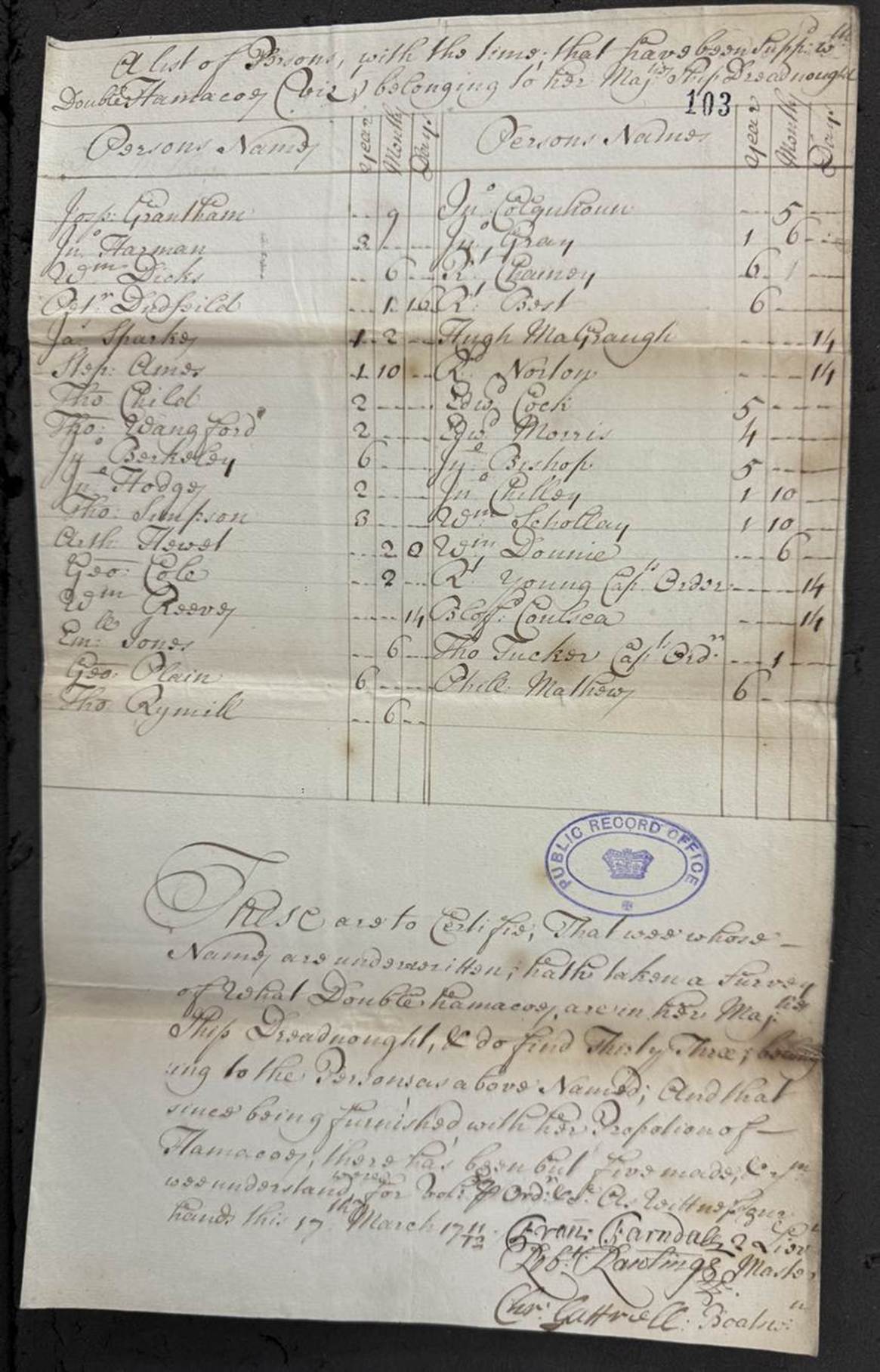
Margherita’s fifth child was Second Lieutenant
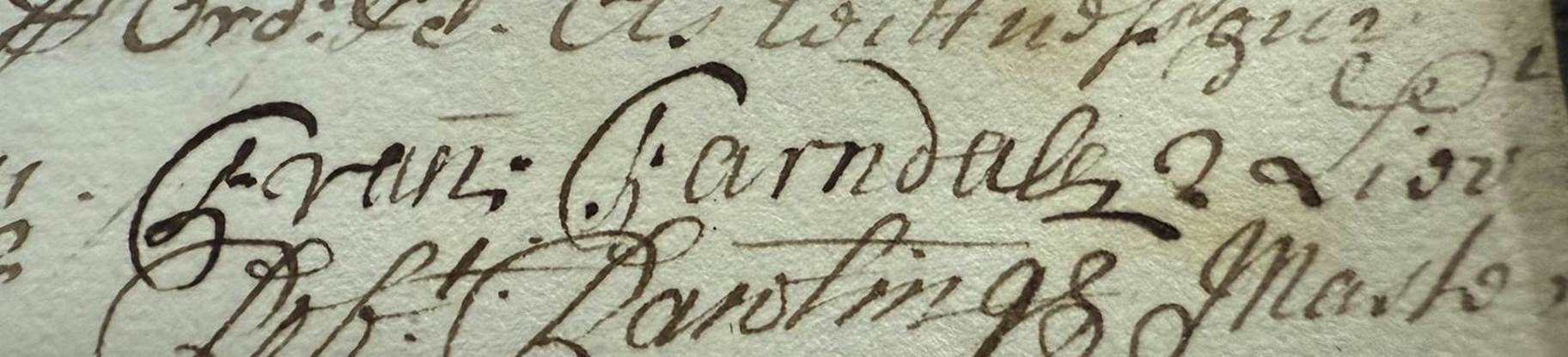
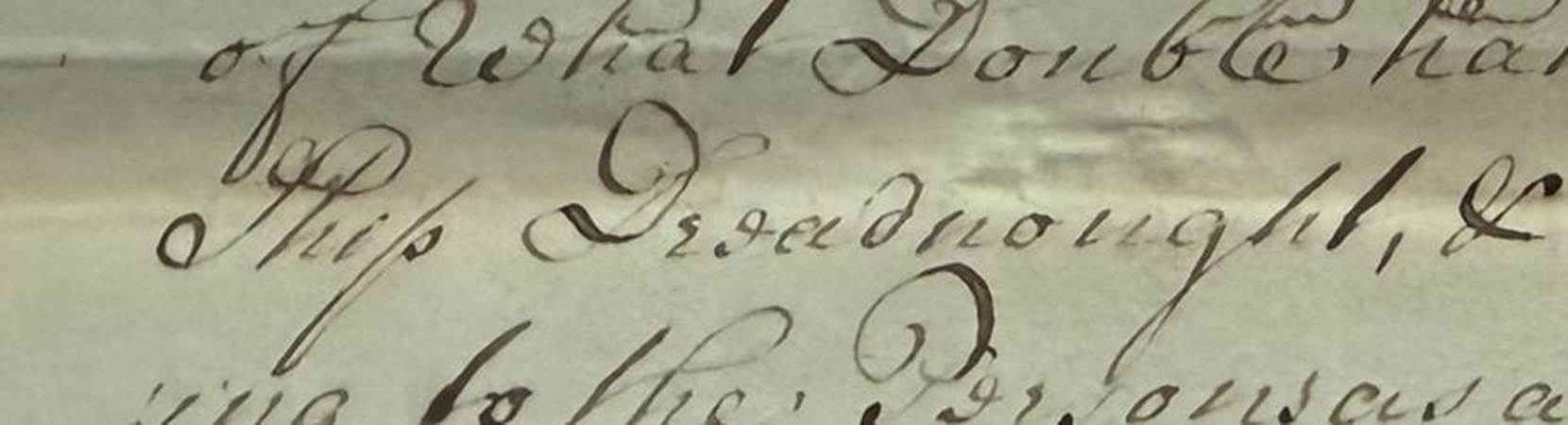
Francis Farndale RN, an officer on the Dreadnaught in 1712 who
signed off a list of 32 men who had been issued with hammocks[5].
It seems likely that Second Lieutenant Farndale served on HMS Dreadnought
III, a 64 gun third rate ship of the line of the Royal Navy launched at
Blackwall Yard in 1691. The vessel was a capable and common type of warship
during this period, used for a variety of roles including fleet battles, convoy
escort, and patrolling distant stations. She earned a battle honour for her
participation in the decisive Battle of Barfleur in
1692, a key engagement in the Nine Years' War where the English and Dutch
fleets secured command of the sea from the French. She had been reduced to a
fourth rate ship in 1697. During the War of the Spanish Succession (1701 to
1714), the ship was actively involved in operations in European waters, and
this was when Francis Farndale served aboard as an officer. She had been
rebuilt in 1706, a common practice to extend the lifespan of valuable wooden
ships, keeping her in service for further conflicts. By 1712, she was an
active, though aging, sailing warship, serving in the Royal Navy during a
period of naval dominance for Britain. She was rebuilt again in 1722, then
converted into a Hulk, a non-seagoing vessel for storage or as barracks, in
1740. She was broken up in 1748.
Francis I’s
son was another Francis
Farndale II, who married Margaret Spark in 1738[6].
The younger Francis was a carpenter[7].
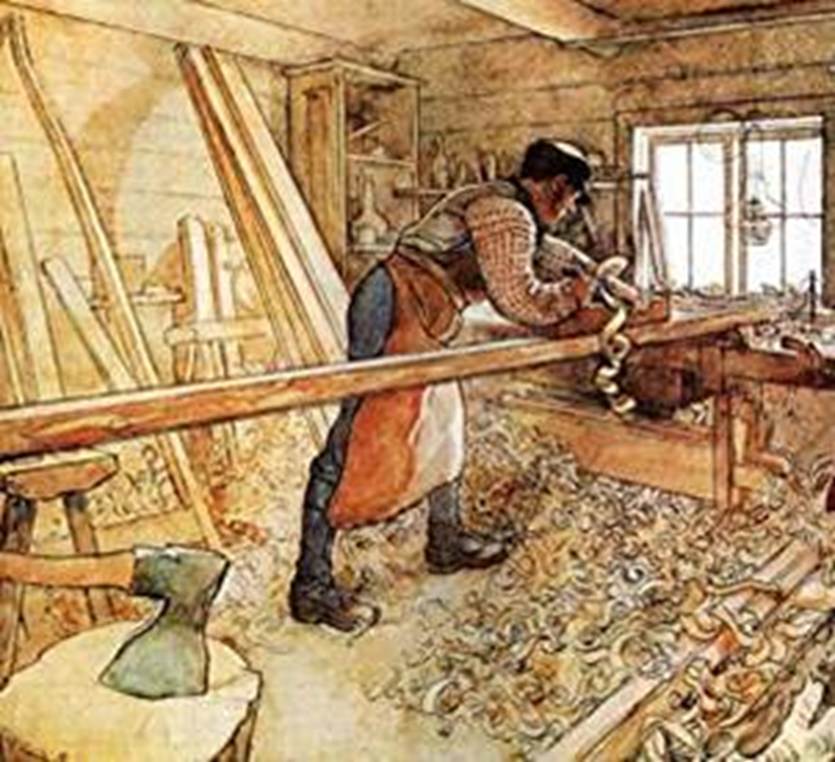
Francis II
had a family of seven with Margaret Spark and another four with his second
wife, Margaret Grey, though several died in infancy.
Their son, Francis
Farndale III seems to have entered into royal service, and he was
buried in St George’s Chapel, Windsor on 6 May 1788[8].
Staff and clergy of the College of St George who served the chapel and castle
sometimes earned burial rights within the church. People closely associated with the
castle's daily life, even if not royal, might have been granted burial as a
mark of honour or service.
Francis Farndale II’s wife Margaret probably died in the late 1740s and he married Margaret
Gray in Whitby on 4 November 1750[9], by which time he was 39 years old. Their first child, Thomas Farndale married Jane Calvert on 22 February 1785[10]
and he was a third generation carpenter.
Thomas and Jane
Farndale had eight children.
Four of
those children, Francis,
William, Phillis, and Thomas died in
infancy[11].
A second Thomas
Farndale died aged 35 in 1832[12].
The youngest daughter was Elizabeth
Farndale who married James Husband on 2 February 1819, when she was 21[13].
Margaret Farndale
was a spinster who lived in Flowergate in Whitby by 1841, where she died aged 72 in
1860[14].
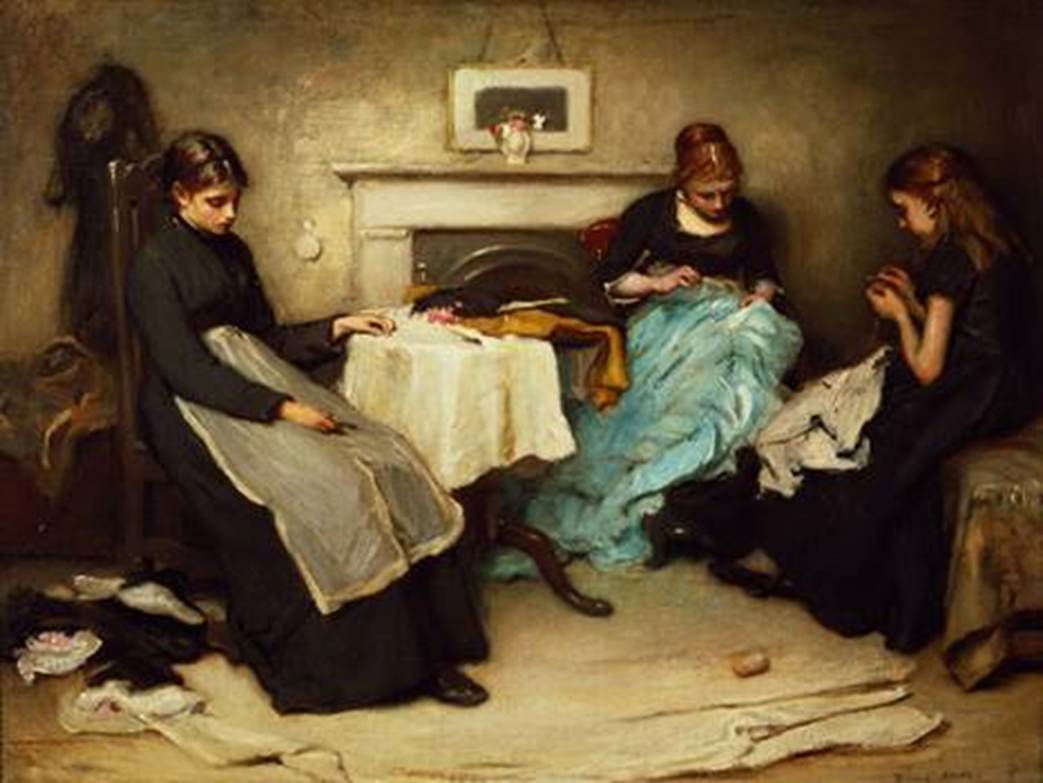
Mary Farndale,
also a spinster, was a seamstress in Flowergate in
1851[15].
Whitby's
dominance in shipbuilding and the transport of coal created a high demand for
accommodation. Houses were built along Flowergate to
cater to the growing population of shipbuilders, artisans, and their families.
Many existing buildings on the street were of eighteenth century origin. Flowergate served as one of the four principal ways into the old town
and functioned as an important commercial area, connecting the harbour to other
parts of the town. It was lined with shops, many dating to the nineteenth
century. The west side
of the river, where Flowergate is located, housed the
professional classes and catered to the growing tourist industry, in stark
contrast to the poorer east side. Many of Flowergate's
buildings housed the professional and middle classes.
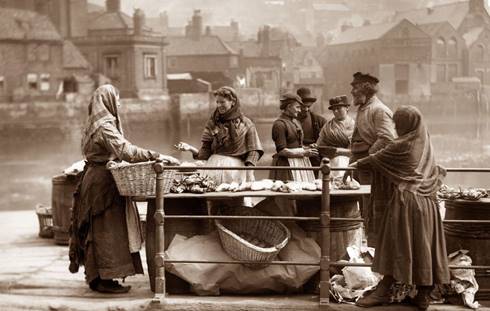
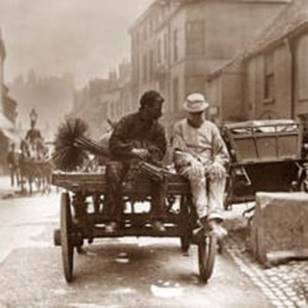
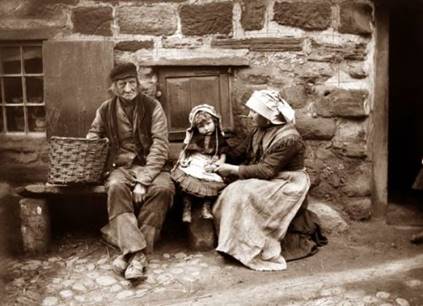
Flowergate, Whitby, in the late
nineteenth century
Francis and
the second Margaret’s daughter, Frances Farndale
had two children when she was unmarried, William who
died at birth, and Margaret Farndale
who died when she was one year old[16].
Frances Farndale
later married Robert Heselton in Whitby in
1791[17].
It seems
that by the fifth and sixth generation of this Whitby
family, life was a struggle with high infant mortality. Though still a thriving
port, Whitby could also be a challenging
place to live.
The
Carpenter’s Family
John and Margherita
Farndale’s sixth child was Thomas Farndale
(1683 to 1747).
Thomas Farndale married Sarah Perkins at Sneaton,
south of Whitby on 11 January 1707[18].
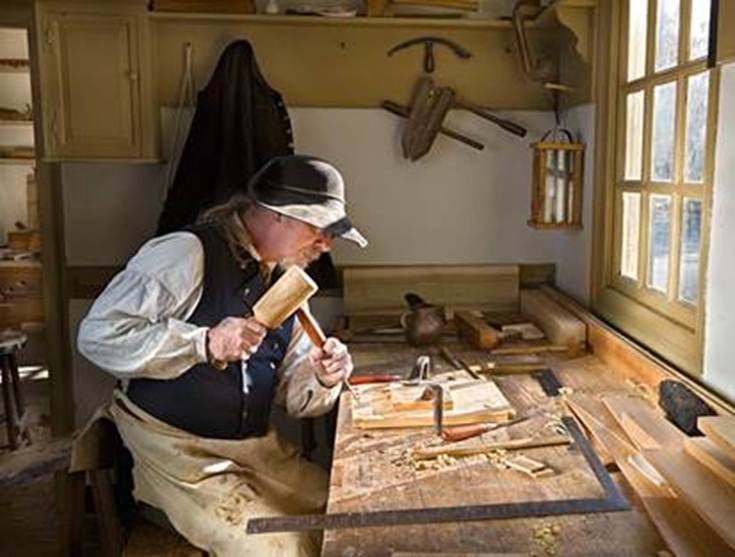
Certainly by 1713, and probably earlier, Thomas was a carpenter in Whitby[19],
most likely working in the substantial maritime industry of the thriving port.
In the
1720s, a Whitby carpenter's work was dominated by shipbuilding and repair,
crafting wooden vessels from local and imported timber. There was also work
building and maintaining houses, docks, and essential infrastructure. Shipbuilding and repair required
skills in shaping hulls, masts, decks, and internal structures from oak, pine,
and other woods, using materials like hemp, flax, and tar.
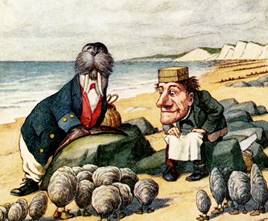
Lewis
Carroll stayed in Whitby on many occasions. Eighty five years after Thomas Farndale’s
death, Lewis Carroll wrote his famous nonsense verse about a carpenter on the
sands of Whitby. It is thought he drew his
inspiration for his poem The
Walrus and the Carpenter from the nearby village of Sandsend.
Thomas and
Sarah had three sons. Their third son, Thomas,
died when he was only a year old[20].
Their first two sons sailed with James Cook, and served in the Spanish Main.
The
Collier seaman who sailed with Captain Cook
Thomas and Sarah
Farndale’s eldest son John Farndale (1709 to 1790) was baptised at St
Mary, the Virgin, Whitby on 22 May 1709[21].

He married
Hannah Christian on 30 May 1736[22],
when he was 27.
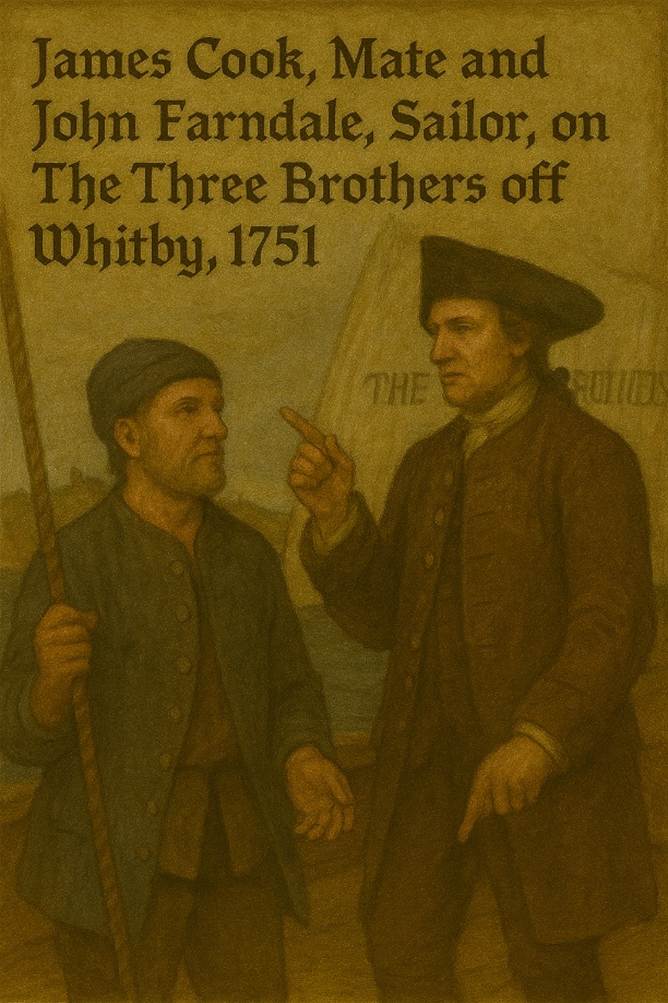
John Farndale served on
the Three Brothers and the Friendship, on a series of voyages
under James Cook as mate, which
included transporting British troops from the Netherlands at the end of the War of Austrian
Succession, trading with Norway and in the Baltic, and taking part in a not
very successful whaling expedition[23].
Between 31
July 1751 and 8 January 1752, he was enlisted on the Coal Cat or collier ship
called the Three Brothers on which ship James Cook, soon to be the discoverer
of new worlds, had just been promoted to mate. This voyage was probably to
Norway. The captain was Richard Ellerton. The Three Brothers was engaged
as a transport ship conveying British troops from the Netherlands at the end of
the War of Austrian Succession. Later she was used for trade in the Baltic.
A few months
later from 31 July 1751 to 8 January 1752, John Farndill, Seaman, 45 years old,
of Whitby, served seven months and twelve days, on the Friendship, for
which he was paid 8s 4d muster dues. Once again, James Cook was the mate. On 30
March 1752, John Farndale was on the crew[24]
under Captain Richard Ellerton and James Cook, as the ship sailed from Whitby
to London, where it arrived on 9 April 1752. It then sailed to Newcastle, where
it arrived on 18 April 1752. It then sailed to Norway, arriving on 3 May 1752.
It then returned to Newcastle on 12 May 1752, and then to Whitby on 17 May
1752.
According to
the muster rolls of Friendship in 1753, the ship had a crew of 24 men,
including Swainston and James Cook. The ship left Whitby on 4 April 1753 on a
whaling expedition and returned on 26 September 1753. The voyage was probably
not very profitable, as the ship only caught one whale. It is not clear whether
John Farndale took part in the whaling expedition, but he probably did. James
Cook was the mate of Friendship in 1753, and this was his last voyage as
a merchant seaman before he joined the Royal Navy.
John
Farndale was a seaman named in a list of 42 of the crew of The Friendship of
Whitby on 10 November 1753.
James Cook
spent
nine years in Whitby, three as apprentice and six as a seaman and later mate
for Captain Walker’s shipping service. Cook served in the Freelove, the Three Brothers
and the Mary before sailing in the Friendship. All the ships were
owned by the Walker Brothers who were engaged in the coal trade. These years had a
profound influence on his later life and career.
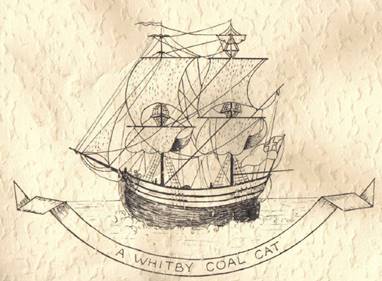
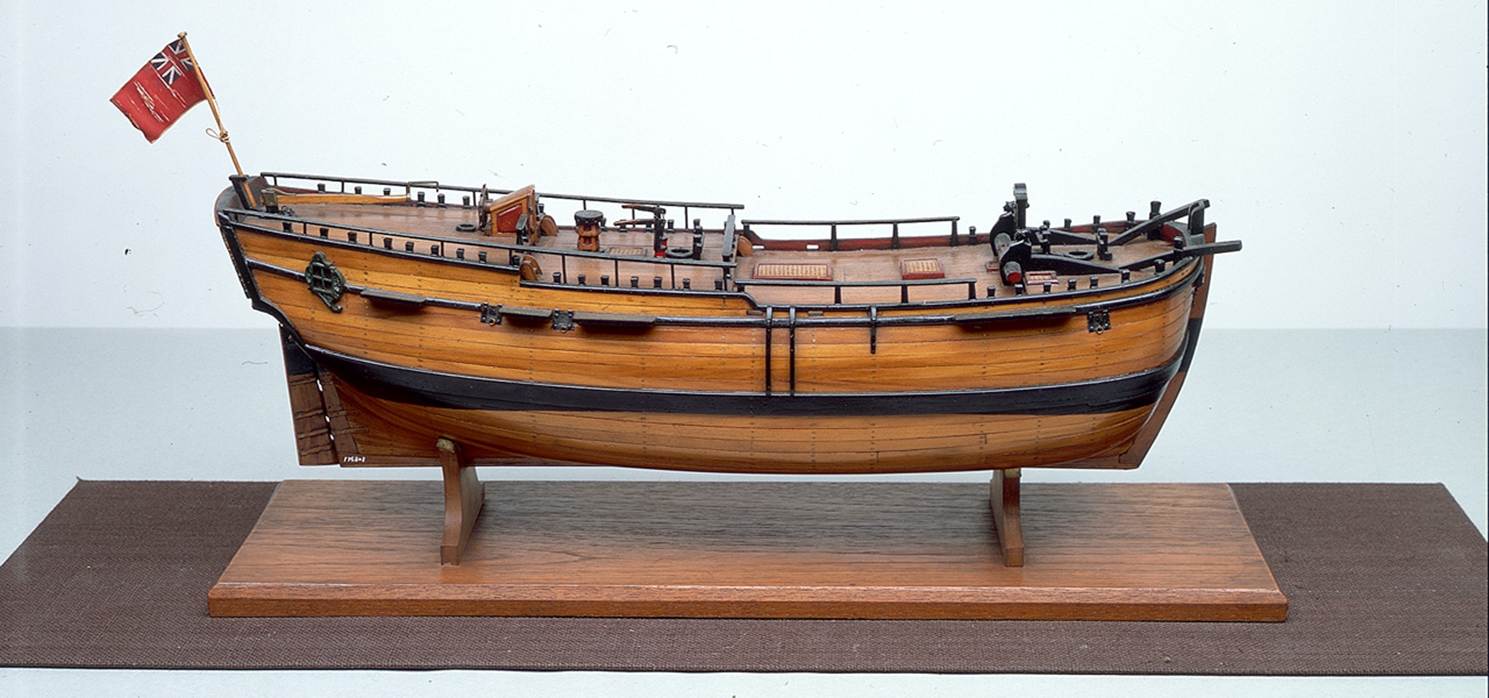
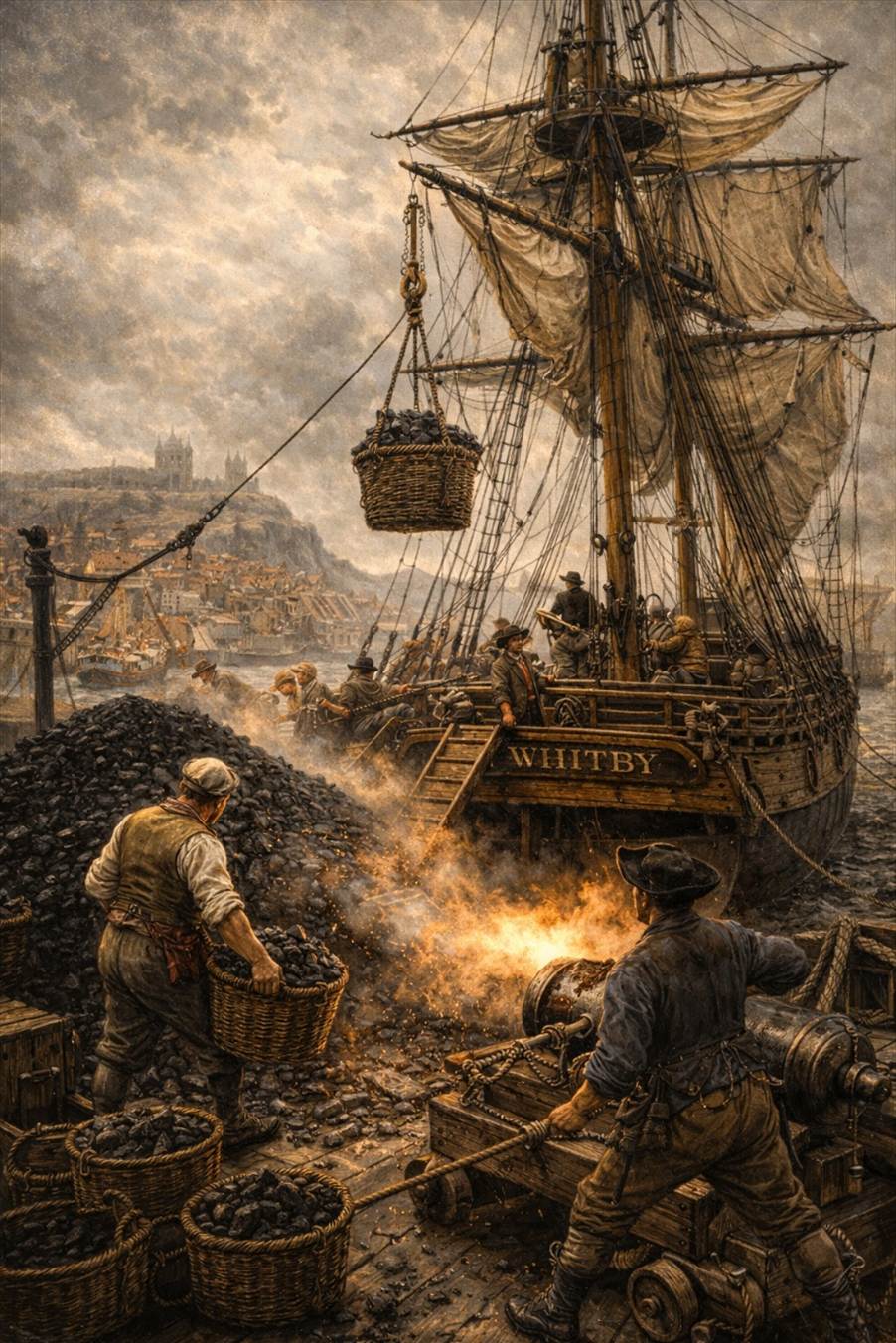
Whitby cats
were wide-beamed, shallow-draught, lightly rigged vessels built in Whitby
designed for the coastal trade[25].
They were used mainly to carry coal from Whitby to the Thames and backloaded
with timber. Cat was an acronym of coal and timber ship.
The Friendship
of Whitby was a collier ship that carried coal and other goods between
London, Newcastle, and Norway and was used as a whaling ship that sailed from
Whitby to the Arctic regions in search of whales and seals. The Friendship
was owned by John Walker, a Quaker shipowner and merchant in Whitby and was
James Cook’s master, who served as his apprentice and later as his mate. He
owned several ships that traded coal and other goods between London, Newcastle,
and Norway.
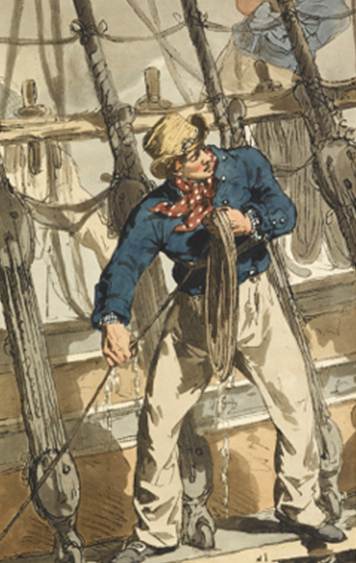
After
James Cook had joined the Royal Navy
and by the time of Cook’s third voyage of exploration, John Farndale had
advanced his own career in the merchant navy and had been promoted to captain
of the Friendship, the same ship which Cook had previously served on as
mate. By 1776 he was master mariner and captain of the Friendship[26].
|
22
May 1709 to 28 March 1790
Married
Hannah Christian on 30 May 1736 John Farndale served on colliers alongside James Cook,
discoverer of the Southern Continent, out of Whitby. Whitby |
|
1728
to 1779
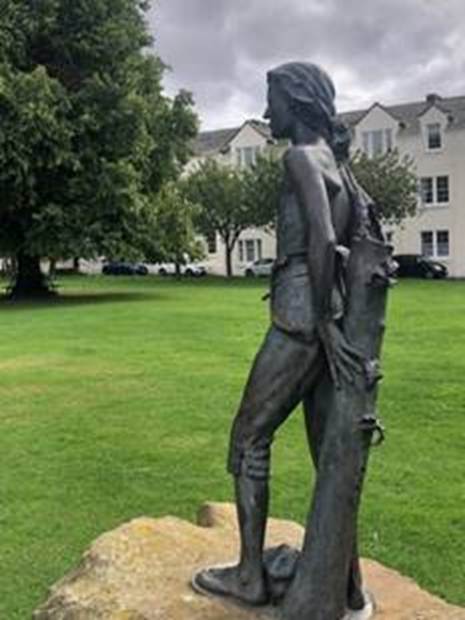
The
association of James Cook with Cleveland, Whitby, Great Ayton, the Farndale ancestral lands,
and individuals of the Farndale Story |
John’s wife,
Hannah died in 1782, aged 75 and John died in 1790[27]
at the age of 79. Both were buried in the graveyard of St Mary, towering above
Whitby town, the graveyard which would one day become associated with the
fictional Dracula.
John and
Hannah had a family of five, the
Whitby 2 Line. Their eldest daughter, Sarah, married a
joiner in Whitby[28].
John and Hannah’s fourth child was John Farndale who
married Phyllis Holdforth of Loftus[29]
and then moved back to Loftus, where he
became a weaver. On 9 July 1787, his apprentice ran away. John Sanderson,
Apprentice to John Farndale, Weaver of Lofthouse, Yorkshire; he is stout made,
a little pitted with the small pox, dark brown hair, and has a bald spot on the
top of his head, occasioned by a fall; he had on when he went off, a blue jacket,
a yellow striped waistcoat, leather breeches, and brown and white mottled
stockings. If the said Apprentice will return to his Master, he will be kindly
received; and any person or persons harbouring or employing him after this
public notice, will be prosecuted with the utmost vigour, and any person giving
notice of the said John Sanderson to the said John Farndale, will be handsomely
rewarded[30].
By 1798 John was an alehouse keeper in East Loftus[31]
and by 1800 he was a police constable[32]
and gave evidence in the prosecution of a yeoman for stealing delft or
earthenware goods, namely two teapots, two decanters, two pitchers, two basins
or small bowls and one cream pot belonging to the said James Lynas[33].
John and Hannah’s
youngest son, Robert
Farndale, also became a master mariner by 1780. Robert Farndale was buried
on 7 June 1827[34]
and his place of burial, along with many others of the Whitby family line, was the Churchyard of St
Mary the Virgin, overlooking Whitby, which
would be forever associated with the story of Bram Stoker’s Dracula.
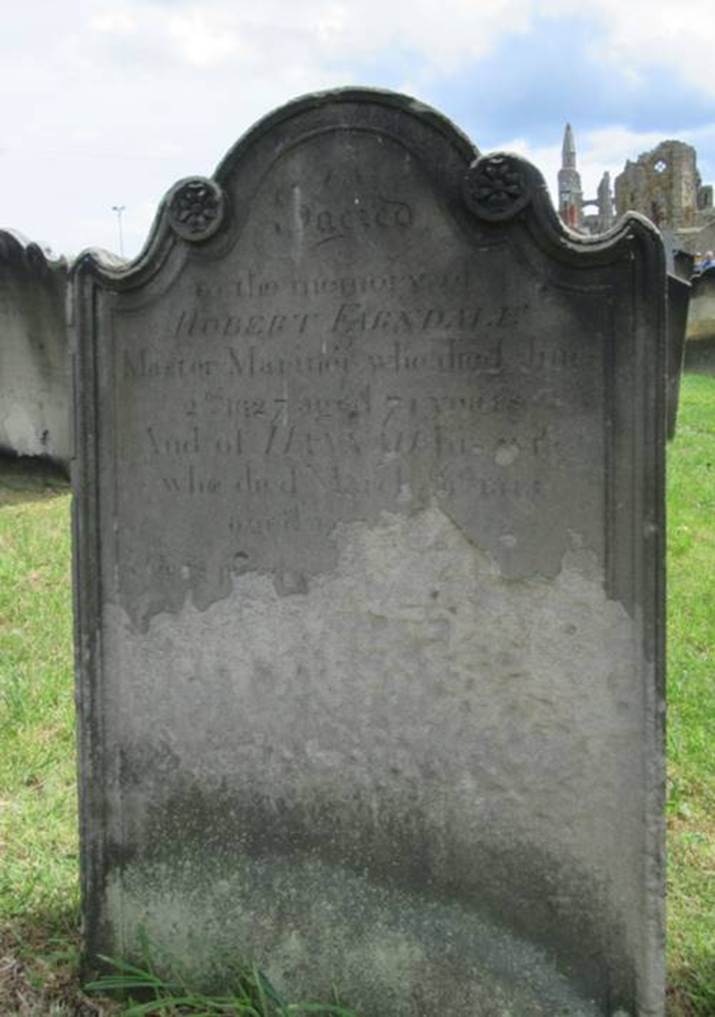
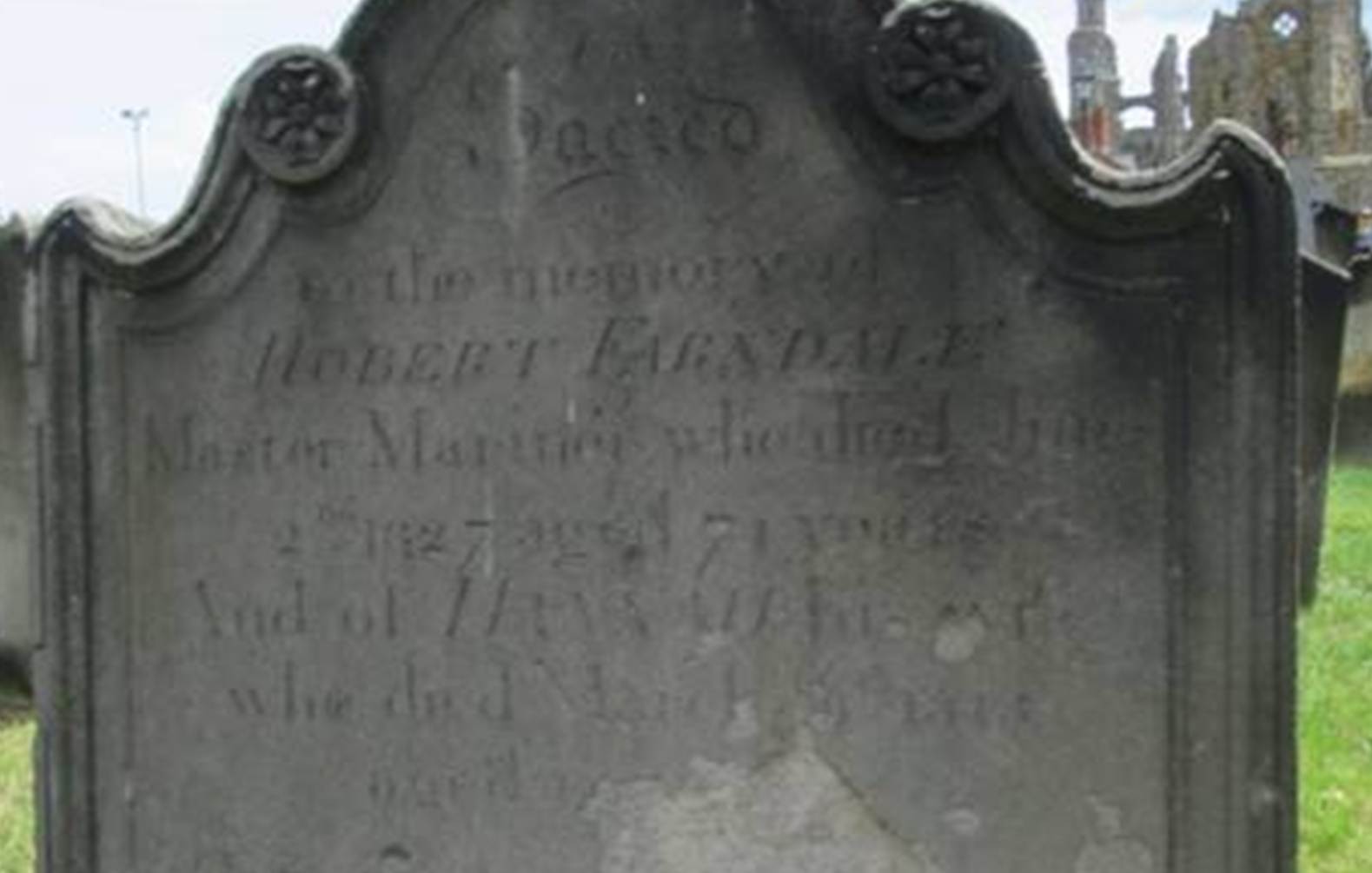
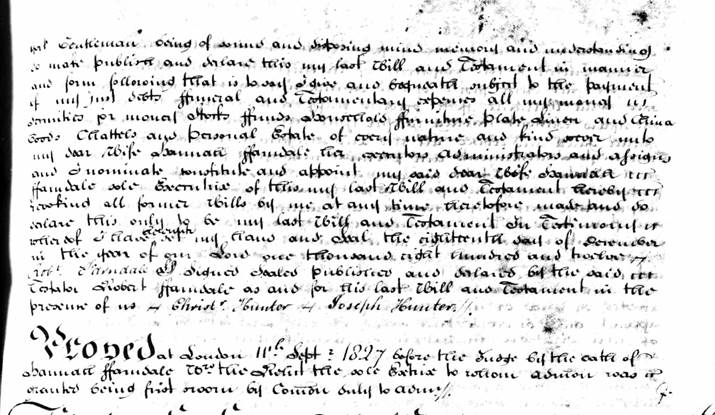
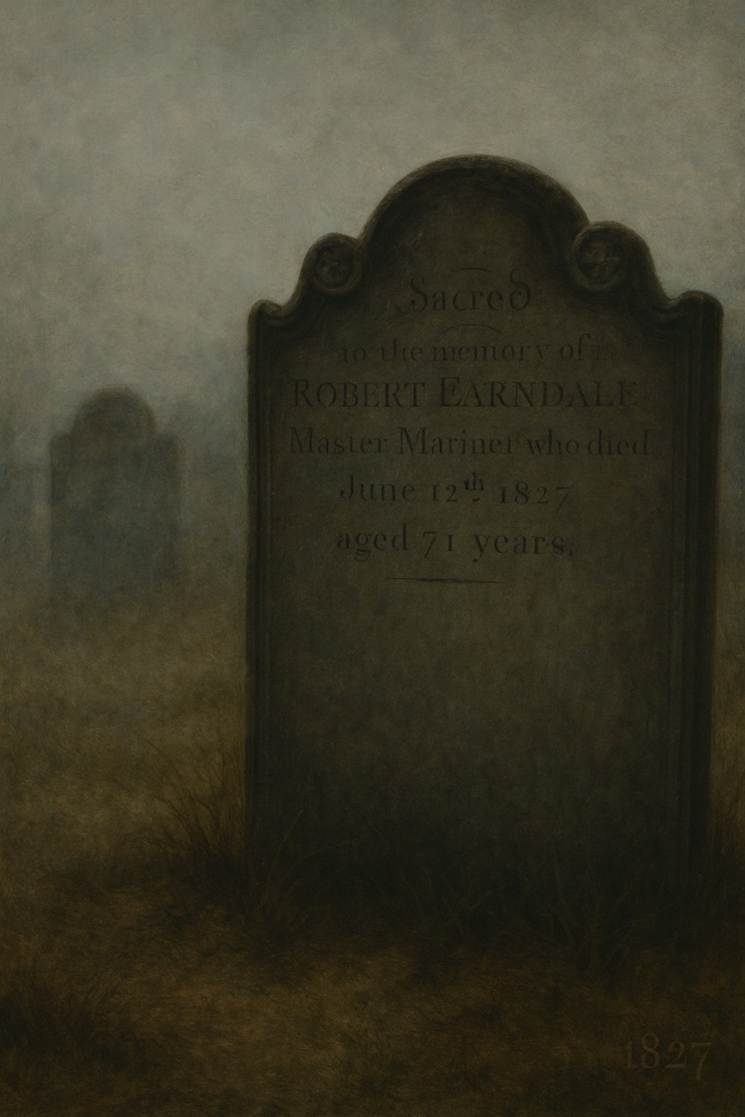
Sacred to
the memory of Robert Farndale Master mariner who died June 2nd 1827 aged 74
years. And of Hannah his wife who died March 28th 1845 aged 89 years Robert Farndale’s Will
A gravestone
with a skull and crossbones is sometimes claimed as the fictional Dracula’s
grave, but in reality was probably the mark of a stonemason. There are stories
of a suicide’s grave, where vampires supposedly have to reside.
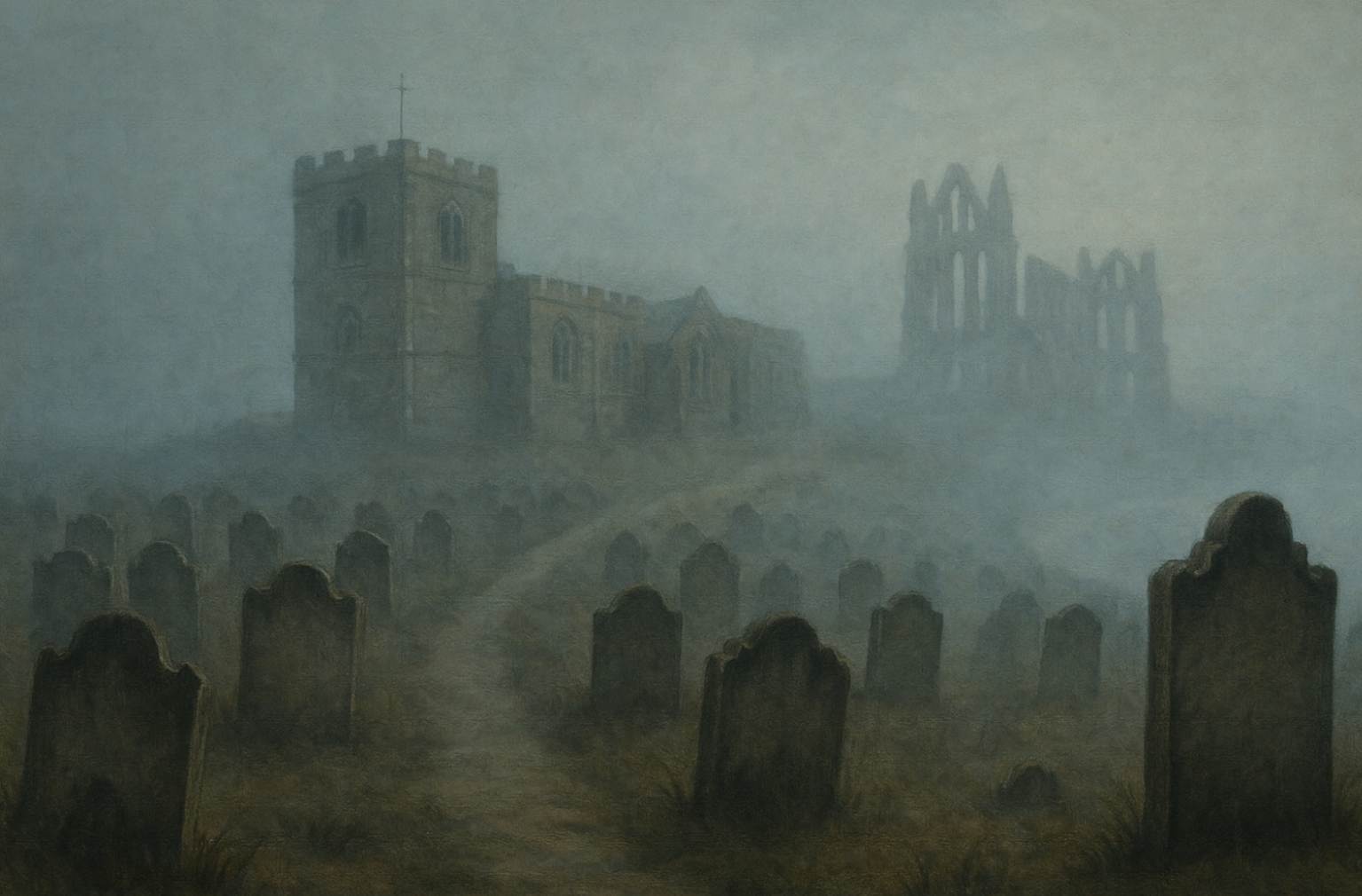
For a
moment or two I could see nothing, as the shadow of a cloud obscured St. Mary's
Church. Then as the cloud passed I could see the ruins of the Abbey coming into
view; and as the edge of a narrow band of light as sharp as a sword-cut moved
along, the church and churchyard became gradually visible. It seemed to me as
though something dark stood behind the seat where the white figure shone, and
bent over it. What it was, whether man or beast, I could not tell.[35]
The
impressed sailor on the Spanish Main
Thomas and Sarah
Farndale’s third son was Giles Farndale (1713
to 1742), born on 18 October 1813[36].

Giles was
press ganged into the Royal Navy at Whitby
at the age of 27 in 1740, almost certainly at Whitby. The Muster Book for HMS Experiment[37],
a brig with a compliment of 130, shows Giles Farndell (also Farndale, he is
listed under both names in different Muster Books) as No 101 Able Seaman,
impressed (press-ganged) and coming onto the ship’s muster on 29 June 1740 when
the Experiment was at The Nore at the mouth of the Thames.
Since Giles
was not recorded as from another ship, this was probably his first experience
in the Royal Navy.
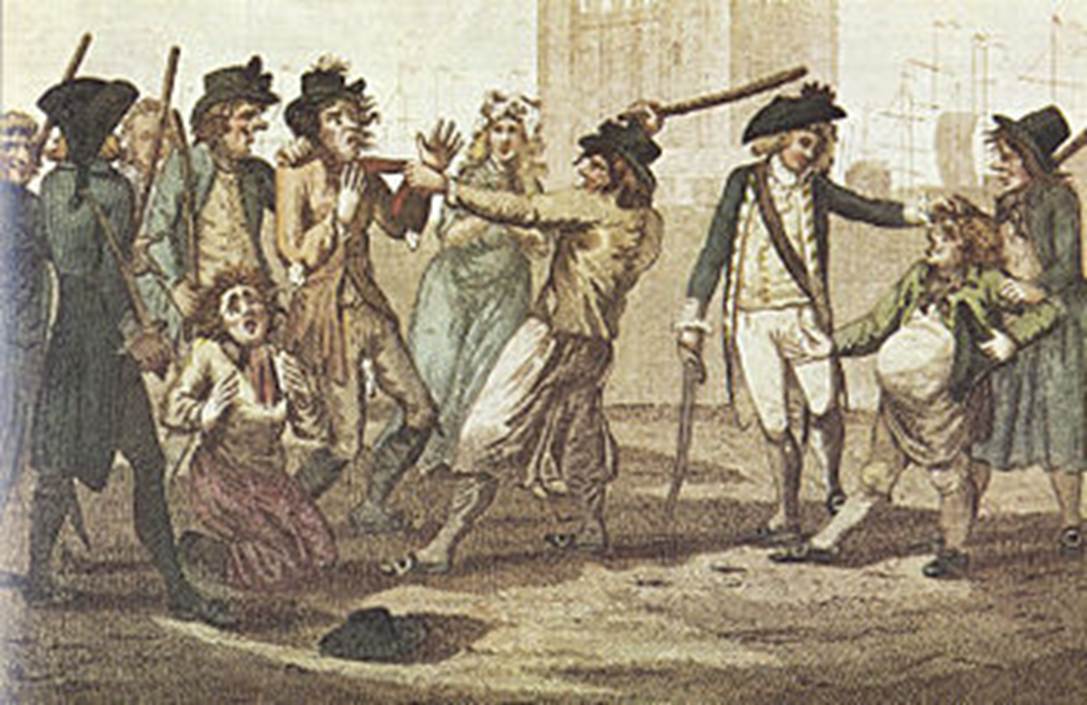
Mid
eighteenth century press gang
|
1713 to 1742 Press ganged into the Royal Navy, Giles served on HMS
Experiment in the Spanish Main during the War of Jenkins Ear where he
died and was buried at sea |
HMS
Experiment of 1740
was a 24 gun, sixth rate ship, of the Royal Navy. She was launched on 18 April
1740 and sold in 1763. At the time of
her commissioning and during the relevant period of the Spanish wars, she was
described as a 20 gun vessel. She was built in Plymouth dockyard by Henry Bird.
The newly commissioned vessel
was given to the command of Captain Rentone, who had recently been paid £200
for reporting the news of Admiral Vernon’s taking of Porto Bellow.
She had a
keel of 87 feet and a breadth of 30 feet. She had a total length of gundeck of
106 feet. On her upper gun deck she had twenty British nine pounders. On the
lower gun deck there were a further 2 British nine pounders. On her quarterdeck
were two British three pounders. So
although described as a 20 gun vessel, she did in fact have twenty four.
In
historical naval usage, a long gun was the standard type of cannon mounted by a
sailing vessel, distinguished from the much shorter carronades. The long gun
was known for its increased range and improved mobility. This allowed the long
gun to establish itself as the best form of artillery to pursue an enemy.
Cannons were
fired through a laborious process that involved a large crew. The process began
by cleaning out the barrel of the cannon with a wet swab. This ensured that any
left over embers from the last firing were
extinguished before the gunpowder was put in. Once the barrel was clean, the
gunpowder was put into the base of the cannon, either loosely or in cloth bags.
A piece of cloth or rope was put in after the gunpowder to ensure that it
stayed tightly packed. This was quite a coarse grained powder for a longer
duration of burn. The cannon ball followed then there was added a piece of wool
or cotton. This secondary piece of cotton helped to keep the cannonball in
place and secure with the explosives.
Long guns,
were extremely heavy when fully loaded and ready to fire, and had to be moved
into position after being loaded. This typically took the full effort from the
group of men. The cannon was then pushed forward until it was in full contact
with the side of the ship, and the barrel was pointed through the gun port.
Once in
position, a small hole in the back of the cannon was lined with a small amount
of gunpowder. This process was called priming. From there, the cannon operator
stood back from the cannon and held a string until the cannon was lined up with
the enemy's ship. Once aimed in the right direction, the operator pulled the
lanyard in order to fire the gun. The gun could typically only be fired two to
three times in five minutes, so it was important to hit target.
HMS
Experiment had a
complement of 140 men. Statistically it seems most likely that Giles Farndale
was part of the gun crew.
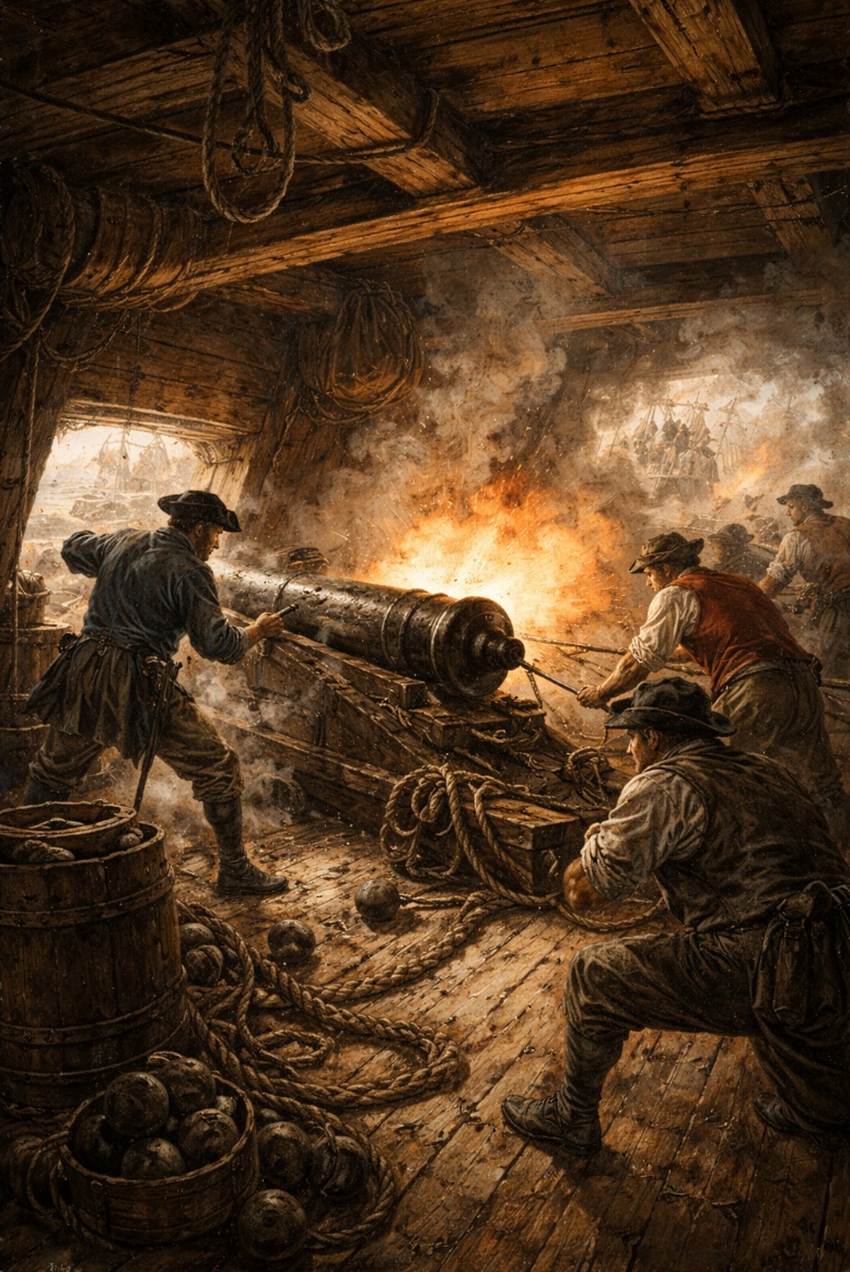
Giles’
Farndale’s Captain on the Experiment was Captain Rentone
who was born in Scotland in October 1702. He first known service was on 30
April 1718. He took command of HMS Experiment on 17 April 1740 and
continued in command of that vessel until 3 June 1741, after which he took
command of the Rippon.
The Nore is
a sandbank which acted as a naval muster point at the entrance to the Thames.
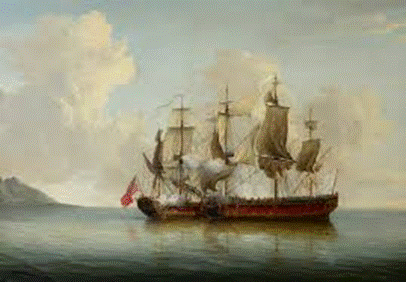
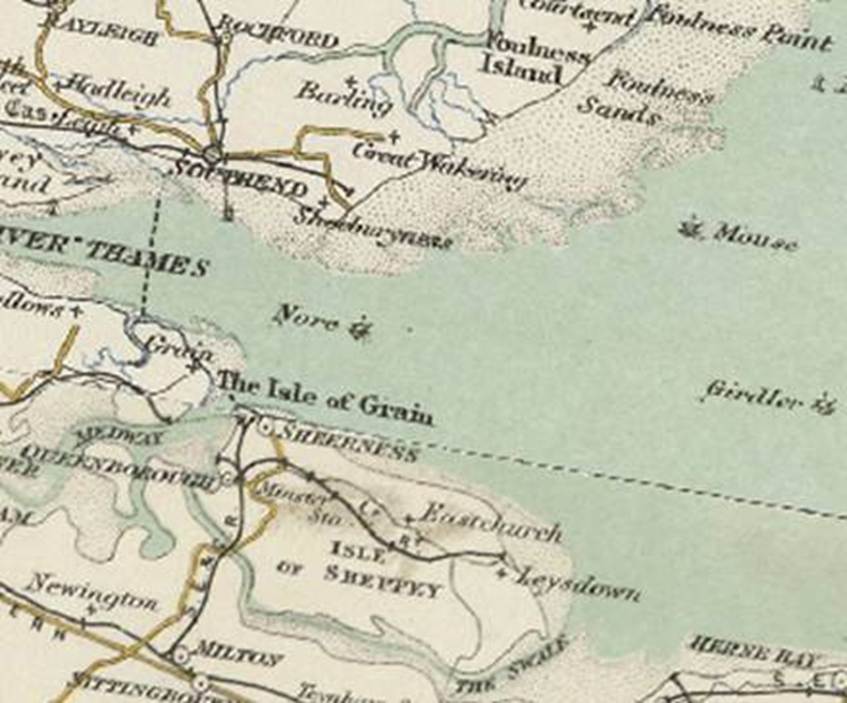
HMS
Experiment
The Nore
From the
Nore, HMS Experiment sailed for Port Royal, Jamaica where she arrived on
15 September 1740. In November 1740 she was reported as having lost her masts
in a storm off Jamaica[38].
Port Royal
lies at the mouth of Kingston Harbour, in southeastern Jamaica. Founded in 1518
by the Spanish, it was once the largest settlement in the Caribbean,
functioning as the centre of shipping and commerce by the end of the
seventeenth century. Port Royal had been a launch site for privateers to attack
Habsburg Spain's vessels when smaller European powers did not dare to make war
on Spain directly. As a port city, it was notorious for its gaudy displays of
wealth and loose morals. It was a popular homeport for the English and
Dutch-sponsored privateers to spend their treasure.
Until June
1741 the ship was either in Port Royal, at sea, or in Cartagena[39],
during the War of Jenkins’ Ear on the Spanish Main.
Admiral
Vernon had been appointed as the commander-in-chief of the Jamaica Station in
1739, with orders to attack Spanish commerce and settlements. It was he who introduced grog, a
mixture of rum and water, to his sailors to prevent scurvy and drunkenness.
The
Experiment was
involved in a number of early actions over the winter of 1740 to 1741. A number
of ships including the Experiment had failed to muster with Admiral
Vernon’s fleet in October 1740[40],
but by January was clearly part of his force. In December 1740, Admiral Vernon
sent the Experiment on a reconnaissance mission to report on the
erection of batteries by the French at Donna Maria Bay[41].
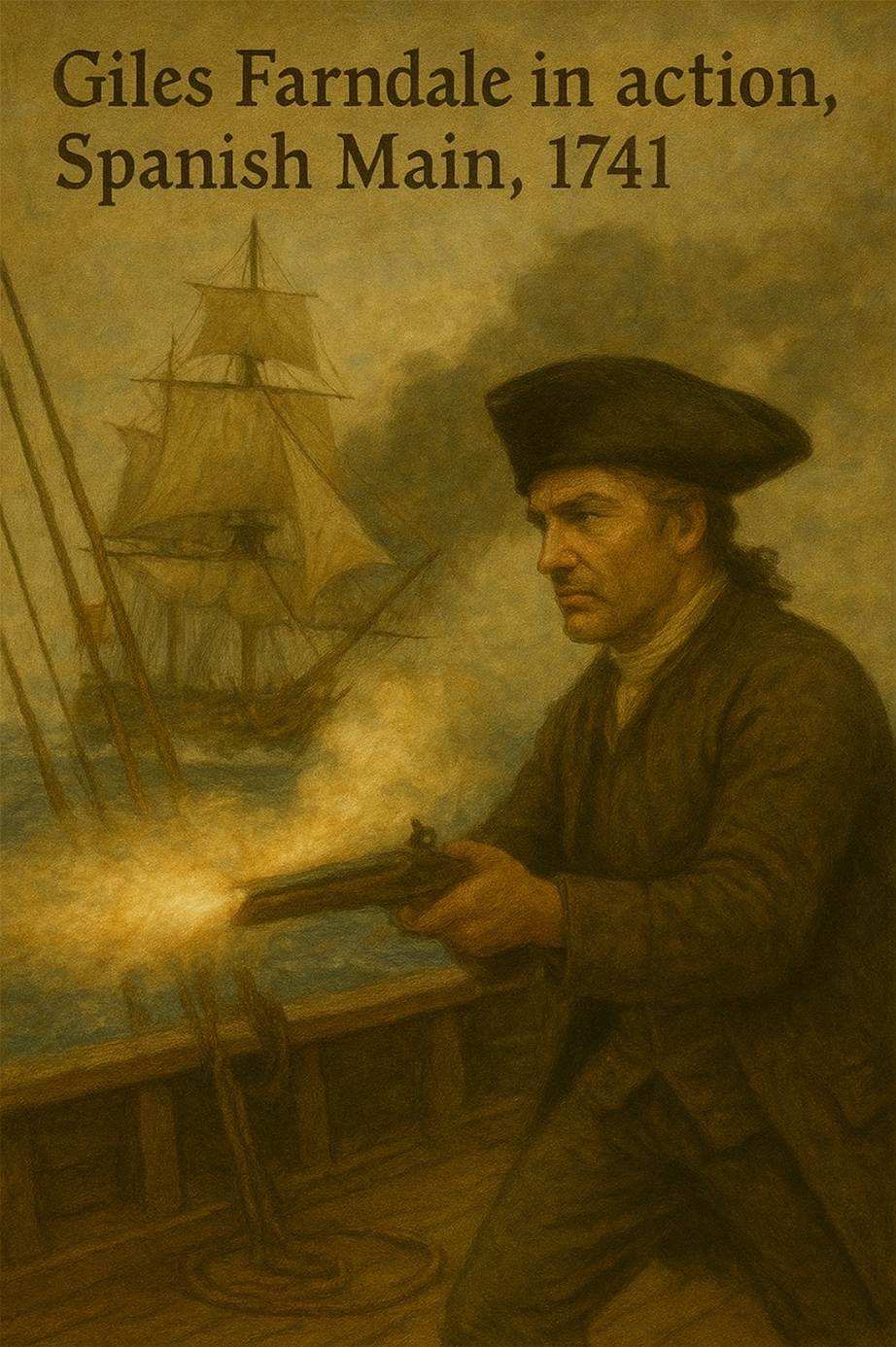
In February 1741, the Experiment, presumably with Giles Farndale as part
of her crew, engaged in a false flag operation, disguis’d
under false colours, and took an enemy Advice Boat bound from
Cartegena to Hispaniola before it was able to throw their Dispatches
overboard, and recovered information of Matters of so great Consequence,
that the Admiral felt it important to transport them to England[42].
During the
time of Giles’ service, HMS Experiment served under Admiral Vernon
during the
War of Jenkins’ Ear in the Spanish Main, and took part in a large
amphibious operation against the port of Cartagena
de Indias in Colombia.
Admiral
Vernon suffered his most humiliating defeat in March 1741, when he led a large
amphibious operation against the port of Cartagena de Indias in Colombia.
Despite having a superior naval and land force, he was unable to overcome the
strong Spanish defences led by Blas de Lezo, and was forced to withdraw after
losing thousands of men to disease and combat.
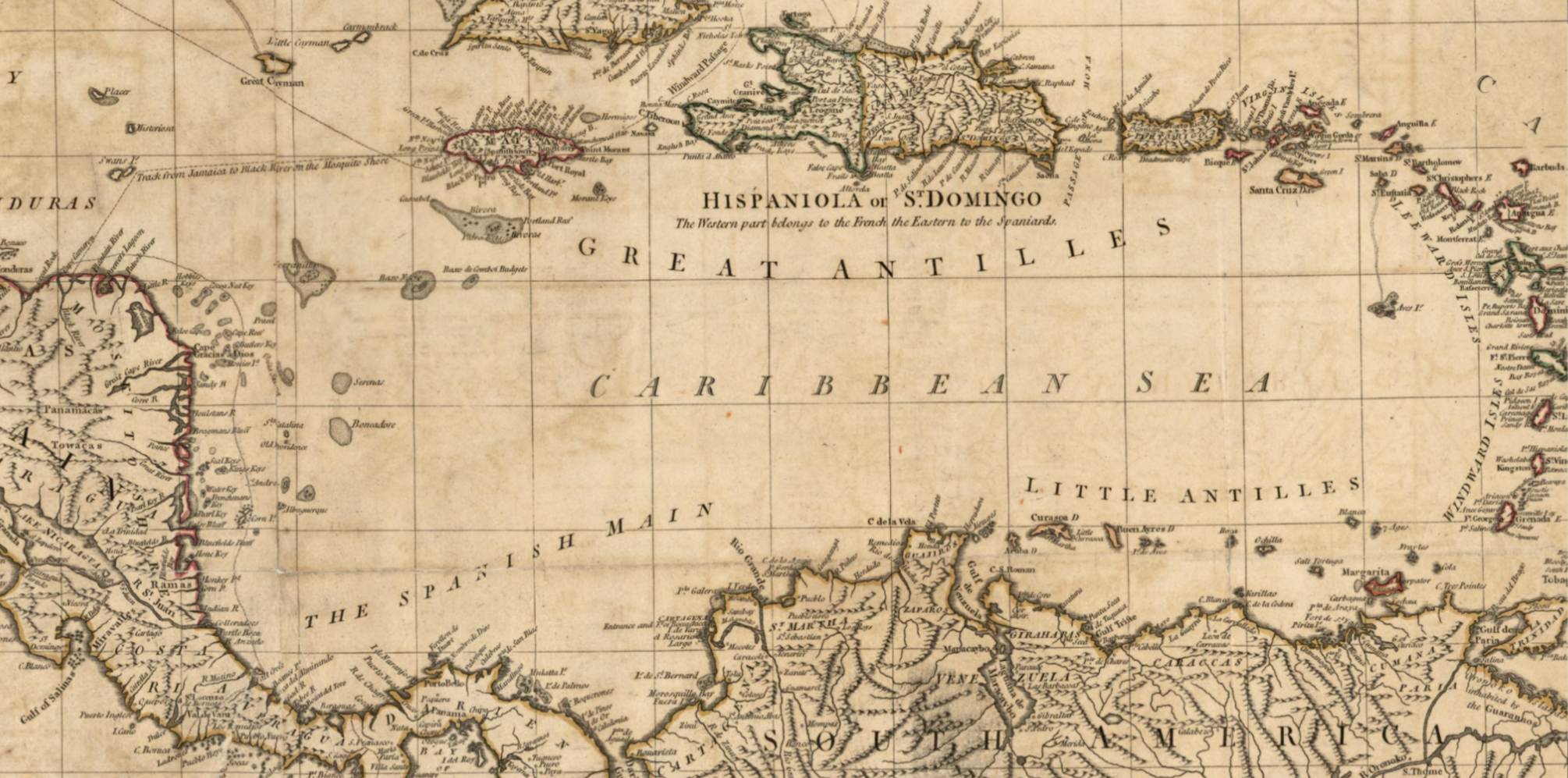
Let’s roll
out our charts and study the area a bit. Jamaica is circled in red and it lay
to the north of the Spanish main.
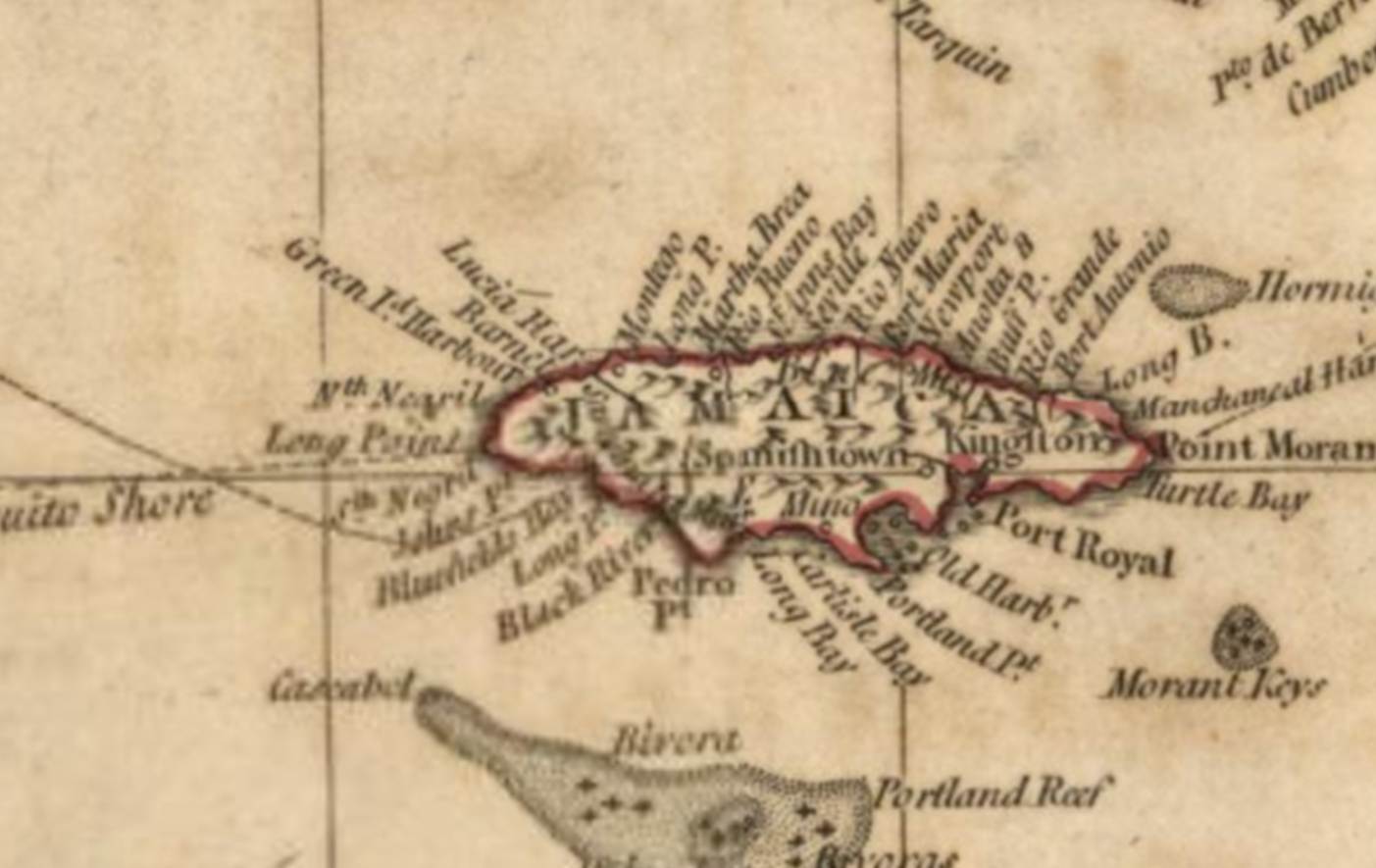
Port royal
was to the southeast of Jamaica at the mouth of the bay to Kingston.
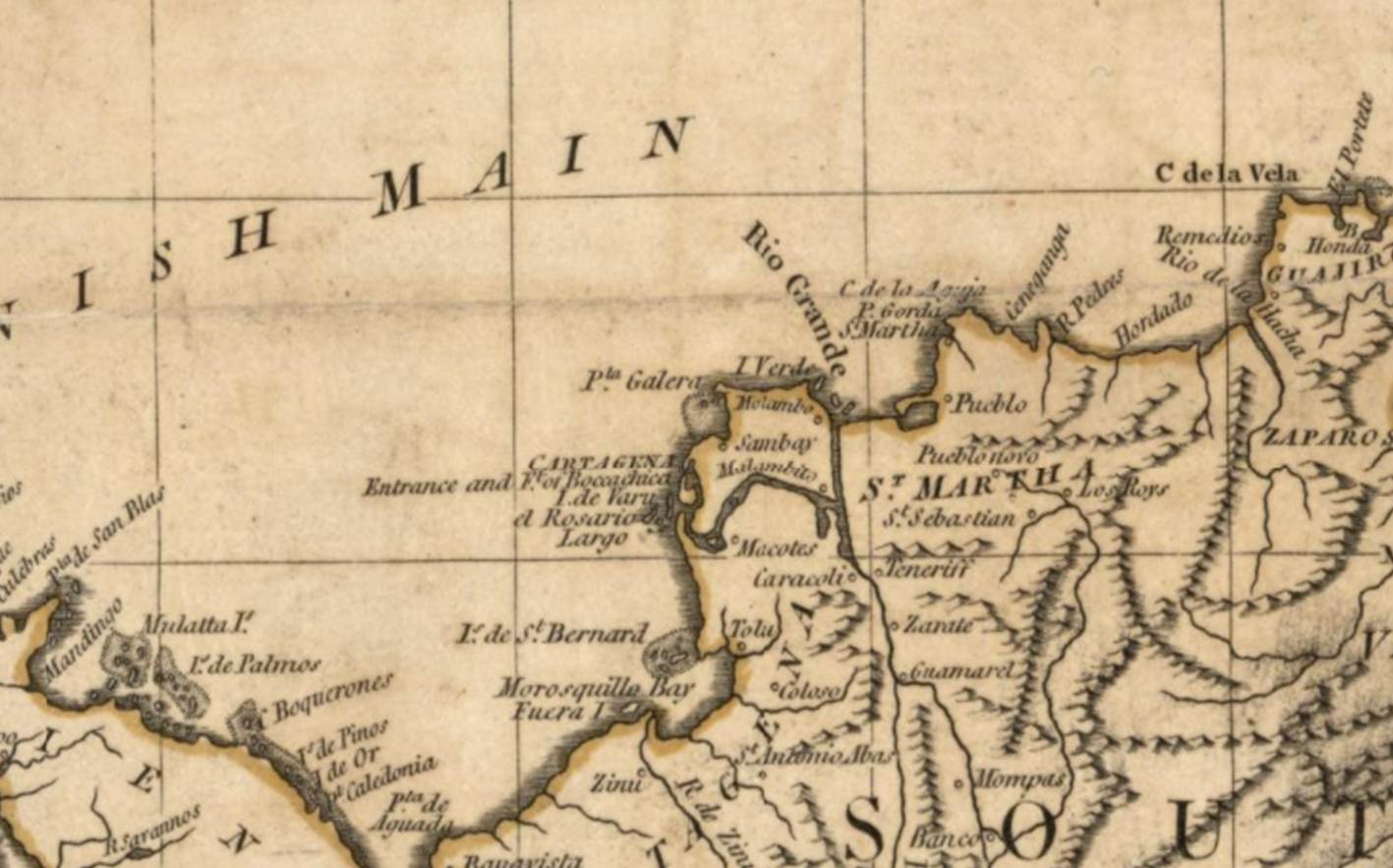
On the north
coast of South America, at the edge of the Spanish Main, was the Spanish town
of Cartagena.
Let’s remind
ourselves that Giles Farndale was present at every muster until 9 May 1741.
The Battle
of Cartagena de Indias, which started on 13 March 1741 and lasted for two
months, was a major naval and land engagement during the
War of Jenkins' Ear. It was part of Admiral Vernon's attempt to capture the
Spanish port city of Cartagena de Indias, which was a key trading and military
centre in the Caribbean. Giles almost certainly lost his life in the later
stages of this two month battle.
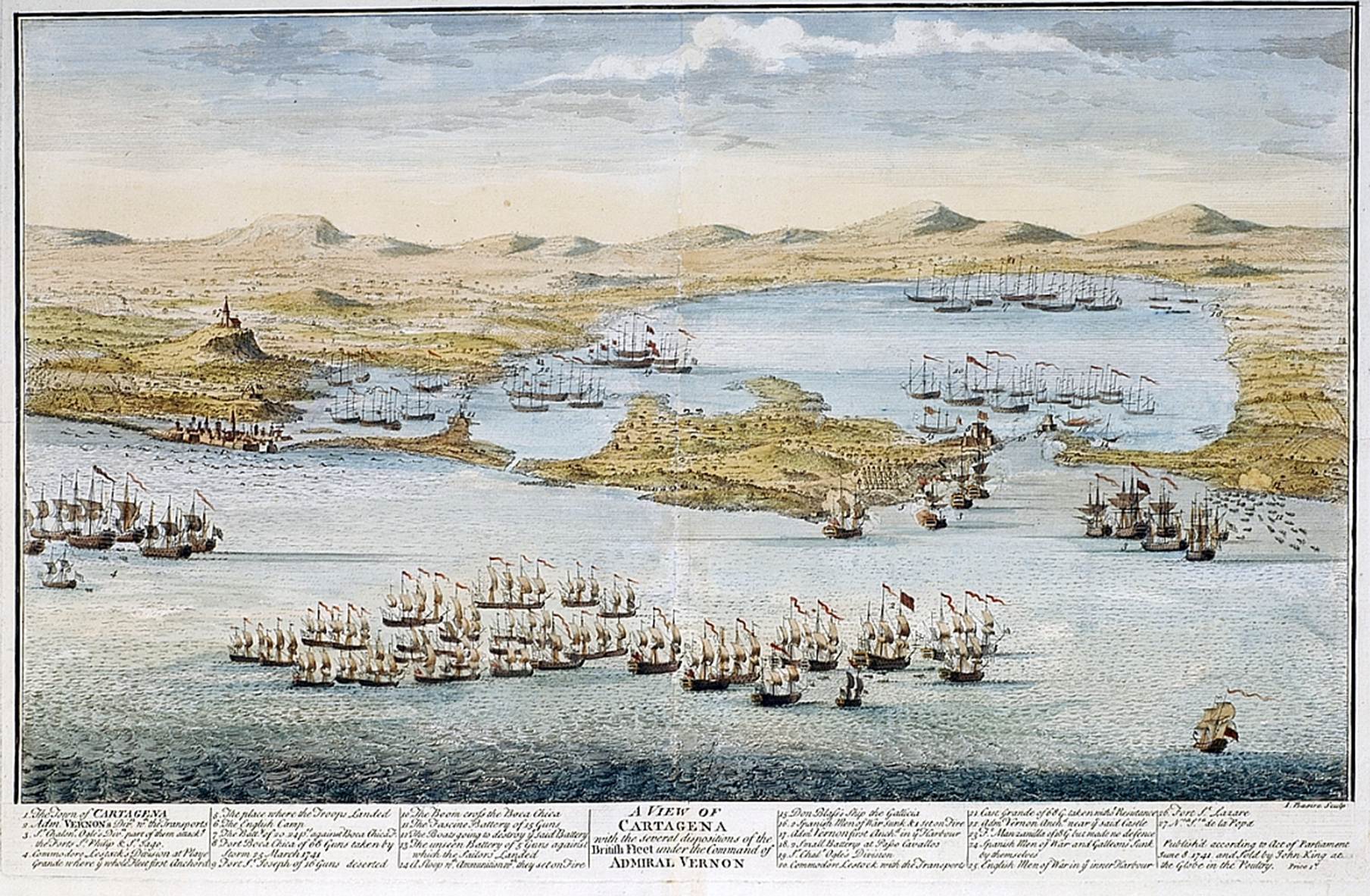
Battle of
Cartagena de Indias
Vernon had a
large force of 29 ships of the line, 22 frigates, 71 sloops-of-war, 80 troop
ships, and 50 merchant ships, carrying about 12,000 soldiers and 15,000
sailors. He also had the support of 4,000 colonial troops from Virginia and
Jamaica.
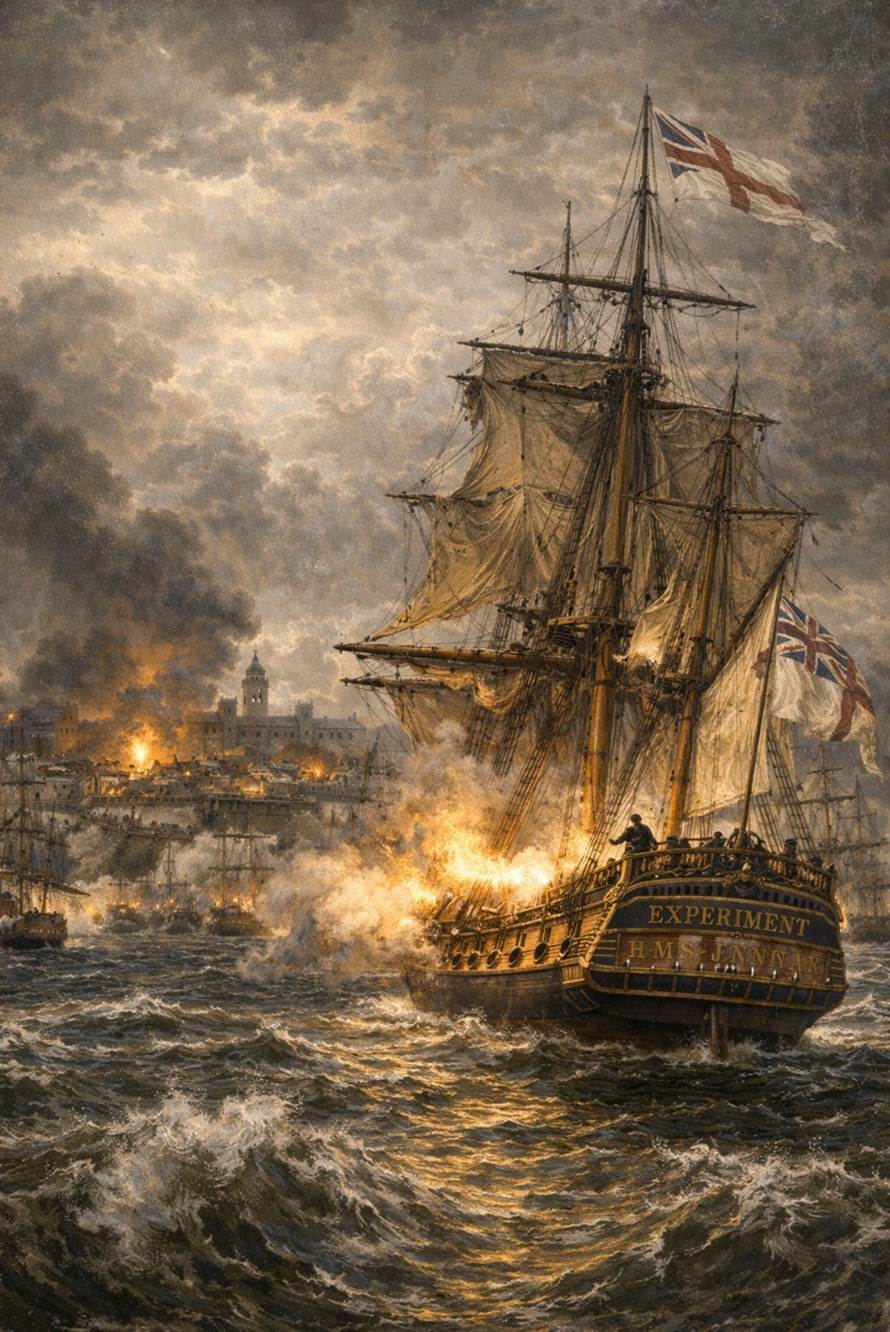
HMS
Experiment, with 20 guns, commanded by James Rentone, took
part in the battle.
The
Spanish defenders were led by Admiral Blas de Lezo, a veteran officer who had
lost an eye, an arm, and a leg in previous battles. He had only 6 ships of the
line and about 2,700 soldiers and 600 sailors, but he had the advantage of
strong fortifications around the city and the bay. He also had the help of 600
native archers and some local militia.
The battle
lasted for more than two months, and involved several naval and land attacks by
the British, as well as counterattacks by the Spanish. The British managed to
capture some of the outer forts and batteries, but they failed to breach the
main defences of the city. They also suffered heavy losses from disease,
especially yellow fever and malaria.
Cartagena's
defensive fortifications had been repaired and improved over the past year.
Given overwhelming force against them, the Spanish conducted a fighting
withdrawal to delay the British until the start of the rainy season at the end
of April. The tropical downpours would delay campaigning for another two
months. The longer the enemy had to remain, mostly crowded on ships at sea and
in the open on land, the more likely that insufficient supply, discomfort and
disease would mar the British threat.
The rains
came and the British had to board their ships, where close quarters made
disease even more deadly. By 25 April 1741, Vernon and the council decided to
retreat to Jamaica, and by mid-May they were gone. By 7 May 1741, only 1,700
men of the land forces were fit for service and no more than 1,000 in condition
to land against the enemy. Within a month of leaving Cartagena, another 1,100
died. British strength was reduced to 1,400 and American to 1,300.
The expedition
and battle lasted for 67 days and ended with the British fleet withdrawing in
defeat, with 18,000 dead or incapacitated, mostly by disease
The British
finally gave up on 20 May 1741, only eleven days after Giles’ death, after a
failed assault on the Castillo San Felipe de Barajas, the largest fort in the
city. They retreated with about 9,500 to 11,500 dead and 7,500 wounded. The
Spanish lost about 800 dead and 1,200 wounded.
The battle
was a decisive victory for Spain, and a major setback for Britain. It prevented
Britain from gaining control of the Caribbean trade and colonies, and it
boosted the morale and prestige of Spain. It also showed that Spain could
defend its interests against a superior naval power.
Giles must
have been engaged in operations against the town of Cartegena from 4 March 1741
until May 1741. He succumbed on 9 May 1741. We don’t know how he died, but we
might imagine he died in appalling circumstances, perhaps of disease, perhaps
in an engagement from the cannon deck. Giles died shortly before the end of the
Cartagena engagement.
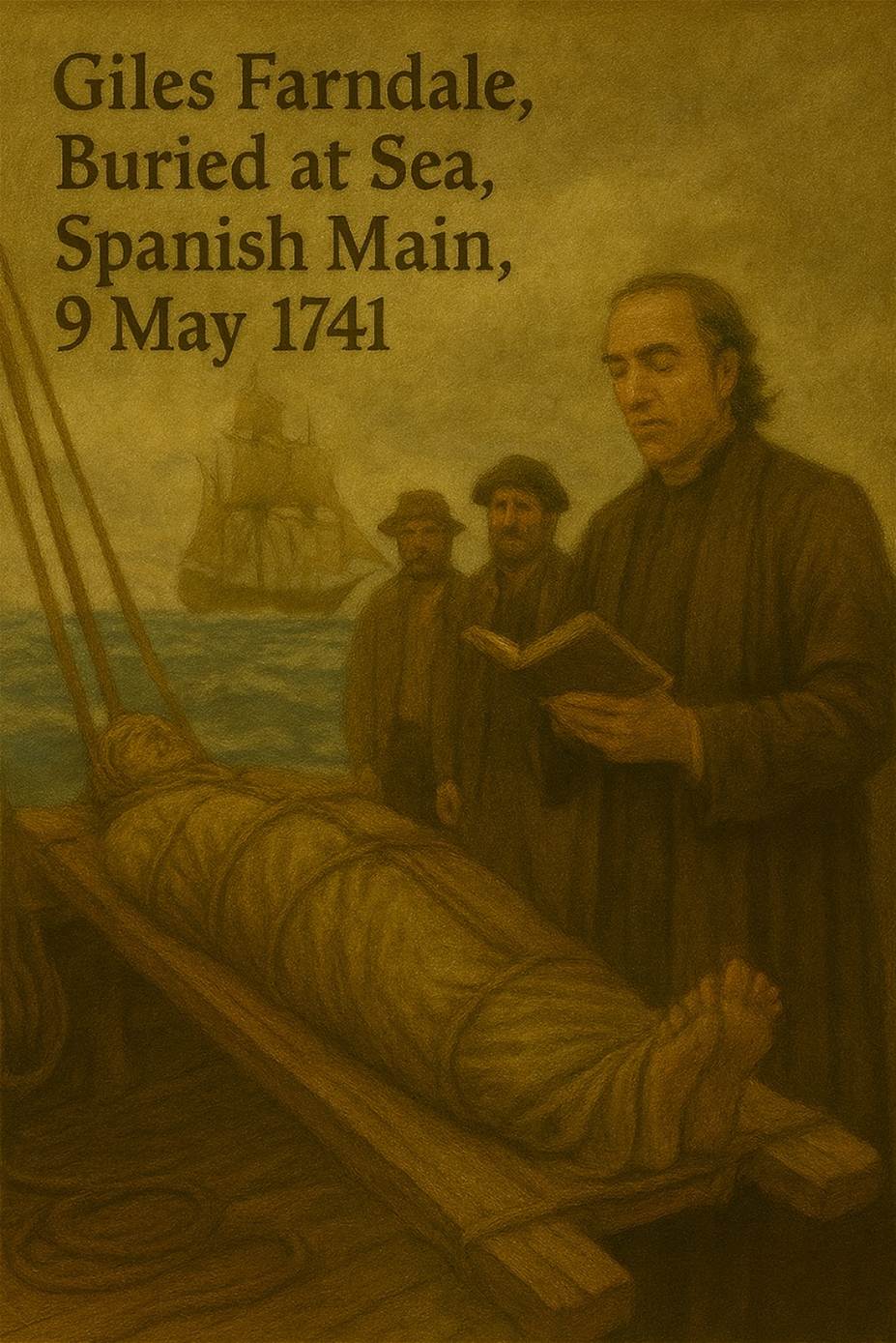
Giles was
present at every muster until 9 May 1741 when he was marked DD,
Discharged Dead.
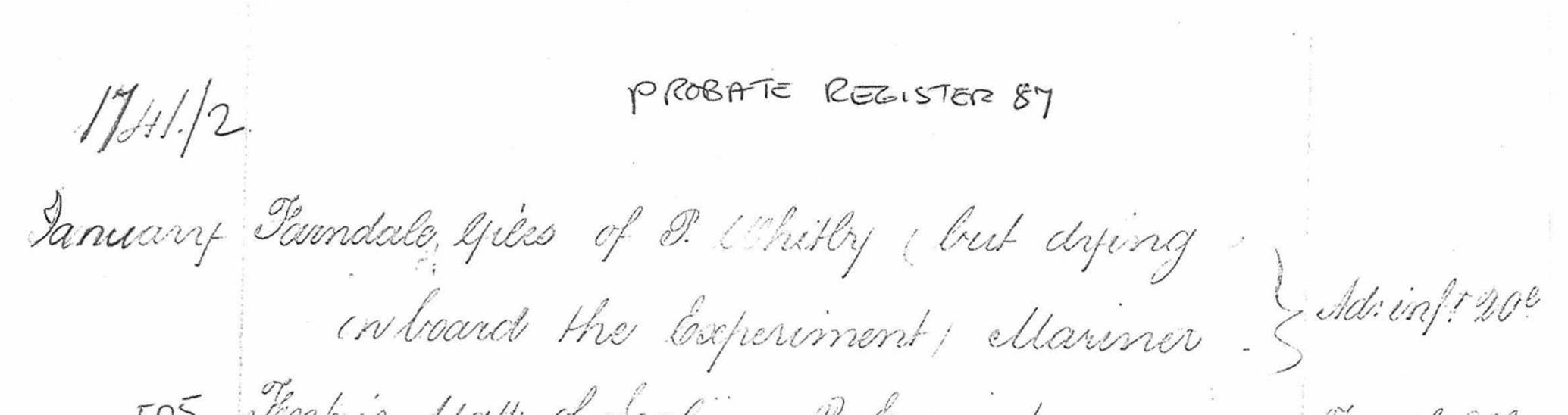
His death
was later recorded in the probate records[43].
Know all men that we Thomas Farndale of Whitby in the County of York,
carpenter, Robert Easton of Whitby aforesaid Master Mariner and Edward Brand of
Whitby aforesaid Mariner, £31, dated 25 Jan 1742. The condition of this
obligation is that the above bound Thomas Farndale, father, next of kin and
administrator of all goods, chattels and credits of Giles Farndale, late of the
Parish of Whitby, in the Diocese of York, Mariner deceased, who died at sea in
His Majesty’s service belonging to HMS Experiment. Signed Thomas Farndalle.
Inventory: Apparel £2 10s 0d, Wages £13 0s 0d[44].
Scene 2 – Of Victorian Captains and
Shipwrights
|
1743 to
1797 Whitby,
Lythe |
|
1773 to
1938 Whitby and
around |
|
1818 to
1849 Whitby |
We now turn
to another family who were descended from the second generation of the Kilton Farndales. They would
also encounter epic adventures at sea, though a little later.
William Farndale
(1743 to 1785) was born in Kilton and
baptised in Brotton on 13 July 1743[45],
the son of William
and Abigail Farndale. We met him in Act 13, Scene 2 and
he was born into the Kilton 1 Line.
William Farndale
the Younger married Elizabeth Barry of Whitby
on 24 September 1766[46]
and became a master mariner in Whitby,
the captain of colliers, like his
kinsman John Farndale.
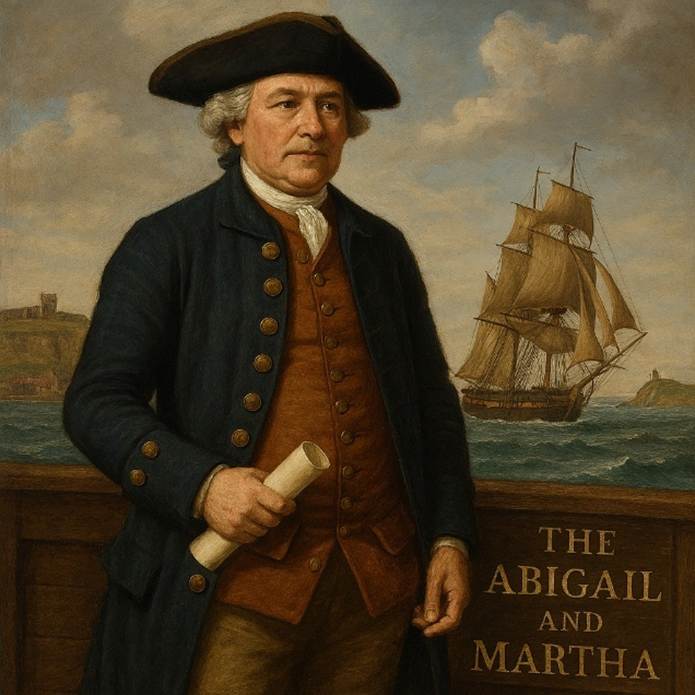
William was
captain of the Abigail and Martha on voyages between Whitby, London and Newcastle[47].
Since Abigail was the name of his mother and his daughter, this suggests he had
a proprietary interest in the vessel.
On 12
December 1775, Master William Craike of the tender Betsy’s Friendship
was indisposed and could not go to sea and proposed that William Farndale took
his place as Master until he was able to join his ship[48].
William and
Elizabeth had two daughters, Abigail and Elizabeth and
two sons Robert
Farndale, a ship’s carpenter[49],
and John Farndale.
John Farndale (1773 to 1833) seems to have been engaged in some form of
military service. John married Dinah Boyes in Loftus on 23 April 1799[50]
and they had eight children, the
Whitby 4 Line. After John died, aged 60, in 1833, the widowed Dinah
Farndale seems to have petitioned for a pension through the Royal Hospital at
Chelsea[51],
so perhaps John served in the Royal Navy, possibly as
a ship’s carpenter.
John and Dinah Farndale had eight children. Six were girls. Ann Farndale did
not marry and worked as a dressmaker, living at Brotton[52].
Hannah Farndale
married a joiner called Edward Hunt[53]
and they lived in Church Street, Whitby.
Edward Hunt and Hannah Farndale had nine children. Edward was the only
surviving of four children of Robert Hunt and Elizabeth Tiplady. The marriage
between Robert and Elizabeth didn’t last and Elizabeth went on to marry John
Spencelayh and Robert Hunt married Anne Arno. The Tiplady line links to the
Dryden family who were heroic lifeboatmen, one of whom was amongst the first
RNLI lifeboatmen in Whitby[54].
Jane Farndale
married Nicholas Rippon[55]
who was another master mariner[56],
and in old age worked in an iron foundry[57].
They lived in Stockton. Dinah Farndale
married Robert Stamp, a ship’s carpenter[58]
and later a master shipwright[59]
in the bustling port of West Hartlepool.
Dinah was later a shareholder in Robert’s business[60].
Mary Ann Farndale
died in infancy[61]
and Elizabeth
Farndale lived with her sister Jane Rippon in Stockton, but died when she was only 16[62].
John and
Dinah’s younger son was John Farndale who
married Elizabeth Frankland in 1848[63].
John was another sailor[64].
John and Elizabeth had a small Whitby family, the Whitby 6 Line. Their younger
son William
Farndale joined the Royal Marines[65],
but was later admitted to Clifton Hospital for mentally ill patients between
1879 and 1881[66].
John and Dinah
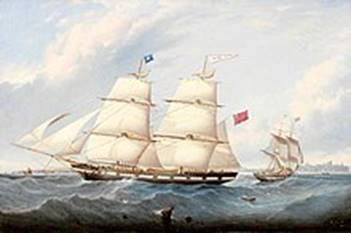
Farndale’s elder son amidst the six sisters was John Christopher Farndale the Elder
(1802 to 1837). John Christopher
Farndale the Elder was a painter when he married Ann Ling in 1825 and until the
birth of his third son in 1830[67].
But by 1836, he was a master mariner of Whitby, captaining a coal brig called the
William and Nancy with cargos of coal largely between Whitby and the north
east and Wisbech in Cambridgeshire and the southeast[68].
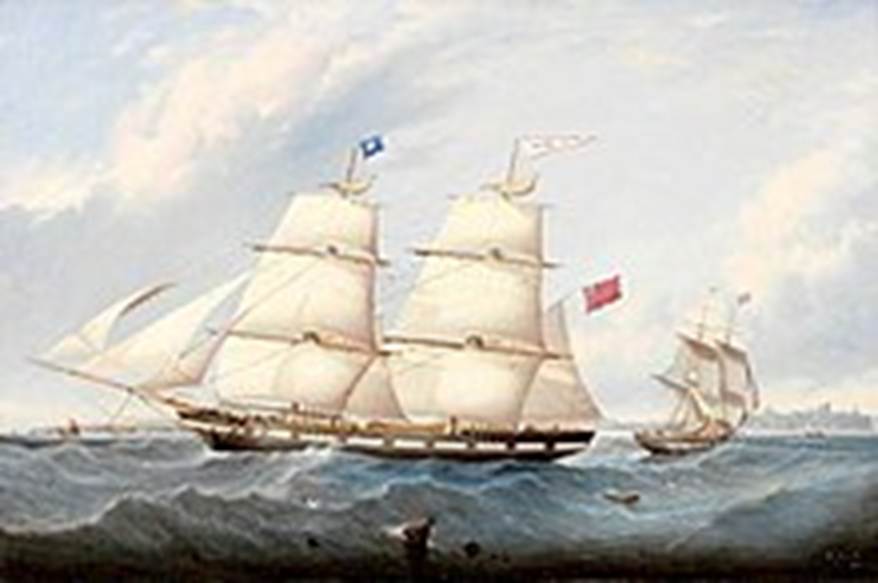
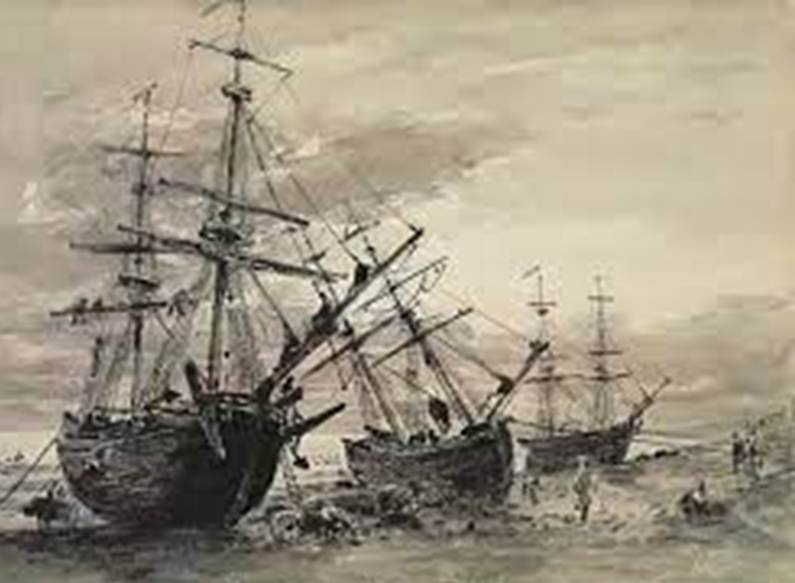
The Mary, a Brig
of South Shields painted in 1855
The Collier Brig was a
traditional song. Oh, the worst old ship that ever set sail, Sailed out of
Harwich on a windy day. Chorus: Stormy weather, boys, stormy weather, boys,
When the wind blows the barge will go. She was built in Roman style, Held
together with bits of twine. Skipper’s half Dutch and he hasn’t got a clue, The
crew were fourteen hands too few. Cook spilt the dinner on the galley floor,
Skipper caught his hand in the wheelhouse door. Off Orford Ness we sprang a
leak, Hear our poor old timbers creak. We steered our way round Lowestoft next,
The wind backed round to the sou-sou-west. Through the Cockle to Cromer Cliff,
Steering like a wagon with a wheel adrift. Up The Humber and up to town, Pump,
you devils, pump or drown. Then on a sandbank we got stuck, Skipper’s drunk in
the Dog and Duck. Up come a mermaid covered in slime, We took her down the hold
and we had a good time. We kept on course all through the night, Nearly went
aground at the Apex light. Coal was shot by a Keadby crew, Bottom was rotten
and it went right through. So when we saw the brig was sunk, We went to the
Barge and we all got drunk.
|
John Christopher
Farndale The Elder 3
January 1802 to 5 February 1837
Married
Ann Ling on 24 February 1825 A
painter, farmer and then master mariner in Whitby who died aged 35 who
captained the William and Nancy often between Whitby and Wisbech on
the fenlands in Cambridgeshire Whitby |
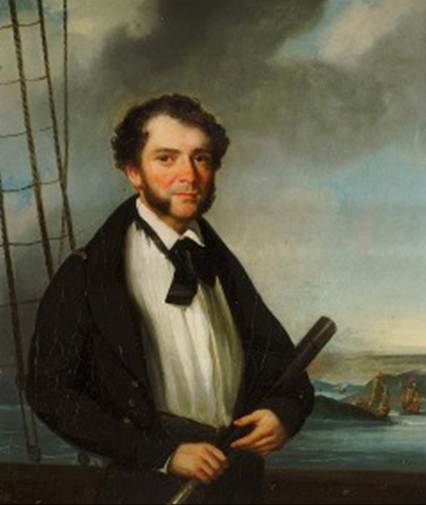
Wisbech was
the main port with which John Christopher traded from Whitby and his son, John
Christopher Junior, would later live there. His early voyages were regularly
between Whitby, sometimes via Newcastle and Sunderland, and Wisbech. Wisbech is
in Cambridgeshire, a port some distance inland, approached from the Wash by a
long canal, the Nene Outfall Cut connecting the Fenland market town and inland
port to the sea. It is in the far north east of the Cambridgeshire, bordering
Norfolk.
On 14 June
1833, John came into difficulty off the North Foreland at Yarmouth, still
captain of the William and Nancy, when he slipped anchor and chain and
lost his stern boat, with other damage to the ship[69].
On 22
October 1833 he arrived in Lancaster from Archangel, the Russian White Sea port
now known as Arkhangelsk. This would have been an epic voyage around the north
cap of Norway into the White Sea in autumn[70].
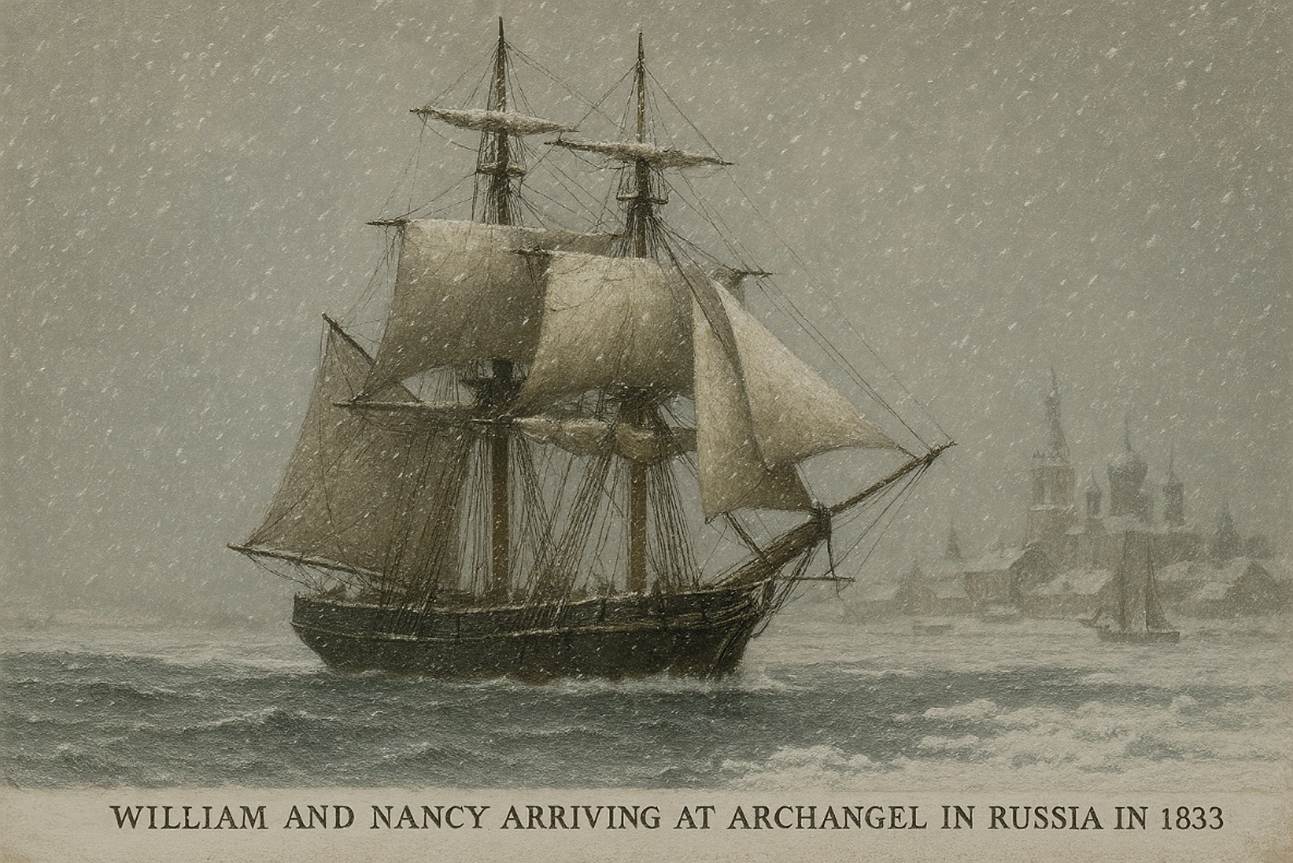
He died in
February 1837, master and owner of the William and Nancy, in
the prime of his life at the age of only 35[71].
John the
Elder and Ann had five children. Thomas Farndale
was a ship broker’s clerk[72]
who died aged only 31[73],
Mary Farndale,
a straw bonnet maker[74]
whose husband, John Chambers was lost at sea with her brother[75],
and James Farndale
died an infant[76].
Their other
two sons were also Master Mariners.
William Farndale
(1825 to 1887) was the elder brother. When his father died in 1837, he was only
twelve years old. By 1849 William Farndale was the captain and master of his
father’s ship, the William and Nancy[77].
|
11
November 1825 to 6 March 1887 Married
Ann Brown on 7 July 1853 Master
mariner of Whitby, whose wife was a lodge house keeper Whitby |
The William
and Nancy was forced to beach south of Bridlington in a storm on 2 December
1849, but the vessel was hoved off the beach on 15
December, and seemed to have suffered no damage. During the day, it was
excessively thick with rain, with the wind blowing in the early part of the day
from the south and east, blowing a perfect gale. At daylight a Brig appeared
but was unable to reach the harbour, and it ran on shore about a half a mile
south of the town. This proved to be the William and Nancy, captained by
William Farndale. The crew were saved[78].
On 7 March
1850 William sailed from London[79].
On 29 May 1850 he arrived at West Hartlepool from Hythe[80].
On 13 May 1830 at 13.30 pm, in a strong south westerly wind and fog, the William
and Nancy, captained by William, lost its anchor and thirty fathoms of
chain, and the windlass was broken[81].
An anchor windlass is a machine that restrains and manipulates the anchor chain
on a boat, allowing the anchor to be raised and lowered by means of chain
cable.
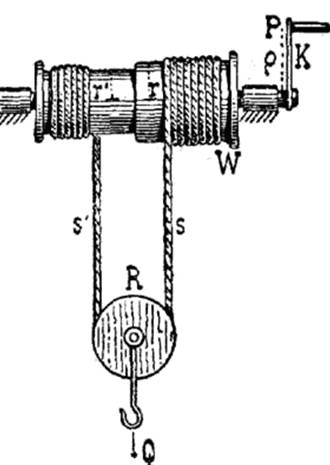
Windlass
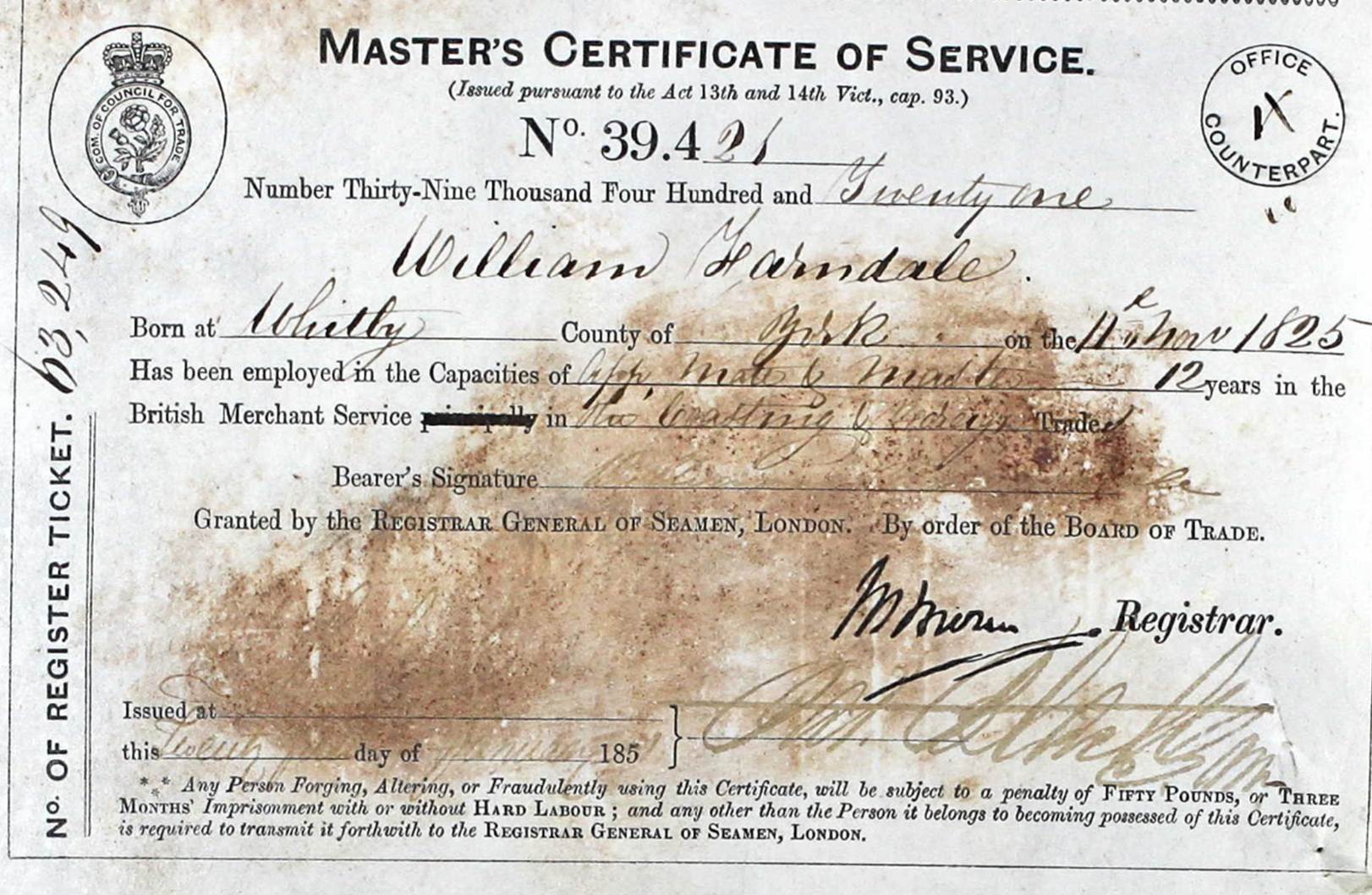
William
received his Master’s Certificate of Service on 10 January 1951[82].
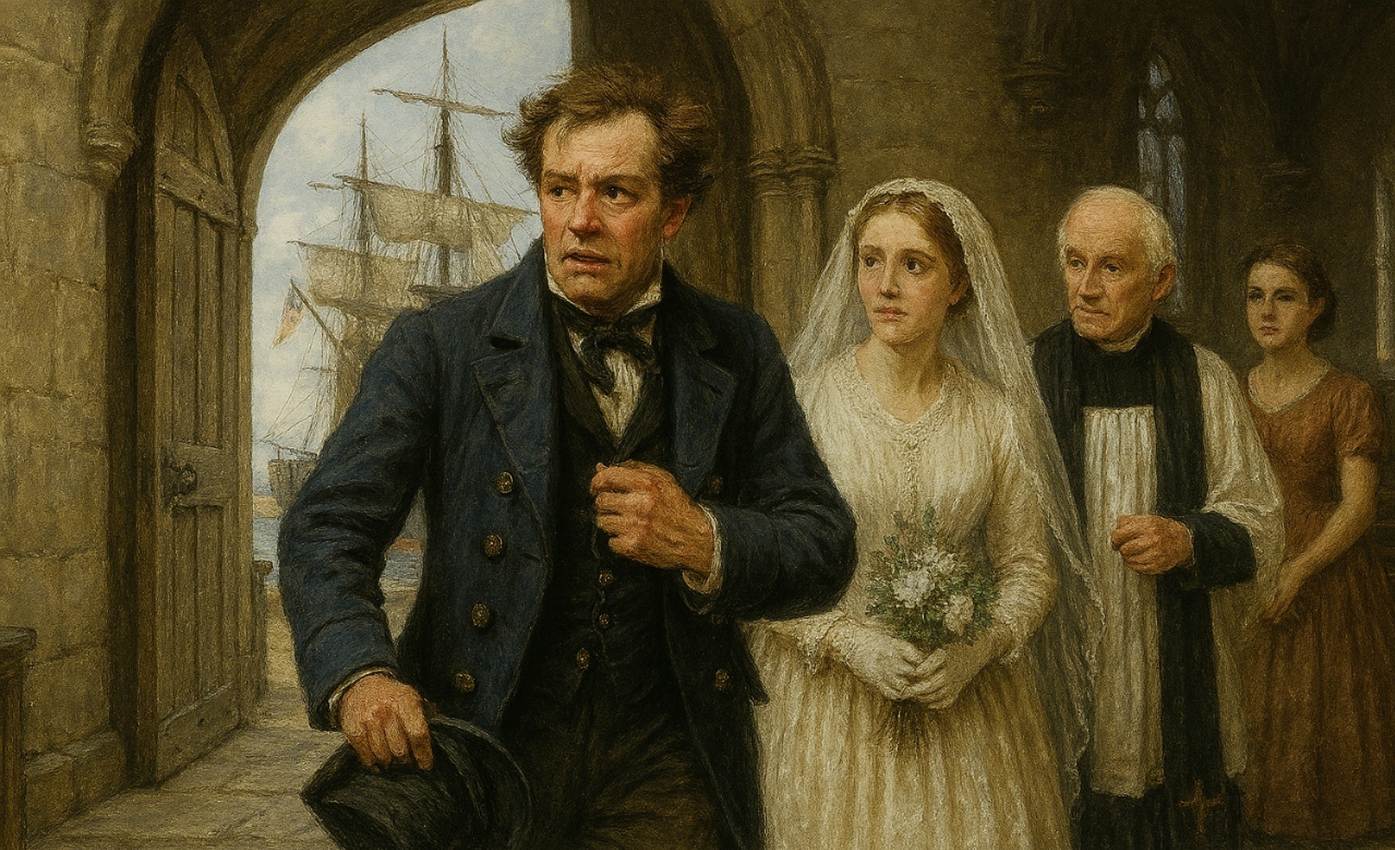
On 4 July
1853 the William and Nancy passed Great Yarmouth at 6am[83].
William was clearly playing it close to the wind, as his wedding was on 7 July
1853, when he married Ann Brown of West Cliff, Whitby[84].
By 24 August
1853, he was back at sea in fresh, thick rain, sailing from Whitby to Dover[85].
In February
1854, John faced a strong north west wind with snow squalls. It was very cold.
The William and Nancy was forced to put in at Lowestoft through stress
of weather. The Harbour Company’s tugs, and two Yarmouth tugs by permission of
the harbour master, had been engaged during the greater part of the day
assisting vessels in, with loss of anchors and other damage. A boy whose name
was never reported, belonging to the Commerce, another brig of Whitby,
was drowned in the inner harbour during the previous evening and his body was
dragged for and found during the morning[86].
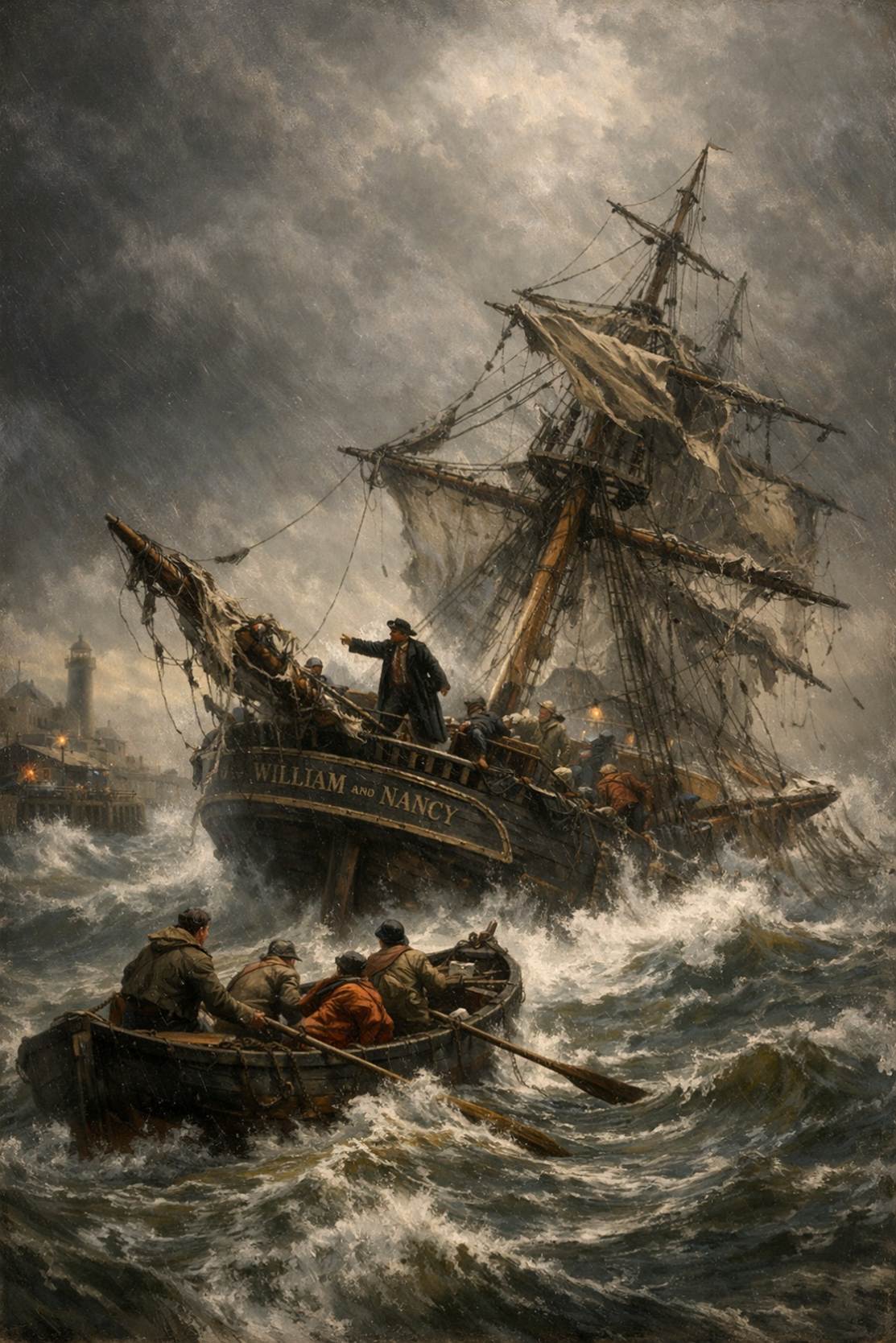
William
Farndale captained the William and Nancy in November 1856 and suffered
severe damage in another storm off Lowestoft. On 13 November 1856, she put in
through stress of weather, having lost her mainmast. She had been fouled in the
storm by the brig Ruby, off Pakefield Cliffs after she had lost her
bowsprit, fore-mast, fore-topmast, main-topmast, and all the gear and long boat
stoven[87].
She was assisted into harbour
by a boat’s crew for £50 and came into the City of Norwich for refuge. During
and subsequent to the late heavy gale, about 100 sailing vessels, many of them
large class vessels, had taken into Norwich harbour for refuge. However again
the vessel was repaired and made seaworthy again. She sailed out of Lowestoft
again on 18 December 1856[88].
In
1857, we have the first record of William’s voyage outwith
the British shores, to France. On 23 April 1857 the William and Nancy,
Farndale, arrived in Whitby from Abbeville[89].
In July 1857, William had more
problems with the William and Nancy. On 22 July 1857, en route from Sunderland for Deal, she had to
put in to port with the loss of her fore and main topmast, off the Inner
Garboard, at 11am, assisted by a fishing smack[90].
On 11 November 1857 William
sailed to Boulogne with 44 hundredweight of coals[91].
A hundredweight is 100 pounds or about 45 kilograms.
In
the elections for Whitby, caused by the death of Robert
Stephenson (the son of George
Stephenson), in 1859, William Farndale voted for the
Conservative candidate, Thomas Chapman[92].
The Prince Maharaja Dhuleep
Singh and suite arrived at the hustings from Mulgrave Castle at the
commencement of the proceedings, and remained until nearly their termination.
His Highness appeared to take great interest, and to be highly amused with the
free and independent ebullitions of the populace, and with the speeches of the
candidates and their friends. Maharaja
Duleep Singh (1838-1893) was the last Maharaja of the Sikh Empire, the youngest
son of Maharaja Ranjit Singh, deposed by the British in 1849, and brought to
England as a child in 1854 where he famously presented the Koh-i-Noor
diamond to Queen Victoria, with whom he developed a complex relationship, later
converting to Christianity but eventually seeking to reclaim his kingdom and
re-embrace his Sikh faith before dying in exile. Maharaja
Duleep Singh lived as a resident at Mulgrave Castle[93]
in Cleveland, about 2 kilometres west of Whitby, leasing the property from the
Marquess of Normanby after 1858. It was his home for several years, following
his exile from the Punjab.
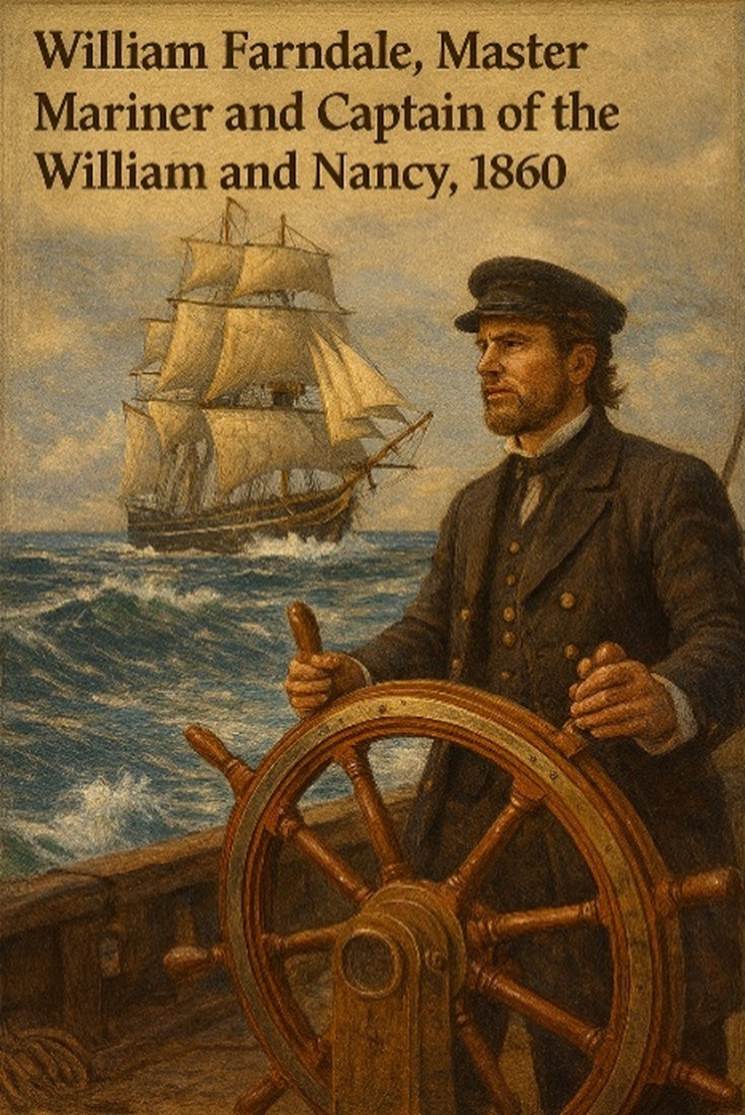
In 1860,
William Farndale and the William and Nancy arrived at Warkworth from Abbeville[94].
Abbeville is in France not far from Le Treport, but,
like Wisbech, has a canal to the sea. Warkworth is in
Northumberland near Alnmouth. On 4 February 1861 William Farndale and the William and Nancy
arrived at Amble from St Valery. Another report recorded that the vessel was
carrying 125 tones of coals from Harrison, Carr &
Co[95].
On the evening of 25 June 1861, Mr Farndale, of the schooner William and Nancy,
of Whitby, arrived at Blyth from Deal, and passed a quantity of German yeast
and picked up one basket. Several pieces of bulwarks were floating about at the
place[96].
She headed for Tynemouth.
There was
more trouble for William Farndale on 2 November 1861 when the brig William
Nancy, Farndale, of Whitby, from
Newcastle for Abbeville, put in at Calais, with bulwarks carried away, having
experienced very severe weather[97].
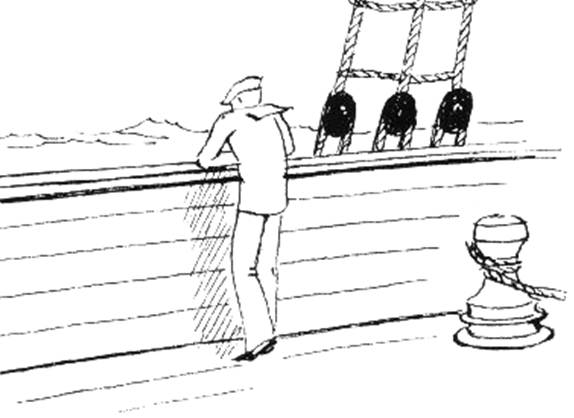
The
bulwark is the extension of a ship's side above the level of the weather deck
On 10 March
1862 William Farndale and the William and Nancy arrived at Shields from
Abbeville[98].
On 23 April 1862 she arrived from Whitby at St Valery[99].
On 22 August 1862 William Farndale and the William and Nancy arrived at
West Hartlepool from Deal[100].
On 24 February 1863 she arrived at Dunkirk from Newcastle[101].
On 24 March 1863 she arrived at Sandwich from Abbeville[102].
On 9 June 1863 she arrived at West
Hartlepool from Whitby[103].
On 3 August 1863 she arrived at West Hartlepool from Deal[104].
On 2 May 1864 William Farndale and the William and Nancy sailed from
Ramsgate bound for Hartlepool[105].
On 26 October 1864 William Farndale, captain of the brig, the William and
Nancy, and travelling from Broadstairs to Whitby
and while in ballast, suffered a broken mainstay[106].
On 4 December 1864 she put into to Dover having sailed from Shields en route to Abbeville[107].
On 14 May 1865 she arrived in West
Hartlepool from Folkestone[108].
On 24 June 1865 she arrived in Hartlepool
from Deal[109].
On 24 August
1865 William Farndale captained the Ythan arriving at Hartlepool from Deal[110].
On 1 November 1865 William Farndale captained the Ythan arriving at
Sandwich from Hartlepool[111].
On 13 December 1865 William Farndale and the William and Nancy arrived
in Sandwich from Hartlepool[112].
On 17 December 1865 William Farndale captained the Ythan arriving at
Sandwich from Hartlepool[113].
On 5 January 1866 William Farndale captained the Ythan arriving at
Sandwich from Middlesbrough[114].
On 31 January 1866 William Farndale captained the Ythan arriving at
Lowestoft from London for Middlesbrough[115].
There is a record of shipwrecks from Whitby which shows that the
William and Nancy, formerly the ship captained by William Farndale,
floundered off Dimlington in June 1866. Dinlington is off the Holderness coast,
near Hill, south of Withensea.
On 2 August
1866 William Farndale captained the Ythan arriving at Hartlepool from Deal[116].
On 27 November 1866 William Farndale captained the Ythan arriving at
Lowestoft from Deal[117].
On 9 February 1867 William Farndale captained the Ythan arriving at Hartlepool from Arbroath[118].
On 5 June
1867 William Farndale captained the Medusa arriving at Sunderland from Cronstadt[119].
On 20 January 1868 William Farndale was captain of the Day Star,
arriving in Portsmouth for Llanelly[120].
On 28 March
1868 there was a report of serious damage to the Ythan of Blyth. The
Ythan, Farndale, of Blyth, for Deal, put into Ramsgate on Thursday, having been
in collision with the brig Doune Castle, carrying away rigging, mainsail,
bulwarks, and receiving other damage[121].
On 30 April 1868 William Farndale captained the Charles Adams and was
cleared at Rotterdam for Ipswich[122].
His voyages
continued regularly over the following years. William Farndale appears to have led a trans Atlantic voyage in February 1873. On 31 January 1873,
The China, Farndale, arrived in Liverpool from New Orleans, having
experienced very severe weather during the whole of the passage. On 27 January
1873, it had passed between Tuskar and Bardsey, through an immense quantity of
pine logs, deals and bulwarks, the latter painted blue and white, all fresh.
The crew were compelled to keep a double watch, the logs being so large and
very dangerous to shipping at night[123].
His last
voyage as a merchant captain was probably in September 1876 and on 9 December
1876, the special business before the monthly meeting of the Trustees of the
Piers and Harbour was the appointment of a harbour master in the place of Mr
William Tose, deceased. It was resolved that Mr Robert Gibson, master mariner,
be appointed to the office, the candidates having included William Farndale[124].
By now William Farndale was 51, so clearly looking for a less stressful life
than one on the high seas.
On 22 June
1878, an inquest was held at the Royal Hotel, by John Buchanan Esquire,
coroner, touching the death of Ada Patton, aged 13 years, a domestic servant in
the service of Captain William Farndale, No 3, North Terrace. Mr Farndale gave
evidence that the deceased, Ada Patton, had lived as servant with them about
six weeks. On Saturday morning last, a little before seven o’clock, he and
Mrs Farndale were in the front kitchen, and Ada Patton was in the back kitchen.
He did not know what she was doing. On hearing her scream he came to her
assistance and found her standing in the passage between the two kitchens with
her clothes in flames. He pushed her into the back kitchen and rolled her in
the carpet to extinguish the flames. Mrs Farndale came to his assistance with a
rug from the front kitchen which was very much burnt by being wrapped around
her. After extinguishing the flames they pulled her clothes off and laid her on
the bed. Dr Stewart was sent for and was soon in attendance. [125]
William
Farndale died at Whitby on 3 March 1887, aged 62[126].
William and
Ann and they had two children John Thomas
Farndale (1854 to 1930) and Jane Farndale
(1856 to 1938). They also seem to have adopted their niece, probably a daughter
of John Christopher
Farndale the Younger, Maria J Farndale.
John
Thomas Farndale and Jane Farndale each
did not marry, but lived together in Thirsk, where John Thomas became manager
of Barclays Bank and both were prominent members of Thirsk society in the early
twentieth century.
William’s
younger brother was John
Christopher Farndale the Younger (1830 to 1868). He was another adventurer
at sea.
|
John Christopher
Farndale the Younger 18
October 1830 to 22 January 1868 Married
Christiana Ainslie on 3 July 1857 and then Jane Barnett Telford on 21
December 1861 A
master mariner of Whitby who moved to Wisbech, Cambridgeshire Died
at sea in the Bay of Biscay Whitby,
Wisbech |
On 19
February 1845 at the Justice Room in Whitby, before Thomas Fishburn, and John
Chapman, Esqrs, it was reported that on Saturday four sea apprentices, named
Matthew Walker, John Christopher Farndale, Isaac Wilson, and Thomas Hill, had
been charged with absenting themselves from the ship Great Britain,
belonging to Mr Joseph Tindale, of Whitby. The charge was clearly
proved by the master, and the lads failing to show any justifiable cause for
their misconduct, were committed to Northallerton for one month’s hard labour.
We hope this punishment will bring the young delinquents to a sense of their
duty, and act as a warning to others. It is notorious that the owners of
vessels in Whitby harbour, particularly the owner of the Great Britain, have
suffered considerably by the incorrigible conduct of their apprentices; and Mr
Tynedale is, in our opinion, worthy of praise for thus stepping forward to put
a check on such proceedings.[127]
Having
clearly learnt his lesson, by January 1853, John Christopher Farndale was the
captain of the collier brig, the John Stewart. On 12 January 1853 he
passed Yarmouth Roads at Lowestoft in south westerly winds and fresh and cloudy
weather, having sailed on 25 December 1852 from Hartlepool for London[128].
However he was back in court in March 1854 when he was found to owe William
Griffin, a seaman on the John Stewart, the sum of £2 9s[129].
In 1856,
John Christopher Farndale captained the Caspian of Whitby arriving in Nyhamn, a harbour in Norway between Kristiansand and Oslo
on its southern shore[130].
John married
Christiana Ainslie, a 23 year old spinster of Wisbech on 3 July 1857[131].
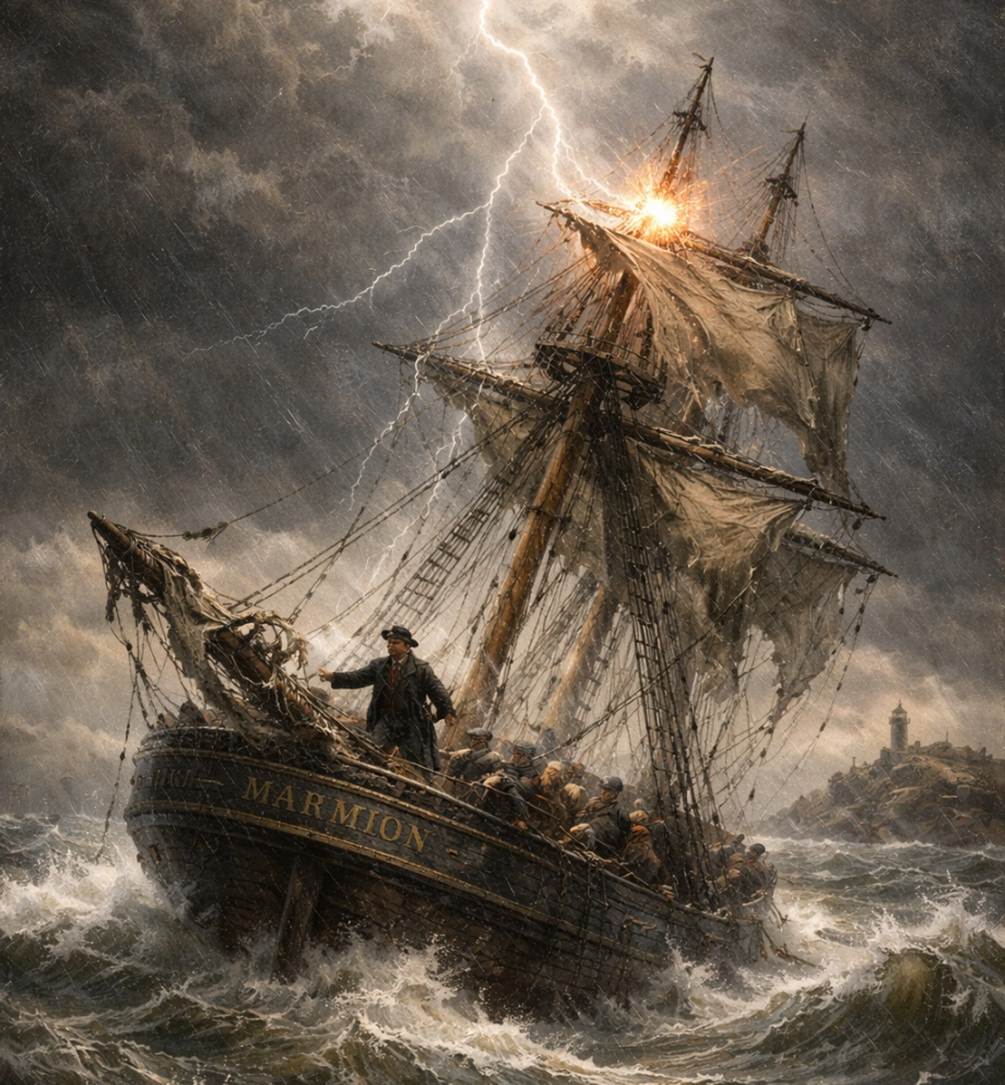
On 19 August as captain of the Marmion, he was forced to put in to
Gothenburg, having been struck by lightning[132]
and two months later he lost the ship and cargo off Osel,
an island at the mouth of the Bay of Riga, off modern day Estonia[133].
His
wife, Christiana, died in Whitby on 10 May 1859, aged only 26[134].
On 22 March
1860 John was captain of the Ada and approached Hamburg harbour[135].
On 18 July 1860 John arrived in Wisbech as captain of the Ada from Narva[136].
Narva is in modern day Estonia, so John Farndale seems to have been sailing
regularly to the Baltic states and Russia delivering coal at this time.
John
transported coals for Lotinga & Co. There was a Lotinga family in Newcastle
at the time, who were part of the Jewish community. Lotinga & Co appear to
have been shipping brokers based in Newcastle. On Tuesday 14 August 1860 John
Farndale was Captain of the Ada on return from Cronstadt,
with 109 hundredweight of coal carried for Lotinga & Co[137].
On 24 August
1860, John sailed up the Baltic, via Elsinore to St Petersburg in Russia, again
captain of the Ada, having originated in Newcastle[138]. He was at Elsinore on 25 August 1860. On 1 September 1860 he arrived
captain of the Ada at Cronstandt from Shields[139].
On 18 September 1860 the Ada, Farndale arrived in Wyburg
from Cronstadt[140].
On 13 January 1861 John Christopher Farndale captained the Ada and arrived in
Hartlepool from Dunkirk[141].
On 5 April
1861 he captained the Ada into South Shields from Hamburg[142].
The crew aboard the Ada on the night of 7 April 1861 included John
Christopher Farndale, a widower, 30, Master of the ship; Richard Gibson, 26,
mate; John Allison, 16, apprentice; and Frederick Cook, 17, apprentice[143].
John at the
age of 30 married the 17 year old Jane Barnett Telford of Wisbech on 21
December 1861[144].
On 31
January 1862 John Christopher Farndale and the Ada were listed amongst the
colliers that arrived on 31 January at Gravesend[145].
On 4 March 1862 he captained the Ada and left West Hartlepool for
Hamburg[146].
On 1 April 1862 he was captain of the Ada of Whitby when she arrived in
Hamburg[147].
On 19 April 1862 John captained the Ada and arrived at Newcastle from Cronstadt[148].
On 14 May 1862 John captained the Ada from Newcastle to Cronstadt[149].
On 1 June 1862 John captained the Ada and arrived at Cronsdtadt[150].
On 20 July 1862 John captained the Ada and arrived at Elsinore having
travelled from Riga bound for Dover[151].
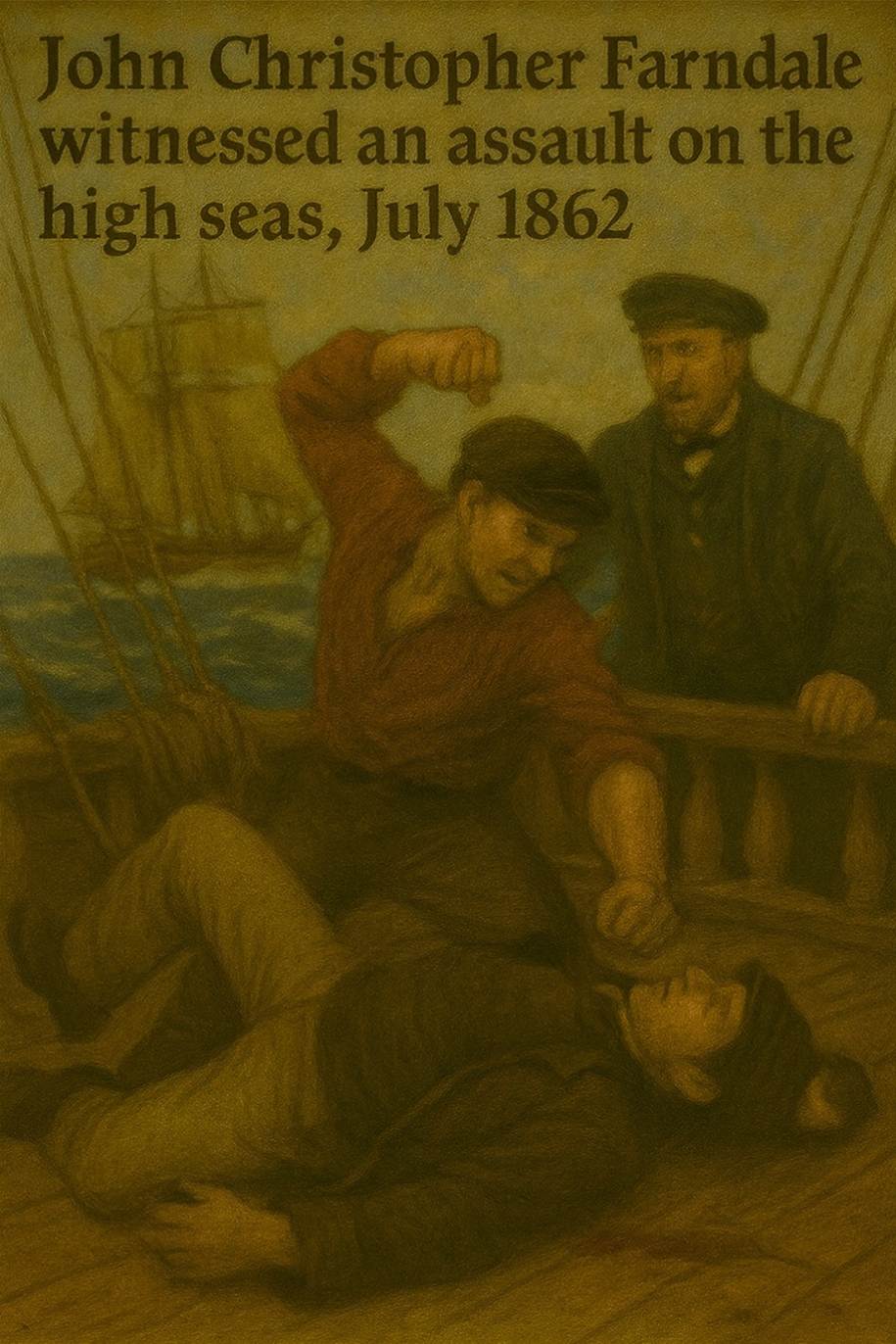
On Friday 9 August 1862 proceedings of the Dover
Police Court before Mayor E F Astley Esq and L Stride Esq concerned a charge of
Assault on the High Seas. Benjaim Burvill, a
mariner, was charged on a summons with having assaulted Edward Sneller, another
seafaring man, on board a British Ship called the Ada, on the high seas
near the South Foreland. Edward Sneller stated that he lived at East cliff and
was a boatman. On Saturday evening last, about half past six or seven o’clock, he
boarded the brig Ada off South Foreland. He asked the captain if he were
bound for Dover with a cargo for Mr Fennis. The captain answered ‘No’
and asked if witness were a ‘branch pilot’. Witness said he was not,
whereupon Burvill stepped forward and assured the captain that he was a
branch pilot. On hearing this, he said to the captain, “He is no more a
branch pilot than I am,” when Burvill instantly raised his fist and gave
witness a blow, which he received at the back of the left ear, and which sent
him reeling.
J C Farndale, the master of the ship Ada, said that on Thursday moring the complainant and defendant
boarded his ship. He believed the former was first on deck. He asked him if he
was for Dover. Witness made no reply, but walked to the lee side of the deck.
Defendant then came alongside, and as he had more the look of a pilot,
and came in a better class of boat (complainant’s having much the
appearance of a leisure boat) witness responded to his inquiry whether he was
bound for Dover, by returning an affrmative answer. After that he asked Burvill
if he were a branch pilot, and he told him ‘yes’, and as they were crossing to
the starboard side of the deck he followed up the question with another,
namely, if he could order the jack to be hauled down, which he also answered
satisfactorily. Upon hearing that complainant said, “This man is no more a
branch pilot than I am,” and then followed the assault. As a reason for his
peculiarity in putting the questions he did, the witness explained that he
had been warned that there was a parcel of hovellers, who palmed
themselves off as branch pilots with a view to getting handsomely paid for
taking vessels into port. Mr Fox (to the witness): When this conversation took
place about the jack, and Burvill ordered it to be hauled down, you considered
that he was engaged? Witness: I considered that he was a branch pilot, and that
the other man was not. - Mr Fox: You
considered he was in charge of the vessel? Yes after the jack was hauled down.
Mr Fox said he was perfectly satisfied from the evidence
of Sneller and the captain that an assualt had been committted.[152]
On 28
January 1863 John captained the Ada and arrived at Dieppe from Shields[153].
On 5 May 1863 he captained the Ada and arrived at Elsinore from Stettin
bound for London[154].
On 11 September 1863 he captained the Highland Chief arriving at
Elsinore from Newcastle bound for St Petersburg, Russia[155].
On 4 October 1863 he captained the Highland Chief and left Shields
headed for Wyburg[156].
On 14 December 1863 he captained the Highland Chief and arrived at
Sutton Bridge from Wyburg[157].
On 26 April 1864 he captained the Highland Chief arriving at Elsinore
from Dantzic bound for Wisbech[158].
On 11 May 1864 he captained the Highland Chief arriving Wisbech from
Danzig[159].
She carried wood from Grimsby into Wisbech so perhaps she delivered coal to
Danzig and called in at Grimsby on the return voyage to pick up wood to deliver
to Wisbech.
His voyages
continued over the following years, around the British coast, across the North
Sea and into the Baltic.
On 21 July
1866 the screw steamer, Medusa, Captain Farndale, was laden with coals
and left Shields for Cronsdadt where she arrived ten
minutes after another screw steamer, the Cambridgeshire[160].
Both ships were the property of Richard Young esq MP, so had perhaps been part
of a small fleet.
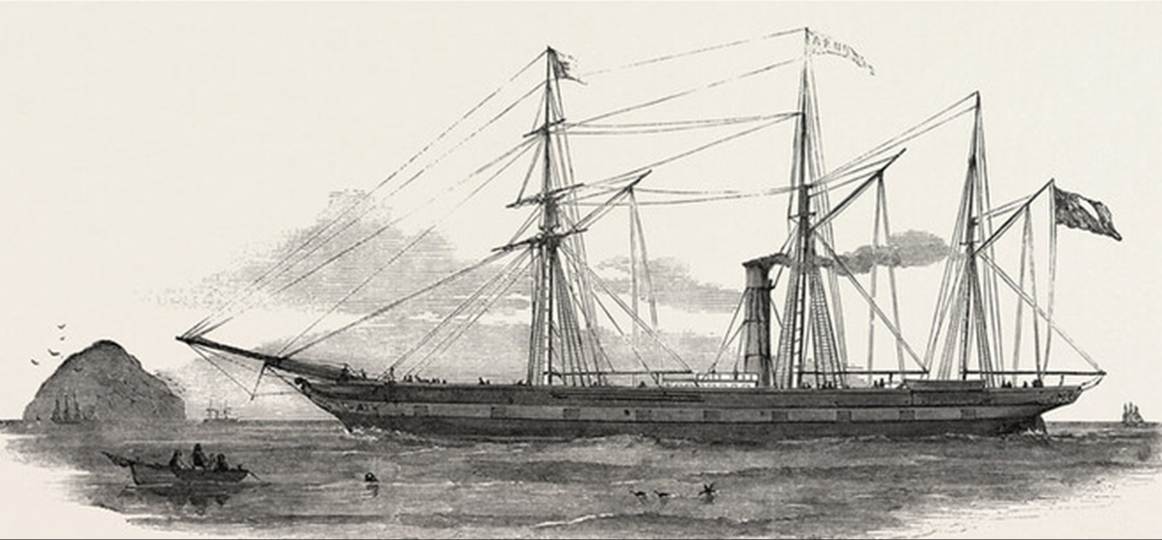
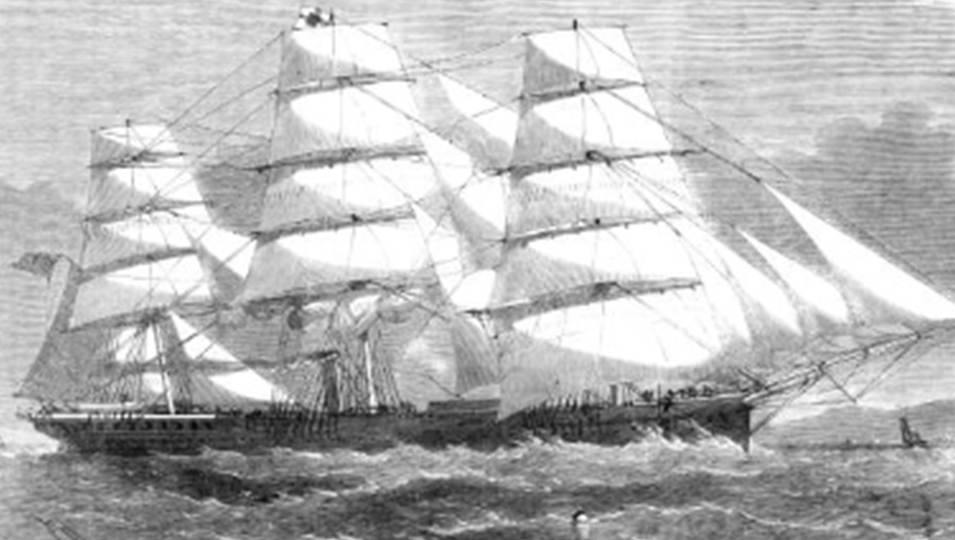
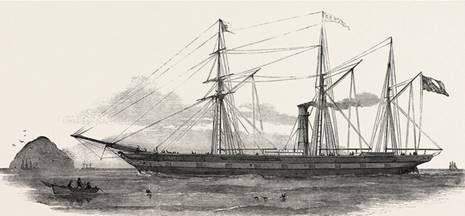
Screw
Steamer
A screw
steamer or screw steamship, abbreviated SS, was a steamship or steamboat
powered by a steam engine, using one or more propellers, also known as screws,
to propel it through the water. In the nineteenth century, this designation was
normally used to contrast with the paddle steamer, a still earlier form of
steamship that was largely, but not entirely, superseded by the screw steamer.
These new vessels started to be used after Thomas Clyde applied Jon Ericsson’s
screw propellor to steam vessels in the USA.
On the
evening of 26 October 1866, Mr Young’s screw steamer, Norfolk, sailed
from Amsterdam to Dantzic, and had proceeded but a
short distance on the passage when one of the sailors, named Allison Brown, of
Sunderland, refused to go on deck, and on the steward, a very respectable man
named Bridgman, going below and telling him he would be made to turn out, Brown
stabbed him in a savage manner in the back, and Captain Farndale had to put
back to Amsterdam, where Bridgman received every possible attention from the
doctors, while Brown was attended by H M British Consul, who considerately sent
him to the durace vile until the return of the
steamer to Amsterdam, when the case will be gone into, and Brown receive the
punishment he so richly deserves.[161]
durance vile is an old term for a long prison sentence.
On 22
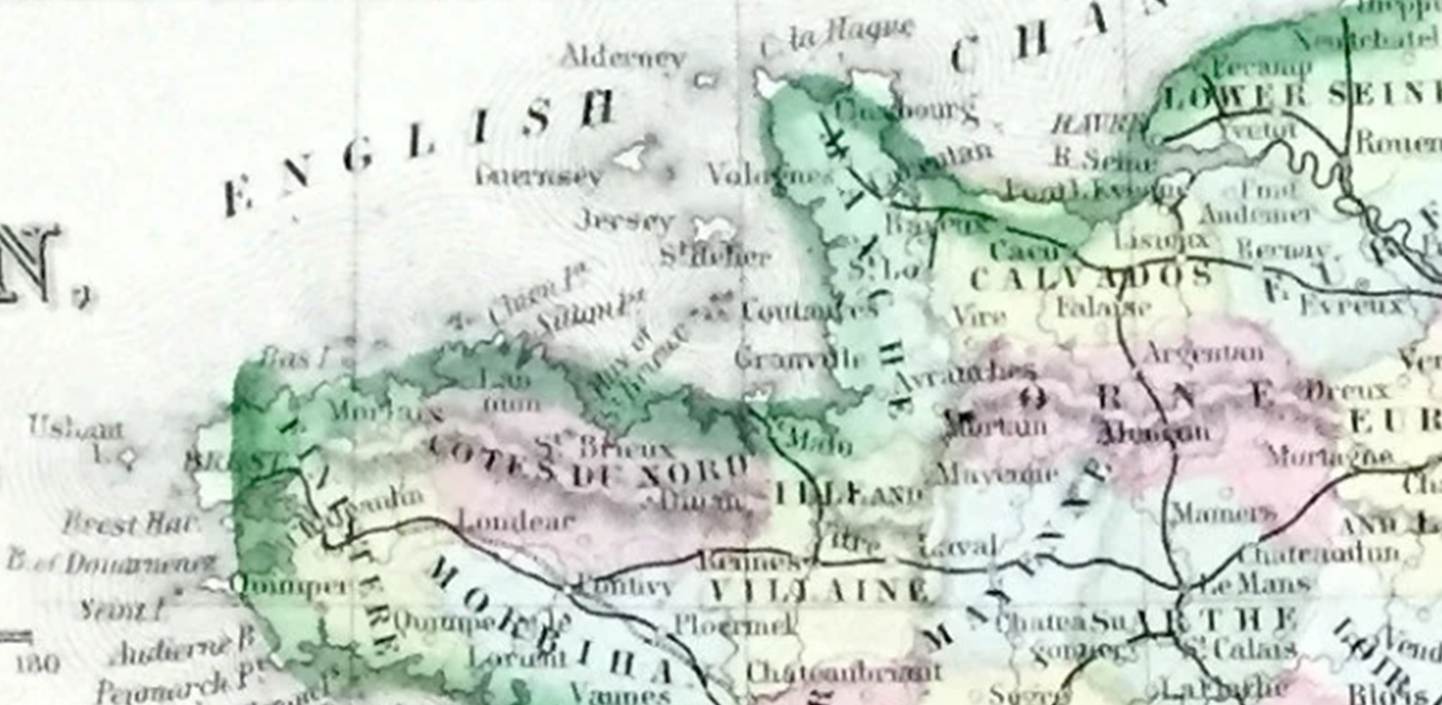
January 1868 John Christopher Farndale was lost at sea. A report from Nantes on
5 February 1868 brought news from Roscoff that the master of the Aigion had arrived at that port, reporting that he had
seen a large steamer founder on 22 January 1868, during a heavy gale, in the
area of Ushant. Some papers, which are supposed to have belonged to the
Norfolk, with John Farndale its Captain, on a voyage from Newcastle to
Barcelona, had been picked up near Plouescat, and a
lifebuoy, marked Norfolk, was been picked up at sea by some Roscoff boats.
Nothing had
been heard of the vessel or her crew. The crew of the Poltarstjernan,
of Hangesund, on a voyage from Abo to Hull, was also
missing and the brig Jane and Margaret from Sunderland to London, laden
with coal, struck onto Sizewell bank and then sank in deep water, her topsail
being just visible. The crew got off in the vessel’s boat and landed at Thorp,
having saved nothing but the clothes they had on.
By 15
February 1868, there were grave doubts for the safety of the screw steamer Norfolk
and the loss of the fine steamship Norfolk, and all her crew, consisting
of eighteen persons was confirmed at Wisbech on 19 February 1868.
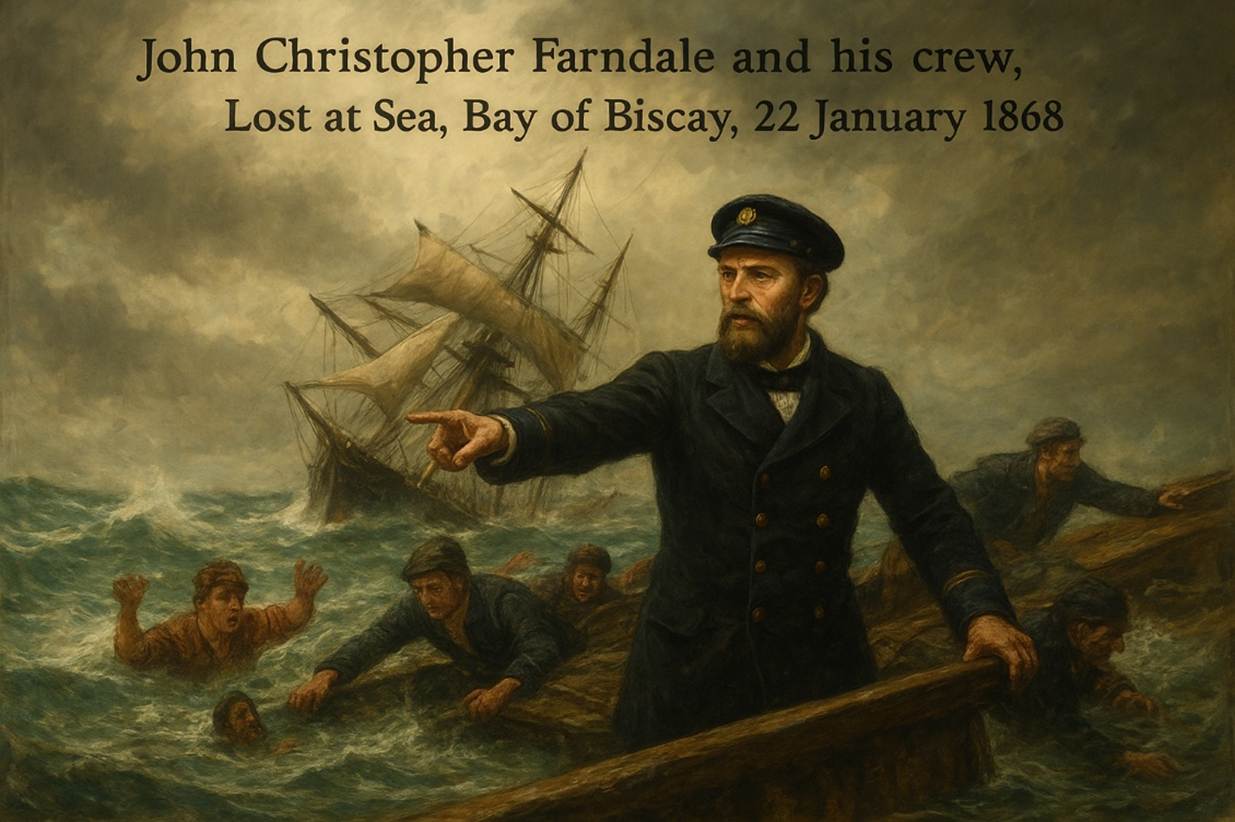
The Master
was John Christopher Farndale, 56 years of age, belonging to Whitby, but residing at 14, New Parade,
Wisbech. He had been seventeen years a master and was much respected, and left
a widow and three children. The Mate was William J Cousins, of Portsmouth. The
Second Mate was William H B Telford, Wisbech, 22. He had passed his examination
on the 8 January, with great credit, and obtained the certificate at Sunderland
only three days before he went on board. He was educated as Wisbech Grammar
School and son of Mr J H Telford, of Wisbech. He was John Christopher
Farndale’s brother in law. The Third Officer and Lamp Trimmer was John
Chambers, 38, who had married Capt Farndale’s sister, Mary Farndale, and left her a
widow with one child at Sunderland. This was John Chambers’ first voyage in the
Norfolk and only a few months previously he had been wrecked, and was four
days on board the wreck, off Yarmouth.[162]
John the
Younger and Jane had two daughters and a son. John left about £800 of effects
in his will[163].
His family went to live with Jane’s father, John Henry Telford in Wisbech. They
then travelled to the United States where on 23 November 1877 Jane married
Stephen Ives, a barrister of Salem, Massachusetts, in New York[164].
Their eldest daughter Fanny
Amelia Rose Farndale travelled to New York to meet her mother in April 1878[165]
and seems to have returned to UK and then sailed back again with the rest of
her family in 1879[166].
Rose married Walter Howard Creamer who applied to be a member of the Sons of
the American Revolution as a descendant of Benjamin Walter[167].
Walter was a native of Salem who served three terms as mayor from 1918[168].
Their son, Tom
Christopher Farndale was a Yeoman
First Class with USS Hartford Military Station by 1900[169].
Scene 3 – Of Innkeepers, Policemen,
Engineers, Presbyterians, Soldiers and Pioneers
|
|
|
1788 to Date Whitby, Danby, Egton, Goathland,
Loftus, York and more widely |
|
|
|
|
|
|
|
|
|
1839 to 2002 Wakefield and more widely |
1849 to 1993 Loftus, Danby, Whitby and more
widely |
1909 to Date Nottingham and more widely |
1914 to Date Holderness, Hull |
1947 to 2004 Wide geographical spread |
|
|
|
|
|
|
|
|
1871 to 1912 Ontario, Canada |
|
|
|
|
|
|
|
|
|
|
1866 to Date London and more widely |
1886 to Date Leicester, Nottingham and more
widely |
1916 to 1945 Bradford |
|
|
There was
another family originated in the
Kilton 1 Line, who came to settle in the lands immediately to the west of Whitby, at Newholm,
in Eskdale and around Goathland, Danby
and Egton.
John Farndale was
the son of Samuel
and Elizabeth Farndale, the cabinet maker family who we met in Act 13, Scene 2.
John was born in Kilton and baptised in Brotton[170].
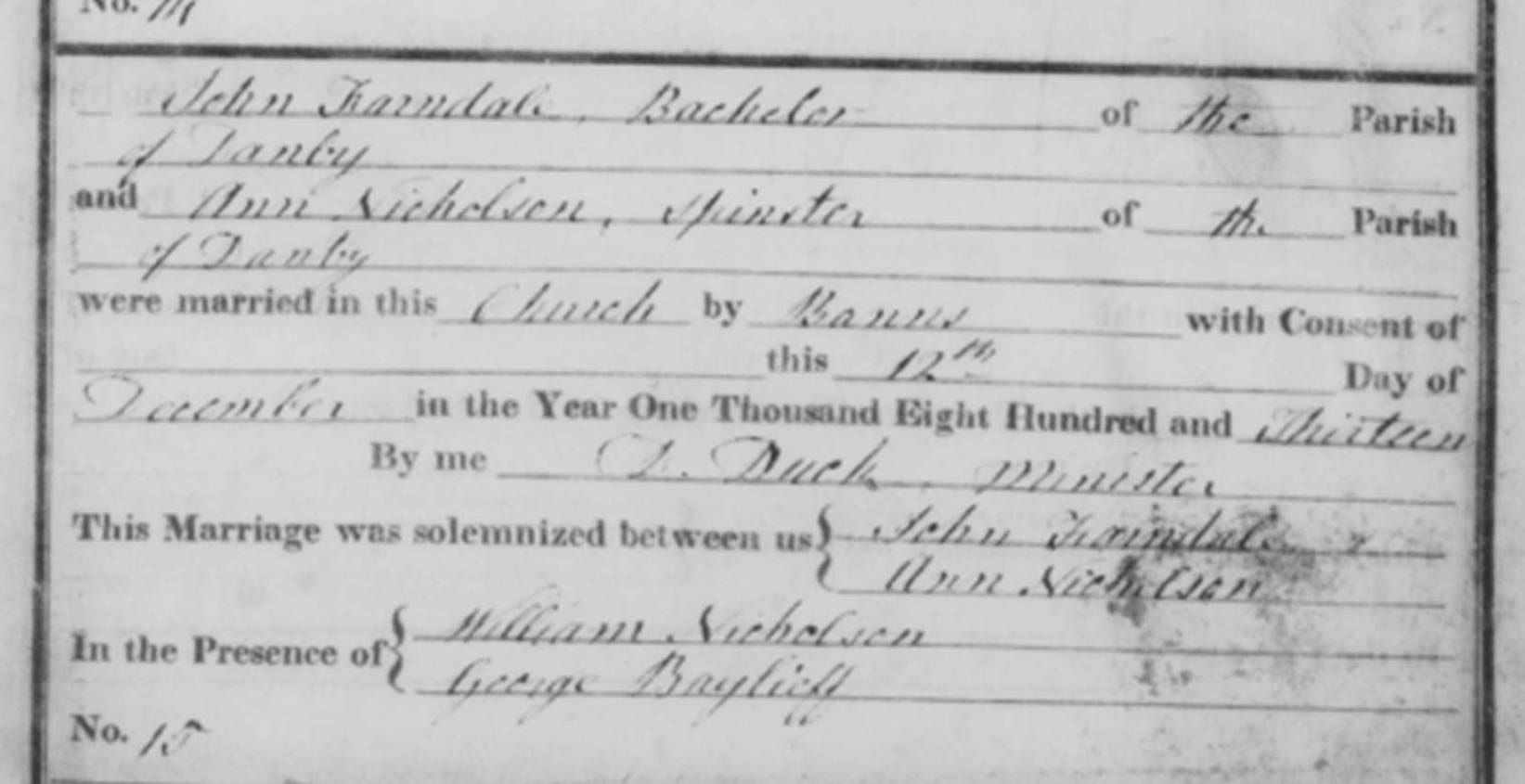
He married Ann Nicholson of Danby on 12
December 1813, and the ceremony was performed by one D Duck[171].
The Ducks were a well known family of Danby and there
is still a Duck Bridge to the east of the town.
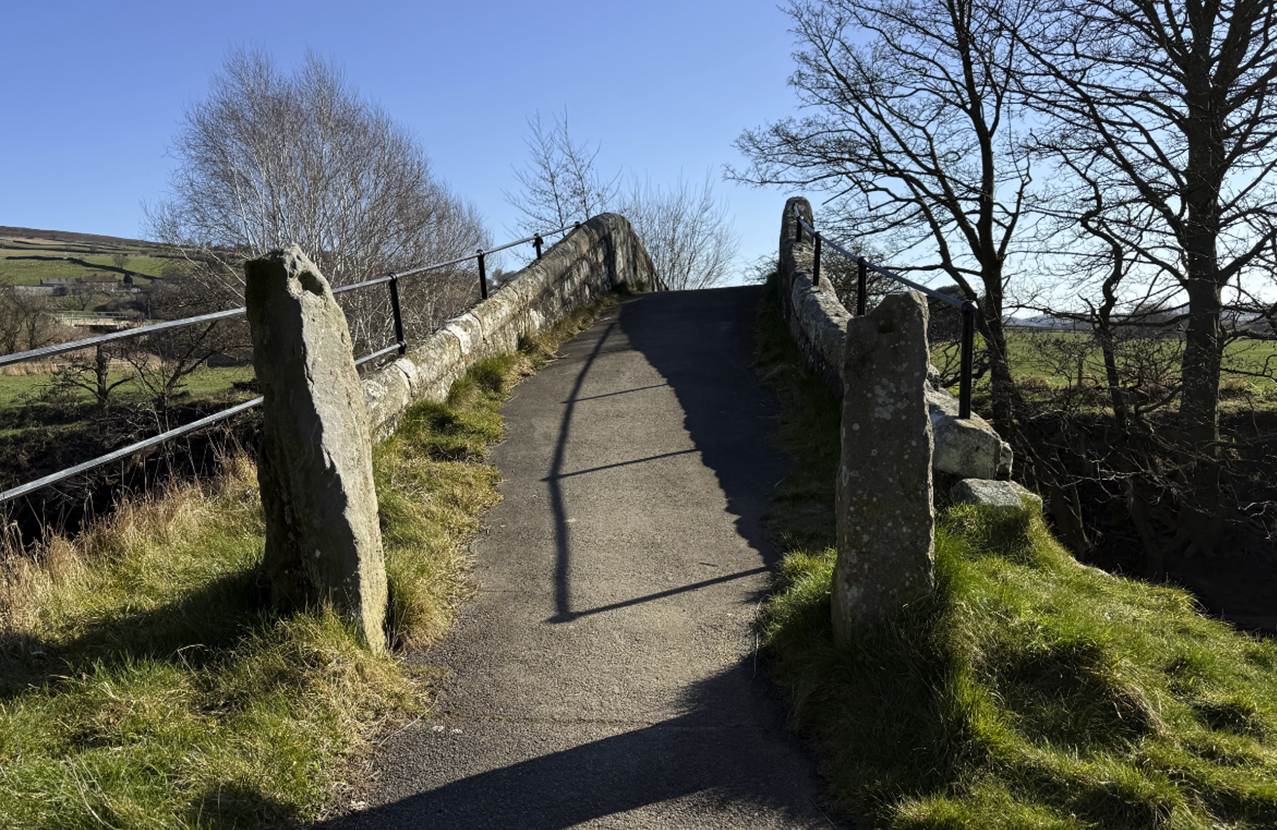
Duck Bridge
John was an
agricultural labourer and farmer at Danby
and Brackon Riggs[172],
and was buried in Egton in 1865[173].
John and Ann had five children, the Whitby 5 Line. Mary Ann
Farndale had a son, John who died of convulsions 3 days after
he was born[174], before Mary was married. She later married William Pringles who worked
on farms and later as a highways labourer[175]. Mary lived to the age of 79[176]. Jane
Farndale was a servant to Thomas Scarth, a farmer of Danby[177] before she married Frank Readman[178].
The Egton Family
John and Ann Farndale’s eldest son was William Farndale (1814 to 1886). William Farndale married Sarah Saunders, a cartwright’s daughter, on 19 April 1841 in Egton[179]. Shortly after he married, William became the innkeeper of Egton[180], but later worked as a farm worker[181].
William and Sarah had seven children,
many of whom were ironstone miners of Egton and Cleveland who we will meet in Act 18. From this family
would descend the Loftus 3 Line
and the Ontario 2 Line.
Their
grandchildren included John William
Farndale (1869 to 1938), a farmer, butter huckster[182],
innkeeper[183]
and Butcher[184]
of Danby and Egton;
Samuel Kirk
Farndale (b 1871), who emigrated to Ontario,
and we will meet again later; and George Farndale
(1891 to 1917), a Blacksmith striker who was killed in action on 27 May 1917,
during the Battle of Arras, barely a month after arriving in France[185].
The
Eskdaleside Family
John and Ann Farndale’s
third child was John
Farndale (1818 to 1874) who was a farmer of Newholm[186],
an agricultural labourer[187]
and quarry waggoner[188]
of Eskdaleside. The younger John Farndale
married Margaret Dawson on 18 June 1838[189]
and they had two sons, Thomas Farndale
(1839 to 1919) who became an innkeeper in Wakefield[190]
and Joseph Farndale.
John and Margaret
Farndale’s son Joseph Farndale
(1842 to 1901) and their grandson, Thomas Farndale’s
son, also Joseph
Farndale (1864 to 1954) became the Chief Constables of Birmingham and Bradford respectively and had extraordinary
police careers. We will meet them both again in Act 21.
Thomas Farndale
married Sarah Bell[191]
and their other children were Thomas Dawson
Farndale (1862 to 1940) who was an amateur athlete[192],
stone mason[193]
and then clerk of works[194]
and eventually a civil engineer[195];
Samuel Farndale
(1866 to 1936), a clerk in Portsea in Hampshire[196] who later lived in London and worked in the
civil service with the Admiralty[197] rising to become clerk to the engineer in
chief[198], whose descendants were the
London 1 Line and Margaret Farndale
(1868 to 1955) who married James Law, another publican in York[199].
The
Carter of York
John and Ann Farndale’s
youngest child was Joseph
Farndale (1825 to 1875), a labourer[200]
and carter of bricks who moved to Brick Yard Lane in York[201].
Joseph married Margaret Brown in 1844[202]
and they had eight children, including William Farndale
(1859 to 1909), a railway porter and Methodist local preacher[203],
then town missionary[204],
and later baker and confectioner at Macclesfield and Chorlton[205].
William’s son was Rev Dr
William Edward Farndale, a leading Methodist who would become President of
the Methodist Conference in 1947[206].
We will meet them again in Act 31.
From this
part of the family would also descend a family who settled in Holderness, the Holderness Line, where William Derrick
Farndale, a motor fitter and tractor driver, was patrol commander of the Withensea Patrol during the Second World War.
This was a
diverse section of the family who fanned out from Eskdaleside immediately to
the west of Whitby, across the nation, to
become innkeepers, leading policemen, civil engineers, Presbyterians, soldiers
and Canadian pioneers.
The
Farndales experienced lives of adventure from Whitby as it grew from a small
fishing port into a major shipping hub in the eighteenth and nineteenth
centuries. We wi9ll next pick up on the fourth hub, who returned to the
family’s original home south of the moors.
Go Straight to Act 16 – Return to
Yearsley
or
|
This
is a new experiment. Using Google’s Notebook LM, listen to an AI powered
podcast summarising this page. This should only be treated as an
introduction, and the AI generation sometimes gets the nuance a bit wrong.
However it does provide an introduction to the themes of this page, which are
dealt with in more depth below. |
|