Act 31
The Methodists
The influence of religion and ideas
in the family history
|
Hugh Bourne and Primitive Methodism
Non Conformity into the early
twentieth century |
Religion
and ideas
Pope
Gregory’s mission to convert the Angles[1] after noticing Deiran slaves in the Roman
market in 580 CE led in time to the conversion of the Deiran King Edwin to
Christianity at Eoforwic,
only 40 kilometres south of our ancestral lands, in 627 CE. Only decades later
the founding of a monastery in Lastingham
was in the heart of our ancestral home in 653 CE, only a few kilometres from
the mouth of Farndale itself. The Roman form of Christianity was accepted at the Synod of Whitby,
only 30 kilometres from our ancestral home in 664 CE. The influence of
Christianity was bound to play a significant role in our family story from an
early stage in our two thousand year journey.
By about 685
CE a church at Kirkdale,
dedicated to the Roman Pope Gregory, was built as a focal point in the lands
where our Anglo Saxon ancestors lived. Bede
was the intellectual powerhouse of the early eighth century at nearby Jarrow
and that intellectual focus was transferred to Eoforwic, by the
late eighth century, where Alcuin and
others taught the Liberal Arts and inspired an intellectual age which would
transform European education under Charlemagne.
After a
destructive Viking period, a new Anglo-Saxon-Scandinavian culture emerged, so
that in the mid eleventh century Kirkdale was rebuilt by Orm Gamalson, with its magnificent sundial, which evoked a complex
understanding of the passage of time.
Religion and
a synthesis of new ideas weaved together over time, shaping our ancestral
direction. From a historian’s perspective, the path of Christian and
intellectual thought is an inescapable influence on our family story, and of
real significance to an understanding of our ancestors.
By 1338 William
de Farndale the Younger, wandered from Haltwhistle in Northumberland to
Chelmsford in London, as parson and chaplain. Possibly influenced by the
horrors of the Black Death, another William Farndale
was the influential Vicar of Doncaster between 1397 and 1403.
By the time
our family arrived in Cleveland[2] in the mid sixteenth century, a new
Protestant Church had split from Rome, to which the Pilgrimage of Grace in
1536 was a local reaction in Lincolnshire and Yorkshire and in 1569, the Rising
of the North[3] was another local uprising against
the reforms of Elizabeth I. Those differences came to a head in the Civil War
and our Moorsholm relatives[4] were direct witnesses to the
skirmish which occurred between Guisborough
and Skelton in 1643[5].
Established
religious belief were challenged in the late seventeenth century by the
Enlightenment, and by a new Victorian era of scientific and industrial
revolution[6] which questioned the status quo.
When inter glacial age hyena bones at Kirkland
Cave, adjacent to our ancestral minster, were interpreted by the Reverend
William Buckland, he was forced to surrender his ideas that the bones were
survivors from the Biblical flood, to be replaced by a new understanding of the
passage of geological time.
Yet even John Farndale,
who embraced scientific change, remained fervently rooted to his Christian
upbringing, as did his son, Charles Farndale,
and for very many years Methodist services have been held in the
spacious farm kitchen of Mr C Farndale, Kilton Lodge, which was also that of
his father before him[7]. Their Whitby relative William Farndale
was an ardent Methodist preacher in York and Macclesfield in the late
nineteenth century and his son, Rev
Dr William Edward Farndale became President of the Methodist Church in 1947
and then Moderator of the Free Church Council in 1948.
There is a
relationship between the history of Christianity in Britain, the evolution of
intellectual and scientific thought, and the individual stories of families who
lived there, which is enmeshed together. In this section of our story, we
explore the religious aspect on our family path.
|
Exploring
the role of religions of various denominations and the evolution of
intellectual ideas on the Farndale Story |
The
Established Church
From the acceptance
of Gregory’s form of Christianity at the Synod of Whitby in 664 CE
until Henry VIII fell out with Rome in a desire to seize back sovereignty from
Europe as the only means to get his divorce, Christianity was a relatively
homogenous belief system. After the dissolution of the monasteries and the
Reformation, when the Acts of Supremacy[8] confirmed Henry VIII as the only
supreme head of the Church of England, the seeds were sown for centuries of
dispute and Civil War between Roman focused Catholicism and the new Anglican
Church.
Elizabeth I
brought some calm and toleration back to her realm after the reign of Bloody
Mary. The Act of Supremacy 1558 was An Acte
restoring to the Crowne its Jurisdiction over the State Ecclesiasticall
and Spirituall, and abolyshing
all Forreine Power repugnaunt
to the same[9]. The Act of Uniformity 1559[10], authorised a book of common prayer
which was similar to the 1552 version
but which retained some Catholic elements, and the Thirty
Nine Articles 1563[11] provided a compromise return to a
new Anglican world. This was the foundation of a new religion which was later
called Anglicanism. It looked Catholic and sounded Protestant. It was a
religious middle way. It was a compromise and perhaps the foundation of a
British spirit of compromise. It contrasted to a time of Catholic versus
Protestant polarisation in Europe. Elizabeth had little sympathy for hardliners
from either wing of the religious divide. She stopped heresy trials. This was a
brave new world, though still to be threatened for a while by Spanish invasion
plans and a medley of plots. Over time however, there were acts by her monarchy
which supressed Catholicism, which was still popular in Yorkshire. The
Recusancy Acts in 1558[12] required attendance at Church of
England services, returning to Henry VIII’s Reformation. Those who refused to
do so were called Recusants and were brought to Court to face penalties. In
Cleveland, at first Egton, with 9 Recusants, was the centre of
protest. By 1586, Brotton had 19
presentations for Recusancy, Egton 13,
Hinderwell 10 and Skelton 8.[13]
As time
passed, the Anglican Church became embedded and established into the national
hierarchy.
Methodism
The
Enlightenment which emerged after the Glorious Revolution of 1688 was also a
time of religious revival. A new evangelicalism was different from the
Puritanism that dominated the Civil War period.
An
alternative to the established church emerged from Oxford undergraduates in the
1730s[14], particularly John Welsey[15] and George Whitefield[16]. Wesley wrote prolifically. He was
influenced by Locke’s philosophy to develop a practical method, hence methodism,
of piety. It grew out of the forces of the Enlightenment. It also grew within
the existing Church and found impetus in areas of rapid change, including rural
areas of the north of England and Wales, especially in industrial towns. It
attracted miners, sailors and soldiers and others. This is why there was an
emphasis on travelling preachers who gave open air services. It also had a
strong women’s movement as it gave a unique, for the time, role to women.
Singing was an important part of methodism. The Wesley brothers, John and
Charles, produced 30 hymn books and composed well known hymns including Hark
the Herald Angels Sing.
Methodism
was both subversive and conservative and it was not suppressed by the Church.
From the 1750s the north, Wales and the Scottish borders boomed in population,
and many became integrated into non
conformist sects, especially methodism. John Wesley’s approach
thrived on socio economic change. An autonomous religious movement grew around
chapels and Sunday schools.
Mainstream
methodists attracted hard working and prosperous businessmen who were now able
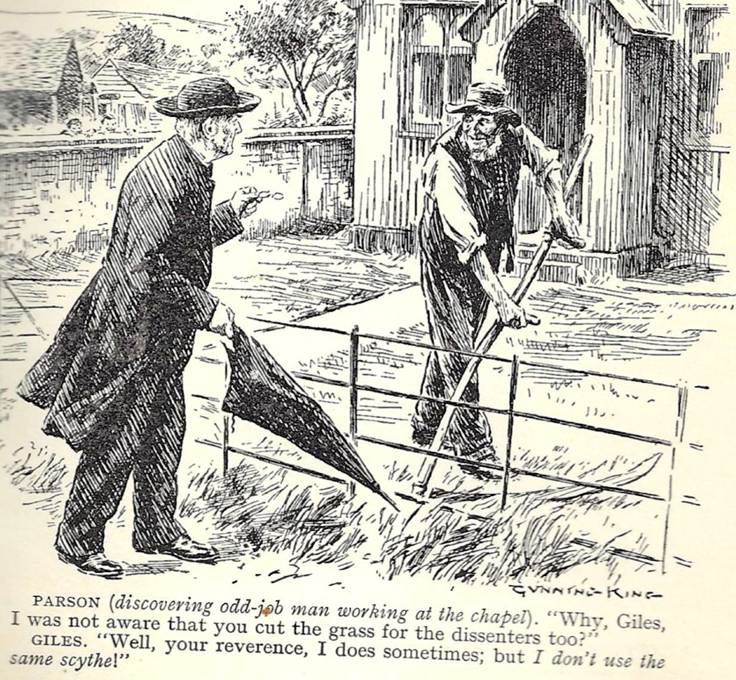
to vote. In the Victorian era, non
conformist, generally Liberal religion thrived in the north, the south west and the industrial Midlands. It tended to be less
agricultural and it formed a peripheral nationalism
with a distinct character. The non conformists opposed
the public subsidy of church schools under the Education Act 1870[17] as they worried that future
generations would be brought up Tory and Anglican.
Flora
Thomson wrote that the Methodists were a class apart. Provided they did not
attempt to convert others, religion in them was tolerated. Every Sunday evening they held a service in one of their cottages, and,
whenever she could obtain permission at home, it was Laura's delight to attend.
This was not because the service appealed to her; she really preferred the
church service; but because Sunday evening at home was a trying time, with the
whole family huddled round the fire and Father reading and no one allowed to
speak and barely to move.
The first
thing that would have struck any one less accustomed to the place was its
marvellous cleanliness. The cottage walls were whitewashed and always fresh and
clean. The man of the house stood in the doorway to welcome each arrival with a
handshake and a whispered 'God bless you!' If the visiting preacher happened to
be late, which he often was with a long distance to cover on foot, the host
would give out a hymn from Sankey and Moody's Hymn-Book.
Sometimes
a brother or a sister would stand up to 'testify', and then the children opened
their eyes and ears, for a misspent youth was the conventional prelude to
conversion and who knew what exciting transgressions might not be revealed.
Most of them did not amount to much. One would say that before he 'found the
Lord' he had been 'a regular beastly drunkard'; but it turned out that he had
only taken a pint too much once or twice at a village feast. One man,
especially, claimed that pre-eminence. 'I wer' the
chief of sinners,' he would cry; 'a real bad lot, a Devil's disciple. Cursing
and swearing, drinking and drabbing, there were nothing bad as I didn't do.
Why, would you believe it, in my sinful pride, I sinned against the Holy Ghost.
Aye, that I did,' and the awed silence would be broken by the groans and 'God
have mercy's of his hearers while he looked round to
observe the effect of his confession before relating how he 'came to the Lord'.
But the
chief interest centred in the travelling preacher, especially if he were a
stranger who had not been there before. Then there was the elderly man who
chose for his text: 'I will sweep them off the face of the earth with the besom
of destruction', and proceeded to take each word of
his text as a heading. 'I will sweep them off the face of the earth. I will
sweep them off the face of the earth. I will sweep them off the face of the
earth', and so on.
Methodism,
as known and practised there, was a poor people's religion, simple and crude.[18]
The
Methodists offered something that was not offered by the Anglican Church. These
new preachers showed a degree of compassion for the plight of ordinary folk.
Primitive
Methodism
In the early
decades of the nineteenth century there was a growing body of opinion among the
Wesleyans that their religion was moving in directions which were a distortion,
even a betrayal, of John Wesley’s teachings. A Methodist preacher called Hugh
Bourne[19] became the catalyst for a breakaway,
to form the Primitive Methodists, an offshoot of the principal stream of
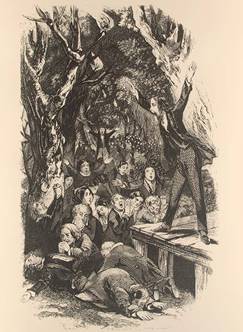
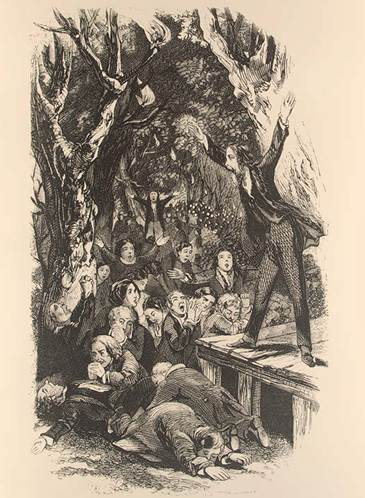
Methodism. Also known as Ranters, for their
enthusiastic preaching, Primitive Methodists were so called because they
wanted a return to an earlier, purer form of Methodism, as they felt had been
intended by John Wesley, based on the early Methodist church. Their badge of primitive
stressed their belief that they were the true guardians of the original, or
primitive, form of Methodism.
Primitive
Methodism was a nineteenth century working class movement which originated in
the Potteries, where an open air camp meeting
was held at Mow Cop in 1807[20], igniting a passion for the love
of God which quickly spread across the Midlands. By the end of the century
there were over 200,000 members.
The sorts of issues which divided the Primitive
Methodists and the Wesleyans were these. The Methodists developed
a high doctrine of the Pastoral Office to justify leadership being in the hands
of the ministers. They were open to cultural enrichment from the Anglican
tradition and more ornate buildings. They were involved with more affluent and
influential urban classes. They were nervous of direct political engagement. In
contrast the Primitive Methodists focused attention on the role of lay people.
They stressed simplicity in their chapels and their worship. They concentrated
their mission on the rural poor. They stressed the political implications of
their Christian discipleship.
In the
context of the growing democratisation and sense of dislocation caused by the
Industrial Revolution, Primitive Methodism appealed to miners and mill hands,
farm labourers, and workers in developing factory towns. In rural areas,
Primitive Methodists often came into conflict with the Squire and Anglican
clergy, who saw them as a threat to the established order.
The
conviction that God’s love was for all, led to a concern for social
justice, and many Primitive Methodists became involved in politics, as trade
unionist leaders, Chartists, and later as Labour MPs.
George
Edwards[21], who championed the cause of farm
labourers in Norfolk, was typical of the early trade union leaders who
developed their passion and leadership skills through the Primitive Methodist
Chapels. He started his working life at the age of six and he was illiterate
until he became involved in Primitive Methodism when he embarked on a journey
of self-education, as he recounts in From Crow Scaring to Parliament[22].
By the end
of the nineteenth century the two streams of Methodism realised they had more
in common than they might have supposed. Conversations began which led to there
being the two principal partners in the union. In 1932 Primitive Methodists
joined with Wesleyan and United Methodists to form the Methodist Church.
Smaller
sects like to Quakers and Unitarians were adopted by urban and business elites.
The Quakers included Cadbury, Fry, Rowntree, Barclay, Lloyd, Swan and Hunter,
Price and Waterhouse,
Evangelism
created charities and philanthropic lobby groups.
Charles
Farndale and the Kilton Farndales
It is not
surprising perhaps that the Farndales of rural and industrial Cleveland adopted
Methodism from the early nineteenth century. In 1902 it was remembered that
for very many years services have been held in the spacious farm kitchen of Charles Farndale,
Kilton lodge, which was also that of his father before him. Methodism in the
neighbourhood and the cause of righteousness generally owes much to the high
Christian character and active interest in all good works displayed by this
devoted Methodist family. Here the preachers have always found a hearty welcome
and ministers and others who know the circuit spent under this hospitable roof.[23]
|
1838 to 1914
Charles farmed 577 acres Kilton Hall Farm. His family were staunch
supporters of the Wesleyan Church. |
|
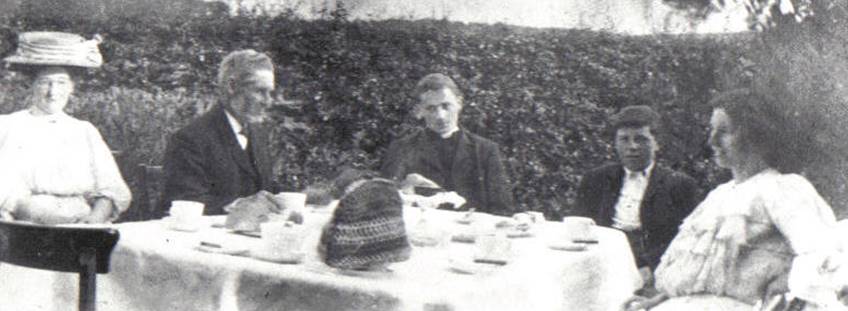
More Tea
Vicar?
Kilton Tea Party about 1910 - Mrs Ann
Farndale, Charles
Farndale, visiting vicar (The Rev W Slader, O Wardley or W Nicholson
perhaps?), Vincent Grainger (who worked on the farm) and Grace Farndale
When his son
George
Farndale (1876 to 1970) retired from farming in 1940, it was remembered
that for over a century the Farndale family have been associated with the
Loftus and Staithes Wesleyan Circuit, a connection which is soon to be severed
by the removal of Mr George Farndale from Kilton Lodge to Saltburn. A member of
the third generation of the well known
family, Mr Farndale has been a circuit official for over 20 years, and a
steward for seven. His grand father was a local
preacher in the circuit for a number of years, and the
late Charles Farndale upheld the family tradition by serving for the major
period of his life as circuit official and steward. In the outlying districts
of the circuit Mr George Farndale has worked equally hard,
and stands as Trustee for many of the circuit chapels.[24]
The story of
the Kilton Farndales,
and many other Farndale lines, is intricately woven with the spread of
Methodism.
The
Railway Porter
William Farndale
(1859 to 1909) was a railway porter who became a local Methodist preacher and
missionary in York[25] and later in Macclesfield[26], about ten kilometres north of Mop
Cop.
In August
1886, in celebration of the anniversary of the Duke of York Street Primitive
Methodist Sunday School sermons were preached in the Mission room, on Sunday,
by the newly appointed minister, the Rev W L Spooner. In the afternoon, Mr
Spooner gave an address to the parents, teachers and scholars. Yesterday
evening the annual meeting was held in the Mission room under the presidency of
Mr Mansfield. There was a good attendance, and the large gallery was occupied
by the Sunday school children. Addresses were given by the chairman, the Rev W
L Spooner, and Mrs Joseph Croft, W Farndale, and others. Many recitations,
dialogues and hymns were given by the school children in their credit
creditable manner. Collections were made at each service in aid at the school
funds.[27] Sadly the Rev W L Spooner, who
William Farndale spoke alongside, was not the same person as the famous Rev
William Archibald Spooner who lived at the same time and was most notable for
his absent-mindedness, and for mixing up syllables with unintentionally comic
effect.
On 14
January 1889 a new venture of faith was started in Macclesfield when the
town mission was opened. The first missionary was Mr Farndale, who is still
remembered by some of the older members. He and those who have followed have
established a fine tradition of Christian service.[28] He later worked as a baker, confectioner
and grocer alongside his missionary work, but his end was tragic. In February
1909, a pathetic letter was read at an inquest on the body of William
Farndale, 50, a grocer, who lived at in Hesketh Avenue, Didsbury. He was found
hanging in the cellar of his shop in School Lane on Tuesday.[29] Before hanging himself in the cellar
of his grocer’s shop in Didsbury, William Farndale wrote a note in which he
said he was past living. “My mind has gone, and the hope of life has died out.
I have tried and failed. Misfortune has seemed to follow me.”[30]
William Farndale’s son was Rev Dr
William Edward Farndale (1881 to 1966) who entered the Primitive Methodist
ministry in 1904. He led circuits in London, Oldham, Chester-le-Street,
Birkenhead and Grimsby before he became President of the Primitive Methodist
Conference in 1947.[31]
The younger
William was born in York on 24 September 1881[32]. By 1901, he was working as a clerk
in Chorlton and south Manchester[33]. He entered the Primitive Methodist
ministry in 1904 after completing his theological training in Hartley college,
Manchester[34].
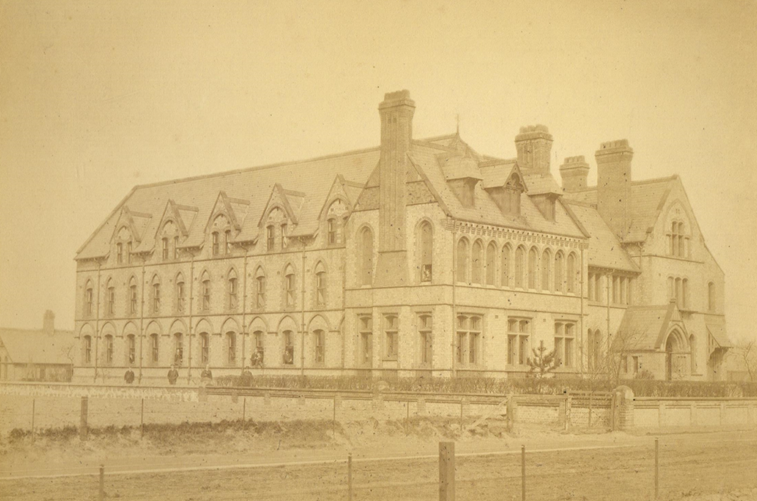
Hartley
College
He then
moved to south London where he preached at the Forest Hill Methodist Church on
Stanstead Road[35]. In 1906 he given special mention
for passing his exams at 90%[36]. It was in 1909 that his father died
so tragically, and he returned to Oldham for a few years[37] where he married Florence May Price
in 1910[38]. In 1913 he moved to the circuit at
Chester-Le-Street[39] where he formed a Bible League[40]. The Birtley Brotherhood has
embarked upon a task that is almost herculean. They have started a Bible league, and have fixed eight o’clock on Sunday mornings as
the time for it to meet. This is certainly a test of men's loyalty to an ideal,
and one that few people would care to make. The League will be under the care
of a leader who is not only enthusiastic but is very keen Bible student and
brilliant expositor, and if it can be made a success, the Rev W E Farndale is
likely to carry it through.[41] It was at this time that William’s
wife Florence began to preside at Suffragette gatherings[42].
Wartime
preaching
The First
World War began on 28 July 1914. William continued his ministry at
Chester-Le-Street[43]. His message at New Year 1915 was in
line with the patriotic fervour, whilst pursing a methodist line of hard work
and abstinence. Dulce et decorum est pro patria mori. To die for one's
country is sweet and befitting. The uttermost sacrifices our soldiers, sailors
and airmen, are gallantly making and winning lasting renown for arms. All
honour to them! But in this grave hour we too need to heed the summons: pro
patria vivere: We must live for our country, live strenuously, energetically.
Many will emulate the patriotic fervour of those in the homeland who willingly
surrendered the loved ones that have heard the King’s call. And eternally and
uncompromisingly to remove from the soldiers’ path every flaunting temptation
to drink, gamble and vice, to arrange for social entertainment and spiritual
administration to the men in khaki at our doors; to resolve that the disabled
and their dependants shall not, as afterwards in other days, be reduced to
beggary. These and cognate tasks also demand the earnest devices and self denying labours of all true
lovers of their country. May the New Year prove rich in patriots of this kind
who will live for the State's best welfare and that of its heroic defenders.[44]
With the
younger folk away, a sign of the times was reflected when the old people’s
tea was held at the cricket field, kindly lent for the occasion and the weather
being happily fine, the dear old folk came up in good numbers, although ninety
teas were sent out for those who were ill and unable to come. However, many are
quite able, especially the younger ones who sent for their teas, which is quite
contrary to the principle of the tea. Well they had a
good time. Votes of thanks to the donors after being read out, was given and a
very timely address was given by Rev Farndale. The National Anthem as usual
brought a very enjoyable afternoon to a close.[45]
Florence
continued her work with the suffragettes movement, raising funds for a
maternity unit for Russian refugees[46] and tragedy struck the family when
Florence’s younger brother Lieutenant
Graham Price, a pilot with the Royal Army Flying Corps was shot down in a
dogfight at 8,000 feet in a duel which his chaplain described as a most
glorious fight[47]. William continued with his
preaching[48].
In March
1917, Mr Farndale was given permission to take up national service for the
remainder of the war, all while he remains in circuit, and was released from
all week day duties. He will preach on Sundays as
usual[49].
In July
1917, he presided over a tragic memorial service after three sons of the same
local family had been killed in France. William gave a sermons
which summarised the tragedy. “These things did the three mighty men”, the
Rev W E Farndale said: “Strangely parallel with the narrative of our text is
the cause which has led to the special service this morning. They for who David
made the great hazard were three in number. Today Mr and Mrs Grimshaw mourned
the loss of the third of their sons in the Great War. The first to die was
Private Peter Grimshaw, of the 6th Yorks, who succumbed to his wounds on 17th
September 1916. His brother, Private Fred Grimshaw, of the 11th DLI was killed
on the 13th December 1916. And now private Robert
Grimshaw, of the 13th DLI, is officially reported killed in action on 3rd June
1917. So far as I'm aware this is the only family in Birtley which has paid
such a toll in life and our hearts’ sympathy goes out to each mourning
relative. Concerning R E Grimshaw, the Chaplain wrote on June 5th, saying, “He
was killed in action by a shell in the trenches here, shortly before the recent
advance. He did his duty. Let us commend him to God's mercy and pray that he
will accept the service of his life laid down for his country, a service rendered
to him and may he give to you who mourn for him the same courage to bear your
sorrow as he has given to our brave boys who are doing such splendid work out
here.”[50]
Not shying
from politics, in February 1918 he opposed the new Divorce Bill[51]. His final months in
Chester-Le-Street were in 1918[52]. It was in that year that the
Representation of the People Act[53] was passed which allowed women over
the age of 30 who met a property qualification to vote. Although 8.5 million
women met this criteria, it was only about two-thirds
of the total population of women in the UK. The same Act abolished property and
other restrictions for men, and extended the vote to
virtually all men over the age of 21. Additionally, men in the armed forces
could vote from the age of 19. The electorate increased from eight to 21
million, but there was still huge inequality between women and men.
Temperance
and social influence
The non conformist conscience extended
to politics in promoting its moral code. William Wilberforce’s influence
extended beyond anti slavery to animal protection and
religious education. The John Keble’s Oxford Movement in the 1820s was a High
Church revolt against Anglicanism.
Alongside
his other political views, William continued to advocate in favour of
prohibition during the war and for six months afterwards and argued in
these days it was imperative that what at best was a only a luxury, and at
worse a curse should absolutely cease to be produced, and that no intoxicating
liquor should be sold during the war. We could not afford it. The waste of corn
and sugar involved in its manufacture was criminal, and the use of shipping for
its importation was a sin against humanity[54].
The
temperance movement[55] pursued regulation against access to
drink and alcohol consumption declined from the 1870s. Drink was seen to be at
the heart of moral, social and economic problems. In the 1850s reformers
campaigned against beer and ale houses as the direct causes of crimes. Places
of popular entertainment were targeted. Temperance built up a large organised
following focused around churches, chapels and Sunday school. However drinking
culture was also central to social life and there were only really
local successes in the control of drink, although there was a general
decline in drinking in the second half of the nineteenth century. Temperance
measures never came close to those in Wales and US.
A couple of
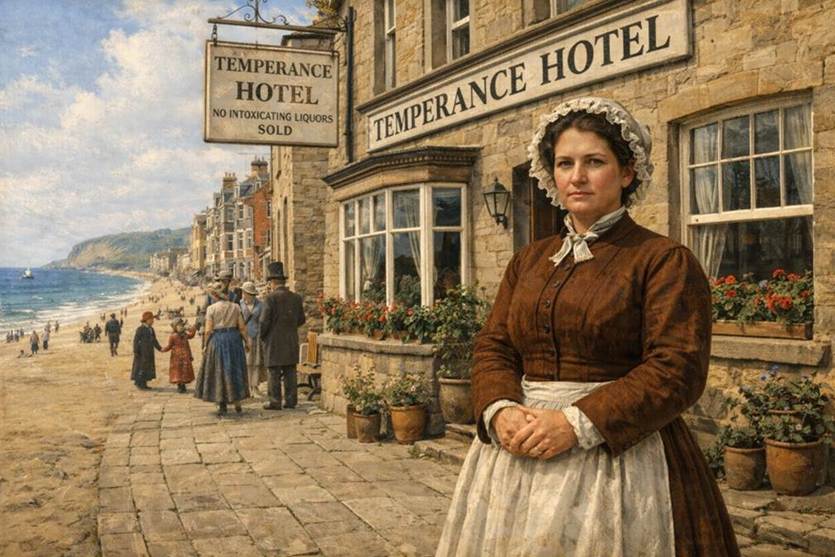
generations before William, Ann Farndale, the wife of Matthew Farndale,
ran a Temperance Hotel at Saltburn. In 1873 she advertised her Temperance
Hotel and Refreshment Rooms at Milton Street, Saltburn specially fitted up for
comfort and convenience of visitors and the public[56]. Miners’ meetings were regularly
held at Farndale’s Temperance Hotel[57].
Dickens depicted the movement. Then came the Teetotal
Society, who complained that these same people would get drunk, and showed in
tabular statements that they did get drunk, and proved at tea parties that no
inducement, human or Divine (except a medal), would induce them to forego their
custom of getting drunk. Then came the
chemist and druggist, with other tabular statements, showing that when they
didn’t get drunk, they took opium. Then
came the experienced chaplain of the jail, with more tabular statements,
outdoing all the previous tabular statements, and showing that the same people
would resort to low haunts, hidden from the public eye, where they heard low
singing and saw low dancing, and mayhap joined in it; and where A. B., aged
twenty-four next birthday, and committed for eighteen months’ solitary, had
himself said (not that he had ever shown himself particularly worthy of belief)
his ruin began, as he was perfectly sure and confident that otherwise he would
have been a tip-top moral specimen. Then
came Mr. Gradgrind and Mr. Bounderby, the two gentlemen at this present moment
walking through Coketown, and both eminently practical, who could, on occasion, furnish more
tabular statements derived from their own personal experience, and illustrated
by cases they had known and seen, from which it clearly appeared—in short, it
was the only clear thing in the case—that these same people were a bad lot
altogether, gentlemen; that do what you would for them they were never thankful
for it, gentlemen; that they were restless, gentlemen; that they never knew
what they wanted; that they lived upon the best, and bought fresh butter; and
insisted on Mocha coffee, and rejected all but prime parts of meat, and yet
were eternally dissatisfied and unmanageable.
In short, it was the moral of the old nursery fable:
There was an old woman, and what do
you think?
She lived upon nothing but victuals
and drink;
Victuals and drink were the whole of
her diet,
And yet this old woman would never be
quiet.[58]
In 1929 the
May monthly meeting of the Grimsby Branch of the British Women’s Total
Abstinence Union was held at the Heneage Road Wesleyan Church. Mrs Thompson
presided and the Rev W E Farndale spoke on “Democracy and drink.”[59]
In November
1929 the British Women's Total Abstinence Union are making a special effort
to secure the signatures of a million women to a petition addressed to the
Prime Minister asking for national Sunday closing for England. A Bill to secure
Sunday closing has already been drafted at the request of a very large and
representative conference. Every denomination in the land is concerned in this
important temperance measure. On Sunday evening at the Ebenezer church, the Rev
W E Farndale will make special reference to this movement in the sermon on the
relation between the Christian Sabbath and Sunday closing.[60]
In December 1939
the Lincoln branch of the National British Women's Total Abstinence Union
held their December meeting yesterday at Clasketgate
schoolroom. Mrs W Sindell presided and Mrs F W Farndale gave a talk on Finland
and its prohibition laws.[61]
In November
1940 a well attended meeting of the National
British Women's Total Abstinence Union, Lincoln branch, was held by invitation
of councillor and Mrs J W Lawson, at Greylands Place,
Lee Road, Lincoln. Mrs W Sindell (president) presided
and an address was given by the Rev W E Farndale on temperance work from the
time of the Napoleonic works wars to the present. Mrs Farndale, County Union
President, told of the county branches efforts to raise funds for a mobile
canteen for Lincolnshire.[62]
The
Birkenhead Years
At the end
of the First World War, William and his family moved to Birkenhead, across the
River Mersey from Liverpool in about August 1918[63]. Upon arrival, in a vigorous
speech, he said when he received the invitation to come to a meeting he found that 27,275 soldiers were discharged
disabled during 1916 and to this had to be added the disabled sailors. There
also had to be added the number of casualties since 1916, and those who may
have come back with disease not apparent to the eye. The object of this
association was to make those matters fully known to the public and to see that
the discharged men, whether from wounds or disease, got their full rights, and
that other noble lads or their dependants did not suffer. He strongly objected
to women with children in their arms having to go before a committee to get to
know what they could have. He said they would have nothing less as an association
than that the government should fix up in plain language what they were
entitled to. The women had now the vote, and they could apply the screw, and
make them do what they wanted, or send them about their business. He strongly
commended the association which strove to help the men and women to get their
full rights for the noble work they had done for us. Applause.[64]
He quickly
settled into his ministerial duties at Birkenhead[65].
The
Grimsby Years
In 1928 it was
announced that William would take up ministerial duties at the Ebenezer
church in Grimsby, in July. Mr Farndale has been at his present church since
1918 and comes here with a high reputation[66]. There, he continued his work[67]. He continued his campaign on his
favourite topics including democracy and drink[68] and the ‘maddest modern craze’, a
reference to gambling, which has attained such enormous dimensions and is the
cause of such widespread deterioration of character[69].
The
Lincoln Years
Then in 1934,
due to his elevated position as Chairman of the Lincoln and Grimsby Methodist
District, the Rev W E Farndale, chairman of the Lincoln and Grimsby district
of the Methodist Church, have now left Grimsby and taken up residence in
Lincoln. This change of residence has been imminent ever since his appointment
as chairman of the district when the three Methodist churches amalgamated. For
some time past he has been without pastoral duties to enable him to devote his
time to this high office. Both he and Mrs Farndale had made many friends during
their stay in Grimsby, and their departure to Lincoln will be deeply regretted.
In recent months the Rev W E Farndale have had to spend a very large proportion
of his time travelling in order to fulfil engagements
in his very large district. Lincoln is more centrally located for his duties,
and it is for this reason that Mr and Mrs Farndale have finally decided to
leave Grimsby.[70]
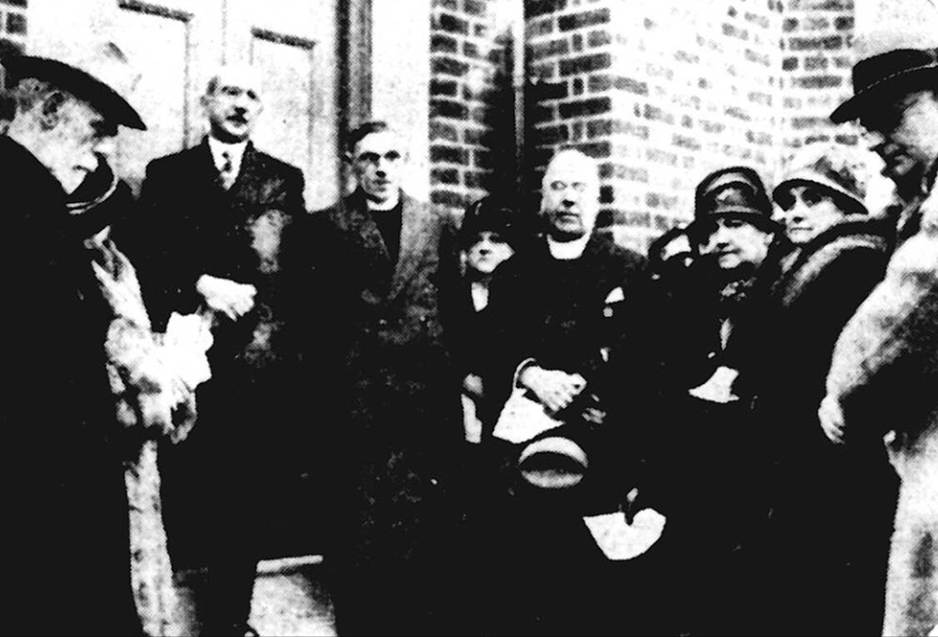
William
opening a new Boston church in 1934[71]
His work
continued in his new role[72]. In 1939 the Rev W E Farndale
said that it was heartening in these times that in British Methodists there
were more than a million children attending Sunday school[73].
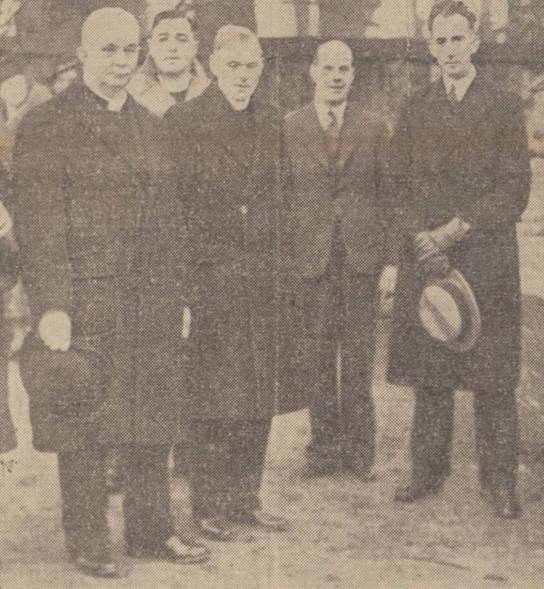
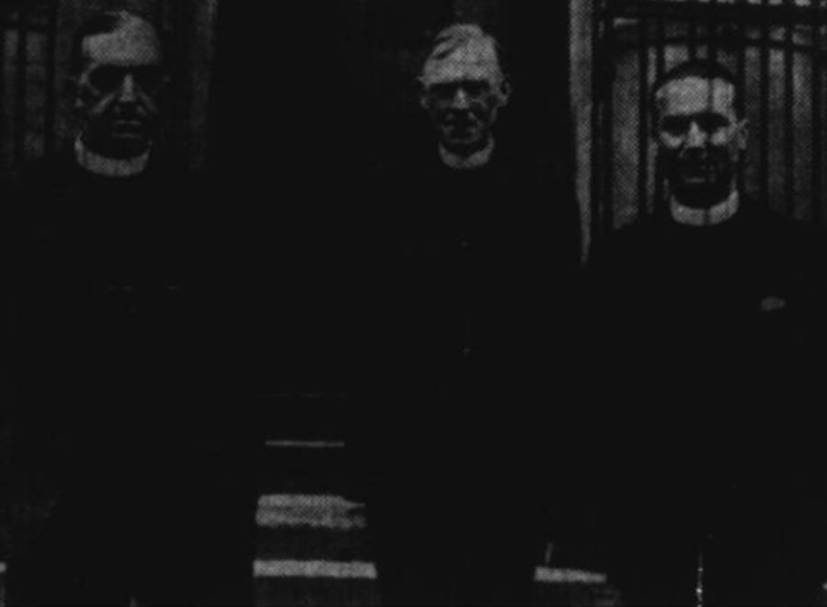
Laying
foundation stones of the Methodist new Sunday school at Scarthoe
in 1939[74] Chief officers at the Lincoln and
Grimsby District Methodist Synod in Lincoln[75]
Wartime
returns
As war broke
out in September 1939, war problems were discussed at the September Senate
of the Lincoln and Grimsby District of the Methodist Church at Lincoln, on
Wednesday. The Senate was to have been held at Holbeach, but owing to the
outbreak of war, was transferred to Lincoln. The Rev W E Farndale, chairman of
the district, presided and there was an attendance of ministers and laymen
representing 600 congregations in the county[76]. He returned to work as a wartime
religious leader[77].
In October, the
Rev W E Farndale gave an address on “The moral value of church worship”[78]. By November it was announced that in
the event of air raids, Church of England clergy in the Lincoln diocese and
Free Church ministers in the Lincoln and Grimsby Methodist Church, will take
their part in helping any homeless or injured or any members of the public in
need of assistance. As in other parts of the country, clergymen here have been
issued with an armlet of Air Force blue, bearing the letters ARP, in red, above
a white cross. The Rev W E Farndale, chairman of the Lincoln Methodist district
said that the Methodist churches had kept its close contact with their London
headquarters in the matter, and headquarters had been in touch with the
ministry of home defence. In the Lincoln district, which is equivalent to the
whole of Lincolnshire, said Mr Farndale, the ministers would wear armlets and
be otherwise equipped in the case of an air raid.[79]
In time
of war, he said, there was need for Sunday school work to increase[80]. Meantime Mrs F W Farndale gave a
talk on Finland and its prohibition laws[81] while an address was given by the
Rev W E Farndale on temperance work from the time of the Napoleonic works wars
to the present[82]. He urged that religion must be
regarded never as a dope but ever as a dynamic[83]. On Remembrance Day in 1941 a
Remembrance Day service was conducted on Sunday morning at the Wesley Church, Clasketgate, by the Rev W E Farndale, who spoke on the subject of vindicating their faith. The outbreak of
the last war, he said, was marked by intense confidence in the righteousness of
the cause of freeing Belgium from the invader. Signing of the Armistice brought
a resurgence of that idealism and hopes for a better world. The faith of those
men who won the last war needed to be vindicated in these days by a still
deeper faith, faith which allied itself to God as the supreme right ruler of
the nations[84].
In early
January 1944, arrangements are now fast approaching completion for the
Christian Commando Campaign in Lincoln. The proceedings will be opened by a Mayorial reception at Portland Place Church on Monday
January 24 at 6:15 pm. This will precede the inaugural public meeting in the
same church at 7:15 PM, when the Rev W E Farndale, chairman of the district,
will preside and short testimonies will be given by members of the commando
team, led by the Rev Colin Roberts, of London[85]. At the same time the Rev W E
Farndale hoped that this year would see an even more decisive defeat of a
dictator in Europe than befell Napoleon in it in 1815, the year of the
foundation of the Lincoln Trustee Savings Bank[86].
By August
1944, it was hinted that within a few years the chairman of the Lincoln
district, the Rev W E Farndale, is more than likely to become president of the
Methodist conference, the highest honour which can be
accorded him by his church. He secured over 40 votes in this year's election,
which is a high figure at “the first time of asking”. Mr Farndale has very many
friends in and around Boston. His charming personality and his forcefulness as
a preacher have won him many friends. Should he be elected at some future date,
it will be a high honour confirmed upon Lincolnshire Methodism.[87]
In July
1945, the Rev W E Farndale, chairman of the Lincoln and Grimsby Methodist
district, was nominated for the Presidency of the Methodist Conference during
yesterday's session of the conference at Nottingham. Three rounds of voting
were necessary before the conference elected Dr Newton Flew, president of the
National Federal Free Church Council, as President of the Conference for 1946,
with Mr Farndale second in a heavy poll. There were several nominations, but
the number was reduced to four for the second voting, and this was further
reduced to two for the final vote. A friend of Mr Farndale, who was present at
the conference, told the Echo: “A number of us felt we
would like to put our chairman's name forward for the presidency next year, and
it was very gratifying to us to find the voting and supported Mr Farndale
increasing each time. We are naturally sorry that he was not successful, but
the close voting encourages us to hope that next year we may have the
satisfaction of seeing him elected president for 1947.[88]
Post War
William’s
new year message in 1946 was to ask What is the master problem of 1946? In
this, the crucial year, for our reconstruction at home and peace keeping for
the world, there will be many difficulties to overcome, political
, social and economic. But the master problem, the root trouble, lies
far deeper, it is to be found in human nature. When man is equal to his task,
he the will to find a way to his goal, despite every obstacle. This year,
however, to a supreme degree, are needed high qualities of goodwill, patience,
adaptability and generous outlook. Christian citizenship will be at a premium.
The mind must therefore be cleansed of prejudice, and the heart purified from
selfish faints. The driving force in all our planning must be not mere
expediency, but high toned moral energy. So to change, human nature has to
be capable of this high work, possible only through supernatural force, and
nothing short of this will suffice for the months ahead. The New Year’s call,
therefore, to every believer is to unite to intercession for spiritual rebirth
throughout the land, the conversion of England for the salvation of the world.[89] By December he was commenting that We
are learning how difficult it is to lay agreed foundations for international
security[90].
As his ministerial
work continued[91], in July 1946 it was announced Rev
W E Farndale, chairman of the Lincoln and Grimsby district, has been nominated
as President-Elect at the Methodist Conference. He will take up his
presidential duties in July next year. Mr Farndale is now stationed in the
Lincoln Circuit, and prior to going to the capital city was
in charge of one of the circuit in Grimsby. A
keen educationalist, Mr Farndale has rendered valuable service on the Lindsay
Education Committee. It will be recalled that Mr Farndale came out second in
the voting for the president last year, after a second vote. It was not a
surprise, therefore, that the Methodist Church have decided to confer on him
its highest honour.[92]
President
of the Methodist Church
Installation
of the Rev W E Farndale, first Lincoln minister to be president of the
Methodist Church when resident in the city, will take place at Newcastle City
Hall on Tuesday afternoon. In accordance with tradition, the Rev Farndale will
be robed in a special presidential gown and will then be presented with a Bible
which formerly belonged to John Wesley[93].
He was
particularly interested in rural methodism and led a Back to the Soil
campaign. In 1947, a new “forward” movement in the
Methodist Church “to Evangelise and Christianise Rural England” was launched
today by the Church’s president, the Rev William Farndale, who told the
conference at Newcastle on Tyne that the last great forward movement was on
behalf of the great cities and led to the establishment of mission centres amid
crowded populations. This time it was to be in the countryside, with the slogan:
“On to victory, victory in the villages.” “There is an acute feeling,” said the
president, “that the state and the churches have been out of close touch with
the realities and intimacies of village life. Policies and programmes which may
have first class relevancy to conditions in towns, have been superimposed on
the countryside, where circumstances have been of a quite different order. The
President said it would be the height of folly to ignore the new developments
under the recent Acts, which were providing a far higher standard of education
in the villages. The many activities of the service of youth have had effects
that will prove cumulative, he said, and must be reckoned with any church
anxious now to fulfil its mission in the villages. Here is a new mission field,
needy, urgent, but promising, opening out before us.[94]
During his Presidency he attended the Methodist Ecumenical
Conference in Springfield, Massachusetts, U.S.A., and went as a visiting
preacher to the United Church of Canada, during which time he received from
Victoria University, Toronto, the honorary degree of Doctor of Divinity. He was
a convinced Free-churchman, as his published writings
testify, and was in his element in 1950-51 as the Moderator of the Free Church
Council. William E Farndale travelled from Southampton to New York in 1947[95]. The "high explosive" for the Christian is to
avoid the defensive and take the offensive, the Rev. Dr. William E. Farndale,
president of the Conference of the Methodist Church in England, declared
yesterday morning in a sermon at Christ Church, Methodist, 520 Park Avenue[96]. The University of Toronto
confirmed honorary degrees upon four leading Methodists. The British recipient
was the President of our Conference, the Rev W E Farndale, who was also chosen
to give the address of the evening. Dr Farndale did full justice to the
occasion.[97]
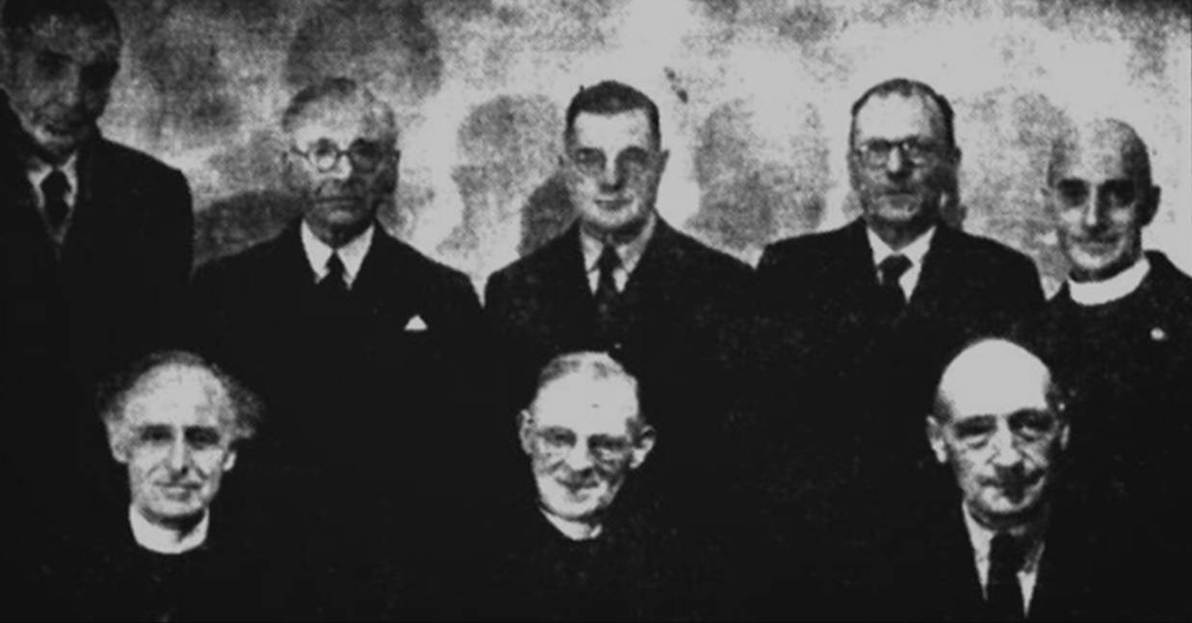
William centre, sitting
He engaged in an active campaign of activity during his
tenure[98]. In May 1948, he unveiled a new memorial at Mow Cop. Between
2,000 and 3,000 people gathered on the Cheshire side of Mow Cop Castle on
Saturday afternoon to witness the unveiling of a stone obelisk bearing an
inscription recoding that it marks the site of the first Camp Meeting in 1807
from which arose the religious revival linked with the founding of Primitive
Methodism. The commemorative block of Kerridge stone, erected by public
subscription, was unveiled by the President of the Methodist Conference (the
Rev W E Farndale DD). After performing the unveiling ceremony, the Rev WE
Farndale gave an address on “The power of prayer” which he said, was the source
whence the early pioneers obtained their inspiration and strength.[99]
He was succeeded as President by Rev Ian Benson Perkins in
July 1948[100].
Moderator of the Free Church Council
In May 1949, a month after taking office as Moderator of
the Free Church Council, the Rev W E Farndale, in his 60s, will attend a
meeting of Bristol Free Church Council at Eastville Methodist Church, Lower
Stapleton Road. Dr Farndale has been a keen student of theology all his life,
and his gained admiration in his work all over the world. As President of the
Methodist conference he visited America last year, and created an excellent impression by his cultured
speeches and clear, logical thinking. He is also interested in general
education and has for many years advocated the present schooling system.[101] In his late sixties, he was as proactive as ever[102]. The story of a girl whose efforts increased a
congregation from 10 to 72 was told by the moderator, Rev W E Farndale. In a
Lincolnshire village, he said, there was little girl of 12 who had become
concerned that the people in the village did not attend chapel. She wrote out
“Please come to our Chapel? Our minister is preaching”, and then handed them to
people at every cottage asking “You will come, won't
you?” She went into public houses. In one, she gave the man behind the bar the
notice, it was probably the first time he had ever been asked to attend a
service. In the other there was a woman behind the bar. The girl said “You will come won't you?”
“The woman smiled back and said “Yes dearie I will”.
She said the publicans both came.[103]
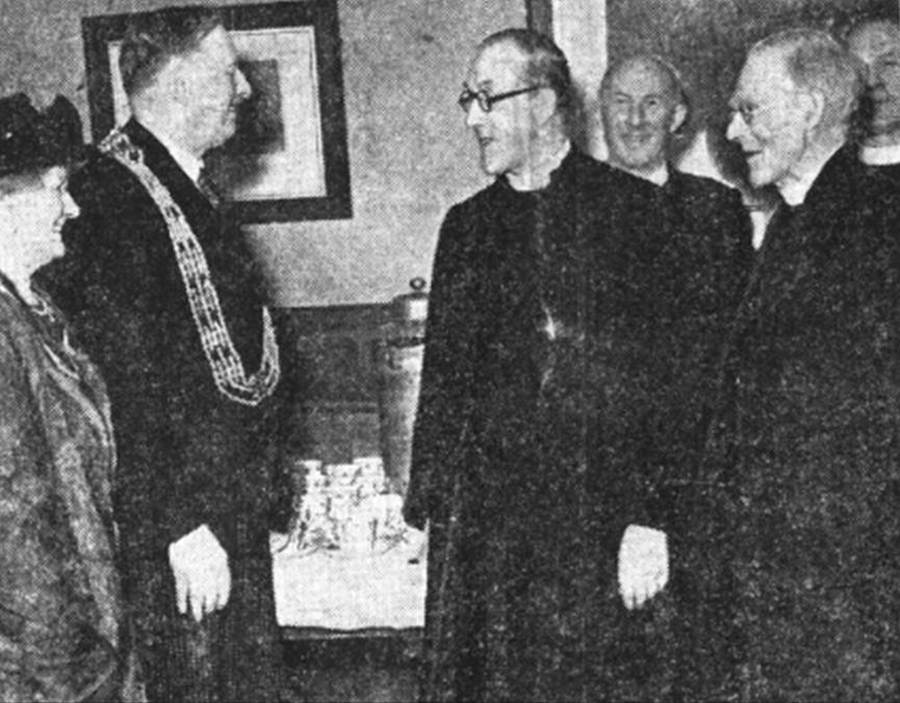
William on right[104]
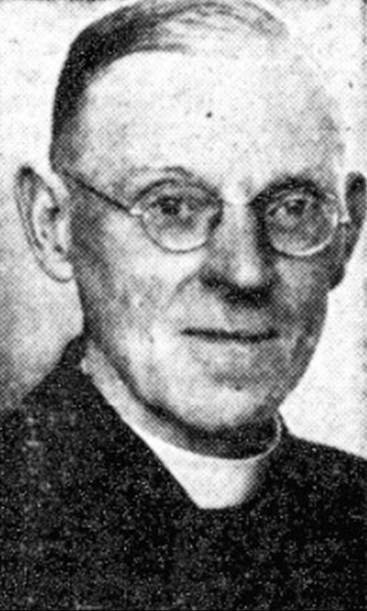
William continued his work in his seventies[105]. He had things to say about the Russian zone of Berlin[106] and when United States troops have crossed the 38th
parallel into North Korea and are advancing
along the main highway to Pyongyang, the communist capital, Dr William E
Farndale, Moderator of the Free Church Federal Council, has commended the
proposal for a day of prayer for peace on Sunday, October 29. In a message to
the United Nations Association, Dr Farndale says: “There have been coming
expressions from many Free Churchmen of a desire for such a call.[107]
The Secret of Mow Cop: A New Appraisal
of the Origins of Primitive Methodism was a 1950 lecture by W. E. Farndale that
summarised his appraisal of the origins of Primitive Methodism. The lecture was
given at the Wesley Historical Society and published by Epworth Press in
London. In the lecture, William Farndale concluded that the secret of Mow Cop
and the success of the Primitive Methodist movement was corporate prayer. He
believed that prayer in faith to a God who intervenes on behalf of his people
was an essential element of the movement's ethos. Mow Cop is a special place for Primitive
Methodists because Hugh Bourne, the founder of the movement, organized a Camp
Meeting there in 1807. The Camp Meeting was a day-long event where people could
pray, sing, and hear preachers. The event was so successful that a four-day
event was organized a few months later.[108]
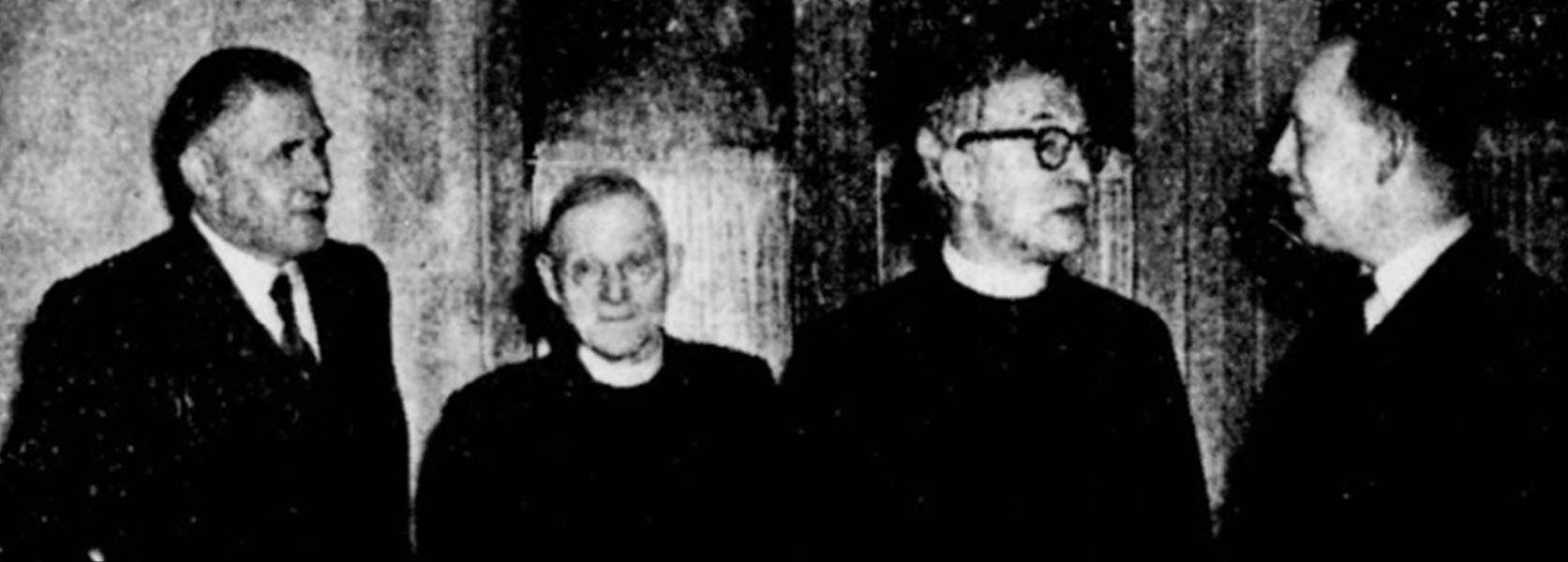
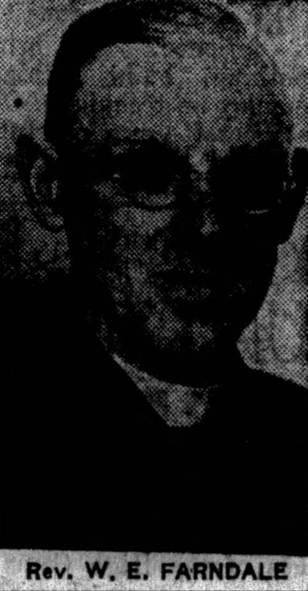
William, second from left
In May 1951, for Dr W E Farndale, Chairman of the
Lincoln and Grimsby Methodist District, who was on air yesterday from Trinity
Methodist Church, Cleethorpes, broadcasting is no new experience. In the early
days of religious broadcasting, Dr Farndale took part in a radio service from
Merseyside, and during his year as president the Methodist Conference he
broadcast from Newcastle upon Tyne and from city road London. Dr Farndale tells
me that as far as he knows, yesterday was the first broadcast of her communion
service from Lincolnshire. Taking part with Dr Farndale was the minister of the
church, Rev Frank Baker, who is secretary of the Wesley Historical Society.[109] Florence meantime was on the committee of the Methodist
Women’s Fellowship[110].
In 1951 there was a change in the leadership of the
Northampton Christian Commando Campaign when Dr William Edward Farndale,
of Lincoln, President of the Methodist Conference in 1947 and Moderator of the
Free Church Council from 1949 to 1951 is to succeed the Rev G Arnold West of
Hastings[111]. Colin Roberts, Secretary of the Home Mission Department in
1939, was concerned about the shape post-war society would assume. In 1940
Conference adopted a Forward Movement Report recommending plans for
evangelistic work over a period, in co-operation with other Free Churches and
the Church of England where possible. Out of this grew the Commando
Campaigns, which adopted the military idea of trained people making forays
into places where the gospel was not normally heard - works canteens, cinemas,
clubs, pubs, schools, colleges etc. Their theme was New Men for a New World.
Roberts provided the Team Leaders and Team Members, but arrangements for
campaigns in the larger urban areas were made locally. They reached a climax in
Greater London in 1947, with an inaugural rally in the Royal Albert Hall on 14
April. Those who participated in the Campaigns found that it profoundly changed
the nature of their ministry.
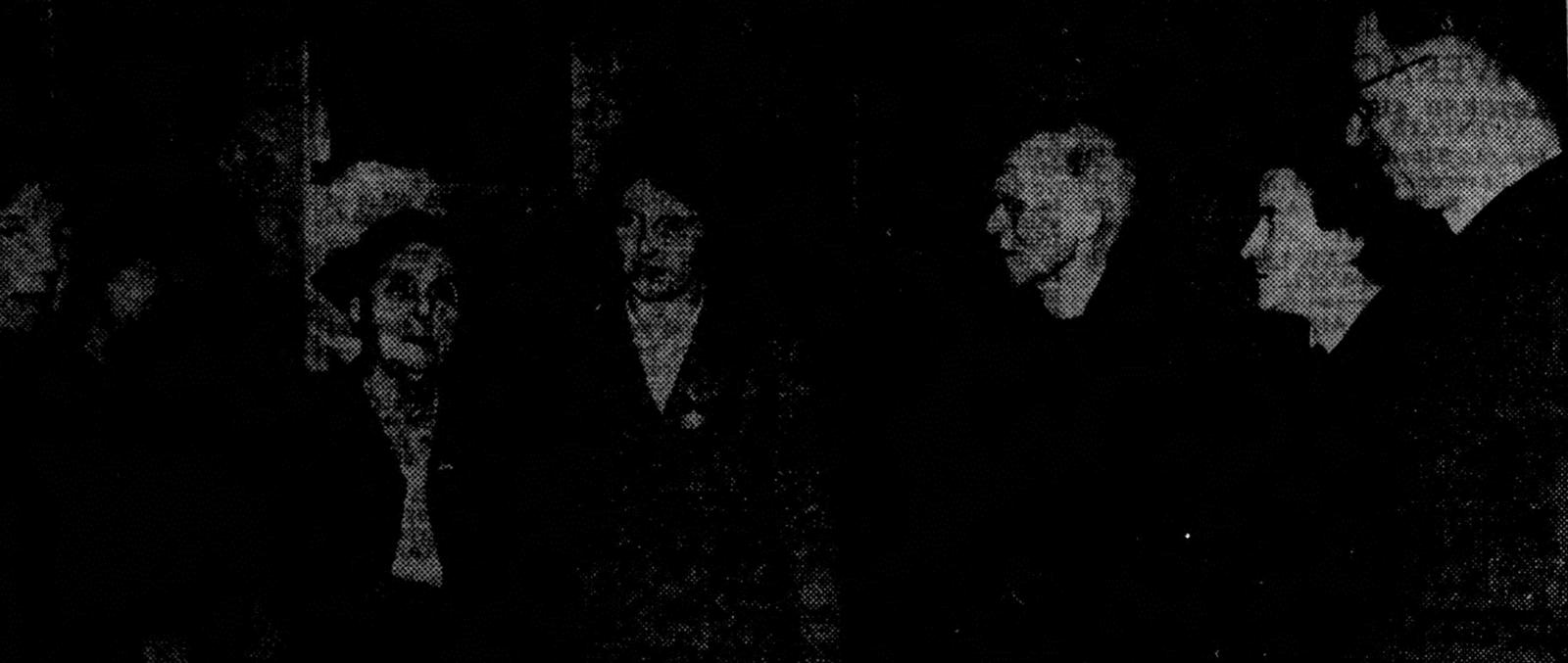
Then in January 1952, Dr W E Farndale, President of the
Methodist conference, 1947 to 1948, has signified his intention to give up the
chairmanship of the Lincoln and Grimsby district, which he has held since 1933.
This is a long tenure of an individual chairmanship, and Dr Farndale has won a
great place for himself in the affections of the Lincolnshire people, not least
because of his keen devotion to the interests of rural Methodism. He was
Moderator of the Free Church Federal Council from 1949 to 1951. In 1947 he was
a delegate to the Methodist Occumenical Conference in
the United States, and Visiting Preacher to the United
Church of Canada in Toronto. Dr Farndale has not yet indicated what his future
course will be, beyond letting it be known that he means to be active.[112]
He did indeed continue to be active[113]. There was a family scare in the spring when Mrs
Farndale, wife of the Rev W E Farndale, Chairman of the Lincoln and Grimsby
District of the Methodist Church, is recovering from shock received when her
nightgown caught fire, and she was badly burned on Saturday. Mrs Farndale, who
was ill, was awaiting the arrival of the doctor at the time[114]. In May, during the Synod a wireless set and a cheque
was presented to the Chairman, the Rev Dr W E Farndale, of Lincoln. He retires
in August after 20 years as chairman and district missionary in Lincolnshire.
His retirement ends 48 years activity in the ministry. Dr Farndale is succeeded
by the Rev F O Le Sueuer[115].
The Cliff College (near Sheffield)
Years
On his retirement from the active ministry in 1952 he
became a tutor at Cliff College, where his biblical scholarship was placed
at the service of many grateful students. Then came the years of physical
infirmity which only served to throw into greater relief his indomitable
spirit. He remained an omnivorous reader and kept abreast of current affairs,
always (to quote his own words) ‘‘seeking recourse to the Head of the Church
through prayer”, and was ever ready with his
characteristic friendly counsel to assist and encourage ministers and laymen
alike. His spare figure and twinkling but penetrating glance will long be
remembered by many who found wisdom and grace in his presence. His mind was
clear and active and his spirit buoyant until the time of his death on 4
February 1966, in the eighty-fourth year of his age and the sixty-first of his
ministry.
The Rev Dr W E Farndale, of 10,
Mainwaring Rd, Lincoln, chairman of the Lincoln and Grimsby District of the
Methodist Church for the past 20 years, is leaving Lincoln on Monday to live in
Derbyshire. Dr Farndale is a former president of the Methodist Conference and,
for two consecutive years, in 1948 and 1949, was elected Moderator of the
National Free Church Federal Council. When, in 1947, he was elected president
of the Methodist Conference, Dr Farndale attended a World Methodist conference
at Springfield, Massachusetts, and during that visit he preached in New York
and elsewhere in the states. Afterwards, under the auspices of the United
Church of Canada, he preached in Toronto, and the honorary degree of Doctor of
Divinity was conferred on him at Victoria university, Toronto. Freed from
district responsibilities, Dr Farndale will be engaged in other activities,
including lecturing at Cliff College and preaching. He continues his membership
of several denominational committees including the Connexional education
committee. The conference recently held at Preston appointed him on the newly
formed committee on evangelism which is to direct a nationwide campaign during
the coming year. Dr Farndale came to Lincolnshire in 1928 following a 10 year ministry in Birkenhead. He was appointed chairman of
the district in 1932, and is the only district
chairman to have continued in such a position continuously from Methodist Union
until the present day. Since 1934 he has been a member of the Lindsey Education
Committee, and before that took a prominent part in preparing the first agreed
religious syllabus for the country. Mrs Farndale has taken an active part in
the work of the Methodist Women's Fellowship, the county and local branch of
the British Women's Temperance Association, and the District Women's Missionary
work.
One of the best known
figures in Methodism in Lincoln, the Rev Dr W E Farndale, chairman of the
Lincoln and Grimsby District for the past 20 years, left on Monday to live in
Derbyshire. Freed from district responsibilities, Dr Farndale will be engaged
in other activities, including lecturing at Cliff College and preaching.
Before the weathered commemorative
stone on Mow Cop, with the castle ruins dominating the scene, Methodists from
many parts of Staffordshire and Cheshire twice gathered in October 1952 to
provide the most impressive scenes in the programme marking the centenary of
the death of Hugh Bourne, chief founder of the primitive Methodist Church.
Another speaker was Dr W E Farndale, a former President of the Conference who
unveiled to the Mow Cop commemorative stone in 1948. He said that Hugh Bourne's
camp meetings were a reaffirmation of the right of the individual to worship,
according to his conscience. The camp meetings were also a vindication of the
need for a progressive church.[116]
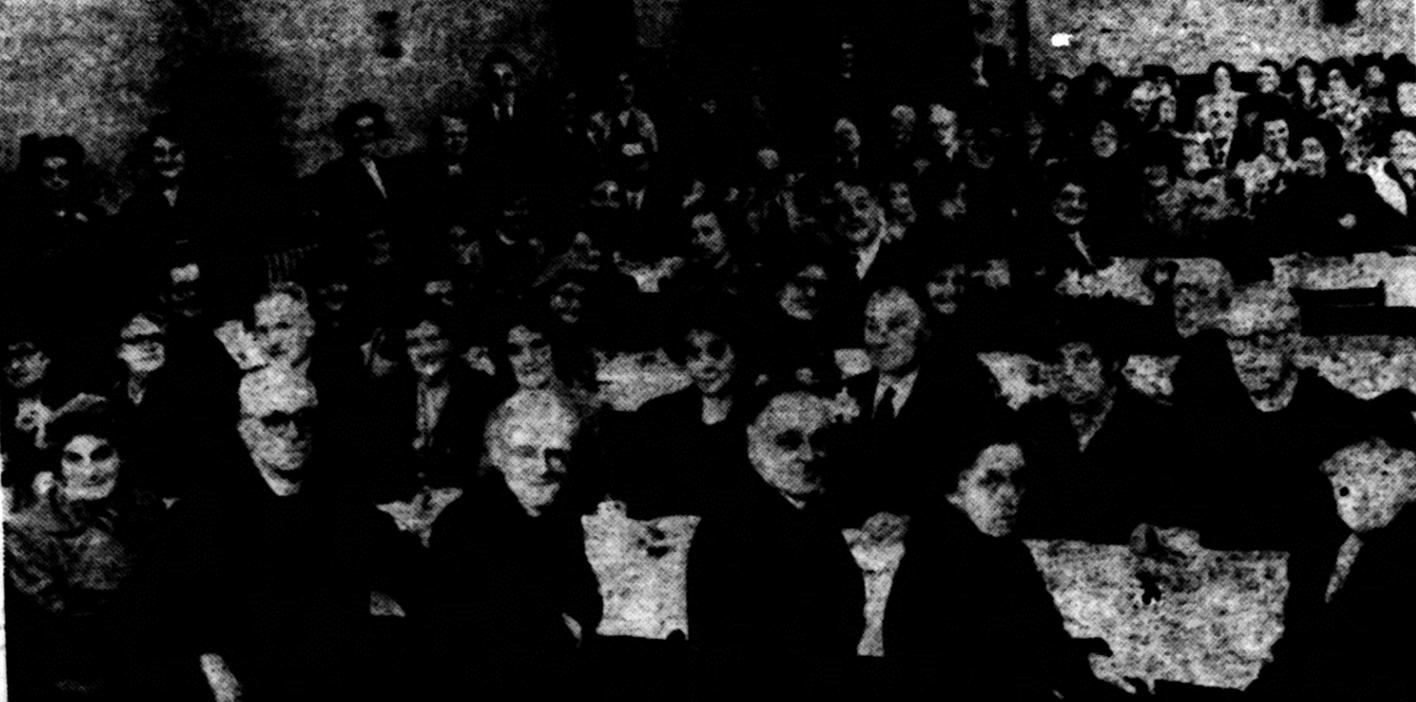
Ministers and congregation at the
Trinity Methodist Church tea, held as part of the trust anniversary
celebrations last weekend. Afterwards a service was held presided over by Mr R
Brandon, of Buerton, at which the address was given by Dr W E Farndale, of
Cliff College[117]
His continued to work hard and advocate his ideas in his
new role[118].
William E Farndale, died age 84, died at Waterhouse, Limpley Stoke, Wiltshire on 4 February 1966. He was buried
on 9 February 1966.[119] There were several obituaries and tributes to him[120].
His many
publications included The Secret of Mow Cop: A New Appraisal of the Origins
of Primitive Methodism[121], Mow Cop After One Hundred and
Fifty Years[122], The Psalms in new light[123], and Sun-lit years: a series of
devotional studies and a treasury of moral and spiritual encouragement for the
elderly[124].
|
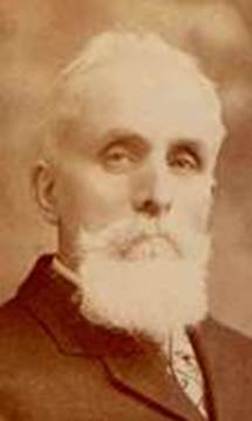
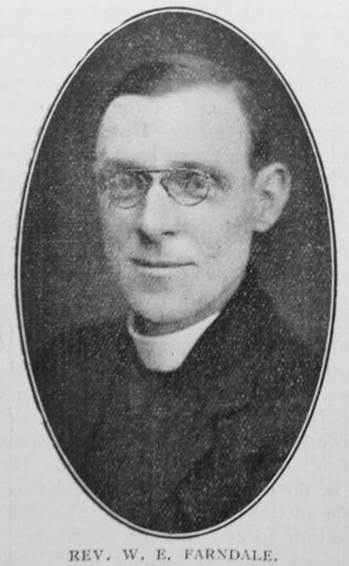
Rev Dr William
Edward Farndale 1881 to 1966
The influential Primitive
Methodist who became head of the Methodist Church shortly after the Second
World War |
or
Go Straight to Act 32 – The Soldiers
|
This
is a new experiment. Using Google’s Notebook LM, listen to an AI powered
podcast summarising this page. This should only be treated as an
introduction, and the AI generation sometimes gets the nuance a bit wrong. However it does provide an introduction
to the themes of this page, which are dealt with in more depth below.
Listen to the podcast for an overview, but it doesn’t replace the text below,
which provides the accurate historical record. |
|