Game of Thrones
1042 to 1200
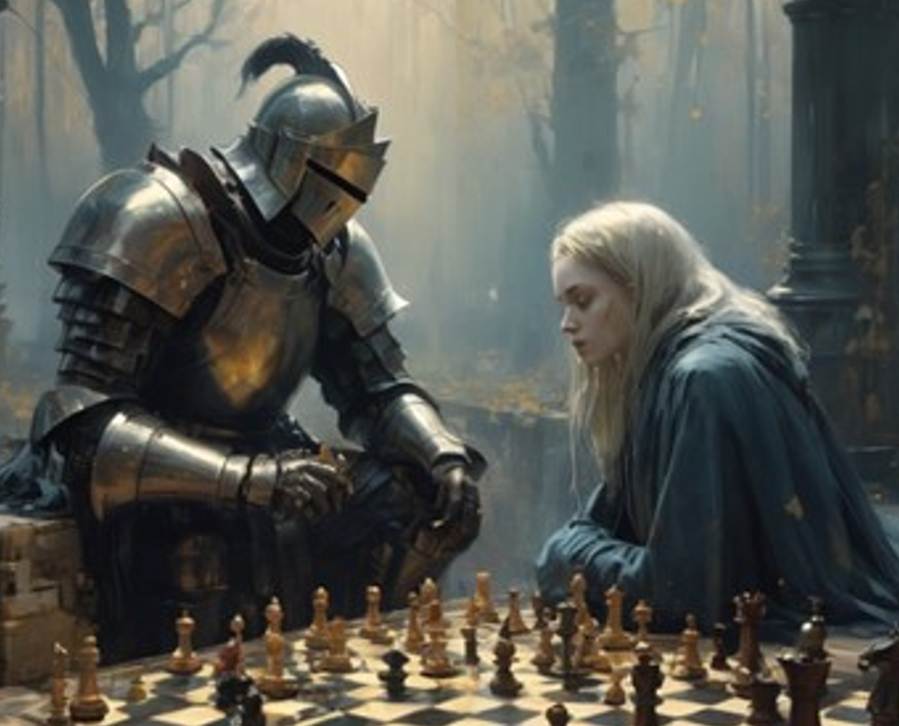
The Kirkbymoorside (Chirchebi)
Estate from the eve of the Norman Conquest
|
Some
introductory music to set the scene. |
Prologue
We now find
ourselves in the century and a half before the ancestors of Kirkdaleland first
settled in Farndale. The story takes us from the eve of the Norman Conquest to
the chess games of the great Norman noble Houses over the lands where our
ancestors lived.
The final
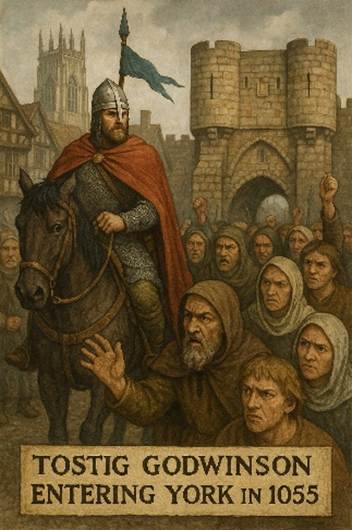
days of the Anglo-Saxons played out after Harold Godwinson’s son Tostig was
rejected by the population around York for his arrogance and brutality. Not
least of his crimes was the murder of the son of Orm, the great Lord of many
Yorkshire estates with their heart at Kirkdale minster. The disgruntled Tostig
then brought Norwegian help to an encounter with Harold at Stamford Bridge,
only thirty kilometres south of Kirkdale, in the first of two battles in 1066
which would change the direction of England’s history again.
The new King
William had little patience for northern rebellion, which he punished with his
cruel Harrying of the North. His Domesday Book provides us with historical
evidence which allows us to build a remarkable pre and post Conquest record of
Kirkdale and its place within the estate of Chirchebi, later
Kirkbymoorside. We are then able to follow the paths of two great Norman
families, the Mowbrays and the Stutevilles, to whom the population of the Chirchebi
estate now answered.
Scene 1 – Final Days of the Anglo
Saxons
The Return of the House
Wessex
The rule by Cnut from 1016
to 1042 as part of the Scandinavian empire, and the restoration of the House
Wessex with the accession of Æthelred’s son Edward the Confessor caused rapid
changes in dynastic loyalties which made life for England’s ruling elite
extremely complicated.[1]
Edward
was the seventh son of Æthelred the Unready, and
the first by his second wife, Emma of Normandy. He was a staunch reformist,
conversing with monks and giving alms to the poor, a patron of monasteries.
After years of exile in Normandy, he lacked allies to solidify his rule. He therefore
depended on Godwin, even though not a natural ally as the killer of his brother
Alfred. Godwin though weary of the consequences of the killing of his brother
Alfred, may have seen advantage in Edward as an easier monarch to control.
There was an awkward reconciliation as Godwin swore he never intended Alfred to
come to harm and presented the king with a gilded warship, while the king
granted lavish earldoms to Godwin’s family. Sweyn and Harold were given seats
in the Midlands and East Anglia and nephew Beorn was also rewarded in the
Midlands. Edward married Godwin’s daughter Edith.
|
Anglo Saxon Kings
immediately before the Norman Conquest 1042 to 1066
The eventful years
immediately preceding the Norman Conquest |
Edward
the Confessor started his reign on 8 June 1042. Godwin was earl of Wessex and
controlled the main power base of the realm.
|
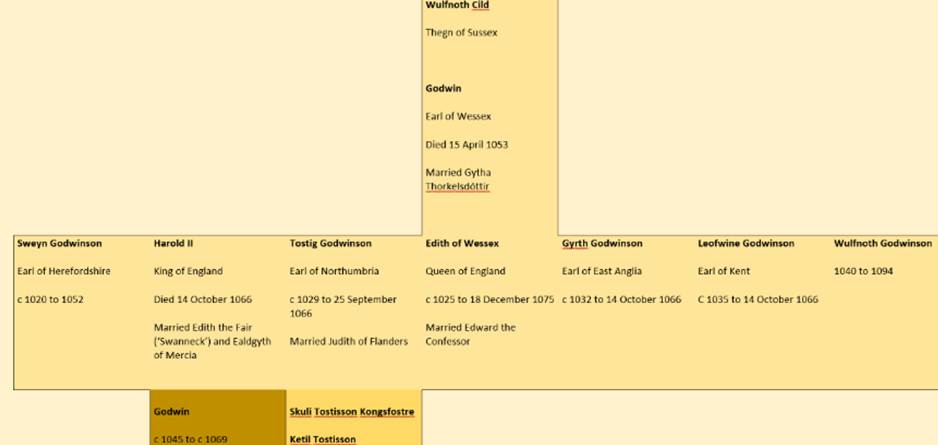
The family tree of Earl Godwin and his sons |
Yet,
in time, the natural tension between Godwin and Edward became problematic.
First,
Edward started to distance himself from the Danish association with England,
while Godwin sought to preserve close relations with Denmark. In 1047 Swein Estrithson, Denmark’s king,
asked for English support against Norway, but Edward refused.
Second
in 1050, Edward rejected Godwin’s recommendation for the new archbishop of
Canterbury and appointed is friend, a Norman, Robert of
Jumiège.
Third,
Godwin began to hold Edward responsible for scuppering Godwin’s ambition that
his daughter Edith would give birth to a Godwin descendant as future king of
England. No child was forthcoming, perhaps due to Edward’s celibacy. In 1051,
Edward had identified an alternative source for the succession in his cousin,
William, Duke of Normandy, who had proved himself in establishing control of
his own duchy. The prospect of a Norman succession was a disaster for Godwin’s
own ambitions.
The
trigger for a rift was a dispute between a returning ambassador, the Count of
Boulogne who squabbled with the folk of Dover. Edward ordered Godwin to punish
the Doverans, but Godwin refused, it being part of
his earldom. Instead Godwin and his family took up arms against the king.
Edward summoned Leofric of Mercia and Siward of Northumbria to respond. The
armies met in Gloucestershire, but at a parley, they agreed to resolve their
differences back in London. By the time they returned to London, much of Godwin’s
support had evaporated and the emboldened Edward turned against the Godwin
family. In 1051, Earl Godwin's opposition
to Edward the Confessor’s policies had brought England to the brink of civil
war. In 1051 the tide temporarily turned. Two Godwin sons
fled to Ireland. The rest of the banished Godwin family, including Gytha and
Tostig, together with Sweyn and Gyrth, sought refuge
with his brother-in-law the Count of Flanders. Edith did
not escape and was sent to a nunnery. The Godwin earldoms were redistributed. If
any Englishman had been told that events would take this turn, he would have
been very surprised for Godwin had risen to such great eminence as if he ruled
the king and all England.[2]
Edward
summoned William of Normandy to England, presumably to affirm his plans for
succession. He received William as a vassal, and may have hoped that Normandy
would come to his aid in the event of further trouble with the Godwins.
Yet, only a year later,
the Godwins returned to England, having regrouped,
with an armed force. They demanded that Edward restore the Godwins’
earldoms. The tide of public support had ebbed back to
the Godwin family, unimpressed by Edward’s preference of William of Normandy in
his succession plan. The Godwins arrived with a large
fleet and army and Edward was unable to resist them. His surrender was
presented as a reconciliation. The Godwins were returned to their former earldoms. Edith was
restored as Edward’s queen. Some of the king’s Norman friends in England fled
north and some entered the service of Macbeth in Scotland. The plan for Norman
succession seemed to be over.
Earl
Godwin died of a seizure on Easter Monday 1053. He left two sons, Harold and
Tostig.[3]
Godwin’s older son Sweyn had died in September 1052 on return from
a pilgrimage to Rome. His reputation was not promising, having abducted the
abbess of Leominster and murdered his cousin. Godwin’s successor as Earl of
Wessex was therefore Harold Godwinson. A true friend of his people and the
country, he wielded his father’s powers even more actively and walked in his
ways of patience and mercy recorded the somewhat biased Life of King
Edward[4].
The Confessor seems to have become a Godwin puppet from 1052. His returned wife
Edith seems to have controlled him and stage managed his public appearances.
A
new trend for church building
Edward’s
sympathies clearly lay with the monastic reform begun in Wessex by Dunstan and Æthelwold in the mid tenth century. He had embraced
Benedictine monasticism whilst exiled in Normandy. His devotion was physically
embodied in his rebuilding the church at Westminster in the Romanesque style.
However the English population had, since the Danish invasion, retained their
piety, but discarded the more extreme forms of moral purity. The archbishopric
of Canterbury was awarded to Stigand, a secular
priest and not a monk, who was a worldly cleric with contempt for the ideals of
reform.
Harold
was a benefactor of Benedictine monasteries, but primarily interested in a non monastic church at Waltham in Essex, which he rebuilt
in a lavish style and re-founded it as a college of secular canons, a new form
that had become popular on the Continent. Leofric of Mercia established another
college of secular canons at St Mary, Stow in Lincolnshire. Siward, earl of
Northumbria founded the secular minster of St Olaf, a former Norwegian King, in
York. Earl Odda commissioned a chapel in Deerhurst,
Gloucestershire. All across the country in Edward’s reign, prosperous thegns
were either founding new parish churches on their estates, or rebuilding old
wooden ones in stone[5].
Whilst
the 1040s were an age of harsh winters, storms and pestilence, the 1050s were
blossoming into a golden age. There was reform of the coinage. At least
according to the Godwin propaganda piece, the whole country settled down in
peace and tranquillity[6].
But
beneath this economic success there were deep political divisions, an enduring
legacy of the Danish Conquest. Some people in the country were committed to the
ancient royal House of Wessex, and wanted to see it continue, in spite of
Edward’s failure to father a successor.[7]
There
was still some hope in Edward’s nephew, the son of Edmund Ironside, who Cnut
had sent to Sweden to be dispatched, but who had been sent in pity still alive
to Hungary. Whilst his brother Edmund had died, Edward the Exile had survived
in Hungary. Delegates had been sent to persuade his return since 1054. Finally
he did so, 1057. He died almost immediately upon his arrival on England’s
shores. We do not know the reason that it was brought about that he could
not visit his kinsman King Edward[8].
Even so, there was still some tentative hope of a Wessex succession, since
Edward the Exile had a son himself, Edgar, aged about 5 and he came to be known
as Edgar Ætheling.
On
the other hand the Danish Conquest had dissolved long established loyalties and
there were many who did not crave a return of the House Wessex. Indeed, the
Godwin family had other ambitions.
Tostig
Godwinson
In 1054, Earl Siward of
Northumbria launched an invasion into Scotland, on behalf of the King, to
support Máel Coluim, son of the king of the Cumbrians to claim the
throne. Máel Coluim is traditionally identified as Malcolm Canmore, later
King Malcolm III of Scotland. His campaign was fought against the Scottish King
Mac Bethad mac Findlaích, Macbeth. Despite the
death of his son Osbjorn, Siward defeated Mac Bethad in battle in 1054.
This was later immortalised in William Shakespeare's Macbeth. Earl Siward did not remain
in Scotland after his victory but he returned to England with considerable
booty, though died in the following year in York.
|
The Scottish Royal
Family Tree The relationships that bound Scotland and England and
the Brus family |
|
|
On Siward's death in 1055,
Edward the Confessor, the puppet of Harold Godwinson, chose a West Saxon to
govern Yorkshire, in place of Siward's little son, Waltheof. Edward's choice,
Tostig Godwinson, was the third son of Godwin and Gytha Thorkelsdóttir,
the daughter of Danish chieftain Thorgil Sprakling.
Tostig was descended from Danish invaders and Anglo-Saxon survivors. Tosti,
Earl of Northumberland, was brother of King Harold who [effectively]
ruled England, and had large possessions at Falsgrave,
near Scarborough; he had fifteen carucates of land, to be tilled by eight
ploughs, which he held as one manor.[9]
In 1055 Tostig had been given the earldom of Northumbria, on the demise of the
noble and brave Siward, whose little son, the rightful heir, was thus wickedly
deprived of his patrimony[10].
With
all but one of England’s major earldoms under their control, the Godwinsons seemed unassailable[11].
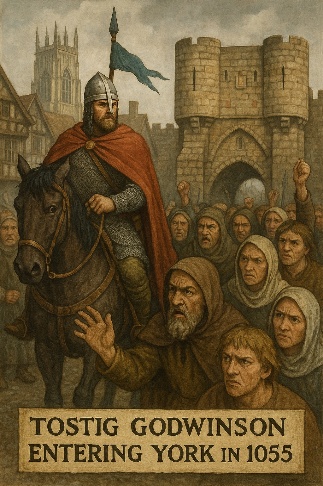
Tostig’s role in Yorkshire was to strengthen the
King’s influence in this, from the south’s perspective, unruly land. The Archbishop of York
died in 1060 and was replaced by Harold’s friend, Bishop Ealdred of Worcester.
In 1061 Tostig visited Pope Nicholas II at Rome in the company of Ealdred.
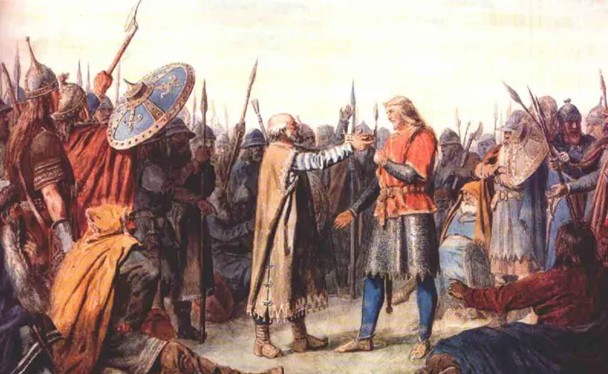
Tostig proclaimed Earl of Northumbria
Yet, the imposition of a Godwinson as their governor was unpopular
with the Northumbrian
ruling class, who were an ethnic mix of Danish invaders and Anglo-Saxon
survivors[12]. Tostig’s actions over the
following decade confirmed their worst fears. Local biases might have played a part in his
unpopularity. Tostig was from the south of England, a distinctly different
culture from the north, and Northumbria had not been governed by a southern
earl for several generations. The inhabitants of Northumbria, the recent lands
of the Danelaw, had enjoyed lesser taxation than in other parts of England.
Tostig was heavy handed
with those who resisted his rule, and murdered several members of leading
Northumbrian families. The
Vita Edwardi, otherwise sympathetic to Tostig, records that he had repressed the
Northumbrians with the heavy yoke of his rule. He was often absent and
seems to have shown a lack of enthusiasm against the raiding Scots. Their new
king Malcolm had sworn a bond of brotherhood with Tostig in 1059. Yet by the
1060s, Malcolm repeatedly raided Northumbria while Tostig was away or during
his pilgrimage to Rome in 1061. Tostig met Scottish destruction with diplomacy
rather than force, angering the folk of Northumbria. Tostig's unpopularity made
it difficult to raise local levies for defence. He resorted to using Danish
mercenaries, housecarls, as his main military force, an expensive and
resented policy.
By 1063, still immersed in the confused local politics
of Northumbria, Tostig’s popularity plummeted. He raised taxes, robbed the
Church, murdered his opposition and seized their lands. In 1064 the earl had
invited two of his rivals to a peace conference in York, only to have them
treacherously slain. When their lord came south to complain at the Confessor’s
Christmas court, he was in turn murdered on the orders of Tostig’s sister,
Edith. It was in 1064 that Tostig murdered Gamal the
son of Orm,
who had married AEthelthryth, daughter of Earl Ealdred. Ulf, who was grandson
of Siward also fell a victim to this Tostig’s treachery.
The following year, at the instigation of his sister Edgitha, Queen of
England, his perfidy culminated in the murder of Cospatric
at the court of his monarch; by this last act his cup of blood was full to
overflowing, and retribution was at hand, for Gamalbar,
a relative of the murdered Orm, with a strong force despoiled Tosti's
household, slew 200 of his retainers, and demanded from Harold his expulsion,
which he obtained.
[13]
In
Northumbria Tostig was a tyrant, and ten years of galling oppression and
rapacity at last thoroughly roused the thanes of Yorkshire and Northumberland,
who burst into open revolt, decreed Tostig an outlaw, slew his retainers, and
finally drove him out of the kingdom.[14]
On 3 October 1065, the
thegns of York and the local nobility descended on York. Two hundred armed men
attacked the city, killed Tostig’s housecarls, and raided the treasury and
armoury. The whole region was soon in rebellion with a similar slaughter in Lincoln.
Violence spread into the countryside. Anyone associated with the Godwinsons was murdered. The rebellion intended to replace
Tostig with Morcar, son of Earl Æfgar, the late
Earl of Mercia. Supporters from Wales and the Midlands joined the rebellion. It
was growing into a broader coalition against Godwinson rule. Tostig was in
Wiltshire at the time of this Rising in the North.
The northern
rebels marched south to press their case with Edward the Confessor. At
Northampton they were met by Earl Harold Godwinson, Tostig’s older brother, who
had been sent by King Edward to negotiate with them. He had not come with an
armed force. Harold met the rebels and told them
that the king ordered that they stand down and that their grievances would be
addressed. This was rejected by the rebels who demanded Tostig’s exile.
Frustrated that Tostig had brought about this rebellion, Harold was aware that
he could not raise an army against the rebellion so late in the year. After Harold, by then the King's
right-hand man, had spoken with the rebels at Northampton, he probably
understood that Tostig would not be able to retain Northumbria. When he
returned to Oxford, where the royal council was to meet on 28 October, he had probably
already made up his mind.
Harold
Godwinson persuaded King Edward to agree to the demands of the northern rebels.
Tostig was outlawed because he refused to accept the deposition of Edward. It
was likely that Harold had exiled his brother to promote peace and loyalty in
the north. This led to confrontation and enmity between the two Godwinson
brothers. At a meeting of the king and his council, Tostig publicly accused
Harold of fomenting the rebellion.
Edward
ordered the exile of Tostig, seemingly reluctantly, and his anger at being
forced into the situation resulted in his winter illness. The northerners’ choice of
new earl was accepted by Edward. Morcar was Earl of
Northumbria from 1065 to 1066.
Along with his family and some loyal thegns, Tostig
had taken refuge with his brother-in-law, Baldwin V, Count of Flanders. Baldwin
provided him with a fleet and he landed in the Isle of Wight in May 1066, which
he plundered.
He raided the south coast all the way round to Sandwich.
Harold’s forces pursued him and Tostig
therefore moved north and after an unsuccessful attempt to get his brother Gyrth to join him, he raided Norfolk and Lincolnshire
In
sullen and angry temper, full of revenge, the banished earl, his wife, and a few
followers sailed across the sea to find a temporary home with his
brother-in-law, Baldwin, earl of Flanders. Here he remained the greater portion
of the winter, maturing plans for the invasion of England and the dethronement
of his brother, for which purpose he collected and manned some sixty ships.
Successful overtures to obtain the help of Harald Hardrada, king of Norway,
were also made by the designing Tostig, and whilst the Norwegian fleet was
getting equipped, he very suddenly swooped down on the Isle of Wight, whose
inhabitants received much cruel treatment at his hands, and having laid them
under heavy contributions both for food and money, he sailed along the south
coast, laying waste every maritime town as far as Sandwich in Kent.
All along the coasts of Norfolk and Lincolnshire did Tostig ravage both town
and village! He entered the Humber, and continued his piratical excursions into
both Yorkshire and Lincolnshire, where he devastated the district of Lindsey
with fire and sword.[15]
The Earls Edwin and Morcar
defeated Tostig decisively. Deserted by his men, he fled to his ally, King
Malcolm III of Scotland. Tostig spent the summer of 1066 in Scotland.
The End of Time
In 1064 Harold decided to visit William of Normandy. The visit is
depicted at length in the Bayeux Tapestry[16].
It was suggested in Norman records that Harold’s
visit was on the orders of Edward to confirm the Norman succession, but that is
unlikely, given the power of the Godwinsons. It is
more likely that his purpose was to secure the release of two Godwin relatives,
held as hostages. En route to Normandy, he was blown off course to Porthieu where he was taken prisoner, but released with
William’s intervention. He seems to have joined William on campaign and
acquitted himself well. William made it clear that he had no intention of
abandoning his claim to the English throne, and made Harold swear an oath on
holy relics that he would ensure the smooth transition to William.
Two years later, on 6 January 1066,
Edward the Confessor died. Harold
was crowned King in Westminster Abbey on the same day. Pro Godwin sources
suggest Harold was nominated by Edward in his dying moments. Alternative
sources suggest he was merely entrusted with the kingdom’s future. Yet
most of the English magnates supported his coronation. His support was
widespread through the kingdom from the earldoms to both archbishops. He almost
certainly had to negotiate an agreement with Eadwine, Earl of Mercia and Morcar, Earl of Northumbria. Indeed Harold, although
already married to Edith the Fair, the Swan-neck, married Ealdgyth of
Mercia, the sister of Morcar and Eadwine.
When Harold
became King in 1066, his immediate priority was to unify England in the face of
the threat from William of Normandy, who had openly declared his intention to
take the English throne. His immediate
concern was a Norman invasion. Indeed William of Normandy had quickly started
to make preparations. Fears were stoked by the passing of Halley’s Comet in
April 1066, depicted in the Bayeaux Tapestry.
Harold
continued to assemble an army and ships along the south coast to deal with the
Norman threat. He gathered together greater naval and land levies than any
king in this country had ever gathered before[17].
Yet bad weather held back the Norman invasion.
Armies
could not be held together for lengthy periods, particularly as the harvest
approached, and on 8 September 1066, Harold was forced to disband his army.
Yet
the initial threat came from Harold’s brother Tostig, who continued to plot his vengeance. In
late summer Tostig had left Scotland and crossed the North Sea to Harold
Sigurdson (Hardrada, Hard Ruler) of Norway. One of the sagas claims that
he sailed for Norway, and greatly impressed the Norwegian king and his court,
managing to sway a decidedly unenthusiastic Hardrada, who had just concluded a
long and inconclusive war with Denmark, into raising a levy to take the throne
of England. There is indeed no suggestion that Hardrada had any intention of
seizing the English throne previously.
An
expedition had left Norway in August and joined Tostig with a smaller force on
the Tyne before the whole force landed at Riccall on
the Humber. His arrival was unwaran,
unexpected[18].
Meanwhile
the king of Norway's promised aid was completed, and from the many fiords of that
rugged coast sailed some five hundred ships filled with warlike Norsemen
chanting their weird battle-songs. They sailed to the Tyne, and in its mouth
they anchored, waiting for Tostig, who soon joined them, bringing with him some
assistance from Scotland and the Orkney Isles. The combined fleets then set
sail for the Humber, which they entered unmolested, and continued their course
up the Ouse as far as Riccall, a village ten miles to
the south of York, where, leaving their boats, the allied forces landed and
pushed on to that city, which they intended to take by storm. On their march
thither the country-people fled panic-stricken[19].
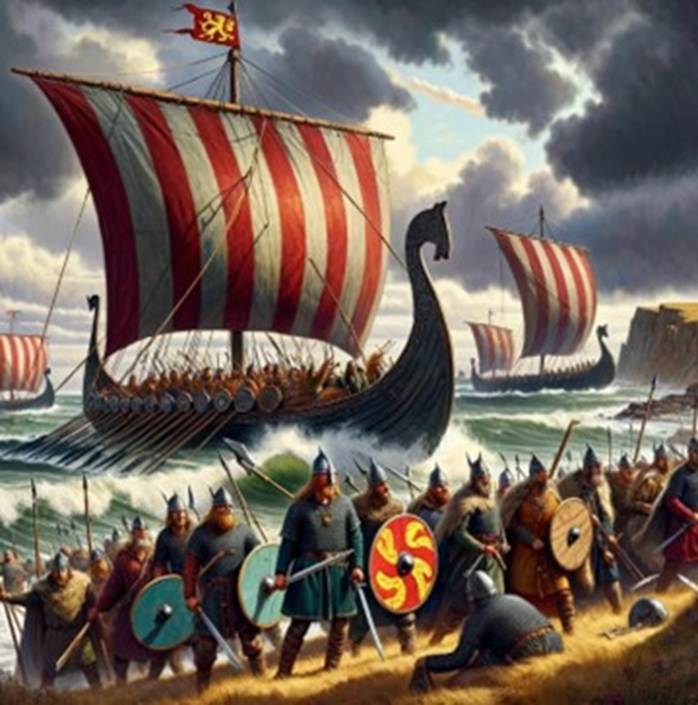
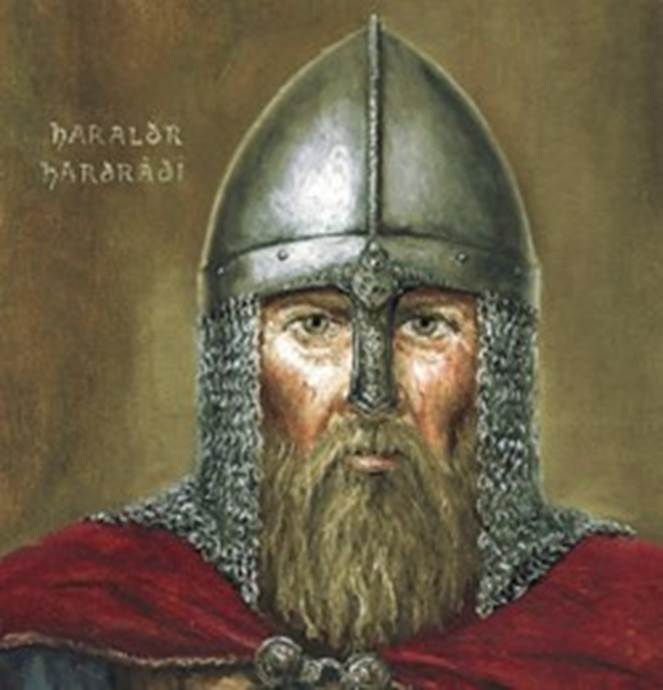
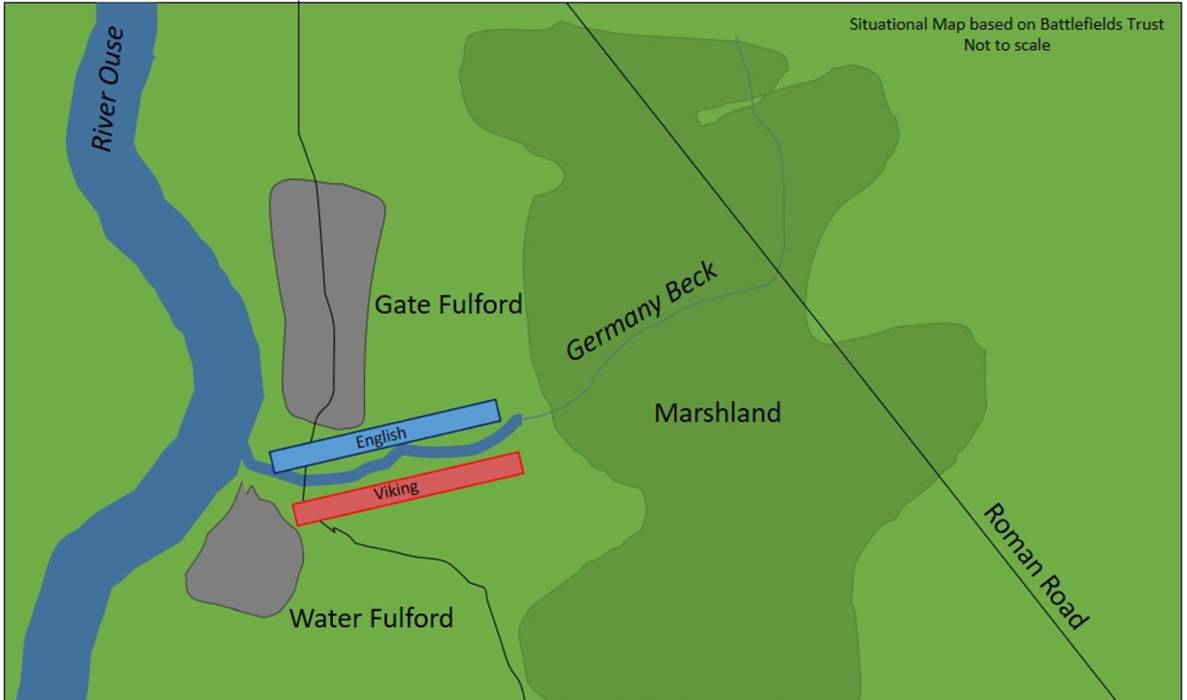
Having
sailed up the Humber and the Ouse, on 20 September 1066, Eadwine and Morcar faced the Tostig-Hardrada invasion near York, and
both sides suffered heavy losses at the
Battle of Fulford, but Hardrada’s army held firm and
entered York after the battle reaching an agreement with the folk of York who
seem to have agreed to join the invading force.
The
earls Edwin and Morcar were again on the alert.
Citizens and men of the surrounding district joined their ranks, the garrison
of York turned out to help, nay even priests armed for the fight, so determined
was everyone to resist the invaders and defend their dearly loved city. They
met the Norsemen at Fulford, a village on the northern bank of the Ouse, a mile
and a half to the south of York. There was hard fighting, and fortune, though
at first favouring the English, later on veered round to their opponents, and
then the war-song of the Norseman was heard that he was triumphant on that day.
Many on both sides perished, but the loss on the part of the English was by far
the heaviest. Numbers were drowned by having been forced back into the waters
of the Ouse, whilst of priests it is said more than one hundred stark corpses
were left on that fatal field. This calamitous event took place on Wednesday,
20th September, 1066, the eve of S. Matthew.[20]
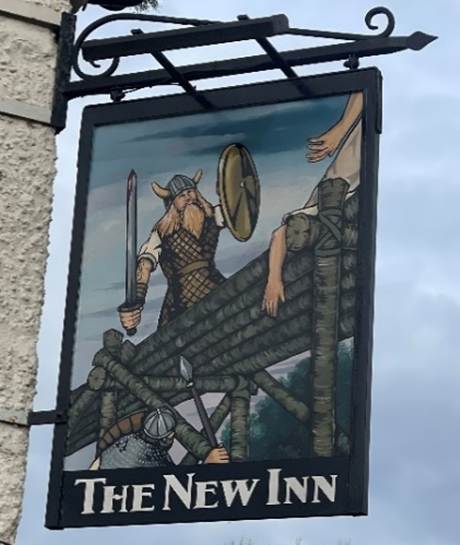
Harold
had meantime swiftly reassembled his recently disbanded army and marched north in four days to take the invaders by surprise,
reaching Tadcaster by 24 September 1066.
Learning
of Harold’s arrival, Hardrada’s army marched to Stamford Bridge. One account
suggest that since the weather was hot, the invaders didn’t wear their mail
shirts.
But
news had arrived that Harold of England was rapidly approaching, so Tostig and
his Norse allies marched across country from Ricall
to Stamford Bridge, where they secured a very strong position, and forthwith
set about to dispose their forces on the defensive.
At
this place the river Derwent is about twelve to fourteen yards in width, and
runs almost due north and south. The village of Stamford is divided by it into
two unequal portions. On the west bank there is a tract of level ground, and at
some distance from the river arises a gentle slope, and when you are standing
on the highest ridge of this you can see for some distance over a flat country.
On the east bank in and just behind the village is a continuous crest of higher
ground, rising at once from the water’s edge, but when you walk over the edge
of the crest there is a dead level, and here are the fields still called the “
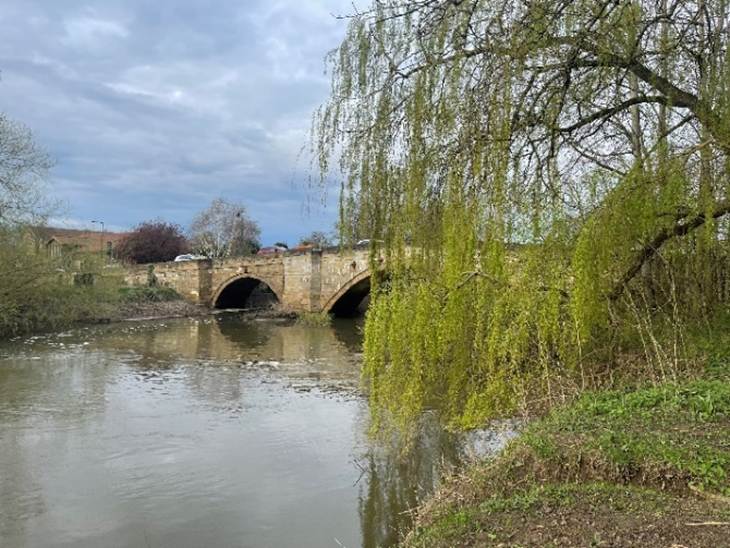
Battle Flats.” The river at Stamford Bridge is sluggish and not fordable, and
at the period of the battle was crossed over by a wooden bridge about five
hundred yards above the present structure.[21]
A
fierce battle took place. No quarter was given and none was asked — to kill was
the order of the day. From dawn to midday, from seven in the morning until
three in the afternoon, the battle raged with fatal significance[22].
At
the Battle of Stamford Bridge[23], only thirty kilometres south of Kirkdale,
on 25 September 1066, Harold defeated and killed Harold Hardrada and Tostig. Alas,
those brothers, hearts too hard! This murderous page will hardly please their
sister, the queen[24].
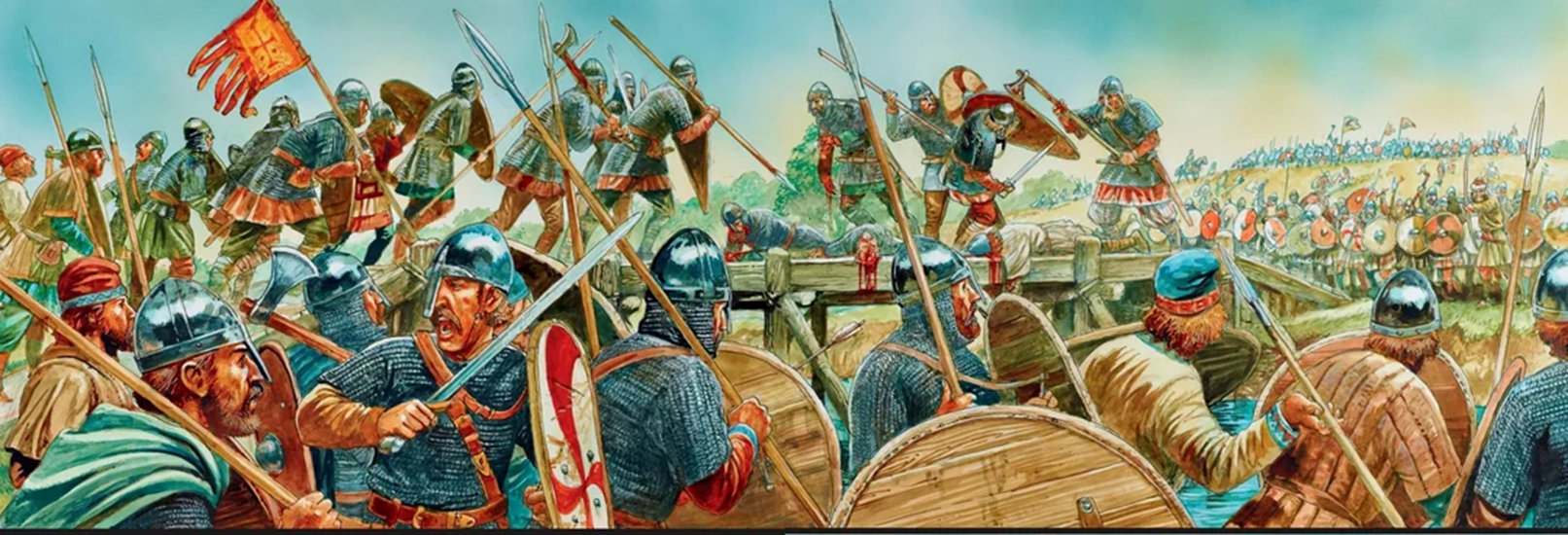
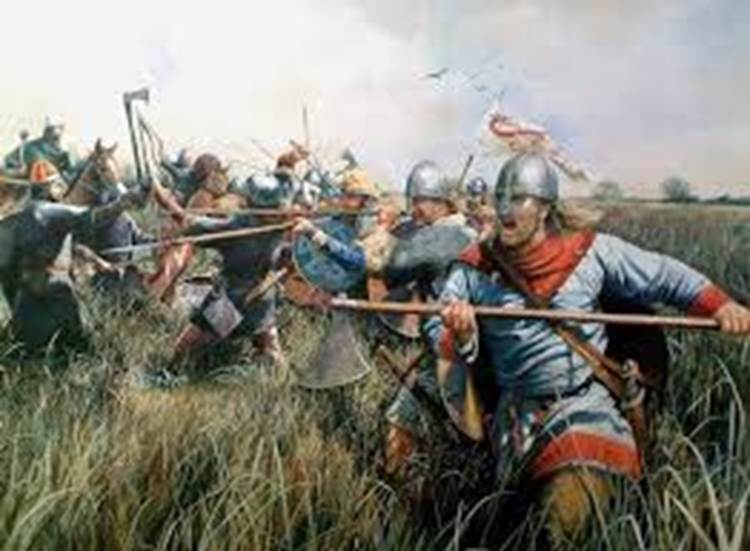
The
defeated Norwegian army fled back towards Riccall,
but were slaughtered by the English.
So far so
good for Harold.
The trouble of
course was that Harold then had to march his exhausted army south again, to
confront the second threat from William of Normandy, near Hastings,
and in that episode, he didn’t do so well.
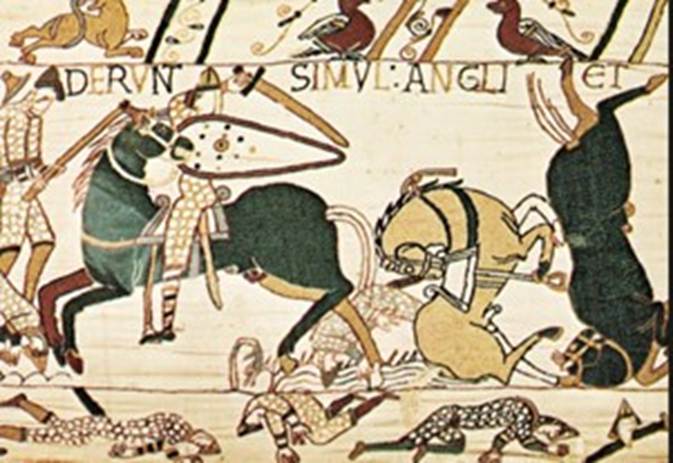
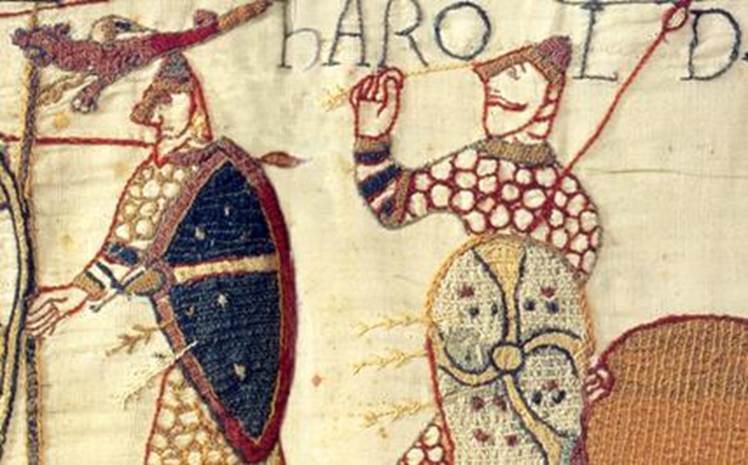
On
28 September 1066 William of Normandy invaded southern England. On 14 October
1066 Harold was defeated and killed by William at the Battle of Hastings. The Godwinsons were all killed, Harold, Tostig, Leofwine and Gyrth. Their mother Gytha, was exiled.
It took several years for
the Normans to consolidate their rule over England. The Conqueror exercised
little authority north of the Humber in the early years.
Scene 2 – Living in the heart of the
action
Rebuilding
Kirkdale
The
Anglo-Saxon-Scandinavian overlord of the ancestral lands of the Farndale family
on the eve of the Norman Conquest was Orm
Gamalson who was associated with sixty one locations, including the estate
of Chirchebi, now Kirkbymoorside, the estate which included the lands
which would become Farndale.
Before 1066,
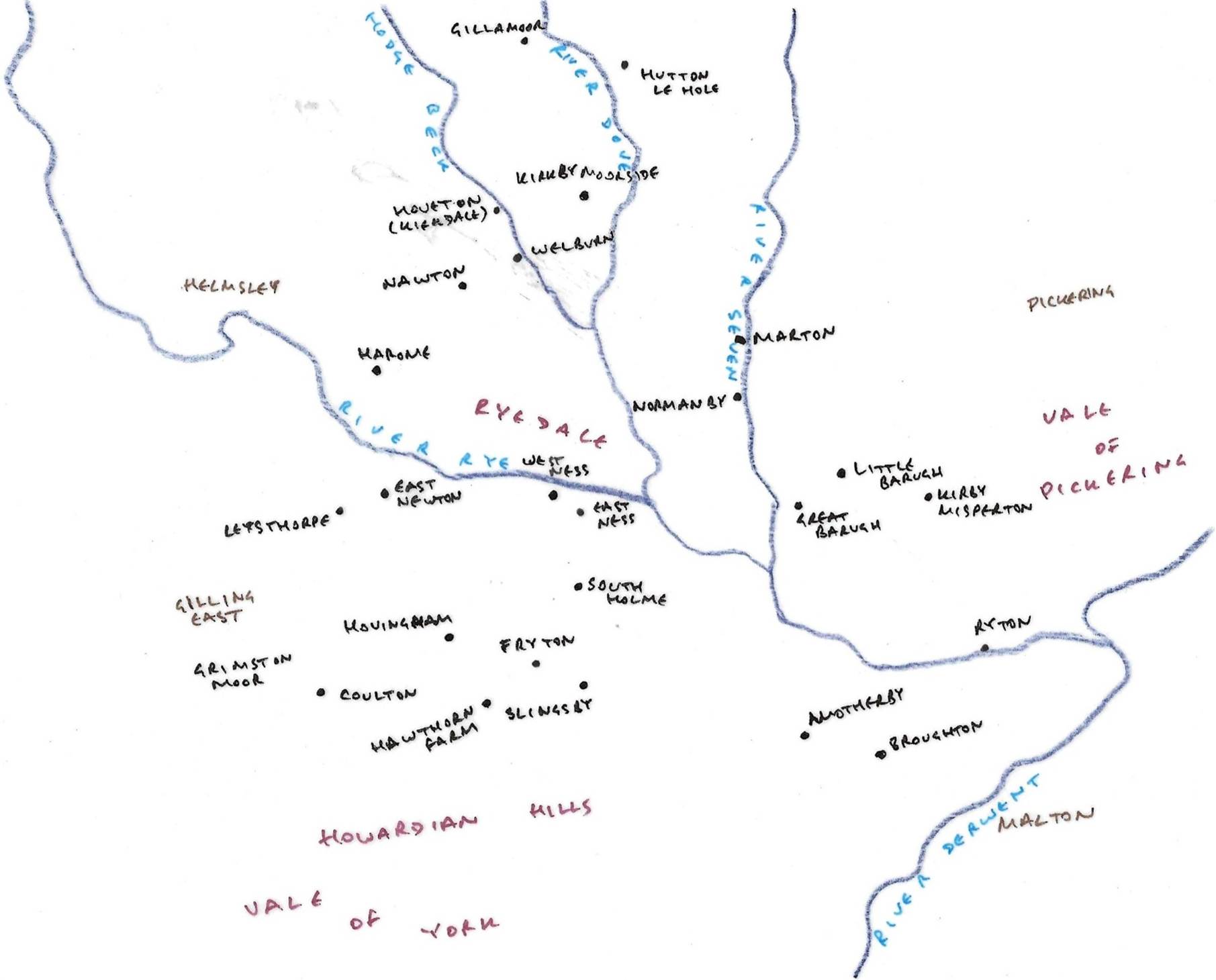
Orm held lands widely around the North York Moors, mapped out below, and the
heart of his interests lay in the Hundred of Maneshou, which is magnified in the second map[25].
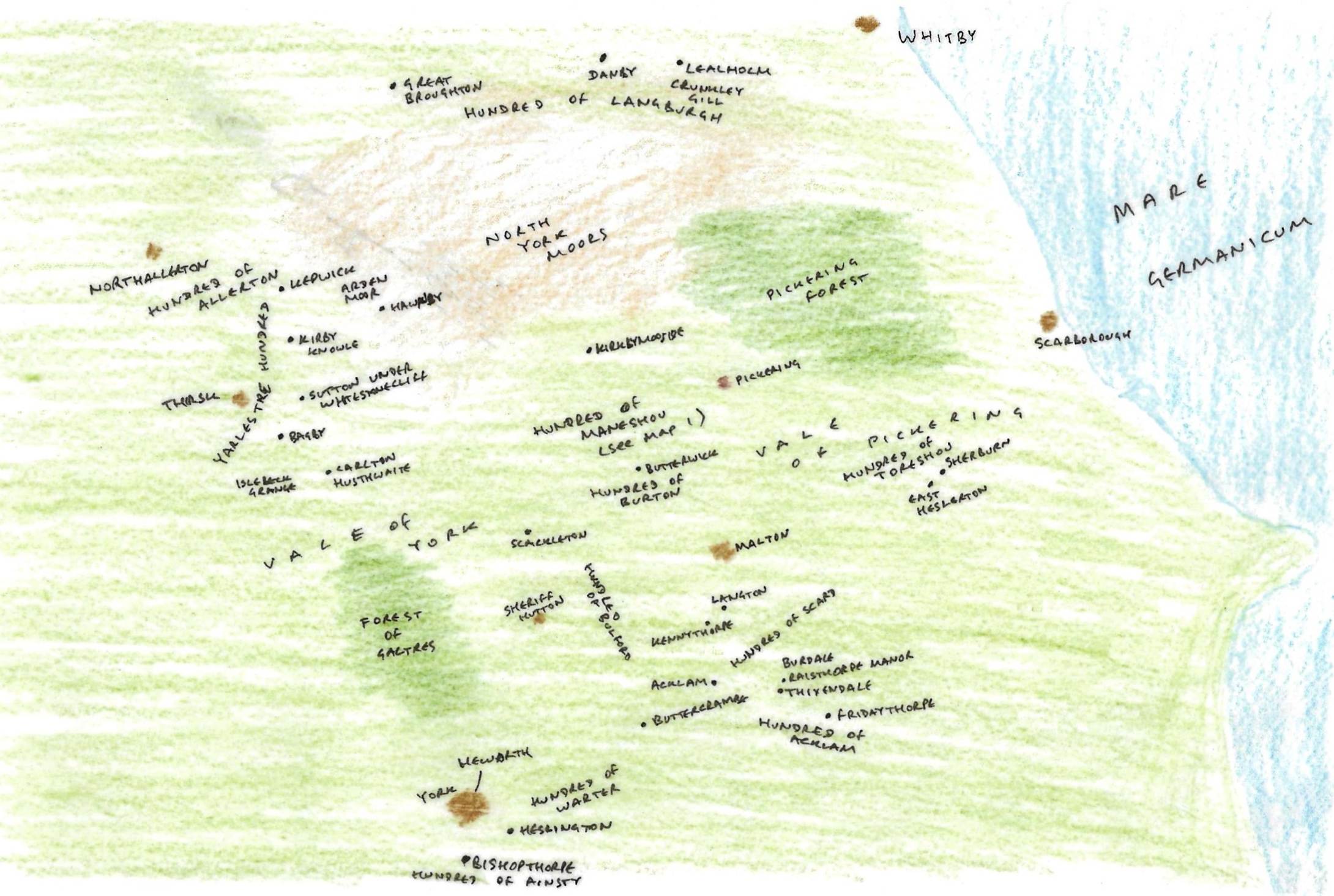
Lands of
Orm Gamalson before the Conquest
The Hundred of Maneshou
|
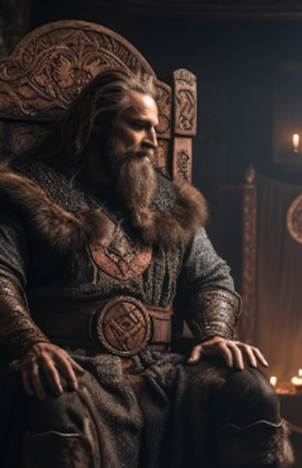
The powerful figure at the
heart of the aristocracy, who rebuilt Kirkdale and put our ancestral lands
firmly onto the national political stage |
|
The
estate of Chirchebi at the time of the Domesday Book was likely focused
on the small settlement Chirchebi (later Kirkby Moresheved
and Kirkbymoorside) itself, and another small community
around the seventh century minster at Kirkdale,
only a couple of kilometres to the east. Around those two small communities was
a constellation of berewick farms at such
places as Hoton (Hutton-le-Hole) and Gillamoor, nestled into the edges of the dales; and from
Kirby Misperton to Harome across the northern reaches
of the Vale of Pickering.
A
silver sceat or coin of Aethelred I, King of
Northumbria (who reigned 789 to 796 CE) was found in the churchyard in 1965[26]
suggesting that a settlement had been established at Kirkbymoorside by the
eighth century. There may have been a church in the settlement by about the
ninth century, and certainly by the tenth century. A sceat,
meaning ‘wealth’ or ‘money’, was a type of Anglo Saxon coin in circulation in
the seventh and eighth centuries CE.
The
lands of Chirchebi which nestled into the side of the wilderness of
dales and moors, at the north western edge of the Vale of Pickering had been an
agricultural heartland for centuries. The Roman Villas of Beadlam and Hovingham were likely to have been the
heart of estates of the fourth century CE, probably supplying the Roman
military forces in Eboracum and these lands under the protection of the
dales’ edge, appear to have survived and perhaps prospered during the
tumultuous periods of Anglo-Saxon and later Scandinavian invasions.
By
the time of the Conquest, TRE[27],
Chirchebi was a great estate, one of many in the hands of Orm Gamalson[28],
but perhaps the heart of his interests.
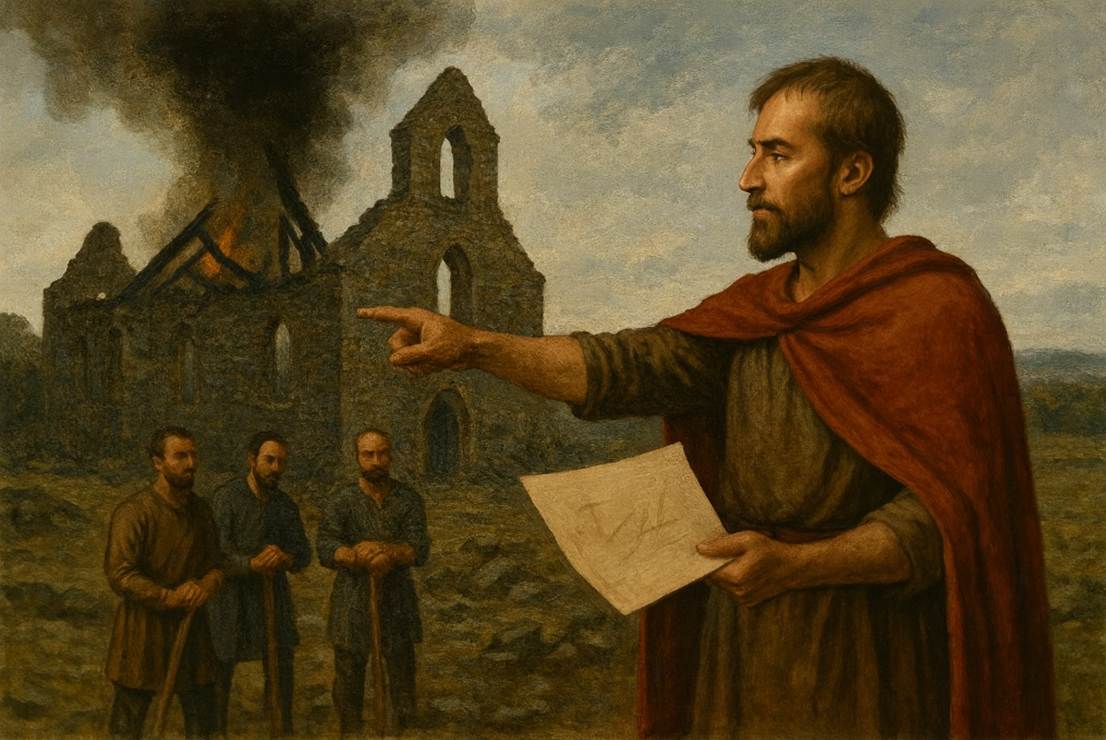
The
archaeological record shows that the old church of Kirkdale was destroyed by
fire, probably at about the turn of the first millennium[29]. It had previously been thought that
the church might have fallen during the Viking period, but it seems more likely
that the church suffered a fire perhaps not many years before Orm Gamalson, as he recorded on his
sundial, rebuilt Kirkdale Church in about 1055[30]. This was in the period of church
building encouraged by Edward the Confessor, and during the time of millennial
fears instilled by Wulfstan of York.
|
Anglo-Saxon-Scandinavian
Kirkdale
Kirkdale in the
Anglo-Saxon-Scandinavian period from about 800 CE to 1066, with a brief
summary of its history through to 1500 |
|
|
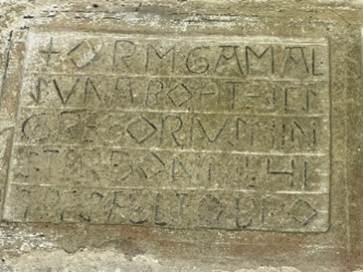
Although
we’re not certain that the sundial
was built into the church during the 1055 building work, it’s likely that it
was, possibly in its current position.
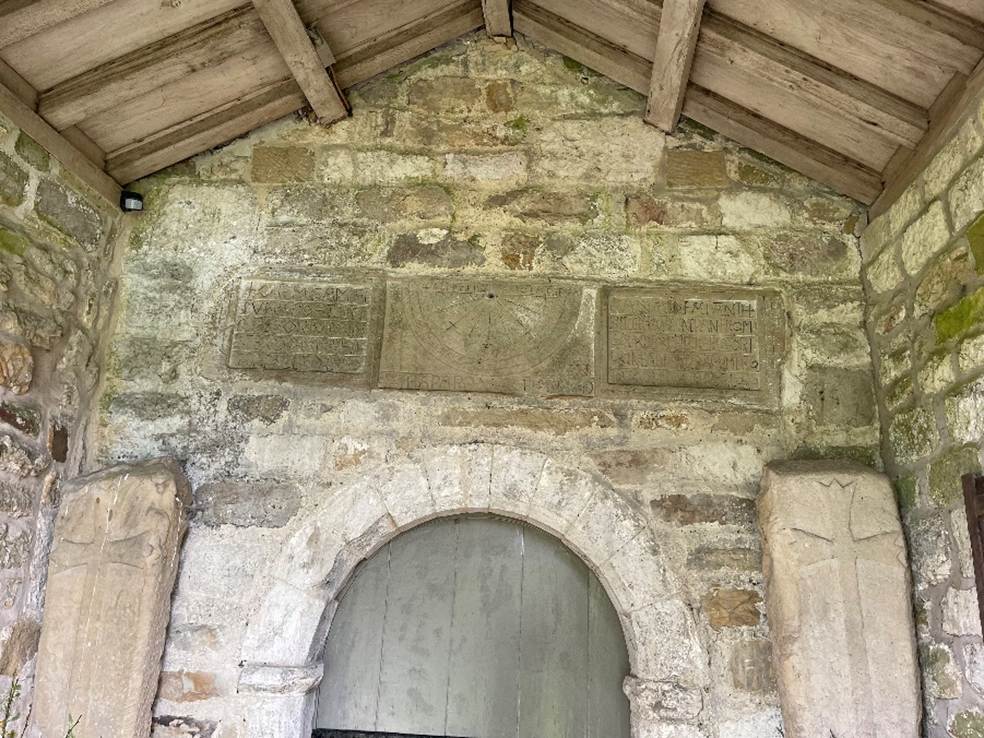
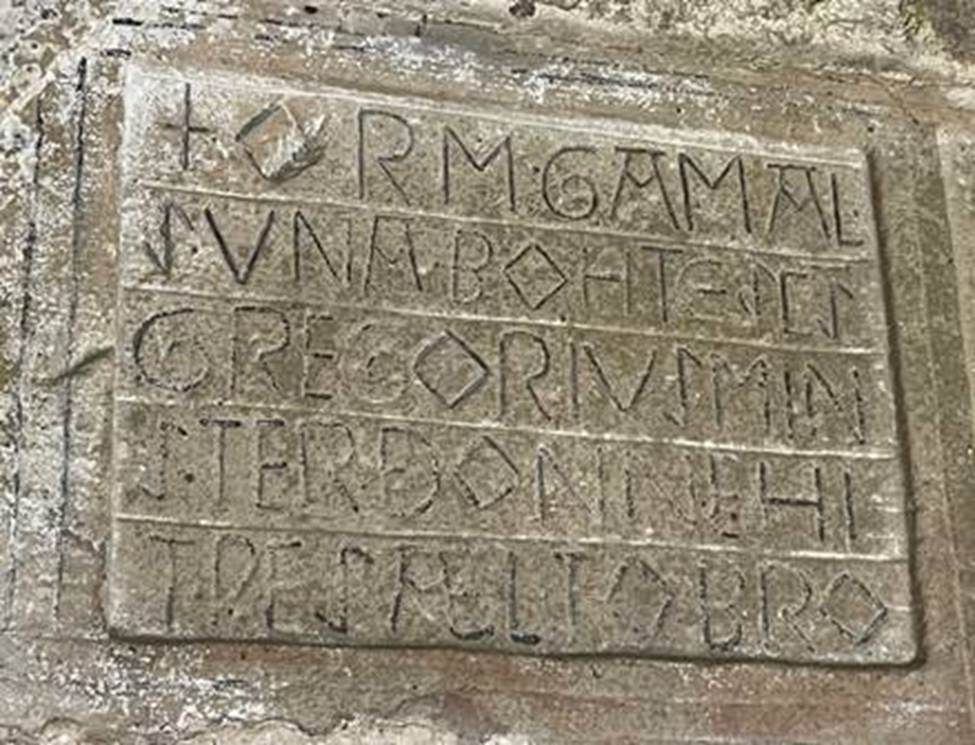
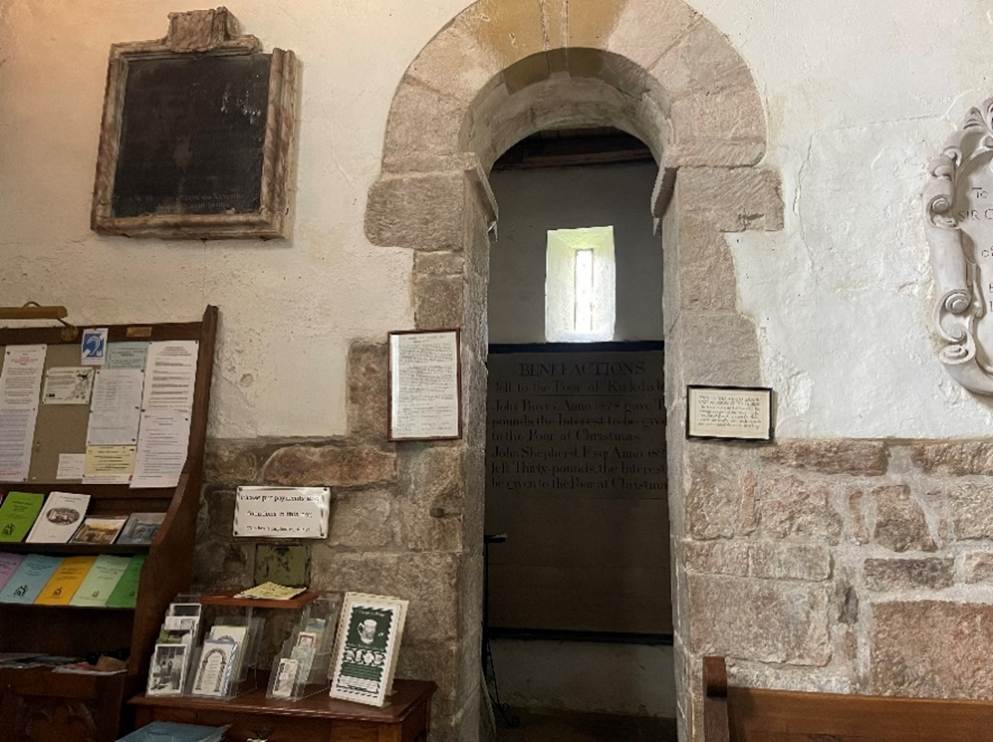
The south
doorway with the sundial
The original west doorway which was part of Gamal’s rebuilding
At the same
time that Orm had rebuilt Kirkdale
Minster in the decade before the Norman Conquest, Tostig Godwinson had
become the Anglo-Saxon Earl of Northumbria.
The
sundial’s inscription refers to Edward the Confessor and to Tostig, the son of
Earl Godwin of Wessex and brother of Harold II, the last Anglo Saxon King of
England. Tostig had rebelled against his brother Harold Godwinson to join the
Dane, Harold Hardrada in the invasion of northern England which immediately
preceded the Battle of Hastings. It was therefore during that last tumultuous
decade, immediately before the Norman conquest, that Orm, son of Gamal rebuilt
this Church, dedicated to St Gregory and when he did, he placed that sundial
over the doorway.
|
The powerful figure at the heart of the aristocracy,
who rebuilt Kirkdale and put our ancestral lands firmly onto the national
political stage |
|
A unique treasure whose secrets
transport us into the world of the eleventh century upon which you can stare
today, imagining direct ancestors who did the same a thousand years ago |
Our
ancestors found themselves at a place of historical significance in the year
1066, not so far from the first of the two great battles of that year, the most
significant year of change in English history. And our ancestors’ home had
direct cultural and political links with the world of Edward the Confessor,
Tostig and Harold Godwinson and others, who were the main actors in that story.
Orm Gamalson was clearly a substantial figure,
and the place he chose to articulate his power was Kirkdale. Kirkdale had political significance in this
pivotal historical episode.[31]
An
Anglo-Saxon-Scandinavian World
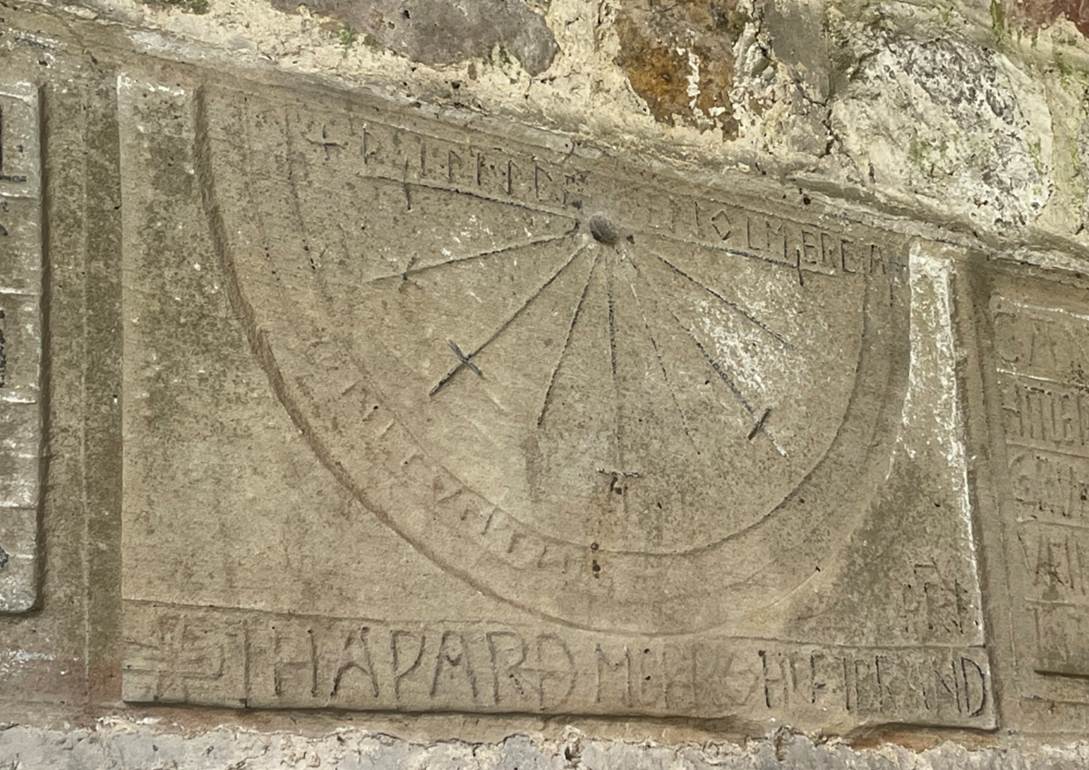
The sundial is written in the Old
English of the late Anglo Saxon period. Orm the son of Gamal acquired St
Gregory’s Minster when it was completely ruined and collapsed, and he had it
built anew from the ground to Christ and to St Gregory in the days of King
Edward and in the days of Earl Tostig. The sundial itself bears the
inscription This is the day’s sun circle at each hour and then The
priest and Hawarth me wrought and Brand.[32]
The
Kirkdale sundial has been described as ‘a unique record of the purchase of the
rights over a church’ when it declares that Orm the son of Gamal ‘bought’ St
Gregory’s Minster. It has justly been described as the most remarkable and
complete pre-Conquest sundial to survive, ‘not least because its inscription
names its carver, the patron saint, the priest, the landholder, and the earl’.[33]
There is a
single Old Norse word in the text, solmerca,
which means sundial. The old Norse word might just have been borrowed from the
Norse language. The Scandinavian names, including Orm, have been Anglicised
from the Norse, Ormr. So when you first
interpret the words of the sundial, as you walk beneath it, it doesn’t seem
particularly Scandinavian.
It might
appear that Orm rebuilt an ancient, ruined church, which he re-dedicated to St
Gregory, rejecting the disorder of the Scandinavian centuries, in order to
restore the Christian traditions of the older world. The sundial might seem to
reflect a rejection of Scandinavian culture and a recovery of the earlier
Anglo-Saxon Christian period. And yet, there is tangible evidence of
Scandinavian culture on the local community. [34]
The
inscription provides the names of Orm Gamalson, the elite landholder; of a
priest called Brand and of Hawaro, probably an
artisan. This is a record of a reasonable cross section of its society. There
is little doubt that Orm Gamalson
came from a Scandinavian tradition and probably was of Scandinavian descent.
Brand was the priest and was likely to have been responsible for the design of
the sundial. Brandr was a common personal name from Denmark and Iceland.
Hawaro was probably the craftsman, responsible
for the inscription. This is also a Scandinavian name, as in the Icelandic saga
of Hávarður of Ísafjörður.
The use of a
Scandinavian name might evidence Scandinavian descent, or simply an increased
use of fashionable Norse names. Yet the way that names were used in this period
followed strict genealogical form. Orm Gamalson had a father and son each
called Gamal son of Orm, and his grandfather was probably also Orm Gamalson.
Names were used in a carefully controlled manner. They bound families together
and created a network of obligations. Analysis of the Domesday Book shows the
proportion of Old Norse to Old English names was more than two to one. The
highest of all such names was in Yorkshire and the Ryedale Wapentake,
which included Kirkdale, had a higher than county average. There were 92 Old
Norse to 8 Old English names. Although Norman names were adopted in large
numbers after the conquest, the total number of different names adopted
from the Normans was very small. Yet the use of Norse names at the time of the
Norman invasion reflected a large number of different names which were
used, so is less likely to reflect an adoption of common Scandinavian names by
an entirely indigenous population.
By the tenth
century there was extensive interaction between northern England and
Scandinavia. In 1016 when the Danish King Cnut had assumed the throne from his
conquering father Swein Forkbeard he had granted
estates to many of those who had supported the reconquest. Orm’s father Gamal
probably benefited from this redistribution of land. In later marrying the Earl
of Northumbria, Ealdred’s daughter Aethelthryth, Orm became embedded into the
Scandinavian and English elite society.
Old Norse
was still spoken at the eve of the Norman Conquest, particularly in Yorkshire.
Old Norse speakers continued to arrive, with another influx during the reign of
Cnut. The Old Norse language flourished in Cnut’s court. In the north there was
a rich culture of elite poetry, read in the Old Norse language for English
audiences.
During
this period Viking colonials from Ireland settled in north Yorkshire, where it
is possible that they constituted a ruling elite, but still subject to Anglian
influences. In consequence some sculptured stones from this period, including
sundials, may properly be described as Anglo-Scandinavian. It is this
circumstance which accounts for words with Scandinavian roots occurring in
otherwise Old English inscriptions, such as those which accompany the most
important of the Ryedale group of Anglo-Saxon sundials.[35]
Whilst
Scandinavian culture was originally pagan, by the tenth century the
Anglo-Saxon-Scandinavian community had adopted Christianity. There is extensive
evidence of religious piety particularly through Scandinavian inspired stone
sculpture. There are at least nine examples of such inscriptions at Kirkdale,
apart from the sundial. They were probably funerary monuments for the new local
Scandinavian elite.
Some 38
Anglo-Saxon sundials have so far been identified in England, the majority (24)
in the north. Of these no less than 14 are located in Yorkshire, and nine of
them in Ryedale District alone.
Of the important group of seven Anglo-Saxon sundials with inscriptions
nationwide, no less than four are located in Ryedale.[36]
The language
of the Kirkdale sundial was Old English, as were four similar inscriptions in
the area at Aldbrough (Ulf had this church built for his own
sake and for Gunnvor's soul), the Traveller’s Clock at Great
Edstone (Loðan
made me; Orlogium Iatorum, “The Traveller’s Clock” ); Old Byland (Sumarleoi’s house servant made me); and St
Mary Castlegate, York (and Grim and Aese
raised this church in the name of the holy Lord Christ and to St Mary and St
Martin and St Cuthbert and All Saints. It was consecrated in the … year in the
life of …). Yet Old Norse had never become a written language using
the Roman alphabet. The two written traditions were Latin and Old
English. Since Old English and Old Norse were related languages, the
Scandinavian elite didn’t worry themselves about using existing traditions of
Old English and Latin for the written record.
Kirkdale is
a place where Scandinavian, Latin and English traditions met and found
expression. It was at the heart of the Anglo-Saxon-Scandinavian world.[37]
A concept
of Time
The
sundial’s inscription, This is the day’s sun circle at each hour, takes us
into the imaginations and perceptions of our ancestors who conceived of the
sundial and looked up at it as they regularly walked through the door. It was
unlikely to have been a practical time telling mechanism, given its position on
the minster’s wall surrounded by high ground. It is more likely, particularly
given its position over the doorway into the minster, that the real purpose of
the sundial was not practical and secular, but religious and profound. Indeed
the practice was to bury the dead who had been faithful on the south side of
the church, so the exterior of the south wall was a natural place for such
symbolism.
It was
probably intended to be a symbolic reminder of temporal progression. Time was
perceived as the linear temporal space within which the world moved towards its
final judgement and dissolution. By the fourth century CE, Christian theology
had focused on God’s plans for how life on earth was lived. This brought with
it a conception of history and the passage of time.
This was an
uneasy generation of the period just after the end of the first millennium. In
1014, Wulfstan, Archbishop of York, had published his sermon addressed to
the English nation. He anticipated the coming of the Antichrist and found moral
decline in the nation. There was always some uncertainty about the exact span
of the thousand years. What was in doubt was the precise date, but not of the
fact of a Second Coming. So it is possible that Orm’s sundial, created not so
long after the turn of the millennium, was recording the passing of the last of
days. If that is so, it is difficult to tell whether it was created with a
sense of foreboding, or whether it was a more optimistic symbol.
In 325 CE
the Council of Nicaea ruled that Christians should hold Easter on the same day,
always a Sunday. The computational method involved complex cycles of years. It
never worked well. It was the issue which had sparked the resolution at the Synod of Whitby. Bede’s De
temporum ratione was an attempt to help calculate
the dates of Easter up to the millennium and beyond. There was a renewal of computus learning in the late tenth and early
eleventh centuries. Aelfric’s De temporibus anni
was a development of Bede’s earlier work. With guidance from texts such as
Bede’s and Aelfric’s, it had become possible for a reasonably educated cleric
to make his own calculations. There was likely to have been a network of
ecclesiastical connections, leading to the restored library at York. Kirkdale’s likely associations with York would probably
have given access to Kirkdale’s priest, Brand, to
these works.
So Brand may
have been a priest who, with Orm’s patronage, was able to articulate complex
ideas of the passage of time, reinforcing the correct calculation of time
through computus science, with a primarily
theological symbolism, inspiring our ancestors to use their time wisely and
piously, particularly against the perceived threat of an ending of time.
So when you
look at the sundial today, it is worth reflecting on what it might have meant
to a person who may have been a direct, but distant relative. If he or she was
contemplating time, the sundial might now be a portal across a thousand years,
to provide some linkage into our ancestors’ minds.[38]
The Community
in the last days of the Anglo-Saxon-Scandinavian world
The Domesday
Book records two churches within the estate of Chirchebi, with one at
Kirkdale and the other being the site of Kirkbymoorside Parish Church.
The
Domesday survey of 1086 recorded that Chirchebi (Kirkbymoorside) had two
churches, one of which was in the manor of Orm, a considerable local landowner.
If this refers to Kirkdale, as seems probable, the other church, in the manor
of Thorbrand, would be Kirkbymoorside parish church. It
seems to me more likely that the whole manor was that of Orm, and Thorbrand
held a secondary interest in the church at Kirkdale. Brand is perpetuated in
Brandsdale, the name of the valley for some miles
upstream of Kirkdale. The Hodge Beck was known as the River Bran until
comparatively modern times. [39]
The Domesday
Book evidences that Kirkdale by the mid eleventh century comprised ten
villagers, one priest, two ploughlands, two lord’s plough teams, three men’s
plough teams, a mill and a church living in an area of five caracutes
of land. A carucate was a medieval land unit based on the land which a
plough team of eight oxen could till in a year. The reference to a villanus, villager, in the Domesday Book generally
refers to a male head of a peasant household, often the tenant farming a
specific plot of land. The entry reflected the household's holding and
obligations, not just one individual's existence. The villagers were those
individuals who were part of the manorial economy, distinct from servi, slaves and sokemen, freemen. So each villanus embraced a family. This was a relatively
thriving community.
If you visit
Kirkdale today, walk through the gate to the west of the church and into the
field beyond. Look carefully at the ground and you will see that the field is
marked by long ridges in the grass. Ridge and furrow describes the
archaeological pattern of ridges and troughs which evidences the system of
ploughing used during the Middle Ages, typical of the open-field system. It is
predominant in the North East of England and in Scotland. Walk across the field
and imagine the community that lived there in the late Anglo-Saxon-Scandinavian
world, listed in some detail in the Domesday Book.
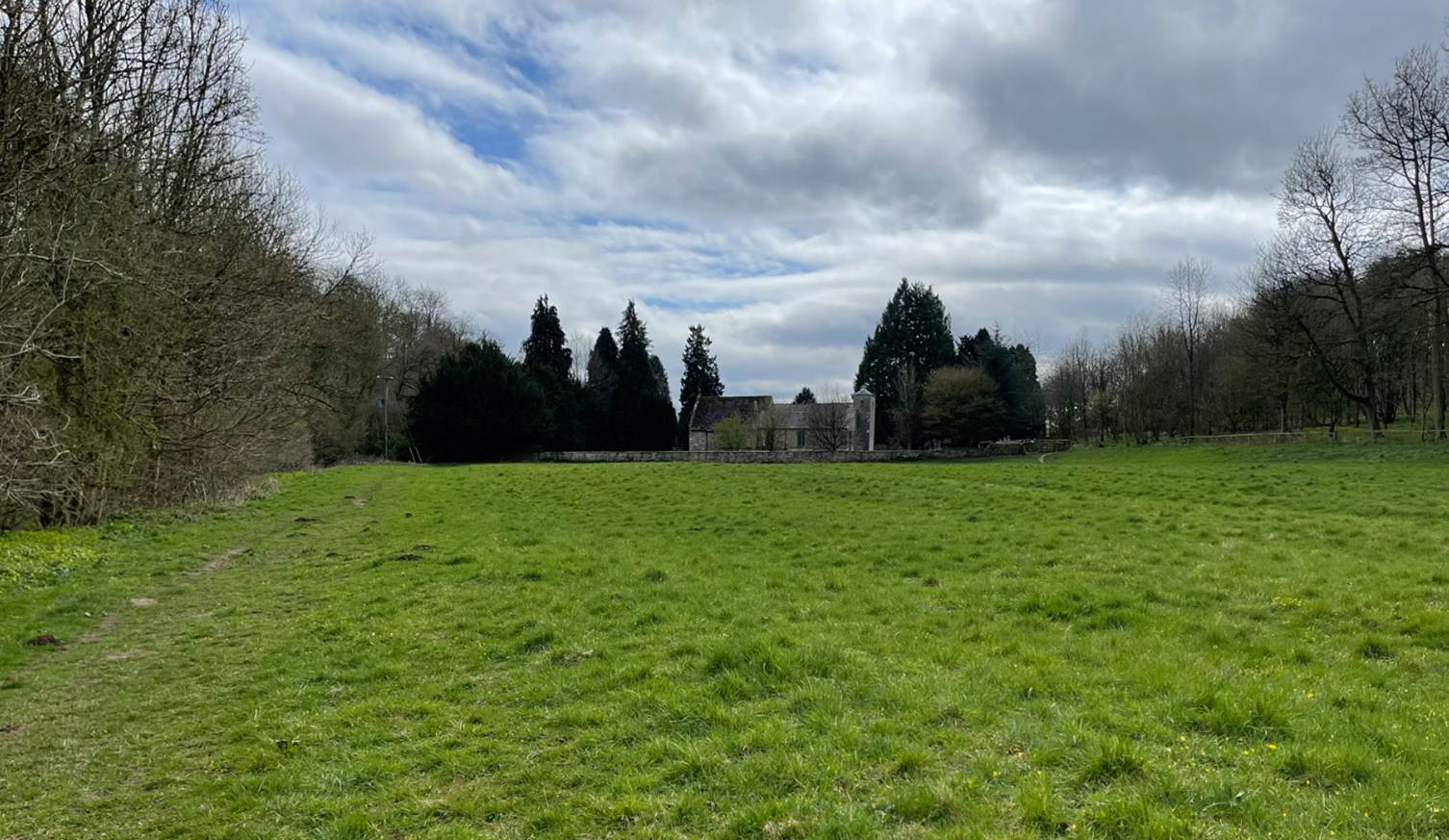
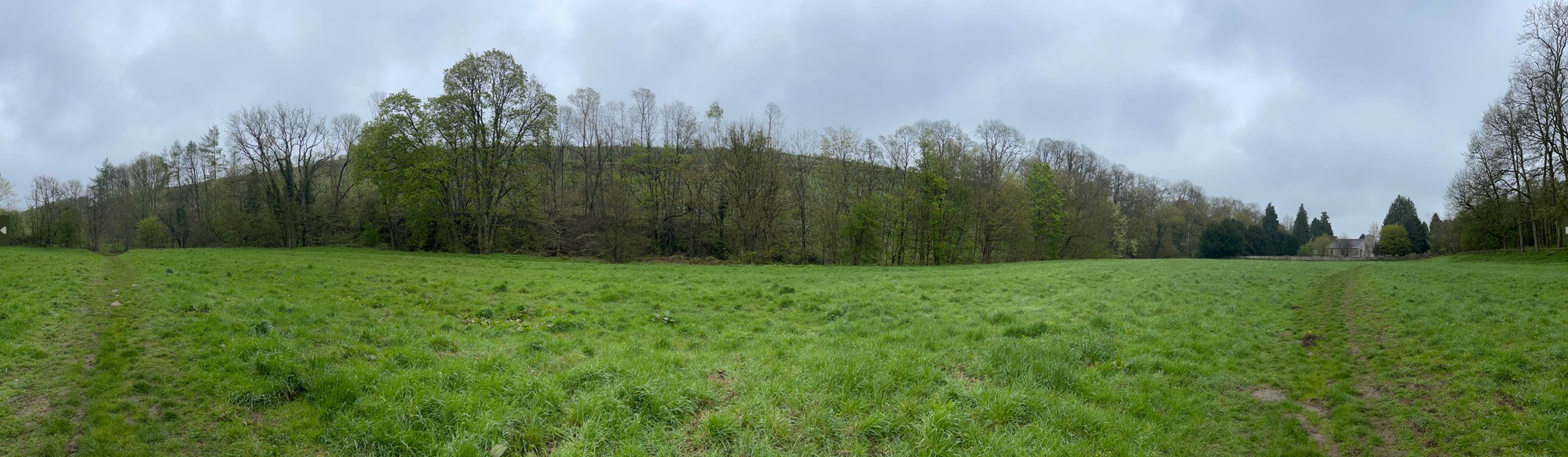
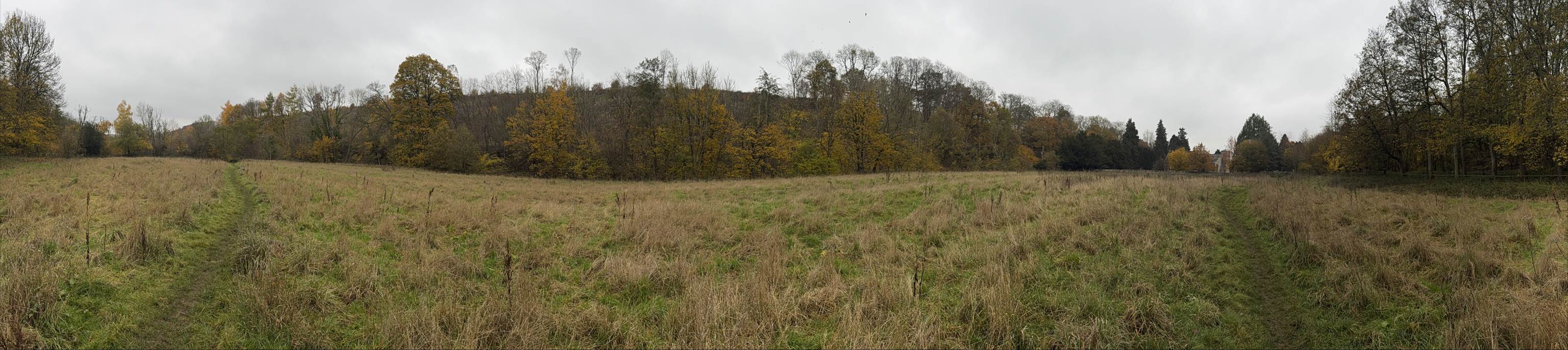
The field
to the immediate north of Kirkdale Church retains prominent earthworks of ridge
and furrow, which suggest that this field was in arable use by the twelfth
century, although we have already noted its arable use long before that.[40]
Sir Herbert Edward
Read[41],
art historian, poet and critic was born at Kirkdale and wrote a poem in his
collection A World within a War:
|
Kirkdale I, Orm, the son of Gamal Found these fractured stones Starting out of the fragrant thicket The river bed was dry |
The rooftrees naked and bleached, Nettles in the nave and aisleways, On the altar an owl’s cast And a feather from a wild dove’s wing |
There was peace in the valley; Far into the eastern sea The foe had gone, leaving death and ruin And a longing for the priest’s solace |
Fast the feather lay Like a sulky jewel in my head Till I knew it had fallen in a holy place Therefore I raised these grey stones up again |
Scene 3 – Regime Change
Harrying
After the
Conquest, Orm Gamalson was stripped of all his lands. The years immediately
following 1066 saw regime change with unparalleled thoroughness.
The English magnates did not immediately
surrender to William, but elected Edgar Ætheling, the son of Edward the Exile
and the last surviving descendant of the House Wessex. William marched north to
London and began a campaign of terror. He secured Dover, parts of Kent, and
Canterbury, and sent a force to capture Winchester, and the royal treasury. Archbishop
Stigand submitted to William at Wallingford on the
Thames, and when the duke moved on to Berkhamsted soon afterwards, Edgar the Ætheling, Morcar, Edwin, and
Ealdred also submitted. William then sent forces into London to construct a
castle.
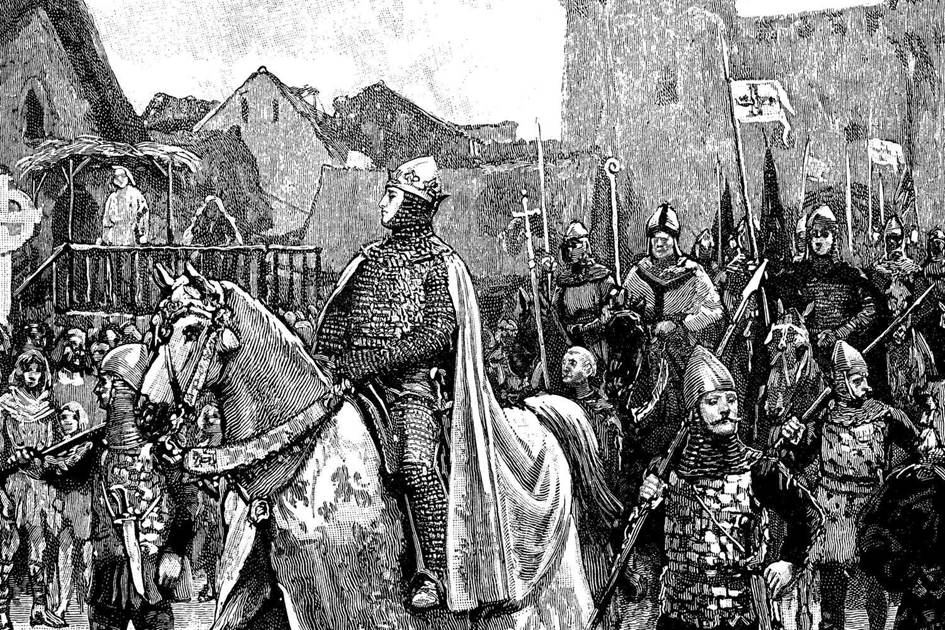
William
was crowned on Christmas Day 1066 at Westminster Abbey.
|
1066 to 1154 Domination from northern France |
|
Regime Change |
|
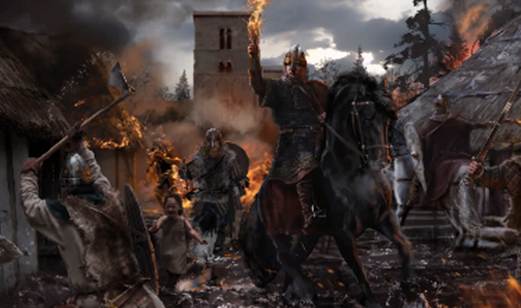
The devastation of Yorkshire and northern England by William the
Conqueror |
|
|
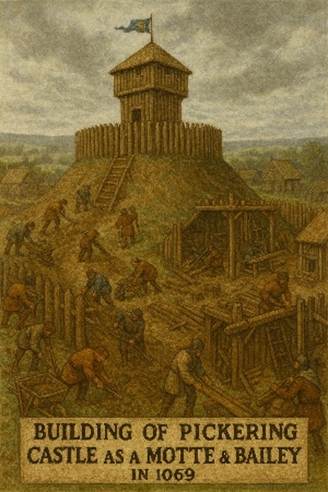
The
Normans brought their castles to England. They built castles far and wide
throughout the land[42].
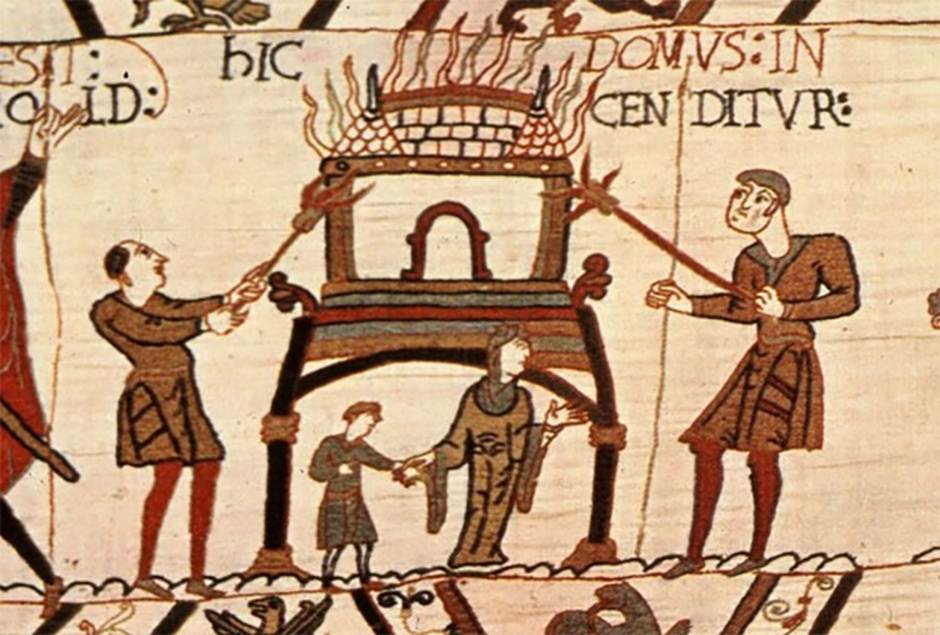
Castles were built wherever Norman barons took ownership of land. Within a
couple of generations there were about 500 castles across the country, to keep
the population in check.
In
1067 there was rebellion in the north led by Merleswain,
Eadwine and Morcar. William led an army to York and the rebels fled into
Scotland. York submitted and the Normans built a castle.
William left 500 men at York under William Malet and Richard FitzRichard.
Early
in 1069, Edgar Ætheling revolted and attacked York.
Although William returned to York and built a second castle, Edgar remained
free. In the autumn Edgar Ætheling joined up with
King Sweyn of Denmark who brought a large fleet to England and attacked York,
Exeter and Shrewsbury. York was captured by the combined
forces of Edgar and Sweyn. Edgar was proclaimed king by his supporters. William
bought off the Danes, retook York and symbolically wore his crown in the ruins
of York on Christmas Day 1069.
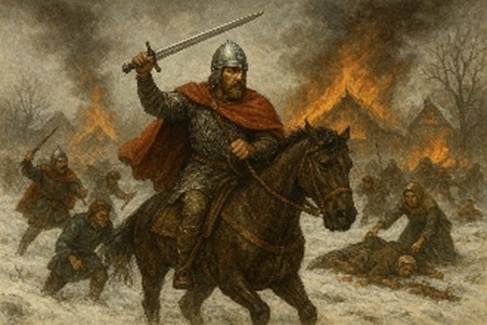
William
then marched to the River Tees, ravaging the countryside as he went. He suppressed
northern England in the Harrying of the
North and started a period of ruthless domination.
One writer described how livestock and carefully harvested crops in every settlement
were brought together and burned, and stated that, as a result, more than
100,000 people perished in the famine. The data in Domesday Book suggests that
the true death toll was probably even higher. A Norman force ravaged
Northallerton. The Harrying continued until about April 1070.
Domesday
The
Kirkbymoorside estate was under the Norman thumb by 1086, which was the date
when the
Domesday Book recorded the extent of Norman domination two decades after
the invasion.
In midwinter
1085, William the Conqueror announced the Domesday Project to his witan.
The King had mickle thought (great thinking) and sooth deep speech
(true and deep conversation) with his Witan about his land, how it were set
and with whilk (which) men[43].
The Great
Survey was made in the course of the first seven months of the year 1086. Commissioners were sent into
every shire, who inquired by the oaths of the men of the hundreds by whom the
land had been held in King Edward’s days, and what it was worth then; by whom
it was held at the time of the Survey, and what it was worth then ; and lastly,
whether its worth could be raised. Nothing was to be
left out.[44] So very narrowly did he let spear it
out, that there was not a hide nor a yard of land, nor further, it is shame to
tell, and it thought him no shame to do, an ox nor a cow nor a swine was left
that was not set in his writ.[45]
As well as
recording comprehensive regime change, the Domesday Book also evidenced the
administrative efficiency of the new overlords. A millennium later, that
efficiency provides us with the tools with which to have eyes on the historical
events of our very distant past. The Domesday Book, written in Latin, recorded
every important place in the country, what was there, who owned it prior to the
conquest, and to whom it was transferred after the Conquest. It established the
taxable values of all the boroughs and manors across the nation. The record was
held in two large books, which are still held by the National Archives[46] and accessible at Domesday Online[47]. The surveyors visited 13,000
villages over the course of about a year. The whole landed property of England
then totalled a value of £37,000, which puts subsequent inflationary increases
into some perspective.
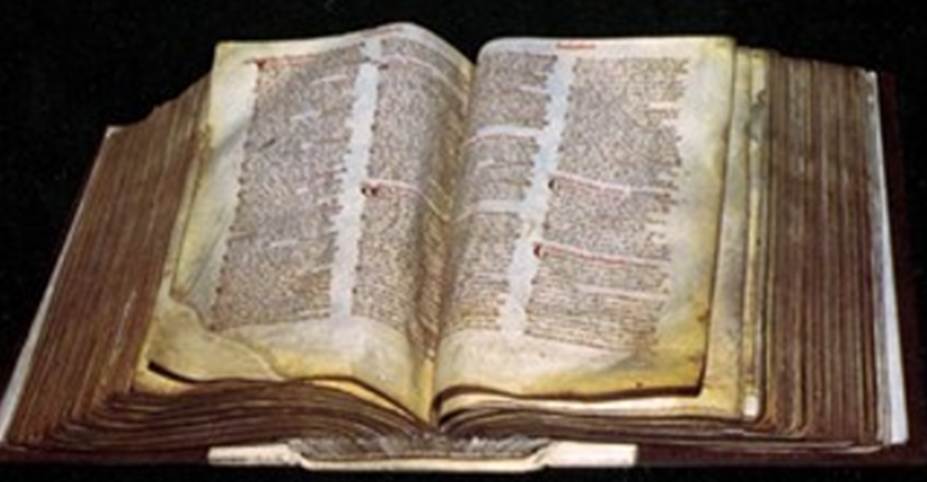
We therefore
know from the Domesday Book, that Chirchebi, of which the Farndale lands
were a part, was in the possession of Orm at the time of the Conquest.
|
The Game of
Thrones and the Estate of Kirkbymoorside The Domesday Book
evidence of the change of ownership in the estate of Chirchebi |
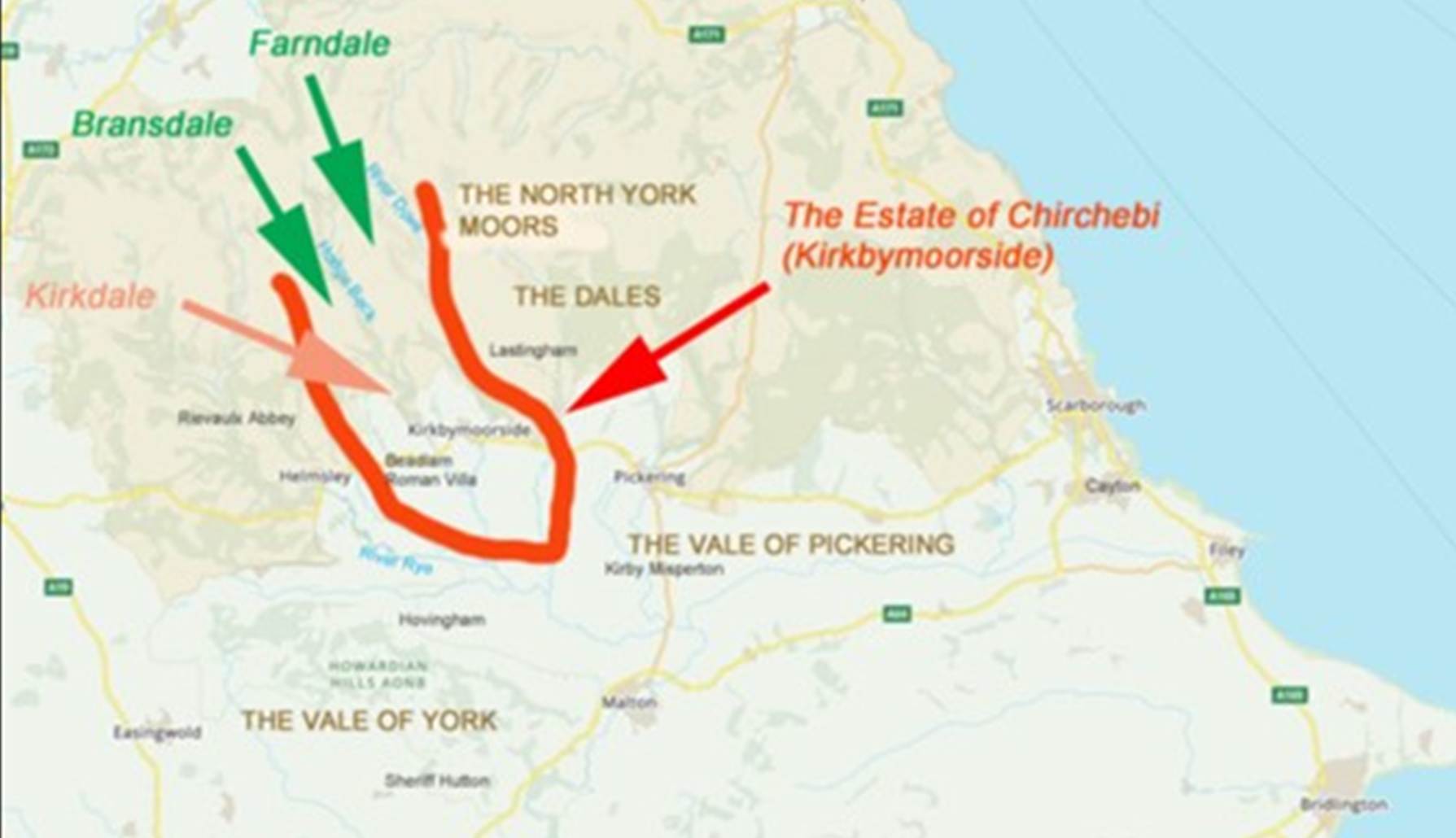
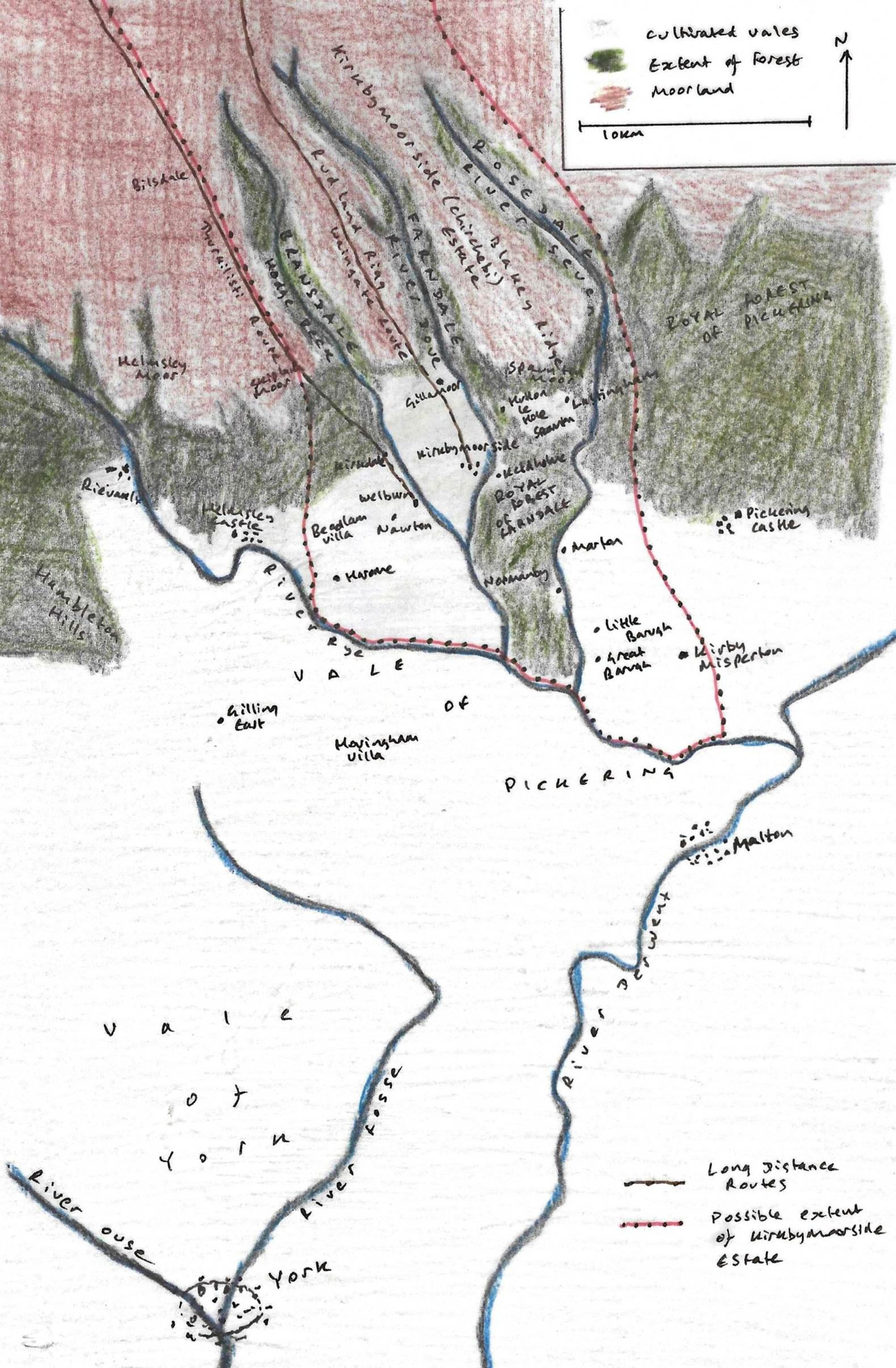
The wider
estate of Chirchebi stretched 12 leagues (about 42 miles) long by 2
leagues (about 7 miles) broad. It included Kirkbymoorside itself, and also the
wider area stretching south to Kirkby Misperton and north to Gillamoor, the
agricultural lands of Orm’s day.
The wider
holding also included cultivated lands at Hutton le Hole and Gillamoor up into
the southerly ends of Bransdale and Farndale, though the extent of
cultivation did not reach into those dales. It included Hoveton
believed to have been around Fadmore, Welburn, Harome, Nawton, Great Barugh,
Normanby, Kirby Misperton, Marton and Little Barugh. So this helps us to
clearly define the area of the likely home of our Farndale ancestors in Roman,
Anglo Saxon, Viking and early Norman times, before Farndale itself was
cultivated.
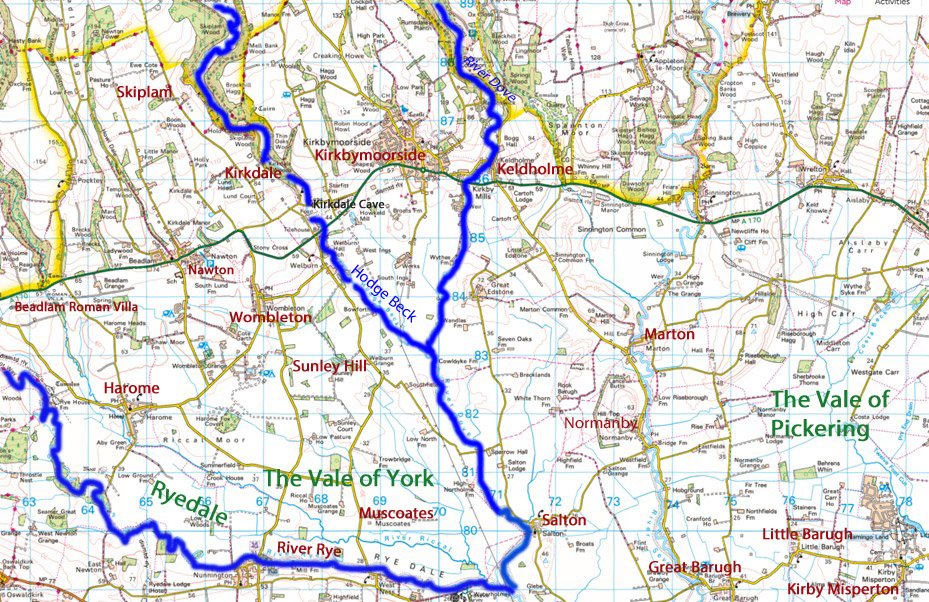
Most of the
northern reaches of this large Norman estate was forested and probably largely
impenetrable, and certainly not settled. It may have been used for hunting.
However the lands to the south in the northwest corner of the Vale of York,
were ancient agricultural lands.
Within the
northern part of the estate, there lay a forested valley, which was then wild
and remote, but which was nestling quietly in those woods, the place which in
time would come to be known as Farndale.
Farndale was little more than a possession, and a place which the owner himself
did not likely know, and which after the Conquest, would continue to be
possessed, transferred, perhaps sometimes hunted within, for another two
centuries.
So our
ancestral home was to become the tactical theatre of two great noble houses
within which to play their political manoeuvres. Our ancestors then must have
been pawns, crushed or saved, at the whims of the noble houses.
Scene 4 – The Games the Noblemen Play
The Noble
Houses
The House
Stuteville 1066 to 1106
After the
Conquest, the estate of Chirchebi was forfeited to Hugh Fitz Baldric,
Hugh, the son of Baldric, a German archer who had
served William the Conqueror and became the Sheriff of the County of York in
1069. When Hugh son of Baldric died in 1086, almost as the ink dried on the
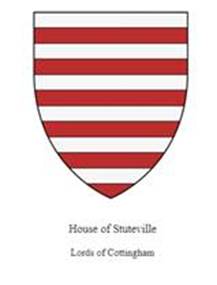
Domesday Book, the estate passed to Robert D'Estoteville or de Stuteville[48]. So in the
game of Norman barons, Kirkbymoorside started in the possession of House Stuteville.
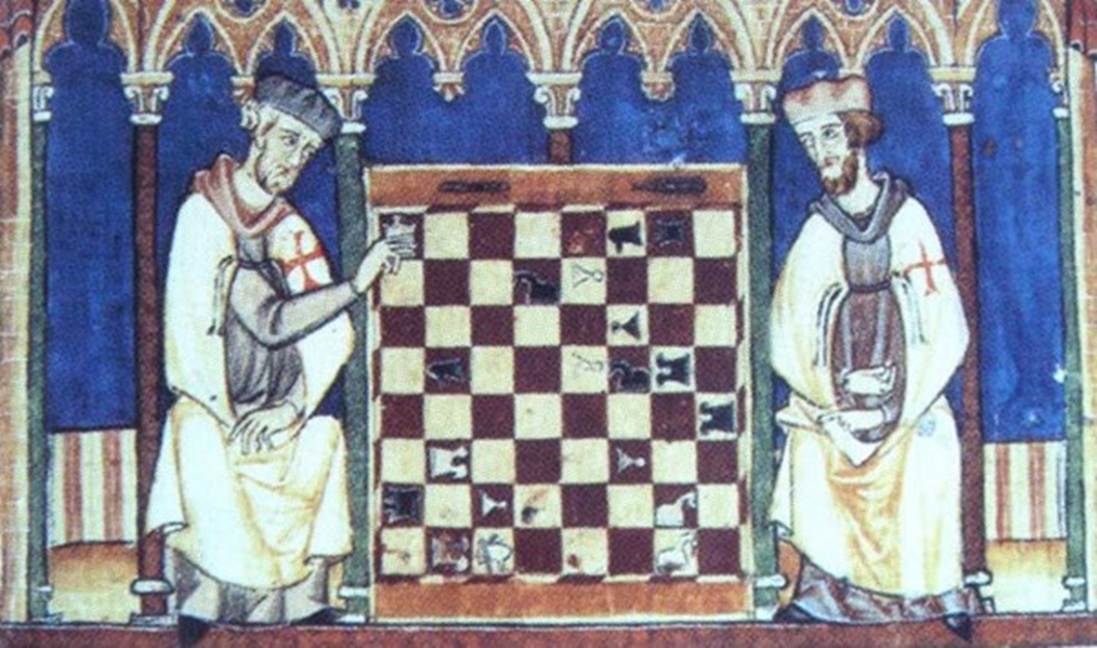
The
Stuteville family built a moated wooden castle on Vivers
Hill behind the church at Kirkbymoorside with commanding views of the town and
beyond. On the east of the church rises the hill on which is the site of the
ancient castle of De Stuteville. Of this ancient Baronial Castle there are now
no traces excepting the deep moat surrounding it. The family which occupied it
were great in their day and great benefactors of the catholic church. The first
which came to England was Robert de Stuteville. Lord of Kirby, he founded the
celebrated Priory for Cistercian Nuns at Keldholme in the reign of Henry I; he
succeeded Eustace Fitzjohn as Lord of Knaresborough in the same reign.[49]
The House
Mowbray 1106 to 1154
However the
turn of the twelfth century was a challenging period for the Norman nobility
obliged to select the right brother to support in the royal clashes between the
Conqueror’s sons. When this period of uncertainty ended with Henry I’s defeat
of his elder brother Robert Curthose in Normandy in 1106, it was Nigel d’Aubigny who emerged as one of Henry’s new men. The
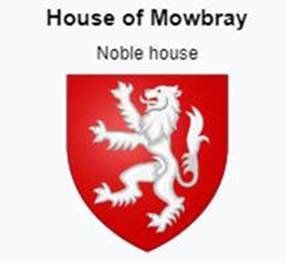
Mowbrays came into possession of Kirkbymoorside. Nigel’s mother was Avice of Montbray in Normandy. He married Gundreda
of Gournay, and they had a son who would become Roger de Mowbray. It was House
Mowbray who took control of Kirkbymoorside as the dust settled. And so our
ancestors came to be pawns to the whims of the House Mowbray.
|
The descendants of Robert de
Stuteville to whom our ancestors owed their allegiance in the eleventh and
then from the late twelfth century |
|
The descendants of Nigel
D’Aubigny to whom our ancestors owed their allegiance in the twelfth century |
|
The Royal Line and the Noble Houses The relationship between the
Royal Dynasties of England and the Noble Houses who directly influenced our
family history |
On Nigel d’Aubigny death in 1129, his son Roger had
become a ward of the Crown. It was Roger’s mother Gundreda,
administering the estate on behalf of her under aged son Roger de Mowbray, who
had made a grant of lands which included Middelhoved
in Farndale to the sons of St Ecclesiff. The exact date of
this grant is unclear from the Rievaulx Chartulary where it is recorded, but it
must have been prior to 1138 when Roger took his majority. On reaching his majority, in 1138,
Roger de Mowbray took title to the lands awarded to his father by Henry I both
in Normandy including Montbray, as well as the
substantial holdings in Yorkshire and around Melton.
The
twelfth century boundaries of Rievaulx suggest that Kirkdale was an island
amidst abbey land[50].
The sub property within the Kirkbymoorside estate to which Kirkdale was clearly
attached, was Welburn[51].
Kirkdale came to be surrounded by the abbey lands of Rievaulx.
The Mowbrays were significant benefactors of
several religious institutions in Yorkshire. In 1154, the name Farndale appeared for the first
time in the Chartulary of Rievaulx Abbey when Roger de Mowbray, gave
land to the abbey, which included Midelhovet and Duvanesthuat
in Farndale. This story is told in Act 1 of the Farndale
Story.
|
The First Reference to Farndale
Rievaulx
Cartulary, 1154 |
|
This history of the Cistercian
monastery of Rievaulx, in whose Chartulary the name Farndale was first
recorded in 1154 |
|
The
breathtaking abbey ruins that must have been held in astonished awe by our
forebears when the abbey broke through the soil of Ryedale, adjacent to
Farndale, in only a couple of decades before it started to take control of
swathes of those lands |
|
A
History of Helmsley to about 1500 |

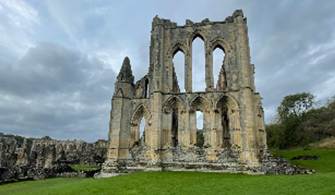
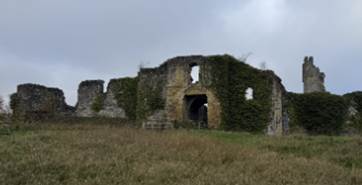
The lands
around Farndale, which Bede had described as
a land of monsters, of wild beasts and men who live like wild beasts,
were finally being tamed.
A period
of transition between House Mowbray and House Stuteville 1154 to about 1200
In that same
year 1154, Robert de Stuteville, grandson of the first Robert de Stuteville,
laid claim to the barony which had been forfeited by his grandfather. Roger
gave him Kirkbymoorside for 10 knights’ fees in satisfaction of his claim. This
arrangement however was not ratified in the King’s courts. This was the start
of a refreshed interest in the Kirkbymoorside lands from the House Stuteville.
|
The Forest of Farndale as a royal forest and
monastic supply base 1128 to 1255
The Crown’s
insistence on a Royal Forest and gifts of clearings in Farndale to monastic
houses |
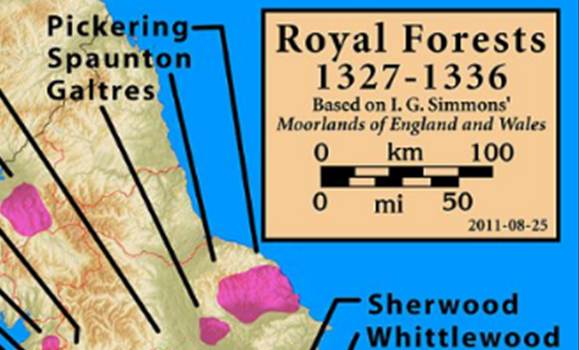
At about the same time Robert gave to
Saint Mary's Abbey in York, who held the nearby Manor of Spaunton,
as much timber and wood as they required together with pasture and pannage of
pigs in Farndale. The records suggest that Farndale was provided primarily as a resource
of timber and pasture in the mid twelfth century, with limited evidence of
settlement.
Roger de Mowbray supported the Revolt of 1173 to 1174
against Henry II and fought with his sons, Nigel and Robert, but they were
defeated at Kirkby Malzeard and Thirsk.
The Stutevilles came back into favour with the accession
of Henry II and Roger de Mowbray was compelled to hand back Kirkbymoorside,
along with many others fees.
Robert III de Stuteville died in 1186.
Since the arrangement of 1154 between
Roger de Mowbray and Robert III de Stuteville had not been not ratified in the
King's courts, the dispute broke out again between William de Stuteville, son
of Robert, and William de Mowbray, grandson of Roger, in 1200. However in time,
William de Mowbray confirmed the previous agreement and gave 9 knights' fees in
augmentum.
Whilst the Mowbrays remained the
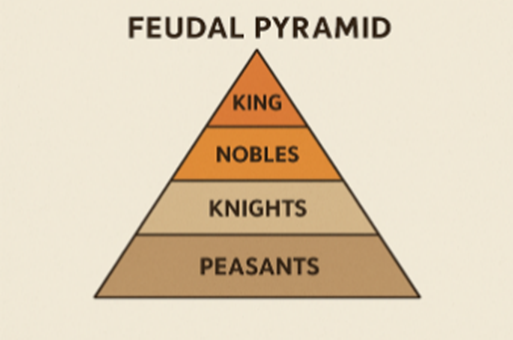
theoretical feudal superiors of Kirkbymoorside, effective control was in the
hands of the Stutevilles after about 1154.
The House Stuteville from 1200
In or about 1209 the Abbot of St.
Mary's obtained from King John rights in the forest of Farndale which the king had recovered from
Nicholas de Stuteville. Keldholme Priory had right of pasture in Bransdale and
Farndale by grant of its founder, Robert de Stuteville.
In 1216, Joan de Stuteville was born,
the heiress of the Stuteville estates. She married Hugh Wake, feudal lord of
Bourne and later Hugh Bigod, Chief Justice of England, but as a widow she
continued to be known as Joan de Stuteville, the Lady of Liddell.
It is during
the time of Joan de Stuteville, that we meet the first settled inhabitants of
Farndale. It was now the Stutevilles who were the overlords of the
Kirkbymoorside estate and therefore of the lands of Farndale during the
following centuries, as our ancestors started to work on the land there.
|
Meet the Medieval
Inhabitants of Farndale We have records of many of the folk who lived in Farndale in the
thirteenth and fourteenth century Here you can meet the whole crowd of the medieval inhabitants of
Farndale |
By the mid
fourteenth century another Joan of Stuteville descent, had inherited the
estate. She married Thomas Holland, made Earl of Kent in 1360, and Joan became
known as the Fair Maid of Kent.
Later Joan married Edward the Black Prince and their son was Richard II.
You could
now remind yourself of Act 1 – the Cradle,
which tells of our family’s settlement in Farndale or you could go straight to Act 7 – the Poachers of
Pickering Forest, to pick up the story with the second generation of
known ancestors.
|
Our Own Game of Thrones Podcast This
is a new experiment. Using Google’s Notebook LM, listen to an AI powered
podcast summarising this page. This should only be treated as an
introduction, and the AI generation sometimes gets the nuance a bit wrong
(for instance there are aspects of the relationship between the Stutevilles
and the Mowbrays that are more accurately to be found in the text and links
below). However it does provide an introduction to the themes of this page,
which are dealt with in more depth below. |
|