The Feudal System
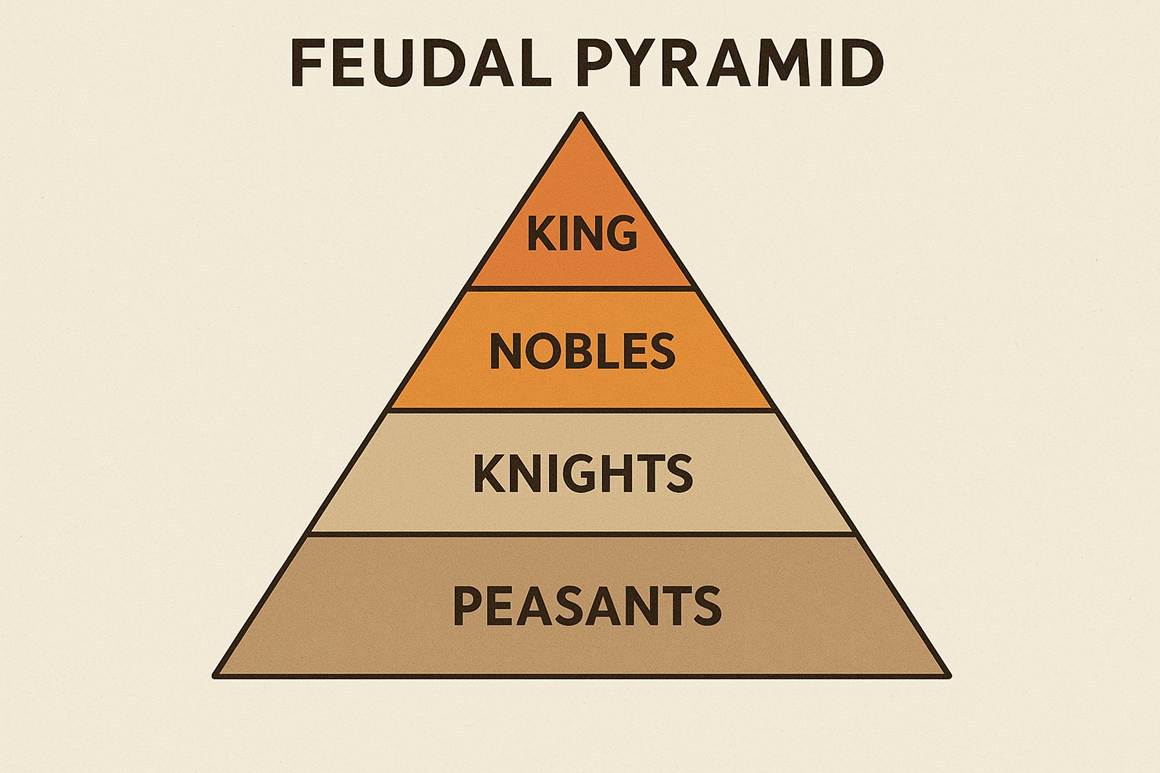
An Overview of the Feudal System in Medieval Times
|
Return to the Home Page of the Farndale Family
Website |
The story of one family’s journey through two
thousand years of British History |
The 83 family lines into which the family is divided.
Meet the whole family and how the wider family is related |
Members of the historical family ordered by date of
birth |
Links to other pages with historical research and
related material |
The story of the Bakers of Highfields, the Chapmans,
and other related families |
Introduction
Dates are in red.
Hyperlinks to
other pages are in dark
blue.
Headlines are in brown.
References and
citations are in turquoise.
Contextual
history is in purple.
Pyramidal structure of land
ownership
In the Feudal System all land was considered to be owned by the
Crown and sub-let to the Barons and through them to their knights and tenants.
Similarly the Crown had Rights to charge the Barons arbitrary
amounts and Fines, which seem to have been based purely on the King’s financial
requirements at the time.
Barons, like the de Brus, Stutevilles or Mowbrays had to pay a
large sum on their succession, at which time they had to swear “fealty” to the
monarch. They had to serve in the King’s forces or pay a fine instead –
“scutage” etc.
The Barons in turn had to find what amounted to Royal Taxes by
making similar charges of their knights and tenants in the form of Rent and
various fines and charges in their own local Courts and Markets etc.
There was clearly much scope for abuse and consequent grievance by
those who had to pay which at times led to open revolt.
The lives of the serfs
Villagers lives were controlled by the Lord of the Manor. They
could not leave. They had unfenced strips of land to feed their families, but
had to work the Lord’s demesne on certain days.
They had to pay the Church a tenth of their meagre produce. They
had to pay the Lord a fine to marry – the “merchet”. In some parts the Lord
even had the droit de seigneur, a right to be
the first to have sex with the young brides of their tenants.
On the peasant’s death the Lord had the right (the heriot)
to take the family’s best beast.
Justice was usually the law of the strongest.
Hunting and hawking were the preserve of the Lord. The villager,
living in a wooden shed with an earthen floor and his cow and pig living
alongside, went after rabbits and any kind of bird.
Later Restrictions
The Act of Settlement 1662 attempted
to prevent anyone from settling elsewhere than their place of birth. Privileged
people were excepted. It was intended mainly to prevent paupers moving to be
maintained by a Parish other than their own, as each Parish had to collect a
Poor Rate to maintain their own. Removal orders were made returning people to
their own Parish right up to the 1840s and the start of the Workhouse. Money
was sent from one Parish to another to pay for the upkeep and funerals etc of
paupers and chasing maintenance for bastards.
To help raise over a million pounds for the Royal Household a
Hearth Tax was imposed in 1662, whereby each household was compelled to pay 2
shillings per annum for every fireplace that they owned.