Hovingham
A Roman Villa on palatial scale

A
palatial villa
Hovingham
was a significant Roman villa, perhaps on a palatial scale, nearly 10km
southwest from Kirkdale,
and it could have had very extensive holdings, which may have embraced a wider
estate including Beadlam and Kirkdale.
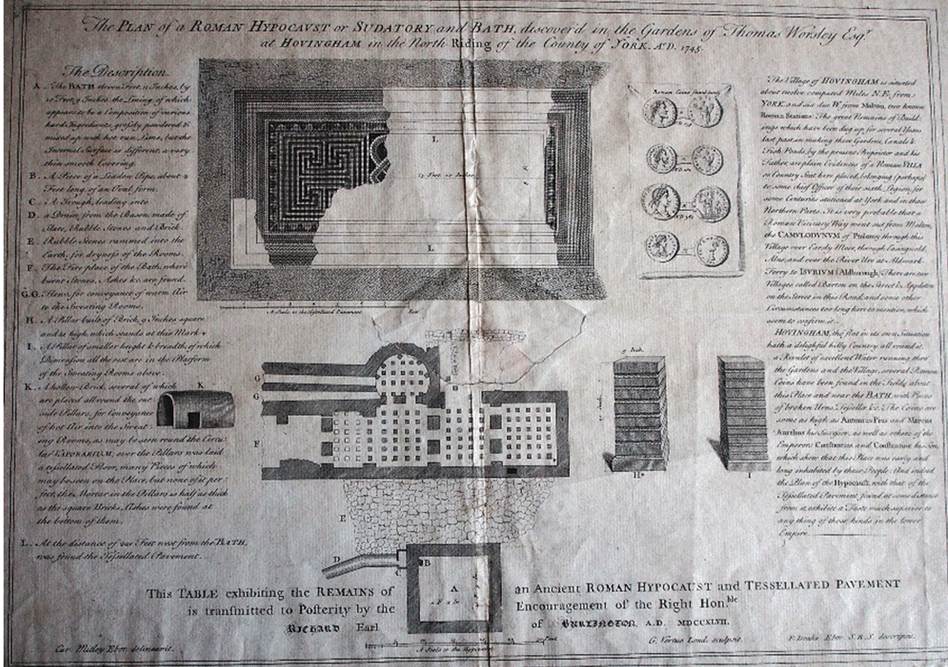
This is a place of some antiquity, standing on the old Roman road or street, as indicated by the names of its adjoining villages, Appleton-le-Street and Barton-le-Street. Traces of its existence in Roman times were found during the formation of the Hall gardens in 1745, when a Roman bath and tesselated pavement were unearthed[1].
It was
probably on the Roman Road from Isvrivm Brigantvm
(Aldborough) to Derventio Brigantvm (Malton). The road starts at Malton and follows approximately the
present B1257 Malton-Helmsley road as far as
Hovingham. The road deliberately avoids the tumulus outside Hovingham which is
reputed to be Roman. The metalling of the old road is visible as scattered
stone in the adjacent field between Barton-le-Street and Hovingham. Somewhere
near the villa at Hovingham it ceases to follow the present road and probably
turned in a south-westerly direction passing the villa site and following the
Hovingham-Coulton road.
During the
construction of ornamental gardens, streams and fish-ponds
at Hovingham Hall in 1745 the remains of a Roman bath-suite were found complete
with hypocausts[2]. To the west of this structure
another building was excavated comprising a mosaic floor and, a Ground
Penetrating Radar survey has identified a further rectangular building, 45
metres by 23 metres.
The
remarkable Ryedale
Ritual Bronzes, comprising a bust,
horses head, plumb bob and horse and rider might have been associated with
Hovingham.
Oswiu’s
monastic endowment
In
consequence of his victory over the Mercian Penda in 656 CE, and the birth of
his daughter, Oswiu offered twelve small estates of ten hides each for the
foundation of monasteries, six in Bernicia and six in Deira, an attempt to join
two people into a single kingdom. The Deiran monasteries were generally focused
around Ryedale and the Vale of Pickering[3]. Those monastic sites probably included
Hovingham.
In the
parish Church of All Saints in Hovingham, a carved stone slab from a tomb
shrine was built into the 11th century tower and small scale
excavation within the interior revealed the length of construction trench and
two courses of stone building which the excavator speculatively interpreted as a
small two cell structure of nave and chancel. The charcoal sample from the fillings
of the foundation trench has a calibrated radiocarbon date of 610 to 890,
calculated at the 95% probability level.[4] Its Roman past supports the theory.
Hovingham is
one of a number of sites where the evidence of
sculpture suggests an early Anglian monastery … with its slab of sculpted
figures, as well as other early carved fragments. The place name is intriguing.
Usually thought to refer to an otherwise unknown Hofa, the Hov- element could
equally derive from the Old English word for temple (Hof), or perhaps
‘dwelling’, ‘house’, or ‘court’ as in Beowulf
(I, 1507), This last reading may be supported by the fact that a major Roman
villa, perhaps associated with the commanders of the garrison at Malton, to
which it was attached by a Roman road, underlies the site. Had some memory of
the Roman palace survived? Was it indeed the centre of a great estate out of
which the monastic world of the Vale of Pickering was cut?[5]
Hovingham
is the site of one of the finest pieces of Anglo Saxon
sculpture and was probably a rich and sophisticated monastery[6].
Its name may derive from an unknown Hofa, but
may also derive from the Old English
Hof meaning temple or sometime court. It is possible that Hovingham, a
central place under the Romans, continued to be a central place under the
Northumbrian kings of the seventh century, or even a royal court[7].
An 18th century
chance discovery of the partial remains of an opulent Roman villa site at
Hovingham have drawn Dominic Powlesland’s attention to the site, which has
yielded a number of Anglian sculptures, including
crosses. The place name might derive from an Anglian tribe name, the Hofingas; or from hof, a small
hill. But Victor Watts has also raised the possibility that it derives from old
English hof meaning an enclosure, a temple or house,
with the implication of a royal centre. Hovingham lies 11 kilometres West of
Malton along the Roman road that hugs the north facing edge of the Howardian
Hills overlooking Ryedale, a perfectly suitable site for an early medieval
royal vill on a circuit that extended into Ryedale,
where later church territories perhaps map the itinerary.[8]
Anglo-Saxon
estate
In the Doomsday
survey of 1086, Hovingham held demesne lands in dependent vills,
from Grimston in the west to Swinton in the east, suggesting that this estate
represents the former large royal territory named from the people of one Hofer,
which itself probably emerged out of an estate of the Roman era. Pastoral care
for its people came from Hovingham. Within the territory, the monastery of Gilling
had a close familial bonding with the centre, and Stonegrave
had a church presence by the 9th century, if not before, both eventually became
centres of parishes.[9]
or
Go Straight to Chapter 5 – Roman Kirkdale
Or read
about Eboracum (Roman York), the
nearby villa of Beadlam, or the
regional capital of Isurium
Brigantum.