Kirkdale and its Minster
An Introduction
This page is an introduction to
Kirkdale, the heart of our family’s original ancestral home
|
Return to the Home Page of the Farndale Family
Website |
The story of one family’s journey through two
thousand years of British History |
The 83 family lines into which the family is
divided. Meet the whole family and how the wider family is related |
Members of the historical family ordered by date
of birth |
Links to other pages with historical research
and related material |
The story of the Bakers of Highfields, the
Chapmans, and other related families |
Hyperlinks to other pages are in dark blue.
Headlines are in brown.
References and citations are in turquoise.
Context and local history are in purple.
The history of Kirkdale is told
across six webpages.
· The Kirkdale
Anglo Saxon artefacts
· Anglo-Saxon Scandinavian Kirkdale
The Wonder of
Kirkdale
The seventh
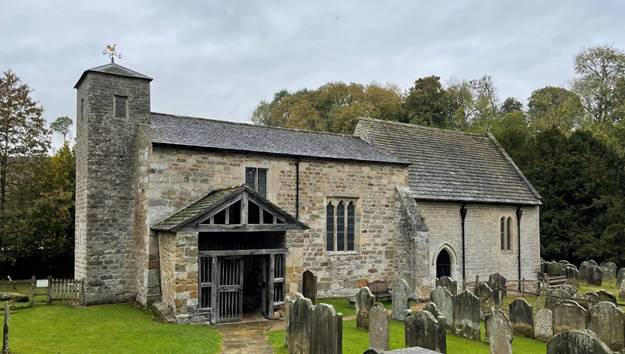
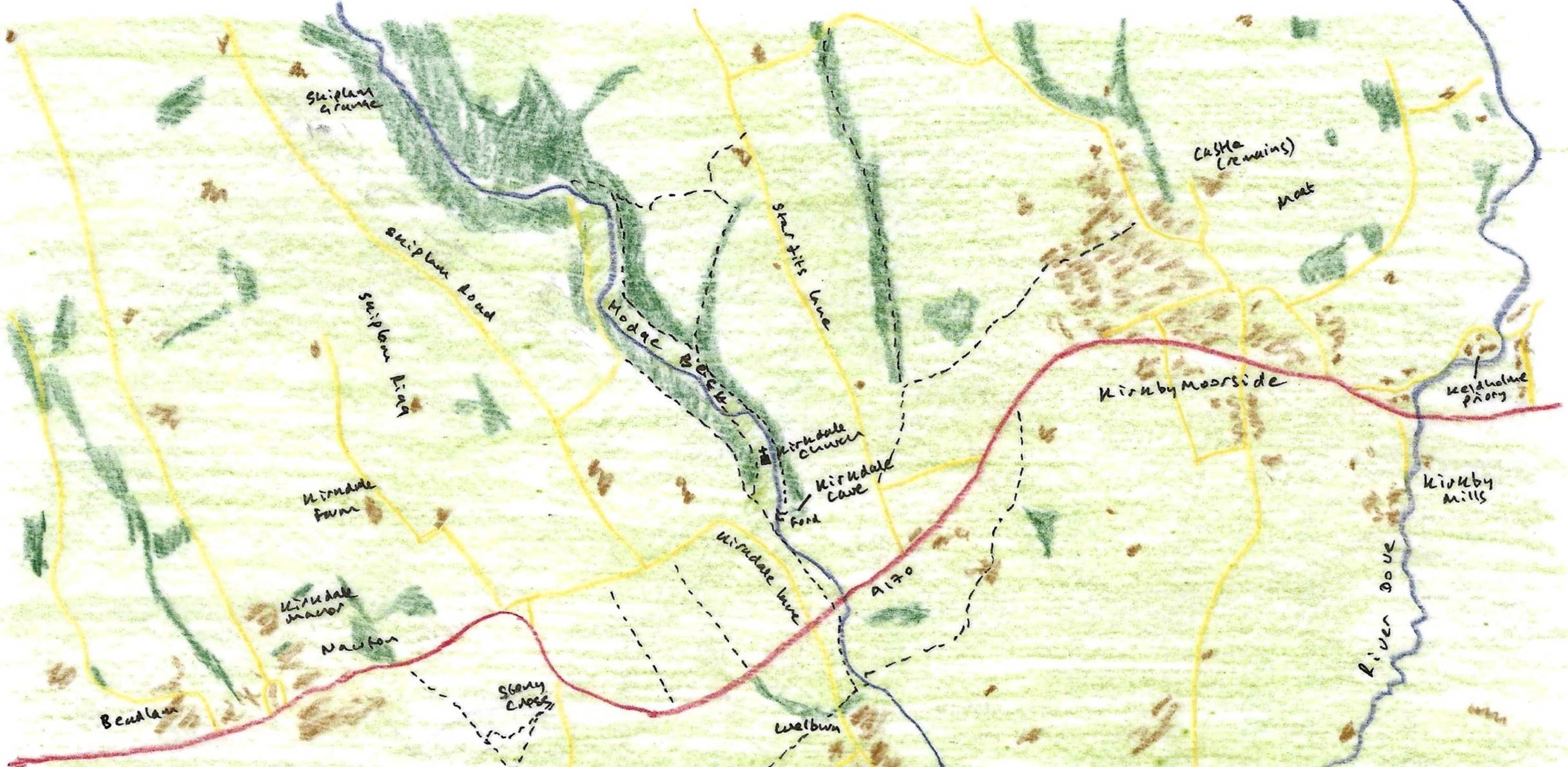
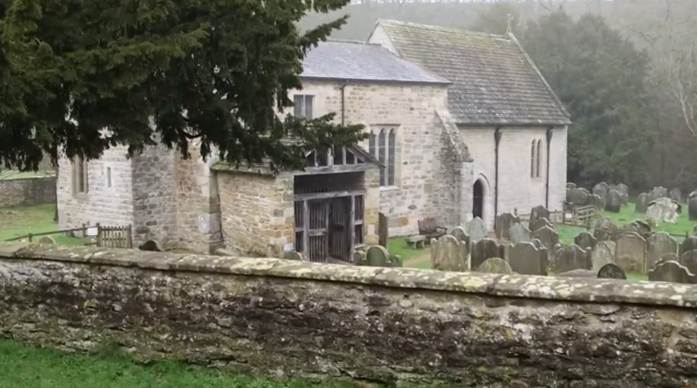
century Anglo-Saxon Church of Kirkdale is an exquisite historical jewel which lies
about a mile west of Kirkbymoorside, south of the North York Moors. It sits
beside the Hodge Beck which runs from the moors through Bransdale. Within the
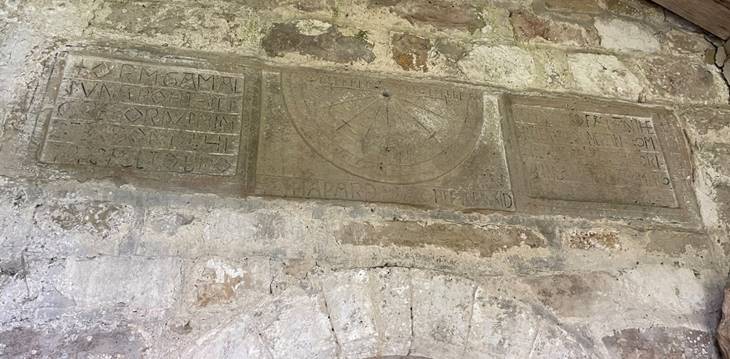
porch at the entrance door is housed a Yorkshire treasure. It is a Saxon sundial, and it bears the
following inscription: Orm the son of Gamal acquired St Gregory’s Minster
when it was completely ruined and collapsed, and he had it built anew from the
ground to Christ and to St Gregory in the days of King Edward and in the days
of Earl Tostig.
The sundial
itself bears the inscription This is the day’s sun circle at each hour
and then Hawarth made me: and Brand (was)
the priest.
One would
look far before finding a place which surpasses Kirkdale for the combination of
beauty of setting with historic and architectural interest. Situated in that
belt of limestone which separates Ryedale from the North Yorkshire Moors,
through which the streams have scoured narrow valleys, Kirkdale can scarcely be
seen from any direction until one is close at hand. The Hodge Beck, rising
above Bransdale, flows southward through a wooded gorge and then, just below
the old mill at Hold Caldron, it enters a subterranean channel, leaving a
surface bed to carry the flood water after heavy rain. The Beck rises again at
the spring at Howkeld and eventually rejoins the
surface bed near Welburn Hall. At Kirkdale a ford crosses the bed of the
stream; normally dry, in time of flood it can be covered by up to three feet of
water. (St Gregory’s
Minster, Kirkdale,
Arthur Penn, Parochial Church Council).
To the student of antiquity, and the lover of
nature, this secluded spot will alike prove a welcome resort. The woods clad in
leafy verdure rise abruptly on each side the valley, at the south end of which
stands the quaint old church; no dwelling strikes the eye, no sound the ear,
excepting when the swollen waters fill the otherwise dry bed of the stream
beneath the walls of the church-yard, which like all others of this immediate
district, runs underground for some distance, this one disappearing a mile above
the church at Hold Caldron Mill, to rise again a short distance south of
Kirkdale. (Ryedale and North Yorkshire antiquities, George Frank, 1888, page
135).
Much of the
existing church is late Anglo-Saxon-Scandinavian, dating from its rebuilding in
about 1055. Within the church are the remains of grave slabs and crosses of
an earlier period.
Etymology
Kirkdale
is variously applied to the church of St Gregory’s Minster, to the lower part
of the valley, and later to the parish (St Gregory’s Minster, Kirkdale, North Yorkshire,
Archaeological Investigations and Historical Context, Philip Rahtz and Lorna Watts, 2021, 1).
Kirk
is an Anglo Saxon place name which is usually associated with a pre existing church. Kirk indicates the existence of
a church prior to the ninth century. It has been suggested that the churches at
Kirkdale and Kirkbymoorside might have formerly belonged to the monastic estate
of Lastingham.
The
word dale comes from the Old English word dæl,
from which the word dell is also derived. It is also related to Old
Norse word dalr and the modern Icelandic word dalur, which may perhaps have influenced its
survival in northern England. The Germanic origin is assumed to be dala-. Dal- in various combinations is common
in placenames in Norway. It is used most frequently in the north of England and
the southern uplands of Scotland.
Vale,
from the modern English valley and French vallée
are not related to dale. The word Vale is generally used to describe
wide plain like valleys, such as the Vales of Pickering, Mowbray and York.
The
reference to Kirkdale minster on the sundial is likely the English
equivalent of monasterium, which was not an
association with later monasticism, but to more varied types of religious
establishment. So minster does not particularise the religious purpose
of the original building. It doesn’t mean that it was a monastery, nor a
minster in the modern sense.
When
the Anglo-Saxons had begun to convert to Christianity in the seventh century,
they had used to word ‘minster’ to describe a wide variety of different
religious communities. Some, like those founded by St Wilfred, had proudly
proclaimed their adherence to the Benedictine Rule, and in these houses the
monks lived celibate and secluded lives, submitting themselves to a limited
diet and a routine of prayer, study and contemplation. But although this was
the ideal for some, it was in no sense the norm. Most abbots and abbesses
simply invented their own rules, and often took a more relaxed attitude to
earthly luxuries. Even in institutions where high standards of abstinence and
devotion were observed, it was seldom the case that the entire community was
monastic. Even famous minsters usually contained both celibates and secular
priests. Early English monasticism had always been a very mixed bag.
(The
Anglo Saxons, A History of the Beginnings of England,
Marc Morris, 2021, page 280 to 281).
Orientation
Maps
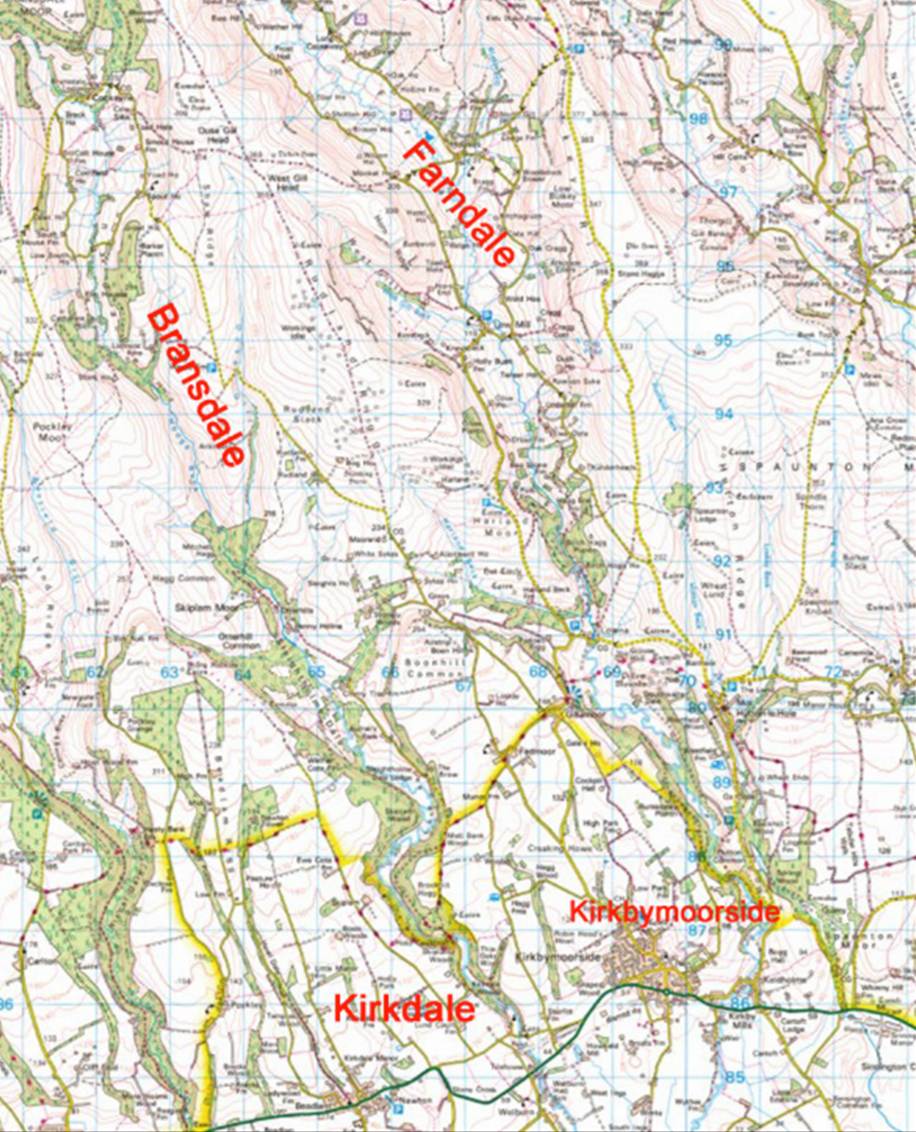
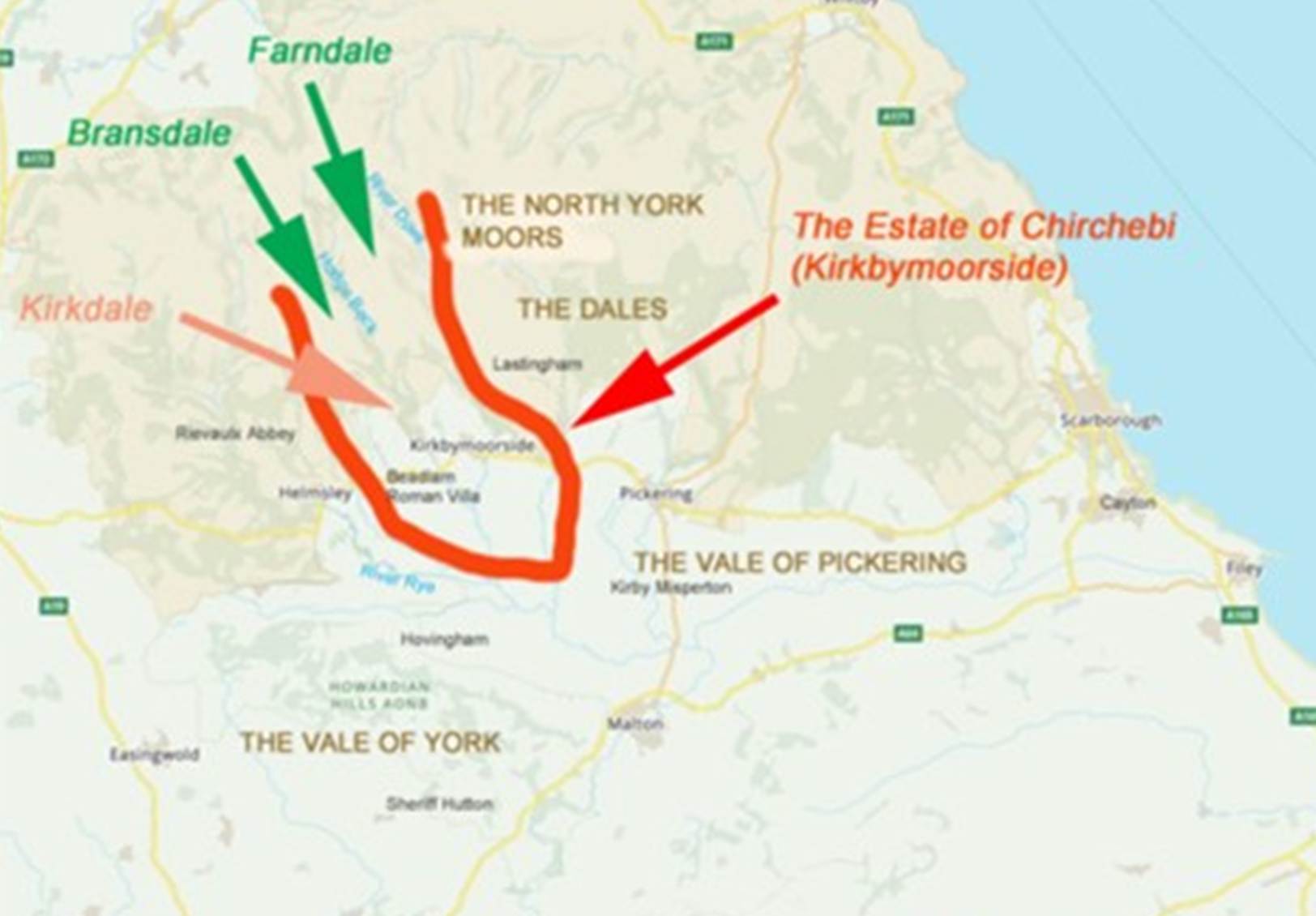
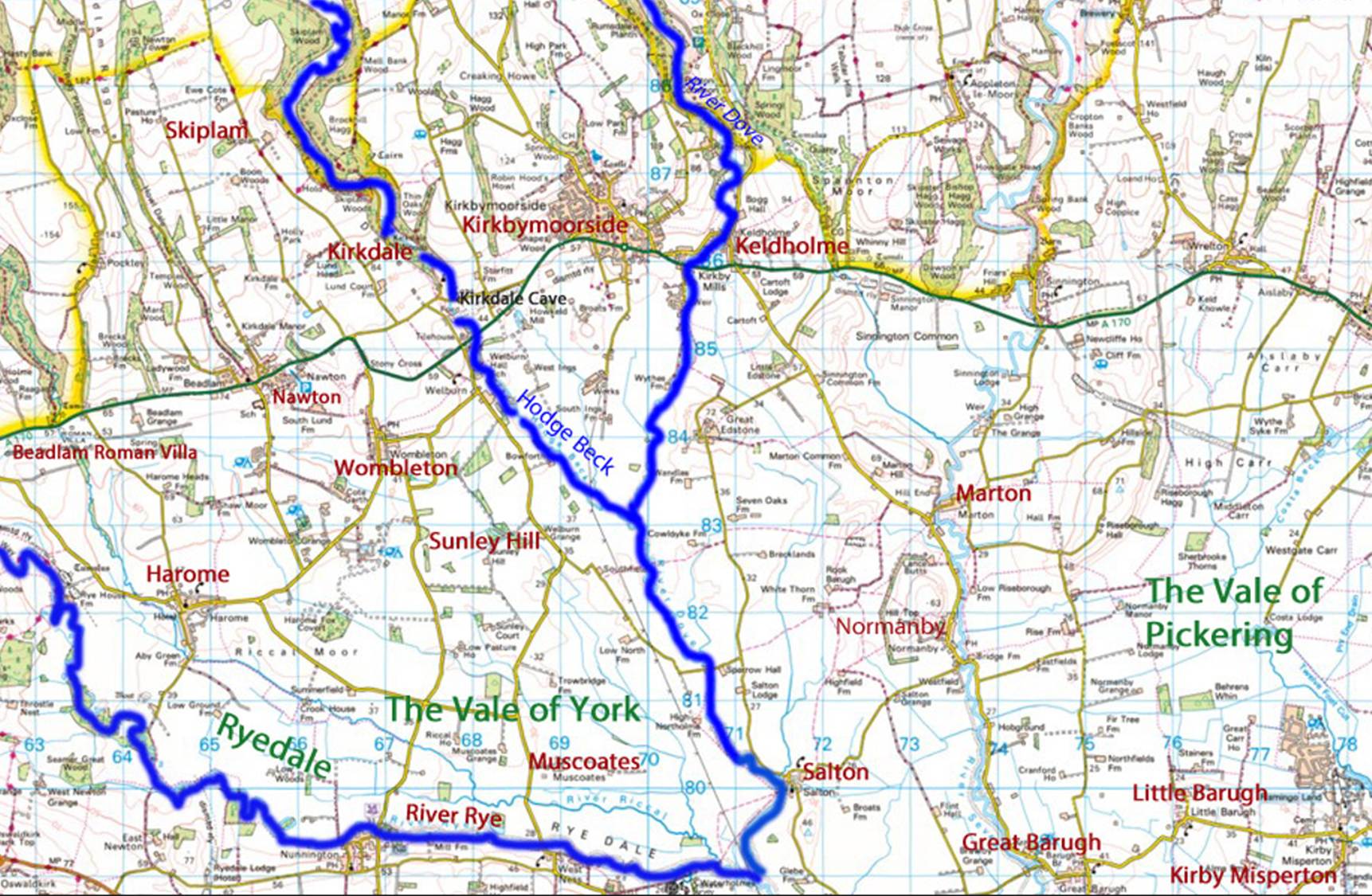
Maps
showing relationship of Kirkdale to Farndale and the lands of the Chirchebi Estate
The lands of Kirkdale
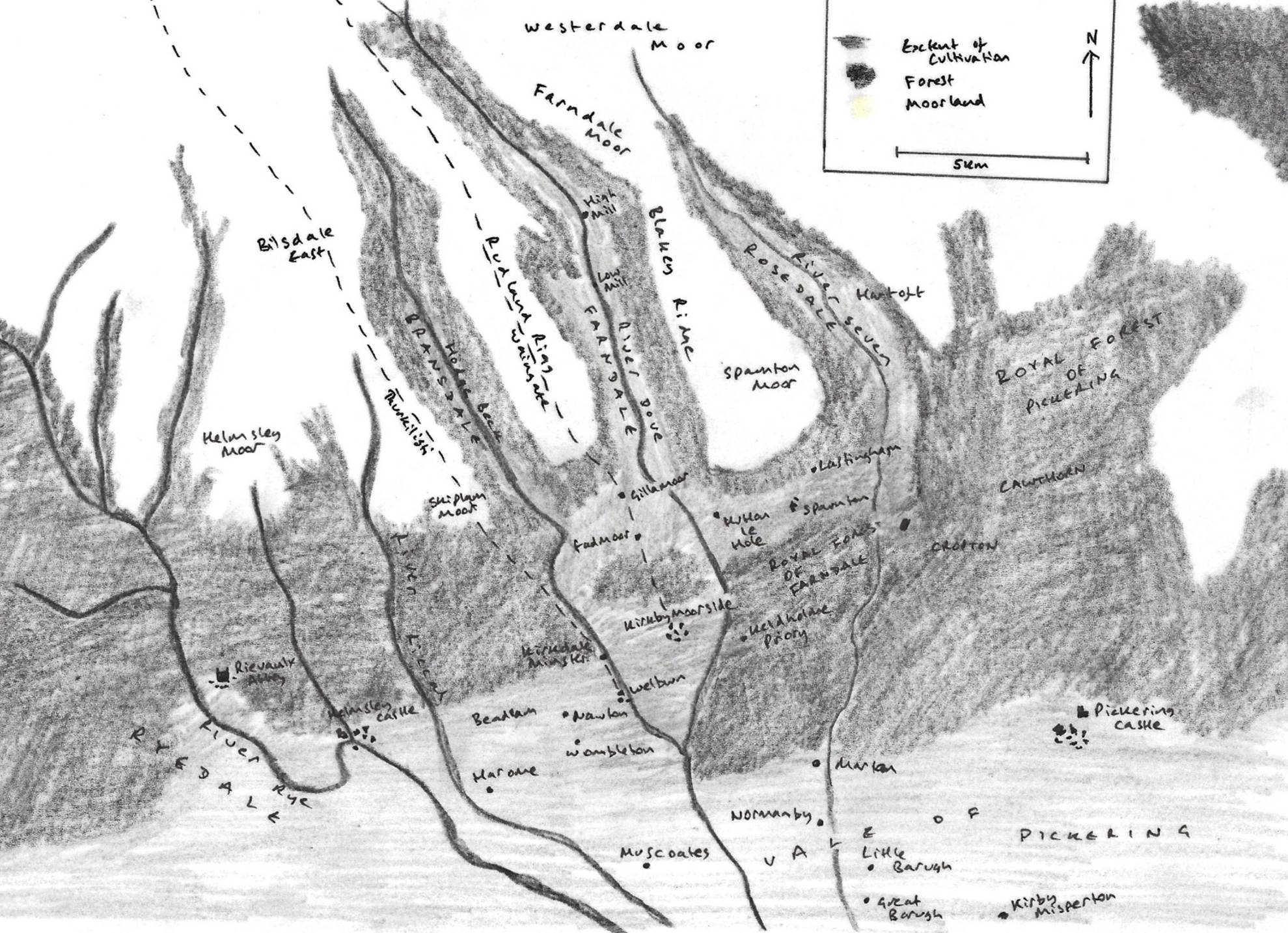
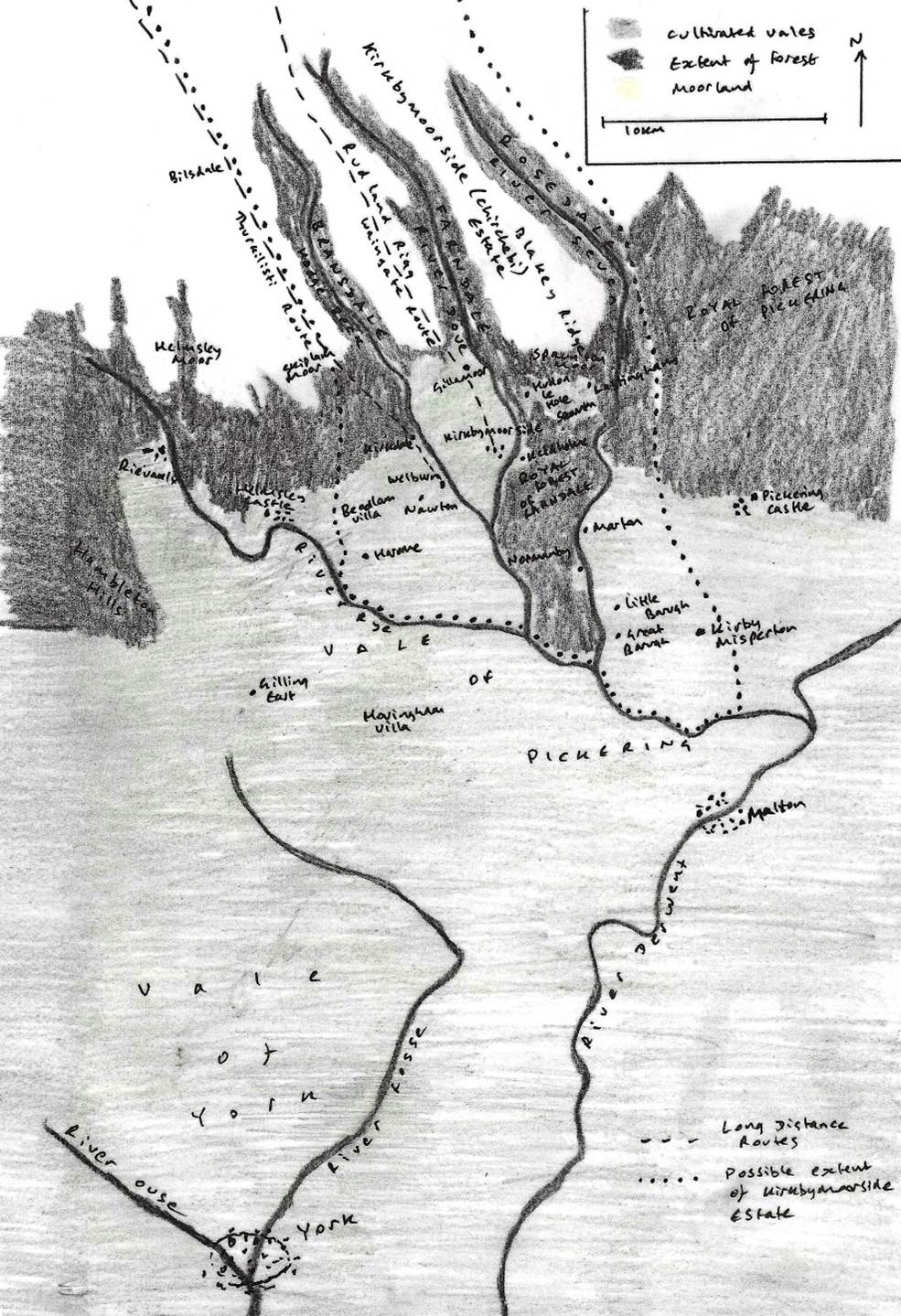
Kirkdale and the ancient Thurkilisti route which crossed the
moors to Cleveland The boundaries of
the Kirkbymoorside estate
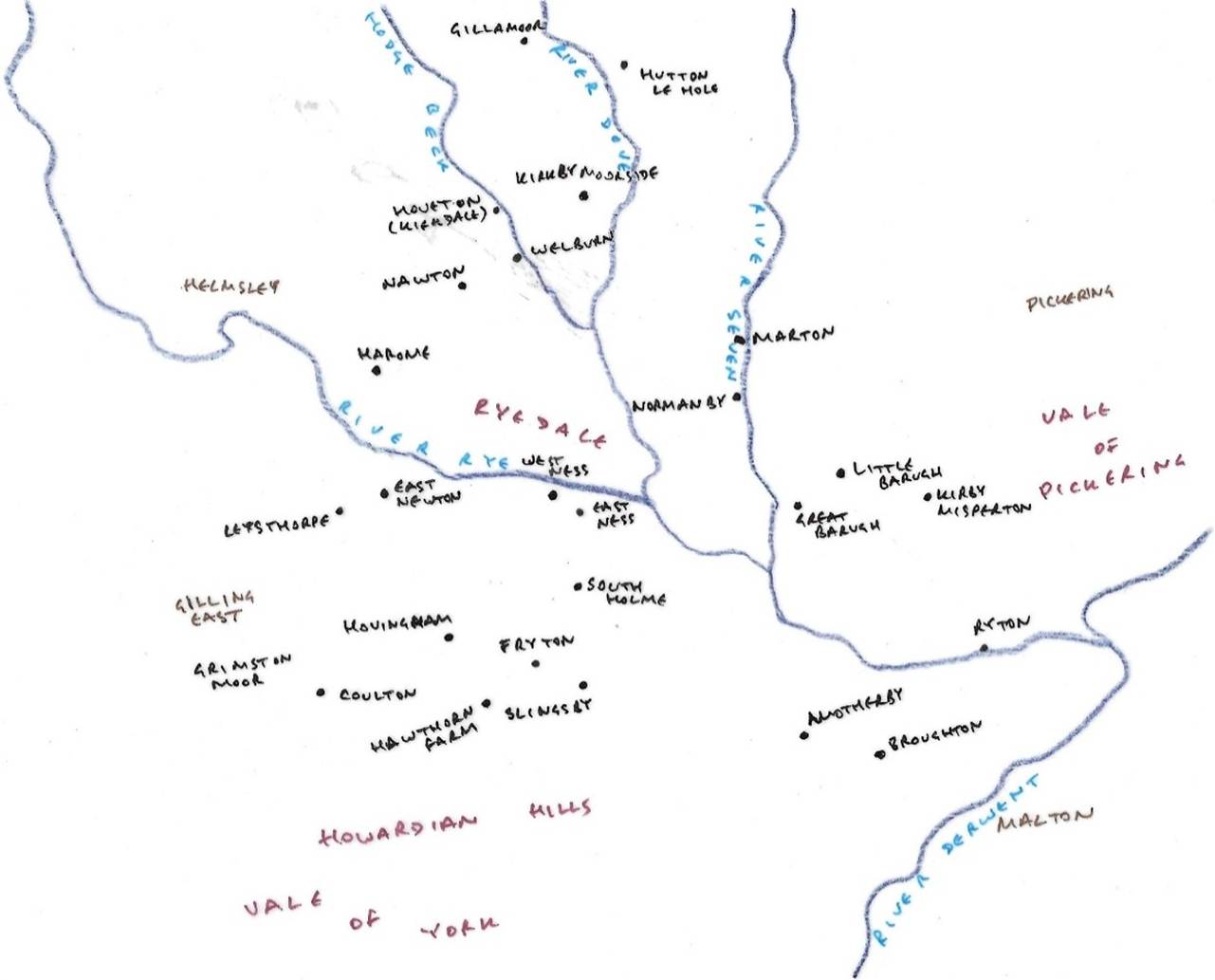
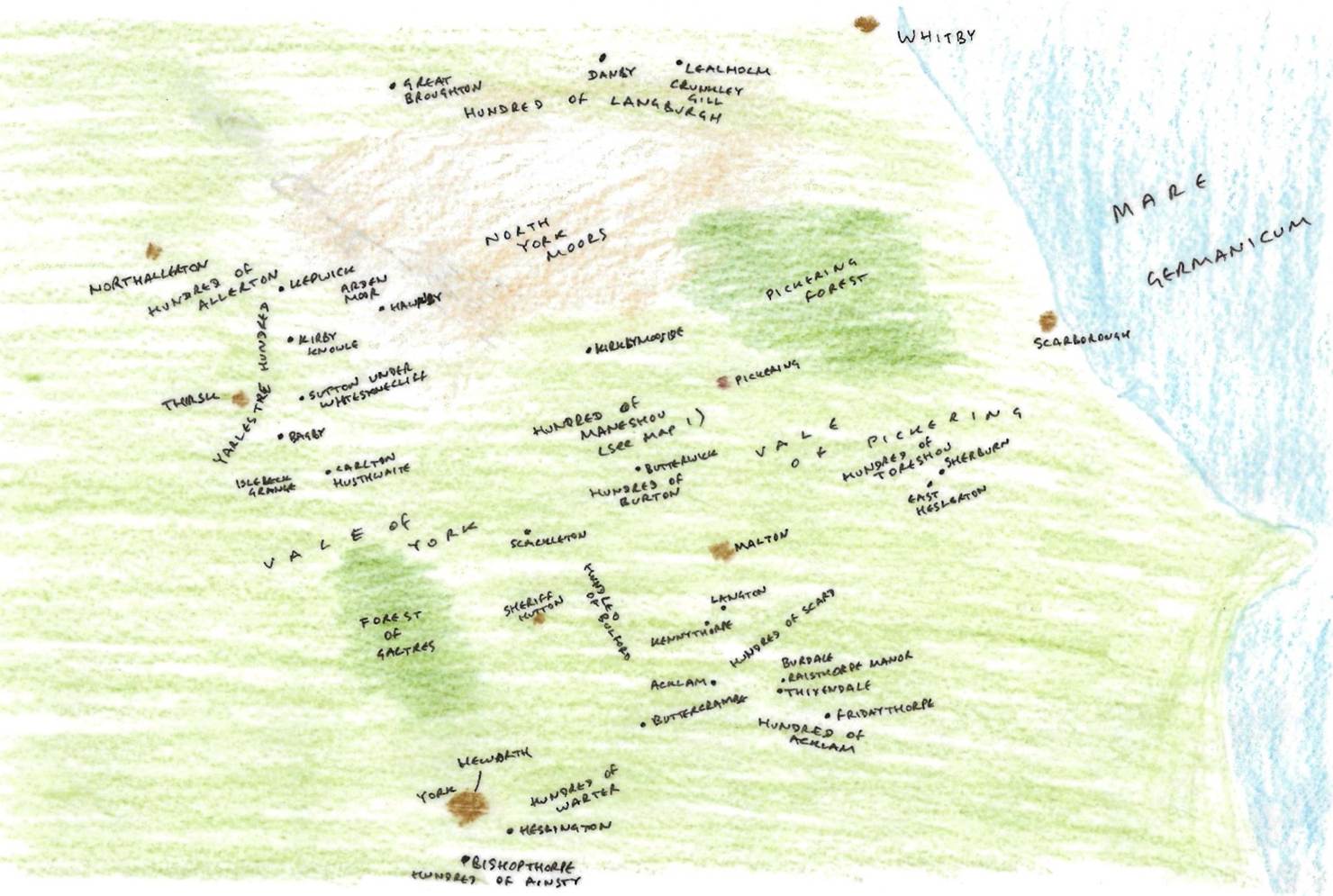
The
locations in the vicinity of Kirkdale referred to in the Domesday Book The lands of Orm Gamalson
The vicinity of
Kirkdale
To
the north of Kirkdale lie the North Yorkshire Moors, the windswept and barren
heights. Flowing down from the moors, following river courses, are the dales,
relatively steeply sided valleys, with Bransdale following the Hodge Beck and Farndale
following the River Dove. The dales flow down to the wide, flat agricultural
lands of two vast vales, the Vale of York which sweeps south towards York and
the Vale of Pickering, temporarily a prehistoric lake, which flows east towards
Pickering and beyond.
The
vales are ancient agricultural lands. The dales beyond the
southern extremities were probably impenetrable and heavily forested for much
of their ancient history. The moors have always been a harsh and bitter
place.
Kirkdale
therefore lies at the edge of the wild lands of the dales and the moors, but at
the northwest corner of vast agricultural lands, at the southern point of the
dales, where there is some protection, and access to stone, mineral and wood
resources, and to hunting opportunities. The church is positioned to avoid
excessive flood damage, but is at a location which has historically been liable
to flooding.
It
is clear from the
Domesday Book that Kirkdale was at the centre of a
section of those vast agricultural lands, stretching from Kirkby Misperton and Muscoates to the south to Gillamoor
at the approach to the dales in the north. The River Dove and the Hodge Beck
flowed out of the dales and through Kirkdale and Chirchebi
(Kirkbymoorside).
The nearby Kirkdale cave revealed animal
remains dating to the last interglacial period, 130,000 to 115,000 Years Before
Present (“YBP”). This is an ancient place, where animals have long
roamed and where our distant ancestors later lived and worked, even before
historical written records provided more direct evidence of their presence.
In time,
after the Norman conquest, the new Norman overlords would seek more
agricultural land by probing higher into the dales, as the wooded dales were assarted
(“slashed and burned”) to provide extensions of the farmed land, into Farndale and Bransdale.
The Hodge
Beck flows from its source in Bransdale. It has been associated with the water
course which was called Redofra or Redover in the Rievaulx
Chartulary.
The nearest
settlement is Welburn which is 1 km south of Kirkdale, and also referred to in
the Domesday book, where Roman finds have been discovered.
Kirkdale was
likely to have had an important relationship with Kirkbymoorside, which developed from a
centralised estate centre to a small urban settlement, whose landowners, by the
time of the Norman Conquest and probably prior to that, were active in York and the wider area.
Only two
kilometres east of Kirkdale there was a Roman Villa at Beadlam which
might have been part of an estate which might perhaps have included the lands
of Kirkdale (St
Gregory’s Minster, Kirkdale, North Yorkshire, Archaeological Investigations and
Historical Context, Philip Rahtz and
Lorna Watts, 2021, 287).
Lastingham lies close by in a sheltered
valley on the edge of scarcely settled moors. Hovingham, Kirkbymoorside and Kirkdale by
the middle Anglo Saxon period, were secure locations within a wider territory,
and within a network of road and exchange networks. Lower down the vale,
Sherburn and Kirkby Misperton were at island crossing points within low lying
marshes. Pickering, Old Malton and Hovingham are likely to have been the
centres of major estates within the wider administrative framework.
Archaeology at
Kirkdale
Archaeological research at Kirkdale started in
late 1994 and focused on the church building itself, above and below ground,
and the fields to the north and the south along the river. The
Kirkdale evaluation project started in 1995. This work continued to 1998, with
further work to the exterior of the church in 2000 and 2014. The excavations
were dug by hand.
The
work was led by Professor Philip
Arthur Rahtz (11 March 1921 – 2 June 2011), founder of the
University of York’s Archaeology Department in 1979, and Lorna Watts.
In
1986, Philip retired from being a professor of archaeology at York University
and returned to his home near Helmsley in Yorkshire, a short distance from
Kirkdale Minster, which he decided would make an excellent retirement project
for himself and his wife Lorna. Of course he knew about the famous sundial, but
the church now stands in the beautiful open country of Ryedale with no village
around it. The obvious question was, how and why did it get there? Another
friend of mine, Richard Morris, who was director of the Council for British
Archaeology, is a leading authority on the early church in Britain. Richard had
suggested that a large field immediately north of the church yard might contain
earlier remains, perhaps relating to a pre Viking Saxon monastery.
Philip
and Lorna were able to demonstrate that Richard's hypothesis was almost
certainly correct. Early graves near the church were orientated on a natural
alignment which reflected the local topography and was the same as features in
the north field. Later graves were arranged east to west, reflecting a stricter
canonical structuring of the grave yard. In addition to a fine stone Saxon
stone sarcophagus, they also found a fragment of so-called filigree coloured
glass rod which may have formed part of an elaborately decorated vessel, which
was probably made overseas. They point out that this provides evidence that the
early monastery at Kirkdale was part of the great seventh to ninth century
pan-European trading networks.
There
was evidence to that the early monastery fell out of use and became derelict
before it was rebuilt, probably in the eleventh century, just as it said on the
famous sundial. So the Viking noble Orm Gamalson, as he would probably have
called himself, who rebuilt the minster ‘from the ground up’, was indeed
reconstructing an earlier ruined church. By choosing such a place, he was
deliberately allying himself with what had gone before. In anthropological
terms, he was legitimising his claim to the area around the minster. This was a
way of seeking local goodwill, and is not the action of a person who did not
wish to become part of the community. Gamalson’s rebuilding of the minster was
part of a widespread process in both Viking and late Saxon England, whereby an
emerging nobility was making its mark up by rebuilding, effectively
privatising, rural churches, using their own money.
(Britain in the Middle Ages, An Archaeological History, Francis Pryor, 2007, page 87).
Much
of the present interpretation depends on the excavation of a small sample of
only about 0.36% of the area around the church.
The
excavations were at Kirkdale itself, with three trenches in the North Field –
Trench II at the church boundary wall, Trench III in the middle of the field
and Trench I to the north by the Hodge Beck. There was also an excavation in
the south field.
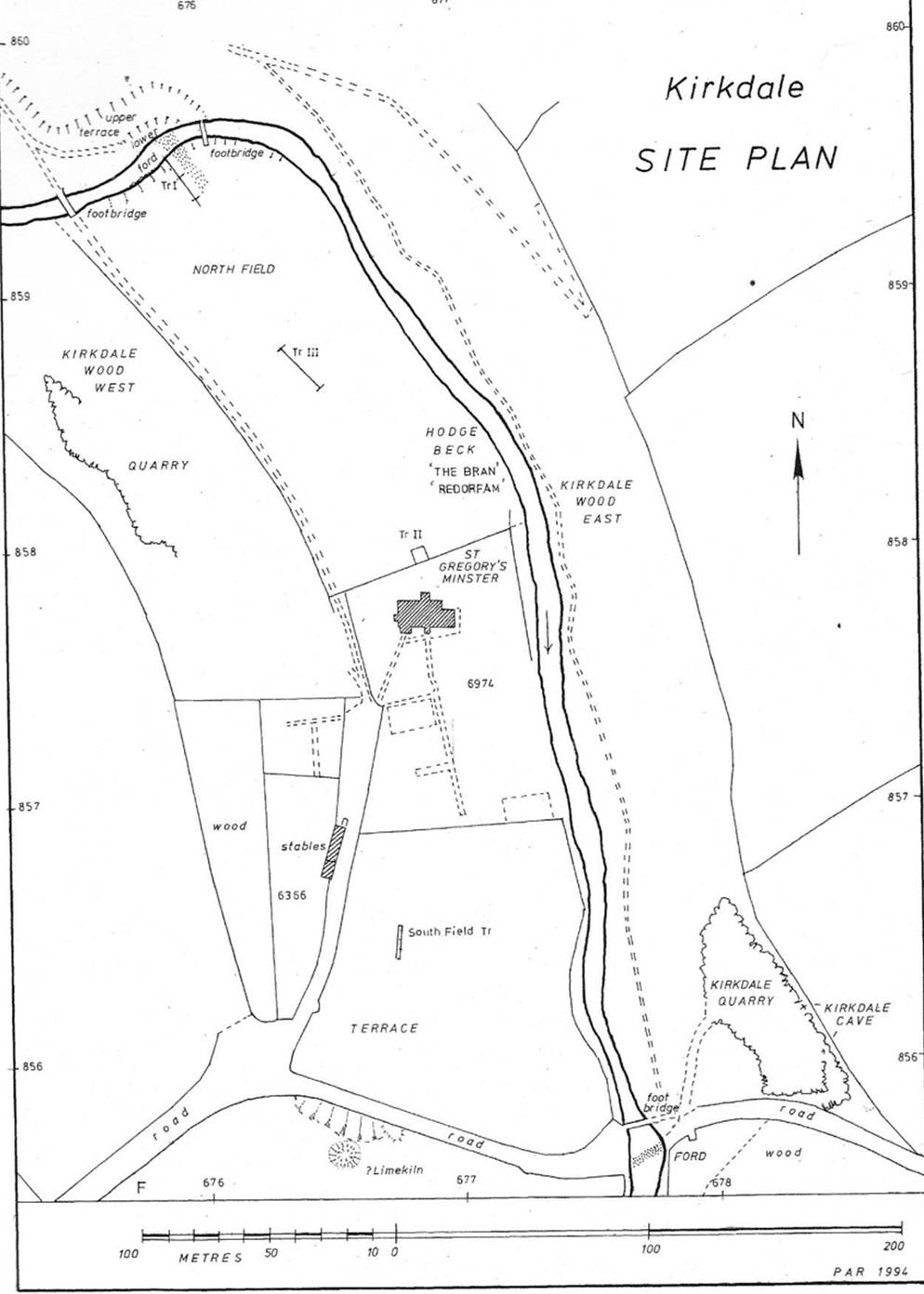
Archaeological
excavations at Kirkdale
(St Gregory’s Minster, Kirkdale, North Yorkshire,
Archaeological Investigations and Historical Context, Philip Rahtz and Lorna Watts, 2021, 10, 283).
The earlier history of the church is
evidenced by artefacts at Kirkdale dating to as early as the late eighth
century CE:
The
inscription on the sundial makes it clear that the church built by Orm replaced
an earlier one on the site which was, completely ruined and collapsed
when Orm acquired it.
The
earlier church may have been associated with the celebrated early Anglo-Saxon
monastery of Lastingham,
only seven miles to the north-east of Kirkdale. Lastingham
was founded by Cedd in about 655. He was a
native of Northumbria, a monk and missionary who became the first bishop of the
East Saxons, modern Essex, in about 654 CE and died in 664. He kept up his
links with his native region, and it was in the course of one of his travels
back in Northumbria, after he had become a bishop, that he founded Lastingham.
The sort of architecture favoured by Cedd may still be seen at the imposing,
barn-like church of Bradwell-on-Sea in Essex. The monastery at Lastingham was
an important one, and it is by no means impossible that it had daughter-houses.
A nearby and contemporary parallel is Hackness,
founded in 680 CE as the daughter-house of the monastery of Whitby. It is
therefore possible that Kirkdale may have originated as a satellite of
Lastingham.
Since
very early times Kirkdale Church has been known as St Gregory's Minster. It is
dedicated to St Gregory, the Pope who sent Augustine's mission in 597 CE to
convert the Angli to Christianity.
There
was, for a time, disagreement between the Roman and Lindisfarne missions, which
was resolved at the Synod of
Whitby in 664 CE. Cedd was at Whitby and agreed to the adoption of Roman
customs. It may well be that the dedication of a foundation, established by a
Lindisfarne missionary, to St Gregory, was a deliberate attempt to foster
unity.
Whilst
Kirkdale almost certainly had a long history connecting with Ryedale’s Roman
period, the Minster dates to about 685 CE or earlier. This tranquil site then
witnessed the period of Scandinavian influence. The church was destroyed by a
fire, probably in the early to mid eleventh century,
and then rebuilt by Orm Gamalson,
as recorded on its sundial.
Whilst this
website is a history of a single family’s journey through two thousand years of
British history, a significant part of that story reflects the history of the
place that has come to be known as Kirkdale.
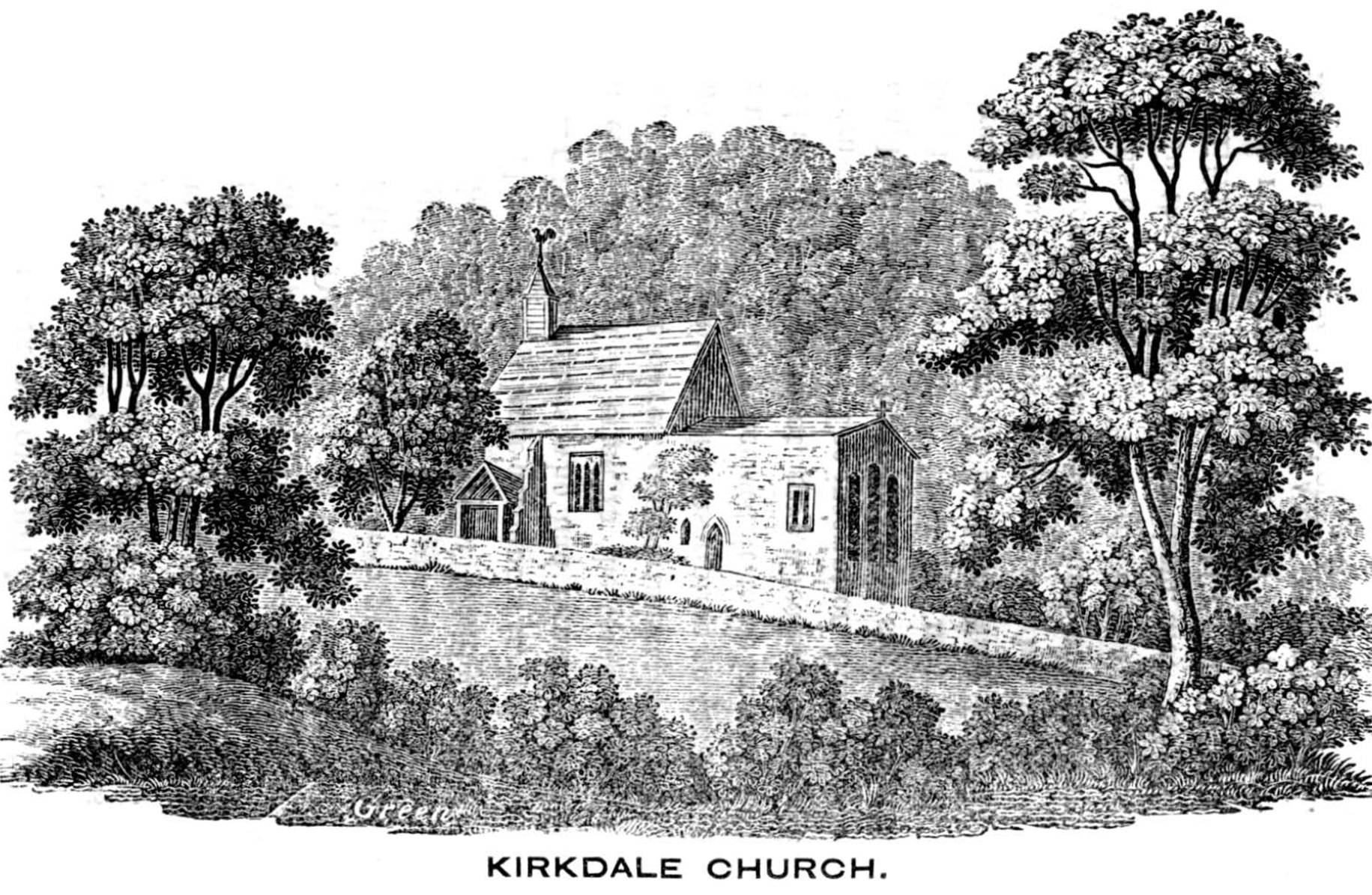
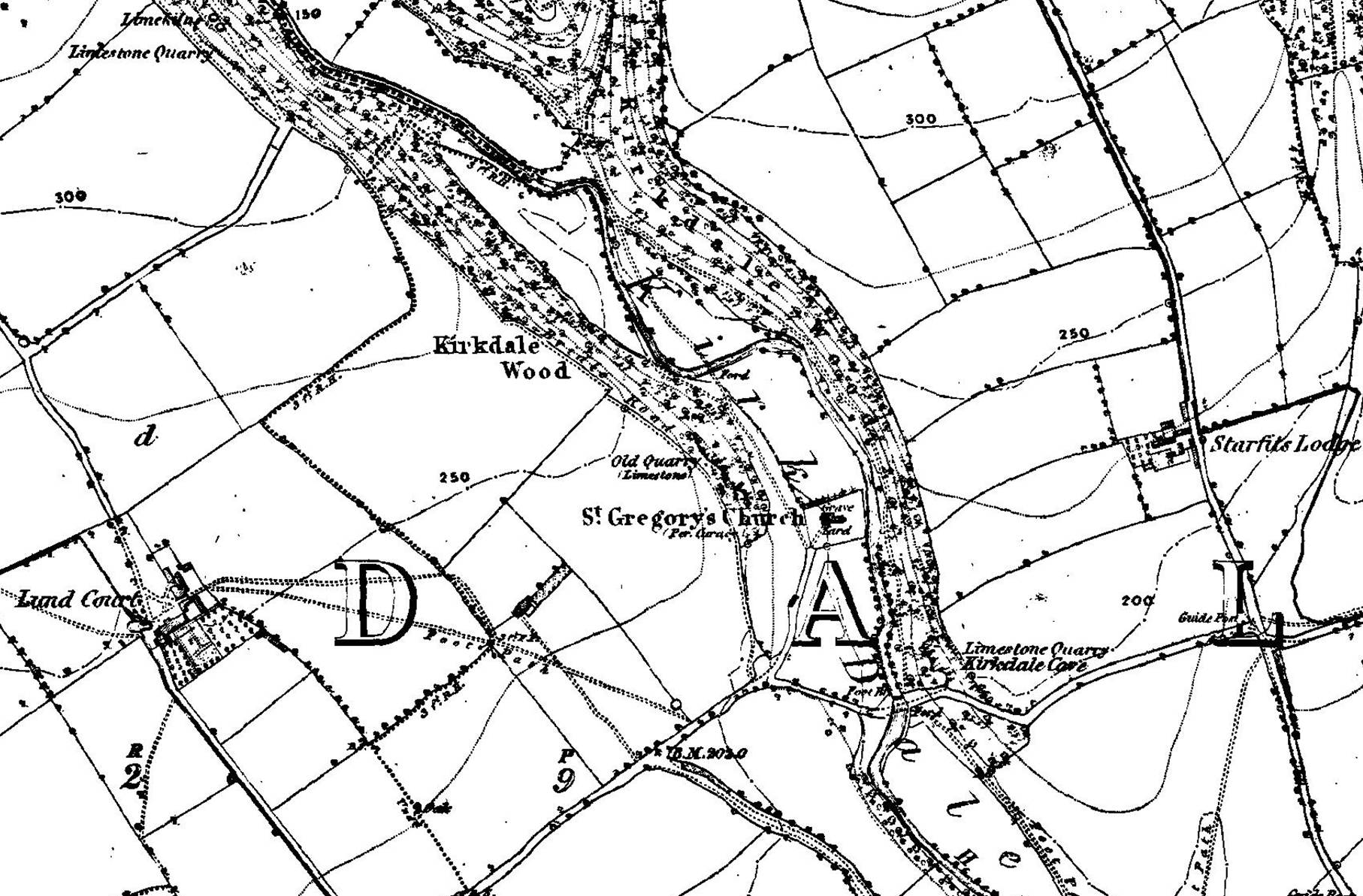
Kirkdale
from Rev. George
Young D.D, A Picture of Whitby and its environs, 1840 Kirkdale, 1857
You can next
read about Kirkdale Cave.
Bibliography
Kirkdale Archaeology 1996 to 1997, Philip Rahtz and Lorna Watts,
Ryedale Historian, 1998 to 1999.
An
illustration of a Saxon inscription on the church of Kirkdale in Ryedale In a letter addressed to Mr. Gough, by John-Charles
Brooke,
read at the Society of Antiquaries 16 January 1777.
St Gregory’s Minster, Kirkdale, Arthur Penn, Parochial Church
Council.
St Gregory’s Minster, Kirkdale,
Richard Fletcher, 2003, Published by the Trustees of the Friends of St
Gregory’s Minster, Kirkdale.
Archaeology at Kirkdale,
Lorna Watts, Jane Grenville and Philip Rahtz, Supplement to the Ryedale Historian Volume 18,
1996 to 1997.
Kirkdale Archaeology,
supplement to the Ryedale Historian Volume 19, 1998 to 1999.
St
Gregory’s Minster, Kirkdale, North Yorkshire, Archaeological Investigations and
Historical Context, Philip Rahtz and Lorna Watts, 2021.
The
Friends of St Gregory’s Minster.
University of Chester Book Review.
Orm Gamalson’s Sundial, The Lily’s
Blossom and the Roses’ Fragrance,
The Kirkdale Lecture 1997, Published by the Friends of St Gregory’s Minster,
Kirkdale, S A J Bradley MA FSA, Professor Emeritus, University of York.
Power,
Religious Patronage and Pastoral Carte, Religious Communities, Mother Parishes
and Local Churches in Ryedale, c650 to c1250, Thomas
Pickles, D Phil (Oxon), Lecturer in Medieval History and Fellow by Special
Election at St Catherine’s College, Oxford, The Kirkdale Lecture 2009,
Published by the Friends of St Gregory’s Minster, Kirkdale.
Monasteries
and Parishes in Medieval Yorkshire, Janet Burton
FSA FR Hist S, Professor of Medieval History, University of Wales, Lampeter,
the 2010 Kirkdale Lecture, Published by the Trustees of the Friends of St
Gregory’s Minster, Kirkdale.
Scandinavian
Culture in the Eleventh Century, Matthew
Townend, Department of English and Related Literature and Centre for Medieval
Studies, University of York, the 2007 Kirkdale Lecture, Published by the
Trustees of the Friends of St Gregory’s Minster, Kirkdale.
Lastingham
and its Sacred Landscapes,
Ian Wood, Professor of Early Medieval History in the University of Leeds, The
Fifth Lastingham Lecture, 2008.
Viking
Age Lastingham, Heather Donaghue, Professor of Old
Norse in the University of Oxford, Lecture on 1 October 2016, Printed for the
Friends of Lastingham Church.
East
Coast Connections, Ian Wood, Professor of Early
Medieval History in the University of Leeds, The Thirteenth Lastingham Lecture,
2016.
“When
the Danes Most Greatly Persecuted them, Wulfstan Archbishop of York’s Sermon to
the English People, translated from the Anglo Saxon by S
A J Bradley, Published by the Trustees of the Friends
of St Gregory’s Minster, Kirkdale.
Notes
on Ryedale Churches, Kirkdale revisited, Cyril King, Ryedale
Historian, Volume 7, 1974, page 42.
Kirkdale
and Welburn, Thomas Parker, Ryedale Historian, Volume 10,
1980, page 4.
History
of Kirkdale and its vicinity, Ryedale
Historian, Volume 11, 1982, page 10.
Ghosts
at Kirkdale, Philip Rahtz, Ryedale Historian, Volume 19,
1998 to 1999, page
17.
Runes
at Kirkdale, Lorna Watts, Ryedale Historian, Volume 19,
1998 to 1999, page
21.
St
Gregory’s Minster, Kirkdale, Lorna Watts, Ryedale Historian, Volume 27,
2014 to 2015, page 54.
Incised
Stones at Kirkdale Church, Yorkshire Archaeological Journal, Volume 7,
1882, page 285.
Anglo
Saxon Sundials in Ryedale, John Wall, Yorkshire Archaeological
Journal, Volume 69, 1997, page
93
A History
of the County of York North Riding: Volume 1. Originally published by
Victoria County History, London, 1914, Kirkdale.
|
|
A
You Tube film taking a tour around Kirkdale. |
The history of Kirkdale is told across the following
webpages.
· The Kirkdale
Anglo Saxon artefacts
· Anglo-Saxon Scandinavian Kirkdale
There are related webpages:
· Alcuin and the birth of modern
education