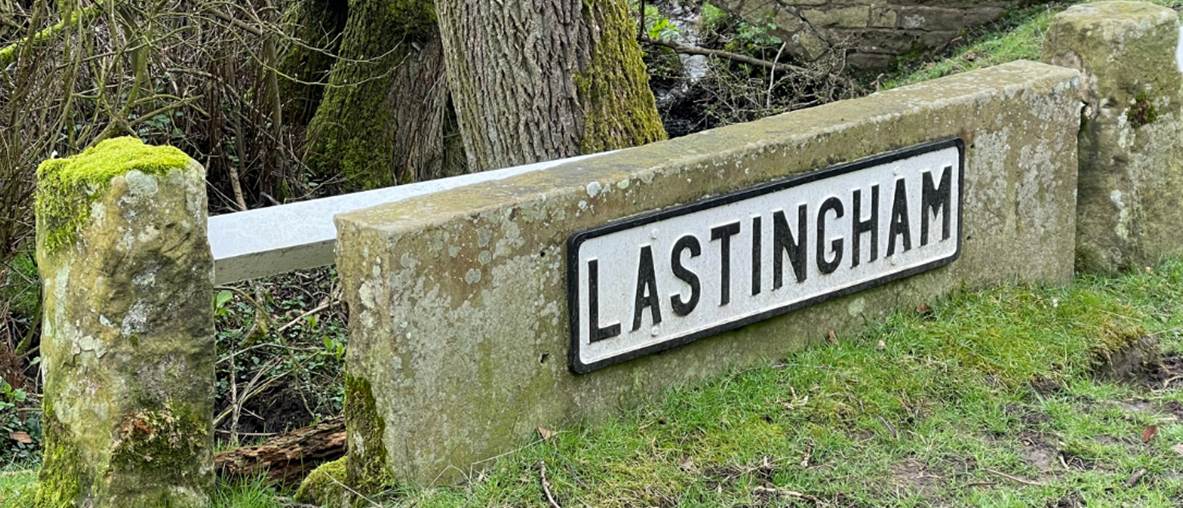
Lastingham

The
foundation of Cedd’s monastery, 2 km east of the entrance to Farndale
|
Return to the Home
Page of the Farndale Family Website |
The story of one
family’s journey through two thousand years of British History |
The 83 family lines
into which the family is divided. Meet the whole family and how the wider
family is related |
Members of the
historical family ordered by date of birth |
Links to other pages
with historical research and related material |
The story of the
Bakers of Highfields, the Chapmans, and other related families |
Headlines are in brown.
Dates are in red.
Hyperlinks to
other pages are in dark
blue.
References and
citations are in turquoise.
Context and local
history are in purple.
Geographical
context is in green.
Roman period
There was
probably a Roman building at Lastingham, evidenced by some carved stones now in
the crypt which seem to have been Roman in origin. It is possible that the
crypt itself began as some sort of Roman mausoleum or shrine, and if not there
may have been a Roman monument in the area, or possibly a nymphaeum. A Roman
street ran from Malton to Hovingham with a military centre at Malton and a
villa at Hovingham. Hovingham might have been the official residence of the
military commander of Malton. A pagan shrine at Lastingham might have lain on
the periphery of the estates of the Hovingham villa. (Lastingham in its sacred landscapes, Ian Wood, Professor of Early Medieval History, The
Fifth Lastingham Lecture, 2008, page 7).
Even in Roman
times, Ryedale was not peripheral but central to the political landscape.
The idea of Rome
continued into the Anglo Saxon period.
Anglo-Saxon Period
563 CE
Columba left
Ireland to found the monastery of Iona, off the coast of Scotland.
634 CE
Bishop Aiden of Iona
was requested by the King at Bamburgh to bring Christianity to Northumbria and
set up a see at Lindisfarne. Amongst his pupils were Cedd, Cynebil,
Caelin and Chad, four brothers who eventually became bishops.
651 CE
Oswine, King of
the Deiri (644 to 651 CE), was murdered. Oswine was
the nephew of Edwin, and so a member of the dynasty competing for control of
Northumbria. Oswine had decided to disband his forces at Wilfaraesdun,
ten miles north of Catterick and went into hiding at a place called Gilling,
but he was betrayed and murdered on Oswiu’s orders. Gilling West is near
Catterick, but Gilling East is the more likely
site of the murder. The first abbot was Trumhere,
a relative of Oswine and he was followed shortly afterwards by Cynefrid,
brother of Ceolfrith of Jarrow. Later Ceolfrith
and other brethren left to join Wilfred’s community at Ripon.
There is a
reference in the History of St Cuthbert to King Ecgfrith of the Bernicians
granting land at Suthgedling, which has been
interpreted as Gilling East, in 685 CE.
Oswiu, King of
the Bernicii, founded Gilling. Oswiu’s queen, Eanflaed (who was related to Oswine) persuaded Oswiu to
atone by building a monastery at the site of the murder. Gilling was founded
within Bernicia, in the territory of another King. It must have been seen as an
admission of guilt.
Aethewald (651 to 655 CE) became
King of the Deiri and seems to have ruled alongside
Oswiu.
653 CE
Oswiu sent Cedd to evangelise the Middle Angles under Paeda and the East Saxons as Bishop.
The founding of the
monastery at Lastingham
Bede, in his History of the English Church and People (731 CE),
recorded
that a small monastic community was founded at Lastingeau,
the abode of Læ̃sta's people, now Lastingham (some 10km
northeast of Kirkdale) under royal patronage, partly to prepare an eventual
burial place for Æthelwald, Christian king of Deira, partly to assert the
presence and lordship of Christ in a trackless moorland wilderness haunted by
wild beasts and outlaws.
The monastery was founded on land given for
the purpose by Ethelwald, king of the Deirans, a
people whose early settlements lay in the East Riding, but who had conquered
most, at least, of modern Yorkshire by the mid-seventh century. Ethelwald's father, Oswald, had ruled both the Deirans and
the Bernicians, The early centres of Bernician power lay in modern Northumberland, but when
Lastingham was founded the king of the Bernicians
ruled from Stirling in the north to, probably, the Tees in the south. In 642 Oswald
had been killed in battle leaving his kingdom to his younger brother, Oswiu.
Two years later, in 644, Oswiu lost control of the Deirans, who were ruled from
then until 651 by Oswine, a member of the old royal family of Deira which had
been displaced by Oswald. Ethelwald became king of
the Deirans in or after 651 and seems to have lost his kingdom through
supporting the losing side in a great campaign in the autumn of 655.
Lastingham, therefore, was founded between 651 and 655. (The
foundation of Lastingham, T M Charles-Edwards, Ryedale Historian,
Volume 7, 1974, page 13).
Cedd was Bishop of the East Saxons and had
founded house at Bradwell on Sea and Tilbury, but was a regular visitor to his
native Northumbria (Lastingham in its sacred landscapes,
Ian Wood, Professor of Early Medieval History, The Fifth Lastingham Lecture,
2008, page 1).
Lastingham, was probably
only the second religious community founded in Deira after Gilling. (Power, Religious Patronage and Pastoral Care, Religious
communities, mother parishes and local churches in Ryedale c650 to c1250,
Thomas Pickles D Phil Oxon, Lecturer in Medieval History, The Kirkdale Lecture
2009). Aethewald may have been trying to carve
some political independence for his line by creating a dynastic mausoleum.
Aethelwald, son
of Oswald, gave the land at Lastingham to Cedd between about 653 to 655 CE.
These lands ‘vel
bestiae commorari vel hommines bestialiter
vivere conserverant’, ‘fit only for wild beasts,
and men who live like wild beasts’ were about 2 km east of the entrance to Farndale.
The same man of God, whilst he was bishop among the East Saxons,
was also wont oftentimes to visit his own province, Northumbria, for the
purpose of exhortation. Oidilwald, the son of King Oswald, who reigned among
the Deiri, finding him a holy, wise, and good man, desired him to accept some
land whereon to build a monastery, to which the king himself might
frequently resort, to pray to the Lord and hear the Word, and where he
might be buried when he died; for he believed faithfully that he should
receive much benefit from the daily prayers of those who were to serve the Lord
in that place. The king had before with him a brother of the same bishop,
called Caelin, a man no less devoted to God, who, being a priest, was wont to
administer to him and his house the Word and the Sacraments of the faith; by
whose means he chiefly came to know and love the bishop. So then, complying
with the king's desires, the Bishop chose himself a place whereon to
build a monastery among steep and distant mountains, which looked more
like lurking-places for robbers and dens of wild beasts, than dwellings of
men; to the end that, according to the prophecy of Isaiah, “In the
habitation of dragons, where each lay, might be grass with reeds and rushes;”
that is, that the fruits of good works should spring up, where before beasts
were wont to dwell, or men to live after the manner of beasts. (Ecclesiastical History of the
English People, Venerable Bede, Chapter
23).
In the seventh century Lastingham was
probably an island in the wilderness. From the following passage from Beowulf a
good understanding may be gained of what men thought of such country.
These two (monsters) live in a little-known
country, wolf-slopes, wind-swept headlands, perilous paths across the boggy
moors, where a mountain stream plunges under the mist-covered cliffs, rushes
through a fissure. It is not far from here, if measured in miles, that the lake
stands shadowed by trees stiff with hoar-frost. A wood, firmly-rooted, frowns
over the water.
Such districts as these were for the monks of
north-western Europe what the desert was for the monks of Egypt.
(The foundation of Lastingham, T M Charles-Edwards, Ryedale Historian, Volume 7, 1974, page 17).

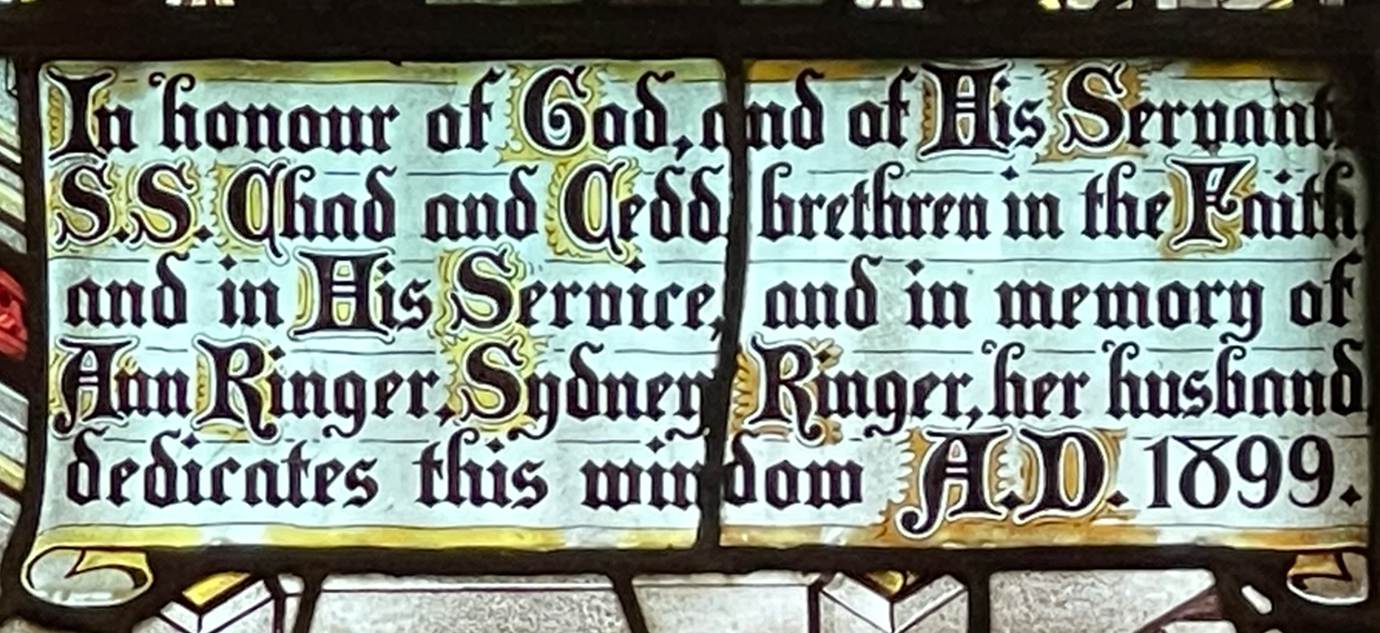
Stained glass
windows at Lastingham
Landscape was important
and Bede was purposely drawing attention to an image of wilderness, as a
vehicle for transformation. This was a common image of early medieval
monasticism. Lastingham stands on the edge of the uncultivated, with
implications for spiritual development. The wild nature of the site, as with
the Romulus and Remus story, provided the perfect setting against which to
described the civilisation of the area.
Bede went on to
say that to cleanse the place from former crimes, St. Cedd planned to spend all
Lent there in prayer, but being called away on the king's affairs, his place
was taken by his brother Cynebil, who readily complied, and when the time of
fasting and prayer was over, he there built the monastery, which is now called
Lestingau, and established therein the religious customs of Lindisfarne, where
they had been educated.
It should be remembered that a seventh
century Englishman like Cedd would have had no belief in the essential goodness
of nature. The natural world contained many evils. Cedd, therefore, considered
it right to purify the site of his monastery from evil by prayer and fasting.
The season of Lent was chosen for this task, thus making it more clearly an
imitation of Christ's fast in the desert. For the reasons which I have given,
moorland occupied in men's ideas a position similar to that of the desert in Egypt
and Palestine. Cedd's actions, then, have a complex background of belief and
imagination, a background utterly remote from that which we naturally associate
with the site of Lastingham today. (The foundation of
Lastingham, T M
Charles-Edwards, Ryedale Historian, Volume 7, 1974, page 18).
The monastery was
then established, following the practices of Lindisfarne.
The founder of the
monastery was Cedd, one of four brothers who were all priests, and two of whom,
Cedd himself and Chad, became bishops. It is because of the considerable part
in the conversion of England between the Thames and the Humber played by Cedd,
a missionary among the Wast Saxons and the Middle Angles, and by Chad, one of
the early bishops of the Mercians and the men of Lindsey, that Bede devoted the
better part of a chapter to the foundation of Lastingham. Bede's main source of
information about the missionary activities of Cedd and Chad was the monastery
of Lastingham. His other source was a monk called Trumberct
who taught Bede scripture and had himself been taught by Chad. It is not
surprising, therefore, that Bede wrote about Cedd and Chad with warm sympathy.
The other two brothers, Caelin and Cynibill, were
both active in founding the monastery. Caelin was a priest in Ethelwald's household, and it was he who brought Cedd to
the king's attention. Cynibill appears to have been
Cedd's main assistant
in the actual
work of foundation.
Like
other monastic foundations of the period, therefore, Lastingham was the product
of co-operation between king and monks. It is not certain, however, whether
Cedd and his brothers belonged to a Deiran or to a Bernician
family. Ethelwald, though king of the Deirans,
belonged to the Bernician royal family, so that
Caelin's presence in his household proves nothing. Both Cedd and Chad were
disciples of Aidan, the leader of the Irish mission to Northumbria (namely
Bernicia and Deira). Aidan had founded the monastery of Lindisfarne in Bernicia
in 635 or 636. This does not, however, show that they were Bernicians:
Aidan's diocese embraced the whole of Northumbria since Oswald ruled over the
Deirans as well as the Bernicians. One sentence in
Bede's account suggests that the balance of probability is slightly in favour
of a Deiran origin for Cedd's family. Bede says that Cedd was brought to the
attention of Ethelwald when revisiting "his own
province, that is that of the Northumbrians." Northumbria included both Deira
and Bernicia. Yet since Ethelwald's kingdom did not
extend beyond Deira, and Cedd's return to his own district was the occasion of
his meeting Ethelwald, I think it more likely than
not that Cedd was a Deiran. This argument is very far from being proof, but it
is the only definite evidence.
(The foundation of Lastingham, T M Charles-Edwards, Ryedale Historian, Volume 7, 1974, page 13).
There are
theories that Kirkdale
was the true site of the monastery. An inscription on a coffin lid was
interpreted in 1846 by D H Haigh as the cross of King Ethelwald of Deira and
another coffin lid was interpreted as belonging to St Cedd. However Bede later
referred to Cedd cleansing the site from its former crimes by fasting and
prayer, before he built the monastery which is now called Lestingau, and
established on the religious customs of Lindisfarne.
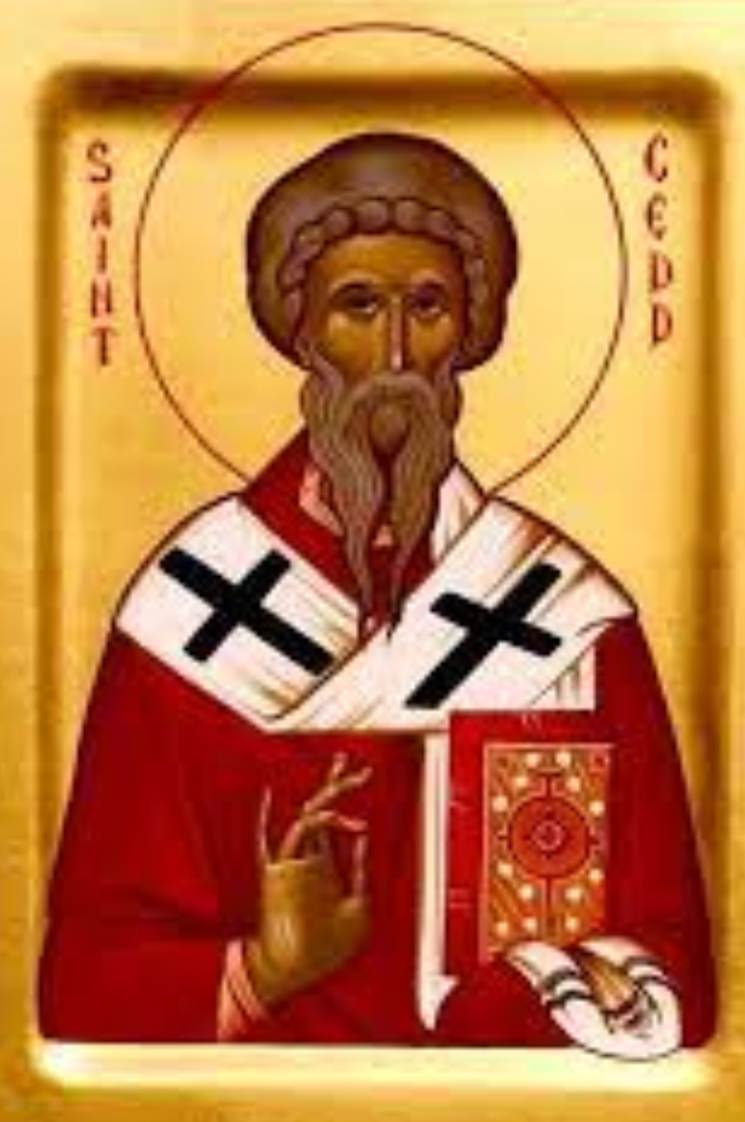
St
Cedd (c 620 to 26 October 664) was one
of a family of missionary priests, educated at Lindisfarne under St Aidan, the
most famous of whom was Chad, the first Bishop of Lichfield. Cedd preached first to the Middle Angles and
then to the East Saxons. About 654 CE he became their Bishop. Cedd was
appointed as abbot of the monastery of Lastingham in his native Northumbria at
the request of the sub-king Œthelwald of Deira. Bede records the foundation of
this monastery in some detail, showing that Ethelwald was put in contact with
Cedd through Caelin, one of the bishop's brothers, who was on the king's staff.
The rule which Cedd gave to his new monastery
was modelled on that of Lindisfarne where he had received his own monastic
training. Direct evidence of the nature of this rule is sparse, but there is
reasonable indirect evidence. Aidan came from lona,
the island site, off the west coast of Scotland, of one of the leading Irish
monasteries of the period, founded in 565. Its founder was Columba, a member of
the royal family of Tir Conaill (part of the modern county of Donegal). A life
of Columba survives written, probably in the 690's, by the ninth abbot of lona, Adomnan. This gives us some idea of the monastic
tradition in which Aidan was reared. From the evidence of Bede it is clear that
it was this tradition which formed the monastic life of Lindisfarne. The
monastic rule of Lastingham was, therefore, of Irish origin, at one remove.
Cedd, indeed, spoke Irish and Chad spent some time in Ireland. All monks at lona lived under the authority of an abbot who was assisted
by a council of senior monks. Important decisions appear to have been debated
by this council. Monks were admitted by a process of probation followed by the
taking of monastic vows. The monastic routine included the singing of the
divine office at fixed hours and manual or other work. In outline then, the
frame-work of life was the usual one at most periods of monasticism. lona was the head of a federation of monasteries. The abbot
of lona exercised authority over all these
monasteries and appointed a superior, praepositus, to
rule each one. It seems probably that an abbot chose his successor after having
secured the consent of at least the senior monk. The monastery at Lindisfarne
was, until 664, under the authority of the abbot of Iona. The man in charge was
not an ordinary praepositus but rather a bishop.
Aidan and his two successors, Finan and Colman, were each sent from lona. They, in turn, appointed the superior who ruled the
monastery while they carried out their duties as bishops. They also had other
monasteries to which they appointed superiors, for example Melrose.
This system was reproduced by Cedd. When he
founded Lastingham he had already been consecrated bishop. As bishop of the
East Saxons he founded two monastic communities in Essex. He retained ultimate
authority over Lastingham, but the day-to-day management was in the hands of a
superior whom he appointed. Cedd's authority over Lastingham was of exactly the
same type as that of Aidan over Lindisfarne. It seems probable, but cannot be
proved, that Cedd as bishop was to some extent under the authority of the Irish
bishops of the Northumbrians, Finan and Colman: it is at least certain that it
was Finan who took the decision that Cedd's success in Essex was such as to
justify his consecration as bishop.
(The foundation of Lastingham, T M Charles-Edwards, Ryedale Historian, Volume 7, 1974, page 14).
It seems most
probable that the early monastery was established in or about 653 CE by St Cedd
at Lastingham.
Cedd occupied the
position of abbot of Lastingham to the end of his life, while maintaining his
position as missionary bishop and diplomat. He often travelled far from the
monastery in fulfilment of these other duties. His brother Chad, who succeeded
him as abbot, did the same. Cedd and his brothers
regarded Lastingham as a monastic base, providing intellectual and
spiritual support, and a place of retreat. Cedd delegated daily care of
Lastingham to other priests, and it is likely that Chad operated similarly.
655 CE
In 655 CE, less
than three years from the foundation of Lastingham, Aethelwald joined forces
with Penda against his uncle, Oswiu. Aethewald did
not participate in the ensuing Battle of Winwaed when
Penda, King of Mercia, was killed.
Oswiu commemorated
his victory by founding twelve votive monasteries, six among the Deiri and six among the Bernici.
Bede did not name the monasteries. These monasteries probably related in some
way to the already established monasteries of Lastingham and Gilling.
Oswiu then sought
to assert more control over the Deirans and he founded his own dynastic
mausoleum at Whitby (see below). He installed his own son Alhfrith
as king of the Deirans.
The six Deiran
monasteries must have marked the failure of Aethewald’s
rebellion as well as the defeat of Penda. This must have influenced the
community at Lastingham.
The importance of Ryedale
Lastingham was a
royal foundation on land granted to Cedd by Aethewald,
King of the Deirans from 651 to 655 CE, to build a monastery where he might be
buried.
Athelwald’s uncle Oswiu
(King of Northumbria 642 to 671 CE) played the most significant role in the
development of Ryedale. It was here who founded Gilling, probably at Gilling
East, and later the twelve monasteries, of which six were in Deira.
These twelve
monasteries did not include Gilling, Lastingham, Hartlepool, Whitby nor its
daughter house of Hackness, since they were already
in existence. Ian Wood felt it likely that the Deiran monasteries had strong
links with Gilling and Lastingham. Among the monasteries with strong royal
links are:
· Stonegrave and Coxwold,
both referred to in a letter from Pope Paul I to Easdbert
of Northumbria in 757 CE.
· St Gregory’s Minster
at Kirkdale,
associated with Ceolfrith’s cornu vallis.
· Crayke, referred to in Historia de Sancto Cuthberto.
· Hovingham, Kirkbymoorside,
Middleton and Kirby Misperton, on the evidence of early sculpture.
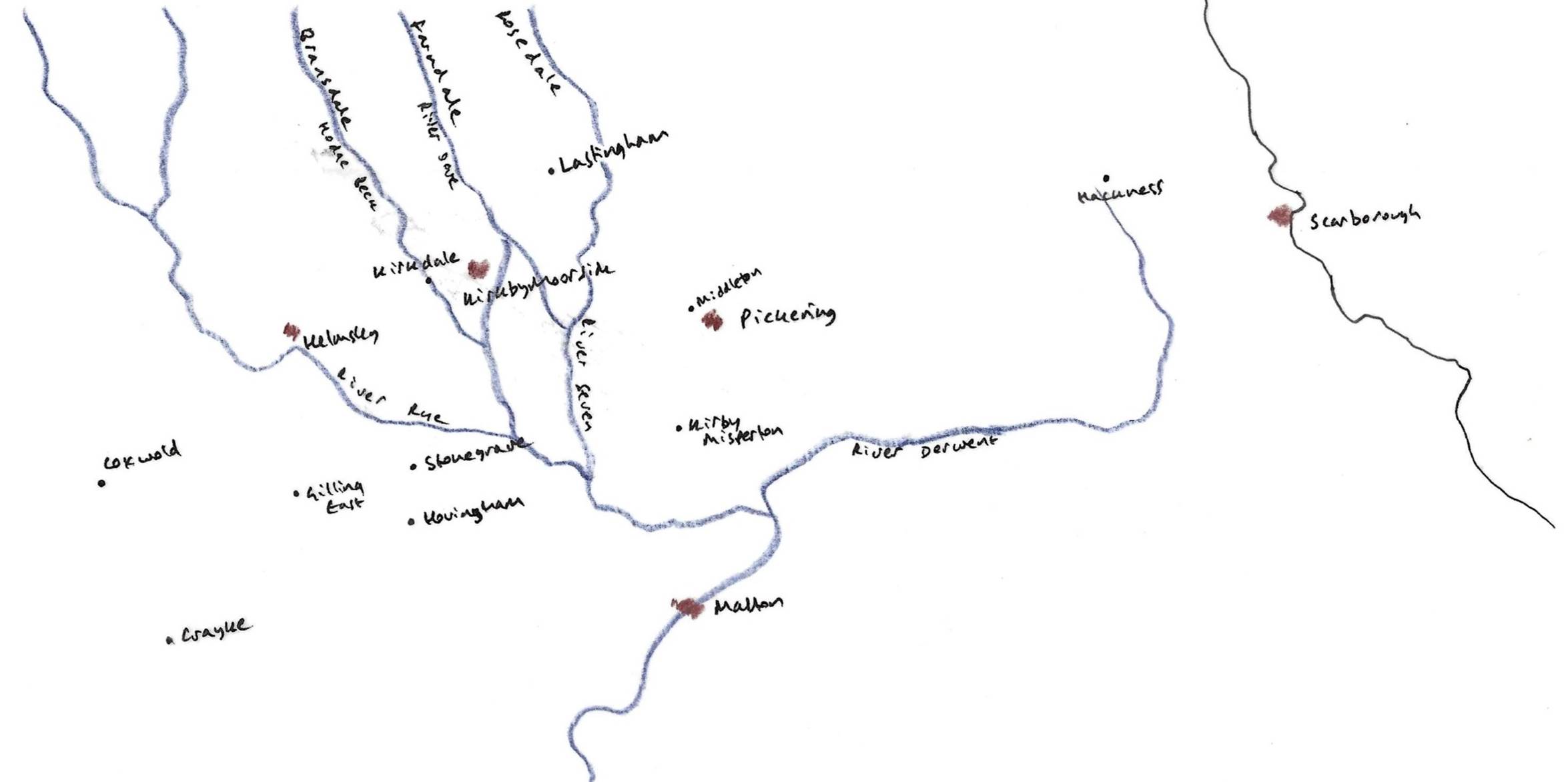
Ryedale’s Sacred
Landscapes
The chances that
some of Oswiu’s six Deiran monasteries might be located amongst this group of
sites is surely quite high. If so then Ryedale would have been the focus of a
quite extraordinary intensity of religious foundations associated with royal
power in a single decade of the mid seventh century.
The association
of kingship with monasticism is also evidenced by the community of Whitby,
closely associated with lading women of the royal dynasty (Hild and Eanflaed,
daughter of Edwin and wife of Oswiu and their daughter Aelfflaed) and its
daughter house at Hackness.
Ripon, later transferred
to Wilfred in 660 CE, was originally founded by King Alhfrith, probably as a
foundation for a similar purpose to Lastingham.
There is a wealth
of Middle Saxon material found in Ryedale, an area of wealth and power as well
as religious activity. York, Malton and Hovingham were important centres.
We might assume a landscape in which the Roman past was still very
present, and that York, Malton and Hovingham continued to be central places.
That the Northumbrians were interested in romanitas
is clear from the de[paction of Romulus and Remus on the Frank’s Casket.
Hovingham may have been the centre of a royal estate, so held by
Oswine in the 640s. After his death in 651, his relative Eanflaed
forced her husband Oswiu to found a monastery at Gilling, perhaps the earliest
monastic house in the area. By 653 CE Aethelwald founded Lastingham. Two years
later in 655 CE, after the battle of Winwaed Oswiu
established 12 votive monasteries. As part of the same process, Alhfrith established Ripon.
The foundation of Lastingham and the importance of Ryedale is
therefore seen in the context of the establishment of Christianity in Northumbria
and political rivalries of the period.
(Lastingham in its sacred
landscapes, Ian Wood, Professor of Early
Medieval History, The Fifth Lastingham Lecture, 2008, pages 13 to 23)
657 CE
The foundation of
Whitby. Oswiu founded his own dynastic mausoleum at Whitby in order to promote
his control over Deira.
660 CE
Foundation of
Ripon by Alhfrith, King of Deira.
661 CE
Ripon transferred
to Wilfred.
664 CE
This was the year
of the
Synod of Whitby.
Bede also tells
us that St Cedd later died of pestilence (plague) in 664 CE, while visiting the
monastery and he was buried in the open air, but at the site of the formerly
wooden monastery, while a stone church was being built. His body was interred
to the right of the altar. Although this suggests that the crypt was not yet
part of the, then wooden, church, Ian Wood suggests that it is possible that
the main fabric of the crypt was in existence before the late Middle Saxon and
Norman church. (Lastingham
in its sacred landscapes, Ian Wood,
Professor of Early Medieval History, The Fifth Lastingham Lecture, 2008)
Ian Wood
suggested that Cedd was originally buried outside the walls of Lastingham, but
was placed at the right side of the altar after the construction of a new stone
church. There is a suggestion that a Roman sarcophagus was reshaped to form a
mandorla or an oval shaped aperture to house the saint’s relics. In time a cult
of Cedd was created around his shrine. Bede tells of how thirty monks from his
East Saxon foundation came to spend the rest of their lives in his tomb after
he died. Lastingham seems to have retained its connections with the south east
of England.
The death of
Cedd, his burial and reburial, and the development of a cult, further changed
the religious landscape of the monastery. On hearing of his death thirty monks
from one of his East Saxion foundations came to spend the rest of their lives
at his tomb (Bede, Ecclesiastical History).
The cult of Cedd transformed this remote place at the edge of the moors to an
important location, a conduit singled out by Bede as one of his major sources
of information, connected through Cedd’s own history to the south-east (Lastingham in its sacred landscapes, Ian Wood, Professor of Early Medieval History, The
Fifth Lastingham Lecture, 2008, page 9).
His brother Chad
then governed the monastery. St Chad was not at Lastingham for long, before
becoming Bishop of Lichfield. It was while Chad was Abbot of Lastingham that St
Ovin joined the monastery, renouncing a life of privilege and influence in
favour of prayer through manual work.
There was a later
claim that a Midland diocese, probably Lichfield, had the relics of Cedd and
Chad
Lastingham was a
monastery centuries before the Cistercian abbeys such as Rievaulx and
Fountains. The monastery had thus ceased to be, centuries before the great
Yorkshire Abbeys of Rievaulx, Byland and Fountains were begun.
It
has generally been agreed that the monastery referred to was Lastingham, where
the church is dedicated to S. Mary. In 1846 D. H. Haigh claimed that it was Kirkdale. He identified the coffin lid with the cross as that of King
Ethelwald of Deira, on the strength of the runic inscription. The other coffin
lid with an interlace design, and the tassels of a pall on the edges, was said
to be that of S. Cedd. This theory has had few supporters.
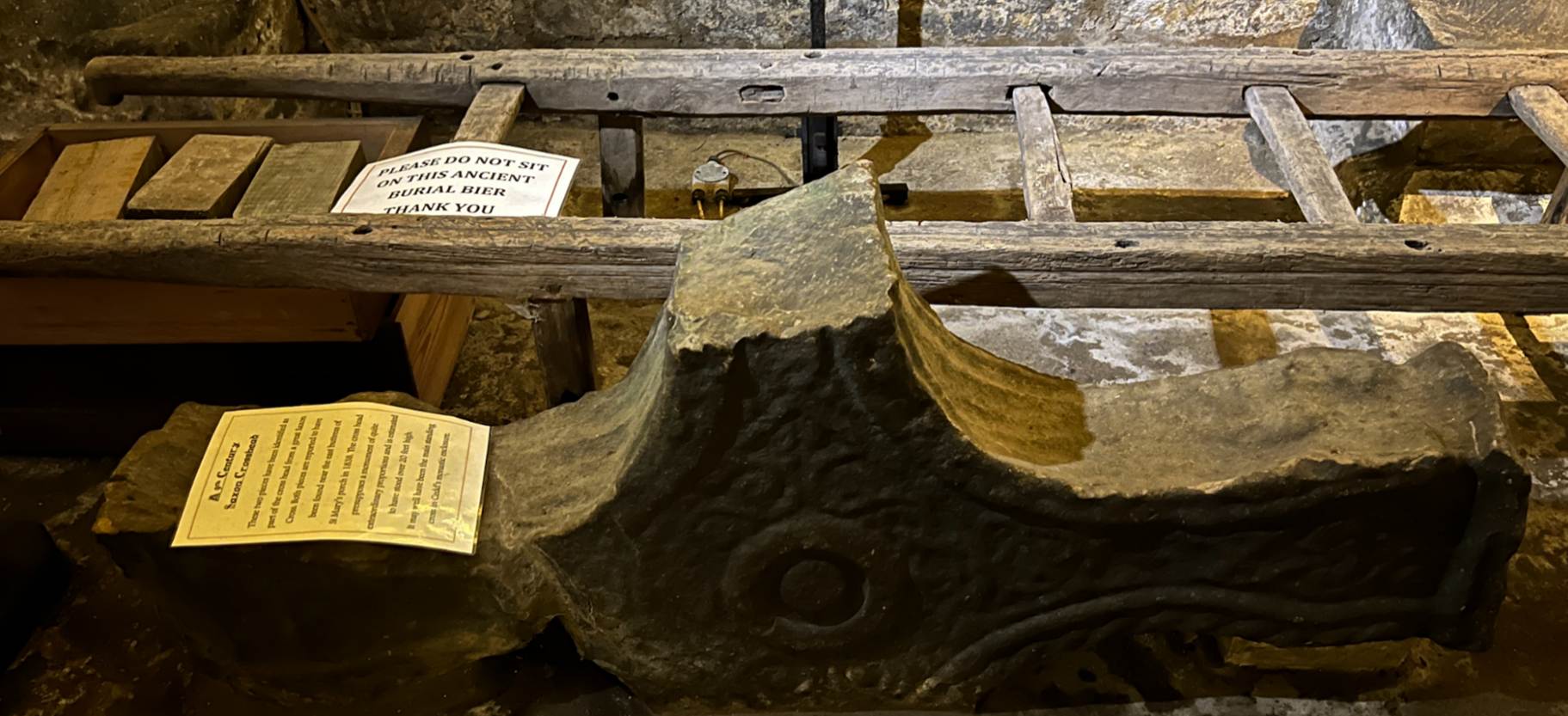


Carved Celtic stones in the crypt, which probably date to Cedd’s
time.
Bede’s account indicates that the royal foundation of Lastingham
by Aethelwald came with an expectation that he was to be buried there. In fact
Aethelwald was not buried there and seems to have died outside Northumberland.
He was probably not buried at Kirkdale either, despite later claims of his association with the tombs
there.
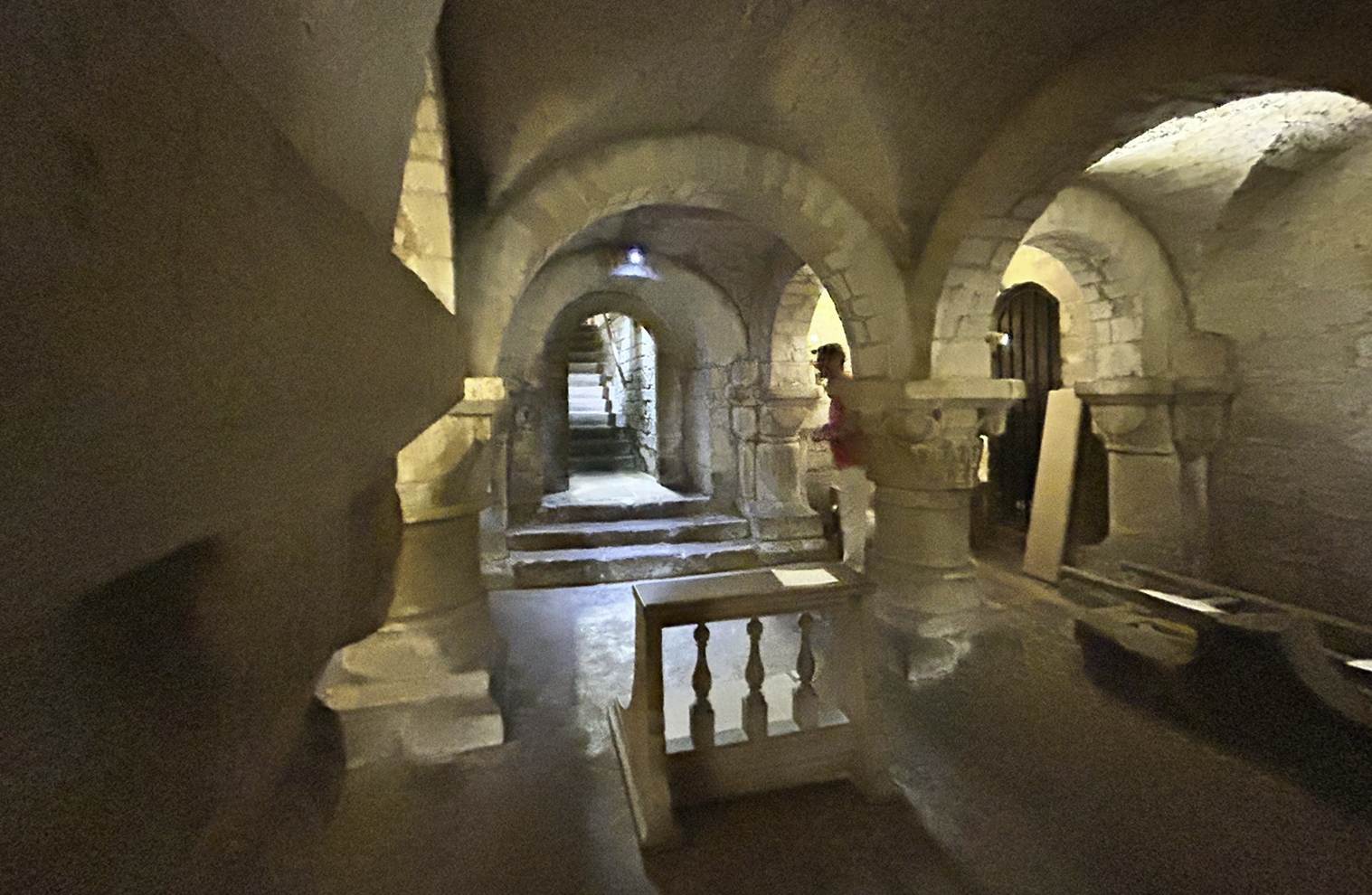
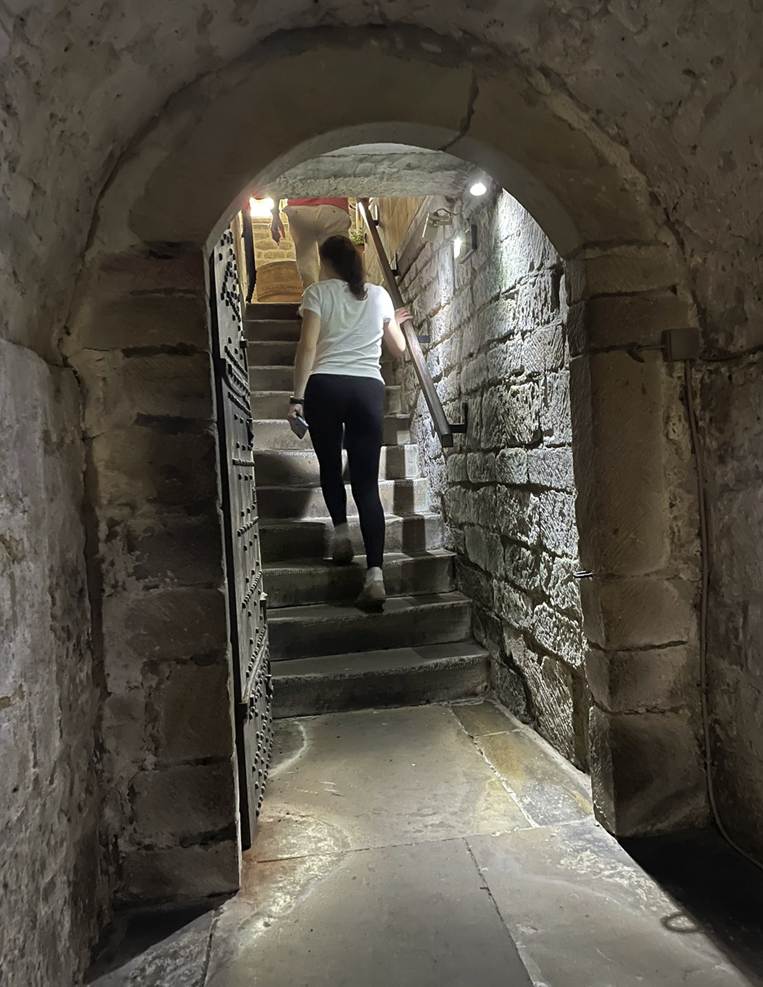
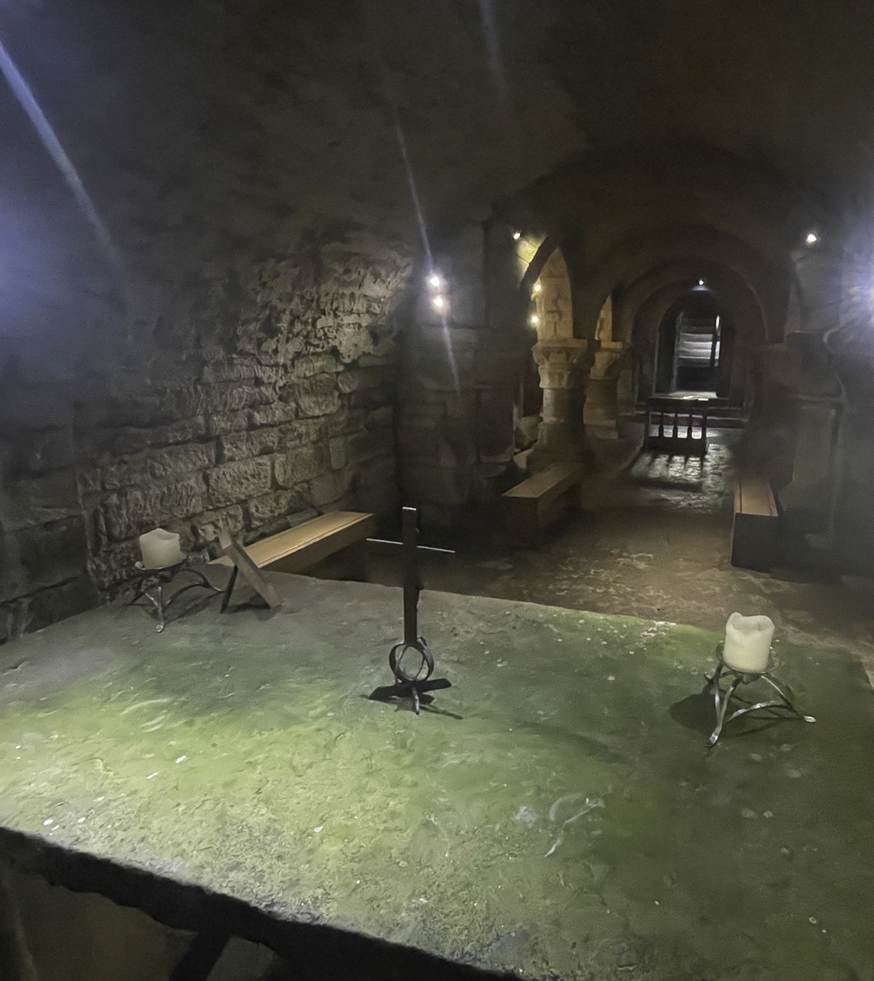
Lastingham’s Crypt
725 CE
A stone church replaced earlier wooden structures, although there
is a suggestion that the stone structure was started at the time of Cedd’s
death.
Later eleventh century masonry of the existing church was inserted
into a previously existing structure. It is likely that the shell of the crypt
dates to the seventh and eight centuries and may have been part of a pre existing structure, possibly of Roman funerary origin.
The Northumbrians do not appear to have built stone churches before Wilfred
rebuilt York and built Ripon in the 670s. Lastingham was established in the first
generation of Northumbrian Christianity. The original monastery was built of
wood. A stone church was built only after Cedd’s death when his body was translated
to the right side of the altar. (Lastingham in
its sacred landscapes, Ian Wood,
Professor of Early Medieval History, The Fifth Lastingham Lecture, 2008, page 6).
There are references to the founding of religious communities at
Coxwold and Stonegrave in 757 CE and fragments
evidencing religious communities at Middleton, Kirkbymoorside and Kirby
Misperton. The concentration of religious communities in Ryedale may have
arisen because the Deiran kings held extensive lands there.
Kings and aristocrats may have competed for control through
display of prominence by founding religious communities as a political act and
a statement of power and wealth.
The Scandinavian
Period
793 CE
The Viking raid on Lindisfarne (the place where Cedd was a pupil)
is generally taken to be the start of the period of Scandinavian domination,
though there were attacks in the years before 793 CE.
The historical record of Lastingham is silent during this period. Heather O’Donaghue gave a Lastingham Lecture to
try to piece together how the Scandinavian age might have influenced
Lastingham.
It has long been recognised that following a period of Viking
raids, there came a period of Scandinavian settlement, often taken to be
heralded by the Anglo Saxon Chronicle entry for 876 CE, and they proceeded
to plough and support themselves.
Yorkshire place names are a mix of Scandinavian and Anglo Saxon
and the North Yorkshire dialect includes words derived from Old Norse. The
evidence suggests a mixture of ethnic groups living together. There is
significant evidence of Viking Age sculpture and a fusing of Anglo Saxon and
Viking influences. There was no tradition of stone crosses in Scandinavia, but
there are crosses decorated with pagan and mythological scenes from
Scandinavian tradition. Sometimes Scandinavian tales were used to illustrate Christian
themes, such as Thor fishing for the World serpent, depicting Christ hooking
Leviathan. Evidence also comes from the hogback stones, with a profile like a
pig’s back, which are typically
Anglo-Scandinavian. There is a hogback
stone in the Lastingham crypt. These stones date from the first half of the
tenth century and are mostly found in North Yorkshire and Cleveland. They were
possibly grave markers and often include extensive Scandinavian scenes. They
appear to depict the permanence of Anglo-Scandinavian settlement in the area.
O’Donaghue suggests that like all immigrants, the Scandinavians probably
felt a fundamental conflict between their own beliefs and customs with the
local, and may have expressed a desire to fit in to their new home through
creative impulse. Anglo Scandinavian sculpture might be the expression of this
conflict.
870 CE
The monastery is believed to have been destroyed in 870 CE.
The Norman Conquest
1066
Domesday Book shows that Lastingham was an insignificant
settlement. In the main text it is counted as a separate manor, but there was
no demesne. The place was occupied by one prosperous villanus
who had one plough team. It was not given a separate value, and the so-called
index, probably a document used by the commissioners and then copied into
Domesday Book, gives Lastingham as an un-named part of the manor of Spaunton. Spaunton itself bears a
name which is partly Scandinavian, and the village may not go back to the early
Anglo-Saxon period. Even if we go back as far as the eleventh century, then,
Lastingham already appears a very different place from what it is today: then,
it was a farm on the edge of the moor. Four hundred years and more separate the
Lastingham of Domesday Book from the Lastingham of Cedd. (The foundation of
Lastingham, T M Charles-Edwards, Ryedale Historian,
Volume 7, 1974, page 16).
1078
William the Conqueror gave permission for the building of a new
church at Lastingham, for Benedictine monks from Whitby, under the authority of
Abbot Stephen of Whitby. A crypt was built where it was believed that Cedd’s
body had been laid to rest.
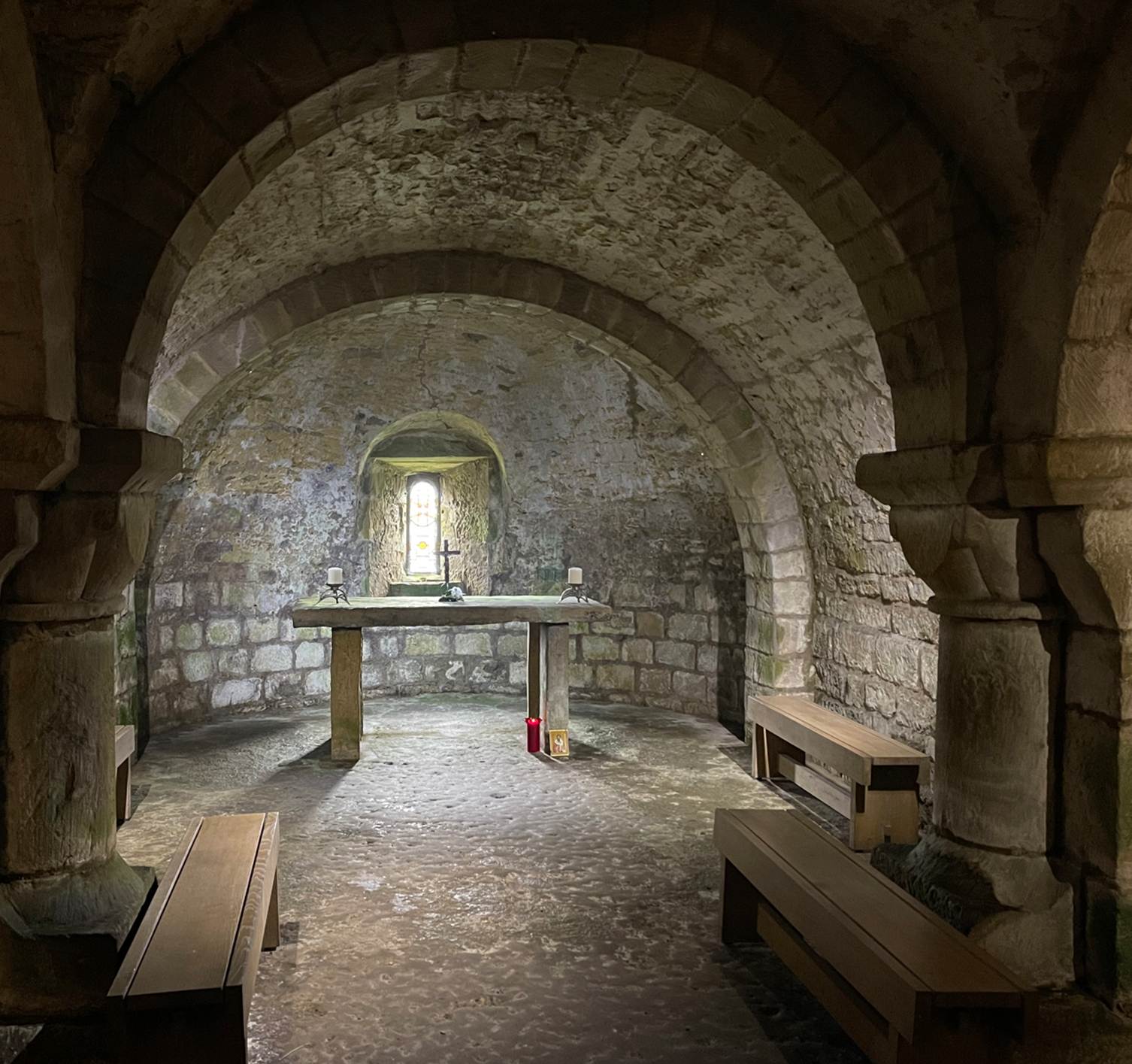
The Norman Crypt dates to the late eleventh century
The crypt is the only Norman Crypt with a nave, apse and side
aisles. The walls are nearly three feet thick.
1088
The monks left and the church was left to decay. It has been
suggested that the remoteness of the abbey and the outlaw nature of the area
forced them to relocate.
1228
A new parish church was built on the site. From 1228 a full time
priest was appointed and this has been the foundation of the parish church ever
since.