Cedd
c 620 to 26 October 664
The
life of Cedd
|
Return to the Home
Page of the Farndale Family Website |
The story of one
family’s journey through two thousand years of British History |
The 84 family lines
into which the family is divided. Meet the whole family and how the wider
family is related |
Members of the
historical family ordered by date of birth |
Links to other pages
with historical research and related material |
The story of the
Bakers of Highfields, the Chapmans, and other related families |
Headlines are in brown.
Dates are in red.
Hyperlinks to
other pages are in dark
blue.
References and
citations are in turquoise.
Context and local
history are in purple.
Geographical
context is in green.
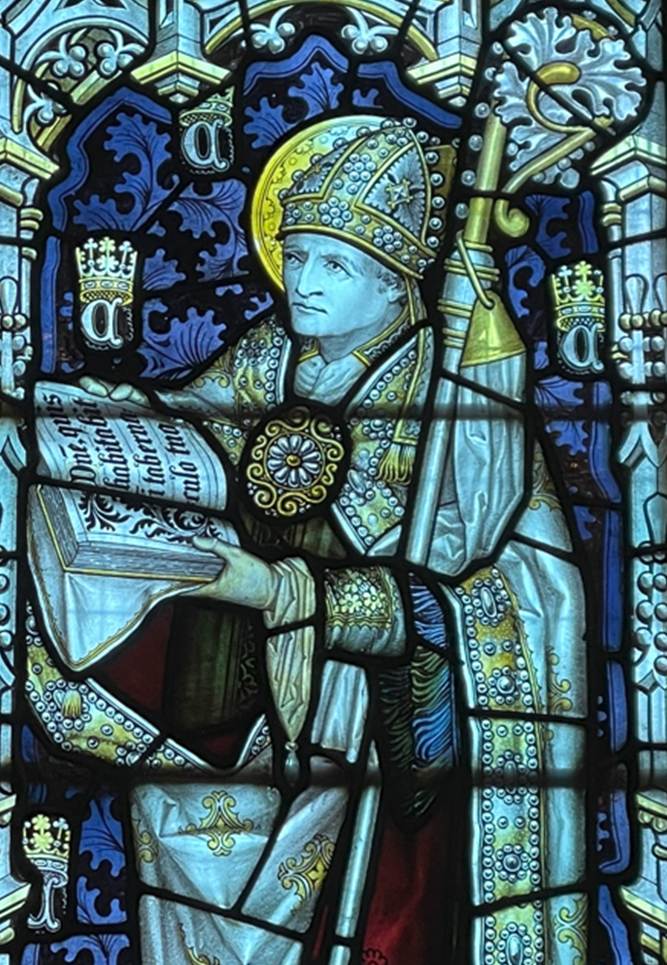
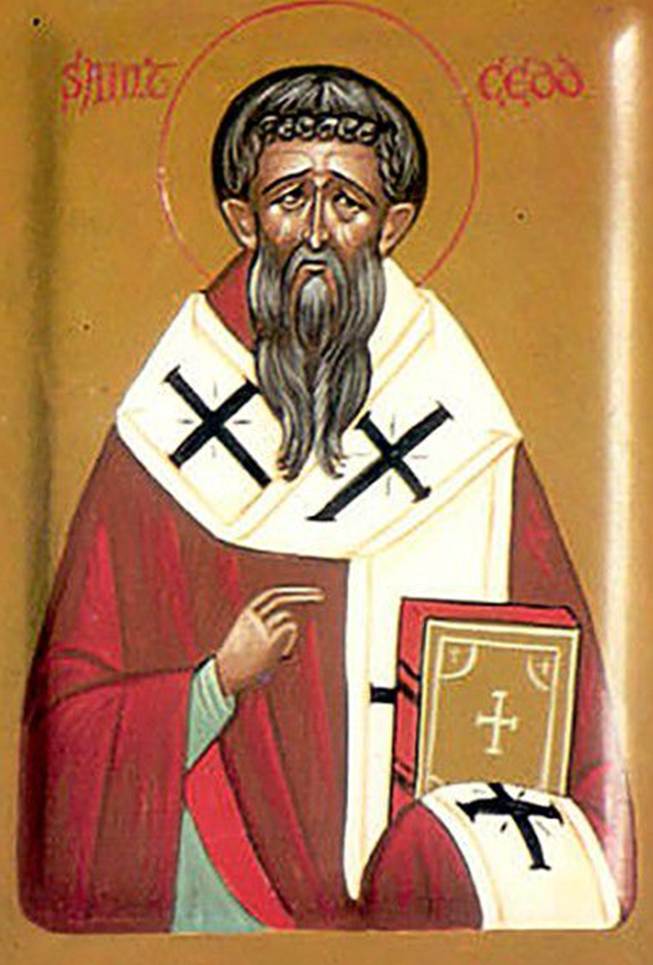
St Cedd (c 620 to
26 October 664) was one of a family of missionary priests, educated at
Lindisfarne under St Aidan, the most famous of whom was Chad, the first Bishop
of Lichfield. Cedd preached first to the
Middle Angles and then to the East Saxons. In about 653 CE he became their
Bishop.
c 620
CE
Cedd was born in
the kingdom of Northumbria and brought up on the island of Lindisfarne by Aidan
of the Irish Church. He had three brothers: Chad of Mercia (transcribed into
Bede's Latin text as Ceadda), Cynibil and Cælin. All
four were priests and both Cedd and Chad became bishops. Despite being of
apparent Northumbrian birth, the names of all four brothers are Celtic in
origin, rather than Anglo-Saxon.
651 CE
Cedd went to
study with the Irish after the death of Aidan (Bede,
Ecclesiastical History).
Aidan had come to
Northumbria from Iona, bringing with him a set of practices that are known as the
Celtic Rite. As well as superficial differences over the computus
(calculation of the date of Easter), and the cut of the tonsure (the
practice of cutting or shaving some or all of the hair on the scalp as a sign
of religious devotion or humility), these involved a pattern of Church
organisation fundamentally different from the diocesan structure that was
evolving on the continent of Europe.
In contrast, Irish
Christian activity was based in monasteries, which supported peripatetic
missionary bishops. There was a strong emphasis on personal asceticism, on
Biblical exegesis, and on eschatology. Aidan was well known for his personal
austerity and disregard for the trappings of wealth and power. Bede several
times stresses that Cedd and Chad absorbed his example and traditions. Bede
tells us that Chad and many other Northumbrians went to study with the Irish
after the death of Aidan.
653 CE
The first datable
reference to Cedd by Bede makes clear that he was a priest by the year 653 CE.
This probably pushes his birth date back to the early 620s. It is likely that
Cedd was oldest of the brothers and was acknowledged the head of the family. He
seems to have taken the lead, while Chad was his chosen successor.
Mercia
In 653 CE, Cedd
was sent by Oswiu of Northumberland with three other priests to convert the
Middle Angles, who were one of the core ethnic groups of Mercia, based on the
mid-Trent Valley. Peada of Mercia, son of Penda, was sub-king of the Middle
Angles. Peada had agreed to become a Christian in return for the hand of
Oswiu's daughter, Alchflaed (c.635-c.714) in
marriage. This was a time of growing Northumbrian power, as Oswiu reunited and
consolidated the Northumbrian kingdom after its earlier (641/2) defeat by
Penda. Peada travelled to Northumbria to negotiate his marriage and baptism.
Cedd, together
with the priests, Adda, Betti and Diuma, accompanied Peada back to Middle
Anglia, where they won numerous converts. Bede relates that the pagan Penda did
not obstruct preaching even among his subjects in Mercia proper, and portrays
him as generally sympathetic to Christianity at this point – a very different
view from the general estimate of Penda as a devoted pagan. But, the mission
apparently made little headway in the wider Mercian polity.
Bede credits
Cedd's brother Chad with the effective evangelisation of Mercia more than a
decade later. To make progress among the general population, Christianity
appeared to need positive royal backing, including grants of land for
monasteries, rather than a benign attitude from leaders.
East Saxons
Cedd was soon
recalled from the mission to Mercia by Oswiu, who sent him on a mission with
one other priest to the East Saxon kingdom. The priests had been requested by
Sigeberht the Good to reconvert his people.
The East Saxon
kingdom was originally converted by missionaries from Canterbury, where
Augustine of Canterbury had established a Roman mission in 597. The first
bishop of the Roman Rite was Mellitus, who arrived in Essex in 604. After a
decade, he was driven out of the area. The religious destiny of the kingdom was
constantly in the balance, with the royal family itself divided among
Christians, pagans, and some wanting to tolerate both.
Bede tells us
that Sigeberht's decision to be baptised and to reconvert his kingdom was at
the initiative of Oswiu. Sigeberht travelled to Northumbria to accept baptism
from Bishop Finan of Lindisfarne. Cedd went to the East Saxons partly as an
emissary of the Northumbrian monarchy. Certainly his prospects were helped by
the continuing military and political success of Northumbria, especially the
final defeat of Penda in 655. Practically, Northumbria gained hegemony among
the Anglo-Saxon kingdoms.
After making some
conversions, Cedd returned to Lindisfarne to report to Finan. In recognition of
his success, Finan ordained him bishop, calling in two other Irish bishops to
assist at the rite. Cedd was appointed bishop of the East Saxons. As a result,
he is generally listed among the bishops of London, a part of the East Saxon
kingdom. Bede, however, generally uses ethnic descriptions for episcopal
responsibilities when dealing with the generation of Cedd and Chad.
Bede's record
makes clear that Cedd demanded personal commitment and that he was unafraid to
confront the powerful. He excommunicated a thegn who was in an unlawful
marriage and forbade Christians to accept the man's hospitality. According to
Bede, when Sigeberht continued to visit the man's home, Cedd went to the house
to denounce the king, foretelling that he would die in that house. Bede asserts
that the King's subsequent murder (660 CE) was his penance for defying Cedd's
injunction.
After the death
of Sigeberht, there were signs that Cedd had a more precarious position. The
new king, Swithhelm of Essex, who had assassinated
Sigeberht, was a pagan. He had long been a client of Æthelwold
of East Anglia, who was increasingly dependent on Wulfhere of Mercia, the
Christian king of a newly resurgent Mercia. After some persuasion from Ethelwald, Swithelm accepted
baptism from Cedd. The bishop travelled into East Anglia to baptize the king at
Ethelwald's home. For a time, the East Saxon kingdom
remained Christian.
Bede presents
Cedd's work as decisive in the conversion of the East Saxons, although it was
preceded by other missionaries, and eventually followed by a revival of
paganism. Despite the substantial work, the future suggested that all could be
undone.
Cedd founded many
churches. He also founded monasteries at Tilaburg
(probably East Tilbury, but possibly West Tilbury) and Ithancester
(almost certainly Bradwell-on-Sea). Bradwell on Sea was a Saxon Shore Fort in
Roman times, called Othona, and the Anglo
Saxons called it Ithancester. Cedd’s
foundation of 653 CE survives as the restored chapel of St Peter on the Wall, one
of the oldest churches in Britain.
Lastingham
Cedd was
appointed as abbot of the monastery of Lastingham in his native Northumbria at
the request of the sub-king Œthelwald of Deira. Bede
records the foundation of this monastery in some detail, showing that Ethelwald was put in contact with Cedd through Caelin, one
of the bishop's brothers, who was on the king's staff. Cedd undertook a 40-day
fast to purify the site, although urgent royal business took him away after 30
days, and Cynibil took over the fast for him.
Cedd occupied the
position of abbot of Lastingham to the end of his life, while maintaining his
position as missionary bishop and diplomat. He often travelled far from the
monastery in fulfilment of these other duties. His brother Chad, who succeeded
him as abbot, did the same. Cedd and his brothers regarded Lastingham as a
monastic base, providing intellectual and spiritual support, and a place of
retreat. Cedd delegated daily care of Lastingham to other priests, and it is
likely that Chad operated similarly.
The Venerable
Bede writes of Cedd:
The same man of
God, whilst he was bishop among the East Saxons, was also wont
several times to visit his own country, Northumberland, to make exhortations. Ethelwald, the son of King Oswald, who reigned among the Deiri, finding him a holy, wise and good man, desired him
to accept some land to build a monastery, to which the king himself might
frequently resort, to offer his prayers and hear the word, and be buried in it
when he died; for he believed that he should receive much benefit by the
prayers of those who were to serve God in that place.
That prelate,
therefore, complying with the king's desires, chose himself a place to build a
monastery among craggy and distant mountains, which looked more like lurking
places for robbers and retreats for wild beasts, than habitations for men.
Bede goes on to
say that to cleanse the place from former crimes, S. Cedd planned to spend all
Lent there in prayer, but being called away on the king's affairs, his place
was taken by his brother Cynebil, who readily complied, and when the time of
fasting and prayer was over, he there built the monastery, which is now called Lestingau, and established therein the religious customs of
Lindisfarne, where they had been educated.
Bede also tells
us that S. Cedd was visiting his monastery, when he died of a pestilence.
He was first
buried in the open air; but in the process of time a church was built of stone
in the monastery, in honour of the Mother of God, and his body interred in the
same, on the right hand of the altar. The bishop left the monastery to be
governed after him by his brother Chad.
It has generally
been held that the monastery referred to was Lastingham, where the church is
dedicated to S. Mary. In 1846 D. H. Haigh claimed that it was Kirkdale.
He identified the coffin lid with the cross as that of King Aethelwald of
Deira, on the strength of the runic inscription. The other coffin lid with an interlace design, and the tassels of a pall on the edges,
was said to be that of S. Cedd. This theory has had few supporters.
664 CE
Cedd died of the
plague on 26 October 664 CE, probably that which followed the Synod of
Whitby in 664 CE.