Spreading out from Brotton and Loftus
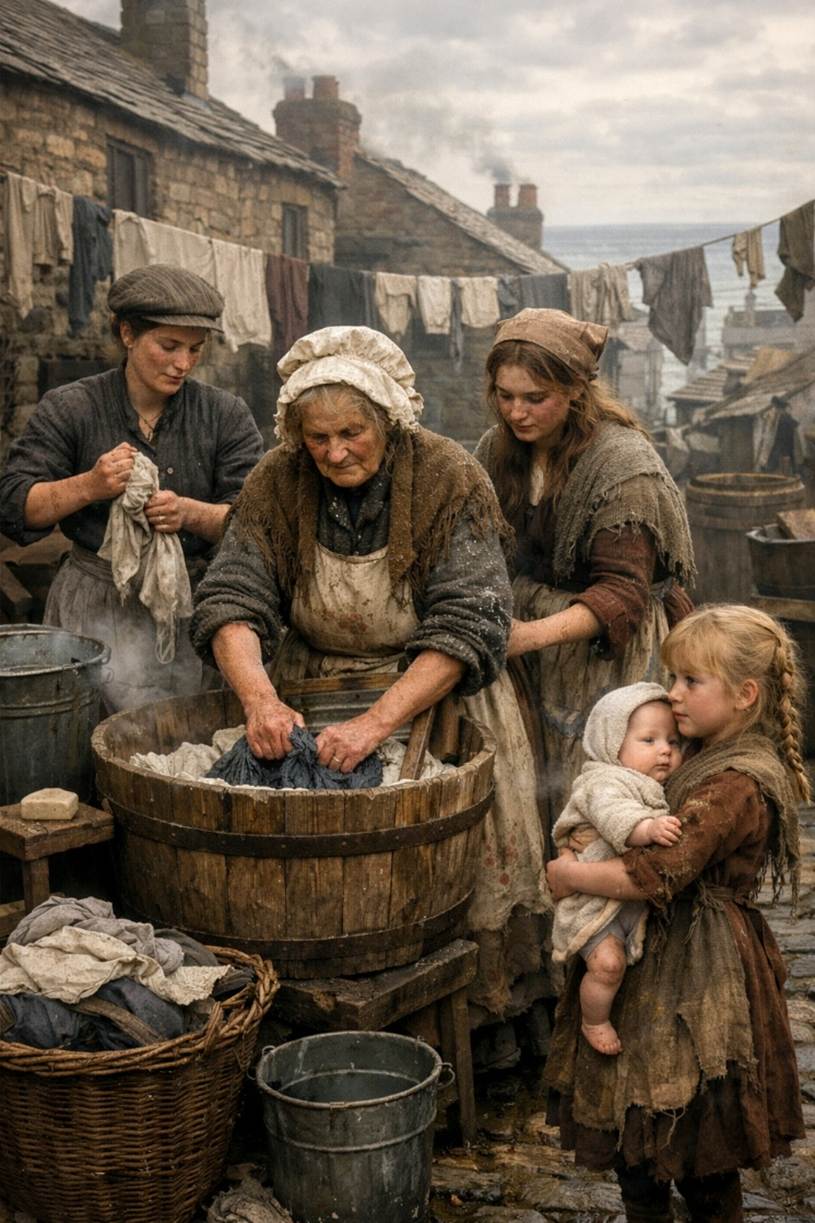
The story of a second large family,
with their heart around Brotton and Loftus and later Stockton and beyond
The Second Hub
|
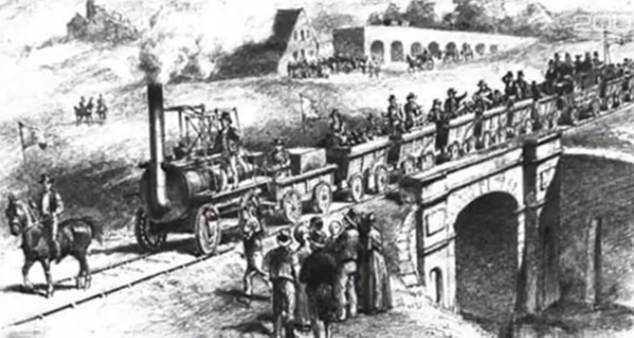
The Stockton to Darlington Railway
A
quick introduction to the Stockton to Darlington Railway, a backdrop to this
section of our family history. |
Introduction
We now meet
the second Hub of the family. This was another large section of the family who
initially also made Kilton their home for a
generation, before dispersing across Cleveland and beyond. They are a little
more difficult to define geographically as they dispersed widely. The heart of this
family began around Loftus, also once known
as Lofthouse, two kilometres east of Kilton;
and also around Brotton, two kilometres
north of Kilton. The family then became more
focused on the growing town of Stockton. This family were living in close
proximity to their relatives who we met in the last Act, but
they soon encountered very different and more challenging lives.
|
1690 to 1841 Skelton,
Brotton, Liverton, Kilton, Lythe, Whitby |
|
1680 to 1973 Kilton,
Brotton, and more widely over time |
|
|
|
1650 to 1709 Brotton, Skelton, Loftus |
|
|
|
|
|
|
|
|
|
1739 to 1833 Loftus, Whitby, Brotton |
|
1772 to 1917 Loftus,
Brotton, Whitby, Marske, Middlesbrough |
|
1725 to 1877 Kilton |
||
|
|
|
|
|
|
|
|
|
|
1796 to Date Stockton, Guisborough, Rothbury,
Northumberland |
1814 to Date Stockton,
Middlesbrough and more widely |
1914 to 1944 Surrey, Sussex |
1932 to Date California, Oklahoma, Arizona,
Washington |
|
|
|
|
|
|
|
|
|
|
|
|
1913 to Date Northumberland |
|
|
|
|
|
These were
folk who left the protection of the rural extended family, and struggled for
survival in the brave new world of Georgian and Victorian Britain. Their
resilience against the odds is sometimes inspiring, often tragic, and reflects
the challenges of Victorian Britain. Some made successful lives for themselves,
but many suffered, particularly during the terrible decade of the 1870s, the decennium
horribilis.
From 1873 to
1896, a period sometimes referred to as the Long Depression, most European
countries experienced a drastic fall in prices. This was a period of two
decades of stagnation, and this family suffered the worst of these years of
agricultural and economic struggle.
The stories
of struggle, alongside achievements against the odds, reveals a quiet
determination by this stoic branch of the family. When sorrows come, they
come not single spies, but in battalions[1].
In Scenes 1
and 2 we meet two small families who had married out of the Farndale family by
the mid nineteenth century. In the remaining scenes, we meet individuals from
whom some members of the modern Farndale family descent.
Scene 1 – The Family of Loftus
|
1690 to 1841 Skelton,
Brotton, Liverton, Kilton, Lythe, Whitby |
|
|
|
|
|
1739 to 1833 Loftus, Whitby, Brotton |
|
William Farndale
(1690 to 1782) was the son of George and Ellis
Farndale of Liverton and Loftus. We met George in Act 12 and you might remember
that he was fined for letting his horse graze on the Common at North Loftus in 1700[2].
William was
born in Liverton and baptised there on 23
November 1690[3].
He was a church warden at Skelton
in 1729[4]
and in 1738 he married Mary Butterwick of Brotton[5].
He seems to have lived in Kilton, and they
had five children who were baptised at Skelton church, but were
probably born in Kilton which lay within
the Skelton estate. He died
in 1782 and was buried at Brotton[6].
William and Mary
had five children. The youngest was John Farndale who
worked in Ormesby[7]
now in Middlesbrough and later took
property[8]
with his brother, William, in Loftus. William and Mary’s
third child was George Farndale, who was baptised in Skelton on 26
May 1743[9].
By 1765, George, aged 22, was a seaman living in Liverpool and Chester, when he
married Ellen Ansdale, a widow of Liverpool at St George’s Church, Liverpool on
21 August 1765.
William Farndale The Younger (1739 to 1813) was the older brother, baptised in Skelton on 3 January 1739[10].
William married
Hannah Toes of Lythe in 1761[11],
where they lived until about 1765 before they moved to Loftus[12].
Loftus was the family home of William’s
grandparents, George
and Ellis Farndale, so this probably felt like moving back to the paternal
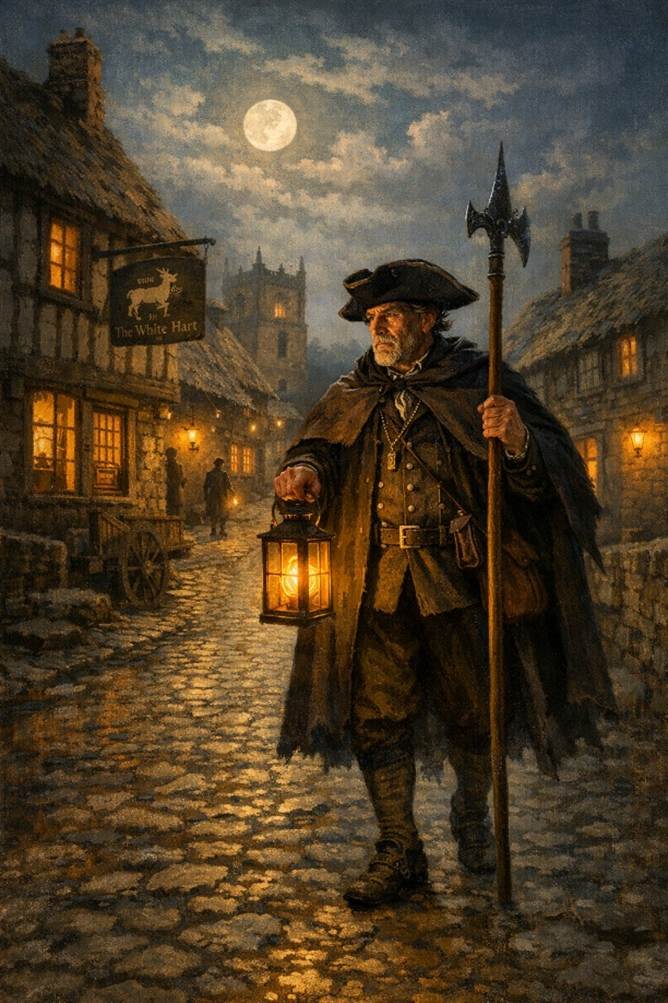
family home. William seems to have quickly established himself in Loftus and in 1781 at this Court Leet
William Farndale was elected and sworn as Constable for the year for South and
North Loftus[13].
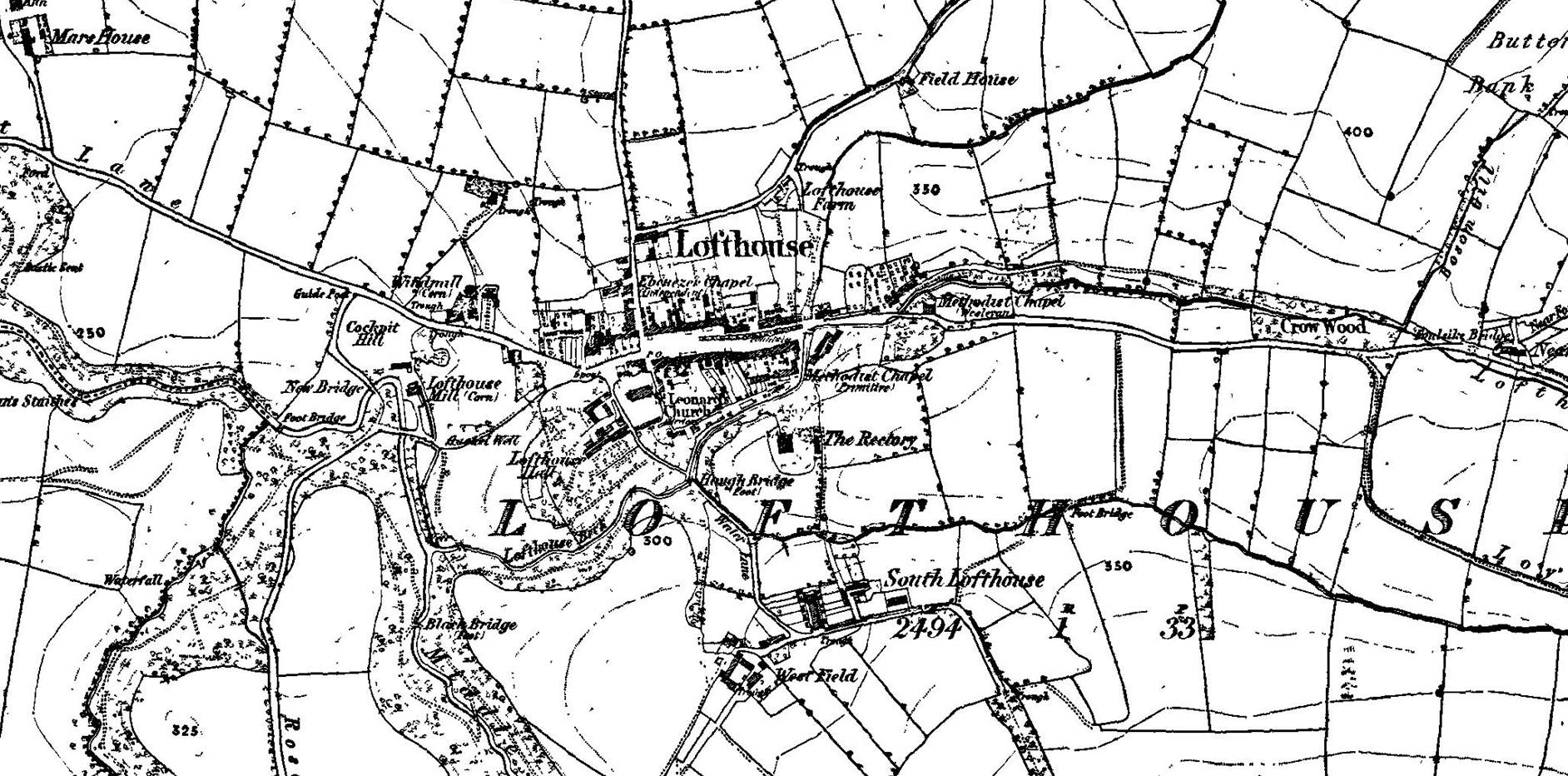
Loftus
(‘Lofthouse’) in about 1850
Law
enforcement and policing before the eighteenth century were not administrated
nationally, but organised by local communities such as town authorities. Within
local areas, a constable could be attested by two or more Justices of the
Peace. From the 1730s, local improvement Acts made by town authorities often
included provision for paid watchmen or constables to patrol towns at night,
while rural areas had to rely on more informal arrangements. In 1737, an Act of
Parliament was passed for better regulating the Night Watch of the City
of London which specified the number of paid constables that should be on duty
each night. Henry Fielding established the Bow Street Runners in 1749 and
between 1754 and 1780, Sir John Fielding reorganised Bow Street like a police
station, with a team of efficient, paid constables. Parish constables, played a
variety of roles, and in more populated areas could make a reasonable living
from fees. They were professional, competent, and entrepreneurial. They were
regulated to some extent by systems of legal incentives and warnings. The main
form of oversight on them, and limit on their power, was the possibility that
they might be subject to a lawsuit. Watchmen in towns were waged, with less
legal power than constables, and subject to more supervision, including periods
of definite duty.
By 1784, William Farndale
The Younger was a freeholder and tenant of property in South Loftus. Hannah died in 1801[14]
and William The
Younger lived until the age of 75 and was buried in Loftus on 19 June 1813[15].
William Farndale
The Younger and Hannah had a family of five, the Loftus 1 Line.
Their
youngest son was John
Farndale (1772 to 1828) who lived his life in Loftus, where he died aged 85
on 9 August 1836[16].
These were
generations who were starting to leave the stability of the family nest, but
still generally remained within the same locality.
Scene 2 – A small Kilton Family
|
1650 to 1709 Brotton, Skelton, Loftus |
|
|
|
1725 to 1877 Kilton |
There was
another family who settled at Kilton
in about 1750. William Farndale
(1727 to 1789), the son of William and Mary
Farndale of the Brotton 1 Line,
married Mary Taylor in 1750[17]
and he became a farmer at Craggs.
William died
at the age of 50 on 27 April 1777[18],
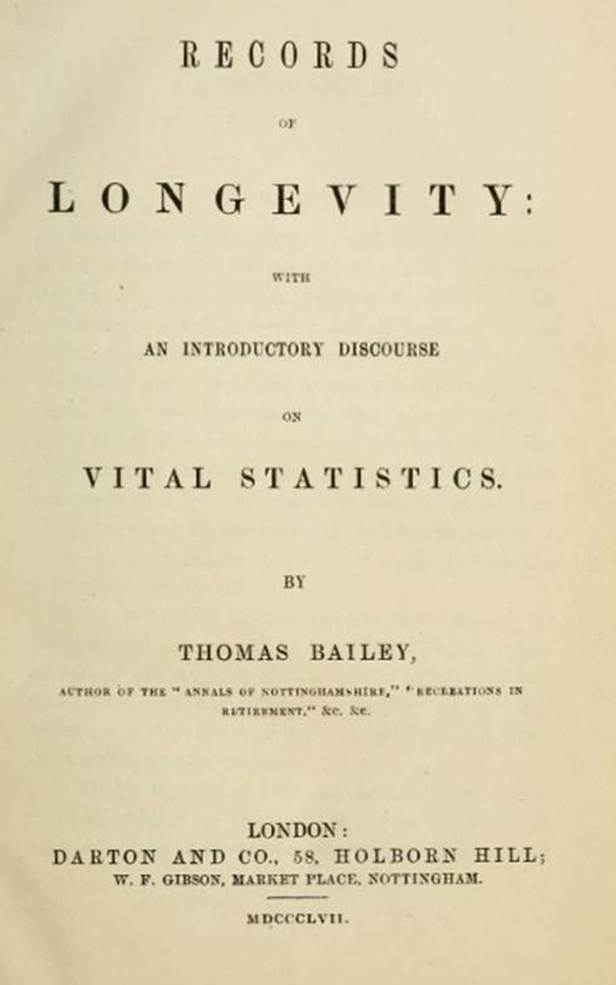
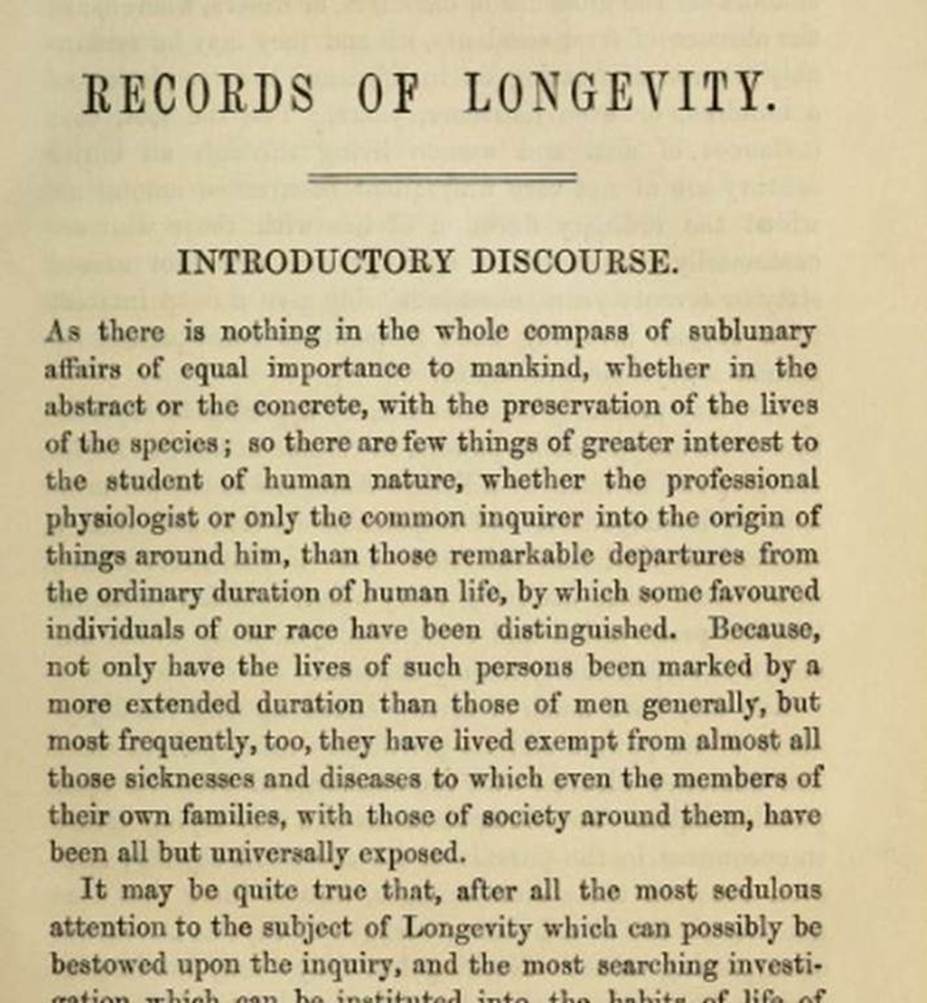
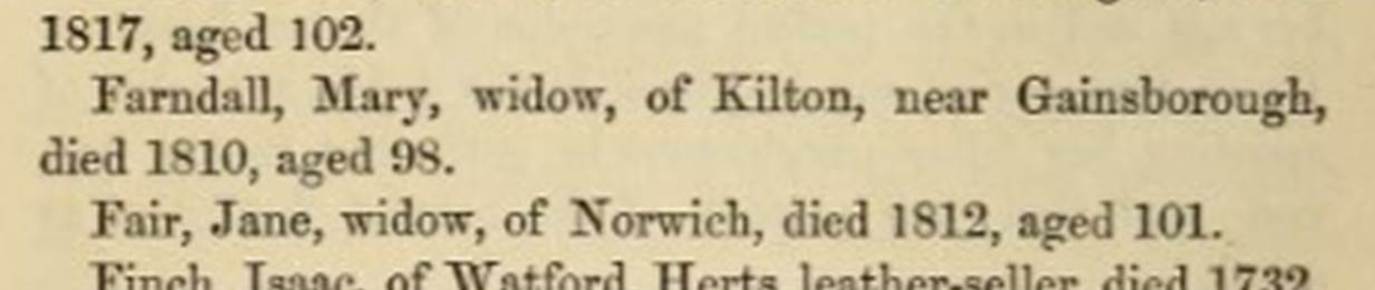
but his wife lived to the age of 98 and died in 1810[19].
So remarkable was Mary’s age that she
featured in a Victorian volume known as Bailey’s Records of Longevity[20].


William and
Mary Farndale had two sons and the younger son, John Farndale[21]
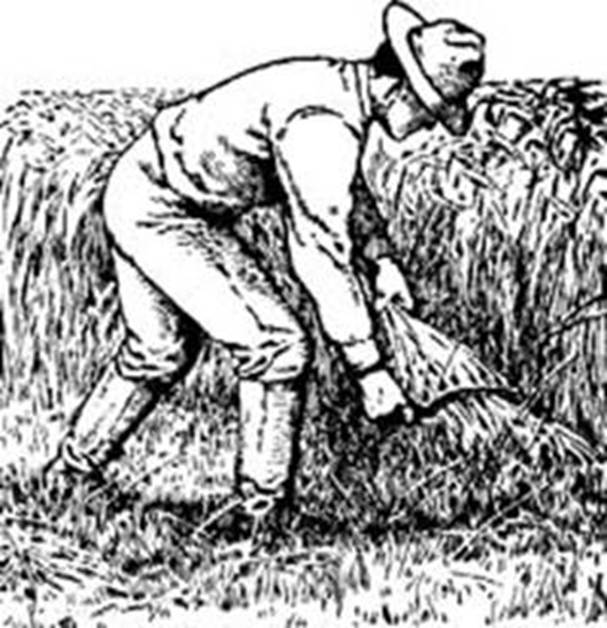
(1755 to 1829) was a husbandman[22]
and later a farmer in Kilton too[23].
John married
Hannah Wilson[24]
and they had a family of six, including Wilson Farndale
(1794 to 1857) who worked as an agricultural labourer in Lythe[25],
and John Farndale
(1799 to 1877) who was a farmer of 143 acres at Long Newton near Stockton[26]
and sat on a jury in 1845[27].
In 1847 John
Farndale the Younger was praised at a meeting with Lord Londonderry. We
also beg to recommend to your Lordship the names of the following tenants who
deserve commendation for the spirited manner in which they have cultivated
their farms, viz Mr Farndale, Long Newton[28].
The twenty first century Farndale family
does not descend from this small Kilton family, but this small family worked
alongside their relatives, the Kilton
1 Line and
the Kilton 2 Line.
Scene 3 – The family of Brotton
|
|
1680 to 1973 Kilton,
Brotton, and more widely over time |
|
|
|
|
|
|
|
|
|
|
1772 to 1917 Loftus,
Brotton, Whitby, Marske, Middlesbrough |
We met John and
Jane (nee Pybus) Farndale in Act 13 Scene 3. They had a family of eight, the Brotton 3 Line, all baptised
in Brotton.
John and Jane’s family were brought up at Kilton where John was a farmer. It was John’s
younger brother William Farndale who became a merchant and more
substantial farmer at Kilton over time. By contrast, John’s family worked
smallholdings which seem over time to have been insufficient to support them,
and the family were forced to seek new opportunities where they could.
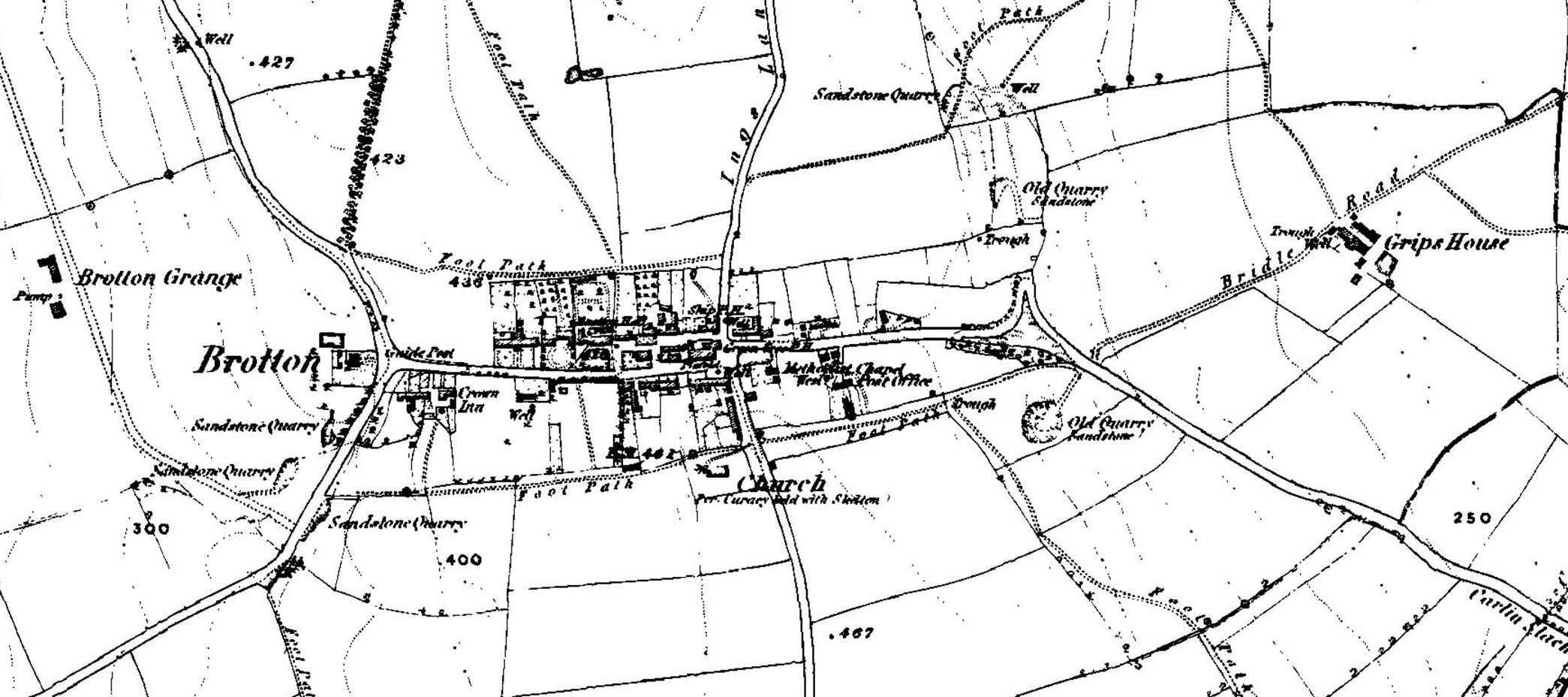
Brotton
in about 1850
Jane Farndale was
their second child. She married Isaac Robinson in Loftus on 9 November 1824[29],
and died there in 1845, aged only 46[30].
Hannah Farndale
married a farmer, George Ventress, in 1843, aged 38,with whom she had three
children. By 1851, the family were farming a smallholding of 33 acres in
Brotton[31],
reduced to 25 acres by 1861[32].
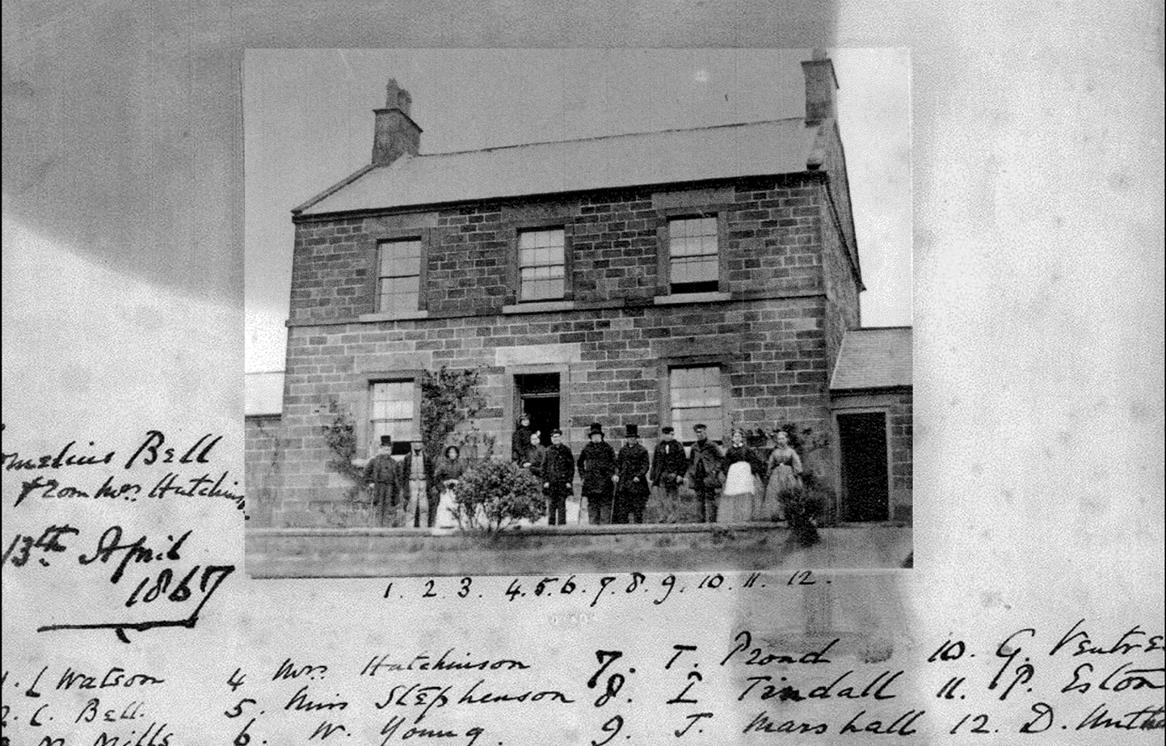
George
Ventress (labelled 10) at Brotton Hall, 13 April 1867
Mary Farndale
died in infancy in 1811[33].
Mary Ann
Farndale married a cartwright called John Porritt of Moorsholm[34].
William
Farndale was John and Jane’s third child,
born on 9 August 1801[35].
He was an agricultural labourer when he married Jane Scott at the Chapelry in
Brotton on 31 May 1841[36].
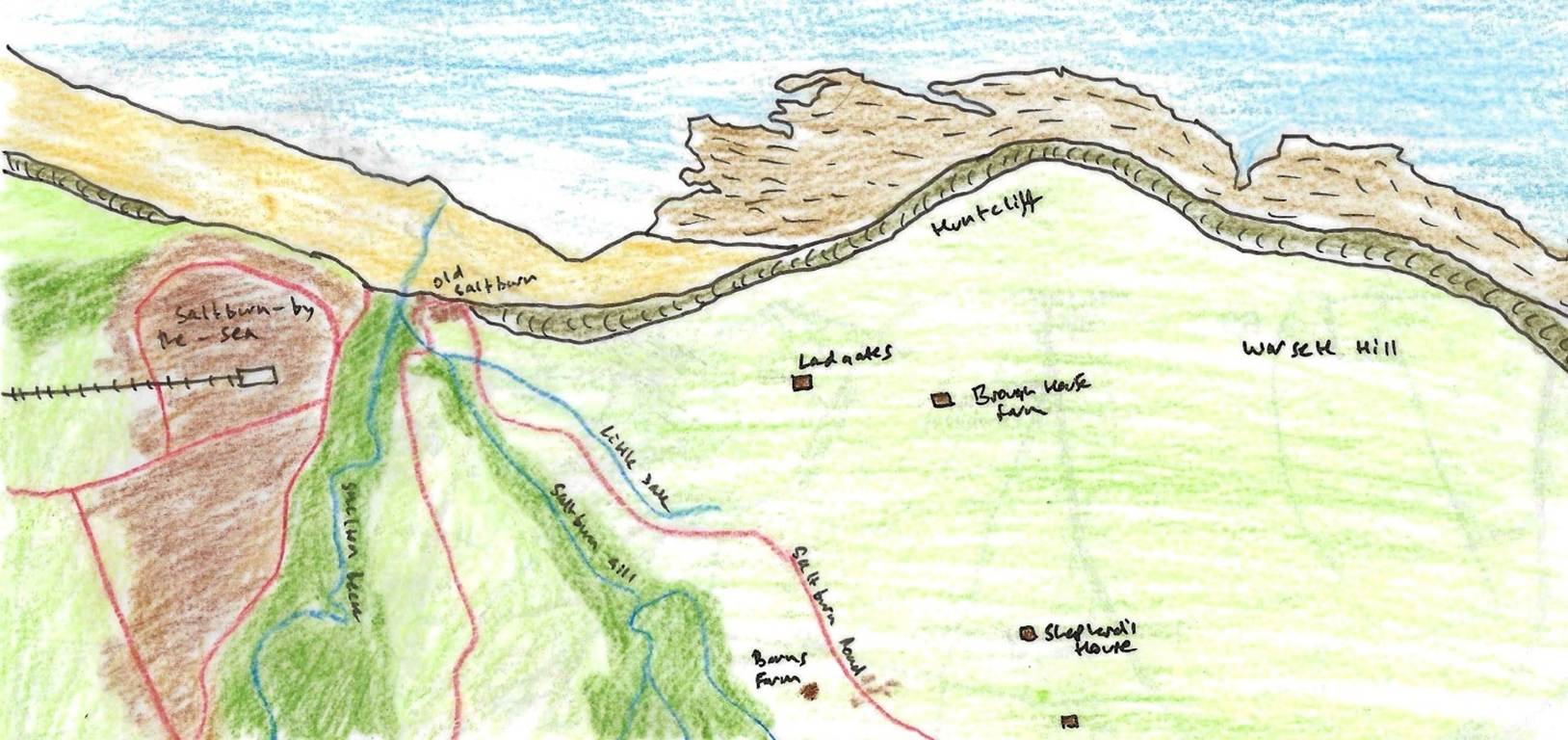
By 1851 he had taken a small farm at Ladgates on the
cliffs of Huntcliff near Old Saltburn. We will pick up the tragic story of his
family in Scene 6.
George Farndale
remained around Kilton and we will meet him again in Scene 7.
John Farndale and Robert Farndale
both began new lives in Stockton and we will turn to their stories next.
Scene 4 – A Stockton Family
|
|
|
1772 to 1917 Loftus, Brotton, Whitby, Marske, Middlesbrough |
|
|
|
|
|
|
|
|
|
|
1796 to Date Stockton, Guisborough, Rothbury, Northumberland |
1814 to Date Stockton, Middlesbrough and more widely |
Stockton
From the end of
the eighteenth century the Industrial
Revolution changed Stockton-on-Tees from a
small and quiet market town into a flourishing centre of heavy industry. The
discovery of iron ore in the Eston Hills resulted in blast furnaces lining the
River Tees from Stockton to the river's mouth. Iron-making, engineering
industries, and shipbuilding expanded along the River Tees.
As Stockton’s
population began to expand, in 1820 an Act set up the Commissioners, a body
with responsibility for lighting and cleaning the streets. From 1822
Stockton-on-Tees was lit by gas.
Then, in 1825,
Stockton witnessed an event which changed everything and heralded the dawn of a
new era in trade, industry and travel. The first rail of George Stephenson's
Stockton and Darlington Railway (“S&DR”) was laid near St John's crossing on
Bridge Road. Hauled by Locomotion No 1, Stephenson himself manned the engine on
its first journey on 27 September 1825. This was the world's first passenger
railway, connecting Stockton with Shildon. This linked the town with the coal
mines of County Durham, boosting Stockton's economy by facilitating the
transport of coal and other goods to its port.
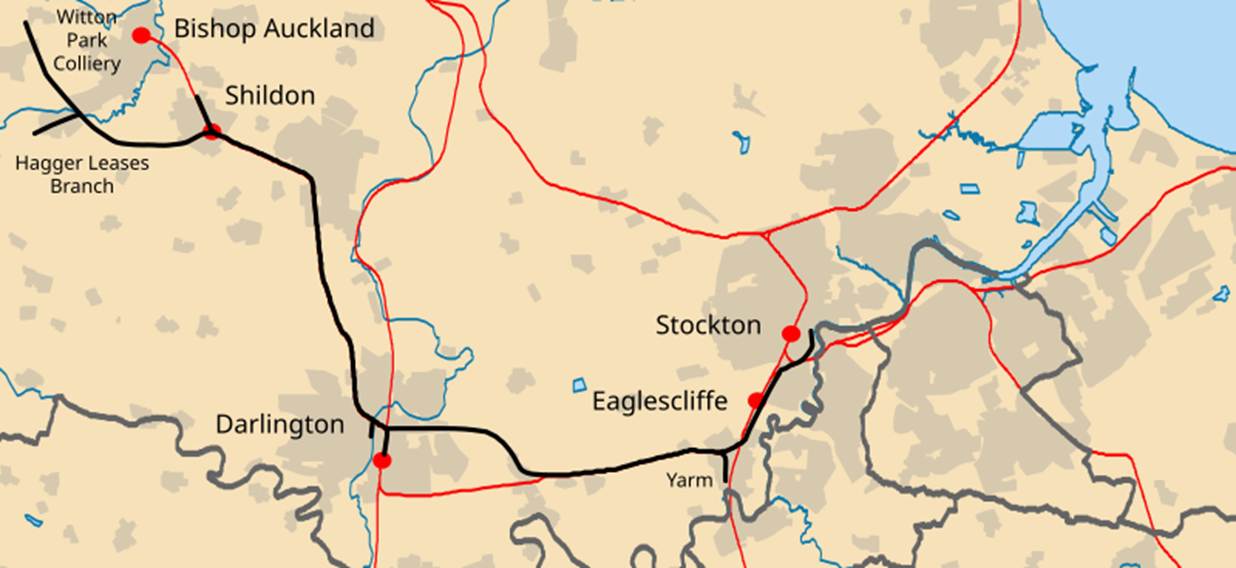
The route of the Stockton &
Darlington Railway in 1827, shown in black, with today's railway lines shown in
red
Stockton
witnessed another discovery in 1827. Local chemist John Walker invented
the friction match in
his shop at 59 High Street. The opening of the railway greatly boosted
Stockton, making it the temporary epicentre of engineering innovation.
The S&DR operated from 1825 to
1863. The rapid industrial expansion led to a
significant increase in population as migrant workers moved in seeking
employment. The town's population was 10,000 in 1851.
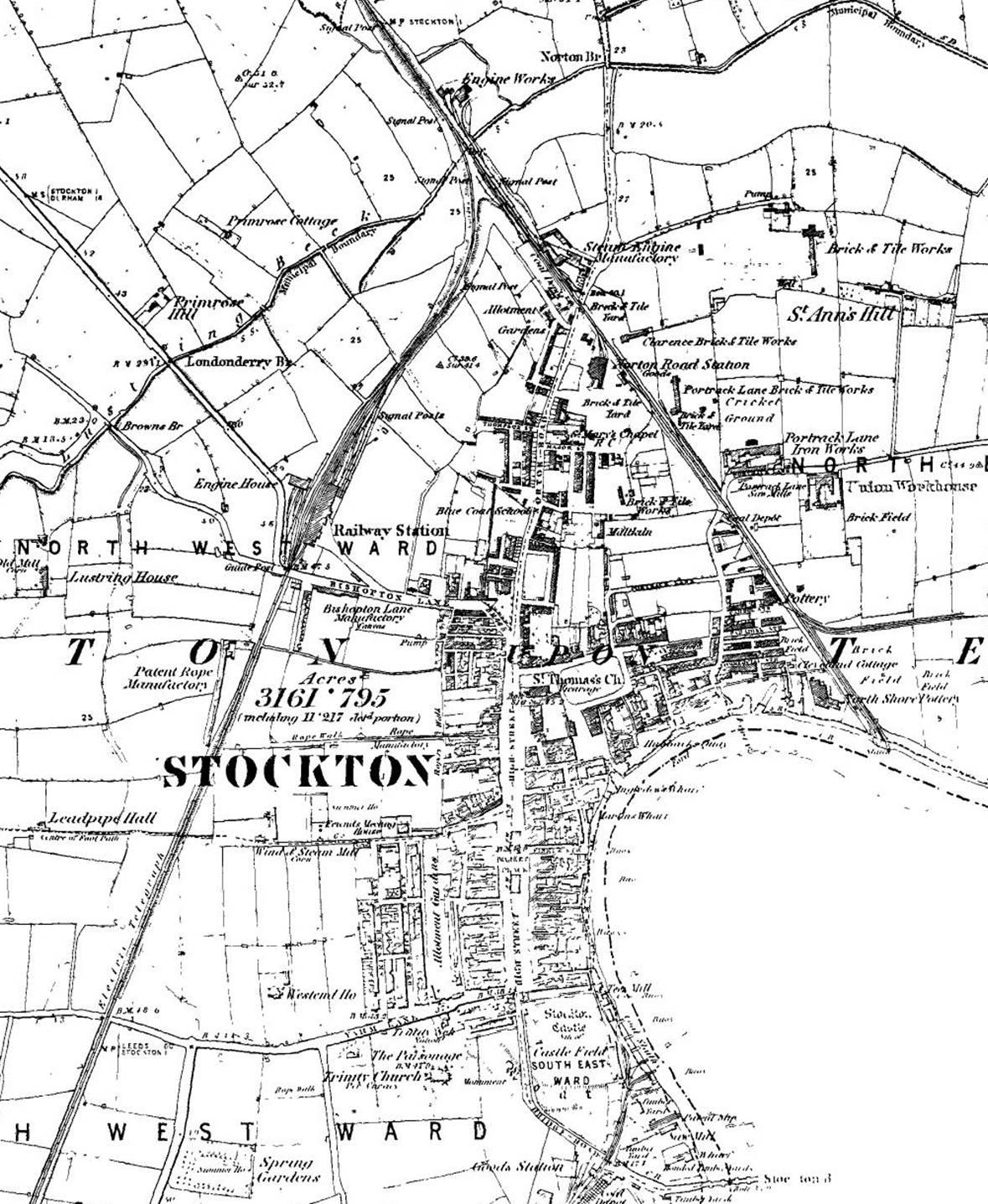
Stockton, 1867
However, the same railway infrastructure soon
led to the development of a new port further downriver, called Port Darlington,
which later became Middlesbrough, where business increasingly moved, causing
the port of Stockton to decline in importance as the nineteenth century
progressed.
We have already visited Stockton in
Act 13, following John Farndale The Author’s exploits there from the 1850s to 1873. He did not make Stockton his
permanent home, but we now meet his cousins, who did.
John Farndale Senior and Elizabeth
Wallace
John Farndale (1796 to 1868) was the eldest son of John and Jane Farndale
born on 16 March 1796 in Kilton and baptised in Brotton[37].
He married Elizabeth Wallace at Hinderwell, near Staithes and Runswick Bay, on
30 December 1827[38]
and worked for a while on farms at Kildale[39]
near Great Ayton before he became a Yeoman Farmer in Skelton. In 1830 a Bill of
indictment for felony was issued against Hannah Bradley and Jane Mark both
single women, lately of the House of Correction at Northallerton, for stealing
three pecks of wheat value 3s, the property of John Farndale. The offence was
committed at the parish of Skelton on 6 October 1830.[40]
In 1831, a
certain Masterman Patton appointed John Farndale and
William Hugill to act as trustees and executors[41]
to resolve the division of Masterman Patton’s farm between his daughters after
he died. The somewhat complex arrangements suggest that John Farndale was
respected in the local community in Skelton. However he seems to
have then worked on an off as a farmer and farm worker particularly around Coatham.
However,
twenty years later in 1851, John seems to have lost his farm and was working as
a farm labourer, having suffered bankruptcy[42].
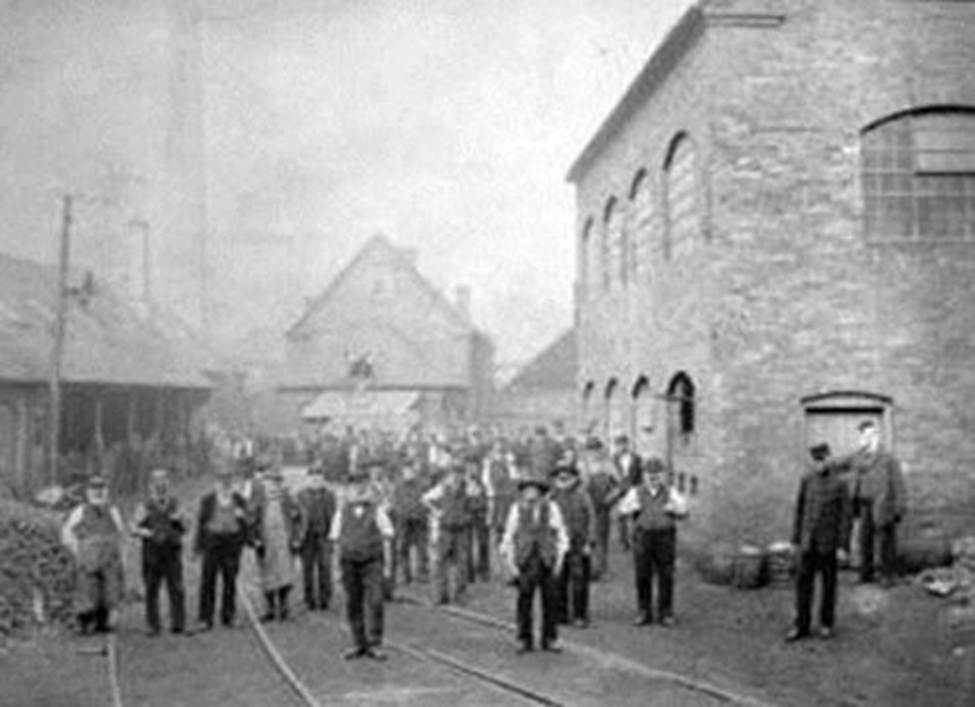
By 1861 the family had moved to Stockton[43],
where John was
working in the iron foundry. However this seems to have been temporary work and
by 1865, when his son George married, he was a farmer in or around Stockton[44].
Iron
Foundry, Stockton
John died in Stockton in 1868, aged 72, a farmer, but
living in Stockton at 8 Queen Street. His daughter Sarah was with him when he
died[45].
John and Elizabeth Farndale had a large family of ten children who made Stockton their home. This was a time of
momentous change in Stockton.
John Farndale Junior, the grocer’s assistant
John
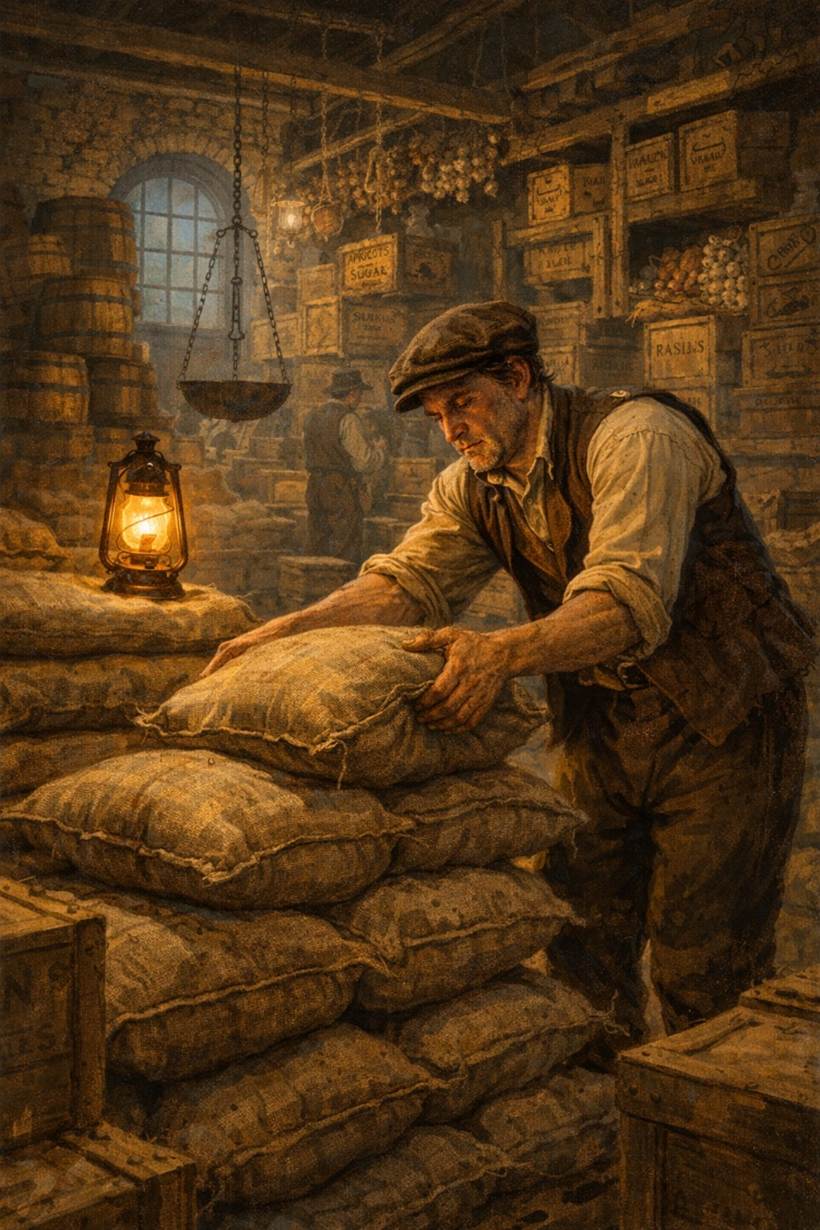
and Elizabeth Farndale’s eldest son was John Farndale
(1829 to 1899) who became a grocery warehouseman in Stockton[46].
After his first wife Ann Thrattles died[47]
John married his sister in law, Ellen Thrattles in
1873[48].
John and Ann had five children. Their daughter Mary Ann married Ralph Gibbon[49]
and returned to Kilton by 1881 where Ralph worked at the ironstone mine. Their
son William died in Stockton at the age of 11[50].
Jane Ellen Farndale was born in Stockton in 1864[51].
By 1881 she worked for a butcher at Billingham, north of Middlesbrough[52]
and worked for the same person, by then a cattle dealer, in Stockton by 1891[53].
She died in South Shields in 1951, aged 87[54].
Sarah Hannah Farndale married a Stockton book binder[55].
Her son, Alfred Farndale Windross, continued the book binding business in
Stockton[56]
and Sarah died in West Hartlepool aged 86 in 1953[57].
The youngest sibling was Margaret Elizabeth Farndale, who didn’t marry, but
became a teacher in York[58].
John died, aged 69, in 1899 in Stockton[59].
George
Farndale, the Druggist
John and Elizabeth
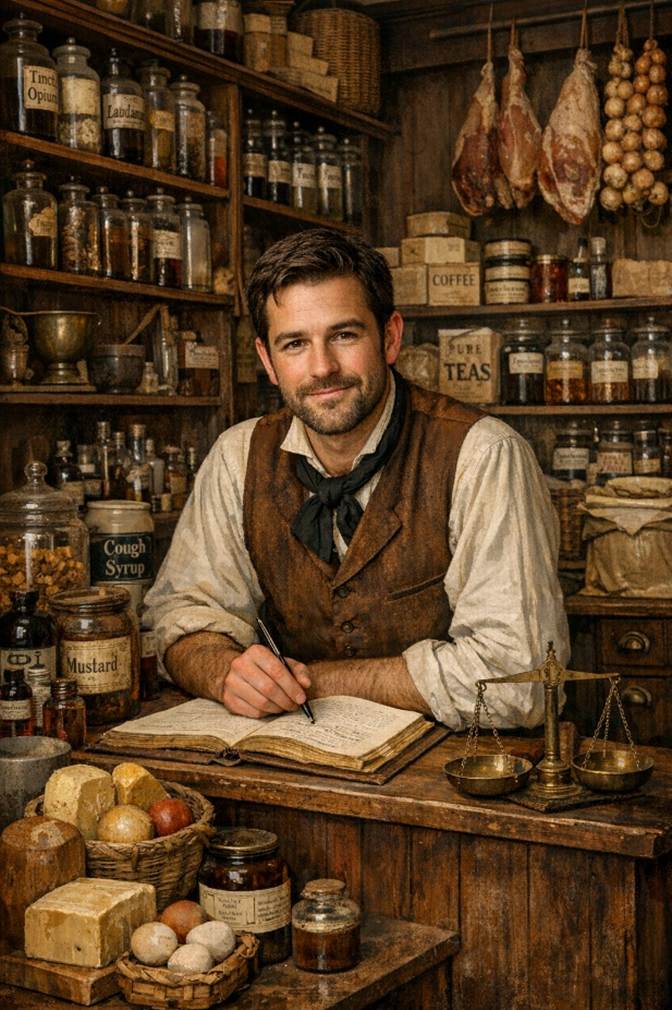
Farndale’s second son was George Farndale
(1835 to 1887) who became a druggist and grocer in Stockton[60].
George married Catherine Wemyss Leng in
1865 at Salem Chapel, Stockton[61].
At Christmastime in 1873 George, like his father, was forced to petition for
bankruptcy and his chemist, druggist and grocery business went into liquidation[62].
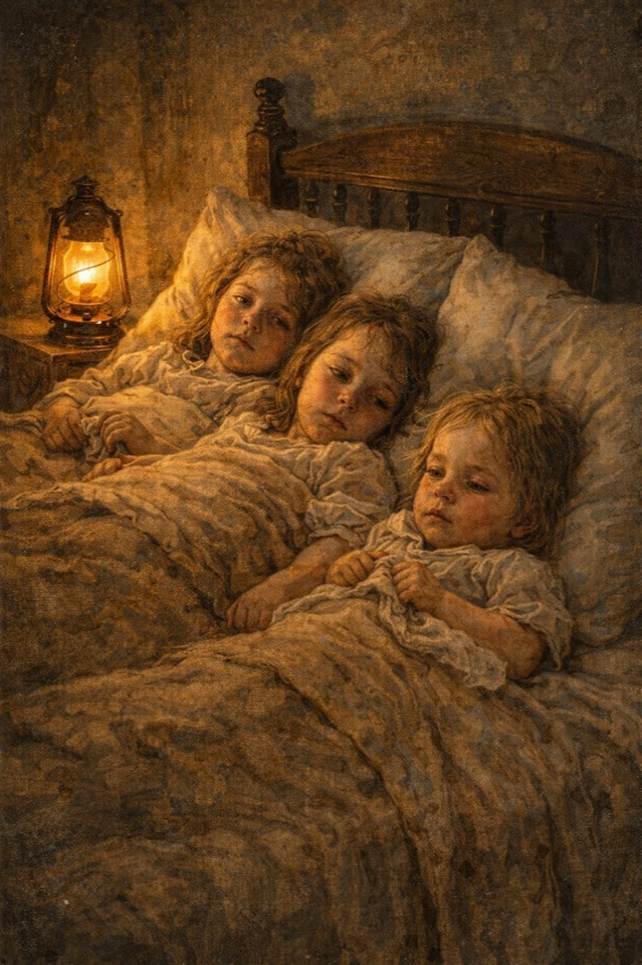
George and
Catherine suffered further tragedy when their three daughters, Mary Frances
Farndale, Catherine
Wiley Farndale, and Annie Louisa
Farndale, all died aged 7, 4 and 3 within nine days of each other at
Christmas, between 17 and 26 December 1874[63].
There was a smallpox pandemic in 1870 to 1874, which originated in France. The Vaccination
Act 1853 helped to mitigate its effect in England, but perhaps this pandemic
was the cause of three sisters dying in the same year. There was also a cholera
epidemic at that time. This was also at the time when George’s grocery
business was struggling. When the last of the three girls died in such short
succession, an unspeakably sad notice on 2 January 1875 seemed to summarise the
ill fortune that the family had met, Death on the 26th Dec, at
Newport Road, Middlesbrough, Annie Louisa, aged three years, the beloved and
last surviving daughter of Mr Geo Farndale[64].
The 1870s was the Stockton Farndales decennium horribilis.
However,
out of these tragic circumstances, the younger brother, William Leng
Farndale, survived, and he has a story to tell, which we will pick up in
Scene 8.
In 1875 George served on
a jury in Northallerton[65],
by which time he had restarted a chemist business. However he seems to have
been made bankrupt again in 1878[66].
Micawber
was waiting for me within the gate, and he went up to his room (top storey but
one), and cried very much. He solemnly conjured me, I remember, to take warning
of his fate; and to observe that if a man had twenty pounds a year for his
income, and spent nineteen pounds nineteen shillings and sixpence, he would be
happy, but that if he spent twenty pounds one, he would be miserable.[67]
After his
second bankruptcy, George
and Catherine moved to 22 Great Oxford Street, Liverpool, where he was a
druggist’s assistant, lodging with a Russian and German family of tailors[68].
He died aged 52 in Gateshead in 1887[69].
George’s widow, Catherine, remained in Gateshead with their remaining son,
William[70].
Catherine worked as a dressmaker and William took a post as a clerk at the iron
foundry. She later lived with William at their new home at Rothbury, Northumberland[71]
where she remained until she died in 1926, aged 89[72].
Five
Daughters and a son
Of John and Elizabeth’s
next six children, Peter
Wallis Farndale, Hannah
Farndale, Sarah
Farndale and probably Jane
Farndale all died in infancy in the 1840s. Mary Farndale and a younger Sarah Farndale both married.
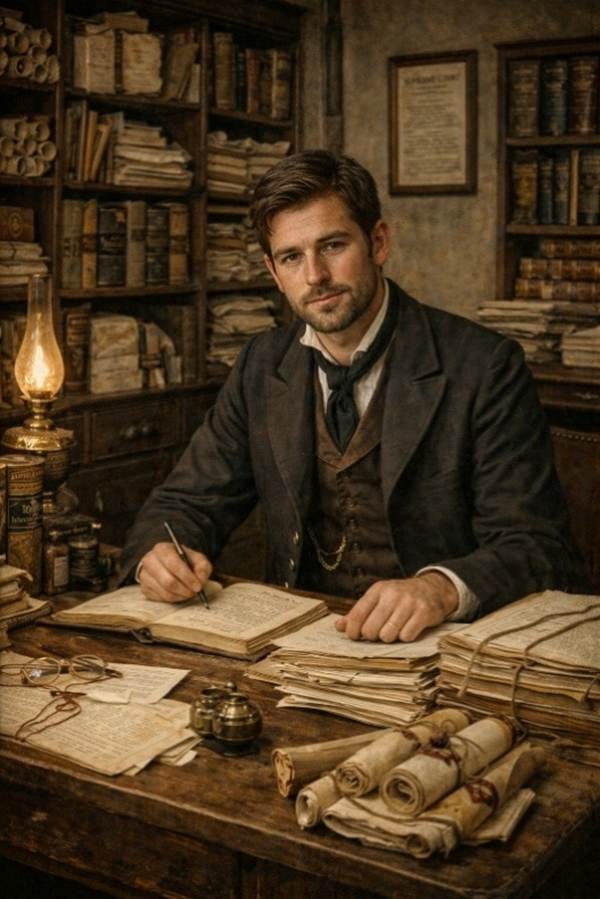
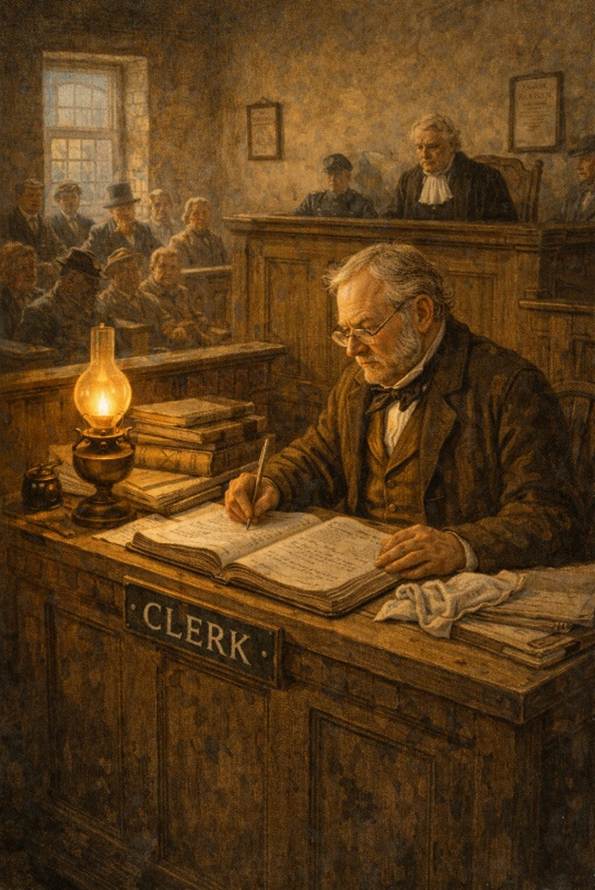
The Court
Clerks
The youngest
sons of John and
Elizabeth Farndale were William Farndale
and Peter Farndale,
who both became solicitors’ and court clerks in Stockton[73].
Both brothers took active roles in legal proceedings in the Stockton courts during the second half of the
nineteenth century.
William and Peter Farndale
were at the centre of the colourful life of Victorian Stockton.
Peter
Farndale regularly helped to clarify the law on various matters. On 18 May
1878 a case of threat and assault came before the court when there was a
complaint about the milk being short, and the female accused had replied
to her complainant that she wanted none of her nonsense. A further
altercation ensued and Mrs Oliver ejected the female from the cow byer. She
quickly returned and said that if she did it again she would smash her face,
and to a certain extent carried out that threat by doubling her hand into
prosecutrix’s face. Mrs Oliver also called the defendant a “wizen faced old
devil”. The male prisoner, having heard the disturbance went towards them and
told his wife that if she didn't smash prosecutrix’s face he would smash hers.
He told his wife to “pull the cat and croker.”
The accused gave evidence that she knew nothing about watering the milk that
was to be sent to the Union, as the doctor would not allow it. She might have
used the words “wizen faced old devil”, but not a stronger expression. John
Finlowe, a lad who said he was groom; George Barker, the milk boy; John
Kilgore, another boy; and the manservant, Stephen Davey, all spoke to Mrs
Oliver putting the female prisoner out of the byer, and then the latter
threatening her if she did that again. Mr Hutchinson, the magistrate,
said the question of the water had not come out in evidence. Mr Draper replied
that he could produce the girl who would prove it. Mr Farndale, the deputy
clerk, said the prisoner could not call witnesses in a case of this nature.
The female prisoner was then discharged, and her husband bound over to keep the
peace for two months, himself in £10, and one surety in £5. Mr Hutchinson
observing as he left the bench that he did not think all the evidence had come
out. There had been some intimidation amongst the boys. Mr Draper denied
anything of the kind on his on the part of his clients.[74]
Peter was not
shy of directly enforcing the peace in Stockton. On Tuesday 15 October 1878 an
Irishman named Samuel O'Neill who was a repulsive looking fellow, was brought before the Stockton Borough
Bench charged
with having been drunk and disorderly in the street, and also with having
committed an aggravated assault upon his paramour, Jane Johnson. It appears
that the prisoner brutally ill treated the woman a
few days ago, and pawned a quantity of her clothing to supply himself with
drink. On Monday morning he continued to threaten to take the woman's life, and
the woman in consequence went to the police court. Then, at the office
of the magistrates clerk in Finkle Street, the prisoner entered the office
brandishing a knife and threatening to murder her. Mr Jennings, the deputy
magistrates clerk, and Mr Farndale, one of the clerks, immediately seized
the infuriated man and prevented him carrying out his rash intention.
Inspector Caisely and Police constable Grey were then
called in, and after handcuffing the prisoner they took him to the police
station.[75]
A few days
later on 18 October 1878, at Stockton Police Court, a dejected looking
female named Mary Hayward, a tramp, was committed to Durham Gaol for 14 days
for being found secreted in the office of the town clerk for an unlawful
purpose. Prisoner was found by Mrs Sanderson, the office keeper, sitting behind
a corner in the passage leading into the offices. She informed Mr Farndale
that she had had a drop of drink, but meant no harm. When people got drunk
they went into strange places. She just went there to smoke her pipe.[76]
In September
1879, a man named David Porter, living in Bowser Street, was charged with a
breach of the peace. When asked if he had any defence he at once commenced a
long speech, telling the magistrates clerk, Mr Farndale, not to interrupt,
and when the bench seemed impatient adjured them with “don't be so fast, your
honours.” He then went on to say he had been 16 years in the town, was a
ratepayer, and had never done any wrong except perhaps taking a glass of drink
and being rather noisy etc. The bench cut him short with the inevitable 5s and
5s 6d costs, or 14 days.[77]
In that same month, the Rev W Stoddart, BA, minister of the
Unitarian Church, Wellington Street, Stockton, appeared before the Borough
Magistrates on Thursday morning in answer to a summons for neglecting to have
his child vaccinated as required by the law. The Vaccination Officer proved
that the child had not been vaccinated since its birth. Mr Stoddart, in
defence, said that he had a conscientious objection to vaccination, believing
it to be contrary to the laws of God and opposed to sound common sense. As a
parent he considered it his duty to protect his child from any and every kind
of harm; but he should not be doing his duty as a parent if he allowed the
germs of disease to be inserted into his child's body with a view to the
possible prevention of some other kind of disease. He therefore considered it
to be his duty to oppose the laws of the State rather than disobey the laws of
God. Alderman Knowles (chairman of the bench): “Very well, the Bench make the
order with costs”. Mr Farndale (deputy magistrates’ clerk): “The child must
be vaccinated within the next 14 days, or you will be summoned again”. The
reverend defendant then paid the costs of the present proceedings and left the
court.[78]
Peter’s older brother George had suffered by the death of his three girls in 1874 during the smallpox
pandemic in 1870 to 1874, which originated in France and Peter may well have had little time for those who refused to be vaccinated.
The Vaccination Act 1853 which had prevented many deaths, was nevertheless controversial and
there was a strong anti-vaccination
movement in late Victorian Britain.
On 22 June
1891, an ironworker alleged a double marriage on the part of his wife after his
wife complained in court that her husband had stayed out several nights last
week, and she had not seen him since Friday. There had been nothing but trouble
since defendant had commenced to go down to the betting ring on the quayside.
He wanted to pull a ring from her finger to pledge it to bet. The accused
ironworker seems to have counter attacked his wife when he alleged she had
been married before. Her first husband’s name was Jas Fawcett. She could not
swear he was dead, but seven years ago she was told by a friend who saw him in
America he was living with another woman and had a family. She afterwards heard
he was dead. She was married to defendant in November 1888. Mr Thomas applied
that only an order should be made on defendant to contribute to the child, the
parentage of which he admitted. Mr Farndale the clerk, said there was only a
statement but no actual proof as to bigamy, and accordingly the bench
ordered defendants to pay 7s to complainant.[79]
A special
meeting of the Stockton police court was held on 22 March 1892 to investigate charges of shop
breaking against several young fellows who supposed recent escapades have
created quite a sensation of alarm in the town. Evidence was given that
when he came into the police station the accused said “I don't know anything
about these tools.” Elsey: “Might I say a few words gentlemen? I believe he has
been in the habit of reading “the Boys of London” and the “Detective” week by
week. You might be as lenient as you can on account of my wife.” Mr
Farndale, the assistant clerk: “you had better not say anything”. Anderson, in
reply to Mr Farndale’s query as to whether he wished to ask any questions,
said: “He, witness, says we took a box of chocolate, but we never took any”.[80]
When Peter died in
June 1895[81],
his obituary read To a very wide circle, especially in the legal profession,
the intelligence we now record of the death of Mr P Farndale, or 52 Hartington
Road, Stockton, will be startlingly sad information. Mr Farndale was a native
of the Coatham district, but since his boyhood had been in the offices of Mr
Faber and Messrs Faber, Fawcett and Faber. His special department, which he
held for over 20 years, was that of clerk to the present Mr Faber, and also his
father, in connection with their clerkships to the Stockton borough and county
justices. He was a gentleman with wide and accurate knowledge of criminal law
and general police court work. Reticent by nature, he was nevertheless both
courteous and obliging and imparting his knowledge to those whose duties
brought them in contact with him. Most regular and methodic
in his habits, he was thoroughly reliable and correspondingly respected. Last
Friday, in pursuit of his duties, he had occasion to visit Port Clarence, where
he caught a chill, but no serious consequences were apprehended, for both on
Saturday and on Monday morning he went to his duties as usual. About ten
o’clock, however, on Monday morning, after he had made his usual preparations
for attending the petty sessions, he complained and went home. He became worse,
the attack resolving itself into one of diphtheria, and on Tuesday afternoon he
succumbed shortly after undergoing the operation of tracheotomy. He had no
children, but leaves a widow, who was a member of the well
known family of Devereux, of Stockton, and with whom much sympathy is
felt.[82]
The family
witnessed Stockton, at the peak of its
Victorian influence, suffering its Victorian challenges, but also participating
in its excitement.
Scene 5 – The Master Grocer of
Stockton
|
1772 to 1917 Loftus,
Brotton, Whitby, Marske, Middlesbrough |
|
|
|
1814 to Date Stockton,
Middlesbrough and more widely |
Robert Farndale
(1814 to 1866) was the seventh child of John and Jane Farndale[83].
By 1841, he was the grocer in Brotton[84]
in which year he married Sarah Taylor[85],
the daughter of John Taylor of the Preventative Service. The
Preventative Service were engaged in preventing the smuggling trade, and perhaps
John Taylor might have come from the same family as Elizabeth Taylor,
granddaughter of the notorious smuggler John
Andrew, who married Martin Farndale
in 1842. Poachers and gamekeepers lived in worlds that were not so far apart.
In 1844
Robert and Sarah moved to Stockton where
Robert continued working as a grocer[86].
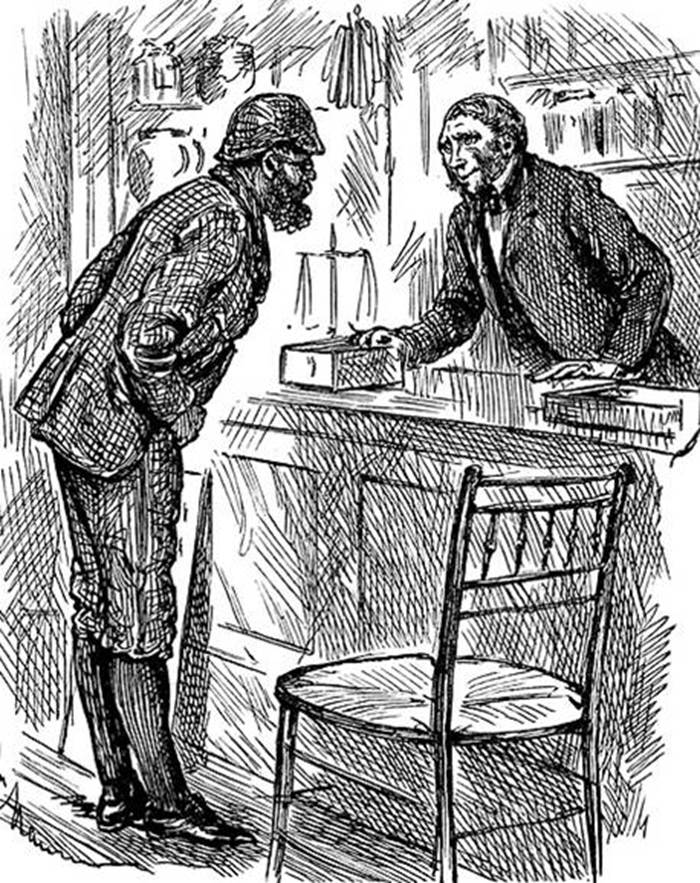
By 1862, he
was the proprietor of his own grocery business and on 16 May 1862 he announced Near
the North Eastern and Hartlepool Railway Station. R Farndale, announces to his
friends and the public in general, that he has Opened the Shop lately occupied
by Mr M Welch, where he intends to carry on the above business in all its
respective branches. Having had 19 years experience
in one of the largest establishments in the town, RF trusts that by diligent
attention to business and supplying a good article, to merit a share of public
patronage and support. Bishopton Lane, Stockton, 8th May, 1862.[87]
Robert died
at the age of 51, by which time he was a Master Grocer[88].
Robert and Sarah had six children, the
Stockton 2 Line. After Robert died, his widow Sarah Ann Farndale, remarried
to Benjamin Burlinson, an engine fitter[89],
who was from the same family as the partner in business of John Farndale, the
author. After Benjamin died, Sarah Ann Burlinson continued to live in
Stockton[90]
where she still worked as a boarding house keeper at the age of 91[91].
Robert
Edward Farndale (1844 to 1875) was an Iron ship builder’s clerk[92]
and later a plasterer and cement maker[93]
of Stockton who
later lived in Birmingham. His business was bankrupted[94],
and he died five years later, aged only 30[95].
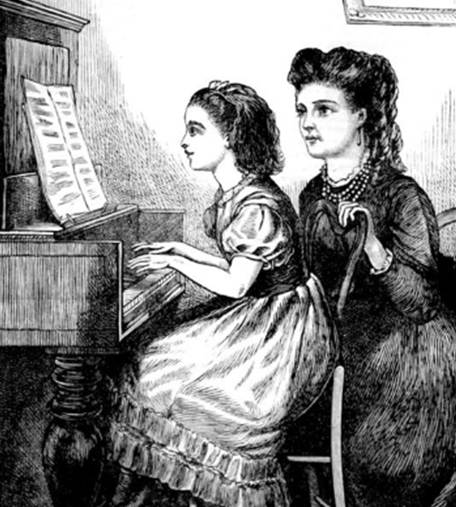
He left his widow, Elizabeth, and three daughters, Emily Gertrude Farndale, Annie Paver
Farndale and Hannah
Elizabeth (‘Lily’) Farndale. Emily became a music teacher, Annie a
drawing and painting teacher, and Lily was also a teacher.
John Henry
Farndale died when he was only 20 and Charles Herbert
Farndale died when he was 12.
Mary Emily
Farndale (1860 to 1923) was a private school teacher in Stockton. Sarah Ann
Farndale married a draper’s assistant and later moved to Cumberland.
Thomas
William Farndale (1848 to 1899) was a brass polisher at the brass foundry
in Stockton[96].
He married Elizabeth Shinton White[97]
and they had three children. William
James Farndale became a solicitor’s clerk in Redcar[98],
and he married Mabel Hills[99],
and their son William
Hills Farndale (1917 to 2009) became a gas and chemical engineer, who
invented a coal effect fire[100].
Scene 6 – the Struggles of the Family
of Ladgates Farm
William Farndale
(1801 to 1876) was the third child of John and Jane Farndale,
born at Craggs House, Brotton, on
9 August 1801[101].
He married a lass from Hartlepool called
Jane Scott on 31 May 1841 at the Chapelry at Brotton[102].
He lived next door to his brother, Robert Farndale,
who was the Brotton grocer[103].
Ten years
later by 1851, he was a farmer at a small coastal farm of 35 acres, a kilometre
to the east of Old Saltburn, called Ladgates[104].
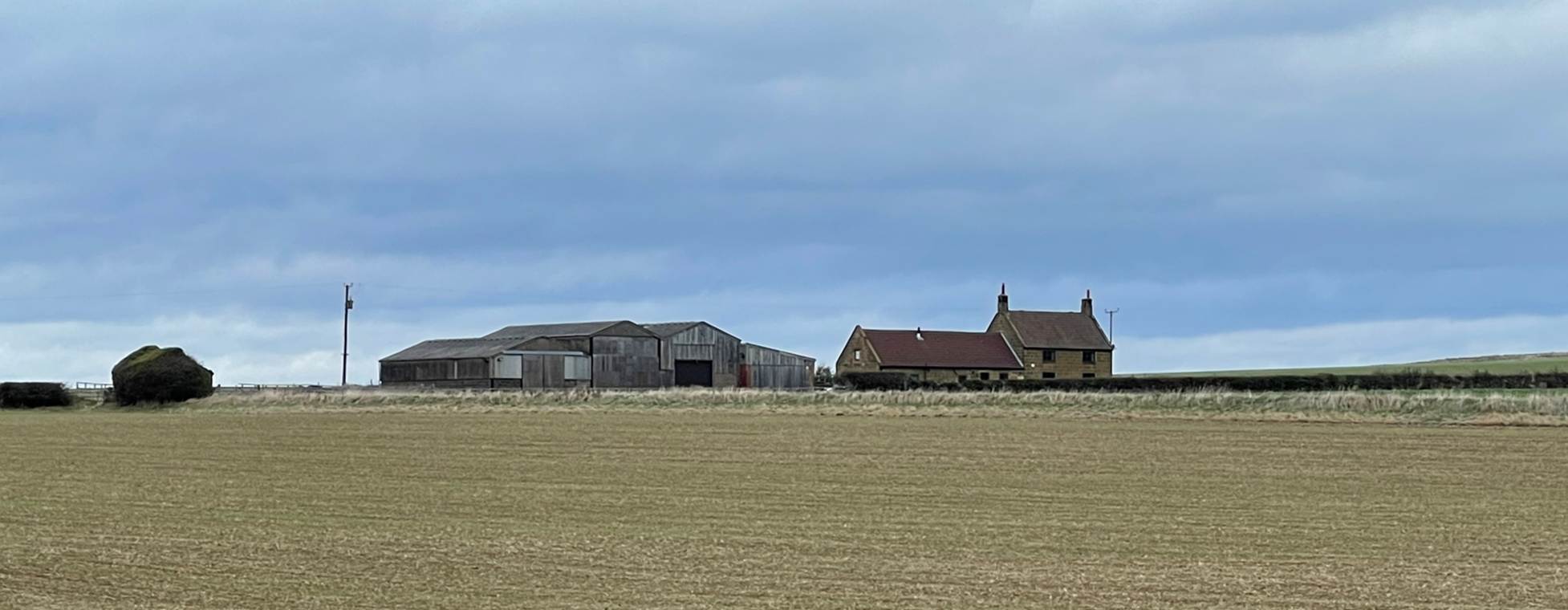
Ladgates
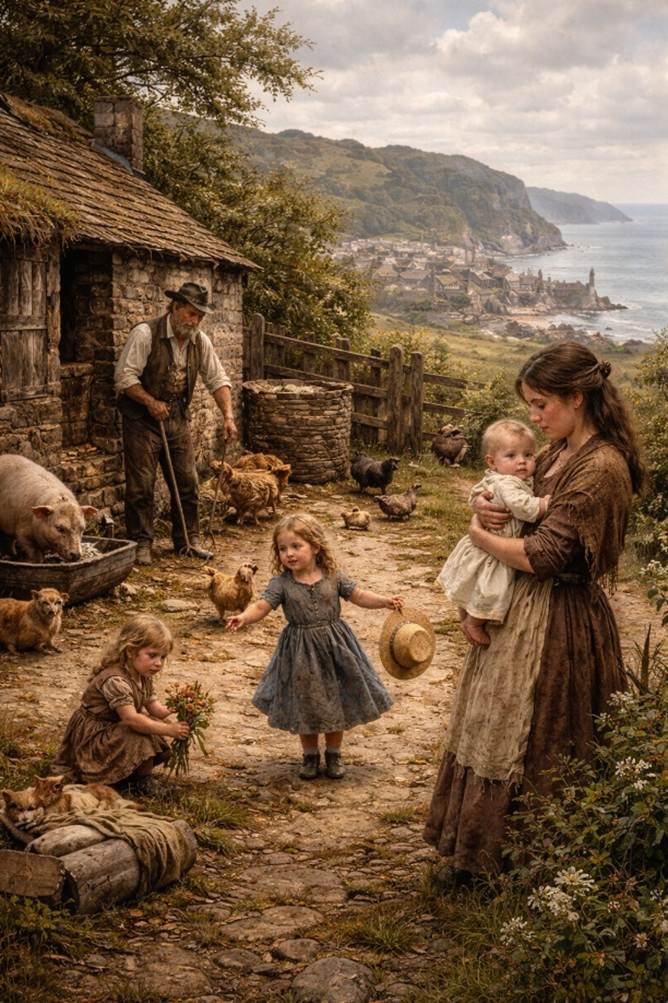
William was a
tenant at Ladgates Farm when it was sold at auction
by its owner, a gentleman, in 1860. The life interest of a gentleman,
aged 40, was sold in August 1860 including Ladgate
Farm and premises, at Brotton aforesaid, containing 100 A, 2 R 26 P, of the
annual value of £30, in the occupation of William Farndale. It comprised a
farm house and outbuildings, and about 35 Acres of Arable, Meadow, and Pasture
Ground adjoining.[105]
There
was a reservation for ironstone and minerals and a railway from Brotton to join the Middlesbrough and Guisborough Railway was intended to pass
close to the farm leased by William Farndale.
The Vendors reserve the right to themselves of working and taking away
ironstone and other minerals, upon the whole or any part of the Premises, and
the right of making Tramways and other Roads for taking and carrying away the
same, but they will pay the purchaser of any Lot any surface or other damage he
may sustain thereby. A railway is in the course of formation from Brotton to
join the Middlesbrough and Guisborough railway at Guisborough, and is intended
to pass over or close to the farms in the occupation of Henry Elot and William
Farndale. Another Railway is about to be formed, to join the North Yorkshire
and Cleveland railway, at Ingleby, with the Middlesbrough and Guisborough
railway, at or near to the Nunthorpe station, which will pass through the Wood
Land and Premises at Easby.
The railway
craze had reached the Saltburn
coast by 1860.
William and Jane
Farndale had three daughters, Mary Jane
Farndale, Hannah
Farndale and Sarah
Ann Farndale. All three married, but all three, with their children, lived
with their parents in Marske by 1871 by which time William had lost his farm
tenancy and was working as a labourer[106].
By 1873, William was
working in Saltburn
when he raised a complaint against an engine fitter, for obtaining by false
pretensions the sum of 10s from William Farndale, of Saltburn, labourer.
The defrauder was imprisoned for a month after he gained possession of 10s
from Mrs Farndale on the representation, which was untrue, that he had been
sent for the money by her son in law, Richard Agar, a drainer of Saltburn[107].
William died of
heart disease and chronic bronchitis on 20 February 1876 in Saltburn, by which time he
had been working as a cartman[108].
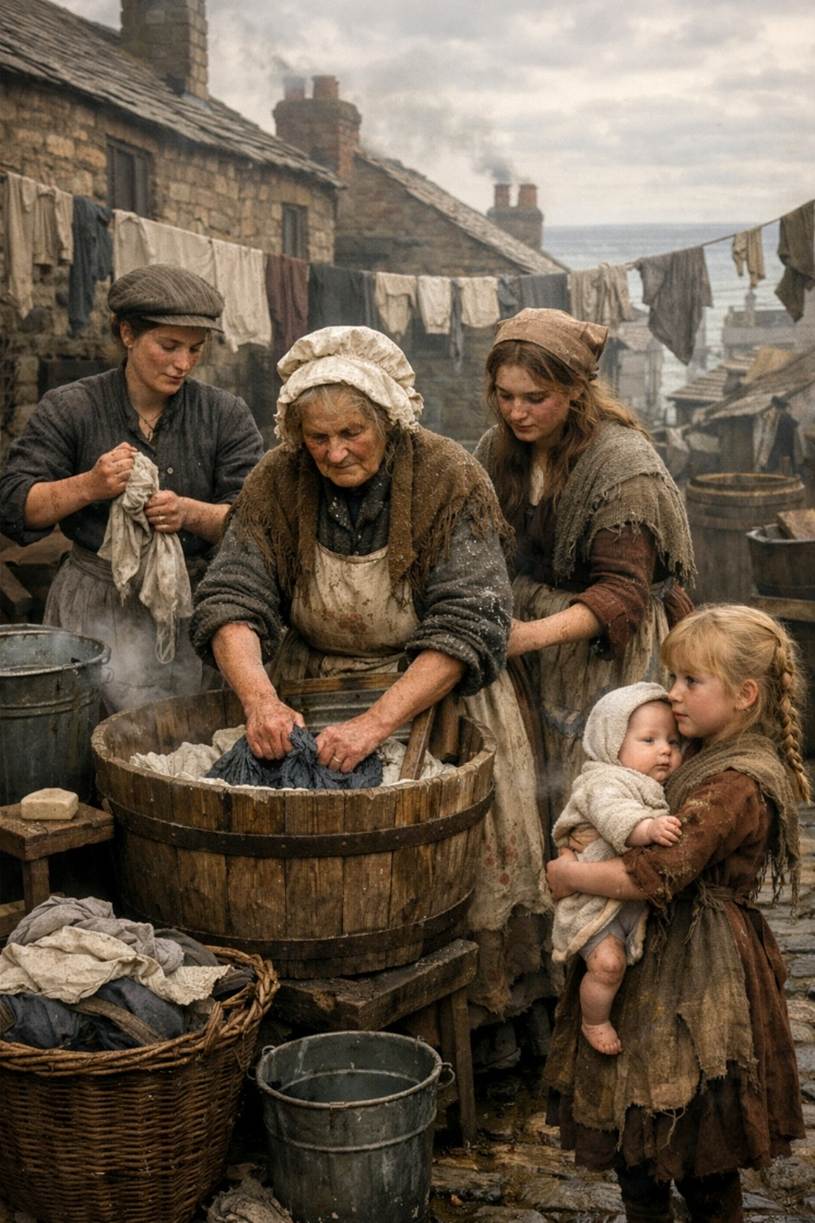
Later that year his wife Jane seems to have started a grocery business, which
went into liquidation[109]. All three of the girls had died young in
their late twenties in the early 1870s, and left their own children to be
brought up by their now widowed grandmother, who struggled to keep her family
afloat by working as a laundress[110].
The
1870s was also the Saltburn Farndales’ decennium horribilis.
Jane Farndale,
who clearly struggled against the odds to see her four grandchildren, Eva
Appleby, Fenna and Sarah Agar, and Lily Purdy into adulthood, lived until 2
January 1900[111]
when she was buried at Saltburn.
William and Jane Farndale also had a son, William George Farndale, who served as a soldier[112] with the Buffs, possibly in the Zulu
War 1879, the Anglo-Egyptian War 1882, the Mahdist War in Sudan in 1884, Malta
and India.
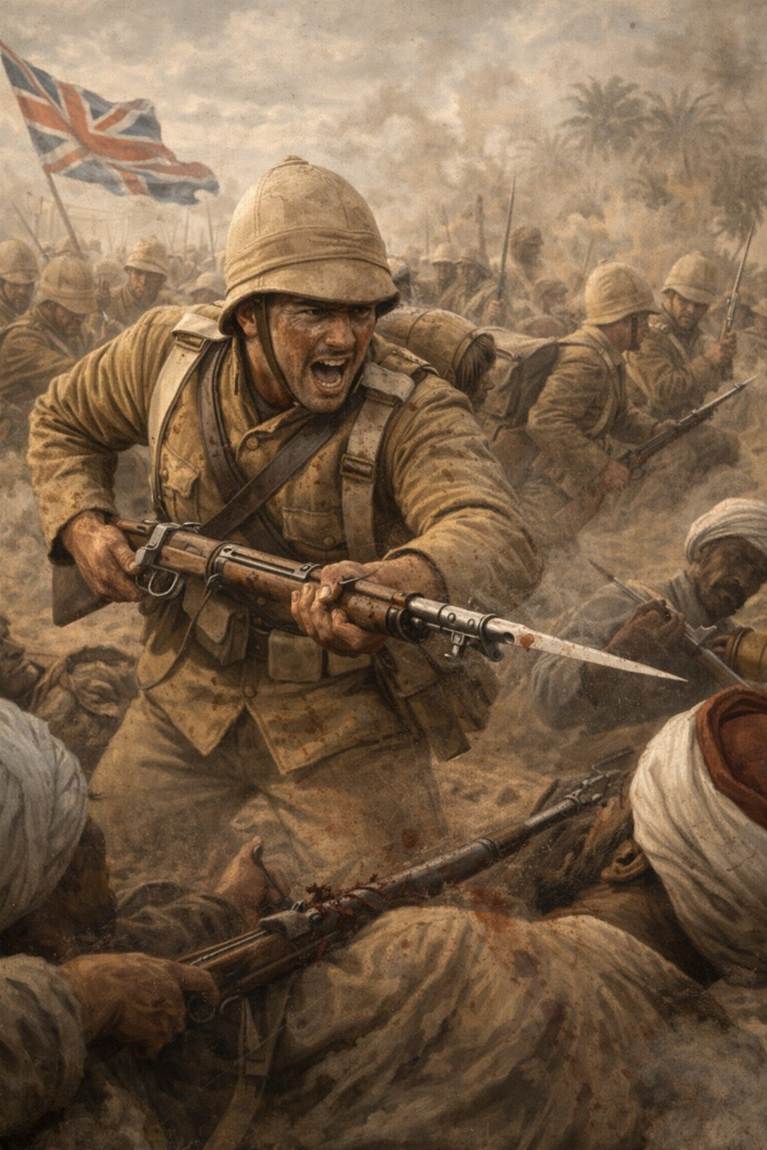
It seems likely that 4505 Private N Farndale, who served with the Buffs in 1901, including
at the Relief of Kimberley, was a son of William, probably born before William
married.
By 1891 William had returned home to
Marske, aged 37[113] and in 1902 he married a widow, Elizabeth Buckenham at Redcar by which
time he worked there as a butcher[114].
However by 1908 the veteran soldier
was struggling when William George Farndale, a labourer, of no fixed abode,
was on Tuesday at Guisborough fined 21s, with the alternative of a month’s
imprisonment for obtaining food and lodgings by false pretences from Catherine
Cogan, of West Dyke, Redcar. The evidence showed that he obtained board and
lodgings by representing that he was employed by Mr F Senior in asphalting in
connection with the new school at Redcar. He came to her house on March 28th,
and Mr Senior was today called to prove that he left his service on March 21st,
and that he had no authority to say that he was working for him at Redcar
schools. Inspector Hall stated that when Farndale was charged with false
pretences he replied, “It is alright, she will be paid.” Superintendent Rose
said the defendant was a joiner by trade, and a native of East Cleveland, but
he had lived a roaming life.[115]
In 1911, he had resumed his work as a
butcher in Marske, lodging alone[116], but he died aged 57 in 1915 in the workhouse at Guisborough[117].
In his autobiography, the Methodist George Edwards described the challenges
of mid Victorian Britain. It was in the year 1855 when I had my first
experience of real distress. On my father's return home from work one night he
was stopped by a policeman who searched his bag and took from it five turnips,
which he was taking home to make his children an evening meal. There was no
bread in the house. His wife and children were waiting for him to come home,
but he was not allowed to do so. He was arrested, taken before the magistrates
next day, and committed to prison for fourteen days' hard labour for the crime
of attempting to feed his children! The experience of that night I shall never
forget. The next morning we were taken into the workhouse, where we were kept
all the winter. Although only five years old, I was not allowed to be with my
mother. On my father's release from prison he, of course, had also to come into
the workhouse. Being branded as a thief, no farmer would employ him. But was he
a thief? I say no, and a thousand times no! A nation that would not allow my
father sufficient income to feed his children was responsible for any breach of
the law he might have committed. In the spring my father took us all out of the
workhouse and we went back to our home. My father obtained work at brickmaking
in the little village of Alby, about seven miles from Marsham. He was away from
home all the week, and the pay for his work was 4s per thousand bricks made, and he had to turn the clay with which the bricks were made
three times. He was, however, by the assistance of one of my brothers, able to
bring home to my mother about 13s per week, which appeared almost a godsend. In
the villages during the war hand-loom weaving was brought to a standstill, and
thus my mother was unable to add to the family income by her own industry.[118]
For all of John Farndale’s enthusiasm at the ambition of the new Victorian seaside town, life was
not easy at Saltburn.
Scene 7 – The Farmer of Kilton
George Farndale (1807 to
1847) was the fifth child of John and Jane Farndale
baptised on 15 March 1807 at Brotton[119].
He became a farmer in the parish of Brotton[120],
where he married Ann Child[121],
a widow, and sister of George Ventress, who had married George’s older sister, Hannah Farndale.
His farm was
in Kilton, that generational hub of the
Farndale family, where the family lived at Sykes House[122].
So George had
remained within the fold of the rural extended family, which seems to have been
a better place to weather the storms of the later Victorian period.
He died in
1847 when he was only 40[123],
but his determined widow, Ann Farndale, took on the Kilton farm where she ran the farm business
with three employees[124].
George and Ann
Farndale had one child, a son, George Farndale
(1843 to 1917), born on 8 March 1843 and baptised on 12 March 1843 in Brotton[125].
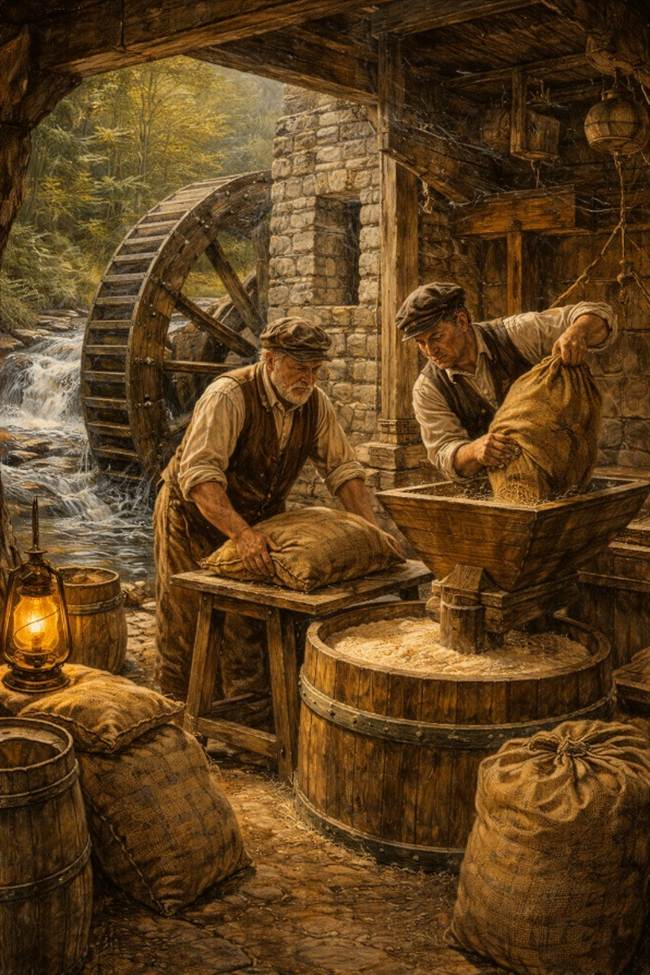
By the age
of 18, in 1861, George was still at Kilton and took work with the millers of Kilton mill, John and Eliza Child, his step
siblings[126].
In 1867 he married Hannah Mary Walker, the daughter of a blacksmith at Loftus[127],
and by 1871, George
was working as a blacksmith himself at 54 Lambs Lane, Liverton[128].
By 1875, George was working as an ironstone miner[129].
George
was clearly a person of artistic talent and in August 1883, he exhibited in the
eighth annual exhibition of the Horticultural and Industrial Society run
by the Skinningrove Miner’s Association. The exhibition took place in a
field pleasantly situated within half a mile at the village of Skinningrove and
the German ocean. It was Queen’s weather. The sun from early morning shone out
magnificently, and although at noon the heat was somewhat intense, the gentle
breezes wafted up the valley from the sea so tempered the burning rays as to
make the day and most enjoyable one. In the ornamental and mechanical
department there was a great improvement, especially in fretwork, the first
prize being awarded to Mr George Farndale for a magnificent clock frame, the
design being purely gothic, made of black walnut and white Maple, nicely
varnished.[130]
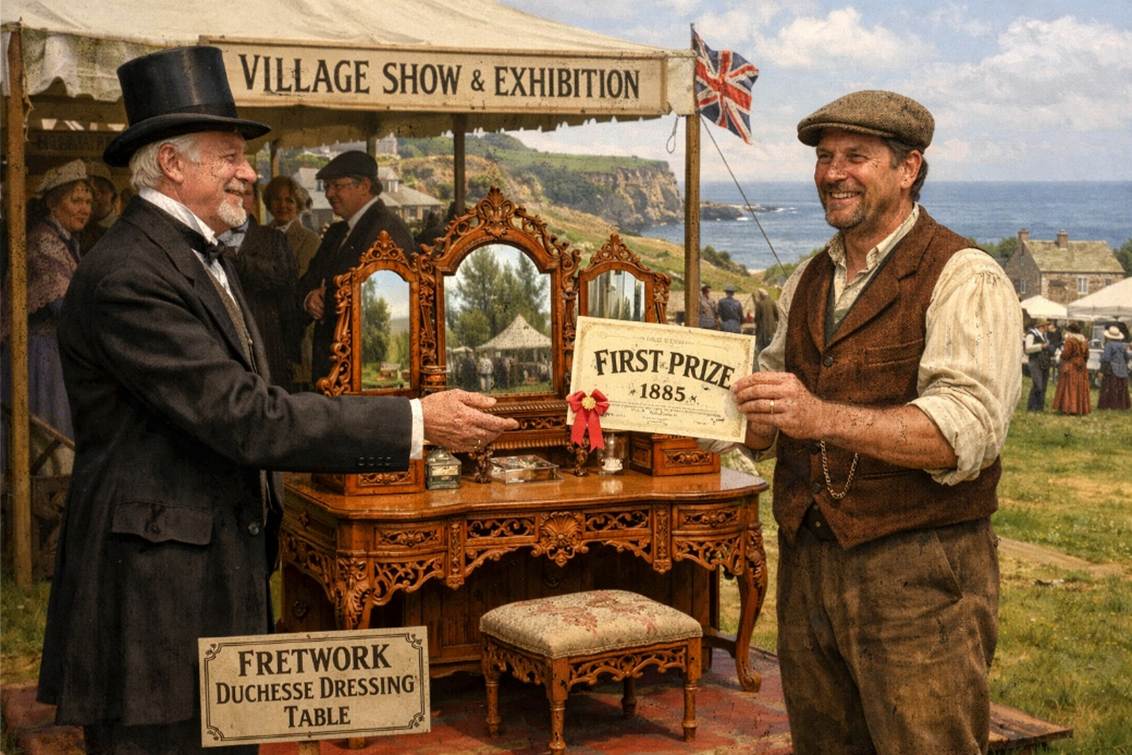
In August
1884, at the Spennymoor Floral and Industrial Exhibition, the fretwork duchese dressing table cut by G Farndale, Loftus, which
has already at other shows been so much admired, received premier honours again[131].
In September 1884 at the Durham Floral, Horticultural and Industrial Show, Mr
George Farndale, Loftus, entirely merited the first prize for a beautiful
toilet table, which was a marvel of fretwork[132].
George
seems to have travelled to the United States on SS Gallia in 1888[133],
but by 1891, was working as a joiner at Middlesbrough[134].
By 1891, George was
working as a joiner in Middlesbrough.
By 1903, he was a member of the religious Order
of Rechabites[135].
The Independent Order of Rechabites, also known as the Sons and Daughters of
Rechab, was a fraternal
organisation and friendly society founded in England in 1835 as part of the
wider temperance movement to promote total abstinence from alcohol.
At the age
of 68, in 1911, George
was working as a picture framer in Middlesbrough[136],
where he died in 1917[137].
George and Hannah
Mary Farndale had a family of four.
William
George Farndale, the Accountant of California
Their eldest
son, William George Farndale
was a clerk in Middlesbrough, who
clearly followed his father’s passion for social reform and temperance and in
June 1892, succeeded in keeping large numbers of men out of the public
houses by providing a pleasant musical programme[138].
I’m not sure if that would work today. It was also in 1892 that William, by then a
Middlesbrough clerk, married Annie Emma Bell[139].
In 1896 William was
acting as a returning officer for council elections for Great Ayton[140].
By 1901 he was an assistant bookkeeper working in a part of Great Ayton known as California[141]
where he also started translating books from Spanish. Houses were built in
north east Great Ayton for hundreds
of men who came to the village to work as whinstone and ironstone miners. This
large scale immigration was likened to the American gold rush, which is why it
became known as California. There was no street planning and anyone in
the village who owned land put up terraces of houses wherever they could, hence
the irregular street plan.
In 1901 an
advertisement appeared for Erimus, Impressions of Middlesbrough
from the Spanish of F Alderete Sanchez, translated by W G Farndale. The
public were given a taster of the translated story about their hometown. The
train has arrived. The streets have become quiet and still, and a dull silence
reigns over the town. Here and there the stern athletic figure of a policeman
stands out, vigilant and alert, passing along his beat with slow and measured
step, imperturbably scrutinising each belated passer by hurrying rapidly
homewards. The town hall clock has just struck the hour of 12, and the echoes
of the last peel are slowly dying away. “Erimus” has
given himself over to repose. But yonder on the other side of the river there
is no such thing as repose. Human energy is always in full activity. It matters
little that daylight fades; in that extensive suburb of Middlesbrough.[142]
Why there was a necessity to translate a novel set in Middlesbrough from Spanish is not
explained. It all seems rather bizarre.
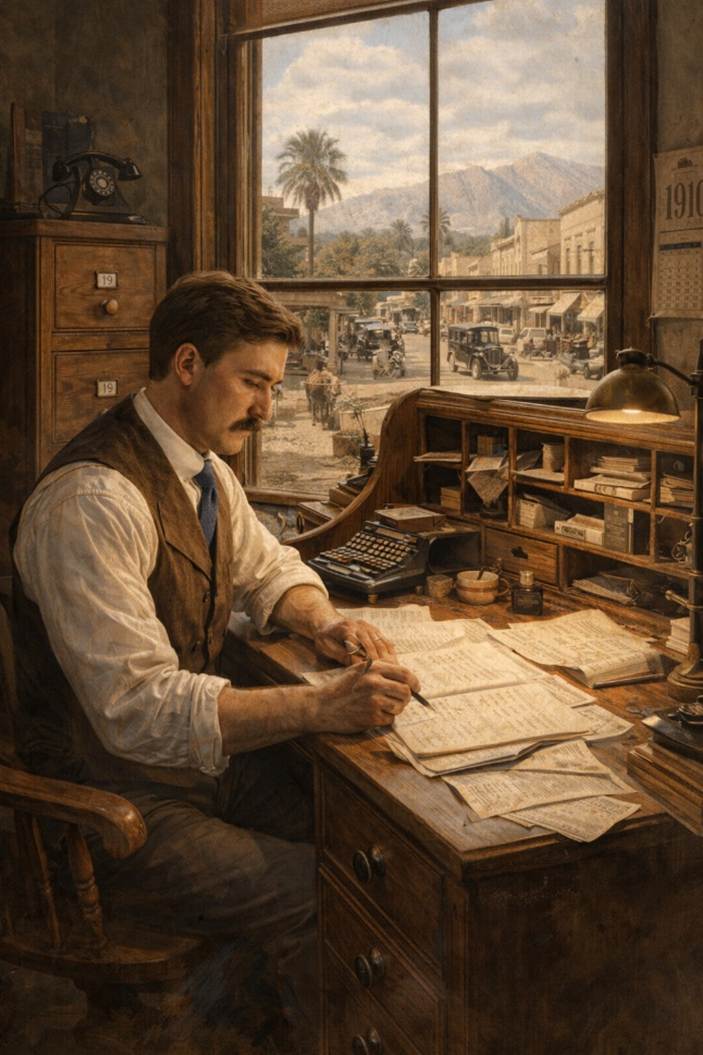
William and
Annie emigrated to the USA in 1907[143]
and by 1910 they had settled in Riverside City, California[144],
where William had become a naturalised citizen and was working as an
accountant.
It
is tempting to suppose that William was so impressed with the attempt to
recreate California in Great Ayton,
that he couldn’t resist experiencing the real thing. The reality seems to be
that Annie had relatives in California, and they ended up living with Eliza
Bell in Riverside, which may explain how William
became naturalised so quickly. We will follow his adventures in the United
States in Act 28 Scene 4.
Two Daughters
George and Hannah
Mary Farndale’s second child was Sarah Anne
Farndale who lived in Great Ayton
with her husband Arthur Wilks, a joiner[145].
She died in Sheffield, a widow aged 70 in 1945[146].
Their fourth
child, Edith
Emily Farndale, was a milliner[147],
who later married John Smith, and settled in Middlesbrough[148].
After John died, she married Arthur Wilks, aged 77, in 1944[149].
Arthur
Edwin Farndale, the Railway Clerk
George and Hannah
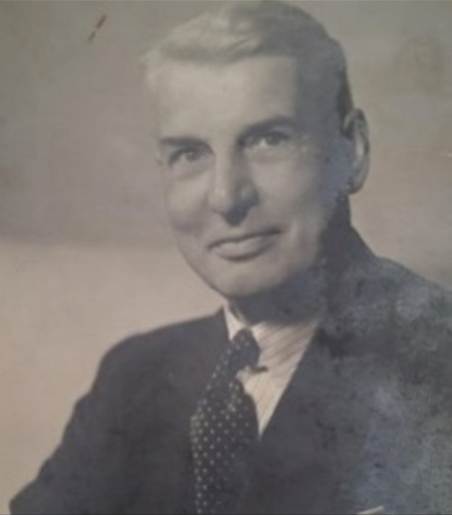
Mary Farndale’s third child was Arthur Edwin
Farndale (1875 to 1962), who became a clerk at the Battersby Rail Junction
with the North Eastern Railway (“NER”) Company[150].
In the 1890s, Battersby Junction was a crucial railway hub, linking industrial
centres such as Middlesbrough for steel and coal) and Whitby for fish and coal
with the Rosedale ironstone quarries via the steep, busy Rosedale Mineral
Railway and its dramatic inclines, handling vital freight traffic, especially
iron ore, and serving as a key interchange for the NER with its powerful
locomotives.
Arthur
married Mary Annie Burns in 1896[151]
and they had six children. Arthur and Mary’s eldest son, George
William Farndale (1897 to 1953) was a clerk with the Army Pay Corps and
Army Service Corps during the First World War[152]
and later became a shipping clerk[153]
and financial accountant[154].
Their second son, Arthur Edwin
Burns Farndale (1901 to 1952) was a shipping clerk[155]
and later an assistant manager and accountant with a finance company in
Wiltshire[156].
Their third son, Alfred
Farndale, was an engine cleaner with the North Eastern Railway Company[157]
and Railway Engine Firemen at Middlesbrough[158].
Their son Bernard
Farndale (1912 to 1944) was shot down over Denmark in a bombing raid during
the Second World War, and we will pick up his story again in Act 32. Their
youngest son Albert
Farndale (1914 to 1986) was an airman and Sergeant in the Royal Air Force
in the Second World War[159]
and later settled in Chichester[160].
Their
grandchildren included John
Alan Farndale (1932 to 2012) who also emigrated to USA[161],
whose descendants are the American
3 Line, and Brian
Picton Farndale (1934 to 2009), son of the bomber flight engineer, who
settled in Wales[162],
and whose family are the Wales 1 Line.
By the
twentieth century, the family of the Kilton
farmer had significantly diversified in its experiences and geographical spread.
Scene 8 – The Rothbury Farndales
|
1796 to Date Stockton, Guisborough, Rothbury,
Northumberland |
|
|
|
1913 to Date Northumberland |
You will
recall that William Leng
Farndale (1876 to 1932) was the last surviving child of George and Catherine
Farndale, who had suffered so much hardship in Stockton in the 1870s. He was born in Middlesbrough in 1876[163]
and moved with his family to Liverpool[164]
and then to Gateshead by 1891, where William became a clerk in an iron foundry[165].
In 1896 he married Margaret Ann Davison[166]
and they moved to Rothbury, north of Morpeth in Northumberland where William
took work as a brewer’s clerk[167].
Rothbury is the town adjacent to the remarkable house at Cragside,
the home of the visionary Victorian inventor Lord William Armstrong and his
wife Lady Margaret Armstrong. In the late nineteenth century, shortly before
the arrival of the Farndales in Rothbury, William Armstrong had been building
his extraordinary home fitted with the most pioneering technology and powered
by renewable energy, mainly hydro power.
William Leng
Farndale served with the Northumberland Imperial Yeomanry (Hussars) and may
have taken part in the Second Boer War between 1900 and 1902, when that
Regiment was used as mounted infantry.
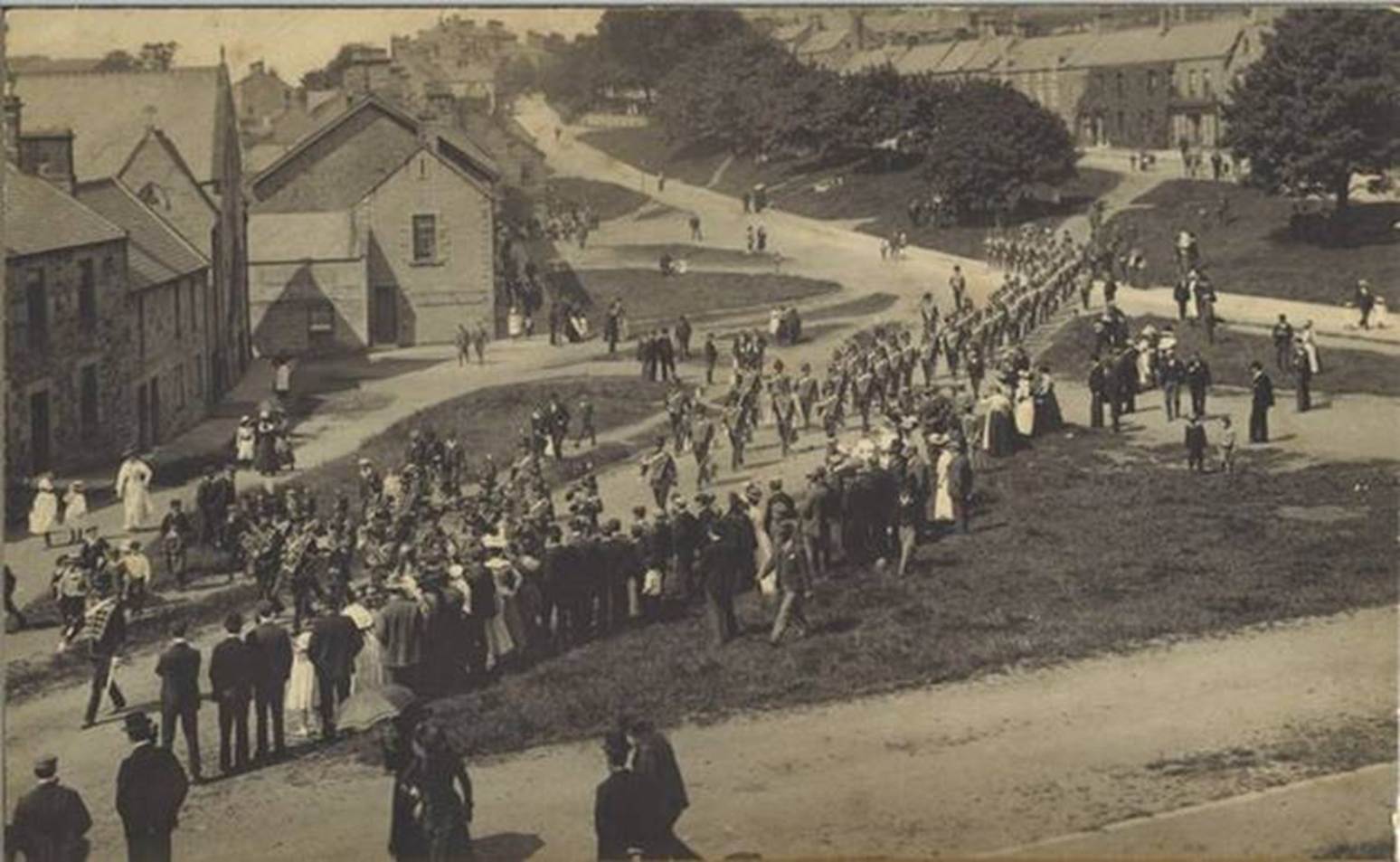
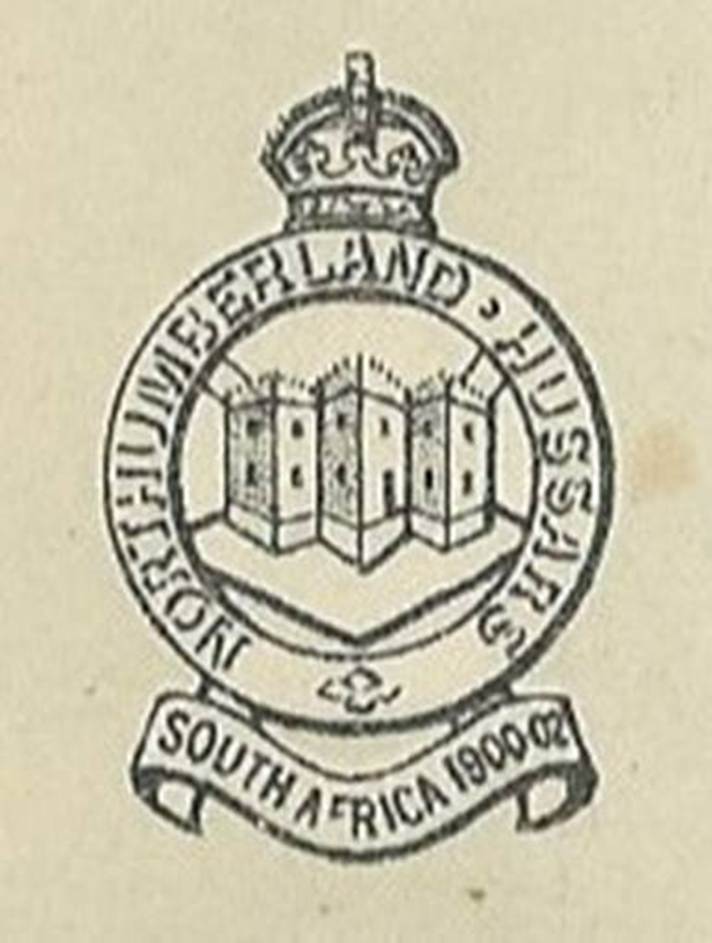
William was
a sergeant in the Northumberland Hussars by 1902[168].
In November 1902, perhaps shortly after their return home, there was an
annual dinner and reunion of those who had fought in South Africa when William
held the Colonel’s Cup shooting prize. In 1905 he was awarded the
Imperial Yeomanry Long Service Medal[169].
By 1907 he
was managing the Rothbury brewery, continuing the business of Brewers and Wine
Merchants which had been trading as Geo Storey and Company[170].
A freemason[171],
William was regularly involved in social activities in Rothbury and by 1916, he
was leading decision making of the local victualling trade[172].
Then in
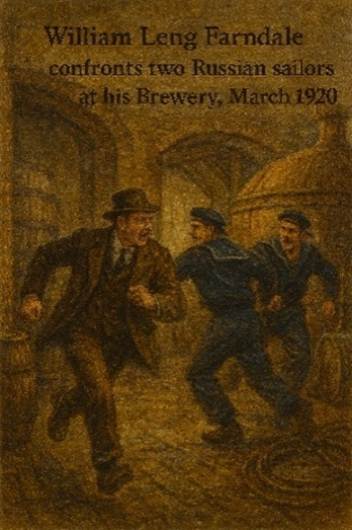
February 1920, he was involved in a violent burglary at his brewery in Rothbury[173].
A Rothbury policeman was attacked by two Russian seaman during an attempted
robbery at the brewery and William had been called to help. I was called from my home about 9:15
by Curry, who told me that he had been sent by a policeman. I went to the
firm's premises at the other side of the street in my slippers. As I entered by
the gate leading to the back premises a man came running out, and I immediately
tackled him. We struggled for a time, but when I heard a shot fired behind me,
I thought that I could do more good in the fight which I thought the police
were having. The man I was fighting with escaped, leaving his white muffler in
my possession, and I ran to the back door of the premises. Curry followed, and
we were surprised not to find anyone there. We tried the door twice, and it was
only when leaving that Curry said to me ‘What is that in there?’. We went
inside the shed. I found Constable Sinton in a sitting position. He had his
baton lying loosely in his hand, but he was unconscious from a severe wound on
the head. I at once thought that this had been caused by the shot I had heard,
but it is now clear that the constable was struck by a heavy weapon. We had him
conveyed to his home, and up to the present he has been unable to give any
information about the affair. He is badly hurt, but it is expected that he will
live. Two Russian
seamen were charged with the attempted murder of Police Constable Francies
Douglas Sinton at Rothbury, having for three months prior to his arrest
been partner with Strautin in a career of brigandage
in Northumberland and Durham. They were found guilty.
|
1876 to 1932
A Brewer and Northumberland Hussar of Rothbury, Northumberland
who confronted an armed robbery by two Russian sailors in the vicinity of his
brewery |
William and
Margaret Farndale had seven children
who lived in Rothbury, working variously as a clerk at the brewery[174],
hotel waitresses[175]
and a quarryman for road stone in Rothbury quarries[176]. One of their sons, Kenneth Farndale
went to Quebec, Canada in 1927 at the age of sixteen amongst boys brought to
Canada by the British
Immigration and Colonisation Association[177].
This was a scheme for British Boys aged 14 to 18, to work as farm hands and
eventually become permanent citizens.
The settlers were selected carefully as to their health, physical and
mental characteristics, previous records and adaptability. Kenneth
returned to Northumberland in 1931[178]
and later worked as a general labourer in Rothbury[179].
Change
and hardship
In this Act
of our story, we have met families who were forced to leave the net of the
extended family of Kilton, to seek new opportunities during the fast and
dramatic changes of the nineteenth century in Brotton,
Loftus, Stockton,
Northumberland and beyond. Some members of the family embraced the change, and
became pillars of the new societies, as legal clerks, village brewer, or
railwaymen. Other families struggled, particularly during the decennium
horribilis of the 1870s, suffering devastating family losses and
bankruptcy. Other families were kept afloat by sheer graft and hard work,
sometimes led by a widowed mother, seeking what work she could, as a laundress,
or housekeeper. It is apparent that in hard times, all could be lost within the
timescale of a single generation.
This Hub of
the family has many descendants amongst the twenty first century Farndales.
or
Go Straight to Act 15 – The
Mariners of Whitby
|
This
is a new experiment. Using Google’s Notebook LM, listen to an AI powered
podcast summarising this page. This should only be treated as an
introduction, and the AI generation sometimes gets the nuance a bit wrong.
However it does provide an introduction to the themes of this page, which are
dealt with in more depth below. The
AI chat wrongly concludes that John Farndale’s works have been lost. We will
explore them elsewhere on this website. |
|