Towns
The
evolution of towns in northern Britain
|
Return to the Home Page of the Farndale Family
Website |
The story of one family’s journey through two
thousand years of British History |
The 83 family lines into which the family is divided.
Meet the whole family and how the wider family is related |
Members of the historical family ordered by date of
birth |
Links to other pages with historical research and
related material |
The story of the Bakers of Highfields, the Chapmans,
and other related families |

Headlines are in brown.
Dates are in red.
Hyperlinks to
other pages are in dark
blue.
References and
citations are in turquoise.
Context and local
history are in purple.
Geographical
context is in green.
1100
After the
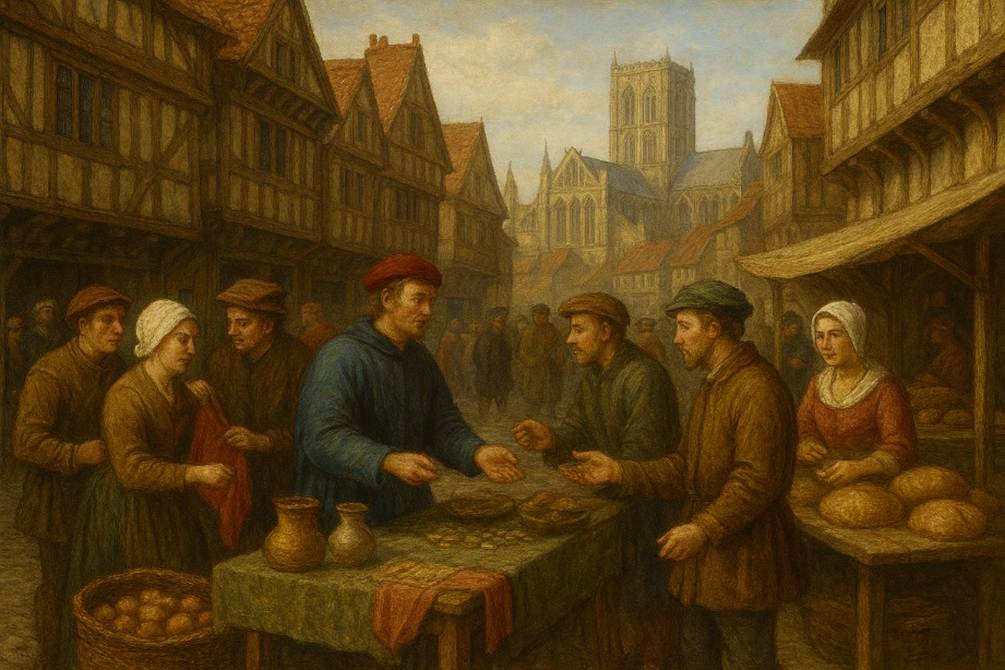
Norman Conquest people living in towns did retain some degree of autonomy
and wealth. There was an influx of urban immigration resulting from the
Conquest, but the indigenous urban population remained influential.
The royal elite
classes established boroughs which became towns alongside their castles or in
strategic sites such as road junctions and river crossings. Weekly markets
encouraged trade, that in turn could be taxed. Yearly fairs brought rural
populations to towns to trade. Charters were sold for a price.
The market place
became the focal point of towns with burgages, plots of land, surrounding
it. The owners were freemen and came to
be known as burgesse, with associated rights and
duties. The burgage was usually long and think.
Three early
boroughs were established at Richmond,
Pontefract and Tickhill south of Doncaster.
Boroughs were
also established on church lands by the Archbishop of York including Beverley,
Otley and Patrington. The Bishop of Durham
established boroughs at Hedon and Northallerton.
There was a
growth of:
· Primitive bankers
(‘moneyers’)
· Moneylenders
(including the Jewish communities)
· Goldsmiths
· Merchants
· Administrators
and royal officers.
Life was not always
straightforward. There was congestion and poverty. There were episodes such as
Henry I’s purge on moneylenders leading to castration and hand amputations.
A new type of
town, the borough, emerged in Norman England. In contrast to agricultural
towns, they did not rely directly on agriculture, but on other means such as
trade, crafts or other services. Often land was set out around castles for
borough towns, for instance at Thirsk, Skelton
and Scarborough.
Thirteenth
century
Each borough
developed in its own way. The town of Whitby
moved away from the old village on the east cliff down to the waterside and
absorbed the old Flora estate into Flowergate.
None matched the
scale of York as a centre for craftsmen.
Fourteenth
century
Population
expansion led to new settlements growing in the countryside. Towns were created
more rapidly than at any other time. Over 50 were established between 1200 to
1320.
London was the
biggest with a population of circa 80k. Norwich was second at 20k. The next
level of towns were perhaps circa 5k. Most towns had under 2k.
Many now held
annual fairs.
Towns started to
be defined as boroughs with their own charters and local systems of government
evolved.
By 1377, York had
7,248 adults paying the poll tax, and may have had a population of about
15,000. It has absorbed many migrants from the countryside, particularly
impacted by the devastation caused by the outbreaks of plague in rural areas.
A concentration
of small crafts made York the industrial
centre of Yorkshire and it developed specialities such as 11 goldsmiths, 12 pin
makers, manufacturers of rivets, armour plate and locks as well as York
pewterers.
Outside York, the
largest boroughs were Scarborough
(1,391 taxpayers), Whitby (641), Pickering (435) and Northallerton (373). Towns such a
Kirkbymoorside (511) were about the same size, though included the by then
populous Farndale.
Fifteenth
century
The customs and
liberties of the burgesses of Malton were recorded in writing. The burgesses
had a free court with 2 bailiffs and 2 under bailiffs, a burgess clerk and 12
sworn burge4sses would form a jury. The court met twice a year around Michaelmas
and on the morrow of St Hilary. They levied four pence fines or could impose
prison, a pillory, a thew or the rack.
The Borough of
Malton had gone a long way to removing control by the lord.
(John
Rushton, The History of Ryedale, 2003, 142 to 143).
The Victorian Age
Coal,
steam and machinery reshaped society by concentrating populations in towns
around mines, factories and workshops..
In
the 1851 census 54% of England’s population lived in towns (in France, only
19%).
In
the following two decades:
· Total
production nearly doubled.
· The
length of the railways doubled.
· The
number of railway passengers doubled.
· Freight
tripled.
· The
tonnage of steamships increased by 600%.
· About
1.5M new houses were built.
· The
rate of income tax halved from 7d in £ (2.9%) to 4d (1.6%).
· Old
buildings were demolished en masse.
The new
towns were smelly, smoky and noisy. Development was uneven. There were new
civic buildings, monuments and public utilities. This was accompanied by slums
and rows of uniform red brick houses.
Cities
were also starting to develop globally – New York, Calcutta, Shanghai, Essen,
St Petersburg.
New
literature from Dickens and later HG Wells reflected the change as did art.
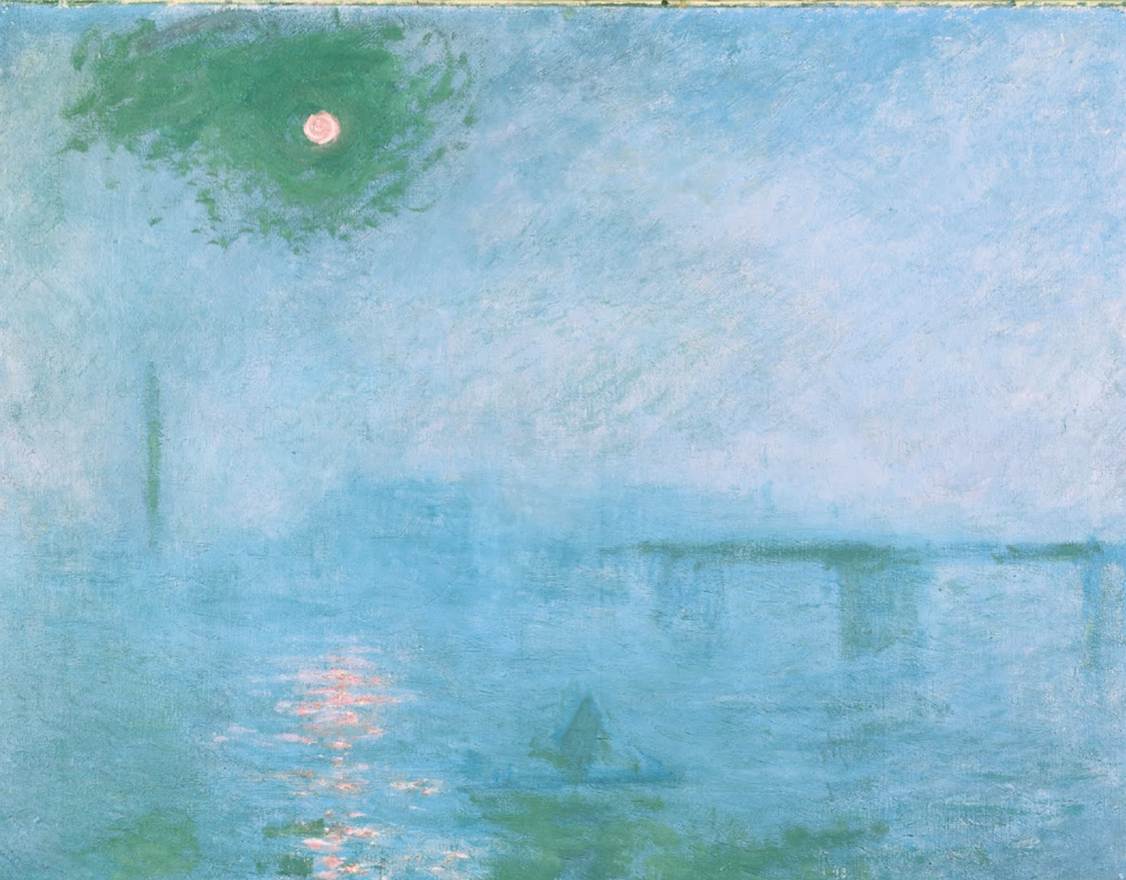
Charing
Cross Bridge, Fog on the Thames, 1903
In
1850 a quarter of the population lived in large towns of over 100,000, mostly
industrial centres, like Bradford,
Sheffield and Leeds.
The
fragmentation of development was chaotic, and as pioneers of urban growth,
Britain made many mistakes.
However
death rates and infant mortality were low on the global scale, below Sweden,
but above France, Germany, Spain, Russia and US. Inevitably infant mortality
was higher in poorer areas.
The
greater representation of government and the network of local authorities coped
relatively well with the new growth.
By
the 1880s:
· Britain
strove to a better minimum health standard than other countries.
· Cities
had invested in sewers and water facilities.
· Sanitary
inspectors reduced over crowding and adopted measures
to control pollution.
By
the 1840s, the average number per house in the East End was 6.4 and 30% of
homes were well furnished (ie including a piano!).
The growth in non
agricultural production meant the population had to be fed by imports.
Since 1822 Britain’s balance of trade has remained permanently in deficit. It
had to be balanced by invisible earnings from banking, insurance and shipping,
and returns from foreign investments.
This brought new kinds of wealth (commerce,
manufacturing, food and drink, tobacco) and new wealthy families, like the
Rothschilds and the Guinness’s. Someone of the very richest, like the Duke of
Westminster, continued to derive their wealth from their land holdings, but now
because they benefitted from mineral rights.
There were very significant disparities of
wealth:
By 1914, 92% of wealth was owned by 10% of the
population.
In the 1860s:
· The
population was around 20M.
· 4,000
people had incomes over £5,000 per year.
· 1.4M
had around £100.
· A
farm labourer might earn £20.
· Women
workers earned about half of men’s wages.
There was a rise in wages from mid century, with a significant rise in 1873.
However in rural areas, wages lagged behind.
Living standard improved with a fall in the
birth rate. The sharpest increase in spending was tobacco – the mechanically
produced Wills
Woodbines at 1d for five
were popular from the 1880s to the 1960s. The consumption of alcohol fell
sharply.
The Industrial Towns, depicted in Disraeli’s Sybil,
established their own traditions and institutions.
· In
textile towns such as in Lancashire and elsewhere, people played together, sang
in choral societies together, voted together and holidayed together.
· Mining
industries formed brass bands.
· New
sports grounds and works teams emerged.
· Neighbourhood
clubs provided some security for unemployment, burial costs, clothes, medicine
and Christmas.
· Charities
expanded.
· There
was a multiplication of cooperative societies, savings banks and friendly
societies (like the Independent Order
of Oddfellows, and the Ancient
Order of Foresters). By 1901 there were 5.47M members of friendly societies.
· There
was a growth in trade unions.
o
“Combination” by workers became legal in the
1820s.
o However
the Master and Servants Acts 1823 and 1867 continued to punish workers for
breaking contracts.
o The Employers and Workmen Act 1875 recognised a right to collective bargaining
and soon led to unionisation being seen as a right.
o This
was a contrast to the position in France, Germany and US. The British workforce
became more unionised.
o Unions
tended to be peaceful but adversarial with employers.
o The
Victorian Working Class had a recognised and independent place in the social
order.
· Medical
insurance developed.
· Voluntary
hospitals were funded by donations.
There were increasing attempts to improve the
quality of life in towns.
· A
growth of parks, gardens and allotments.
· New
suburban districts with villas with gardens.
· Gardeining became a popular
hobby.
· The
planned urban estates of Regency London, Bath and Edinburgh.
· Communities
of workers were created by such people as Titus
Salt.
There was a new sentiment for rural England
from the towns. In many cases, these new organisations were largely driven by
the provision of amenity for town dwellers.
· The Commons
Preservation Society 1865
· The English
Dialect Society 1873
· The Society for the Preservation of Ancient
Buildings 1877
· The Folklore Society 1878
· The Lake
District Defence Society 1883
· The Society for the
Protection of Birds 1889
· The National
Trust for Places of Historic Interest or Natural Beauty 1895
· The Folk Song Society 1898
· The
English Folk Dance Society 1911
· The National
Trust Act 1907 allowed the
Trust to declare land inalienable.
· Thomas
Hardy novels
·
A E Housman’s A Shropshire Lad 1896
(Robert Tombs, The
English and their History, 2023, 477 to 492).