The House Hanover and the Victorian Period
1714 to 1901
Eighteenth
and Nineteenth Century Britain
|
Return to the Home Page of the Farndale Family
Website |
The story of one family’s journey through two
thousand years of British History |
The 83 family lines into which the family is divided.
Meet the whole family and how the wider family is related |
Members of the historical family ordered by date of
birth |
Links to other pages with historical research and
related material |
The story of the Bakers of Highfields, the Chapmans,
and other related families |
Headlines are in brown.
Dates are in red.
Hyperlinks to
other pages are in dark
blue.
References and
citations are in turquoise.
Context and local
history are in purple.
Geographical
context is in green.
The Stuarts
The House of Hanover
1714
When the last
true Stuart, Queen Anne died in August 1714, and following the process of the
Act of Settlement 1701, the electoral prince of Hanover, George Ludwig von
Braunschweig - Luneburg, became George I.
George I, 1714 to 1727
George I was even
less an English King than James VI and William of Orange. He brought with him
an exotic entourage; did not bother to learn English; and his speeches were
read by the Lord Chancellor. He was, though, a toned down monarch, the
Hanoverians having not the money nor desire to aspire to the opulence of the
Sun King in France. He rather lived on a domestic scale at Kensington Palace.
No bill has ever failed
to gain royal assent since George’s accession. The monarch still governed, but
required parliamentary consent to do so. A constitutional balance was thus
achieved. Parliamentary Sovereignty became a fundamental constitutional
principle. The absence of a constitution in a British context really means the
absence of a written constitution which limits the powers of Parliament.
Most Tories
accepted the Hanoverian succession, assuming that the Tory government would
continue and the Church would be protected.
However George
was not apolitical and threw out the Tories, angry at their Peace of Utrecht 1713
and supported a
Whig coup. The Whigs then impeached the former Secretary of State,
Robert Harley and Henry St John, Viscount Bolingbroke (who had negotiated the
Utrecht terms), the latter who fled to France.
The combination
of executive and legislative powers ended the purist form of the separation of
powers to that extent.
At his Coronation
in October 1714, there was an outbreak of violence. In Catholic Ireland and
Highland Scotland, Jacobitism was strong. In England there was increasing
discontent at high taxes. Plans started to emerge for a Jacobite uprising. A
small armed rebellion materialised in Catholic area of Yorkshire and
Lancashire.
1715
However disaster
struck early for the Jacobites when their intended primary supporter, Louis XIV
died in September 1715, just as the Earl of Mar rallied a Scottish army.
The Jacobite Rebellion of 1715
(also referred to as the Fifteen or Lord Mar's Revolt), was the
attempt by James Francis Edward Stuart (also called the Old Pretender) to
regain the thrones of England, Ireland and Scotland for the exiled House of
Stuart. A diversionary rising had been planned in Northumberland to accompany
the main rising in the West.
The rising in the
West was forestalled by prompt Government action, but the rising in
Northumberland went ahead on 6 October 1715.
The Northumbrian
Jacobites were led by local Tory Member of Parliament Thomas Forster and the
wealthy Catholic James Radclyffe, 3rd Earl of Derwentwater. The local leaders
hoped to seize Newcastle upon Tyne as a key port, cutting off London's coal
supply, and expected significant support from local Catholic gentry,
disaffected Tories, and a landing of French troops. They marched through
various Northumbrian towns like Alnwick and Morpeth, gathering recruits but
failing to gain widespread popular support or capture Newcastle due to a swift
government response in fortifying the city. The Northumbrian force, numbering around 300,
moved north and met up with Scottish border Jacobites and a contingent of
Highlanders under Brigadier Mackintosh of Borlum at Kelso.
The English
Jacobites joined with a force of Scottish Borderer Jacobites, led by William
Gordon, 6th Viscount Kenmure, and this small army was joined by Mackintosh's
contingent. They marched into England as far as Preston, where the Government
forces caught up with them. This led to the Battle of Preston, on
12 to 14 November. The Jacobites won the first day of the battle, killing large
numbers of Government forces, but Government reinforcements arrived the next
day and the Jacobites eventually surrendered.
The first
Jacobite rebellion petered out by November 1715. There is an In
Our Time podcast,
The Jacobite Rebellion,
the Stuart dynasty's attempt to reclaim the throne of England.
1716
George I was sufficiently unflustered to visit Hanover for five
months in mid 1716.
The Septennial Act
1716 reduced the frequency of elections to seven years. Jean Jacques
Rousseau quipped that the English were free, but only once every seven years.
1718
The Derby Silk
Mill, also known as Lombe's Mill, is widely regarded as the world's
first fully mechanised factory. It was built for the Lombe brothers, John and
Thomas, in the early 1700s, with operations starting around 1718 to 1721.
The mill was
built for throwing silk, a process of spinning raw silk into a strong,
high-quality thread called organzine.
1720
The South Sea Bubble was a financial
crisis in 1720 that began with a speculative frenzy over the South Sea Company,
which was initially formed to reduce national debt by trading slaves and goods
with Spanish America. Both France and Britain accumulated vast debts due to the
wars. A Scot, John Law, persuaded the French government in 1717 to adopt his
new scheme to swap state bonds for shares in a new monopoly trading company. The
British caught wind of this and set up their own similar scheme, through the
South Sea Company, in 1719.
The South Sea
Company, officially The Governor and Company of the merchants of Great
Britain, trading to the South Seas and other parts of America, and for the
encouragement of fishing, was a British joint-stock company originally
founded in 1711, created as a public-private partnership to consolidate and
reduce the cost of national debt. The company was also granted a monopoly to
trade with South America and nearby islands, hence its name. The modern use of
the term South Seas to refer to the entire South Pacific was unknown in
England at the time.
When the company
was created, Britain was involved in the War of the Spanish Succession and
Spain controlled South America. There was no realistic prospect that trade
would take place, and the company never realised any significant profit from
its monopoly. The South Sea Company share price rocketed top 700% and many
flocked to jump on the bandwagon, just as the better informed, including Robert
Walpole, decided that it was time to cash in.
The bubble burst
in 1720 collapsing to little above its original flotation price. The economic
bubble became known as the South Sea Bubble. In Great Britain, a considerable
number of people were ruined by the share collapse, and the national economy
greatly reduced as a result. The founders of the scheme engaged in insider
trading, using their advance knowledge of when national debt was to be
consolidated to make large profits from purchasing debt in advance. Huge bribes
were given to politicians to support the Acts of Parliament necessary for the
scheme. Company money was used to deal in its own shares, and selected
individuals purchasing shares were given loans backed by those same shares to
spend on purchasing more shares. The expectation of profits from trade with
South America was used to encourage the public to purchase shares, but the
bubble prices reached far beyond the profits of the slave trade.
In France, the
fiasco prompted by John Law, ruined their credit for a century.
There is an In Our Time podcast on
the South Sea Bubble,
the speculation mania in early 18th-century England which ended in the
financial ruin of many of its investors.
About this time nearly everyone in London
stupidly got involved in an enormous bubble that appeared at South Sea. Some
were persuaded that it would be a Good Thing if all the money in the country,
including the National Debt, were sunk in it; others got into it merely with
the object of speculating how soon it would be before it burst (1066 and all that, Walter
Sellar and Robert Yeatman, 1930).
1722
The Norfolk
Squire and Whig politician, Sir
Robert (“Robin”) Walpole, was First Lord of the Treasury and Chancellor of
the Exchequer and considered to be the first Prime Minister from 1722 to 1742.
Walpole ought
never to be confused with Walpole, who was quite different; it was Walpole who
lived in a house with the unusual name of Strawberry Jam and spent his time
writing letters to famous me (such as the Prime Minister, Walpole etc) (1066 and all that, Walter Sellar and Robert Yeatman, 1930).
Walpole was on a
path to self enrichment, from which wealth he built Houghton Hall in Norfolk.
His novelty came
from his practice of parliamentary management. He spent time in the Commons. He
cultivated MPs. He explained policy. He had private meetings. He patronised
supporters with favours and office.
Purist Whig
policies including toleration of religious dissent and a significant role in
European politics, leading to high taxation, were unpopular, reinforced by the
South Sea Bubble fiasco.
Walpole steered
toward a more coalition approach, with restraint on taxation and public
spending and a period of peaceful interlude from the European wars.
The role of
opposition against Walpole was adopted by Henry St John, Viscount Bolingbroke,
who himself took a less extreme approach and returned to England in 1723. He
represented the Country Party resentment of taxation, promoted ideas of a
patriotic king ruling in the national interest, and was an early proponent of
empire, focused on seapower. He suggested a new synthesis of the separation of
powers, which would in time feed into the bedrock of the British and US
constitution.
There was satire
against Walpole. Jonathan
Swift’s Gulliver’s Travels (1726) mocked his selfishness and
political manoeuvring. Alexander Pope described the dullness of his government
in The
Dunciad (1728). John Gay authored the first stage musical, The Beggar’s
Opera, portraying politicians as criminals. William Hogarth portrayed
decadence and corruption in Gin Lane
and The
Rake’s Progress, a series of paintings which tell the story of Tom Rakewell,
the Rake, who inherits a fortune from his city merchant father only to
fritter it away on an extravagant lifestyle which ultimately leads to his
downfall.
Walpole fought
back. He raised the Jacobite spectre to threaten the Tories. He used public
money to bribe and to buy newspapers and to pay for his propogandists.
1723
The Black
Act added 50 capital offences to the penal code including some forms of
poaching. Commonly known as the Black Act, or the Waltham Black Act, it was
passed in 1723 in response to a series of raids against landowners by groups of
poachers, known as the Blacks from their habit of blacking their faces
when they undertook the raids. The Act was expanded over the years and greatly
strengthened the criminal code by specifying over 200 capital crimes, many with
intensified punishment. Arson, for example, had its definition expanded to
include the new crime of burning, or threatening to burn, haystacks.
Knatchbull’s Act
enabled workhouses in parishes.
1724
Daniel Defoe’s A
Tour through the whole island of Great Britain describes Britain on the
eve of the Industrial Revolution through a series of journeys or circuits.
The book is a detailed account of the country's geography, economy, and
society, covering towns, people's living conditions, and trade. Though
presented as a travelogue, it is based on Defoe's past experiences and reliance
on other sources, and its enduring value lies in its vivid, matter of fact
portrayal of an emerging nation.
1727
George II, 1727 to 1760
George II was
born in Hanover the son of George I and Sophia of Celle. He married Caroline of
Brandenburg-Ansbach in 1705.
The coronation of
George II and his wife Caroline of Ansbach took place on October 11, 1727, at
Westminster Abbey. The event was a grand spectacle, magnificent and lavish. Handel’s
Zadok the Priest was sung at the Coronation and at every Coronation
since then.
1728
Vitus Johanssen
Bering reached the vicinity of the strait separating Asia and North America in
August 1728 and, due to poor visibility and his mission's objective, turned
back before sighting the American coast. He entered the strait now named after
him and sailed north, convinced he saw no landmass connecting Asia and America,
and returned to Kamchatka.
1729
The Gin Act of
1729 was a law designed to curb gin consumption by imposing a £20 annual
license fee on retailers and a 5s per gallon excise duty on distillers.
However, this and subsequent acts were largely ineffective because they were
difficult to enforce, and the high costs encouraged illegal sales and
smuggling. While the Act intended to reduce consumption, it actually spurred
more illicit, dangerous production and failed to significantly curb the gin
craze.
Charles Wesley
founded the Methodists at Lincoln College Oxford. John Wesley, his
brother Charles, and others formed a group called the Holy Club dedicated
to rigorous spiritual discipline, Bible study, and charitable work, including
visiting prisons and the poor. They were mockingly called Methodists by
their peers due to their structured, "methodical," approach to faith.
1730
The first seaside
towns appeared in Brighton and Margate. Brighton evolved from a poor fishing
town into a premier seaside resort after 1730, driven by the rise of the
sea-bathing cure, the patronage of the Prince Regent, and improved transport
links. The
primary catalyst for Margate’s evolution was the growing belief from the 1730s
in the health benefits of bathing in and drinking seawater.
Charles Turnip
Townsend promoted crop rotation. A key figure in
the British Agricultural Revolution, he was known for popularising the Norfolk four
course system of crop rotation, which eliminated the need to leave fields
fallow and significantly increased agricultural productivity.
1732
The Bastardy Act
of 1732 aimed at shifting the financial burden of supporting an illegitimate
child from the parish ratepayers to the child's parents, primarily the putative
father. The core aspects of the law were punitive and deterrent. Unmarried
mothers were expected to name the father of their child under oath during a
Bastardy Examination.
1733
Latin was
replaced by English in public records by the Proceedings in Courts of Justice
Act 1730.
The flying
shuttle was invented by John Kay in 1733 as a pivotal innovation that helped
trigger the Industrial Revolution's mechanisation of the textile industry. It
dramatically increased the speed and efficiency of weaving.
1734
Jethro Tull (1674
to 21 February 1741) published essays on improving farming including the use of
the seed drill. Jethro Tull was an English agricultural pioneer from Berkshire,
an important figure in the British Agricultural Revolution. He perfected a
horse drawn seed drill in 1701 that economically sowed the seeds in neat rows.
He later developed a horse drawn hoe. Tull's methods were adopted by many land
owners and helped to provide the basis for modern agriculture.
1735
The Hawkhurst
smugglers were a notorious eighteenth century gang that operated along
England's south coast, from Dorset to Kent, using inns like the Mermaid Inn
in Rye as their base. They smuggled goods like brandy, tea, and tobacco, and
were known for using violence, secret tunnels, and hidden cellars to avoid
authorities. The gang's violent and audacious actions, including the raid on
the customs house at Poole, ultimately led to a public backlash and their
downfall, with many members being executed or transported.
1739
The Great Frost
in Britain was a period of extreme and prolonged cold that struck Europe,
including Britain and Ireland, from Christmas Eve 1739 until March 1740, part
of the Little Ice Age.
The War of
Jenkins' Ear, with Spain, 1739 to 1740, was a conflict between Great Britain and
Spain, named after a British sea captain, Robert Jenkins, whose ear was severed
by Spanish sailors in 1731 during a skirmish at sea. Fueled by trade disputes,
particularly over Spanish smuggling crackdowns and territorial conflicts in the
Americas, the incident became a rallying cry for war after Jenkins presented
his preserved ear to Parliament in 1738.
Formation of
Methodist Societies around London.
Dick Turpin,
began his life of crime as a butcher, then joined a violent gang involved in
poaching and house-breaking in Essex. After the gang was broken up, he became a
highwayman, committing robberies and murder. Following the murder of a
forest-keeper, Thomas Morris, Turpin fled to Yorkshire and assumed the alias John
Palmer. He was arrested in Beverley, initially for shooting a man's cockerel
and threatening the owner. While imprisoned in York Castle on suspicion of
horse theft, he wrote to his brother-in-law for help. His brother-in-law
refused the letter, which had postage due, and it was returned to the post
office. Turpin's former schoolmaster happened to see the letter, recognised his
handwriting, and identified him as the notorious Dick Turpin, sealing his fate.
Turpin was tried
at the York Assizes in March 1739 and convicted on two charges of horse theft.
He was not tried for the more violent crimes that made him famous in the south
of England. Turpin
was reportedly calm at his execution, conversed with the executioner, bowed to
the large crowd of spectators, and then, after briefly showing a tremble in his
right leg, threw himself off the ladder to ensure a quicker end.
Turpin's body was
initially buried in St George's Churchyard. However, it was stolen by body snatchers
the next morning to be sold for medical dissection. An angry mob intervened,
recovered the body, and reburied it in the original grave, filling the coffin
with quicklime to deter further attempts. Turpin's legend was largely romanticised
in the 19th century, particularly through William Harrison Ainsworth's novel Rookwood
(1834), which added the fictional, famous ride from London to York on his mare
Black Bess.
The downfall of
Robert Walpole started in 1739 as the War of Jenkins Ear drew Britain into the
War of Austrian Succession (1740 to 1748).
1740
The death of Holy
Roman Emperor Charles VI in 1740 led to the European War
of Austrian Succession in which the British and Dutch supported Marie
Theresa’s claim to the Austrian throne against the Prussians and French.
However early
patriotic excitement waned after naval failures and Walpole became unpopular
for perceived corruption.
1741
New charities and
reform organisations were emerging. The Foundling Hospital opened in London,
with outposts elsewhere across the country.
Vitus Bering
returned to Kamchatka in 1741 with a new, larger expedition than in 1728.
During this voyage, a storm separated his ship from his partner, Alexey
Chirikov, but Bering was able to sight the southern coast of Alaska and land on
Kayak Island. He also documented some of the Aleutian Islands.
1742
Dr William’s
Library recorded a general register of births of Protestant Dissenters of the
Three Denominations of Baptists, Presbyterians and Independents.
Walpole was
pressed to leave office in February 1742. However the Whigs continued in power.
1743
George II
personally led his troops at the Battle of Dettingen
in 1743, becoming the last British monarch to lead his troops into battle. It
was a victory for the British led Pragmatic Army against the French.
1745
In 1745 the
French were victorious over the British at Fontenoy
in Flanders. Fought
near Tournai, the French army, led by Marshal Saxe, repelled Allied attempts to
relieve the besieged city, using a strong defensive position to their
advantage. The Allies ultimately retreated after suffering heavy casualties,
allowing France to capture Tournai and consolidate control over Flanders.
The ongoing wars
had caused Britain’s worst economic recession for a century. The Hanoverians
became a target of unpopularity.
In the Jacobite
Rebellion of Forty Five, Charles Edward Stuart, Bonnie Prince Charlie,
landed in the Western Isles of Scotland on 23 July 1745 and, with a few dozen
supporters, marched to Glenfinnan to raise the Stuart standard on 19 August
1745. He had left behind him a letter to Louis XV pleading for his help.
He planned to
march into England, relying on the French to invade. At first his surprise operation
seemed to favour the Jacobites and they beat a smaller British and Irish force
at Prestonpans on 21
September 1745. Most of the British Forces were deployed in the Low Countries
as the Scots crossed into England. However the English Jacobites, apart from
some diehard Yorkshire Catholics, were fearful of the consequences of failure.
The Scottish army reached Derby but lacked any significant English support and
they turned back north on 5 December 1745 to focus the fight in the Highlands.
The French had embarrassing difficulties which led to a lack of support from
them. There is an In Our Time podcast on the Jacobite Rebellion,
the Stuart dynasty's final attempt to reclaim the
throne of England.
1746
On 16 April 1946,
at the Battle of
Culloden, 1746, the Scottish army was defeated by the British forces under
the Duke of Cumberland, the King's second son, who ruthlessly repressed the
rebels and Scottish traditions. Both sides alleged atrocities by the other. Romantic
tales followed, of Bonnie Prince Charlies’ rescue by Flora MacDonald and the
rescue of a Scottish peer from the tower. However a grim fate awaited the rank
and file of the Jacobites.
The end of the
’45 marked the final ending of the Civil War.
1747
A tax was imposed
on all horse drawn carriages.
1748
The end of the
War of Austrian Succession left Britain and France in a cold war.
1750
In 1750, the
population of Great Britain was about 7 million, with the majority of people
living in rural areas and working in agriculture. This figure was a significant
increase from previous centuries, and a precursor to the rapid population
growth that would occur during the Industrial Revolution.
1751
The Army
introduced Regimental numbers. The 1751 Royal Warrant ordered that infantry and
cavalry regiments should be known by a permanent number according to their
order of precedence, rather than by their commanding colonel's name. They were
however soon given official titles such as the King’s Own.
1752
Estates forfeited
by the Jacobites were bestowed to the Crown.
On 14 September
1752 Great Britain and its colonies transitioned from the Julian to the
Gregorian calendar system, a change mandated by the Calendar (New Style) Act
1750.
1753
The Bow Street
Runners were appointed to patrol London’s streets. Operating out of the
magistrates' court at No. 4 Bow Street, they represented an evolution towards
modern policing, replacing the largely ineffective system of amateur parish
constables and corrupt thief-takers. Henry Fielding and his blind half-brother, Sir
John Fielding sought
to combat rising crime rates in London, particularly highway robbery.
The Licensing Act
required the recording of full registers of victuallers to be kept by the Clerk
of the Peace as Quarter Sessions.
1754
Hardwicke’s Marriage
Act required marriages to take place in the parish where either bride or groom
had been born. Parties to a marriage were required to be 21 years old or have
parental consent and marry in a licensed church.
The first
official British Army printed list, first published in 1740, but annually from
1754, provided an official roll of officers and their standing within the
military hierarchy.
The French were
interested in expanding in north America, and claims into the Great Plains.
They pushed south along the Ohio river. The first direct clash was in May 1754
in the Ohio valley. Major George Washington, son of a Virginia planter, with
100 Virginia militiamen and native allies, attacked a small French patrol.
1755
The Seven Years War 1755 to 1763 was a
global conflict between Great Britain and Prussia against France, Austria, and
their allies, driven by European power struggles over Silesia and colonial
disputes in North America and India. Britain emerged victorious, gaining vast
territories in North America, including Canada, and establishing dominance in
India, while Prussia cemented its status as a major European power. The war was
concluded by the Treaty of Paris and the Treaty of Hubertusburg, which redrew
global maps and fueled future conflicts, such as the American Revolution.
The old enemies
Austria and France allied against their new enemies, Prussia and Britain. The
war also involved Sweden and Spain and later Russia and has been called the
real First World War.
A large British
expedition was ambushed and killed in the Ohio valley on 9 July 1755 by the
French.
1756
The French took
the offensive on three continents. The French raided into New York and
Pennsylvania and captured Fort William Henry in New York. The French captured
the British naval base in Minorca and invaded Hanover. The French ally, the Nawab
of Bengal captured Calcutta from the British in 1756. Prisoners were crammed
into a small cell, the Black
Hole of Calcutta, where many died. The Black Hole of Calcutta was a
dungeon in Fort William, India, where British prisoners were confined in
horrific conditions by the Nawab of Bengal, Siraj-ud-Daulah, after he
captured the fort in 1756. Whilst accounts vary, the event became a rallying
cry for the British, who used it to justify their military actions against the
Nawab and the expansion of their authority in India.
Guernsey and
Alderney became bases for privateering expeditions. Situated just
miles off the Cotentin Peninsula of France, Alderney provided a crucial base
for quickly intercepting French merchant shipping in the English Channel.
Privateers
operated legally under Letters of Marque issued by the British Crown,
which authorised private ship owners to capture enemy vessels and bring them to
port as prizes. Privateering was a low cost way for Britain to augment its naval
power and disrupt French commerce during the war, forcing France to divert
resources to protect its trade routes.
This was a time
of the worst harvest failure for generations and the most significant food riots
of the century in August 1756. The governing class was accused of failing the
nation.
Admiral Byng was
accused of cowardice at Minorca, court martialled and shot.
The Laudable
Society was founded, a mutual benefit or friendly society dedicated to providing
financial support, specifically for widows.
William
Pitt the Elder represented new patriotic demands. He was a ruthless,
ambitious, intelligent politician, if unstable and unpredictable. He became
Secretary of State in 1756 (and again from 1757 to 1761). He advocated the
commitment of large sums and resources to the military objectives.
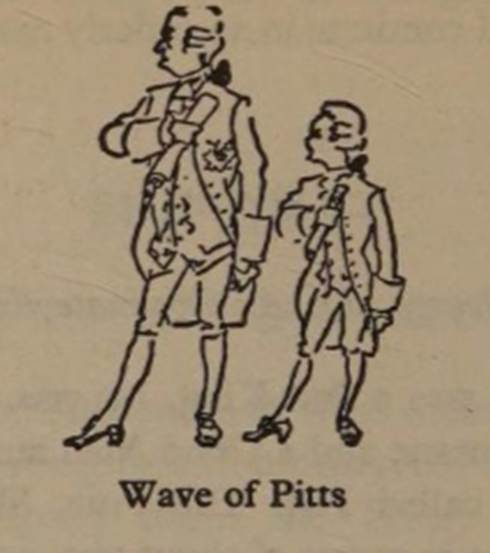
(1066 and all that, Walter Sellar and Robert Yeatman, 1930).
1757
The Militia Act
revived county militias. 30,000 men were raised between 1757 and 1763.
The company clerk
who became a soldier, Robert Clive secured Bengal at the Battle of Plassey,
India, on 23 June 1757, a decisive victory for the British East India Company.
He defeated the Nawab of Bengal. Although a small skirmish where the British
were outnumbered, the battle was won because the Nawab's commander-in-chief,
Mir Jafar, had secretly conspired with Clive and defected, leaving much of the
Nawab's army ineffectively positioned. This victory was a major turning point
that established British political dominance in India, paving the way for their
eventual rule over the subcontinent.
1759
1759 was a year
of British victories.
The Capture of Quebec by
General James Wolfe followed a decisive victory at the Battle of the Plains of
Abraham, which was the culmination of a three-month siege. British forces scaled
the cliffs to surprise and defeat French forces led by General Louis-Joseph de
Montcalm on 13 September 1759. Both commanders were mortally wounded, and the
city surrendered a few days later, a victory that ultimately led to the British
conquest of Canada.
At the Battle
of Minden in Hanover, fought on 1 August 1759, a small force of six British
battalions routed the French after a mistaken order to advance. Despite
suffering heavy losses when the infantry advanced prematurely, they
successfully repelled multiple French cavalry charges. A key failure for the
Allies was the refusal of their cavalry commander, Lord George Sackville, to
advance when ordered, which squandered the opportunity to fully rout the
fleeing French forces.
An audacious
naval action by Admiral Sir Edward Hawke at Quiberon Bay,
Brittany on 20 November 1759 led to the destruction of the core of the French
navy. The battle occurred during a gale, as the French tried to escape a
British blockade of Brest. Hawke pursued the French into Quiberon Bay and,
despite dangerous weather, destroyed a significant portion of their fleet,
ending the immediate threat of a French invasion of Britain.
1760
The industrial
revolution began in around 1760, a period of economic and social
transformation. It marked a shift from a largely agrarian, craft economy and
domestic production system to one dominated by machine manufacturing, the
factory system, and new energy sources like steam power.
Robert Bakewell
began pioneering innovative agricultural practices including the selective
breeding of sheep.
George III, 1760 – 1820
1761
In a mood of
victories, George III’s first act, with ambitions as a patriotic king, was to
sack his Whig ministers. Traditional Tory families took new roles as JPs and
militia officers. Whig grandees were humiliated.
Some Whigs
accepted the changed political landscape, but others resisted, particularly:
· The Old Whigs and
the Revolution Whigs who sought to restrain George
· The Rockingham
Whigs, who followed Charles Watson-Wentworth, Second Marquess of Rockingham who
owned significant land in Yorkshire.
· The actions of
John Wilkes to undermine the Earl of Bute and the King himself.
The Parliamentary
Enclosure Acts between 1750 and 1845 legalised the enclosure of landowners’
property, transforming the countryside.
There is an In Our Time podcast on
the 18th and 19th century enclosure
movement which divided the British countryside both literally and
figuratively.
The Bridgewater
Canal opened, followed by a period of canal building.
John Harrison’s
chronometer allowed the determination of longitude at sea.
1762
Records were
required to be kept in metropolitan parishes of parish poor infants.
1763
Mortimer’s
Universal Directory listed retail shops in London.
William Dade, a Yorkshire
clergyman, started the practice to keep detailed parish registers, which
practice spread.
The Treaty of
Paris ended the Seven Years War. France gave up all its territories in mainland
North America, effectively ending any foreign military threat to the British
colonies there. It left Britain dominant in North America and eastern India.
At first this was
welcomed euphorically by the American colonialists. The journalist Benjamin
Franklin spoke proudly as a Briton, and saw the future of the British Empire in
America. James Otis, who would later be a rebel leader rejoiced “We love,
esteem and reverence our mother country, and adore our King”.
However the King
and his ministers saw things differently – they wanted to reduced the financial
burden of the colonies, whilst stabilising and rationalising the growing empire
in preparation for further war with France.
· They intended to
increase the power of governors to enforce trade regulations and induce greater
contribution to defence (the Americans were the most lightly taxed anywhere in
the world)
· They sought to
limit encroachment onto native land in fear that it would provoke a bloody an
costly conflict – the Royal
Proclamation of 1763 recognised indigenous land ownership and there were
treaties between the Crown and the American nations.
The American
colonial citizens were resistant to these changes:
· They felt they
had been the real heroes in the prior wars – they stressed loyalty to the Crown
whilst resisting the Westminster Parliament.
· Colonial
assemblies sought to set their own taxes and decide their contribution to
defence.
· They wanted to
buy cheap land, including the former French territories, but were prevented
from doing so.
· They were
encouraged by the campaign for greater liberty by John Wilkes in the 1760s and
felt they were subject to a systematic assault on their liberties as free born
Englishmen.
The Whigs in
opposition in England felt they were facing an absolutist plot led by the king
to undermine the constitution. They complained at bureaucracy in the growing
army and navy and abuses of power by the East India Company.
1764
James Hargreaves’
Spinning Jenny.
Lloyds Register
of Shipping.
1765
The first attempt
to levy direct taxation on the American colonies was the
Stamp Act 1765, which was violently resisted. The British needed to station
a large army in North America and on 22 March 1765 the British Parliament
passed the Stamp Act, which sought to raise money to pay for this army through
a tax on all legal and official papers and publications circulating in the
colonies. When a colonial congress called for a boycott of British goods, the
Act was repealed.
1766
Hanway’s Act
required all pauper children under 6 from metropolitan parishes to be sent to
school in the countryside, separating the children from their parents.
The Declaratory
Act 1766 stated that Parliament had a right in principle to legislate in
America, even if it prudently refrained to do so.
1769
Captain James Cook claimed New Zealand for
Britain.
Richard Arkwright
patented his water frame.
Bengal was the
victim of famine from 1769 to 1770. It was widely blamed on oppression by the
East India Company. John Wesley anticipated divine vengeance. However despite
concerns. It was felt that there could be no turning back – the loss of Indian
trade would cause British bankruptcy and dominance of absolutist France.
1770
Lord Frederick
North became the new Tory Prime Minister.
Captain James Cook landed in Botany Bay.
A rise in grain
prices saw the potato surpassing bread as the staple of the working man’s diet.
First water
powered mills begin the age of mass production in factories.
Exports and
imports had shifted away from the Continent so that by the 1770s over half were
from further afar and new commodities such as tea, cotton and sugar were being
consumed. The merchant navy protected by Navigations Acts, expanded. Government
revenues from trade grew. The Caribbean was particularly important, as the
source of sugar.
America
The British
colonists could not work with the heat and disease, and so over 3 M people were
shipped from Africa as slaves between 1660 and 1807. At its peak in the 1780s,
120 Africans were transported each day.
The triangular
trade was established by Britain and France:
· Manufactured good
to Africa to buy slaves;
· Slaves sold in
the Caribbean to buy sugar.
The mainland
colonies were swelling in population, but were more modest providers of wealth.
However up to this stage, there was no sign of these colonies growing apart
from their mother country.
Lord North had
the idea of abolishing existing duties, leaving only a light duty on tea from
India, following the principle of the Declaratory Act to demonstrate
Parliament’s power to legislate. This had the effect to make tea cheaper, so
the Patriots would find it difficult to oppose.
India
Asia was the
focus for luxury goods, spices, fine textiles and significantly, tea.
The Europeans
built fortified trading posts at Calcutta (founded in 1690 and with 120,0009
people by 1760), Bombay and Madras.
War with France
transformed the European approach in India.
The Mughal Empire
had been established in the 1520s by Muslim invaders from central Asia. There
was a Golden Age marked by the Taj Mahal (1650) and Great Mosque of Delhi
(1656). Then there was a period of fragmentation – defeats by the Hindu
Marathas and the Persian sack of Delhi in 1739. By the late eighteenth century,
there had been fragmentation into regional power centres, often ruled by Mughal
nawabs, governors.
The French and
the British both raised local military forces. By 1761, the East India Company
had 2,000 European and 23,000 Indian soldiers.
There is an In
Our Time podcast on the East India Company.
1772
The first Navy
Lists were published.
Publication of
the first Morning Post.
1773
The Boston
Tea Party, December 1773. A group of patriots threw a shipload of tea into
the sea bringing to the fore the question of who would govern America.
Captain Cook
reached Antarctica.
The East Indies
Regulating Act 1773 tried to bring some control over the East India Company.
1774
The Quebec Act in
1774 placed Quebec into the hands of a royal governor, without an elected
assembly.
The Madhouse Act
required all ‘madhouses’ to be licensed, and aimed to counter abuses including
imprisonment of rejected spouses. The Act remained in force until 1959.
By 1774 there
were patriots in England and America who felt they were fighting to protect a
threat to fundamental British liberties. This was encapsulated in calls for no
taxation without representation. Samuel Johnson’s pamphlet, The Patriot
in 1774 provided the contrary argument that He that accepts protection
stipulates obedience.
A continental
Congress of patriot committees met in Philadelphia in September 1774.
· The North
government offered compromise.
· Leading colonial
politicians were reluctant to break from the mother country.
1775
Watt’s steam
engine was patented.
See the Industrial
Revolution.
There is an In Our Time podcast, The Industrial Revolution
and about the far-reaching consequences of the Industrial Revolution,
which brought widespread social and intellectual change to Britain. There is
another about Isambard
Kingdom Brunel, the Victorian engineer responsible for bridges, tunnels and
railways still in use today.
A Second
Continental Congress in 1775 still denied any intention to break with Britain
or seek independence.
However patriot
hotbeds, especially in New England, were growing restless.
Shooting began at
Lexington
in April 1775 followed by a pitched battle at Bunker
Hill, outside Boston, in June 1775.
The American
War of Independence, 1775-1783
1776
The Declaration
of Independence, 4 July 1776:
We hold these
truths to be self evident; that all men are created equal; that they are
endowed by their Creator with certain inalienable rights; that among these are
life, liberty, and the pursuit of happiness.
Loyalties were
split in both America and Britain.
About a third of
those in Britain supported the American Patriots including Whigs, dissenters
and those with American business interests, particularly focused on Bristol at
the heart of American trade. The use of force in America was deplored.
However there was
also public resentment at the rebellion and support for the use of force
against the rebels came from most Anglicans and the Methodists (a Whig peer
pointed out that Methodism was becoming popular by forcing the country into a
destructive war).
There was a
reemergence of the religious divides of the Civil War – the colonial Patriots
were equated to the Roundheads and supported by Dissenters and Ulster
Presbyterians. Unitarians were the avant garde of dissent.
Thomas
Paine wrote Common Sense in 1776 and was the intellectual leader of
the revolution. 100,000 copies were sold. He saw American independence as
inevitable and that it would allow prosperous and peaceful isolation from
quarrels in Europe. England to Europe, America to itself!
There is an In Our
Time podcast
about the part British thinkers played in the Enlightenment
in the 18th century and another about the emergence and impact of the Scottish Enlightenment
which was led by the philosopher David Hume and the father of modern economics,
Adam Smith. There is another Adam Smith's celebrated
economic treatise The Wealth
of Nations. There is another about the pioneering
British Enlightenment thinker Mary Wollstonecraft
(1759 to 1797). There is another about The Bluestockings,
a group of prominent women intellectuals in 18th-century England.
There was
nevertheless strong loyalist support in America. German and Scottish settlers
had little kinship with the patriot roundheads. Volunteers for new British
Regiments came readily from Jacobite clans. Flora MacDonald, thirty years after
her saving of Bonnie Prince Charlie, was a prominent Tory in North Carolina.
The established nations, including Mohawks, Creeks, Delaware, Iroquois and
Cherokees, feared invasion by the colonists and worried about the risk that the
Royal Proclamation of 1763 would be overturned. When freedom was declared to
any enslaved African who joined the Crown forces, up to 100,000 slaves joined
the army, many who had belonged to George Washington.
The War went
relatively well for the Crown in America initially. New York was occupied and
defended in 1776. George Washington’s weak Continental
Army withdrew to Pennsylvania. The British aimed to isolate them there, and
sought a defeat by 1777. The British sent a force of 5,000 men under General
Burgoyne south to link up with General Howe at New York.
An Act which
allowed decommissioned ships to be used as prison hulks.
1777
Washington’s army
was defeated on 11 September 1777 at Brandywine
by General How and Philadelphia was taken.
However
Burgoyne’s force was then cut off at Saratoga
(19 September to 7 October 1777) and, with dwindling supplies, forced to
surrender on 17 October 1777.
A tax was imposed
on male servants.
1778
The French became
interested in the opportunities of the American Civil War, especially after
Saratoga, the French foreign ministry declaring that 1778 will decide the
fate of England, and the predominance of France.
· There was a minor
action in June 1778 between British and French frigates off Brittany.
· The American
Civil War thus became another world war.
· Spain joined in
1779 and besieged Gibraltar and Holland.
· The French
planned its coup de grace by landing a force of 20,000 on the Ilsa of
Wight.
· Militia camps
were set up around London
· Defiant anthems
were composed: Tho’ Monsieur and Don should combine, What have true British
heroes to fear? What are Frogs, and soup-meagre and wine, To beef, and plum
pudding, and beer?
James Cook and George Vancouver were the
first Europeans to reach British Columbia.
Louis XVI of
France declared war on Britain.
1779
The French and
Spanish fleet of 104 ships gathered in Normandy, but was hit by plague and the
threat petered out without a fight.
In India, new
threats were faced, by a strong alliance of Indian states, the Maratha
Confederation and Haider Ali, the ruler of Mysore, Southern India. The Bombay
force of the East India Company surrendered Marathas in 1779 and the Madras
army was defeated by Hailder Ali in 1780. Company troops in Bengal were
massacred by their former ally, the rules of Benares. Warren Hastings, the
governor general, fled for his life.
Increased
reliance on Ireland for support to its armed forces, led to concessions to
Irish demands:
· The Irish Relief
Act 1778 and the Catholic Relief Act 1778 reduced legal disabilities of
Catholics in Ireland.
· There was a
greater assertion of autonomy by the Irish “Grattan’s Parliament.
1780
Britain started
its largest ever mobilisation in its struggle to survive. The navy was
increased from 16,000 sailors to 100,000 by 1782 and the army expanded to
250,000 soldiers. Irish and Scots were recruited into the military forces.
These were not released criminals as has been suggested but included skilled
craftsman and a strong officer corps.
Political
discontent inevitably accompanied these new times. A Whig Association Movement
pressed for parliamentary reform. John Wesley asked why Catholics basked in the
sun while Dissenters were stigmatised as the enemy.
The famous
Commons motion was tabled in April 1780: “The influence of the Crown has
increased, is increasing, and ought to be diminished.”
However the
Loyalists across Great Britain and Ireland felt their Britishness.
On 6 June 1780 a
petition was presented to Parliament demanding the repeal of the Catholic
Relief Act.
There followed
five days of riots, known as the
Gordon Riots in London in protest against the Catholic Relief Act. The
Gordon Riots of 1780 were several days of rioting in London motivated by
anti-Catholic sentiment. They began with a large and orderly protest against
the Papists Act 1778, which was intended to reduce official discrimination
against British Catholics enacted by the Popery Act 1698. Lord George Gordon,
head of the Protestant Association, argued that the law would enable Catholics
to join the British Army and plot treason. The protest led to widespread
rioting and looting, including attacks on Newgate Prison and the Bank of
England and was the most destructive in the history of London. They were
dramatized by Dickens in Barnaby Rudge. The rioters were mainly
respectable apprentices and labourers and included the radical William Blake.
They were well informed. Noone was killed by the crowds. The city authorities
refused to act, perhaps out of fear or from sympathy. After five days the
troops were given reassurances about the lawfulness of preventing further
disturbance and the King ordered them to fire on those who refused to disperse
after the reading of the Riot Act. 160 rioters were tried and 26 (mainly young)
were hanged.
The crowd that 9
years later stormed the Bastille in France was only a fraction of the size of
the rioters mustered by Gordon. They have largely been forgotten as the anti
catholic basis for the riots has been seen with retrospective distaste by later
radical movements.
There is an In Our Time podcast on
the Gordon Riots of 1780,
and why a Westminster protest against 'Popery' in June 1780 led to widespread
rioting across London, lethally suppressed
Methodist
registers began.
Notwithstanding
the Gordon Riots, there was some stabilisation politically and militarily
during 1780. The Spanish were occupied in the Siege of Gibraltar. Washington’s
army was having problems with mutiny and desertion.
1781
Washington begged
for more help from the French. In March 1781 the French sent its Atlantic fleet
to the West Indies, and after failing to capture Jamaica, it sailed to Virginia
in July 1781. A small British force was trapped at Yorktown
and the British surrendered.
1782
Lord North
resigned as rime Minister and the Whig Rockingham returned to office in March
1782. He began to withdraw troops from America.
The French sailed
again for Jamaica. The British fleet confronted them in the only great battle
fought by the Royal Navy outside European waters until the twentieth century.
The Battle
of the Saints in the Caribbean on 9 to 10 April 1782 ended in a British
victory which was their greatest success over the French during the American
War. The action tilted the advantage to Britain against the French.
Gilbert’s Act
allowed parishes to form unions to maintain workhouses for the elderly and
infirm.
1783
The Stamp Duty
Act introduced tax on baptisms, marriage and burials (not paupers).
The volcano Laki
erupted in Iceland which had catastrophic effects on European weather and
caused many deaths.
Rockingham and
his successor, Lord Shelburne, were eager to end the war in America. Several
significant constitutional changes occurred at this time:
· An opposition
party came to power despite its opposition to the king and sacked previous
office holders before taking measures to diminish the power of the Crown
· The Civil List
came under parliamentary scrutiny.
· A new post of
Foreign Secretary was created.
Shelburn led
peace negotiations. The Treaty of Paris created the United States. Full
independence was given to all 13 colonies involved in the rebellion. Little
concern was given to the fete of the loyalists and the freed slaves. The native
American allies were abandoned in a sentence of death for their civilisation.
If the intent had
been there the half hearted patriots could have been defeated, but Britain was
fighting a world war, and so had wider interests to defend. An idealised
version of the American Revolution prevailed in the ‘Whig Histories’.
England was
written off as a second rate power.
However, and
paradoxically, Britain became more politically and economically stable after
the war. She retained the Westy Indies, Canada, Gibraltar and its position in
India. Trade with the United States would in time become a significant bulwark
of Britain’s economy. A long trade boom began in 1783. By 1821, the US took 44%
of its imports from Britain.
A new model of
Britain emerged, more paternalistic and progressive.
American
independence had relieved Britain of significant burdens on its economy,
particular in the cost of defence in America.
In December 1783,
the king orchestrated a defeat to the Whig ministry in the House of Lords.
George II then appointed William
Pitt the Younger as prime minister to rally patriot forces around the
patriot king. Pitt then won an early general election. There was a rally to
Pitt’s patriotic policies. The king became popular and nicknamed Farmer
George, in part due to his agricultural interests.
The loss of
America placed greater focus on India. There were growing concerns about the
East India Company which was seen as utterly incorrigible, and there was an
attempt in 1783 to set up a political board of control, but this was seen as a
political move to control the wealth from India.
Warren
Hastings was the first Governor General. He tried to reform Company rule,
and promoted moderation and greater reliance on Indian laws, ideas and
institutions and employment of Indian people. This seemed a move towards a more
respectful approach. However the bottom line was that Britain was eager to
extend its power through taxation and trade.
The British were
now actively interacting with the rest of the world.
· Sir William Johnson
married into Mohawk nobility.
· James Skinner,
born in Calcutta in 1778 to an East Indian Company officer and an Indian mother
became Colonel of Skinner’s Horse.
1784
The invention of
the threshing machine.
The first mail
coaches were introduced.
A Game Tax was
levied on all qualified to kill or sell game.
Taxes introduced
on owners of hoses used for transport or racing.
William Pitt was
Prime Minister, 1784-1801
1785
In 1785, after 10
years of service, during which he helped extend and regularise the nascent Raj,
Warren Hastings resigned. On return to England, Hastings was impeached in the
House of Commons for alleged crimes in India, notably embezzlement, extortion and
coercion, and an alleged judicial killing of Maharaja Nandakumar. At first
thought unlikely to succeed, the prosecution was managed by MPs including
Edmund Burke, encouraged by Sir Philip Francis, whom Hastings had wounded
during a duel in India, Charles James Fox and Richard Brinsley Sheridan. When
the charges of the indictment were read, the 20 counts took Edmund Burke two
full days to read. The House sat for 148 days over a period of seven years
during the investigation. The House of Lords acquitted him of all charges on 24
April 1795. The Company subsequently compensated him with £4,000 annually,
retroactive to the date he returned to England, but did not reimburse his legal
fees, which he claimed to have been £70,000.
The impeachment
of Hastings, and the anti slavery movement showed a growing sensitivity to the
negative outcomes of the Empire, but Britain was at the same time becoming
increasingly dependent on colonial trade. The dilemma was that it was becoming
difficult to retain Britain’s status as a wealthy and prosperous nation, whilst
avoiding the darker aspects.
Prior to the
1770s, Britain had not been vocal in its criticism of slavery. I pity them
greatly, but I must be mum, For how could we do without sugar and rum?
However from the 1770s, there was a campaign against slavery. In 1785 the vice
chancellor of Cambridge set his students an essay prize on whether slavery was
right and it was won by Thomas
Clarkson, an important slave campaigner.
First edition of
The Times.
A tax was imposed
on female servants.
1787
The Society
for Effecting the Abolition of the Slave Trade was founded.
1788
A penal colony
was established in Botany
Bay in Australia.
After serious
bouts of illness in 1788-89 and again in 1801, George III became permanently
deranged in 1810. He was mentally unfit to rule in the last decade of his
reign; his eldest son - the later George IV - acted as Prince Regent from 1811.
Some medical historians have said that George III's mental instability was
caused by a hereditary physical disorder called porphyria.
1789
William
Wilberforce, with the encouragement of William Pitt, began a long
parliamentary campaign to ban the slave trade. However the issue was taken ff
the agenda for some time, by the beginning of another war with France.
The French
Revolution began. On 14 July 1789, a few hundred Parisiens stormed
the Bastille. At first England welcomed this new development in the affairs
of their old enemy France.
· The House of
Commons promoted a day of thanksgiving for the French Revolution.
· William Pitt
hoped for friendly relations with the new nation
· The Dissenters
and Whigs in opposition were particularly enthusiastic and saw it as a blow to
popery and superstition.
Before long there
were differing views on the subject:
· The Unitarian
intellectual, Dr Richard Price, preached that most governments were usurpations
on the rights of men.
· But Edmund Burke replied in Reflections
on the Revolution in France (1790) saying the revolution had become a
spectator sport for the middle class, and a free society relied upon respect
for its institutions. The revolution caused suffering and loss. He argued that
societies grew organically and he was appalled by the sudden destruction of
institutions.
· In reply, Thomas
Paine’s Rights of Man (1791) dismissed Burke’s ideas. The new French
constitution was the rational course of thins. For a nation to be free, it is
sufficient that it wills it to be so. In June 1792 Paine was summoned for
seditious libel.
· Fundamental
divisions in British politics, reopened Civil War divisions.
· Radical Societies
emerged.
· There was
rioting, though not violent.
Soon after
America had ceased to be memorable, the French Revolution broke out (in
France). This, like all other Revolutions, was chiefly due to Liberty,
Fraternity, Equality etc, but also to the writings of Madame Tousseau, the
French King’s mistress, who believed in everyone returning to a state of nature
and weas therefore known as la belle savage (1066 and
all that, Walter Sellar and Robert Yeatman, 1930).
1790
The invention of
a new surfacing treatment for roads by John McAdam.
1791
Thomas Paine’s
Rights of Man was published.
The Canada Act
divided Canada into Upper and Lower Canada.
The Universal
British Dictionary in 5 large volumes gave details of counties, schools and
other facilities.
1792
The first Regency
Crisis
The September
massacres in France of 1792 led to the butchering of women and children on the
streets of Paris and Louis XVI and Marie Antionette were executed in the
escalating Terror (la
Terreur). This was the context of Charles Dickens Tale of Two Cities,
contrasting the Terror with peace and security in Britain. The scene was set in
the classic description of life in 1775, before the dramas of the ensuing
years:
It was the best
of times, it was the worst of times, it was the age of wisdom, it was the age
of foolishness, it was the epoch of belief, it was the epoch of incredulity, it
was the season of Light, it was the season of Darkness, it was the spring of
hope, it was the winter of despair, we had everything before us, we had nothing
before us, we were all going direct to Heaven, we were all going direct the
other way—in short, the period was so far like the present period, that some of
its noisiest authorities insisted on its being received, for good or for evil,
in the superlative degree of comparison only.
There were a king
with a large jaw and a queen with a plain face, on the throne of England; there
were a king with a large jaw and a queen with a fair face, on the throne of
France. In both countries it was clearer than crystal to the lords of the State
preserves of loaves and fishes, that things in general were settled for ever.
It was the year
of Our Lord one thousand seven hundred and seventy-five. Spiritual revelations
were conceded to England at that favoured period, as at this. Mrs. Southcott
had recently attained her five-and-twentieth blessed birthday, of whom a
prophetic private in the Life Guards had heralded the sublime appearance by
announcing that arrangements were made for the swallowing up of London and
Westminster. Even the Cock-lane ghost had been laid only a round dozen of
years, after rapping out its messages, as the spirits of this very year last
past (supernaturally deficient in originality) rapped out theirs. Mere messages
in the earthly order of events had lately come to the English Crown and People,
from a congress of British subjects in America: which, strange to relate, have
proved more important to the human race than any communications yet received
through any of the chickens of the Cock-lane brood.
France, less
favoured on the whole as to matters spiritual than her sister of the shield and
trident, rolled with exceeding smoothness down hill, making paper money and
spending it. Under the guidance of her Christian pastors, she entertained
herself, besides, with such humane achievements as sentencing a youth to have
his hands cut off, his tongue torn out with pincers, and his body burned alive,
because he had not kneeled down in the rain to do honour to a dirty procession
of monks which passed within his view, at a distance of some fifty or sixty
yards. It is likely enough that, rooted in the woods of France and Norway,
there were growing trees, when that sufferer was put to death, already marked
by the Woodman, Fate, to come down and be sawn into boards, to make a certain
movable framework with a sack and a knife in it, terrible in history. It is
likely enough that in the rough outhouses of some tillers of the heavy lands
adjacent to Paris, there were sheltered from the weather that very day, rude
carts, bespattered with rustic mire, snuffed about by pigs, and roosted in by
poultry, which the Farmer, Death, had already set apart to be his tumbrils of
the Revolution. But that Woodman and that Farmer, though they work unceasingly,
work silently, and no one heard them as they went about with muffled tread: the
rather, forasmuch as to entertain any suspicion that they were awake, was to be
atheistical and traitorous.
In England, there
was scarcely an amount of order and protection to justify much national
boasting. Daring burglaries by armed men, and highway robberies, took place in
the capital itself every night; families were publicly cautioned not to go out
of town without removing their furniture to upholsterers’ warehouses for
security; the highwayman in the dark was a City tradesman in the light, and,
being recognised and challenged by his fellow-tradesman whom he stopped in his
character of “the Captain,” gallantly shot him through the head and rode away;
the mail was waylaid by seven robbers, and the guard shot three dead, and then
got shot dead himself by the other four, “in consequence of the failure of his
ammunition:” after which the mail was robbed in peace; that magnificent
potentate, the Lord Mayor of London, was made to stand and deliver on Turnham
Green, by one highwayman, who despoiled the illustrious creature in sight of
all his retinue; prisoners in London gaols fought battles with their turnkeys, and
the majesty of the law fired blunderbusses in among them, loaded with rounds of
shot and ball; thieves snipped off diamond crosses from the necks of noble
lords at Court drawing-rooms; musketeers went into St. Giles’s, to search for
contraband goods, and the mob fired on the musketeers, and the musketeers fired
on the mob, and nobody thought any of these occurrences much out of the common
way. In the midst of them, the hangman, ever busy and ever worse than useless,
was in constant requisition; now, stringing up long rows of miscellaneous
criminals; now, hanging a housebreaker on Saturday who had been taken on
Tuesday; now, burning people in the hand at Newgate by the dozen, and now
burning pamphlets at the door of Westminster Hall; to-day, taking the life of
an atrocious murderer, and to-morrow of a wretched pilferer who had robbed a
farmer’s boy of sixpence.
All these things,
and a thousand like them, came to pass in and close upon the dear old year one
thousand seven hundred and seventy-five. Environed by them, while the Woodman
and the Farmer worked unheeded, those two of the large jaws, and those other two
of the plain and the fair faces, trod with stir enough, and carried their
divine rights with a high hand. Thus did the year one thousand seven hundred
and seventy-five conduct their Greatnesses, and myriads of small creatures—the
creatures of this chronicle among the rest—along the roads that lay before
them.
The mood
regarding the French Revolution changed. There was hostility to the violence.
Soon there were
some 2,000 Loyalist Societies, such as the Association for the Preservation of
Liberty and Property against Republicans and Levellers, founded in November
1792.
There were also
smaller numbers of Radical Societies, such as the London Corresponding Society
which was founded in January 1792 by the Scottish Dissenter, Thomas Hardy. A
circle formed around the Unitarian publisher Joseph Johnson, including Samuel
Taylor Coleridge, Mary Wollstonecraft and William Wordsworth.
In April 1792,
France declared war on Austria and Prussia. Initially intending to remain
neutral, William Pitt assured the Commons on 17 February 1792 that Britain
might reasonably expect fifteen years of peace.
1793
The execution of
Louis XVI in January 1793 shocked the English public. There was a new fear for
the independence of Holland, and Britain pledged to support the Dutch. The
French revolutionary leaders were buoyed by a euphioc belief in their
invincibility and strove to spread their revolutionary message across Europe.
The French
Republic declared war on Britain and Holland on 1 February 1793.
Thomas Paine was
an enthusiastic supporter of the French Revolution and was granted honorary
French citizenship. Paine was selected as one of nine deputies to be part of
the convention's Constitutional Committee, who were charged to draft a suitable
constitution for the French Republic. He drafted a call on British people to
revolt.
The
French Revolutionary Wars 1793 to 1802. With a short
break from March 1802 to May 1803, war with France would last for the next
twenty years.
Britain adopted
its usual strategy to encourage and finance a coalition against France. The
French navy was weak and easily routed by the Royal Navy. However the Franch
Army was formidable and was able to raise vast armies through mobilisation and
terror.
The war that
followed is another candidate for the first real world war.
The Friendly
Societies Act.
There were splits
in the Whig party and concerns about William Pitt’s closeness to George III.
William Pitt was reserved and often irritating and not ideal as a war leader.
However he had strong willpower and a sound knowledge of finance, which was
helpful in the critical strategic concern of war finances.
In France there
were initially expectations of quick victory. France’s unruly army swarmed into
Savoy, Germany, Belgium and Holland. A revolutionary dictatorship took power,
in which the dominant figure was the yo0ung lawyer, Maximilien Robespierre.
There was counter revolutionary resistance focused on peasants and Catholics.
France was soon
in the grip of civil war and terror, with 16,000 executed on the guillotine and
thousands more slaughtered. Refugees streamed into England.
Despite gruesome
events in France, there remained support for the revolution in England and
Thomas Paine continued to promote an invasion of England. The Dissenters still
saw the revolution as a struggle against popery.
Britain’s
economic situation was precarious:
· A booming
population, but imports becoming more difficult due to the war.
· Local workforce
mobilised for war.
· Climatic
conditions, partly caused by south east Asian volcanic activity causing poor
harvest in 1791, 1792, 1794, 1795, (with serious shortages 1795 to 1796) 1800
(with serious shortages 1800 to 1801), 1811 and 1812 (with serious shortages
1809 to 1810).
The Royal Navy
sailed into the French base at Toulon in August
1793 to support French Royalist rebels. They were forced to withdraw under
canon fire commanded by the young artillery officer, Napoleon Bonaparte. The
siege was the first involvement of the British Royal Navy with the French
Revolution.
1795
Now General
Bonaparte put down a royalist rising in Paris in October 1795.
Corsican patriots
threw out the French and tried to join the British Empire, but were unable to
hold out.
Britain’s main
war aim was the independence of Holland, but Holland fell in early 1795 and
became a French satellite. British troops in the Low Countries under George
III’s second son, Frederick,
the Grand Old Duke of York soon had to march down again.
The government
took a carrot and stick approach to the hardships arising from war.
· Corn exports
stopped and grain was imported from US, Canada and India.
· However “Pitt’s
reign of terror” began in May 1794, which led to a restriction on civil
liberties and suspension of habeas corpus, focused on the “Two Acts” in the
wake of the stoning of King George III on his way to open Parliament in 1795:
o The Treason Act
1795 (sometimes also known as the Treasonable and Seditious Practices Act) made
it high treason to "within the realm or without compass, imagine,
invent, devise or intend death or destruction, or any bodily harm tending to
death or destruction, maim or wounding, imprisonment or restraint, of the
person of ... the King". The Act became a permanent Act in 1817.
o The Seditious
Meetings and Assemblies Act 1795 restricted the size of public meetings to
fifty persons.
The Speenhamland
system for poor relief was introduced offering financial assistance linked to
the price of bread, but this effected the south of England.
The Quota Acts
forced counties to supplement recruitment to the Royal Navy.
Food riots and
widespread famine in England following poor harvests and high prices caused by
the war with France.
1796
Napoleon marched
into Italy. He defeated an Austrian army and the French were soon in possession
of northern Italy, the Austrian Netherlands and the Rhineland.
Chaplains’
Returns recorded baptisms, marriages and burials overseas.
Edward Jenner’s
first vaccination against smallpox.
The Retreat near
York opened, offering a more humane approach to the treatment of persons with
mental illness.
The Supplementary
Militia Act raised an additional 64,000 men, by ballot, to serve in the war
against France.
The Army began to
record deaths of serving personnel.
1797
In
February 1797 a small force of 1,400 French landed accidentally in Fishguard, Pembrokeshire
in an effort to burn Bristol. They quickly surrendered after seeing a group of
Welsh women dressed in red cloaks, who they thought to be a Ridgment of
soldiers. Perhaps thousands of local Welsh women dressed in their
traditional scarlet tunics and tall black felt hats had come to witness any
fighting between the French and the local men of the militia. The by then
inebriated invasion force mistook them for Redcoats. Although a fiasco, the
incident caused a run on the Bank of England.
There were serious naval mutinies in 1797.
·
In April 1797, the Channel Fleet at Spithead refused to put to sea
and there was violence until an agreement was reached for better pay, food and
leave conditions.
·
There followed mutinies at the Nore and Yarmouth. The public
turned against them. By 13 June 1797 the mutiny was over and 30 sailors were
hanged.
·
They were in reality more like collective bargaining for better
conditions and Nelson commented that the mutinies had been the most manly I
ever heard of and does the British sailor infinite honour.
1798
Napoleon led an
invasion of Egypt in a bid to dominate the Mediterranean. However his fleet was
annihilated by Nelson at the Battle of
the Nile on 1 August 1798. 11 of 13 battleships were destroyed or captured.
Napoleon abandoned his army in Egypt and returned to France.
Encouraged by
Napoleon’s failure in Egypt, a Second Coalition emerged of Britain, Austria,
Russia and Turkey. The French Revolution was under threat.
There was a
United Ireland uprising in 1798, though brutally crushed. The ‘Irish Question’
had become a perennial concern.
There is an In Our Time podcast on
The Irish Rebellion of 1798,
led by the United Irishmen, who were inspired by American and French
revolutions, and the impact this had across Ireland.
There were big
increases in taxation to fund the war. There was an introduction of the first
income tax, at 10% on incomes over £200.
The second phase
of the French Revolutionary Wars was the First War with Napoleon Bonaparte,
1798-1802.
Battle of the
Nile, 1798
Thomas Malthus’ An
Essay on the Principle of Population.
1799
The Russians and Austrians
advanced in Italy, Switzerland and Germany. British and Russian troops landed
in Holland and seized the Dutch fleet.
Napoleon seized
dictatorial power and became First Consul in November 1799. He offered peace
terms, which were rejected.
1800
In Summer 1800
there were attempts at coordination of attacks on France, but the plan
unravelled and the French rallied.
The tide had
turned again and now Britian was threatened. There was rationing and starvation
at home.
Napoleon defeated
the Austrians in a surprise attack after marching over the Alps, at Marengo.
Pitt's Bill for
the Union of Great Britain and Ireland into the United Kingdom.
1801
United Kingdom
population was 16.3 million.
In March 1801
General Abercrombie landed in Egypt and defeated a larger French army at the Battle of
Alexandria.
On 2 April 1801, Nelson
destroyed the Danish fleet at the Battle of
Copenhagen.
In November 1801
William Pitt admitted that the intended war aims were unattainable.
The Treaty of
Amiens was agreed in March 1802 with an enlarged France getting control
over its gains including the Low Countries.
Food prices fell
and tourists streamed abroad, even to see post Revolutionary France.
Napoleon ordered
a naval building programme and openly planned another invasion of Egypt.
1802
Frances fresh
global visions meant that before long, a relatively minor issue sparked fresh
conflict. The Treaty of Amiens required Britian to abandon Malta, but the
British stayed on. An ultimatum expired and on 12 May 1803, Britain declared
war.
The
Napoleonic Wars 1803 to 1815
The ordinary folk
in Britain and France were horrified at the resumption of hostilities.
However even
those who had initially supported the revolution had become disillusioned.
Frances involvement of the neutral Switzerland turned Wordsworth against it.
There remained a hardline few, such as Ebenezer Aldred, Unitarian minister of Wakefield who thought Britain was guilty of
imperialism and decadence and was shocked at the near naked portrayal of
Britannia. He held the unpatriotic view that the Beast foreseen in the biblical
Book of Revelation was Great Britain, a wicked and degenerate nation, guilty of
imperialism, slave trading and sodomy, not to mention its regrettable habit of
stamping the image of the Whore of Babylon on its coins.
The Health and
Morals of Apprentices Act 1802 improved conditions of apprentices working in
cotton mills.
1803
Napoleon turned
his attention to an invasion olf Britain. He built up a force of 2,500 gunboats
and landing craft and an ‘Army of England’ of 165,000. There was a fervour
across Britian and panic in Colchester that the invasion had been sighted.
· The regular army
was avoided by respectable English workmen. It was always short of men, though
bolstered by Irish and Scottish recruits.
· But a formidable
local volunteer force grew up. The Volunteer Corps was a British voluntary part-time
organization for the purpose of home defence in the event of invasion, during
the French Revolutionary and Napoleonic Wars. For instance the Leeds Volunteer Corps (1794–1802, 1803–1808) was
line infantry regiment of volunteers in the West Riding of Yorkshire. They were
active during the Napoleonic Wars and were part of the British Volunteer Corps
and units like the East
York Militia Regiment and the North Holderness Volunteer Infantry and the volunteer
infantry of West Yorkshire.
· By 1805 there
were 800,000 men doing some form of military service, 20% of the active male
population, comparable to the world wars of the twentieth century.
· Recruitment was
encouraged by propaganda but also by opportunities for rape and pillage.
Defence
preparations were undertaken extensively, mainly focused south of Great
Yarmouth, but extending from Cornwall to Scotland. 168 Martello Towers were
constructed. The Volunteers role was to slow down the invaders and while non
combatants were to leave the scene of an invasion with all the food in their
possession, volunteer units would muster at rendezvous points.
This was a war
for Britain’s existence. Success by Napoleon would mean long military
occupation; dividing up of the United Kingdom; destruction of Britain’s naval
power; annexation of its colonies; diversion of its trade to France; and an end
to the Industrial Revolution.
1804
The first railway
steam locomotive.
Napoleon became
Emperor of France.
One sixth of
British men served in the army or navy.
1805
In 1805 Napoleon
summoned his fleet on the Channel for an invasion of Britain, but Admiral
Villeneuve had cold feet and Napoleon angrily abandoned the venture.
Napoleon marched
his army to Germany and Austria.
He defeated the
Austrians and the Russians at:
· The Battle of Ulm on 20
October 1805
· The Battle of Austerlitz
on 21 October 1805.
After Austerlitz,
William Pitt retorted, Roll up the map of Europe, it will not be wanted
these ten years.
However on 21
October 1805, at the
Battle of Trafalgar, the French and Spanish fleet was destroyed.
· Nelson asked that
every man will do his duty.
· It was a one
sided battle, and the Royal Navy was dominant.
· Two third of the
Franco Spanish fleet of 33 ships of the line were captured or destroyed by 29
British ships, at a cost of 448 British lives.
· French casualties
were dreadful- 571 of the 643 crew of the Redoutable were killed.
There is an In Our Time podcast on
The Battle of Trafalgar
(1805).
See the Royal
Navy in Napoleonic Times in Farndales
and the Sea.
Napoleon did not
give up, and began the construction across Europe of a fresh fleet.
Despite dominance
at sea, the French continued to dominate the Continent. Britain could have
little influence there without allies.
1806
William Pitt died
in January 1806 after being Prime Minister for 18 years. There followed a
period of three years of political instability with three Prime Ministers,
including the Ministry
of All the Talents.
A military
academy opened at Woolwich for the training of officers.
Napoleon’s
attempted economic blockade of Britain.
1807
Napoleon signed the
Treaty of Tilsit with defeated Russia in 1807. Britain was alone.
Economically,
Britain was faring well. Agriculture had increased its farmed acreage. The
French sought to attack merchant shipping which damaged British trade, but the
French suffered worse.
Napoleon’s
Continental System required control of the whole European coastline. Vast
organised smuggling ensued. France’s customs revenue collapsed.
Sanctions and
counter sanctions
Napoleon resorted
to a land blockade to wreck British trade. London retaliated with orders in
1807 to forbid any ship from any country to trade with Napoleonic Europe.
The Peninsular War
(1807-1814)
To close off
access, Napoleon tried to take over Portugal and Spain in 1807 to 1808.
Resistance was provoked including a 3 May 1808 uprising in Madrid (depicted by Goya’s painting).
Britain gave
financial, naval and military assistance to the rebels.
Abolition of
Slavery
A consequence of
the trade war was the abolition of slavery. Politicians saw its abolition as
morally and politically attractive. There were high costs associated with
slavery and the British were using freed slaves as soldiers. The French had
brutally reintroduced slavery in 1803 and ant slavery became patriotic. The
import and use of slaves in Britain was outlawed by a large majority, but
continued in the colonies.
There is an In Our Time podcast about
the 1807 Abolition of the Slave Trade, and the life of William Wilberforce.
1808
The County
Asylums Act encouraged the construction of private asylums for the mentally
ill.
Arthur Wellesley
(later Duke of Wellington), dismissed by Napoleon as the sepoy general,
having gained experience in India, led the British military force in the
Peninsula. The army was British, with only 20% English, and largely Irish and
Scottish. It was initially only 30,000 strong relying heavily on Spanish and
Portuguese allies. It was initially chaotic and the British army gained a
reputation fort drunkenness, looting and rape. Wellington himself admitted that
some of his men were the scum of the earth, but they were also adventurous and
patriotic.
The Battle
of Sahagun on 21 December 1808 was a dawn attack in the snow by the British
15th Hussars, routing a French cavalry brigade and setting the standard for
British cavalry in the Peninsular War; ‘Success to the Fifteenth; and ‘God Save
the King’.
1809
The Battle
of Corunna, 16 January 1809 ensured the escape of the British army from
Spain on 16th January 1809, during the Peninsular War, with the death of Sir
John Moore at the moment of success.
The Battle of
Talavera, 27 to 28 July 1809. The British army under Sir Arthur Wellesley
combined with a Spanish army under General Cuesta to fight in operations
against French-occupied Madrid. At nightfall, the French army withdrew a short
distance after several of its attacks had been repulsed; the allies, having
suffered comparable casualties to the French, made no attempt to pursue. The
British victory south of Madrid on 28th July 1809 over Joseph Bonaparte, the
King imposed on Spain by Napoleon, and his French army in the Peninsular War.
1811
With Spanish and
Portuguese allies, exports from the Iberian Peninsula and from South American
colonies increased to Britain.
George III’s bouts
of mental illness meant that his unpopular son, George became Prince Regent.
Population of the
United Kingdom reached 18.5 million.
First Luddite
activity, in Nottingham.
1812
In February 1812,
a government of Pitts’ supporters against the Whigs, led by Spencer
Percival, brought some stability.
However in May
1812, Spencer Percival was assassinated in the lobby of the House of Commons.
There followed a
period of political chaos, until he was succeeded by Robert
Jenkinson, Lord Liverpool, who remained in office for the next 15 years.
The Battle
of Salamanca on 22 July 1812 saw Wellington’s victory over the French army
of Marshal Marmont, during the Peninsular War, leading to the re-capture of
Madrid; also known as the Battle of Los Arapiles or Les Arapiles
Napoleon
recklessly invaded
Russia in 1812 with his Grand Armée of 220,000, which was decimated by
Russian resistance, the burning of Moscow as the French sought to winter there,
disease and the weather.
The British
funded a rejuvenated alliance of Russia, Prussia and Austria who were able to
field a 700,000 strong force, funded by income tax, trade with India and taxes
levied in India.
The textile
industry faced continued barriers to trade imposed by Napoleon’s Continental
System. When bad weather exacerbated hardships in 1811 and 1812, weavers,
knitters and croppers in Lancashire and Yorkshire inspired by the mythical Ned Ludd,
began to break up new machinery. There were pitched battles.
The Framebreaking Act
imposed the death penalty for Luddites.
Gas lamps became
widely used to light streets.
From 1812 to
1815, Britain was at war with
the recently independent United States. The fighting took place along
America's Canadian frontiers and Atlantic coastlines. Militarily, the conflict
ended in stalemate, but it had a lasting impact on the communities of North
America. A dispute arose with the US about its trade with Napoleonic Europe.
The Americans attacked in July 1812 and there was a period of naval
skirmishing. The American invasion of Canada was resisted, and a 3,700 British
force landed in US and burned Washington. Peace was agreed in 1815.
There is an In Our Time podcast on
the War of 1812, the
conflict between America and Great Britain which is sometimes referred to as
the second American War of Independence.
1813
The Battle
of Vitoria was Wellington’s decisive defeat of Joseph Bonaparte’s French
army on 21 June 1813 in North-Eastern Spain in the Peninsular War.
Between 16 to 19 October 1813, the French lost 60,000 men at the Battle
of Leipzig, or the Battle of the Nations, the bloodiest confrontation
before the First World War.
1814
Wellington’s army
crossed the Pyrenees. He ordered his soldiers not to pillage and pay for
supplies. The French landowners were delighted.
Support for
Napoleon dissolved. Napoleon abdicated on 6 April 1814. As compensation he was
given the Isle of Elba off the Italian coast.
The Battle
of Toulouse on 10 April 1814 sealed the end for Napoleon.
There was
celebration and relief in Britain. A miniature naval battle was displayed on
the Serpentine.
James Pigot published
national directories comprising information about professional people, gentry
and nobles, clergy, and coach and carrier services.
1815
Napoleon left
Elba on 1 March 1815, with 600 men and regained power by May.
The British were
forced to finance a final campaign allied with Russia, Prussia, Austria, and
Holland.
Napoleon marched
against a British army mustering in Belgium, when the Prussians were still on
their way to support him.
At the Battle of
Waterloo on 18 June 1815, a ‘near run thing’, the British suffered 15,000
casualties, almost one in four. The British army put up a stoical resistance,
calmed by calls of Steady lads, steady. Victor Hugo contrasted the
precision and foresight of the British against the guesswork and supernatural
instinct of Napoleon. The British disciplined volleys, controlled stillness in
the face of violence, founded a new British ideal of masculine courage. The
names of soldiers are recorded in medal rolls.
Impressment into
the Royal Navy ended.
It has been
estimated that British military losses between 1793 and 1815 from combat,
shipwreck and disease was 210,000, which compares to the First World War. The
war effort was supported by heavy taxation, state efficiency and political and
military leadership.
Britain emerged
the richest and most powerful state on the world stage, although mass
unemployment followed demobilisation of the army. Britain would now make a
permanent impact on global affairs. It’s coal powered and mechanised economy
and worldwide network was now the bulwark for what followed.
Until the 1860s
the British and Russians would dominate the western and eastern spheres, and
mass European migration across the rest of the world, would bring global
influence.
Between 1815 and
1850 Britain struggled though with its explosive population and with food
shortages. It also faced new problems with epidemic diseases.
The lavishness of
the Regency and the widely detested Beau
Brummel were quickly rejected – Beau Brummel died in penniless exile.
The weight of taxation,
debt and a growing poor mean there was pressure for reform.
Mount Tambora is
a volcano on the island of Sumbawa in present-day Indonesia, then part of the
Dutch East Indies, and its 1815 eruption was the most powerful volcanic
eruption in recorded human history. There were food shortages in 1816 to 1817.
During the war a
booming population meant an extension of cultivation across common land.
Landlords and tenant farmers made profits, but the poor lost customary rights
by the enclosure of the land.
In 1815, the
first of the Corn Laws helped farmers, but disastrously impacted upon the poor.
It gave protection to domestic producers by excluding imports of grain until
the price reached 80s a quarter for wheat and other measures for other cereals.
There is an In Our Time podcast on
the Corn Laws, cause of
one of the most explosive political debates in the 19th century.
There were concerns that Britain was heading for famine. These
were the circumstances in which Thomas Malthus argued that population
inevitably outran food supply and would be checked by natural forces. His ideas
were influential until the 1850s He feared that the Poor Law would encourage
dependency and the breeding of too many children.
The population in England grew from
8.6M in 1801 to 17M in 1851, about 98%. The urban population tripled in the
same period. In the 1820s, London doubled, Bradford grew
78%.
One way to escape this cycle was to import more food, and security
of the seas through naval supremacy remained a priority.
John Stuart Mill
recognised a divide between supporters of:
· Jeremy Bentham (1748 to 1832)
and his utilitarianism, which saw the universe as self regulating. He advocated
the seeking of the greatest happiness to the greatest number. The main driver
was individual choice, ot society. The role of Government is to regulate
individuals through reward and punishment. He advocated all seeing inspectors
in prisons, which were adopted in Millbank and Pentonville.
· Samuel
Taylor Coleridge (1772 to 1834) promoted paternalism and interventionism.
He thought that society needed leadership and high minded government. Coleridge
with Wordsworth had by now abandoned his youthful hopes for the French
Revolution and found consoilation in the English countryside. He disliked the
market and everything being sold for the highest price.
Lord Liverpool’s government saw the early stages of a professional
civil service and the idea of His Majesty’s Opposition, as a government in
making.
Britain began a period of global dominance not seen until the US
from the 1980s.
There was however some reluctance to widen the imperial project.
· There
was a strong post war pressure to reduce taxation and debt.
· Lord
Castlereagh, the Foreign Secretary thought it was not our business to
collect trophies.
· The
navy was cut back from 713 ships in 1814 to 121 in 1818.
· There
was an initial desire fort a friendly relaxation of the costs of empire.
· Military
spending was about 2 to 3% of national income, but Britain’s imperial wealth
allowed for a relatively powerful military force to be sustained.
· The
navy had about 50,000 men by mid century.
· However
the army was generally over stretched. In 1857 at the time of the Indian
Mutiny, there were only 23,000 British soldiers in northern India. There was a
massacre of British troops in Afghanistan in 1841 and 1880 and at Isandlwana in
1879.
· However
from 1815, Britain was in practice invulnerable to invasion and there was no
calculated attack on its empire until Japan in 1941.
· Britain
continued to dominate the seas and in the 1880s, the Royal; Navy had 38 large
battleships. It adopted a two power standard, to remain larger than the
next two strongest naval powers combined.
The context of this dominance was a period of global fragmentation
of the Mughal Empire in the early eighteenth century, the Chinese Empire from
the mid eighteenth century, and the Ottoman empire after defeat by Austria and
Russia in the late eighteenth century. The Spanish and Portuguese empires had
been finished off by the Napoleonic Wars. There were new and sometimes
aggressive nations appearing in Africa and Asia, such as the Asante and Zulus.
The British started to view their empire as a duty as well as an
interest, spreading Christian civilisation, constitutional freedoms and
humanitarian rights. Cecil Rhodes quipped that this was philanthropy plus 5%
profit. However Whig policies were largely driven by support for civil and
religious liberties.
The Treaties of 1814 and 1815 left Britain and Russia as the
dominant European powers. Alexander I promoted a distinct policy of his Holy
Alliance to establish permanent international organisation based on religious
mystic principles.
The Portuguese government repeatedly asked Britain for assistance;
the Swedes asked for patrols in the Baltic; Britain discouraged Russia and
Prussia from intervening in France; and helped to bring Greek independence. It
promoted Italian independence from the 1850s and defended the Ottoman empire
from France, Egypt, Austria and Russia. It sent a fleet to counter moves by
Prussia and Austria in Denmark.
Britain’s soft power spread the adoption of British styles of
clothing, the English language and its system of government, the mother of
all Parliaments. British style democracies were established in Belgium
(1832), the Netherlands (1848), Denmark (1848), Italy (1860), Sweden (1867) and
Spain (1874). British economic structures became a global model along with its
technology (railways and steam power) and institutions.
During the Napoleonic Wars, Britain‘s overseas possessions had
increased from 26 to 43. During the nineteenth century, its expansion averaged
100,000 square miles each year.
Yet Britain had little appetite for expansion. Parts of Indonesia
were returned to Holland in 1824. The Ionian islands were ceded to Greece.
There was no attempt to regain Corsica who had asked to join the Empire and it
turned down request from Ethiopia, Mexico, Uruguay, Sarawak, Katanga and
Morocco. Britain was not at all sure she wanted an empire. She preferred to see
it as a free association. Disraeli’s famous phrase in full went: There never
was a jewel in the crown of England that was so truly costly.
British presence
in India had initially been commercial,
through the Chartered Honourable East India Company (“HEIC”). Over the
second half of the eighteenth century it was increasingly government under a
nominal Mughal sovereignty as an agent of the British government. It was of
huge economic and strategic importance to Britain. It was governed for a mix of
motives of improvement, destiny (a ‘new Rome’), and fortune. In 1835 the
Utilitarians James Mill and Thomas Babington Macaulay drafted an education policy
for India focused on the teaching of English and European science, philosophy
and history.
(Robert Tombs, The English and their History, 2023,
534 to 541).
1816
A Whig-Radical
Alliance in 1816 abandoned income tax, though this meant the government became
more dependent on regressive indirect taxes.
· The opposition
Whigs were led by Earl Grey.
· The Radicals were
small in size and divided.
· The Whigs and
Radicals combined had about 150 seats in 1815.
The ‘Year without
a Summer’ led to dire harvests.
1817
Maps of most
English counties published by the Greenwood Brothers.
1818
Spending on poor
relief grew from £5.4M in 1814 to £8M in 1818.
1819
The Peterloo Massacre on
16 August 1819 – 15 dead and several hundred injured.
1820
There were
violent plots and riots. The
Cato Street Conspiracy was an attempt to murder all the British cabinet
ministers and Prime Minister Lord Liverpool in 1820. The name comes from the
meeting place near Edgware Road in London. The police had an informer and the
plotters fell into a police trap and 13 were arrested, while one policeman was
killed. Five conspirators were executed, and five others were transported to
Australia. How widespread the Cato Street conspiracy was is uncertain. It was a
time of unrest; rumours abounded. Malcolm Chase noted that, "the London-Irish
community and a number of trade societies, notably shoemakers, were prepared to
lend support, while unrest and awareness of a planned rising were widespread in
the industrial north and on Clydeside."
First Europeans
settled in New Zealand.
George IV, 1820-1830
1821
Population of the
United Kingdom was 20.9 million.
Michael Faraday
invented the electric motor.
The Greek War of
Independence attracted people from Britain including Lord Byron.
During the 1820s
there was a vision to transform the world through free trade. Its prophet was
Richard Cobden, co founder of the Anti Corn Law League. It probably made
Britain overall poorer, but its benefits were cheaper food, a stimulation of
world trade and cheaper Brish manufactured goods. It came to be felt that it
was so beneficial that no government, such as China and Japan, had a right to
deny its benefits to their own people. In part this might explain a
contradictory approach to stop the African slave trade whilst exporting opium
to China.
There is an In Our Time podcast on
David Ricardo and his
argument for free trade after the Napoleonic Wars. He argued that Britain's
economy was being held back by the interests of landlords and protectionism,
and his call for free trade.
1823
The requirement
that either bride or groom were to have been resident in a parish for 4 weeks
was reduced to 15 days.
1824
The Ashanti War.
Act to repeal the
law allowing magistrates to fix wages of workmen.
Act repealing law
preventing workmen seeking work from travelling to different parts of the
country.
Repeal of the
Combination Laws (preventing fixing of wages by 'combinations' or masters and
workers) enabled workers to establish trade unions.
1825
The opening of
the Stockton and Darlington Railway – the first public steam railway.
1826
White’s first
commercial directory published for Hull and listing names and addresses.
1827
Greenwood’s Map
of London.
The Shepherd’s
Calendar, a poetic account of the cotemporary farming year by John Clare, was
published.
Burke and Hare
murders in Edinburgh.
In 1827 Lord
Liverpool resigned as Prime Minister after a stroke.
1828
Perry’s Bankrupt
and Insolvent Gazette published monthly.
An Act to
Regulate the Carrying of Passengers in Merchant Vessels regulated the safety of
emigrants to the colonies.
1829
The first Bobbies
appointed by Sir Robert Peel.
Stephenson’s
steam locomotive won the Rainhill Trials.
The Catholic Relief
Act 1829 allowed Irish and British Catholics to sit in the House of
Commons.
1830
Wellington and
Robert Peel became convinced that Catholic emancipation was politically
necessary to avoid Ireland becoming ungovernable. Many Tories did not accept
this. It was some of the opponents of Catholic emancipation who demanded a more
representative House of Commons.
Wellington
resigned in November 1830, partly in exasperation at the rebel opposition to
emancipation and calls for constitutional reform.
Economic
recession was made worse by taxes and Church tithes and there was some disorder
and riot (the
Swing Riots) in November to December 1830. There were protests against low
wages and poor law overseers.
Lord
Charles Grey, the Whig Leader, took office as Prime Minister, with a
manifesto to reform the constitution.
There were European revolutions
in Belgium and France in 1830.
The Liverpool and
Manchester Railway opened.
A significant
rise in those emigrating from Britain following the agricultural depression.
The Plymouth
Brethren established in Plymouth.
Rural Rides by William
Cobbett published a detailed account of the English countryside.
1830-1837 - William IV
1831
Opening of the first
great railway between Liverpool and Manchester
The Parish
Register Abstract collated all parish records before 1813.
The Royal
Geographical Society was formed in London.
Population of the
United Kingdom was 24.1 million.
Samuel Lewis’s
Topographical Dictionary of England provided details on towns and villages in
England.
A cholera
epidemic spread by infected drinking water killed about 7,000 in London. But
the same disease killed 18,000 in centrally administered Paris.
New Social
problems gave rise to new ideas in the 1830s:
· Owenism. Robert Owen (1771) to
1858) was a Welsh businessman who owned a textile mill at New Lanark with
Jeremy Bentham. He adopted a new enlightened model providing schools and houses
for his workers with ambitions to change human society. He campaigned for
cooperative societies in England, for factory regulation and trade unions.
· Young
Englandism was a romantic gothic revival aspiring to a more humane and
fraternal society. It drew on a romantic view of paternalism in medieval
aristocracy and was a prototype to one nation Toryism. It was the political
starting place for a clever young novelist, Benjamin
Disraeli, whose novels Coningsby
and Sybil
or the Two Nations expressed its ideas. He promoted the idea that
legitimate rule involved social responsibility. Paternalistic Toryism
campaigned in the 1830s to limit hours and improve factory conditiopns, and to
protect women and child workers.
Young England
ideas were taken forward by Richard Oastler
and Michael
Sadler, both Leeds linen merchants.
Industrialists
retorted that the new Tory paternalists cared less about farm labourers on
large estates.
The new ideas were
not necessarily supported by those affected by social change. Factory work
could given women greater independence. The rural poor found escape from over
populated villages to towns and factories, escaping dependency. The work was
risky, but provided more regular work and there were opportunities for
adventure and new social; and cultural opportunities.
Problems arose
from the lack of good governance, outwith the traditional control of church and
parish in rural communities.
1831
The constitution
was archaic and unjust. However it was not a significant issue among ordinary
folk. The system worked ok. Rotton boroughs such as Old Sarum which allowed 7
burgesses to elect two MPs had some benefit in allowing unrepresented talent to
find a way into politics. Potwalloper boroughs bizarrely allowed everyone with
a hearth to boil a pot to vote, but brought wide representation such as 50,000
mostly working class voters in Preston. Those without the vote used petitions
to have some voice. Antiquated, not ideal, but not seen to be a big issue.
The Great Reform
Bill of 1832, the "Great Charter of 1832" aimed to bring significant
change to the electoral system including the abolition of ‘rotton boroughs’. It
passed by a single vote. However it was defeated in committee. William IV, convinced
of the need for Reform, dissolved Parliament. The elections of October 1831
returned a pro Reform majority.
· Supporters of
constitutional reform gravitated to the Whigs, who before long started to call
themselves Liberals.
· Opposition came
from the Tories, led by Sir Robert Peel, wanted to preserve the 1688
constitution and started to call themselves Conservatives.
A second Bill was
defeated in the Lords in October 1831.
1832
A third Bill was
amended and delayed in the Lords and Grey resigned in May 1832. Wellington
failed to form a Tory government and Grey returned to office. The Lords
surrendered and the Reform Act passed in June 1832.
The
Representation of the People Act 1832 was not however democratic.
· It abolished
potwalloper boroughs which had provided some working class representation.
· It
disenfranchised all in receipt of poor law relief.
· It expressly
excluded women.
· It introduced
forty shilling freeholders in the counties, providing a new category of voters
who were substantial tenants, more likely to vote with their landlords.
The total
electorate nonetheless increased by 45% from 497,000 to 811,000, 18% of adult
males.
There is an In Our Time podcast on
the Great Reform Act of
1832, a landmark in British political history.
The Reform Bill had two important clauses,
which said (1) that some of the Burrows were rotten and that the people who
lived in them should not be allowed either to stand or to have seats; (2) that
‘householders, leaseholders and copyholders who had £10 in towns pr freeholders
who paid 40s in the country for 10 years or leaseholders (in the country) and
copyholders for 21 years in towns (paying a rent of £50) should in some cases
(in towns) have a vote (for 1 year) but others for 41 years (in the country) paying
a leasehold or copyhold of £10 should not. When this unforgettable Law was made
known there was great rejoicing and bonfires were lit all over the country (1066 and all that, Walter Sellar and Robert Yeatman, 1930).
Electoral
registers compiled.
The Whigs
benefitted by winning a large majority at an early election. They slashed
public spending to 10%.
The Anatomy Act
1832 allowed unclaimed corpses to be used for medical purposes. This partly
explained the fear and hatred of the workhouse.
1833
Parliament
enacted a watered down Factory Act 1833
which attempted to regulate factory hours in the textile industry.
Slavery was
abolished in the British Colonies in 1833 and 780,993 slaves were freed. Canada
(as part of the British Empire) became a destination for American slaves to
escape on the “Underground Railroad”.
The death penalty
was ended for all but murder.
1834
There was a trend
towards a more mechanistic approach based on Utilitarianism and political
economy, focused on science, method, discipline and economy. There were a new
breed of inspectors, such as Edwinb Chadwick who became Secretary of the new
Poor Law Commission and control of the General Board of Health, which
introduced for instance the self flushing narrow diameter sewer.
The Poor Law was
reformed in 1834. The New Poor
Law Act 1834 led to the construction of over 300 workhouses over the next
five years. Outdoor relief forced all paupers into workhouses. There was
considerable opposition particularly in northern England.
See Poverty.
There is an In Our Time podcast on
the Poor Laws, the 19th
century legislation intended to discourage poor people from seeking relief
instead of work, with handouts replaced by the workhouse.
The palace of Westminster caught fire and burned down in 1834.
In the 1830s, life for farm workers was hard and they could not
bear more cuts to their pay. In Dorset they organised a union to fight back but
this brought harsh punishments. The Tolpuddle Martyrs were six
agricultural labourers from the village of Tolpuddle in Dorset, England, who,
in 1834, were convicted of swearing a secret oath as members of the Friendly
Society of Agricultural Labourers. They were arrested on charges under an
obscure act during a labour dispute over cut wages before being convicted in R
v Loveless and Others and sentenced to penal transportation to Australia.
People around the country campaigned and won the freedom of the Tolpuddle
Martyrs. They were pardoned in 1836 after mass protests by sympathisers and
support from Lord John Russell and returned to England between 1837 and 1839.
Slavery
In 1814 Castlereagh had pressed the French to agree to abolish the
slave trade, during Napoleon’s brief internment on Elba. Wellington put similar
pressure on Spain and Portugal. The Treaty of Vienna in 1815 included a
condemnation of the slave trade.
Anti slavery campaigning peaked in 1833, with 5,000 petitions and
about 1.5M signatures.
Parliament emaciated 800,000 slaves across the empire in 1834 and
paid £20M in compensation to the owners in order to achieve this.
In 1843 British subjects were forbidden to own slaves anywhere in
the world. The Boers responded by trekking out of British territory.
From 1808 to 1870, the Royal Navy had a permanent squadron,
sometimes a sixth of its ships, patrolling from Freetown to intercept slave
traders from West Africa. This was thankless and gruelling. There was exposure
to yellow fever. France and US refused to allow the navy to search their ships.
When the trade continued, the navy adopted more aggressive tactics, including
the blockading of rivers. In 1861 it occupied Lagos. Over 60 years it captured
hundreds of slave ships and freed 160,000 slaves.
Britain signed 45 treaties with African rulers to stop the traffic
at source. Its campaign against the aggressive slaving kingdom of Asante, was
at the request of Africans on the coast. Central Africa was devastated by
Muslim slavers who took 25,000 to 30,000 people each year during the 1860s. The
consul General in Cairo in the 1860s, Thomas Reade, spied out Egyptian slave
markets in disguise.
Palmerstone ordered seizure of Portuguese slave ships in 1839 and
declared Brazilian slave ships as pirates.
The American Civil War reversed US policy n 1862.
Whilst not in its economic interests, British was sufficiently
wealthy to allow its humanitarian and religious lobby to prevail.
In 1885, Britain pressed for the insertion of an anti slavery
agreement in the Berlin Act on the partition of Africa.
There was no panacea. There was a huge multiplication of
indentured labour and unsaleable slaves were held cruelly by slavers.
There was a difficult relationship
with settlers. Māoris from New Zealand first visited London in the 1820s.
They encouraged white settlers in the 1820s and 1830s. Many settlers were
innocuous, even benevolent. However others were less scrupulous. Captain William Hobson
signed the Treaty of Waitangi in
1840 with Māori rulers, intended to control white settlement and regulate
land sale. British troops ended up fighting the Māori in the 1860s to
defend the settlers whose aggressive behaviour the British government deplored.
(Robert
Tombs, The English and their History, 2023, 543 to 547).
1835
The Merchant
Shipping Act led to the listing of all crews.
1836
The Tithe Commutation
Act ended the ancient system of paying tythes in goods. Fixed charges were
introduced. Tithe maps were prepared across the country.
The Prisoners’
Counsel Act 1836 regularised the adversarial system in court.
1837
Queen Victoria, 1837-1901
On the death of
William IV, Queen Victoria, though asleep at the time and thus in her
nightdress, showed great devotion to duty by immediately ascending the throne.
In this bold act she was assisted by Lord Melbourne and the Archbishop of
Canterbury, who were both properly dressed. Finding herself on the throne,
Queen Victoria immediately announced her intention of being Good and plural but
not amused (1066 and all that, Walter Sellar and Robert Yeatman, 1930).
An image of
Victorian England conveys convention, ugliness, humourlessness, hypocrisy,
harshness and snobbery. The reality was more complex. There was propriety and
convention, but also emotion and an enthusiasm for modernity.
This was not a
time of chaos, but of growth of new cities, roads and sewers, viaducts,
telegraph wires, gas, water, schooling.
There was a
Victorian energy and confidence.
There was a
degree of cultural unity overlapping the new class structure through a taste
for similar things such as horse racing, cricket, nooks, poetry and paintings.
Victoria was not
snobbish, nor racist, nor insular. She was not typically English and embodied
an international idea of traditional monarchy, becoming in time the matriarch
of a European royal clan. Albert, the Prince Consort was intelligent and
earnest. She suirvived six assassination attempts.
London’s first
railway station (Euston) opened.
Beginning of
civil registration of Births, Marriages and Deaths (“BMD”).
Burke’s Commoners
of Great Britain and Ireland published details of land owners and holders of
high rank outside the nobility.
1838
There was a
growing conviction, in the aftermath of the New Poor Law, that the government,
elected by the propertied class, was unfair and hostile to ordinary people.
Chartism
started in 1838. The
People’s Charter was drafted by William Lovett,
an Owenite activist, with its ‘six points’: universal male suffrage; the
removal of the property qualification for MPs; annual elections; equal
constituency sizes; payment for MPs; and secret ballots in elections. It soon
bore 1.2M signatures.
Chartism brought
together a range of causes – Owenism, trade unionism, factory reformers,
temperance promoters, land reformers. They adopted Methodist like approaches
with lectures, dances, sports, sermons etc.
There is an In Our Time podcast on
Chartism.
Outbreaks of
smallpox.
Samuel Morse
demonstrated the telegraph.
The Public Record
Office established in Chancery Lane.
1839
The Anti-Corn
Law League, formed in Manchester in 1839, led by Richard Cobden and John
Bright. It condemned trade barriers and aristocratic oppression. It was
supported by a new business class, and by Evangelicals and Dissenters.
The corn laws
were heavy duties levied on imported corn. The landowners and agriculturalists
wished to keep foreign corn out of the country, by imposing duties on imported
corn, so that the price of home grown corn would be kept up. The Corn Laws
however caused suffering among the poor and crippled trade.
Farmers led a
counter campaign.
The new Postage
Scheme
1839-1841 - First
War with China (the “Opium Wars”).
1839-1842 - First
Afghan War
The County Police
Act allowed voluntary rural forces.
1840
With these changes came a growth in ideas of freedom. Science was
the embodiment of progress. The universe was seen as perpetually developing.
The British considered themselves to be naturally free and became enthralled
with free trade and libertarian language.
Yet Victorian
Britain could be intrusive and authoritarian:
· The Factory Acts
including the Factory Act 1833 instituted inspection and enforcement.
· The New Poor Law was unparallelled for its social
intervention.
· The payment of
income tax abolished in 1815 but reintroduced in 1842 required detailed
declaration and inspection of matters long felt to be private matters.
· A series of
Public Health and Sanitary Acts from 1848 allowed sanitary
inspectors to enter private dwellings, order
cleansing, stop nuisances and remove the sick to hospital.
· The Contagious
Diseases Acts 1864 saw state intervention in vice.
· The Society for
the Prevention of Cruelty to Animals was founded in 1824 to curb rowdy blood
sports such as bull baiting. It became Royal from 1840 and transformed
perceptions from national toughness instilled by blood sports.
Local authorities
tended to be less oppressive, but managed local issues financed by local rates
including Poor Law guardians, elected school boards under the Education Act
1870 and watch committees supervising the police.
Introduction of
the Penny Stamp.
Henry Mayhew
described the condition of the poor in London in articles for the Morning
Chronicle.
The 1840s were an
era of emergencies – The First Opium War, the New Zealand wars, the First Anglo
Aghan War, the First Sikh War and a dispute with France over influence in
Spain.
It was also a
time of economic boom across Europe as railways were built across Europe using
British capital, entrepreneurs, workmen and equipment, which lasted until 1846.
Britain’s
proactive pursuit of global free trade marked a tension in Anglo Chinese
relations. Chinese consumers were eager to buy opium grown in India, and opium
was a valuable asset to the East India Company including merchants such as
Jardine & Matheson. The authorities in Peking insisted that this was
stopped. For the Quing Empire much was at stake and contact with the outside
world was seen as destabilising on the Chinese empire.
When Canton
authorities destroyed opium stocks, the First
Opium War stated (1840 to 1842). The British governments had other
priorities, but felt it had to uphold its credibility.
The Chinese were
alarmed by Royal Navy frigates sailing up the Pearl River to bombard and occupy
Canton. The British were alarmed by Chinese resistance; some Manchu soldiers
killed their families and committed suicide rather than surrender. Both were
shocked by the cruelty of the other.
1841
The rural counter
campaign against the corn laws gave the Tories a sweeping victory in 1841. The
Tories now dominated the English counties. The Whigs dominated the larger
towns, especially in the north, and Scotland and Ireland. He aimed to steer
Britain into safer waters.
Sir
Robert Peel (a Staffordshire landowner) became Prime Minister. He
popularised the name Conservative. However Peel, though elected to support
agriculture, recognised that Britian was becoming an industrial nation. He was
supported by the Duke of Wellington.
In 1841, life
expectancy was 41.7 years.
The first
national census to record more detailed information.
The first
excursion by rail organised by Thomas Cook. Launched by cabinet-maker Thomas
Cook in Leicestershire in 1841, the business originally focused on one-day rail
excursions.
Richard Beard
opened the first photographic studio in Regent Street, London.
Population of the
United Kingdom was 26.8 million.
The new Royal
Fine Arts Commission was appointed in November 1841 to consider the decoration
of the newly rebuilt Houses of Parliament, with a view to 'promoting and
encouraging the Fine Arts' in England. The president was Prince Albert and it
was not his finest hour. It was intended to shape the national memory with a
school of mocumentary historical painting. There was disagreement between the
traditional Whig aspirations with Albert’s aspirations to emphasise the royal.
1842
There were
Chartist strikes and riots.
Peel slashed corn
and other tariffs and reintroduced income tax for incomes over £150.
First Edition of
the Illustrated London News.
The Treaty
of Nanking 1842 ceded to Britain the sparsely inhabited island of Hong
Kong, which had excellent anchorage, and opened five ‘treaty ports’, including
Shanghai.
The aftermath was
rebellion across China, the bloody Taiping rebellion (1850 to 1864), civil war
in China between the Manchu-led Qing dynasty and the Hakka-led Taiping Heavenly
Kingdom. The conflict lasted for 14 years, from its outbreak in 1850 until the
fall of Nanjing, renamed "Tianjing", in 1864. However, the last rebel
forces were not defeated until August 1871. Estimates of the conflict's death
toll range between 20 and 30 million people, representing 5–10% of China's
population. While the Qing ultimately defeated the rebellion, the victory came
at a great cost to the state's economic and political viability.
The retreat from
Kabul during the First
Anglo-Afghan War.
The Mines Act
1842 outlawed the employment of women and children under 10 in mines.
There was a shift
from indirect taxes to Peel’s income tax.
The Mining and Collieries Act 1842 prohibited all
underground work for women and girls, and for boys under 10.
1843
The New Zealand
Wars
The Elizabeth
Tower, originally named the Clock Tower, and popularly known as "Big
Ben", was built as a part of Charles Barry's design for a new Palace of
Westminster after the old palace was largely destroyed by fire on 16 October
1834. Although Barry was the chief architect of the neo-gothic palace, he
turned to Augustus Pugin for the design of the Clock Tower, which resembles
earlier Pugin designs, including one for Scarisbrick Hall in Lancashire.
Construction of the tower began on 28 September 1843.
1844
The Companies Act
1844 required the registration of all companies.
The Factories Act
1844 restricted hours of work for women and children and required registers to
be kept listing child employees.
Friedrich Engels
published The Condition of the Working Classes in England, based on his work in
Manchester.
The Railways Act
1844 extended rail travel. 200,000 ‘navvies’ were employed to construct new
lines across the country.
The Bank Charter
Act 1844 allowed only the Bank of England to issue banknotes in England.
The First Sikh War 1844.
1845
Failure of the
potato crop in Ireland, leading to the famine. Ireland lose 16% of its
population between 1845 and 1852.
The General
Inclosure Act. An Act to facilitate the Inclosure and Improvement of Commons
and Lands held in common. Enclosure, or the process that ended traditional
rights on common land formerly held in the open field system and restricted the
use of land to the owner, is one of the causes of the Agricultural Revolution
and a key factor behind the labour migration from rural areas to gradually
industrializing cities.
Kelly’s
Directories began.
The Lunacy and
County Asylum Acts described those with mental illness as patients and provided
for inspection by Masters in Chancery of asylums. Mentally ill persons in
workhouses were moved to asylums.
The first Medical
Directory published with names, addresses ad qualifications of medical
practitioners.
There was a very hot summer. This was the start of a period of
economic crisis across Europe.
The Hungry Forties was a period of economic slump across Europe which began in 1846.
A speculative bubble of railway building burst. There was a dread of mass
hunger and a revolutionary feel across Europe. This was a period of self
examination in Britain.
An unknown plant disease arrived from America and started to cause
an ecological catastrophe. Potatoes provided a staple cheap diet but harvests
failed across Europe. Ireland, whose population had risen to 8M (England’s
population was 15M) suffered worst. The famine left a dark stain on English
history and bred hatred in years to come.
·
In fact in September 1845, Peel imported American maize for
Ireland to feed 500,000 for three months.
·
In January 1846 a suspension of the Corn Laws allowed untaxed
imports.
·
The Public Works (Ireland) Bill provided employment.
·
Irish nationalists tended to minimise the issue to avoid begging
to England.
After the temporary suspension of the Corn Laws, they were
formally abolished in January 1846.
There was angry debate and a split in the Conservative party. Two
thirds of the party agreed with Pitt that the agricultural sector needed
support, as the provider of church revenue, justice and provision for the poor.
Liberals and Radicals had overwhelmingly (95%) voted for repeal. Peel’s
followers, including William Ewart Gladstone, gravitated to the Liberals. The
repeal had little immediate economic effect, but it split the Conservative
party.
Peel’s government fell after repealing the Corn Laws in June 1846.
A Whig Government under Lord John Russell came to power.
The end of the Corn Laws was the end of a political idea which saw
Britain as primarily an agricultural country, feeding itself, with a
paternalistic landed elite, the vision of Burke, Wordsworth and Coleridge.
By 1846 over half the population lived in towns.
The Whigs continued the public works programme in Ireland which
employed over 700,000 at its peak.
1847
In January 1847,
direct food distribution in Ireland through soup kitchens fed 3M people a day.
Voluntary contributions reached £435,000 (about £100M today).
However the
assistance to Ireland was not enough in the face of the famine. It was immense
in scale and duration and could not have been prevented. The Whig government
might have lacked foresight, but it wasn’t guilty of deliberate heartlessness.
Public opinion blamed the Irish landlords and prosperous tenant farmers for
failing to meet their obligation to feed the poor.
A typhus epidemic
killed more the 30,000 people.
The Factories Act
1847, also known as the
Ten Hours Act restricted the working hours of women and young persons
(13–18) in textile mills to 10 hours per day. The practicalities of running a
textile mill were such that the Act should have effectively set the same limit
on the working hours of adult male mill-workers.
The Consolidated
General Order regulated life in workhouses across the country.
1848
Chartism
continued to campaign for parliamentary suffrage. The climax in April 1848 was
a mass meeting at Kennington Common. Revolution was in the air. 85,000 special
constables were recruited and Queen Victoria retired to the Isle of Wight.
There were rousing speeches, but the meeting broke up peacefully. The petition
was taken to Westminster, but again rejected.
Chartism then
faded from public consciousness. In Britain, fundamental liberties had already
been won in 1688. Britain had developed a tradition for peaceful protest.
Extremism within Chartism was seen as alien. There was a feeling that the
undemocratic government nevertheless responded to public demands.
The California
gold rush (1848–1855) was a gold rush that began on January 24, 1848, when
gold was found by James W. Marshall at Sutter's Mill in Coloma, California. The
news of gold brought approximately 300,000 people to California from the rest
of the United States and abroad. The sudden influx of gold into the money
supply reinvigorated the American economy; the sudden population increase
allowed California to go rapidly to statehood in the Compromise of 1850. The
Gold Rush had severe effects on Native Californians and accelerated the Native
American population's decline from disease, starvation, and the California
genocide.
Year of
Revolutions across Europe. First stirrings of rebellion arose in Switzerland
and Naples. On 24 February 1848 there was an uprising in Paris, which installed
a democratic republic. Revolution spread across Germany, the Habsburg Empire
and Italy.
The springtime of
revolution started to turn more ugly. There was a workers’ uprising in Paris in
June 1848. Napoleon’s nephew, Louis Napoleon Bonaparte was elected President of
the French Republic in December 1848.
Karl Marx and
Frederick Engels’ The Communist Manifesto.
Cholera epidemic
claimed 52,000 lives.
Public Health Act
1848.
1849
The first edition
of Who’s Who.
First edition of
quarterly Notes and Queries.
1850
The first
emigrants arrived in New Zealand.
The first census
in the United States to name all household members.
1851
After the California
Gold Rush began in 1848, many people went there from Australia, so the New
South Wales government sought approval from the British Colonial Office for the
exploitation of mineral resources, and offered rewards for finding gold. The Australian
gold rushes began in 1851. Significant numbers of workers moved from
elsewhere in Australia and overseas to where gold had been discovered. Gold had
been found several times before, but the colonial government of New South Wales
(Victoria did not become a separate colony until 1 July 1851) had suppressed
the news out of the fear that it would reduce the workforce and destabilise the
economy.
Population of the
United Kingdom was 27.5 million.
The Great
Exhibition of the Works of Industry of All Nations, also known as the Great
Exhibition or the Crystal Palace Exhibition, was an international exhibition
that took place in Hyde Park, London, from 1 May to 15 October 1851. It was the
first in a series of World's Fairs, exhibitions of culture and industry that
became popular in the 19th century. The event was organised by Henry Cole and
Prince Albert. It was housed in the astonishing Crystal Palace designed by
Joseph Paxton. Victoria declared its opening the greatest day in our history.
It was a source of national pride. Over the six months during which it was
open, an average of 43,000 people attended each day, the largest indoor crowd
ever.
Britain
congratulated herself as the greatest and most highly civilised people.
Not everyone was
so congratulatory of progress. John Ruskin and Matthew Arnold were scathing of
materialism.
There is an In Our Time podcast about
the 1851 Great Exhibition,
housed in the magnificent Crystal Palace, the exhibition showcased Victorian
Britain's technical ingenuity and industrial might.
The first
Canadian census.
The first
Religious census was held on 30 March 1851 recording all places of worship
across England, Scotland and Wales.
Louis Napoleon
Bonaparte proclaimed himself Napoleon III in a coup. Britain reacted with
relief that she had escaped the revolutionary violence of the last few years
and with sympathy for the victims of oppression, and suspicion of the new
French regime.
Britain was
supportive of emerging nationalist leaders including the Hungarian leader and
opponent of Habsburg domination in Hungary, Lajos Kossuth; and the Italian
leaders Guiseppe Mazzini and Guiseppe Garibaldi.
1852
To Britain’s
alarm Napoleon III revived Frances empirical ambitions, forbidden by the Treaty
of Paris 1815. This was a blow to Cobdenite internationalists and the peace
lobby.
Threatened by a
new danger, Britain started to increase its naval expenditure.
At the start of
two decades of global crisis: China was still in turmoil and there was unrest
in British colonies.
This sparked off
a move towards increased taxation for defence and consolidation of the empire.
The Burials Act
allowed local authorities to open cemeteries to relieve the over crowding of
churchyards.
Serious floods in
Holmfirth in West Yorkshire.
1853-1856
Gladstone was
chancellor in 1853 to 1854.
Gladstone’s
budget of 1853 set some financial rules for the new era including a consensus
on the need for curbing the spending of taxpayer’s money and avoiding
redistribution.
·
The civil service was e3fficient and relatively accountable.
·
However there was no clear line between politics and
administration.
·
The Civil Service Commission 1855 oversaw recruitment.
·
The Order in Council 1870 required recruitment by competitive
examination.,
·
These reforms did not make the civil service democratic, but
provided a barrier to corruption,.
·
The new civil service was still small – In the 1860s, the Foreign
Office had 85 and the whole UK civil service had 1,173 professional grade civil
servants; 1801 superior grade and 10,000 general clerks.
·
In time it became the domain of public school Oxbridge graduates.
Balliol College Oxford grew a reputation for training a national elite.
The aim was to
create a neutral state which was non political.
Alongside this
the Crown took an increasingly apolitical role. It was a symbol and the apex of
power. Walter
Bagehot in his English Constitution (1867) referred to the
dignified part in contrast to the efficient part. The Crown had a
role to be consulted, to encourage and to warn. Vicvtoria continued to
influence foreign policy, and Church and military appointments. The Crown
generally benefitted from a growing legitimacy of state institutions which saw
a decline in Republicanism.
The Crimean War, told in the
story of John Farndale (FAR00337). There is an In Our
Time podcast about The Charge of the Light
Brigade.
This was the first war which
was borught directly to public knowledge by the press led by the pioneering
Times correspondent, William
Howard Russell, early photography and the work of Alfred Tennyson.
Causes of the Crimean War:
(1) The English had not yet fought against the Russians; (2) The Sick Man of
Europe (cured later by Floremnce Nightingale); (3) Russia was too big and was
pointing in the direction of India; (4) The French thought that the Holy Places
ought to be guarded (1066 and all that, Walter Sellar and Robert Yeatman, 1930).
Britain’s military weakness
and inadequate leadership was exposed:
· The stoical suffering and
courage of the troops.
· Florence Nightuingale’s purge
of care of the woundd and sick, alongside Mary Seacole who sold food and drink.
Britain became an
ally to France, which gave Napoleon III an opportunity to remodel Europe.
A London cholera
epidemic killed more then 10,000 people.
Records for naval
ratings began to give details of birth, physical appearance, occupation and
ships where served.
Vaccination
against smallpox, administered through workhouses, became compulsory and
registers of those vaccinated were kept from 1862.
1854
Large urban
populations and dropping life expectancy corresponded to Dickens’ images of
Coketown (1854). A French visitor to Birmingham commented, if the people go
to hell, they won’t find anything new.
Yet these views missed as much as they say. There were horrible
slums, but most people didn’t live in slums. Those in England were probably
better off than elsewhere in the world.
The Battle of
Balaclava.
The Great Fire of
Newcastle and Gateshead.
1856
The Second
War with China, the Arrow War, began when Chinese authorities
arrested the crew of the British registered Arrow. The governor of Hiong
Kong, Sir John Bowring tried to acquire greater commercial access by China in
November 1856. The Chinese governor of Canton offered a reward for British
heads. The Earl of Elgin was sent to negotiate. He disliked the Hong Kong merchants,
but allowed a bombardment of Canton in December 1857 and an expedition to
Peking in 1860.
There was a minor
conflict with Persia in 1856 to 1857.
The County and
Borough Police Act 1856 required the compulsory establishment of county forces.
1857-1859
The
Indian Mutiny
The Bengal army
mutinied in February, April and May 1857. This spread across north central
India and involved peasants and princes.
Its causes were
perhaps a combination of:
· British military
exposure from the Crimean War.
· A prophesy of
British defeat a hundred years after Clive’s victory in 1757.
· Political,
economic and religious grievances.
· Deteriorating
conditions of service in what had one been an attractive employment.
· Princely dislike
of British takeovers of ‘lapsed’ states.
· The abolition of sati,
the burning of widows to legalise remarriage, a historical practice in India in
which a widow sacrifices herself by sitting atop her deceased husband's funeral
pyre.
· Anonymous papers
circulating declaring that Britain sought to overthrow all religions.
· The introduction
of new rifle cartridges believed to be greased with pork and cow fat, polluting
for Muslims and Hindus.
The British were
horrified by the savage violence. At Cawnpore,
after a three week siege from, June to July 1857, only a few men escaped and
the 200 captured women and children were butchered and thrown into a well.
The British,
particularly those whose families had been killed, took the lead in response.
Villages suspected of harbouring rebels were burned. The governor general, Lord
Canning (“Clemency Canning”), tried to reign in the response.
The revolt did
not spread beyond the north central provinces. The Madras and Bombay armies
stayed loyal to the Crown, as did the Sikhs and Gurkhas of the Bengal army.
The Siege of
Delhi was one of the decisive conflicts of the Indian Rebellion of 1857.
Seeking a symbol around which to rally, the first sepoys to rebel sought to
reinstate the power of the Mughal Empire, which had ruled much of the Indian
subcontinent in the previous centuries. Lacking overall direction, many who
subsequently rebelled also flocked to Delhi. Large numbers of rebels were
committed to the defence of a single fixed point, perhaps to the detriment of
their prospects elsewhere, and their defeat at Delhi was thus a very major
military setback. The British recapture of Delhi and the refusal of the aged
Mughal Emperor Bahadur Shah II to continue the struggle deprived the rebellion
of much of its national character. Although the rebels still held large areas,
there was little co-ordination between them, and the British were able to
overcome them separately.
3,000 British and
8,000 Indian troops stormed the city on 14 September 1857. There was bloody
stalemate in the narrow streets. Eventually the rebels fled. Soldiers looted
the city, especially the Red Fort.
Fighting
continued for about two years.
The East India
Company was abolished and the Indian possessions transferred to the Crown. 600
princely states continued as semi autonomous dependencies.
There followed a
pardon to rebels not involved in murder, and a State of Peace was finally
declared in 1859.
Following the
mutiny, India became de industrialised, but from the 1850s, mechanised cotton
mills were built. Famous names appeared such as J N Tata who visited Lancashire
in 1872 and his son Sir Dorabji Tata, who established a huge steelworks in
1911. Traditional subsistence farming went into decline. There were famines in
1876-9, 1889-91 and 1896-1902. There was a growth in export orientated
commercial agriculture and railway building.
1857
The East India
Company passed control of India to the British government (“the Raj”), which
lasted from 1858 to 1947.
The Matrimonial
Causes Act allowed divorce on grounds of adultery.
1858
The Great Stink
in London accelerated the construction of sewers.
There is an In Our Time podcast about
The Great Stink of 1858
and the work of Joseph Bazalgette to fix it.
On 14 January 1858, Italian nationalists threw bombs at Napoleon
III. It emerged that some of the bombers were from England. To placate the
furious reaction from France, the government introduced a Conspiracy to Murder
Bill, but there was public outcry. Palmerstone resigned but returned to office
the following year.
The rapprochement with France over Crimea, turned to a French
invasion scare. Napoleon didn’t want war however and he pointedly invited
Victoria and Albert to a gala at Cherbourg, an ambiguous invitation, since
Cherbourg would be the invasion point for an attack on England.
1859
Napoleon went to
war with Austria to destroy its power over the Italian states. In 1859 he
defeated the Austrians in northern Italy. Victorian liberals were supportive of
Italians in their struggle for liberty.
Disraeli's Reform
Bill.
Diphtheria
epidemic.
Charles Darwin’s On
the Origin of Species was published.
Medical registers
began to record medical practitioners.
1860
In January 1860,
Napoleon agreed to a commercial treaty with Britain, negotiated between Richard
Cobden and the French free trade economist, Michel Chevalier.
This open up the
French market to British goods. It was the first, but short lived European
economic community, extended across western and central Europe and
including free movement of peoples, rights of citizenship and a form of single
currency, the Latin Currency Union. It was exactly what the free traders were
looking for.
However later in
1860, Napoleon annexed Nice and Savoy, which were Sardinian territories. She
then launched the world’s most powerful warship.
Enormous
fortifications, Palmerstone’s follies, were quickly built in Portsmouth,
Plymouth and elsewhere. An even bigger warship, HMS Warrior, was built. Men
flocked to join the volunteers around cricket clubs, free masons, and the
London Scottish.
The Royal Navy
supported Garibaldi in his landing of a tiny army in Sicily, and then on to
invade Naples. The small Italian states collapsed and a Sardinian government,
encouraged by the British was established under King Victor Emmanuel and his
pro British minister, Cavour. The peninsula was united as the Kingdom of Italy.
Garibaldi was enthusiastic in his praise of Britain and adopted the English
way. He visited England in 1864. Thomas Cook began tourist trips to Italy.
The Māori
War in New Zealand.
An Anglo French
force landed in China to march to Peking in August
1860. Private Moyse of the Buffs was taken prisoner and beheaded for
refusing to know tow to a Chinese officer, And thus with eyes that would not
shrink, With knee to man unbent, Unfaltering on its dreadful brink, To his red
grave he went. Elgin ordered the destruction of the Summer Palace.
The Convention of
Peking 1860 extended concessions to foreigners, ceded Kowloon and allowed
British diplomats at Peking.
Not wanting a
collapse, Britian treated China as an informal protectorate. In 1860 Major
Charles (“Chinese”) Gordon volunteered for the 'Arrow' war against the Chinese.
In May 1862 Gordon's corps of engineers was assigned to strengthen the European
trading centre of Shanghai, which was threatened by the insurgents of the
Taiping Rebellion. A year later he became commander of the 3,500-man peasant
force raised to defend the city. During the next 18 months Gordon's troops
played an important role in suppressing the Taiping uprising and took command
of the force at Songjiang, which had received the name of "Ever Victorious
Army". Gordon led them at once to the relief of Changsu, a town 40 miles
northwest of Shanghai.
1861
Population of UK
was 29 million.
1861 to
1865
The American
Civil War began in 1861. At first, the
southern Confederate armies were successful, better led and motivated.
There was strong
anti slavery feeling in Britian, with a strong impact from Harriet
Beecher Stowe’s Uncle Tom’s
Cabin (1852). The novel had a profound effect on attitudes toward
African Americans and slavery in the US, and is said to have "helped
lay the groundwork for the Civil War".
However President
Abraham Lincoln repeatedly indicated that the north was not fighting for an end
to slavery, but for preservation of the Union and the British saw expansion
threatening Canada. The southern states were the main suppliers of raw
materials to Britain.
Opinion was
divided. The government were cautious; Lord John Russell, the Foreign Secretary
warned They who in quarrels interpose, Will often get a bloody nose.
The American
Civil War led to a blockade of cotton exports which had a devastating effect on
the English textile industry. This led to riots in 1863.
In Russia,
Alexander II emancipated serfs.
1862
In Summer 1862,
Napoleon III suggested mediation in the American Civil War led by France,
Britain and Russia. Gladstone formed the view that secession of the south was
inevitable. However Abolishonists disagreed. Many textile workers, especially
in Lancashire, suffering from the war in the south, also disagreed.
The Land Registry
Act 1862 led to recording of the conveyance of land. The system was improved in
further Acts in 1875, 1897 and 1925.
The last recorded
slaving voyage left from Liverpool.
Prince Albert
died of Typhus.
1863
The first urban
underground railway opened from Paddington to Farringdon.
The Confederates
were defeated at the bloody Battle
of Gettysburg.
Japan was ruled
by the feudal shogun government, with a puppet emperor, which forbade foreign
access. After 1853 foreign diplomats were reluctantly admitted, but were often
threatened and attacked. Foreign ships were fired on in 1863 and as British
squadron bombarded the port of Kagoshima, which sparked a restoration of the
emperor in 1867 followed by a period of economic westernisation.
1864
A flood in
Sheffield left 270 dead.
In 1864, Prussia
and Austria annexed the mostly German speaking Schleswig and Holstein from
Denmark.
1865
The Morant Bay
rebellion in October 1865 began with a protest march to the courthouse by
hundreds of people led by preacher Paul Bogle in Morant Bay, Jamaica. Some were
armed with sticks and stones. After seven men were shot and killed by the
volunteer militia, the protesters attacked and burned the courthouse and nearby
buildings. Twenty-five people died. Over the next two days, poor freedmen rose
in rebellion across most of St. Thomas-in-the-East parish. The governor, Edward
Eyre, declared martial law. Houses were burned amd nearly 500 were killed.
There was an outcry in Britain and Eyre was removed.
1866
A cholera
epidemic killed 5,500 people in London’s East End.
In 1866 Prussia
declared war on Austria. It had swift military success and declared the North
German Confedxeration.
1867
Voting was not
seen widely as an individual human right. Democracy was about representation of
interests and there was an acceptance that landowners and businessmen could
represent employees. Electoral reform was therefore a matter of tidying up
after the 1832 Act. Often it was part of the political scheming. Gladstone saw
an opportunity in franchising a select proportion of the working class as
buttressing his policy for cutting expenditure and maintaining peace. Disraeli
under a slogan of Household Suffrage looked to have an Act past that would keep
the Tories in power.
The Second
Reform Act 1867 gave householders the vote in borough constituencies, but
not in the counties. New voters in towns voted Liberal anyway and there was
little effect on Tory voters. About 30% of adult men could now vote.
There were some
indications of future support for women’s suffrage.
The general
election in 1868 was barely affected by the reforms.
The
larger electorate was harder to manage. Widening the franchise began years of
electoral corruption and a gilded age of bribery. A common practice was to hire
‘committee’ rooms’ in public houses with free refreshments and cash for
expenses. Electoral turnout could be encouraged up to 90%. The Liberal
candidate for Bradford in 1868 hired rooms in 158 pubs and spent £7,000 (well over £1M
today).
The MP for Windsor was so popular that he would have retained his
seat for as long as he liked and was a personal; friend to every inhabitant of
the borough.
There was also a development of more elaborate political
organisation, such as the Conservative Primrose League, which by 1900
included half a million women.
New professional politicians emerged, such as ‘Radical Joe’
Chamberlain and Lord Randolph Churchill, who adopted calculated publicity
seeking by taking on controversial issues to attract a national following and
force themselves to the front of British politics.
The Second Great
Reform Act enfranchised male town dwellers and widened eligibility for men in
rural areas.
The British North
America Act 1867 was passed for the Confederation of North American Colonies,
united under the name, the Dominion of Canada. This was the start of a period
of consolidation of empire. In due
course Australia, New Zealand and South Africa followed.
The Abyssinian
Expedition.
The Agricultural
Gangs Act 1867 regulated the employment of women and children and required
licences for gang masters.
The new Palace of
Westminster was completed in 1867.
1868
Disraeli became
prime minister in 1868 (on the resignation of the Earl of Derby due to gout).
The abolition of
public executions.
The
transportation pf convicts to Australia ended.
1869
The Debtor’s Act
1869 ended imprisonment for debt.
The completion of
the Suez Canal. This led to a strong presence by Britain in Egypt, Sudan and
East Africa.
There is an In Our Time podcast on
the Victorian reformer Octavia
Hill, pioneer of social housing and campaigner for public open spaces.
1870
The Married
Women‘s Property Act 1870 gave married women the right to keep their own
earnings and property inherited after marriage.
Women now
admitted to Oxford and Cambridge Universities.
The Agricultural Depression
– land values dropped and extensive bankruptcies amongst farmers.
Teachers were
required to keep attendance lists and log books of events on a weekly
basis.
1870-1871
The
Franco-Prussian War 1870 to 1871. In July 1870 Prussia’s Otto von Bismark went
to war with Napoleon III’s armies of France. In September 1870 Paris was
besieged.
In January 1871 a
German Empire was proclaimed at Versailles, consuming all the German states
except Austria and the annexation of a large slice of north eastern France.
A new era in
European history had begun.
Britain was
generally sympathetic to German unification and was friendly with the new
Italian state. In 1870, most Britons felt France was the main aggressor.
Victoria’s eldest daughter was heir to the Prussian throne. Britain was most
concerned by the independence of Belgium.
1871
Population of UK
was 31.6 million
Bank holidays
were introduced for bank workers and soon were
practised more widely.
The Great Gale
hit the north east coast of England.
The Trades Union
Act
The Regulation of
the Forces Act 1871 (“the Cardwell Reforms”) created a regimental structure for
the army.
The Paris Commune
insurrection in May 1971.
There was though a
burgeoning of concern about the new power of Germany. The Battle of Dorking by
G T Chesney imagined a German invasion of Britain.
1872
The Ballot Act
(secret ballot) made voting private but had little effect on corruption except
possibly to help voters take bribes from both sides.
1873
The Second
Ashanti War
The Panic of 1873
was the start of an economic depression from 1873 to 1877.
The Returns of
Owners of Land listed those with more then one acre in England and Wales.
1874
Disraeli was
Prime Minister in 1874 after an election victory.
The Public
Worship Regulation Act
The Factory Act
1874 introduced a 56 hour week.
The Births and
Deaths registration Act made registration compulsory, within 42 days.
Massive storms
hit the Yorkshire coast.
1875
The Employers
and Workmen Act 1875 recognised a right to collective bargaining and soon
led to unionisation being seen as a right.
· “Combination”
by workers became legal in the 1820s.However the Master and Servants Acts 1823
and 1867 continued to punish workers for breaking contracts.
· After
1875 the British workforce became more unionised. This was a contrast to the
position in France, Germany and US.
· Unions
tended to be peaceful but adversarial with employers.
A Christian uprising in Turkish ruled Bosnia and Bulgaria was
denounced as the Bulgarian Horrors. A Russian army invaded Bulgaria and marched
on Constantinople.
Disraeli took the traditional approach to defend the Ottoman
Empire against Russia.
1876
Alexander Graham
Bell patented the telephone.
The Battle of
Little Big Horn in USA.
Disraeli warned
the Russians off Constantinople. The chant, We don’t want to fight, but by
jingo if we do gave rise to a new notion of jingoism.
1877-1878
Disraeli and the
Queen agreed to Victoria’s proclamation as Empress of India.
The Russo-Turkish
War.
1877
Britain annexed
the Transvaal.
1878-1879
The Second War
with Afghanistan.
A Congress in
Berlin in 1878 shored up the core of the Ottoman Empire and ceded Cyprus to
Britain.
1878
The Factory and
Workshop Act 1878 consolidated previous legislation and applied it to all
trades. The m,inim working age was raised to 10 years old and children under 10
were to attend school. The age was later raised to 11 in 1891 and 12 in 1901.
1879
The Cape had been
taken as a naval base during the Napoleonic Wars. There followed a familiar
pattern of reluctant imperial expansion led by settlers, mostly Dutch Boers,
who were difficult to control.
The British were
thus drawn in to the Zulu wars who saw early triumph against the British at Isandlwana
in 1879.
A public
telephone service was introduced in Britain.
1880
Disraeli was
defeated in 1880 and died in April 1881.
The First
Anglo-Boer War.
The Elementary
Education Act 1880 made schooling compulsory for 5 to 10 year olds and children
under 13 in work had to demonstrate a certain standard.
Greenwich
Meantime (“GMT”) was introduced across Great Britain.
The first British
telephone directory.
1881
The Boers
decimated a small British force at Majuba
in February 1881.
The UK population
was 35 million.
The agricultural
depression across Europe struck Ireland hard. Tensions were inflamed between
largely Protestant landlords and largely Catholic tenants. London’s first
reaction was coercion, detention without trial and mayhem followed with
disruptive Irish representation at Westminster.
A Home Rule Party
emerged led by the fox hunting, cricket playing nationalist squire, Charles
Stuart Parnell.
The Land Act 1881
created a land court to arbitrate land rents and increase tenant rights.
1882
In Ireland
hardline nationalists stabbed the Chief Secretary for Ireland and his deputy in
Phoenix Park Dublin.
The Married
Women’s Property Act 1882 gave married women in England, Wales and Ireland the
same rights as single women to control their financial affairs, including
ownership of property, running a business, being liable for debts and making
wills.
1883
The Corrupt
Practices Act 1883 limited the amount of money that could be spent and started
to have an impact on corruption. By the 1900s people gradually become less
tolerant of corruption.
1884
The
Scramble for Africa
The scramble for
Africa began in the southern Mediterranean.
In 1881 the
French claimed a protectorate over Morocco.
Britain’s main
interest was driven by events in Egypt. The Suez Canal was built by French
engineers in the 1860s. Disraeli had bought the near bankrupt Khedive’s shares
in the canal in 1874. To ensure the honouring of Egyptian debt, a prototype IMF
was formed as an international commission to manage state finances. In June
1882 British troops occupied Egypt after anti western riots. Gladstone was
Prime Minister. A nationalist coup under Arabi Pasha was defeated by a British
military force in September 1882. Gladstone was sympathetic to Egypptian
independence, but Evelyn Baring was appointed agent and Consul General and
remained, effectively as governor, for the next 24 years. Had this episode not
occurred there would probably have been no scramble.
Another Berlin
Conference divided Africa among the European colonial powers. Proponents of the
approach saw it as progressive, taking responsibility for exploitation and
victimisation across Africa. Britain pressed for agreement to abolish slavery
in states taken over by European states.
· France laid claim
to vast areas in western and central Africa.
· Italy joined in
and sought Libya and Ethiopia.
· Germany entered
the race.
· Semi independent
African states including Ethiopia, Egypt , Liberia, Transvaal, the Orange Free
State and the Muslim Sokoto Caliphate also expanded their territories.
· Individuals also
became involved including King Leopold of the Belgians’ interest in Congo and
Cecil Rhodes who set up the British South African Trading Company.
Whitehall was
unenthusiastic, but went along with the momentum. In 1885 Lord Salisbury, the
Prime Minister dismissed the drawing of lines on maps where no white man’s
foot ever trod.
However the
British claimed and occupied:
· West African
coastal outposts in Sierra Leone, the Gold Coast, and the vast colony Nigeria
to keep the French out.
· In East Africa,
it saw no particular economic motive, but was driven to suppress the slave
trade. The former slaving island of Zanzibar became a Protectorate and the
mainland territories further north became British East Africa, later Kenya.
Britain’s
involvement in Egypt enmeshed her in a struggle with Egypt’s southern colony,
the Sudan.
In 1883 the new
leader, the Mahdi annihilated an Egyptian army of 10,000 men commanded by the
British officer, Hicks Pasha. The Gladstone government were unwilling to get
involved, but sent General Charles “Chinese” Gordon, an eccentric,
unpredictable, dangerous commander, who was as fatalistic about death as his
opponents. He refused to evacuate Khartoum, obliging Gladstone to send a force
to fight to Mahdists in 1884. British troops arrived in Khartoum two days after
it had fallen and the romanticised death of Gordon caused a backlash against
Gladstone at home.
The Third
Reform Act 1884 gave the vote to most male householders in the countryside.
After the 1884 reform gave near male democracy, there was a trend
away from moralism towards economics and sociology, with a focus on concepts
like unemployment. People turned to Darwin to explain social conditions as a
cause of deterioration.
The Fabian
Society was formed in 1884, a British socialist organisation whose purpose
is to advance the principles of social democracy and democratic socialism via
gradualist and reformist effort in democracies, rather than by revolutionary
overthrow. The Fabian Society was also historically related to radicalism, a
left-wing liberal tradition.
1885
In March 1885, the Penjdeh incident, a Russian threat in
Afghanistan, was another crisis, leading to Asian rivalry with Russia.
1886
Gladstone's Home
Rule Bill for Ireland. Gladstone was converted to Home Rule and felt that a
self governing Ireland would curb extremism and ‘outgrow popery’. The issue
opened a political rift and split the Liberal Party. Gladstone’s Bill was
defeated in 1884 by a Unionist Alliance with Tories and Liberal Unionists.
1887
Queen Victoria's
Golden Jubilee
1888
The first Kodak
camera.
Jack the Ripper
murders began in Whitechapel.
The start of
professional football.
1889
First moving
pictures recorded on celluloid.
The Prevention of
Cruelty to and Protection of, Children Act 1889.
Charles Booth began a detailed survey
of the London Poor including a map (The Life and Labour of the People). There is an In Our Time podcast about Charles Booth and the Labour Survey, to discover how many people in late
Victorian London were living in poverty, and understand why.
1891
The population of
the United Kingdon was 37.8 million.
200 lost their
lives in the Great Blizzard.
1892
Despite splits
over the Irish Question, the Liberals emerged as the largest party in the 1892
elections.
Gladstone’s second Irish Home Rule Bill unlike the first attempt,
which was defeated in the House of Commons, the second Bill was passed by the
Commons but vetoed by the House of Lords.
The Conservative and Unionist Party became the predominant
political force for more than a century.
The Elementary Education (School Attendance) Act 1893 raised the
school leaving age to 11 (and in 1899, to 12) years.
The Independent
Labour Party was founded in Bradford, a non Marxists Socialist party. It attracted future politicians
including James Keir Hardie and James Ramsay MacDonald.
1894
Gladstone finally
resigned in 1894.
The Parish
Councils Bill
The Royal Mail
started to deliver picture postcards.
The Local
Government Act 1894 established Urban and Rural District Councils and Parish
Councils elected by rate payers.
1895
In the 1895
elections, all the candidates of the new Independent Labour Party came bottom
of the poll. Most unions and workers remained Liberal.
The Factories and
Workshops Bill
The notification
of infectious diseases became compulsory.
The first
Dictionary of National Biography.
In South Africa,
the Boers, patriarchal and racists colonial farmers, had established a
turbulent South African Republic. The discovery of gold and diamond turned the
lands into a wild west and income from mining allowed the Boers to build up
supplies of arms and ammunition to shoot down all the armies of Europe.
The New Colonial
Secretary, Joseph Chamberlain, supported by Cecil Rhodes, a diamond millionaire
felt that security required a reunification of the empire.
A plan was
hatched to ferment an uprising in South Africa by secret encouragement of the Jameson Raid
into the Transvaal in December 1895. However the raiders were rounded up by the
Boers and it became a fiasco.
1896-1899
The Sudan War
1896
The invention of
the wireless telegraph invented by Marconi was first used in England.
Eleven years
after the death of Gordon, General Kitchener led an Anglo Egyptian force
against the Mahdists.
1897
The Diamond
Jubilee.
The Spithead
review.
1898
The Battle of
Omdurman in September 1848 was fought during the Anglo-Egyptian conquest of Sudan
between a British–Egyptian expeditionary force commanded by British
Commander-in-Chief (sirdar) Major General Horatio Herbert Kitchener and
a Sudanese army of the Mahdist State, led by Abdallahi ibn Muhammad (the Khalifa),
the successor to the self-proclaimed Mahdi, Muhammad Ahmad. The battle took
place on 2 September 1898, at Kerreri, north of Omdurman. The battle was
romanticised for the last full scale cavalry charge, in which the 23 year old
Winton Churchill took part.
The value of
total estate was shown in probate indexes in England and Wales.
There was concern
at US threats against British Guiana in 1895 and then an attack on Spain in
1898 to seize the Philippines and make Cuba a satellite.
1899
The Victoria
County History provided detailed commentaries on each county including details
of buildings of historical note. See also British History on line.
1899-1902
The
Second Anglo-Boer War
Britain had built
up forces in the Cape after the fiasco of the Jameson Raid. The Boers declared
war on Britain in October 1899. Britain’s garrisons at Ladysmith
and Mafeking
were besieged and relief forces were badly mauled in December 1899.
Opinion at home
was divided. Liberals felt that further intervention was immoral and expensive.
Others, including the Fabian Society, supported further intervention.
The majority view
was for continued intervention and led to a Conservative victory at the khaki
election in October 1900.
The war became
more onerous than had been imagined. British soldiers were icked off by
concealed snipers armed with Mauser rifles. The defeat at Spion
Kop became renown.
A third of army
recruits were rejected for their physical unfitness. This was taken as a sign
of biological deterioration, although in reality it was because the fit young
folk found better paid jobs.
Volunteers from
across Europe and from Ireland joined the Boers. The British were reinforced by
Australia, Canada and New Zealand. The British force built up to 250,000 strong
commanded by Lord Roberts of Kandahar and Sir Herbert Kitchener of Omdurman.
Kitchener
embarked on a scorched earth policy, setting up barbed wire fences across the
country protected by blockhouses and armoured trains and civilians were
evacuated to overcrowded concentration camps.
The Boers
surrendered in 1902 and accepted British sovereignty and a federation was
formed with the British colonies of the Cape and Natal.
However the Boers
largely won the peace and self government was gradually conceded. The losers
were the Africans who were left to a racist government, with Swaziland,
Bechuanaland and Basutoland continuing to remain outwith the new government’s
regime.
This was a period
of experiments with eugenics, and ‘national efficiency’, exhorting the middle
classes to reproduce more, but it didn’t go to the horrendous more radical
ideas of the 1940s in Germany.
1900
Higher elementary
schools provided education from 10 to 15 years old.
1901
The House of Saxe Coburg Gotha and House of Windsor