Audlem
A Chronological History of Audlem
|
Return to the Home Page of the Bakers Family part of the website |
The Bakers of Highfields Story
The Story of the Dods and Bakers and of Highfields,
Fenton House and Hasfield Court. A journey through the history of Cheshire
and Staffordshire, an Anglo-Saxon nobleman who retained his lands after the Conquest,
pottery at Stoke on Trent, an encounter with Elgar, and the history of an
Elizabethan manor house at Audlem |
The family tree of the Bakers of Highfields |
The Family Tree of the Dods, predecessors to the
Bakers of Highfields |
The Bakers of Fenton House and Hasfield Court
The Family Tree of the pottery Bakers of Stoke on Trent |
The Family Tree of the Bellyse Family |
The main part
of this website tells the story of the Farndale family from Yorkshire Descendants of Arthur Baker, the story of the
Farndale ancestry is told through the main part of this website You can also return to the Farndale
website home page |
The genealogy of the family of James Hall, linked to
the Baker family through marriage to Arthur Baker |
Headlines are in brown.
Dates are in red.
Hyperlinks to
other pages are in dark
blue.
References and
citations are in turquoise.
Context and local
history are in purple.
Geology
It has been said that in its early
stages Cheshire was a mixture of forest, moss, heath and marsh with open tracks
where the gravel had been fanned out by glacial action. The uplands in this
area include the central ridge embracing Delamare, Beeston and the Peckforton hills, and the eastern range starting near
Audlem and finishing in the Pennines. These areas were reasonably habitable and
were well above the marshes caused by the undrained rivers. (Latham F A, Editor (1997), Audlem, The History of
a Cheshire Parish and its five townships, Local History Group, page 12).
Neolithic
A Neolithic knife or scraper was
found near Kynsal Lodge in
1959, a rare piece of Neolithic technology from an area predominantly known for
its later medieval and industrial history. In March 1959 Mr Hardy of Kynsal
Farm, near Audlem, but in the parish of Adderley, found a stout leaf shaped
knife scraper while deep ploughing; together with some arrowheads (Latham F A, Editor (1997), Audlem,
The History of a Cheshire Parish and its five townships, Local History
Group, page 12).
Roman
There is no evidence of Roman
settlement around Audlem, although the significant Roman hubs of the
fortress city of Deva Victrix (Chester) and its famous Amphitheatre and Roman
Walls were about 30 miles north.
1086
The Old Lymes
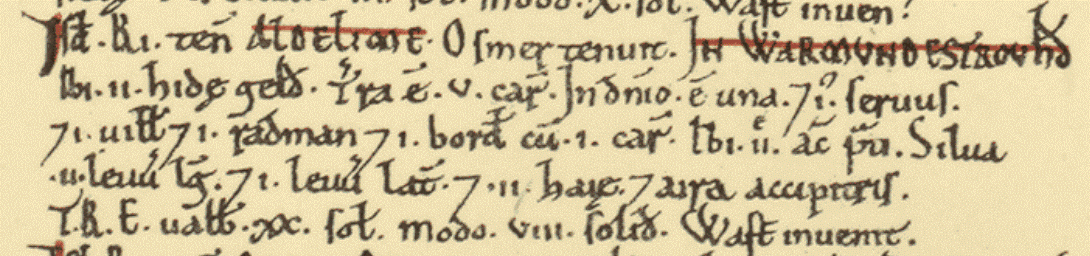
Audlem was recorded in 1086 as Aldelime or Adelime, and was held by Richard de Vernon as part of the Barony of
Shipbrook. Prior to the Conquest it was held by Osmer
of Shipbrook. It comprised 5 ploughlands with 1
lord’s plough team, 1 men’s plough team, 2 acres of meadow and 2 by 1 leagues
of woodland. The listed population comprised 1 villager, 1 smallholder, 1 slave
and 1 rider. It was valued at £1 before the Conquest and 8s in 1086. It was
part of the Hundred of Warmundestrou.
(Powell-Smith, Anna, Audlem, Open
Domesday).
There was no reference to a church
at Domesday. From the silence of Domesday, it is most probable that the Church
of Audlem was not in existence at the time of that survey, and that the
townships, whose inhabitants now resort to it, were comprised in Wybunbury, or
some of the adjoining parishes. (Ormerod,
George, History of the County Palatine and City of Chester, Volume
2 pages 465
to 472).
The vill of Audlem was parcel of the Norman barony of Shipbrook (Ormerod, George, History
of the County Palatine and City of Chester, Volume
2 pages 465
to 472).
Aldelime probably derives from the Old
English ald or former, and
may mean formerly of the Lymes.
The Tralebews
held the manor which included Audlem from the Crown after Domesday. The
mesne lords were the Traylebews, who settled shortly
after the Conquest, subsequently assumed the local name, and [occur
In the Plea Rolls 5 & 6 Edw II
in the person of Thomas de Aldelyme (who there is
reason to think was son and heir of the Thomas, aged 80 in Booth's pedigree),
and who again occurs 9 Edw II
with his daughter Matild, in
the account of Aston in Mondrem (Ormerod,
George, History of the County Palatine and City of Chester, Volume
2 pages 465
to 472). There is a pedigree of the Tralebews in
Ormerod, with a detailed record of the succession.
1133
A Cistercian abbey
The Cistercian Combermere
Abbey was founded in 1133. It was the earlier of two great Cistercian abbeys in
Cheshire, the other being Vale Royal. The abbey became wealthy and its
endowments included substantial salt revenues, but it developed a reputation
for maladministration and was often taken into royal custody. Hugh Malbank, the
second Baron of Wich Malbank, now Nantwich, was the
founder. It was confirmed in 1130 by Ranulf de Gernons (also Ranulf II), the
fourth Earl of Chester, who was one of the witnesses of its foundation charter.
By the mid thirteenth century the abbey
was in decline, after a succession of financial problems and scandals. In 1253,
its creditors were prevented from seizing its flocks, if the debt could be
settled by another means. In 1275, the abbey's debts were so great that its
management was assigned to the Lord Chancellor and Bishop of Bath and Wells,
Robert Burnell, and the following year it was placed under royal protection for
two years. Edward I's war against Wales of 1282–83 drew heavily on Cheshire and
placed additional strain on the monastery; it ran so low on food stores in 1283
that it was exempted from providing supplies for the army and once again
removed from the abbot's management.
1135
The first mill
Brooks Mill appears to be the
oldest and is said to occupy the site of that referred to in 1135 in the
Foundation Charter of Combermere Abbey (the Mill of
Chelly). At present the bridge is known as Chelly or Old Mill bridge. Both mill
and house were rebuilt in 1831 by Lord Combermere. By
1880 this was a steam mill and occupied by the Hall family, but in 1914 Albert
Bebbington became he last miller and it had almost stopped working by 1925. (Latham F A, Editor (1997), Audlem, The History of
a Cheshire Parish and its five townships, Local History Group, page 88).
Audlem Old Mill is at the
northeast edge of the town.
1250
Thirteenth century pottery
Excavations to the rear of the
present butcher's shop revealed the site of a pottery kiln with contemporary
vessels dated to between 1250 and 1300. It therefore seems certain that Audlem
has been a significant centre of population since at least that time.
1269
Thomas de Aldelym
The vill
of Audlem was parcel of the Norman Barony of Shipbrook,
held by Richard de Vernon. The mesne Lords (holding directly from the Crown) were the Traylebews who by now had assumed the local name and, in
the 53rd year of the reign of Henry III (1269) Thomas
Traylebew became Thomas de Aldelym. (Bishop
Gastrell (1845), Historical Notices on the Diocese of
Chester, Notitia Cestriensis page
206).
1274
A mill on the valley stream of the swans
Audlem New Mill or Swanbach Mill (meaning “valley stream frequented by swans”
was first recorded in 1274 when it was a toll passage held by the Earls of
Chester in the Barony of Nantwich. A letter of 1978 from Gidfrey
Smith recorfds that he was the last to work the water
wheel “until the end of 1918”. The
building was later converted into a byre. (Latham F A, Editor (1997), Audlem,
The History of a Cheshire Parish and its five townships, Local History
Group, page 88).
1278
The parish church of St James the Great
The parish church of St James the
Great was originally built in 1278 (Dow, George (1977), Audlem,
Then and Now, Southampton: Hobbs). The
church of St James the Great was founded by Thomas de Aldelime
in the middle of the 13th century in the reign of Edward I under the
jurisdiction of St. Thomas’s Priory, Stafford. The site is thought to have been a Celtic burial
ground, and there may also have been a Saxon church here. The only visible medieval building
is that part of the church dated from the 14th to the 16th centuries.
According to the earliest record a
church was built and dedicated to St James the Great in 1278, and was served by
the monks from Combermere Abbey, there being no resident
priest. There was a priest’s door on the south side, which has been walled up
and the steps removed. On a large stone in the southwest buttress of the nave
aisle there is a very fine scratch dial, thought to be of ancient origin. These
dials are generally the size of a human hand and were used by medieval priests
to mark the time of their services. (Burton, Marjorie (1973), Nineteenth
Century Audlem, Audlem District Amenities Society, Johnson & Son
Nantwich Limited page 22).
It is believed that the present
church was originally built in 1278 and it is recorded as a parochial centre in
the 1291 Ecclesiastical taxation. But some are of the opinion that it stands on
the site of an ancient Celtic place of worship over layers of burials. (Latham F A, Editor (1997), Audlem, The History of
a Cheshire Parish and its five townships, Local History Group, page 21).
1281
Audlem’s church had an early
connection with the Priory of St Thomas the Martyr. In 1281 Archbishop Pecham granted the church of Audlem to the priory. In April
and July of the previous year he had stayed at the priory in
the course of his visitation of the diocese, during which he had
evidently found that Audlem church had long been vacant. By presenting one of
his own clerks the archbishop had obtained the advowson and the rectory; he
granted the advowson to St. Thomas's Priory and shortly afterwards allowed the
canons to appropriate the church. (Houses
of Augustinian canons: The priory
of St Thomas near Stafford, in A History of the County of
Stafford: Volume 3. Originally published by Victoria County History, London,
1970).
Thomas de Audelyme,
the Lord of Audlem, Cheshire gave up his advowson (the valuable right to
nominate the parish priest) of the Church of Audlem to the Priory in free
alms (also known as frankalmoin or frankalmoign),
meaning it was a tax-free religious gift given in exchange for prayers. The
grantee was Brother Nicholas, the Prior of the Augustinian Priory of St. Thomas
near Stafford, and his monastic convent.
Thomas de Audelyme,
lord of Audlyme, co. Chester and Brother Nicholas,
prior of St. Thomas by Stafford, and Convent. Quitclaim (formal renunciation of a claim) in
free alms of advowson of church of Audelyme, to hold,
with church, to their own uses (The
National Archives, D938/626
and D938/625).
Enrolment of grant from Thomas de Audelyme, lord
of Audelyme, co. Chester, to Nicholas, prior of St.
Thomas near Stafford, and the convent of the same, in frankalmoin,
of the advowson of the church of Audelyme, with warranty
against all men except brother J. archbishop of Canterbury and the chapter of
the same and Sir John, prior of Wenlok, and the convent of the same. Witnesses:
Sir Ralph de Hengham, then chief justice of the Bench; Sir Guncelin
de Badelesmere, justice of Chester
; Sir William de Audedeley, Sir Nicholas de Staff[ord],
Sir William Bagot, Sir William de Staff[ord], Sir
Roger de Peulesdon, Sir Henry de Kersewalle, knights; Ralph de Burgo, William
de Burton, Richard de Hunsterton. (Close
Rolls of
the reign of Edward I, 1279 to 1288, page 134).
Sir Ralph de Hengham
was one of the most famous legal minds of the Middle Ages,
he was the Chief Justice of the Bench (Court of Common Pleas). His presence
indicates this grant was officially acknowledged and enrolled in the royal court,
likely during a session of parliament or a major judicial gathering. Sir Guncelin de Badelesmere was the
Justice of Chester, the King’s primary administrative and military officer in
the Palatinate of Chester, the county where Audlem was located. Figures like
Sir William de Audley, Sir Nicholas de Stafford, and local gentry (like Richard
de Hunsterton) were there to provide community endorsement and local
enforcement power to ensure the contract was respected.
The Priory of St. Thomas near
Stafford, dedicated to St. Thomas the Martyr, was an influential medieval
religious house belonging to the Augustinian Order. The priory was established
around 1174 by a wealthy local landowner and citizen (burgess) of Stafford
named Gerard fitz Brian. The timing of its foundation
is highly symbolic. Archbishop Thomas Becket was murdered in Canterbury
Cathedral in 1170 and canonised as St. Thomas the Martyr in February
1173. Fitz Brian's priory was one of the first religious houses in England
dedicated to the newly sanctified Thomas. He brought over a group of Black
Canons (Augustinians) from Darley Abbey in Derbyshire and gifted them 70 acres
of marshy land known as Sheepwash Meadow alongside
the river. While the priory never
housed a large population of monks, usually averaging between 5 and 13 canons
over the centuries, it became wealthy. Much of this was due to its second major
patron, Richard Peche, the Bishop of Lichfield. Peche showered the priory with
properties, woodlands in Cannock Forest, and exclusive fishing rights across
the entire River Sow. In 1182, Peche actually resigned
his powerful bishopric to move into St. Thomas as a simple monk, dying and
being buried there a year later. It
grew to become the wealthiest Augustinian house in Staffordshire. By 1535, its
net annual income was recorded at over £141, a very large sum for a small
convent.
1295
A market
Edward 1 granted a market charter
in 1295 to Sir Thomas Aldelyn. On 13 July 1295 at Denbigh there was a Grant
to Thomas de Aldelym, and his heirs, of a weekly market on Thursday at his
manor of Aldelym, co. Chester, and of a yearly fair
there on the vigil, the feast and the morrow of St. James the Apostle (ie 24 to 26 July). (Calendar of Charter
Rolls, Volume 2, Henry III to Edward
I, 1257 to 1300, page 460).
A weekly market was held at the
site of the Butter Market, erected in 1733, until at least 1914.
In the thirteenth century the
manor of Newhall belonged to the baronial family of Audley which later
descended to the Touchets. (Latham F A, Editor (1997), Audlem, The History of
a Cheshire Parish and its five townships, Local History Group, page 24).
In 1295 Ralph Basset and Margaret
his wife, late wife of Urian de St Pierre, sue John de Grey, guardian of St
Pierre’s heir, for dower of the manor of Audlem, a sixth of Shipbrook,
and other manors of the Vernons, but then, by descent,
in the St Pierre’s. This suit apparently relates to the paramount lordship,
with perhaps some parcel of its territory, and the services of the mesne lords.
Lands here certainly descended to the younger branch of the Vernons. (Ormerod,
George, History of the County Palatine and City of Chester, Volume
2 pages 465
to 472).
1296
Two daughters and heiresses of
Thomas de Aldelyn brought moieties of the manor of Audlem in marriage to the
families of Hogh and Wrenbury. (Latham
F A, Editor (1997), Audlem, The History of a Cheshire Parish and its five
townships, Local History Group, page 24).
1311
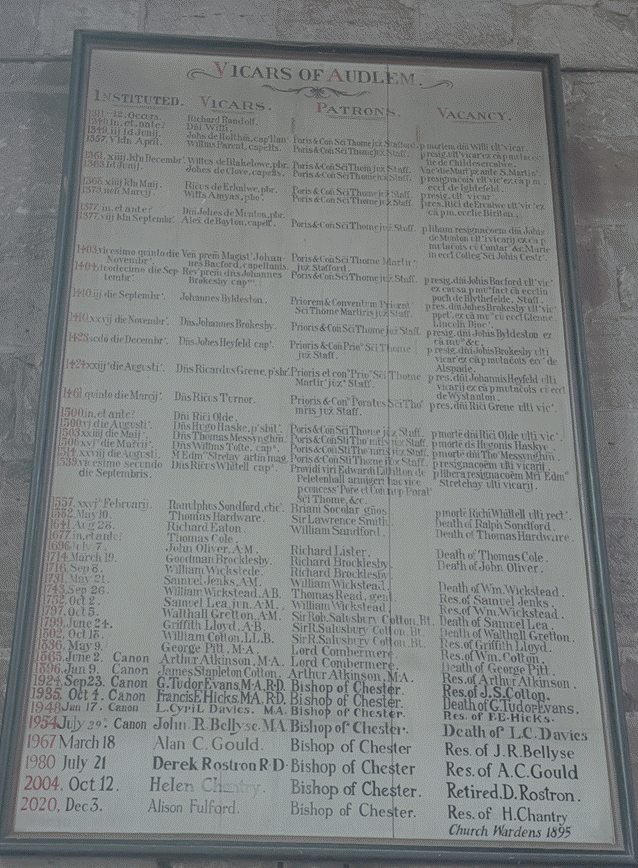
Richard Randolf was the first
listed vicar of St James the Great church from 1311 to 1312. St James the Great
was enlarged in the fourteenth century (Dow,
George (1977), Audlem, Then and Now, Southampton: Hobbs). A metal seal found at Lichfield
Cathedral showing a person praying to the Virgin and Child has been
authenticated by the British Museum as the seal of Richard Randolph (Latham F A, Editor (1997), Audlem,
The History of a Cheshire Parish and its five townships, Local History
Group, page 21).
In 1310 to 1311 Richard Audlem, Hikedown of Audlem, was indicted for stealing
Thomas Audlem’s beehives. William the carter of Audlem was indicted for receiving
Roger of Hov, a thief and taking stolen goods. Simon Moos of Audlem was
arrested for burglary. Thomas le Mareschal, living in Audlem, was arrested for
burglary. Richard Oldcostrel of Audlem who lived at Longhull
was indicted for receiving stolen goods. (Latham
F A, Editor (1997), Audlem, The History of a Cheshire Parish and its five
townships, Local History Group, page 23, Cheshire Fine Rolls 1310 to 1311).
c 1320
In the time of Edward III, the
Manor (of Audlem) was parted between
the aunts and coheiresses of Sir Thomas de Aldelym, one wife of Hough of Hough
in Wibunbury; and the other, the wife of John de
Wrenbury. The share of the first passed to the Masseys of Hough, and being
alienated to the Smyths, was sold by them about the beginning of the eighteenth
century to William Mascie Esq of Lymme (Bishop Gastrell
(1845), Historical Notices on the Diocese of Chester, Notitia Cestriensis page
206).
The Hassals of Hankelow
The Hassall family were prominent
medieval landowners who served as lords of the manor for Hankelow and the
neighbouring settlement of Hassall, both located in the Hundred
of Nantwich. The Hassalls established a long-running
family line centred in Hankelow starting as early as the fourteenth century,
with genealogical records tracking generations of Hassalls
of Hankelow (such as Robert, Hugh, and Richard Hassall) marrying into regional
gentry. (Latham F A, Editor (1997),
Audlem, The History of a Cheshire Parish and its five townships, Local
History Group, page 24).
1349
Black Death
The vicar, William the Priest,
died, and this was probably due to the Black Death.
1363
In
1363, William de Blakelow, the vicar of Audlem (Aldelym),
exchanged his ecclesiastical post with John de Clone, the rector of Ightfield (Ightefeld). On or about 3 May 1363, there was a presentation
of William de Blakelow, vicar of the church of Aldelym,
in the diocese of Coventry and Lichfield, to the church of Ightefeld,
in the same diocese, in the king’s gift by reason of his wardship of John son and heir of John Lestraunge of Blakemere who held
in chief; on an exchange of benefices with John de Clone. (Patent
Rolls of the reign of Edward III, 1361 to 1364,
page 335).
The King, Edward III, held the right to appoint the new rector (in the
king’s gift) because he currently held the wardship of John, the underage
son and heir of John Lestraunge (Le Strange) of Blakemere. Because the Le
Strange family held their lands in chief, directly from the King, their
estates and accompanying rights, like appointing priests, temporarily reverted
to the Crown during a minority heirship.
John de
Clone therefore became the new vicar of Audlem. Though Audlem is in Cheshire
and Ightfield is in
Shropshire, they were close enough to make a direct swap of roles entirely
practical. In the medieval period, a clerical exchange required both
priests to intimately understand the properties they were trading. The fact
that they swapped positions indicates that these two parishes were well within the
same regional orbit, physically separated by a road distance of only under 7
miles. Both parishes belonged to the Diocese of Coventry and Lichfield. This
shared administrative relationship meant that both priests answered to the same
Bishop. The legal paperwork, ecclesiastical courts, and bureaucratic processes
governing their livelihoods were the same. Moving between these specific towns
required no complex cross-diocesan licensing, facilitating smooth regional interaction.
Local life in both towns was dictated by the same high-level networks of
nobility and the Crown. The Le Strange family of Blakemere, near Whitchurch,
held major influence over Ightfield, but their status as tenants in chief
brought direct royal administration into the local area. Because regional noble
families held interconnected lands across the Cheshire-Shropshire border, the
administrative and spiritual lives of Audlem and Ightfield were frequently
bound together by the actions of the same elite landlords and the King.
1370
On 8 February 1370 at Westminster
there was a record of the Presentation of Richard de Erkalwe, vicar of the
church of St Mary, Aldelym, in the diocese of Coventry and Lichfield, to the
vicarage of the church of St Mary, Shirevehalys, in
the same diocese, in the king’s gift by reason of the Priory of Ware being in
his hand on account with the war with France; on an exchange of benefices with William
Huwet. (Patent Rolls of the reign of Edward III, 1367 to 1370,
page 371).
Richard
de Erkalwe, the vicar of the parish church in Aldelym,
Audlem, Cheshire, traded positions with William Huwet, the vicar of St Mary's
Church in Shirevehalys (Sheriffhales
in the West Midlands). The presentation was authorised at Westminster by Edward
III. The King held the right to appoint the new vicar because the Priory of
Ware, the usual patron, had been seized by the Crown (in his hand) due
to the ongoing war with France known as the Hundred Years' War.
Not withstanding that Audlem’s parish church was
founded and dedicated to St James the
Great in 1278, it was referred to in the patent rolls of 1370 as the church of
St Mary. In the original Latin text of the Patent Rolls, the entry records
the presentation of the vicar to the church of St Mary, Shirevehalys.
Medieval scribes routinely copied dozens of presentation letters at a time.
Because the incoming church at Sheriffhales was
dedicated to St Mary, the scribe almost certainly duplicated the dedication
name when writing out Richard de Erkalwe's originating church in Audlem. The
Crown records are full of such formulaic transcription errors where adjacent or
related names were mistakenly conflated. The Church of St Mary the Virgin at Sheriffhales stands in the village today as a Grade II listed
building with Norman architectural origins.
1372
The Massys
The Audlem family of Massy, the
name is spelt in many different ways, descended from
the Massys of Tatton. Hugh de Mascy of Tatton who
died in about 1372 had inherited a sixth of Audlem on marriage. His grandson,
Sir Geoffrey Massy of Tatton settled part of Audlem Manor and Denfield on his bastard son John in 1447 and so the estate
became separated from Tatton. (Latham,
Frank (1997), Audlem: The History of a Cheshire Parish and its seventeen
townships, page 124).
1377
On 20
July 1377 at Westminster, there was recorded the Presentation of John de
Munton, vicar of the church of Aldelyme in the
diocese of Coventry and Lichfield, to the chaplaincy or keepership of the
chantry at the altar of St. Mary in the collegiate church of St. John, Chester,
in the king’s gift by reason of his custody of the land of the heir of Joan, daughter
of John de Orreby, deceased, which she held of the king’s father in the county
of Chester by knight service ; on an exchange of benefices with Alexander de
Bayton. (Patent Rolls of the reign of Richard II, 1377 to 1381,
page 11).
1397
See the Cheshire Archers.
1403
Ellen, daughter and heir of
Richard de Hogh married Richard de Massie who died in 1403, being seized in
right of his wife of a moiety of the manor of Audlem. His descendants, a
younger branch of the Massies of Sale, continued to
hold the manor until the death of William Massie after 1712. The ancient hall
of the manor, later called Moss House, was the seat of the Massies
and later the Taylors until 1760 (Latham
F A, Editor (1997), Audlem, The History of a Cheshire Parish and its five
townships, Local History Group, page 24).
1453
Wars of the Roses and the Battle of Blore Heath
During the Wars of the Roses, as
far as Cheshire was concerned, the most famous of these was the Battle of Bloor
Heath, still noted as such, near Market Drayton, on 23 September 1459. The
reasons for the Wars need not be discussed here, except to say that at that
time a nobleman's chief occupation was frequently fighting and various well known families had been killing each other for decades.
Michael Drayton, a Cheshire man, described the bloodshed at Bloor Heath in a
verse in his Plyalbion.
There Dutton Dutton
kills, a Done doth kill a Done,
A Booth a Booth, and Legh by Legh
is overthrown;
A Venables against a Venables doth
stand,
A Troutbeck fighteth
with a Troutbeck hand to hand.
After horrendous casualties on
both sides this was a brilliant and unexpected York victory for the Earl of
Salisbury. The Lancastrians were under the command of Lord Audley.
Just how the battle affected Audlem
is not recorded, but Bloor Heath lying only a few miles from the parish border
it must, in some way, have been involved in the fighting. Jack Knield of the
Ash, Woodhouse lane, recalls a legend.
This lane, he says, used to be
named Widows Lane, because after the battle many wandered up and down looking
for wounded or dying relatives. In this neighbourhood some of the casualties
were buried on the bank which was later planted with 7 yew trees as a memorial.
Now the yews are gone, because within living memory cattle died through eating
their berries and greenery.
Lord Audley, the Lancastrian
leader, was a prominent landowner who at one time lived at his castle or hall
at Newhall which was probably erected originally as a protection against the
marauding Welsh. It is said that in times of war three men were employed here
to ‘watch and ward’. It is supposed to have stood in a field called the Three
Butts near Scheppanhall Hall. A moat is shown on the
map. However Lelland (1505 to 1552) states that the
building, then called Newhall tower, “is now down. There be motes and fair
water”, although Dugdale (1605 to 1686) records that there were some remains.
The Audleys held the estate until 1497 when it passed
to the crown, later to the Lowells, and then
Cholmondeley in 1556, to the Foulshursts in 1666 and
on to the Crewe family. (Latham F A, Editor (1997), Audlem,
The History of a Cheshire Parish and its five townships, Local History
Group, page 24).
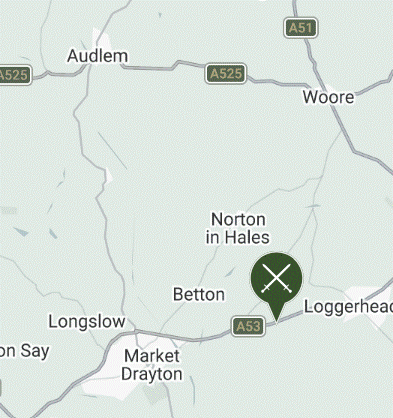
The Battle
of Blore Heath was the first major engagement of the English Wars of the
Roses, fought on 23 September 1459. The Yorkists were led by Richard Neville,
5th Earl of Salisbury, a force of roughly 3,000 to 5,000 men. The House of
Lancaster was led by James Tuchet, 5th Baron Audley, a larger force of roughly
8,000 to 14,000 men. Lord Audley was killed during the fighting. Queen Margaret of Anjou ordered
Lancastrian forces to intercept Salisbury as he marched from Yorkshire to join
the Duke of York at Ludlow. Audley set up an ambush at Blore Heath. After an
initial exchange of longbow fire, Audley launched a costly cavalry charge that
was decimated by Yorkist archers and infantry, leading to a rout and heavy
Lancastrian casualties, with around 2,000 dead.
1457
After various intermediate
descents, the share of Wrenbury became vested in the Masseys of Tatton. Sir Geoffrey
Massey of Tatton, knight, left a bastard son, John, in 1457, from whom the
Masseys of Audlem and Denfield descended, they inheriting part of the former manor by settlement. The whole
manor is now vested in Mascie Taylor of Audlem and
Chester Esq, great grandson of William Mascie of Lymme
above mentioned. (Bishop Gastrell
(1845), Historical Notices on the Diocese of Chester, Notitia Cestriensis page
207). There is a detailed
pedigree of the Masseys of Audlem and Denfield in Ormerod,
George, History of the County Palatine and City of Chester, Volume
2 pages 465
to 472.
1536
Dissolution of the Monasteries
At the dissolution of the
monasteries, the church passed into private custodianship. St James the Great church was remodelled in the
sixteenth century to its modern form (Dow,
George (1977), Audlem, Then and Now, Southampton: Hobbs).
In 1535 the gross
annual value of the Priory of St Thomas in Staffordshire was £180 8s 0d,
including possessions at Audlem, and was thus one of the wealthiest in that
county. In 1536, when dissolution seemed imminent, “there began a scramble for
its property”. But it was not until 1538 that Prior Whytell
and five canons surrendered the Priory to the Crown. The Prior then received a pension
of £26 13s 4d and in 1539 became vicar of Audlem. He retained this living until
his death some eighteen years later. (Latham F A, Editor (1997), Audlem,
The History of a Cheshire Parish and its five townships, Local History
Group, page 27).
The nearby Abbey of Combermere was dissolved on 27 July 1539, following which
the property was granted to “George Cotton in tail male by the letter patent on
24 August 1539 and was surrendered by him to the King in February 1541 in exchange
for a grant in fee to George Cotton and his wife, Mary, giving them possession
of the house etc of Combermere monastery, County
Chester, from fisheries in Wrenbury, Audlem.” And other places. Thirteen monks,
including the Abbot, signed the deed of surrender and were awarded pensions.
The possessions of the abbey included the manor of Wilkesley
with land in Dodcott and tithes in Audlem. A house
was built by the Cottons on the site of the Abbey. (Latham F A, Editor (1997), Audlem, The History of
a Cheshire Parish and its five townships, Local History Group, page 27).
1539
Following the dissolution in
August 1539 the Crown quickly
transferred the extensive properties of the dissolved Combermere
Abbey into private secular hands. George Cotton was a prominent courtier, and
this grant established his family as major landowners in the
Cheshire-Shropshire border region.
The text explicitly notes that certain
closes and woods and a significant estate called Heyfeldes
(Heyfields) were located within Audlem and nearby Wrenbury. These had all been
owned and managed by the monastery. The
reference to closes (enclosed fields) and woods indicates that
the land around Audlem was a developed agricultural landscape of managed timber
and enclosed farming pastures rather than wilderness.
There was a grant Geo. Cotton, and Mary,
his wife. Grant, in tail male, of the house and site of the late monastery of Combermere, Cheshire, the church, steeple, and churchyard
thereof, &c., and certain closes and woods (specified) in Wrenbury and Awdelem, Cheshire, the manor of Wylkesley,
Cheshire, with lands called Heyfeldes, in Wrenbury
and Awdelem, the lands called Dodcotte in the tenure of John Dodd, in Chyles Arkoll, Salop ; and the land called Clyff,
in the tenure of John Hilles, in Dray ton in Hales, Salop, and granges called Erled grange, now in the tenure of James Colyer, in
Stafford ; Wyucull grange, now in the tenure of Edm. Savage, in Presbury, Cheshire ;
Newton grange, now in the tenure of Hugh Bereforde, and John Bereforde, in Assheborne, Derb; Cots grange, alias " Cots felde,"
now in the tenure of Francis Bassett, in Hortonton, Derb. ; all which premises
belonged to the said late monastery ; in as full
manner as the last abbot held the same. The grantees to be discharged of an
annual rent of 66s 8d for the said lands called Hey felds.
Del.,
Walden, 24 Aug., 31 Hen. VIII.— S.B. Pat. p. 1, m. 2. Vacated on personal surrender by
the said George and Mary, 1 Feb., 32 Hen. VIII., in order that the grant might
be made out in another form. (Public
Records of the reign of Henry VIII, Volume 14 – Part 2, Folio 113
(22), see also Public Records of the reign of Henry VIII, Volume 16,
Folio 580
(7)).
While ownership shifted from the
Abbot to the Crown, and then to the Cotton family, the actual day-to-day
farming was steady. The document details specific tenants (like John Dodd and
James Colyer in nearby granges), showing that while the landlords changed
overnight, the local tenant farmers generally remained on the land.
The grant explicitly discharges
the Cottons from an annual rent of 66s 8d for the Heyfields property in
Audlem, an example of how the Crown used monastic wealth to financially favour
and secure the loyalty of loyal subjects.
The record at the end shows the
bureaucratic fluidness of this period. The Cottons surrendered this specific
deed just a few months later in February 1541 (32 Hen.ryVIII)
simply to have the property granted back to them in a legally altered or more
secure format.
Sir George Cotton (c.1495–1545)
was a powerful Tudor courtier, politician, and landowner who leveraged his
close relationship with Henry VIII to build a vast family fortune. He came from
a modest gentry background as the second son of John Cotton of Coton,
Shropshire. However, his career accelerated rapidly through royal service. He
began his rise as an Esquire of the Body to Henry VIII and was a
frequent archery companion to the King. In 1526, he was appointed governor to
Henry FitzRoy, Duke of Richmond, Henry VIII's deeply loved,
illegitimate son. Managing the household of the King's only male child at the time
cemented his status at court. Following FitzRoy’s early death, Cotton was
appointed Vice-Chamberlain to the household of the King's legitimate heir, the
future Prince Edward (Edward VI). He was later knighted for his services in
1542.
When the Dissolution of the
Monasteries began, Cotton was perfectly positioned to profit. In August 1539,
he and his wife, Mary Onley, were granted the massive properties of Combermere Abbey. Sir George quickly tore down the ancient abbey
church and most of its monastic buildings, using the surviving structural core,
specifically the Abbot's House, to establish a grand country estate. His
descendants would remain at Combermere Abbey as
dominant regional figures for nearly four hundred years, holding the estate
until 1919.
In October 1539, Roland Lee,
bishop of Coventry and Lichfield. Grant in fee of the house and site of … the vicarage and parish church of Aldelem, Cheshire ; and all other
possessions … (Public Records of the reign of Henry VIII, Volume 14
– Part 2,
Folio 435
(12)). Before the dissolution, the parish
church of St. James the Great in Audlem (and its associated lands were not
independent. Like many medieval churches, its appropriation, meaning its
tithes, properties, and the right to appoint the vicar, belonged to a monastic
house. Records indicate that the Priory of St. Thomas the Martyr near Stafford
held rights and leases over the church at Audlem. When these monasteries
surrendered to the King's commissioners, all of their
assets, including the vicarage and parish church of Aldelem,
legally passed to the Crown. Roland Lee, the Bishop of Coventry and Lichfield.
Lee was a fierce, highly influential loyalist to Henry VIII and a close ally of
Thomas Cromwell. Lee is famously believed to have secretly performed the
marriage ceremony between Henry VIII and Anne Boleyn in 1533. At the time of this 1539 document,
Lee was also serving as the Lord President of the Council of the Marches of
Wales. He was notorious for ruthlessly enforcing English law and royal
supremacy along the Welsh border, earning a brutal reputation for swift executions.
The Books of Augmentation for 1539
to 1540 recorded Humphrey Maynewaryng, of Nantwich, Cheshire. Tithes in the
lordship of Newhall and Colelane, in the parish of Audelem and the lordship of Wylkesley,
except Smetenwood. Combermere.
(ln lieu of 61 years' lease, cited, to John Browne, by
Combermere abbey.) (Public
Records of the reign of Henry VIII, Volume 15, page
562). For centuries following
its founding in 1133, Combermere Abbey was the
dominant religious and economic superpower in this part of Cheshire. The abbey
owned massive amounts of land and held the rights to collect tithes (a
10% tax on agricultural produce) from local populations to fund its operations.
When Combermere
was surrendered to the Crown in 1538, its immense wealth was seized. This
record from the Court of Augmentations (the temporary government body set up in
1536 specifically to manage and reallocate confiscated monastic lands) marks
the moment Audlem's spiritual taxes were permanently diverted into secular,
government hands. Before the dissolution, the abbey routinely leased out its
revenue streams to generate income. The record mentions an older, 61-year lease
originally granted by the abbey to a man named John Browne. Following the royal
takeover, the Crown voided or bought out that old monastic lease and
transferred the lucrative right to collect tithes in the parish of
Audlem (specifically within the lordships of Newhall, Colelane,
and Wilkesley) to Humphrey Maynewaryng
of nearby Nantwich. This marked the rise of the local gentry and merchant
classes, who grew wealthy by buying up former church properties and taxes.
Following this transition of the
church out of monastic hands, the modern framework of the town began to
solidify. Shortly after the religious upheaval, Audlem built a new dedicated
vicarage (1554) and began its formal Parish Registers (1557), which survive to
this day.
1540
Between 1540 and 1542 there was
significant quarrelling and fighting in the parish. There was an assault on
John Griffin by William Hassall and others in a lane in Hankelow and the case
was heard in the Court of the Star Chamber in September 1540, but no judgement
was recorded. (Latham F A, Editor
(1997), Audlem, The History of a Cheshire Parish and its five townships,
Local History Group, page 27).
1546
Isabella Whitney (c1546 to 1548 to
after 1624) grew up in Ryle Green when her father took a lease of a farm there.
She was the first woman known to have published secular poetry in the English
language. Her brother, Geoffrey Whitney (c 1548 to c1601) was presumably also
brought up there and he was also a poet, known for his collection Choice
of Emblemes. (Travitsky, B S (2004), Whitney,
Isabella, Oxford Dictionary of National Biography. Oxford University Press).
1549
On 21 December 1549, for £2,146
paid in the Augmentations by Richard Venebles and John Maynerde Esq, there were
a long list of grants including of the tithes of grain, sheaves and corn
within the lordship of Newhall and Colelanne, within
the parish of Audlem and within the lordship of Wylkesley,
Cheshire, lately in the tenure of Humphrey Manwarynge, which belonged to the
late monastery of Combermere (Patent
Rolls of the reign of Edward VI, Volume 3, 1549 to 1551, page 89). During the Dissolution of the
Monasteries (1536–1541), Combermere was surrendered
to the Crown in 1538. Its vast estates, including the lordships of Newhall and Wylkesley, and various rectorial
tithes in Audlem, instantly became royal property. Before the dissolution, the abbey
frequently leased out the collection of local tithes to prominent regional
figures. Humphrey Mainwaring (Manwarynge),
member of a powerful and well-established Cheshire gentry family, was the
sitting tenant who paid rent to the Crown for the right to harvest these
agricultural tithes.
By 1549, England was ruled by the
child king Edward VI under the Lord Protector, Edward Seymour (Duke of
Somerset). Somerset had plunged England into a disastrously expensive military
campaign against Scotland and was simultaneously fighting off internal unrest,
such as Kett's Rebellion. To avoid bankruptcy and pay off foreign mercenaries,
the regency government began aggressively liquidating the Crown's newly
acquired monastic lands and tithes. The substantial sum of £2,146 paid by Venebles and Maynerde was
desperate cash injection straight into the royal treasury.
Richard Venebles and John Maynerde
were not local Cheshire farmers; they were part of a rising class of urban
professionals, lawyers, and merchants mostly based in London. These men
frequently acted as land hunger speculators or agents. They bought huge,
mixed bundles of property from the Court of Augmentations all over England.
Investors like Venebles and Maynerde
would purchase these properties in bulk, strip the assets (like lead from
church roofs or timber), and then either hold them to collect the annual tithes
as a guaranteed passive income stream, or sell them at a premium to local
gentry like the Mainwarings who actually lived on and
worked the land.
1550
Similarly, on 11 July 1550 for £2,551
3s ½ d paid in the Augmentations by William Place, gentleman, and Nicholas
Spakeman, ‘haberdassher’ in ready money another
transaction included the messuage called ‘the Churchehouse’
in tenure of Thomas Eton of Aldelen, Cheshire (Patent
Rolls of the reign of Edward VI, Volume 3, 1549 to 1551, page 411).
1550
First school
There is evidence that a school
had existed in Audlem since about 1550. It is recorded that the son of the
parish priest of Wybunbury completed his education there. From 1559 all
teachers had to obtain a licence from the bishop. This named the location of
the school and often the type of instruction to be given. (Latham F A, Editor (1997), Audlem, The History of
a Cheshire Parish and its five townships, Local History Group, page 93).
1553
Highfields
Highfields was probably built by William Dod
of Lostford sometime after 1553. The first mention of
the pasture or close of the Highefelds is in a
deed, still at Highfields, dated 1 October 1553. The owner was Hugh Chester of Newstrete Lane, Salop and the land was some 500 acres. He
bequeathed the estate, on the death of his wife and himself to his son in law, William
Dod and so William had inherited the Highefelds
pasture from Hugh Chester, his father in law. No house
yet stood there, so a house must have been built about that time. It seems
likely that Highfields was built in the 1560s.
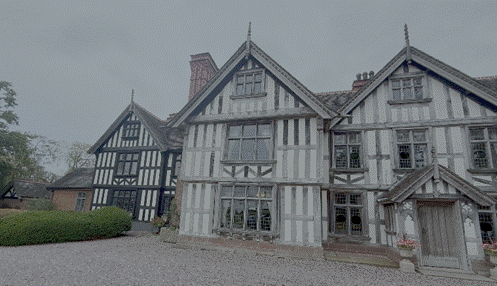
Highfields
1570
Recusants
Those who didn’t attend services
at their parish church came to be known as recusants. Margaret Pearson
of Audlem, a widow, was presented as a recusant at the Diocesan Visitation of
1598, but had died before a later visitation in 1604. In 1564 the Audlem
doctor, John Aldershawe, with his wife and family, had refused the sacrament
and failed to attend church for many years and were compelled to appear before
the High Commissioner in York in 1579 and the Cheshire Quarter Sessions in 1581
and 1592. They were heavily fined. (Latham
F A, Editor (1997), Audlem, The History of a Cheshire Parish and its five
townships, Local History Group, page 29).
1590
In 1590 the church was remodelled
and this could have been due to an increase in the population which has been
estimated as between 300 and 400 (Latham F A, Editor (1997), Audlem, The History of
a Cheshire Parish and its five townships, Local History Group, page 29).
1616
Moss Hall
Clearly national affairs had their
knock on effect in Audlem and possibly the increasing
national prosperity played some part in the decision to build Moss Hall 1616 by
Hugh Massey. Roughly similar is the date of 1615 over the front door of Highfields, but the House of William
Dod is reputed to date from 1585. (Latham F A, Editor (1997), Audlem,
The History of a Cheshire Parish and its five townships, Local History
Group, page 31).
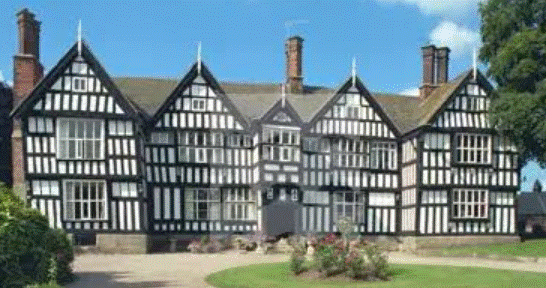
Moss Hall
The timber framed manor house of Moss
Hall, a surprisingly complete example of a gentleman's house of the
early 17th century, was built in 1616 for Hugh Massey. Moss Hall, once
known as Audlem Hall, is an Elizabethan manor house of rare beauty and great
antiquity. It is a commodious structure built of oak and plaster. Over the
entrance is the date 1016, but as this could not be the time of erection of the
present building it may be the date of some earlier one. In 1860 it had
thirteen gables and was lighted with bay windows. In the whole there were forty
rooms, several of which were wainscoted with oak and ornamented with the arms
of the different families who had been resident there. At this period it was the property of Earl Kilmorey
and occupied and farmed by William Silvester. (Burton, Marjorie (1973), Nineteenth
Century Audlem, Audlem District Amenities Society, Johnson & Son
Nantwich Limited page 13).
Moss hall, or Audlem hull as it
appears to have been originally called, was built, according to the date over
the porch, in 1616 by the Massy family, probably Hugh Massy of Denfield and Audlem who had married Elizabeth Whitney of
Coole Lane. He died in 1621 and was succeeded by his eldest son William who had
married a Cotton from Combermere and whose arms,
impaling Cotton, are depicted on the overmantel of a stone fireplace in the
house. The second edition of Ormerod’s history of the county (1882), described
the house very much as it is today. “Audlem Hall, called the Moss Hall, is a
large building of timber and plaster. The front consists of four large gables,
with a smaller and lower one in the centre over the entrance porch which, like
the ends of the buildings, projects from the general line of the front. The
rooms are lighted by large bay windows”. However in
1861, the directory of Cheshire says of the house: “It has 13 Gables and in the
whole are 40 rooms, several of which are wainscotted
with oak, and ornamented with the arms of the different families who have been
resident here. The Massy family ceased to live there in 1760 when it passed
from William Massey to his son-in-law, Robert Taylor. By 1810 it was occupied
by a farmer. Later the estate was purchased by Earl Kilmorey of Shavington Hall who became Lord of the Manor. In recent
times Moss Hall has been farmed by a number of
families. The ghost of a nun was supposed to haunt the house. An exorcist was
called in who managed to persuade her to go into a bottle which was then cooked
up. When the James family bought the farm in about 1920 the bottle, presumably
complete with ghost, was given to Mrs James by the previous owner. Having no
interest in such matters the good lady threw the bottle into the dustbin and the nun has never been seen since. The house is
now occupied by the Vernon family. There is a local legend that a secret
passage existed between Moss Hall and the church. This seems very unlikely as
it would have necessitated tunnelling under the moss in front of the house
which, until drained in the present century, was so treacherous that a man, out
snipe shooting, sank to his armpits and had to be rescued with a horse and
ropes. Before the construction of the canal the meadow in front of the house
was a large lake. (Latham, Frank (1997), Audlem:
The History of a Cheshire Parish and its seventeen townships, page 124).
1625
Possibly a sign of increasing disorder
was the furnishing of a musket, in 1625, to the vicar of Audlem, possibly
Thomas Dykes who became vicar that year (Latham F A,
Editor (1997), Audlem, The History of a Cheshire Parish and its five
townships, Local History Group, page 31).
1627
In 1627 the Audlem Committee
petitioned rather effusively, as follows: “Wee whose names are subscribed,
inhabitants of the parish of Audelem that doe monethly assemble by way of assistance with the officers
thereof in discharge of these duties houlde it
requisite to certifie our dislikes of the byndage of Richard Eldershaw of Audlelem
to brew and sell ale it being contrary to our returnes
upon all occasions.” (Latham F A, Editor (1997), Audlem,
The History of a Cheshire Parish and its five townships, Local History
Group, page 37).
1632
A new vicarage was built in 1632
to replace the original (Latham F A, Editor (1997), Audlem,
The History of a Cheshire Parish and its five townships, Local History
Group, page 31).
1635
The puritan schoolmaster, Rev Edward
Burghall wrote One Colley’s Wife in Audlem parish, having a writing taking
out of her coffer, prayed in a rage that the hands that had taken it might rot
off, thinking her daughter-in-law had taken it, her daughter-in-law indeed said
Amen to it, who had opened the coffer, and directed a little boy of hers to
take it; but within a little while after, the poor child began to have sore
hands, which could not be cured, but by degrees rotted off, according to her
fearful execration. (Latham F A, Editor (1997),
Audlem, The History of a Cheshire Parish and its five townships, Local
History Group, page 32).
1640
The old manor of Hankelow belonged
anciently to a family of that name; afterwards to the Hassals
who from whom it passed, in the seventeenth century, to the family of Wibbenbury. It was sold shortly afterwards to the Bayley
family who still owned the hall in 1810, when it was in the occupation of a Mr
Knight. The present Hankelow Hall was, before the year 1640, the property of Gabriel
Wetenhall Esq, a younger son of a of the family of Wetenhall of Nantwich. The
house probably dates from this period. (Latham F A, Editor (1997), Audlem,
The History of a Cheshire Parish and its five townships, Local History
Group, page 125).
1643
Civil War and a Battle for Nantwich
During the Civil War, in Audlem
support was divided between the opposing sides and, as
described above, the Dod family at Highfields appear to have sided with the Royalists.
As the vicar, Richard Eaton refused to sign the Covenant and was fined thirty
shillings, he was presumably of Royalist sympathy. Supporting Parliament was
the Massey family of Moss House who were raided by the Royalists in 1643. Burghall describes this raid as follows. “Whitchurch was
now filled with many soldiers for the king, of which Lord Capel was commander,
who did much hurt by plundering the country, especially about Nantwich. On
April 10 they plundered captain Massey of the Moss house, and took from him
sixty head of cattle, and some of his household goods, and horses from many
others; which the Nantwich soldiers having intelligence of, pursued, hoping to
have rescued them; But they came half an hour too late, yet they overtook some,
and slew three of them, took eleven oxen, and some arms they threw away in
flying, and brought back fifteen prisoners, whereof young Bulkeley of Buntingdale was one. The next day after, the Nantwich
forces hearing from the Whitchurch men, now grown strong, intended with many
carts, to fetch away all that was left at Mr Massey's, raised almost all their
strength, both horse and foot, about one thousand, and marching towards Burley
dam Chapel, met the enemy, who after a little skirmish fled to Whitchurch. They
slew five, and took two or three prisoners, without the loss of one man, except
3 taken and carried off.”
Burghall described many encounters at
Nantwich at this time.
(Latham F A, Editor (1997), Audlem, The History of
a Cheshire Parish and its five townships, Local History Group, page 33).
1644
The Battle for Nantwich in late
January 1644 resulted in an overwhelming victory for the Parliamentary
defenders and Nantwich was never seriously threatened again. There was a
further scare, however, on 19 May 1644 when Prince Rupert arrived in Audlem
from Shrewsbury with an army estimated to be about ten thousand men which
included many mounted. As was the norm the men plundered the local countryside
and passed through Hanke low. Burghall wrote
“Nantwich being suspicious of Prince Rupert, who was gathering men in Wales and
about Shrewsbury, kept a day of humiliation, and then prepared for an assault;
but he came not that way, but drew all his men towards Holt, Farndon and
Whitchurch; and May 18, advanced to Drayton etc and plundered all the country.
Monday the Nantwich forces, about a thousand, marched towards Hatherton, but the enemy retired to Audlem, so they did not
meet. Tuesday night Prince Rupert lay at Betley, and his army advanced towards
Haslington, Sandbach etc, plundering most fearfully all the way, especially men
and horses. (Latham F A, Editor
(1997), Audlem, The History of a Cheshire Parish and its five townships,
Local History Group, page 35).
The Battle
of Nantwich was fought on 25 January 1644 and was a major Parliamentarian
victory during the First English Civil War. Royalist forces under Lord Byron
had controlled most of Cheshire and laid siege to the strategic town of
Nantwich. Sir Thomas Fairfax brought a relief force to break the siege.
Parliamentarian troops and the town's garrison trapped and defeated the
Royalist army near the village of Acton. The victory ended Royalist dominance
in Cheshire and captured vital artillery. The anniversary
is celebrated annually as Holly Holy Day, featuring a historic battle
re-enactment by the Sealed Knot Society. It gets its name from the sprigs of
holly that soldiers placed in their hats as a field sign.
Audlem, then as now, is situated
on a crossroads roughly equidistant from Market Drayton to the south, Nantwich
to the north, Whitchurch to the west, and Madeley to the east. Even though
Audlem crossroads could be considered an important location, the village itself
was too small to have strategic value unlike larger Nantwich
which was for the Parliament, and the much larger Royalist base at Shrewsbury.
The Civil War activity in and near Audlem was therefore largely confined to
military passage through the village. Fortuitously opposing forces did not want
to pass through simultaneously.
In May 1642 (sic, recte
1644?) Prince Rupert, Charles the first nephew, the third son of
Frederick V of Bohemia, and Elizabeth daughter of James I, marched with his army
from Shrewsbury to relieve Stockport, just before the
Battle of Marston Moor (fought on 2 July 1644). The army camped
between Market Drayton and Buerton and a number of his
offices were billeted in local houses notably at Bellaport
Hall. It is claimed that Prince Rupert himself spent the night at Highfields,
and his army camped in the fields thereabouts.
In Audlem support was divided between
the opposing sides and, as described above, the Dod
family at Highfields appear to have sided with the Royalists. As the vicar,
Richard Eaton refused to sign the Covenant and was fined thirty shillings, he
was presumably of Royalist sympathy. Supporting Parliament was the Massey
family of Moss House who were raided by the Royalists in 1643. Burghall describes this raid as follows. “Whitchurch was
now filled with many soldiers for the king, of which Lord Capel was commander, who
did much hurt by plundering the country, especially about Nantwich. On April 10
they plundered captain Massey of the Moss house, and took from him sixty head
of cattle, and some of his household goods, and horses from many others; which
the Nantwich soldiers having intelligence of, pursued, hoping to have rescued
them; But they came half an hour too late, yet they overtook some, and slew
three of them, took eleven oxen, and some arms they threw away in flying, and
brought back fifteen prisoners, whereof young Bulkeley of Buntingdale
was one. The next day after, the Nantwich forces hearing from the Whitchurch
men, now grown strong, intended with many carts, to fetch away all that was
left at Mr Massey's, raised almost all their strength, both horse and foot,
about one thousand, and marching towards Burley dam Chapel, met the enemy, who
after a little skirmish fled to Whitchurch. They slew five, and took two or
three prisoners, without the loss of one man, except 3 taken and carried off.”
(Latham F A, Editor (1997), Audlem, The History of
a Cheshire Parish and its five townships, Local History Group, page 33).
1645
A new vicar, William Seddon MA,
was presented to Audlem by the patron Sir Thomas Smith on 25 June 1645. Quite
soon afterwards, with the approach of the Roundhead army towards Chester,
Seddon was compelled to withdraw his family and effects into Chester where
Bishop Bridgeman kindly accommodated them with rooms for lodging in his palace.
With the threat of a siege the Bishop left Chester
resulting in Seddon being left in charge. Undaunted he continued diligently
with his ministry and, it is stated, preached to the Royalist garrison.
Following the surrender of Chester on 3 February 1646, Seddon was arrested and
imprisoned. During their sojourn in Chester, on 12 October 1645, Mrs Seddon
gave birth to her ninth child, all of whom were living. The baptism of the new child
was said to be the last public baptism in Chester before the restoration some
15 years later. Rather curiously Seddon’s name does not appear on the list of
Audlem vicars given by Ormerod, but Richard infers he was the vicar until 1664. (Latham F A, Editor (1997), Audlem, The History of
a Cheshire Parish and its five townships, Local History Group, page 35).
1647
Audlem Grammar School
The Old
Grammar School was founded. While the Civil War was progressing
there was one very important peaceful development in
Audlem, the establishment of the Grammar School. This came about largely
through bequests. As early as 1635, under the terms of the will of William
Gamul, of Buerton hall, £30 was left for the “maintenance, erection and continuence “of a school. In 1640 his brother, Thomas
Gamul, citizen and grocer of London entrusted £500 to his brother-in-law, William
Dodd of Highfields, Captain William Massey of Moss Hall and Hugh Hassall of
Audlem, “where I was borne”. The money was to be managed by six custodians, the
equivalent of twentieth century trustees, who had to appoint and dismiss the
master. It was to be used to build “a convenient schoolhouse and dwelling house
for a schoolmaster in the town of Audlym”. (Latham F A, Editor (1997), Audlem,
The History of a Cheshire Parish and its five townships, Local History
Group, page 36).
Gamul and Bolton both attempted to
regulate the character of their foundation. Gamul required six governors to be
responsible for revenues and the appointing of schoolmasters. Ralph Bolton
designated nine trustees who owned the premises and received part of the
income; any vacancies to be filled by parishioners. The six governors were to
be elected annually at the Easter vestry and they had
the actual management of the school. (Latham F A, Editor (1997), Audlem,
The History of a Cheshire Parish and its five townships, Local History
Group, page 95).
See West, Gwen, Audlem
Grammar School, 31 March 2015, Audlem History Society.
1648
Ralph Bolton, a London merchant,
left £466 13s 4d to the Merchant Taylor’s Company of London on condition they
paid £20 a year towards the maintenance of Audlem Free School (Latham F A, Editor (1997), Audlem, The History of
a Cheshire Parish and its five townships, Local History Group, page 36) Ralph Bolton, by a deed poll
of the 27th February 1648, gave to the said Company £466 13s 4d on condition
that they should pay yearly £20 towards the maintenance of a free school at
Audlem, in the county of Chester. The Company pay £20 per annum to the master
of the grammar school at Audlem, in Cheshire (Report
on the Charities of the Merchant Taylors' Company, City of London Livery
Companies Commission. Report; Volume 4. Originally published by Eyre and Spottiswoode, London, 1884).
1655
The Elizabethan style grammar
school was completed in 1655 from legacies and gifts, most notably of Thomas
Gamull, citizen and grocer of London and Ralph Bolton, a London merchant
tailor. Its first 33,000 bricks were made in a kiln set up on Little Heath. (Burton, Marjorie (1973), Nineteenth
Century Audlem, Audlem District Amenities Society, Johnson & Son
Nantwich Limited page 16).
1656
In a will proved in 1656 Thomas Dod, eldest
son of William, left a gift of £30 to Audlem Grammar School. (Latham F A, Editor (1997), Audlem,
The History of a Cheshire Parish and its five townships, Local History
Group, page 36).
1683
These are to certifie
whom it may concern that Mark Tomkin the elder of Hanke low in the parish of Audlem
and County of Chester who hath formerly been excommunicated for being a
dissenter from the Church of England hath gained his absolution and doth repair
to his Parish Church and hears Divine Service. Witness our hands this 30th
September 1683, Thomas Cole, Vicar of Audlem. Wardens Robert Birchall, John
Dutton. (Quarter Sessions 1691).
1692
I stayed at father’s
till dinner. Then after dinner I go to Coolane (Coole Hall Farm is just north of
Moss Hall) where I find old Mr Massey, but his son my tenant is gone to
Audlem, this being a holiday, and return not till nine of the clocke. In ye mean time I walke
over ye grounde and about the house, eat my supper
with them and lye at Coolane all night. (The Recorder of Chester’s Diary,
29 September 1692).
1719
Charity School
There was also a Charity School
founded 1719, by Mrs Bolton, to which she gave £4 9s per annum, out of a modus
for tithe hay in the Township of Audlem (Ormerod,
George, History of the County Palatine and City of Chester, Volume
2 pages 465
to 472). The Charity school was founded in 1719 by Mrs Trephyna Bolton
for the education of poor boys and girls of the townships of Audlem and Hanke
low. She donated £4 9s per annum our of a modus for tithe hay. (Latham F A, Editor (1997), Audlem, The History of
a Cheshire Parish and its five townships, Local History Group, page 98).
1733
The Butter Market
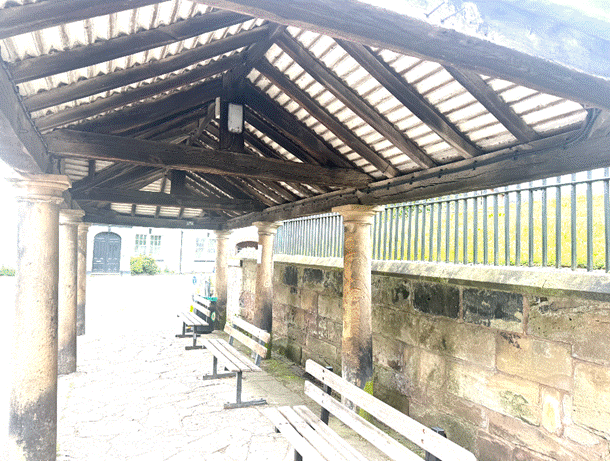
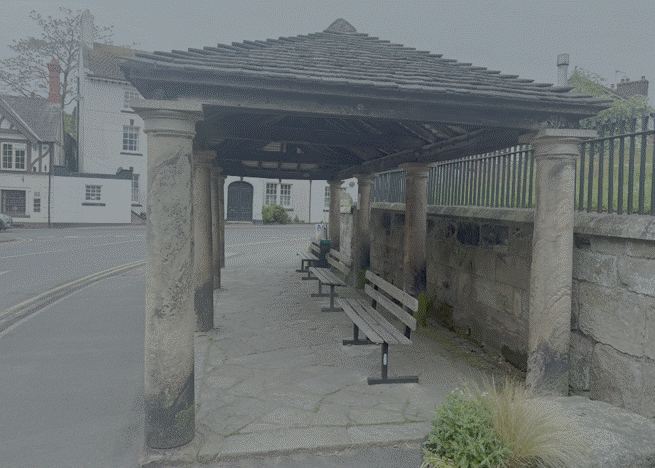
The Butter Market, Audlem was erected in 1733 and restored in
1992.
1745
The Crown Hotel was known as the Baker’s
Tenement from 1745 to 1808. In the latter year it was described as the Crown
Inn, when it came into the possession of Sarah Hough, of Hayward, in Audlem. On
her death in 1824 the Crown was inherited by her only child, Ann Baker, whose
children sold it to Charles Longhurst in 1877. (Burton, Marjorie (1973),
Nineteenth Century Audlem, Audlem District Amenities Society, Johnson
& Son Nantwich Limited page 4).
1747
William Baker of Highfields
The payments book of William Baker
records detailed activity in and around Audlem between 1747 to 1759.
1749
The
earliest references to angling come from William Baker’s
diary, when he notes on 7 March 1749 that he “killed one carp out of Brew House
field” and a further entry for 11 May 1750 “from Old Pitt in gate house ground.
Took a carp 2 feet 3 inches” (Latham
F A, Editor (1997), Audlem, The History of a Cheshire Parish and its five
townships, Local History Group, page 112).
1772
In
Audlem parish there were two turnpikes which were both established in the
eighteenth century. The first seems to have been the Newcastle to Whitchurch
stretch in 1772. (Latham F A, Editor (1997),
Audlem, The History of a Cheshire Parish and its five townships, Local
History Group, page 116).
Turnpikes were private
toll roads managed by local groups called Turnpike trusts that collected money
from travellers to fix and build main roads. A turnpike was originally a
rotating wooden barrier or gate that blocked the road. It only opened after a
traveller paid a fee. Better roads helped support the early Industrial
Revolution by connecting towns and cities for trade. They made travel faster for
stagecoaches and reduced the cost of moving goods. Turnpikes began to fade in
the nineteenth century when railways took over long-distance travel. The
Whitchurch to Woore turnpike road, west to east,
existed in 1820 with a toll bar at Brown’s Bank Audlem, while two other
turnpikes from the north were shown at a meeting at Hankelow and were made
after 1820 with a toll bar.
1777
According to the
Manchester Mercury of that time, on Sunday 14 September 1777 the worshippers at
various churches and chapels in both Cheshire and Lancashire were “disturbed
from their devotions by the unwonted experience of a shock of earthquake.”
Apparently, the vibration was sufficiently strong to set the bells ringing at
the parish Church of Manchester. This did not happen at all bloom, but the
church records do include an entry in September that “when the people were in
church a great earthquake happened which shook the Fabrick so that a large
stone fell out of one of the windows of the steeple”. (Latham F A, Editor (1997), Audlem, The History of
a Cheshire Parish and its five townships, Local History Group, page 41).
1778
Mr Lea, the vicar of Audlem, hasn’t resided in
the parish for these eight years past, and is said to be in a private Mad-house at Bilson, and stays there more from choice than
necessity, as he likes the people of the House. His brother (Rector of Action
Burnell, Shrewsbury) has provided a Curate with a salary of £40 and Dues. The
last Curate died. (Articles
of Enquiry of the Bishop of Chester).
1801
The population of Audlem
was 2,375 in 1801 (Latham
F A, Editor (1997), Audlem, The History of a Cheshire Parish and its five
townships, Local History Group, page 43, 1801 Census).
1802
At Audlem Grammar School, Young
gentlemen are boarded and genteenly educated on the
following terms. Boarding and education, £21. Washing and mending per quarter,
14s. French per quarter, £1. Dancing per Quarter, 15s. Drawing per Quarter, £1
1s. Entrance, £1 1s. (Staffordshire
Advertiser, 10 July 1802).
1812
The Audlem Wake
The Audlem Wake of 1812 was the first of what became the Audlem
Carnival. It was a traditional English wakes week celebration. The 1812
Audlem Wake was a rough, boisterous, and rowdy affair typical of the era and
included bull and bear baiting, cockfighting, and heavy drinking. Audlem
Wake in the year of Napoleon’s retreat from Moscow was a three
day jollification in October from 10am until late in the afternoon (Dow, George (1977), Audlem,
Then and Now, Southampton: Hobbs).
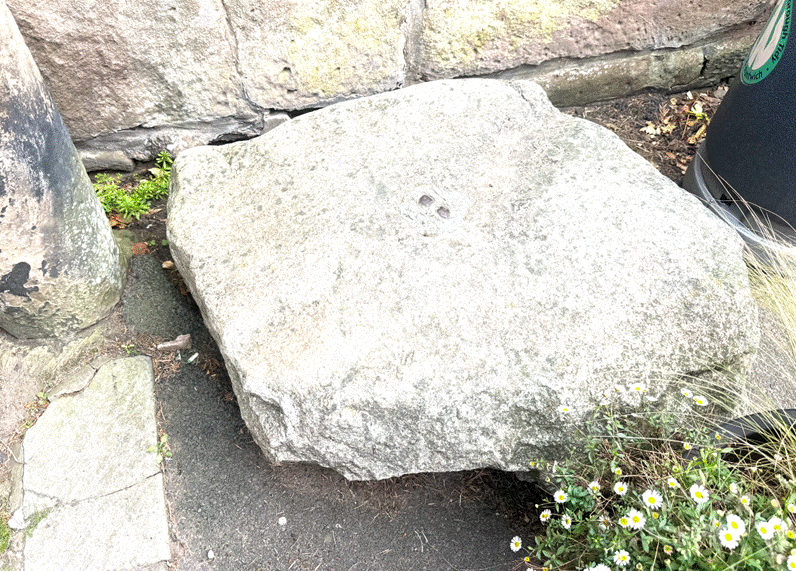
The Bear Stone
The Bear Stone is
a granite boulder from deposits left during the Great Ice Age and probably
originated in Cumberland or the Mountains of Mourne. It was fitted with an iron
ring and used for bear baiting. Originally it stood in
the centre of the Square, where the monument to Richard Baker Bellyse
erected in 1879 now stands. The large stone at the foot of the church steps was
formerly in the centre of the Square, where the monument now stands. It is
known as the ‘bear stone’ and there was a large ring on it to which a bear was
tied when bear baiting was practised. This ruing was
later taken to the Lord Combermere to lower barrels
into the cellar. (Burton, Marjorie (1973), Nineteenth
Century Audlem, Audlem District Amenities Society, Johnson & Son
Nantwich Limited page 3). The blood sport was a
common feature of local life during these annual wakes until it was officially outlawed
across Great Britain by the Cruelty to Animals Act of 1835.
A gruesome murder
There was a gruesome murder on the night of 12 April 1812 of
George Morrey at his farm, now the site of Hanke low Court. Neighbours heard
the noise of a struggle and his body was found on the
bed in an upstairs room lying on an axe with his throat cut. A razor was found
in a pond outside. The initial investigation was by William Dooley, the parish
constable and John Groom, an attorney. John Lomas, a servant and lover of Morrey’s
wife was arrested and taken to Chester Castle. The post
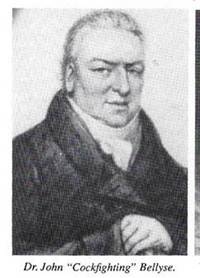
mortem was undertaken by Dr John Bellyse Junior and an inquest was held
in the White Lion. John Lomas and Edith Morrey were both convicted at Cheshire
and John Lomas was hanged. Edityh was pregnant and
she was executed in April 1813 after the birth of the boy. (Latham F A, Editor
(1997), Audlem, The History of a Cheshire Parish and its five townships,
Local History Group, page 43). There
were doubts about the conviction, which are the subject of Neild, Maureen
(1993), The Rope Dance.
1820
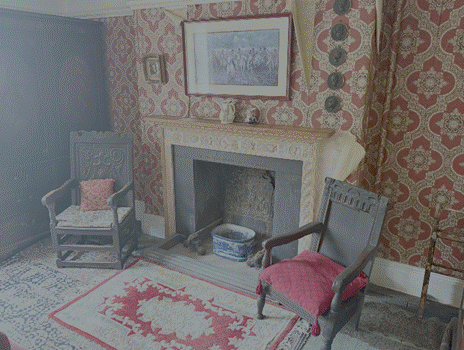
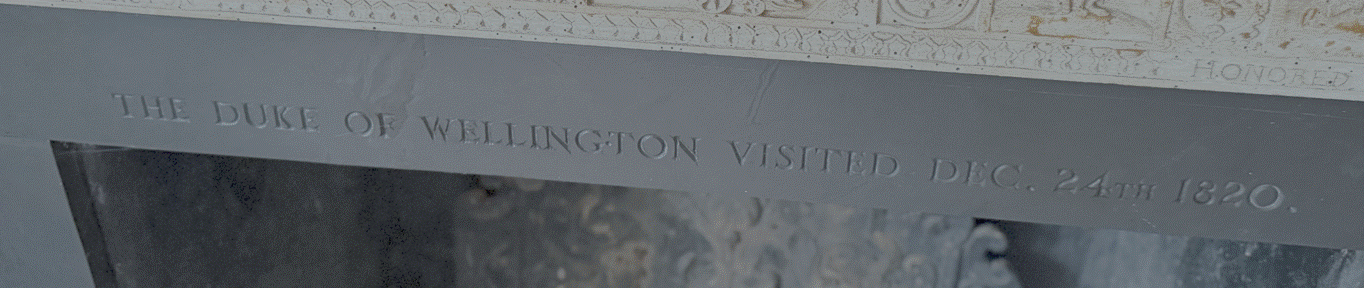
The Duke of Wellington’s visit
The Duke of Wellington visited Combermere
Abbey for the christening of Lord Combermere’s son
in December. During the visit they both went to Audlem, where Combermere’s brother was the vicar. Having both been to
Audlem Grammar School with William
Baker (1785 to 1863) they carried on to Highfields bringing the Duke with them. Combermere’s
sister, Hester, lived at the Vicarage and her brother carved the mantle piece commemorating the occasion. The fireplace was
removed when the Vicarage was demolished some years ago and is now in a bedroom
at Highfields. (Latham F A, Editor
(1997), Audlem, The History of a Cheshire Parish and its five townships,
Local History Group, page 44).
1831
The population of Audlem
was 2,878 in 1831 (Latham
F A, Editor (1997), Audlem, The History of a Cheshire Parish and its five
townships, Local History Group, page 43, 1831 Census).
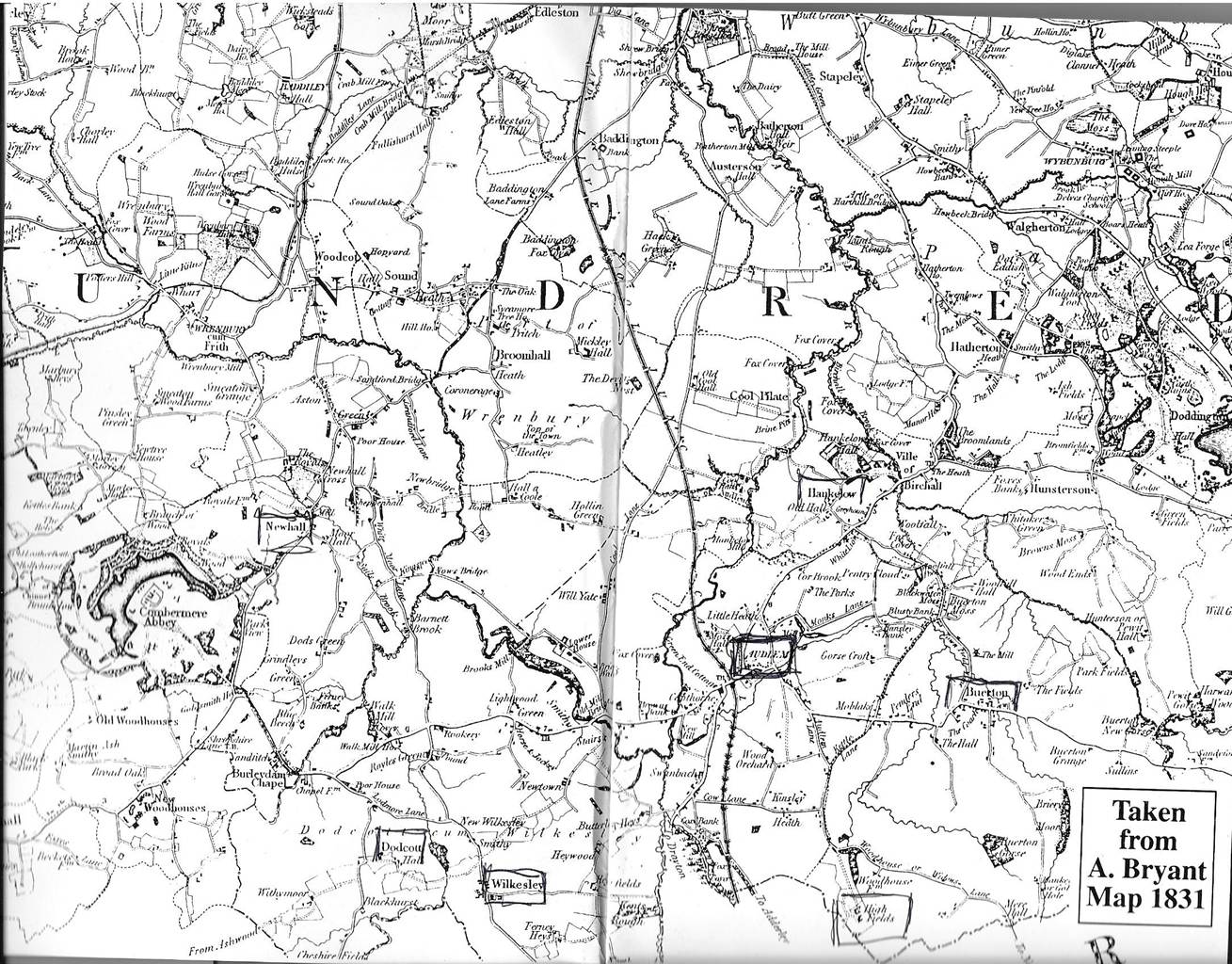
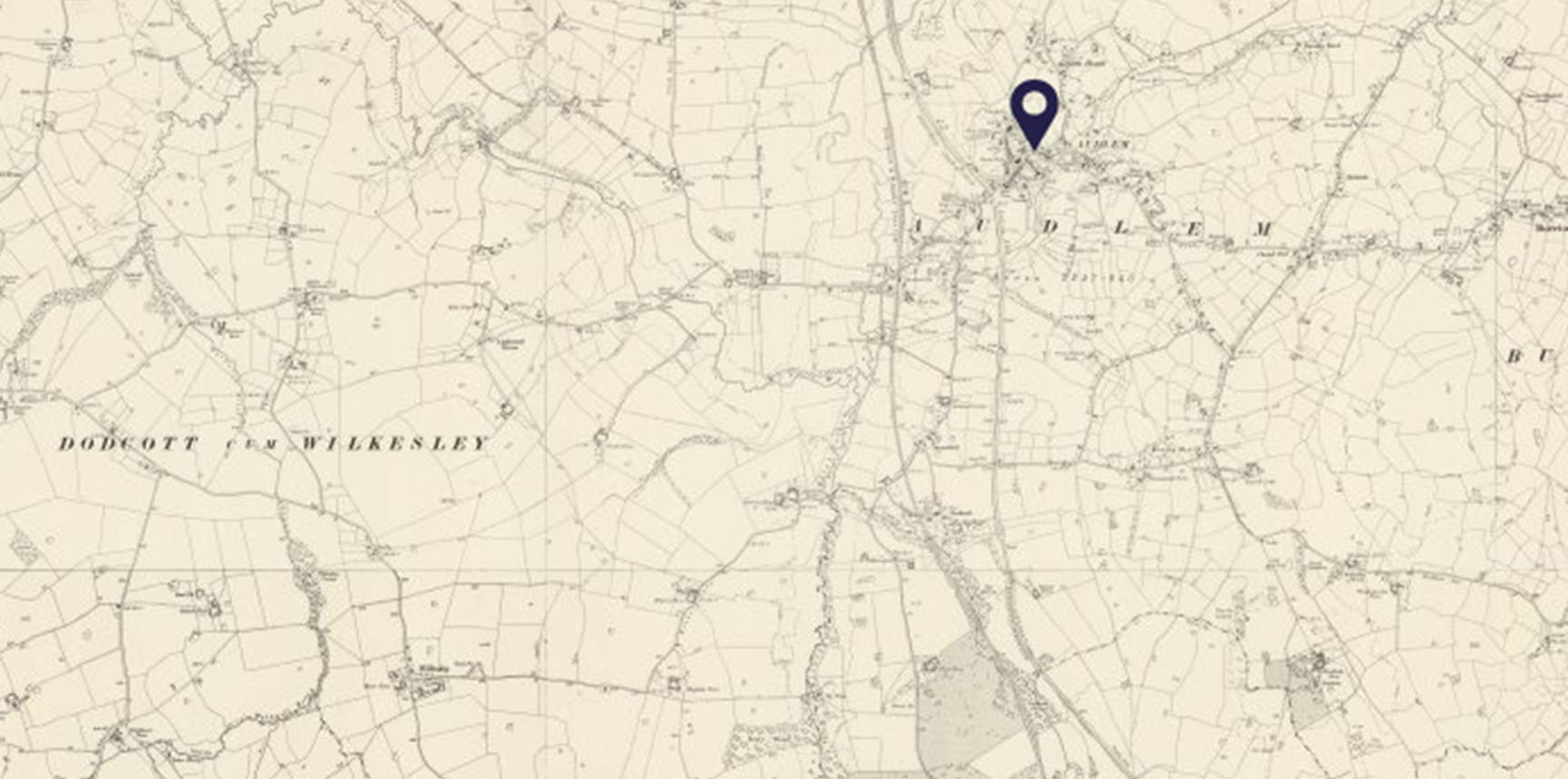
Audlem in 1831 showing Audlem,
Buerton, Hankelow and High Fields.
Slavery, Petitions for Abolition
of, Upon reading the Petition of the Inhabitants of
the Parish of Audlem, in the County of Chester, whose Names are thereunto
subscribed, It is Ordered, That the said Petitions do
lie on the Table. (House of Lords Journal Volume
63, 18 March 1831).
1835
The Canal
The canal was surveyed and
engineered by Thomas Telford (1757 to 1834). The canal extended 39 miles from Autherley Junction, near Wolverhampton, to Nantwich. Work
on it started in 1827 and the first boat to traverse its full length did so
eight years later. In 1846 it was merged with other canals to form the
Shropshire Union Canal Company. (Dow, George (1977), Audlem,
Then and Now, Southampton: Hobbs).
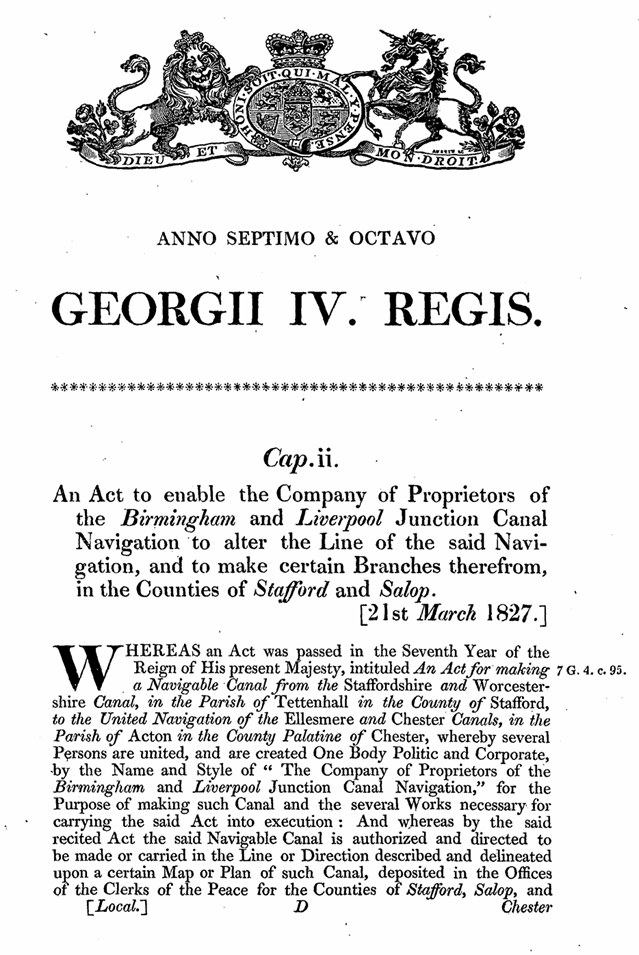
The canal was
originally known as the Birmingham and Liverpool Junction Canal and the Act
authorising its construction received Royal Ascent in 1827 (Birmingham and Liverpool Junction Canal Navigation Act
1827 (7
& 8 Geo. 4. c. ii)). Work began that year. Within six months
there were 1,600 workers and completion was originally planned for five years
There were significant problems during construction. On 2 March 1835 the
first boat travelled the full distance from Autherley
Junction, through Audlem with its fifteen locks, to Nantwich. (Burton, Marjorie (1973), Nineteenth Century
Audlem, Audlem District Amenities Society, Johnson & Son Nantwich
Limited page 9).
Audlem is on the Shropshire Union
canal, which has a run of 15 locks, designed by Thomas Telford to raise the
canal 93 feet from the Cheshire plain to the Shropshire plain. The arrival of the canal in 1835
transformed the village economy, allowing easy transport of coal and dairy
produce. A flight of 15 locks, designed by engineer Thomas Telford, was built
on the canal near the village. Many of the buildings and
historic merchant houses seen along Cheshire Street and Stafford Street date
from this prosperous trading period.
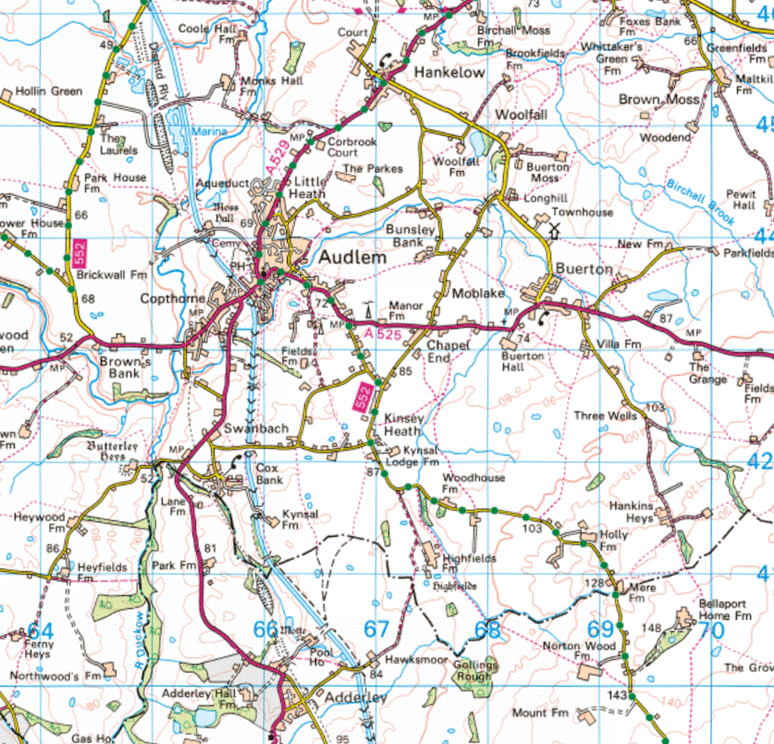
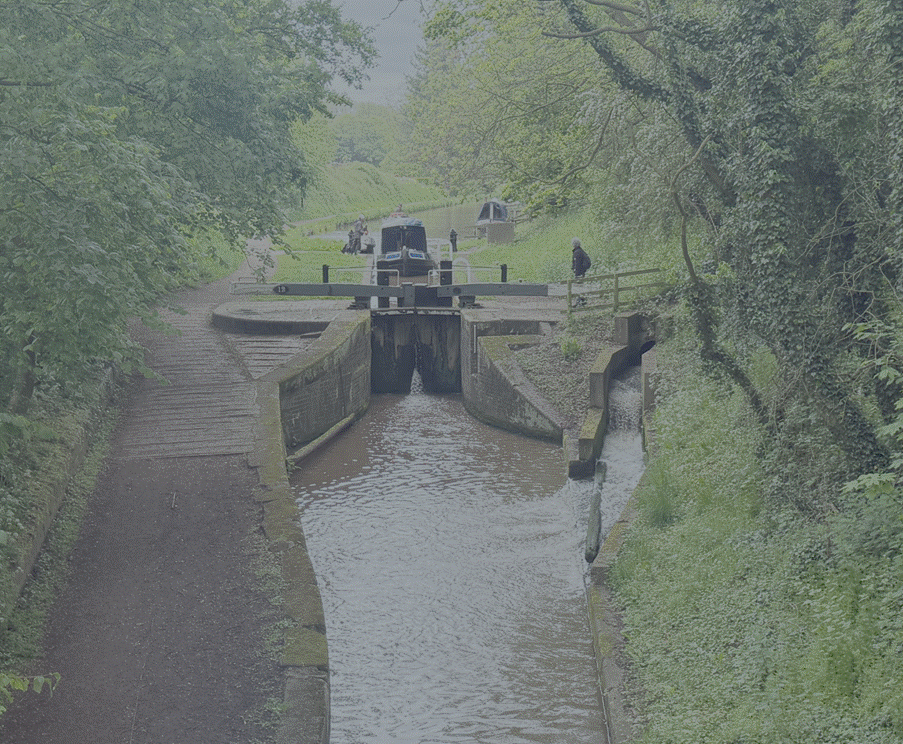
Map showing Audlem, Highfields,
Hankelow, Swanbach, Kynsal Lodge, and Buerton The canal at Audlem
1840
John Bonell began a business
sinking wells. Over the following hundred years the family business expanded
into a large contracting enterprise. (Latham
F A, Editor (1997), Audlem, The History of a Cheshire Parish and its five
townships, Local History Group, page 91).
1841
The population of Audlem
Parish was 1,621 (Audlem), 512 (Buerton), 392 (Dodcott)
and 279 (Hanke low) in 1841 (Latham
F A, Editor (1997), Audlem, The History of a Cheshire Parish and its five
townships, Local History Group, page 43, 1841 Census).
1848
Audlem (St. James), a parish, in
the union and hundred of Nantwich, S. division of the
county of Chester; comprising the townships of Audlem, Buerton, Hankelow, and Tittenley, part of Dodcot cum Wilkesley, and part of Newhall; and containing about 3000
inhabitants, of whom 1621 are in the township of Audlem, 6½ miles (S.) from
Nantwich. The Tralebews, ancestors of the family of Aldelym or Audlem, are said to have possessed the manor from
the Conquest; it subsequently passed by marriage and purchase, in moieties or
parts, to various owners. The township of Audlem comprises 2346 acres, the soil
of which is clay and sand, The road from Nantwich to Shrewsbury, and the
Chester and Birmingham canal, pass through the parish. A grant was obtained in
the 24th of Edward I., of a weekly market, and a fair on the eve, day, and
morrow of St. James the Apostle, both which, after long disuse, were revived a few
years since: the market is on Thursday. The living is a vicarage, valued in the
king's books at £5. 16. 8., and in the patronage of Viscount Combermere: the tithes for Audlem township have been
commuted for £247 and £81. 10., payable respectively to the impropriator and
the vicar. There is a place of worship for Particular Baptists. A free grammar
school was endowed about the middle of the seventeenth century, by Mr. Ralph
Bolton, with £20 per annum, and a similar sum arising from a bequest by Mr. Thomas
Gammull, both of London; £40 were also given for its benefit by the Rev.
William Evans. There is likewise a preparatory English school for younger boys
and for girls, endowed with a modus of the tithe of hay, and a house and half
an acre of land. (A
Topographical Dictionary of England,
Originally published by S Lewis, London, 1848).
1850
During the first half of [the twentieth] century most
of the trades in the parish were certainly connected with agriculture; such as
wheelwrights, blacksmiths, butchers and boot makers. But by 1850 shops were
starting to appear and these included chemists, grocers and tailors. From this
time onwards complete lists of these can be found in the Cheshire Directories.
(Latham F A, Editor (1997), Audlem,
The History of a Cheshire Parish and its five townships, Local History
Group, page 90).
1853
The Police Station
The police station was the modest
building in Salford (part of the main road from Woore
into Audlem) erected in 1853, which provided a pleasant residence for the
Superintendent, who was John Morgan in 1860. It contained three cells. (Burton, Marjorie (1973), Nineteenth
Century Audlem, Audlem District Amenities Society, Johnson & Son
Nantwich Limited page 16).
1855
By the mid-1850s, Audlem
extended over 2,335 acres, with 358 houses and some 1,600 inhabitants. The
canal was a place of significant commercial activity by this time, which
continued well into the twentieth century. The more speedy
fly boats would travel through the night, lit by massive oil lamps with bulls eye glass that threw a beam of light ahead. (Burton, Marjorie (1973), Nineteenth
Century Audlem, Audlem District Amenities Society, Johnson & Son
Nantwich Limited page 10).
1860
In 1860 John Capper was at the
Crown. At this time a notorious character called Joby Buckley lived in Audlem,
working as a casual labourer with a gang of poachers who spent most of their
free time in the public houses. One day old Joby said
“Mr Capper we’re goin’ to kill two pigs, an’ I was wonderin’ if yer missus could do
with ‘am or two?.” “I’ll go and ask her”, he replied,
and on return said “She says she can do with a ham or
two”, adding “I expect you’d like a few drinks Joby?”
As Joby sat swilling down, the money mounted up, and a by now anxious Mr Capper
asked “What weight would those hams be, Joby?” “About
1 pound 3 ounces!”. “What?” “Well you see, Mr Capper,
they’re guinea pigs.”
A shoot was held at Highfields,
and Mr
Baker asked Joby if he would take a brace of hares to Mr Cartlich at Woore. On arrival he knocked on the door, which was opened
by Mr Cartlich. “Mr Baker’s sent thee these ‘ere ‘ares”
Joby said. “That’s not the way to bring a present from one gentleman to
another”, was the reply, “you step inside and I’ll show you how it should be
done.” Mr Cartlich knocked and Joby thereupon opened the
door. “With Mr Baker’s compliments and will Mr Cartlich
kindly accept these hares.” Joby, quick thinking and not to be outdone, “Oh
yes, come inside and sit yersel down, ‘ave something
to eat and drink, and ‘eres two ‘alf
crowns for thee.
(Burton, Marjorie (1973), Nineteenth Century
Audlem, Audlem District Amenities Society, Johnson & Son Nantwich
Limited page 5).
1861
John Slyth was a Master Watchmaker
aged 29 (1861 census).
1863
The Railway
The railway through Audlem arrived
in 1863. It was prompted as the Nantwich and Market Drayton Railway, which was
incorporated on 7 June 1861, to build a line from Market Drayton junction at
Nantwich to Market Drayton via Audlem. The authorised capital was £60,000 in
shares and £25,000 loan capital.
Audlem and Adderley were the original intermediate stations on the line. Goods
traffic generated by Audlem was predominantly agricultural. Passenger traffic
in these early years was very light. (Burton,
Marjorie (1973), Nineteenth Century Audlem, Audlem District Amenities
Society, Johnson & Son Nantwich Limited page 13).
See Audlem
Rail Chronology, and Summary
of the Railway in Audlem 1863 to 1963, both 4 February 2016, Audlem
History Society and Opening
of the Railway, 1863, 9 September 2013.
1868
Canon Atkinson and his
parishioners took a very wide interest in the local and national affairs of
their day. In 1868 a numerously signed petition against Mr Gladstone’s
resolutions for the disendowment of the Irish Church was forwarded for
presentation to the House of Commons. A church collection in 1870, in the aid
of the sick and wounded in the war amounted to £19 which was forwarded,
together with 2 hundredweight of clothing to the Prussian Embassy and
acknowledged with many thanks by the Countess Bernstorff. (Burton, Marjorie (1973), Nineteenth Century
Audlem, Audlem District Amenities Society, Johnson & Son Nantwich
Limited page 22).
1871
The population of Audlem
was 2,666 in 1871 (Latham
F A, Editor (1997), Audlem, The History of a Cheshire Parish and its five
townships, Local History Group, page 43, 1871 Census).
1873
A hundred years ago Audlem was a
village of cobbled streets and wooden shuttered shops. When the road surface was
improved William Shuker carted away the cobbles to pave his yard at Holmes Farm. (Burton, Marjorie (1973), Nineteenth Century
Audlem, Audlem District Amenities Society, Johnson & Son Nantwich
Limited page 15).
1874
In 1874 Audlem Grammar School had
a very fine Italian headmaster. He was the Rev D J Poggi DD, late Principal of
New Brighton College. During his headmastership the Trustees included
Viscount Combermere. The Feofees
included William Baker, Joseph H Bellyse and Richard B Bellyse. (Burton, Marjorie (1973), Nineteenth
Century Audlem, Audlem District Amenities Society, Johnson & Son
Nantwich Limited page 16). In 1874 the [Grammar]
school’s headmaster was the Reverend D J Poggi DD, said to be Italian. He
was educated at St Mark’s College in Florence, was ordained a Deacon in the
Church of England in 1833 and took priest’s orders the following year. Prior to
becoming Headmaster at Audlem in 1870 he had established New Brighton College
of which he was Principal and also of St Aidans College in Birkenhead. The atmosphere in the
schoolroom was said to be genial in the extreme, Rev Poggi believing that all
work and no play make Jack a dull boy. A Godfrey Pgii,
possibly the son of the head, was in charge of the
school magazine which was published monthly. It was delivered to subscribers
for 2s a year r by post for 2s 6d. Doctor Poggi kept
goats. One party day it is told that some of his pupils upturned one of the
animals and doused it in turpentine. The poor goat was so upset he dashed into
the school and overturned the tables laden with delicacies. Dr Poggi was unable
to discover the culprits and he had the goat killed
and skinned. The boarders were made to eat the entire animal. (Latham F A, Editor (1997), Audlem,
The History of a Cheshire Parish and its five townships, Local History
Group, page 97).
The diaries
of Chatty Baker,
Tottie
Baker and Emily Baker
tell of life at Highfields,
and around Audlem from 1878 to 1882.
1880
William Baker’s
second son, Richard Dod Baker,
was rather unusual for his day and age, insomuch that not only did he take no
interest in field sports, but took great delight in
making fun of those who did.
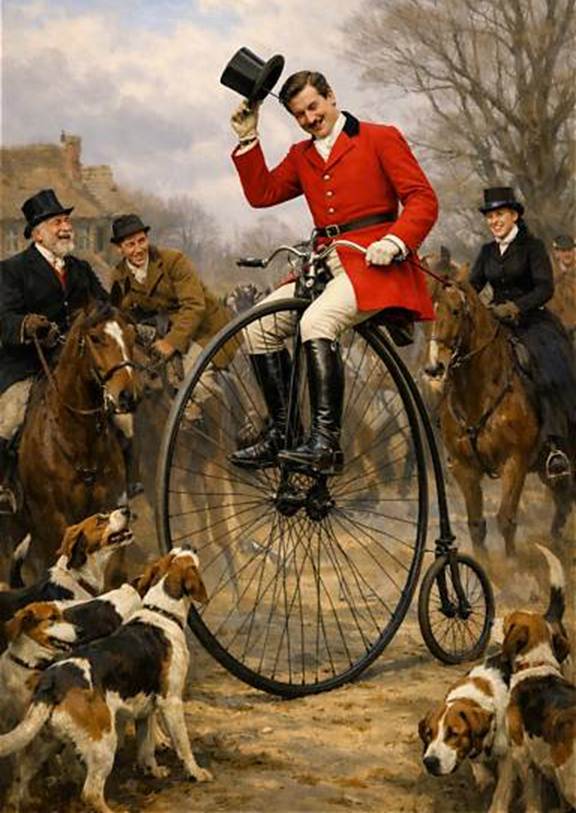
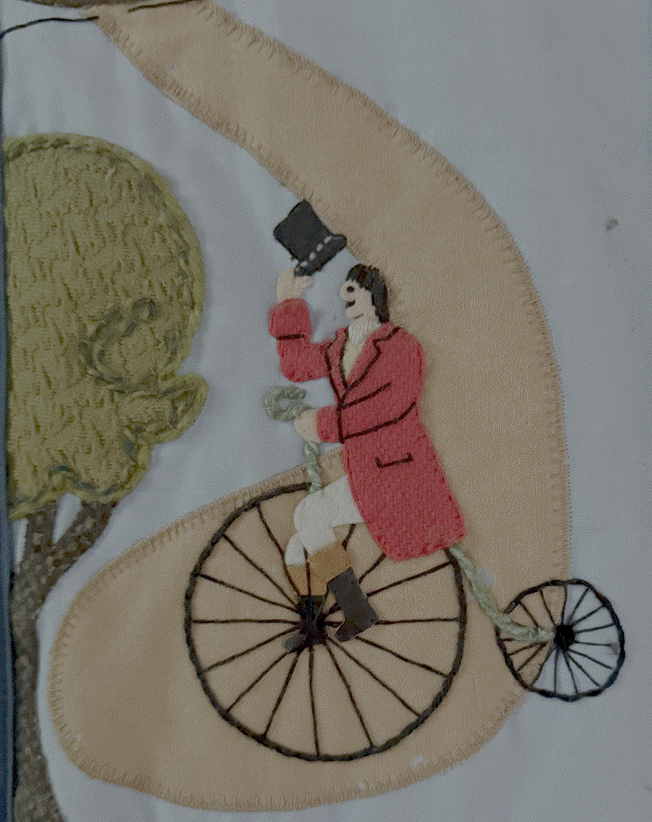
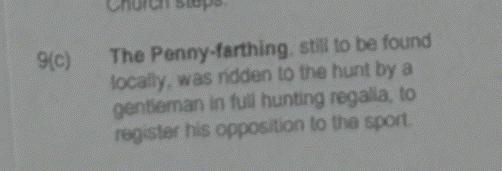
Richard Baker
teasing the Cheshire Hounds, recreated by artificial intelligence The
same scene depicted in a Community Wall Hanging in Audlem Church
In the early
1870s the Cheshire Hounds met regularly in Audlem Square, under the mastership of HR Corbet, father of the late Reggie Corbet
of Adderley, a meet which Richard’s father and eldest brother Jack always
attended. Unknown to them there was an occasion when he ‘borrowed’ a top hat,
pink coat and white breeches, also a penny farthing bicycle from Mt Moseley in
the village. When the meet assembled below the church at eleven, he duly
arrived in full hunting kit, riding the penny farthing and raising his hat to
the mounted company. Finally, when performing a specially
deep bow to the master, he fell off at the feet of that gentleman’s horse.
Audlem cricket
had its hour of glory. At the end of the last century Market Drayton held an
Annual Cricket Week, when a number of Lancaster County
men stayed with their then captain, AN Hornby, and played for the town, matches
being arranged with the local towns and villages, including Audlem
The captain of
Audlem at this time was Arthur Baker of Hillside, youngest son of William Baker
of Highfields. Some idea of the quality of the Audlem side may be gathered from
the fact that the captain’s 13 years old nephew Bellyse, on holiday from
school, was brought in to complete the team. Indeed, the main purpose of the
game, a single innings match, was to allow the spectators to watch the great
Lancashire stars in action. Audlem, however, possessed a fast bowler. He was
one of the Shuker brothers, the local blacksmiths, whose cannon ball deliveries
were only exceeded in speed by their usual inaccuracy.
Audlem went in
first and were dismissed, with little difficulty, for 13 runs. The spectators
settled down to watch the great men perform. Shuker opened the bowling, and
with his lighting delivery removed the batsman’s middle stump. This success
inspired him to hitherto unknown heights, and helped
no doubt by the un-Old Trafford like ground, he dismissed Market Drayton for 11
runs.
The captain then came
over to Arthur Baker and said, “Well, Arthur, it’s been great fun. I suppose
we’d better make it a two innings match?”
“We’ll both go in
again by all means,” was the reply, “but as far as the match is concerned, it’s
all over and we’ve won.”
“If that’s
Audlem’s idea of good sportsmanship”, said their captain, “Market Drayton will
never play them again.” And for all I know to the contrary they never did until
the middle of the 1960s, when the club revised after a lapse of twenty five years.
(Burton, Marjorie (1973), Nineteenth Century
Audlem, Audlem District Amenities Society, Johnson & Son Nantwich
Limited page 21).
Their brother, Richard, always known as Dick,
was of a similar nature. There is a tapestry in Audlem church, woven by members
of the W.I., and one of the squares depicts a gentleman in a pink coat riding a
penny farthing bicycle. The man so depicted was Dick Baker, who rather enjoyed
making fun of field sportsmen. One day, when hounds were due to meet in Audlem Square,
he borrowed an old pink coat of his father's and a penny farthing from Mr.
Moseley at the shop. Then, when all were assembled, he arrived on the bicycle
raising his topper to all and sundry. Unfortunately, this caused him to fall
off under the hooves of the Master's horse. Old "Regie" Corbet, the
Master, was equal to the situation. Turning to the youth's father,
"Really, Will," he said, "I should have thought you could have
turned your son out better mounted for an Audlem meet." (Latham, Frank (1997), Audlem:
The History of a Cheshire Parish and its seventeen townships, page 124).
1881
Commuting of the death
penalty
In
1881 a memorial was sent from Audlem to the Secretary of State asking that the
capital sentence against Ann Smith should not be carried out (Burton, Marjorie (1973), Nineteenth Century
Audlem, Audlem District Amenities Society, Johnson & Son Nantwich
Limited page 22). The death sentence of Ann Smith was
commuted to penal servitude following her conviction on 29 January 1881. Ann
Smith was tried alongside a co-defendant, William Stanway, in Cheshire. Both
were found guilty of a capital crime and formally sentenced to death. This commutation reflects the
broader Victorian shift away from public executions (which were banned in 1868)
and toward the penal servitude system. By the 1880s, penal servitude had
completely replaced overseas transportation to Australia as the standard
alternative to the death penalty.
Ann
Smith, aged 19, a servant was indicted for the murder of her 14
month old child, Mary Jane Smith, on 6 December 1880. “I did not know
what I was doing when I did it: I am very funny sometimes, and I did not know
what I was doing”. The child had been placed with her sister Mrs Clews at
Buerton and 3s a week was paid for her maintenance. The prisoner was getting
paid £9 per year and worked 30 miles away. “She did not at first intend to
drown the child but when she got to the brook some
funny thoughts came into her head and she dropped the child into the brook and
ran up the meadow towards Audlem”. The death penalty was passed but later
commuted to life imprisonment. (Latham
F A, Editor (1997), Audlem, The History of a Cheshire Parish and its five
townships, Local History Group, page 47).
1885
In 1885 to 1886 on the initiative
of the vicar, Canon Arthur Atkinson, whose long term of office extended from
1865 to 1896, much internal improvement and renovation work was carried out to the
church by the architects Lynam and Rickman (Dow, George (1977), Audlem,
Then and Now, Southampton: Hobbs).
Marriage at the Parish Church. Audlem church is being restored
by the Midland Joinery Company, of whom Mr. Clark, of Birmingham, is one of the
principals. The work is being well and rapidly executed in a first-class style.
A beautifully designed roof of oak has been placed over the chancel, the old
roof of the nave has been thoroughly cleansed, the gallery removed; the beautiful
arcades of the nave, the clerestory windows and walls have been redressed and
repaired, and a new heating apparatus has been placed, but there is still a
large amount of labour to be expended on the fabric before it will be
thoroughly restored. In the meantime the services of
the church are being celebrated in the National Schools, but on account of the
strong desire of the bride, a marriage was celebrated in the unfinished church on
Thursday last, by the Reverend Cannon Atkinson, vicar of Audlem, assisted by
the Reverend WW Tyson, of Butterton. The parties to
the marriage were Mr
Charles Cotterill Lynam, son of Mr
Lynam, architect, of Stoke-on-Trent, and Miss
Catherine Alice Hall, eldest daughter of Mr. James Hall,
of Kynsal Lodge, Audlem. The
bridesmaids were Miss Marianne Hall
and the two Mises Lynam. Mr Hall gave his daughter away, and Mr Robert Lynam
was the best man. The bells of the parish church were run at intervals during
the day, and in the evening Mr Lynam gave a substantial supper at the Combermere Arms, Audlem, to all the workmen, about 30, who
are now employed on the restoration of the church, of which Mr Lynam is the
architect. Mr Beckett, clerk of the works, Mr. Williams, as foreman of the
works, and Mr. Jones, as foreman of the stonemasons, together with Mr. Clark,
junior, time keeper, presided at the supper. After the
loyal toasts were given and responded to, the health of the bride and the
bridegroom was given amidst loud applause. Mr Beeston, of Audlem, carpeted from
the road to the altar, and Mr. Scott, of Newcastle Under Lyme, provided
carriages. (Chester Chronicle, 8 August 1885).
1890
Gas was installed
in the parish.
1894
Audlem Parish
Council was formed.
1896
In 1896 Lord Combermere
was patron of the church and his right to select a vicar was purchased from him
by the then Vicar, Canon Atkinson, who then gave it to the Bishop of Chester.
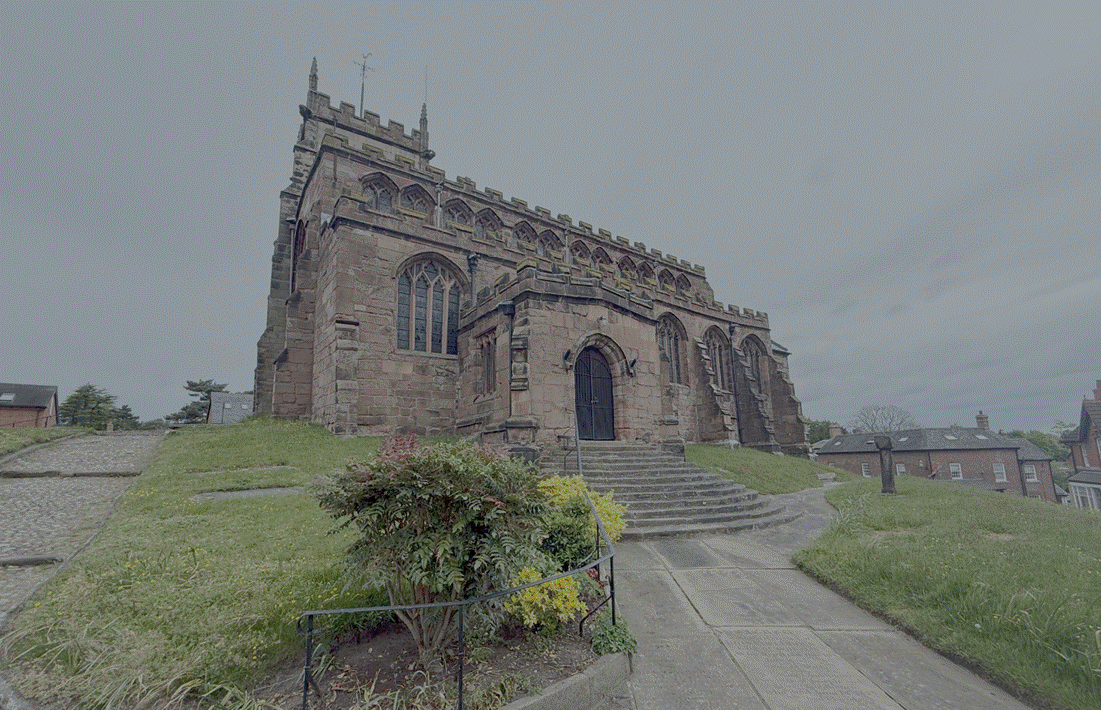
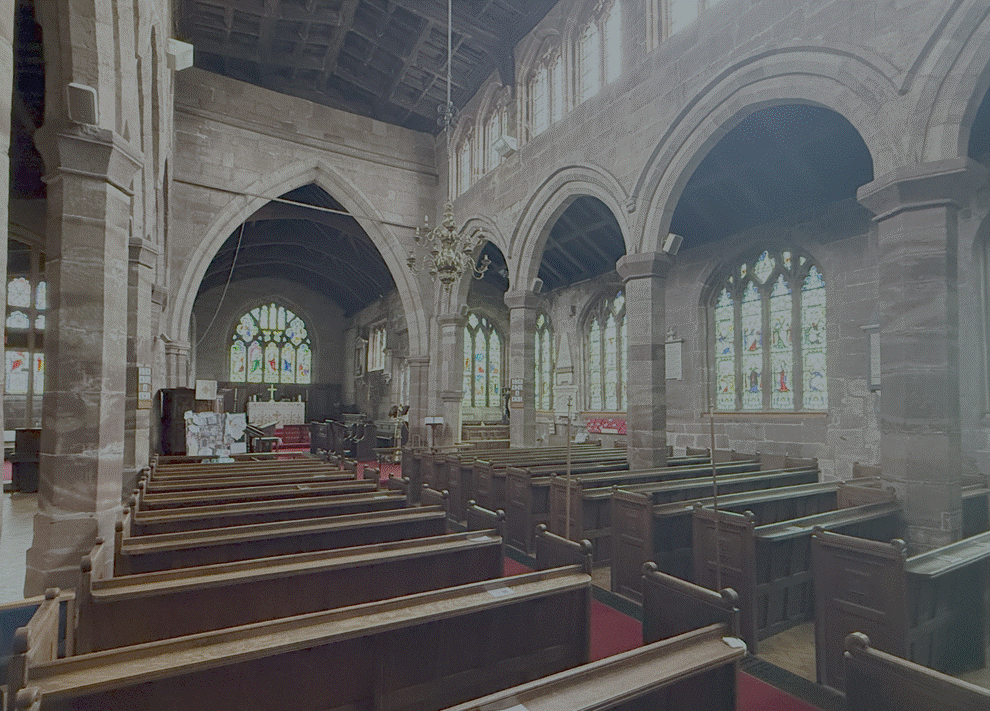
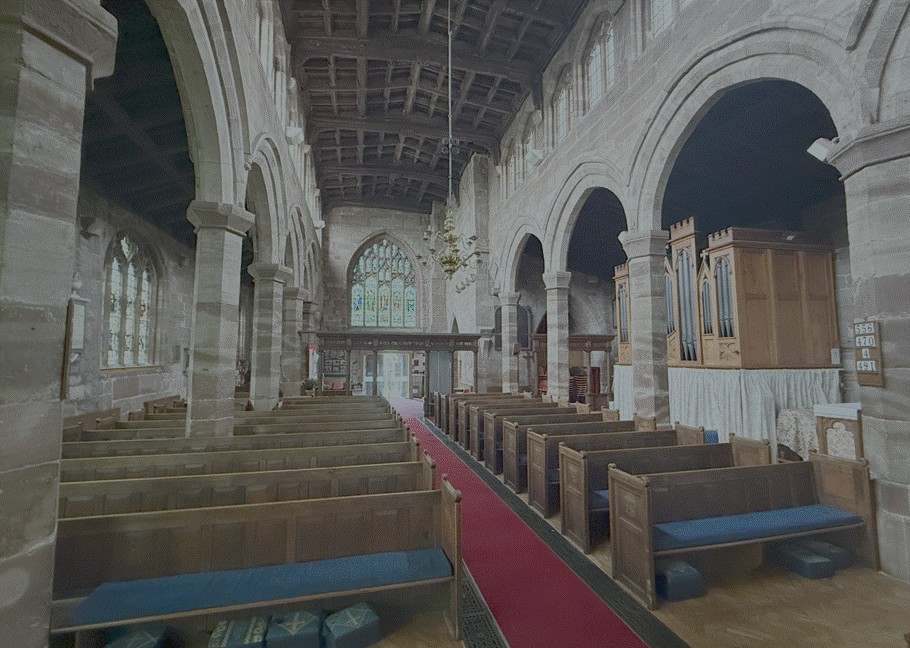
Audlem cricket
had its hour of glory. At the end of the last century Market Drayton held an Annual
Cricket Week, when a number of Lancaster County men
stayed with their then captain, AN Hornby, and played for the town, matches
being arranged with the local towns and villages, including Audlem
The captain of
Audlem at this time was Arthur Baker of
Hillside, youngest son of William Baker of Highfields. Some idea of the
quality of the Audlem side may be gathered from the fact that the captain’s 13 years
old nephew Bellyse, on holiday from school, was brought in to complete the
team. Indeed, the main purpose of the game, a single innings match, was to
allow the spectators to watch the great Lancashire stars in action. Audlem,
however, possessed a fast bowler. He was one of the Shuker brothers, the local
blacksmiths, whose cannon ball deliveries were only exceeded in speed by their
usual inaccuracy.
Audlem went in
first and were dismissed, with little difficulty, for 13 runs. The spectators settled
down to watch the great men perform. Shuker opened the bowling, and with his
lighting delivery removed the batsman’s middle stump. This success inspired him
to hitherto unknown heights, and helped no doubt by
the un-Old Trafford like ground, he dismissed Market Drayton for 11 runs.
The captain then
came over to Arthur Baker and said, “Well, Arthur, it’s been great fun. I
suppose we’d better make it a two innings match?”
“We’ll both go in
again by all means,” was the reply, “but as far as the match is concerned, it’s
all over and we’ve won.”
“If that’s
Audlem’s idea of good sportsmanship”, said their captain, “Market Drayton will
never play them again.” And for all I know to the contrary they never did until
the middle of the 1960s, when the club revised after a lapse of twenty five years.
(Burton, Marjorie (1973), Nineteenth Century
Audlem, Audlem District Amenities Society, Johnson & Son Nantwich
Limited page 21).
Those living in Audlem Parish at
the time included Canon Arthur Atkinson, Mr and Mrs J B Baker, J Bancroft, Mrs
Beeston, Mrs Etches, T L Boote (Deacon’s
County Blue Book, 1886).
1899
In Audlem it is claimed that the
Volunteer Fire Brigade started in 1898, but the first Minute Book suggests that
the first meeting of forty one subscribers took place
at the Crown Hotel on 14 February 1899 when a Committee was formed by J H Bellyse in the Chair
and G U Beeston as permanent Secretary and Treasurer. For an engine shed “Mr
Hassall’s shed was rented for £2 a year. On 28th February the
members of the Brigade numbered 12 with 8 in reserve. A bell was bought and
hatchets for each man. The first call out seems to have been at 2.55 am on 28
April 1899 “when a messenger arrived on a horse from Woore
Hall reporting a rick on fire at the farm”. The Fire Brigade with 400 yards of
hose arrived, pumped the water from a pit on the far side of a ploughed field
and the fire was out by 6.555am. One large and two small stacks were destroyed. (Latham F A, Editor (1997), Audlem, The History of
a Cheshire Parish and its five townships, Local History Group, page 51).
1901
The village bakery was built in
1901 (1901 census).
There was a kindergarten run at
the Cedars, the residence of Richard Dod Baker, by the Misses Baker (Latham F A, Editor (1997), Audlem,
The History of a Cheshire Parish and its five townships, Local History
Group, page 101).
Dr Laffan’s daughter, a Mrs Noble,
now in her eighties, lives in Yorkshire, and has a birthday book containing the
signatures of the Baker family, of the Cedars, which was a kindergarten. She
can remember her brother Cecil going to school there in petticoats. The
signatures in her birthday book are Emily Baker
7th October, Henrietta
Baker 9th February, and Tottie
Baker 29th July. (Burton, Marjorie (1973), Nineteenth
Century Audlem, Audlem District Amenities Society, Johnson & Son
Nantwich Limited page 22).
1908
The Grammar School closed and the
building became a private residence.
1913
The former Grammar School reopened
on 6 January 1813 as a Mixed Council School. The curriculum included butter
and cheesemaking, cokkery, laundry, agricultural
chemistry, poulty, bee keeping, gardening and rural carpentry (Latham F A, Editor (1997), Audlem,
The History of a Cheshire Parish and its five townships, Local History
Group, page 97).
Before the First
World War there was a modest shoot on the Hankelow estate, organised by James
Greaves of the Court and Arthur Baker of
Hillside. As head keeper they employed West Timmis, a member of a family
with long Audlem connections and a keen naturalist. A frequent guest at
shooting parties was Dr Stain, the local medic who, although popular in the
district, had a reputation for claiming any game as his if more than one gun
fired. On one occasion Jack,
Arthur Baker’s brother, quietly took a hare that had already been shot and ‘legged’,
and set it up in a realistic position on the far side of the hill. As the
guests breasted the mount the hare appeared. The doctor fired, as did someone
else who was in the know. “My hare, I think”, said the doctor as the animal
dropped. “Great Scott,” said Jack, as he retrieved the corpse. “He’s not only
shot it this time, he’s legged it as well.” (Latham,
Frank (1997), Audlem: The History of a Cheshire Parish and its seventeen
townships, page 111).
1920
Between 1920 and 1930 there were some
innovations in the parish starting with the founding of the Audlem District
Nursing Association in 1920. Here Nurse Jones was the District Nurse, and she
stayed for 31 years until the National Health Service took over. (Latham F A, Editor (1997), Audlem,
The History of a Cheshire Parish and its five townships, Local History
Group, page 63).
1921
Among the more prosperous families
during this century were the Bancrofts and the Beestons who intermarried in 1921 and changed the name to Beeston-Bancroft.
The Bancrofts lived at Shipbrook,
Audlem between 1787 and 1823 and later the Beestons
lived at the Mount and Bridge House. William Beeston was a one time doctor and lived at Ash Villa in 1892. By
1940 the Beestons seem to have left the village. (Latham F A, Editor (1997), Audlem, The History of
a Cheshire Parish and its five townships, Local History Group, page 48). In the mid nineteenth
century Considerable property at the New Bridge end of Stafford Street was
owned by the Beeston family. George Beeston was a very familiar bearded
character who lived in the house which his father built. It is now known as
Bryn Mor. (Burton, Marjorie (1973),
Nineteenth Century Audlem, Audlem District Amenities Society, Johnson
& Son Nantwich Limited page 16).
1926
In 1926 the Audlem Guides started
with Miss Nelly Baker,
as their Captained and continued until 1936. (Latham F A, Editor (1997), Audlem, The History of
a Cheshire Parish and its five townships, Local History Group, page 63).
1940
During World War II, Audlem
bustled with evacuees, Land Army members, and service personnel, serving as an
active agricultural and community centre.
1963
The sleepers sleep at Audlem
Audlem railway station on the
Wellington to Nantwich Railway, opened a hundred years earlier, closed in 1963
as part of the Beeching reforms. The station was immortalised in the song Slow
Train by Michael Flanders and Donald Swann. The site is now residential.
Audlem railway station was
explicitly immortalised in the lyrics of the song. On the Main Line and the
goods' siding, The grass grows high, At Dog Dyke,
Tumby Woodside, And Trouble House Halt. The sleepers (the wooden blocks
that support the tracks) sleep at Audlem and Ambergate
(Slow Train by Michael Flanders and Donald
Swann, 1963).
2000
Peter McGarr, born in 1953, a classical
composer and teacher has written several pieces inspired by Audlem including Audlem
Sonatas, Night-time and Mourning Gamelan (a homage to his
mother, who lived in the village when she was a child). He won the 2013–14
British Composer Awards in the Making Music Category for his piece Dry Stone
Walls of Yorkshire.
2008
In 2008 village residents launched
an online referendum on transferring the village to Wales from England, in a protest
over prescription and parking charges in England.[4][3] A vote was held which
received 88 in favour of the change, and 40 against; no further action was
taken. (Williams, Brendon (25
April 2008), English
village votes to be Welsh).
2021
The population of Audlem in 2021
was 1,832 (civil parish) (2021 Census). The population size of the town
has barely changed since 1801.
Bibliography
Burton, Marjorie (1973), Nineteenth
Century Audlem, Audlem District Amenities Society, Johnson & Son
Nantwich Limited.
Dow, George (1977), Audlem,
Then and Now, Southampton: Hobbs.
Draper, Anne (2019), Audlem
Remembers, The village fallen in WW1.
Hewitt,
H J, Church Building in Cheshire during the Thirteenth Century,
Transactions of the Historic Society of Lancashire and Cheshire, Volume 95.
This article offers deep structural analysis of regional churches, including
the architectural development of Audlem's St James Church during the medieval
period.
Latham F A, Editor (1997), Audlem,
The History of a Cheshire Parish and its five townships, Local History
Group.
Marshall, Charles and Meredith,
Gordon (1980), A History of Mills in Audlem. *
Ormerod,
George, History of the County Palatine and City of Chester. Volume
2 page 465
to 472 (Audlem), 473
to 475 (Buerton).
Redwood,
Brian C (1965), Audlem Free Grammar School, in the Journal of the
Chester Archaeological Society New Series Volumes 51 and 52. *
Audlem
History Society Archive.
The Story of
Audlem, Audlem online.
Audlem, Cheshire, A vision of Britain Through
Time.
Audlem
Terriers, available at Cheshire Archives and Local Studies, 1701
to 1747, 2
July 1728, 20
May 1701, 30
June 1747.
Further research
For detail on land transactions, in Fine
Rolls of the reign of King John, 1199
to 1216, search for Aldelyme.