Roman Cheshire
The
history of the Romans at Chester and the environs
|
Return to the Home Page of the Bakers Family part of the website |
The Bakers of Highfields Story
The Story of the Dods and Bakers and of Highfields,
Fenton House and Hasfield Court. A journey through the history of Cheshire
and Staffordshire, an Anglo-Saxon nobleman who retained his lands after the
Conquest, pottery at Stoke on Trent, an encounter with Elgar, and the history
of an Elizabethan manor house at Audlem |
The family tree of the Bakers of Highfields |
The Family Tree of the Dods, predecessors to the
Bakers of Highfields |
The Bakers of
Fenton House and Hasfield Court
The Family Tree of the pottery Bakers of Stoke on Trent |
The Family Tree of the Bellyse Family |
The main part
of this website tells the story of the Farndale family from Yorkshire Descendants of Arthur Baker, the story of the Farndale
ancestry is told through the main part of this website You can also return to the Farndale
website home page |
The genealogy of the family of James Hall, linked to
the Baker family through marriage to Arthur Baker |
Headlines of are
in brown.
Dates are in red.
Hyperlinks to
other pages are in dark
blue.
References and
citations are in turquoise.
Context and local
history are in purple.
The arrival of the Romans
40 to
50 CE
Discovered by a metal detectorist on 9 January 2014, the Malpas Hoard is a collection of 35 ancient coins buried
around 40 to 50 CE. The find includes 28 Roman denarii struck
during the Roman Republic and early Empire, alongside 7 Iron Age British coins
minted by the Western (Dobunni) and Southern (Atrebates) tribes.
The latest coin in the stash features the Emperor Tiberius (14 to 37
CE). Because the coins show minimal wear, historians believe the hoard was
buried within a decade of the Roman invasion of Britain in 43 CE, likely shortly
before Roman troops pushed further north into Cheshire.
50 to
60 CE
There was an initial Roman
military presence and reconnaissance in the area of the Dee estuary.
The region was of great military
importance to the Romans. In the early years of the occupation it lay between
the territory of hostile tribes in North Wales and the potentially dangerous Brigantes
in the Pennines in the north, and that military focus persisted. A major
advance directed famously at the druidic stronghold on Anglesey in 60 to 61 CE, may well have
seen a set up at Chester by the provincial governor Suetonius Paulinus. Traces
of timber buildings and a box rampart of this date have been recovered in
excavation. (Hartwell, Clare and others (2011), Cheshire
in The Building of England series originated by Nikolaus Pevsner, Yale University
Press, page 9).
70 to
79 CE
Deva Vitrix
The Romans occupied Cheshire for
nearly 400 years, beginning in about 70 CE. The Romans chose the River Dee to
build Deva Victrix as a main military stronghold against northern tribes
and Wales They built the massive fortress and town of Deva Victrix,
modern Chester, as a strategic base for the Twentieth Legion, Valeria
Victrix, using the region's river access, agricultural wealth, and
important salt works. Over 5,000 soldiers from the
Twentieth Legion lived there. They built Britain's largest known military
amphitheatre for training and events.
The large earth-and-timber
legionary fortress of Deva Victrix was constructed by the Legio II Adiutrix,
serving as a strategic base against the local Cornovii
tribe and neighbouring Welsh tribes, such as the Ordovices.
The decisive creation of a much
larger legionary fortress on the raised ground in the angle of the early course
of the River Dee occurred in the mid or late 70s. Its characteristic plan,
shaped like a playing card and extending to a little less than 60 acres (somewhat
larger than the 50 acre norm, at for example Colchester, York, Caerleon and Inchtuthil) set the template for later Roman, medieval and
early modern configurations of Chester. (Hartwell, Clare and others (2011), Cheshire in The
Building of England series originated by Nikolaus Pevsner, Yale University
Press, page 9).
80s CE
Legio II Adiutrix was transferred to the Danube and
replaced at Chester by the Legio XX Valeria
Victrix, the “Valiant and Victorious Twentieth Legion".
90 CE
Legio XX Valeria Victrix officially arrived to permanently
garrison Deva, supervising regional lead-mining operations in north-east Wales
and managing local infrastructure.
The Romans controlled inland salt
springs around Cheshire to preserve food for troops.
100 CE
Reconstruction of the timber
fortress into durable stone began, alongside the expansion of the civilian
settlement, canabae, outside the walls, including
a large amphitheatre, bathhouses, and riverside wharves.
The Romans built a network of
roads connecting Chester to Manchester and other regional forts. For the
modern traveller, and outside Chester, the Roman past is encountered through
relics of their well developed road network, which
linked all the centres mentioned. A notable stretch is the straight alignment
of King Street north of Middlewich towards Northwich. (Hartwell, Clare and others (2011), Cheshire in The
Building of England series originated by Nikolaus Pevsner, Yale University
Press, page 11). Chester (Deva Victrix) served as the primary military and
administrative focal point for the Roman road network in Cheshire, connecting
legionary forces to North Wales, Manchester, and the wider northern
infrastructure. The Roman road map is dominated by Chester as it was an
important Legionary centre not just for North-West England but North Wales too.
The east of the County is suspiciously empty - perhaps more work is required
here. It would also be expected that Eaton Villa, the only such known villa in
the north-west, would be reasonably close to a road. Roman Roads
in Cheshire, Roman Roads Research
Association, where there is an interactive map of Cheshire’s Roman roads).
Roman Nantwich and the
other wich towns
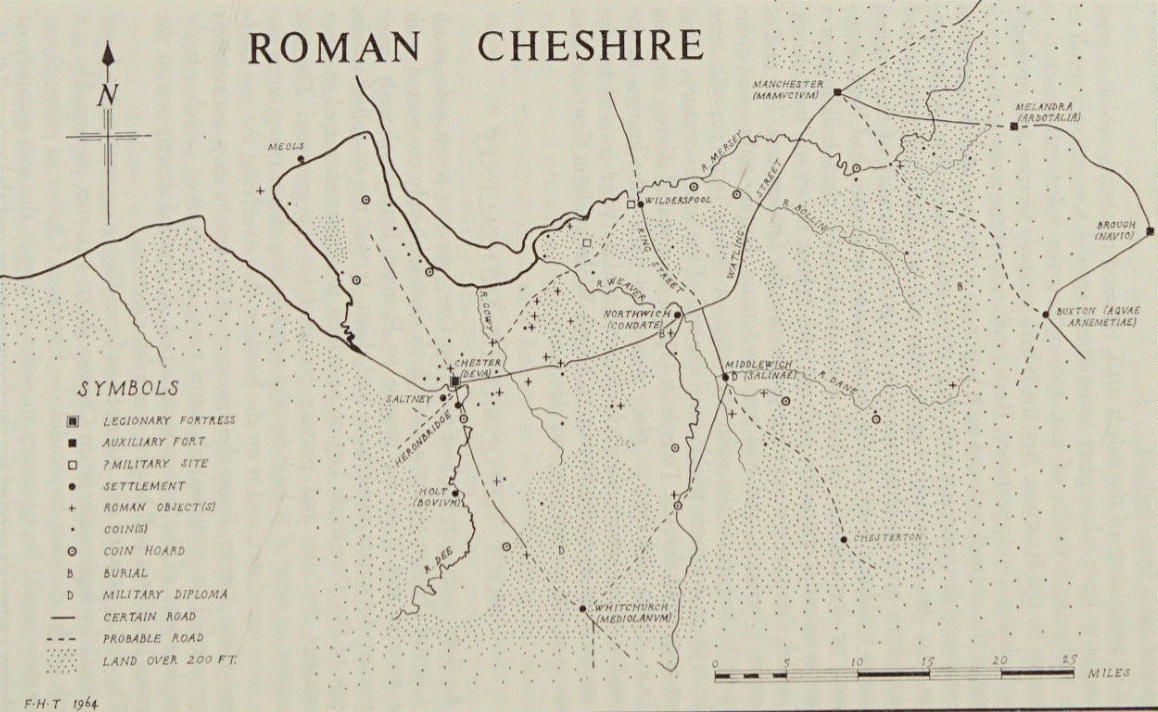
(Thompson, FH
(1965), Roman
Cheshire, page
14)
Evidence continues to accumulate
for the varied industrial basis of Roman small towns at Northwich (Condate), Middlewich (Salinae),
and Nantwich, in addition to the well established
salt production that they had in common. Like the better known settlement with
a similar profile of industrial activity at Wilderspool, southwest Lancashire,
Northwich clearly had a military focus in several phases of fort, and the other
two centres, located on the road system and at river crossings, may have had
so, too. Whether the dominant market was, and continued to be, military remains
unclear. (Hartwell, Clare and others (2011), Cheshire in The
Building of England series originated by Nikolaus Pevsner, Yale University
Press, page 10). For Wilderspool see Thompson,
FH (1965), Roman Cheshire, page 67. For Northwich (Condate),
see page
88. For Middlewich (Salinae), see page
91.
During the second century, salt
was produced at Nantwich, likely worked by slaves, to preserve food, tan
leather, dye fabrics, and supply Roman garrisons in places like Chester.
Archaeologists have found large
clay-and-timber-lined underground tanks used to hold massive amounts of brine
before evaporation. A Roman lead salt pan engraved with the British name Cunitus was used to boil and evaporate brine (Nantwich Museum).
120 to
165 CE
A large portion of the legion was
redeployed north to help construct and garrison Hadrianic
and Antonine frontiers. There was reduced active military presence in Chester.
Eaton Roman Villa
Most of Cheshire outside Chester
remained peaceful, with small farms and local trade rather than heavy military
control.
150 CE
The earliest occupation began at
the site of Eaton. A villa consisted of two successive timber-framed phases,
acting as a high-status proto-villa farmstead. The Roman villa at Eaton near
Tarporley is historically significant as the only certain known Roman villa
site in the county of Cheshire. It stands out because Roman villas were rare in
this part of northwest Britain, which was heavily militarised rather than
heavily civilianised or settled with grand country estates. Archaeological
investigations indicate a rectangular timber building complex rather than a
massive stone palace, reflecting the unique pattern of Romano-British rural
settlement in the region.
Only one clear cut villa is known,
at Eaton-by-Tapperley, a modest development from a
rectangular timber farmhouse to a simple stone successor with symmetrical
layout of wings and veranda, and a small integral bath suite. While others no
doubt remain to be discovered, the parallel evidence is of farmsteads of
traditional forms continuing with limited Romanising effect. This evidence is
currently based to the West of the county and the impact of Chester, but palaeo-environmental results from Lindow Moss, for example,
point to a cleared landscape of mixed arable and pasture in the east also. (Hartwell,
Clare and others (2011), Cheshire in The Building of England
series originated by Nikolaus Pevsner, Yale University Press, page 10).
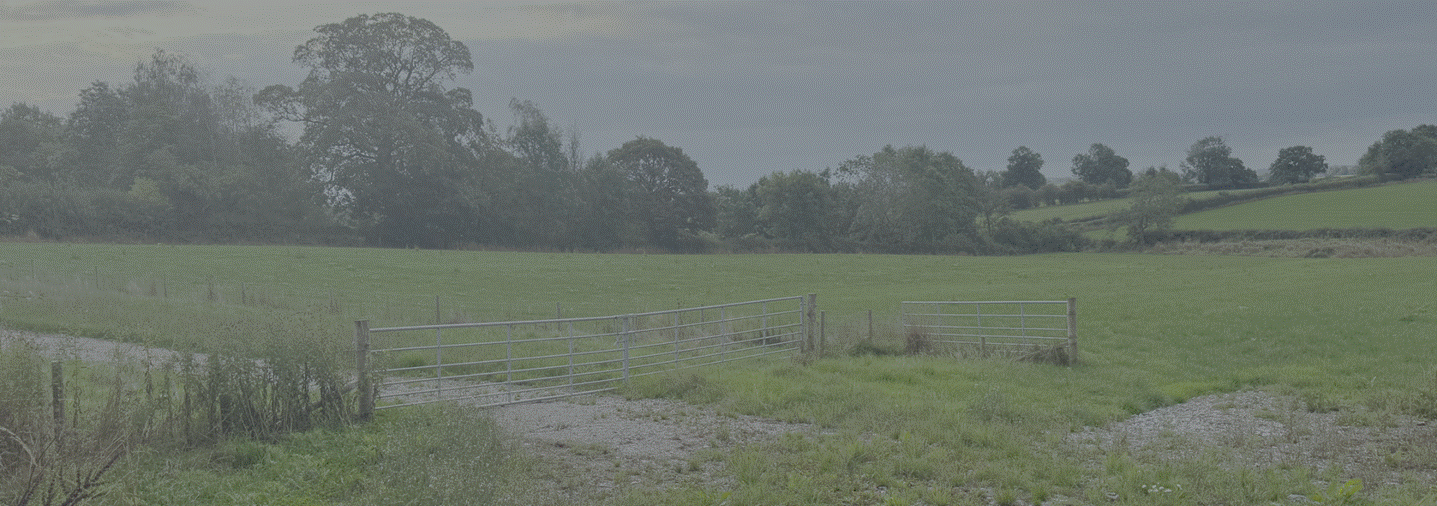
(The site of Eaton Roman Villa,
September 2026, by the author)
In the late second century, the
site at Eaton underwent a grand transformation and was rebuilt entirely in
stone. It took on a classic winged-corridor plan featuring five main rooms, two
projecting wings, a veranda, and luxury amenities including an integrated
bathhouse suite and underfloor hypocaust heating systems. It might be compared
to the Roman Villa at Beadlam
in Yorkshire.
200 CE
Major structural reconstruction
and renovation work took place across the Deva fortress.
350 CE
Structural modifications were made
to the Eaton villa during the mid fourth century. The front veranda was
enclosed with a solid-walled corridor, and a second story added to expand the
layout.
380 CE
The Roman military presence at
Chester wound down and the official structures are largely abandoned by the
retreating empire. The villa at Eaton was abandoned as Roman administrative
control in Britain broke down.
410 CE
Roman troops left Britain in about
410 CE. Deva was left to transition into post-Roman
British control.
Bibliography
Roman Chester, in A History of the County of
Chester: Volume 5 Part 1, the City of Chester: General History and Topography,
ed. C P Lewis, A T Thacker (London, 2003), British History Online pages 9 to 15.
Fitzpatrick-Matthews, Keith
(2006), The
Roman Period in western Cheshire.
Philipott, Rob (2007), Roman Resource Assessment 2007.
Thompson, FH
(1965), Roman
Cheshire.
Wood, Philip N and Griffiths, David G
(2022), Excavations
at Chester. Roman land division and a probable villa in the hinterland of Deva.
Watkin, W Thompson (1886, reprinted 1974), Roman
Cheshire: A Description of Roman Remains in the County of Cheshire.