Cheshire Archers
The
history of the archers of Cheshire
|
Return to the Home Page of the Bakers Family part of the website |
The Bakers of Highfields Story
The Story of the Dods and Bakers and of Highfields,
Fenton House and Hasfield Court. A journey through the history of Cheshire
and Staffordshire, an Anglo-Saxon nobleman who retained his lands after the
Conquest, pottery at Stoke on Trent, an encounter with Elgar, and the history
of an Elizabethan manor house at Audlem |
The family tree of the Bakers of Highfields |
The Family Tree of the Dods, predecessors to the
Bakers of Highfields |
The Bakers of
Fenton House and Hasfield Court
The Family Tree of the pottery Bakers of Stoke on Trent |
The Family Tree of the Bellyse Family |
The main part
of this website tells the story of the Farndale family from Yorkshire Descendants of Arthur Baker, the story of the Farndale
ancestry is told through the main part of this website You can also return to the Farndale
website home page |
The genealogy of the family of James Hall, linked to
the Baker family through marriage to Arthur Baker |
Headlines of are
in brown.
Dates are in red.
Hyperlinks to
other pages are in dark
blue.
References and
citations are in turquoise.
Context and local
history are in purple.
This page is work in progress
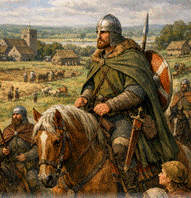
The Cheshire archers were elite
medieval longbowmen from Cheshire. Famed for their exceptional skill due to
frequent border practice, they served as key forces for Edward III and the
Black Prince at Crécy and Poitiers, and later acted as
a feared personal bodyguard for King Richard II.
They were recruited primarily from
the Macclesfield Hundred and local forests. Their proximity to Wales kept their
combat skills sharp.
Edward III and the Black Prince paid
them higher wages and issued distinctive green-and-white uniforms.
Their privileged status and
aggressive loyalty made them notorious across England, occasionally receiving
royal pardons for local crimes in exchange for service.
The activities of Richard the
second's Cheshire Archers, led by prominent land owners,
have been well chronicled. These had their origins in a group known as the
Archers of the Principality of Chester in 1397 and many of them were recruited
in the south of the county where they gained a reputation for criminality.
Against them were complaints of murder, rape and robbery and they were
protected from prosecution by king who used them to oppress his enemies.
Probably some were among those against whom there were complaints by men of
Shropshire for their raids across the border. However, these were career soldiers,
and their bravery was never in doubt. Twenty years after the death of Richard II,
some were still employed by Henry the 5th and were active again in France when
the 100 years war was renewed. Several members of the
Massey family are noted, and in 1415 it is recorded that Richard de Hakelow
received a protection to serve at Harfleur with the Earl of Dorset. It was in
this year that Henry V crossed the channel for an attack on this destination
when he laid formal claim to the French throne. The capture of Harfleur was
completed by 8 October and a fortnight later, on 25 October, Henry won his
great victory at Agincourt. The success was not to last, however, and the
French had driven the English out of their lands by 1453. Just two years later
the Wars of the Roses began at home as the result of the breakdown of law and
order which culminated in clashes between aristocratic fractions. (Latham F A, Editor (1997), Audlem, The History of
a Cheshire Parish and its five townships, Local History Group, page 25).
Bibliography
Archers
at the Battle of Shrewsbury in The Soldier in Later
Medieval England, University of Southampton.