Act 5
Scandinavian Yorkshire
866 CE to 1042
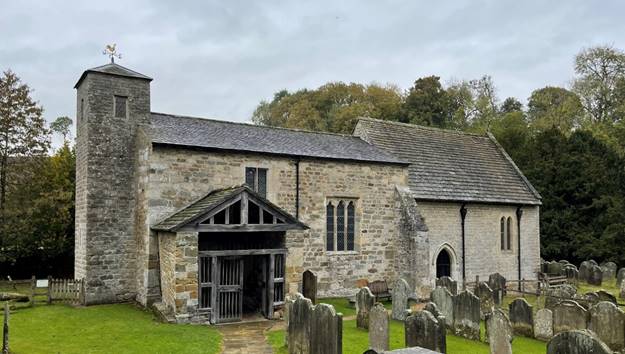
Kirkdale Minster
Kirkdale under Scandinavian influence
|
As
a scene setter, you might enjoy a dramatic interpretation of the Viking
threat. It is fictional, but might help to set a scene. |
Prologue
It might be
thought that the period of Viking invasion which impacted heavily on northeast
England from the mid ninth century CE, would have been devastating for the
inhabitants of the agricultural lands around Kirkdale. However the Kirkdale
lands were nestled at the protective edge of the moors and dales, and were not
at the heart of Viking violence. Whilst the farmers of Kirkdale cannot have
escaped disruption and some experience of violence, the cultivated region seems
to have been more gradually subsumed into a new Anglo-Saxon-Scandinavian
culture.
The
Late Saxon Period (850 to 1066 CE) consolidated and built upon the societal
evolution of the Middle Saxon Period, but across the lands of modern Yorkshire,
it also met the revolutionary change brought by newcomers. It is better
documented, particularly through the Anglo Saxon Chronicle, begun in the
late ninth century. Nine manuscripts of the Chronicle, none of which is
the original, survive in whole or part. Seven are held in the British Library,
one in the Bodleian Library at Oxford, and the oldest in the Parker Library of
Corpus Christi College, Cambridge. The oldest seems to have been started
towards the end of Alfred's reign, while the most recent was copied at
Peterborough Abbey after a fire at that monastery in 1116.
Scene 1 – Becoming Scandinavian
Attack
The best known
Viking raid on the British Isles was the attack on Lindisfarne off the modern
Northumbrian coast in 793 CE. There had in fact been attacks from Scandinavia
before that time, mostly further to the north.
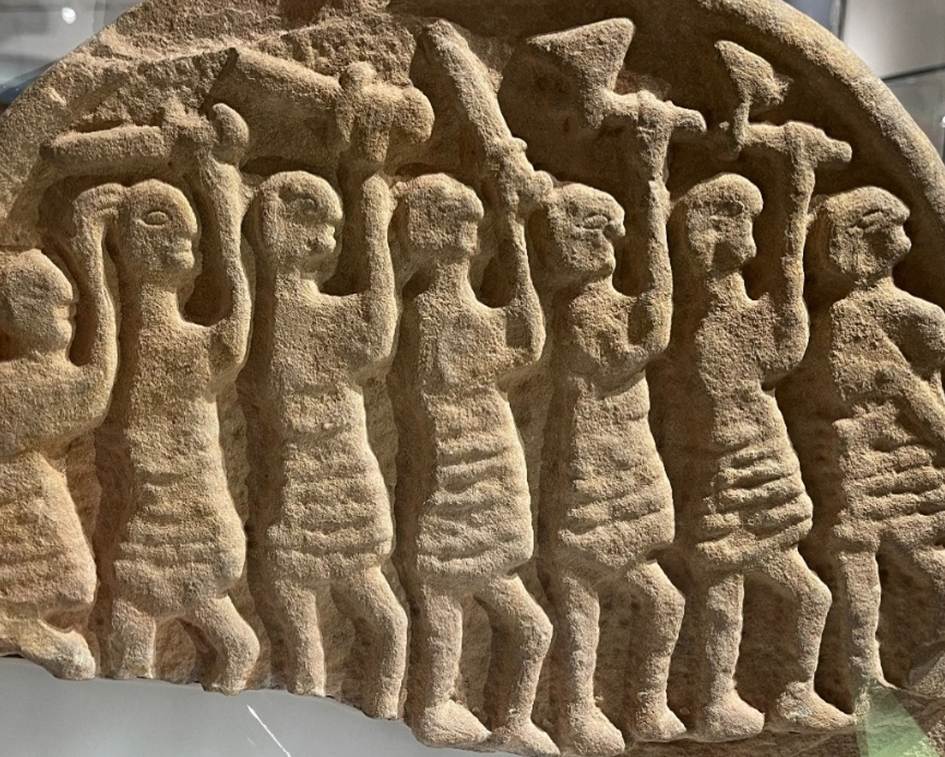
The
Judgement Day Stone, Lindisfarne
The effects
of Viking raids on the indigenous population, who were exposed to violence and
enslavement, must have been profound. Opportunistic raids by Viking warrior
seamen continued over the next half century. By 835 CE larger Viking fleets
began to engage in more significant confrontations with royal armies.
A great
Scandinavian army arrived in 865 CE. The Anglo Saxon Chronicle, written
in the age of King Alfred, recorded that year that there sat the heathen
army in the isle of Thanet, and made peace with the men of Kent, who promised
money therewith; but under the security of peace, and the promise of money, the
army in the night stole up the country, and overran all Kent eastward. By
867 CE, the army went from the East-Angles over the mouth of the Humber to
the Northumbrians, as far as York. And there was much dissension in that nation
among themselves; they had deposed their king Osbert, and had admitted Aella,
who had no natural claim. Late in the year, however, they returned to their
allegiance, and they were now fighting against the common enemy; having collected
a vast force, with which they fought the army at York; and breaking open the
town, some of them entered in. Then was there an immense slaughter of the
Northumbrians, some within and some without; and both the kings were slain on
the spot. The survivors made peace with the army. The same year died Bishop
Ealstan, who had the bishopric of Sherborn fifty winters, and his body lies in
the town.[1]
Given the proximity of York, this must have been a
traumatic time for the region, but the lands around Kirkdale were at the
periphery of the main action.
After
the Great Heathen Army seized York, the Scandinavians began to settle. By 876
CE Northumberland lands were being shared out among the Scandinavians. The
Scandinavians under Halfdan decided to take permanent hold on the northern
kingdom. And that year Halfdan divided up the land of Northumbria; and they
were ploughing and were providing for themselves[2].
There followed a period of assimilation
between the indigenous Anglo-Saxon population, with the Scandinavian incomers.
|
The
Anglo-Saxon-Scandinavian Period 866 CE to 1042
The Scandinavian
influence on Yorkshire after the Viking raids from 793 CE and the assault of
the Great Heathen Army |
|
Southern
Resistance
The
Scandinavian army turned its primary attention southwards again from 866 CE and
it marched into Mercian lands, wintering around Nottingham. Mercia appealed to
their recent rivals Wessex for help. The Mercians supported by Wessex though
could not dislodge the invaders. Æthelred of
Wessex, with his brother Alfred fought a
series of battles against the Vikings culminating in a victory at Æscedun (Ashdown) in 871 CE. The heathen army was more
successful at Basing south of Reading, and then at Mæredun
two months later. After fourteen days had elapsed King Æthelred and his
brother Alfred joined their forces, and marched to Basing to fight with the
heathen. Having thus assembled, battle was joined, and they held their own for
a long time, but the heathen gained the victory, and held possession of the
battle-field. After this fight, another army of heathen came from beyond sea,
and joined them.[3]
|
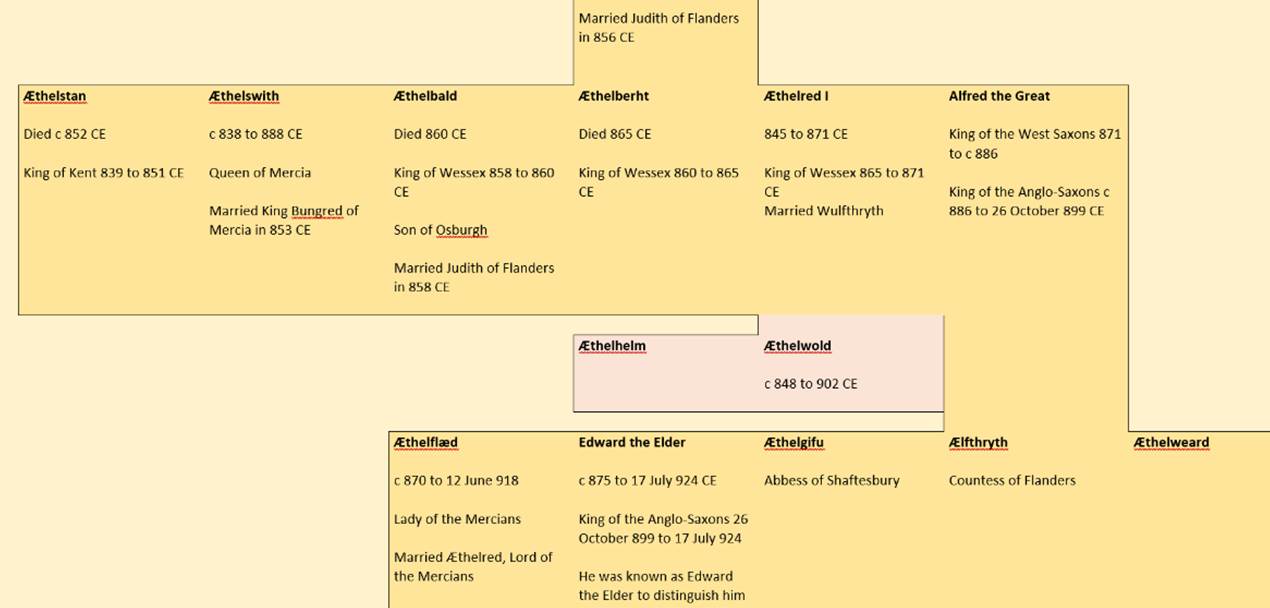
The Genealogy of the House Wessex
The family tree of the Kings of Wessex, the Anglo-Saxons, and the
English |
When
Æthelred died in 871 CE after a relatively short reign, the fourth brother to
do so, only one brother, the youngest and fifth, was left. With
Æthelred’s death, Alfred was left the Kingdom of Wessex. As he did so pagan men
were laying waste to the land with fire and sword, mercilessly slaying
Christian people[4].
He was crowned at a time of acute crisis. Northumbria and East Anglia had
fallen to the heathen army, Mercia was in dire straights
and Wessex was threatened. Alfred had an early setback against the Vikings at
Wilton soon after he took the crown[5].
Early
in the year 878 CE, the Viking army attacked the Wessex town of Chippenham.
They may have launched a surprise attack during Christian festivities. Soon
afterwards they overrode and occupied the land of Wessex, and drove many of
the people across the sea, and the greatest part of the others they overrode[6].
By strength of arms they forced many men to sail overseas, through both poverty
and fear, and very nearly all the inhabitants of that region submitted to their
authority[7].
Alfred
took refuge in the swamps of Athelney, accompanied by
a small group of thegns and warriors. He took to guerilla warfare and his
biographer, the Welsh monk Asser wrote that he led a life of great distress
amidst the woody and marshy plains of Somerset with nothing to live on except
what could be foraged in raids. In May Alfred left the swamps and rallied
support at Egbert’s Stone in Selwood Forest at Whitsun. He then marched towards
Chippenham and encountered the Viking army at Edington which he defeated
with great slaughter, and pursued them flying to their stronghold[8].
It was clearly a remarkable victory, for he took hostages including Guthrum.
This
was an important turning point. Guthrum and thirty high ranking warriors,
accepted baptism after his defeat. Oscetel and Anwend had disappeared from the
record. As well as an acquiescence to the Anglo-Saxon region, this had the
potential political impact of bringing the southern Scandinavians into a level
playing field in negotiation. The Scandinavian incomers had until then simply
ignored the terms of negotiations, not playing by the rules, but their baptism
may have been an aspiration of Alfred to bring a degree of incorporation into
the Christian order of things. The hope was not rewarded however, as the
Vikings soon afterwards retook Exeter.
The
Northumbrian Idea of Englishness adopted by Alfred
When
Alfred in Wessex started to refer to a united kingdom of the Anglo-Saxons by
879 CE, he was not expressing a new idea[9].
The idea of an English ethnicity had emerged in the Golden Age of Northumbria
in the preceding two centuries. In the ninth century CE, the same idea was
picked up in the southern Anglo-Saxon lands. The old rivalry between Mercia and
Wessex was fading and since 867 CE a common currency was being adopted. As he
started to use the style King of the Anglo Saxons, Alfred made a statement of
the unity of Angelcynn[10].
In his dealing with Guthrum, he spoke of ealles Angeleynnes
witan, all the councillors of the English and Angelcynn
began to be used more frequently on coinage, which also started to refer to
Alfred as Rex Anglorum. From 882 CE Asser described Alfred as Angulsaxonum rex. The idea of Englishness,
born in Northumbria, was used by Alfred for a political purpose, to persuade
Mercia and others being subsumed within a Greater Wessex, that they were all
part of the Kingdom of the Anglo Saxons.
For
the next fourteen years, Alfred built a chain of fortified burhs and
raised a part time army, the fyrd, from thegns who owed service to their
lords, with rotational shifts of duties, and equipped with horses. Noblemen
were obliged to lead their followers to the King’s wars. Burhs were the
next form of urban settlements after the emporia or wics
of the early Anglo-Saxon period, a reaction to the Scandinavian threat. The Burghal
Hidage[11],
produced between 911 and 914 CE, listed 31 burhs, not necessarily all created
under Alfred, and accounted for the number of hides to support each.
These fortified towns operated as a network. Their locations were carefully
chosen to control roads and rivers. They were strongholds permanently
garrisoned with soldiers. Whilst fortifications had protected towns like York
and Nottingham, they had fallen more easily than Alfred’s fortified towns
operating as part of a strategic defensive network. The fortresses were fully
manned, supported by the association with hides of productive land. It
has been calculated that an astonishing force of about 27,000 soldiers were
stationed across the network. This was an ambitious feat of mobilisation.
Although
the burhs provide the derivation for later boroughs, many of Alfred’s
towns were not commercial centres, at least during Alfred’s reign, but
defensive points within a network. Winchester did grow to become an important
commercial centre and London also began to revive as a commercial centre and by
the mid ninth century Lundenwic started to be
referred to as Lundenburh.
Alfred
also ordered the building of a fleet of ships which numbered about a hundred by
910 CE at the time of his son Edward. By 957 CE King Edgar was able to provide
a naval defence which patrolled the coasts for pirates and Edgar may have
maintained three fleets. Alfred was, perhaps, the founder of a royal navy,
although his ships were generally created for impact, some with sixty oars, and
tended to be outmanoeuvred by the smaller Danish longboats, or ran aground.
Alfred
convened councils of ealdermen, and those most
regularly summoned took the style of his witan, perhaps comprising two
or three bishops, four ealdermen and about eight
thegns or ministers.
The
church had been badly impacted by Viking attacks, with seizures of gold and
precious objects, the enslavement of monks, the torching of libraries, and the
ransoming of valuable books such as the Codex Aureus of Canterbury.
Alfred lamented these losses, which had also led to a deterioration in literacy
and learning. A decline in literacy since
the Golden Age in Northumbria, was widely seen in the southern lands as a
failure to uphold the Christian duties of the Anglo-Saxon kings. Alfred began a
campaign to rectify these failings. He founded new religious houses in the
south and strove to restore monastic libraries and improve the literacy of his
subjects and the church. He recruited learned men to his court. For the first
time Alfred had at least seven books translated into English, including Bede’s Ecclesiastical
History, and works of Gregory the Great, so that they could be more widely
understood, although he also aimed at a revival of Latin literacy. Whether
Alfred had any personal involvement in the translations is open to debate. He
intended that all freeborn men in his kingdom should be literate in their own
language. This was also a part of his political strategy to foster a sense of a
gens Anglorum, a common identity. Alfred also commissioned his own
history, the Anglo Saxon Chronicle, which originally concluded in 890 CE
with Alfred ruling over a peaceful kingdom, but was later continued to record
later periods of resumed Viking raids.
The
exaltation of Alfred largely arose in his reinvention from the eighteenth
century onwards. His story was retained by the Welsh bishop, Asser, who wrote a
hagiographical[12] record of his life, The Life of
King Alfred[13]. The original of Asser’s work was
destroyed in a fire in 1731, and it was embossed with non
authentic material when it was later reassembled. The cake story was a
later gloss on his life[14] and the credit to him as a
translator of books has been challenged since[15]. The King was a self
proclaimer of his greatness, perhaps to justify himself as the fifth son
to rule Wessex, but there has been debate more recently about the extent of his
greatness. His life was marked by illness. The pious lad is said to have preyed for an illness to overcome his feelings of lust and
was rewarded with a dose of haemorrhoids, and illness continued to dominate his
life.
Alfred died
on 26 October 899 CE, after a reign of 28 years, leaving his kingdom to his son
Edward the Elder. By then the term King of the Anglo Saxons was in regular use.
Alfred was king over all the Anglo Saxon kingdoms except the parts subject to
Danish rule. Alfred had maintained control of Wessex and annexed Mercia west of
Watling Street, but everything north and east of Watling Street was still part
of the Danelaw. He was therefore not the first king over all of England.
The lands north of Watling Street were beyond his realm. Yet his defence of the
southern realm from the Scandinavian threat was remarkable.
Anglo-Saxon-Scandinavian
Culture
Northumbria
found itself within a very different Scandinavian ambit, and cultural
advancement in the south impacted little in the northeast.
The
Scandinavian settlers were pagan but rapidly adopted Christianity, probably
within a few generations, driven by political benefits and cultural blending
with the indigenous Anglo-Saxon population. Pagan motifs persisted in art and
poetry, with incorporation of a Norse heritage into the Anglo-Saxon culture.
This led to a unique Anglo-Saxon-Scandinavian-Christian culture, seen in hybrid
monuments and strong support for church rebuilding, which in time transformed
sites like Durham and York into significant Christian centres.
The monks of Lindisfarne had long
abandoned their island, taking the bones of St Cuthbert with them, and had
initially settled at Norham on the Tweed. In about
883 CE they settled in the Roman fortification at Chester-Le-Street on the
Wear, where they remained for over a century, until 995 CE.
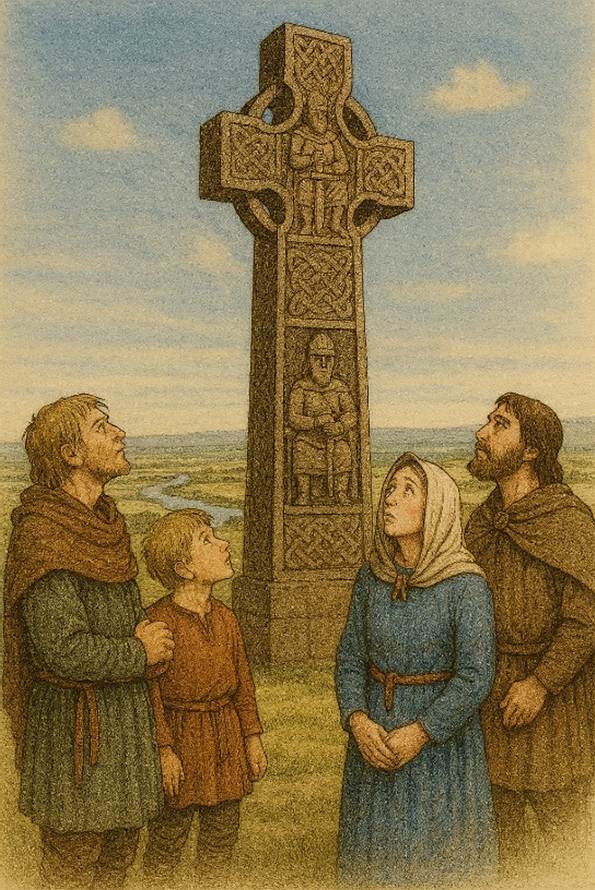
Scandinavian
crosses are found in churchyards, a good example being the Middleton Cross[16],
northwest of Pickering, which probably
represents a Norse warlord sitting on his throne. It may have been a memorial
stone rather than a gravestone.
There
are a series of distinctive Scandinavian grave markers, known as hogback
tombstones, from their curved profile. There’s an example in Helmsley church. They are believed to have
been tombstones, but none has actually been found over graves, and their
decoration, which can be very elaborate on the best examples, is a
distinctively Viking style, with bear-like beasts at head and foot and
elaborate interlacing patterns. Their shape and design, some have carvings of
roof tiles on their upper surfaces, and their bowed sides resemble those of
boat shaped houses, recall, for example, the pre-existing English tradition of
small, house shaped stone shrines. They are usually found in parts of the
country which were settled by Norwegian Vikings. Although they are undoubtedly
Viking creations, no examples of hog backs are known from Norway, and along
with much of the stone art of this period they are best seen as a colonial
creation of Anglo Scandinavian culture. Hogbacks seem to have been a short
lived phenomena, being confined to the middle decades of the 9th century.[17]
The
Gilling sword is an Anglo-Saxon sword, dating from the late ninth to early
tenth century, found in Gilling Beck in Gilling West[18].
It reflected Scandinavian influence with craftsmanship suggesting the presence
of wealthy Norse settlers integrated with Anglo-Saxon culture. Its
sophisticated design mirrored artefacts found in Viking homelands.
The area to the north and
east of Watling Street was first referred to as the Danelaw in the
eleventh century[19]. The northern lands were
not a single political unit, but were split into separate zones with many rival
leaders. East Anglia was ruled by Guthrum until he died in 890 CE. The East
Midlands to the Humber were ruled by a loose confederation with bases at
Leicester, Nottingham, Stamford, Lincoln and Derby, later known as the Five
Boroughs[20].
Northumbria was once again
split into two, having been carved up by Hafdan in
875 CE. The northern half, north of the Tees, remained Anglo -Saxon with its
base at Bamburgh. Its southern half, south of the Tees, was a new Scandinavian
kingdom, centred on York. This Scandinavian kingdom was our family’s home for
two centuries.
The Danelaw posed a
continual threat to the Anglo-Saxon kingdoms in the south. The future course of
English history was in the balance.
By the late
ninth century there was an increasing influence of Scandinavian culture in the
northeast, including upon the language. Almost half the placenames
in Yorkshire recorded in the Domesday Book in 1086, had Scandinavian origins.
Settlements ending in -by or -thorpe
are the prime examples. The early Norse word for a farmstead or village was bý. It was at about this time that Hild’s Streanæshealh
became Whitby. gate in the suffix
of road names is the Scandinavian form. Some 48% of place names in the East
Riding of Yorkshire have Scandinavian origins. Many words of modern use in local dialect have Norse
origins, including dale, from the Norwegian dalr,
or valley; beck, a stream and fell, a mountain. Significant
archaeological finds such as Scandinavian coins, clothes, amulets with pagan
symbols evidence the extent of the Scandinavian influence. It has been
estimated that the Scandinavian immigrants to the area may have numbered 20,000
to 35,000.
It is likely that rather than a wholesale
transplanting of Scandinavian culture into the Anglo-Saxon world, the old
Anglo-Saxon world continued, but increasingly absorbed new traditions and ideas
to create an Anglo-Saxon-Scandinavian culture, especially in the region around
the new Scandinavian heart of Jorvik.
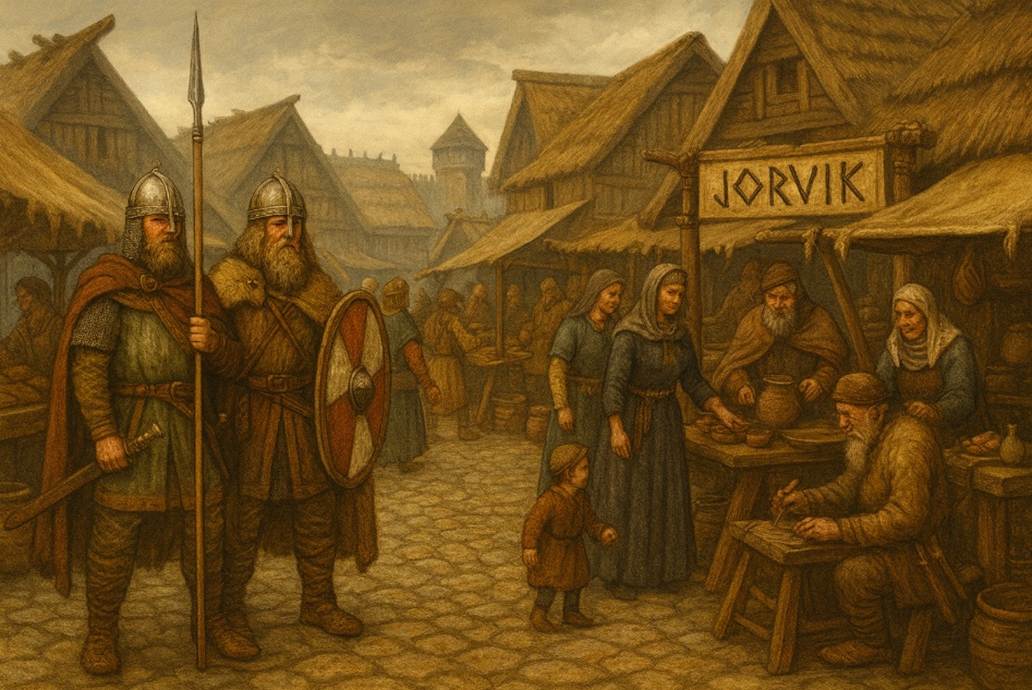
By about 900 CE there was
a grid pattern of long narrow plots in Jorvik and archaeology at Coppergate revealed a major commercial and craftworking
centre between the Rivers Ouse and Foss. Workshops produced leather goods,
wooden houseful vessels, textiles and grave slabs. Honestones
(for sharpening) were imported from Scandinavia, pottery and wine from the
Rhineland and silk from the Middle East. In the early decades of the tenth
century a mint was producing coins for the Anglo-Saxon King Æthelstan.
|
The Scandinavian centre of
northern England |
|
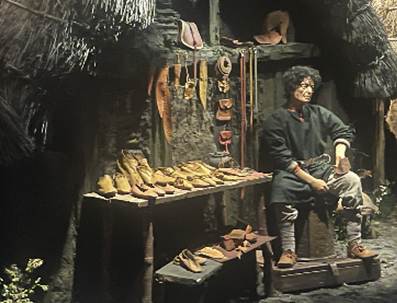
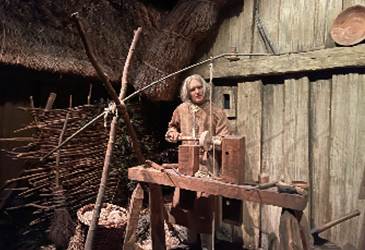
A
reconstructed journey into Scandinavian Yorkshire and a glimpse of
Scandinavian objects which tells its story |
For the
lands around Kirkdale
the evidence of the early Scandinavian period is slim. Whilst the
ancestral inhabitants there might have witnessed unrest, disruption and
violence, Kirkdale was
off centre to the known locations of Danish upheaval[21]. In fact Kirkdale might have found
itself with more responsibility over an increasingly dispersed population. By
the time the Scandinavian government was more firmly established at Jorvik, Kirkdale might have become
directly associated with the city, and by the later Scandinavian period, the
local elite had acquired property in York.
It therefore
seems likely that the home of distant ancestors of modern Farndale family was a
place of general stability, and likely political influence for most of the
thousand years from the Roman period to the Norman. This stability probably
continued through the Scandinavian period, perhaps with some violent and
unstable interludes.
Scene
2 – England Born
Æthelstan’s conquest of York and
unification of the English nation
Edward
the Elder of Wessex embarked on a month long raid into northern territory in
909 CE. The raiders took Oswald’s bones from Bardney Abbey in the Kingdom of
Lindsey and buried them in the new St Oswald’s Priory in Gloucester.
Edward the Elder died in his early
fifties, leading to another succession crisis in the south. Edward the Elder
had a lot of children from three wives. His eldest was Æthelstan,
but his mother had died, or been discarded. The Mercians supported Æthelstan who seems to have been reared there, but many
powerful nobles of Wessex preferred Ælfweard, eldest
son of Edward’s second wife, reared in Wessex. At this point Ælfweard mysteriously died. It seems that an agreement was
then reached with Edward’s third wife, Eadgifu, which may have been an
agreement to Æthelstan’s crowning, conditional upon
his recognition of Eadgifu’s son as his heirs and a promise not to bear
children. Indeed Æthelstan neither married, nor bore
children.
|
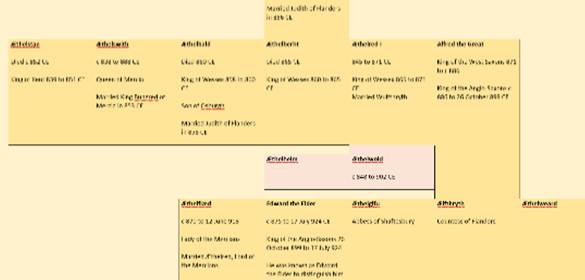
The Genealogy of
the House Wessex
The family tree of the Kings of Wessex, the
Anglo-Saxons, and the English |
|
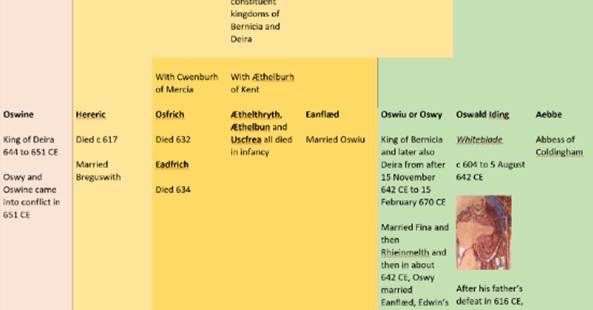
Family
tree of the Kings of Northumbria
The family tree
showing the succession of the Kings and Earls of Deira, Bernicia Northumbria |
Æthelstan was the most pious king, and
became very wealthy[22]. He became king of the Anglo Saxons
in 924 CE on the death of Edward the Elder. The Deeds of the Kings of the
English by William, a monk of Malmesbury[23], records details of his life. William
suggested that he had been specially selected by Alfred in his childhood, as
Alfred had been by Æthelwulf, but this may be a later gloss. Æthelstan was finally crowned on 4 September 925 CE at the
royal estate of Kingston on the Thames, on the border between Wessex and
Mercia. For the first time the new king had a crown, rather than, as
previously, a helmet, placed on his head, adopting an ancient Roman style which
had recently revived amongst the emperors in Europe.
Although the annals
indicated that Sitric Cáech,
the Northumbrian king, was reluctant to submit to Edward, he finally submitted
to Æthelstan at Tamworth in January 926. Part of the
agreement was that Sitric should marry Æthelstan's
sister Eadgyth and that he should be baptised. He seems to have repudiated
Christianity and rejected his bride shortly afterwards.
After the death of Sitric, Æthelstan, whose sister
was Sitric’s widow, seized the opportunity to invade
Scandinavian York. He thereby united the Kingdoms of Mercia, Wessex and
Northumbria. This was probably a military invasion by Æthelstan
who marched north and destroyed the Scandinavian stronghold at York.
Although this was but one
of many times that York had been sacked and may not have been regarded as a
significant divergence from the instability that had beset York since the
Scandinavian arrival in 866 CE, this was
in fact a momentous event in the history of the northeast. It was the first
point at which the northeast had come under the direct control of the southern
parts of these Isles, and within a year it would result the foundation of a new
English nation. Whilst the region would not yet shed its Scandinavian
influence, Northumbria began to steer a course away from eastern interest and
towards union with the south.
There followed an
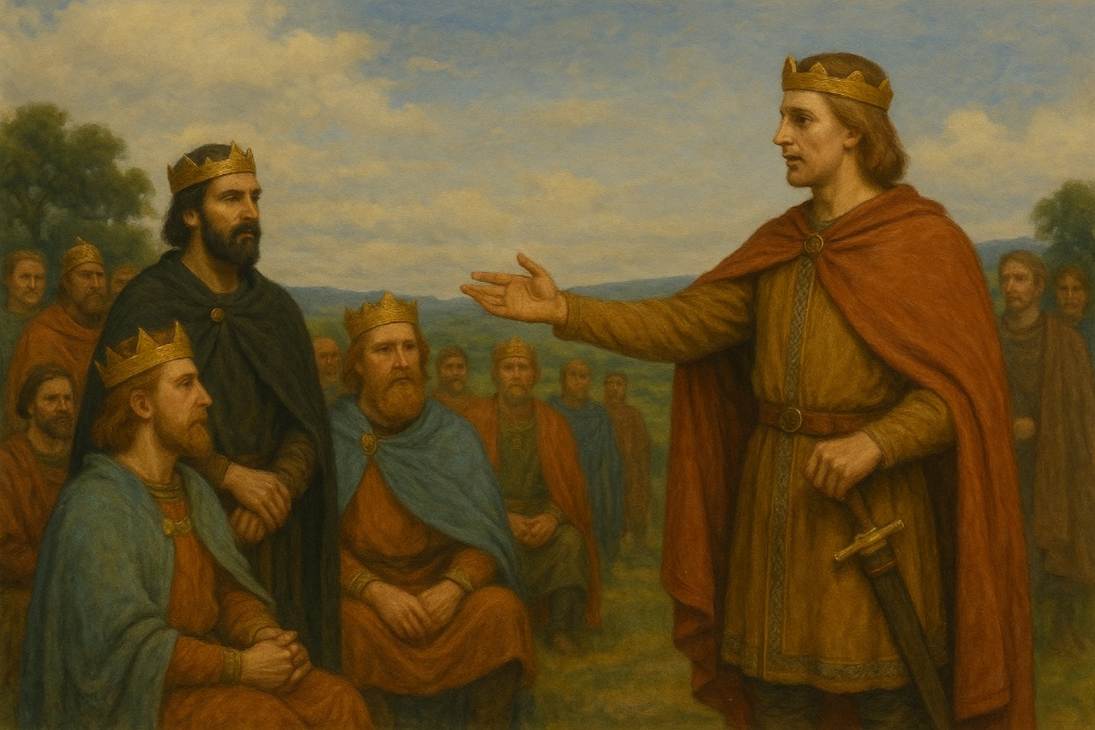
important meeting at Eamont Bridge near Penrith, near the ancient earthworks
known as King Arthur’s round table and Mayburgh
Henge, between the rivers Lowther and Eamont, where roads converged from all
directions. The Anglo
Saxon Chronicle records that kings from across
Britain converged here on 27 July 927 CE[24] at a meeting which is
generally taken to be the founding of the Kingdom of England. The year is
beginning to be recognised as being of similar or greater significance to 1066[25].
Æthelstan met with Constantine,
King of the Scots; the king of the Britons of Strahclyde;
and Ealdred of Bamburgh. Æthelstan had a military
force behind him to impose his will. Æthelstan was King of the Anglo-Saxons from 924 to 927 CE.
After 927 CE he came to be more commonly referred to as Rex Anglorum,
sometimes upgraded to ruler of the whole world of Britain This new title
reflected Æthelstan’s conquest of the Scandinavian
Kingdom of York, previously part of the Northumbrian Kingdom. He established
direct rule over York.
Æthelstan is widely considered one
of the most successful Anglo-Saxon kings for his efforts to consolidate the
English kingdom and the prosperity his reign brought. He brought legal and
economic reform, but there were frequent clashes with the Scots and the Scandinavian
lands.
After the meeting at Eamont
Bridge, Æthelstan demanded subservience from the
rulers in Wales at Hereford, and then the Britons of the southwest, the Corn-Welsh.
As fiery lights were seen in the northern skies, Æthelstan
had brought under his rule all the kings who were in this island.
His achievements came
partly from his success as a warrior, probably honed when fighting alongside
his father, Edward the Elder. He also had the advantages of his wealth which he
had inherited from his Wessex predecessors, and his conquests added further
wealth. The rulers in East Anglia and the east Midlands must have paid heavy
tributes. He found York to be full of plunder. The Welsh were forced to
provide a hefty tribute. He likely extracted similar tributes from the Corn-Welsh,
the Scots and the Britons of Strathclyde.
Whilst he maintained
control over his homelands of Wessex and Mercia by itineration, or regular
journeys through his realm, he adopted a new approach to governing the new
territories further away. He called on the rulers of those lands to attend him
at increasingly large royal assemblies. The charters increasingly comprised
long lists of names of former rulers now reduced to subreguli, or
sub-kings. Some were so large that they must have been held in the open air.
They were also a means of demonstrating Æthelstan’s
majesty to his newly enlarged realm.
However Constantine of Scotland and Owain of Strathclyde, did
not make the journey to these assemblies, after the meeting of 927 CE.
In 934 Æthelstan
travelled to York and gave to the Northumbrians a large area of land in modern
Cumbria, possibly a bribe for their continued loyalty.
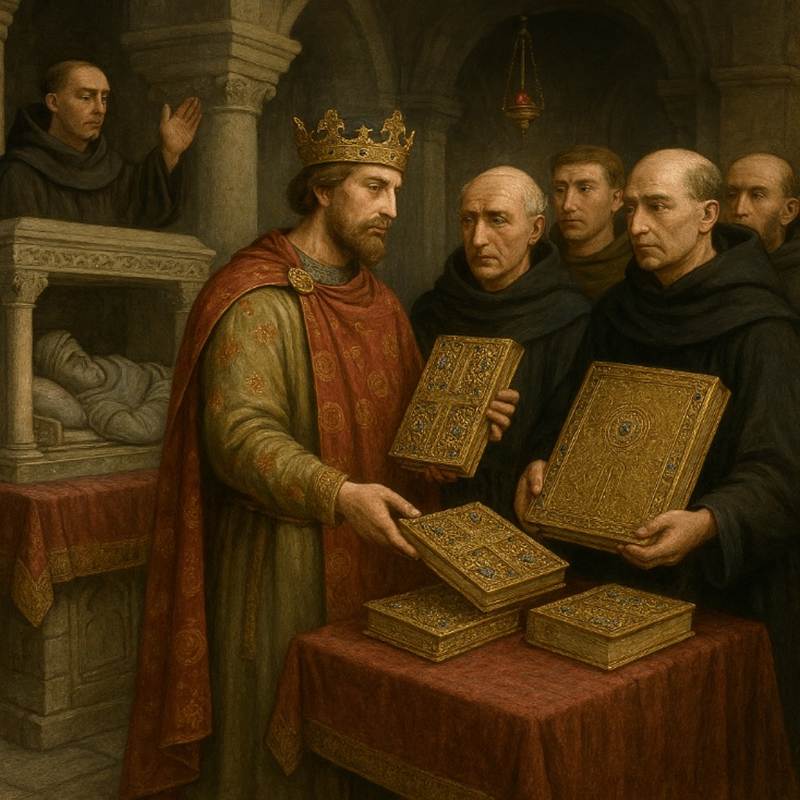
Æthelstan later
marched to Scotland with an army of soldiers from Wessex and Mercia, some Danes
from the east and Britons from the west. On his way, he made a pilgrimage to
the shrine of St Cuthbert in Chester le Street. He encouraged the cult of
Cuthbert as a unifying policy. He made generous gifts to the monks including a
royal headdress woven in gold and several texts including three ornate gospels
and a Life of St Cuthbert. He also gave them lands on the south of the
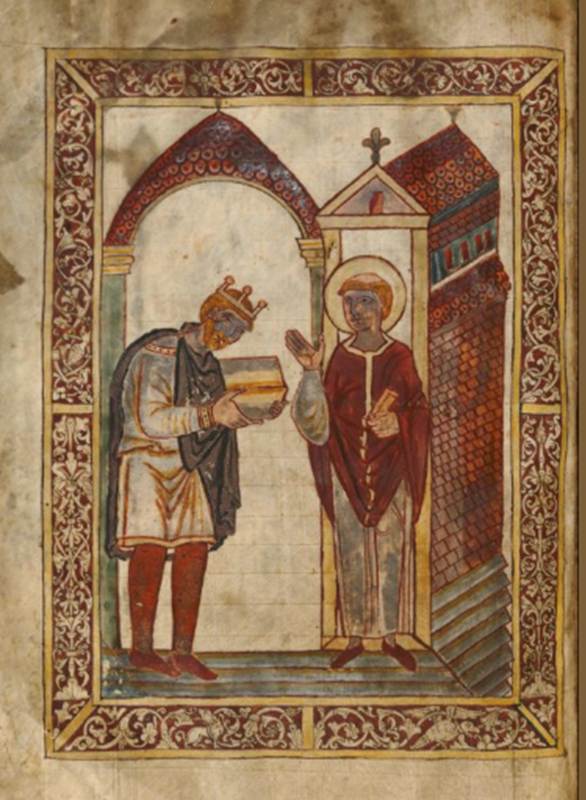
Wear. Some of the items, including embroidery and the Life of St Cuthbert
survived, and the latter, held by Corpus Christie College, Cambridge, contains a picture of Æthelstan
presenting the book, the earliest image of an English king in a manuscript.
Frustrated
by the non-compliance by Constantine of Scotland and Owain of Strathclyde, Æthelstan continued into Scotland to lay waste
to their lands as far as Dunnottar and Caithness. By August 934 CE Constantine
was unable to resist, and taken back all the way to the burh at
Buckingham, he submitted as subregulus. In 935 CE there was a fresh
royal assembly attended by the sub-kings including Constantine.
It
was at about this time that the Welsh poem Armes Prydein
Vawr, the Great Prophecy of Britain
prophesied the unification of Celtic peoples, the Irish, and the Scandinavians
of Dublin to drive the Anglo-Saxons out of Britain[26].
Led by legendary figures like Cynan and Cadwaladr, the prophecy was a rallying
cry against Anglo-Saxon dominance and expressed frustration with policies that
sought peace with the ascendant English kingdom of Wessex.
In summer 937 CE, the new
king in Ireland, Olaf Guthfrithson, the son of Guthfrith
who had failed to seize York in 927 CE, sailed to join a coalition anticipated
in the Great Prophesy. He was joined by Constantine of Scotland and
Owain of Strathclyde and they despoiled everything with continuous ravages
driving out the people, setting fire to fields[27]. Æthelstan
raised an army and met them at Brunanburh,
probably Bromborough on the Wirral peninsula. The battle was violent, a great,
lamentable and horrible battle. Thousands of the invaders were killed. In
the great war of 937 CE, Æthelstan
routed the
coalition. Æthelstan
was recognised
again as king throughout England. The rebels made a shameful retreat. The
chronicler Æthelweard
wrote that the fields of Britain were consolidated into one, there was peace
everywhere, and an abundance of all things. However the peace would not
survive the king’s death two years later.
Æthelstan died on 27 October 939 CE at
Gloucester, aged about 45. His body was taken to Malmesbury Abbey. Æthelstan’s half brother,
Eadgifu’s son, Edmund succeeded to the whole English Kingdom, the first to do
so, but his inheritance was uncertain.
The final submission of Northumbria
When Æthelstan
died in 939 CE, the Scandinavian leader Olaf Guthfrithson arrived from Dublin
and took over Northumbria with minimal opposition. Coins minted at York during
his reign show the Raven motif. In 940 CE, his cousin Olaf Cuaran, the son of Sitric, joined him in York to reclaim his father’s throne. The
Northumbrians were false to their pledge, and chose Olaf from Ireland as their king[28].
Edmund negotiated with Wulfstan,
Archbishop of York, a native Northumbrian, leading the negotiation for Olaf. The
peace they concluded was devastating to the claim of those southern kings to be
rulers of all the English. It was decided that the border between Edmund and
Olaf should be the line of Watling Street, just as it had been in the days of
Alfred and Guthrum. In a matter of months the conquests of Æthelstan,
Edward and Æthelflæd had been undone.[29]
However in
944 CE Edmund invaded Northumbria, to recover the losses of the previous year.
He expelled the Scandinavian leaders from Northumbria. Eadred was the
half-brother of Æthelstan and full brother of Edmund,
all of whom were sons of King Edward the Elder. Eadred inherited Northumbria,
and succeeded Edward as King of the English in 946 CE. However, like Edmund, he
lost Northumbria soon afterwards. Shortly after his
coronation Eadred met Archbishop Wulfstan and other Northumbrian leaders on the
southern border of Northumbria at Tanshelf
(Pontefract) and called on them to swear oaths of obedience to him. Almost
immediately afterwards however, the leaders broke their oath and accepted the
Scandinavian Eric as their king.
Eadred ravaged Northumbria
in 948 CE, burning St Wilfred’s minster at Ripon and taking his bones to
Canterbury, and the Northumbrians agreed to the reinstatement of English rule.
However the tribute he imposed, and the settlement, didn’t last.
Scandinavian domination came to an end when
Eadred's forces killed Eric, the last Scandinavian king of Northumbria, at the
Battle of Stainmore in 954 CE[30]. The whole area was then
governed by earls, from the local nobility, who were appointed by the kings of
England. Eadred had finally achieved the submission of
the Scandinavians in York. When Eadred finally regained control, he appointed Oswulf earl of the whole of Northumbria.
Unready
Two decades later, there was a coup in the southern
Kingdom in 978 CE when Eadred’s grand nephew, Edward
the Martyr was killed under suspicious
circumstances. His twelve year old step brother, Æthelred, succeeded him to the English crown,
with his mother Ælfthryth; the priest, Æthelwold; and the Mercian ealderman,
Ælfhere acting
as his regents. Æthelred
was given a bad reputation after his death, from ominous portents of his
failings from the time of his baptism. The Unready was a
misinterpretation of his nickname, the unraed,
meaning badly advised, a pun on his name Æthelred, which meant noble counsel.
His reputation arose because Scandinavian raids returned during his reign, and
he failed to deal with them with the same efficiency as his ancestor, Alfred.
Yet he ruled for 38 years, one of the longest of the Anglo Saxon period.
A burgeoning new society
This was a time when the word Englalond
was starting to be used to define the burgeoning nation. The coinage referred
to Anglia, but a writer of various works, Ælfric of Eynsham[31],
started to refer to Engla-lande.
Generally society was divided into those who fought, those who
prayed and those who worked the land. However a new group of ceorls,
small scale gentry farmers, emerged as estates divided and this is associated
with the creation of new parishes and parish churches.[32] As time passed, society had become ever more
hierarchical[33].
The
thegns, originally a term for slave, were the new elite class of
Anglo-Saxon royal households. They were brought up in the royal household, and
dined with the king. In time they were rewarded with land, and governed local
districts whilst continuing to spend a third of their time in the King’s
service. This began a process that in time led to organisation by manors.
Everyone was expected to attend manorial courts, presided over by the
landowner, where the business of the locality was determined including the
organisation of the Open Field system.
The
cnichts, or knights were a new rank below the
thegns that grew in importance over time. The lowest form of freeman, the ceorl,
pronounced carl, was the head of a free peasant household. These social
divisions varied between the different kingdoms of later Saxon England, but ceorls
too were liable for military service. Although in the country at large things
may have been relatively settled, these were still turbulent and often violent
times.
Those
at the bottom, whose labour ultimately supported the entire system, were the villeins,
tenants in a state of serfdom. By the tenth century these were the new class of gebur who
intensively worked the estates of large landowners. They were required to work
for their overlord for several days a week and supply renders of food. They
were an Anglo-Saxon form of serf, operating as part of a pre-Norman system of
feudalism. They were tied to the land and their lord. Their social status was
higher than a slave but lower than a fully free peasant. They generally held an
allotment of land, typically around 30 acres, known as a yard-land. The
lord provided him with the land, tools, and livestock. This property reverted
to the lord upon the gebur's death. In exchange for his tenancy, the gebur
owed a combination of labour services and rent in cash or kind to his lord. For
example, he might be required to work on his lord's land for a set number of
days each week and pay additional rents in goods like barley or hens. Unlike a fully free
peasant, a gebur could not leave the lord's estate. The lord's control
extended to regulating much of his life. They were tied to
their landlord and owed a lifetime’s obligation of labour. In return they had
rights to work land in the open field systems for their own use. They were the
largest group in society. The villeins provided labour for their landlords’
wholly owned farms or demesnes. This provided the landlords with their
main source of income.
There
were also slaves who had no rights at all. Some were able to buy their way out
of slavery or with permission, join the church. If they escaped and managed to
live in a new place for more than a year and a day, they might gain their
freedom. Slaves were an integral
part of Anglo-Saxon society and may have accounted for as much as 30% of the
population. They could be punished with branding and castration. Ælfric of Eynsham[34] provided a rare depiction
of an enslaved person's experience through his Colloquy[35], a Latin textbook
designed to teach students through dialogues about different professions. It
included a dialogue with an enslaved ploughman who described his difficult
daily life. This passage provides a unique, empathetic glimpse into the
conditions of slavery. The enslaved ploughman is given a voice to describe his
plight, saying Hig! Hig!
micel gedeorf ys hyt. Geleof,
micel gedeorf hit ys, forþam ic
neom freoh, Old English
for Oh! Oh! The labour is great. Yes, the labour is great, because I am not
free. He details a life of relentless, back-breaking work from daybreak to
nightfall, driven by the fear of his master. There is not a winter so harsh
that I dare lurk at home for fear of my master.
Warrior
armies during this period were not formed entirely from freemen, but also from
ealdormen and thegns and their own followers. They were probably often
mounted, including in battle. They carried out offensive warfare into the lands
of their enemies, pillaging and burning, for the opportunities for plunder.
From
the mid tenth centuries the fortified burhs of Alfred in the south began
to become commercial centres. In Winchester, the names of Flesher Street and
Tanner Street started to appear. Jorvik had seen this process of
commercialisation earlier in the tenth century. Suburbs were created outside
the towns to accommodate noisier industries and regular markets were held.
The West
Saxon unit of administration, the shire, was introduced northwards, to
Lincolnshire, Staffordshire, Nottinghamshire and Northamptonshire. Legal
administration came to be administered by local courts answerable to the king,
assembling every 4 weeks, and organised into hundreds, based on areas of
one hundred hides.
However this
religious and lay reform of the southern kingdoms which stretched into the
former Danelaw, never reached the lands of the Five Boroughs nor into
Northumberland. The hundreds were known as wapentakes in Northumbria and
the Five Boroughs, from a Scandinavian word vapnatak
referring to the practising of brandishing weapons as a sign of accord. Edgar
(King of the English 959 to 975 CE) showed discretion in his impositions in the
north. It is my will that such good laws be in force among the Danes as they
best prefer. However he strove for the uniformity of criminal law, wishing
measures to deal with thieves to be common to all the nation, whether
Englishmen, Danes or Britons. Wapentakes and hundreds were
used to organise populations through courts for administration and enforcement
of justice.
Changing
rural landscape
The
rural landscape was also changing. In Mercia and Wessex this started to occur by
the ninth century, but in Kent and East Anglia, it sometimes did not occur
until the eleventh century or later. It was driven by peaceful conditions which
started to be felt in Northumbria after 954 CE with the expulsion of the
Scandinavian kings. It was also driven by a growing population.
From
about the 980s CE, the estate overlords were splitting up their estates and
granting smaller ones to their dependants, so that smaller lordships emerged.
This resulted in farmers moving closer together forming communities that were
the early villages. This resulted in greater cooperation, with the purchase of
communal plough beats and the overlords provided them with new technology such
as watermills to save the daily grind by hand in return for payment. These new
villages were often named after their creator.
More
prosperous landowners started to build long ranges, divided internally into
halls, and some even with a second floor. Private churches also started to
appear.
There
were opportunities for the elite class to reorder the landscape. The focus of
agriculture in more difficult times was on pigs, sheep and cattle, with the
more arduous task of growing crops being more restricted. With the growth of
villages, common land was converted for arable use, in time leading to the open
field system of the later medieval period.[36]
The roots of the open
field system lay in the Late Saxon Period when earlier settlements, which were
dispersed and surrounded by their own fields, were replaced with larger
centralised villages with open field systems. This was a parish based system of
arable farming, involving two or three large open fields which were subdivided
into small strips of about half an acre each. Groups of these strips were
referred to as furlongs. The arable land of the open fields was
managed by common agreement among the tenants, each of whom would have
possession of several strips and furlongs scattered through the open fields.
Disputes were settled at the manorial court, where the tenants also met to
decide which furlongs were to remain farrow and where animals could be grazed.
It was realised that grazing, manuring and leaving land fallow were important
if the arable land was to be rested to regain its fertility and minimise plant
diseases. Animals were also grazed in the woods and on open pasture, often on
heavier clay land around the fringes of the parish. The arable land was closest
to the village, and was usually the best drained, lightest and most fertile
ground. The big drawback to the system was the fact that individual holdings
were so widely dispersed, but as time passed there was a tendency to
rationalise them into groups of furlongs. In practice the system varied
from place to place.[37]
Scene 3 – World’s End
Once you have paid him the Danegeld, You never
get rid of the Dane
A
much larger army arrived from Scandinavia, comprising 93 ships under the
command of Olaf Tryggvason, a future King of Norway. They landed at Folkestone
and met the English army, led by Ealderman Byrhtnoth
at Maldon in Essex on 11 August 991 CE. The English army was defeated,
shattering the period of successful English resistance since the days of
Alfred.
Æthelred responded by paying a tribute
of £10,000 to cease their attacks. He was not the first to buy off the Danes,
and even Alfred did so in his early years. However, combined with the disgust
at Æthelred’s failure to fight against his enemies in person, his reputation
took a dive.
Dane-geld is a poem by Rudyard Kipling (1865 to
1936) which laments the foolishness of paying Danegeld. The most famous lament
is that once you have paid him the Danegeld, You
never get rid of the Dane.
The poem ends, It is wrong to put temptation
in the path of any nation, For fear they should succumb and go astray; So when
you are requested to pay up or be molested, You will find it better policy to
say: "We never pay any-one Dane-geld, No matter how trifling the cost; For
the end of that game is oppression and shame, And the nation that pays it is
lost![38]
The
approach of the end of the world
The Book of
Revelation foretold that Satan would be unbound 1,000 years after Christ’s
birth[39]. This was a period of apocalyptic
writing and the renewed Scandinavian attacks made these fears feel more
immediate.
Waltheof was Earl of
Northumbria from c 994 CE to 1006. Waltheof was high-reeve or ealdorman of
Bamburgh. He was father of Uhtred the Bold, Ealdorman of Northumbria. The name
Waltheof remained in his family when Earl
Siward married his great-granddaughter and named his son Waltheof.
The Lindisfarne monks
moved from Chester-le-Street to Durham in 995 CE[40], after a stop in Ripon,
taking the bones of Cuthbert with them. There is a legend that the cart
carrying Cuthbert’s coffin suddenly stopped and couldn’t be moved. A cowgirl
asked after her lost dun, or brown, cow and was told it had been seen in
the direction of Dunholme. The monks followed the
cowgirl, and found that the cart with the coffin moved again. The protective
peninsula of Durham was an ideal defensive location for the monks.
Wulfstan
was Bishop of London from 996 and became archbishop of York in 1002. He had
made a name for himself with apocalyptic sermons at the turn of the first
millennium.
In the south, Æthelred was told that the Danish men in his
territory would faithlessly take his life, and then all his councillors, and
possess his kingdom afterwards. He made a defensive pact with Duke
Richard II of Normandy by agreeing to marry his sister, Emma, as his Queen. He then ordered the deaths of all
Danes living in England. It seems unlikely that this included all Danes, since
the former Danelaw lands of Northumbria and East Anglia would have been wiped
out, but he likely ordered the killing of the remaining members of a disloyal
mercenary force. The orders were carried out on 13 November 1002, later known
as the St Brice's Day massacre.
This provoked the King of Denmark,
Sweyn Forkbeard, to invade England in 1003. Sweyn was King of the Danes since
the death of his father Harold Bluetooth in 986 CE. He was a veteran raider,
likely including attacks along the east coast of England. He had recently
defeated Olaf Tryggvason of Norway and annexed part of that kingdom. Sweyn
landed in Devon in 1003 and destroyed the burh at Exeter. He then
attacked Wiltshire and the burh at Wilton. He attacked East Anglia in 1004,
including Norwich and Thetford. Æthelred still failed to confront the Danish
invader in person, even though Sveyn was a rival king
ravaging through his lands.
|
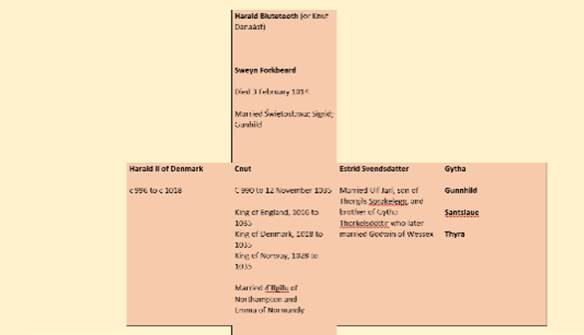
The Genealogy of
Sweyn Forkbeard and Cnut
The family tree showing the relationship of Sweyn
Forkbeard and Cnut to the Godwinsons and Edward the
Confessor |
After two years of campaigning, Sweyn
returned to Denmark. At this stage his attacks were a retribution for the
massacres of 1002, and not yet a threat to the leadership of the kingdom.
1005 was a year of severe famine, micla hungor, the Great
Hunger. Crop failure and starvation seemed to be further evidence of divine
displeasure at the turn of the first Millennium. Æthelred’s response to these
disasters was a fresh purge on his court. New advisers started to dominate the
government including Wulfstan, Archbishop of York and the layman Eadric whose
meteoric rise to power earned him the title streona,
the Grabber.
In 1006 Malcolm II of
Scotland invaded Northumbria and besieged the episcopal city of Durham. The
Danes were raiding southern England and King Æthelred was unable to send help
to the Northumbrians. Ealdorman Waltheof was too old to fight and remained in his
castle at Bamburgh. Ealdorman Ælfhelm of York also
took no action. Waltheof's son Uhtred, acting for his father, called together
an army from Bernicia and Yorkshire and led it against the Scots. The result
was a decisive victory for Uhtred. Local women washed the severed heads of the
Scots, receiving a payment of a cow for each, and the heads were fixed on
stakes to Durham's walls. Uhtred was rewarded by Æthelred II to become the
ealdorman of Bamburgh, even though his father was still alive.
The Sermo
Lupi ad Anglos,
The Sermon of the Wolf to the English, was a homily composed between 1010 and
1016 by Wulfstan, Archbishop of York, who styled himself Lupus, or wolf.
Wulfstan reminded his listeners of the imminent end of the world, about which
all remained certain, only reconsidering that their calculation of when the
millennium might fall may have been in error[41]. He preached that these dire times
had been brought on by the invasion of the Scandinavians, yet we repay those
who insult us. We pay them continually, and they humiliate us daily.
|
The Sermon of the Wolf to the English |

A Danish
World again
Another large Danish army arrived, led
by their king, Sweyn Forkbeard in 1012. Whilst Sweyn’s 1003 attacks had been
for revenge after the massacres of 1002, this fresh attack was an invasion for
control of England. He was probably encouraged by dissention against Æthelred’s
leadership and a willingness of many to look favourably upon regime change as
an alternative to incompetence and poor government.
Sweyn landed at Gainsborough in
Lincolnshire, in the old Danelaw lands. He may simply have felt better able to
rally his army across the northern Scandinavian rooted territory, but it has
been speculated that he had already made a pact with the northern lands to
support his mission. This theory is supported by the marriage upon his arrival
of Sweyn’s son Cnut to Ælfgifu of Northampton, the
daughter of Ælfhelm, an ealderman of Northumbria who
had been murdered by Eadric the Grabber in 1005. Indeed the Northumbrians and
folk in Lincolnshire and the Five Boroughs immediately submitted to Sweyn when
he arrived.
Sweyn then launched his assault on the
south across the old dividing line of Watling Street and did the greatest
damage that any army could do. There was little resistance. By the end of
the year Queen Emma of Normandy and her sons fled to her homeland, and Æthelred
soon followed them there into exile.
Sweyn was installed as
king of England on Christmas day 1013. Sweyn only reigned for five weeks before
he died on 3 February 1014. His body was taken for burial at York. The Danish
army, camped at Gainsborough, immediately declared their allegiance to Sweyn’s
son, Cnut. However Sweyn’s death caused the English magnates, who had supported
Sweyn, attending Sweyn’s funeral in York, to reconsider. Whilst Wulfstan,
Archbishop of York, seems to have accepted Sweyn’s installation as king,
notwithstanding his Sermon of the Wolf, he swiftly changed his views
when Sweyn died. He urged the doubting English magnates that it was all their
own fault and that the solution was the reinstallation of Æthelred. The English
magnates sent messages to Normandy, seeking assurances against revenge for
their treachery and for a new improved style of leadership.
Æthelred made some half hearted attempts to
appease his magnates as re regained the crown. However tensions soon resurfaced
and played out in the death of his eldest son, Æthelstan
Ætheling, who seems to have been aligned with his father’s enemies. In the
atmosphere of renewed chaos in the English court, Cnut returned to land at
Sandwich in 1015, then sailing to Dorset and into Wessex. Æthelred’s second son
Edmund struggled to rally the English defence.
Æthelred was in many ways
remarkably similar to King John, and this was his Magna Carta moment. The
notorious Plantagenet king who ruled two centuries later was criticised by his
contemporaries for his cowardice and cruelty, his over reliance on sheriffs and
foreign mercenaries, and his harsh financial exactions that included exorbitant
death duties, the forcible seizure of goods, and punitive levels of taxation.
John’s subjects had rebelled against him and plotted his removal, but then been
persuaded to give him a second chance in return for a long and detailed promise
to rule better, the celebrated Great Charter of 1215. The evidence suggests
that Æthelred’s subjects did the same in 1014, presenting him with a raft of
grievances they wished to see redressed. With little room for manoeuvre the
exiled king agreed.[42]
In 1016 Cnut moved north and began to menace
York. Uhtred the Bold of Northumbria deserted with the Northumbrians to join
Cnut, but Uhtred was replaced with a Dane called Erik. Uhtred the Bold was
murdered, probably on Cnut's orders. His death by assassination was described
in De obsessione Dunelmi
and has been interpreted as the beginning of a blood feud. Cnut appointed his
most trusted followers as earls, and Erik of Hlathir
was appointed to the Earldom of Northumbria from 1016 to 1033.
Æthelred died on 23 April
1016. All these disasters befell us through unrædas, bad counsel.
Æthelred was succeeded by his son, Edmund. His stout defence of the realm
after his election as king caused him to be known as Edmund Ironside. He fought
four valiant battles with Cnut in spring and summer 1016. However Edmund and
his forces were decisively beaten by Cnut at the Battle of Assandun,
Ashingdon. There Cnut had the victory. After
the battle, Cnut made a treaty with Edmund whereby Edmund would be King of Wessex
and Cnut would rule the rest of England. Edmund ruled from 23 April to 30
November 1016 when he died, perhaps from wounds sustained at the Battle of
Ashington.
Cnut then became king of
all England from 1016 to 1035[43]. Cnut succeeded to all
the kingdom of England[44]. Cnut married the widow of
Æthelred, Emma of Normandy even though he already had a wife, Æfggifu of Northumbria who he had married in 1013. Emma
retained her royal status and appears to have been Cnut’s formal queen. Cnut
made an effort to mend the divisions of the reign of Æthelred. The surviving
evidence of his reign is generally praised for his leadership, but it is almost
certainly a one sided view. His conquest was brutally executed. He had Eadred
the Grabber and many of the old regime executed. He sent the sons of Edmund
Ironside, Edward and Edmund, into exile.
Administration of the
realm didn’t change dramatically, but the household army were referred to as housecarls
and ealdormen became earls. Cnut divided England into four
semi-independent earldoms using a system of governance based on the
Scandinavian system of the time. Northumbria was not well integrated into the
rest of the country. It had already been delegated to Eric during Cnut’s conquest.
East Anglia was given to Thorkell the Tall as a reward for his support. Mercia
was sub-divided between Scandinavian earls. Cnut held Wessex under his direct
control.
Encouraged
by Wulftsan of York, who had reconciled to support
the new reign, Cnut sent two important letters to the English people during his
reign, one around 1020[45]
and another around 1027[46],
both aiming to assure his subjects of good governance and his commitment to
English law and tradition. The first letter of 1020 promised adherence to the
law, protection from external danger, justice and good governance.
On
his death bed in 1023, Wulfstan returned to his apocalyptic mood of the
Sermon of the Wolf when he warned of those who despise God’s law,
murderers and killers of kinsmen, those who hate the church and priest killers,
violators of the holy orders, adulterers, prostitutes and murderers of children.
The Rise of the Godwins
A rare survivor of Cnut’s purge of
1017, was Godwin, who may have been the son the Sussex thegn, Wulfnoth. The story
of the Godwin family was recorded in a book commissioned by Edith of Wessex,
later recast as a history of Edward the Confessor, and so called the Life of
King Edward.
|
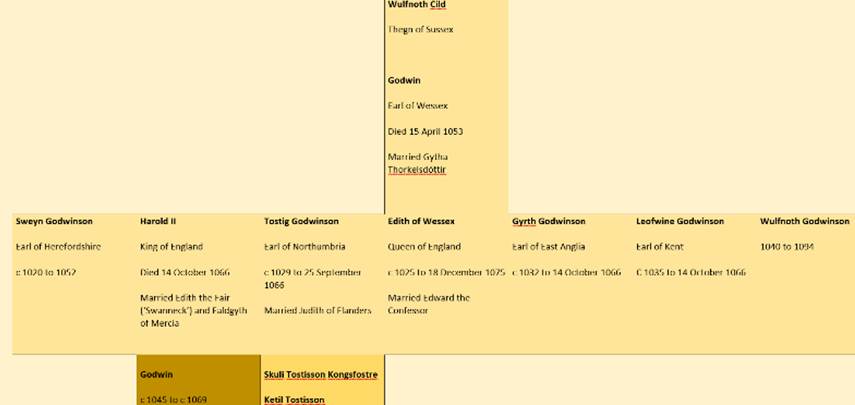
The family tree of
Earl Godwin and his sons |
After Cnut seized the throne in 1016,
Godwin's rise was rapid. By 1018 he was an earl, probably of eastern Wessex. He
accompanied Cnut to Denmark in 1019 to claim the Danish throne and appears to
have impressed Cnut with his courage and wisdom. Whilst in Denmark, Godwin
married Cnut’s sister in law, Gytha, the sister of the Danish earl, Ulf, who
was married to Cnut's sister, Estrid. By around 1020 he was earl of all Wessex.
Cnut came to rely increasingly on Godwin who became steward of almost all
the Kingdom[47].
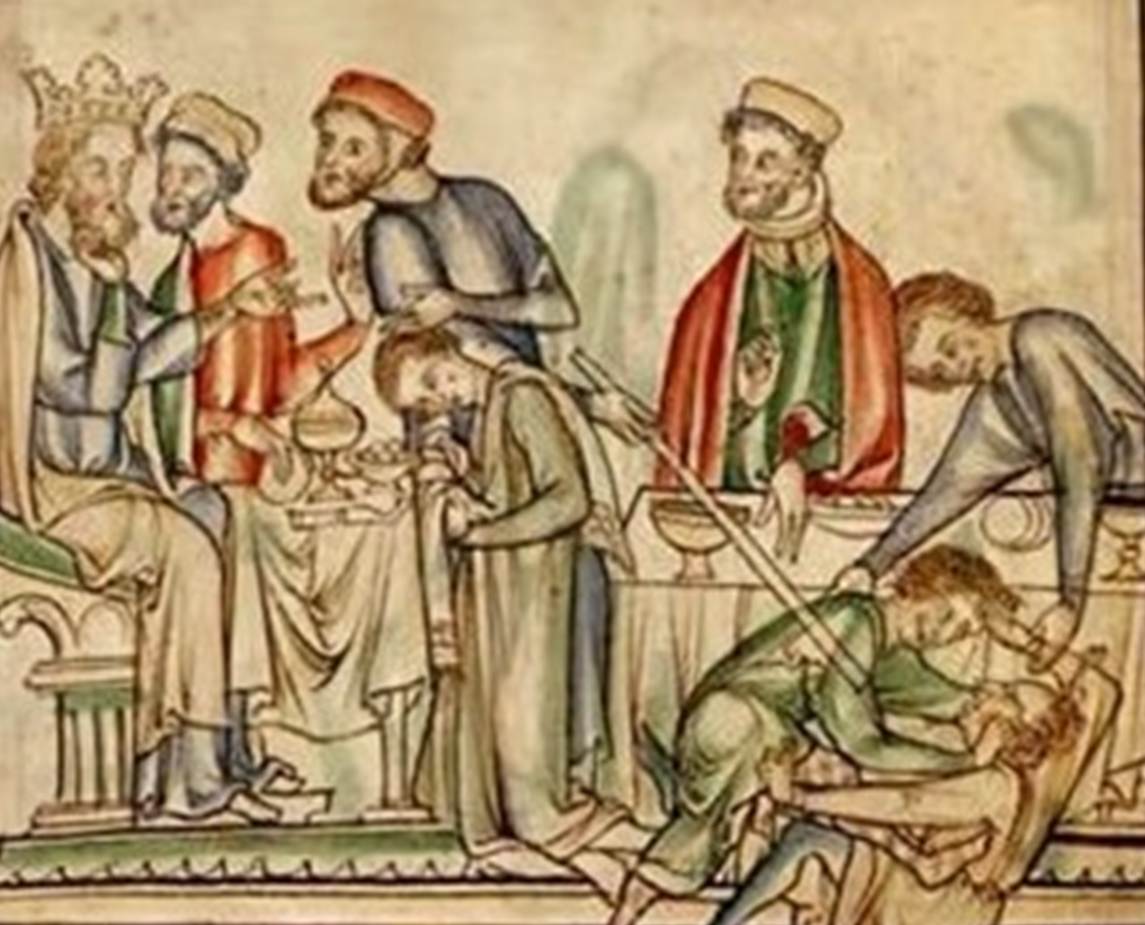
Godwin
and his sons
Siward became the last Scandinavian Earl of
Northumbria from 1033 to 1055 when he succeeded Erik in about 1033. He governed
for 22 years. Siward strengthened his position in northern England by marrying
Ælfflæd, the daughter of Ealdred, Earl of Bamburgh. After killing Ealdred's
successor Eadulf in 1041, Siward gained control of all Northumbria. He
supported Cnut's successors Harthacnut and Edward with military aid and
counsel, and probably gained control of the middle shires of Northampton and
Huntingdon by the 1050s. There is some evidence that he spread Northumbrian
control into Cumberland.
Cnut died from illness on
12 November 1035.
To understand the next seven
years, it is to be remembered that Cnut had two wives – Ælfgifu,
the daughter of an ealderman of Northumbria; and Emma
of Normandy, the widow of Æthelred. With Ælfgifu, he
had two sons, Svein Knutsson and Harold Harefoot. With Emma he had a son,
Harthacnut and a daughter, Gunhilda. By her previous marriage with Æthelred,
Emma had two sons, Edward and Alfred.
Cnut had sent Ælfgifu with her eldest son Swein
to Norway; and Emma with her son Harthacnut to Denmark and seems to have
anticipated a division of his realm. The realm of England fell once again into
a divided state on Cnut’s death. Earl Godwin and Wessex favoured Harthacnut as
Cnut’s successor to the English throne. The northern thegns led by Earl
Leofric, Swein having died in the interim, favoured Ælfgifu’s second son, Harold Harefoot. Harold had the
advantage of being in England.
Emma of Normandy fought a
counter-offensive against the momentum towards Harold Harefoot. At this point
Emma brought into play her two surviving sons by Æthelred, Edward and Alfred,
still exiled in Normandy. Edward and Alfred landed separately in England. A
mob, opposed to the return of the Æthelred’s sons, persuaded Edward to retreat
back to Normandy. Alfred landed in Dover, was met by Godwin who swore
allegiance to him, and escorted him to Guildford.
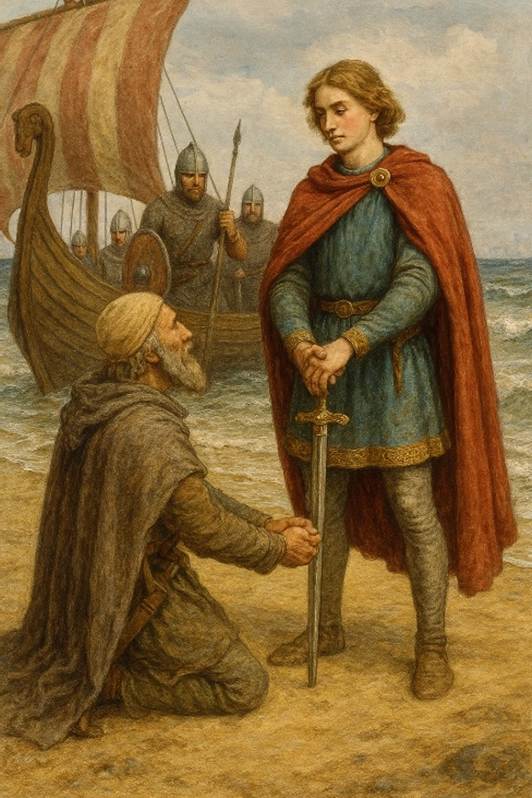
Godwin was playing a
dangerous game, since the basis of his success had been his support for the
Danish conquest. His motives for taking Alfred to Guildford were indeed
treacherous and Godwin’s men attacked Alfred who was blinded and left in the
care of the monks of Ely, to die shortly afterwards.
Harold Harefoot became
Harold I, but died on 17 March 1040, aged about 25. Urged on by his exiled
mother Emma from Normandy, Harthacnut was en
route to England in spring 1040 to seize the throne by violence, but found
that Harold’s death allowed him to take the throne by peaceful means. Godwin
was forced into a spin of manoeuvres for his part in the death of Alfred, but
managed to persuade the new regime that he had only been obeying orders.
Faced with growing
unpopularity, Harthacnut invited his half brother,
Edward, to return from exile and share in the rule of England. England had two
kings, born of the same mother. One was a son of one of the last Anglo-Saxon
king Æthelred. The other was the son of the Danish king Cnut. Emma’s Encomium
described this arrangement as a triumvirate akin to the Holy Trinity.
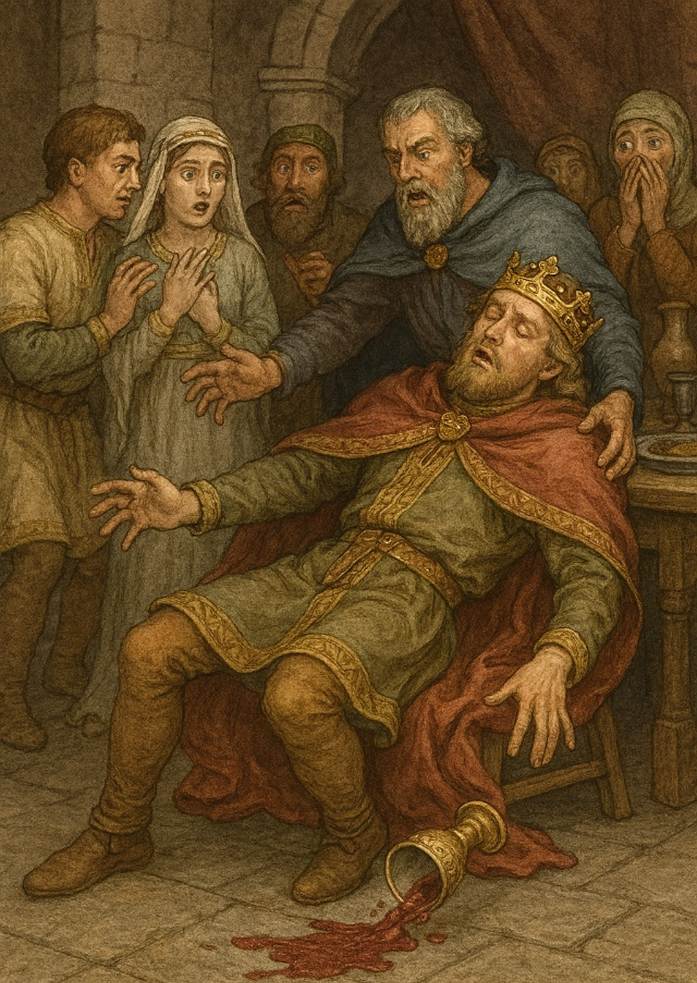
She claimed all was harmony, but that seems unlikely. On 8 June 1042 Harthacnut
was standing with a drink at a wedding when he suddenly collapsed to the floor.
Go Straight to Act 6 – Game of Thrones
or
|
This
is a new experiment. Using Google’s Notebook LM, listen to an AI powered
podcast summarising this page. This should only be treated as an
introduction, and the AI generation sometimes gets the nuance a bit wrong.
However it does provide an introduction to the themes of this page, which are
dealt with in more depth below. |
|