Culture and writing
The
evolution of culture, writing and literature
|
Return to the Home
Page of the Farndale Family Website |
The story of one
family’s journey through two thousand years of British History |
The 83 family lines
into which the family is divided. Meet the whole family and how the wider
family is related |
Members of the
historical family ordered by date of birth |
Links to other pages
with historical research and related material |
The story of the
Bakers of Highfields, the Chapmans, and other related families |
Headlines are in brown.
Dates are in red.
Hyperlinks to
other pages are in dark
blue.
References and
citations are in turquoise.
Context and local
history are in purple.
Geographical
context is in green.
731 CE
The Venerable
Bede (672 or 673 to 26 May 735) (“Saint Bede”) was an English
monk and an author and scholar who wrote the Ecclesiastical History of the
English People which he completed in about 731 CE. He was one of the greatest
teachers and writers during the Early Middle Ages, and is sometimes called
"The Father of English History". He
served at the monastery of St Peter and its companion monastery of St Paul at
Monkwearmouth and Jarrow in the Anglian Kingdom of Northumbria.
The Life of the Venerable Bede, on the state of
Britain in the seventh century, begins: In the seventh century of the
Christian era, seven Saxon kingdoms had for some time existed in Britain.
Northumbria or Northumberland, the largest of these, consisted of the two
districts Deira and Bernicia, which had recently been united by Oswald King of
Bernicia ... The place of his birth is said by Bede himself to have been in the
territory afterwards belonging to the twin monasteries of Saint Peter and Saint
Paul at Weremouth and Jarrow. The whole of this
district, lying along the coast near the mouths of the rivers Tyne and Weir,
was granted to Abbot Benedict by King Egfrid two years after the birth of the
Bede.... Britain, which some writers have called another world, because from
its lying at a distance it has been overlooked by most geographers, contained
in its remotest parts a place on the borders of Scotland, where Bede was born
and educated. The whole country was formed formerly studded with monasteries,
and beautiful cities founded therein by the Romans, but now, owing to the
devastations of the Danes and Normans, has nothing to allure the senses.
Through it runs the Were, a river of no mean width, and of tolerable rapidity.
It flows into the sea and receives ships, which are driven thither by the wind,
into its tranquil bosom. A certain Benedict built churches on its banks, and
founded there two monasteries, named after St Peter and St Paul, and united
together by the same rule and bond of brotherly love.
Bede gave
intellectual and religious significance to as burgeoning nation at Jarrow from
where many centuries later John
William Farndale was the youngest member of the Jarrow marchers. Bede first
defined an English identity. Bede produced the greatest volume and quantity of
writing in the western world of his time. At his monastery at Jarrow he had
access to a university library with more books than were in the libraries of
Oxford or Cambridge 700 years later. (Robert Tombs,
The English and their History, 2023, 24, 26).
750s
By the 750s, the
York school led by the golden age of Archbishop Ecgbert was renowned as a
centre of learning in the liberal arts, literature, and science, as well as in
religious matters. From here, Alcuin of York
drew inspiration for the school he would lead at the Frankish court.
1100
There was a
significant revival of writing and literature emerging by the early twelfth
century, possibly deriving from English traditions, but written in Latin and
French.
The first
significant historical writings since Bede started to appear.
1109
There were even
some works of a defiant tone, suggesting resistance by the indigenous
population. Hereward the Wake was written in Latin some time
after 1109 and told stories of Fenland uprisings.
1126
William of Malmesbury’s Gestia
Regem Anglorum narrated English history from the Saxons to Henry I. Henry I
started to tolerate a more even handed approach between the indigenous
Anglo-Saxon/Scandinavian population and the Normans.
1131
Henry of
Huntingdon’s Historia Anglorum comprised two medieval works on the
history of England.
These works gave
England a history and an element of pride and identity.
There is an In Our Time podcast on
Roger Bacon, the
medieval English scholar, an early pioneer of science who became known as
Doctor Mirabilis.
There is an In Our Time podcast on the Twelfth Century
Renaissance.
1136
Geoffrey of
Monmouth’s Histoira Regum Britanniae
was a mixture of historical account and epic legend, which perhaps reinforced a
sense of nationhood. It became more widely read than Bede’s works across
Europe.
1250
By about the mid
thirteenth century, a tangible English identify had emerged, albeit this was a
land of multiple identities. There were the gems of a national community, communitas
regni, emerging. Societies started to develop dense networks of communities
and associations.
One of the
earliest compositions of early music emerged with Sumer is icumen in, recorded in writing at Reading Abbey in
about 1250.
An idea had
crystalised into stories by the mid thirteenth century, about the outlaw Robehod. By the fifteenth century those compound
stories, with a stock character encountering various formulae of adventure, had
evolved into more formal tales
of Robin Hood, a forest outlaw. The first surviving written stories date to
about 1450 by which time there were large numbers of rymes,
some of which have survived.
1303
Robert Mannyng
(c. 1275 – c. 1338) was an English chronicler and Gilbertine monk from Malton. Mannyng provides a surprising amount of information about
himself in his two known works, Handlyng
Synne (1303) and Mannyng's Chronicle (1338).
In these two works, Mannyng tells of his residencies
at the Gilbertine houses of Sempringham (near Bourne)
and Sixhills, and also at the Gilbertine priory at
Cambridge, St Edmund’s.
1350
After the Black
Death, many craftsmen had died, and there was a temporary drop in the quality
of craftsmanship such as stained glass.
Composers of
music for the first time became known as individuals.
Language
Post Conquest
Britain was multilingual and the elite were trilingual, speaking Latin
(religion, scholarship and administration), French (culture and some legal use)
and English (for everyday use).
Old English was a
simple language, without grammatical sophistication. There was no common
spelling and distinct local usages.
In the 1320s,
English language history started to appear, particularly in the works of Robert
of Gloucester and Robert Manning.
By 1350,
patriotic fervour was instilled by the Hundred Years War with France and there
was a swift and dramatic switch to use English as the national language.
· 1362 – The Law Courts
started to use English
· 1363 – Parliament was
opened in English
· 1380s – Parliamentary
proceedings were recorded in English
· 1399 – Henry IV
accepted the crown with a speech in English
· 1415 – Henry V
rallied support for his war with the French in English
Between 1250 and
1450, 27,000 words emerged. A quarter were derived from French (Old English ful added to French words like beau) and many
from Latin and the language grew in its sophistication. There were nuances of
meaning.
The Robin Hood
stories were written down.
(Robert Tombs, The English and their History, 2023,
126-128).
1400
Geoffrey Chaucer
brought the English language into European culture. He was more influenced by
Dante and Petrarch, together with bawdy French tales, than English writing, yet
became the father of English poetry. His Canterbury tales (1387 to 1400) satirised
a wide cross section of contemporary life.
(Robert Tombs, The English and their History, 2023,
130).
The Canterbury
Tales is a collection of twenty-four stories that runs to over 17,000 lines
written in Middle English by Geoffrey Chaucer between 1387 and 1400. The tales
are mostly written in verse, although some are in prose. They are presented as
part of a story-telling contest by a group of pilgrims as they travel together
from London to Canterbury to visit the shrine of St Thomas Becket at Canterbury
Cathedral. The prize for this contest is a free meal at the Tabard Inn at
Southwark on their return.
There is an In Our Time podcast on
Margery Kempe (1373 to
1438) and English Mysticism, and English mystic who went to Jerusalem and
dictated her life story, said to be the first autobiography in English.
1516
Thomas More,
Henry VIII’s Chancellor, wrote the humanist parable, Utopia,
describing an imaginary pagan island governed by equality and justice.
1520s
Henry VIII
promoted a fashion for portraiture with his patronage of Hans Holbein.
Individual and family portraits became fashionable
1549
Language
Thomas Cranmer’s
Book of Common Prayer became the compulsory liturgy. It used single sentence
prayers and fresh styles of rhetoric. This would also become the focus of the
growth of the English language, and many phrases which came into common use
derived from it.
The Reformation
and the Counter Reformation:
· Led to the
destruction of significant artistic expression
· England began to
see herself as an Empire, under rulers with proclaimed rights from God
· However much
power was increasingly influenced by parliaments who adopted increasing
functions dubbed omnicompetence
· A national
consciousness emerged distinct from the rest of Europe which was centred on
Rome – religion became nationalised with its English bible and prayer book
Protestantism
focused on the interpretation of words rather than the enactment of rituals.
This was the catalyst to the English becoming increasingly tolerant as a
nation. England switched from a shame culture to a guilt culture, from
extroversion to introversion.
English had been
a scorned language, and in some ways it continued so:
· In 1605 the
Bodleian Library in Oxford had only 58 of its 2,000 books in English
· Latin and Greek
remained a bedrock with the elegant modernity of Italian and French
· English was seen
as a base speche
· Where English was
used, it tended to be used in a form to attempt a form of sophistication
through complexity and long words. This flamboyant use of the language was
parodied in Thomas Wilson’s The Arte of Rhetorique.
A new tradition
of a more readable vernacular English was embodied in the work of William
Tyndale, born in 1494, versed in Latin, Greek and Hebrew and trained in
Oxford, the Netherlands and Germany.
· He pioneered a
more easily read form of the language, of writing to be understood, and the use
of everyday words of proverbs
· He drew on French
and Latin to find new words in the English language, such as granddaughter
· His linguistic
naturalness was a challenge to the Church, and the likes of Thomas More saw the
dangers in an English language (which was forbidden to be read by labourers by
Henry VIII in the Act for the Advancement of True Religion)
When James I came
to the throne in 1603, new versions of the English Bible were authorised, which
became the King James Bible.
Tyndale, Cranmer
and the Authorised version of the Bible gave rise to a simple Protestant style.
Plain speaking became an English virtue.
A more
standardised form of English became familiar across the country. This
contrasted with France where worship remained in Latin.
It also
reinforced a sense of nationhood, where in England, this already existed, but
was strengthened into an imagined community of nationhood.
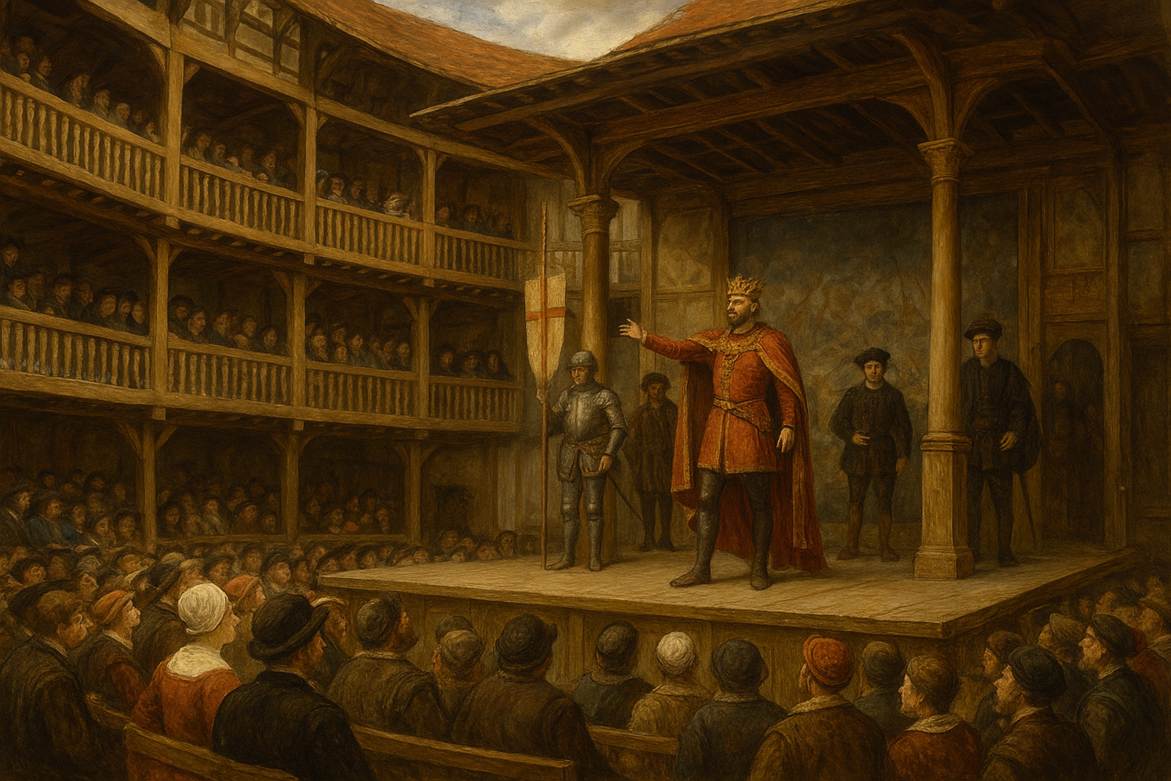
Concurrently with
these influences, came a growth in theatre. Professional theatre grew out of
religious plays which had become repressed from the 1530s. In the 1550s,
travelling players were patronised by noblemen and courtiers.
From the 1570s,
permanent theatres came to be built on the south side of the River Thames,
outside the ambit of the City authorities, including the Rose in 1587 and the Globe in 1599.
New plays were
written by the University Wits including Christopher
Marlowe, Thomas
Nashe and Thomas Kyd.
This was the
context for William Shakespeare, 1564 to 1616. Rather than dogmatic, he was
inspired by multiple cultural and religious influences, he did not respect
social and gender hierarchy and women played an important role in his plays. He
was an innovator who went beyond Chaucer. He was also an inventor of words and
phrases in the development of the English language. He was able to adopt the
new style of monosyllabic simplicity in a novel way.
Tyndale’s work
gave rise to such phrases as the salt of the earth, the powers that be, signs
of the times, the straight and narrow.
Shakespeare
provided such phrases as the game is up, be all and end all, the world’s mine
oyster, pomp and circumstance.
The thoughts and
speech allowed by the English language was enlivened and enriched. Shakespeare
recognised that language gives life to thee.
(Robert Tombs, The English and their History, 2023, 194 to
203).
1558
Architecture
Henry VII and
VIII built palaces on an unprecedented scale
Under Elizabeth
I, the drive for building came from the nobility who competed to attract a
royal visit. Property acquired as monastic land were repurposed as country
seats. Medieval features such as battlements, great halls, towers, were
replaced by a modern vernacular style providing comfort, elegance and light,
with the privacy of individual rooms.
(Robert Tombs, The English and
their History, 2023, 182-183).
1590
Shakespeare wrote
his ten history plays in the 1590s. Uniquely he wrote about recent history and
whilst some have dismissed his plays as propaganda, they were mostly not so.
His narration
also gave some light to the rural England of the general populace.
1603
With the Union of
the Crowns in 1603, Shakespeare started to write about Britain directly in
Macbeth (1606), King Lear (1606), and Cymbeline (1610) and even anticipating
the change in his Welsh, Scottish and Irish characters in Henry V (1600).
1649
In 1649, Thomas
Hobbes, a Royalist in exile in Paris, wrote Leviathan,
which he presented to Charkes II. Its premise was that humans originally lived
in a barbarous state of nature, but emerged by yielding individual rights to an
all powerful sovereign. In practice he upset both
camps and copies of Leviathan were burned in Oxford. It has subsequently been
regarded as a masterpiece of political philosophy, insofar as it is regarded as
a statement on the sovereignty of the state and the law rather than the person
of a prince.
On the
Parliamentary side of the argument, John Milton
(including Paradise Lost), Sir Henry
Vane, the Younger and Algernon Sidney
wrote their treatises.
1667
John Milton’s Paradise
Lost.
Theatres closed
during the Civil War were restored.
1678
Dissenters went
underground. John
Bunyan, imprisoned for illegal teaching, wrote the Pilgrim’s Progress, a
work on Puritan piety.
Henry
Purcell (10 September 1659 – 21 November 1695) was an English composer of
Baroque music. Purcell's musical style was uniquely English, although it
incorporated Italian and French elements. Generally considered among the
greatest English opera composers, Purcell is often linked with John Dunstaple
and William Byrd as England's most important early music composers. No later
native-born English composer approached his fame until Edward Elgar, Ralph
Vaughan Williams, Gustav Holst, William Walton and Benjamin Britten in the 20th
century.
1688
After the
Glorious Revolution, two new parties formed. The Tories were opposed to this
exclusion. The derogatory term Tory came from the toraigh,
the Irish Catholic rebels. The "Country Party", who were soon to be
called the Whigs, supported the exclusion. The derogatory term Whig came from
the whiggamore, Scottish Presbyterian rebels.
The Civil War camps were the foundation of the evolution of British politics
and a trend towards what Robert Tombs called a Whig History.
The Enlightenment from the
late 1600s to the early 1800s
There is an In Our
Time podcast about the part British thinkers
played in the Enlightenment
in the 18th century and another about the emergence and impact of the
Scottish Enlightenment which was led by the philosopher David Hume and the
father of modern economics, Adam Smith. There is another Adam Smith's
celebrated economic treatise The
Wealth of Nations. There is another about the
pioneering British Enlightenment thinker Mary Wollstonecraft (1759 to 1797).
After the
Glorious Revolution Europeans started to contemplate the universe and
themselves in new way in what came to be referred as the Age of Enlightenment,
or the Age of Reason.
New ideas
generated economic innovation and accelerated overseas contact, though also
conflict.
Europe began a
period of ascendancy as Asian empires were in decline.
Ideas and
institutions emerged which have come to be seen as modern British ideas.
Rationality, tolerance, optimism and politeness were new values emerging. There was greater freedom to debate. For the
first time the English language and English ideas started to spread overseas.
For the first
time Europeans began to think about the universe and there was greater secular
awareness.
There was even a
new parody of traditional religious ideas, as in Laurence
Sterne’s The Life
and Opinions of Tristram Shandy (1759).
Francis
Bacon (1561 to 1626) was the father of modern scientific method.
Isaac Newton
(1642 to 1727) began with experiments by pushing pieces of metal into his own
eye. His Principia Mathematica
(1687) remains a significant influential work. He made fundamental insights
into the forces holding the universe together. His own story of the apple gave
popularity to his important work on gravity. He found an ordered world and
benevolent creation. He remained a pious Anglican Cambridge don. He was
President of the new Royal Society and Master of the Mint.
John Locke (1632 to 1704)
was influential in changes in philosophy and political thought. He was a
political adviser to Earl Shaftesbury during the Exclusion Crisis and went into
exile in 1682. In exile his views were radicalised, and he wrote his Essay
Concerning Human Understanding and Two Treatises of Government. In
the latter, his contract theory, in line with Hobbes’ ideas in Leviathan,
saw government as arising from an agreement with the governed. He argued
against contemporary Tory ideas that a king derived authority from God. He
returned from exile after the Glorious Revolution. His Essay Concerning
Human Understanding was a seminal philosophical work. He argued that humans
were born with minds like a piece of black paper and felt there were no innate
ideas of principles. All were capable of reasoning. His Letters on Toleration
(1689 to 1692) prompted religious tolerance. People did not permanently
surrender their liberty and he recognised natural laws. His ideas have perhaps
retained their influence after Locke’s death most notably in the US, for
instance in ideas within the American Declaration of Independence including
that governments were made by the consent of the people.
The Royal Society
was founded in 1660 to promote sociable intellectual discussion.
The Third Earl of
Shaftesbury in his Characteristics of Men, Manners, Opinions, Times
(1711) promoted politeness and an innate sense of right and wrong. This in turn
found a place in ideas of good breeding. The Spectator (1711 to 1714)
endorsed the idea daily.
In contrast to
this developed a counter culture of flouting the rules of politeness
deliberately, through drinking, and bawdy jokes. There was an interest in
racing and boxing and fox hunting (which became increasingly important in rural
life) and masculine ideas.
A new form of literary work emerged in the eighteenth century, the
novel, focused on ordinary people and the present. The probable father was
Daniel Defoe and Robinson Crusoe (1719), with direct prose and vigorous
narrative, and vice, danger and crime in Moll Flanders (1722). Novels
worked through the imagination of both author and reader and inspired by
getting inside peoples’ heads.
In due course the novel would evolve away from Tory or Whig
ideals, to a bridge across the political divide, where conflict is resolved, as
in courtship tales such as The History of Tom Jones, a Foundling (1749)
by Henry Fielding. In due course this would evolve to the rationalist and
romantic ideals as Jane Austen’s works.
There was a new and moral response to and a new vision of nature.
There was a new taste for paintings with a picturesque ideal.
There was also the invention of a new idea of the English garden,
idealised nature, carefully planned to seem unplanned, Garden designers came to
fame including William
Kent, a Yorkshire apprentice from Bridlington, who came to fame in the
1730s and is now considered to be the father of modern gardening; Lancelot
‘Capability’ Brown (1716 to 1783) whose opulent parkland style can be found
at Kew, Warwick, Blenheim and Chatsworth, and Humphrey
Repton.
Exploration went beyond the merely commercial. The President of
the Royal Society commissioned James Cook
for his voyages of exploration, and he brought back stories of Polynesian
exoticism, the Tahitian prince Omai and even the story of his death in a clash
with the Hawaiians in February 1779 (which highlighted that exploration was not
such a benign affair), as well as importantly his answering remaining questions
about the southern hemisphere.
Even the London Stock Exchange was described by Voltaire in the
1720s as peaceful, albeit Baron de Montesquieu felt that in England money was
more important than honour.
Ordinary folk were now reading for pleasure, prestige and
empowerment. 300,000 books were published between 1660 to 1800. Daniel Defoe’s True
Born Englishman sold 80,000 copies.The Methodists
were pioneers of innovation in reading and produced an abridged Pilgrim’s
Progress in a 4d booklet in 1743 and similar initiatives.
The end of the Licensing Act in 1695 brought an end to press
controls. These were the early days of newspapers and magazines. The first
London daily of note was the Courant which began in 1702. By the mid
eighteenth century 35 provincial papers sold 200,000 copies per week. Magazines
such as the Spectator, Tatler and Gentleman’s Magazine
were popular.
Samuel
Johnson (1709 to 1784) published his Dictionary of the English Language
in 1735. He was a Tory with Jacobite sympathies. James Boswell (1740
to 1795), his young friend, wrote his biography (1791). Johnson was a literary
pioneer and authored works from Latin poerty to
travel writing. He produced a scholarly edition of Shakespeare and his Life of
the English Poets (1781). His Dictionary evidenced that language was not
a static system.
This was a new age of the exchanging of information in the
public sphere.
· New
and fashionable coffee houses.
· Freemasonry
spread rapidly
· Libertine
groups such as the
Hellfire Club, founded by Philip
Wharton.
· Literary,
philosophical, scientific and debating societies such as the Newcastle Literary and Philosophical
Society (The Lit and Phil) and Samuel Johnson’s Literary Club.
There emerged a new momentum of public opinion and political
discussion. Politics was opened to public scrutiny. Montesquieu, the French
Philosopher, recognised an English sense of liberty in his De l’esprit des Lois (1748). The public was restricted to
those with money, education and respectability, but even so there was greater
permeability in social boundaries.
The national character emerged in songs and fictional characters.
John Bull was the invention of the Scot, John Arbuthnot in 1712. Fielding
composed the light hearted patriotic song Roast Beef of Old England. But
there was also a questioning of English identity, such as the sarcastic poem of
Daniel Defoe, The True Born Englishman (1701), who felt that successive
invasions and immigrations into the country meant “we have been Europe’s
sink.”
These new characteristics have been interpreted as insular and
xenophobic. There was a focus on new freedoms and rights. However it came with
an admiration for Continental culture (especially Italian and French) and the
nation perhaps saw itself more as fighting for liberties in a European context.
In the late eighteenth century Francois de La Rochefoucauld was
amazed by the confidence of ordinary farmers, who he saw as mere peasants,
talking knowledgeably and meeting in clubs.
Trends in dress codes were sometimes pioneered by ordinary folk,
such as the adoption of round hats instead of wigs.
There was a new interest in travel, or for those less adventurous,
vicarious travel through reading travel books. At the end of each war there was
a rush to the continent. Young gentlemen started the tradition of the Grand
Tour. Influences arrived from overseas such as classical statuary. These new
collections at scale led to the founding of the British
Museum (established 1753, largely based on the collections of the
Anglo-Irish physician and scientist Sir Hans Sloane and opened in 1759) and the
National
Gallery (founded in 1824).
Musical tastes became more cosmopolitan with fashions for Handel
and Johann Christian Bach.
(Robert
Tombs, The English and their History, 2023, 275 to 300).
Charles Dickens (1812 to
1870)
Charles
Dickens was a self made gentleman, son of an
Admiralty clerk.
Dickens was
prominent in a literary and intellectual post romantic group, which also
included Thomas
Carlyle, Alfred,
Lord Tennyson, William
Makepeace Thackeray, Elizabeth Gaskell
and Harriet
Martineau.
His most popular
novels were The
Pickwick Papers (1836 to 1837) and Oliver Twist
(1837 to 1838).
Dickens adopted
an approach of populist non sectarian Christian
radicalism. He disliked the elite, including the church, but did not sympathise
with the criminal poor. He supported capital punishment. He accepted the
inevitability of social and economic inequality. He sent his eldest son to
Eton. He wrote of a family ideal around adorable children, but his indulgence
in these dreams led to disastrous consequences for his own family. He welcomed
progress.
He was the first
significant writer to make working people and children his central characters.
Poorer folk provided models of human and moral values. He was able to portray
larger than life characters.
Dickensian
England was becoming a new kind of society, but without any blueprint. It was
scientifically and technologically modern, but there were concerns that it was
heading for disaster. It was a place of exhilarating but frightening change.
Dickens and Carlyse were both concerned with the condition of England
and hoped to influence social change. They consciously wrote about society that
seemed unstable and dysfunctional. Yet, the Poor Law that he attacked was at
the time the biggest form of wealth distribution in the world. He had a
nostalgia for a land of his childhood memories.
In Hard Times he drew a nightmarish picture in his Coketown,
based on Preston, with its joyless materialist culture. He did not disapprove
of progress, but disliked the inhumanity.
He was contemptuous of Parliament and did not aspire to politics.
Dickens works were read by every class from Queen Victoria.
Pickwick sold 40,000 copies of each episode and copies were often read by
several people.
(Robert Tombs, The English and
their History, 2023, 420 to 425).
1846
The Hungry
Forties was a period of economic slump across Europe which began in
1846. A speculative bubble of railway building burst. There was a dread of mass
hunger and a revolutionary feel across Europe. This was a period of self examination in Britain.
Several of
Dickens’ most popular works:
The Old Curiosity
Shop 1840
to 1841
Barnaby Rudge 1841
A Christmas
Carol 1843
Dombey and
Son 1848
David
Copperfield 1849 to 1850
Thomas Carlyle’s Chartism
1840 and Past and Present 1843
Disraeli’s Coningsby
1844 and Sybil
1845
Charlotte
Bronte’s Jane Eyre
1847
Thackaray’s Vanity Fair
1848
Elizabeth
Gaskell’s Mary Barton
1848 (Chapter 27, In the Liverpool Docks)
Tennyson’s Locksley Hall
1835
Science and religion
Religious belief were challenged by new geological, archaeological
and astronomical discoveries.
Charles
Lyell’s Principles of Geology (1830 to 1833).
Robert
Chambers’ Vestiges of the Natural History of Creation (1844)
Charles
Darwin’s On the Origin of
Species by Natural Selection was largely written after the HMS Beagle
voyage in the 1830s, under Malthus’ influence but publication was delayed until
1859.
Samuel
Smiles’ Self Help promoted patience, perseverance and conscientious
working, based on sketches of successful self made
men, even foreign ones like Napoleon.
These all had implications for theories of divine creation and led
to a clash with the Church at a meeting of the British Association of Oxford in
1860 between Thomas
Henry Huxley, defending Darwin and “Soapy Sam”
Wilberforce, son of the anti slavery campaigner,
William Wilberforce, Bishop of Oxford. The Evangelical literal interpretation
of the Bible was particularly threatened.
See the Kirkdale cave discoveries.
Railways were
constructed at enormous speed in the 1840s and 1850s. Thackeray in 1860
recognised a new era of the railroad replacing an age of stage coaches, pack
horses, highwaymen, druids and ancient Britons.
With these
changes came a growth in ideas of freedom. Science was the embodiment of
progress. The universe was seen as perpetually developing.
Social Darwinism
was pioneered by Herbert Spencer,
applying Darwin’s theory of natural selection to human society, with race,
nationality and class being subjected to the survival of the fittest theories.
Inter
war years
The lives of the
gentry became a new theme – Evelyn Waugh, Brideshead Revisited, DH
Lawrence, Lady Chatterley’s Lover, P G Woodhouse, Right Ho!
Jeeves.
Modernism in art
was tempered by a revival of traditional cultural forms.
Literature
followed a multiplicity of different paths from T S Eliot, Virginia Woolf,
to John Betjeman
to J B Priestley (born
in Bradford)’s English
Journey 1933 (see Chapter 7, the Potteries, Chapter 9, the Tyne,
Chapter 10 East Durham and the Tees).
There was
cultural novelty in entertainment in the mass phenomenon of the cinema, the
gramophone and later the wireless. The cinema also became a source of news and
propaganda through newsreels.
American trends
led to the
Roaring Twenties – the Jazz Age, the Charleston (1925) and flappers
with bobbed hair and relatively short skirts.
British
entertainers included the working class Lancastrian Gracie
Fields and George
Formby.
The wireless was
supervised by a paternalistic elite including John
Reith, director general of the British
Broadcasting Company, which in time replaced the Church of England as the
provider of moral compass. George V made his first
royal broadcast in 1932 and Stanley Baldwin started to use the wireless as
a means to talk to the population in their own homes.
World
War 2
The BBC grew
significantly in its size and impact in the Second World War, adding the Light
Programme and newsreaders like Alvar Lidell and Bruce Belfrage
became celebrities. A new type of satirical and rather mad comedy took hold,
such as Its That Man Again. War became a seedbed for post war British
humour.
The Proms started
to attract mass audiences and Myra Hess organised daily lunchtime piano
concerts in the now empty National Gallery.
The
Entertainments National Service Association (“ENSA”) took travelling shows
including Gracie Fields, Vera Lynn and Goerge Formby.
Cinema became
popular. The Ministry of Information encouraged morale boosting films. The film
industry though sometimes took a critical view, such as the challenge of
British values in The Life and Death of Colonel Blimp (1943).
The Royal Navy
often featured in films as in Noel Coward’s In Which We Serve (1942).
Historic films depicting Britain’s unchanging character, such as Laurence
Olivier in Henry V (1944) were popular; “We few, we happy few, we
band of brothers.”
Evelyn War wrote
of action in Norway and Alistair Maclean wrote the Guns of Navarone.
Films of the 1950s included The Wooden Horse (1950), the Cruel Sea
(1953) and The Cockleshell Heroes (1955).
There is an In Our
Time podcast about the history of English national identity
which examines the concept of the Nation State in an era of globalisation.