The House Tudor
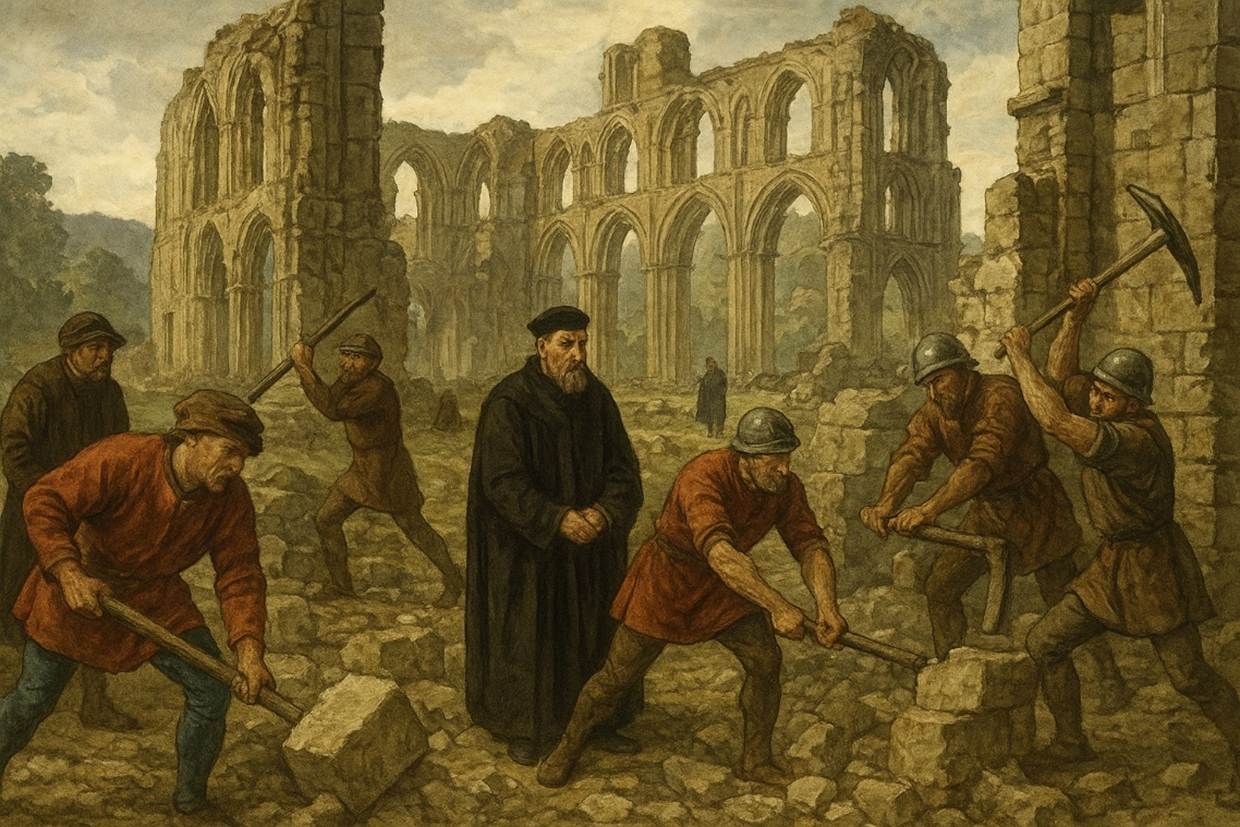
The dissolution of Rievaulx Abbey,
3 December 1538
1485 to 1603
Sixteenth
Century England
|
Return to the Home Page of the Farndale Family
Website |
The story of one family’s journey through two
thousand years of British History |
The 83 family lines into which the family is divided.
Meet the whole family and how the wider family is related |
Members of the historical family ordered by date of
birth |
Links to other pages with historical research and
related material |
The story of the Bakers of Highfields, the Chapmans,
and other related families |
Headlines are in brown.
Dates are in red.
Hyperlinks to
other pages are in dark
blue.
References and
citations are in turquoise.
Context and local
history are in purple.
Geographical
context is in green.
Return to The Houses of Lancaster and York.
The Tudors, 1485 to 1603
With support from
the French, Henry Tudor, Earl of Richmond, with a tenuous claim to the throne
through his mother, Lady Margaret Beaufort, a descendant of John of Gaunt,
marched to confront Richard III near Bosworth in Leicestershire.
According to
legend, Richard was killed by a Welshman and Sir William Stanley picked up the
crown and placed it on Richmond’s head.
The Tudors did
not seen themselves as a new dynasty, and as a label the House of Tudor was not
used until the Scottish historian David Hume in the eighteenth century.
The Wars of the
Roses had not impacted heavily on the commoners, but it had weakened the
aristocracy. By 1495 the French were distracted by conflict over the next three
centuries with the Hapsburgs.
There is an In Our Time podcast on the role of the Tudor dynasty in
reshaping the British state and whether their government of England laid the
political foundations of our own age
Henry VII, 1485 to 1509
1485
As London was hit
by the sweating sickness in September 1485 Henry Tudor, Earl of Richmond
and his mother Margaret Beaufort left London for Woking. Having secured Henry’s
position by carefully planned strategic moves during the short reign of Richard
III, Margaret, officially known as My Lady the King’s Mother, was a
queen in all but name and her household was second only to the King’s.
Edward
Plantagenet, Earl of Warwick, 10 year old son of the late George, Duke of
Clarence, was put into the care of Margaret, along with Henry’s future bride,
Elizabeth of York. Meantime Henry had no interest in investigating the
disappearance of the princes, since any cult around them could only threaten
the new regime.
Henry was crowned
and anointed at Westminster Abbey on Sunday 30 October 1485. In November
parliament confirmed that the inheritance of the crowns of England and
France abide in the most royal person of our sovereign Lord King Henry VII and
in the heirs of his body. His right was simply accepted as the will of God
made evident by his victory at Bosworth. The first known broadsheets, prototype
newspapers, single sheet publications that covered one off events, advertised
the Pope’s blessing for Henry’s reign.
1486
On 18 January
1486 Henry married Elizabeth of York.
In April 1486,
Henry VII's visit to York was a carefully staged event to gain the support of
the capital of Richard III’s former heartlands. Citizens released rose water,
showered him with sweetmeats, and displayed symbolic red and white roses to
represent the union of the houses of Lancaster and York. They hoped to win favour and financial
support for the impoverished city. A group of Yorkist supporters planned to
ambush the king during his visit, hoping to take advantage of the element of
surprise. The Earl
of Northumberland, who had shifted his allegiance to Henry, learned of the
conspiracy and warned the king, allowing him to avoid the ambush.
On 20 September
1486, Prince Arthur was born.
1487
The Pretenders
In April 1487,
the pretender Lambert
Simnel was joined in Ireland as the figurehead of a Yorkist rebellion by
John de la Pole, Earl of Lincoln who sailed with an army from Burgundy. Simnel
claimed to be Edward Plantagenet, 17th Earl of Warwick, the rightful heir to
the throne. Even though by now the real Edward Plantagenet was imprisoned in
the Tower and exhibited in the streets, there was uncertainty who was genuine.
The army of
Yorkists, Irishmen and 1,500 German mercenaries, the Landsknecht, sailed
from Dublin on 4 June 1487 and landed in Lancashire, and crossed the Pennines
into Wensleydale. The invasion army was of similar size to Henry’s army in
1485, and the new Tudor dynasty was vulnerable. The armies met near East Stoke
in Nottinghamshire. As the Irish fell in their hundreds Lincoln was killed,
and the lad Simnel, whom the rebels called King Edward, was captured (Tudor, the Family Story, Leanda de Lisle, 2014, page 90). The invasion force was
defeated at the
Battle of Stoke Field on 16 June 1487, a final flurry in the Wars of the
Roses.
The Yorkshire Rebellion in 1489 was a protest against heavy taxation. The Earl of
Northumberland was killed by rebels after telling them the king would not back
down on the tax. The uprising was short lived and suppressed by the Earl of
Surrey in May.
1492
Perkin
Warbeck impersonated Richard of York, one of the Princes in the Tower,
in a further challenge Henry VII's legitimacy. Although the King of France,
Charles VIII, had supported Henry’s coup against Richard III, he was irritated
by Henry’s support for an independent Brittany, and so provided sanctuary in
France and support to Warbeck.
Henry responded
with the Siege of Boulogne. The invasion was a tactic to pressure the French
King into a favourable peace. The siege ended quickly with the signing of the
Peace of Étaples on 2 November 1492, the French King
agreeing to expel Warbeck and pay an indemnity of 742,000 crowns (£160k).
Warbeck fled to Burgundy.
Christopher
Columbus, sponsored by Spain, sailed west to find a new route to Asia but
instead landed on an island in the Bahamas on 12 October 1492. Believing he had
reached the East Indies, he explored the Caribbean, including Cuba and
Hispaniola, before returning to Spain with riches and captive Native Americans.
His voyage initiated a period of European exploration and colonisation that
profoundly impacted the Americas.
The fall of
Granada in 1492 marked the end of the Reconquista, which had lasted
about 800 years, with the city's surrender to the Catholic Monarchs, Ferdinand
II of Aragon and Isabella I of Castile. After a long siege and a war campaign
that benefited from internal strife within Granada, the last Muslim emir, Boabdil,
gave up the city. This event solidified Spain's religious and political
unification, but it also led to forced conversions, exile, and persecution of
Jews and Muslims.
1494
The Vagabonds and
Beggars Act 1494 stipulated that able-bodied vagrants would be placed in the
stocks for three days with only bread and water, and then sent back to their
place of birth. This was one of the first laws to address the rising problem of
homelessness and idleness during the Tudor period, though later acts imposed
even harsher punishments and introduced different approaches to poor relief.
In 1494, France,
under King Charles VIII, launched an invasion of Italy to assert an Angevin
dynastic claim to the Kingdom of Naples. The French invasion upset the existing
balance of power, leading to the formation of an anti-French coalition.
The Medici were
exiled from Florence in 1494 and Savonarola established a theocratic
dictatorship. He enforced a strict moral code, including the Bonfires of the
Vanities, which to destroyed secular art and luxury goods.
1495
On 7 January 1495
Henry’s step uncle, Sir William Stanley, who had conclusively come to the aid
of Henry at Bosworth, was arrested for plotting against the King and executed.
The nervous Henry appointed lowly officials over the nobility into positions of
power.
On 31 March 1495,
the League of Venice was formed as an anti-French alliance which included the
Holy Roman Empire, Spain, the Papal States, the Republic of Venice.
By July 1495 from
his own court in exile, Perkin Warbeck left Burgundy with a force of 6,000 men
in 14 ships and landed in Kent. His
vanguard were slaughtered at Deal and the inexperienced Perkin retreated to
Ireland and then to Scotland, taking refuge with James IV.
In the Alehouse
Act 1495 introduced the first legislative control over alehouses in England to
combat disorder and vagabondage. JPs could reject and put away common
ale-selling at their discretion. This gave local authorities the power to
close disorderly or useless alehouses. The licensing system was
established later by the Act of 1552.
1496
After a
propaganda campaign which described Henry as the son of Owen Tudor of low
birth in the country of Wales and a usurper, a Scottish invasion into
Northumberland, laid waste the fields, pillaged and then burnt the houses
and villages, those who resisted cruelly killed. The shocked
northern population were horrified and unsurprisingly failed to flock to
Warbeck’s cause, so once again the invasion retreated back across the
border.
1497
A new Cornish
uprising, protesting against taxation, was crushed by the King's army at the
Battle of Deptford Bridge (also called Blackheath) on 17 June 1497.
The Italian
navigator Giovanni Caboto (John Cabot), commissioned by King Henry VII,
sailed west across the Atlantic on the Matthew to search for a trade
route to Asia. He landed on the east coast of North America on 24 June 1497,
which he claimed for England, mistakenly believing it to be the northeast coast
of Asia or a nearby island. The exact location of his landfall is debated by
historians, with possibilities including Cape Bonavista or St. John's in Newfoundland.
Vasco da Gama's
1497-1499 voyage was the first to successfully link Europe and Asia by sea,
rounding the Cape of Good Hope to reach Calicut, India. After leaving Lisbon,
his fleet navigated around the Cape, facing hardships including scurvy, before
landing in India in May 1498. He was met by a hostile reception from local
rulers and Arab merchants, forcing his hasty retreat, but he returned to
Portugal as a hero.
There began a new
era of maritime trade and European imperialism.
After a Treaty of
Friendship was signed with Spain, on 3 September 1497 two Italian ambassadors
found Prince Arthur to be a most distinguished husband to be wed to
Katherine of Aragon, daughter of Ferdinand and Isabella of Spain.
Stirred by the
Cornish uprising, Warbeck landed at White Sands Bay, Cornwall, on 7 September
1497. He declared himself king at Bodmin and the recent Welsh rebels swelled
his numbers to about 8,000. However the Pretender was finally captured at
Beaulieu Abbey and imprisoned in the Tower.
1499
In 1499, after
the capture of another impersonator of Edward Plantagenet, the Spanish monarchs
demanded that Henry have the real Edward Plantagenet killed as a condition of
Arthur’s marriage to their daughter. Henry was appalled by the demand, and put
Edward Plantagenet’s loyalty to the test by setting him up in a meeting with
Perkin Warbeck. Perkin Warbeck was executed on 23 November 1499 and Edward
Plantagenet was beheaded on 28 November.
1500
The estimated
population of the kingdom in 1500 was about 2.1 million people, though
estimates from the era are approximate. There had been a slow recovery from the
drastic population decline caused by the Black Death and subsequent plagues in
the fourteenth and fifteenth centuries. The relatively low population for the
available resources meant that living standards and wages were comparatively
high in the early sixteenth century.
1501
Arthur, the
Prince of Wales, and Katherine of Aragon were married at Old St Paul's
Cathedral on 14 November 1501, both aged 15 years. Katherine was escorted to
the altar by her future second husband, Arthur's younger brother, Prince Henry.
1502
The Treaty
of Perpetual Peace of 24 January 1502 was an attempt to end centuries of
intermittent warfare between England and Scotland. The key components were a
formal peace agreement and a marriage alliance between the two royal families.
Arthur died on 2
April 1502 after an illness grew and increased upon his body. A
Franciscan Friar came to the King’s chamber and asked him in Latin, if we
receive good from the hand of God, should we not also tolerate the bad,
before he showed his Grace that his dearest son was departed to God.
1503
An impatient and gregarious
13 year old who enjoyed archery, music, dancing and cards, Queen Margaret would
need all her high spirits and optimism now she was to leave those she loved.
Scotland was notoriously violent and it was considered a rare thing for a
Scottish king to die of natural causes. The husband she had not yet seen, James
IV, wore an iron belt as penance for his unwitting role in the death of his own
father, James III, killed by rebels whose cause he had been supporting. (Tudor, the Family Story, Leanda de Lisle, 2014, page 113). Margaret met James IV at
Dalkeith Castle on 3 August. Margaret Tudor, aged 13, and James IV of Scotland,
aged 30 with a great red beard, were formally married on 8 August 1503, at
Holyrood Abbey. He gave her the palace of Linlithgow.
On 2 February
Queen Elizabeth gave birth to a premature daughter, Katherine, caught and
infection and died on 11 February, their daughter dying on 18 February. Henry’s
physical and mental state would never recover.
1504
Henry remained
obsessed by threats to his kingship and in September 1504 he appointed Edmund
Dudley to keep the nobility in danger at his pleasure, bound to his grace
for great sums of money. He came to be dependent upon bribes including
£108k to the Duke of Burgundy, and raised revenues from his estates that had
grown to fourfold those under Edward IV. People were informed without notice
that they had broken some obscure law, and required to pay hefty fines. The
good prince by degrees lost all sense of moderation and was led into avarice
(Anglica Historia, Polydore Vergil).
In 1504 Arthur’s
widow, Katherine of Aragon, was betrothed to her brother in law, Henry. The
betrothal was repudiated in 1505. She nevertheless remained in England, living
in limbo.
1508
The betrothal of
Mary Tudor to Philip the Fair of Burgundy’s young son Charles V, the future
Holy Roman Emperor, was confirmed at Richmond. The betrothal was called off in
1514.
A few weeks later
Henry IV fell seriously ill.
1509
Henry died on 21
April 1509.
Before Henry VII
was buried, the young Prince Henry announced his intention to marry Katherine of Aragon. In June 1509 Henry, aged 17,
married the 23 year old Catherine. The pope granted dispensation. His marriage
to Katherine was intended to gain him friendship of her father, King Ferdinand,
and the Holy Roman Emperor, Maximilian whose son had married her sister. Yet
marrying Katherine was not about securing military alliances alone. It also
held romantic appeal. A beautiful princess, for years in distress, lonely, yet
unattainable while her marriage prospects were being negotiated, Catherine was
the heroine to match the hero, Henry so badly wanted to be. He felt he was now
rescuing her, and so it seemed to Katherine, who was passionately in love with
him. (Tudor, the Family Story, Leanda de Lisle, 2014, page 125). They were a
popular couple and by many accounts, shared a loving and respectful
relationship for many years. His first and longest marriage lasted nearly 24 years and began as
a devoted union, but ended in a controversial annulment that triggered
England's break from the Catholic Church.
King Henry VIII, 1509 to
1547
On 22 June 1509
Henry and Catherine were crowned King and Queen at Westminster Abbey.
On 29 June 1509,
Henry’s grandmother, Margaret Beaufort died. Margaret Beaufort's Book of
Hours was a personalised Christian devotional book containing prayers, a
calendar of saints' days, and handwritten family records, including the birth
of Henry VII and his wedding to Elizabeth of York. It also features the Tudor
rose and portcullis, symbols of her family, and likely reflects her piety and
importance to the Tudor dynasty. The book provides a window into her religious
life and her family's history.
1510
Within days of
his coronation, Henry ordered the arrest of Sir Richard Empson and Edmund
Dudley, his father's widely disliked chief financial ministers. They were
charged with treason and executed in 1510, a popular move that helped the new
king gain public favour and distance himself from his father's more onerous
financial policies.
The young Henry,
known for his athleticism and love of music, jousting, and hunting, presided
over a magnificent and extravagant court filled with parties and tournaments.
1511
In 1511, Henry
joined the Holy League, an anti-French alliance that included Spain, the Holy
Roman Empire, and the papacy.
1512
The relationship
between the royal brothers in law, Henry VIII of England and James IV of
Scotland, his 23 year old Queen Margaret Tudor, now an asserted Scotswoman,
broke down in January 1512 when the English parliament reasserted its claim to
overlordship of Scotland. James IV reestablished the auld alliance by signing a
treaty with Louis XII.
1513
On 30 June 1513
Henry led an army to land at Calais, with ambitions to reconquer former English
lands. His priest Thomas Wolsey was responsible for the supply and discipline
of his army.
In the Italian
Wars known as the War of the League of Cambrai, Henry VIII allied with the Holy
Roman Empire and Spain against France.
He began the
Siege of Thérouanne in Artois on 1 August 1513. In
the Battle
of the Spurs on 16 August the French cavalry used their spurs hastily to
escape English cavalry supported by artillery and the small town fell to the
English.
However on 24
August 1513 James IV crossed the border into Northumberland with the largest
army that had been assembled in Scotland. Within a week the Scots had captured Norham Castle.
In her husband’s
absence, Katherine of Aragon helped to raise and equip troops, sending
supplies, and providing inspirational leadership through her actions and
speeches.
The Battle
of Flodden on 9 September 1513 was a decisive English victory and a
catastrophic defeat for Scotland, in which King James IV and much of his
nobility were killed. Fought near Branxton in Northumberland, it was the
largest battle ever fought between the two kingdoms in terms of troop numbers.
Following the
battle, Katherine of Aragon sent the bloodied coat of James IV to Henry as a
trophy which Henry received in the midst of the siege of Tournai.
Under the terms
of James’ will his most dearest spouse Margaret Tudor, became regent of
Scotland, the first Tudor woman to rule a kingdom. A general council gathered
at Stirling Castle and the coronation of the 17 month old James V followed in
the royal chapel on 21 September 1513. Robert Carver’s Dum Sacrum Mysterium,
was sung at the mourning coronation.
Henry returned
from France in October 1513, having captured Tournai. He made peace with Louis
XII, negotiated by Thomas Wolsey sealed by Louis’ marriage to Mary Tudor,
Henry’s sister in 1514 (cancelling her betrothment to Charles of Burgundy. The
population of France was by then six times that of England and the opportunity
for a return to the days of Henry V had passed.
On his return
Henry ordered a raid into Scotland burning corn and destroying villages. A
report on the outcome came, there is neither law, nor reason, nor justice at
this day, either used or kept in Scotland.
The punishment continued until February 1514.
The Scottish
Council wanted a military leader rather than a female regent, and there were calls
for the return from exile of John Stuart, Duke of Albany, James IV’s cousin,
but this was blocked by Henry.
1514
Queen Mary of
France was miserable in the days after her marriage. A ballad was sung in
Paris, The King of England has given the King of France a new young filly
who will carry him off either to hell or to paradise. Both Mary and Henry
hoped that the aged and sickly French King would not last long, giving Henry
greater influence in French affairs. Amongst the queen’s English maids, was a
14 year old Anne Boleyn.
1515
Louis died on 1
January 1515. To Henry’s horror, the widowed queen Mary Tudor and Charles
Brandon had a secret wedding in France in February 1515, followed by a public
ceremony in England on 13 May 1515, at Greenwich Palace. Reminded by Mary of
Henry’s promise that she could marry anyone she liked after Louis, their secret
marriage nevertheless defied Henry VIII, who initially reacted with anger,
forcing them to pay a large fine to secure his eventual forgiveness and
permission for the public event.
1515
In 1515, Thomas
Wolsey was elevated to Cardinal, having been appointed Archbishop of York in
1514, following his successful management of Henry VIII's 1513 military
campaign in France. This dual appointment solidified his power, making him the
second most important clergyman in England and a dominant force in both church
and state. In the same year he was appointed as Lord Chancellor. This gave him
immense power, wealth, and influence over England's church and state affairs.
In 1515, Margaret
Tudor was besieged in Stirling Castle with her two young sons by John Stewart,
Duke of Albany, who sought to take over the regency for her son, James V.
Margaret was forced to surrender the castle and her children in August 1515 as
Albany besieged the castle with cannon including Mons Meg. Mary managed to
escape from Linlithgow to Tantallon and thence from Scotland in September 1515
with her husband, Archibald Douglas, Earl of Angus, and the Earl of Arran.
Where Henry VII
had micromanaged state affairs, personally annotating treasury accounts, Henry
VIII delegated the daily grind, only intervening when and where he wanted. He
would spend days shooting, singing, dancing, wrestling, casting of the bar,
playing at the recorders, flute and virginals. He also loved the joust, which
his father had never taken part in. One Ambassador described him as like St
George on horseback when he performed; another claimed he had never seen such a
beautiful sight. (Tudor, the Family Story, Leanda de Lisle, 2014, page 153). Henry’s
confidence and happiness was boosted by the birth of a daughter, Mary, and he
felt a son was sure to follow.
Civil war broke
out in Scotland, and Margaret Tudor lost the regency to John Stewart, Duke of
Albany and fled to England.
Thomas More, Henry’s Chancellor, wrote the humanist parable, Utopia, describing an imaginary pagan island governed by equality and
justice. He contrasted flawed European societies of his time, exploring themes
of communal living, elected leaders, religious tolerance, and the humanistic
values of reason and community. There
is an In Our Time podcast, Humanism.
Conversion of arable land to pasture became an offence by various
anti-enclosure acts, like one passed in 1516, driven by the Tudor crown's
concerns about the social and economic consequences of sheep farming which led
to the loss of farmland, reduced tax revenues, decreased potential for military
recruitment, and increased social unrest from displaced villagers.
1517
Luther
In 1517, Martin Luther, a German monk and professor of theology at
the University of Wittenberg, nailed his critique of the religious authorities
to a church door in Wittenburg. He challenged the Roman Catholic Church's
practice of selling indulgences and circulated his Ninety-five Theses. Luther
saw religious salvation as an individual quest in which the church had
little role and the clergy were just another venal interest group (Tudor, the Family Story, Leanda de Lisle, 2014, page 165).
1518
While Katherine was pregnant again, Henry took a 19 year old
mistress, Elizabeth Blount. She gave birth to a son, Henry Fitzroy in June
1519.
1519
Ferdinand
Magellan's expedition was the first to circumnavigate the globe, departing
Spain in 1519 with five ships and completing the journey in 1522. While
Magellan was killed in the Philippines in 1521, his crew, led by Juan Sebastián
Elcano, completed the voyage. The expedition proved the Earth was a sphere,
discovered the Strait of Magellan, and crossed the Pacific Ocean.
By 1519 concerns
were growing about the lack of a male heir. There were murmurs about the
possible suitability of Edward Stafford, Duke of Buckingham, a descendant of
Thomas of Woodstock and of John of Gaunt. Henry asked Wolsey to keep a careful
watch over Buckingham. Henry’s relationship with Stafford soured with growing
paranoia over the succession. Stafford's wealth, independent power, and
Plantagenet bloodline made him a primary target for an increasingly insecure
King. By
1520 Wolsey, began an investigation into Buckingham's actions. Stafford was
accused of imagining and compassing the death of the king by consulting
a monastic prophet, Nicholas Hopkins, about the likelihood of Henry's death and
his own potential future as king. He was summoned to court in April 1521 and
imprisoned in the Tower, found guilty of treason and beheaded on Tower Hill on
17 May 1521.
1520
At 6pm on 7 June
1520, Henry VIII of England met François I of France near Calais, for an
astonishingly grand European festival, designed to improve relations between
the two great rival kingdoms. So magnificent was the occasion that it became
known as the Field of Cloth of Gold. The meeting of Henry VIII and Francois I
on the Field
of the Cloth of Gold in 1520 was a flamboyant display of opulence. There is an In Our Time
podcast on the
Field of the Cloth of Gold in 1520, one of the greatest and most conspicuous displays of
wealth and culture that Europe had ever seen.
In 1520 Luther published The Babylonish Captivity of the Church,
dismissing four of the seven sacraments (confirmation, holy orders, extreme
unction given at death and marriage), for which he found no reference in the
Bible, thereby seeing justification for the dissolution of a marriage through
divorce.
Henry disliked Luther’s teachings and attacked his theories and
had Lutherans burned as heretics, which led the Pope to declare him Fidei
Defensor, ‘Defender of the Faith’, a monarchic title which has survived.
Henry even composed a reply to the Babylonian Captivity, defending the
seven sacraments including marriage.
1521
Yet at the same
time, he was increasingly drawn down a path of challenge of papal authority.
Margaret Tudor
sided with John Stewart, Duke of Albany against her husband Archibald Douglas,
Earl of Angus in competition for power in Scotland.
1523
The Great Subsidy
on all individuals over 16 years old was a comprehensive, graduated tax introduced
by Cardinal Thomas Wolsey to fund England's war campaigns in France. It was a
significant departure from older, fixed tax systems (known as fifteenths and
tenths) because it was assessed more realistically based on individual
wealth, rather than on simpler community valuations. A long list of taxpayers
were included in the returns.
1525
At the 1525
Battle of Pavia, the French army led by King Francis I was decisively defeated
by the smaller, Spanish-Imperial forces of Emperor Charles V. in that battle
Richard de la Pole, the last White Rose and last serious rival to
Henry’s succession planning, had died.
Henry hoped to
persuade Charles V to divide France between them, but as Charles was out of
funds, he made peace with France, scuppering Henry’s plans. Henry himself
reestablished relations with the French crown, and Wolsey negotiated the
perpetual peace on 30 April 1526.
Angus
outmanoeuvred Margaret Tudor and became Lord of the Articles in Edinburgh.
1526
Archibald Angus,
6th Earl of Douglas, was appointed Lord Warden of the Marches in
1526, to suppress disorder and anarchy on the border. He concluded a three year
peace treaty with England. On 4 September 1526 Angus defeated John Stewart, 3rd
Earl of Lennox, who had advanced towards Edinburgh with 10,000 men in August at
the Battle of Linlithgow Bridge, and he subsequently took Stirling.
Anne Boleyn
Henry VIII may
have first encountered Anne Boleyn, daughter of Henry’s friend, Sir Thomas
Boleyn in March 1522 at a court masque, but their romantic involvement began
later, around 1526. Anne, who had returned to England in 1522 to serve as a
lady-in-waiting to Queen Catherine of Aragon, captivated the King in 1526 after
he had an affair with her older sister, Mary Boleyn. The affair with Anne
probably began in a similar way to that with Elizabeth Blount.
After Anne’s
return to England she had attracted the attention of Henry Percy, heir to the
earldom of Northumberland, who served in Wolsey’s household. They had a
passionate, secret love affair in the early 1520s that was abruptly ended by
their families and Cardinal Wolsey, probably prompted by Henry who had become
interested in the most desired woman at court.
Anne did not
aspire to be a discarded royal mistress when she could have been Countess of
Northumberland. 17 undated love letters between Henry and Anne record the
evolving relationship. The problem for Henry and Anne (now obliged to play
for the highest marriage stake of all) was that he remained married to
Katherine of Aragon. There was a possible solution, however, in the new
revisionist theology of a depressive German former monk called Martin Luther.
(Tudor, the Family Story, Leanda de Lisle, 2014, page 164).
Henry’s mind
seems to have been turned to the possibility of ending his marriage with
Katherine after the French had queried Mary’s legitimacy in negotiations for
her marriage to the Duke of Orléans, daughter of Henry II of France. The basis
of their query was a potential breach of a warning in Leviticus that If
a man shall take his brother’s wife it is an impurity; he hath uncovered his
brother’s nakedness; they shall be childless, the Levitical objection.
Katherine had not
produced a male heir. She had given birth to a stillborn girl in 1510; a boy
who died after 7 weeks in 1511; had a miscarriage in 1513; a boy who died
shortly after he was born in 1514; a girl, Mary, in 1516, but after the traumas
of the Wars of the Roses, Henry felt a daughter was too risky; a miscarriage in
1517; and a still birth in 1518. Meantime Henry had an illegitimate son in
1519, Henry Fitzroy, who lived into his teens. So Henry convinced himself that
any issue in providing an heir was not caused by him.
Christianity was
unique at that time, in not allowing divorce. Henry became convinced that the
Pope had been in error in granting dispensation and his marriage was against
God’s will. At first he hoped that Katherine would understand and cooperate. In
any event Henry was eager to portray that this was a matter of conscience and
nothing more. There was some tradition of popes’ understanding in tricky
questions over royal marriages.
However the
complexities of European politics were about to entangle themselves further as
the circumstances in Rome dramatically changed.
Anne Boleyn spent
her formative years, from about 1513 to 1522, being educated in the Netherlands
and France as a lady in waiting in powerful European courts. This period shaped
the sophisticated and confident woman who would later captivate Henry VIII. She
introduced new evangelical ideas from the Continent to Henry VIII and
influenced his appointments of reforming bishops like Cranmer, promoting Tyndale's
English Bible, and fostering reformist networks at court, pushing Henry towards
a break with Rome and establishing the foundation for Protestantism in England.
Her own faith was complex and aligned with emerging reformist views rather than
strict Lutheranism. Her patronage, support for evangelical texts, and personal
piety demonstrated a commitment to reform, making her a crucial catalyst for
the English Reformation.
1527
The 1527 Sack of
Rome was a catastrophic event where the mutinous, unpaid troops of Holy Roman
Emperor Charles V stormed and looted the city. After the attack began, their
leader, Charles III, Duke of Bourbon, was killed, but the troops rampaged
through Rome for eight days, killing, torturing, and raping civilians, and
plundering churches and palaces. The Lutherans took particular pleasure in
raping nuns and tormenting clerics before they were killed: one old priest was
slaughtered after refusing to offer communion to an ass. Palaces and churches
were sacked and desecrated, libraries were burned, and unique manuscripts from
the ancient world lost forever (Tudor, the
Family Story, Leanda de Lisle, 2014,
page 168).
Pope Clement VII,
a Medici, allied to France, Venice, Florence and Milan against the emperor,
escaped to the Castel Sant' Angelo through a secret passage, and the sack
effectively ended the High Renaissance in Rome and significantly weakened the
power of the Papacy.
Concurrently with
these events, at Henry’s instruction Wolsey set up a secret court to try to the
king for his incestuous relationship, the first stage in a plan to build a case
against Henry’s marriage to Katherine. Katherine caught wind of this event, and,
humiliated and angry, began to consider a strategy to defend her marriage and
her daughter’s legitimacy.
Learning that the
pope was besieged in the Castel Sant' Angelo, Henry shared his plans with
Katherine and to his dismay found her to be uncooperative. Furthermore Henry’s
actions leaked into the public domain where his people expressed disgust at
this attack on their beloved queen.
Henry’s marital affairs gave rise to the greatest revolution in
English history (Robert Tombs, The English and
their History, 2023, 163).
Humanists
Besides the Roman church and the Lutherans, there was another
group of scholars called the humanists. Humanism was first associated
with the study of humanities including the Roman and Greek classics,
literature and ideas. Desiderius Erasmus (c. 1466 to 1536), widely known as the
Prince of Humanists, was a Dutch Renaissance scholar, Catholic priest, and
theologian who championed a return to the original sources of Christian and
classical antiquity to reform the Church from within. He is a pivotal figure
for his role in biblical scholarship, educational reform, and his nuanced
stance during the onset of the Protestant Reformation. This was a time when new
interpretations were questioning centuries of belief. Whilst many humanists
remained orthodox Catholics, some would become what became known as Protestant.
The humanists were amongst the evangelicals who wanted to return to the evangelium or good news of the Gospel, replacing the
traditional theology of the church.
John Fisher, Bishop of Rochester, pioneer of Greek learning and
Chancellor of Cambridge University, was a humanist who had written treatises
supporting papal authority against Luther. In response to Wolsey, he replied
that the pope was authorised to dispense with the Levitical objection. Fisher
became an eloquent opposition to Henry’s evolving arguments.
1528
On 11 March 1528, Margaret Tudor succeeded in obtaining her
divorce from Angus. Later that month she and her lover, Henry Stewart, were
besieged at Stirling. A few weeks later the young James V escaped from Angus's
custody, took refuge with Margaret and Arran at Stirling, and immediately took
revenge by proscribing Angus and all the Douglases.
James V began to rule in his own right. Margaret was an early beneficiary of
the royal coup, as she and Henry Stewart, who became Lord Methven, became the
leading advisors to the king.
1529
Wolsey procured a hearing on the matter in England before himself
and Lorenzo Campeggio, England’s Cardinal Protector in June 1529. The
Legatine Court at Blackfriars was a dramatic and politically charged event.
While Henry spoke of his troubled conscience, Katherine made a powerful and
emotional plea directly to her husband, kneeling before him in open court. She
affirmed her fidelity, stating she was a virgin when she married him, and
argued that their marriage was lawful, having been brokered by their wise
fathers and granted a papal dispensation. Ultimately Katherine refused to
recognise the court's authority. The protection of women lay at the heart of
the concept of chivalry, and Catherine had played to the Princess in distress,
to perfection. Yet Henry felt she was behaving utterly selfishly. The future of
his Kingdom was at stake, and to his frustration, he was not granted the quick
judgement he wanted (Tudor, the Family Story, Leanda de Lisle, 2014, page 174).
The case was adjourned and after delaying tactics, Campeggio
knowing the decision would go against Henry whilst the pope did not wish to
alienate the English king, the case was finally recalled to Rome. Henry angrily
retorted By the Mass, now I see that the old saw is true, that there was
never legate nor cardinal that did good in England.
Henry also began to question his reliance on his faithful servant,
Wolsey. Anne Boleyn, who Wolsey later referred to as the night crow, had
lost all faith in him.
1530
In October a papal instruction ordered Henry to separate from
Anne. Henry began to question whether the Pope had the authority to interpret
God’s law and whether he was superior to a Christian King.
Henry blamed Wolsey for the mess, and a desperate Wolsey tried to
rally support from the king of France and the pope, which opened him to
allegations of treason. On 4 November 1430 Wolsey, a broken and sick man, was
arrested at dinner in York. Henry had his properties seized, including Hampton
Court which Wolsey had originally built and expanded. Wolsey died in Leicester
as he was brought to London for trial. Anne Boleyn celebrated his death by
sponsoring the performance of a farce which portrayed his descent into hell.
Henry now looked to become absolute emperor and pope in his
kingdom and supreme head of the church of England, a significant change to
the position he had adopted in his attacks on Lutherism
ten years earlier. He began to see his status in imperial terms, harping back
to the legends of Arthur. By far the majority in England saw the papacy, for
its many faults, as the heir to St Peter.
In the 1530s, the Barbary slave trade was actively raiding
European coasts and ships to capture people for enslavement in North Africa.
Barbary corsairs, operating from bases on the North African coast, would raid
coastal towns from Spain to as far north as Ireland, and attack merchant ships
at sea. The captives were sold in slave markets, primarily as Christians
captured by North African Muslim raiders.
Thomas Cromwell
Thomas Cromwell started working for Henry VIII after his patron,
Cardinal Thomas Wolsey, fell from power in 1529. Cromwell, who remained loyal
to Wolsey, came to Henry's attention when he was sent to plead for his former
master. Impressed by Cromwell's abilities and loyalty, Henry invited him into
his service, and by 1530, he was appointed to the Privy Council. Like
Wolsey, Cromwell came from humble origins (his alcoholic father was a tradesman
from Putney), he had a phenomenal appetite for hard work, a sharp intellect
and, in common with Anne Boleyn, he held strongly evangelical views on church
reform, as well as supporting the supremacy of the king. (Tudor, the Family Story, Leanda de Lisle, 2014, page 183). He was the son of a cloth
merchant and inn keeper, an itinerant soldier in Flanders and Italy, a
self-taught businessman, lawyer and intellectual.
1531
An assassination attempt was made on John Fisher in February 1531,
possibly instigated by the Boleyns.
On 16 July 1531 Henry left Katherine for the last time, who
retired to the More in Hertfordshire.
1532
On 15 May 1532 Cromwell engineered the submission of the clergy to
Henry as their overlord, ending the independence of the church guarantees in
Magna Carta. This caused Henry’s chancellor, Thomas More, to resign the
following day.
In August 1532, William Warham, Archbishop of Canterbury, died.
Henry appointed the evangelical Thomas Cramner as the new archbishop, willing
to marry Henry and Anne.
1533
The Reformation
Henry married Anne Boleyn in February 1533, after she was already
pregnant.
There followed a succession of parliamentary acts to remove the
English church from papal jurisdiction.
On 7 April 1533, the Act in Restraint of Appeals 1533 ended legal
recourse to Rome, removing Katherine’s course to appeal to the pope. Reference
was made to Geoffrey of Monmouth’s Historia Regum Britanniae (History of
the Kings of Britain); by divers sundry old authentic histories and
chronicles it is manifestly declared and expressed that this realm of England
is an empire governed by one supreme head and king.
On 23 April 1533 Cramner formally
declared Henry’s marriage to Katherine to be void.
On 29 May 1533 ceremonies began for Anne Boleyn’s coronation as
Queen.
On 7 September 1533, Henry and Ann had a daughter, Elizabeth,
named after the late queen Elizabeth of York.
The coronation of Anne and the christening of their daughter
Elizabeth had been unpopular. Henry grew frustrated and turned on his daughter
with Katherine, Mary, declaring her to be illegitimate. With two daughters he
felt he could not have the older Mary being seen as somehow superior to his
daughter in his new marriage. The young, courageous and stubborn Mary would
have none of it and continued to use her title. He shut down her household and
isolated her.
Whilst to most ordinary folk, these issues were remote and caused
little issue, public anger was nevertheless mounting and the legitimacy of
Henry VIII’s right to the throne was questioned. Henry responded with tyranny.
Executions followed.
1534
The First Act of Succession 1534 declared
Catherine’s marriage ended and conferred the succession on Anne’s issue, also
formally making Mary illegitimate. Thomas More and John Fisher refused to swear
their support.
Two Acts of Supremacy confirmed that Henry was the only supreme head of the Church of
England, under pain of treason. Every man in the Kingdom was required to take
an oath to accept the new law.
In summer, Anne miscarried her second child.
On 25 September 1534, Pope Clement VII died. The new Pope Paul III
was open to reform and new beginnings. Amongst his new cardinals, he appointed
Fisher as the English representative on a council to reform the church. Henry
had meantime come to see his supremacy of the church as a primary purpose of
his kingship. On hearing of Fisher’s appointment, he threatened to send his
head to Rome for his cardinal’s hat.
The Treason Act 1534 drastically expanded the definition of
treason to enforce compliance with the King's new religious and political
policies, especially the Act of Supremacy 1534, making any denial of royal
supremacy punishable by death.
Henry VIII's suppression of monastic resistance to his religious
reforms began with trials of the Carthusians, a widely respected contemplative
order. When juries refused to convict them, the juries were threatened to a
verdict by Thomas Cromwell, and with little pretence at legal process, they
were hung drawn and quartered to the horror of those who witnessed it.
1535
Henry More and John Fisher were entrapped by the solicitor general
Sir Richard Rich, using admissions made in private conversation
against them, and beheaded. The Pope declared the offence against Fisher worse
than the death of Thomas Becket. Henry, wishing to prevent the likes of More
and Fisher becoming martyrs, had the shrine of Becket destroyed.
On 1 September 1535 the Pope declared that until Henry repented,
he should be cast out of the Christian family as a heretic and schismatic. The
annulment of Henry’s marriage the Katherine was seen to be unlawful across
Europe.
Concerns grew that Henry’s annulment of his marriage to Katherine
who lead to war with Aragon and its ally, Charles V, though Charles treated the
new marriage as a passing aberration.
Amidst this tension, it became ever more important that Henry
should have a son.
Henry VIII started to exercise his control, partly driven by his
religious revolution, over Wales and Ireland. In Ireland this translated as
bloody and indiscriminate repression and by 1546, he started the process of
introducing armed English, Welsh and later Scottish settlers, which caused
antagonism into the modern age.
William Tyndale
was a leading figure in the Protestant Reformation, and his views were
considered a direct challenge to the authority of the Catholic Church. In 1535
Tyndale was betrayed and captured in Antwerp. He was imprisoned in the castle
of Vilvoorde near Brussels on charges of heresy. He
was held for over a year before his trial and execution in 1536. Thomas Cromwell
made some attempts to intercede, but the charges of heresy fell under the
jurisdiction of the Catholic authorities of the Holy Roman Empire, who were
staunchly opposed to the Protestant ideas Tyndale promoted.
The Act of
Supremacy had redirected church taxes to the English crown. In January 1535,
commissions were appointed across the country, primarily involving unpaid local
gentry, mayors, magistrates, and bishops, to conduct the survey. The
visitations and stocktaking of religious houses provided a detailed survey of
church wealth. The Valor Ecclesiasticus, the Value of the Church,
was a comprehensive survey of the Church's property and wealth arranged by
Thomas Cromwell.
John Leland, the
King's Antiquary, undertook an extensive survey of England and Wales between
1535 and 1543 covering the West Country, the North-West (Cheshire, Lancashire,
Cumberland), the North-East (Yorkshire, County Durham), and the West Midlands.
This six year journey was commissioned by the King with the primary goal of
searching monastic and college libraries for ancient manuscripts and records
before their potential destruction during the Dissolution of the Monasteries.
The History and Antiquities of this Nation, provided a detailed
topographical account and gazetteer. In the eighteenth century Leland's notes
were published as the five volume Itinerary of John Leland the Antiquary.
Katherine of Aragon died on 7 January 1536.
Henry, aged 44, had lost the fitness of his youth and grew stout
in stature. On 24 January 1536 he fell from a hose and was unconscious for a
couple of hours.
On 29 January 1536 Anne miscarried her third baby, it is said a
boy. There are reports that Henry started to complain that he had been seduced
and trapped into marrying Anne. It was at about this time that Henry became
interested in Jane Seymour. Opponents of the Boleyns
began to exploit Anne’s weakness.
Henry started to accumulate chests of gold stored in his bed
chamber. There was vast looting and thousands of objects and works of art
taken, and often melted down. Some historical material was preserved, for
instance by Matthew Parker, Master of Corpus Christi, Cambridge, who saved many
ancient documents.
The significant wealth accumulated from the Church by the monarchy
was spent on creating a new navy and on a futile war with France in 1544.
The Pilgrimage of Grace in Lincolnshire
and East Riding of Yorkshire was in opposition to the dissolution of the
monasteries. Led by Robert Aske, the rebels, calling themselves pilgrims,
also sought the return of the Pope's authority, the dismissal of Thomas
Cromwell, and the repeal of new taxes and laws. Despite the rebels' initial
success in occupying cities and negotiating, the King eventually suppressed the
uprising, though it highlighted significant discontent with his rule. Many of
the leaders of the rebellion were executed, including Robert Aske.
Henry came to see
the monasteries as the main focus of opposition to the Reformation.
The Dissolution of the Monasteries was a series of legal and
administrative acts between 1536 and 1541 by which Henry VIII disbanded all
Catholic monasteries, priories, convents, and friaries in England, Wales, and
Ireland, seizing their assets for the Crown. This radical policy was a key
component of the English Reformation. There is an In
Our Time podcast on Henry VIII and
the Dissolution of the Monasteries, asking whether Henry’s policy was an act of grand larceny or the
pious destruction of a corrupt institution. One of the strongest things
Henry VII did was about the Monasteries … Henry told Cromwell to pass a very
strong Act saying that the Middle Ages were over and the monasteries were all
to be dissolved (1066
and all that, Walter Sellar and Robert Yeatman, 1930).
The process took only four years. By January 1540 all the
monasteries across the country had been suppressed, their art, relics and
libraries pillaged or destroyed. 3 volumes out of 646 survived the destruction
of the Augustinian friars of York. Many monks were retired, but the remaining
Carthusian monks were chained to posts at Newgate and left to die.
The Act for Punishment of Sturdy Vagabonds and Beggars 1536, which
allowed vagrants to be whipped, made English parishes responsible for the care
of their poor and established a system for organised, voluntary charity.
Anne Boleyn was convicted of treason for multiple adultery,
probably wrongly alleging affairs with Mark Smeaton and Henry Norris, and
beheaded on 19 May 1536. Her real afront was two miscarriages and producing
only one daughter, Elizabeth.
Both Mary and Elizabeth were declared to be illegitimate, so that,
by the rules of primogeniture, James V of Scotland, daughter of Henry’s older
sister Margaret, became Henry’s heir. Henry amended the Act of Succession to
prevent that. The new act vested the succession in any future children from his
marriage to his new wife, Jane Seymour, and gave Henry the authority to
determine the succession through his will or letters patent if he had no
further heirs.
The Rest is History Podcast Episode 616 explores the impact on Elizabeth of Anne Boleyn’s death.
Jane Seymour
Henry already had his eyes on Jane Seymour. He married her 11 days
after Anne was beheaded on 30 May 1536.
In July 1536, an Act of Attainder was passed against Lord Thomas
Howard, who had secretly contracted to marry Lady Margaret Douglas, the
daughter of Henry VIII's sister Margaret Tudor and a potential heir to the
throne.
1537
The Honourable
Artillery Company (“HAC”), the oldest regiment in the British Army, was founded
by a Royal Charter granted by Henry VIII on 25 August 1537. The charter
authorized the creation of a perpetual corporation for the defence of the
realm to be known as the Fraternity or Guild of Artillery of Longbows,
Crossbows and Handguns.
Jane Seymour gave
birth to a son, the future Edward VI on 12 October 1537. She died soon
afterwards on 24 October.
1538
Henry was now
determined to forge a new religious unity within a reformed English Catholic
church that was humanist, Christo-centric, anti-papal and biblical (Tudor, the Family Story, Leanda de Lisle, 2014, page 218).
Henry
commissioned a silver gilt image of himself in the shrine of Thomas Becket and
had the tomb of Thomas Becket fired out of cannons. His inquisitions and
destruction of church property began to attract the threat of crusade against
the reformed realm.
On 17 December
1538 Pope Paul III definitively excommunicated Henry VIII (having suspended a
previous bull of excommunication in 1535) and called for a crusade against him,
which the French and Spanish were supportive of. The final act that prompted the
definitive excommunication in December 1538 was the desecration of the revered
shrine of St Thomas Becket at Canterbury Cathedral.
Facing a threat
of invasion, the greatest construction of fortifications since the Romans began
along the English coast and the navy was enlarged leading to Henry’s reputation
as the father of the Royal Navy, albeit his actual success in that regard was limited.
1539
In 1539, Sir Nicholas Fairfax served as a commissioner of musters
for the North Riding of Yorkshire, a royal appointment by King Henry VIII to
assess and organize the military strength of the county in the face of
potential invasion. The muster was part of a national effort to improve
England's defences, and audit the home defence capabilities, as Emperor Charles
V and King Francis I of France were reportedly planning a joint expedition
against Henry VIII following England's breach with the Catholic Church. Numbers
of men mustered before Sir Ralph Eure and Sir Nicholas Fairfax included 83 from
Farndale, 71 from Kirkbymoorside, 38 from Gilling, and 28 from Ampleforth (John Rushton, The History
of Ryedale, 2003, 161).
1540
Anne of Cleves
Thus threatened,
Henry VIII saw advantage in an alliance with the Lutheran States of northern
Germany, the dukedom between the Low Countries and the German Empire, and
persuaded by assurance of her beauty supported by Hans Holbein’s painting, he
agreed to marry Anne of Cleves. There is an In Our
Time podcast on Hans
Holbein's role in the Tudor Court, painting Henry VIII as he asserted
himself as supreme head of the Church during the Reformation.
Henry met Anne of
Cleves on 1 January 1540, in a disastrous traditional attempt to come to her in
disguise, leading to Henry’s humiliation. Deeply disappointed by Anne, he
immediately began to plan his exit strategy. His wedding was not consummated
and a mutual annulment was wisely (for Anne) agreed, confirmed by parliament on
12 July. By 10 July Henry had begun
courting with Catherine Howard.
Henry blamed
Thomas Cromwell and he was arrested on 10 June 1540 and beheaded on 28 July
1540.
The Statute of
Wills permitted freehold land to be bequeathed for the first time. Prior to this
act, land typically passed by strict feudal rules of inheritance, primogeniture,
or reverted to the Crown if there were no heirs.
Catherine Howard
Henry married
Catherine Howard on 28 July 1540, on the day of Thomas Cromwell’s execution.
Reports reached soon reached the king that she had not been a virgin before the
marriage and of her exotic life before Henry. There were allegations also of
her indiscretions after her marriage to Henry with Thomas Culpepper. By 6
November 1540 Henry deserted Catherine at Hampton Court, never to see her
again.
The executions
against Catherine Howards’ alleged lovers and friends and family, began in
December 1541.
1542
Catherine Howard
was executed at the Tower of London on 13 February 1542.
Henry planned to
crippled Scotland before turning his attention to France, hoping that
territorial gains in France would secure the throne for his son, still aged
only 5, Edward. The Scots were heavily defeated at the Battle
of Solway Moss in December 1542, a decisive English victory over a much
larger Scottish army, leading to the humiliation of Scotland's King James V.
James V died just weeks later and his infant daughter, Mary, succeeded him as
monarch.
The Scottish
crown had come to the Stuarts through a woman. Unless James’ daughter married
another Stuart, it seemed certain the dynasty would end with one as well. “It cam wi’ a lass and it will gang wi’ a lass” were the last coherent words James is reported
by tradition, as having said. (Tudor, the
Family Story, Leanda de Lisle, 2014,
page 228).
1543
Catherine Parr
Henry VIII
married his sixth wife, Catherine Parr. She was an intellectual influence on
Prince Edward and Princess Elizabeth. She was interested in religious reform
and promoted evangelical tutors for Edward, potentially exposing herself to
danger from Henry.
1544
The English captured Boulogne after a lengthy siege in 1544. The invasion
was part of a joint offensive with Emperor Charles V, and it followed Henry's
justification of the war, which was partly due to French support for England's
enemies in Scotland. Although Boulogne was captured, the war was ultimately
inconclusive, with France making a separate peace with the Emperor and the
English forces becoming trapped, leading to a later peace treaty in 1550 where
France eventually bought back Boulogne.
The first approved English language church service published in
1544 was The Exhortation and Litany. It was written by Cranmer to
encourage prayers for victory.
1545
The war with
France (allied with Scotland) became costly and largely futile. It was
ruinously expensive.
The Mary
Rose sank, Henry VIII's flagship, sank suddenly during the Battle of the
Solent on 19 July 1545, witnessed by the King, with 500 men drowned. The
sinking is generally attributed to a combination of factors, including human
error, the ship's design, and weather conditions.
Henry VIII's
will, drawn up in December 1546, established the succession for the English
throne by first naming his son Edward, then his daughters Mary and Elizabeth,
and finally the descendants of his younger sister Mary. The claims of Mary
Queen of Scots and Margaret Douglas via Henry’s older sister Margaret Tudor,
went unmentioned. The will also created a regency
council to govern for the young Edward, appointed his executors, and directed
his burial to be with his wife Jane Seymour. Though controversially signed with
a dry stamp, the will was largely followed, though Edward Seymour seized power
as Lord Protector instead of implementing the council structure.
1547
Henry VIII died
on 28 January 1547, aged 57. If all the pictures and patterns of a merciless
prince were lost in the world, they might again be painted to the life of the
story of this king. For how many servants did he advance in haste (but for what
virtue no man could suspect), and with the change of his fancy ruined again; no
man knowing for what offence (History of the
World, Sir Walter Raleigh, Preface, 1614).
Edward VI, 1547 to 1553
The accession of
the nine year old Edward caused a period of fighting for influence amongst the
related factions.
Henry had
intended a council of equals in his will, but his private secretary Sir William
Paget felt that after Henry’s reign, government must continue to be controlled
in the hands of one man, and he procured the appointment of Edward Seymour, 1st
Duke of Somerset, Edward’s uncle and brother of Henry’s former wife Jane
Seymour, to be Lord Protector.
The death of
Henry was announced in parliament on 31 January 1547 after which Edward was
proclaimed king.
Henry’s executors
renamed themselves the Privy Council which had evolved from the Curia Regis
(royal court) of the Norman monarchs, and formed as the Privy Council in 1540
when Henry VIII gave the antique but informal institutions a fixed membership
which met almost daily, as an effective executive council.
Edward’s
coronation was on 20 February 1547.
He was tutored by
reformists including John Cheke. A new Book of Homilies promoted Lutheran
teaching. By August the rosary was banned and the Mass began to be attacked.
Ashes on ash Wednesday and palms on Palm Sunday were banned.
Edward VI was a
committed and fervent Protestant with strong evangelical convictions, viewing
himself as God's agent to protect the true faith and eradicate
Catholicism from England. His beliefs, shaped by his Protestant tutors and
Archbishop Thomas Cranmer, formed the basis of the comprehensive Edwardian
Reformation.
Mary and
Elizabeth were given incomes of £3,000 a year. Mary left Catherine Parr’s
household to set up her own household. She was angered at the religious
changes. Elizabeth remained with Catherine Parr. The two sisters had been
affectionate, but they were separated. Catherine Parr controversially remarried
to Thomas Seymour, Edward Seymnour’s brother. She died in 1548. After
Catherine's death in September 1548, Seymour made advances toward Elizabeth,
leading to a scandal with allegations of inappropriate behaviour. Thomas
Seymour was arrested for treason and executed in 1549.
The Rest is
History Podcast Episode 617 explores
the lives of Elizabeth and Mary during Edward VI’s reign.
The Vagabonds Act
allowed the branding and enslavement of beggars deemed capable of work.
1549
The Book of
Common Prayer was published in 1549. It was the first comprehensive English
prayer book, replacing the various Latin service books with a single,
simplified volume for all church services, including Morning and Evening
Prayer, Holy Communion, Baptism, Matrimony, and burial rites. Now a new
religious service had been commanded. Written in English, it reflected the view
that Christ was not present, body and blood, in consecrated bread and wine.
This was an attack on the heart and soul of Catholic belief. (Tudor, the Family Story, Leanda de Lisle, 2014, page 228). There was growing anger.
Rebellion spread from Devon, to the Midland, Essex and Norfolk.
Kett’s rebellion
was a peasant revolt in Norfolk led by Robert Kett against the enclosure of
common land and other grievances. The rebels, numbering up to 16,000, captured
Norwich and defeated the first royal army sent against them before being
suppressed by a larger royal army under the Earl of Warwick at the Battle of Dussindale. Kett was captured and hanged, along with
hundreds of other rebels, but the rebellion highlighted the instability of the
time and the social and economic issues caused by enclosure.
In October 1549,
Edward Seymour was overthrow as Lord Protector by a coup d'état of his
fellow privy councillors, led by John Dudley, Earl of Warwick, who blamed him
for widespread social unrest, costly foreign wars, and an arrogant, autocratic
style of rule.
Reforms were
driven hard by the new regime under Harry Grey and John Dudley. Statutory
approval was given for clergy to marry and for stone altars to be destroyed to
be replaced with simple wooden communion tables.
As Mary Tudor’s
daughter with Charles Brandon, Lady Frances Brandon, visited Katherine of
Aragon’s daughter Mary at Beaulieu in Essex, with her daughters Jane, Catherine
and Mary Grey, whilst demonstrating a continued friendship, significant
differences were exposed since the Greys had been influenced by the religious
reformers that Mary had become so opposed to.
1550
The University of
Oxford's main library was purged in 1550 of its entire collection of over 281
manuscripts and books with some burned.
Mary remained a
steadfast Roman Catholic. She continued to hear traditional Latin Mass
privately in her own chapels on her estates, in open defiance of the Act of
Uniformity 1549.
1551
The Ale Houses
Act 1551 introduced the first national licensing system for the sale of
alcohol. Its primary purpose was to control the abuses and disorders
associated with common alehouses and tippling-houses, which were seen as
sources of crime, public disorder, and vice. The Greys saw Mary’s practices as
idolatrous worship.
1552
The Poor Act
banned begging and authorised a Collector of Alms in each parish to keep a
register of licensed poor.
1553
By 1553, Edward
was suffering from lung disease. He made a last ditch effort to prevent his
Catholic half sister Mary, daughter of Katherine of Aragon, from becoming Queen
and he declared both Mary and Elizabeth illegitimate. In his will he ignored
any claims of his half sisters Elizabeth and Mary as
his successors, and also ignored the Scottish Catholic descendants of Margaret
Tudor, but followed the line of Henry VIII’s younger sister Mary Tudor to the
daughters of Frances Grey.
Edward died on 6
July 1553 aged 15.
Fifty years of
Tudor Queens
Lady Jane Grey, 1553 (9
days)
Edward’s 17 years
old second cousin, Jane Grey had been named as Edward’s heir. Jane Grey arrived
at the Watergate near the Tower on 10 July 1553. She had not sought the crown,
but she believed in the need to preserve the religious reforms of the Reformation.
There she was proclaimed Queen. No coronation followed.
On Edward’s death
Mary escaped to a stronghold in East Anglia and quickly gathered public
support. This was not yet a Protestant country. The break with Rome was
recent in historical terms and had been deeply traumatic, while to the majority
of Englishmen, Protestantism remained an alien creed, begun in Germany. (Tudor, the Family Story, Leanda de Lisle, 2014, page 271). The public also questioned
the basis on which Jane Grey’s husband, Lord Guildford Dudley, had any basis to
be a King of England. With support for Jane collapsing, the Privy Council
switched its allegiance to Mary who was proclaimed Queen on 19 July 1553.
The nine day
queen was executed on 12 February 1554. The tragedy was portrayed in a
painting by Paul Delaroche, depicting her final moments as she pleaded, What
shall I do? Where is the block?
The Counter Reformation
The coronation of Mary I took place on Sunday, 1 October 1553, at
Westminster Abbey. It was the first coronation of a queen regnant, a female
ruler in her own right, in England, requiring the adaptation of ceremonies
previously designed for a king or queen consort. Mary was a warrior queen,
established by gold, by blood, and by law, and she had now ‘taken charge of the
supreme authority and administration of the realm of my forefathers’ as
England's first ruling queen. (Tudor, the
Family Story, Leanda de Lisle, 2014,
page 278).
Mary began to restore the authority of Rome in the Counter
Reformation.
Her cousin, Charles V of Spain, encouraged Mary to marry his son, Philip,
heir to the Spanish Crown. Mary was concerned about threats from France, so the
marriage was attractive on strategic grounds, though she sought assurances that
Philip would not take any role in government.
To the English population this union brought the threats of
religious persecution, with Spain focused on eliminating the emerging threat of
Protestantism by the targeting of individuals by the Spanish Inquisition. The
public began to fear a suppression of new freedoms.
The Rest is History Podcast Episode 618 explores the life of Elizabeth and Mary during her step sister
Mary’s reign.
1554
Wyatt’s Rebellion against the marriage of Queen Mary to Philip of Spain was a
failed uprising in 1554 led by Sir Thomas Wyatt against the marriage and the
threat of a return to Catholicism. The rebellion failed. Wyatt was executed.
The rebellion led to the execution of Lady Jane Grey and heightened suspicion
of Mary's half-sister, Princess Elizabeth, who was briefly imprisoned but
ultimately spared and taken to house arrest at the Oxfordshire palace of
Woodstock, Mary hoping she would soon be forgotten.
The Act for the renewing of three Statutes made for the Punishment
of Heresies in 1554 revived three older statutes from the late fourteenth and
early fifteenth centuries, which provided the legal basis for the prosecution
and burning of individuals who held religious beliefs contrary to the official
doctrine of the Catholic Church.
Mary married Philip of Spain on 25 July 1554 to secure a Catholic
heir, but the marriage was personally unsuccessful and politically disastrous.
Philip, who found Mary unappealing, spent little time in England, which was
unpopular with the English public. Philip left England soon after the marriage,
and Mary was left childless. The union failed to produce children, and a
Spanish alliance led to England losing Calais in the war with France, a major
humiliation for Mary.
Born in 1527, Philip became King of Spain on the abdication of his
father Charles V. He ruled over a unified Spain and all its dominions in the
New World, as well as the Netherlands and Naples and Sicily. In 1554 he married
his second wife Mary Tudor, Queen of England, by which marriage he and his
father hoped to bring the English church back within the Catholic fold. On
Mary's death he became the implacable enemy of the Protestant Queen Elizabeth,
which culminated in his preparation of an immense fleet, the Armada, which was,
however, defeated in 1588.
Mary experienced at least two phantom pregnancies, a condition now
known as pseudocyesis, in the mid-1550s. These events were a source of
immense personal sadness and political humiliation, driven by Mary's desperate
desire to produce a Catholic heir and secure her dynasty.
1556
Philip became King of Spain in January 1556 after his father
renounced his sovereignty over the Netherlands and then Spain. The Spanish
Netherlands were a group of 17 states in the Low Countries (modern-day Belgium,
Luxembourg, and parts of northern France and western Germany) ruled by the
Spanish Habsburgs from 1556 to 1714.
At first Mary had used subtlety hoping to encourage a return to
the Papal fold. She appointed her cousin, Cardinal Reginald Pole to negotiate
with Rome as legate, and procure a forgiveness of past sins and a return to the
Roman Church. With Mary’s support, Pole, as papal legate and later
Archbishop of Canterbury, brought to life a humanist version of a reformed
Catholic Church in England. A new translation of the New Testament was
commissioned, support was given for the printing of other religious texts in
English as well as Latin, clerical education was encouraged and great attention
was paid to beauty in worship, especially liturgical music. (Tudor, the Family Story, Leanda de Lisle, 2014, page 292).
There were practical difficulties in returning to the traditional
church, since religious objects had been disposed of and religious buildings
now used for other purposes.
The Evangelicals continued to meet and resist the changes.
Bloody Mary
And so it was that Mary and Cardinal Pole turned to force, earning
Mary the seventeenth century nickname Bloody Mary. Notwithstanding her
approach at encouragement of the reestablishment of the traditional church, all
were expected to conform to the religion of the state. Although Protestants
remained a minority, there was a strong Protestant commitment, in the southeast
of England, in particular, where people had embraced the Edwardian reforms and
iconoclasm with enthusiasm (Tudor, the
Family Story, Leanda de Lisle, 2014,
page 293).
There followed the most intense persecution of the time in Europe.
280 Protestants were burned at the stake.
Possession of heretical literature was subject to the death penalty.
Bishop Latimer of Worcester, Bishiop Ridley of London and Archbishop Cranmer
were burned at the stake.
This was an age when hanging for theft was commonplace and heresy
was considered to be a heinous crime in stealing souls. In London there was
some sympathy for stamping down on heresy. However there was increasing
sympathy for the victims of the persecution. The numbers that Mary had burned
were striking, unmatched in the rest of Europe.
John Foxes’s Actes and Monuments of these Latter and Perillous Days, known as the Book of
Martyrs, published after Mary’s death in 1563, compiled the shocking
stories of the persecutions. The book was a history of Christian martyrs which
provided accounts of Protestant martyrs, particularly those persecuted under
the Catholic Church, linking the English Reformation to the early Christian
church. It included graphic stories of suffering and death for the sake of
faith, aiming to legitimize the English Church and shape public opinion against
Roman Catholicism.
In 1556, the
Courtenay plot was a conspiracy among English Protestant exiles on the
continent who hoped to overthrow the Mary and place her Protestant half-sister
Elizabeth and Edward Courtenay, 1st Earl of Devon, on the throne through
marriage. The plan was cut short, however, by the sudden death of Courtenay in
Padua, Italy, in September of that year.
1557
On 25 April 1557
a raiding party, known as Stafford’s Raid, comprising Protestant exiles led by
Thomas Stafford landed on the Yorkshire coast and took control of the
dilapidated Scarborough Castle in a surprise attack. Stafford issued a
proclamation declaring himself Protector of the Realm. However the raid
did not achieve local support and the castle was retaken three days later, and
Stafford and his sup[porters executed.
Mary declared war
on France in summer 1557. The English and their Spanish allies captured Saint
Quentin. However this led to a falling out with the pope who recalled Cardinal
Pole to Rome. Ironically Mary found herself using her royal power over the English
church to defy the wishes of Rome.
1558
Loss of Calais
and inception of imperial ambitions
Mary’s marriage
to Philip of Spain had brought England into a disastrous war with France and on
New Year’s Day 1558 they captured England’s last possession in France, Calais.
The poorly defended English garrison was quickly overwhelmed, leading to a humiliating
defeat for England by the Duke of Guise in a surprise winter offensive. The
loss was politically devastating for Mary I, and ended England's ambitions as a
continental power, shifting its focus to overseas exploration and empire.
As Mary grew ill,
Elizabeth began to plot with Sir William Cecil, who had been Secretary of State
to Edward VI and Jane Grey, for her accession. Mary did not place obstacles in
Elizabeth’s way.
Mary died, aged
42, of influenza on 17 November 1558 at St James’ Palace. Mary had spoken of
her marriage to her kingdom and treated her coronation ring as a wedding band,
providing the basis by which Elizabeth could take the throne with the powers
previously reserved to a king. However England was at war with France and Mary
Queen of Scots had married the dauphin.
Elizabeth would not have a Spanish king as a husband to rely upon.
The English
Protestant clergyman and writer Christopher Goodman (1520 to 1603), exiled to
the continent during the reign of Mary I, had preached at Geneva alongside John
Knox, with whom he formed a lifelong friendship, and became a prominent and
outspoken figure among his fellow reformers. In summer 1558 he argued that
obedience of a subject was dependant upon a monarch
obeying divine law, which excluded women from rule. The view was shared by John
Knox in Scotland. Let men that receive of women authority, honour, or
office, be most assuredly persuaded, that in so maintaining the usurped power,
they declare themselves enemies to God (The
First Blast of the Trumpet against the Monstrous Regiment of Women, John Knox, 1558).
Elizabeth I, 1558 to 1603
Elizabeth became
Queen at a time of increased religious intolerance across Europe.
Elizabeth controlled policy more than any other Tudor and her
reign did much to keep England safe throughout her reign. Yet she failed in one
crucial duty, to produce an heir, which would prevent the long term continuity
of her legacy (Robert
Tombs, The English and their History, 2023, 179).
1559
Elizabeth was crowned in a two day event which ended with her
coronation on Sunday 15 January 1559. The whole court so sparkled with
jewels and gold collars that they clear the air (Venetian
witness). She took Communion behind a curtain so that no one could be
sure whether she followed the Catholic or Protestant rites.
On 2 February 1559 the Commons asked about her intention to marry.
To their horror she responded that she would be happy never to marry, in the
end this shall be for me sufficient: that a marble stone shall declare that a
queen, having reigned such a time, lived and died a virgin.
She had a relationship with her Master of Horse, Robert Dudley; a
complex, lifelong bond that encompassed deep affection, political ambition, and
public scandal. They were childhood friends. The relationship was emotionally
intense but ultimately prevented from marriage by political realities and the
mysterious death of Dudley's first wife.
Gómez Suárez de Figueroa, the Count de Feria, was the Spanish
Ambassador to the English court. His primary mission was to persuade the new
queen to marry Philip II of Spain.
The Elizabethan Religious Settlement
The Queen is sometimes depicted as an essentially secular figure.
She was not. Like Henry VII, she believed that it was the exceeding goodness of
God that had protected her through difficult times until coming to this, our
crown. She was not doctrinaire, however, and was now trying hard to shape her
religious settlement that would appeal to as broad a Protestant constituency as
possible - Lutherans and Swiss reformed Protestants - with some Catholic
dressing that would ease the change for her conservative subjects. (Tudor, the Family Story, Leanda de Lisle, 2014, page 309).
Elizabeth annulled Mary’s counter reformation. As the daughter of
Anne Boleyn, she relied on royal supremacy and the reformist principles of her
father. The Elizabethan Religious Settlement was intended to create a moderate
and stable church that would be acceptable to both Protestants and Catholics.
The Act
of Supremacy 1559, An Acte restoring to the Crowne thauncyent Jurisdiction over the State Ecclesiasticall
and Spirituall, and abolyshing
all Forreine Power repugnaunt
to the same established Elizabeth I as the Supreme Governor of the Church
of England, ending the authority of the Pope and declaring that England's
monarch was the ultimate authority over both church and state. It required all
clergy and government officials to swear an oath of loyalty, though it avoided
the more confrontational title of Supreme Head used by her father.
The Act of Uniformity 1559, established a
single, mandatory form of worship for the Church of England, mandating the use
of a new Book of Common Prayer which was similar to the 1552 version but which
retained some Catholic elements. The act also set out specific rules for church
services, the appearance of churches, and the attire of ministers.
This was the foundation of a unique religion which was later
called Anglicanism. It looked Catholic and sounded Protestant. It was a
religious middle way. It was a compromise and perhaps the foundation of the
British spirit of compromise. It contrasted to a time of polarisation in
Europe, when the badges of Catholic and Protestant started to be used for the
first time. Prior to that, the evolution of the church was seen more as
turbulent schisms occurring within a single Christian church.
Elizabeth promoted choral music. She retained the choir of King’s
College Cambridge which had been restored by Mary. She promoted bell ringing
which purists considered to be sinful. She had no sympathy for hardliners from
either wing of the religious divide. She stopped the heresy trials.
Parish Records
In 1558,
Elizabeth I reissued the mandate for Church of England parishes to maintain a
register of all baptisms, marriages, and burials, a practice that had first
been ordered in 1538 but was inconsistently implemented. This was therefore the
practical start date for parish records.
William Cecil became Elizabeth’s most important and trusted
Secretary of State. He was immediately sworn into her Privy Council and began
work on the critical challenges facing the new Protestant regime. There is an In Our Time podcast on William Cecil, the 1st
Baron Burghley, Elizabeth I's powerful Secretary of State who advanced
England's interests throughout her reign.
The peace between
the Habsburgs and France, known as the Treaty of Cateau-Cambrésis,
ended a 65-year struggle primarily for control of Italy. Signed on 3 April
1559, it solidified Habsburg Spain as the dominant power in Italy, with France
renouncing its claims to most of its territories there. In return, France kept
control of the Three Bishoprics of Toul, Metz, and Verdun, as well as
the port of Calais, which it had recently taken from England. The peace was
secured through a marriage alliance between Philip II of Spain and Elisabeth of
Valois, daughter of the French King Henry II. This made possible a grand
Catholic Alliance to once and for all get rid of Protestantism.
The pope urged
Philip of Spain to invade England.
However the
danger was not an immediate one since France and Spain remained competitors.
Mastery of England would give either of them a strategic advantage.
Mary Queen of
Scots
Mary Stewart, daughter of James V and Mary of
Guise, consort queen of the French King, Francis II, had been Queen of Scotland
since 14 December 1542 when her father died. The French were effectively ruling
Scotland in her name. (Robert Tombs, The English
and their History, 2023, 183). There is an In
Our Time podcast on Mary
Queen of Scots.
1560
Francis II died on 5 December 1560, less than a year after
becoming King of France on 10 July 1559 and there was a power vacuum in France
with an expansion of Protestantism, a popular Catholic backlash and armed
Protestants and Catholic factions. Mary Stewart was grief stricken.
Elizabeth’s ambassador in France reported that Mary Quen of Scots
had said As God has so provided that she is Queen of France and Scotland, so
she trusts to be Queen of England also. William Cecil’s was tasked with
preventing that from ever happening.
In Scotland a Protestant revolt against Mary of Guise, the
Catholic Regent of Scotland, was led by the Lords of the Congregation and
supported by England, with English forces helping to oust French troops who
supported the Regent. Mary of Guise’s death on 12 June 1560 removed a central
authority figure and created a political vacuum. The conflict culminated in the
Treaty of Edinburgh on 6 July, which led to the withdrawal of foreign troops,
and the Reformation Parliament, which abolished the Pope's authority and the
Mass in Scotland.
1561
Mary Queen of Scots returned to Scotland and arrived at Leith on
19 August 1561. Having lived in France, she could not have understood the
complexities of Scottish politics, torn between Catholic and Protestant
factions. The protestants didn’t trust her devout Catholicism. Mary tolerated
the Protestant ascendancy. That she didn’t appoint a Catholic council and ally
herself closer to France, may be an indication of her ambitions on the English
throne.
Mary sent William Maitland of Lethington
to Elizabeth to negotiate her succession to the English throne, but Elizabeth
refused to name her as heir. Mary, Queen of Scots’ advisers had proposed
that Mary renounce her immediate claim to the English throne, a claim based on
the grounds she was the senior legitimate descendant of Henry VII, in exchange
for formal and binding recognition as Elizabeth's heir. Mary was working with
the incumbent Protestant regime in Scotland, she accepted Protestantism as the
national religion, while she, in turn, had assurances she could hear Mass. It
was a possible template for a future role as Queen of England, and William
Maitland of Lethington, the ‘flower of the wits of
Scotland’, had arrived to negotiate the issue with Elizabeth. Cecil feared he
might be successful, with Elizabeth moving to dispose of the Grey/Seymour claim
once and for all. (Tudor, the Family Story, Leanda de Lisle, 2014, page 321).
1562
In October 1562, Queen Elizabeth I, aged 29, contracted a severe
case of smallpox which brought her to the brink of death. The illness caused
widespread panic at court and throughout England due to the lack of a named
successor, raising fears of a potential civil war.
1563
The Thirty Nine Articles 1563
were a foundational document of the Church of England, agreed to by its bishops
in 1563 and later confirmed in 1571. They defined the doctrinal beliefs of
Anglicanism, which included the Holy Trinity, the authority of Scripture,
original sin, justification by faith, and the two sacraments of baptism and the
Lord's Supper. The Articles intended a balanced Protestant and Catholic stance,
rejecting certain Catholic doctrines like purgatory and indulgences, while also
permitting some traditional practices and clarifying specific issues for the
Church of England.
Over the following years, bewildered congregations had
seen remaining rood screens, with their images of Christ, Mary, and St John,
replaced with the royal arms of the supreme governor of the Church of England.
Newly whitewashed walls were decorated only with biblical quotations, there was
no holy water with which to cross themselves, no candles, everything was plain
and without colour, while elaborate music too was frowned on at as a
distraction from prayer.
This cultural revolution was not entirely to Elizabeth
taste. She employed to the Catholic composers Thomas Tallis and William Byrd in
the royal chapels.
(Tudor, the Family Story, Leanda de Lisle, 2014, page 355).
1565
On 29 July 1565 Mary Stewart married her half cousin, Henry
Stewart, Lord Darnley, a leading Catholic, daughter of Margaret Douglas and
granddaughter of Margaret Tudor. The king and queen reiterated promises
previously made by Mary to maintain the newly established Protestant religion
in Scotland.
Margaret Douglas was imprisoned by Elizabeth I in the Tower in
1565 for her role in arranging her son, Lord Darnley, to marry Mary, Queen of
Scots, without royal approval. She remained in the Tower until 1567, when her
son was murdered, at which point she was released. Distraught by his death, she
publicly blamed Mary, though the two were later reconciled.
Darnley became more arrogant, demanding the Crown Matrimonial to
jointly reign with Mary. Mary refused, and Darnley entered into a secret
conspiracy with the Protestant rebels. The
19 year old Darnley found having to play second fiddle to his reigning wife
intolerable, while she had concluded he possessed neither aptitude for hard
work nor the wisdom required to rule a country as volatile as Scotland. As
their marriage broke down, he began spending his nights in the brothels in
Edinburgh, and she refused him the crown matrimonial that would have given him
an equal share of royal power. (Tudor, the
Family Story, Leanda de Lisle, 2014,
page 338).
Mary was facing a dangerous enough enemy in
the form of her Protestant half brother, James V's
illegitimate son, the Earl of Moray and his allies. They had begun to play on
her effete husband’s sense of impotence, using Mary's trust in her Italian
secretary, David Riccio, to make him jealous. (Tudor, the Family Story, Leanda de Lisle, 2014, page 338).
Darnley and his conspirators stabbed Mary’s Catholic Private
Secretary, Rizzio , of whom he was jealous, to death at Holyrood House. Mary
was having supper with Rizzio in her private rooms when Darnley and his
accomplices appeared. Rizzio was dragged out of the room. Fifty five stab
wounds were later found with Darnley’s dagger.
An open rebellion was led by the Earl of Moray and protestant
nobility who feared Mary’s marriage to Darnley threatened a return to
Catholicism. The rebels were eventually chased around Scotland in the Chaseabout Raid, led personally by Mary, on 26 August 1565.
They finally fled to England.
1566
Mary and Darnley’s son James was born in Edinburgh Castle on 19
June 1566. He was baptised at Stirling Castle into the Catholic faith, which
alarmed the Protestant factions. He was christened Charles James after Charles
IX of France and James V of Scots.
The Low Countries rebelled against Spain. Protestants vandalising
Catholic churches and destroyed art, in the Beeldenstorm.
1567
A Spanish Army under Duke Alva crushed the Low Country revolt.
Refugees streamed into neighbouring countries including England and Scotland.
England allied herself with the French Protestants. England also allied herself
with Scottish Protestants, as the Catholics in Scotland supported France.
Mary discussed the problem of Darnley with her councillors.
Darnley fled and became ill. On his return to Edinburgh after a period of
conciliation, he died probably when leaving his accommodation at Kirk o’Field House in Edinburgh on 10 February 1567, perhaps
covered by the explosion which followed. Two barrels of gunpowder had been
placed in Darley’s room.
Suspicion immediately fell upon James Hepburn, the 4th Earl of
Bothwell, Mary's close advisor and later her third husband, as the principal
conspirator though many others had a motive. Mary became concerned about her
own fate.
In 1567 Mary Queen of Scotland was abducted, willingly or not, and
taken by Bothwell to Dunbar Castle. Mary claimed to have been captured and
raped, which is generally thought to be more likely, though she may have been
seeking Bothwell’s protection. The following month Mary and Bothwell were
married in Edinburgh under Protestant rites. 26 Scottish peers, the Lords of
Congregation or the confederate lords, turned against Mary and Bothwell and
raised an army. Mary was captured, denounced in Edinburgh, and imprisoned in
Loch Leven Castle.
Mary’s infant son James was crowned King of Scotland in her place
on 24 July 1567. John Knox gave a sermon.
1568
Mary escaped from
Loch Leven Castle and fled to England. She immediately sent a letter to
Elizabeth, expecting the English Queen to help her restoration to the Scottish
throne. However she had miscalculated.
Elizabeth ordered that Mary be kept guarded in the north. She was
interred in a succession of castles, including Bolton Castle in Wensleydale.
Mary was held at Bolton Castle for approximately six months, from July 1568 to
January 1569. Mary
was treated more as an honoured guest and lived in the best apartments in the
south-west tower. The castle was furnished with tapestries, rugs, and furniture
borrowed from nearby estates to be suitable for a queen. She maintained a
large retinue of around 50 attendants, including a physician, surgeon,
apothecary, and ladies-in-waiting. She was allowed to wander the grounds and
even to go hunting under supervision. Sir Francis Knollys, one of her keepers,
taught her to read and write in English, as her primary languages were French
and Scots.
1569
Mary was moved
from Bolton Castle in January 1569 to the more austere Tutbury Castle,
Staffordshire, as Elizabeth sought to move her further from the Scottish border
and potential rescue attempts.
Soon after Mary’s
arrival, a rebellion began in the pro Catholic north of England led by the
earls of Northumberland and Westmoreland. The Rising of
the North of 1569, also called the Revolt of the Northern Earls or Northern
Rebellion, was an unsuccessful attempt by Catholic nobles from Northern England
to depose Queen Elizabeth I of England and replace her with Mary, Queen of
Scots. In November 1569 the rebels took Durham, but within 6 weeks it was over.
Elizabeth ordered hangings in every village involved in the revolt. On 23
January 1570, a officer in the North Riding reported six
hundred and odd had been executed and the people were in marvellous fear
so that I trust there shall never such thing happen in these parts again.
As Catholic
communities shrank, they were more subjected to the Elizabethan regime’s
attacks, and more so after the Risings in 1569.
Elizabeth’s
bishops pressed her to execute Mary Queen of Scots.
James VI’s
grandmother, Margaret Douglas had moved to Yorkshire, where Temple Newsam
became a hub for Catholic intrigue, known as the Hampton Court of the North.
She established another significant residence at Jervaulx
Abbey. From there she corresponded with her grandson, focusing primarily on
securing his claim to the English throne and reconciling her family with Mary,
Queen of Scots.
1570
The growth of
Presbyterianism was primarily centred in Scotland, where it became the
established national church, and spread to England, Ireland, and later North
America, often amidst political and religious conflict. Key events include the
formalisation of its unique governance structure and the eventual global spread
through migration and missionary work.
On 25 February
1570 the papal bull of Pope Pius V, Regnans in excelsis, ‘Reigning on High’,
excommunicated Elizabeth and declared her a heretic.
1571
The Ridolfi plot
was a failed Catholic conspiracy to assassinate Elizabeth I, install her cousin
Mary, Queen of Scots, on the English throne, and restore Catholicism in England
with the help of a Spanish invasion force. It involved spies, codes, gold and
the Italian banker, Ridolfi. One of Ridolfi's messengers, Charles Baillie, was
intercepted at Dover and, under torture, confessed and revealed the details of
the plot and the existence of coded letters. Further arrests and interrogations
of the Duke of Norfolk's servants provided irrefutable evidence. The Privy
Council was so alarmed that it sanctioned the use of torture.
1572
The revolt in the
Netherlands flared up again. England gave financial and military aid.
France lurched into religious anarchy and there was a wholesale
massacre of Protestants, the St Barthlomew Day’s Massacre. There was apocalyptic terror on the
Continent. There
is an In Our Time podcast about the infamous
St
Bartholomew’s Day Massacre in 1572
when the River Seine ran red with Protestant blood.
1577
Religious
conflict spread globally.
Francis
Drake was sent to harry the Spanish colonies. He attacked Spanish vessels,
taking the treasure that they had brought back from abroad, and raided Spanish
and Portuguese ports. The Spanish called him El Draque,
the Dragon. In his expedition of 1577 to 1580, he became the first
captain to safely circumnavigate the world, The Spanish treasure he seized en route gave a 1,000% profit and the Queen’s
share equalled a year’s Crown revenue. He sailed in the Pelican, which
was later renamed the Golden Hind. The Spanish complained that
Captain F Drake, the memorable bowlsman, had singed
the King of Spain’s beard (or Spanish Mane, as it was called) one day when it
was in Cadiz Harbour (1066 and all that, Walter
Sellar and Robert Yeatman, 1930).
1579
Christopher
Saxton’s country maps of England and Wales, An Atlas of England and Wales,
published in his landmark 1579 atlas, which included his 1577 map
of Yorkshire, were the first comprehensive, systematic survey and mapping
of the counties of the two nations. This work is considered a pivotal moment in
the history of British cartography and established a new standard for
mapmaking.
1580
A papal backed
force of about 600 Spanish and Italian soldiers landed at Smerwick,
Ireland, to support the Second Desmond Rebellion. They fortified themselves in
a fort at Dún an Óir, but were soon besieged
by English forces. After a short bombardment, the papal troops surrendered and
were subsequently massacred by the English.
Catholicism
continued to be practised among the gentry. It was particularly popular in
Lancashire and Warwickshire. There was a new generation of Catholic priests and
the Jesuits in particular were zealous in their efforts to convert and pave the
way for another Counter Reformation.
1581
Persecution
reached a peak in the 1580s. Recusancy (not attending Anglican services,
especially by Catholics) became a criminal offence. The Act to Retain the
Queen's Subjects in Their Due Obedience drastically escalated the penalties for
recusancy, making it a much more severe offence and linking it directly to
treason.
The victims came
to be seen as martyrs.
1583
The beginning of
England’s trans Atlantic interests
In 1583, Sir
Humphrey Gilbert, granted letters patent by Queen Elizabeth I, formally claimed
the harbour of St. John's, Newfoundland,
for the English Crown, establishing England's first overseas colonial
possession in North America.
The Throckmorton
Plot of 1583 was a conspiracy by English Catholics, backed by Spain and the
Pope, to assassinate Elizabeth I and replace her with the Catholic Mary, Queen
of Scots. The plot was discovered and foiled by Elizabeth's spymaster, Sir
Francis Walsingham.
1584
Virginia is the
oldest designation for English claims in North America. In 1584, Sir Walter Raleigh
sent Philip Amadas and Arthur Barlowe to explore what is now the North Carolina
coast. They returned with word of a regional king (weroance)
named Wingina, who ruled a land supposedly called Wingandacoa.
It is also said that Virginia was named by Raleigh after the Virgin Queen. Virginia
was originally a term used to refer to England's entire North American
possession and claim along the east coast from the 34th parallel, close to Cape
Fear, north to 45th parallel. This area included a large section of Canada and
the shores of Acadia.
On 10 July 1584,
William of Orange, the leader of the Dutch Revolt, was assassinated by
Balthazar Gérard, a French Catholic fanatic.
William Cecil and
other councillors agreed the Bond of Association, which held Mary
responsible for any plots against the Queen in the event of her death, as they
were determined she should be eliminated from any succession claim.
The 18 year old James
VI had spent his childhood at Stirling Castle under the regency of nobles. He
received a rigorous education from the scholar George Buchanan, who tutored him
to reject his mother, and her Catholicism. The truth was that Mary, Queen
Scots, was a stranger to her son, and one of whom he had rarely heard a good
word. For years James had been told that she had murdered his father. And
whatever he believed, his principal concern was his own survival. His subjects,
James later commented, were a far more barbarous, stiff necked people than the
English. His main objective was to inherit Elizabeth's crown and get the hell
out of Scotland as soon as he could. (Tudor,
the Family Story, Leanda de Lisle, 2014,
page 366). This unstable and often violent environment forged a shrewd
and highly educated, but wary, king who began to take personal control of his
realm in his teens.
1585
In 1585, Raleigh
sent his first colonisation mission to Roanoke Island, in present-day North
Carolina, with over 100 male settlers. However, when Sir Francis Drake arrived
at the colony in the summer of 1586, the colonists opted to return to England
because there was a lack of supply ships, abandoning the colony. Supply ships
arrived at the abandoned colony later in 1586; 15 soldiers were left behind to
hold the island, but no trace of these men was later found.
1586
William Camden’s Britannica
was the first topographical survey of England. It was a comprehensive, county
by county description of Great Britain and Ireland, combining history,
geography, and antiquarianism. Published first in Latin in 1586, it became a
foundational work for studying the British Isles by tracing the influence of
Roman Britain and using historical sources, landscapes, and archaeological
finds to connect the past with the present. The book was expanded through
multiple editions during Camden's life and was later translated and augmented
by other scholars.
Mary Stewart
through secret contacts with Philip of Spain, plotted her escape from
imprisonment and in July 1586, her letter to the Catholic Anthony Babington
finally agreed to an assignation of Elizabeth, but the plot was uncovered and
the conspirators confessed. By early 1586, Philip was already planning an
invasion of England. His objectives were to end English aid to Dutch rebel
forces and also to halt the relentless attacks of English privateers against
Spanish shipping with its cargoes of gold from its colonies in the Americas.
But Philip did not wish his invasion to be seen merely as an act of Spanish
conquest or punishment. As the husband of Elizabeth’s sister Mary I, he had
been the king of a Catholic England, subsequently dismantled and then persecuted,
almost to extinction. Philip wanted his invasion to be a religious crusade. For
that, he needed the backing of the energetic new Pope, Sixtus V, who was
reluctant to give it. (Tudor, the Family
Story, Leanda de Lisle, 2014, page 368).
Fearing the growing power of Philip as king now of both Spain and Portugal, the
Pope eventually gave his backing subject to Mary Queen of Scots being given the
throne.
The Babington
Plot of 1586 was a conspiracy by English Catholics to assassinate Elizabeth I,
free the imprisoned Mary, Queen of Scots, and place Mary on the English throne
with the support of a Spanish invasion. The plot was deliberately uncovered and
manipulated by Elizabeth's spymaster, Sir Francis Walsingham, to gather the
irrefutable evidence needed to execute Mary for treason.
1587
Elizabeth had
resisted Mary’s execution, being wary of the consequences of the execution of a
fellow Queen. There was also concern of the reaction of Mary’s son, James IV of
Scotland. However following the Babington Plot she relented and signed the
death warrant to have Mary beheaded
on 5 February 1587 at Fotheringhay Castle, Northamptonshire.
Drake was
involved in the destruction of a Spanish fleet at Cadiz in 1587, in what became
known as singeing Philip of Spain’s beard. The action was intended to disrupt Spain's
preparations for the planned invasion of England.
Philip II tended to
be as cautious as Elizabeth, but in or about March 1587, he had taken the
decision to invade England through a joint invasion by a Gran Armada.
Spain had 140
galleys and 60 or 70 warships to Elizabeth’s 40 ships. However the English
ships were more formidable warships of a permanent naval force. They were
commanded by experienced captains including Francis
Drake, John
Hawkins and Martin
Frobisher under the admiralship of Lord
Howard of Effingham.
1588
On 30 May 1588 a
fleet of 130 ships carrying 18,000 men, set sail from Lisbon. On 29 July 1588,
the Spanish Armada, was sighted. On 27 July 1588, the Armada anchored off
Calais to wait for Parma’s 27,000 troops to join the invasion force.
On the night of 6
to 7 August 1588, the English sent in eight fire ships, which scattered part of
the fleet. On 8 August 1588, the English ships were able to get in amongst the
Spanish ships and inflict damage with their guns in the Battle of Gravelines.
The English fleet lost perhaps 100 men; the Spanish Armada lost 12,000 men and
a third of the fleet.
There is an In Our Time podcast on
the Spanish Armada, the
fleet which attempted to invade Elizabethan England in 1588.
As the Spanish
fleet fled northwards, Elizabeth headed for Gravesend, knowing the Armada had
been badly damaged, but the battle was not yet over. On 9 August 1588,
Elizabeth addressed
the troops at Tilbury.
My loving people,
We have been persuaded by some that are careful of our safety to take heed how
we commit ourselves to armed multitudes, for fear of treachery. But I assure
you, I do not desire to live to distrust my faithful and loving people. Let
tyrants fear. I have always so behaved myself that, under God, I have placed my
chiefest strength and safeguard in the loyal hearts
and good-will of my subjects; and therefore I am come amongst you, as you see,
at this time, not for my recreation and disport, but being resolved, in the
midst and heat of the battle, to live and die amongst you all; to lay down for
my God, and for my kingdom, and my people, my honour and my blood, even in the
dust. I know I have the body of a weak and feeble woman; but I have the heart
and stomach of a king, and of a king of England too, and think foul scorn that
Parma or Spain, or any prince of Europe, should dare to invade the borders of
my realm: to which rather than any dishonour shall grow by me, I myself will
take up arms, I myself will be your general, judge, and rewarder of every one
of your virtues in the field. I know already, for your forwardness you have
deserved rewards and crowns; and We do assure you on a word of a prince, they
shall be duly paid. In the mean time, my lieutenant
general shall be in my stead, than whom never prince commanded a more noble or
worthy subject; not doubting but by your obedience to my general, by your
concord in the camp, and your valour in the field, we shall shortly have a
famous victory over these enemies of my God, of my kingdom, and of my people.
However the
Spanish fleet continued north following the east coast to Scotland and then
around Scotland.
Robert Dudley
died on 4 September 1588. Dudley's death signalled the passing of the old
order, but Elizabeth still hoped she could continue ruling according to her
motto, semper eadam, Always the same (Tudor, the Family Story, Leanda de Lisle, 2014, page 379).
1595
War continued
with Spain until 1604, and in 1595, Spanish raiders burned Penzance.
The Nine Years
War began in Ireland against England. A major rebellion in Ireland led by Hugh
O'Neill of Tyrone and Hugh Roe O'Donnell against English rule, sparked by the
English Crown's efforts to assert control over Ireland, began in Ulster and
spread across the island. It was stoked by religious tensions. The Irish had
Spanish support. Although the Irish won initial victories, the English
ultimately prevailed, leading to the Treaty of Mellifont.
The defeat of the
rebellion and the subsequent Flight of the Earls is considered the end
of the Gaelic aristocracy's dominance and ushered in a new era of English and
Scottish colonisation.
The 1590s were
years of economic duress. Severe and consecutive failed harvests from 1594 to 1597, led to a
major social and economic crisis during Elizabeth’s final years. This period of
dearth had devastating consequences particularly for the poor. This was also a
period of heavy taxation to fund the war with Spain.
The Jesuit text
written under the name Robert Doleman, A
Conference About the Next Succession to the Crowne of Ingland
claimed that England had always been, in effect, an elective monarchy.
It proposed that the first respect of all others ought to be God and
religion.
1597
The first
performances of plays like Henry IV, Part 1, Henry IV, Part 2, and King
John occurred around 1597.
The Vagabonds Act
1597 was prompted by widespread poverty and social unrest caused by economic
hardship and poor harvests. It provided a basis for the comprehensive
Elizabethan Poor Law of 1601. It introduced penal transportation of convicted
criminals to the colonies.
1598
William Cecil
died on 4 August 1598.
1600
The beginning of
England’s interests in India
Following the English defeat of the Spanish Armada in 1588,
English traders were keen to break the Spanish and Portuguese monopoly on the
lucrative East Indies spice trade. News of a highly profitable Dutch voyage to
the region in 1599, which yielded a 400% profit, galvanised the London merchant
community into action. The association that would become the East India Company
was formed on 22 September 1599, with £30k raised through subscriptions. The
group petitioned Elizabeth I for a royal charter that would grant them
exclusive rights to English trade with the East Indies, specifically the region
between the Cape of Good Hope and the Strait of Magellan and this was granted
on 31 December 1600. There is an In Our Time
podcast on the East
India Company.
In 1600, the
population of England was about 4 million people, though some estimates place
it slightly higher at around 4.5 million. This was a period of significant and
rapid population growth, which had nearly doubled from the 2.5 million recorded
around 1500.
1601
The Poor Law 1601
consolidated earlier laws into a national system, making parishes responsible
for their poor and levying a compulsory poor rate tax to fund relief.
It created a
three tiered system: the impotent poor (such as elderly or disabled)
received relief in the form of aid or housing in almshouses;
the able-bodied poor were required to work; and the idle poor or vagrants
were punished and sent to houses of correction. This Act established an early
idea of a national welfare system, with relief tied to parish of residence, and
remained in effect for over 200 years.
Elizabeth's
health and spirits deteriorated over the following months, and by October she
had reached a state of physical and mental collapse. At the opening of her last
Parliament in November 1601, she fell under the weight of her ceremonial robes. (Tudor, the Family Story, Leanda de Lisle, 2014, page 385).
1603
After 44 years of
her reign, semper eadem, there must have been
a feeling of continuity as at the end of the reign of Elizabeth II. However she
was not immortal and she had recklessly refused to contemplate planning for her
succession. She died in Richmond on 24 March 1603. There is an In Our Time podcast on the death of Queen Elizabeth I
and its immediate impact, as a foreign monarch became King in the face of plots
and plague.
Now proceed to The Stuarts.
Bibliography
Tudor, the Family Story,
Leanda de Lisle, 2014.