William Baker II of Fenton
18 April 1745 (baptised) to 25 November 1785
BAK00084
|
Return to the Home Page of the Bakers Family part of the website |
The Bakers of Highfields Story
The Story of the Dods and Bakers and of Highfields,
Fenton House and Hasfield Court. A journey through the history of Cheshire and
Staffordshire, an Anglo-Saxon nobleman who retained his lands after the
Conquest, pottery at Stoke on Trent, an encounter with Elgar, and the history
of an Elizabethan manor house at Audlem |
The family tree of the Bakers of Highfields |
The Family Tree of the Dods, predecessors to the
Bakers of Highfields |
The Bakers of Fenton House and Hasfield Court
The Family Tree of the pottery Bakers of Stoke on Trent |
The Family Tree of the Bellyse Family |
The main part
of this website tells the story of the Farndale family from Yorkshire Descendants of Arthur Baker, the story of the
Farndale ancestry is told through the main part of this website You can also return to the Farndale
website home page |
The genealogy of the family of James Hall, linked to
the Baker family through marriage to Arthur Baker |
Headlines of
William Baker II’s life are in brown.
Dates are in red.
Hyperlinks to
other pages are in dark
blue.
References and
citations are in turquoise.
Context and local
history are in purple.
1745
William Baker was the son of William
and Jane (nee Dod) Baker (FAR00068) was born
in 1745. He
was baptised at Bridgnorth on 18 April 1745.

We will refer to this William as
William Baker II.
William was born in 1744 (sic, recte
1745). (Baker,
J Bellyse (1982), Highfields,
Audlem: Sixteenth Century Home of the Dod and Baker Families, Audlem
District History Society, page 14).
1765
William Baker II’s father, the
elder William Baker bought the manor of Fenton
Culvert, near Stoke on Trent, together with the pottery factory in 1765. William and Jane had four children, two sons and two daughters whose dates and times
of birth are recorded on the back page of the account book. Richard, the first
son, was to become an architect and inherit the family home but the youngest
child, William was the link with Fenton. His father is recorded as buying the
manor of Fenton Culvert together with a pottery factory in 1765. This was a
period of technical development in the manufacture of pottery, the industry was
expanding and it is said that it provided a suitable career for the second sons
of wealthy gentlemen farmers. At the time, Fenton comprised two manors, Fenton
Vivian and Fenton Culvert. Fenton Culvert was mainly South of City Road as it
is now called and included the present town centre where the Church and Town
Hall now are together with Heron Cross, Great Fenton and Mount Pleasant. No
record has been found of the sale of Fenton Culvert to Mr. Baker and the
Victoria County History (VCH) records various changes of ownership up to 1715
but states that the further history of the manor is not known. The Bakers
certainly purchased a considerable amount of land there and in fact some of it
is still owned by a member of the family. (Dodd, F (1987), The Baker Family and Fenton,
Presidential Address in Transactions 1986 to 1987, The North
Staffordshire Field Club page 12).
This was a period of technical
development in the manufacture of pottery and the industry was expanding. It
was generally felt to provide a suitable career for the second sons of wealthy
gentlemen farmers. At the time Fenton comprised the two manors of Fenton Vivian
(or Great Fenton) and Fenton Culvert (or Little Fenton).
The Bakers also purchased a
considerable amount of land associated with Fenton.
1767
William Baker II came to Fenton in
1767.
1770
He married Sarah Bagnall (1746
to 1833) on 22 August 1770 at Norton le Moors, St Bartholomew, Staffordshire (Norton le Moors Parish Records). Sarah was the daughter of
Thomas Bagnall, lord of the Manor of Shelton and the Bagnalls
were a well known local
family, some of who had been mayors at Newcastle under
Lyme.
William, of Fenton Court,
Staffordshire, Lord of the Manor, DI, JP, Staffordshire, partner, with his
father-in-law, in Baker and Bagnall of Fenton, potters, from 1767, born 1744,
married 1767 (sic, recte 1770), Sarah (who secondly married 21 December
1793, Ralph Bourne, DI, JP, of Hilderstone Hall,
Stone, Staffordshire (died 30 November 1835), and died 6 June 1833, leaving
further issue), daughter of Thomas Bagnall, of Fenton, Lord of the Manor of
Shelton, Stoke-on-Trent, Staffordshire, and died 25 November 1784, leaving
issue. (Burke, John and Burke,
Sir Bernard (1836)(Eighteenth Edition, 1972), Bellyse Baker of Highfields
in Burke’s Landed Gentry, Volume 3, pages
35 to 38).
William
(II) came to Fenton and married, in 1767 (sic, recte
1770), Sarah
Bagnall, daughter of Thomas Bagnall, Lord of the Manor of Shelton. The Bagnalls were a well-known local family some members having
served as Mayors of Newcastle-u-Lyme. William is said to have entered into a partnership with his father-in-law in a firm
known as Bagnall & Baker but no record of such a
firm has been found. Mr. Mountford of the City Museum has very kindly searched
but found nothing about the firm, but William obviously was in the industry and
must have been successful. (Dodd, F (1987), The Baker Family and Fenton,
Presidential Address in Transactions 1986 to 1987, The North
Staffordshire Field Club, page 12).
William married Sarah, the
daughter of Thomas Bagnall of Fenton with whom he went into partnership as
Baker and Bagnall, Potters. His grandson purchased the manor under state of
Hasfield and founded the family of Baker of Hasfield Court. (Baker, J Bellyse (1982), Highfields, Audlem: Sixteenth
Century Home of the Dod and Baker Families,
Audlem District History Society, page 19).
1771
Following
the death of William (BAK00068) in 1771, Highfields
passed to his elder son, Richard Dod Baker. To his younger son William, he left
the estate and manor of Fenton Culvert, Staffordshire and a pottery works at Fenton. (Baker, J Bellyse (1982), Highfields,
Audlem: Sixteenth Century Home of the Dod and Baker Families,
Audlem District History Society, page 14).
William
Baker II became a Deputy Lieutenant and a Justice of the Peace. There is no
record of where William and Sarah lived, but they had one son, another William
(III), born in 1771. (Dodd, F (1987), The Baker Family and Fenton,
Presidential Address in Transactions 1986 to 1987, The North
Staffordshire Field Club, page 12). In fact
they had four sons and three daughters. William Baker III was born on 25
November 1771 (BAK00106).
William became a potter, initially in partnership with his father in law, as Baker & Bagnall of Fenton, Staffordshire from 1767.
William became Lord of the Manor of Fenton Culvert.
William was Deputy Lieutenant and a Justice of the Peace for Staffordshire.
William and Sarah had three sons
and three daughters, from whom descend the Meath-Baker family of Hasfield
Court.
1774
Richard Baker (BAK00107) and Samuel Baker (BAK00107A) were twins, born on 16 October
1774.
1778
Jeremiah Baker (BAK00108) was born in 1778.
1780
Charity Baker (BAK00109) was born in or about 1780.
1782
Mary Baker (BAK00110) was born in or about 1782.
1785
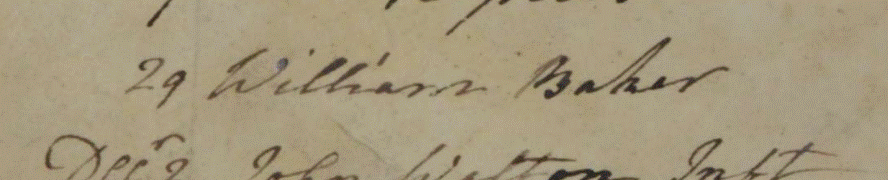
William Baker II of Fenton died on 25 November 1785. He was buried at St Peter Ad
Vincula in Stoke on Trent on 29 November 1785 (St Peter Ad Vincula, Stoke on Trent Parish Records). He was only 40 years old.

1786
Jane Baker (BAK00111) was born on 30 November 1786.
Sarah later remarried on
21 December 1793 to Ralph Bourne (d. 1835) of Hilderstone
Hall, Staffordshire, with whom she had a further family. Ralph Borne was a man
of consequence, who was also a Deputy Lieutenant and a Justice of the Peace,
who lived at Hilderstone Hall. Ralph’s father, James
Bourne had come to the area to join the pottery industry. Ralph Bourne was a
potter and a philanthropist. Ralph became partners with his step
son, the third William Baker and they traded as Bourne and Baker. The
business made staple products and exported them on a considerable scale. It was
later said that unglazed clayware was exported to
Africa. The business flourished and by 1829, they had expanded to a second
factory and acquired a flint mill. A History of
Stoke on Trent by Ward referred to very extensive earthenware
manufactories, which for many years were carried on by the firm of Bourne,
Baker and Bourne (Ralph’s brother John had also joined the business) and
raised the proprietors to the first rank among the preeminent and opulent
potters who flourished during the by-gone portion of the [nineteenth] century.
William (II) died in 1784, when his son was
only 13, and nine years later, in 1793, Sarah married again, her new husband
being Ralph Bourne, a man of some consequence, who was also Deputy Lieutenant
of the County and a J.P. and who lived at Hilderstone
Hall. Ralph's father, James Bourne (born 1718) was the third son of John Bourne
of Madeley Heath who was a landowner in Barthomley.
James came to Fenton, presumably to go into the pottery industry, married and
had three sons, Ralph, John and Charles. Ralph Bourne as well as being a potter
was a philanthropist. He had built and endowed, at his own expense, the church
at Hilderstone and, after his marriage to Mrs. Baker
extended his generosity to Fenton. He and William Baker, his step-son,
became partners in the pottery business trading as Bourne and Baker, later
taking in Ralph's other brother, John, the firm then becoming known as Bourne,
Baker and Bourne. The factory was on the North side of City Road, between Manor
Street and Fountain Street.
According to Mankowicz
and Haggar's Dictionary they made staple products exporting them on a
considerable scale. Mr. Bellyse Baker told me that the story passed down on his
side of the family was that unglazed red clayware was
made and exported to Africa! Whatever the product, the business flourished and
by 1829 they had taken over another factory opposite to the first. This is the
factory mentioned earlier which later had the iron gates with W. M. B.'s
monogram. They also acquired a flint mill near to the factories. Ward's History
of Stoke-on-Trent refers to "the very extensive earthenware manufactories,
which for many years were carried on by the firm of 'Bourne, Baker and Bourne
and raised the proprietors to the first rank among the eminent and opulent
potters who flourished during the by-gone portion of the present century [i.e.
in the nineteenth century]".
(Dodd, F (1987), The
Baker Family and Fenton, Presidential Address in Transactions 1986
to 1987, The North Staffordshire Field Club, page 12).