Richard Baker
24 May 1676 to 24 May 1749
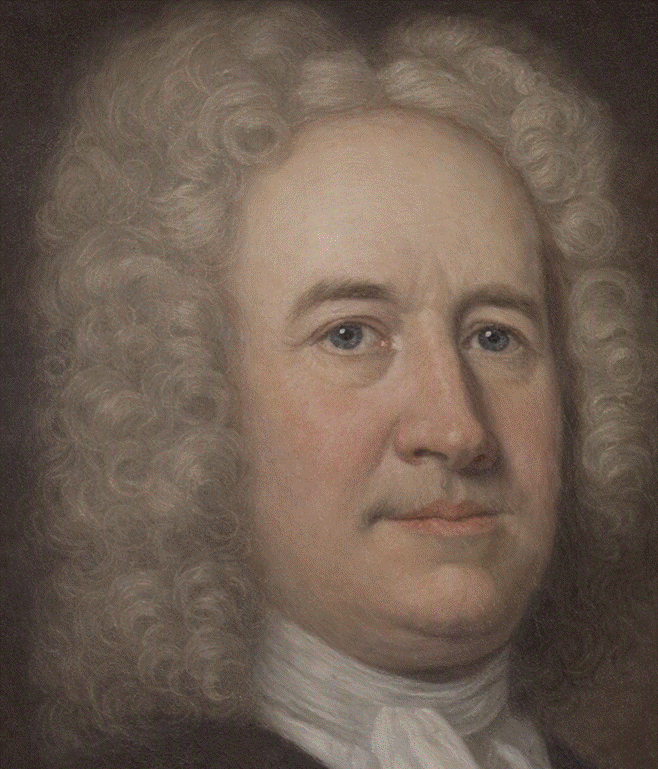
Surgeon
BAK00060
|
Return to the Home Page of the Bakers Family part of the website |
The Bakers of Highfields Story
The Story of the Dods and Bakers and of Highfields,
Fenton House and Hasfield Court. A journey through the history of Cheshire and
Staffordshire, an Anglo-Saxon nobleman who retained his lands after the
Conquest, pottery at Stoke on Trent, an encounter with Elgar, and the history
of an Elizabethan manor house at Audlem |
The family tree of the Bakers of Highfields |
The Family Tree of the Dods, predecessors to the
Bakers of Highfields |
The Bakers of Fenton House and Hasfield
Court
The Family Tree of the pottery Bakers of Stoke on Trent |
The Family Tree of the Bellyse Family |
The main part
of this website tells the story of the Farndale family from Yorkshire Descendants of Arthur Baker, the story of the
Farndale ancestry is told through the main part of this website You can also return to the Farndale
website home page |
The genealogy of the family of James Hall, linked to
the Baker family through marriage to Arthur Baker |
Headlines of
Richard Baker’s life are in brown.
Dates are in red.
Hyperlinks to
other pages are in dark
blue.
References and
citations are in turquoise.
Context and local
history are in purple.
Stepney,
London
1676
Richard Baker was the son of John
and Margaret (nee Claiton or Leighton) Baker (BAK00050), born
on 24 May 1676. He was baptised at St Dunstan, Stepney, Middlesex on 28 May 1676 (St Dunstan, Stepney Parish
Records).

Richard Baker, of St Bride’s,
London, and later of Leominster, Herefordshire, surgeon, married in 1700 (sic, recte,
1698) Mary, daughter of W Smith of St Bride’s, London, and died 24 May 1749
(will proved 7 August 1750, and had issue (Burke, John and Burke, Sir Bernard (1836)(Eighteenth Edition, 1972), Bellyse Baker of
Highfields in Burke’s Landed Gentry, Volume 3, pages
35 to 38).
Parish of
St Bride, Fleet Street, London
1698
Richard married Mary Smith, daughter of W Smith, at St Bride, Fleet
Street, London on 9 October 1698 (St Bride, Fleet Street Parish
Records).
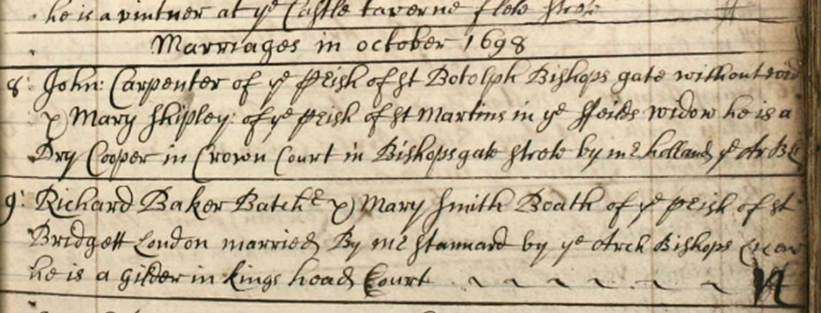
They had eight children.
Richard Baker married Mary
Smith and both she and my father were born in London as was myself in St Brides
parish. (William Baker’s Account
Book and Baker, J Bellyse
(1982), Highfields,
Audlem: Sixteenth Century Home of the Dod and Baker Families, Audlem
District History Society, page 12).
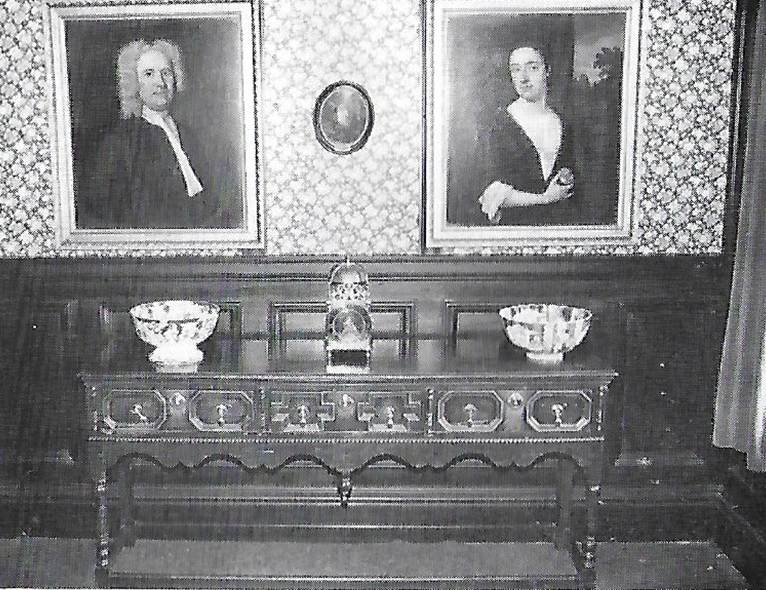
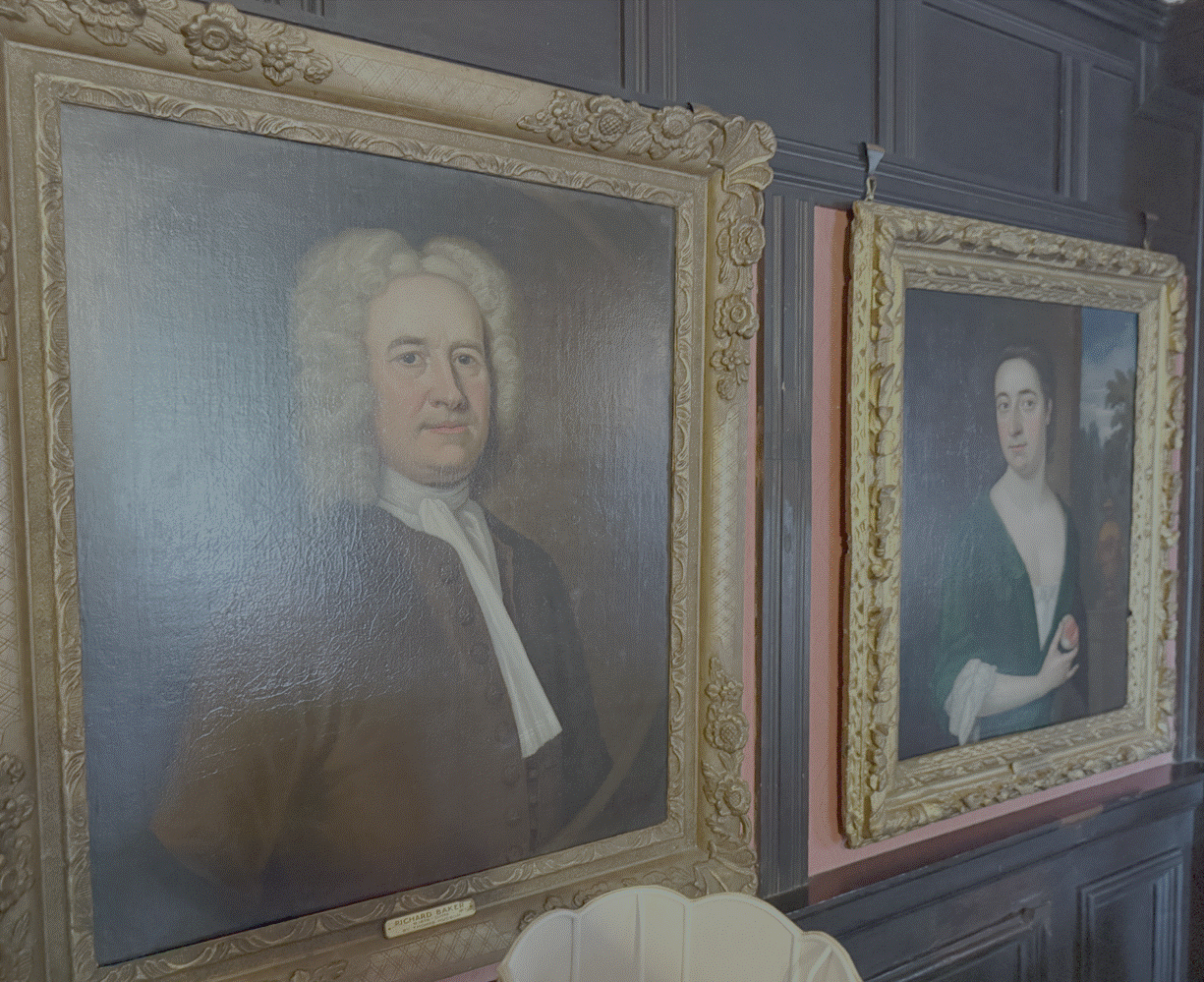
Jane Baker’s father
in law Richard
and his wife Mary. Beneath them is a 17th century dresser
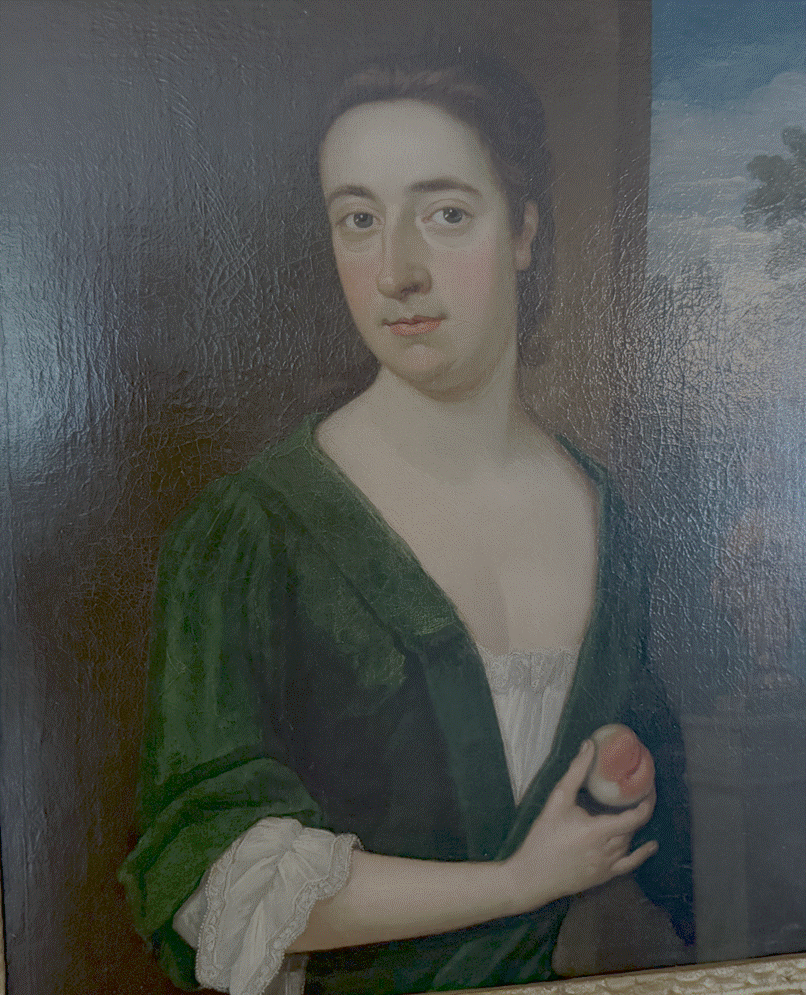
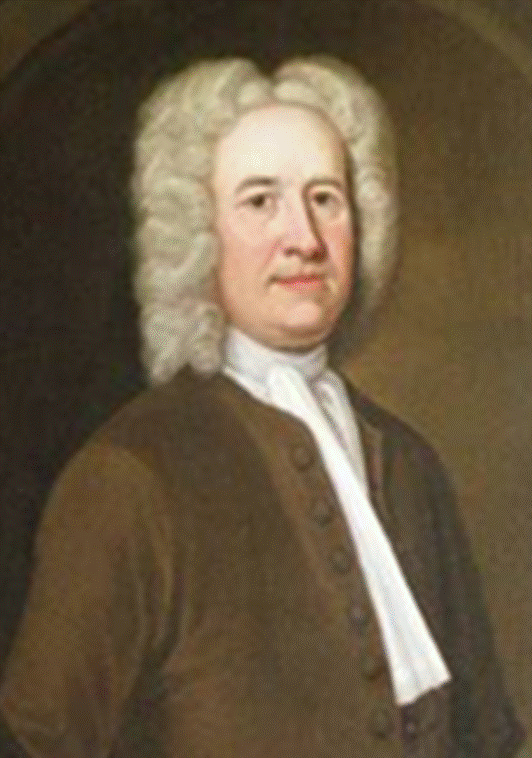
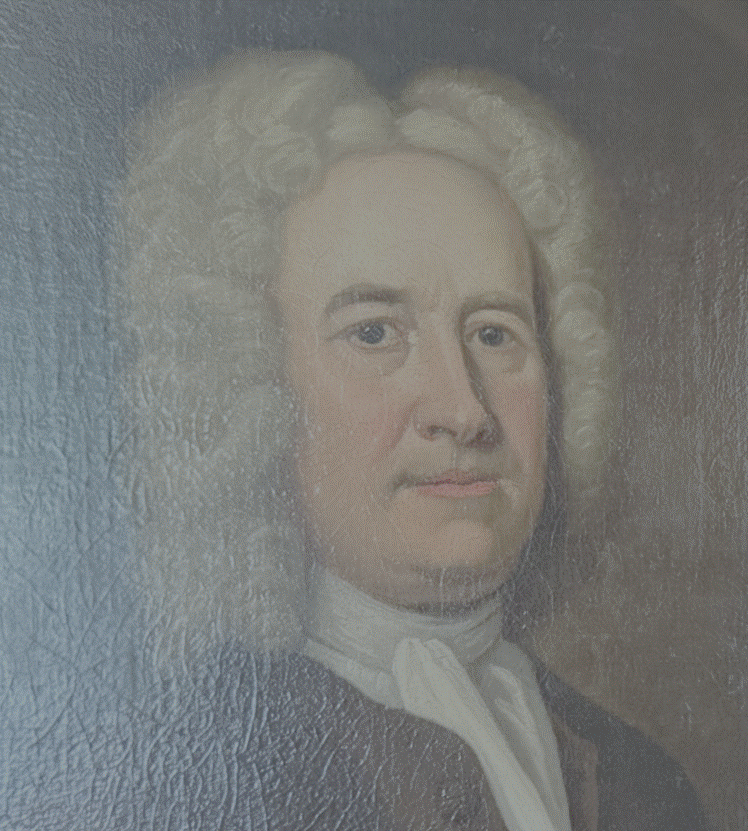
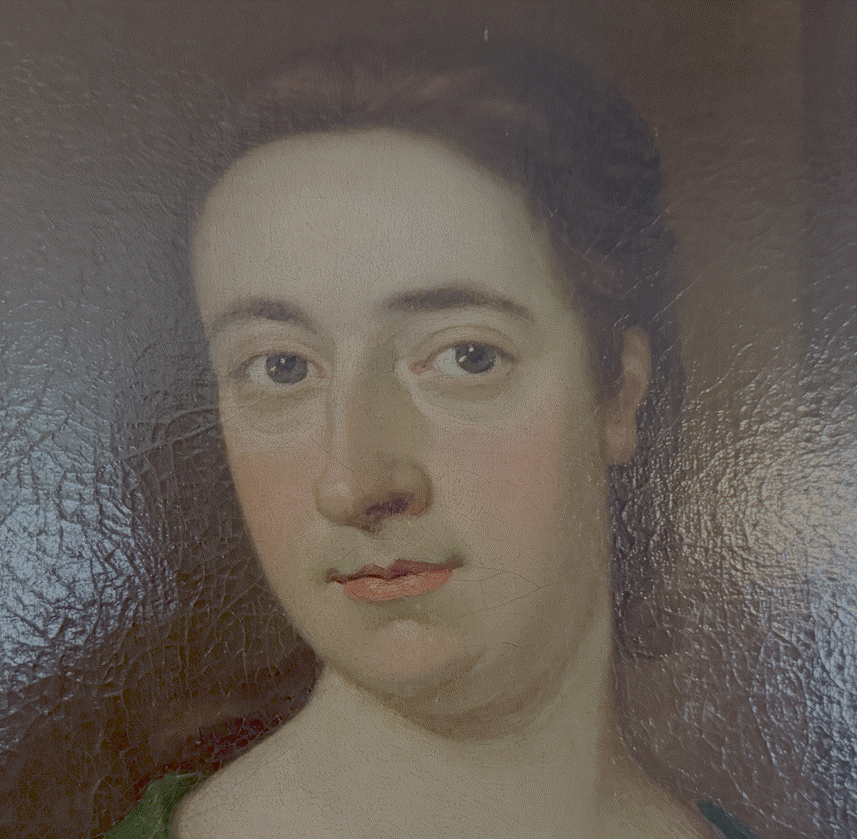
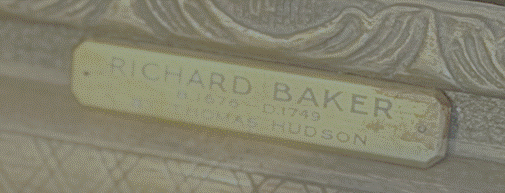
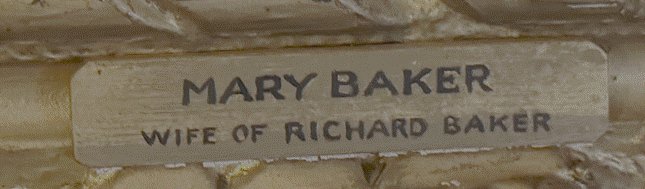
In his earlier days, he seems to
have shifted occupation, being at first recorded as a gilder and button-maker and later as a 'sea surgeon'.
He later worked as a surgeon at
Leominster, Herefordshire.
Richard Baker was
baptised at Stepney (Middx) in 1676, his parents were John and Margaret, as
Burke's suggests. But no marriage of a John Baker and Margaret Leighton is to
be found, and nor is a baptism for a John, son of Sampson Baker. It may,
however, be relevant to note that Burke's gives John a brother, Sampson Baker,
gent., of Market Bosworth (Leics) and Rugby (Warks), born about 1643, and it is
possible to find baptisms for both 'Samson', son of William & Susanna Baker
in 1637 and his brother John in 1642 in the parish registers of Market
Bosworth. William Baker of Market Bosworth was born in 1608 and was in turn the
son of Sampson Baker of Market Bosworth and his wife Millicent Gooddale, who
were married in 1605. It seems very possible that they are the true antecedents
of this family.
Very little is
known about Richard Baker (1675-1749) of Leominster, surgeon. He married at St
Bride, Fleet St., London, in 1698, and his older children were born there. He
appears to have moved to Leominster between 1705 and 1708
and he was still described as 'of Leominster' when his will was proved in 1750.
His eldest surviving son and executor was William Baker (1705-71), about whom
much more is known.
Probably the son
of John Baker (b. 1642?) of London and his wife Margaret Leighton (or perhaps
Claiton), baptised at Stepney (Middx), 28 May 1676. He seems to have shifted
occupation radically, being at first recorded as a gilder and button-maker and
later as a 'sea surgeon'. He later worked as a surgeon at Leominster (Herefs). He married, 9 October 1698 at St Bride, Fleet St.,
London, Mary, daughter of W. Smith, and had issue.
(Kingsley, Nicholas (2018), (333) Bakers
of Highfields in Landed Families of Britain and Ireland).
King’s
Road Court, London
1699
Mary Baker (1699 to 1790)(BAK00065) who
later married Captain Thorley was born in 1699 and baptised at St Bride’s,
Fleet Street. On 6
August 1699, Richard Baker was a gilder and lived at King’s Road Court, London (St Bride, Fleet Street, City of London Parish
Records).

In
1700, a gilder living near Maiden Road and the King’s Road Courthouse area in
London practiced a delicate, highly toxic craft. He applied ultra-thin gold
leaf to wood, metal, or picture frames using dangerous mercury amalgams or
sizing glues. Working by candlelight in a rapidly growing capital, he balanced
modest artisanal independence with the constant threat of poverty and
occupational illness. Gilders handled
paper-thin sheets of gold, using squirrel-hair tips and specialised glues or wet
gold techniques. They decorated ornate furnishings, coach trimmings, mirrors,
and architectural moulding for affluent Londoners or merchant classes. They
generally worked in small, poorly ventilated domestic workshops with open
charcoal fires or stoves used to dry primed surfaces.
The
area of King’s Court Road comprised tightly packed, volatile urban parishes
near Westminster. Gilders would have suffered frequent exposure to harmful
fumes and chemicals, particularly mercury if doing 'fire-gilding' on metals.
They earned a fluctuating income dependent on luxury trade demand, leaving
families vulnerable to seasonal slowdowns, high food prices, and crowd
diseases.
1701
Elizabeth Baker (BAK00066) who later
married Thomas Nash, also a surgeon, was born in 1701. On 20 March 1701
Richard Baker was a gilder and lived at Maiden Road, King’s Road Court House,
London (St Bride, Fleet Street, City of
London Parish Records).

Parish of
St Bride, Fleet Street
1702
It has been
suggested that Richard Baker became a button maker for a short time. It has
also been suggested that he began to work as a sea surgeon. It might make sense
that he returned for a while to Stepney and the London docks and gained
experience as a surgeon amongst the maritime community, possibly joining ships’
companies. However there is no evidence of this other
than the comment by Nicholas Kingsley, and given the lack of written evidence,
this was almost certainly short lived. Perhaps he gained a rough apprenticeship
in surgery before the family moved to Leominster.
Perhaps the
scientific knowledge Richard gained as a gilder was transferrable to work as a
surgeon. However in 1700, surgery in London was a
tightly regulated trade governed by the Company of Barber-Surgeons. To legally
practice surgery, draw teeth, or perform bloodletting within the City of
London, an individual had to complete a formal seven-year apprenticeship under
a licensed master and pass rigorous oral examinations. The path Richard took
from a gilder in 1699 to a surgeon in the first decade of the eighteenth
century is not therefore obvious.
Establishing a
medical or surgical practice at the turn of the eighteenth century depended
heavily on kinship, patronage, and professional reputation. A gilder’s network
would consist of furniture makers, frame carvers, architects, and church
wardens. These connections would not translate into the medical market or help
them secure patients who trusted them with a scalpel or bone saw.
Perhaps Richard
Baker gained the experience he required through a rough apprenticeship in the
early years of the War of Spanish Succession.
During
the War of the Spanish Succession (1701–1714), naval and merchant sea surgeons
working out of London were required to be examined by the Barber-Surgeons'
Company or licensed through the Navy Board.
Richard and Mary’s son, Richard
Baker (1702 to 1750) (BAK00067) who
did not marry, was born in 1702 and baptised at St Bride, Fleet Street, London
on 28 February 1702.
1705
William Baker (1705 to 1774) (BAK00068),
later a famous architect, who married Elizabeth Eykyn and later Jane Dod, was
born in 1705 and baptised at St Bride’s, Fleet Street, London on 14 October
1705.
Leominster
1708
James Baker (1708 to 1744) (BAK00069) who
later married Martha Adams, was born in 1708 and baptised at Leominster on 26
December 1708.
1710
Anne Baker (BAK00070) was born in 1710 and
baptised in Leominster on 3 December 1710.
1714
Susanna Baker (b 1714) (BAK00071) was in in 1714
and baptised at Leominster on 26 May 1714.
1715?
Henry Baker (BAK00072) was born in perhaps about
1715.
1729
Richard Baker was a surgeon in
Leominster, but also acting as a Master to an apprentice named Edward Wellington
of Hay, Breconshire (The National Archives IR
1/49 folio 144, held by Hertfordshire Archives and Local Studies, not available
at The National Archives), with reference to a
premium of £48 6s 0d.
If Richard Baker was a surgeon
master by 1729, he must have begun his practice in Leominster soon after
arriving there.
An Act passed in 1709, during
the reign of Queen Anne, placed a tax/stamp duty on apprentice indentures. The
master was required to pay a duty based on the premium or the upfront fee they
charged to take on the apprentice. In this case, Surgeon Richard Baker had to
register the hefty £48 6s 0d premium he received from Edward Wellington to
ensure the apprenticeship was legally recognized.
Rather than attending
university, a surgeon in the 1720s learned through a gruelling, hands-on
five-to-seven-year apprenticeship under an older master.
In the 1720s, the life of a
surgeon in the market town of Leominster, Herefordshire looked vastly different
from modern medical practice. During the early eighteenth century, a provincial
surgeon was not considered an elite gentleman like a university-educated
physician. Instead, they were classified as highly skilled craftsmen who worked
with their hands.
Working exclusively as a surgeon
was rare in small country towns because there were not enough operations to
make a living. A Leominster surgeon in the 1720s almost certainly operated as a
surgeon-apothecary. They had a role equivalent to today's general practitioner.
They spent their mornings dispensing herbal mixtures and compounding drugs (the
apothecary side), and their afternoons performing manual treatments like
setting fractured bones, pulling teeth, lancing boils, and dressing wounds (the
surgical side). Pain relief was virtually non-existent, and the germ theory of
disease was over a century away. Operations were terrifying and bloody affairs.
A surgeon’s reputation relied heavily on sheer speed. Amputations or bladder
stone extractions which were common procedures at the time had to be completed
in minutes to prevent the patient from dying of shock or cardiac arrest on the
table. Even if a surgery was physically successful, post-operative infection or
putrefaction was standard. A surgeon in the 1720s simply accepted that a
high percentage of patients would succumb to fever days later.
Leominster was a wealthy
agrarian hub built on the wool trade, but its population was modest. To
maintain a steady income, a surgeon would have spent hours traveling on
horseback. They rode out to surrounding Herefordshire villages
and isolated farms to attend to patients. Major surgical procedures were not
done in hospitals, as Leominster did not have a dedicated hospital until much
later, but were literally performed on patients' kitchen tables.
Unlike elite London doctors who
demanded immediate cash guarantees, a provincial surgeon operated heavily on
credit. They catered to a middle-class and working clientele. Their account ledgers
were often plagued by bad debts from local labourers, vagrants, or patients who
died before paying their bills. However, successful surgeons were highly
respected figures in the Leominster community, often leveraging their income to
venture into local politics or farming.
To legally practice in
Leominster, the surgeon had to be licensed by the local Church authorities,
specifically through the Diocese of Hereford. They had to produce testimonials
from established local medical men proving their competency. It is not clear
how Richard Baker would have gained his competency, having left London as a
gilder.
1736
On 21 September
1736, Richard Baker was a churchwarden at St James the Great, Audlem, Cheshire.
1749
Richard died on 24 May 1749, aged 73 (William Baker’s Account Book). He was buried at Leominster on
26 May 1749 (St Peter’s and St Paul’s,
Leominster).
In his accounts
books, Richard’s son William Baker later recorded some notes about his father.
He recorded his father’s death on 24 May 1749 and that he married Mary Smith
and both she and my father were born in London, as was myself, in St Bride’s
parish. The place of his father’s burial was recorded as In
the covered Isle of Leominster Church near the row of pillars and about the
middle.
William Baker’s father died on
24th May 1749 (Baker, J Bellyse
(1982), Highfields, Audlem:
Sixteenth Century Home of the Dod and Baker Families, Audlem
District History Society, page 12).
1750
His will was proved at Hereford on
7 August 1750.