The Welsh Marches
The
relationship between Cheshire and the Welsh Marches
|
Return to the Home Page of the Bakers Family part of the website |
The Bakers of Highfields Story
The Story of the Dods and Bakers and of Highfields,
Fenton House and Hasfield Court. A journey through the history of Cheshire
and Staffordshire, an Anglo-Saxon nobleman who retained his lands after the
Conquest, pottery at Stoke on Trent, an encounter with Elgar, and the history
of an Elizabethan manor house at Audlem |
The family tree of the Bakers of Highfields |
The Family Tree of the Dods, predecessors to the
Bakers of Highfields |
The Bakers of
Fenton House and Hasfield Court
The Family Tree of the pottery Bakers of Stoke on Trent |
The Family Tree of the Bellyse Family |
The main part
of this website tells the story of the Farndale family from Yorkshire Descendants of Arthur Baker, the story of the Farndale
ancestry is told through the main part of this website You can also return to the Farndale
website home page |
The genealogy of the family of James Hall, linked to
the Baker family through marriage to Arthur Baker |
Headlines of are
in brown.
Dates are in red.
Hyperlinks to
other pages are in dark
blue.
References and
citations are in turquoise.
Context and local
history are in purple.
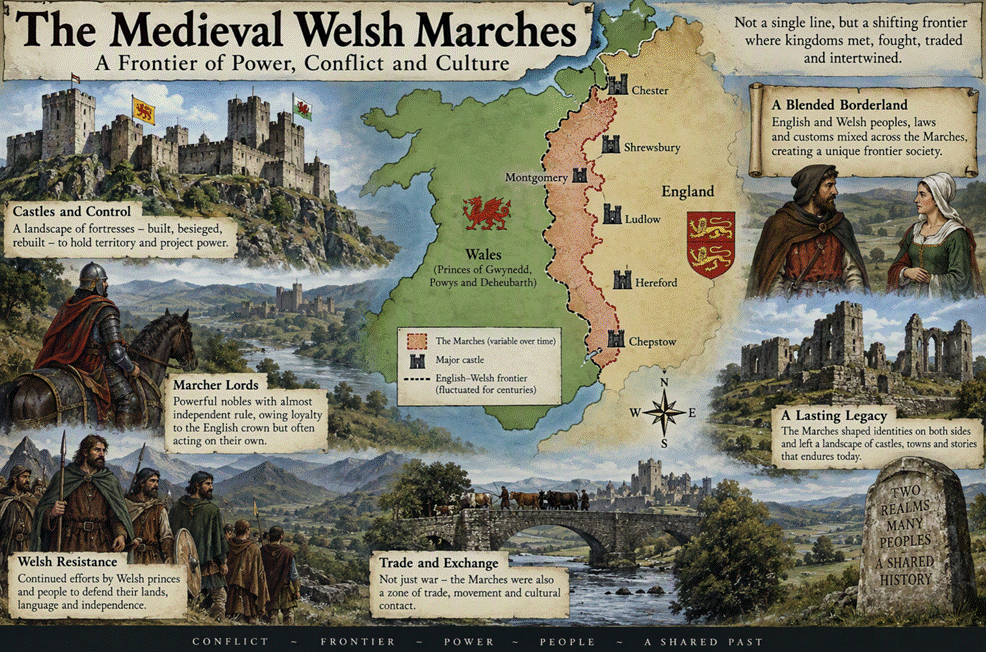
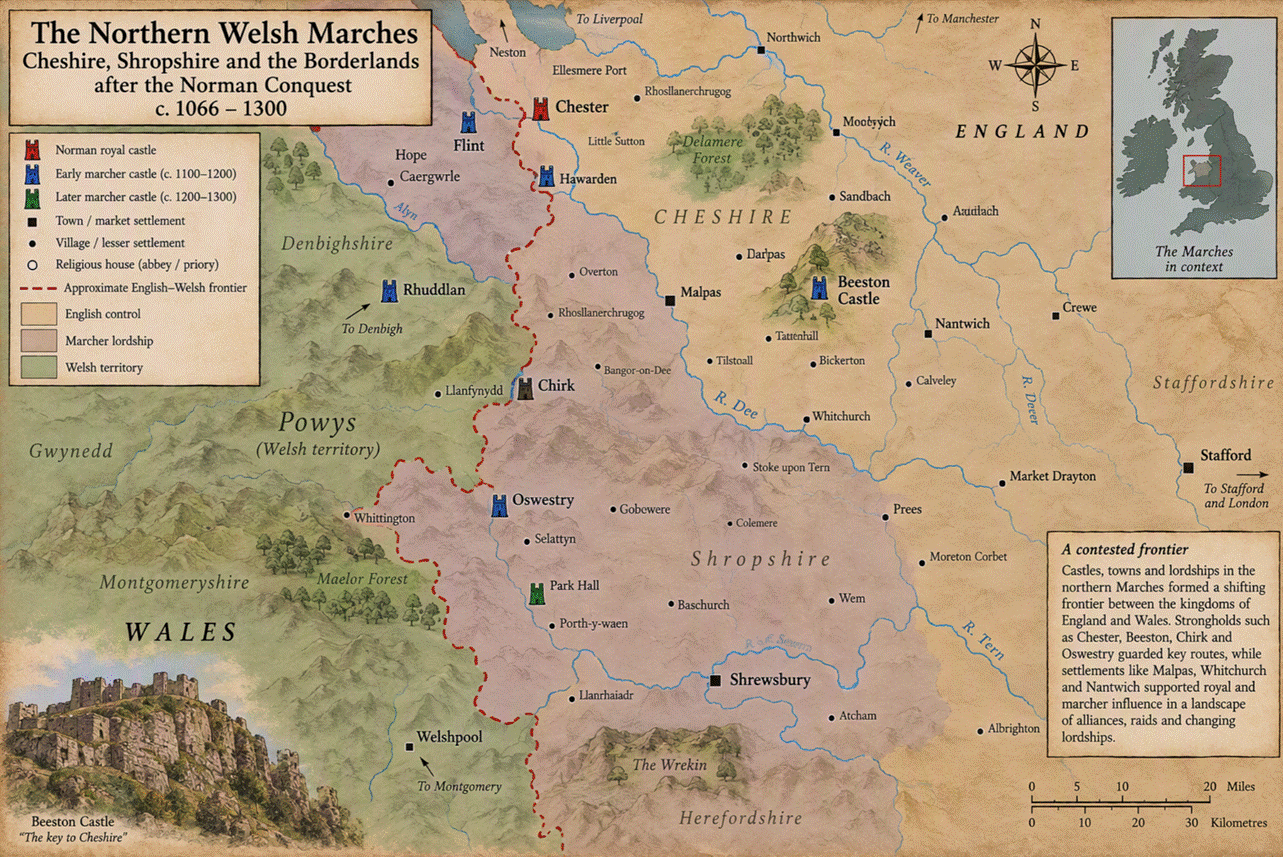
Cheshire and the Welsh Marches
Cheshire was a marcher county, with many settlements partially
wasted after William’s northern campaigns. Edge’s
entry in the Domesday Book fits this pattern as it was a functioning but modest
agricultural unit on the Welsh frontier.
Cheshire served as a crucial strategic northern anchor of the
Welsh Marches, functioning as a powerful county palatine tasked with defending
the border against the Welsh. William the Conqueror established the Earldom
of Chester as one of the three primary early earldoms, along with Hereford and
Shrewsbury, to secure the frontier. Unlike other English shires, Cheshire
held palatine jurisdiction. The Earl of Chester exercised regal powers within
the county to swiftly manage border defence and military campaigns. Bordering
the Dee Estuary, Cheshire controlled the northern approaches into Wales,
complementing the Marcher lordships further south. Cheshire,
Shropshire, Herefordshire, Worcestershire and Gloucestershire were grouped
under the jurisdiction of the Council of Wales and the Marches.
The dilemma of the Marches
|
High the vanes of Shrewsbury
gleam Islanded in Severn stream; The bridges from the steepled
crest Cross the water east and west. |
The flag of morn in conqueror's
state Enters at the English gate: The vanquished eve, as night
prevails, Bleeds upon the road to Wales. |
Ages since the vanquished bled Round my mother's marriage-bed; There the ravens feasted far About the open house of war: |
When Severn down to Build was
ran Coloured with the death of man, Couched upon her brother's grave The Saxon got me on the slave. |
The sound of fight is silent
long That began the ancient wrong; Long the voice of tears is still That wept of old the endless
ill. |
In my heart it has not died, The war that sleeps on Severn
side; They cease not fighting, east
and west, On the marches of my breast. |
Here the truceless armies yet Trample, rolled in blood and
sweat; They kill and kill and never
die; And I think that each is I. |
None will part us, none undo The knot that makes one flesh of
two, Sick with hatred, sick with
pain, Strangling-When shall we be
slain? |
When shall I be dead and rid Of the wrong my father did? How long, how long, till spade
and hearse Put to sleep my mother's curse? |
(Housman, AE
(1919), The Welsh Marches, from The Shropshire
Lad, Part 28).
This passage from the Shropshire
Lad explores violence, mixed heritage, and internal psychological conflict, set
along the historically turbulent border region of the Marches. The poem uses
the landscape to draw out a brutal ancestral legacy that continues to torment
the speaker. The poem opens in
Shrewsbury, where the morning sun rises over the English gate like a
conquering army, while the setting night bleeds onto the road toward
Wales. The narrator traces his own lineage back to the medieval wars between
the Saxons and the native Celts when a Saxon warrior raped his Celtic mother, The
Saxon got me on the slave, directly on top of her own brother's fresh
grave, while the River Severn ran red with blood. Because he carries the blood of
both the conquering Saxon, and the conquered Celt, his own biology is a
battlefield where two opposing factions cease not fighting.
Anglo-Saxon Period
The Welsh Marches in Anglo-Saxon
Britain were the frontier borderlands between the Anglo-Saxon kingdoms,
especially Mercia, and the independent Welsh principalities. Mercia was the last of the major
Anglo-Saxon kingdoms to emerge. Its name derives from mierce,
or march, reflecting that they were a border people between the Britons and the
Anglo-Saxon kingdoms.
Built in the late eighth century,
the linear earthwork ditch and bank that ran alongside the border, probably
built by King Offa of Mercia, is known as Offa’s Dyke. It served as a clear territorial
boundary barrier, probably more symbolic than defensive, between Anglo-Saxon
England and Wales. Wat’s dyke ran north from Offa’s Dyke. Strategic trading and
defensive hubs, including Shrewsbury and Hereford, were fortified and
garrisoned by the Mercians to watch over the frontier.
1040s
Even before the conquest of 1066,
Edward the Confessor settled Norman knights in the Marches, such as at
Hereford, to manage the restless border. Before the 1066 Norman Conquest, Edward
allowed favourites like Ralph the Timid to introduce continental style
motte-and-bailey fortifications to the border.
1055
The powerful Welsh king, Gruffudd
ap Llywelyn, united Wales and raided deep into English territory, sacking
Hereford in 1055. Edward the Confessor
relied on earls like Harold Godwinson to launch retaliatory campaigns into
Wales, ultimately subduing Gruffudd by 1063.
Norman Conquest
However, the fully autonomous Marcher
Lordships system followed, after the Norman Conquest, when William the
Conqueror militarised the frontier on a much larger scale.
1066
The Welsh Marches were not just a boundary line on a map, but a
broad zone of lordships stretching along much of the England-Wales border.
Following 1066, Norman rulers recognised that controlling England required them
to secure against the threat from Wales, yet rather than conquering Wales
directly they relied heavily on powerful Norman nobles who established semi-independent
territories along the frontier.
There were two distinct zone in the Welsh Marches.
The Englishry, Englescherie, was
the lowland, economically more developed, heavily colonised areas, often to the
east. It was inhabited by Anglo-Norman knights, English settlers and foreign
traders, including Flemins. It was governed by Anglo-Norman common law,
organised on English manorial lines and relied on arable farming, feudal labour
and market commerce.
The Welshry, Walleria,
was upland, mountainous and culturally indigenous. It was regulated by Welsh
customary law of Hywel Dda. The Welsh paid customary rents including
food tribute, gwesta, to their Marcher lord.
It principally relied on pastoral farming of cattle and sheep. Marchia
Wallie was distinguished from Pura Wallia, and
was politically separate from both Wales and from England. The indigenous
population of modern Wales did not initially see themselves as Welsh, but rather
as Britains, the descendants of the often wealthier Roman-British
population who had migrated westwards in the face of evolving Anglo-Saxon
dominance to the east. It was the Anglo-Saxons who differentiated themselves
from these indigenous Britains, who applied the Old English word wealas, meaning foreigner, to the Welsh and the
Corn-wealas.
Although they retained some customary rights, the indigenous Welsh
were a conquered, subservient population who faced systemic discrimination.
Because the King's writ did not run in the Marches, the indigenous Welsh
could not appeal to the English Crown or English common law courts if they were
mistreated or exploited by their Marcher lord.
The Marcher lords were barons of England and held their lordships
from the king, yet they were not subject to many of the institutional and legal
structures of the English Crown. Within their lordships, they claimed and
exercised many of the powers which the king exercised in his kingdom. Marcher lords
ran their own courts, collected their own taxes, and raised private armies,
ruling much like independent kings. Marcher lordships operated with
extraordinary autonomy. Their rulers exercised powers that elsewhere belonged
largely to the king. They could build castles, wage local war, establish towns,
administer justice and create their own political networks. As a result, the
Marches developed into one of the most distinctive regions in medieval Britain.
The Norman advance into Wales was never straightforward. Unlike
England, which experienced relatively rapid conquest, Wales presented
geographical and political challenges. Mountainous terrain and the resilience
of Welsh rulers ensured that conquest remained incomplete for generations. The
Marcher lords occupied a world of continual negotiation, alliance-making and
conflict. Some lordships prospered, others collapsed, and boundaries shifted constantly.
The frontier became a meeting place of Welsh and Norman cultures rather than
merely a dividing line between them.
Alongside new castles, towns were populated by settlers from
England and elsewhere, enjoying privileges different from those of the
surrounding Welsh population. In many places distinct legal systems coexisted,
creating a patchwork of rights and obligations that reflected the frontier's
mixed character.
There was a cultural complexity to the region. Languages, stories,
laws and customs crossed the border in both directions. Literary culture
flourished in this contact zone, producing a distinctive frontier identity.
The most significant magnates entrusted with the area of the
Marches after the Conquest were William FitzOsbern, Earl of Hereford; Roger de
Montgomery, Earl of Shrewsbury; and Hugh d'Avranches,
Earl of Chester.
Hugh d'Avranches, 1st Earl of Chester (c
1047 – 1101), was one of the most powerful and brutal early Norman magnates appointed
by William the Conqueror to secure the Welsh Marches. Nicknamed Lupus,
the Wolf, for his savage ferocity against the Welsh, and le Gros, the
Fat, due to his gluttony, he played a pivotal role in establishing Norman
dominance on the Anglo-Welsh frontier.
In 1071, King William granted Hugh the Earldom of Chester with
County Palatine status. Because Cheshire was a highly vulnerable frontier zone,
Hugh was given extraordinary royal privileges. He could appoint his own hereditary
barons, execute his own laws, and hold lands across 20 counties. This gave him
near-regal autonomy to govern independently of the English Crown to efficiently
contain and subdue the Welsh kingdoms. Hugh viewed his positioning along the
Marches not just as a defensive assignment, but as a launchpad for conquest.
Alongside his aggressive cousin, Robert of Rhuddlan, Hugh spearheaded campaigns
deep into Northern Wales. Together, they subdued a significant portion of the
Kingdom of Gwynedd. Following Robert's death in 1093, Hugh took direct control
of these advance territories, temporarily making himself the virtual ruler of
most of North Wales.
The Mortimers of Wigmore became one of the greatest Marcher
dynasties and exemplified the extraordinary independence of the Marcher lords.
They could raise armies, administer justice, build castles and act in many
respects like rulers in their own right. Established
following the Norman Conquest, the family's primary caput, seat, was
Wigmore Castle in north Herefordshire. Ralph Mortimer took possession of
numerous regional manors recorded in the Domesday Book by 1074. Generations of
Mortimers balanced local conflicts against Welsh princes, such as Llywelyn
ap Gruffydd, with vital military and judicial support for English monarchs
like Henry III and Edward I.
The FitzAlan family, later Earls of
Arundel, formed another long-lasting Marcher dynasty centred on Oswestry and Clun.
Like other Marcher families, they maintained castles, exercised local authority
and played an important role in the politics of the borderlands.
1067
The early Earldom of Chester was one of the most powerful and
autonomous feudal lordships in medieval England, functioning as a County
Palatine on the volatile Welsh border. Gerbod the Fleming (Chester earldom from
1067 to 1070) was appointed as the first Earl of Chester by William the
Conqueror. Gerbod was captured in France at the Battle of Cassel. King William
declared his title vacant in 1070/1071.
1071
Hugh d'Avranches, Hugh Lupus
(Chester earldom from 1071 to 1101), William's nephew and the first of the
great Norman line in its second creation held near-regal powers, governed the
Welsh Marches, and amassed vast estates across England.
1102
In a campaign in 1102 to 1103, Henry I broke the power of the
rebellious Montgomery family at Shrewsbury. He reorganized the central Marches and
asserted direct royal influence over border regional struggles.
1106
Henry de Beaumont was granted the Lordship of Gower, expanding the
southern March westward into southwest Wales. Concurrently, construction began
on stone strongholds like Ogmore Castle.
1111
Between 1111 to 1114 there was a consolidated Norman push into
North and South Wales. Henry I encouraged the
colonisation of the southern Marches, settling thousands of Flemish, Breton,
and English immigrants to secure farming and trade.
1120
Richard d'Avranches (Chester earldom
from 1101 to 1120), the son of Hugh d'Avranches, died
tragically alongside his wife in the sinking of the White Ship in 1120, leaving
no legitimate heirs.
Ranulf de Meschines (Chester earldom
from 1120 to 1129), a cousin of Richard d'Avranches,
succeeded to the earldom by royal grant.
1129
Ranulph de Gernon (Chester earldom from 1129 to 1153) was known as
a volatile political player during the civil war known as The Anarchy, switching
sides between King Stephen and Empress Matilda.
1135
Following the death of Henry I, civil war, The Anarchy,
dominated the politics in England. Native Welsh rulers launched significant
counter-offensives. At the Battle of Llwchwr in 1136,
Welsh forces defeated the Anglo-Norman Marchers in the south, fracturing Norman
control.
1140s
Taking advantage of weakened royal authority under King Stephen,
Marcher lords independently expanded their legal jurisdictions eastward into English
shires and solidified their private castles.
1157
Henry II launched major royal campaigns through the Marches to
subdue the rising power of Owain Gwynedd and Rhys ap Gruffydd, The Lord Rhys.
1171
Henry II changed strategy and signed a peace agreement with The
Lord Rhys, recognising him as Justice of South Wales. This stabilised the
southern March and led to an era of peaceful coexistence and trade between
Welsh kingdoms and Marcher boroughs.
1173
Hugh de Kevelioc (Chester earldom from 1153
to 1181) participated in the great revolt against King Henry II in 1173 to
1174, resulting in temporary imprisonment before his lands were restored.
1181
Ranulf de Blondeville (Chester earldom
from 1181 to 1232) was one of the most influential magnates of the realm under
Richard the Lionheart, King John, and Henry III. He died without a direct male
heir in 1232.
1200
King John courted Llywelyn ap Iorwerth, Llywelyn the Great, of
Gwynedd. Llywelyn married John’s illegitimate daughter, Joan, shifting the
geopolitical balance of the northern Marches.
1211
In 1211 to 1212, King John invaded Wales through the Marches,
briefly forcing Llywelyn to submit before Marcher lords. Native Welsh switched
alliances due to John’s tyranny.
1215
Clauses 56, 57, and 58 of Magna Carta specifically
addressed the Marches, guaranteeing that Welshmen dispossessed of lands or
liberties by the English king or Marcher lords must be restored according to
the Law of the March.
1218
Under the Treaty of Worcester, the young Henry III officially
recognised Llywelyn the Great’s custody over key Marcher lands, including
Cardigan and Carmarthen castles.
1230s
Violent frontier wars broke out between Llywelyn and the powerful
Mortimer and Marshal families. Llywelyn burned Marcher towns like Radnor and
Montgomery to halt the construction of new royal border stone castles.
John the Scot (Chester earldom from 1232 to 1237) was the nephew
of Ranulf de Blondeville, who briefly held the title until
his death without children in 1237, after which the crown annexed the earldom
to prevent it from being divided among female heirs.
1240
Llywelyn the Great died. His successor, Dafydd ap Llywelyn, faced
immediate pressure as Henry III used the succession to reclaim crown lands and
reinforce Marcher strongholds.
1244
From 1244 to 1246, Dafydd launched a fierce border war against the
Marcher lords but died unexpectedly in 1246 without a clear heir.
1247
The Treaty of Woodstock forced Gwynedd to cede all lands east of
the River Conwy to the English Crown. This permanently partitioned Wales,
leaving the Marcher lords securely entrenched across roughly two-thirds of the
country.
1254
Henry III of England granted his eldest son, the future Edward I,
extensive lands including Chester and royal territories in Wales, making Edward
a direct player in Marcher politics.
1255
Llywelyn ap Gruffudd defeated his brothers at the Battle of Bryn Derwin,
securing sole mastery of Gwynedd. He immediately set his sights eastward on
reclaiming lands lost to the Marcher lords and the English Crown.
1256
Llywelyn launched a massive blitz into the Perfeddwlad,
the Four Cantrefs, in northeast Wales, overrunning Prince Edward's lands. He
pushed deep into the Marches, striking into Powys and parts of the Middle
March.
1257
A royal English army led by Henry III attempted a
counter-offensive but failed spectacularly. Llywelyn allied with other native lords,
systemically dismantling English administrative control along the border.
1258
Llywelyn extracted homages from other native rulers and formally
proclaimed himself Prince of Wales.
1262
Seizing upon the outbreak of civil war in England, the Second
Barons' War, Llywelyn attacked the Marcher lordships of the Mortimer family. He
captured and destroyed the key strongholds of Cefnllys,
Radnor, and Builth, shifting the border eastward.
1263
Llywelyn formed a strategic alliance with Simon de Montfort, the leader
of the English baronial rebellion against Henry III.
1264
Llywelyn and de Montfort launch joint campaigns against royalist
Marcher lords. They ravaged the lands of Roger Mortimer and capture Hereford.
1265
In June, the alliance was formalised in the Treaty of Pipton, where de Montfort, acting in the captive King
Henry’s name, recognised Llywelyn as Prince of Wales and ceded major Marcher
strongholds to him.
In August, the baronial cause collapses when Simon de Montfort was
killed at the Battle of Evesham. Despite his ally's defeat, Llywelyn remains
deeply entrenched in the Marches.
1266
Llywelyn continued to press his advantage, invading the Marcher
lordship of Brecon and crushing a local force at Bryngwin.
1267
In September, recognising that he could not defeat Llywelyn by
force while England was recovering from civil war, Henry III signed the Treaty
of Montgomery. In exchange for an enormous financial tribute, the English Crown
formally recognised Llywelyn as the Prince of Wales and granted him direct
lordship over vast swaths of the Marcher lands, including Builth, Brecon, and Gwerthrynion. This marked the historic high-water mark of
native Welsh power in the borderland.
1268
The treaty failed to bring lasting peace. Displaced Marcher lords
begin a bitter, covert counter-offensive. Gilbert de Clare, Earl of Gloucester,
began constructing the massive Caerphilly Castle to halt Llywelyn's aggressive expansion
into Glamorgan. Llywelyn attacked and burned the incomplete castle in 1270, but
de Clare immediately rebuilt it.
1272
Henry III died. The fiercely ambitious Prince Edward ascended the
throne as Edward I. Trapped in deep financial trouble from squeezing his
subjects to pay for the Treaty of Montgomery, Llywelyn stopped making payments
to the English Crown. The stage was set for the total collapse of diplomacy and
the eventual Edwardian conquest of Wales.
When Edward I succeeded to the throne in 1272 relations with the
Welsh Princes were poor. Their leader refused to meet the king, even at his
coronation. Edward launched a campaign against the Welsh in 1276. The Welsh
Marches served as the military staging ground, defensive shield, and source of
manpower for Edward I’s campaigns into Wales. During the 1277 and 1282–1283
campaigns, Edward used the Marches as an advanced assembly area to launch
coordinated multi-pronged ground attacks into the heart of Wales. He made
Chester Castle his base. Beeston Castle was used as a supply base for Edward’s
troops. Experienced infantry and cavalry were raised from the border counties
such as Cheshire, Shropshire, and Herefordshire.
While the Marches initially acted as the primary vehicle for royal
expansion, Edward's direct royal lordships and massive stone castles ultimately
overshadowed the independent power of the traditional Marcher aristocracy.
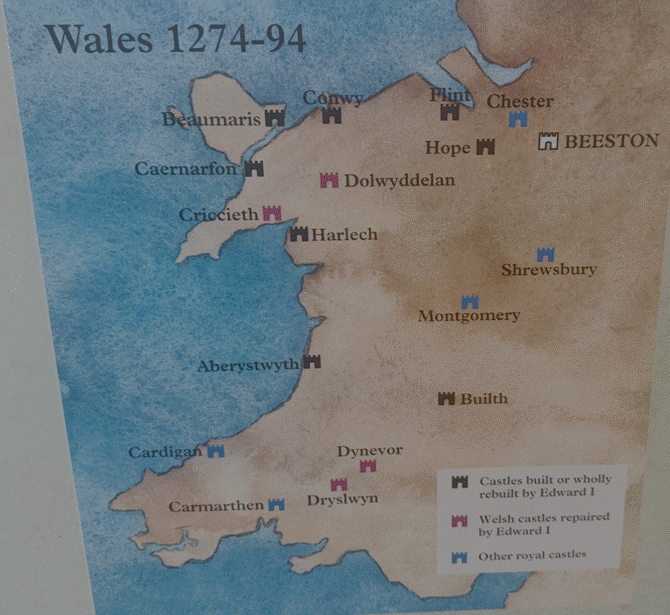
Edward I’s castles
The First Welsh War and Marcher Support (1276–1277)
1276
Edward I declared war
on Llywelyn ap Gruffudd after the prince refused to pay homage.
1277
Marcher Lords and paid royal troops deployed early in south and
mid-Wales, securing quick surrenders from native rulers. Edward followed with a
massive northern expedition, resulting in the Treaty of Aberconwy.
The Second Welsh War and Royal Control (1282–1284)
1282
Dafydd, Llywelyn's brother, launched raids into the English Marches,
reigniting conflict. Llywelyn was killed in battle later that year.
1283
The final resistance was crushed with the capture and execution of
Dafydd ap Gruffudd. Edward began building massive ring castles, such as Conwy
and Harlech, to secure dominance.
1284
The Statute of Rhuddlan reorganized the governance of Wales,
bringing lands under direct crown authority while defining the legal limits and
jurisdictions of the Marcher lordships.
The young prince Edward, the future Edward II was born at Caernarfon
on 25 April 1284, following his father's conquest. He grew up with strong local
networks and a lifelong affinity for the Welsh.
Asserting Royal Authority over the Marches (1286–1295)
1286
Edward left for Gascony. During his absence, the fragile peace
among the semi-autonomous Marcher Lords began to fracture.
1292
Edward asserted his sovereign right to hear complaints within the
Marcher lordships, challenging the traditional independent privileges of the
Marcher barons.
1294
A widespread Welsh rebellion broke out against English
administration, requiring Edward to mount another winter campaign to restore
order.
1296
Following the rebellion, a period of military stabilisation
settles over the borderland. The Marcher Lords firmly re-assert their
authority, relying on the distinct legal system known as the Laws and
Customs of the March, rather than English common law.
1301
In February 1301 the prince Edward was formally invested as the first
English Prince of Wales. While he directly ruled the crown lands in the north,
the southern Marches remained under the iron grip of independent Marcher Lords.
1307
In the early years of Edward II’s reign, Marcher politics remained
secondary to his conflicts with English barons over his favourite, Piers
Gaveston.
1314
The young Earl of Gloucester and Lord of Glamorgan were killed at
the Battle of Bannockburn. The massive, strategic Marcher lordship of Glamorgan
temporarily reverted to the crown. Edward appointed a heavy-handed
administrator, Payne de Turberville, to oversee it.
1316
From January to March 1316, there was a fresh revolt by Llywelyn
Bren. Angered by Turberville's systemic removal of Welshmen from local offices,
Welsh nobleman Llywelyn Bren appealed to Edward II. Edward dismissed him and
threatened him with sedition. In response, Bren launched a swift revolt,
placing Caerphilly Castle under siege. Edward coordinated with neighbouring
Marcher Lords to crush the rebellion. Llywelyn Bren surrendered and was
imprisoned in the Tower of London.
1317
Edward divided the de Clare estates among the late Earl's sisters.
Glamorgan was awarded to Eleanor de Clare and her husband, Hugh Despenser the
Younger, the King’s aggressive new royal favourite.
1318 to 1320
Backed blindly by Edward II, Hugh Despenser used royal leverage to
systematically blackmail, cheat, and dispossess his neighbouring Marcher Lords.
He seized lands belonging to his brothers-in-law, Hugh Audley and Roger Damory,
and aggressively threatened the borders of powerful dynasties like the
Mortimers of Wigmore and Chirk.
1318
Despenser took custody of Llywelyn Bren, brought him back to
Cardiff, and had him brutally hanged, drawn, and quartered without a royal
trial. This horrific breach of law outraged both the native Welsh and the
Marcher Lords, solidifying a coalition against the King and Despenser.
1321
A massive coalition of Marcher Lords, led by Roger Mortimer of
Wigmore, the Earl of Hereford, and the Earl of Lancaster, launched a
pre-emptive strike known as the Despenser War. They ravaged Despenser's lands
across South Wales and Glamorgan.
In August 1321, the Marcher army marches on London. Holding the
military upper hand, they forced a reluctant Edward II to formally banish both
Hugh Despenser the Younger and his father.
In the winter of 1321 to 1322, Edward used a dispute over Leeds Castle
in Kent to recall the Despensers and raise an army. Moving with
uncharacteristic speed, Edward marched his royal forces directly into the Welsh
Marches.
1322
In January 1322, the Mortimers Surrendered. Caught off guard by
the King's winter campaign and abandoned by the Earl of Lancaster, the powerful
Roger Mortimer of Wigmore and Roger Mortimer of Chirk surrendered to Edward at
Shrewsbury. Edward imprisoned them in the Tower of London.
In March 1322, Edward chased the remaining rebels north and at the
Battle of Boroughbridge, the Earl of Lancaster was defeated and executed,
giving Edward II absolute, tyrannical control over both England and the
Marches.
With the traditional Marcher Lords dead, exiled, or dispossessed,
Edward allowed Hugh Despenser to accumulate a massive territory encompassing
virtually the entire southern coast of Wales.
1323
In August 1323 Roger Mortimer of Wigmore successfully escaped from
the Tower of London and fled to France. Edward used his fiercely loyal native
Welsh networks, including knights like Sir Gruffydd Llwyd and Sir Rhys ap
Gruffydd, to hunt for him, but Mortimer eluded capture.
1326
In September 1326, Queen Isabella and Roger Mortimer, by then
lovers, invaded England to depose the King and the Despensers.
In October to November 1326, as his regime collapses, Edward II
fled to where he believed his support was strongest; deep into the Welsh Marches
and South Wales. He attempted to rally Welsh levies but was hunted down.
On 16 November 1326, Edward II and Hugh Despenser the Younger were
captured by Mortimer's forces near Llantrisant, Pantybrad.
Despenser was promptly executed.
1327
Edward II was forced to abdicate in January and imprisoned at
Berkeley Castle, just across the Severn estuary from the Marches, where he was
murdered in September 1327.
In the aftermath, Roger Mortimer claims vast swaths of the Marches
for himself and creates the title Earl of March.
Following the forced abdication of Edward II, the powerful Marcher
lord Roger Mortimer, 1st Earl of March, became the de facto ruler of
England alongside Queen Isabella. He used his brief period of dominance to
aggressively expand his Marcher estates.
1330
The young Edward III seized power, executing Mortimer and
temporarily forfeiting the family's expansive border territories.
1349
The Black Death swept violently through Wales and the Marches. Killing
up to 40% of the population, the plague triggered immense economic strain,
acute labour shortages, and widespread social unrest, fundamentally fracturing
the feudal economy of the Marcher lordships.
1354
Edward III fully restored the Mortimer inheritance to Roger's
grandson. Over the subsequent decades, the Mortimers of Wigmore consolidated an
unrivalled empire of border estates, making them arguably the most powerful
magnates in the realm.
1390
During the late 1390s, Richard II transformed Cheshire and the
Welsh Marches into his personal military and political power base. This
geographic alliance was a cornerstone of his increasingly autocratic rule,
often termed his tyranny, and ultimately played a central role in his dramatic
downfall in 1399.
Cheshire already held a unique constitutional status as a County
Palatine, meaning it possessed its own legal autonomy and sat outside the traditional
English parliamentary taxation system. Because there was no active Prince of
Wales for much of his reign, Richard ruled the earldom directly.
1397
In 1397, Richard took the unprecedented step of elevating the
county to the Principality of Chester, declaring himself the Prince
of Chester. He fused it with newly confiscated lands from his political
rivals, the Lords Appellant, along the Welsh border. This turned the region
into a highly fortified, loyal crown citadel.
Richard heavily courted the local gentry, confirming Chester’s
ancient liberties, granting extensive royal patronage, and keeping local tax
burdens light compared to his predecessors.
To enforce his absolute authority on a deeply hostile English
parliament and nobility, Richard raised a private army entirely from the
northwest. He recruited an elite, full-time personal
bodyguard composed of hundreds of Cheshire
longbowmen. In 1397 to 1398, Richard used these fierce Cheshiremen to surround Parliament at Westminster,
literally drawing their bows to ensure lawmakers condemned his political
enemies. The rest of England deeply loathed and feared the Cheshire guard.
Chroniclers noted that the archers behaved with immense insolence, secure in
the knowledge that they had the king's absolute backing. They were so close to
Richard that they broke rigid medieval court etiquette, familiarly addressing
him by the nickname Dycum.
Trusting the region implicitly over London, Richard moved the
massive royal treasury out of the capital and secured it in the formidable
border fortresses of Holt Castle and Beeston Castle in the Marches.
1399
When his cousin Henry Bolingbroke (invaded England in 1399 while
Richard was campaigning in Ireland, Richard immediately sailed back to Wales,
planning to fall back on his loyal Cheshire and Marcher network. Despite
Richard's strategic preparation, his wider army dissolved in panic as
Bolingbroke swept across England. Richard’s Cheshire bodyguard remained
fiercely loyal to the bitter end, escorting him to Flint Castle in the Marches,
where Richard was ultimately trapped and forced to surrender his crown to
Bolingbroke.
Henry Bolingbroke overthrew Richard II to become Henry IV. Because
Bolingbroke held the massive Duchy of Lancaster, which included major southern
Marcher lordships like Monmouth and Kidwelly, the English
Crown itself suddenly became one of the dominant landowners inside the March.
1400
Even after Richard's deposition and subsequent death in 1400, the
region's fierce Ricardian loyalty lingered. Cheshire erupted into a pro-Richard
rebellion in early 1400, and many Cheshire archers later died at the Battle of
Shrewsbury in 1403, fighting against the new Lancastrian dynasty.
The last major war for Welsh independence plunged the Marches into
brutal warfare. Owain Glyndŵr sacked border towns
and targeted Marcher strongholds like Clun and Radnor.
1402
In a notable alliance shift, Sir Edmund Mortimer, captured by Glyndŵr, defected to the rebel cause and married Glyndŵr's daughter, forming a coalition aimed at
splitting England and Wales among themselves.
1410
The rebellion collapsed, leaving the Marches physically
devastated, economically ruined, and under severe racial and legal
restrictions.
1425
Edmund Mortimer, 5th Earl of March, died without issue. His massive
lands and title passed to his nephew, Richard, Duke of York. This transferred
the immense military and territorial weight of the Marches directly to the
House of York, in the build up to the Wars of the Roses.
1455
Because the regional lords controlled massive, private armies
exempt from the King's writ, the Marches became the critical military power
base for both Yorkists and Lancastrians during the Wars of the Roses.
1461
Edward, Earl of March, Richard of York's heir, won the decisive Battle
of Mortimer's Cross in Herefordshire. He ascended the throne as Edward IV,
meaning the vast Mortimer Marcher lordships were permanently annexed into the
Crown property.
1472
To govern the fractured borderlands and curb endemic lawlessness,
Edward IV established the Council of Wales and the Marches at Ludlow Castle.
Originally acting on behalf of his infant son, the Prince of Wales, this
institutional body marked the first major step toward replacing individual
baronial tyrannies with organised royal bureaucracy.
1485
Change came under the Tudor monarchy. The Welsh-descended Henry
Tudor won the crown at Bosworth Field. Through his victory and the high
mortality rate of old noble lines during the wars, nearly all the major Marcher
lordships were consolidated under the Crown. The autonomous frontier lordships
disappeared as political entities. The unique, semi-independent military
function of the Marcher Lords was effectively over, leading directly into the
Tudor Acts of Union in the 1530s, which integrated Wales more fully into the
English state and reduced the special privileges that had long distinguished
the Marches.
1569
Unlike many other marcher lordships, Cheshire was formally
exempted from the authority of the Council of Wales and the Marches, later on during the Tudor period in 1569.
Bibliography
Davies, RR (1978), Lordship and Society in the March of Wales
1282 to 1400, Oxford University Press. The book explores how English aristocratic
families governed semi-autonomous private territories along the border between
England and Wales.
Housman, AE (1919), The Welsh Marches, The Shropshire
Lad, Part 28.
Hume, Philip (2021), The Welsh Marcher Lordships I: Central and
North, Logarston Press. This
volume covers the traditional Welsh counties of Radnorshire, Montgomeryshire,
Denbighshire, Flintshire, together with the adjacent lordships in Shropshire
and Herefordshire, that also became Marcher lordships.
Lieberman, Max (2018), The March of Wales 1067 to 1300: A
Borderland of Medieval Britain, University of Wales Press. The
book provides a concise and comprehensive look at the forty-some castle-centred
lordships that developed along the Anglo-Welsh border following the Norman
Conquest.
Lieberman, Max (2010), The Medieval March of Wales: The
Creation and Perception of a Fronter, 1066 to 1283, Cambridge University
Press. The book explores the geopolitical development and changing
contemporary views of the Anglo-Welsh borderland. Lieberman
focuses heavily on the Shropshire border region, arguing that its
administrative evolution from around 1165 (Marchia Wallie) served as the
primary blueprint for how the broader March of Wales was constructed (“The
Shropshire Paradigm”).
Parker, Mike (2024), All the Wide Border: England, Wales and
the Places Between, Harper North. An exploration of the Welsh–English
borderland, the Marches, examining themes of identity, belonging, and
nationhood, around the three major rivers that define the border's watersheds,
the Dee in the north, the Severn in the centre, and the Wye in the south.
Roberts, Dewi (1998), Both
Sides of the Border: An Anthology of Writing on the Welsh Border, Gwasg Carreg Gwalch, Eagle Rock Press.
Somerville, Christopher (2021), The Welsh Borders, Philips. A journey from the
mouth of the Wye at Chepstow northwards to Chester on the River Dee.
Stephenson, David (2021), Patronage and Power in the Medieval
Welsh March: One Family Story, University of Wales Press. A full-length
account of a non-princely, native Welsh gentry family, the Clanvowes,
originally emerging from Hywel ap Meurig, as they navigated the shifting
socio-political landscape of the Welsh Marches from the 13th to the 15th
centuries.
BBC In Our Time Podcast (28 May 2026), The Welsh Marches.