Edge
A
history of Edge, Cheshire
|
Return to the Home Page of the Bakers Family part of the website |
The Bakers of Highfields Story
The Story of the Dods and Bakers and of Highfields,
Fenton House and Hasfield Court. A journey through the history of Cheshire
and Staffordshire, an Anglo-Saxon nobleman who retained his lands after the
Conquest, pottery at Stoke on Trent, an encounter with Elgar, and the history
of an Elizabethan manor house at Audlem |
The family tree of the Bakers of Highfields |
The Family Tree of the Dods, predecessors to the
Bakers of Highfields |
The Bakers of
Fenton House and Hasfield Court
The Family Tree of the pottery Bakers of Stoke on Trent |
The Family Tree of the Bellyse Family |
The main part
of this website tells the story of the Farndale family from Yorkshire Descendants of Arthur Baker, the story of the
Farndale ancestry is told through the main part of this website You can also return to the Farndale
website home page |
The genealogy of the family of James Hall, linked to
the Baker family through marriage to Arthur Baker |
Headlines of are
in brown.
Dates are in red.
Hyperlinks to
other pages are in dark
blue.
References and
citations are in turquoise.
Context and local
history are in purple.
This page is work in progress
The Dods of Cloverly, from whom the
Dods of Highfields were descended, were in turn a cadet branch of the Dods of
Edge, who had held that manor, near Malpas in
Cheshire, since the reign of Henry II and, as Wolley Dod, are still seated
there today (Robinson, John Martin (1991), Highfields,
Audlem, Cheshire, Seat of John Bellyse Baker, Country Life 31 January 1991,
page 48 see also Country Life, 21 November 21,
1985).
Marcher Lords
Linguistically and historically,
marcher lords were quite literally the lords of the edge. The term march
is derived from an ancient root meaning an edge, border, or frontier. In
medieval Britain, Marcher Lords were
Anglo-Norman barons appointed by the Crown to conquer, guard, and govern the
volatile borderlands between England and Wales.
The Lords of Edge, the descendants
of the Saxon thane Edwin of Poulton. and later the Dod family of Edge Hall in
Cheshire, held lands situated just three miles east of the Welsh border. While they
answered to the supreme Marcher Lord of their region, the Earl of Chester, they
and their fellow border barons behaved with a unique, aggressive autonomy that
defined the Marches.
Because the Crown required a
heavily fortified buffer zone to protect England from Welsh raids, Marcher Lords were granted extraordinary
powers that regular English barons did not possess. The Marches were not subject to English
common law. Marcher lords ran their own courts, applied their own custom laws, the
customs of the March, and enforced taxes as they saw fit. In England,
building a castle required a strict royal license, crenellation. Marcher
lords bypassed this entirely, raising private strongholds at strategic redoubts
whenever they pleased. This turned the border into one of the most densely
fortified regions in Europe. They held the right of
private conquest. They routinely raised their own armies, invaded neighbouring
Welsh territories, and kept whatever land they managed to seize. When violence
failed, border lords acted as independent states. They regularly bypassed the
king to negotiate their own peace treaties, arrange strategic marriages with
Welsh nobility, and manage local cross-border trade.
Medieval Edge
Edge in Domesday appears as a
small Cheshire manor held by Edwin, with two manors recorded, modest value, and
typical mixed resources of a frontier county.
It was the ancestral home of the
Dod family from the twelfth century, if not earlier, to the early twenty first
century.
1289
In the Inquisition Post Mortem on the death of John de Sancto
Petro on 21 November 1289, at Little Egge, he held a moiety of the manor
held in demesne of Urian de Sancto Petro. (Calendar of Inquisitions Post Mortem, Volume 2, (Edward I, 1272 to 1291), Folio 761).
Sir Urian de Sancto Petro, also
known as Urian de St. Pierre. was an Anglo-Welsh knight and landowner in
medieval Cheshire during the late 13th century. He belonged to the St. Pierre
(Sancto Petro) family originating from St. Pierre in Monmouthshire, Wales, with
roots extending back through generations of landowners named John and William.
He gained significant landholdings
in Cheshire through his marriage to Idonea de Malpas, daughter and co-heiress
of David de Malpas. Through Idonea, he acquired a major portion (a quarter) of
the barony of Malpas. By 1290, his estates included lands, burgages, and
saltpits in places like Malpas, Fulwich, and surrounding Cheshire holdings held
in free socage. Following the death of Idonea, Urian married a second wife
named Margaret. Urian died prior to 1295 (with various records pointing to his
Inquisition Post Mortem around that era), leaving his heir, grandson Urian (son
of John de St. Pierre), to inherit the family lands.
During the 13th and 14th
centuries, the St. Pierre family played a vital military and political role in the Welsh Marches and the Palatinate of
Cheshire. Functioning as Marcher Lords and elite knights, they served as a
strategic buffer between the English Crown and the independent Welsh principalities.
They showed absolute loyalty to the Crown, specifically to Lord Edward, the
future King Edward I. During the Second Barons'
War, when Simon de Montfort briefly took control of the kingdom and sought to
claim Cheshire, the St. Pierres rose up. Merely three days after Lord Edward
made his dramatic escape from captivity in May 1265, Sir Urian de St. Pierre,
alongside James de Audley, successfully seized and recaptured the strategically
vital Beeston Castle from Montfort's loyalists. Because of this fierce loyalty, the Crown heavily
favoured the family. King Edward I supported their claims and integration into
the wealthy Barony of Malpas.
The family held land by serjeanty
(military service in exchange for land). Sir Urian’s grandson held the critical
passage of Tarporley and Kelsall, where the high road emerged from the Delamere
Forest. The family was legally responsible for guarding this road and
protecting merchants traveling to the Chester markets from Welsh raiders. The
St. Pierres operated as elite military mobilisers on the borderland. They
frequently leased out portions of their vast estates in exchange for active
military support during times of conflict. For example, records show the family
leasing land in areas like Malpas to local sub-tenants explicitly in return for
the service of a Welsh lance for forty days whenever war broke out with
Wales. This allowed them to quickly field highly effective, specialised
frontier forces for the King’s campaigns.
1311
In the Inquisition Post Mortem on
the death of Urian de Sancto Petro on 26 March 1311, Urian held lands in Malpas
and other places, of which lands there are assigned by the king's command to
Iseult, late the wife of the said Urian, in dower, a third part of a fourth
part of the said barony (of Malpas) in Schokelache, Cudinton, Great Egge,
and Fulwich (Calendar of Inquisitions Post Mortem, Volume 5,
(Edward II 1307 to 1316), Folio 251,
page 137).
1400
On 22 May 1400 there was a
general pardon by Henry IV, following his usurpation of the Crown from Richard
II, to all the king’s lieges of the county of Chester for all treasons,
insurrections, felonies, rebellions and trespasses committed by them from
Christmas last to the Purification, except murders and rapes, but a number
of men were excluded from this general pardon including John Davidson leche
of Malpas; David Dodde; John del Malpas; Thomas de Grene of Malpas; Robert de
Sutton of Frodesham; and David Dodde of Egge. (Patent Rolls of the reign of Henry IV, 1399
to 1401, page
285 to 286).
This general pardon on 22
May 1400 was granted by Henry IV to suppress anti-Lancastrian unrest in the County
of Chester following the Epiphany Rising. The named individuals, including John
Davidson, David Dodde, and Robert de Sutton, were excepted because they were
identified as die-hard Ricardian loyalists, former members of Richard II’s
private Cheshire
Guard, or primary instigators of the local revolt who were forced to
sue for individual pardons.
When Henry Bolingbroke
usurped the throne from Richard II in autumn 1399 to become Henry IV, he inherited
a deeply unstable kingdom. No region was more hostile to his new regime than
Cheshire. Richard II had elevated Cheshire to a principality, showered its
gentry with titles and annuities, and recruited his infamous, highly loyal
personal bodyguard, the Cheshire Guard,
directly from the county. When Henry's invading forces marched through Cheshire
in 1399, they subjected the area to harsh retribution and violence.
In January 1400, a conspiracy
of counter-revolutionary nobles launched the Epiphany Rising to assassinate
Henry IV and restore Richard II. Simultaneously, an anti-Lancastrian rebellion
flared within Cheshire itself. Rebels attacked Chester Castle and attempted to
hold the county for the deposed king. The rebellion failed, and Richard II died
mysteriously, likely starved on Henry’s orders, at Pontefract Castle in
February 1400 to eliminate him as a focal point for future revolts. By May
1400, Henry IV used a mix of tactical leniency and intimidation to pacify the
county: a general pardon designed to sweep up the lesser offenders, restore
basic legal order, and prevent Cheshire from remaining an open hotbed of insurrection.
The Calendar of the Patent
Rolls lists over 100 men explicitly excluded from this blanket mercy. They were
isolated for three primary reasons. Some were core ringleaders and activists. Rather
than giving a free pass to the ringleaders who orchestrated the attacks on
Chester Castle, Henry's government singled them out to prevent immediate
immunity. Many of those excepted were former retainers, archers, and loyalist
elements of Richard II’s military affinity. Men from Malpas, Frodsham, and Edge
belonged to prominent local families that had heavily benefited from Richard
II's patronage. For example, the Suttons and Doddes were deeply embedded in the
county’s military structures. Being excepted from a general pardon did
not necessarily mean immediate execution. Instead, it meant these men were
compelled to sue for individual pardons.
By forcing men like John
Davidson, David Dodde, and Robert de Sutton to surrender independently, the
Crown achieved two goals. It forced them to formally acknowledge Henry IV's
legitimacy, and it required them to find financial sureties, large
monetary bonds, from their neighbours to guarantee their future good behaviour.
See McNiven, Peter, The Cheshire
Rising of 1400.
The Dods of Edge or Egge
were one of Cheshire's oldest and most martial gentry families, deeply woven
into the fabric of the county's military aristocracy. During the political
upheaval of 1399 to 1400, their deep loyalty to Richard II and their actions
during the Cheshire Rising of 1400 put them at direct war with the newly
crowned Henry IV. The
family's alignment with Richard II was rooted in direct royal patronage. Edge
is located in the parish of Malpas (Broxton hundred), at the epicentre of
Richard II's recruitment ground for his infamous Cheshire Guard.
In the 1390s, Richard II
bypassed traditional feudal levies to build a highly personal, 2,000-man
bodyguard composed primarily of Cheshire archers and gentry. The Lords of Edge
and their close kin, including John Dod and David Dod, were part of this elite,
fiercely loyal military affinity. They wore Richard's personal badge, the White
Hart.
When the Epiphany Rising
flared in England in January 1400, the Cheshire gentry orchestrated a
coordinated internal insurrection. The Dods of Edge used their regional
influence to muster the local population around Malpas. Armed with their
longbows, the men of Edge marched on Chester. Alongside other local commanders,
they successfully seized Chester Castle, took control of the city, and publicly
proclaimed that Richard II was still alive and marching to join them. For
several weeks, they effectively held the county in open defiance of the
Lancastrian usurpation.
When the wider national
coup failed and Richard II was confirmed dead, the Cheshire rebellion
collapsed. Because David Dod was designated as a ringleader, Henry IV excluded
him from the General Pardon of May 1400. However, their story did not end in
execution, but rather in a calculated political and financial submission.
To secure individual
pardons, those excluded from general pardon had to provide immense financial
sureties. They were forced to sign recognizances for debt to the King, massive
monetary bonds that would be completely forfeited if they, or any of their tenants
at Edge, showed a shred of future disloyalty.
The Lords of Edge survived
the Lancastrian transition.
1403
The true test of their
pacification came just three years later in 1403, when Henry Hotspur Percy
launched a second, massive rebellion in Cheshire against Henry IV. While many
of their neighbours rose up and died at the bloody Battle of Shrewsbury. The
Dods of Edge, heavily restricted by their 1400 financial bonds, largely stayed
out of the active fighting.
Or (to review
further)
However there is an
alternative view to check: Cheshire was
a fierce stronghold of loyalty to the deposed King Richard II. When Hotspur
arrived in the Palatinate in July 1403 to raise an army, the vast majority of local
elite families and their highly skilled Cheshire archers joined his banner. The
Dods of Edge mobilised alongside neighbouring families, such as the Massies of
Coddington, who married into the Dod family. On 21 July 1403, the rebel forces
clashed with the Royalist army at the Battle of Shrewsbury. The Cheshire gentry took
catastrophic casualties during the intense longbow exchanges and subsequent
melee. Following Hotspur's death and the collapse of the rebellion, King Henry
IV exacted harsh penalties on the surviving Cheshire rebels. Members of the
family faced the temporary forfeiture of their lands and were forced to pay
steep fines or secure royal pardons to reclaim their ancestral manor at Edge.
See McViven, Peter (1979), The
Men of Cheshire and the Rebellion of 1403 in Transactions of the Historic
Society of Lancashire and Cheshire, Volume 129.
Having successfully navigated
the transition, the family retained their ancestral lands at Edge. Over the
coming decades, they were fully rehabilitated into the Lancastrian apparatus.
By the reigns of Henry V and Henry VI, the Dods of Edge were once again serving
as local magistrates, royal commissioners, and prominent local benefactors.
1544
In the Cheshire Musters in
July 1544, there was a Certificate of musters headed: "Broxton in com.
Cestre. — The certificate of Sir Hugh Chomeley, Sir Hugh Calveley and Thomas
Grosvenour, commissioners of musters taken afore them of the King's Majesty's
subjects inhabitants within the said hundred allotted, assigned and appointed
unto the said commissioners, 'w a play and speciall note of theyre able harnes
and weapons and horses able to cary to the feld as hereafter ensuyth, that ys
wytt.' Giving under names of places lists of persons, each described as "a
billman" or "a bowman," with a note of his harness, &c..
This list included Newton juxta Malpas 6, Broxton 21 and 5 lost, Hole 7,
Edge 19. Totals given on the inner side of the fly leaf, viz. 1,067 able
men, of whom 65 are archers with horse and harness, 167 archers on foot, 449
billmen harnessed, and 406 billmen without harness. (Public Records of the reign of Henry VIII, Volume 19 – Part 2, Appendix
Folio 9(2)).
The Cheshire Musters of
1544 were a comprehensive military census ordered by Henry VIII to assess the
defensive strength, available manpower, and military readiness of England's
counties. At this point in time, Henry VIII was engaged in simultaneous conflicts:
the Rough Wooing campaigns against Scotland and a massive, expensive
invasion of northern France, culminating in the Siege of Boulogne in the summer
of 1544. Because England relied on a traditional national militia system rather
than a standing professional army, the Crown required local commissioners to
meticulously catalogue every able-bodied man, along with their specialized
roles ("bowman" or "billman") and personal armour
("harness"). This
specific record focused on the Broxton Hundred in southern Cheshire, compiled
by local prominent gentry acting as commissioners: Sir Hugh Cholmondeley, Sir
Hugh Calveley, and Thomas Grosvenor.
Providing 19 able-bodied
men for a military muster indicates that Edge was a reasonably substantial rural
community for the era. Because musters only counted adult males who were
physically capable of fighting and met specific residency criteria, a
contribution of 19 men suggests a total parish/manor population several times
that size (including women, children, the elderly, and the infirm). In
comparison to its immediate neighbours listed in the same certificate, Edge was
a significant local hub.
The muster reflects the
ongoing influence of the local manorial lord, the Dod family of Edge, who held the
manor of Edge from the time of Henry II through the Tudor period. The ability
to muster 19 men under the oversight of regional commissioners shows how
effectively the manorial network could be mobilised to serve the Crown's
wartime demands.
Though the exact breakdown
for Edge's 19 men isn't isolated from the hundred's totals on the flyleaf, they
would have been split into bowmen (archers) and billmen. Edge's
fighters were equipped with classic English weaponry: the longbow and the bill (a
hooked staff weapon). While continental European armies were rapidly
transitioning to firearms and pikes, this record captures the manor of Edge
firmly rooted in the twilight of England's traditional medieval military
tradition.
Indeed, in May 1544, John Dod (probably DOD00060), was a captain of 100 men in the
expedition to Scotland of 1544, who was paid 20 days wages at 4s for himself and
petty captain and 6d for each man from 28 April to 18 May 1544 with deductions
for victuals (Public Records of the reign of Henry VIII, Volume 19
– Part 1 561). This was an exceptionally
destructive military campaign known today as the Burning of Edinburgh or
the first major strike of the War of the Rough Wooing. Henry VIII had successfully negotiated
the Treaty of Greenwich in 1543, which stipulated that the infant Mary, Queen
of Scots, would marry his young son, Prince Edward (later Edward VI). However,
the Scottish Parliament rejected the treaty and renewed their Auld Alliance
with France. Enraged, Henry ordered Hertford to invade Scotland with explicit
commands to lay waste to towns, loot what they could, and burn Edinburgh to the
ground as a show of divine vengeance.
The invasion successfully captured the
port of Leith, sacked and burned Edinburgh for three days, and laid waste to
the surrounding region. However, they failed to take Edinburgh Castle, which
held out using heavy artillery. Hertford's land forces marched back to Berwick
in mid-May, burning Haddington and Dunbar on their retreat, which matches the
end-date of 18 May 1544, in Dod's pay ledger.
1545
On 17 April 1545 in a letter from Shrewsbury to the Commissioners
of Musters of Cheshire, he wrote, Whereas the King's ancient enemies, both
Scots and Frenchmen, of their insatiable and deadly malice, intend to annoy
this realm both by land and sea, and as the certificates of musters lately
taken before you do not set forth to whom the men therein certified belong, the
King commands you, within your hundreds and divisions, to put ready the said
men to the number of 3,000, as many as possible to be horsemen, so horsed as to
be able to serve when they reach the Borders, and the rest footmen, archers and
billmen (arms described), to be ready before 12 May next. You are not to
meddle with servants or tenants of the earl of Derby, who is appointed to serve
in person. Those appointed to lead the men included Sir Randall
Manwaryng, Sir John Massy, Sir Hugh Cholmondeley, Sir Urien Brereton, Sir Roger
Brereton, Sir Richard Egerton, Sir William Brereton, Sir Hugh Claveley, Randall
Brereton of Malpas and others. (Public Records of
the reign of Henry VIII, Volume 20 – Part 1 Folio 538).
Edge Hall
1600
The core of the house dates from
about 1600. Its architectural style is Jacobean. The house is constructed in brick,
standing on stone plinths, and has a slate roof.
1721
The main part of the building
dates from 1721.
1790
Additions have been made from
about 1790.
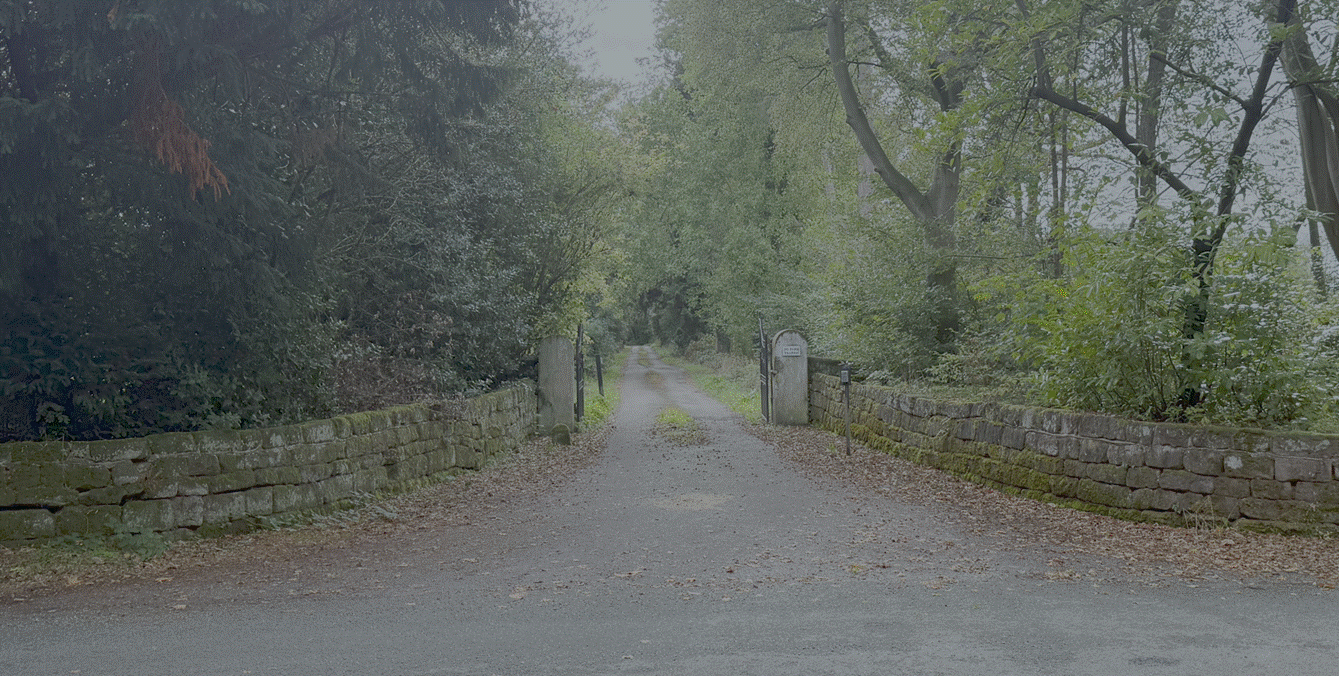
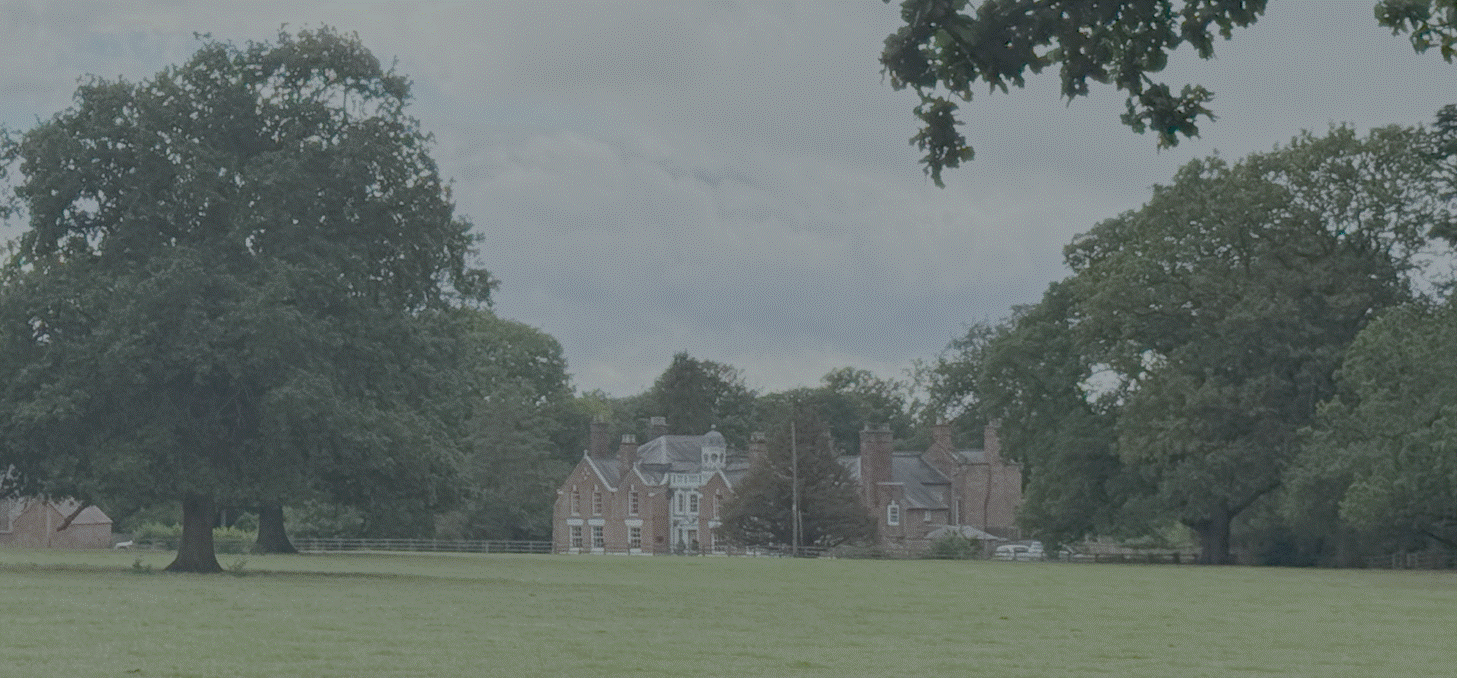
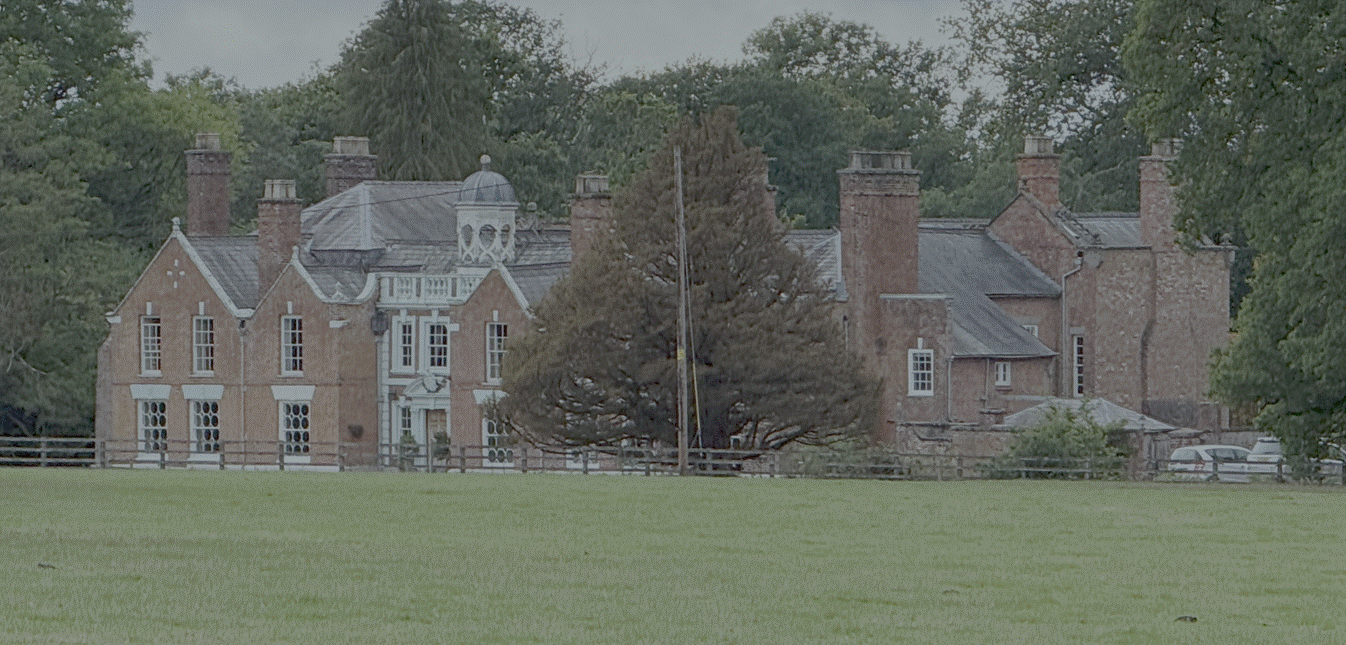
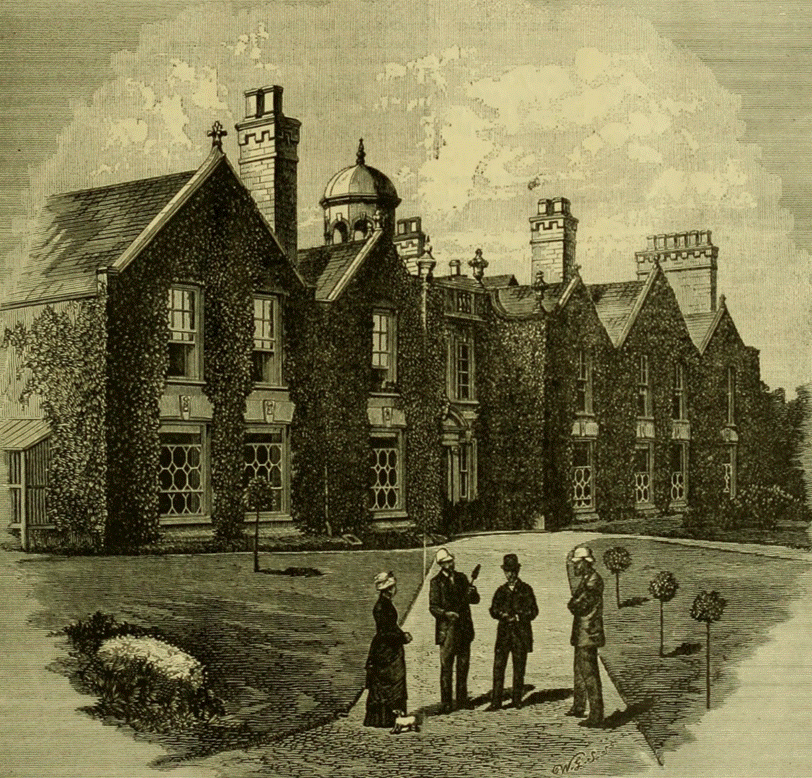
Edge Hall is a later medieval and
early‑modern estate built on the
ancient manorial footprint, with a continuity of landholding from the Domesday
period into the modern era. Edge Hall is a Grade II
listed country house in the township of Edge, near Malpas,
Cheshire. It served as the ancestral home of the ancient Dod family
for roughly nine hundred years, from the twelfth century until the early twenty
first century.
The oldest sections of the moated
house are timber-framed and date back to around 1600. The structure was updated
and encased in brick in around 1700, with the main front block constructed in
1721 featuring Jacobean styling, an octagonal cupola, and Corinthian pilasters.
Further additions and rear bow windows were introduced around 1790 and into the
nineteenth century. In the late nineteenth century, the estate grounds gained
national fame for their gardens in the time of the Reverend Charles Wolley-Dod.
After retiring from teaching at Eton in 1878, Charles Wolley-Dod cultivated
celebrated gardens across the difficult local clay soil.
Bibliography
Edge in the Domesday Book
(1086) in A History of the North in 100 Archives
(2024).
Haslam, Richard (1985), Edge
Hall, Cheshire, The Home of Mr and Mrs Anthony Wolley Dod, Country Life, 21
November 1985, pages 1612 to 1615.