The Cheshire Men of Richard II
The
close association between Richard II and Cheshire
|
Return to the Home Page of the Bakers Family part of the website |
The Bakers of Highfields Story
The Story of the Dods and Bakers and of Highfields,
Fenton House and Hasfield Court. A journey through the history of Cheshire and
Staffordshire, an Anglo-Saxon nobleman who retained his lands after the
Conquest, pottery at Stoke on Trent, an encounter with Elgar, and the history
of an Elizabethan manor house at Audlem |
The family tree of the Bakers of Highfields |
The Family Tree of the Dods, predecessors to the
Bakers of Highfields |
The Bakers of
Fenton House and Hasfield Court
The Family Tree of the pottery Bakers of Stoke on Trent |
The Family Tree of the Bellyse Family |
The main part
of this website tells the story of the Farndale family from Yorkshire Descendants of Arthur Baker, the story of the
Farndale ancestry is told through the main part of this website You can also return to the Farndale
website home page |
The genealogy of the family of James Hall, linked to
the Baker family through marriage to Arthur Baker |
Headlines of are
in brown.
Dates are in red.
Hyperlinks to
other pages are in dark
blue.
References and
citations are in turquoise.
Context and local
history are in purple.
Richard II had a deep, unique, and
ultimately ill-fated political connection with Cheshire. Treating the county as
a personal power base, he elevated Chester to a principality in 1397 and
surrounded himself with a feared bodyguard of loyal local archers, which
alienated the rest of England and contributed to his downfall.
Cheshire was a palatinate
earldom under direct crown control, giving the king unique local authority. The
earldom of Chester, stretching from Cheshire in northwest England across the north
Welsh county of Flintshire, lands dominated by the two great castles of Flint,
looking over the Dee estuary, and Chester itself, further upriver, had been
among the estates that belonged to Richard's father as heir to the throne.
Because Richard did not yet have a son, he still held these titles and
properties as Earl of Chester and Prince of Wales along with his crown. The
county of Cheshire in particular had a remarkable
depth of military experience and expertise on which the Black Prince had drawn heavily
for his campaigns overseas in the 1360s. It was also one of only three
palatinates in the Kingdom; that is, a territory where the King's writ did not
run. Instead, its Lord had the right to exercise judicial authority within its
borders in the King's name and on his behalf. In Cheshire, therefore, Richard
was both king and lord, but now, with the crown's powers in the hands of the
council, it seemed disconcertingly possible that he might enjoy more freedom of
action as Earl of Chester than he did as England’s king. On that basis, if de
Vere’s estates in the eastern counties would not serve as a recruiting ground,
Cheshire might offer a viable alternative. As he travelled through the
northwest, Richard was taking local knights and gentlemen into his service and
doing what he could to establish de Vere as the commander of this nascent army,
appointing him justice of both Chester and North Wales, and giving him the
keeping of the stronghold of Fleet Castle. (Astor, Helen (2025), The Eagle and the Hart: The
Tragedy of Richard II and Henry IV, page 134).
1397
The Revenge Parliament of 1397. In
1397, Richard elevated Cheshire to a principality, styling himself Prince of
Chester to honour their fierce local backing. He used massive levies of
Cheshire men to overawe parliament and quash his noble rivals.
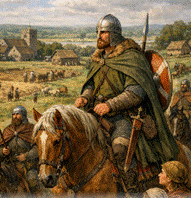
Richard recruited hundreds of
dedicated yeoman archers from Cheshire as a permanent standing force. The guards wore his personal white
hart badge and closely attended his bedchamber.
Other English lords and commoners feared and loathed the guard for
their perceived insolence and unchecked power.
1399
When Richard was challenged by Henry Bolingbroke in 1399, his
wider military support crumbled, but his Cheshire followers remained fiercely
loyal. Following Richard's imprisonment and death, Henry IV revoked the
short-lived principality, leading to brief local uprisings by diehard Ricardian
loyalists in Chester.
1400
There was a Robert Hall who
appealed that Robert Dod had committed treason and had pursued the appeal to a
duel in Northumberland and was killed, and his goods forfeited to Richard II,
Henry IV granting the goods to his widow, Mary (Patent Rolls of the reign of Henry IV, 1399
to 1401, page 119). Robert Dod might have
been related to the Dods of Cheshire.
On 22 May 1400 there was a
general pardon by Henry IV, following his usurpation of the Crown from Richard
II, to all the king’s lieges of the county of Chester for all treasons,
insurrections, felonies, rebellions and trespasses committed by them from
Christmas last to the Purification, except murders and rapes, but a number
of men were excluded from this general pardon including John Davidson leche
of Malpas; David Dodde; John del Malpas; Thomas de Grene of Malpas; Robert de
Sutton of Frodesham; and David Dodde of Egge. (Patent Rolls of the reign of Henry IV, 1399
to 1401, page
285 to 286).
This general pardon on 22
May 1400 was granted by Henry IV to suppress anti-Lancastrian unrest in the
County of Chester following the Epiphany Rising. The named individuals,
including John Davidson, David Dodde, and Robert de Sutton, were excepted
because they were identified as die-hard Ricardian loyalists, former members of
Richard II’s private Cheshire Guard, or primary instigators of the local
revolt who were forced to sue for individual pardons.
When Henry Bolingbroke
usurped the throne from Richard II in autumn 1399 to become Henry IV, he
inherited a deeply unstable kingdom. No region was more hostile to his new
regime than Cheshire. Richard II had elevated Cheshire to a principality,
showered its gentry with titles and annuities, and recruited his infamous,
highly loyal personal bodyguard, the Cheshire Guard, directly from the
county. When Henry's invading forces marched through Cheshire in 1399, they
subjected the area to harsh retribution and violence.
In January 1400, a
conspiracy of counter-revolutionary nobles launched the Epiphany Rising to
assassinate Henry IV and restore Richard II. Simultaneously, an anti-Lancastrian
rebellion flared within Cheshire itself. Rebels attacked Chester Castle and
attempted to hold the county for the deposed king. The rebellion failed, and
Richard II died mysteriously, likely starved on Henry’s orders, at Pontefract
Castle in February 1400 to eliminate him as a focal point for future revolts.
By May 1400, Henry IV used a mix of tactical leniency and intimidation to
pacify the county: a general pardon designed to sweep up the lesser offenders,
restore basic legal order, and prevent Cheshire from remaining an open hotbed
of insurrection.
The Calendar of the Patent
Rolls lists over 100 men explicitly excluded from this blanket mercy. They were
isolated for three primary reasons. Some were core ringleaders and activists.
Rather than giving a free pass to the ringleaders who orchestrated the attacks
on Chester Castle, Henry's government singled them out to prevent immediate immunity.
Many of those excepted were former retainers, archers, and loyalist elements of
Richard II’s military affinity. Men from Malpas, Frodsham, and Edge belonged to
prominent local families that had heavily benefited from Richard II's
patronage. For example, the Suttons and Doddes were
deeply embedded in the county’s military structures. Being excepted from
a general pardon did not necessarily mean immediate execution. Instead, it
meant these men were compelled to sue for individual pardons.
By forcing men like John
Davidson, David Dodde, and Robert de Sutton to surrender independently, the
Crown achieved two goals. It forced them to formally acknowledge Henry IV's
legitimacy, and it required them to find financial sureties, large
monetary bonds, from their neighbours to guarantee their future good behaviour.
See McNiven, Peter (1970), The
Cheshire Rising of 1400 in the Bulletin of the John Rylands Library, Volume
52, No. 2, pages 375 to 396.
The Dods of Edge or Egge were one of Cheshire's oldest
and most martial gentry families, deeply woven into the fabric of the county's
military aristocracy. During the political upheaval of 1399 to 1400, their deep
loyalty to Richard II and their actions during the Cheshire Rising of 1400 put
them at direct war with the newly crowned Henry IV. The family's alignment
with Richard II was rooted in direct royal patronage. Edge is
located in the parish of Malpas (Broxton hundred), at the epicentre of Richard
II's recruitment ground for his infamous Cheshire Guard. In the 1390s, Richard II
bypassed traditional feudal levies to build a highly personal, 2,000-man
bodyguard composed primarily of Cheshire archers and gentry. The Lords of Edge
and their close kin, including John Dod and David Dod, were part of this elite,
fiercely loyal military affinity. They wore Richard's personal badge, the White
Hart.
When the Epiphany Rising
flared in England in January 1400, the Cheshire gentry orchestrated a
coordinated internal insurrection. The Dods of Edge used their regional
influence to muster the local population around Malpas. Armed with their
longbows, the men of Edge marched on Chester. Alongside other local commanders,
they successfully seized Chester Castle, took control of the city, and publicly
proclaimed that Richard II was still alive and marching to join them. For
several weeks, they effectively held the county in open defiance of the
Lancastrian usurpation.
When the wider national
coup failed and Richard II was confirmed dead, the Cheshire rebellion
collapsed. Because David Dod was designated as a ringleader, Henry IV excluded
him from the General Pardon of May 1400. However, their story did not end in
execution, but rather in a calculated political and financial submission.
To secure individual
pardons, those excluded from general pardon had to provide immense financial
sureties. They were forced to sign recognizances for debt to the King, massive
monetary bonds that would be completely forfeited if they, or any of their
tenants at Edge, showed a shred of future disloyalty.
The Lords of Edge survived
the Lancastrian transition.
1403
The true test of their
pacification came just three years later in 1403, when Henry Hotspur
Percy launched a second, massive rebellion in Cheshire against Henry IV. While
many of their neighbours rose up and died at the bloody Battle of Shrewsbury. The
Dods of Edge, heavily restricted by their 1400 financial bonds, largely stayed
out of the active fighting.
Or (to review
further)
However there is an alternative
view to check: Cheshire was a fierce
stronghold of loyalty to the deposed King Richard II. When Hotspur arrived in
the Palatinate in July 1403 to raise an army, the vast
majority of local elite families and their highly skilled Cheshire
archers joined his banner. The Dods of Edge mobilised alongside neighbouring
families, such as the Massies of Coddington, who
married into the Dod family. On 21 July 1403, the rebel forces clashed with the
Royalist army at the Battle of Shrewsbury. The Cheshire gentry took catastrophic casualties
during the intense longbow exchanges and subsequent melee. Following Hotspur's
death and the collapse of the rebellion, King Henry IV exacted harsh penalties
on the surviving Cheshire rebels. Members of the family faced the temporary
forfeiture of their lands and were forced to pay steep fines or secure royal
pardons to reclaim their ancestral manor at Edge.
See McViven, Peter (1979), The
Men of Cheshire and the Rebellion of 1403 in Transactions of the Historic
Society of Lancashire and Cheshire, Volume 129.
Having successfully
navigated the transition, the family retained their ancestral lands at Edge.
Over the coming decades, they were fully rehabilitated into the Lancastrian apparatus.
By the reigns of Henry V and Henry VI, the Dods of Edge were once again serving
as local magistrates, royal commissioners, and prominent local benefactors.
Bibliography
Astor, Helen (2025), The Eagle and the Hart: The
Tragedy of Richard II and Henry IV.
Lumby, J H (1904), Chester and Liverpool in the
Patent Rolls of Richard II and the Lancastrian and Yorkist Kings, pages
163 to 187.