Carlisle
A brief guide to Carlisle, particularly those locations associated
with the Farndale family
|
Return to the Home Page of the Farndale Family
Website |
The story of one family’s journey through two
thousand years of British History |
The 83 family lines into which the family is divided.
Meet the whole family and how the wider family is related |
Members of the historical family ordered by date of
birth |
Links to other pages with historical research and
related material |
The story of the Bakers of Highfields, the Chapmans,
and other related families |



Dates are in red.
Hyperlinks to
other pages are in dark
blue.
Headlines are in brown.
References and
citations are in turquoise.
Contextual
history is in purple.
The Farndales of Carlisle
The Carlisle
Line is a small family who are descendants of Thomas Farndell (born 1822),
who married Mary Jones and settled in Carlisle.
Carlisle
The early history of Carlisle is
marked by its status as a Roman settlement, established to serve the
forts on Hadrian's Wall.
During the Middle Ages,
because of its proximity to the Kingdom of Scotland, Carlisle became an
important military stronghold. Carlisle Castle, still relatively intact,
was built in 1092 by William Rufus, and once served as a prison for Mary,
Queen of Scots. In the early 12th century, Henry I allowed the
foundation of a priory in Carlisle. The town gained the status of a city when
its diocese was formed in 1133, and the priory became Carlisle
Cathedral.
The introduction of textile
manufacture during the Industrial Revolution began a process
of socioeconomic transformation in Carlisle, which developed into a
densely populated mill town. This, combined with its strategic position, allowed
for the development of Carlisle as an important railway town, with seven
railway companies sharing Carlisle railway station.
Although Carlisle continued to garrison
soldiers, becoming the headquarters of the Border Regiment, the city's
importance as a military town decreased as the industrial age took
over. The post of Governor of Carlisle as garrison commander was
abolished in 1838.
In the early nineteenth century
textile mills, engineering works and food manufacturers built
factories in the city mostly in the Denton Holme, Caldewgate
and Wapping suburbs in the Caldew Valley. These included Carr's of
Carlisle, Kangol, Metal Box and Cowans Sheldon. Shaddon Mill, in
Denton Holme, became famous for having the world’s eighth tallest chimney and
was the largest cotton mill in England.
The expanding industries brought
about an increase in population as jobs shifted from rural farms towards the
cities. This produced a housing shortage where at one point 25,000 people in
the city only had 5,000 houses to live in. People were said to be herded
together with animal houses, slaughter houses and
communal lavatories with open drains running between them. Living conditions
were so bad that riots were common and some people emigrated. The problem
wasn't solved until the end of the nineteenth century when mass housing was
built west of the city walls.
In 1823 a canal was built to
Fisher's Cross or Port Carlisle to transport goods produced in the city. This
enabled other industrial centres such as Liverpool to link with
Carlisle via the Solway. This was short-lived and when the canal operators
ran into financial difficulty the waterway was filled in. A
railway was built in place of the canal.
Carlisle became a
major railway centre on the West Coast Main Line with
connections to the east. At one time seven companies used Carlisle Citadel
railway station. Before the building of the Citadel railway station the city
had several other railway stations, including London Road railway station.
Carlisle had the largest railway marshalling yard in Europe, Kingmoor, which, reduced in size, is operational and used
by railfreight companies.
The Strand Road drill
hall opened in 1874.
Botchergate
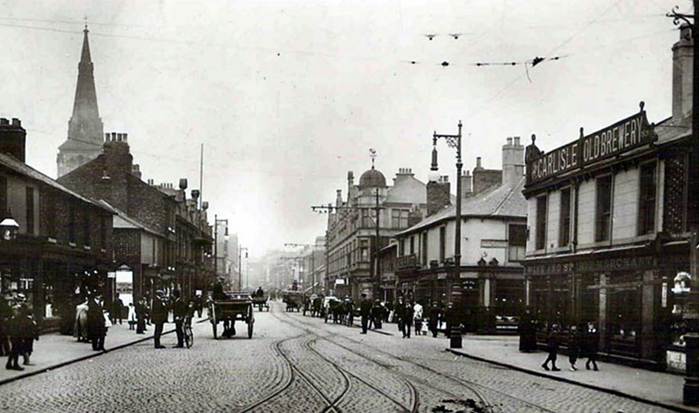
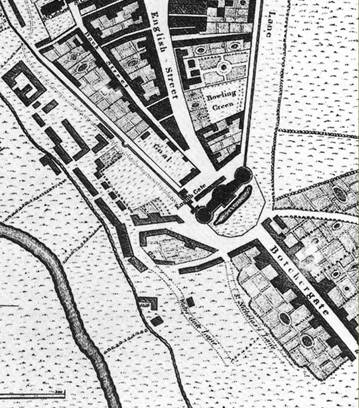
Historically a suburb outside of the gates of Carlisle, Botchergate was swallowed by the southerly expansion of the
city. Originally a linear development on the approach to the walled city, Botchergate became increasingly urban and commercial during
the nineteenth century. Firstly narrow lanes, and
later, spur roads were developed along its length serving new development,
until it became fully enmeshed as the heart of the web of streets that survive
today.
Carlisle's gradual expansion during the eighteenth and nineteenth
centuries saw the linear strip of Botchergate develop
adjoining streets of working class housing,
interspersed with the industrial enterprises these residents served. The mixed
residential and commercial nature of the main street became increasingly
commercial, with an eclectic range of public houses, hotels, manufacturing,
entertainment and retailers present. The proximity to Carlisle Citadel Station
will have stimulated this growth, and in particular that
of the grander hotels which developed at the northern extremity.