21 April 1848 to 30 December 1937
BAK00307
|
Return to the Home Page of the Bakers Family part of the website |
The Bakers of
Highfields Story
The Story of the Dods and Bakers and of Highfields,
Fenton House and Hasfield Court. A journey through the history of Cheshire and
Staffordshire, an Anglo-Saxon nobleman who retained his lands after the
Conquest, pottery at Stoke on Trent, an encounter with Elgar, and the history
of an Elizabethan manor house at Audlem |
The family tree of the Bakers of Highfields |
The Family Tree of the Dods, predecessors to the
Bakers of Highfields |
The
Bakers of Fenton House and Hasfield Court
The Family Tree of the pottery Bakers of Stoke on Trent |
The Family Tree of the Bellyse Family |
The main part
of this website tells the story of the Farndale family from Yorkshire Descendants of Arthur Baker, the story of the
Farndale ancestry is told through the main part of this website You can also return to the Farndale website home page |
The genealogy of the family of James Hall, linked to
the Baker family through marriage to Arthur Baker |
Headlines of Mary
Baker’s life are in brown.
Dates are in red.
Hyperlinks to
other pages are in dark
blue.
References and
citations are in turquoise.
Context and local
history are in purple.
1848
Mary Frances Baker was the
daughter of Rev Ralph B and Frances (nee Singer) Baker (FAR00302).
Mary was born in
Dublin, Ireland on 21 April 1848.
1851 Census - Parsonage, Hilderstone, Stone, Staffordshire
Ralph Bourne Baker, Head,
Married, Male, 47, 1804, Perpetual curate of hilderstem
rural dean of stone magistrate of county of Stafford, Fenton, Staffordshire,
England
Frances Crofton, Baker,
Wife, Married, Female, 28, 1823, Clergyman’s wife, Dublin, Dublin, Ireland
Mary Frances Baker, Daughter, Female, 2, 1849, Clergyman's
daughter, Dublin, Dublin, Ireland
Sarah Adelaide Baker,
Daughter, Female, 0, 1851, Clergyman's daughter, Staffordshire, England
Jane Fisher, Servant,
Unmarried, Female, 35, 1816, Cook, Staffordshire, England
Hannah Hervey, Servant,
Unmarried, Female, 31, 1820, Housemaid, Staffordshire, England
Mary Tomlinson, Servant,
Unmarried , Female, 25, 1826, Nurse,
Derbyshire, England
Mary A Hasketh,
Servant, Unmarried, Female, 15, 1836, Under nurse, Staffordshire, England
1861 Census - 22, Porchester Square,
Paddington
Ralph B Baker, Head , Married, Male, 58, 1803, Clergyman church
England without cure of souls, Kenton, Staffordshire, England
Frances C Baker, Wife,
Married, Female, 38 , 1823, Ireland
Mary F Baker, Daughter, Female, 12,
1849, Scholar, Ireland
Letitia J D Baker,
Daughter, Female, 9, 1852, Scholar, Ireland
William M Baker, Son,
Male, 3, 1858, Hilderstone, Staffordshire, England
Jessie Goward, Servant, Unmarried, Female,
25, 1836, Housemaid, Scotland
Sarah Death, Servant, Unmarried, Female, 22,
1839, Cook, Kentish Town, Middlesex, England
Sarah Addison, Servant, Unmarried, Female,
22, 1839, Nurse, Staffordshire, England
1871
1871 Census – Hasfield Court, Hasfield,
Tewkesbury, Gloucestershire
Ralph Bourne Baker, Head, Male,
68, 1803, Staffordshire, England
Frances Crofton Baker, Wife, Female,
48, 1823, Ireland
Mary Frances Baker, Daughter, Female, 22, 1849, Ireland
Letitia Jane Dowthen Baker, Daughter, Female, 19, 1852, Ireland
Sarah Hitchman, Sister, Female, 60, 1811 Staffordshire, England
John Belmore, Servant, Male, 56,
1815, Devon, England
John George, Westlake, Servant,
Male, 16, 1855, Somerset, England
Louisa Field, Servant, Female, 34, 1837, Somerset, England
Jane Welch, Servant, Female, 36, 1835, Somerset, England
Mary Heywood, Servant, Female, 33 , 1838, Devon, England
Elizabeth Ann Redding, Servant, Female, 18, 1853,
Gloucestershire, England
1881
1881 Census – Hasfield Court,
Hasfield, Tewkesbury, Gloucestershire
Frances Crofton Baker,
Head , Widow, Female, 57, 1824,
Householder, Ireland
Mary Frances Baker, Daughter, Single, Female,
32 , 1849, Householder’s daughter,
Ireland
Letitia Jane Baker,
Daughter, Single, Female, 28, 1853, House holders
daughter, Ireland
William Meath Baker, Son,
Single, Male, 23, 1858, Landowner, b a
Stafford, Staffordshire, England
Alice Frances Crofton,
Visitor, Single, Female, 32, 1849, Ireland
Helen Julianna Jenkins,
Visitor, Single, Female, 36, 1845, Bond holder, Ireland
John Belmont, Servant, Widower, Male, 59, 1822,
Domestic servant butler, Marwood, Devon, England
Thomas Smith , Servant, Single, Male, 18, 1863, Domestic
servant footman, Aston, Gloucestershire, England
Elizabeth An Bedding, Servant, Single, Female, 28, 1853, Domestic
servant housemaid, Forthampton, Gloucestershire,
England
Laura Box, Servant, Single, Female , 27, 1854, Domestic servant cook, Monmouthshire, Wales
Clara Louisa James,
Servant, Single, Female, 32, 1849, Domestic servant ladies
maid, Tipton, Staffordshire, England
Kate Lake, Servant,
Single, Female, 16, 1865, Domestic servant kitchen maid, Ashleworth,
Gloucestershire, England
Rose Emme Colebrook,
Servant, Single, Female, 19, 1862, Domestic servant house maid,
Carmarthenshire, Wales
Louisa Westlake, Servant, Married, Female, 39,
1842, Domestic servant housekeeper, Somerset, England
1889
Mary Frances Baker had been
a childhood friend of Caroline Alice Roberts, who later married Edward Elgar in
1889.
1895
Mary married on 28 August
1895, Canon Alfred Penny (1845-1935), prebendary
and Rural Dean of Lichfield, son of Rev. Charles Joseph Penny, rector of Bubbenhall, Warwickshire in Tewkesbury, probably as
Hasfield Court.
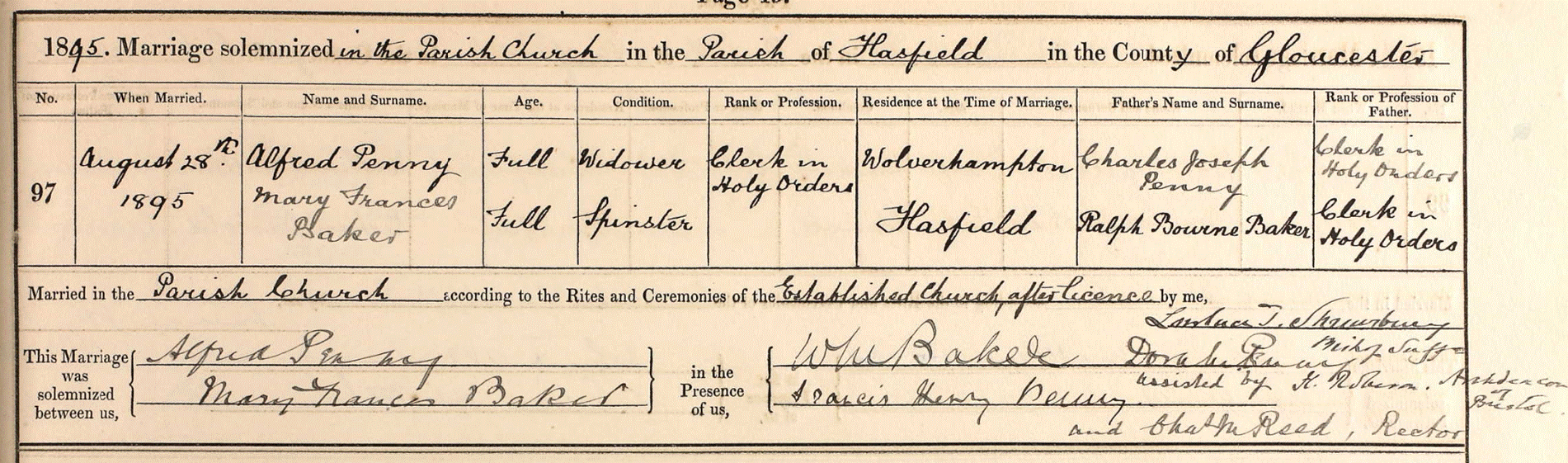
(Hasfield Parish Records)
Dora Mary Powell, nee Penny, born
8 Feb 1874 was the daughter of Rev Alfred Penny and Dora Mary Heale. Following
the death of her mother, she had lived at Highfield with her grandmother while
her father served in missionary work in the Melanesian and Solomon Islands. She
rejoined her father at Wolverhampton, where he had been appointed Rector in
1895.
Soon after Dora joined her father in
Wolverhampton, [her widowed father, Canon Alfred Penny]
married Mary Frances Baker, known to the family as ‘Min’, the daughter of the
Reverend Ralph Bourne Baker of Hasfield Court near Gloucester. Dora and her
stepmother became firm friends and they lost no time,
it seems, in gently ganging up on the rector as occasion demanded. Dora later
wrote “she was unfailingly good to me from the outset. Kind and sympathetic,
she was often torn between the two of us for the settling of things, and her
quick wit, tact and good nature smoothed matters time and again”. Min was a
charmer, with a hint of the Irish in her voice. She was my favourite elderly
relative beyond any question, notwithstanding the sharp ticking off she once
gave me for trying to balance on some monumental masonry outside the cathedral.
She used to let me join her in a small room off the south aisle where she
prepared flowers. There she would talk of the cathedral and its history, particularly
in the civil war. There was no doubt where her sympathies lay and it was from
her that I learned about the local hero of that time, Dumb Dyott, a deaf mute marksman who helped to repel the roundheads from
his perch high on the nave. Since their girlhood Mary Baker had been a friend
of Caroline Alice Roberts whom Elgar married in 1889. She occupies a special
place in the background to the Variations, which portray three of her
relatives, her step her stepdaughter Dora, her brother William Meath Baker and
her brother-in-law Richard Baxter Townshend. She was a close friend of Isabelle
Fitton and she may well have known other variants as
well, of course, as the Elgar’s. (Powell, R
(1937), Edward Elgar, Memories of a Variation, page 3).
As well as being stepmother
of Dora Powell, Mary was the sister of William Meath Baker, sister-in-law to
Richard Baxter Townshend, and a close friend of Isabell Fitton, all of whom
would feature in Elgar's 'Enigma Variations'. Through this group, Dora Penny became acquainted with
the Elgars and was to be characterised as 'Dorabella' (Variation 10) of the
Variations.
Mary and Alice and Edward
Elgar
Mary’s brother, WMB was a close
friend of the composer, Sir Edward Elgar, and was one of the friends portrayed
in Elgar's 'Enigma Variations' of 1899. He had been acquainted with the family
of Edward Elgar’s future wife and thus became acquainted with Edward Elgar
himself. WMB’s mansion at Hasfield Court was about ten miles from a village
called Red-Marley d’Abitot where a friend of Mary
Baker lived. The friend was Caroline Alice Roberts, daughter of the late Major
General Sir Henry Gee—Roberts of Indian Mutiny and Sikh Wars fame.
Mary and Alice studied geology
together with the local rector who was known as ‘the Professor’ and they would
often go fossil hunting on the Severn.
Alice Roberts started to take
music lessons from an Edward Elgar who taught the violin at Worcester High
School. Despite a lack of talent, she tried hard at her lessons
and the reason soon became apparent. She became engaged to Edward Elgar. When
they visited Hasfield Court, Mary Baker found Edward rather shy. Alice Robert’s
family, including two rather severe aunts were horrified at the idea that Alice
wanted to marry a music teacher and she was cut of
from various wills and ostracised. Of course the
snobbery was misplaced since Sir Edward Elgar would become one of the country’s
most famous composers!
However WMB and Mary continued to welcome
the Elgars and their friends to Hasfield. Mary Baker took them on holiday to
Germany in 1892 and they visited Bayreuth, Heildelberg
and the Bavarian Highlands.
In 1895 Mary Baker married Rev
Alfred Penny and then moved to Wolverhampton. By his first marriage, Alfred had
a daughter called Dora who later wrote “Memories of a Variation” which
includes many stories about life at Hasfield.
Mary Baker became great friends
with the Elgars. She described how Edward Elgar would bring in hedgehogs from
the woods at Hasfield and feed them in the house. There is a story of him
sitting in a strawberry bed and wishing that someone would bring him champagne
in a bedroom jug.
1896
When he visited the potteries in
October 1896, the first performance of Edward Elgar’s oratorio, King Olaf was
performed at the Victoria Hall, Hanley. The work had been commissioned for the
Hanley Festival. It was conducted by Elgar himself. After the performance,
Elgar wrote “If ever I may come to the Potteries again I may come among
friends.” WMB was in the audience and had already been a friend of Edward
Elgar for many years.
1898
During part of September
we were all the way from home and my stepmother had
met the Elgars at Hasfield Court, where there was a party for the Gloucester
Festival. He took her in to dinner and one of the
first things he said was “How is my sweet Dorabella?” “Oh! So
it has got to that, has it?” said my stepmother. “That's a quotation from
Mozart's Cosi fan tutte, don't you know it?” This piece of information was
retailed to me in a letter from my stepmother, and a few days afterwards I had
a letter from the EE with the musical quotation from Cosi on the back of the
envelope. He wrote “We missed you at Hasfield very much and I could have made
you useful as well as … ah! I didn't write the other word. Well, Caractacus is
to be rehearsed at St James's Hall on Thursday at about 11 and my fate sealed
at two o’c. I hope your croquet will be good and that
you will have the tea service, it is sure to be that, for your very own, and
then come Sunday at Wolverhampton you can give us tea and fire eggs at me as of
yore. Believe me amicably, Edward Elgar, 24 September 1898. Ever afterwards I
was Dorabella. (Powell, R
(1937), Edward Elgar, Memories of a Variation, page 21).
Dorabella is a leading female character, the fiancée of Ferrando,
and the sister of Fiordiligi in Wolfgang Amadeus Mozart's comic opera Così fan tutte. She
is deeply in love with the soldier Ferrando at the start of the story. She is
more easily swayed and quick to yield to temptation than her sister,
Fiordiligi. When their fiancés disguise themselves as "Albanians" as
part of a cynical wager by Don Alfonso, Dorabella is the first sister to fall
for the new suitor, who is actually Guglielmo in
disguise. Dorabella’s notable arias include the grieving Act I aria Smanie implacabili
and the playful Act II aria È amore un ladroncello,
Love is a little thief.
R B Townshend, Dora Penny and WMB
would be immortalised in consequence of Edward Elgar’s visits to Hasfield. In
October 1898, Edward Elgar was at his piano one evening and his wife liked a
new theme and asked what it was. He replied, ‘nothing, but something might
be made of it.” He played some more and asked Alice who it was like. Alice replied
that “it is exactly the way WMB goes out of the room.”. She added “surely
you are doing something that has never been done before.” This was the
origin of the Enigma Variations, one of the greatest orchestral works written
by a British composer. Elgar dedicated the variations to ‘my friends
pictured within’.
He called the third variation
“RBT” and his funny voice and his bicycle bell can be heard in the music.
He called his fourth variation “WMB”
and the variation is highly energetic and includes a sharp bang of the door.
He called the tenth variation Dorabella after Dora Penny,
which was her nickname from Cosi Fan Tutte and
the music parodies her youthful stammer. The piece depicted Dora Penny,
daughter of the Rector of Wolverhampton and step daughter
of Mary
Baker, a close friend of the Elgars.
Then I turned over and had a shock. No 10,
Dorabella. Being overcome by many emotions I sat silent when it was over.
“Well, how do you like that, hey?” I murmured something about its being
charming and rather like a butterfly, but I could think of nothing sensible to say;
my mind was in such a whirl of pleasure, pride, and almost shame that he should
have written anything so lovely about me. The voice from the fireplace came to
my rescue: “Isn’t it beautiful, dear Dora? I do hope you like it.” (Powell, R (1937), Edward Elgar, Memories of a
Variation, page 13).
What I thought of this composition when I
first heard it on the orchestra will be found earlier in this book. I had no
idea what it really meant. It was not until many years afterwards that it dawned
on me that I had been as much the victim of EE's impish humour as had RBT. I
stammered rather badly at times when I was young and as is the case with so
many of those afflicted it was a terrible trial to me. Now, I am thankful to
say that this is to a certain extent a thing of the past. Elgar exploited his
humour at my expense with such marvellous delicacy that no one could help
laughing with him if they understood it. Anyhow, I had the satisfaction of knowing
that nothing like the Intermezzo has ever been written before or since. All
sorts of curious things have been said about it. One critic said that the
intermezzo was quite out of place in the Variations and should have been in the
Wand of Youth; and that, as though Elgar had lost a golden opportunity, the
Intermezzo had all that was required for a first class
pretty piece! (Powell, R
(1937), Edward Elgar, Memories of a Variation, page 132).
|
Elgar’s
Enigma Variations X, Dorabella
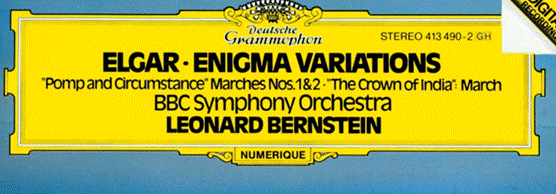
The
music immortalising Dora Penny Elgar's
tenth variation, titled "Dorabella," is an Intermezzo: Allegretto
from the Enigma Variations, Op. 36 (1899). It portrays Dora Penny, a close
friend of the Elgar family, and captures her charming, playful personality
and a slight, endearing laugh or stutter through fluttering woodwind figures. |
But for the Bakers and Hasfield
Court, the Enigma Variations would not have been what they were.
1901
1901 Census – The Rectory, 1 Waterloo Road,
Wolverhampton
Alfred Penny, 55, Rector of St
Peters
Mary F Penny, his wife, 52
Dora M Penny, 27
A parlour maid, cook, housemaid
and page boy
1911
1911 Census – The Rectory, Wolverhampton
Alfred Penny, 65, Clergyman of the
Established Church
Mary F Penny, his wife, 62
Dora Mary Penny, 36, single
A parlour maid, cook, housemaid,
kitchen maid and page boy
1937
Mary Frances Penny died in
Lichfield on 30 December 1937, and
probate was given on 15 March 1938 to Frances Ralph Baker and Sir Morgan Singer
KCB KCVO retired admiral RN (presumably her mother’s brother). Effects
£16,144 5s 3d. Penny Mary Frances of the
Close Lichfield widow died 30 December 1937 Probate Birmingham 15 March to
Francis Ralph Baker of no occupation and Sir Morgan Singer KCB KCVO retired
admiral RN. Effects £16217 8s 3d. (Probate
Records).
Lichfield Canon’s Widow. Mrs Mary
Frances Penny Died Aged 89. The death has occurred at her home, the Close,
Lichfield, in her 90th year of Mrs Mary Frances Penny, widow of the
Rev Alfred Penny, Canon of Lichfield Cathedral, who predeceased her in 1935 at the
age of 90. Mrs Penny, who was a daughter of the late Rev Ralph Bourne Baker, of
Hasfield Court, Gloucester, had resided in Lichfield since her late husband’s
appointment as Cathedral Canon in 1919. She was particularly well known in
Wolverhampton, where she was a loyal helpmate to the canon during his 24 years
as Rector. The funeral will take place at Lichfield Cathedral on Monday (Birmingham Gazette, 1 January 1938).