Sampson Baker of Baxterley
29
November 1581 (baptised) to 1647
BAK00017
|
Return to the Home Page of the Bakers Family part of the website |
The Bakers of Highfields Story
The Story of the Dods and Bakers and of Highfields,
Fenton House and Hasfield Court. A journey through the history of Cheshire
and Staffordshire, an Anglo-Saxon nobleman who retained his lands after the
Conquest, pottery at Stoke on Trent, an encounter with Elgar, and the history
of an Elizabethan manor house at Audlem |
The family tree of the Bakers of Highfields |
The Family Tree of the Dods, predecessors to the
Bakers of Highfields |
The Bakers of Fenton House and Hasfield Court
The Family Tree of the pottery Bakers of Stoke on Trent |
The Family Tree of the Bellyse Family |
The main part
of this website tells the story of the Farndale family from Yorkshire Descendants of Arthur Baker, the story of the
Farndale ancestry is told through the main part of this website You can also return to the Farndale
website home page |
The genealogy of the family of James Hall, linked to
the Baker family through marriage to Arthur Baker |
Headlines of
Sampson Baker’s life are in brown.
Dates are in red.
Hyperlinks to
other pages are in dark
blue.
References and
citations are in turquoise.
Context and local
history are in purple.
1581
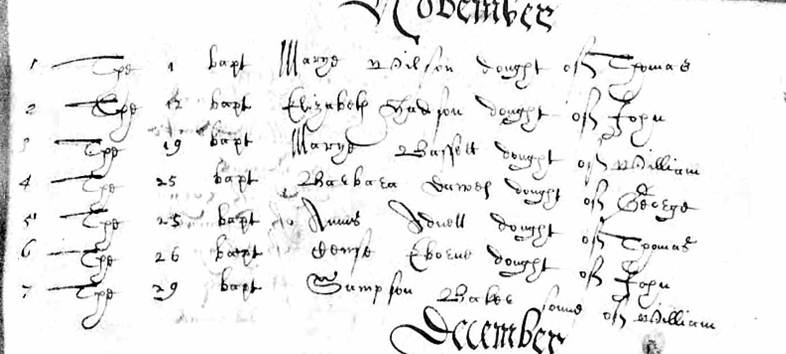
Sampson Baker was the son of
William Baker (BAK00010). He was baptised on 29
November 1581 at Holy Trinity, Coventry (Holy Trinity,
Coventry Parish Records).

1605
Sampson Baker married
Millicent Gooddale (1584 to 1634) of Shenton in 1605 in Market Bosworth, near
Nuneaton. A licence was granted on 19 February 1605 (Leicestershire
Marriage Licences, 1604-1891, Record Office for Leicestershire, Leicester &
Rutland, Boyd's Marriage Indexes, 1538-1850).
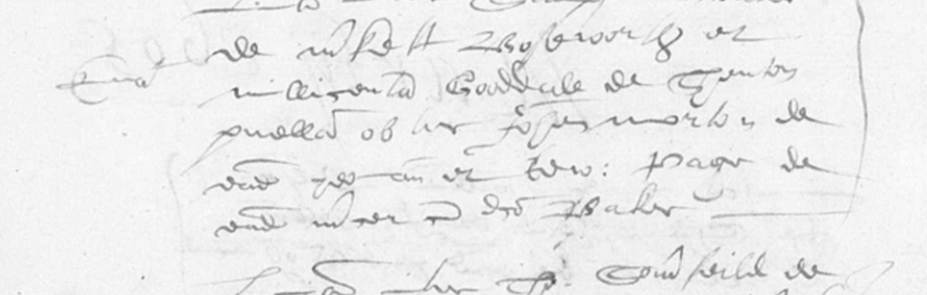
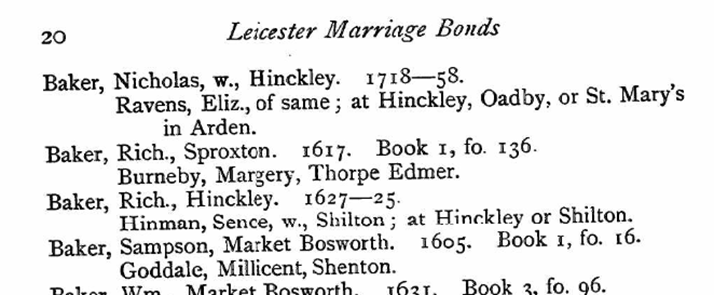
(Marriage Licence)
Millicent
Goodall, the daughter of William Goodall, was born in Shenton, Leicestershire
in or about 1584.
1606
George Baker was
born and died in 1606 (BAK00030).
1608
William Baker
(1608 to 1671) (BAK00031)
was born in 1608.
1610
Dorothy Baker (BAK00032) was born in
1610.
1611
Thomas Baker (BAK00033) was born in 1611.
1614
Sampson Baker
(1614 to 1668) (BAK00034)
was born in 1614.
1617
Elizabeth Baker
(1617 to 1638) (BAK00035)
was born in 1617.
1619
George Baker
(1619 to 1619) (BAK00036)
was born in 1619.
1620
Walter Baker
(1620 to 1645) (BAK00037)
was born in 1620.
1622
John Baker (BAK00038) was born in 1622.
1624
Nicholas Baker
(1624 to 1645) (BAK00039)
was born in 1624.
1628
Millicent Baker
(1628 to 1645) (BAK00040)
was born in 1628.
1634
Millicent Baker,
the wife of Sampson Baker, died in 1634 and was buried on 24 November 1634.

1638
In 1638, Sampson
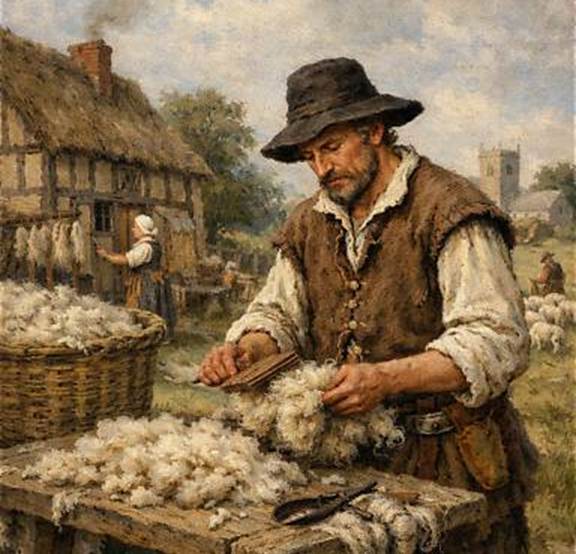
Baker was a Woolman of Baxterley, Warwickshire.
As a woolman during the reign of King Charles I, he acted as a
merchant and dealer of raw wool. He bought fleeces from local sheep farmers
across the Midlands and sold them to weavers and textile producers. In 1638, Sampson
was a widower. His first wife, Millicent Gooddale, whom he married around 1605,
had died a few years prior and was buried on 24 November 1634.
By the mid sevententh century, wool and woollen cloth formed the
backbone of the English economy, accounting for roughly two-thirds of foreign
trade. Warwickshire's broader textile network heavily involved nearby major
centres like Coventry, which had a centuries old legacy of wool merchanting,
weaving, dyeing, and cap-making. Rural parishes like Baxterley,
situated in the Hemlingford hundred near Atherstone
and the dissolved Merevale Abbey lands, participated
in the agrarian and localised merchant pipeline that fed raw fleece or
intermediate yarn into regional markets.
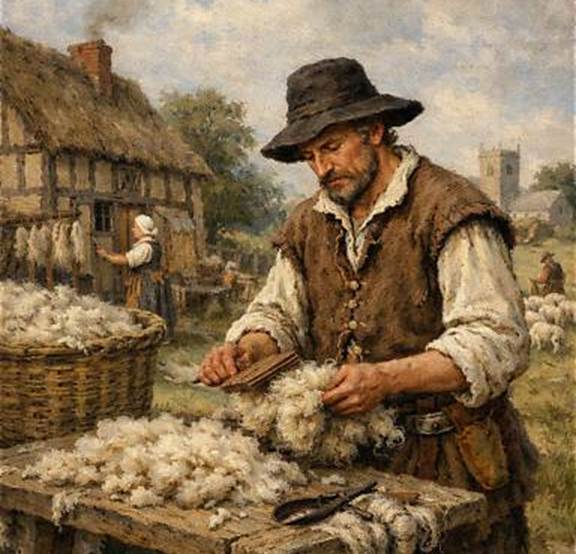
Sampson Baker,
the Woolman, in Baxterley in about 1638, reimagined
using artificial intelligence
1647
Sampson Baker of Baxterley, Warwickshire died before October 1647. Probate was
granted on 14 October 1647 in London. His will was proved by his sons William
and Thomas Baker.
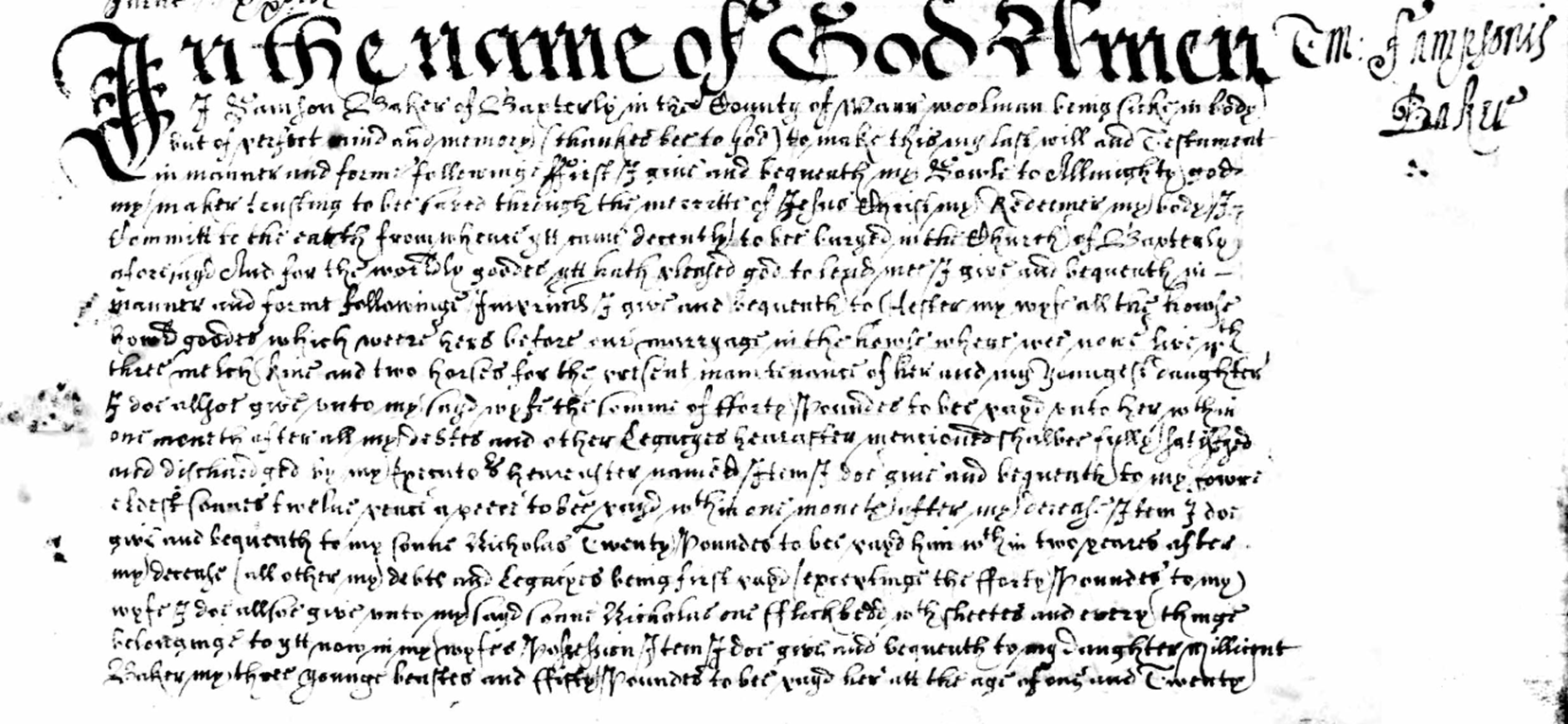
In the name of God Amen
I Sampson Barker of Baxterley in the County of Warwickshire, woolman, being sick in body but of perfect mind and memory
(thanks be to God), do make this my last will and testament in manner and form
following.
First I give and bequeath my soul to
God my maker, desiring to be saved through the merits of Jesus Christ my
Redeemer. My body I commit to the earth from whence it came, to be buried with
Christian decency.
And for the worldly goods which Almighty
God of his mercy hath given me, I give and bequeath in manner and form
following.
First I give and bequeath to
[illegible] my house and goods which [illegible] mortgage in the hands of
[illegible], that one ten kine and two heifers, the
rest [illegible] of this and my [illegible].
I do also give unto my [illegible]
the sum of three pounds, to be paid one month after my decease, and other
legacies bequeathed, mentioned and discharged in my [illegible] and after
named.
Item: I give and bequeath to my
[illegible] twenty pounds, to be paid him within two
years after my decease, all other my debts and legacies being first paid and
discharged.
The rest I do also give unto my
son Nicholas, one [illegible] and other things belonging to my manor in my
possession.
Item: I do give and bequeath to my
daughter Millicent Baker my younger heifers and fifty pounds, to be paid her at her age of twenty‑one years, and two heifers.

(Prerogative Court of Canterbury, Wills,
1384 to 1858)