Enigma Variations
The
association of the Bakers and the Enigma Variations
|
Return to the Home Page of the Bakers Family part of the website |
The Bakers of Highfields Story
The Story of the Dods and Bakers and of Highfields,
Fenton House and Hasfield Court. A journey through the history of Cheshire and
Staffordshire, an Anglo-Saxon nobleman who retained his lands after the
Conquest, pottery at Stoke on Trent, an encounter with Elgar, and the history
of an Elizabethan manor house at Audlem |
The family tree of the Bakers of Highfields |
The Family Tree of the Dods, predecessors to the
Bakers of Highfields |
The Bakers of
Fenton House and Hasfield Court
The Family Tree of the pottery Bakers of Stoke on Trent |
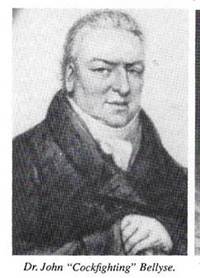
The Family Tree of the Bellyse Family |
The main part
of this website tells the story of the Farndale family from Yorkshire Descendants of Arthur Baker, the story of the
Farndale ancestry is told through the main part of this website You can also return to the Farndale
website home page |
The genealogy of the family of James Hall, linked to
the Baker family through marriage to Arthur Baker |
Headlines of are
in brown.
Dates are in red.
Hyperlinks to
other pages are in dark
blue.
References and
citations are in turquoise.
Context and local
history are in purple.
The Enigma Variations
In October 1898, Edward Elgar was at his piano one evening and his
wife liked a new theme and asked what it was. He replied ‘nothing’, but
something might be made of it. He played some more and asked Alice who it was
like. Alice replied that it is exactly the way WMB
goes out of the room. She added surely you are doing something that has never
been done before. This was the origin of the Enigma Variations, one of
the greatest orchestral works written by a British composer. Were it not for
Alice Elgar’s interruption, we might never have had one of the greatest of all
English orchestral works. Elgar called the tune, which he had not recognised as
anything worthwhile, Enigma, not in the sense of a riddle to be solved,
but, he said, a dark saying that must be left unguessed, expressing the
nothingness from which it came.
Edward Elgar's Enigma Variations (his Opus 36) premiered in 1899.
They comprise an orchestral masterpiece consisting of an original theme and
fourteen variations. Each variation is a musical portrait of a friend or family
member, while the overarching enigma refers to a hidden, unplayed major
melody.
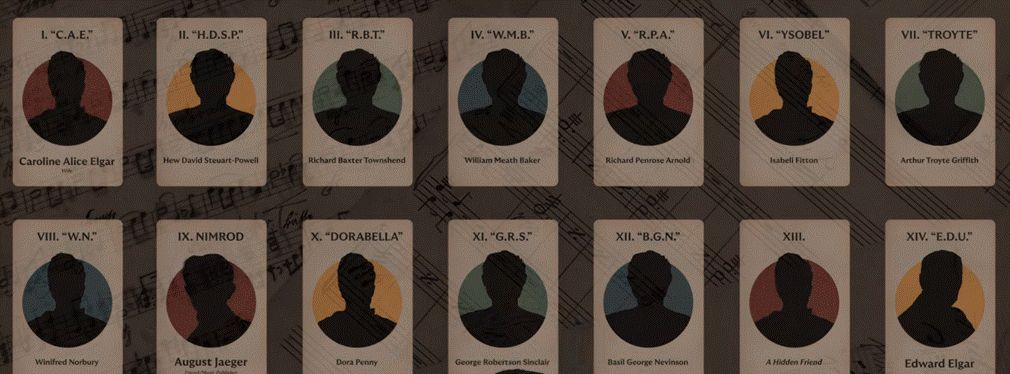
The Variations begin with CAE, his wife, Caroline Alice
Elgar, who he lovingly portrayed.
Variations III, IV and X depict William
Meath Baker, Richard Baxter Townshend (husband of Letitia
Jane Dorothea (nee Baker) Townshend), and Dora Penny, known to Elgar as
Dorabella (stepdaughter of Mary
Frances Baker).
Variations VIII to XIII, the Slow Movement Group, features Nimrod
(for his great friend, Augustus Jaeger, a deep and noble tribute), a barking
bulldog (GRS), and an anonymous lady.
|
The
people behind the Music |
|
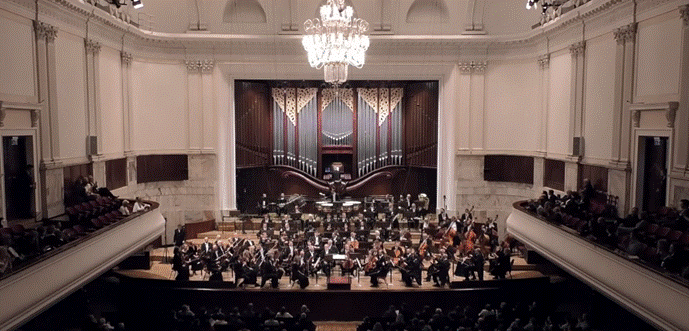
Played
by the Warsaw Philharmonic Orchestra |
The Bakers
Richard Baxter Townshend, Dora Penny and William
Meath Baker were thus immortalised in consequence of Edward Elgar’s visits
to Hasfield Court. But for the Bakers and Hasfield Court, the Enigma Variations
would not have been what they were.
RBT
He called the third variation RBT and his funny voice and
his bicycle bell can be heard in the music. The piece remembered Richard Baxter
Townshend, husband of Letitia
Jane Dorothea Baker, a friend whose caricature of an old man in an amateur
theatre production is captured in the variation. The variation depicts an
amateur actor and mimic, capable of extreme changes to the pitch of his voice,
a characteristic which the music imitates.
Then he turned over 2 pages and I saw No 3,
RBT, the initials of a connection of mine. This was amusing! Before he had
played many bars I began to laugh, which rather annoyed me. You don't generally
laugh when you hear a piece of music for the first time dedicated to someone
you know, but I just couldn't help it, and when it was over we both roared with
laughter! “But you’ve made it so like him! How on earth have you done
it?” (Powell,
R (1937), Edward Elgar, Memories of a Variation, page 12).
The ‘story’ of the RBT variation goes back to
about 1895, before I had any connection with the family. They were doing some amateur
of theatricals that Hasfield Court, the home of W M Baker, and someone was
wanted to take the part of an old man. No one could be found who was really
suitable so they ran in RBT, who was staying there to act, much against his
will. He had never taken part in anything of the sort before and, I was
assured, never did so again. The difficulty was in what sort of voice should he
speak? His voice sounded as though it had never broken. He spoke in the sort of
high falsetto, rather a soft voice, and one which was eminently suitable for
the telling stories of his travels and life in Colorado and for the same reason
he was a capital reader of Uncle Remus. He decided to put on a deep bass voice
for the old man's part, but he couldn't keep it up and his occasional lapses
into his ordinary voice convulsed the audience! Richard Baxter Townsend was
rather an eccentric looking person with his brick red, weather-beaten face,
bright blue eyes and shock of grey hair. And he rode about Oxford on a
tricycle. Being slightly deaf he invented the idea of a bell which could be set
to ring continuously like an alarm clock. It was dreadful! Cycling with him one
day I called out “Why do you let that bell ring all the time?” “So that people
can hear me coming. I can't hear them!” I've called this variation a
caricature, but it requires special explanation. RBT was, by any reckoning, a
very unusual person. He was a classical scholar of Cambridge, a first-class
rifle shot, had been a cattle rancher, gold prospector, and had written books
and stories about it. His two books, A Tenderfoot in Colorado and The Tenderfoot
in New Mexico (the Bodley Head), are interesting and amusing. He also wrote a
novel, Lone Pine, which achieved the distinction of being reprinted in 1913 as
a “Sevrenpenny” (Messrs Methuen and Co). His brother-in-law, WMB, called him a
wild Irishman and objected strongly to the strange clothes he generally wore.
He had a curious didactic way of speaking, the first few bars of the variation
give it to you, and he had a trick of finishing up a rather tall sounding story
with an impressive “I'm telling you”, to convince you of the truth of it.
Retailing more lurid stories of his life in New Mexico to men friends, I have
been told that RBT’s blue eyes blazed with exasperation and excitement when the
audience did not seem sufficiently impressed. “Damn and blast it, man! Can't
you understand what I'm telling you?” It is amusing to note what may be a
suggestion of this in the four bars before No 10 in the full score. So this
variation can be truly called a portrait after all: Elgar has got him with his
funny voice and manner, and the tricycle! It is all there and is just a huge
joke to anyone who knew him well. No wonder that WMB burst out laughing when he
first heard it. (Powell, R
(1937), Edward Elgar, Memories of a Variation, page 124).
|
Elgar’s
Enigma Variations III, RBT
The
music immortalising Richard Baxter Townsend Edward
Elgar’s Third Variation, marked Allegretto, from the Enigma
Variations, Opus 36 portrays his friend Richard Baxter Townshend, RBT.
It humorously captures Townshend's comical stage caricature of an old man
with shaky, alternating high and low register leaps in the woodwinds and
strings. |
WMB
He called his fourth variation WMB and the variation is
highly energetic and includes a sharp bang of the door. The piece recalled William
Meath Baker, country squire, gentleman and scholar, informing his guests of
the day's arrangements. The piece depicts a country squire, gentleman and
scholar who has just forcibly read out the arrangements for the day and
hurriedly left the music room with an inadvertent bang of the door.
“Go on, turn over”. And the next piece was
called No 4, WMB, another connection and a great friend; very energetic and
downright. Why did it remind me of him so? (Powell, R (1937), Edward Elgar, Memories of a
Variation, page 13).
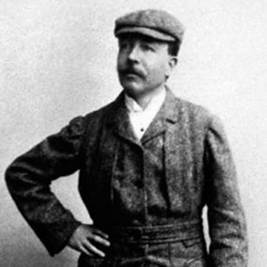
William Meath Baker was a small, wiry man,
very quick and energetic. He had an incisive way of speaking and of laying down
the law sometimes. He was an excellent host and the Elgars called him ‘the
Squire’. He was always well turned out, and it is odd that I had to choose the
photograph of him in his new bicycling kit for the set of portraits for the
Variations, but it was the only one available at the right date. I used to like
seeing him at the in the hunt coat and knee breeches which he usually wore at
dinner when there was a house party at Hasfield. He used to say it was a good
way of wearing the coats out! He was a capital companion for a day's outing.
Many a jolly day have I spent with him climbing in Switzerland or on the Welsh
hills. We were about the same height and walked rather well together. He was
brother to my stepmother and we were great friends. He was very good to me. I
heard a good deal of music with him, both at the three choirs and the
Birmingham festivals and also at various concerts in London and elsewhere. He
took me to the opera at Covent gardener garden, Wagner only: no other was worth
listening to, according to him. Die Meistersinger was his favourite and I heard
that for the first time in his company. He also took me to Rheingold and to a
complete cycle of the Ring the following year. On one of my frequent visits to Hasfield,
a day that I particularly remember was when the whole party staying there was
taken over to a point to point meeting. The ladies of the party were in the
library after breakfast and we heard a quick step coming along the hall. “There's
Bill”, someone said, “now we shall get our orders for the day”. He came in,
shut the door sharply behind him, and stood against it, “Oh here you all are!
That's alright. Now about this business today”, consulting a card in his hand, “the
Brougham will take three, five can go in the Brake, and someone will have to
drive over with me in the dog cart. His eye fell on me, sitting on the floor
near the large wood fire. “Dora, will you come?” “Oh please!” I cried
joyfully. Now that really was delightful and I knew that I was in for a jolly
day. “Well look here”, he went on, “we must get over to this place by twelve
sharp and I've arranged the start for eleven fifteen”. And he disappeared as
suddenly as he had come, pulling the door to behind him with a loud clap. Just
before eleven fifteen, I came down, ready. “There you are! Splendid. Let's
shove off at once without waiting for the others”. Throughout the day
everything went according to plan, and at top speed. When the events had all
been run, we met for tea in a large tent. I remember the critical eyes that
observed my muddy shoes! Though the end of this Variation may remind those who
knew the subject well of the sharp shutting of a door, the music is principally
a picture of energy; of quick, decisive making, and the issuing of orders.
There is a tendency these days to take this Variation at such a pace that it
becomes almost chaotic rather than energetic. The correct tempo should not be
in doubt because the composer himself has made a gramophone recording of the
work. (Powell, R (1937), Edward Elgar,
Memories of a Variation, page 126).
|
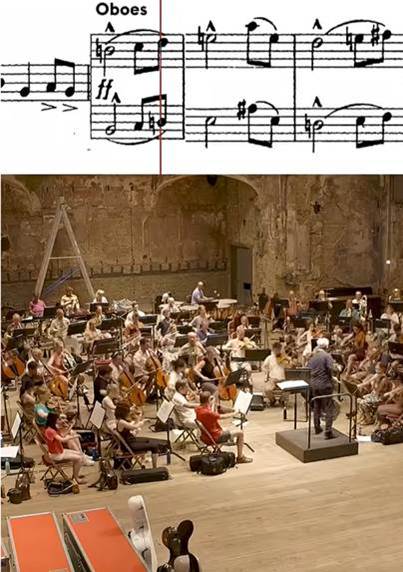
Elgar’s Enigma Variations IV, WMB
The
music immortalising William Meath Baker Elgar's
Fourth Variation, marked Allegro di molto and titled WMB, is a
brisk, energetic, and very short musical portrait from Edward Elgar's
masterwork, the Enigma Variations. It depicts William Meath Baker, a
brisk country squire and friend of the composer known for bustling about and
announcing plans. |
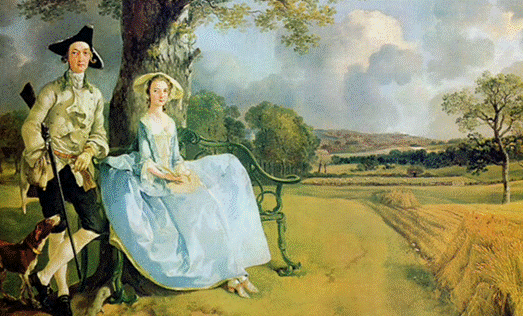
“Enigma” person? WILLIAM MEATH BAKER (1857 –
1935) pottery manufacturer, Fenton. BECAME High Sheriff of Gloucestershire and
their entertained the composer Edward Elgar and his wife. The 4th of Elgar’s
Enigma Variations is said to have been inspired by the memory of Baker striding
out of the music room at Hasfield court and inadvertently banging on the door.
He was a keen mountain climber and made several ascents in the Swiss Alps. (Staffordshire Sentinal, 13 March 1985).
Dorabella
He called the tenth variation Dorabella after Dora Penny,
which was her nickname from Cosi Fan Tutte and the music parodies her
youthful stammer. The piece depicted Dora Penny, daughter of the Rector of
Wolverhampton and step daughter of Mary
Baker, a close friend of the Elgars.
Then I turned over and had a shock. No 10,
Dorabella. Being overcome by many emotions I sat silent when it was over. “Well,
how do you like that, hey?” I murmured something about its being
charming and rather like a butterfly, but I could think of nothing sensible to
say; my mind was in such a whirl of pleasure, pride, and almost shame that he
should have written anything so lovely about me. The voice from the fireplace
came to my rescue: “Isn’t it beautiful, dear Dora? I do hope you like it.” (Powell, R (1937), Edward Elgar, Memories of a
Variation, page 13).
What I thought of this composition when I
first heard it on the orchestra will be found earlier in this book. I had no
idea what it really meant. It was not until many years afterwards that it
dawned on me that I had been as much the victim of EE's impish humour as had
RBT. I stammered rather badly at times when I was young and as is the case with
so many of those afflicted it was a terrible trial to me. Now, I am thankful to
say that this is to a certain extent a thing of the past. Elgar exploited his
humour at my expense with such marvellous delicacy that no one could help
laughing with him if they understood it. Anyhow, I had the satisfaction of
knowing that nothing like the Intermezzo has ever been written before or since.
All sorts of curious things have been said about it. One critic said that the
intermezzo was quite out of place in the Variations and should have been in the
Wand of Youth; and that, as though Elgar had lost a golden opportunity, the Intermezzo
had all that was required for a first class pretty piece! (Powell, R (1937), Edward Elgar, Memories of a
Variation, page 132).
|
Elgar’s
Enigma Variations X, Dorabella
The
music immortalising Dora Penny Elgar's
tenth variation, titled "Dorabella," is an Intermezzo: Allegretto
from the Enigma Variations, Op. 36 (1899). It portrays Dora Penny, a close
friend of the Elgar family, and captures her charming, playful personality
and a slight, endearing laugh or stutter through fluttering woodwind figures. |