Coventry in the Sixteenth Century
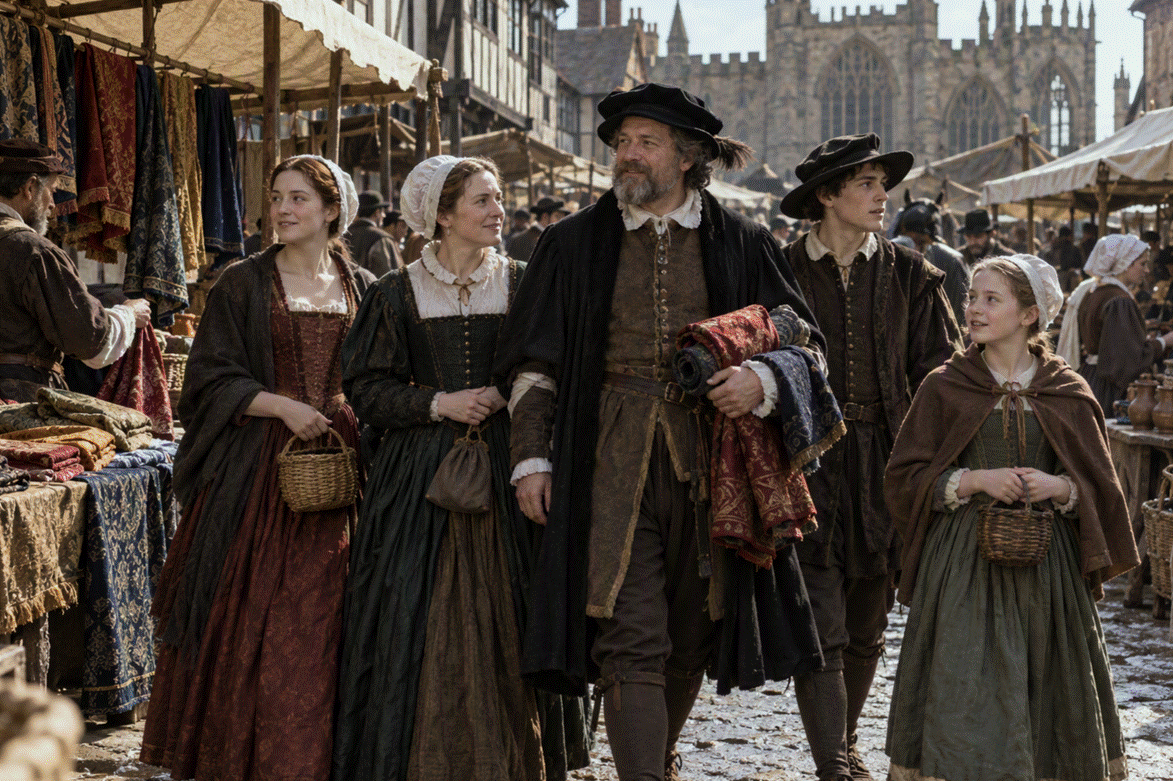
The
home of the Baker family in the mid to late sixteenth century
|
Return to the Home Page of the Bakers Family part of the website |
The Bakers of Highfields Story
The Story of the Dods and Bakers and of Highfields,
Fenton House and Hasfield Court. A journey through the history of Cheshire and
Staffordshire, an Anglo-Saxon nobleman who retained his lands after the
Conquest, pottery at Stoke on Trent, an encounter with Elgar, and the history
of an Elizabethan manor house at Audlem |
The family tree of the Bakers of Highfields |
The Family Tree of the Dods, predecessors to the
Bakers of Highfields |
The Bakers of
Fenton House and Hasfield Court
The Family Tree of the pottery Bakers of Stoke on Trent |
The Family Tree of the Bellyse Family |
The main part
of this website tells the story of the Farndale family from Yorkshire Descendants of Arthur Baker, the story of the
Farndale ancestry is told through the main part of this website You can also return to the Farndale
website home page |
The genealogy of the family of James Hall, linked to
the Baker family through marriage to Arthur Baker |
Headlines of are
in brown.
Dates are in red.
Hyperlinks to
other pages are in dark
blue.
References and
citations are in turquoise.
Context and local
history are in purple.
During the high and late medieval
periods, Coventry grew from a modest monastic settlement into the fourth
largest and wealthiest city in England. Driven by an immense boom in the
textile and wool trades, its strategic central location eventually elevated it
to a crucial seat of royal power.
For Mercian History, see a
chronology built around the Anglo-Saxon
history of Cheshire and wider Mercia.
1023 to
1032
Leofric, son of Leofwine, was
elevated to Earl of Mercia. Alongside his famous wife, Godiva, Leofric
became a legendary patron of Mercian religious houses such as Coventry and
ruled the region with stability for nearly three decades.
Godiva’s Old English name was Gōdgifu, meaning God's gift. She lived
from around 1004 to somewhere between 1066 and 1086. She was married to Leofric, Earl
of Mercia, a powerful and wealthy women. She and her husband were major
landowners who generously funded churches and monasteries, most notably
founding a large Benedictine monastery in Coventry in 1043. She was mentioned
in the Domesday Book. According to tradition, Leofric imposed heavy, oppressive
taxes, including the heregeld, on the people of Coventry. Godiva
repeatedly begged him to reduce the burden. Exasperated by her constant pleas,
Leofric jokingly or mockingly declared he would lower the taxes only if she
rode through the town's marketplace completely naked. Expecting his modest wife
to refuse, Godiva took him up on the challenge. She instructed the townspeople
to stay indoors with their doors and windows bolted, then rode through the
streets covered only by her long, flowing hair. Leofric kept his word and did
not impose the taxes. The story first appeared in the Chronicle of Roger of
Wendover, a St Albans monk who wrote it down more than 100 years after Godiva's
death. (The
City of Coventry: The legend of Lady Godiva, in A History of the County
of Warwick: Volume 8, the City of Coventry and Borough of Warwick, edited
by W B Stephens, London, 1969).
1057
Earl Leofric died and was buried
in Coventry. He was succeeded by his son, Ælfgar, as Earl of Mercia.
1066
Coventry was a scattered
settlement centred around the Benedictine monastery previously founded in 1043
by Earl Leofric and Lady Godiva.
1067
Lady Godiva died. Her legendary status
left a lasting cultural imprint on the settlement's identity.
1086
Coventry was the Land of the
Countess Godiva, a large settlement in the Hundred of Stoneleigh with 69
households (50 villagers, 12 smallholders, 7 slaves), putting it in the top 20%
of settlements across the nation (Powell-Smith,
Coventry,
Open Domesday).

c 1095
Bishop Robert de Limesey moved the
seat of his diocese from Chester to Coventry. He acquired the monastery,
transforming it into a cathedral priory. This divided the layout of Coventry
into two distinct jurisdictions: the Prior’s Half under ecclesiastical
authority and the Earl’s Half under feudal authority.
1143
During the civil war known as The
Anarchy, Robert Marmion fortified the cathedral priory against Ranulf, the
Earl of Chester.
1150
Construction began on St Michael’s
Parish Church, which would later become the historic Coventry Cathedral.
1182
Henry II granted Coventry its
first Royal Charter, securing critical trading rights and commercial privileges
for the town's merchants.
1250
The local Prior took tighter
control over the administration of Coventry's commercial affairs.
1322
Led by Edward II’s powerful
cousin, Thomas, Earl of Lancaster, and various Marcher Lords, including Roger
Mortimer, the barons revolted to protest the overreaching power and greed of the
King’s royal favourites, Hugh Despenser the Younger and his father. As the King
moved to confront Lancaster’s forces in the Midlands, Coventry served as the
central staging ground. Edward II physically assembled his royalist army in
Coventry before marching out to defeat the rebels at the Battle of Burton
Bridge and decisively at the Battle of Boroughbridge in March 1322. The commonalty
of the town of Coventre granted the very
significant sum of £100, roughly equivalent to millions today in purchasing
power, and 100 fully equipped men-at-arms for 40 days at their own expense.
Commission
to Hugh de Meriton, Ralph de Tywe, William Graunpe, Laurence de Shepeye, Roger de Pakwod and Robert de Chilton, reciting
that the commonalty of the town of Coventre has
granted to the king 100L to be paid without delay in aid of the king's
expedition against certain rebels, and 100 men at arms to go with the king in
his service on the said expedition at the costs of the said commonalty for
forty days ; and appointing the said commissioners to levy the said sum and the
expenses for the said men and to bring the said sum to the king (Fine
Rolls of the reign of Edward II, 1319 to 1327 page 104).
In the early fourteenth century, Coventry
was transforming into one of the wealthiest and most important textile and
wool-trading hubs in England. Financing an entire company of elite men-at-arms
evidences the immense liquid wealth accumulating within the town's merchant
class.
The commonalty (communitas)
reflected a town operating collectively under its own urban elite, represented
by the named commissioners like Hugh de Meriton and Ralph de Tywe. At this
stage, Coventry was aggressively pursuing total independence from local feudal landlords,
particularly the Prior of Coventry and the Crown's manorial rights. Providing
vital financial and military aid to the King was a calculated move to secure
royal favour, which eventually culminated in the town receiving its famous
Charter of Incorporation in 1345.
1342
Construction began on St Mary’s
Guildhall to serve the merchant guilds that were amassing immense fortunes from
the wool and textile industries.
1345
Edward III granted the milestone Charter
of Incorporation. This was the first charter of its kind in England, unifying
the Prior's and Earl's halves into a single municipal corporation with its own
council and mayor.
1355
The Tripartite Indenture formally
settled outstanding territorial disputes between the Crown, the monastic
priory, and the townspeople.
Construction began on the Coventry
City Walls. Spurred by the immense wealth of the textile trade, this massive
two-mile defensive fortification features 12 gatehouses to rival London.
1378
Early in the reign of Edward III,
on 24 March 1378, there was a confirmation in favour of the mayor, bailiffs and
men of Coventry of various preceding charters and letters patent, listed in
detail in the record (Calendar of Charter Rolls, Volume 5, Edward III to Henry
V, 1341 to 1417 page 242).
Late
14th Century
Coventry peaked as the fourth
largest city in England, globally famous for its high-quality wool and unique Coventry
Blue dyed cloth.
1399
Two major sets of rights were given
to the mayor, bailiffs, and commonalty of Coventry in 1399. The first was the
Financing of the City Walls (Murage). The record explicitly defined the exact
physical boundaries of the town, tracing a line from Jabettesassh
past various local landmarks like Nassyngtones
Milne, Cheylesmore Park (Cheillesmore),
and St. Nicholas Church, and granted the town the right to collect profits,
rents, or taxes from gates, towers, bridges, and vacant spaces (wastes) within
those bounds. This money was legally earmarked to fund the repair and
amendment of the walls of the town. The second was Judicial Independence
(Justices of the Peace). The provision established a localised legal system,
granting the mayor, recorder, and four appointed good and lawful men the
authority to act as local Justices of the Peace. Crucially, it barred the
county justices of Warwickshire from interfering (intermeddle) within
Coventry's jurisdiction, though it reserved the highest-stakes criminal cases (felonies)
for the King's explicit command. (Calendar of Charter Rolls, Volume 5, Edward III to Henry
V, 1341 to 1417 page 380).
1404
Henry IV convened the unlearned
parliament, the Parliamentum Indoctorum, at Coventry Priory, intentionally excluding
lawyers from the assembly.
1451
Henry VI issued a royal charter
making Coventry an independent county corporate, the County of the City of
Coventry. This status unified surrounding villages under its jurisdiction for nearly
400 years.
1456
At the onset of the Wars of the
Roses, Queen Margaret of Anjou moved the Royal Court and seat of Lancaster
government to Coventry, turning the city into the de facto capital of
England.
1459
The Parliamentum
Diabolicum, Parliament of Devils, was held at
Coventry's St Mary's Guildhall, passing severe attainders against Yorkist
leaders.
1471
Following the Yorkist victory at
the Battle of Tewkesbury, Edward IV stripped Coventry of its liberties and
enforced a massive fine due to the city's previous allegiance to the
Lancastrians.
1480
After paying hefty recompense,
Coventry restored its standing with the crown, cementing its place as a heavily
fortified medieval industrial hub as the period draws to a close
Laurence Saunders
Following his election as
chamberlain in 1480, Laurence Saunders aggressively defended the city's freemen
by driving hundreds of sheep off the common lands. He impounded animals belonging
to wealthy elite merchants and the Prior of St Mary’s, arguing they were
overgrazing and encroaching on public pasture. Saunders's actions were suppressed by Coventry's
ruling class, led by the Mayor and the city's powerful
recorder, Henry Butler. The municipal court, the Leet, fined and jailed
Saunders. He escaped to Ludlow to appeal directly to Prince Edward, the Prince
of Wales, and his council, accusing local officials of corruption and denying him
justice. Saunders spent the next fifteen
years leading protests and provoking civil unrest. His rhetoric grew
increasingly radical. In a public address in August 1494, he stoked populist
anger by declaring that the common people would never have justice until they
had striken off the heads of three or four
of these churls... that rule us.
1485
Lancastrian and Tudor
Loyalty
Throughout the Wars of the Roses,
the city of Coventry, as best it could, maintained its allegiance to the House
of Lancaster (McGrory, David (2004), A History of Coventry, The
History Press, page 101). The City came to
venerate the Lancastrian King Henry VI, overthrown, some may say usurped, twice
by Edward IV in 1461 and 1471. The King’s Window at St Mary’s Hall commemorates
Henry VI and his ancestors. The early sixteenth century Coventry Tapestry,
the oldest medieval tapestry still in its original place, and which hangs below
the north window in the Guildhall, probably depicts Henry VI and Margaret of
Anjou (though in the nineteenth century Sir George Scarf concluded that the
tapestry may have depicted Henry VII and Elizabeth).
After Henry Tudor’s (the first Tudor King, Henry VII)
victory at Bosworth Field he travelled via Leicester to Coventry, the City
Annals recording that “The earl being proclaimed King in the Fields came to
Coventry and the City gave him a hundred pounds and a Cup, and soe hee departed”. He stayed at the Black Bull Inn in Smithford Street, Coventry’s most prestigious inn, and home
of the mayor, Robert Onley. (McGrory, David (2004), A History
of Coventry, The History Press, page 99).
Coventry was a
city loyal to the House Lancaster, and to the House Tudor, which drew its
tentative lineage from the Lancastrian Line.
Yet the Tudor
lineage would not treat Coventry well.
1496
By 1496, after years of defying municipal
orders and instigating persistent enclosure disputes, Saunders was summoned
before the Mayor's court. His appeals to royal
authority ultimately failed to save him from local corporate power. He was
handed over to the Crown and vanished from public life after being committed to
London's Fleet Prison.
1500
Economic depression
At the start of the 1500s, Coventry was still heavily reliant on
its famous wool, weaving, and cloth-dyeing trades. However, a combination of restrictive
trade guild monopolies, prolonged warfare, and a major crash in broadcloth
exports during the 1540s and 1550s devastated the local economy.
During the sixteenth century, Coventry transitioned from a booming
late-medieval powerhouse into a city facing severe economic hardship and
dramatic structural change. After centuries of ranking as England's fourth-largest and wealthiest city, sixteenth century
Coventry suffered from the collapse of its main industry and the sweeping
disruptions of the English Reformation.
The wealthy wool merchants who once dominated the city virtually
disappeared by mid-century. Houses sat empty, and a large portion of the
population fell near or below the poverty line.
Diversification
To cope with the crash, the city's economy diversified. Suburban
areas like Spon and Gosford adapted by pivoting toward cap-making and blue
thread manufacture, for which Coventry became renowned.
At the beginning of the century all the wool woven
in the city was placed in the Searching House next to the Wool Hall in Bayley
Lane. The quality of weaving was checked by two weavers and fullers especially
appointed for the task….. Merchandise which did not
reach the required standard was returned. (McGrory,
David (2004), A History of Coventry, The History Press, page 143).
1506
The almshouse, Bond's Hospital was
founded and endowed in 1506 by Thomas Bond, a wealthy draper and former Mayor of Coventry, to
provide housing and sustenance for ten poor men and a female housekeeper. The
inmates were required to wear a hooded black gown and attend matins, mass and
evensong at St John’s daily. There was a second almshouse
known as Ford’s Hospital at Greyfriars Friary, founded in 1509 by William Ford.
1510
Lollardism was
a proto-Protestant religious movement that emerged in late fourteenth century
England. Initiated by the followers of John Wycliffe, a prominent Oxford
theologian and reformer, it rejected the authority and wealth of the Roman
Catholic Church in favour of a scripture-based, personalised faith. The term Lollard
originated as a derogatory Middle Dutch insult meaning mumbler.
Lollardism was
well established in Coventry, and in the reign of Henry VIII, according to Dr
Gairdner, the city was a “special nest of heresy”. In 1510, the year of Henry’s
visit, ten Lollards accused of heresy were forced to carry heavy bundles of
faggots, symbolic of their death by fire, before the people at Cross Cheaping. All recanted except Joan Ward, who was burnt at
the stake in the Little Park at Park Hallows. (McGrory, David (2004), A History of Coventry, The
History Press, page 109).
1517
In 1517 the Leet ordered every alderman in the city with men to
search for vacaboundes and lusty beggars
and make them leave their wants on threat of imprisonment.
1518
And these bygge
beggars, that will not worke well to get ether
levying, but lye in the feldes and breke hedges and stele mennys fruyt in somour, let them be
banished from the town. Or els pnyssh theym so without fauour that they
schal be wery to hyde therein. (The
Leet, 1518).
1520
In 1520 the mayor caused a census to be made and the population was recorded at 6,601 (McGrory, David (2004), A History of Coventry, The
History Press, page 125).
In the 1520s there were ninety separate trades
and the leading trades were Cappers, Weavers, Shearmen, Butchers, Shoemakers,
Drapers, Dyers, Bakers, Mercers, Tailors, Tanners and Smiths (McGrory, David (2004), A History of Coventry, The
History Press, page 144).
In addition to the inns which provided accommodation, there were
numerous alehouses. When a census of people and grain was taken in 1520 there
was a total population of 6,601. There were 68 brewers brewing 146 quarters of
malt a week and 43 bakers baking 132 quarters of wheat a week. From this it has
been calculated that the consumption of ale or beer was a quart a day for each
member of the population, man, woman and child (The City of
Coventry: Social history to 1700, in
A History of the County of Warwick: Volume 8, the City of Coventry and Borough
of Warwick, ed. W B Stephens. London, 1969).
1523
There was decline in Coventry even before the
Dissolution of the Monasteries. As early as 1523 there were 565 empty houses
counted in the city. Much of this is believed toi be
due to the decline in the cloth and cap trade. Production of the famed
‘Coventry true blue’ cloth and dark blue threat noted for its permanence lasted
from the fifteenth to the end of the sixteenth centuries. The colour came from
the woad plant, which was imported from Southampton. That Coventry blue was
better than most is often attributed to the local water, but other old sources
suggest that woad was being mixed with madder and sloe berries which once grew
prolifically in the area. (McGrory, David
(2004), A History of Coventry, The History Press, page 143).
1525
The uprising, commonly
known as the Coventry Lammas Day Rebellion, took place in August 1525. It was a
sharp, localized violent protest driven by a mix of economic desperation and
civic betrayal. The spark was the illegal enclosure of communal lands.
Traditionally, on Lammas Day (1 August), certain agricultural fields around
Coventry were opened up to the public as common
pasture. However, local landlords and wealthy oligarchs had begun fencing off these
fields for private use, stripping the city’s poor weavers and commoners of
their livelihoods. On late July and early August, the commonalty of
Coventry revolted. Driven by rumours and anger, an angry mob tore down the
hedges, broke open the gated enclosures, and rioted through the streets.
Strikingly, the Mayor of Coventry, Nicholas Heynes, actually
sympathised with and sanctioned the riotous behaviour rather than
suppressing it.
Alarmed by the breakdown
of civic order, Henry VIII issued a royal commission to the regional magnate,
the Marquess of Dorset. Dorset raised an army of several thousand men and
surrounded the city. The rebellion quickly folded under the threat of
overwhelming military force. When the
local nobility, led by Thomas Grey, 2nd Marquess of Dorset, marched to suppress
the Coventry rioters, they used Kenilworth to safely imprison thirty six arrested rebels. Furthermore, because Coventry itself
was deemed too volatile and plagued by illness, the death, the Abbot
hosted the royal judicial court at Kenilworth to try and sentence the
ringleaders safely outside the city walls. This vital support earned him Henry
VIII’s personal promise of future royal favour.
During the 1525 uprising, Abbot William Wall opened
up the secure defences of Kenilworth Castle and abbey lands to serve as
a base of operations for the King’s forces. A later letter from William Wall, the
Abbot of Kenilworth (wrongly attributed to Sir William Gascoigne) to Thomas
Cromwell on 17 June 1536 wrote I and my poor house are much disquieted about
our manor or cell of Broke, Rutland, owing to the canon I sent thither to rule
there giving up the title of the house to the King, because he had not as large
a pension assigned to him as he wished. When I first received your letters, you
will remember I offered the lease of the house to any friend of yours, and gave a bond of 1,000 marks to the lessee for his
surety; which, if we cannot fulfil, we shall be dangered
in the said sum. I beg therefore that you will be a mean to the King that the
manor may still belong to us, or that we may have it at a reasonable rent ;
especially as his Highness, for my good service done at the insurrection at
Coventry, promised me his favour in any reasonable suit. (Public Records of the reign of Henry VIII, Volume
10, Folio 1151).
1533
Break with Rome and
Dissolution of the Monasteries
When Henry VIII and Anne Boleyn married in a secret, pre-dawn
ceremony on 25 January 1533, at Whitehall Palace it was probably Dr Rowland
Lee, a trusted royal chaplain. It was later said that Lee hesitated to perform the
ceremony because Henry did not have the Pope's written permission to remarry.
Henry reportedly lied and told Lee that he did have the papal license, but it
was locked away elsewhere in the palace. Lee was later rewarded for his loyalty
by being named Bishop of Coventry and Lichfield.
A significant consequence of the break with Rome was the
dissolution of the monasteries.
There is a separate page which explains the fate of Charterhouse, Coventry.
1536
Henry VIII’s Dissolution of the Monasteries hit Coventry
exceptionally hard. As a major ecclesiastical centre, the city was stripped of
its wealth, and its influential religious institutions, including Whitefriars,
Greyfriars, and the Benedictine Priory of St. Mary's, were dissolved and
looted.
St Mary's Priory and Cathedral was Coventry's first medieval
cathedral and a major Benedictine monastery. When St. Mary’s Priory was
demolished, Coventry lost its status as a cathedral city. The corporation fought
to save the Cathedral and the Priory of St Mary, arguing that the former could
serve as a parish church, but Coventry already had two large parish churches
and there was another cathedral at Lichfield, which held secular canons not the
Benedictines that Henry hated so much and in June 1545 the crown disposed of
the Priory for £1,000. (McGrory, David (2004), A
History of Coventry, The History Press, page 116). It
was the only English cathedral completely demolished during
the Reformation, because the civic administration could not raise the funds to
buy and spare it as a parish church.
Dugdale wrote extensively about St. Mary's
Priory and Cathedral, the crown jewel of Coventry’s religious life and the
city’s single largest property owner. He recorded that after its surrender in 1539, the massive cathedral church was completely razed. He
detailed how the local citizenry was offered the buildings by the Crown, but because
they could not raise the necessary funds to purchase them, the
vast majority of the majestic structure was systematically demolished
for its raw materials. Dugdale was deeply critical of how sacred
spaces were rapidly privatised and commodified. He tracked how the Crown
treated monastic assets as an economic windfall, stripping valuables and
immediately putting the estates up for sale. In Coventry, he highlighted the
actions of John Hales, a prominent Crown servant who bought up vast swaths of
the city's suppressed monastic property in 1545, including St. Mary's and the
Whitefriars monastery. Dugdale noted how these ancient spiritual sites were
aggressively restructured into private, secular residences or repurposed for
civic functions. Beyond the physical brick and stone, Dugdale’s
writing was motivated by a deep sense of historical regret. He argued that the
wholesale destruction and sale of Coventry's monasteries was a massive
historical mistake that triggered a severe economic and population collapse for
the city, with the loss of industry driving the city's population down from
roughly 7,000 to 3,000. In both The Antiquities
of Warwickshire and his later Monasticon Anglicanum, he saw
the dissolution not as a holy reform, but as an act of short-sighted
architectural and cultural vandalism.
Deprived of monastery-driven commerce and pilgrimage wealth, the city’s
population plummeted drastically, shrinking from roughly 7,000 down to just
3,000 residents.
1538
In 1538, Humfrey Reynoldes of Coventry, a yeoman of the Crown, submitted a
reform proposal to reorganise the lands and revenues of abbeys, using the Black
Monks (Benedictines) of Coventry as a blueprint. He argued that despite holding
some of the most profitable lands in the realm, religious houses were heavily
in debt. The Coventry monks had a revenue of nearly £1,000 but were in debt for
almost the same amount, partly because the bishop held £300 of their best
lands. The monasteries force tenants to overbid for convent leases, causing
local disputes and variance. The ill living and conversation of the
monks, and their failure to live according to their vows, was cited as a
primary reason for the dissolution (pulling down) of abbeys. Monks spend over
£40 per individual, yet failed to maintain their full
numbers or upkeep their houses. Reynoldes proposed
capping the total expenditure at roughly £1,000 yearly by restructuring the
monastery into a combined religious and secular military/administrative estate.
The revenue would support 20 monk-priests. The Abbot or Prior's role would be
restricted to spiritual guidance over his brethren, stripping him of control
over temporal (financial/worldly) matters. The Prior would receive 40s
annually, the subprior 20s, and each monk 6s 8d, with each monk also supporting
a student scholar in the almonry until they become priests. The abbey's wealth
would instead fund a structured hierarchy of secular officials, gentlemen, and
soldiers who would receive fees, clothing liveries, housing, and meals.
Leadership would be provided by a Head Captain/Justice of the Peace (£40 fee)
and a Petty Captain (£20 fee); administration by an attorney/controller,
steward, receiver, marshal, and a physician; with a Garrison/Retinue of 15
gentlemen, 15 yeomen, 15 grooms, and 15 pages—all required to provide their own
horse, harness, and weapon, and share a bed between two. (Public Records of the reign of Henry VIII, Volume 13 –
Part 2,
Folio 1198
(page 505)).
While this provides a historical snapshot of the early 1530s, the
Crown ultimately went in a completely different, much more radical direction. Reynolds'
reform plan was heavily motivated by personal frustration. He was an ambitious
local man who had been repeatedly outbid by wealthy merchants when trying to
lease lands from the wealthy Coventry
Priory. His petition was essentially an attempt to get Henry VIII to strip
the monks of their financial power so that local men like himself could
benefit. The monks of Coventry
Priory actually held an emergency chapter meeting
around 1533 specifically to plan their defence and appeal against Reynolds'
hostile proposals.
Henry VIII and his chief minister, Thomas Cromwell, chose not to
reform or repurpose the monasteries into administrative military estates as
Reynolds envisioned. Instead, they opted for complete Dissolution.
In 1539, just a few years after this proposal, Coventry Priory was fully suppressed and
surrendered to the Crown. Rather than being turned into a secular
administrative house with captains and pages, the monastic buildings were
completely dismantled, the cathedral church was defaced and ruined, and the
vast lands were sold off or granted to wealthy royal favourites and the city's
civic elite.
On 20 September 1538, the Mayor and Aldermen of Coventry wrote to
Thomas Cromwell. It is reported that the Grey and White Friars of Coventry
are to be suppressed. Their churches can ill be
spared; for in time of plague, sick people resort to them to hear divine
service. There are but two parish churches in the town, and no small number of
Christian people belong to them. If in time of plague sick people resorted to
the parish churches they would infect the whole city.
We beg you therefore to intercede with the King that those two churches of
friars remain, the religious persons thereof to be reformed at the King's
pleasure. Coventry 20 Sept. Signed by William Cotom, mayor, Roger Wigston,
recorder, Thomas Banwell, Julian Nethermyll, Ric. Heryng,
Thos Dode, Thos. Arcelen, Roger Myllys, Hugh Lawton,
John Gett, Roger Palmer, Chr. Wayd, Chr. Waren; Henry
Woner, Wm. Mailer, Cuthbert Jenour, Ric. Lee. In desperation, they wrote
again on 20 October 1538. The King's commissioner, Dr. London, is now at
Coventry to suppress the two houses of friars for their demerits, and though we
have asked him to forbear till we should hear from your Lordship about leaving
the churches, or at least one of them, standing, we find him very hard. For all
we can do, he has defaced the church of the Grey Friars and begun to do the
like with the White Friars, but by great entreaty we have got him to stay as to
the latter till we have sent to your Lordship for help. We beg you to intercede
with the King that we may obtain the same, with the houses and gardens, else it
will be a danger and decay to the city. They added, perhaps not helping
their case, A rental of the house and gardens of the Carmelite or White
Friars of Coventry, viz., of 31 houses and 11 gardens specified by tenants'
names or otherwise. Total, £5 15s 8d (Public
Records of the reign of Henry VIII, Volume 13 – Part 2 Folio 394,
650).
1540s
Despite the economic ruin, Coventry maintained a distinct civic
identity. It was historically a hotbed for religious radicalism and
late-medieval heresy. During the late 1540s, a growing Protestant faction
within the city’s elite took root, ultimately leading Coventry to become a
heavily Puritan and Parliamentarian stronghold by the time the next century
closed.
The physical landscape altered as well. While the great medieval
city walls still stood tall and protected the residents, the towering stone
ruins of the dissolved monasteries were gradually sold off or absorbed into
private gentry estates.
1544
The Coventry Cross
The deeds of Holy Trinity Church contain the
first reference to a cross in Coventry in a document dated 1300. The cartulary
of St Mary’s Priory, compiled around 1400, also contains reference to this
early cross (McGrory, David
(2004), A History of Coventry, The History Press, page 129). The
City Annals record that Cuthbert Joyner, the mayor, laid the first stone of the
new cross in 1541. It rose to a height of 57 feet, exceeding expectations. In
the lower section stood statues of Henry VI, King John, Edward I, Henry II,
Richard I and Henry V. In the second storey were Edward III, Henry II and
Richard III, St Michael and St George. (McGrory,
David (2004), A History of Coventry, The History Press, page 130).
That stately cross here (is)
one of the chief things wherein this city most glories, which for
workmanship and beauty is inferior to none in England (Sir William Dugdale, The Antiquities of Warwickshire).
The cross is the subject of a rhyme that predates a similar rhyme
about Banbury Cross. Ride a cock horse to Coventry Cross; To see what Emma
can buy; A penny white cake; I’ll buy for her sake; And a twopenny tart or a
pie. The Coventry text mirrors the structure of the earliest recorded
iteration of the rhyme from Tommy Thumb's Pretty
Song Book (c 1744), which similarly focused on going to a cross to buy
baked goods rather than watching a fine lady.
1545
Whereas formerly the city has been wealthy and
famous it had of late years been brought into decay and poverty; and though
numbering 11,000 or 12,000 houseling people had but
two churches where God’s service could be done (Letter to the Crown, 1545).
The King Henry VIII School was founded by
John Hales in the church of the Whitefriars dissolved monastery. After his return to London, he
desired his intimate Acquaintance, Lord Cromwell and Sir Anthony Dennis to move
the King, that he might have leave to purchase some of his Majesty’s Lands
lying in and about Coventry. The King
was easily prevailed upon to hearken to any motions of this Kind but
understanding there was no Free School in the said City, he told Sir Anthony
that he should be well pleased to meet with a Purchaser who would give
something towards the Foundation of a School, whereby others might be
encouraged to promote so good a Work. Sir Anthony answered, That His Majesty knew
John Hales to be a very good Scholar, and a Lover of Learning and Learned Men;
and therefore, could not meet with a Purchaser more fit for that Purpose. Hereupon the King sent for Mr Hales and asked
him whether in case of a Purchase he would be willing to do something towards
the erection of a Free School in Coventry.
Mr Hales answered, that he should
be very well pleased to do so,
and that since the Motion was made
by His Majesty, the
School which he would found should be called King Henry VII’s School (Lamond,
Elizabeth (1549), A
Discourse of the Common Weal of This Realm of England).
In its period at Whitefriars and, initially,
at St John’s the first headmaster of the school was called Sherwyn. He was followed
by John Tovey, who the City Account of 1599 state was paid 40s to go to Oxford
to take his degree as Master of Arts. Tovey would lead the school successfully
into the new century. (McGrory, David
(2004), A History of Coventry, The History Press, page 130).
In 1547 the annals record that the stews was
putt down by the King’s Commandment, the suppression of the brothels being
part of a nationwide attack on immorality.
1549
Coventry Bakers
Coventry bakers and millers were encouraged in 1549 by an arrangement
which required the bakers to use Coventry millers and the millers to serve
Coventry bakers first. It is perhaps significant that this took place just five
years after the millers had been allowed to form a company and draw up their
ordinances. Brewing also was regulated according to circumstances. (The
Coventry Leet Book 772 and 793. For
control of the bakers' guild, see pages 161 to 162). The Coventry
Leet Book is a highly detailed, medieval ledger containing the official
records, ordinances, and court proceedings of Coventry’s Court Leet (the
municipal governing body) spanning from 1420 to 1555.
1555
Bloody Mary
After Mary was crowned in 1553 the city magistrates were
ordered to put down any Protestant services in the city, but few in Coventry
were Catholic at heart and secret services went on in the fields until more
tolerant times returned with the reign of Elizabeth (McGrory, David (2004), A History of Coventry, The
History Press, page 109). The bloody reign of Mary was felt in Coventry.
Foxe's Book of Martyrs,
recorded the public execution at Coventry on 8 February 1555 of the Protestant
minister, another Lawrence Saunders. Saunders preached against the restoration
of Popery and holding heretical views on transubstantiation,
and was stripped of his ministry by Bishop Edmund Bonner before being
sent to Coventry to serve as a warning to local Protestants. There is a
monumental cross, erected in 1910, to the Coventry Martyrs, at the bottom of
Little Park Street.
1557
Mystery Plays
Coventry, like York, Chester and Wakefield, had a cycle of Corpus
Christi or Mystery Plays. The Coventry Mystery Plays were lavish, civic-backed
theatrical productions dramatising Bible stories,
performed annually in Coventry until their final suppression on 18 June 1579.
They were normally performed by the city’s trade guilds on Corpus
Christi day. Huge wagons, known as pageant wagons, were dragged around
the city as stages on wheels.
The grand finale of the theatrical cycle was a spectacular
production of The Last Judgment (Doomsday). During the last pageant of the
day, the ‘saved’ souls wore white leather while the ‘doomed’ had blackend faces and wore yellow clothes painted with flames.
Accompanied by the cries of the crowd, each was dragged or driven into a giant
‘hells mouth’ by a black devil. (McGrory, David
(2004), A History of Coventry, The History Press, page 128).
While most of the original Coventry cycle is lost, two pageants
survive, The Shearmen and Tailors' Pageant and The Weavers' Pageant.
The Shearmen
and Tailors' Pageant covers the Nativity and the Massacre of the Innocents,
featuring the haunting Coventry
Carol sung as a lullaby by the mothers of Bethlehem.
The plays were banned in 1579 as the Reformation took hold and authorities
grew suspicious of traditional Catholic elements and popular vernacular drama.
1560
In 1560 Thomas Wheatley founded Bablake
School, which later shrank to 21 pupils from poor backgrounds picked because of
their deserving character.
1565
Queen Elizabeth made her one and only visit to
Coventry on Saturday 17 August 1565, during one of her state visits around the
realm. John Throckmorton, the recorder, gave a speech of welcome, informing her
of the city’s connection to the Black Prince and Henry VI. (McGrory, David (2004), A History of Coventry, The
History Press, page 109).
1569
Mary Queen of Scots in Coventry
A Catholic
uprising in northern England aimed to depose Elizabeth I and put her cousin
Mary on the English throne. Elizabeth I ordered Mary
moved south from Tutbury Castle because Coventry had strong, defensible city
walls and sat far away from northern rebel sympathisers. Mary arrived with an escort
of 400 troops and her own small entourage. In November 1569 Elizabeth
ordered that Mary Queen of Scots be brought to the safety of walled Coventry.
On 25 November Sir Ralph Sadler wrote “yesterday the Queen of Scots was removed
from Tutbury to Asby and we had assured account that
she shall be in Coventry this night. (McGrory,
David (2004), A History of Coventry, The History Press, page 134).
Mary was held in
Coventry for roughly 38 to 39 days. On January 2, 1570, as the threat of the northern
rebellion receded, she was transferred back to Tutbury.
1570s
Pastimes included
cockfighting and animal baiting. All classes enjoyed baiting badgers, dogs,
bulls and bears.
1579
1579 was a plague
year.
1585
William Shakespeare
William
Shakespeare played in Coventry every year between 1585 and 1591. In 1594 he
joined the Chamberlain’s Men and his last tour as a player was with the King’s
Men (Shakespeare’s own company) in 1603 who again performed in Coventry. They probably
performed in St Mary’s Guildhall. (McGrory, David
(2004), A History of Coventry, The History Press, page 148). The
Mystery Plays deeply influenced Shakespeare's writing and imagery, such as
references in Macbeth and The Tempest. In 1603, London
theatres were shut down due to a major plague outbreak and the death of Queen
Elizabeth I. Newly patronised by King James I, the King's Men went on an
extensive regional tour and performed in Coventry. The plays they travelled
with during this time likely included Hamlet, Twelfth Night, The
Merry Wives of Windsor and Troilus and Cressida. From July to
December 1608, another plague outbreak forced London playhouses to close again.
Records show the King's Men were in Coventry in late October 1608. The plays
likely included Coriolanus, Antony and Cleopatra and Pericles.
1588
Sixteenth century Satire
Sir Richard
Knightley was a staunch Puritan and a member of Parliament who strongly opposed
the Crown's suppression of religious freedom. The Martin Marprelate
Tracts were a series of highly controversial, illegal Puritan pamphlets
published between 1588 and 1589 under the pseudonym Martin Marprelate.
Written with a brilliant, witty, and deeply irreverent tone, they used satire,
gossip, and biting irony to attack the institutional power of the Elizabethan
bishops. In late 1588, Knightley agreed to hide the rogue printing press at his
family estate, Fawsley Hall in Northamptonshire. To protect the operation, Knightley
leveraged his family network and sent the radical printer Robert Waldegrave and
author John Penry to Coventry. The press was relocated to Whitefriars, the
former Carmelite friary which had been converted into a manor house.
Whitefriars was owned by Knightley's nephew by marriage, John Hales. Records
suggest that Hales was not particularly thrilled about harbouring illegal
subversives. He later claimed he only agreed to host them out of strict family
loyalty to Knightley.
Despite the tension,
the secret press was highly productive during its stay in Coventry from January
to March 1589, printing three major texts. Certain Mineral and Metaphysical Schoolpoints was a satirical broadsheet completed in
late January. A View of Some Part of Such Public Wants was a treatise
written by Puritan reformer John Penry in February. Hay any Work for
Cooper was
the exlosive fourth official Marprelate
tract, completed by late March, which directly mocked Thomas Cooper, the Bishop
of Winchester.
When the secret
ring was exposed, the Queen's Privy Council cracked down harshly. Sir Richard
Knightley was arrested, hauled before the Star Chamber, fined an astronomical
£2,000, and imprisoned in the Tower of London. John Hales was also arrested and
fined. Because of their high social standing, both Knightley and Hales
eventually had their financial fines remitted, but the Coventry printing
operation remains one of the most famous hit-and-run campaigns in the history
of English free speech.
Sabbatarianism
was growing during this period. In 1588 the opening of shops, playing games, or
idly walking about were forbidden during service time on Sundays. In 1599 these
orders were intensified, indoor games and idly sitting in streets or fields
being added to the other forbidden activities. Football in the streets would
incur gaol after 1595 and children's games in the street were forbidden in 1605. (The City of Coventry:
Social history to 1700, in A History
of the County of Warwick: Volume 8, the City of Coventry and Borough of
Warwick, ed. W B Stephens. London, 1969).
1599
Coventry hath
abundance of ale houses, taverns and innes whiche are so fraught with maltworms (drunkards) noghte and daye that
you shal wunder to see
them. You shal have them ther
sitting at the wine and good ale all daye longe and nighte too, even a whole week as longe as money is lefte (Thomas Platter’s Travels
in England 1599, London: Jonathan Cape).
1603
Coventry’s part in the Gunpowder Plot
James VI of
Scotland, soon James I of England, stayed on the Rutland estates of Sir John
Harington in April 1603 during his historic royal progress from Edinburgh to
London to claim the English throne following the death of Queen Elizabeth I.
Sir John was made a ward of the King’s eight-year-old daughter, Elizabeth, who
was sent to Coombe Abbey on the outskirts of Coventry. Princess Elizabeth lived
at Coombe Abbey for about five years, receiving a rigorous education in
history, theology, languages, and music.
1605
The Catholic
conspirators of the Gunpowder Plot of 1605, planned to kidnap the young
princess Elizabeth from Coombe Abbey and install her as a puppet monarch. The
plot failed. Princess Elizabeth was brought into Palace Yard in Coventry to keep
safe from the Gunpowder Plotters.
Afterwards
Princes Elizabeth returned to Coombe Abbey, where she remained until 1608 when
she moved to Kew.
1611
In 1611, James I
severely rebuked the city corporation for allowing citizens to receive Holy
Communion while standing rather than kneeling.
The Puritans
found that James I, like Elizabeth, disappointed their expectations. In 1611
they were ordered, in a letter from the king himself, to receive the sacrament kneeling,
'to the grief of many'. Ten years later James refused to approve the new
charter until he was satisfied that the orders of the church were being
observed. (The City of
Coventry: Social history to 1700, in
A History of the County of Warwick: Volume 8, the City of Coventry and Borough
of Warwick, ed. W B Stephens. London, 1969).
1617
In September
1617, James I stayed in Coventry as part of the homeward leg of his royal progress
back from Scotland. This had been his only return visit to his homeland after
ascending the English throne in 1603. Coventry served as a convenient and
politically vital stopover as the royal entourage journeyed south back to
London. He stayed at the by then grand manor house at Whitefriars. On 2
September 1617, the city welcomed the King with formal civic pageantry. The
celebrated scholar and translator Philemon Holland, a prominent Coventry
resident, was chosen by the city to deliver an oration in the King's honour.
Clad in a custom suit of black satin, Holland delivered an elegant speech
praising the monarch, which was so well received that it was later published.
Despite the
outward display of luxury and celebration, the visit took place against a
backdrop of political and religious friction between the Crown and Coventry's
elite. James was deeply concerned with the Puritan temper of Coventry.
He used the 1617 visit to inspect local conformity to the Church of England.
The local magistrates had their own agenda. On the advice of Sir Edward Coke,
Coventry's legal advisor, the city was transitioning into a self-electing
oligarchy. The Corporation used the lavish feast to curry favour with James in
hopes of securing a new royal charter to formalize this power structure, which
they eventually secured in 1621.
1621
A self-electing Oligarchy
In 1621, James I issued
a new Governing Charter to Coventry. While it aimed to streamline local
administration, it structurally centralised power away from ordinary citizens.
The charter created a strict ruling body composed of the Mayor,
ten aldermen, and freemen chosen by the council itself. This was viewed locally
as a significant step backward. It effectively revoked the right of the general
population to democratically elect their city leaders, a privilege they had possessed
since Edward III's Charter of Incorporation in 1345.
The later years
of James I's reign saw a slow stabilisation of the city. Structurally, Coventry
was transitioning away from its medieval dominance as a cloth hub. It had began showing stronger Puritan leanings. The tightening of
royal control after the 1621 Charter alienating the common populace, combined
with growing religious dissent, caused local sentiment to sour toward the Crown
near the end of James's life.
1626
Two Coventry Chamberlains
were fined £20 each because their Lammas Feast was not as good as the one the
previous year.
1635
Tensions with Charles I
Relations between
the monarchy and Coventry deteriorated dramatically during Charles I's period
of Personal Rule, eleven years when he ruled without calling Parliament.
Historically, Ship Money was a non-parliamentary tax levied only on
coastal towns for naval defence during times of war. In 1635, Charles extended this
tax to inland counties, including Warwickshire. As a landlocked city,
Coventry's citizens and leadership strongly protested the considerable
contribution demanded of them. The imposition of what locals viewed as an
illegal, arbitrary tax bred deep resentment against royal authority and pushed
the city's influential merchant class toward the opposition.
The city became
increasingly influenced by Puritanism, with local leaders, preachers, and townspeople
increasingly favouring austere, reformed Protestant practices.
Charles I and his
Archbishop of Canterbury, William Laud, attempted to enforce Laudianism, High Church practices and uniformity
that many Puritans viewed as a dangerous drift back toward Catholicism.
1641
The town was
surrounded by massive red sandstone city walls, with 32 towers and 12
gatehouses. These defences gave the local leadership a sense of security and
political leverage. As the national political crisis escalated, Coventry used
this geographical advantage to protect its own municipal and religious
interests from royal interference.
The Puritans were
back in the ascendancy in 1641 when the altar of Holy Trinity was replaced by
the table. Two Presbyterians, Obadiah Grew and John Bryan, became vicars
respectively of St. Michael in 1642 and Holy Trinity in 1644. The covenant was
taken in 1643 and Coventry remained staunchly
Parliamentarian throughout the Civil War period. It is possible that the phrase
'sent to Coventry' derived from the unbending attitude of the townsfolk to
Royalist prisoners sent there. The diary of Robert Beake (mayor, 1655) gives
some indication of the strict Sabbatarianism in force in Coventry during the
Commonwealth period. Offenders were put in the stocks or the cage for
travelling on Sunday, and even the man who was travelling 'to be a godfather'
was fined. Beake seems to have been very zealous in his duties. He was active
in suppressing disorder and the selling of unlicensed ale and personally
visited all the unlicensed alehouses in three wards, while he spent his Sundays
in the park, to observe 'who idly walked there'. (The City of
Coventry: Social history to 1700, in
A History of the County of Warwick: Volume 8, the City of Coventry and Borough of
Warwick, ed. W B Stephens. London, 1969).
Siding with the Parliamentarians in the Civil War
1642
The accumulation
of these pre-war tensions culminated in August 1642. Just as the Civil War was
sparking across the nation, Charles I marched on Coventry with a cavalry force
to claim the strategic base. Harbouring years of resentment over taxes and religion,
the Mayor and citizens refused the King entry,
shutting the gates and successfully repelling his forces, marking Coventry's
formal entry into the war as a Parliamentarian bastion.
Bibliography
Berger, R (1993), The Most Necessary Luxuries: The Mercer’s
Company of Coventry, 1550–1680, University Park: Penn State University
Press, pages 59–81.
Hulton, M (1979), Coventry and its People in the 1520s,
Stratford upon Avon: The Dugdale Society.
McGrory, David (2004), A History of Coventry, The History
Press.
Phythian-Adams, C (1979), Desolation of a City: Coventry and
the Urban Crisis of the Late Middle Ages, Cambridge: Cambridge University
Press.
Woodhouse, Frederic W (1909), The Churches
of Coventry.
The City of
Coventry: Crafts and industries, Modern industry and trade in A
History of the County of Warwick: Volume 8, the City of Coventry and Borough of
Warwick. Originally published by Victoria County History, London, 1969.