Charterhouse, Coventry in the Sixteenth Century
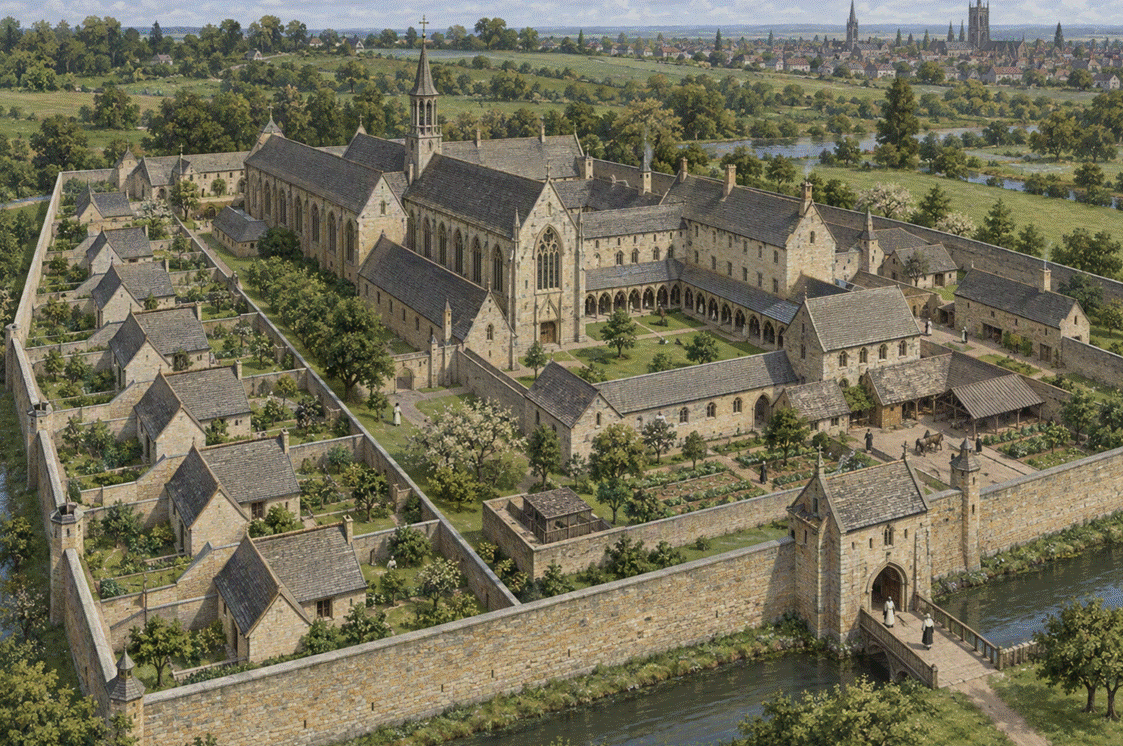
A
Carthusian monastery and after the dissolution of the monasteries, the home of
Robert Dudley, and then the property of Sampson Baker and later Humphrey Baker
|
Return to the Home Page of the Bakers Family part of the website |
The Bakers of Highfields Story
The Story of the Dods and Bakers and of Highfields,
Fenton House and Hasfield Court. A journey through the history of Cheshire
and Staffordshire, an Anglo-Saxon nobleman who retained his lands after the
Conquest, pottery at Stoke on Trent, an encounter with Elgar, and the history
of an Elizabethan manor house at Audlem |
The family tree of the Bakers of Highfields |
The Family Tree of the Dods, predecessors to the
Bakers of Highfields |
The Bakers of
Fenton House and Hasfield Court
The Family Tree of the pottery Bakers of Stoke on Trent |
The Family Tree of the Bellyse Family |
The main part
of this website tells the story of the Farndale family from Yorkshire Descendants of Arthur Baker, the story of the
Farndale ancestry is told through the main part of this website You can also return to the Farndale
website home page |
The genealogy of the family of James Hall, linked to
the Baker family through marriage to Arthur Baker |

Headlines of are
in brown.
Dates are in red.
Hyperlinks to
other pages are in dark
blue.
References and
citations are in turquoise.
Context and local
history are in purple.
The
Carthusian Order, known in England for their monasteries called Charterhouses,
represented the most austere, solitary, and strictly contemplative form of
monastic life in medieval Britain. Unlike communal orders, such as the
Benedictines or Cistercians, Carthusians lived as hermits in individual cells, breaking
their silence only for specific liturgical offices and rare communal meals. Out
of only nine Carthusian monasteries established in medieval England, the Charterhouse
in Coventry (the Priory of St Anne) and Mount
Grace Priory in North Yorkshire still provide a feel for the austere lifestyles.
Mount Grace is the most complete footprint of a charterhouse layout in Europe,
and hints at what Coventry’s Charterhouse once looked like, upon which the
impressionistic representation in the title has been imagined.
Carthusian
monasticism arrived in England in 1178 but saw a significant surge in
popularity during the late fourteenth century following the Black Death.
Wealthy patrons and royalty grew deeply anxious about the afterlife, and the absolute,
unyielding piety of the Carthusians made them the most sought-after
intercessors to pray for souls.
At
Coventry's Charterhouse, archaeologists have excavated the timber-framed
foundations of its cells, suggesting that they mirrored the layout seen at
Mount Grace.
Carthusian Monastery
1381
The Carthusian Order was elite and exclusive. Only nine
charterhouses were ever successfully established in medieval England. Founded in
1381 with the foundation stone laid personally by Richard II in 1385,
Coventry's Charterhouse (St. Anne's) was a prestigious institution.
The monastery was founded by William la Zouche, Lord Zouche of
Harringworth. He obtained 14 acres of land at Shortley, south-east of the
Coventry city walls along the River Sherbourne, from Sir Baldwin Freville.
The project faced four years of political uncertainty and land
ownership disputes, which delayed major construction. Despite this, early benefactors
funded the initial planning of seven individual monks' cells.
1382
On 18 March 1382 an order confirmed the arrangement at
Westminster. To Baldwin Frevylle knight, Richard
Dodenale mayor of Coventre Westminster, and Richard
Luff. Order to give brother John de Netherbury of the Carthusian order,
appointed prior of the house of that order to be founded in ' Shorteleyfeld ' within the liberty of Coventre,
and the monks there, livery of 14 acres of land in the said field which the king
had by feoffment of the said Baldwin, extending from a footpath towards London
on the east to a brook called Shirbourne and from the
highway to Warrewyk on the south to ' Busshele milne,' according to the
king's letters patent giving the same for a dwelling to the said prior and
monks and to their successors, the statute of mortmain notwithstanding. (Close Rolls of the reign of Richard II, 1381
to 1385, pages 65, 66).
1385
On 6 September 1385 Richard II and Queen Anne of Bohemia visited
Coventry and officially laid the foundation stone for the monastery’s church at
the east end of the choir. Richard II declared himself the principalis fundator (principal founder), sparking a wave of
high-profile financial backing from wealthy citizens and nobility.
Late
1380s
Prominent locals endowed further cells. Adam Botoner, a multi-term
Mayor of Coventry, bequeathed £20 for the eighth cell. Sir Nigel Loryng and the
Bishop of London procured the ninth, while other local figures funded the tenth
and eleventh cells.
1390
On 21 October 1390 there was a Grant of special grace to the
prior and convent of the house of the Carthusian order, Coventre,
of two woods called ' Gravenhowe ' and ' Billagwode,' to hold the same to them and their successors
for thirty years, rendering at the Exchequer a yearly farm of 4s, as Richard Wyghtebrigg
used to render for the same ; provided always that no prejudice or damage be
done to any other person, and that no trees be cut down in the wood (Fine Rolls of the
reign of Richard II, 1383
to 1391, page 336).
1396
Following the Norman Conquest, many French monastic houses were gifted
lands, estates, and churches in England. These dependencies were known as alien
priories. Swavesey Priory in Cambridgeshire was a
Benedictine cell belonging to the French Abbey of Saints Sergius and Bacchus in
Angers. Whenever war broke out with France, the English Crown routinely
confiscated the revenues and administration of these alien priories to prevent
wealth and intelligence from being sent to enemy territory. The Crown would
then lease the priory properties to English administrators, noblemen, or other
local religious houses in exchange for an annual fee paid directly to the Royal
Exchequer.
The Priory of St Anne, the Coventry Charterhouse, was recently
founded, and a favoured Carthusian house strongly supported by Richard II. In
1393, the king granted them a licence to permanently acquire Swavesey's assets from its French motherhouse.
On 23 June 1396, Commitment to the prior of the Carthusian
house of St. Anne by Coventre and Thomas Yokflete, clerk,
— by mainprise of Hugh Dalby of the county of Warwick, William atte Welle of Mildenhale of the
county of Suffolk, and Roger Barre of the same county, — of the keeping of the
alien priory of Swavesey and all its lands, rents and
possessions, to hold the same from Michaelmas last for as long as the war with
France shall endure, rendering 43Z. Qs. Sd. yearly at the Exchequer by equal
portions at Easter and Michaelmas, paying tenths and other quotas with the clergy,
and finding the divine services anciently ordained in the priory
; with clause touching maintenance of buildings and support of charges
(Fine Rolls
of the reign of Richard II, 1391
to 1399, page 182).
See also Fine Rolls of the reign of Henry IV, 1399
to 1405, page 26.
1399
On 21 May 1399 at Haverford was a Grant, of special grace, to
the prior and convent of the prior and convent of the house of St. Anne of the
Carthusian order by Coventry, that they and their successors shall have and
hold all their manors, lands, tenements, rents and possessions well and in
peace with all their liberties and customs, as well touching the election of prior
as touching the other customs which the house of Chartreuse has, and quit of
gelds, danegelds, hidages, scutages, works of
castles, bridges, parks, dikes and houses, of toll, passage, payage, pontage, lestage, all service and custom, and all payments (questu pecuniario) to the king
(Calendar of Charter Rolls, Volume 5,
Edward III to Henry V, 1341 to 1417 page 382).
In
May 1399, Richard II, the Charterhouse’s major benefactor, was in Wales (during
the turbulent final months of his reign before his overthrow by Henry IV later
that year. The grant freed the monastery from archaic royal taxes and feudal
dues, such as danegelds, hidages, and scutages, as
well as local tolls and services, allowing the isolated contemplative monks to
manage their properties and internal elections independently like the mother
house of Chartreuse.
In September 1399, Henry IV (Henry Bolingbroke) deposed his
cousin, Richard II, to seize the English crown. Because his claim to the throne
was legally and dynastically fragile, Henry IV spent his early reign
systematically reviewing, renewing, and confirming royal grants made by his
predecessor.
1400
On 4 December 1400 Henry IV granted Inspeximus
and confirmation, with clause licet, in favour of the prior and convent of St.
Anne of the Carthusian Order by Coventry 17 of a charter dated at Hereford,
21 May 1399 (See above) (Calendar of Charter Rolls, Volume 5,
Edward III to Henry V, 1341 to 1417 page 406). By
issuing an Inspeximus, literally we have
inspected, a legal document verifying and renewing an older charter, Henry
IV was assuring the Carthusian monks that despite the dramatic regime change,
their institutional rights, land holdings, and privileges remained safe under
the new Lancastrian dynasty. The inclusion of the clause licet
("although") was a technical legal mechanism of value to the monks.
In medieval English law, if a religious house failed to fully use or exercise the
specific liberties, markets, or exemptions granted in an earlier royal charter,
those rights could technically be forfeited to the Crown under the assumption
of neglect. A confirmation with the clause licet explicitly decreed
that although the monks may not have fully used or practiced their
granted privileges in the past, they were legally permitted to exercise them
fully going forward without fear of royal prosecution or loss of rights.
Because the priory was deeply associated with the deposed Richard
II, obtaining an explicit confirmation from Henry IV will have been a relief
for the prior and convent.
1404
There was a
contract between Robert Palmer (the Prior) and the convent of the Carthusian
House of St. Anne near Coventry on one side, and Roger Flore
of Oakham on the other. The Carthusian monks initially acknowledged a massive
debt of £560 to Roger Flore in the Court of Chancery.
This contract cancelled the £560 penalty on the condition that the monks pay a
lesser total sum of £280. The £280 required to be paid in instalments of £20
four times a year (at Christmas, Easter, Midsummer, and Michaelmas) at Oakham,
repeating every year until the debt was cleared. Both parties formally
acknowledged the agreement in the Chancery at Coventry on 31 October 1404.
Robert Palmer prior of the house of St. Anne
of the Carthusian order by Coventre and the convent
of the one part and Roger Flore of Okeham of the other part. Indenture of defeasance of a
recognisance for £560 by the prior and convent made in chancery, upon condition
that they pay to the said Roger or his executors at Okeham
£20 at Christmas next, £20 at Easter following, £20 at Midsummer, £20 at
Michaelmas, and so year by year until £280 be fully paid. Dated Coventre, 27 October 6 Henry IV. Memorandum of
acknowledgment by the parties in chancery at Coventre,
31 October. (Close Rolls of the reign of Henry IV,
1402 to 1405, pages 472,
473).
1410
Construction was largely completed. The final layout consisted of
a church, a chapter house, a refectory, the Prior's house, and the Great
Cloister surrounded by 12 self-contained, two-storey monks' cells, each
equipped with its own private walled garden.
1414
An illegal, early
attempt at a trade union, a journeymen's guild, was suppressed by the
Crown to protect the established merchant elites and the King's own interests.
Because the
organisation of labour and striking were strictly illegal under English law,
following the post-Black Death Statutes of Labourers, the Coventry journeymen
used a common medieval loophole. They attempted to form a religious fraternity
(a lay guild) dedicated to St. Anne. This was a deliberate political and religious
calculation by the workers. The Carthusian monastery of St Anne had been
founded relatively recently. By naming their labour union after St Anne, the journeymen were
leveraging a highly prestigious, crown-approved local institution. They hoped
that by adopting the same patron saint as the city's newest, highest-profile
royal monastery, their fraternity would appear legitimate, making it
much harder for local magistrates to disband it on religious grounds.
The Carthusians were
a strictly silent, contemplative, and cloistered order. Monks lived solitary
lives in isolated cells to escape the chaos of the world. Yet, right outside
their cloister walls, perhaps within their public outer precincts, hundreds of
angry textile workers and day-labourers were holding boisterous clandestine
union meetings to plot against the King and the city masters.
To the mayor
and bailiffs of the city of Coventre. Strict order to
cause proclamation to be made,, that none shall at their peril make unlawful
assemblies within the priory of Coventre, the houses
of the friars there or elsewhere contrary to the laws and customs of the realm,
nor there nominate, elect or appoint masters, clerks or officers whatsoever,
and order to arrest and put in safe custody all whom after that proclamation
they may find doing or attempting aught contrary thereto until they shall have the
king's command for their deliverance, certifying under seal of the mayor the
names of the principals who shall make such assemblies and do other mischief
after the proclamation, that by advice of the council the king may take order
for their punishment, and to avoid the hurt and peril which is like to happen;
as by report of credible persons it is shewn the king that a number of young
men of that city, servants of tailors and other craftsmen, and labourers
travailing for daily wages called ‘journeymen,’ have assembled and confederated
together, and are making such assemblies within the priory and the houses of
the friars, purposing to make a fraternity, to name it the fraternity of St.
Anne, to support the same by set contributions among them made, to the end that
every one shall bear aid to another and maintain
another's quarrel, and to have a great number of men ever ready in haste to
fulfil their heady* wills, and are minded to elect and nominate masters, clerks
and other officers and ministers within the city which, if suffered, would tend
not only to contempt and prejudice of the king but to impair and it is like to
ruin the fraternity of the Trinity and Corpus Christi therein, and to the disturbance
of the commonalty of the city; and the king is aware that the said fraternity
is founded of old time, and his will is therefore to make provision against
such mischief, especially inasmuch as he is a brother thereof. (Close Rolls of the reign of Henry V,
1413 to 1419, page 117).
c 1417
A monumental, high-quality wall painting of the Crucifixion
featuring the Virgin Mary and St Anne was created within the monastery. This
became the only surviving medieval Carthusian wall painting in England.
1438
A 1437 indenture allowed a critical financial restructuring between
the Coventry Charterhouse (the Carthusian Priory of St Anne) and the Hospital
of St John the Evangelist and St Anne in Oakham of the debt arrangement made in
1404. The Carthusian prior, William, and the Oakham hospital's warden, William
Baxter, and the patron, Thomas Flore, agreed to
reduce the priory's annual obligation from two rents of £20 each (totaling £40 or 60 marks) by 20 marks. The reduction was
granted due to daily increasing trouble and hurt to the Carthusian house,
which threatened the mutual advantage of both institutions. William Baxter
warden of the hospital of St. John the Evangelist and St. Anne Ocham and Thomas
Flore patron thereof of the one part and William
prior of the house of St. Anne of the Carthusian order by Coventre
and the convent of the other part. Indenture reciting that by two writings
under their seal the prior and convent are bound to pay yearly to the warden
and his successors two rents, each of £20, and in consideration of daily
increasing trouble and hurt to the Carthusian house, so that the advantage of
either house would be lost if a remedy were not provided, and witnessing a
defeasance of 20 marks of the said rents from Easter day next, by counsel between
the parties of men learned in the law, reserving to the warden and his
successors 40 marks thereof remaining, and the pains in the said writings
contained, with power to the warden and his successors, and to the patron, his
heirs and assigns to distrain for the same; and agreement that after the
decease or removal of any of the poor of the hospital another poor man shall be
nominated by the patron, his heirs and assigns, and shall be by the warden
admitted, and that no decrease of the pension of 40 marks shall hereafter be
made. Dated the feast of St. Gregory the Pope 15 Henry VI. (Close Rolls of the reign of Henry VI, 1435 to 1441, page 231).
The Coventry Charterhouse was living beyond its means. It was an
ambitious, prestigious project backed by Richard II, but private donations ran
out quickly. The priory was in deep financial distress as early as 1393. By
1403, the monks were so impoverished by massive debt obligations that Henry IV
had to step in, seize the priory, and manage its affairs directly to save it from
collapse. Carrying a massive annual liability of £40 (60 marks) to the Oakham
hospital, imposed by the 1404 arrangement, was an unsustainable drain on an
institution already on life support.
The 1430s was a period of significant capital expenditure at the
priory site. Archaeological and architectural records show that during this
decade, the monks were forced to install a complex, expensive subterranean
water supply and drainage system across their grounds. Simultaneously, they were
trying to finish secondary service buildings. The combination of building
maintenance and declining rental incomes meant that continuing to pay the full
60 marks threatened to completely bankrupt the house.
15th
Century
The Charterhouse established an educational presence by housing 12
schoolboys on its premises, operating alongside the resident Prior, monks, and
manual lay brethren. Future monarchs, including Henry VI and Henry VII, stepped
in as royal benefactors to support the monastery.
1493
Material aid was
provided to the monastery, and in return, the monks promised eternal spiritual
rewards and prayers. A formal spiritual contract, a letter of fraternity or
confraternity, was issued on 26 July 1493, by Brother Thomas, the leader
(prior) of the Carthusian monastery of St. Anne near Coventry. Brother
Thomas prior of the house of St. Anne by Coventry of the Carthusian order and
the convent: grant, in consideration of benefits conferred, of fraternity and
participation in all spiritual goods, viz. masses, prayers, vigils, fasts,
abstinences, alms, disciplines and other spiritual exercises; yearly obits for
his soul and his father's. Dated in the chapter-house,
St. Anne's day [26 July], 1493. (Close Rolls of the reign of Henry VII, 1500 to 1509,
Folio 197
(ii)).
1506
Henry VII was deeply
concerned with both the afterlife and the spiritual legitimacy of his lineage,
having claimed the crown by right of conquest at the Battle of Bosworth Field
in 1485. To anchor his family's legacy, he became a major benefactor of the
church, famously constructing the Henry VII Chapel at Westminster Abbey. As
part of this sweeping devotional program, he established agreements with elite
monastic orders across England. The Carthusians, known for their rigid
asceticism, strict solitude, and uncompromised spiritual devotion, were viewed
as the ultimate intercessors. Their prayers were considered exceptionally
powerful and spiritually efficacious.
Letters patent
were granted containing grants to the king (Christianissimo
illustrissimoque principi
domino nostro supremo domino Henrico hujus nominis septimo Anglie et Francie
regi invictissimo ac domino
Hibernie serenissimo, To the
most Christian and most illustrious prince, our lord, the supreme lord Henry
the Seventh of that name, the most unconquered King of England and France, and
the most serene Lord of Ireland) of prayers and other spiritual benefits by a
list of religious institutions including the Prior and convent of Coventry of
the Carthusian Order (Close Rolls of the reign of Henry VII, 1500 to 1509,
Folio 647
(xxxvii)).
How things were
about to change.
1535
The Dissolution of the
Monasteries
Henry VIII
established the Act of Supremacy. Eighteen Carthusian monks across England were
executed for refusing to acknowledge the King as the Supreme Head of the
Church. While the Coventry monks escaped immediate execution, pressure mounted
heavily on the priory.
In Henry VIII’s records, there was a reference to eight letters
of uncertain years addressed to the Prior of Charterhouse, London,
including one by the Prior of Charterhouse beside Coventry dated 22 October
(Public Records of the reign of Henry VIII, Volume
8, Folio 611).
The context was a moment of political tension amongst the Carthusian Order, just
before the full-scale suppression of their houses. In 1535, the Carthusians
were at the epicentre of King Henry VIII’s religious reformation. The year
before, the Act of Supremacy 1534 had declared the King to be the Supreme Head
of the Church of England. The monks of the London Charterhouse famously
refused to swear the Oath of Supremacy. In response, Henry VIII launched a
campaign of brutal terror. In May and June of 1535, the Prior of the London
Charterhouse, John Houghton, along with other leading Carthusians, was executed
by being hanged, drawn, and quartered. The letter dated 22 October 1535 from
the Prior of the Charterhouse beside Coventry to his counterpart in London was
communication during this period of crackdown. Crown officials like Thomas
Cromwell intercepted these networks of letters to check for signs of organised,
treasonous, Catholic resistance or to pressure localised priors into submission
before the royal commissioners arrived.
The letter evidences that Coventry was
tightly integrated into the national network of spiritual and political power,
keeping direct lines open with London.
While the London Carthusians chose martyrdom, the Coventry house
attempted to navigate the political storm. Ultimately, compliance bought them
only a little time. A few years after this correspondence, on 16 January 1539,
the last Prior of Coventry (Prior Bochard) was forced
to formally surrender the monastery to the Crown. The church was demolished,
and 55 tons of lead were stripped from the roof and melted down. The Prior’s
House and refectory survived because they were sold into private hands as a
secular mansion. It was later owned by Robert Dudley, Earl of Leicester, the
favourite of Queen Elizabeth I, and then by Sampson Baker (BAK00008).
1536
The Dissolution of the Lesser Monasteries Act was passed. Although
the Coventry Charterhouse survived the first wave of closures targeted at
smaller institutions, its operations entered their final, highly restricted
phase under the looming shadow of total suppression by the Crown.
Henry VIII’s Dissolution of the Monasteries hit Coventry
exceptionally hard. As a major ecclesiastical centre, the city was stripped of
its wealth, and its influential religious institutions, including Whitefriars,
Greyfriars, and the Benedictine Priory of St. Mary's, were dissolved and
looted.
Charterhouse, Coventry, along with three other northern Carthusian
houses (Richmond, Hull, and Mount Grace), turned to the Archbishop
for urgent guidance as the Crown began enforcing the royal supremacy over the
Church. The Carthusian monks were deeply traditional and historically resistant
to breaking away from Rome. Confused and terrified by the demands of Henry
VIII’s royal visitors, the Coventry monks travelled to Edward Lee, the
Archbishop of York looking for a theological or legal loophole to save their
monastery or their consciences. The Archbishop gave
evidence to the King that he did not encourage them to resist, but pressured
the monks to capitulate, take the necessary oaths, and to accept Henry VIII as
the Supreme Head of the Church, assuring them that many great
learned men had already done so. On 14 January 1536
Archbishop Lee wrote to Henry VIII, When Drs. Layton and Leghe
were with me as your visitors on Jan 13, they very straitly examined me
concerning words that I was supposed to have spoken to the general confessor of
Syon or to one sent by him, viz, that I would stand against your title of
Supreme Head even to the death, if I thought that I might prevail. Never spake with the said confessor, nor sent any counsel to him,
nor received any messenger from him or any one at Syon in matters concerning
your Highness. Have had nothing to do with any from Syon since coming to my diocese.
Four charterhouses, Richmond, Coventry, Hull, and Mount Grace, have come to me
for counsel. I have always said to them " What counsel shall I give you
but to do as I have done myself, and as many other have done, both great learned men, and taken for good men, and that they
might not think that such men would do but that they might avow (Public Records of the reign of Henry VIII, Volume
10, Folio 99).
Then came a report, as part of the Dissolution of the Monasteries
programme, on the value of the Carthusian priory nigh to Coventry, £161 6s
8d, (2) £201 7s. 6d (3) Twelve with the Prior; all priests; in virtue and
religion excellent; desiring, if the house be dissolved, to be sent to other
houses; (4) Twenty-one, " whereof converses' professed 3 yeomen servants 6,
children brought up in virtue and learning found there of alms 12.", (5)
£89 7s 6d; the house in very good repair; (6) £31 18s 5d; (7) 7 ½ acres, of which 6 are woods of 7 years'
growth, &c; no parks, forests, or commons; (8) £90 5s 5d of which £60 are
owing to the King for part of the first-fruits. (Public
Records of the reign of Henry VIII, Volume
10, Folio 1191
(2)).
This report detailed the evaluation and impending dissolution of
the Carthusian Priory near Coventry.
Financial Breakdown. Annual
Income / Valuation was divided into two assessments: £161 6s 8d and £201 7s 6d.
Moveable Goods & Assets were valued at £89 7s 6d. Regarding Outstanding
Debts, the priory owed £90 5s 5d, which includes £60 owed directly to the King
for first-fruits (ecclesiastical taxes). The
priory was owed £31 18s 5d by others.
Community & Inhabitants.
Monks: 13 total (12 monks plus the Prior). All were ordained priests described
as excellent in virtue and religion. If the house was dissolved, they
requested transfer to other Carthusian houses. Lay Residents & Servants: 21
total, consisting of 3 Converses or Lay brothers who have taken vows; 6
Yeomen Servants, being domestic staff and 12 children, housed and educated in virtue
and learning, supported entirely by the priory's alms.
Property & Land. The
priory buildings were in very good repair. The landholding comprised minimal
land totalling 7½ acres, which included 6 acres of woods (7 years' growth). The
property contained no parks, forests, or common lands.
Charterhouse in Warwickshire (ie
Coventry’s Charterhouse) was listed in a list of monasteries in England of less
yearly value than £200 in 1238 (Public Records of
the reign of Henry VIII, Volume
10, Folio 1238).
In the immediate aftermath of the Lincolnshire Rising, a major
regional rebellion against the religious reforms of King Henry VIII, it was
reported that Thomas Kendall, Vicar of Louth was at Charterhouse, Coventry in
1536, where he made labour to be admitted a brother (Public Records of the reign of Henry VIII, Volume
11, Folio 970
(page 394)). On Sunday 1 October 1536, Thomas Kendall delivered a fiery
sermon at St. James' Church in Louth. He warned his congregation that royal
commissioners were on their way to enforce the Act of Suppression, dissolve
local monasteries, and seize the parish’s prized silver, jewels, and treasures.
His words ignited the Lincolnshire Rising. The very next morning, locals, led
by a shoemaker named Nicholas Melton, known as Captain Cobbler, seized
the Bishop of Lincoln's registrar, burned his books, and mobilised tens of
thousands of armed protesters. However, the movement collapsed quickly when
faced with the king's forces under the Duke of Suffolk by mid-October. Knowing
he was a marked man for inciting treason, Kendall fled Lincolnshire to evade capture.
He arrived at the Carthusian monastery of Charterhouse, Coventry, seeking
sanctuary and attempting to be admitted as a monastic brother. The Carthusian
monks ultimately declined to admit him into their order as a full brother.
However, they did permit him to stay in Coventry under the guise of practicing medicine , physic, and he occasionally lodged with
them. Unbeknownst to the monks, Kendall used his time in Coventry to secretly
smuggle letters back to his sympathizers in Louth. Royal agents tracked these
letters, leading to a midnight raid on Christmas Eve 1536, where Kendall was
hunted down and arrested. He was taken to the Tower of London, convicted of
high treason, and executed via being hung, drawn, and quartered at Tyburn on 25
March 1537. Ten of the Coventry Charterhouse monks were forced to write to
Thomas Cromwell declaring their absolute innocence, explaining they had no idea
who Kendall truly was when he knocked on their doors.
1537
On 4 January
1537, a letter from the Monks of the Charterhouse near Coventry to Thomas
Cromwell. They wrote Touching a priest named Sir Thomas Kendall, who came to
them saying that he came from Oxford, and was beneficed within three miles of
Colchester, and desired to be received into their religion. They communicated
with the prior, who was then at London, and declined to receive him, but he
remained using physic within the city and in the country, sometimes lodging in
their house, and sometimes in the city. He sent writings without our knowledge
to certain men of Lowth by a messenger of ours, which
were shown to the Duke's deputy at Lincoln, who sent
men to our house on Christmas Eve, and took the priest while we were at rest.
Protest their entire innocence. The Charterhouse next Coventry. (Public Records of the reign of Henry VIII, Volume 12 –
Part 1,
Folio 19).
On 12 January
1537, the questions for the interrogation of the Vicar of Louth were prepared. (1.)
Where and when had you the first communication of the insurrection in
Lincolnshire, and with whom, and how devised you to set the said insurrection
forward, and by whose aid, comfort, and counsel ? (2.)
What was done day by day ? (3.) For what cause and to
what end made you it ? Who were their sugges[ters] and surmisers to
stir the people to follow you ? (4.) Who conveyed them
from place to place so shortly, and by what means ?
(5.) What fashion used you to cause this ? (6.) By
whose study and diligence was that done? (7.) Who were the greatest stirrers ? (8.) How they met ? (9.)
How were they harnessed, victualled, and by whose help ?
(10.) Who were their aiders and counsellors by word or writing
? (11.) Whose counsel used you most to keep you together, and "
what intend you then to cloy ?" (12.) " What
caused them to goy home after the proclamation,"
and who opposed this ? (13.) How was it so many
gentlemen and others were taken, as they pretended, against their will, and no
stroke stricken ? (14.) Why told you not your
parishioners, when they assembled first, that their rumours and tales was
untrue, and their pretence and doings contrary to the laws of God and nature,
and this realm, and to their fidelity and oath of obedience to their prince ? (15.) " What caused you to smite your
parishioners of Lowth of the back, bidding them to go
forward justly, for they should have goods and riches plenty at London ? (16.) What moved you to go to the Charterhouse,
and for what intent?"
. In answer to the last question, a chorist of Louth gave
evidence that Neither the prior nor any of
the convent of Coventry knew he was vicar of Lowthe,
for he told them he came from Oxford and was beneficed beside Colchester. (Public Records of the reign of Henry VIII, Volume 12 –
Part 1 Folio 69
(p. 33), 70
i).
Perhaps following their cooperation over the trial of Thomas
Kendall, there was a short lived exemption from suppression of the Carthusian
priory of St Anne near Coventre, where John
Boucheard was to be the prior (Public Records
of the reign of Henry VIII, Volume 12 – Part 2, Folio 411
(23)).
1538
In 1538, Humfrey Reynoldes of Coventry, a yeoman of the Crown, submitted a
reform proposal to reorganise the lands and revenues of abbeys, using the Black
Monks (Benedictines) of Coventry as a blueprint. He argued that despite holding
some of the most profitable lands in the realm, religious houses were heavily
in debt. The Coventry monks had a revenue of nearly £1,000 but were in debt for
almost the same amount, partly because the bishop held £300 of their best
lands. The monasteries force tenants to overbid for convent leases, causing
local disputes and variance. The ill living and conversation of the
monks, and their failure to live according to their vows, was cited as a primary
reason for the dissolution (pulling down) of abbeys. Monks spend over £40 per individual, yet failed to maintain their full numbers or
upkeep their houses. Reynoldes proposed capping the
total expenditure at roughly £1,000 yearly by restructuring the monastery into
a combined religious and secular military/administrative estate. The revenue
would support 20 monk-priests. The Abbot or Prior's role would be restricted to
spiritual guidance over his brethren, stripping him of control over temporal (financial/worldly)
matters. The Prior would receive 40s annually, the subprior 20s, and each monk
6s 8d, with each monk also supporting a student scholar in the almonry until
they become priests. The abbey's wealth would instead fund a structured hierarchy
of secular officials, gentlemen, and soldiers who would receive fees, clothing
liveries, housing, and meals. Leadership would be provided by a Head
Captain/Justice of the Peace (£40 fee) and a Petty Captain (£20 fee);
administration by an attorney/controller, steward, receiver, marshal, and a
physician; with a Garrison/Retinue of 15 gentlemen, 15 yeomen, 15 grooms, and
15 pages—all required to provide their own horse, harness, and weapon, and
share a bed between two.
City and Monastery of Coventry
Scheme for utilising the lands of abbeys by
[Humfrey Reynoldes] of Coventry, who has admitted yeoman of the Crown at [the
suit of Sir Fras.] Bryan, at the King's last being at Ampthill.
Religious houses have as goodly and profitable
lands as are within the realm, and yet few keep themselves out of debt or
maintain their houses, and by making men overbid one another for convent
leases, they set men at variance. Their ill living and conversation was partly the cause of the pulling down of abbeys, and few
or none live after their profession. Houses of religion and especially Black
monks may spend 40l. and above for every mo[nk] and yet have not their full number.
Proposes a scheme for reform at Coventry,
which might be applied to other places. The Black Monks there can spend little
less than 1,000l. in rents, and yet the bishop has 300l. of their best lands.
Few men are maintained and they owe near 1,000l. Proposes that the revenue
should be spent in supporting 20 monks, priests; the abbot to meddle only with
his brethren and not with temporalities. The abbot or prior to have 40s. in
ready money yearly, the subprior 20s., and every monk 6s. 8d. Every monk should
have his scholar found in the “ambre,” (almonry) till
he be priest. There should be a head captain, a justice of the peace with 40l.
fee from the abbey and 6l. 13s. 4d. for his livery; a petty captain with 20l.
and 4l.; an attorney and controller, 20 mks. and 5 mks.; a steward 20 mks and 5 mks.; a receiver, 10l. and 35s.; a marshal, 5l. and 35s.; a
physician, 4l. and 35s.; 15 gentlemen, 4 mks. and 7 yds.
cloth at 5s.; 15 yeomen, 40s. and 7 yds. cloth at 4s.; 15 grooms, 26s. 8d. and
7 yds. cloth at 3s. 4d.; 15 pages, 20s. and 7 yds. cloth at 3s. 4d.; all these
to have meat, drink, horsemeat and man's meat in the abbey, and horse, harness
and weapon of his own, and every two a bed. Including necessary servants and
artificers, this would cost about 1,000l. yearly. The necessary hay, corn,
&c., might be provided by saving in the monk's commons, for which 4l.
yearly is allowed, but there is now no priest in these parts that is above 3l.
commons if there be a company together. Complains of the monks enhancing their
seals. They sometimes get 100l. for the seal of 10l. fee; and how should
younger brethren and yeomen live, having neither land nor fee, if gentlemen and
merchants give such large fines? The King's yeomen are sure to have little or
nothing, except by promotion of the King's own land, and even then, knights or
gentlemen will give a fine to take farms or bailiwicks out of their hands.
The house has divers
hospitals, chauntries, and other benefices, which are
used contrary to the founder's will. Proposes that the head captain should be
justice of the peace where his fee is.
There must be a remedy found for the decay of
cities and corporate towns. The decay of Coventry and all other parts of the
realm is for lack of learned men to be on their councils, and administer justice,
and there is no city or good town without an abbey near it, in which the
justices might sit. The mayor being appointed for one year, “driveth forth his time, what for affection and foolish
pity,” so that men go unpunished. Some men may think that this would be against
their liberties, but it is not so, for these men shall be citizens and
townsmen. They shall not come into the council house with the mayor and his
brethren unless summoned. They must have houses within the city, which will be glad
to have substantial learned men among them, “and the poor husbandmen will be
best content that they be so far from them, whereby they may occupy their
pastures and closings to their best use. For if they dwelled nigh them, if
there were other (either) profit or pleasure in them, they would have them from
them.” The justice shall go in general processions next the mayor with the
recorder, and the attorney and steward with the councillors of the city. Trade is
decayed. There is little “made ware” but what comes from beyond sea, so that if
the commons would work, they could not sell. Acts are made to punish vagabonds,
but it were expedient to find means to set them to
work. Acts have been made to reform part of these made wares, but no man takes
pain therein. Unlawful games are used, so that the artillery is decayed. Has
seen 10 or 12 companies going shooting, but now a man should seek through the city or he could get one company to shoot “half take pence.”
The should be reformed, for unlawful games make men
sit at the alehouse, when they have a penny to spend, and they care not what
inventions they imagine. Refers to the insurrection in the city after the death
of Mr. Swillington, the recorder, who, while he lived, kept the people well in
awe. Of the four men who sued to the King for the commission by which the
offenders were punished, one only remains in the city. He is both loved and
dreaded for his humanity, and if ought come to him but good, they would neither
set by mayor nor recorder nor by one another. The charges of holding office are
so great that when a man has got his living, he sues to an abbey for a convent
seal or else goes to farm in the country. Some sue for licences to exempt them
from offices. The writer, “with other which come of the younger brethren,” has
no fee nor wages nor occupation; if his wife died he
would lose part of his lands, and then he should be taken into office of the
city and in two or three years spend all that his friends have gotten for him.
And therefore he sued to his master to put him to the
King's service, that he might avoid the said offices which every man seeks to
avoid. Begs the King to maintain the cities so that honest and wise men may be
glad of the offices.
When the city and monastery are set in order, the
captain and council shall ride and view the tenants and farmers. Rents should
not be raised by them nor fines taken; but to find men with horse and harness
and wages for a month or two. Sales of wood must be at a reasonable price, so
that the buyer may have a living. If lords and great men would live on their
lands, and leave farms and merchandise, priests live on their benefices, and
merchants and craftsmen live by their occupations in cities and towns, and let
the poor husband[man] live by his husbandry, then the realm would prosper. This
the captain and council will help to do.
(Public Records of the reign of Henry
VIII, Volume 13 – Part 2,
Folio 1198
(page 505))
While this provides a historical snapshot of the early 1530s, the Crown
ultimately went in a different, perhaps more radical direction. Reynolds'
reform plan was heavily motivated by personal frustration. He was an ambitious
local man who had been repeatedly outbid by wealthy merchants when trying to
lease lands from the wealthy Coventry Priory. His petition was essentially an
attempt to get Henry VIII to strip the monks of their financial power so that
local men like himself could benefit. The monks of Coventry Priory actually held an emergency chapter meeting around 1533
specifically to plan their defence and appeal against Reynolds' hostile
proposals.
Henry VIII and his chief minister, Thomas Cromwell, chose not to
reform or repurpose the monasteries into administrative military estates as
Reynolds envisioned. Instead, they opted for complete Dissolution.
In 1539, just a few years after this proposal, Coventry Priory was
fully suppressed and surrendered to the Crown. Rather than being turned into a secular
administrative house with captains and pages, the monastic buildings were
dismantled, the cathedral church was defaced and ruined, and the vast lands
were sold off or granted to wealthy royal favourites and the city's civic
elite.
On 11 February 1538, the abbeys of Kenellworthe
and Combe, prior of Coventry, charterhouse of Coventry, were on a list of
the larger monasteries (Public Records of the reign
of Henry VIII, Volume 13 – Part 1 Folio 254).
On 29 September 1538, in the augmentation accounts there were
fines recorded for toleration and continuance of monasteries, including £20 in
respect of St Anne’s beside Coventry (Public
Records of the reign of Henry VIII, Volume 13 – Parts 2 Folio 457
I (3)).
On 6 November 1538 Dr London reported that when he was at Charter
house of Coventry, Colme is within three miles. (Public
Records of the reign of Henry VIII, Volume 13 – Part 2 Folio 767).
Dr. John
London was a prominent English cleric, legal scholar, and civil servant. He
served as the Warden of New College, Oxford and became one of the most
notoriously energetic royal commissioners deployed by Thomas Cromwell during
the Dissolution of the Monasteries. Dr London was at the Charterhouse of
Coventry in his capacity as a royal commissioner. His mission was to suppress
the city's religious houses, seize their valuables for the Crown, and force the
monks to sign deeds of surrender. Coventry was heavily targeted during
this period; its Whitefriars monastery was suppressed around October 1538, and
Dr. London was systematically moving through the remaining houses, including
the Charterhouse and the massive St. Mary’s Benedictine Priory. Colme
referred to Coombe Abbey, a wealthy Cistercian monastery located just over
three miles east of Coventry.
Dr. London noted that the monks at these institutions knew their
closure was imminent. They were actively trying to secure their personal futures
by quickly selling off timber woods, granting cheap long-term land leases, and
hiding or melting down their valuable silver plate. By highlighting how close
Colme was, London was urging Cromwell to let him seize it immediately while
at the best before the abbot and monks could dilute its financial value.
Coombe Abbey was ultimately surrendered to the Crown shortly afterwards.
On 28 December 1538, in a letter to Thomas Cromwell he Sends a poor
token with good wishes for the new year. Sends also Cromwell's half-year's fee
from him and his house. Will now execute Cromwell's commission in places where
he has not been yet. He Has also received the unwise letters written by
the monks of the Charter House in Coventry. Trusts to accomplish Cromwell's
pleasure there and at the priory. As Colme is so nigh to Coventry, and the
abbot and all his friends at Cromwell's command, would be glad to go through
with that house also. All the sort of them look daily
for their departing and make their hands by leases, sales of wood, and of their
plate. Supposes this abbot will leave his house and lands like an honest man,
and Cromwell had better take the house while at the best. (Public Records of the reign of Henry VIII, Volume 13 –
Part 2 Folio 1153).
1539
Prior Bochard was forced to surrender
the monastery to the Crown in January 1539.. The monks
were evicted, the church demolished, and the site systematically looted. Around
55 tons of lead were stripped from the roofs and melted down. Only the stone
Prior’s House and the refectory range were spared to be sold as real estate.
The question of the amount to be paid in pension to the monk was
discussed in 1539 and on 18 January 1529 Dr John London wrote to Thomas
Cromwell, Mr. Sheriff of Coventry, this bearer, the King's servant, assisted
me in preventing spoil of the goods of this monastery and of the Charterhouse,
and informed me of things which I have willed him to declare to you. “It is
hard trusting those whose coats and hoods be sewn together;” I thought little
the abbot would have been such a conveyer, and, it is told me, he labours to have his house continue longer. If
what the bearer says be true he little deserves such
favour. I beg you to thank the bearer, he can tell you of my conference with
the good father of the Charterhouse, and of their honest behaviour, The
Charterhouse contains but 14 acres and pays the prior of Coventry 14 groats a
year for it; outward they have no commodities. (Public
Records of the reign of Henry VIII, Volume 14 - Part 1, Folios 3,
83).
On 21 January 1539, Dr John London wrote again to Cromwell. I
have, with much ado, dispatched the priory of Black Monks at Coventry, the
Charterhouse, and Combe abbey. The priory was in debt before “he” came and he
has made me an account. I have left the church and house unspoiled and undefaced
as yet. At the Charterhouse I found 20 nobles' worth
of goods to dispatch the whole house; howbeit God has so disclosed their crafty
dealing that I have given each brother 40s for apparel, paid the servants
wages, given each brother “his whole cell saving the house and a vestment,”
paid all debts within £10, and shall yet have 200 oz. of plate over, where at
his coming he found not 40 oz. At Combe I left the house with the implements
unspoiled. Harford, now sheriff of Coventry, informed me that the abbot of
Combe had £500 in a feather-bed at his brother's
house. I searched the bed and found but £25, which the abbot readily confessed
was to pay certain debts at Candlemas, and was put there because he could ill
trust any servant he had. He surrendered the house the same day twelve month he
was made master and left it, everything considered, in a competent state. I
found there 15 monks and 68 servants. To stay spoil and for the safeguard of evidences, let the surveyors come as speedily after me as
may be. I have followed your pleasure for your servant Mr. Whalley at Polesworth, and beg you will remember Mr. Cheyney at Beau
Vale Charterhouse by Nottingham. I have from these three houses over 860 oz. of
plate which I will bring with me at my coming to London. My servant shall
deliver you such ornaments as I have sent up. (Public
Records of the reign of Henry VIII, Volume 14 - Part 1, Folio 113).
The following day he wrote I have been so let by snows and storms, and by
the dissimulation of the good father of the Charterhouse, who spoiled his house
before my coming. Howbeit I am even with him, and have
set forth his double and crafty dealing. Now I beg your favour to him in his
pension, for I have done sufficiently for the reformation of his doubleness.
(Public Records of the reign of Henry VIII, Volume
14 - Part 1, Folio 121). On
27 January, he wrote to Cromwell, The bearer, Mr. Over, is the man who
helped me most when taking the surrender of the friars' houses there, and now at
my being in Coventry for the Charterhouse and Black Monks. He was this last
year sheriff of Coventry. He has always had the custody and conveyance to
London of such plate as I have had in these parts to the King's use. Moreover,
he does more to receive the King's servants and commissioners than most of his
neighbours. I beg your favour in his suits to your Lordship. He is a “lively
politic man,” wherefore I have chiefly trusted him in the custody of houses suppressed
here, to stay the unruly poor people from the spoil of the same. I beg he may
have preferment, for his money, before others that do not take such pains for
the King's affairs. (Public Records of the
reign of Henry VIII, Volume 14 - Part 1, Folio 150).
Then on 29 January 1539 from Coventry, Dr London wrote to the Chancellor
of the Augmentations Certifying that he has taken the surrender of
the Charterhouse beside Coventry and (considering that they lately were at
great cost to obtain the King's charter of continuance and that the house is
little in debt) assigned them the pensions following, which he begs may be
ratified to encourage others to make like surrender. (Public Records of the reign of Henry VIII, Volume 14 -
Part 1, Folio 161).
The Court of Augmentations was established by Henry VIII in 1536
to administer the lands, property, pensions and revenues that came into the
Crown's hands following the dissolution of monasteries. The court had its own
Chancellor, Treasurer, lawyers, auditors and receivers. Sir Richard Rich served
as Chancellor of the Court of Augmentations from its foundation in the mid-1530s
and was one of Thomas Cromwell's principal administrators in handling former
monastic property and revenues.
Mr Wygiston was described as dwelling
in the parsonage of Wolston ‘improperyd’ to the late
Charterhouse beside Coventry only a few weeks later. The surrender of
the cathedral church in Coventry was recorded and that the prior of the
Charterhouse besides Coventry had conveyed into divers
men’s hands, and part he hid in the earth, of the substance of the house. Which
he found by the help of Mr Morloo of Coventry. (Public Records of the reign of Henry VIII, Volume 14 -
Part 1, Folios 182-3).
1541
The accounts of Charterhouse continued to feature in the Accounts
of Augmentation and in July 1541 there was a grant to Thomas, Earl of Rutland
and Robert Turwitt various benefits including the yearly rent of 12s which belonged
to the Carthusian priory near Coventry issuing from lands of the late priory of
Stainfelde alias Staynfelde
Line and in November a grant to Francis, earl of Shrewsbury for the
advowson of the vicarage or church of Eglesfeld,
Yorks, which belonged to the Carthusian monastery of St Anne near Coventre (Public Records of
the reign of Henry VIII, Volume
16, Folios 92,
745
(f 7, 11), 1056(78),
1391(54)).
This marked the systematic dismantling and redistribution of monastic wealth during
the final years of the English Reformation. When the Crown dissolved both Stainfield and Coventry Charterhouse, it inherited the
financial cross-obligations between them. Henry VIII routinely packaged these
minor rents together with grander property grants to reward high-ranking Tudor
aristocrats, courtiers, and loyal military commanders like Thomas Manners (the
1st Earl of Rutland) and the courtier Robert Tyrwhitt. The
parish church of Eglesfeld (Ecclesfield in South
Yorkshire) originally belonged to the Coventry Charterhouse. By granting this
advowson to Francis Talbot (the 5th Earl of Shrewsbury, a powerhouse noble in
the North), Henry VIII shifted local religious and financial patronage out of
monastic hands and directly into the hands of the secular nobility who
supported the Tudor regime.
There was accounting for Charterhouse assets in the Augmentation
Books in 1543 (Public Records of the reign of Henry
VIII, Volume 18 – Part 1 Folios 436
(f.45), page
550 982 (107), 981
(20-1, 56)); 1544 (Public Records of the reign
of Henry VIII, Volume 19 – Parts 1 Folio 368
(f31), and 2
Folios 166
(61), 527(3));
1545 (Public Records of the reign of Henry VIII,
Volume 20 – Part 1 Folios 557
(f28), 465(99),
1335(12,
page 660), and 2
Folios 496(34),
910(39),
1068(19,
page 537)); and 1546 (Public Records of the
reign of Henry VIII, Volume 21 - Parts 1 Folios 643
(f34), 1249(2),
page
775, 1383(89), and 2
Folios 775(f49),
476
page 245).
1542
The era of private
ownership
There was further
accounting in The Books of Augmentation and in June 1542 a grant to Richard
Andrewys and Leonard Chamberleyne of Woodstock,
Oxfordshire of monastic lands including a messuage, 9 cottages, &c.,
tenant Eliz. Warton, widow, in Gosford Yatestrete,
without Coventry, Charterhouse near Coventry, annual value 13s 4d and the house
and site of the late Carthusian priory beside Coventry, with the church and
buildings, &c., and 2 ½ acres of meadow beside Bynley
Bridge in Bynley, Warw., value 46s 10 ½ d (Public Records of the reign of Henry VIII, Volume 17, Folios 258
(ff. 5, 6, 14), 443
(39 sections 14, 50)). Andrews and Chamberleyne were notorious land
jobbers or real estate speculators of the Tudor era. They routinely bought
up massive packages of dissolved monastic lands all over England from the Court
of Augmentations, only to rapidly subdivide and flip them for a quick profit. Their
grant focused primarily on the peripheral income-generating assets of the
Charterhouse. This included 9 rental cottages in Gosford Yatestrete
(Gosford Street, just outside the city walls), existing tenancies (like widow
Elizabeth Warton's), and outlying agricultural assets like the 2½ acres of
meadow near Binley Bridge.
Later in 1542,
the Crown sold the core of the property to Henry Over, a wealthy Coventry
mercer and the Sheriff of Coventry, beginning the site's era of private secular
ownership. Over was a powerful local merchant who had initially been directed
by the Crown to protect the site from local looters who were stripping the
church of lead and stone. Over acquired the remaining central block of the property, most
notably the surviving Prior's House and the Monks' Refectory. The Over family
executed a radical architectural conversion that transformed a severe, communal
monastic space into a prestigious, multi-level private Tudor manor house (Charterhouse, Historic Coventry Trust). The most significant
structural alteration was the insertion of an upper timber floor directly into
the high-ceilinged monks' refectory. Originally, the refectory was a vast,
double-height hall where the monks ate in silence on rare communal feast days.
The Over family
ran a floor straight through the middle of this open space, converting it into a
two-storey structure. This effectively doubled the usable footprint of the
central block, creating ground-floor living areas and upper-floor private
chambers/bedrooms. This structural split came at an immense artistic cost. The
upper wall of the refectory featured a monumental, early 15th-century fresco of
the Crucifixion, which towered over the original dining hall. When the Over
family drove beams across the room and punched out new doorways and passages,
they mutilated and obscured the middle section of this nationally important
painting. The top half of Christ on the cross was left stranded in the newly
created upper bedrooms, while the bottom half remained on the ground floor.
Carthusian
architecture deliberately restricted movement between zones to enforce silence
and isolation. The Over family knocked through thick medieval stone precinct
and internal walls to insert standard Tudor doorways, corridors, and domestic staircases.
This knitted the disjointed monastic western range (the Prior's reception rooms
and the refectory) into a cohesive, fluid private country estate.
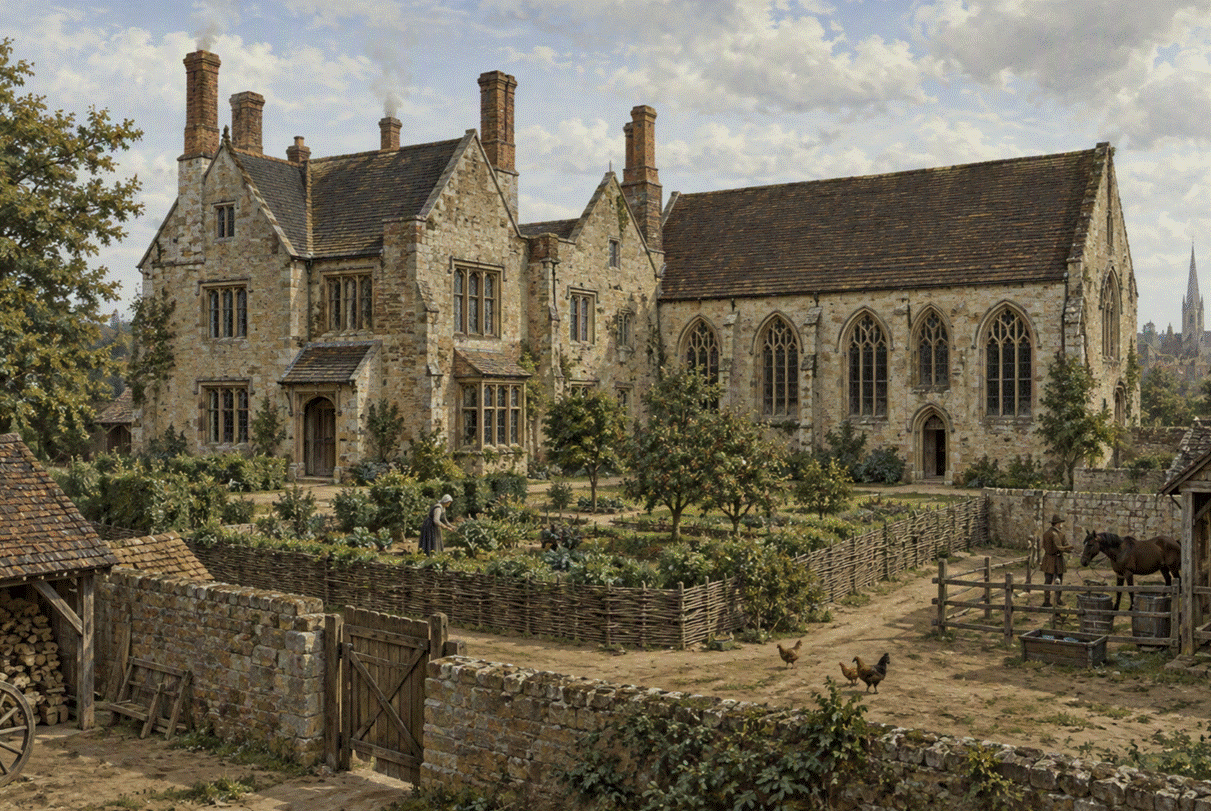
The new residential structure reimagined
1553
While Queen Mary (1553 to 1558) was a devout Catholic determined
to undo the English Reformation, reunite with Rome, and restore the monastic
system, her administration had to make a pragmatic compromise. To legally
reverse Henry VIII’s break with Rome, Mary required the cooperation of Parliament.
However, the House of Commons and House of Lords were heavily populated by the
gentry and nobility who had purchased or been granted dissolved monastic
property over the previous two decades. These landowners refused to pass Mary's
religious legislation or reinstate ancient heresy laws unless their property
rights were guaranteed. Recognising that demanding the return of Church lands
would trigger a massive political rebellion, Mary’s administration and the
newly arrived Papal Legate, Cardinal Reginald Pole, chose to compromise. In
1554, Pole issued a formal papal dispensation on behalf of Pope Julius III.
This decree officially waived the Vatican's legal and spiritual claims to former
monastic lands currently in secular hands, ensuring that private owners would
not face excommunication or property confiscation.
During Mary’s reign, Henry Over’s ownership of the Coventry Charterhouse
therefore continued. Under the protection of Mary’s Second Act of Repeal and
Cardinal Pole’s papal dispensation, the Over family would not have faced legal
threats of confiscation, eviction, or forced recovery of monastic lands from
the Crown. The physical destruction of the site under Henry VIII made it
nearly impossible to revive old priories without massive investment.
The Overs continued to hold wider lands formerly belonging to the Carthusian
monastery, for instance alienating lands in Binley, Warwickshire which were late
of the priory of Carthusians by Coventry in 1582 (Patent Rolls of
the reign of Elizabeth I, Volume 9, 1580
to 1582, Folio 1134).
The Robert Dudley Era
1568
Robert Dudley, 1st Earl of Leicester, and favourite of Queen Elizabeth
I, acquired the estate in late 1568. Dudley held the property for a short time
(about two and a half years) during the Elizabethan period. On 20 November 1568
Richard Waver (also known as Richard Over) was granted official license to
transfer the historic Charterhouse estate to Robert Dudley, the Earl of
Leicester. A licence for alienation was allowed for Richard Waver alias Over
to alienate the house and site of the Charterhouse by Coventry to Robert, Earl
of Leicester, Councillor (Patent Rolls of the reign of Elizabeth I, Volume 4, 1566
to 1569, Folio 2512).
Dudley is said to have initiated extensive remodelling of the
austere monastic block into a luxurious, secular manor house suitable for
high-society entertaining. He was credited with commissioning grand
Renaissance-style wall paintings within the building. The interpretation of the
black and white wall painting, in particular, as being
related to Dudley and Queen Elizabeth is disputed. It is understood that the
claim that Dudley did the conversion of the property was disproved by the tree
ring dating during the recent renovations, which placed the conversion during
Henry Over's ownership. There is also some evidence that the Queen was unhappy
about her lodgings at Kenilworth in 1568, causing Dudley to change his plans
and embark on a building project there. His ownership of the Charterhouse
coincides with when he was building Leicester's Building at Kenilworth Castle,
and it has been suggested, by an architectural historian, that the Charterhouse
should be considered as a source of the stone for that building (Morris, Richard K (2009), I
was never more in love with an olde howse nor never newe worke coulde
be better bestowed’: The Earl of Leicester’s remodelling of Kenilworth Castle
for Queen Elizabeth I in the Antiquaries Journal).
There is no direct evidence that Dudley ever stayed at
Charterhouse.
Unlikelihood of Elizabeth I connection
Queen Elizabeth I
did not stay at the Coventry Charterhouse. There have been suggestions of a connection between
Elizabeth and the Charterhouse, but these are difficult to reconcile.
Elizabeth I made only one
official royal visit to the city of Coventry. This took place over a single
weekend from 17 to 19 August 1566 (see also Cole,
Mary Hill, The portable queen: Elizabeth I and the politics of ceremony,
pages
116 to 117). This was before Dudley’s purchase of the property.
During this progress, she did not stay at Charterhouse. She lodged nearby at
Whitefriars (the converted Carmelite friary) as the guest of John Hales.
There was a visit to Kenilworth in 1568. Unlike
the highly choreographed 19-day progress and festival of 1575, the 1568 visit
was a shorter, impromptu stop lasting six days (14 to 19 August 1568)
during one of the Queen's summer regional progresses. At the time of this
unannounced visit, Kenilworth Castle was in an ongoing phase of transformation.
Dudley had received the castle in 1563 and was actively turning the medieval
fortress into a magnificent Renaissance palace fit for a queen, preceding his
major architectural additions like Leicester's Building and Gatehouse. Local
and household administrators were caught somewhat off guard, requiring swift
local provisioning and gift-giving to honour the monarch (Knowles EH (1872), Kenilworth
Handbook for Visitors).
Elizabeth I went on a 19 day summer progress to visit Dudley at his principal
seat, Kenilworth Castle in July 1575. This was after Dudley’s interest in
Charterhouse. She travelled with a large royal entourage of several hundred
courtiers, guards, and servants. Despite Dudley expanding Kenilworth with a
massive dedicated tower for the Queen, it simply could not physically sleep
everyone. Local history and architectural records have suggested that Dudley
used his newly acquired Charterhouse as a luxury overspill lodge to house the
Queen’s closest courtiers and retinue during these famous visits. However, this
was after he had disposed of the property to Sampson Baker. This therefore
seems unlikely. Furthermore since Charterhouse was
outside the walls and Whitefriars within the city walls, it seems unlikely that
Charterhouse would have been used as overspill accommodation.
John Nichols's The
Progresses and Public Processions of Queen Elizabeth I,
makes no reference to Charterhouse. See also The
Elizabethan Court Day by Day.
While the state papers don't record an official public visit,
local lore has occasionally suggested the Queen or her innermost circle may
have visited the site more casually. Dudley was her childhood friend, Master of
the Horse, and rumoured lover. However there is no
evidence that Elizabeth was in the area at the relevant time. See also Elizabeth
I and Robert Dudley, Earl of Leicester,
The National Archives.
The sale to Dudley was confirmed by Final Concord in January 1569
(The National Archives, Court of Common Pleas: Feet
of Fines, Series II, CP 25/2, January 1569 (Hilary Term, 11 Elizabeth I).
It is understood that even in January 1570, when Dudley was given permission
to be away from the Queen, in order to meet with Ambrose after he'd dealt with
the Rising of the North, Dudley stayed in Kenilworth Castle, rather than in the
Charterhouse, despite the ongoing building work at Kenilworth when he wrote to
the Queen that he is staying in your old ill lodging here. (The National Archives SP 15/17/15b (or item 31), State
Papers Domestic).
It is also understood that in the month before that, when there was
talk of moving Mary, Queen of Scots, from a pub in Coventry, where she was
being held, to somewhere more suitable, the Charterhouse was described as in
a fortnight or three weeks may well be prepared, strong enough it is, and good
for the solitariness of it, which implies the Charterhouse possibly wasn't
in a liveable state. In the end, Mary was moved elsewhere, within the city,
instead. (Letter written by George Talbot, 6th Earl
of Shrewsbury to Sir William Cecil, Queen Elizabeth I’s chief advisor, dated in
December 1569 during Mary’s abrupt, heavily guarded transfer to Coventry, The
Cecil Papers, British
History Online, especially 9 December 1569).
1571
Robert Dudley disposed of the Coventry Charterhouse in 1571, after
owning the estate for only two and a half years (from about November 1568 to about
May 1571). It is understood that by May 1571, when Dudley sold the
Charterhouse, there was a tenant with rights to it. It is understood that when
Dudley relinquished the property in 1571, the conveyance paperwork explicitly
accounted for the rights and presence of the sitting tenant, ensuring that the
transfer of the estate's reversionary interest did not immediately evict the
occupant.
1572
On 10 October 1572 a licence was granted for Thomas Andrew to
alienate the house and site of the Charterhouse by Coventry, to Thomas Ryley
for 33s 4d (Patent Rolls of the reign of Elizabeth I, Volume 5, 1569
to 1572, Folio 2478).
I have been told that Thomas Andrews was a Northamptonshire
gentleman, who twice served as sheriff of Northamptonshire, and that Thomas
Riley or Ryley was a Coventry draper, who served twice as mayor of the city.
Sampson Baker's Ownership
1575
The property passed into the hands of Sampson Baker (BAK00008), a
prominent local gentleman formally styled in contemporary records as being of le
Charterhouse by Coventry.
Sampson Baker and his family may have been Church Papists. These
were individuals who outwardly conformed to Anglican services to protect their
estates from devastating government fines but privately maintained traditional
Catholic beliefs and domestic worship. The Coventry Charterhouse was a highly
spiritual site of the Carthusian order. For a family quietly holding onto the
old faith, purchasing and living in a dissolved monastery may have served as a
deliberate act of preservation or reflected a nostalgic attachment to England's
Catholic past. Sampson Baker’s recusant butler, John Cradock, might support
this hypothesis (see BAK00008).
In 1575 Sampson Baker formally
purchased the Coventry Charterhouse. Since this was previously a Carthusian
Monastery, permission was required beforehand for the sale and on the 8
December 1575, the legal agents, Thomas Ryley was given permission to sell the
Coventry Charterhouse to Sampson.
On 8 December 1575 there was granted
Licence for Thomas Ryley to alienate the house and site of the Carthusian
priory by Coventry to Sampson Baker. For 33s 4d (Calendar of the Patent Rolls,
Elizabeth I, Volume 7, Folio 1187, Page 157). In other words, this was Thomas
Ryley transferring the property to Sampson Baker after completing the legal
formalities.
Sampson Baker expanded on Dudley's artistic works by commissioning
a series of prominent, high-quality black and white wall paintings that
prominently featured the Baker family coat of arms.
1577
and 1578
Sampson Baker was a prominent resident of Warwickshire formerly
designed as living at the Charterhouse.
Humphrey Baker and
Financial Strife
1584
Sampson Baker died. The Charterhouse was inherited by his nephew
and legal executor, Humphrey Baker (BAK00010A).
1585
Humphrey Baker inherited a series of compounding legal troubles.
He was sued in Chancery court by an attorney named Roland Durant, who attempted
to recover outstanding debts linked to Sampson Baker’s estate.
Bibliography
Alcock, Dr Nat, The Coventry Charterhouse: monastic refectory
to gentry house in the Birmingham
and Warwickshire Archaeological Transactions, Volume 126, pages 81 to 99.
Berger, R (1993), The Most Necessary Luxuries: The Mercer’s
Company of Coventry, 1550–1680, University Park: Penn State University
Press, pages 59–81.
Hulton, M (1979), Coventry and its People in the 1520s,
Stratford upon Avon: The Dugdale Society.
McGrory, David (2004), A History of Coventry, The History
Press.
Phythian-Adams, C (1979), Desolation of a City: Coventry and
the Urban Crisis of the Late Middle Ages, Cambridge: Cambridge University
Press.
Rose, James, An interpretation
of the black and white wall painting and inscription in the Coventry
Charterhouse, in the Birmingham
and Warwickshire Archaeological Transactions, Volume 125; see also Interpreting
the Mural (2021) and Unlocking the Mysteries of
the Charterhouse Mural.
Woodhouse, Frederic W (1909), The Churches
of Coventry.
The City of
Coventry: Crafts and industries, Modern industry and trade in A
History of the County of Warwick: Volume 8, the City of Coventry and Borough of
Warwick. Originally published by Victoria County History, London, 1969.
Charterhouse,
Historic Coventry Trust.
Charterhouse
past, present and future in Heritage Park Times (2021),
Historic Coventry Trust.
Friends of the
Charterhouse Facebook page.