Medieval Genealogy
A recognition of some restrictions to
genealogical research before 1500, but some ideas to help overcome the
constraints
Resources
for researching your medieval ancestors
I have found
an excellent starting point to explore medieval records is Medieval Genealogy.
The home page of the site is not particularly fancy, but the site provides structured
access to medieval documents. It’s a great starting point because if you
are not too sure about where to start, it provides immediate access to the
primary medieval documents which will help you to research your early
ancestors. It gives you ideas about where to look in
the first place, particularly in its public records
collection.
I use the Internet Archive as a resource to find primary
sources and relevant articles. It is a very helpful resource when you know the
name of the document or resource that you would like to search for and need
online access. The documents are searchable and the quantity of information to which the site
gives access is astonishing.
The National Archives (“TNA”)
provides access to the national collection of archives. It is a primary source
of material and the website is worth some study to get
best use from it. It is possible to find a lot of material by searching, and
sometimes the material is digitised and can be accessed directly or by
registering for a free account. There is also a lot of guidance on research
including the TNA guides to researching medieval
and early modern history. The quantity of information is such that it might
be that the only way to view the primary documents is to visit the archives at
Kew Gardens in London.
British History Online is a
collection of primary and secondary sources, which provides direct access to medieval
and later material. It is searchable and relatively easy to navigate. It also
includes access to the Victoria County Histories which provide some really helpful source material about the history of particular places across England. It is a great asset for
searching primary
sources. For instance it includes access to the Yorkshire Lay Subsidy
of 1301 and a register
of the freemen of York. You can also find access to Close Rolls, Patent Rolls,
Inquisitions Post Mortem and other such sources.
It provides access for instance to the
Victoria County History for the County of York. It also provides access to
some historical
maps, including Yorkshire maps
of the mid nineteenth century.
The History of England
Resources is another website which provides access to another wealth of
information which is helpful to medieval research.
A great
source of academic articles can be found through JSTOR (short for Jay-Store or Journal
Storage), founded at Princeton University in 1994, to which you can subscribe
for free for up to a hundred articles each month.
Project Gutenberg is another resource for
access mainly to books, many of which are useful in genealogical research.
Open Domesday is a great resource which provides
searchable access to the Domesday Book, completed in 1086, which not only links
to the relevant pages of the Domesday Book, but allows you to search for
particular places and translates the information available about each place
listed in Domesday.
As you
search the medieval records you will often confront dates which are defined by
the regnal year of the monarch of the period. You will need some help to
accurately translate the regnal year to the calendar year
and you’ll find that help through a number of internet
sites which allow you to calculating
regnal years.
There is a
webpage about the value of medieval money.
Before the Norman
Conquest
There is no realistic source for
administrative records before the Norman Conquest, at least regarding ordinary
folk. However for a family with a locative surname,
there are still opportunities to understand the family’s roots. If the family
comes from a place, then there is real value in exploring the place, which is
more of a possibility. Potentially archaeological records might help, but there
are records which help to build a picture of a place in Anglo Saxon Britain.
For instance my family’s story starts with the
Saxon/Viking nobleman, Orm Gamalson, who married in to
the family of the Earls of Northumbria. There are historical records about him
and some clues about the estate of Kirkbymoorside, of which the dale of
Farndale is a part. For instance there is a church of St
Gregory at Kirkdale. The sundial at Kirkdale is one of a
number of late Anglo Saxon sundials and is
particularly intricate in its design. The central panel contains the sundial
and an Old English inscription above it which reads This is the day’s
sun-marker at every hour. The left panel reads Orm the son of Gamel
acquired St Gregory’s Church when it was completely ruined. The right hand panel reads and collapsed, and he had it built
anew from the ground to Christ and to St Gregory in the days of King Edward and
in the days of Earl Tostig. Tostig, the son of Earl Godwin of Wessex and
brother of Harold II, the last Anglo Saxon King of England was the Earl of
Northumbria between 1055 and 1065. It was therefore in the
course of that decade that Orm, son of Gamel rebuilt St Gregory’s
Church.
So although Farndale the place was deep forest
and an unknown place in Saxon times, it was part of an estate whose community
was developing no doubt around Kirkdale.
So we catch a glimpse of the place and the
community around it, in Saxon times, just before the Norman Conquest.
The Norman
Conquest
William the Conqueror was victorious over
King Harold at Hastings in 1066. The south of England was quickly subdued. But
the land was divided at that time, so the north was not so easily controlled and a painful period of about twenty years ensued
when our poor ancestors must have suffered the harrying of the north,
particularly during the winter of 1069–1070 to subjugate Northern England. But
gradually the land fell under the dominance of the Normans
and the land was redistributed to those who had fought with William.
The bureaucratic tool to record the
conquered lands and which described who owned the land before the Conquest and
to whom the land was transferred, is The Domesday
Book. The hyperlinks on this page will take you to other pages to explore
the topic in some more detail, or to other webpages. Kirkbymoorside is on the
list. It was transferred from Orm Gamalson to Hugh fitz
Badric. There were 10 villagers, 1 priest. 2 ploughlands. 2 lord's plough teams.
3 men's plough teams, 1 mill, value 4 shillings. 1 church.
Well we know that Orm Gamalson had just rebuilt St
Gregory, so that must be the church where the priest must have lived. The 10
villagers must have lived around Kirkdale too. So that must have been the
community living on the Kirkbymoorside estate at or around Kirkdale at the time
of the Conquest.
Medieval Society
Medieval society might broadly be
described as hierarchical, shaped like an inverted triangle with the King at the
top, then the noblemen, then knights and with the vast bulk of the population
falling into the bottom rung category of the villeins or the serfs. The
Farndale ancestors were firmly in the villeins camp.
Medieval society was feudal, with land
handed down from the monarch. The land of England was therefore organised into
estates and manors. Farndale lies in the estate called Kirkbymoorside. So that
provides our first important route marker to explore the history of the place, and
the history of folk settling in the place, and eventually emerging with the
name.
Medieval society comprised very rural
societies organised into estates.
Land passed between aristocrats in
various transactions. So in the earliest time, it is
helpful to explore the history of the aristocratic families who held the land.
Their histories are likely to provide an insight into the events in particular
estates. The ordinary folk who were placed on the land
owed service and rent in return for the privilege of being allowed to hold
parcels of land. The rules were also governed by custom. Different methods of
holding land emerged, including freehold, copyhold and leasehold.
Surveys were sometimes undertaken,
into rents, costs, customary obligations. Roads might have been surveyed for
upkeep purposes. For instance terriers were detailed
surveys of boundaries and ownership of land.
Many of the medieval records are now
available on line. A lot of records are available and
searchable through sites such as medieval
genealogy and British History
Online, but the primary source, which is well structured, is the National Archives at Kew,
London (who use the abbreviation “TNA”). TNA also have plenty of
guidance pages to help.
|
A guide to medieval
and early modern family history |
|
An excellent TNA
webinar on researching medieval records |
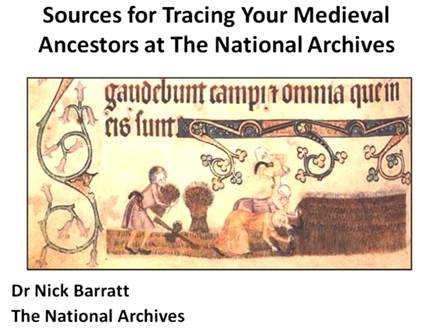
There is a useful graphic
produced by Family Search showing the various medieval sources and the periods
they cover.
For local manorial documents, a good
starting point is the TNA’s Manorial
Documents Register.
The centre of administration was with
the Crown, its royal household, and the parliament.
Medieval Primary
Sources
Here you will find links to the
principal medieval primary sources, with an explanation to each, and links to the
available resources when available online.
|
Records
of Private Instruction |
Open,
public letters issued by the English Crown |
Financial
Records of the Exchequer |
Payments
for legal rights |
Government
Records |
State
and household expenditure |
Earliest
Judicial Records |
|
Formal
inquiries after the death of a tenant-in-chief |
Checking
any implications of legal steps for the Crown |
Inquisitions Miscellaneous
(Chancery) Investigations
into civic disruptions, crown property disputes, and administrative issues |
|
|
|
|
|
Administrative
records and letters from 1346 to 1365 |
Tax
on wealth made between the twelfth and seventeenth centuries and are often
valuable sources of historical information |
The
taxation of Yorkshire in 1301 |
The Poll Taxes of
1377, 1379 & 1381, In
3 vols, Oxford, 1998 to 2005 |
The
evolution of English common law |
Fictional
Land Disputes as a form of medieval conveyancing |
|
|
The
snapshot of 1086 |
Investigations
into civic disruptions, crown property disputes, and administrative issues |
Records
of outlaws in medieval and early modern England. They contained the names of
outlaws sent to the Exchequer from the courts of Common Pleas and King's
Bench. The rolls could include the occupation or status of each outlaw |
The Book of Fees
(Testa de Nevill) 1198-1293 A
listing of feudal landholdings or fiefs |
Included
records of debts (E159, E 368) |
Access
to early British state papers including papers of Henry VIII |
Proceedings and
Ordinances 1386-1542 Records
of the Privy Council |
Cities and trades
The records of Guild and Livery
companies and of Guild Halls provides evidence of town occupations.
There are lists of Freemen, such as
the Freemen of York.
Mayorial Registers can be helpful. There is a list of York Excommunications and York Wills.
Universities produced their own
records including alumni lists.
School records and lawyers’ archives
can be another source of material.
Military
For early military ancestors there are
navy lists, and particulars of account including archer lists. There is a good TNA
search guide on early military resources.
The University of Southampton has
compiled a very helpful list of soldiers
in medieval England. There is a very helpful searchable database
available online. It is worth remembering that medieval names were fluid, so
instead of searching for Farndale, I had a better result from searching for
Farn****.
Palaeography
Palaeography is the science of the way
documents are written and the National Archives has lessons
on palaeography to help interpret old documents.
Documents were rarely written in
English before the late fourteenth century. The National Archives provides guidance on
Latin for beginners. That said if
you google Latin to English and find some Latin text that you need to
translate, you will achieve a pretty accurate result instantly.
Dates
Medieval documents tend to use Regnal
Years, such as 9 Henry III, which refers to the ninth year of Henry III’s
reign, being 1225. To save too much grief about this, I suggest you just use
the regnal year
calculator, which is available online.
The Gregorian Calendar in 1752, went
straight from 2 to 14 September 1752. It’s never caused an issue in my
research, but it might be useful to know.
Cheney’s
Handbook of Dates can help
Yorkshire
genealogy
For
Yorkshire genealogy the Borthwick
Institute for Archives; the York Archbishop
Registers database and the Cause
Papers in the Diocesan Courts of the Archbishopric of York 1300 to 1858 are
all helpful.
Subscriptions
The above
sites are all free, and there are also sites that can be accessed for a
subscription such as the Foundation for Medieval
Genealogy. Genealogy subscriptions to Ancestry
and Find my Past also provide
access to medieval material and provide pretty comprehensive
access to genealogical source material.