James Astley Hall
10 July 1793 to 2 June 1867
HAL00080
|
Return to the Home Page of the Bakers
Family part of the website |
The Bakers of Highfields Story
The Story of the Dods
and Bakers and of Highfields, Fenton House and Hasfield Court. A journey
through the history of Cheshire and Staffordshire, an Anglo-Saxon nobleman who
retained his lands after the Conquest, pottery at Stoke on Trent, an
encounter with Elgar, and the history of an Elizabethan manor house at Audlem |
The family tree of
the Bakers of Highfields |
The Family Tree of
the Dods, predecessors to the Bakers of Highfields |
The
Bakers of Fenton House and Hasfield Court
The Family Tree of the pottery Bakers
of Stoke on Trent |
The Family Tree of the Bellyse Family |
The main part of this website tells the
story of the Farndale family from Yorkshire Descendants of Arthur
Baker, the story of the Farndale ancestry is told through the main part of
this website You can also return
to the Farndale website
home page |
The genealogy of the
family of James Hall, linked to the Baker family through marriage to Arthur
Baker |
Newcastle
under Lyme
1793
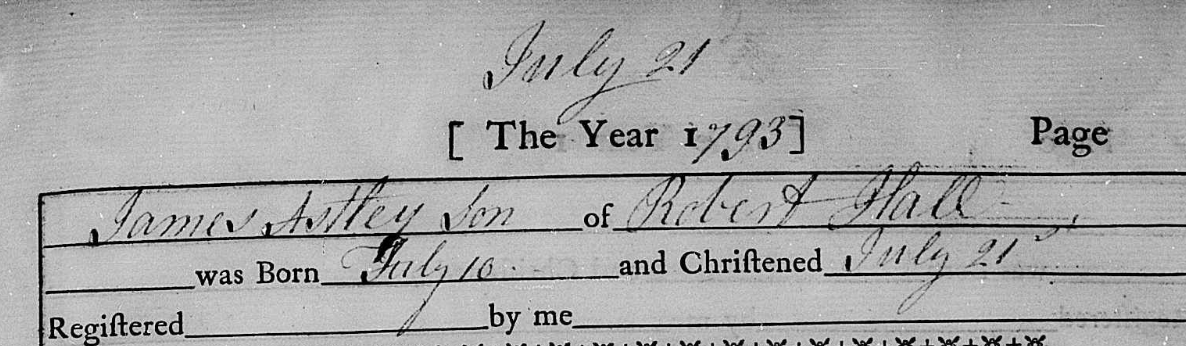
James Astley Hall, son of
Robert and Catherine (nee Eldershaw) Hall (HAL00070), was born on 10 July 1793 and baptised
on 21 July 1793 at the Anglican Church of St Giles, Newcastle under Lyme (St Giles, Newcastle
under Lyme Parish Records).
1817
James Hall was a hat
manufacturer, and merchant in the iron market
The most notable industry in
Newcastle during the 17th and 18th centuries was the making of felt hats. As
early as 1570 a hatter, Richard Norton, is met with and another in 1612, John
Riggs. The existence of hatters presupposes that of feltmakers, of whom, in the 17th century,
there was a considerable number as may be gathered from parish register
entries. Late in the century the trade encountered difficulties because
'servants and others of inferior quality' had ceased to wear felt hats; at that
time (1699) it was stated that there were numerous master hat-makers in the
town who each employed nine or ten journeymen and many other persons, i.e. feltmakers, in producing the materials for hat making. Despite
temporary setbacks the hat industry continued to flourish. At a borough
election in 1734 out of 436 burgesses on the roll 159 were described as
hatters. In the late 18th century the number of hat
manufacturers totalled 27, while in 1822 out of 1,000 householders in the
borough, 307 were described as hat manufacturer, feltmaker,
or hatter. In the early 19th century machinery was introduced, in particular a carding machine and a blowing machine for the
separation of short and coarse hairs from the wool or nap. The latter was the
invention of James Astley Hall, a native of Newcastle and one of the chief hat
manufacturers. Although in 1844 the chief manufacture of the town was still
described as that of hats which were prepared for the finishers in London, the
growing popularity of the silk hat for the upper and middle classes and of the
cloth cap for industrial workers brought about a decline in the demand for felt
hats. By 1850 the number of hat manufacturers in Newcastle had fallen to nine
and 40 years later there were only two. By the early 20th century
the local manufacture of hats had ceased. The fact that in 1836 there were
three straw-hat makers and in 1851 twelve may indicate an attempt to establish
an alternative, though short-lived, headgear industry of a very different kind.
(A History of the County
of Stafford: Volume 8. Originally published by Victoria County History, London,
1963, Newcastle-under-Lyme: Economic history and social life and Anon. Hist. Sketch Newcastle, 10;
Newcastle Register of Electors, 1840 and 1845 (copies at Inst. of Hist.
Research, London)).
1818
He was a freeman and Mayor
of Newcastle under Lyme.
|
Freemen 1734=1829 |
||||||||
|
Date admitted |
Type |
Name |
Bapt/born |
Description |
Father |
Admitted |
Occupation |
Comments |
|
25 Sep 1758 |
FB |
HALL, Edward |
||||||
|
12 Feb 1734 |
FB |
HALL, Elisha |
||||||
|
15 May 1820 |
Gratis |
HALL, George |
Grocer |
High Constable |
||||
|
05 Jan 1768 |
FB |
HALL, James |
Feltmaker |
Robert |
||||
|
09 Jun 1818 |
FB |
HALL, James Astley |
Hat manufacturer |
Robert |
Hat manufacturer |
|||
|
26 Mar 1734 |
FB |
HALL, Jeremiah |
||||||
|
00 00 1674/5 |
FB |
HALL, John |
||||||
|
16 Jun 1790 |
FB |
HALL, John |
Feltmaker |
Thomas |
Feltmaker |
|||
|
26 Mar 1734 |
FB |
HALL, Joseph |
||||||
|
00 00 1715/6 |
App |
HALL, Joseph |
||||||
|
00 00 1662/3 |
App |
HALL, Joseph |
||||||
|
26 Mar 1734 |
FB |
HALL, Leasura |
||||||
|
07 Mar 1657 |
Gratis |
HALL, Mr. |
Clergyman |
|||||
|
14 Nov 1654 |
Gratis |
HALL, Mr. Raphe |
Minister |
for life only |
||||
|
16 Dec 1746 |
FB |
HALL, Richard |
||||||
|
15 Jun 1790 |
FB |
HALL, Robert |
Shoemaker |
William, dcd. |
Feltmaker |
|||
|
26 May 1790 |
FB |
HALL, Robert |
Hatter |
James, dcd. |
Hatter |
|||
|
25 Sep 1731 |
App |
HALL, Robert |
||||||
|
29 Apr 1760 |
FB |
HALL, Thomas |
Thomas |
|||||
|
00 00 1639/40 |
App |
HALL, Thomas |
||||||
|
18 Apr 1734 |
FB |
HALL, Thomas |
||||||
|
00 00 1721/2 |
? |
HALL, Thomas |
||||||
|
09 Nov 1768 |
FB |
HALL, William |
Feltmaker |
Robert |
||||
In the nineteenth century,
James Astley Hall was one of the chief hat manufacturers and merchants in
Newcastle-under-Lyme, operating a prominent manufacturing and retail network centred
around Bath Street, Ironmarket, and Fogg Street. Hall
was a central figure in the town's signature industry, inventing the blowing
machine to mechanise production, before following his commercial success
into local politics as a Justice of the Peace and Borough Mayor.
The business operated out
of interconnected properties in the heart of the town. In April 1833, a
conveyance of hatter's shops in Bath Street was granted from the Duke of
Sutherland to James Astley Hall and Henry Hall. The workshops and retail points
expanded across Bath Street, Ironmarket (the trade
hub), and Fogg Street, integrating manufacturing facilities with commercial
merchant storefronts.
Hall left a permanent mark
on the trade by introducing early 19th-century mechanisation to Newcastle. He
invented the blowing machine, an innovative apparatus designed to separate
short, coarse hairs from wool or fur nap. Combined with carding machines, this
greatly improved the efficiency and quality of local felt production.
Like most local
contemporary factories, Hall's business specialised in the production of felt
hat bodies. These raw felt structures were formed and treated locally before
being shipped down to finishers in London to be trimmed, lined, and prepared
for high-end retail.
During the peak of the
trade in the 1820s, hatting employed up to a third of Newcastle's working
population. However, by the mid nineteenth century, Hall's business had to
contend with severe structural declines in the felt industry. The upper and
middle classes increasingly favoured the newly fashionable silk top hat, while
industrial workers shifted toward cloth caps, slowly eroding the demand for
traditional felt hats and leading to the eventual extinction of the town's
trade by the early 20th century.
1822
James Astley Hall married
Ann Lee at St Mary, Newington, Surrey on 30 September 1822 (St Mary, Newington
Parish Records).
1824
James and Ann’s son, Henry
Hall (HAL00080A) was baptised on 13 October 1824
but died aged only 3 days.
1825
Partnerships dissolved …
January 19 – Robert Hall and James Astley Hall, Newcastle, Staffordshire, hat
manufacturers (Aris’s Birmingham
Gazette, 31 January 1825).
1829
In the Court of the King’s
Bench … The King against James Astley Hall, as Bailiff, elected 3rd
October 1826 (Staffordshire
Advertiser, 13 June 1829). He was appointed as a bailiff
in 1826 and the case was likely to have related to the
validity of the appointment.
1833
Deeds relating to land and
premises in Bath Street, Salters Lane and Lower Street, Newcastle under Lyme.
Includes a conveyance by lease and release of hatter's shops in Bath Street,
Duke of Sutherland to James Astley Hall and Henry Hall, 16 Apr 1833 … (Staffordshire and
Stoke-on-Trent Archive Service: Staffordshire County Record Office, D4452/1/27/1/2)
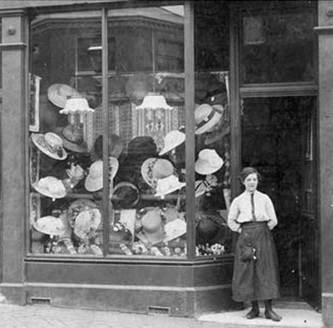
Hat shop in Newcastle
under Lyme, circa 1910
1836
The freehold of the
building in the occupation of James Adtley Hall, as a hatter’s shop, was on the
market for sale (Staffordshire Advertiser, 30
January 1836).
1845
The provisional committee
for the registration of the Leicester, Asby-de-la-Zouch, Burton on Trent and
Stafford junction Railway included James Astley Hall (Sun, 25 June 1845).
1847
The Orme Scheme was set up
in 1847 for the erection of new Orme School on the site of the old workhouse on
Keele Road. The trustees included James Astley Hall, hat manufacturer. In
1866 William Mellard, ironmonger, John Broomhall, tailor and draper and Henry
Hall, timber merchants became trustees in place of Frederick Crewe, James
Astley Hall, and Liddle Elliot. (Staffordshire
Advertiser, 3 May 1913). The Orme Boys' School in
Newcastle-under-Lyme merged with the grammar school in 1872 to become the Boys'
Middle School on Higherland, and its educational
lineage today continues through modern institutions like The Orme Academy and
Newcastle-under-Lyme School. A new Orme School was later founded in 1928, as
Wolstanton County Grammar School, a replacement for The Orme Middle School,
which closed in 1927.
1850
Hall Henry, timber
merchant and saw mills, Bagnall Street.
Hall James Astley, hat manufacturer,
manufactory, Bath Street; warehouses, Iron Market and Fogg Street.
(Kelly’s Directory, 1850
to 1851)
1851
1851 Census – Lion Hotel, Builth, Breconshire,
Wales
James Astley Hall, hatter of
Newcastle under Lyme was a visitor, staying at the hotel.
1856
Deaths. Hall, May 24,
after a short illness, at the house of her sister, Miss Lee, Denmark Hill,
Camberwell, Ann, beloved wife of James Astley Hall Esq of Newcastle under Lye,
Staffordshire. (Staffordshire Sentinel,
31 May 1856, Wolverhampton Chronicle, 28 May 1856). On the 24th
ult, at the residence of her sister, Miss Lee, Denmark Hill, Surrey, Ann, wife
of James Astley Hall Esq, Newcastle under Lyme, Staffordshire, in her 4st year (Arias’s Birmingham Gazette, 2
June 1856).
1861 Census – Ashfield House, Liverpool
Street, Newcastle under Lyme
James Astley Hall, hat
manufacturer, 67
Catherine Hall, 54, his sister
Two servants
Hall became a highly regarded
local magistrate as a JP and served as Mayor of the Borough. In 1861, he
personally funded and presented a new four-faced clock to the town, which was
installed in the newly constructed clock tower of the Newcastle-under-Lyme
Guildhall, where his dedicatory inscription can still be seen today.
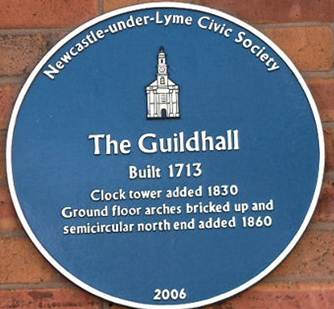
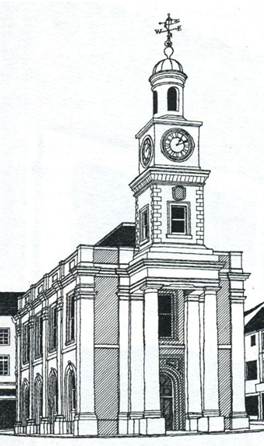
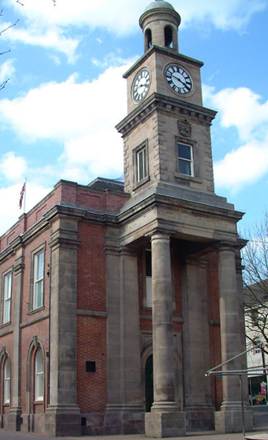
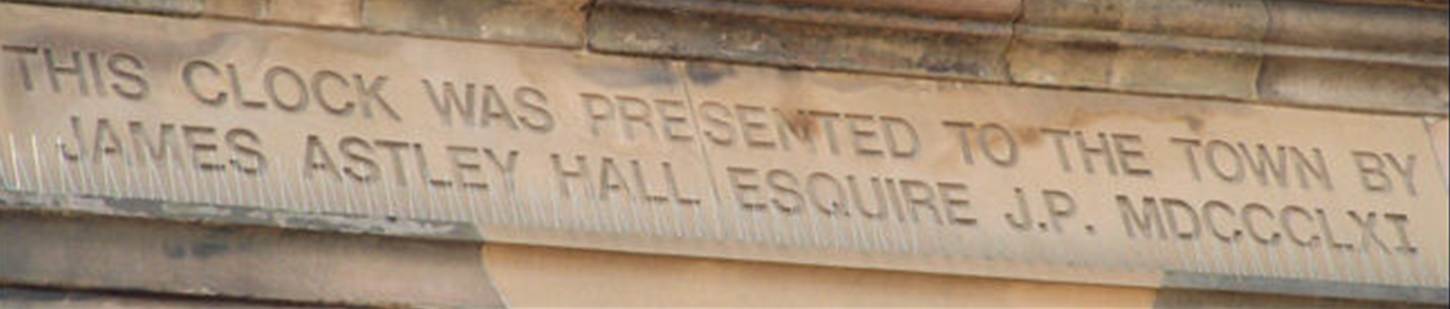
James Hall donated the Guildhall
clock.
The dignified, red brick and stone
Guildhall in the High Street has presided over the busy market-place
for more than 200 years and provides a fitting expression of the growth of
Newcastle. In the 12th century, when Newcastle was beginning to establish
itself as an important trading centre, the High Street would have been one big
marketplace, covered with stalls on market days. The market prospered, and in
1235 the King recognised its importance by granting the townsmen the right to
form a Guild, which quickly became the real authority in the town. Later, craft
guilds came into existence, and these included journeymen and apprentices as
well as employers. Members of craft guilds were skilled practitioners of a
variety of trades, and by the 14th century they had taken control of local
government, ousting the guild merchants. In the 16th century the guilds were
gradually superseded by a new administration which continued to call its
meeting place a Guildhall rather than a Town Hall. This building eventually
became unsuitable and the present Guildhall was built
on an adjacent site shortly after 1713. The clock tower was added later, as the
inscription over the portico proclaims: This clock was presented to the town by
James Astley Hall, J.P., Esq., MDCCCLXI (1861). In
the rapidly expanding borough this building, too, became obsolete, and local
government was transferred to the much larger and elaborate Municipal Hall
following its completion in 1890. (Neville Malkin 14th May 1975).
During Charter Week in 1935, the
clock tower (built in 1861, and containing a clock given by a James Astley
Hall, a mayor of that time), being illuminated by coloured flood lighting (Staffordshire Sentinel, 16
September 1935).
1863
James Astley Hall was the
creditor in the sum of £15 15s 6d in the bankruptcy of Thomas King (Northampton Mercury, 31
May 1862).
1867
James Astley Hall died on 2
June 1867 and his death was registered in the second
quarter of 1897 at Newcastle under Lyme (GRO, Staffordshire Vol
6B Page 44, Record of the Great Western Railway Shareholders). He was buried on 8 June
1867 (St George, Newcastle under Lyme
Parish Records). Hall James Astley. Effects
under £6,000. 4 July. The Will of James Astley Hall late of Newcastle under
Lyne in the County of Stafford Hat Manufacturer deceased who died 2 June 1867
at Newcastle under Lyme aforesaid was proved at Lichfield by the oath of Henry
Hall of Newcastle under Lyme aforesaid Timber Merchant the brother one of the
Executors. (Probate Records)



Deaths. On the 2nd inst, at Ashfield House, Liverpool Road, Newcastle, James
Astley Hall Esq, aged 73 years (Staffordshire Sentinel, 8 June
1867).