Edwin of Poulton
Lord of Edge
c
1045 to c 1120 (estimated)
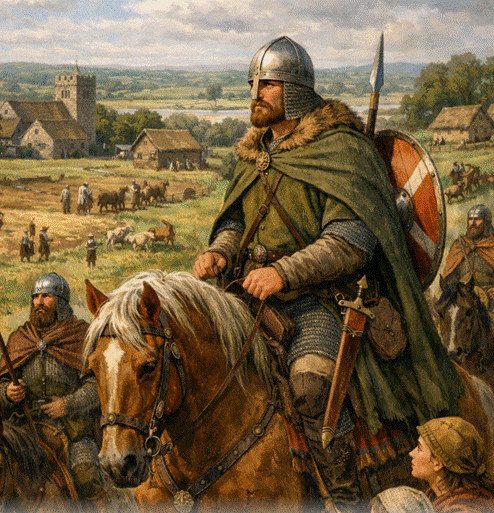
EDW00001
|
Return to the Home Page of the Bakers Family part of the website |
The Bakers of Highfields Story
The Story of the Dods and Bakers and of Highfields,
Fenton House and Hasfield Court. A journey through the history of Cheshire
and Staffordshire, an Anglo-Saxon nobleman who retained his lands after the
Conquest, pottery at Stoke on Trent, an encounter with Elgar, and the history
of an Elizabethan manor house at Audlem |
The family tree of the Bakers of Highfields |
The Family Tree of the Dods, predecessors to the
Bakers of Highfields |
The Bakers of Fenton House and Hasfield
Court
The Family Tree of the pottery Bakers of Stoke on Trent |
The Family Tree of the Bellyse Family |
The main part
of this website tells the story of the Farndale family from Yorkshire Descendants of Arthur Baker, the story of the
Farndale ancestry is told through the main part of this website You can also return to the Farndale
website home page |
The genealogy of the family of James Hall, linked to
the Baker family through marriage to Arthur Baker |
Headlines of are
in brown.
Dates are in red.
Hyperlinks to
other pages are in dark
blue.
References and
citations are in turquoise.
Context and local
history are in purple.
Edwin of Poulton was a rare and notable
Anglo-Saxon minor nobleman (a thegn) who managed to retain some status and land
after the 1066 Norman Conquest. He is recorded in the Domesday Book of 1086
holding lands primarily in Cheshire and the Anglo-Welsh borders.
Edwin of Poulton,
Lord of Edge, was an eleventh century Anglo-Saxon thane or landowner in
Cheshire recorded in the Domesday Book around 1066. He is primarily known through
regional genealogy and county histories as the ancestor whose unnamed daughter
and heiress married Hova Dod, establishing the ancient Dod family of Edge in
Cheshire.
Edwin belonged to the thegnly
class, the Anglo-Saxon nobility and warrior elite just below the rank of Earl.
To be a thegn of Edwin's status required an ancestry rooted in landownership.
His ancestors would have been free men who held their lands by hereditary
right, bocland or bookland,
or by royal grant. Edwin of Poulton’s holdings were heavily clustered around
Cheshire and the Anglo-Welsh border, historically part of the Anglo-Saxon
Kingdom of Mercia. Edwin’s concentration of land strongly suggests that his
ancestors were prominent Mercian thegns who had established deep roots in the
region over generations, likely serving the Earls of Mercia, such as Earl
Leofric or Earl Ælfgar.
It seems that the family was well
established in the district before the Norman conquest. One Dot, among several
of that name, appears in Domesday as a dispossessed owner, but is not mentioned
under Edge, where land was held by Edwin. Dot, Edwin and Drogo were all free
men, and Dot's grandson, possibly Hova, married Edwin's granddaughter and so
acquired “Egge”. This was Little Edge, as distinct from Great Edge; but men
named Dot, or the same person, are recorded at 13 different places, and of
course were subject to the Norman appointee as overlord, Earl Edwin of Cholmondeley
Castle.
Edge itself is situated in lightly
rolling country only three miles east of the Welsh border on the Dee and three
miles north of the old English Maelor of Flintshire. While Edwin presumably was
a Saxon, the recurrence of Welsh sounding names, such as Kadugan,
Hova and Kendrick, alongside Norman ones in the 12th
and 13th century records of the Dods suggest there were English-Welsh
marriages; and Hova (derived from Hwfa),
remains a family Christian name. The proximity to Wales becomes relevant again
in the 18th century, but for the moment it is enough to note that the earliest
Dods called ‘of Egge’, Kadugan and Reginald, sons of
Reginald, mentioned in about 1170.
(Haslam, Richard (1985), Edge Hall, Cheshire, The
Home of Mr and Mrs Anthony Wolley Dod, in Country Life, 21 November 1985,
pages 1612 to 1615).
Historians have wondered whether
Edwin of Poulton was related to, or named after, Earl Edwin of Mercia. Earl
Edwin was one of the most powerful Anglo-Saxon leaders in England before he
rebelled against William the Conqueror and was killed in 1071. While Edwin of
Poulton was a lesser thegn, the sharing of the name
Edwin, meaning rich friend in Old English, within the same kingdom
suggests either a familial connection, a naming tradition meant to honour the
ruling Mercian house, or that he was a direct " vassal of the Earl's
family.
Edge was a settlement in
Domesday Book, in the hundred of Duddeston and the
county of Cheshire.
It was in the possession before and after the Domesday
Book of Edwin of
Poulton.
Edwin of Poulton held 13 estates before the Conquest
and 6 estates after the Conquest. He is a rare example of a Saxon lord who
continued to hold lands after the Conquest.
Before the Conquest he held the following lands and after
the Conquest he still held the starred lands.
Aston, Ati's Cross, Cheshire
Bickerton, Duddeston, Cheshire
Cholmondeley,
Duddeston, Cheshire *
Coleshill, Ati's
Cross, Cheshire *
Duckington,
Duddeston, Cheshire *
Eccleston, Duddeston, Cheshire
Edge, Duddeston,
Cheshire *
Golborne, Duddeston, Cheshire
Hampton, Duddeston,
Cheshire *
Hope, Exestan,
Cheshire
Larkton,
Duddeston, Cheshire *
Llys Edwin, Ati's Cross, Cheshire
Poulton, Duddeston,
Cheshire (passed to Richard the butler after the Conquest).
These were mostly lands of the Hundred
of Duddeston.
Before William the Conqueror’s
invasion, Edwin was a prosperous free man who held the manor of Poulton
(recorded as Pontone in Domesday) in the Duddeston Hundred
of Cheshire. Historians believe he is the same Edwin who held several other
nearby estates. Unlike the major Anglo-Saxon magnates, such as Earl Edwin of
Mercia, who was killed in 1071, Edwin of Poulton operated at a local level.
He lost direct ownership of his primary
manor at Poulton to a Norman Lord named Richard the Butler (who held it under
Earl Hugh of Chester).
Remarkably, Edwin managed to find
favour under another Norman baron, Robert son of Hugh. He was permitted to act
as the immediate lord over peasants across a cluster of Cheshire manors,
including Cholmondeley, Duckington, Edge, Hampton,
and Larkton.
What makes Edwin of Poulton’s
immediate lineage unique in the Domesday Book is his survival. Whilst the vast majority
of Anglo-Saxon ancestors saw their lineages stripped of wealth by the Normans,
Edwin of Poulton managed to retain some status. After 1066, his lands were
given to the Norman lord Robert, son of Hugh, but Edwin was permitted to stay
on and cultivate six of his original thirteen manors as Robert’s sub-tenant.
This allowed his immediate descendants to maintain a foothold in Cheshire long
after the traditional Anglo-Saxon order collapsed.
Edwin’s ability to transition from
a pre-Conquest independent free man to a post-Conquest land manager under
multiple Norman lords highlights how the Normans occasionally relied on the
existing English local gentry to manage estates and maintain peace along the
volatile Welsh border.