John Dod of Cloverley Hall
c
1503 (estimated) to 1578
DOD00060
|
Return to the Home Page of the Bakers Family part of the website |
The Bakers of Highfields Story
The Story of the Dods and Bakers and of Highfields,
Fenton House and Hasfield Court. A journey through the history of Cheshire
and Staffordshire, an Anglo-Saxon nobleman who retained his lands after the
Conquest, pottery at Stoke on Trent, an encounter with Elgar, and the history
of an Elizabethan manor house at Audlem |
The family tree of the Bakers of Highfields |
The Family Tree of the Dods, predecessors to the
Bakers of Highfields |
The Bakers of Fenton House and Hasfield Court
The Family Tree of the pottery Bakers of Stoke on Trent |
The Family Tree of the Bellyse Family |
The main part
of this website tells the story of the Farndale family from Yorkshire Descendants of Arthur Baker, the story of the
Farndale ancestry is told through the main part of this website You can also return to the Farndale
website home page |
The genealogy of the family of James Hall, linked to
the Baker family through marriage to Arthur Baker |
Headlines of are
in brown.
Dates are in red.
Hyperlinks to
other pages are in dark
blue.
References and
citations are in turquoise.
Context and local
history are in purple.
1503
John Dod was the son of
Dod of Cloverley (DOD00058) and was born in or about
1503.
John,
of Cloverley Hall, registered his pedigree with Robert Cooke, Clarenceux King of Arms, and Richard Lee, Richmond Herald
1564, and was allowed arms argent on a fess gules, between two barrulets wavy sa, three crescents or quartering Warren, Plantegenet, Broxton, Cloverley etc, married Margaret,
daughter of John Mainwaring, of Ightfield, Shropshire, descended from William Mainwaring,
of Ightfield (see Volume 2, Cavenagh-Mainwaring of
Whitmore and Biddulph) and died 1578, leaving issue. (Burke, John and Burke,
Sir Bernard (1836)(Eighteenth Edition, 1972), Bellyse Baker of Highfields
in Burke’s Landed Gentry, Volume 3, pages
35 to 38).
1530
John Dod married Margaret,
daughter of John Mainwaring of Ightfield, Salop.
1532
Richard of Ightfield (died
1616) might have been born in or about 1532. His married Elizabeth, 4th
daughter of Sir Thomas Aston, of Aston, Shropshire and dsp 1616 (Burke, John and Burke,
Sir Bernard (1836)(Eighteenth Edition, 1972), Bellyse Baker of Highfields
in Burke’s Landed Gentry, Volume 3, page
36).
1535
Robert might have been born in about
1535. He married Catherine, daughter of John Norwich of Brampton, Northamptonshire
and sister of Sir John Norwich, 1st Baronet of Brampton and dvp leaving issue. For details of his descendants see Burke, John and Burke, Sir Bernard (1836)(Eighteenth
Edition, 1972), Bellyse Baker of Highfields in Burke’s Landed Gentry,
Volume 3, page
36.
1544
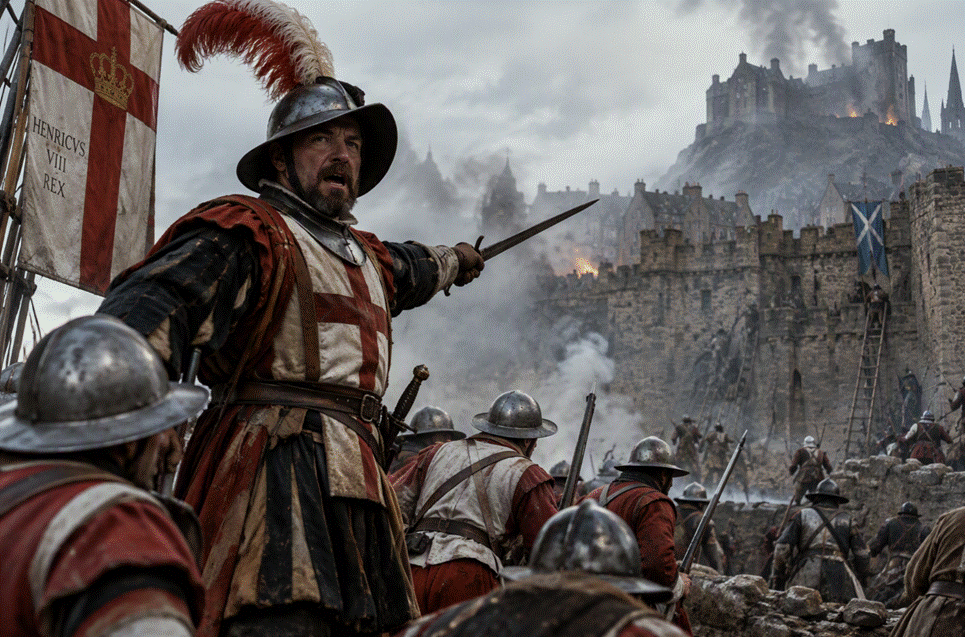
There was a John Dod, captain of 100
men in the expedition to Scotland of 1544, who was paid 20 days wages at 4s for
himself and petty captain and 6d for each man from 28 April to 18 May 1544 with
deductions for victuals (Public Records of the reign of
Henry VIII, Volume 19 – Part 1 561). This was an exceptionally
destructive military campaign known today as the Burning of Edinburgh or
the first major strike of the War of the Rough Wooing. Henry VIII had successfully negotiated
the Treaty of Greenwich in 1543, which stipulated that the infant Mary, Queen
of Scots, would marry his young son, Prince Edward (later Edward VI). However,
the Scottish Parliament rejected the treaty and renewed their Auld Alliance
with France. Enraged, Henry ordered Hertford to invade Scotland with explicit
commands to lay waste to towns, loot what they could, and burn Edinburgh to the
ground as a show of divine vengeance.
The invasion successfully captured the
port of Leith, sacked and burned Edinburgh for three days, and laid waste to
the surrounding region. However, they failed to take Edinburgh Castle, which
held out using heavy artillery. Hertford's land forces marched back to Berwick
in mid-May, burning Haddington and Dunbar on their retreat, which matches the
end-date of 18 May 1544, in Dod's pay ledger.
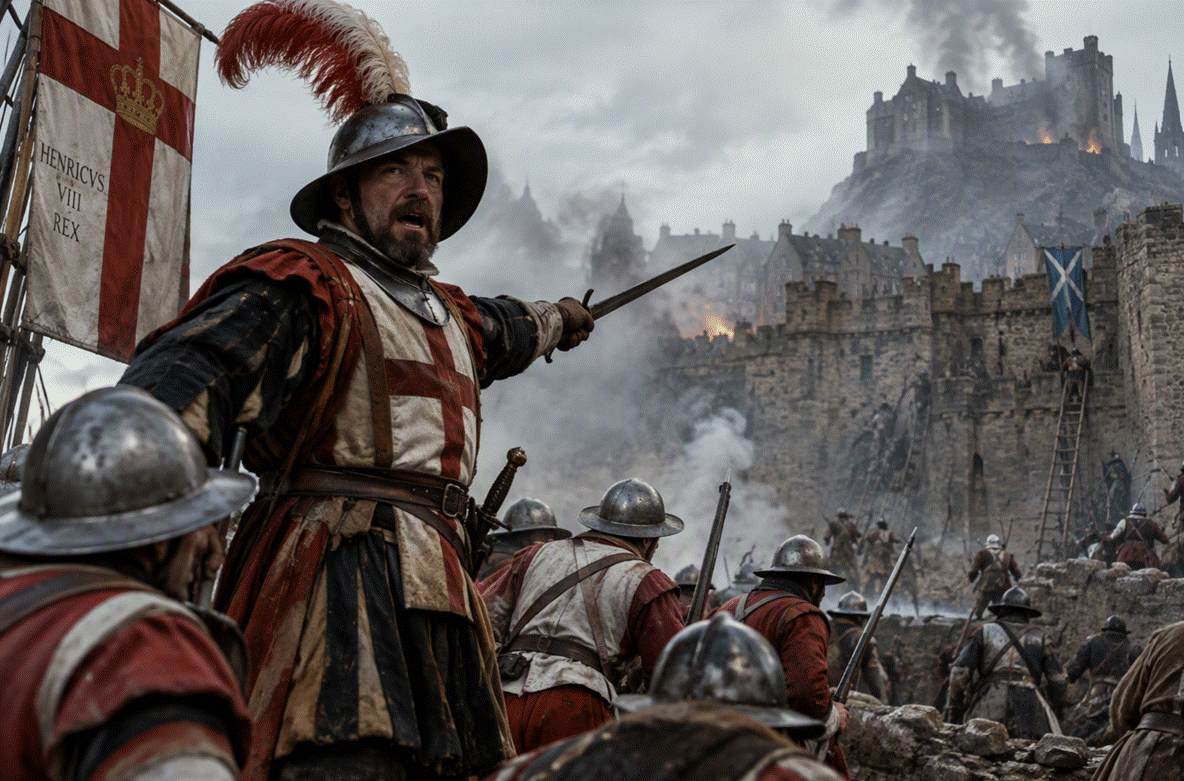
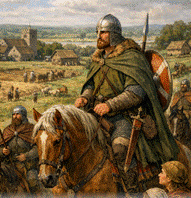
John Dod
commanding his 100 man unit in Edinburgh during the Rough Wooing, reimagined
1545
On 17 April 1545 in a letter from Shrewsbury to the Commissioners
of Musters of Cheshire, he wrote, Whereas the King's ancient enemies, both
Scots and Frenchmen, of their insatiable and deadly malice, intend to annoy
this realm both by land and sea, and as the certificates of musters lately
taken before you do not set forth to whom the men therein certified belong, the
King commands you, within your hundreds and divisions, to put ready the said
men to the number of 3,000, as many as possible to be horsemen, so horsed as to
be able to serve when they reach the Borders, and the rest footmen, archers and
billmen (arms described), to be ready before 12 May next. You are not to
meddle with servants or tenants of the earl of Derby, who is appointed to serve
in person. Those appointed to lead the men included Sir Randall
Manwaryng, Sir John Massy, Sir Hugh Cholmondeley, Sir Urien Brereton, Sir Roger
Brereton, Sir Richard Egerton, Sir William Brereton, Sir Hugh Claveley, Randall
Brereton of Malpas and others. (Public Records of
the reign of Henry VIII, Volume 20 – Part 1 Folio 538).
1547
John Dodd was one of those assigned to keep the peace and
enforce statutes and ordinances in Shropshire (Patent
Rolls of the reign of Edward VI, Volume
1, 1547
to 1548, page 88).
1550
In 1550 Edward VI appointed John Dod, as a wealthy local
landowner, to serve as the Crown's chief property and tax investigator for the
county of Shropshire. John Dodde of Clorley (ie Cloveley) Esq, Shropshire was
appointed as escheateor and in 1551 he was
given a commission to collect relief granted by Parliament (Patent Rolls of
the reign of Edward VI, Volume 5, 1547 to 1553,
page 348,
358). An escheator was a high-ranking royal official appointed
by the Crown to look after the King's feudal property rights in a specific
county. His primary job was to manage escheats lands or assets that temporarily
or permanently reverted to the ownership of the King.
c 1564
John was permitted a coat
of arms on a fess gules, between two barrulets wavy sa,
three crescents or quartering Warren, Plantegenet,
Broxton, Cloverley etc
This is a standard heraldic
blazon. Arg(ent) refers to a a
silver or white shield. On a fess gules refers to a red horizontal band across
the centre. Between two barrulets wavy sable refers to two thin black wavy
bars, one above and one below the fess. Three crescents refers to three gold
crescents placed on the red fess. Quarterings
show descent from armigerous families.
This is the coat of arms of the
Dods of Cheshire.
1578
John died in or about 1578.