William Baker IV of Fenton and Hasfield
Court
2 February 1800 (baptised) to 8 August 1865
BAK00301
|
Return to the Home Page of the Bakers Family part of the website |
The Bakers of Highfields Story
The Story of the Dods and Bakers and of Highfields,
Fenton House and Hasfield Court. A journey through the history of Cheshire and
Staffordshire, an Anglo-Saxon nobleman who retained his lands after the
Conquest, pottery at Stoke on Trent, an encounter with Elgar, and the history
of an Elizabethan manor house at Audlem |
The family tree of the Bakers of Highfields |
The Family Tree of the Dods, predecessors to the
Bakers of Highfields |
The Bakers of Fenton House and Hasfield
Court
The Family Tree of the pottery Bakers of Stoke on Trent |
The Family Tree of the Bellyse Family |
The main part
of this website tells the story of the Farndale family from Yorkshire Descendants of Arthur Baker, the story of the
Farndale ancestry is told through the main part of this website You can also return to the Farndale
website home page |
The genealogy of the family of James Hall, linked to
the Baker family through marriage to Arthur Baker |
Headlines of
William Baker IV’s life are in brown.
Dates are in red.
Hyperlinks to
other pages are in dark
blue.
References and
citations are in turquoise.
Context and local
history are in purple.
1800
William Baker IV was the son of
William and Mary (nee Bourne) Baker (BAK00106).
He was born in 1800 and baptised at St Peter Ad
Vincula, Stoke on Trent on 2 February 1800 (St Peter Ad Vincula, Stoke on
Trent Parish Record).

1810
William was educated at
Manchester Grammar School. William (IV) was educated at Manchester Grammar
School, but his brother Ralph Bourne Baker was said by the present family to
have been taken up by the Bournes and he was educated at Rugby and Trinity
College, Cambridge and then entered the church (Dodd, F
(1987), The Baker Family and Fenton, Presidential Address in Transactions
1986 to 1987, The North Staffordshire Field Club page 13).
1820
William Baker IV was a
pottery and encaustic tile manufacturer, in partnership with Ralph Bourne and
John Bourne as Bourne, Baker & Bourne at Fenton (dissolved
1833). They employed 500 employees.
1833
DISSOLUTION OF
PARTNERSHIP. Notice is hereby given that the partnership later carried on at
Fenton, in Staffordshire, in the Firm of BOURNE, BAKER and BOURNE, by and
between the undersigned Ralph Bourne, and the late William Baker and John
Bourne, both deceased, as manufacturers of China and Earthen Ware, and owners
and workers of Coal Mines; and which partnership, since the decease of the said
William Baker and John Bourne respectively, has been carried on by their
respective executives, in conjunction with the said Ralph Bourne, was this day
finally dissolved. As witness our hands the 11th day of November,
1833. Ralph Bourne, Ralph Bourne, William Baker, John Baker, executives of
William Bourne, deceased. Ralph Bourne, John Pratt Jun, Abm
Kaye Holmes, executives of John Baker, deceased. Signed by all the said parties
in the presence of T Fenton. (Staffordshire Advertiser, 16
November 1833).
William Baker IV was
trading with Ralph Bourne and John Baker as Bourne, Baker and Baker in 1833,
until Ralph Bourne died in 1835.
1840
By 1840 William Baker (IV) alone was running the
business and trading as William Baker & Co. A History of Stoke on Trent by Ward said that "that these manufactories combine every advantageous arrangement,
with millwork and machinery for the exercise of the potters
operations". Jewett says the firm produced an ordinary class of printed, sponged
and pearl-white granite ware suitable for the British, North American, West
Indian, African and Indian markets. This confirms the opinion of the present
members of the Baker family who had always understood that the products were
exported to Canada and Africa. He was a highly successful manufacturer and made
a very large fortune from the pottery. Wedgwoods were said to have offered to
take him into partnership but William is said to have turned
the offer down saying that there was more money in selling chamberpots
to Canada!
(Dodd, F (1987), The Baker Family and Fenton,
Presidential Address in Transactions 1986 to 1987, The North
Staffordshire Field Club, page 14).
William, of Fenton House, of Moorville, Caverswell (tenant in
common with his brother John), and Hasfield Court,
Gloucestershire, which he refaced in the Dutch style (purchased from Thomas
Fulljames the Younger in 1863. Whose father had purchased it from Mr Baker’s cousin,
Edward Gresley Stone, DL, JP, 1847), Lord of the Manor of Hasfield,
joint Patron of the Living of Ch Ch Fenton, JP
Staffordshire, Chief Cailiff of Fenton 1840 to 1865,
partner of Messrs Baker and Bourne, Baker and Challinor, and W Baker and Co,
Fenton, born 1800, died unmarried 8 August 1865, and was succeeded by his next
brother. (Burke, John and Burke, Sir
Bernard (1836)(Eighteenth Edition, 1972), Bellyse Baker of Highfields in
Burke’s Landed Gentry, Volume 3, pages
35 to 38).
Ralph Bourne’s
will had bequeathed the sum of £2,500 in the hands of Viscount Sandon and Rev R
Bourne Baker as trustees for the erection of a church in Fenton and a further
£1,000 for its endowment. An additional £3,000 was later given by Ralph
Bourne’s sister, Mrs William Baker and the east window and organ were also
provided by the Bourne family.
William was
active in local affairs and served as an Improvement Officer and in 1840 was
Chief Bailiff for the Fenton District and he was a JP.
ABSTRACT OF THE
PARISH ACCOUNTS, From the 15th March, to
the 13th September,
1834, WILLIAM BAKER, Fenton, Mr WILLIAM PARKER, Shelton, Churchwardens. (Staffordshire Advertiser, 1 November 1834).
1841
Census
1841 – High Street, Stoke upon Trent
Mary Baker,
Female, 70, 1771, Staffordshire, England
William Baker,
Male, 40, 1801, Staffordshire, England
Jane Baker,
Female, 35, 1806, Staffordshire, England
Charlotte Baker,
Female, 25, 1816, Staffordshire, England
Thomas Naylor,
Male, 20, 1821, Staffordshire, England
Sarah Bailey,
Female, 30, 1811, Staffordshire, England
Charlotte Leese,
Female, 20, 1821, Staffordshire, England
Elizabeth Gee,
Female, 12, 1829, Staffordshire, England
William was
unmarried and so had no children. He is said to have been a taciturn man.
William
(IV) never married and is reputed to have been a taciturn man, unlike his
brother the Rev. Ralph who one occasion held at forth at length on some subject
until William stopped him saying "I think you have talked enough" in
a gruff no-nonsense voice. He took an active part in local affairs in Fenton,
serving as an Improvement Commissioner, and in 1840 as Chief Bailiff of the
Fenton District, and was a J. P. He also maintained the Bourne and Baker
tradition of philanthropy. A building known as the Athenaeum was provided by
him in 1853 at his own expense. It stood on the corner of Christchurch Street
and City Road, and was a most handsome building, designed by Henry Ward.
Pevsner describes it as "nicely Italianate". It housed a library, a
public lecture room and an assembly room which was later used as a school room.
Its final use was as premises for the District (now
National Westminster) Bank and they, in 1977, demolished it to replace it by a
modern building.
(Dodd, F (1987), The Baker Family and Fenton,
Presidential Address in Transactions 1986 to 1987, The North
Staffordshire Field Club, page 14).
Although who was
this? MARRIED. Lately, at Gretna, and afterwards at the Cathedral, Chester,
WILLIAM BAKER Esq, of the Upper House, Fenton Potteries, to MARY, daughter of
GEORGE SYERS, Esq, of Everton. (Liverpool
Standard and General Commercial Advertiser, 21 September 1841).
1847
NOTICE IS HEREBY
GIVEN, that, JOHN PRATT, the younger, and WILLIAM PRATT, of Lane Delph, in the
Parish of Stoke on Trent, in the County of Stafford, earthenware manufacture Co partners, have and each of them hath by an indenture of
release and assignment, bearing date the 9th day of November, 1847, and made
between the said John Pratt, the younger, and William Pratt, of the first part;
William Baker, or Fenton, in the said parish of Stoke upon Trent, earthenware
manufacturer, and Edward Kinnersley, of Newcastle under Lyme who shall execute
the same indenture, being creditors upon the said co-partnership stock or joint
fund of the said John Pratt, the younger and William Pratt, of the third part;
Conveyed and assigned all their and each of their real and personal estate and
effects to the said William Baker and Edward Kinnersley, in trust for the equal
benefit of the creditors of the said John Pratt the younger, and William Pratt,
parties thereto. The said indenture of release and assignment was duly executed
by the said John Pratt, the younger, and William pratt, on the 9th day of
November, 1847, in the presence of an attested by Frances Stanier, of Newcastle
under Lyme aforesaid, attorney at law, and Thomas Udall, at the same place,
attorney at law; and the same indenture was duly executed by the said William
Baker and Edward Kinnersley at the same 9th day of the said month of
November, in the presence of and attested by the said Francis Stanier and
Thomas Udall. Francis Stanier, Solicitor to the Trustees. (Morning Herald, 30 November 1847).
1851
Census
1851 -
High Street, Stoke upon Trent
Mary Baker, Head,
Widow, Female, 81, 1770, Annuitant, Shelton, Staffordshire, England
William Baker, Son, Unmarried,
Male, 50, 1801, Joint coal proprietor earthenware manufacturer employing 380
males and 187 females farmer of 31 acres, Fenton,
Staffordshire
Jane Baker,
Daughter, Unmarried, Female, 40, 1811, Lady Fenton,
Staffordshire, England
Charlotte Baker, Daughter,
Unmarried, Female, 35, 1816, Lady Fenton, Staffordshire, England
Thomas Naylor,
Servant, Unmarried, Male, 30, 1821,
Footman, Cheshire, England
Sarah Lowe,
Servant, Unmarried, Female, 30, 1821 ,
House servant cook, Drayton, Shropshire, England
Mary Chatfield , Servant, Unmarried, Female, 38, 1813, House
servant housemaid, Sandon, Staffordshire, England
Elizabeth
Chatfield, Servant, Unmarried, Female, 26, 1825, House servant housemaid,
Manchester, Lancashire, England
1853
A building called the Athenaeum
was provided by him at his own expense in 1853. It was a ‘nicely Italianate”
building and housed a library, public lecture room and assembly room, also used
as a school room.
1856
In 1856 a
thorough restoration of the church was undertaken a chancel being added as well
as aisles and the galleries were removed. The cost was £3000 - this being
defrayed by William Baker (IV) who also provided a new vicarage house and
substantially increased the endowment to the benefice as well as building an infants'
school and placing a drinking fountain in Victoria Place.
(Dodd, F (1987), The Baker Family and Fenton,
Presidential Address in Transactions 1986 to 1987, The North
Staffordshire Field Club, page 14).
1857
LECTURE AT THE FENTON ATHANEAUM.
This chaste and beautiful edifice, dedicated to the people, erected at the
munificent cost of William Baker, Esquire, whose sainted mother laid the foundation
stone, is a noble example of the private and disinterested benevolence on the
part of Mr. Baker, worthy of imitation. This building contains a lecture hall,
an assembly room, library, reading and committee rooms. The benevolent object
of the founder is being carried out in both public and class lectures,
conducted by a most respectable and energetic committee, of which of which Mr.
John Hancock is honorary secretary. On Monday evening last, the second lecture of
the season was delivered by the Rev JS Broad, MA, of St. Georges Church,
Newcastle. Subject: “A month on the Rhine” with pictorial illustrations. The
Rev W Sollis, MA, incumbent of Christ Church, Fenton, presided in the absence
of W Baker, Esquire, president of the Society. Among others, we noticed J Pratt
Esq, SC Peers Esq, W Pratt Esq, W Hancock Esq, W Locket Esq, and party; Mrs J
Pratt, Mr and Mrs Jensen, Mr McCreevy, Mr. J Hancock, Mr AK Holmes, etc the Rev
Chairman briefly introduced the lecturer, who at once applied himself to the
theme without a prologue. The Rhine, said he, was called everybody's tour, but
everybody had not made the tour of the Rhine. He left the shores of old England
with a light heart, a fair breeze, and a clear sky, sailing to those lands of
great historical association, the continent of Europe. If any of that audience
had made the tour, he trusted that he should that evening refresh their memories
with a repetition of the recollections of the Rhine, and the ancient ruins on
the banks. After a long and pleasant sea trip, he took the rails. The first
place he spoke of was cologne, “The city of stenches”... (Staffordshire Sentinel and
Commercial and General Advertiser, 2 May 1857).
1859
AT the THIRTEENTH ORDINARY MEETING
of the PROPRIETORS of the STAFFORDSHIREW POTTERIES WATERWORKS COMPANY, held at
the Offices of the Company, on Tuesday, the 31st day of May 1859,
JOHN RIDGWAY Esq in the Chair; It was resolved, That the common seal of the
Company be affixed to the registry of Shareholders. That the replacement of
accounts as published and now produced be approved and adopted. That the
profits of the half year will yield a dividend at the rate of 6% per annum,
free of income tax, and that such dividend be now declared payable on and after
the 24th June next. That the remaining 16s per share
be called up, payable on the second August next, that notice be given accordingly.
An application having been made from the borough of Hanley for a supply of
water for a drinking fountain about to be erected there, it was resolved, that
the water be supplied for one fountain to each of the following places free of
charge: Hanley, Shelton, Tunstall, Longton, Burslem,
Stoke, Fenton, and Newcastle. That any additional ones be left to the
discretion of the director's and be made in the satisfaction of the engineer
and his assistant. That John Alcock, William Baker, John Heath, and
Nicholas Price Wood Esquires, the directors who go out by rotation, be and are
hereby re elected. That William Brownfield Esq be
appointed a director, in place of Timothy Dimmock Esquire, who has sent in his
resignation. That this meeting has pleasure in acknowledging the long and
valuable attention of Timothy Dimock Esquire to the interests of the company,
and on his retirement, owing to his removal to a distance, begs to present him
in his family it's best wishes for their health and happiness. That this
meeting has two objects to press on the directors. The first, that every
obstacle may be removed which stands in the way of giving their customers a
full and constant supply of water, accidents only accepted; And second, that
the strictest economy may be practised in the expenditure consistent with the
efficiency of the works, to both of which this meeting will depend on their
giving their best attention. That the thanks of the meeting be presented to Mr
Whittingham and the other shareholders who have offered so many valuable
suggestions. That the thanks of the meeting be given to the chairman and the
directors for their valuable services. That the retiring auditor, Mr. John
Shirley, be and is hereby re elected, with thanks to
Mr Lamb and him for their valuable services. That the thanks of the meeting be
given to the engineer, secretary and other officials for their useful services.
John Ridgeway, chairman. (Staffordshire Advertiser, 4 June
1859).
1861
Census
1861 - 14,
High Street South Side, Stoke upon Trent
William Baker, Head Unmarried, Male, 61, 1800, Earthen ware
manufacturer employing 600 persons, Fenton, Staffordshire, England
Charlotte Baker,
Sister, Unmarried, Female, 50, 1811, Railway proprietor, Fenton, Staffordshire, England
Mary E Cartwright, Niece, Unmarried, Female, 33,
1828, Railway proprietor, Trentham, Staffordshire, England
Mary Chatfield, House
servant, Married, Female, 46, 1815, Ladies maid, Sandon, Staffordshire, England
Ann Kent, House
servant, Unmarried, Female, 36, 1825, Cook, Cheshire, England
Mary Fenton,
House servant, Unmarried, Female, 22, 1839, Housemaid, Stone, Staffordshire,
England
Ann Marsh, House
servant, Unmarried, Female, 19, 1842, Housemaid, Staffordshire, England
Thomas Naylor,
House servant, Unmarried, Male, 48, 1813, Footman, Rock Ferry, Lancashire,
England
1863
He had inherited Fenton House
from his father in 1833 and purchased the Hasfield
Court estate, in Gloucestershire in 1863 for £42,500. William had stayed there as a
boy and had memories of it. There is a family story that he bought it in order to grow exotic fruits, including banans in greenhouses on the estate. The original medieval
house was probably moated and the Paucefoot family
owned it from 1200 to 1598 when they had to see during the ‘persecution of the recusants’. He had planned to reface the brick walls with stone
and add a porch, but he died before he could do so, and his brother Ralph did
the work, along with the addition of bay windows.
In 1863
he bought an estate called Hasfield Court, in
Gloucestershire, from a Mr. Fulljames whose father
had bought it from a relative of the Bakers. In fact
William had stayed at the house as a young boy and the memory of it had
remained. A family story relates that William bought Hasfield
in order to grow exotic fruits, especially bananas, in
greenhouses there, well away from the smoke of the Potteries. According to
Pevsner Hasfield had been owned by the Pauncefoot family from 1200 to 1598 when they were obliged
to sell owing to the persecution of recusants. Pevsner thought that the
mediaeval or early Tudor house was probably moated. [the present owner doubts
this]. The house itself is last half of C17 but contains early Tudor features.
William made plans to change it by refacing the brick walls with stone and adding
a porch but, sadly, he died before the move was accomplished and the
alterations were completed and paid for by his brother Ralph who also added bay
windows.
(Dodd, F (1987), The Baker Family
and Fenton, Presidential Address in Transactions 1986 to 1987, The
North Staffordshire Field Club, page 15).
The lantern roof construction and the large round
headed windows of the conservatory allowed for the cultivation of a range of exotic
plants indoors, a popular pursuit not just inside the house but as part of the
development of the gardens in response to the introduction of many new plant
varieties. The restoration of the Victorian rooms and gardens at Hasfield Court will recapture a golden age for the house
when it was filled with music. Today these rooms can be visited as part of a
‘restoration in progress’ tour led by members of the family (Hasfield Court: where
Elgar played, Country Houses
Foundation).
William Baker IV died on 8 August 1865, aged 65 (Monumental Record, Find a Grave index). He was buried on 15 August 1865 (Christ Church, Fenton
Parish Records). Baker, William Esq. Effects under
£120,000. 16 September. The Will with two codicils of William Baker late of
Fenton in the Parish of Stoke-on-Trent in the County of Stafford Esquire
deceased who died 8 August 1865 at Fenton aforesaid was proved at Lichfield by the
oaths of the Reverenced Ralph Bourne Baker of Clifton in the County of
Gloucester Clerk the Brother George Ford of Barlaston in the County of Stafford
aforesaid Gentleman and Joseph Gimson of Fenton aforesaid Book
Keeper the Executors (Probate Record).
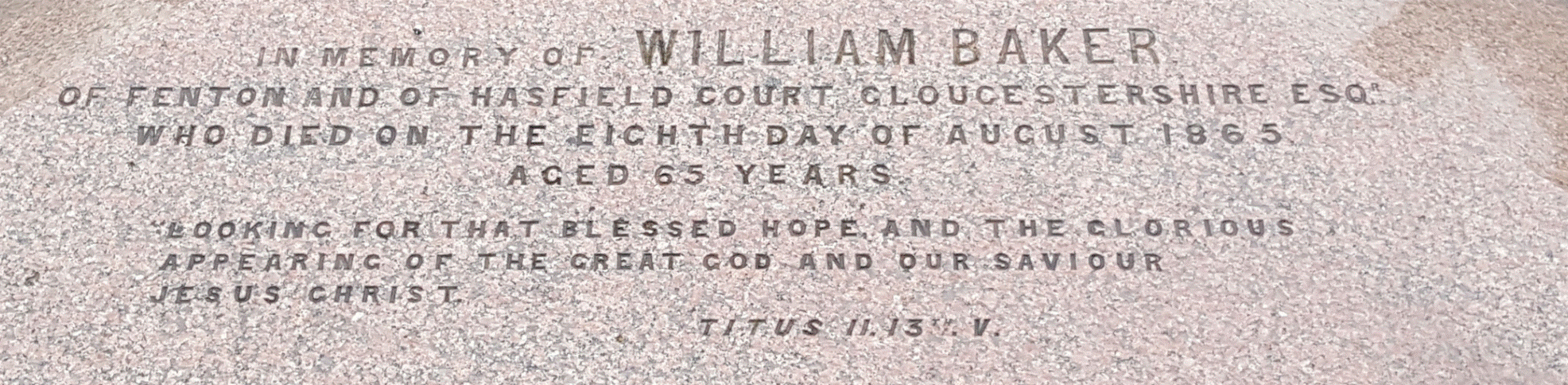
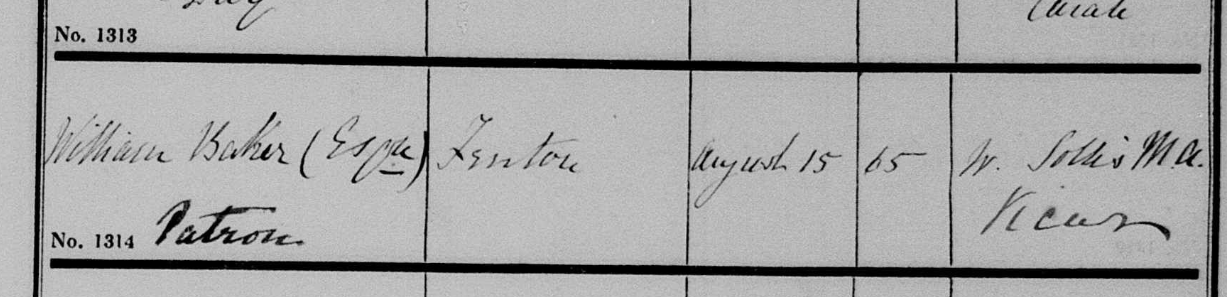
William died on 16th August 1865 and,
according to the report in the Staffordshire Advertiser, the day of his funeral
was one of general mourning in Fenton. All blinds were drawn, no Courts were
held and the funeral was attended by workers from the Baker factories nearby.
He is buried in Fenton Churchyard. (Dodd, F
(1987), The Baker Family and Fenton, Presidential Address in Transactions
1986 to 1987, The North Staffordshire Field Club, page 14).
At his death his property of Fenton, Hasfield,
and Doveridge Woodhouse passed to his next brother,
Rev. Ralph Bourne Baker.