Bakers of Coventry
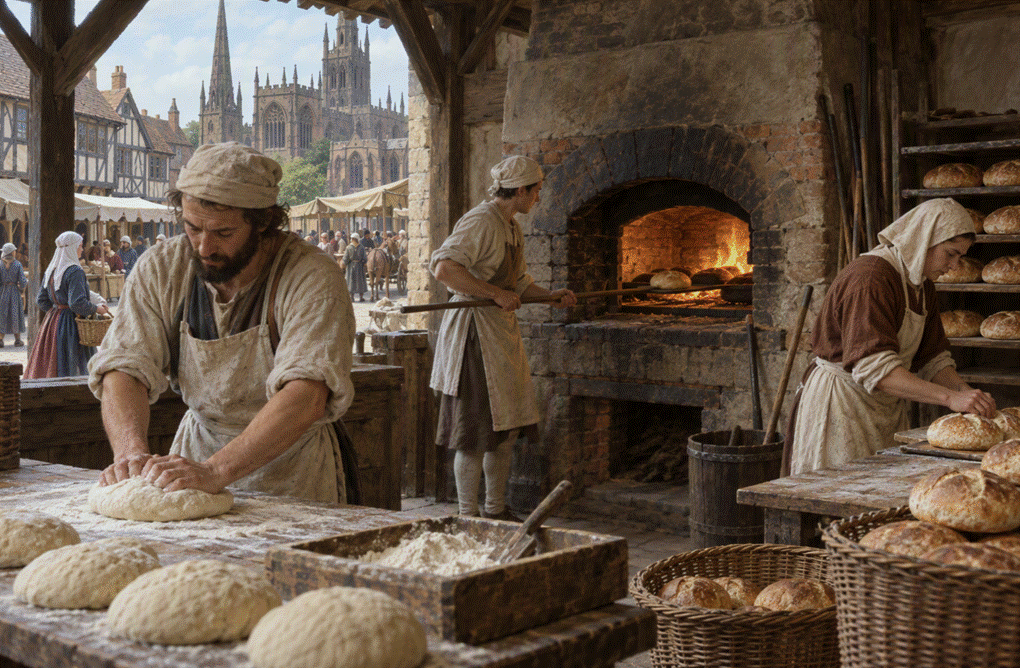
Exploring
the possibility that the Bakers of Highfields may have been descendants of the
bakers of Coventry
|
Return to the Home Page of the Bakers Family part of the website |
The Bakers of Highfields Story
The Story of the Dods and Bakers and of Highfields, Fenton
House and Hasfield Court. A journey through the history of Cheshire and
Staffordshire, an Anglo-Saxon nobleman who retained his lands after the
Conquest, pottery at Stoke on Trent, an encounter with Elgar, and the history
of an Elizabethan manor house at Audlem |
The family tree of the Bakers of Highfields |
The Family Tree of the Dods, predecessors to the
Bakers of Highfields |
The Bakers of
Fenton House and Hasfield Court
The Family Tree of the pottery Bakers of Stoke on Trent |
The Family Tree of the Bellyse Family |
The main part of
this website tells the story of the Farndale family from Yorkshire Descendants of Arthur Baker, the story of the
Farndale ancestry is told through the main part of this website You can also return to the Farndale
website home page |
The genealogy of the family of James Hall, linked to
the Baker family through marriage to Arthur Baker |
Headlines of are
in brown.
Dates are in red.
Hyperlinks to
other pages are in dark
blue.
References and
citations are in turquoise.
Context and local
history are in purple.
As we know that the ancestors of the Bakers of Highfields were in Coventry during the sixteenth century, it is possible that is that the Bakers had long standing interests in Coventry and perhaps originated as bakers of Coventry. If this is the case, since names started to emerge in the twelfth to thirteenth century, the family would have had deep seated, antique interests in the city.
The Emergence of Surnames
A family of bakers in Coventry
would have likely adopted the surname Baker roughly between the twelfth
and fourteenth centuries. This was the era when hereditary surnames first
became necessary in England for taxation, legal documentation, and general
administration. (Powell, Kimberly, 11
June 2019, The
Surname Baker: Its Meaning and Origin). Before the twelfth century, a man named John who
baked bread might simply be known to his neighbours as John the Baker.
By the late 1300s, these descriptive designations froze into permanent,
hereditary family names passed down to children, regardless of whether they
continued the trade. The surname was already established in Coventry and its
surrounding Warwickshire villages during this early formative period. In
this early period when surnames were being adopted, the Baker surname is found
both in Coventry and the surrounding villages indicating that the trade of
baking was widespread. (Wilcox, Philip, The
Bakers Company of Coventry, Historical Association).
Because baking was universally
essential, the surname Baker emerged independently across many different
families throughout Britain. Therefore, a Coventry-based Baker family
represents a distinct lineage rooted specifically in the economic fabric of
medieval Warwickshire. (Bakers Surname
Meaning, Ancestry). We cannot be sure that the
origin of this particular family was in baking in
Coventry, but if this was a family firmly rooted in Coventry’s history, this
seems the most probable model. Indeed the organsiation of baking has particularly deep roots in
Coventry.
Before 1500, Coventry was a
rapidly growing medieval boom town, eventually rising to become the fourth most
populous and wealthy city in England. Because bread was the fundamental staple
of life, the bakers of Coventry operated under a strict web of local civic
governance, nationwide royal statutes, and an incredibly powerful trade guild.
1204
The Fellowship of Bakers in
Coventry, later known as the Company of Bakers, was an antique body, reportedly
formed in 1204, predating the city's general Merchant Guilds by nearly half a
century. The guild held a strict monopoly on who could bake
and sell bread within the city walls. They controlled the entry of new bakers
through rigorous apprenticeship contracts, which generally lasted between 3 and
7 years. Finishing an apprenticeship in Coventry uniquely granted the status of
a Freeman of the City. (The
Master Bakers of Coventry,
Our Warwickshire, see also, for comparison with
London, the History of the Bakers’ Company,
The Worshipful Company of Bakers).
The Bakers' Company of London is
one of the oldest of the London livery companies, dating from between 1130 and
1155 according to the Pipe Rolls (the account rolls of the King's Exchequer).
There are no known surviving contemporary records to prove just when a bakers' guild
was formed in Coventry, and in fact there are no known surviving guild records
for any organisation in Coventry from before the late 14th century. The
earliest known Merchant guild in Coventry was formed in 1340 when some wealthy
merchants provided £1,000 to obtain a royal licence from Edward III to found
the Merchant Guild of St Mary. Other Guilds were formed but eventually with
amalgamations there emerged the Corpus Christi Guild as the junior body and the
Holy Trinity Guild as the senior. (Wilcox, Philip, The
Bakers Company of Coventry, Historical Association).
1448
The guild was not just a
commercial entity; it was tied into the defence of Coventry. In 1448, the
Company of Bakers equipped 19 men for military service, and by 1460, they
supplied 19 bakers with protective armour (jacks) to defend the city
walls.
1484
The power dynamics between the
guild and Coventry’s leadership came to a head in 1484. When the Mayor adjusted
the bakers' profit allowances based on moving wheat prices, the guild revolted.
In a dramatic protest, the Coventry bakers went on strike and staged a mass
exodus to the nearby village of Baginton, leaving the major city entirely
without bread. The civic authorities cracked down; the bakers ultimately
relented, were hit with a massive £20 fine, and swore never to abandon their
ovens again.
The daily operations of a medieval
Coventry baker were highly systematic and dictated by transparency and
traceability. Bakers bought their own raw grain. By law, they had to bring it
strictly to authorised Coventry millers, who were ordered to prioritize local
bakers over external clients. Bakers could not price their bread however they
pleased. Under the national Assize of Bread and Ale laws, the
price of a loaf remained fixed, but the physical size and weight of the loaf fluctuated
depending on the current market price of wheat. Local officials inspected and
weighed the bread at least once a month.
Bakers typically baked distinct
types of bread reflecting social hierarchy. This ranged from fine white bread (manchets
or wastistelle) for nobles and wealthy
merchants, to maslin (a blend of wheat and rye) for ordinary
townspeople, down to dense horse bread made of beans and bran.
Long before modern branding, every
Coventry baker was legally required to press a personal, unique seal or indent
into their dough before baking. If a loaf was found to be underweight, filled
with ash/chalk, or otherwise adulterated, the civic inspectors could trace the
exact oven it came from.
The main hub for buying bread in
late-medieval Coventry was situated just within the boundary of the Prior's
Half, specifically at the Gaol Hall door.
Because Coventry was a lucrative market,
bakers from outlying regions, such as nearby Warwick, often tried to smuggle or
bring bread in to compete. To protect the local monopoly, the Coventry town
governance restricted outside bakers to selling only on Wednesdays and Fridays
at the Gaol Hall door.
Cheating the public on bread was
viewed as a serious civic crime. If a Coventry baker was caught selling
short-weight or low-quality loaves, the legal code followed a
three hits and you're out philosophy. For a first and
second Offence, the offending baker was tied to a wooden frame called a hurdle
and publicly dragged through the streets of Coventry while crowds jeered, or placed in the public stocks. For a third offence,
the punishment was economic ruin. The authorities would march into the baker's
property and physically pull down their stone ovens, permanently revoking their
right to practice the craft.