410 to 866 CE
North
Eastern Yorkshire and the wider political interest of Northumbria during the
period from the fall of the Roman Empire to the early Scandinavian Raids
leading to their eventual control of the northern part of the Anglo-Saxon world
from York
|
Return to the Home Page of the Farndale Family
Website |
The story of one family’s journey through two
thousand years of British History |
The 83 family lines into which the family is divided.
Meet the whole family and how the wider family is related |
Members of the historical family ordered by date of
birth |
Links to other pages with historical research and
related material |
The story of the Bakers of Highfields, the Chapmans, and
other related families |
Dates are in red.
Headlines and
Northumbrian kings are in brown.
The
wider context beyond Northumbria is in purple.
Hyperlinks to
other pages are in dark
blue.
References and
citations are in turquoise.
Geographical
context is in green.
|
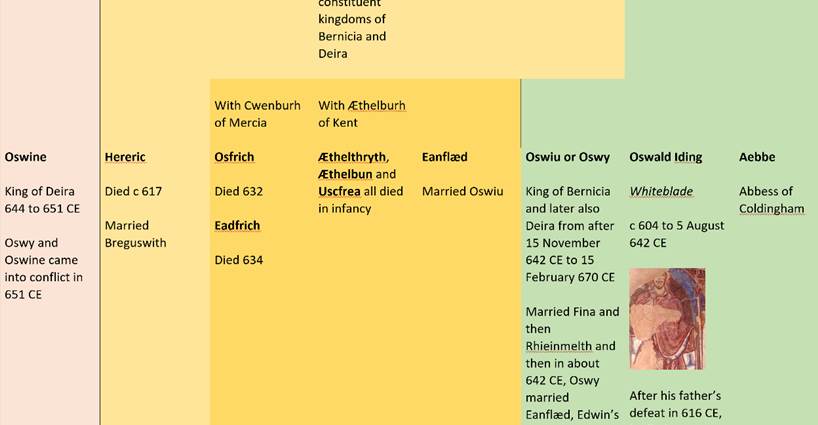
The Genealogy of the Kingdoms of Deira,
Bernia and Northumbria
The Family Tree of the Kings
of Deira and Bernicia and their merger into the Kingdom of Northumbria |
|
The vicinity of Farndale in the Anglo Saxon period
400 CE
to 794 CE |
Go back to Roman Yorkshire.
Introduction and
summary of sources
The Early Medieval Period is
generally taken to cover the period from c 410 to 1066. This was the period
once misguidedly referred to as the Dark Ages. This page focuses on Anglo-Saxon
Northumbria and particular the lands of northern Yorkshire centred on the North
York Moors during the first half of the Early Medieval Period prior to 866 CE.
After 866 CE, these lands were the heart of the Scandinavian territory that
came to be known as the Danegeld and this later period will be the subject of Scandinavian Yorkshire.
Bede’s Ecclesiastical
History is the primary source for the
history of this period, and itself relies on Gildas’ Ruin of
Britain, probably written in the sixth
century CE, more a sermon about the end of times than a history, whose didactic
approach may have also rubbed off on Bede. Bede’s work was intended to share his
view of the rise of the church in English history and he adopted distinct views
about the failures of the indigenous Britons, the inevitability of Roman
Christianity, but with some respect for the Irish Christians. The Ecclesiastical
History nevertheless provides a historical narrative which is invaluable in
being the only early medieval primary source. The much later and more southern
focused Anglo Saxon Chronology, begun in the ninth century,
is a later source which includes a chronology of the earlier period, and may
have relied on other earlier sources not used by Bede.
Gildas’ work was more an
admonition to the leaders of his day than a history and little is known of
Gildas. He saw the violence of the fifth century as divine punishment for the
violation of the commandments by the elite. He probably wrote De Excidio Britanniae, the Ruin of Britain in the
second quarter of the sixth century, about 540 CE. Albeit weighted to his doom
laden message, the work provides a near contemporary record of events. Gildas
was concerned primarily to condemn contemporary British secular and religious
society, but he leaves no doubt that the Britons experienced severe trauma at
the hands of Germanic peoples settled in Britain (The Earliest English Kings, D P Kirby, 2000, page 14).
The Anglo Saxon
Chronicle is a collection of Old English
annals initiated around 890 CE, probably under King Alfred the Great, providing
a year-by-year history of England from Roman times to 1154. It includes the
Anglo-Saxon settlement, important events in Northumbrian history, genealogies,
and Scandinavian invasions.
Other later sources
complete the contemporary or near contemporary written record. Bede’s other
works supplement the Ecclesiastical History. They include his scientific
works on the reckoning of time, astronomy, the tides and the calculation of
Easter; his works on grammar and poetry; his works on theology; and his Letter
to Egbert just before his death in 734 CE. The letters of Sidonius Apollinaris (c 431 to 487) comprise nine
books and approximately 150 letters including Book 8 Letter 6 which describes the arrival of Saxon pirates.
Stephanus’s Vita
Sancti Wilfrithi, written
between 709 and 720 CE is a hagiographical account of the life of Wilfrid. The Anonymous Life of Ceolfrith details the abbot of Monkwearmouth-Jarrow,
Ceolfrith's trip to Rome and the creation of the Codex Amiatinus. The Letters of Alcuin of York, c AD 732 to
804 provide an
important record of the period immediately prior to the Viking attacks from 793
CE. Historia
Brittonum,
traditionally attributed to the ninth century Welsh monk Nennius, is a
compilation blending history, legend, and geography which records Britain's origins,
Roman rule, and battles against Saxons. It is a romanticised emphasis on
British and Arthurian, rather than Anglo-Saxon, history. Asser’s Life of King Alfred
is a hagiographical account of the Life of Alfred of Wessex, his confrontations
with Scandinavian invaders and his promotion of intellectual work. The Chronicle of Æthelweard
is a late tenth
century Latin history of England primarily based on a version of the
Anglo-Saxon Chronicle that is now lost. Symeon of Durham’s Historia
Regum is a twelfth
century Latin chronicle detailing English and Northumbrian history from 735 to
1129. Compiled at Durham Priory, it preserves unique early Northumbrian annals,
copies of works by Asser and Florence of Worcester, and contains original, contemporary
accounts of Northern English events. Historia Anglorum
by Henry of Huntingdon, written around 1123–1154, is a 12th-century Latin
chronicle tracing English history from Julius Caesar’s invasion to the
accession of Henry II in 1154. William of Malmesbury's Gesta Regum Anglorum,
completed around 1125–1127, is a foundational twelfth century chronicle
covering English history from 449 to 1120. It provides detailed accounts of
Anglo-Saxon kings, bridging the gap between Bede and contemporary medieval
history with a focus on moral judgments and political commentary. Roger of
Wendover's Flores Historiarum
is a thirteenth century Latin chronicle covering English and a gloss on world
history to 1235.
There is a bibliography, including
secondary sources, at the bottom of this webpage.
The Old English æ is known as ash, and
represents the unrounded vowel sound in Anglo-Saxon languages, pronounced as
the a in cat. Æthel means noble, so Æthelstan means noble
stone, Ælfred means Elven or supernatural counsel and Æthelfrith,
somewhat ironically, means noble peace.
Emergence from the chaos
410 CE
The Roman Empire had both
required and created surpluses. When the empire withdrew from Britain, its economy
collapsed. There were no interlinked markets, no taxes, no money, no mass
production of goods. People were on the move. They often moved into the ruins
of former Roman settlements, or to ancient hillforts haunted by the ghosts of
ancestors. A community continued to live at Birdoswald, a second century fort on
Hadrian’s Wall. Roman soldiers had married local girls and local boys had been recruited
to its defence. A hybrid community continued to live there over time and by c
470 CE they dismantled the old Roman walls and built new structures and in time
an impressive timber hall. There emerged a series of small scale,
politically independent, socially stratified little worlds. (Britain after Rome, The Fall and Rise,
400 to 1070, 2011, Robin Fleming page 31 to 39, see also Northumbria AD 367-867,
Max Adams and Colm O’Brien, 2025, page 17). If local territorial
lordship developed in some of the Wall forts, similar types of evidence, albeit
fragmented, can also be found elsewhere (Northumbria
AD 367-867, Max Adams and Colm O’Brien,
2025, page 22).
Under the late Roman Empire, taxes
had come to be rendered in kind as the iugum, a render of labour and
goods, and came to be consumed locally rather than exported to Rome and the
northern defence along Hadrian’s Wall came to be provided locally by
frontiersmen (Northumbria AD
367-867, Max Adams and Colm O’Brien,
2025, page 16).
As Britain was abandoned
by the Roman army, the remaining population was subject to direct attacks from
the barbarian lands. The threat came primarily from the Picts and Scots to the
north and west, but also from the Saxons who were the primary threat to
southern and eastern Britain. The social chaos unleashed in the wake of the
revolt, the hordes of displaced and vulnerable people, made the former province
a perfect hunting ground for invaders in search of treasure, cattle or slaves
(The Anglo Saxons, A History of the Beginnings
of England,
Marc Morris, 2021, page 23).
In 455 CE a Gallo Romano
aristocratic poet, Sidonius Apollinarius, referred to the Saxon
pirate, who deems it sport to furrow in British waters with hides, cleaving the
blue sea in a stitched boat. He later added that the Saxon is the most
ferocious of all foes. He comes upon you without warning; when you expect his attack
he slips away. Resistance only moves him with contempt; a rash opponent is soon
down. Shipwrecks are to him no terror but only so much training. His is no mere
acquaintance with the perils of the sea; he knows them as he knows himself.
(Epistulae 8.6, Sidonius Apollinaris).
The barbarians push us to the sea;
the sea pushes us back on the barbarians. Between these two kinds of death, we are
either drowned or slaughtered (Gildas, the Ruin of Britain,
section
20).
The pagan practices of the Saxons
terrified the indigenous Britons. Their reputed practice was to abandon every
tenth captive to the sea in a ritual sacrifice on their return home (Epistulae
8.6, Sidonius Apollinaris).
Bede’s Ecclesiastical History
covers the fifth century and sixth
centuries CE in a relatively brief account (Ecclesiastical
History, Bede, Book 1, Chapter 12 to 23).
A Germanic maritime tradition is evidenced by the ship’s figurehead from the River Scheldt near
Apels, Belgium, dating to the late fourth century, which features an animal
head, attached to a long, lattice-worked stem, representing early Germanic or
Roman-influenced maritime art. Whilst no boat was found with it, the find suggests
river trade and shipbuilding styles in the Low Countries, and might indicate
Germanic maritime activity. It is now housed in the British Museum. The Nydam ship is an important archaeological
find from the Iron Age, which dates to c 310 to 320 CE, preserved in a Danish
bog and considered the oldest known clinker-built vessel from Northern Europe.
We therefore have to temper
the evidence of Gildas and Bede with the archaeological evidence, which
suggests a more subtle transition.
429 CE
In these early days, in c 429 CE
the Gaulish bishop Germanus quashed the heresy known as Pelagianism amongst the
British Christians. Pelagius was an austere and ascetic British monk and
theologian who had appeared in Rome in about 380 CE. Garmanus’ mission was an
early attempt by Rome to impose its authority on the British church. The records of this visit provide an early
insight into immediate post Roman British society.
Bede had contempt for the
indigenous folk of Britain at this time. To other unspeakable crimes, which Gildas
their own historian describes in doleful words, was added this crime, that they
never preached the faith to the Saxons or the Angles who inhabited Britain with
them (Ecclesiastical History, Bede, Book 1, Chapter 22). Perhaps a little unfair on an
indigenous population who had more immediate concerns for their survival.
There were still some leaders in
Britain who attempted to uphold public authority.
At about this time, in about the
430s, the Britons were reputed to have made their disastrous invitation to the
Germanic warbands to protect them against the Pictish and Irish threat in
return for possession of the Isle of Thanet, when according to Bede, Vortigern,
leader of the British tribal councils, made a pact with the Jutish Hengest and
Horsa. The legend has it that the Saxons sent three ships, an apocryphal
formula which was well used. Vortigern means high ruler, and Hengest and
Horsa means gelding and horse. The story was almost certainly
fictional, but it was not unlikely that the British leaders sought help from
mercenaries. That is exactly what the Romans had done for centuries. The story
was recorded three centuries later by Bede (Ecclesiastical
History, Bede, Book 1, Chapter 15, but also in about the sixth century by Gildas in the Ruin of Britain,
section 23).
The Kentish Chronicle, cited by
Nennius, Chronographer, dated Vortigern’s leadership to 452 CE (Historia
Brittonum commonly attributed to
Nennius, page
147, 161,
162).
c 430
CE
Bede dated these events to
449 CE. It is more likely that the first arrivals of this wave of Saxon
mercenaries occurred in about 430 CE when the earliest archaeological records
provide indications of Saxon settlement including burials, artefacts and
buildings of a style unfamiliar in late Roman Britain. The Saxon Revolt (their
reneging on the deal) may have occurred in about 441 CE when the Gallic
Chronicle recorded that the Britons, up to now afflicted by various
disasters and vicissitudes, were widely reduced to the rule of the Saxons (The
Anglo Saxons, A History of the Beginnings of England, Marc Morris, 2021, page 29, the Gallic
Chronicle, 452 CE).
431 CE
Pope Celestine sent
Palladius to Ireland as its first bishop.
Cremations of the dead had not been
practised by the Britons since the third century CE, but was practised by the
Saxons. The body was burned on a pyre, often with animal, and the ashes buried in
an urn. From 430 CE this practice appeared in Britain, including at Spong Hill,
Norfolk. British examples appear generally to the north in the areas of the
Wash and the Humber.
The inclusion of grave
goods was also practised in Saxony since about 400 CE and appeared in
Britain a generation later. British examples appeared more widely, but brooches
and decorated metalwork dominated to the north, whilst the Quoit Brooch style,
of Romano British origin, appeared in the south.
Goods started to appear in
the archaeology from the Continent. The Castle Eden glass claw beaker from county Durham is a rare and
exceptionally well-preserved Anglo-Saxon drinking vessel, likely produced in
the Rhineland region of modern Germany during the fifth to seventh centuries
CE. It is a highly significant object that indicates the high status of its
original owner and the extensive trade networks of the time. The saucer form of brooches dominated the southern parts of
Britain and were associated with areas of modern Germany and the Rhineland. The
cruciform style of brooch dominated in eastern and northern
Britain and is associated with northern German and modern Denmark (Anglia and
Juteland) and coastal Scandinavia (Sweden and Norway).
The square headed brooch from West Heslerton dating to the
late fifth century; the sixth century bow brooches from Maltby in Cleveland;
and the seventh century gold sleeve fastener with its garnet inlay from Boldon,
Tyne and Wear in the collection of the Society of Antiquaries of Newcastle
upon Tyne, evidence a new ornate Germanic influence.
Archaeologists tend to
describe the new styles of decoration as geometric (adopting geometric
shaped chipped into metal) and zoomorphic (reflecting the form of
animals). These forms had been very popular in the Germanic part of the empire,
perhaps from 200 CE onwards. Brooches, belt buckles, horse harnesses and other
objects adopted these kinds of decorations. Such styles are also reflected in the
Roman era hoard at Traprain Law. Their earliest origins were across the steppes
of Asia during the Bronze Age and they swept into the Germanic areas and
Scandinavia. From late fifth and early sixth centuries, such decoration
appeared in the Yorkshire region.
Early Anglo-Saxon art is
renowned for its intricate serpent and beast motifs, in the Germanic zoomorphic
style (Decoding Anglo-Saxon art, British Museum). These designs, often
found on high-status metalwork, are characterised by elaborate interlace and
stylised animal forms, such as those seen in the famous treasures from the Sutton Hoo ship burial. Such forms were
later adapted into Christian decoration.
A narrative history for the
lands north of the Humber is almost non existent before the end of the sixth
century, by which time warlord dynasties bearing native British or Germanic
names, speaking a novel language, were vying for control of a politically
unrecognisable landscape of petty kingdoms. By then Britain no longer had any
functioning urban centres; no civil service or state functionaries; no currency
aside from recycled Roman coins; no market economy and barely any relations
with continental Europe. The lost stratigraphic phases of building, streets and
offences in Britain’s Roman towns are often found to be covered by a thick
layer of what is called, enigmatically but literally, ‘dark earth’: their apparently
deserted streets and buildings became the back filled graves of an empire. Nevertheless the archaeological
record does not provide significant evidence of destruction of forts, vici
and colonia, but rather suggests a process of gradual abandonment from
the mid to late fourth century CE. The archaeology tells a different stories to
such sources as Gildas’ Ruin of Britain. The peoples of the lands
north the Humber endured; they adapted. They still raised cattle, grew cereals
and vegetables; forged decorative arts and weapons; spun and wove cloth; buried
their dead; explored new means of expression and identity that were nevertheless
rooted in the deep, sometimes mythic past. They farmed with pragmatism but with
an eye to the caprices of their gods. They glorified warfare and treasure in an
imaginative world full of warrior heroes and vengeful smiths, dragons and
fantastical creatures. They knew who they were, and who they were not. They
venerated their ancestors and generally treated their dead with reverence,
sometimes with fear. (Northumbria AD 367-867, Max Adams and Colm O’Brien, 2025, page 10).
The archaeological finds further
north tended to reveal a closer affinity with the Saxon homelands. This
suggests that the provincial administration of Roman times may have continued
to some extent.
The archaeology suggests
new settlements were focused primarily along the course of old Roman roads.
They tended to be clustered around, but generally not within, old Roman towns.
They were also more focused towards the east.
So whilst the traditional
view of historians was that the Saxon immigrants replaced the indigenous population,
following Gildas’ suggestion that the British folk were killed or enslaved, by
the 1960s there were doubts about the scale of the Saxon migrations. An idea
emerged that Britain was invaded by a few Saxons who were disproportionately
powerful. An alternative interpretation of a more sizeable population of
Germanic migrants to Britain rests on the adoption of English, a Germanic
language and of Germanic cultural practices. Whilst the French weekdays derive
from the names of Roman Gods, English days of the week are named after Germanic
Gods, Tiw or Tyr, Woden, Thunor and Frig.
It may just be however
that Britain had been ravaged so badly leading to cultural collapse that there
was little to preserve of their former culture. The elite transfer model
suggests the adoption over time of the culture of large numbers of immigrants,
so that archaeological excavations may be those of Britons who had adopted the incoming
culture. It would have taken a lot of ships to land a sizeable Germanic
population in Britain. Sidonius Apollinaris when writing of the Saxon
pirates, spoke of single boats stitched together from animal skins rather than
menacing fleets, where every man acted as both captain and crew (Epistulae 8.6, Sidonius Apollinaris). Yet over decades there may
have been significant numbers of Germanic and Scandinavian immigrants settling
along the east coast. The numbers are likely to have been large for the
Germanic language English to have become the established tongue. (The
Anglo Saxons, A History of the Beginnings of England,
Marc Morris, 2021, page 34).
The immigrants sought
farming land. This does not seem to have been a single and dramatic event, an
invasion, but rather a long historical process. A small number of these incomers
may well have been recruited as mercenaries by more organised Romano-British
groups. Hoards of this period may sometimes have simply reflected the
consequences of sudden economic collapse, rather than the sudden invasion of
Saxons. (Britain
after Rome, The Fall and Rise, 400 to 1070,
2011, Robin Fleming page 40).
This diverse population of
immigrants perhaps focused on the regions around Friesland and the mouth of
the Elbe (The English, 1994, Professor
Geoffrey Elton) introduced the ancestor of the
English language which would, in time, become the dominant world language.
North of the Humber, the
Saxon migration was much thinner. Indeed Bede recorded that there were three
powerful tribes, the Saxons, Angles and Jutes. His model suggested that the
Jutes settled in Kent and the Isle of Wight; the Saxons in Wessex, Sussex, and
Essex; and the Angles in East Anglia and Northumbria. There is some
archaeological evidence to support Bede’s summary. However many artefacts do not
conform to Bede’s analysis. Saxon brooches appear in Yorkshire. The idea of
three separate tribes who carefully maintained their divisions during the
period of settlement is not accurate. There was a steady flow of immigration
from northern Europe and Scandinavia, including Saxons, Angles and Jutes, but
also including Frisians, Swedes and Franks, mixing and forming more complex
societies and cultures. Bede separately acknowledged the part of other peoples including
Huns and Frisians in a less known passage. He knew that there were many
peoples in Germany from whom the Angles and Saxons, who now live in Britain,
derived their origin; hence even to this day they are by a corruption called
Garmani by their neighbours the Britons. Now these people are the Frisians,
Rugians, Danes, Huns, Old Saxons, and Boruhtware (Bructeri). (Ecclesiastical History, Bede, Book 5, Chapter 9).
When Bede located the
Saxons in the south of England and the Angles in the north, he was at variance
with Pope Gregory the Great who addressed Æthelberht, king of Kent, as king of
the Angles and Pope Vitalian, who addressed the northern king, Oswiu, as king
of the Saxons. (The Earliest English Kings, D P Kirby, 2000, page 12). However by the time of Bede the
southern kingdoms were known as East, South and West Saxon, in contrast to an Anglian
consciousness which had emerged in the peoples of the north by the time of
Bede. The distinction was not clear cut. Vita Wilfridi (chapter 21) described Wilfrid as bishop of the
Saxons.
The Angles were Germanic
people who originated in a region of northern Europe called Angeln,
located in what is now northern Germany and southern Denmark (Jutland). Tacitus, writing in about
100 CE, referred to a people called the Anglii living in the region (Tacitus. 1999. Agricola and Germany. Translated by Anthony R
Birley. Oxford and New York: Oxford University Press. (Original work c. 98 AD).
See especially Germania, Chapter 40). Archaeological findings, such
as those at the Thorsberg Moor sacrificial bog, indicate a significant
Germanic presence from the first to the fifth centuries. Thorsberg moor near Süderbrarup in Anglia,
Schleswig-Holstein, Germany, is a peat bog in which the Angles deposited votive
offerings for approximately four centuries.
Even if the purist
approach of Bede to the division of the groups who arrived in Britain is
inaccurate, nevertheless the north eastern part of Britain seems to have adopted
a common group identity by the end of the fifth century and started to define
itself as of Anglian origin.
The Germanic immigrants brought
barley, oats and bread wheat, but communities continued to grow the Roman
staple, spelt.
Many Germanic place names
appeared, but these are not explained by the loss of the indigenous population.
Communities tended to prefer topographical names, and over time they seem to
have adopted descriptive names brought by Germanic immigrants.
The Germanic settlers were
probably primarily small family groups without much social hierarchy. Over time
they settled next to indigenous communities and intermarried. The Romano
British descendants in eastern England over time experimented with Germanic
material culture. Over a few generations, neighbours talked, helped each other,
and married. Identity was not created in a simple or unitary way. Each person
had a unique identity and over time community identities evolved.
(Britain after Rome, The Fall and Rise,
400 to 1070,
2011, Robin Fleming page 45 to 65).
DNA evidence indicates a significant impact of
Anglo-Saxon settlers on Yorkshire, with some studies indicating the region has the
most Anglo-Saxon ancestry in the UK. This is supported by archaeological and
genetic studies of sites like West Heslerton North Yorkshire, together
suggesting the large scale migration and integration of Anglo-Saxons with the
existing population. Environmental archaeology is particularly revealing.
|
DNA and the Anglo
Saxon Migration
Duncan Sayer discusses
the DNA evidence for the continental influence on the British Isles |
West Heslerton
North of the Yorkshire
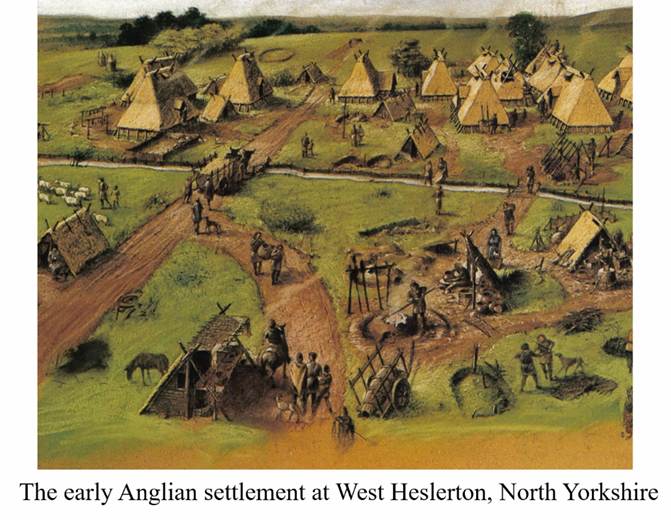
Wolds, excavations at West Heslerton, the Anglian Village,
northeast of Malton, in the Vale of Pickering, between 1987 to 1996 have
revealed 150 houses, workshops, storage huts over a period of 200 years from
the end of Roman Britain to Anglian Northumbria. The extensive archaeology
evidences change from round houses to grubbenhausen, Germanic style structures
built over a sunken pit dug into the ground.
The settlement at West
Heslerton was not initially of significant size, but developed into a 150
building settlement by the sixth century. This was an area of fertile soil
adjacent to a navigable river, with rich supplies of fish. It therefore had
access to communication and trade. The settlement became zoned over time with a
residential area; an area for agricultural processing; and an area for the work
of craftsmen. There is no evidence of violence, no shallow graves, no
suggestion of violence to skeletal remains. The archaeology does not indicate
slaughter, violence or Germanic conquest, but rather a gradual, natural, and
peaceful change in customs over long period of time. The settlement had
probably never been very Roman in the first place.
Because
of the size and longevity of the West Heslerton community one might expect to find
evidence of territorial lordship emerging. But it is hard to see any sign of
hierarchy among West Heslerton’s organised clusters of houses, workshops, craft
areas and animal pens huddled below the former shrine – of one large housed or
central hall. The rectangular hall-type dwellings are almost all identical. In death, as in life, West Heslerton’s
population seemingly belonged in family groups of more or less equal status.
(Northumbria AD 367-867,
Max Adams and Colm O’Brien, 2025, page 31).
The archaeology suggests
an evolution of medieval settlements from waves of Germanic farmer-settlers,
rather than a physical removal of the indigenous population by invaders,
reflecting a mixing with the local British population, adopting the language and
customs of a smaller number of immigrants. These were a people susceptible to
cultural influences, but not overrun. Perhaps the wealthier Romano-Britons,
with material wealth to preserve, may have been amongst those who migrated westwards.
However the model suggested by the archaeology is of a reversion to regionalism
during the tensions of the fourth and fifth centuries, when the world shrank
inwards.
Much of the Vale of
Pickering was agriculturally active, even though the low lying land became
waterlogged. Bede said it was an area rich in grain, cattle and draught
animals. Although some Anglian lords no doubt had significant influence, the
rural population was static. Although there were no functioning towns, the population
were settled in proto villages, clusters of buildings devoted to cereal
producing and crafts. The indigenous population gained access to Rhineland
quern technology, ivory and cowrie shells, traded at beach markets along the
Yorkshire coast. The sense of continuity is reflected in the coincidence of
Bronze and Iron Age boundaries with medieval parishes north of the Wolds.
Although the climate changed a little to cooler and wetter conditions, the
human landscape did not much change between Constantine and Edwin. Markets were
temporary, perhaps opportunistic. Gatherings were seasonal and customary.
Armies were maintained by personal loyalty. Bridges were maintained where they
were crucial, but often fell into disrepair. Justice was exercised through
customary law. (The King of the North, the Life and Times of Oswald of
Northumbria, Max Adams, 2013, page 89 to
93).
The
new population distrusted the old Roman centres and began to live in rectangular
wooden houses.
The Old North
From the early fifth century CE,
the Romano-British kingdom had rapidly broken up into smaller kingdoms. There were a
very large number of small kingdoms across Britain after the Roman withdrawal (Little
Kingdoms, Alex Harvey, 2025, Pen &
Sword Books).
All
the evidence points to continuity in the landscape: there was no wholesale disruption,
such as one might expect if the entire population of what was shortly to become
South and East England had in fact changed. Most towns and cities were indeed
abandoned, but this was a process that had begun long before, in a remarkably
sudden and coordinated fashion shortly after AD 300 - a full century prior to
the Roman departure. The distinguished scholar of Roman Britain, Richard Reece,
has suggested that this was because towns in Roman Britain were an idea ahead
of their time, and that their grip on the population was at best tenuous - and
soon slipped. Whatever the explanation, and I find Reece very convincing,
Romano-British town life effectively ceased in the early 4th century and there
was a consequent rise in rural prosperity, which included the construction or
enlargement of many elaborate country houses, known to everybody today as Roman
villas. The
Anglo-Saxon invasion was more a spread of ideas. (Britain in the Middle Ages, An Archaeological History, Francis Pryor, 2007, page 21).
In time Eboracum
(York) became the centre of the British-Celtic kingdom of Ebrauc. The
kingdom faced increasing pressure and conflict from the Germanic invaders who
began settling in the coastal regions in the early fifth century. The Anglian
kingdoms of Bernicia and Deira gradually eroded Ebrauc's territory. The
last British king of Ebrauc, Gwrgant Gwron, was forced to flee
the city around 580 CE when it was captured by the Angles.

Yr Hen Ogledd (The Old North), c 550 to c 650
These were the last British kingdoms of Hen Ogledd, the Old North.
Deira and Bernicia
Anglo Saxon Northumbria, c 540
To the north of Deira the
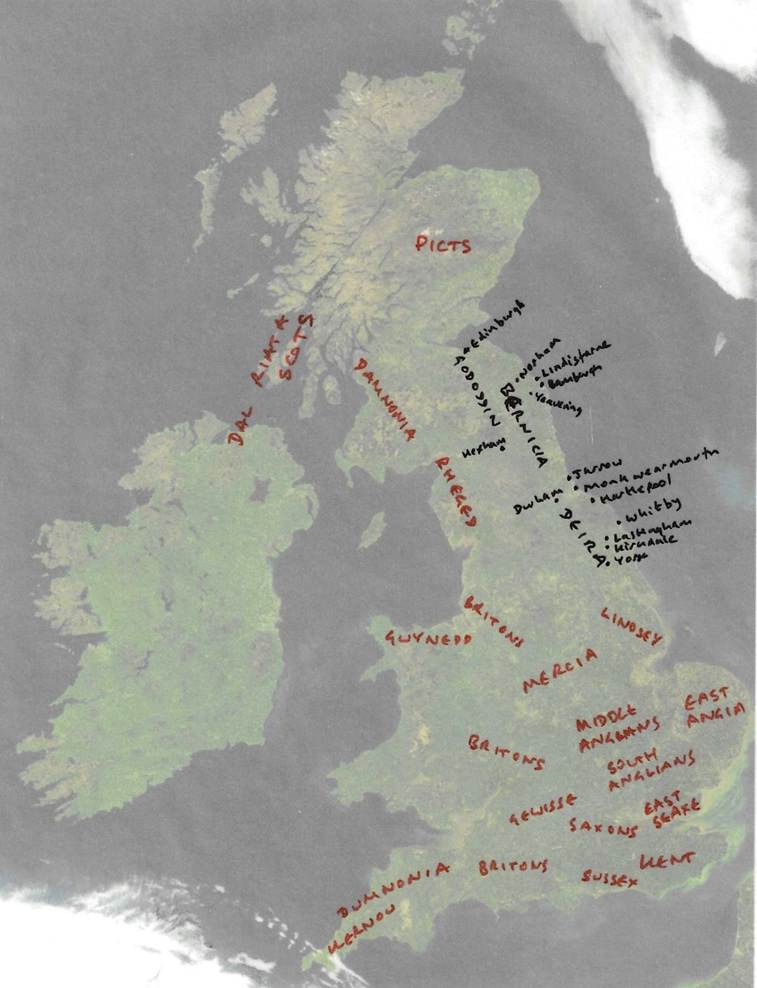
territory was known as Bernicia and north of Bernicia there were the lands of
the Gododdin which stretched up to the Firth. These boundaries were fluid and
Bernicia sometimes stretched into the Goddodin lands and control over the Bernician
and Deiran lands switched over time from Deiran to Bernician control. Over time
all these lands came to be recognised as a single large kingdom, which adopted
the Old English name Norþanhymbre meaning the people or province
north of the Humber (the Northumbrians, that is, the English tribe
dwelling on the north side of the river Humber, Ecclesiastical
History,
Bede, Book 2, Chapter 9). Northumbria started to consolidate
into one kingdom in the early seventh century, when Deira and Bernicia became
dynastically united, though this was a complex process (see also Ecclesiastical
History,
Bede, Book 3, Chapter 1).
The territory of Deira comprised
the ancestral lands of folk of Ryedale and the Vale of Pickering, but from time
to time those lands were controlled by the Bernician Kings, or later merged
into Northumbria.
Over time from the late sixth century
inhumations (burials) came to replace cremation. While cremation was more
common in the fifth and early sixth centuries, inhumation grew in popularity by
the late sixth century, coinciding with broader changes in religious practices.
The move toward inhumation is often associated with the decline of older pagan
rituals and the gradual impact of Christian ideas, which favoured burial over
burning, although the shift was a complex process rather than a sudden conversion.
Although this was still a period before the conversion of Edwin in 627 CE,
inhumation allowed for the burial of whole bodies accompanied by rich grave
goods including weapons, jewellery, and vessels, which served to display the
wealth, power, and status of the deceased and their kin more explicitly than
cremation, which produced only ashes and fragmented items There are few
examples along the River Derwent and to the west, probably largely marshland. However
there are a string of cemeteries around and below the 3,200 metre contour south
of the Vale of Pickering, including West Heslerton. The Yorkshire Wolds is
one of the richest archaeological landscapes in England and the emerging
Deiran cultural identity was formed in part by ways in which burial sites
integrated communities into elements of an inherited visible landscape of
linear boundaries and burial monuments of the past, especially the round
barrows of the Bronze Age and the square barrows of the pre Roman Iron Age.
These boundaries are difficult to date but over time they formed the boundaries
of larger Medieval units of hundreds and wapentakes. (Northumbria AD 367-867,
Max Adams and Colm O’Brien, 2025, page 44).
John Robert Mortimer (1825 to 1911) and Rev William Greenwell (1820
to 1918) worked on Bronze Age barrows on the Wolds and increasingly on
secondary burials of the Deiran period. Deiran burials have tended to be found
in association with monumental features in the landscape.
By the time that Deira first appears in the
historical record, in King Edwin's reign, it is already an emergent Kingdom.
Foundation myths, which in time became embedded in genealogies recorded in the
Anglo-Saxon Chronicle, accounted for the origin of kingdoms by evoking war band
leaders who claimed descent from the God Woden and who arrived with small
groups of men to establish their rule. (Northumbria
AD 367-867, Max Adams and Colm O’Brien,
2025, page 49).
Germanic
culture
There
has been a tendency to distinguish native from Germanic culture, such as burial
forms, but the institutions of Bernicia were really a hybrid. The
population, if one wants to play the ethnicity card, were similarly hybrid with
a very strong genetic bias towards indigenous Britons and a balancing bias towards
Germanic language and mythology. The patronage of Anglian warlords ensured the
supremacy of a cultural elite. Kings generally took Germanic names.
Northumbria, like most of the Anglo Saxon Kingdoms, was a blend of
sophisticated, self-confident native institutions and people with an
invigorating German self-consciousness and vision of which the Idings are
perhaps epitomes. If the Britons described by Gildas as fleeing westwards were
real, they were probably the noble families with horses, servants and
sufficient portable wealth to survive exile in Britain. The reality of the DNA
mix of Northumbria is much more interesting. (The
King of the North, the Life and Times of Oswald of Northumbria, Max Adams, 2013, page 226 to 227).
Those
who still wished to cling to the vestiges of the Roman past, and in particular
to Christianity, would have to head west. Here, in what is now Wales and Cornwall,
were the hills and forests that Gildas said had offered the Britons refuge. These lands remained literate and amphoras
of imported wine and olive oil from the fifth and early sixth century were
found at Tintagel. Yet only a few got to indulge in the pretence that they
were still part of the Roman elite. King Arthur was the fiction of Geoffrey
of Monmouth in the twelfth century. He first appeared in the ninth century as a
dux bellorum, leader of battles. The Battle of Badon Hill, sometimes
associated with Arthur, may have been an early sixth century encounter between
Britons and Saxons. (The Anglo Saxons, A History of the Beginnings of England, Marc Morris, 2021, page 39 to 41).
Though Gildas lived at a time of relative peace, he agonised over what he saw
as a continuing military threat to the Britons from their Germanic neighbours,
and he pays tribute to those Britons who gained some military success against them
under the leadership of Ambrosious Aurelianus, naming specifically a victory at
Mount Baden, fought in the year of Gildas’ birth, 43 years before. (The Earliest English Kings, D P Kirby, 2000, page 14; De Exidio, chapters 25 and 26)
A leader of the Britons,
Ambrosius Aurelianus, was thus credited with organising and leading the native
British resistance against the invading Anglo-Saxons. He is a crucial figure in
the transition from Roman Britain to the post-Roman era and is considered by
many scholars to be a primary inspiration for the legendary King Arthur.
The Battle of Badon was
depicted as a decisive, though historically murky, late fifth to early sixth
century victory for the Romano-Britons against invading Anglo-Saxons, halting
their expansion for decades and ushering in a period of peace often linked to
the legend of King Arthur, possibly against Saxon forces led by figures like
Cerdic or Ælle.
The new Germanic rulers
saw themselves as descendants of heroic genealogies.
Poets
such as Widsith, the ideal wandering minstrel, sang their praises and long
regaled the kings of their day with heroic tales, of which the epic Beowulf is
a fine surviving example (The Earliest English Kings, D P Kirby, 2000, page 1; Chambers, R. W. 1912. Widsith: A study in Old English Heroic Legend, Cambridge: University Press, especially page 4).
Widsith is
an Old English poem consisting of 143 lines, found in the 10th-century Exeter
Book, that presents an idealised self-portrait of a Germanic scop
(minstrel or oral poet) named Widsith, which translates to far-traveller
or wide-journey. Often referred to as The Traveller's Song, it is
a foundational, though probably fictional, account of the heroic age of
Northern Europe, listing various kings, tribes, and heroes from the 4th to the
6th century. It survives only in the Exeter Book,
a manuscript of Old English poetry compiled in the late tenth century, which
contains about a sixth of all surviving Old English poetry. The poem connects English rulers to
Continental Germanic ancestors, including Offa who ruled the Angles, reinforcing
that Northumbrian, Bernician and Deiran kings would have viewed themselves as
part of a wider Germanic, rather than purely British, tradition. Widsith highlights that idealised kings, the giver
of treasures in the hall, were expected to be generous to followers and
poets. This aligns with the heroic ethos and loyalty required of Northumbrian
leaders.
Corelands
Cultural
corelands
developed across the area of Northumbria which formed husbanded zones which reflected
a cultural, social and economic unity. These included lands along the Vale
of York and in Ryedale, the Vale of Pickering and the Yorkshire Wolds.
These were generally associated with the Romano-British landscape and the
concentration of villas and productive rural settlements in the Tees Valley,
Ryedale, the Vale of Pickering and Yorkshire wolds where there had been a high
level of agricultural production. The overall picture is of a hinterland
less intensively utilised rather than abandoned, and with much local variation
(Northumbria AD 367-867, Max Adams and Colm O’Brien, 2025, page 25, 28, 29. Map
4 on page 27 shows the extent of Woodland by the time of the Domesday Book and
projects the likely corelands of Northumbrian north and south of the North York
Moors, with a likely Deiran/Bernician boundary on the Tees, though this is
debated). Brian Roberts identified a Deiran core within the East Riding
of Yorkshire, that is the wolds and Vale of Pickering, and a Bernician core in
the lower-mid Tyne basin. The lower Tyne, perhaps, the best place to get a
visual sense of these corelands. (Northumbria
AD 367-867, Max Adams and Colm O’Brien,
2025, page 41; Northumbrian Origins and Post Roman Continuity: an exploration,
B K Roberts, 2010 in Finds from the Frontier: Material Culture in the 4th
– 5th centuries, Council for Archaeology Research Report 162 pages
119 to 132).
Territorial lordship
Territorial lordship emerged at
different times in different places. In the lands north of the Humber it is
first visible to archaeologists at forts, towns and some villas. As generation
gave way to generation, centres of local power extended control over more
settlements and resources, in a process that only becomes transparent with the
earliest recording of land transfers to the church in the 7th century. Larger
territorial units came to be organised from a central lordship site and, as these
emerge, they show consistent signs of having been arranged on a duo decimal
basis, that is to say such units, as they become visible in the historical
record, often come in multiples of 6 or 12, townships or vills, under the
collective term ‘shire’. Yet this was a long process. The politics,
economics and social interplay that gave rise to what looks uncommonly like a
system in the 7th century evolved over 200 years, a dozen generations of human
life. (Northumbria AD
367-867, Max Adams and Colm O’Brien,
2025, page 31).
It seems that the earliest
Anglo-Saxon settlers had set themselves up as free, independent farmers. The freemen or ceorls
were supported by unfree dependants, who were not free and often slaves. By the
mid sixth century elite classes were seeking to advertise their superiority. (The Anglo Saxons, A History of the Beginnings
of England,
Marc Morris, 2021, page 50).
This was also a period when social
inequalities hardened. The move from a ranked society to a hierarchical
society must in some ways have been a by product of migration. Over decades
the first immigrant families did favours to help later incomers. Favours and
gratitude led to obligation. In time a few people had more wealth. Funerary
practices evidenced these inequalities. Frankish objects in Kentish
graves reveal a close association with the Franks, the dominant political group
in Gaul, that in time would morph to Francia and later France. Wearing exotic objects
and being buried with them allowed privileged families to focus their
hierarchical claims and bolster networks of friendship and exchange. (Britain after Rome, The Fall and Rise,
400 to 1070,
2011, Robin Fleming page 65 to 73).
Identity
In time elite identities
stimulated the evolution of regional identifies. The misinterpretation of an
ordered Anglo-Saxon-Jute conquest claimed later by Bede became a reality
through the collective imagination. This identity emerged in costumes. Kentish women adopted
Frankish imports, but nevertheless augmented this with Scandinavian items and
pioneered a uniquely Kentish costume. Regional dress styles emerged, so that
elite households from the same regions found people who dressed like themselves.
At the same time they probably adopted common songs, ritual observances, myths
and legends. These elite practices were
imitated by the non elite classes. When elite and ordinary folk met at feasts, held
when animals were slaughtered and produced a surplus of food which could not be
preserved by refrigeration or even by imported salt, the more humble folk
observed elite habits, dress and language. (Britain
after Rome, The Fall and Rise, 400 to 1070,
2011, Robin Fleming page 75 to 80).
By the ninth century there was a
primitive concept of an English people, gens anglorum (Latin) or Anglecynn
(Anglo Saxon) describing an amalgam of the Germanic folk with the indigenous
population and promoted by Bede in his Historia ecclesiastica gentis
Anglorum.
Dynasty
The elite families over time
started to territorialise their authority and make it heritable. A feature
of this process was an obsession with the past. In order to assert that their
control over labour and services was legitimate, they sought to claim that
their inheritance was traditional, natural and heritable establishing an
ideology of the permanence of privilege. This is reflected in the
regular legends of three ships founding new lines of dynasty, of associations
with Romulus and Remus, of stories of Horsa and Hengist. This was a reimagining
of Britain’s settlement by Germanic warlords and the creation of elaborate
genealogies. Leading families exaggerated the longevity of their dynasties.
Part of this process was the
co-option of the past. Bronze Age barrows were appropriated to strengthen
rights over farmlands. There were lavish royal burials, such as at Sutton Hoo. Yeavering was erected in a straight
line between a stone circle and a barrow suggesting the layout of the seventh
century villa regalis was determined by ancient and enigmatic
monuments.
People became associated
with territories dominated and organised by elites exemplified by place names
ending -ingas, -ing or -ham, ‘the people of *’ or ‘the place of
*’. Examples include Pickering (the people of Picer), and Hovingham
(containing both ing and ham), The folk of separate regiones became
third class rustics, whose labour and agricultural surplus could be exploited. It
now seems likely that the first examples of -ing and -ingham names date to the
late sixth century; the same moment we see signs of rapidly rising elites.
(The
Anglo Saxons, A History of the Beginnings of England, Marc Morris, 2021, page 51). This was a period far
from benign settlements, where elites were dominating their landscapes.
Stories such as Beowulf came to symbolise the new order.
There was generous entertainment at Yeavering, with large halls and elaborate
ritual practices. These became sites of the consumption of production. Whilst
the lords stayed only so long as the food lasted, small populations of slaves
and reeves remained throughout the years. Permanently settled slaves were
referred to by the Old English word wealas, meaning foreigner, and later
used to describe the Welsh. This supported a growing myth of conquest and
historical difference from the people who were owned. Reeves were free and over
saw the slave labourers.
The Anglo-Saxon poem The Seafarer is an elegy in the voice of an
old sailor who reflects on a life of hardship at sea. Despite the misery of cold,
loneliness, and danger, the speaker is drawn to the sea, contrasting its harsh
reality with the comforts of life on land. Ultimately, the poem turns to a
meditation on the transience of life and the worthlessness of earthly wealth.
The competitive
nature of relations between royal elites was explored by the anthropologist
Bronislaw Malinowski (Argonauts of the Western
Pacific, 1922, Chapter VI) whose principle
of reciprocity suggested that all gift giving had a motive and that lavish
gifts were less generous donations that expressions of power. His research on
the Trobriand Islanders revealed that exchange was driven by a calculated give
and take, where giving a gift created an implicit expectation of a future
return, making reciprocity a core part of the gift economy and ensuring social
cohesion.
Alongside the tribute centres,
hamlet style communities emerged, such as Thirlings, only three kilometres from
Yeavering, a collection of small houses,
workshops and grain storage buildings. Significant centres such as Yeavering sat at the top of a hierarchy of
settlements.
Renders grew more complex,
providing not only meat and wheat, but cheese, fodder and honey. This gave rise
to a landscape of obligation, choreographed to be provided at particular
times of the year. This reinforced identifies around local lords.
(Britain
after Rome, The Fall and Rise, 400 to 1070,
2011, Robin Fleming page 90 to 107).
Royal families
By the second half of the
sixth century CE, the elite families had started to adopt royal titles. They
transferred their former tribute centres into royal vills or villa
regalis.
In the Tribal Hidage,
Wessex was assessed at a large 100,000 hides, Mercia and East Anglia at 30,000
and Kent at 15,000. Kingdoms varied in size and the pattern
may have been that family units secured the submission of their neighbours,
enabling them to take on larger rivals, eventually styling themselves as King.
(The
Anglo Saxons, A History of the Beginnings of England, Marc Morris, 2021, page 53). The derivation of king
is the Old English cyning, which means son of the kin.
This was however an
unstable world where big kingdoms gobbled up little ones, and daughters
of victorious kings found themselves sleeping in the beds of old antagonists. The
princes were brought up by nurses and by late adolescence they were racing
horses, feasting, storytelling and drinking.
When kings took residence
in their royal vills, the estate centre teemed with people. The halls
were polyglot places with Irish, British and English speakers. Northumbrian
exiles were found in Mercian and East Anglian courts. Imported goods came from
royal Frankish estates, found as far as Dunadd in Dál Riata. However these
households had now adopted a cultural English identity. Welsh, Irish and
English Britain was very similar, but competition drove ideological difference.
By about 600
CE there were a relatively small number of elite royal families. Bede
identified 13. In reality these Kingdoms were still in a state of flux. In 600
CE Æthelbert of Kent
appears to have been the more powerful monarch, able to exercise some authority
over other kings. By the 620s, his power was waning and the kings of East Anglia
and later Northumbria came to dominate. Around 640 CE Mercia was in the
ascendency for a while.
(Britain
after Rome, The Fall and Rise, 400 to 1070,
2011, Robin Fleming page 110 to 119, 148 to 149).
The early history of
county development might go back as far as the late fifth century. In the early
twelfth century, Henry of Huntingdon (History of the English, especially Book 2), listed 7 kingdoms
(Kent, Sussex, Wessex, Essex, East Anglia, Mercia and Northumbria). Early
historians of the period lazily referred to the heptarchy. Bede had identified
other kingdoms. The reality was far more fluid (The Earliest English Kings, D P Kirby, 2000, page 4). Bede also referred to
administrative units called regiones or regions. Andrew Reynolds (Late Anglo-Saxon
England: Life and Landscape, 1999) felt these regiones
were the boundaries of smaller late sixth to seventh century sub-territories.
536 CE
The period 536 to 545 was
the coldest decade in 2,000 years (Why 536 was the worst
year to be alive, Ann Gibbons, Science, Volume
362, 2018, page 733) following an Icelandic volcanic
eruption which caused crops to fail and famine to spread.
544 CE
Bubonic plague spread
from Constantinople to Ireland and probably reached Britain.
The dual impact of famine and
plague must have produced a desperate and violent society. This may have been
an environment in which desperate people were willing to sacrifice their
independence for protection. The word lord derives from the Old English hlaford,
or bread giver. This was a world where individuals could emerge as elite
leaders. The earliest records seem to
suggest that the earliest Kings were in southern Britain – perhaps Ælle of the South Saxons; Ceawlin of the West Saxons
(later Wessex); and later Æthelberht of Kent. Kent was heavily influenced by
its close ties to the Franks. Æthelberht’s father Eormenric had a Frankish
name. Æthelberht married Bertha, as Frankish princess who practiced
Christianity. Bertha was provided with a church in the ruins of a Roman city, Durovernum,
which had come to be known as cantwaraburh, the stronghold of the
Kentish people. An ancient Roman theatre seems to have been reused for royal
ceremonial purposes.
Augustine would make use of Berta’s church of St
Martin at cantwaraburh, when he arrived in 597 CE.
Ida
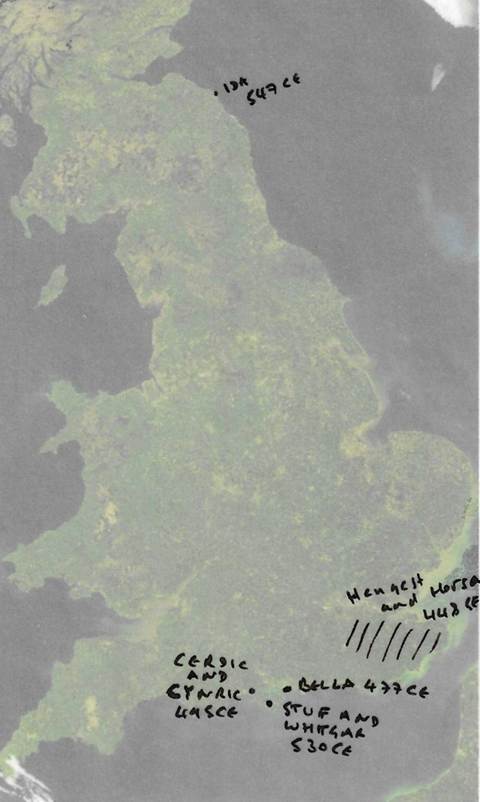
547 CE
Ida, son of Eoppa,
the son of Esa, the son of Ingwy,
the son of Angenwit, Alloc, Benoc, Brand, Beldeg
and ultimately Woden, was the first known king of Bernicia (Historia Brittonum,
Nennius). His family are generally referred to as the Idings. He
arrived at Bamburgh in about 547 CE (Ecclesiastical History, Bede, Book 5, Chapter 24; Anglo Saxon Chronicle), though this is debated (for instance Northumbria AD 367-867,
Max Adams and Colm O’Brien, 2025, page 50). The Germanic
King started the sea borne settlement of the coast and is reputed to have
established an urbis regia ("royal settlement") at Bamburgh.
This was the
first record of a significant Germanic settlement in northern Britain in the Anglo
Saxon Chronicle.
Bede knew of
genealogical traditions concerning kings and he knew of the idea of descent from
Woden: he had cited the Kentish ancestry of Hengist and Horsa back to that
ancestral God. But when it came to his own Kingdom, his only reference to the
beginnings of Northumbrian kingship was a brief mention of Ida in the year 547
in the chronological aide memoire he wrote at the end of the Ecclesiastical
History. (Northumbria
AD 367-867, Max Adams and Colm O’Brien,
2025, page 114).
First Contact – Fifth Century Anglo-Saxon settlement referred to
in the primary written sources
Ida seems
to have established a settlement and royal settlement at Bamburgh, Ground
Zero for post Roman Northumbria. The record doesn’t suggest that this was
an invasion. Ida may have been born in Northumbria. Ida’s grandfather, Esa or
Oesa, is said to have been the first of this line who came to Britain. (The Origins of Northumbria in The Origins of Anglo-Saxon Kingdoms, Steven
Bassett, 1989, page 218; A new chronicle-fragment of early
British history, D N Dunville in English
Historical Review, Volume 88 (1973), pages 312 to 314).
Bamburgh's original name was the Brittonic Din Guaroy or Din
Guaire, an old Celtic fort. It was later renamed Bebbanburh by King
Æthelfrith after his wife, Queen Bebba, which eventually evolved into Bamburgh.
Adjacent to Bamburgh, Ynys Medcaut, Inis Metcaud or Lindisfarne was a place of Romano British significance. Brynaich
was the established British name for the region in the immediate post Roman era
of the Old North. Ida seems to have established a small settlement in and
around Bamburgh, which in time would evolve into the Kingdom of Bernicia. There
is a suggestion that the similarity between the Old English name Lindisfarne
and the people of Lindsey, the Lindissi is not coincidental and that the
Lindisfaran were migrants or refugees or otherwise mearc weardas,
border watching wolves, for those further south (Northumbria AD 367-867, Max Adams and Colm
O’Brien, 2025, page 50). Lindisfarne had probably been occupied since the Mesolithic period.
Yffi
At about the same time Yffi or Yffa was the first known king of
Deira. His family are generally referred to as the Yffings. The Yffings appear to
have established a power base initially in the Yorkshire wolds. As with Ida,
there is no reason to suppose the Yffings were recent arrivals, but they also
evolved into a distinct line in the sixth to seventh centuries.
North of the Humber, framing the east side of the Vale of York,
also prone to flooding then, as now, the chalk wolds are relatively dry, with
few permanent water courses. These uplands had long before been cleared and demarcated
by prehistoric herders; they were rich in surviving prehistoric earthworks,
burial mounts and standing stones. Beyond, the Vale of Pickering paradoxically
carries the River Derwent inland from near the coast at Filey towards the Ouse
at Selby, draining the deeply incised southern slopes of the more formidable
North Yorkshire Moors. (Northumbria
AD 367-867, Max Adams and Colm O’Brien,
2025, page 12).
These legendary founders were not more than the leaders of warbands
who Bede referred to simply as duces. Indeed the legendary Arthur was
referred to be Ninnina as dux bellorum, a leader in battle. The idea of
a king started to emerge in the seventh century; sometimes a tribal chief, the
senior aristocrat of a senior clan; or an overlord, able to subdue and conquer.
Only in the late seventh century, with the emergence of kings like Oswiu, did
Kings become heads of state who introduced a concept of statehood and kingship
that might be recognised today. (The King of the North, the Life and Times of Oswald of
Northumbria, Max Adams, 2013, page 197
to 198).
563 CE
Religion before the conversions in the East
Western Britain continued to
embrace Christianity. They were represented by a large number of early saints
such as Alban, the first recorded British martyr. By the fifth century the
British Church was hierarchical with deacons, priests and bishops. However by the
Sixth century, the driving force was monastic and British monks and
intellectuals took on an ascetic bent. They adopted a tradition of private
penance, the renunciation of homeland, avoidance of bodily excess such as
gluttony, and adopted vegetarianism and celibacy.
The adoption of
Christianity from a pagan tradition in the east of Britain was very different.
The populations of the east from East Anglia to Yorkshire were pagani. At
the time of Augustine’s arrival in 597 CE most people in eastern Britain would
have been entirely innocent of the religion in Rome.
Christianity was likely to
have been adopted by the new English kings as a status enhancing move. The
Kentish King was open to Augustine’s overtures in 597 CE for its new status
enhancing possibilities.
(Britain after Rome, The Fall and Rise,
400 to 1070, 2011, Robin Fleming page 120 to 140,
150 to 151).
Towards the end of the fifth century a
new form of organised Christianity began to flourish in the west of the British
Isles, monasticism which had taken hold in the Egyptian desert in the third century
CE when Christians had retreated into wilderness lands in a new form of ascetic
isolation. These hermits were referred to by the Greek monos. In time,
groups of hermits started to form small communities around a father figure, an abbas,
Aramaic for father. This new practice reached Gaul by the late fourth century
CE and then reached the British Isles where it sat most comfortably with the
rural population in Ireland. Ireland was also suitable as a place of many small
islands, such as Sceilg Mhichíl, Skellig Michael.
At the same time that monasticism was
taking hold in Ireland, the Irish Kings were colonising the western islands and
coastal areas of Scotland, creating the Kingdom of Dál Riata stretching from
northeast Ireland to western Scotland.
(The Anglo Saxons, A History of the Beginnings of England, Marc Morris, 2021, page 88 to 89)
Patrick a Romano-British aristocrat had escaped from
slavery probably to Brittany and spent many years in places where Christianity
had its deepest roots in Gaul, particularly at the cathedral city of Auxerre.
By about 460 CE Patrick was a missionary wanderer in Ireland and the western
isles. Rather than adopt the rigid organisation of the Roman church, Patrick
adopted an independent course, with obedience to local bishops. He adopted a
religion of monastic retreat from his travels in Gaul, which was adopted by the
Dál Riata kings.
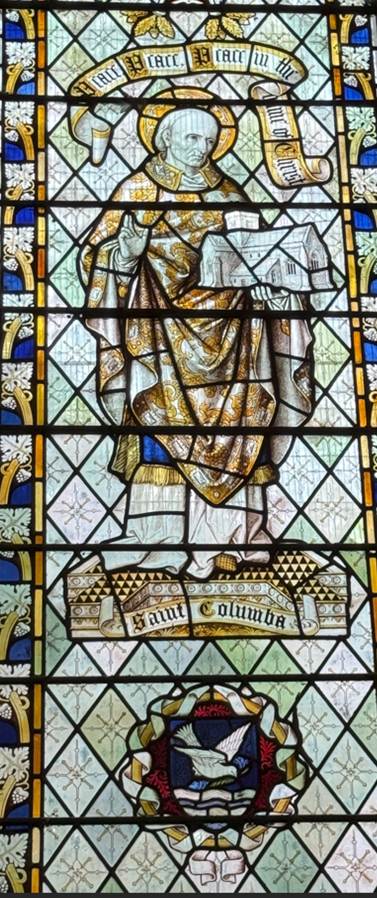
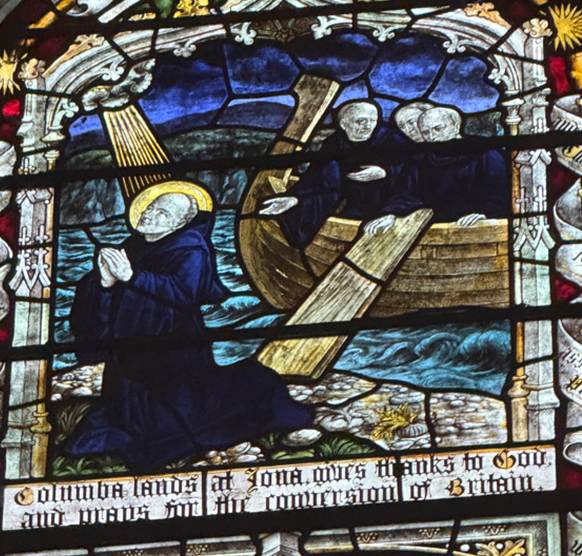
Stained Glass Windows at Helmsley Parish Church
He was charismatic and the reasons given for his
exile vary from a battle for the high kingship of Ireland to the illegal copying
of a book. He sailed in a curragh with twelve companions. The ideal for an
Irish monk was a devotional journey or peregrination, leaving his homeland and
his wealth and family.
Colle Cille was said to have landed on the
southernmost point of Iona, sometime in the 560s CE, but it
is likely that he travelled first to meet the King of Dál Riata, Conall mac Comgaill (558 to
574 CE) who probably granted him the island.
From Fergus Mór mac Eirc, King of Dalriada, would descend
a long line of Scottish Kings, and over time Dalriada came to be referred to as
Alba or Albanach, though to the Latin speaking world, the lands
came to be known by their Irish origins as Scotia, the land of the Scoti.
To the north in Shetland and to the east on the mainland, north of the Forth,
were the Gaelic speaking Picts. (Robert the Bruce, the Champion of a Nation, Stephen Spinks, 2024, page 20).
565 CE
Under
the Irish model abbots or abbesses were given land on which to form monasteries
as if they were a type of specialised secular lord and like secular lords they
gathered followers. However unlike grants to secular lords, religious figures were
given land in perpetuity. In return Colm Cille seems to have become a broker
between the Irish and Dál Riata kingdoms. In return he was given lordship over
other lands. (Northumbria
AD 367-867, Max Adams and Colm O’Brien,
2025, page 94).
In
time Iona became a mother house to monasteries of Mag Luinge on Tiree
and on Jura. He may have returned to Ireland to found monasteries at Derry and
made an expedition to the Great Glen to convert the Picts.
Iona
became, and remained throughout the 7th century, a wellspring of ecclesiastical
power, sculptural excellence, spiritual inspiration and intellectual endeavour.
A lost Iona Chronicle underpinned much of the chronology of contemporary
Ireland and northern Britain; it's abbots’ [later] interest in Northumbrian
affairs ensured lively, if intermittent, contact between their churches. The
Vita Columbae was written by one of his successes as Abbot of Iona to record
episodes, particularly miracles, from his life. (Northumbria AD 367-867,
Max Adams and Colm O’Brien, 2025, page 91).
Colm
Cille probably died in c 593 CE.
Ælla Yffing
569 CE
By the 570s, the
Bernicians were expanding into other territories, such as Rhegged.
Ælla Yffing, son of Yffi, son of Uxfrea, son of
Wisgisl, son of Westerfalca, son of Sæfugl, son of Sæbald, son of Sigegeat, son
of Swedbæg, son of Sigegar, son of Wædæg, son of Woden, was King of Deira from
569 to 588 CE.
575 CE
A conference
at Druim Cett (Limavady) in Ulster confirmed the independence of the Scottish Dál Riata from the Irish Kingdom.
By
this time there were four broad cultures across Britain – the vestigial Britons
clinging on in the west and southwest; the Dál Riata Gaelic people spread from
Ireland, the Hebrides to western Scotland; the loose confederation of Pictish
people across the rest of Scotland; and the pagan Anglo-Saxon-Jutish
people spread from Kent to Bernicia. The Saxon chiefs and kings had a hankering
to possess what had gone before them, the old Roman ideal of the regnum
Britanniae, the kingdom of the Britons, and they often built settlements on the
ruined remains of the old Romano-British towns, but in no other respect did
they remotely resemble that culture. Their political power rested on the spoils
of war and on the unwritten custom of the clan. (A History of
Britain, At the Edge of the World, 3,000 BC to AD 1603, 2009, Simon Schama, page 45).
Æthelric Iding
580 CE
Æthelric
Iding was King
of Bernicia in about 580 CE, though there is debate as to the precise year of
his succession (see Northumbria AD 367-867, Max Adams and Colm O’Brien, 2025, page 55). He faced
opposition from a coalition of Britons who sought to drive the Angle newcomers
back to the sea. His brother Theodoric was besieged on Lindisfarne which was
then called Inis
Metcaud by Urien of Rheged, but they failed to take the Bernician
stronghold.
590 CE
Bede’s narrative began in Kent, known to the Romans as Cantium.
East Kent was divided into lathes rather than shires as elsewhere. It had a
natural wealth as the garden of England and its importance was enhanced by its
geographical proximity to Frankia. Most exotic goods from the Continent arrived
through Kent and particularly through a number of ports or wics. When Kings controlled and taxed them, providing
royal protection and patronage, the wics developed into emporia.
Early emporia included Gipeswic (Ipswich), Dommoc
(Dunwich), Lundenwic (the survival of Roman Londinium) and
perhaps Eoforwic (York). (The King of the North, the Life and Times of Oswald of
Northumbria, Max Adams, 2013, page 39).
East Kent was the earliest English Kingdom. The
Kentish kings saw themselves as inheritors of the late Roman state, evidenced
by coins minted at Canterbury in the seventh century.
Gregory the Great became Pope on 3 September 590 CE.
The historian Procopius (500 to 565 CE)
described the people of Brittia as Angiloi to Pope Gregory the
Great. Gregory had seen fair haired slaves for sale and replied that they were not
Angles, but angels. His pun is sometimes taken to define the origin of the
English and Gregory continued to class them as a single peoples.
It is significant
that Bede described the incident as Gregory’s encounter with a Deiran boy in Rome
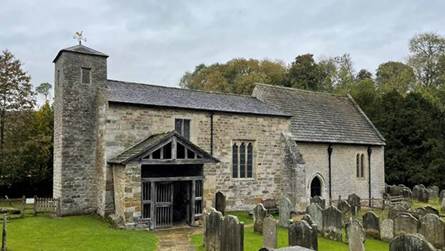
about to be sold into slavery. Kirkdale lay firmly in the Kingdom of Deira.
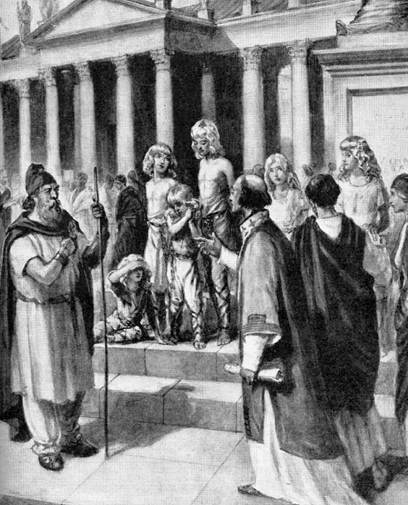
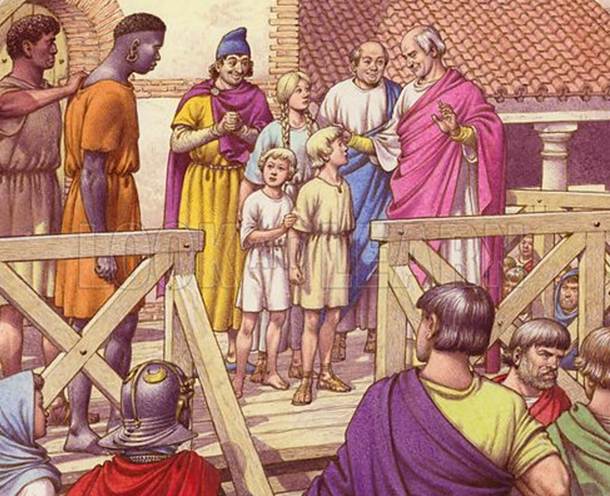
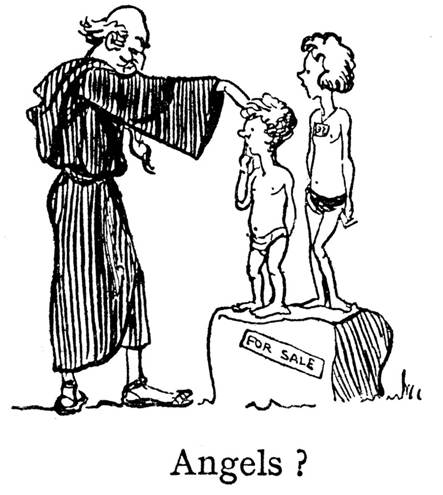
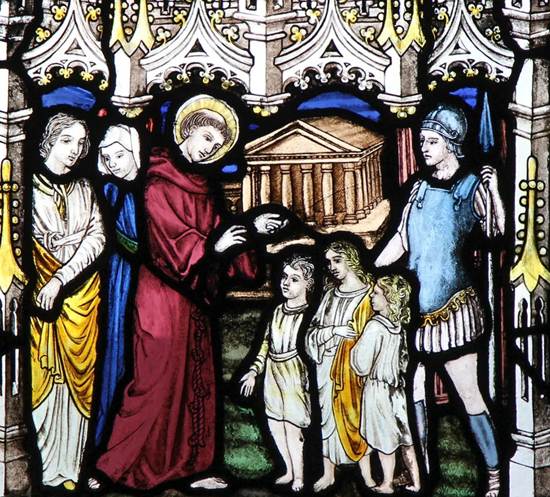
Nor must we pass by in silence the story of
the blessed Gregory, handed down to us by the tradition of our ancestors, which
explains his earnest care for the salvation of our nation. It is said that one
day, when some merchants had lately arrived at Rome, many things were exposed
for sale in the market place, and much people resorted thither to buy: Gregory himself
went with the rest, and saw among other wares some boys put up for sale, of
fair complexion, with pleasing countenances, and very beautiful hair. When he
beheld them, he asked, it is said, from what region or country they were
brought? and was told, from the island of Britain, and that the
inhabitants were like that in appearance. He again inquired whether those
islanders were Christians, or still involved in the errors of paganism, and was
informed that they were pagans. Then fetching a deep sigh from the bottom of
his heart, “Alas! what pity,” said he, “that the author of darkness should own
men of such fair countenances; and that with such grace of outward form, their
minds should be void of inward grace.” He therefore again asked, what was the
name of that nation? and was answered, that they were called Angles.
“Right,” said he, “for they have an angelic face, and it is meet that
such should be co-heirs with the Angels in heaven. What is the name of
the province from which they are brought?” It was replied, that the natives
of that province were called Deiri. “Truly are they De ira,” said
he, “saved from wrath, and called to the mercy of Christ. How is the king of
that province called?” They told him his name was Aelli; and he,
playing upon the name, said, “Allelujah, the praise of God the Creator
must be sung in those parts.”
(Ecclesiastical History, Bede, Book 2, Chapter 1).
So three puns
from this story give us some historical perspective:
· An Angle from
Deira was the inspiration for the historical narration of the evolution of the
nation of England.
· A pun on Deira
itself, de ira, ‘of anger’ was an inspiration on Gregory, in Bede’s
image, that the Deirans had been saved from wrath.
· King Aelli of
Deira was the king who inspired a religious declaration of Allelujah in
the lands of north eastern England.
The four hundred years between 600 and 1000 are now seen to have
been a period of economic renewal following two centuries when northern Europe
was searching for new identities and direction following the demise of the
Roman Empire in the west. The new
economic order was arranged around a series of major commercial centres, known
as emporia in Latin and wics in Anglo-Saxon or Early English. Finds from the
emporia in Britain and on the Continent are characterised by their richness and
range. More importantly they provide clear and unambiguous evidence for long
distance trade. They began as seasonally occupied trading centres (referred
to by archaeologists as productive sites) operated independently by
merchants, but soon came under the control of elites. The emporium system
was essentially elite driven; it was all about power, prestige and display in
the highest echelons of society. It was part of an integrated trading system
connected by the sea, but also by the ancient Roman road system that had never
been completely abandoned. These productive sites were
something different from what had come before, key points in a larger network
of settlement. (Britain in the Middle Ages,
An Archaeological History, Francis
Pryor, 2007, page 41).
Bede’s account
might be rooted in Gregory the Great’s instruction to Candidus to purchase of
English slaves in a letter written in September 595 CE (or potentially 596), which
is recorded in his Registrum Epistolarum (Register of Epistles), Book
VI, Epistle 7. In this letter, addressed to the priest Candidus, who was going
to manage papal estates in Gaul, Gregory instructed him to use the funds from
those estates to purchase English slave boys (who were in the slave markets of
Gaul/Rome) so they could be educated in monasteries and potentially prepared
for missionary work in Britain.
Epistle VII. To Candidus,
Presbyter. Gregory to Candidus, Presbyter, going to the patrimony of Gaul. Now
that thou art proceeding, with the help of our Lord God Jesus Christ, to the
government of the patrimony that is in Gaul, we desire thy Love to procure with
the money thou mayest receive clothing for the poor, or English boys of about
seventeen or eighteen years of age, who may profit by being given to God in
monasteries, that so the money of Gaul, which cannot be spent in our country,
may be expended profitably in its own locality.
Further, if you should succeed in getting anything from the moneys
accruing to revenue which are called ablatæ, from this too we desire thee to
procure clothing for the poor, or, as we have before said, boys who may profit
in the service of Almighty God. But,
since such as can be found there are pagans, I desire that a presbyter be sent
hither with them to provide against the case of any sickness occurring on the
way, that he may baptize those whom he sees to be about to die. Wherefore let your Love so proceed as to lose
no time in accomplishing these things diligently. (Gregory the
Great. Registrum
Epistolarum Book 6, Epistle 7, in Nicene and Post-Nicene Fathers,
Ser. II, Vol. XII, ed. Philip Schaff and Henry Wace. New York: Christian
Literature Company, 1895).
Cottam is a productive site in the Yorkshire Wolds which may have been
part of a royal estate which, after the Scandinavian settlement, developed into
an independent manor. (Cottam:
An Anglian and Anglo-Scandinavian settlement on the Yorkshire Wolds, Julian Richards, Archaeological Journal, Volume 156,
1999).
By the late sixth century, the Anglo Saxons were
gaining control over their corelands, which soon would expand to include Lastingham and Kirkdale, firmly within the ambit of England’s origin story, being a
significant place within the lands of Deira, and the place of a church which soon
afterwards was dedicated to Pope Gregory.
Æthelfrith Iding
Whilst the earliest royal success appears to have been in the
south, by the late sixth century it was in Northumbria that a king was starting
to assert his authority with significant success. At this time Æthelfrith, a
very brave king and most eager for glory, was ruling over the Kingdom of
Northumbria (Bede, Ecclesiastical History,
Book 1 Chapter 34).
When Bede wrote
of Northumbria, he referred to the people of the Northumbrians. Nordanhymbrorum
gentis. And as with the Northumbrians, so too the Bernicians and the Deirans
also appear in Bede’s writing as peoples, gentes, or peoples of a Kingdom
regnum Deirorum and regnum Berniciorum or province, in provincia Berniciorum;
In provincia Deirorum. Understood as a unified political entity, Northumbria
emerged out of a conflict between the ruling dynasties of the two subunits at the
beginning of the 7th century when Æthelfrith of Bernicia achieved dominance. Nevertheless
there continued to be Deiran sub kings to the 670s CE and it took time for a
territorial definition to define a people. (Northumbria AD 367-867,
Max Adams and Colm O’Brien, 2025, page 38).
The
internal boundary between Deira and Bernicia was probably along the River Tees.
In conclusion it may be said that, although the early literary sources yield
no direct evidence, there is a considerable variety of indirect evidence
which
weights the scales heavily in favour of Richard of Hexham’s belief that the
boundary between Bernicia and Deira on the eastern side of the Pennines lay on
the Tees (The boundary
between Bernicia and Deira, P Hunter
Blair, 1949, Archaeologia
Aeliana, Series 4, Volume 27, pages
46 to 59).
Northumbria
had not yet emerged in 592 CE as Æthelfrith Iding was King of Bernicia. He was
pagan in a pagan world, grandson of Ida the legendary founding warlord of
Bernicia, who emerged from the boundary between myth and historical record. (The King of the North, the Life and Times of Oswald of
Northumbria, Max Adams, 2013, page 24).
Edwin’s exile in Kent and East Anglia
Then, he took refuge in East Anglia with
King Rædwald, almost certainly of the Sutton Hoo ship burial, in about 616 CE,
where his presence precipitated the events that caused Æthelfrith's downfall. Bede suggests that Æthelfrith tried to have Rædwald murder
his rival, and that Rædwald intended to do so until his wife persuaded him
otherwise with Divine prompting, resolving then to restore Edwin to his
Northumbrian throne.
597 CE
Pope
Gregory sent Augustine, Prior of a Roman monastery, to Kent on an ambassadorial
and religious mission to convert the Angli, and he was welcomed by King
Aethelberht. Although they approached a once Christian land, once part of the
Roman Empire, large tracts of Britain had become dominated by Germanic pagans,
barbarians from the Continent. Britain had reverted to the outer fringe of
contemporary European civilisation.
The only Anglo-Saxon Kingdom
which is attested in a contemporary 6th century record is Kent. Gregory of
Tours in his Frankish Histories, written in the late 6th century, twice refers
simply to Kent and wants to Kent as a Kingdom. (The Earliest English Kings, D P Kirby, 2000, page 20; History of the Franks,
Gregory Bishop of Tours, Book 4,
Chapter 26). Their northern neighbours were known as the East Angles by
704-13 when the Whitby Life of Pope Gregory
(The Whitby Life of St Gregory, Section 16), which refers
to them as such, was written.
The English church would come to
own a quarter of cultivated land in England and reintroduce literacy at least
amongst the Church. English identity began in a religious concept. Hence there
grew a single and distinct English church. It adopted Roman practices in its dogma
and liturgy (as later confirmed at the Synod of Whitby in 663 CE), but it
venerated English saints and developed its own character.
Gregory’s
missionaries landed at Thanet in 597 CE. When Augustine arrived in Canterbury
in 597 CE, there were at least two churches there of Roman construction,
including Bertha’s church of St Martin. Augustine settled his mission there.
The
mission had a shaky start and Augustine returned to Rome but was forcefully
encouraged to return.
Æthelberht of Kent allowed the Christians freedom to
preach but carefully weighed the political implications of himself converting.
In a letter of 601 CE the pope enticed Æthelberht when he pointed out that Almighty
God raises up certain men to be rulers over nations. Christianity offered
eternal life and the prospect of elevation above his peers. Rome could provide
ideological authority to expanding kingdoms, bolstering the prestige already achieved
by Frankish connections and a capital amongst Roman ruins.
Gregory probably had in mind the establishment of
two sees in London and York. The papacy had good intelligence by this time of
administration in Britain and would have been aware of the principal Roman
settlements. However London was hostile to the mission, and Augustine fell back
on Canterbury where he established what became St
Augustine’s Abbey.
600 CE
Bede tells of the pagan Æthelfrith's significant success over the Britons. He
ravaged the Britons more than all the great men of the English, insomuch
that he might be compared to Saul, once king of the Israelites, excepting only
this, that he was ignorant of the true religion. For he conquered more
territories from the Britons, either making them tributary, or driving the inhabitants
clean out, and planting English in their places, than any other king or tribune
(Bede, Ecclesiastical History, Book 1 Chapter 34).
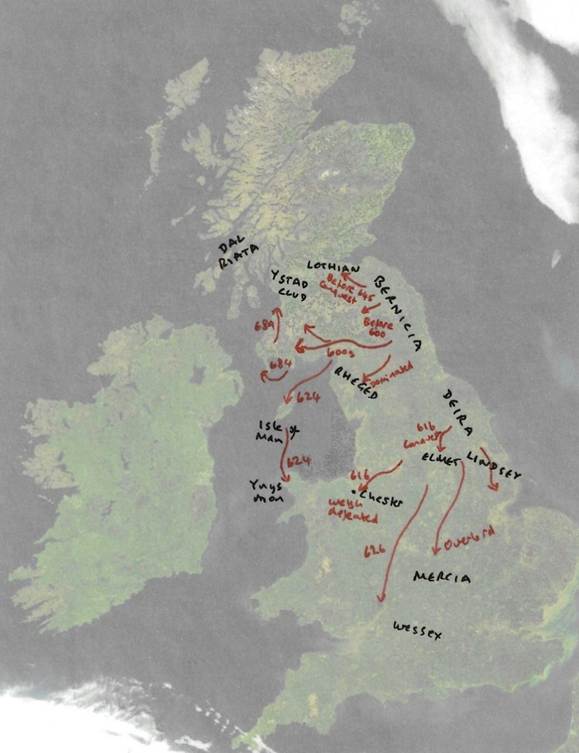
Campaigns of Æthelfrith and his
successors
Æthelfrith fought against the Scots of
Dál Riata, the
Gododdin people of the Forth and of Gwynedd and King Urien of Rhegged. It was
probably Æthelfrith who destroyed an army of Britons at the Battle of Catræth (Catterick)
in about 600 CE. The battle was described in a sixth
century Welsh poem Y Gododdin, an oral lament by Aneirin for the last great expedition by the northern
Britons against the Bernician army.
Men went
down to Catræth; their leader led laughing. Face from to the enemy everywhere killing
all the while losing in silence. Their leader a noble giving his confidence
live to their confidence. Their night long drinking bout over these locals
converged on Catræth three hundred in all handpicked fighting fit. But after
their battle charge silence: death stood their judge and their sentence. … I
had figured them more than a match for that bunch of Bernecians: thought they’d
give them a run for their chances, not leave the ghost of one standing. (Aneirin.
1977. The Gododdin. A version by Desmond O’Grady. Dublin: Dolmen Press.
Internet Archive, verse 7 to
9).
There are
those who do not agree Catræth should be associated with Catterick and
argue the poem is more complex and a compilation of many different events (Yorkshire and the Goddodin Poem, Craif Cessford, Yorkshire Archaeological Journal,
Volume 68,
Page 241, 1996)
We know that
the Roman fort of Cataractonium continued in relatively unscathed
operation after the Roman withdrawal and it may have become the site of a new
settlement under another warlord.
Æthelfrith began to expand the Bernician domain from its original
small heart around Bamburgh to the Tweed and the Swale.
Early Warrior Bands
Early Germanic leaders gathered warriors around them, who sought
reward from booty and in time from grants of land. Thus Æthelfrith’s son, King
Oswin was of a goodly countenance, and tall of stature, pleasant in discourse,
and courteous in behaviour; and bountiful to all, gentle and simple alike; so
that he was beloved by all men for the royal dignity of his mind and appearance
and actions, and men of the highest rank came from almost all provinces to
serve him (Ecclesiastical
History, Bede, Book 3, Chapter 14). These
followers became a landed aristocracy who in time became royal officials, ealdermen,
and the king’s principal counsellors, his witan, advising on matters of
justice and tax collection. (The Earliest
English Kings, D P Kirby, 2000, page 2).
There were
three principal classes of warrior.
The Gedriht
were elite, oath-bound, personal followers and bodyguards of the warlord who
were constantly at his side, always following him into battle. They were the king’s
core of usually young men, the core of the warband. They were generally well
armed, particularly with the Gar, a 2.5 metre long spear with an ash
shaft, perhaps an adaptation of the Roman pilum. There would have been a
small number of Gedriht in the King’s
warband.
The Geoguth
were also young warriors who would have formed the bulk of the warband,
equipped more crudely with a shield, spear and seax, a single edged
dagger or short sword. They would have learnt from the Gedriht.
The Duguth
were the old guard, equipped similarly to the Geoguth, but also wish
long slashing swords and sometimes helmets, of a Sutton Hoo type style. They
were veterans.
There may
also have been fast moving skirmishers, armed with a bow and arrow or a sling.
These bands
probably didn’t use the shield wall in the earlier days but were rather
equipped with smaller shields. They probably fought in open order. As the
shield enlarged to about a metre width, they fought in close order, requiring greater
discipline and training.
The evidence of the use of horses is less clear and
perhaps horses were restricted to the elite Gedriht. The Aberlemno 2 Stone from
Angus may evidence Northumbrian cavalry under Egfrith, Deiran Sub-King from 664
CE, and later King of Northumbria from 670 until his death in 685, fighting the Picts at the battle
of Nechtanesmere at Dunnichen in 685 CE.
In the late sixth and early seventh
centuries, the army would have comprised a number of warbands between perhaps
200 to 600 strong. Perhaps at some of the more significant battles numbers
might have approached a few thousand, but the evidence of army sizes is
limited.
Most of the population comprised
slaves or peasants who lived in varying degrees of personal and economic
bondage. The economic worth of such folk was expressed as a wergild.
Only the wealthier peasants and those engaged in mercantile enterprise might aspire
to improve their standing.
601 CE
Pope
Gregory, encouraged by the early successes of Augustine’s mission in Kent, sent
letters of support to Augustine and to Æthelberht of Kent. He
sent gifts and a select group of priests carrying the pallium, a band of
white cloth worn across the shoulders. He was now interested in the
Christianisation of the other Anglo Saxon kingdoms.
Gregory began by advising Augustine to suppress and
destroy pagan shrines and idols, but a month later he changed his mind. I have
decided after long deliberation about the English people that the idol temples
of that race should by no means be destroyed but only the idols in them. Take
holy water and sprinkle it in these shrines, build altars and place relics in
them. (Ecclesiastical History, Bede, Book 1, Chapter 30) They were not to ban
heathen practices but to adopt them and realign heathen festivals to Christian.
Gregory’s liberal pragmatism contrasted to Augustine’s more rigid style.
By 601 CE Augustine had gained the trust and support
of the political elite in Kent.
603 CE
In 603 CE Æthelfrith
raided far to the north.
Áedán mac
Gabráin, the king of Dál Riata (northwest of Bernicia), was alarmed by
Æthelfrith's successes, and in 603 CE he led "an immense and mighty
army" against him (Ecclesiastical History, Bede, Book 1, Chapter 34), but Æthelfrith, who commanded an inferior force, won a
crushing victory at Degsastan. Dál Riata became tributary to Northumbria. The
English triumph at Degsastan enabled Æthelfrith, finally, to consolidate his position as
overlord of northern Britain. (The King of
the North, the Life and Times of Oswald of Northumbria, Max Adams, 2013, page 29). Warrior kings like Æthelfrith gained as much materially as
politically. He probably seized a substantial hoard from the field of battle.
Bede had no great
interest in solving chronological problems concerning King Æthelfrith’s
early career. He had his own
particular reasons for remarking that after Degsastan in 604 no king of the
Scotti would wage war on the English; but it is nevertheless a credible marker
for the attainment of English overlordship over the north British kingdoms that
would endure at least until the end of the reign of Æthelfrith's grandson Ecgfrid in 685. (Northumbria
AD 367-867, Max Adams and Colm O’Brien,
2025, page 59).
604 CE
Æthelfrith’s appetite for lebensraum
like expansion was not quashed.
In about 604, Æthelfrith
was strong enough to attempt to reclaim the kingdom lost or given up by his father
and unite all the English beyond the Humber. He accomplished this by a
judicious combination of battle and marriage. The battle was waged on him by an
external aggressor, King Áedán mac Gabráin, the king of Dál Riata. (The King of the North, the Life and Times of Oswald
of Northumbria,
Max Adams, 2013, page 27). At this time Æthelfrith Iding became King of Bernicia and
Deira. He gained control of Deira in about 604 CE
temporarily ending internecine struggle between the kingdoms of Deira and
Bernicia. The details are not known but he probably conquered Deira since
Edwin, son of the former King Ælla, had been exiled, although it may have
arisen through the formalisation of some existing relationship between the two
Kingdoms. Either way, the union was consolidated in marriage.
Indeed Æthelfrith married Acha Yffing, uniting the Iding and Yffing
families. She was the mother of six sons (including Oswiu and Oswald), a
daughter (Aebbe, the later abbess of Coldingham) and a stepson. Acha was the daughter
of Ælla Yffing and was born in about 585 CE probably in the Deiran royal
estates on the Yorkshire wolds. The seventh century is outstanding for the
number of women who played active, sometimes decisive roles in the fortunes of
kingdoms, both earthly and spiritual. They are not to be underestimated. They
had their own queenly agendas, engineering lines of patronage for their
families, acting as brakes on hot headed husbands, as brokers of deals, as
pacifiers and landowners in their own right. (The King
of the North, the Life and Times of Oswald of Northumbria, Max Adams, 2013, page 7).
Acha was the
sister of Edwin, but he had been exiled when Æthelfrith became king and they
barely knew each other. Acha’s husband sought excessively to have Acha’s
brother killed. After 616 CE, with her husband dead, Acha may have wondered
about Edwin’s intentions towards her and her sons.
It was in about 604 CE that
Æthelfrith's son Oswald was born.
By 604 CE there were three
archbishops in England, Augustine in Canterbury, Justus in Rochester also in
Kent, and Mellitus in London.
Bamburgh
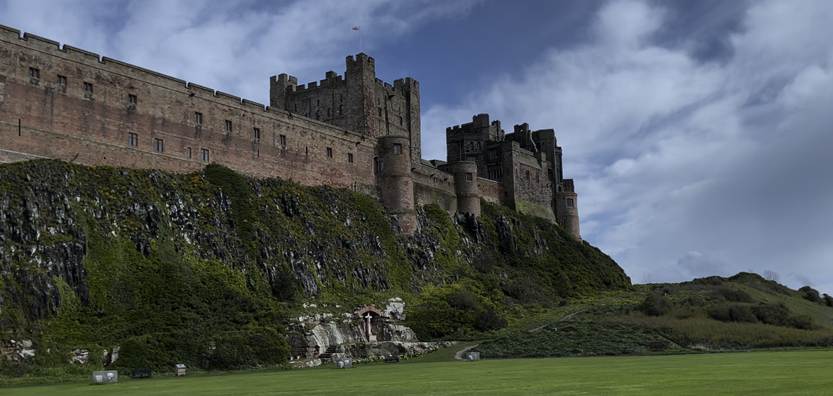
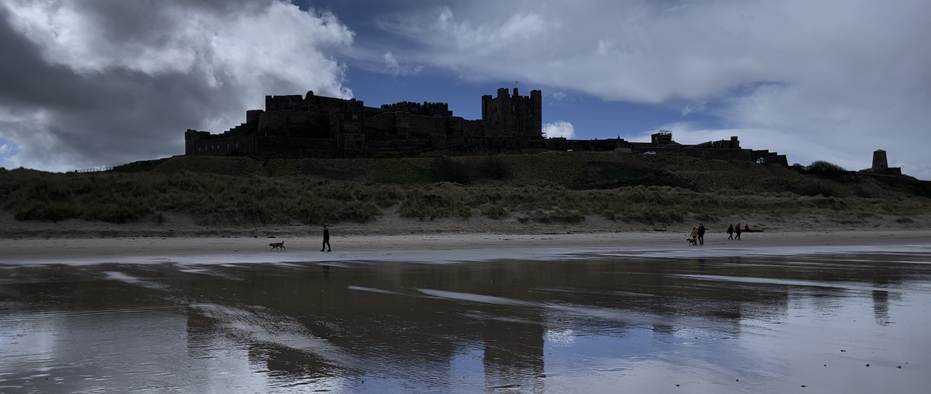
Nennius’ Historia
Brittonum, paragraph
63 recorded that Æthelfrith gave the town of
Din Guaire to his wife Bebba, after whom it was named Bamburgh. The Historia Regum Anglorum by Symeon of Durham in his record for 774 CE, described Bamburgh. The city of Bebba
is extremely well fortified, but by no means large, containing about the space
of two or three fields, having one hallowed entrance ascending in a wonderful
manner by steps. It has, on the summit of the hill, a church of very beautiful architecture,
in which is a fair and costly shrine. In this, wrapped in a pall, lies the
uncorrupted right hand of St Oswald, king, as Bede the historian of the nation relates.
There is on the west and highest point of this citadel, a well, excavated with
extraordinary labour, sweet to drink and very pure to the sight. The
entrance on the north west corner called St Oswald’s Gate, survives.
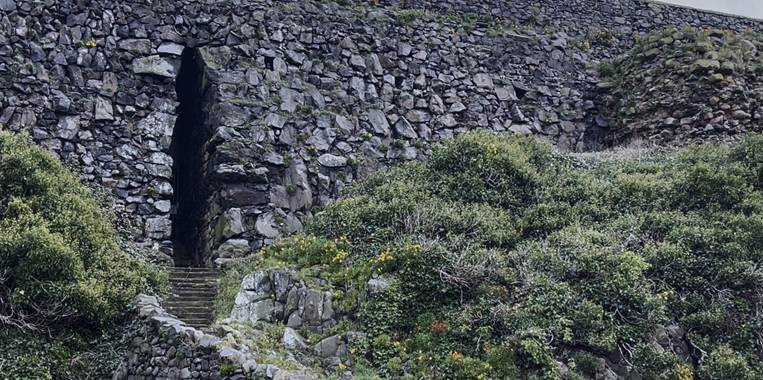
By the mid seventh century Bamburgh was a township as
well as a fortification with many steadings and a proliferation of English
placenames nearby.
Yeavering
Ad Gefrin, ‘By the Hill of the Goat’ at Yeavering was a royal Anglo Saxon settlement.
It is explored in more detail on another webpage.
At
some point York (Eboracum, Caer Ebrauc, now called Eoforwic, Boar Town) became
the capital, though there was still superstitious reluctance to reinhabit the
old fortress: the Anglian town was built right on its edge, near Fishergate. (The Little History of Yorkshire, Ingrid Barton, 2024, page 35).
In about 604 CE, Gregory’s
mission under Augustine met British bishops under Augustine’s Oak at
Bancornaburg (probably Bangor on Dee). Gregory died in the same year. The
British bishops were stubborn in their refusal to accept Rome’s authority. The
core issues were the date of Easter and the cut of the tonsure.
614 CE
In about 614 CE, Æthelfrith's son
Oswiu was born.
615 CE
Æthelfrith attacked the Kingdom of Powys and defeated
its army in a battle at Chester. He also massacred the monks of Bangor-Is-Coed
who were assembled to aid the Britons by their prayers. This cruelty was later
dismissed by Bede as justified by their failure to agree to terms with
Augustine at the oak tree.
The
second battle which Bede describes was fought at the opposite end of Æthelfrith’s sphere of interest, at the place he
calls the City of the Legions, Legacæstir, against the Britons of Gwynedd, North Wales, in 615
or 616. Bede allows his hostility to the Britons to show through in writing of
the cowardice of the British warlord Brocmail and his men who turned tail, thus
allowing the slaughter of monks from the monastery of Bangor who had come to
observe the battle. (Northumbria AD
367-867, Max Adams and Colm O’Brien,
2025, page 59).
616 CE
What Æthelfrith had
achieved was a position of authority in the north analogous to Rædwald’s
over the eastern Angles and their immediate neighbours. His advanced to the River
idle against Rædwald in 616 or 617 could indicate that he
was now beginning to establish a trans-Humbrian overkingship in some of the
lands South of the Humber. Æthelfrith’s move southwards was
therefore about more than Rædwald’s protection of Edwin. It was a confrontation
between two powerful rulers resolved in probably a disputed border area. (The Earliest English Kings, D P Kirby, 2000, page 61).
However
Æthelfrith Iding was killed at the Battle of the River Idle in 616 CE by
Rædwald, King of East Anglia (under whose protection Edwin the Exile remained).
The location was probably at the Roman town of Bawtry in marshy wetland between
Lincoln and Doncaster, on the western boundary of Lindsey. Rædwald lost his
son. The
victory allowed Rædwald to
develop his imperium probably to the Humber and his influence beyond
through his continued support of Edwin.
He raised a mighty army to subdue Æthelfrith; who, meeting him with much inferior forces, (for Rædwald had not
given him time to gather and unite all his power,) was slain on the borders of
the kingdom of Mercia, on the east side of the river that is called Idle (Ecclesiastical History, Bede, Book 2, Chapter 12).
Raising his voice into the half chant, half song of a story, the
scop began to tell again the tale of the Battle of the River Idle, where Æthelfrith had fallen at the hands of Rædwald, and although all the men
present knew the story well, yet they fell silent, listening with appreciation
as the scop wound new rhymes and rhythms into his telling, mixing the normal
poetic patterns with more complex bursts of sound that drew appreciated thumps
upon the long tables. The description of how Æthelfrith the Twister fell and his drawn out death brought gasps of sympathy
and anger, for the scop brought to life the grief and revenge wrath of Rædwald and
the disgrace of a great warrior such as Æthelfrith reduced to begging for his own death. (Edwin, High King of Britain, a historical novel, Edouardo Albert, 2014).
While presented by Bede as being
fought over Edwin’s rights to Deira, the war between East Anglia and
Northumbria was probably a territorial struggle. The Whitby Life and Bede’s narrative can give
an impression of the conflict on the Idle as a clash purely and simply between Æthelfrith
and Rædwald
over the person of Eadwine. It was, however, more than this. It reflected not
only serious rivalries among the northern Angles but on a wider stage it was
part of a protracted struggle to determine the military and political
leadership of the Anglian peoples in the first half of the seventh century. (The Earliest
English Kings, D P Kirby, 2000, page 52).
Æthelfrith and Rædwald were probably not seen by their contemporaries as kings
of Northumbria and East Anglia. Rædwald was probably known by his
contemporaries as Rex Anglorum, as Pope Gregory had referred to
Æthelberht. There was a fluidity in perception of the boundary north and south
of the Humber and the Humber in some records was viewed more widely than simply
the modern river.
There was an idea both north and south of the
Humber of a unified Anglo-Saxon over-kingdom.
Edwin Yffing
Having fought beside Rædwald, Edwin became
King of Deira and Bernicia from after 12 April 616 and reigned until 12 October
633 CE. Following Æthelfrith's death, Edwin
became king not just of Deira but of Bernicia as well. This was with Rædwald’s
support and he was probably effectively a client King at least for a while.
This would have given Rædwald a claim to the prestigious title of Bretwalda,
‘broad ruler’ or overlord of Anglo Saxon Kingdoms. According to Bede, Rædwald
was regarded as the coming man in southern Britain even during the supremacy of
Æthelberht, the fabulously
wealthy king of Kent (The Anglo Saxons, A History of the Beginnings of England, Marc Morris, 2021, page 63).
Each villa
regalis north of the Humber came to submit to the new Deiran King Edwin who
approached York, which still retained some of its Roman grandeur, but was not a
functioning political unit, with no judicial, military nor administrative
function. It may have been abandoned during Æthelfrith’s reign. The high ground of the old
legionary fortress and principia was built on high ground surrounded by flood
plains. Edwin though may have already had ambitions to revive its fortunes, the
city of Constantine the Great’s declaration of his emperorship.
This was in the land of
Deira, the people of the Derwent, derived in turn from the Brythonic word for
oak, which seemed to flow the wrong way to the sea. To its east and south the
Yorkshire Wolds had been densely occupied from Neolithic times.
Deira,
as Bede appreciated, remained Eadwine’s essential power-base (The Earliest
English Kings, D P Kirby, 2000, page 63;
Ecclesiastical History, Bede, Book 3, Chapter 1). The leader of Eadwine’s pagan priests
was in charge of the sanctuary at Godmunddingaham, possibly Goodmanham, near
York, and when Eadwine was converted he was baptised at York. Writing around
731 CE, Bede described how Coifi, the high priest of the Northumbrian pagans,
converted to Christianity in 627 AD and rode to the high shrine or
sanctuary at Goodmanham to destroy it, as it was considered a major centre of
idol worship in the region (Ecclesiastical History, Bede, Book 2, Chapter 13). Bede
locates the shrine at a place where the idols once stood is still shown, not
far from York, to the eastward, beyond the river Derwent, called Godmunddingaham,
"the large farm or estate of the people of Godmund," or possibly
"God-protection". The
present-day All Hallows Church in Goodmanham is believed to be built on the
same man-made mound or site as this early, wooden Anglo-Saxon pagan temple.
Exile in Dál Riata
After their father’s defeat in 616 CE Æthelfrith's sons Eanfrith, Oswald, and Oswy fled
northwards to the Gaelic kingdom of Dál Riata where
they converted to Christianity on the Irish model. It was House Bernicia’s turn to flee into exile. Oswald may have fought
in Ireland during his exile.
For all the dangers of shipwreck and
piracy, travel in the seventh century was generally faster and more secure by
water. Britain’s coast and hundreds of islands were connected by the sea.
Indeed since Roman times the road system linked ports as much as towns and
villages. Any overland journey was impacted as much by geographic obstructions as
by politics. Passage through lands of different political units had to be
negotiated.
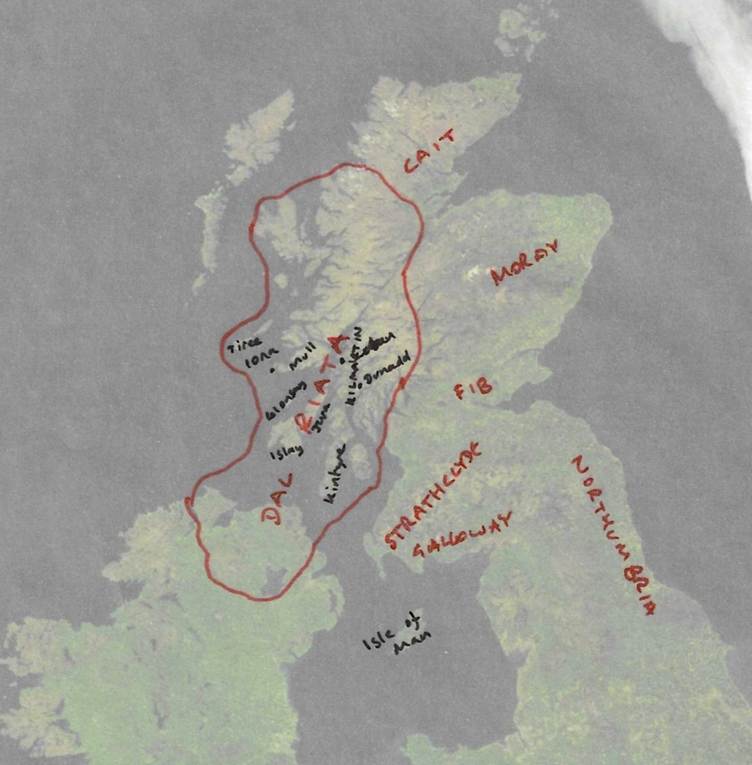
By land and sea Æthelfrith's family
arrived at the court of King Eochaid Buide of Dál Riata, with its ceremonial
seat at Dunadd near modern Kilmartin, on the Kintyre Peninsula in Argyll. The
royal house of Cenel Gabrain was Christian, linked to the northern Irish. (The
King of the North, the Life and Times of Oswald of Northumbria, Max Adams, 2013, page 21). Although Æthelfrith had defeated Áedán mac Gabráin, the king of Dál
Riata, at Degsastan in 603 CE, Acha could seek protection for her sons because
they were her kin.
The exiles would have been expected to
reinforce their bonds in joining battles and perhaps in marrying daughters.
They were trained in the skills of a warrior. In warrior society there was a
great cattle raiding or hosting, at least annually, aimed at an opportunity for
plunder, especially cattle; the training of young soldiers; and demonstration of
horsemanship and weapon skills. Oswald Iding attained the Irish
nickname Lamnguin or Whiteblade, during his exile.
The Kingdom
of Dál Riata was divided into three kin branches. Cenél Loairn comprised
north Argyll and Mull, Iona, Loch Awe, with its capital at Oban, comprising 420
or tech, or houses. Cenél n OEngusa comprised Islay and Colonsay,
with 430 techs. Cenél nGabrain comprised Kintyre and Cowal, with
its stronghold at Dunadd, and 560 techs. Dál Riatan kings summoned these
kinsmen to defend against invaders, guard the borders and attack rebellious
enemies. These tribes could raise about 1,500 fighting men and about 75 seven
bench boats, reflecting the maritime interests of the Kingdom. This web of
obligations had originated in the
Iron Age.
The seat of
power of the Dál Riatan kings was the rocky fortress at Dunadd.
Æthelfrith's sons were likely to have won fame and fortune through the booty
of war during their exile. It seems though that during his 16 years of exile,
Oswald did not try to raise an army against Edwin.
The Iding
athelings were exposed to the monks of Iona for conversion and baptism. As they
arrived in 617 CE, the abbot of Iona was Fergno Brit, the fourth abbot. He died
in 623 CE and succeeded by Ségéne, a kinsman of Colm Cille. The community of
Iona seems to have taken on a fostering role of the royal youths, with an
educational aspect, but also a political dimension. A relationship blossomed,
an opportunity for Iona to expand the influence and interests of the church to
fulfil the Columban ideal by spreading it to all the English.
Meantime the
Roman mission in Kent faced crisis when Æthelberht of Kent died in 616 CE. King
Eadbald of Kent married his stepmother and to appease an illness that followed,
he converted to Christianity, perhaps with pressure from the Merovingian court.
The Axis between Kent and Rome was restored. Negotiations followed between
Eadbald of Kent and Edwin of Northumbria.
With King Edwin,
Bede does not opt for a straightforward chronological narrative. He opens with
Edwin already a great warrior king, and immediately declares his determinist position
by saying that Edwin’s early power had increased as a portent that he would
receive the faith and heavenly kingdom. The driving force of the rest of the
Edwin narrative is the inevitability of conversion. (Northumbria
AD 367-867, Max Adams and Colm O’Brien,
2025, page 115).
619 CE
An 18th century chance discovery of the
partial remains of an opulent Roman villa site at Hovingham have drawn Dominic
Powlesland’s attention to the site, which has yielded a number of Anglian
sculptures, including crosses. The place name might derive from an Anglian
tribe name, the Hofingas; or from hof, a small hill. But Victor Watts has also
raised the possibility that it derives from old English hof meaning an
enclosure, a temple or house, with the implication of a royal centre. Hovingham
lies 11 kilometres West of Malton along the Roman road that hugs the north
facing edge of the Howardian Hills overlooking Ryedale, a perfectly suitable site
for an early medieval royal vill on a circuit that extended into Ryedale, where
later church territories perhaps map the itinerary.
(Northumbria AD
367-867, Max Adams and Colm O’Brien,
2025, page 87; The place name Hexham: A Mainly Philological Approach, V
Watts, 1994, Nomina 17 pages 119 to
136).
Edwin’s reign saw the beginning of
the Deiran kingdom extending beyond its core territory.
Edwin’s first task was to secure his borders.
He initially turned his attention to the threat from the Kingdom of Elmet,
which he added to the portfolio of Northumbria. He expelled King Cerdic from
Elmet. Edwin, son of Alla, reigned seventeen years, seized on Elmet, and
expelled Cerdic, its king. Eanfled, his daughter, received baptism, on the
twelfth day after Pentecost, with all her followers, both men and women. (Historia Brittonum, Nennius, paragraph 63). Elmet was a Brittonic kingdom in an isolated region of southern
Yorkshire. Deirans encountered British speakers with Brittonic Christian
observance. Loidis, later Leeds was a regio within the small
kingdom.
Edwin thus expanded his kingdom to
Elmet with influence in Lindsay and links to the Mercians, establishing himself
as an overlord king with interests north of the Humber and across the Humbrian
lands.
620 CE
By the early 620s Edwin
felt strong enough to consider a more expansionist strategy.
He incorporated the Isle of Man and
the lands of Gwynedd (of which Cadwallon was overlord) in North Wales into his
Kingdom. He brought the islands of Anglesey and Man under his power. He clearly
possessed a fleet allowing his operations in the Irish Sea. He plundered
treasure which he could distribute to his supporters. Edwin’s failure to finish
off Cadwallon would prove fatal to him.
By the early seventh century CE,
there was a political structure across the area of modern Ryedale, under Edwin’s
peripatetic government, which held gatherings on estates where food was
consumed. Eoforwic (the next of the many historic designations of modern York) was at its centre.
Bretwaldas and cattle as tribute
Like none
of the Angles before him, he held under his sway the whole of Britain, both the
Anglian kingdoms and those of the Britons as well (Ecclesiastical
History, Bede, Book 2, Chapter
9).
Edwin
numbered among the seven kings who, according to Bede, exercised overlordship
over others; he ruled over both English and British kingdoms to a greater
extent than any had done previously, even bringing the islands of Anglesey and Man
under his dominion. He must, by implication, have had a navy under his command.
In all probability these were shallow-drafted, clinker-built boats or hide
covered, wooden framed currachs, propelled primarily by oarsmen-warriors owing
military service to Edwin, perhaps partly drawn from tributary kingdoms like
Rhegged. (Northumbria AD
367-867, Max Adams and Colm O’Brien,
2025, page 65).
Such rulers
referred to by later writers as bretwaldas, ‘rulers of Britain’, though there
was no such institutional concept at this stage. This was still a period when
compulsion and success in battle drove the changing status of the various
rulers.
More
powerful kings could place themselves at the head of large confederacies and
wield a wider supremacy, imposing and taking tribute from their dependents. In
the mid 7th century Penda, king of the Mercians, marched against his enemy at
the head of an army commanded by himself and led by 30 royal or most noble leaders,
and within Northumbria also the king had his sub reguli and his duces regii. (The Earliest English Kings, D P Kirby, 2000, page 17). Such command structures probably helped
to produce the succession of those powerful overlords among the Anglo Saxons
whom historians have come to know as bretwaldas and whose existence is so
arresting a feature of the political and military history of the pre Viking
period.
Bede tended to
use imperium, overlordship, as opposed to regnum, royal power, to describe the type
of domination exercised by overkings or overlords who wielded authority in two
or more regna, kingdoms; it is clear, for example, that the Mercian, West Saxon
and Northumbrian kings were thought of as exercising a local imperium over
their immediately dependent territories. (The Earliest English Kings, D P Kirby, 2000, page 17).
Bede listed seven kings who held imperium
over all the Anglo Saxon Kingdoms north or south of the Humber:
· Aelle, South Saxons;
· Ceawlin, West Saxons;
· Æthelberht, Kent;
· Raedwald, East Angles;
· Edwin, Northumbria (who had
the overlordship over all the nations who inhabit Britain, both English and
British, except only the people of Kent);
· Oswald, Northumbria (the
most Christian king of the Northumbrians, whose kingdom was within the same
bounds);
· Oswiu Northumbria (who ruled
over a kingdom of like extent for a time, and for the most part subdued and
made tributary the nations of the Picts and Scots, who occupy the northern
parts of Britain).
(Ecclesiastical History, Bede, Book 2, Chapter 5).
Without question
the concept of Britain (contrasted
to the lands where the non Anglo Saxon Britons lived) exercised a powerful
influence on the imagination of the Anglo Saxons. Bede transmitted to his
audience an image of Roman Britain as a single realm conquered by Claudius and
inherited by Constantine, the Romans occupying north to Hadrian's Wall and establishing
their domination of the further parts of Britain as well as over the adjacent
islands. (The
Earliest English Kings, D P Kirby, 2000,
page 18).
Æthelbald of Mercia used
the title King of Britain, Rex Britanniae, in 736 CE as did Offa in 799 CE. Æthelbald
was certainly not in reality ‘king of Britain’, and nor was Offa. The reality
was far more circumscribed. Bede, Æthelbald’s older contemporary describes the
extent of Æthelbald’s power when he records in 731 that all the kingdoms south of
the Humber, together with their rulers, were subject to him (Ecclesiastical
History, Bede, Book 5, Chapter 23). The probability is
that Bede’s world was profoundly influenced by Æthelbald’s southern imperium.
In reality the Bretwalda idea was a fusion between overlordship over the
southern kingdoms, with an idea of a wider pan-British union.
Subservience to a rule took
the form of tribute, in currencies such as gold or cattle. Cows and Oxen were
driven to royal collection centres and could be kept there until it was time to
kill them. Traditionally animals tended to be slaughtered in winter (the
Anglo-Saxon word for November was Blodmonath), to reduce the stock
needing to be fed over winter. Cattle were of primary economic importance, for
meat but also for leather (boots, purses, flasks, saddles, straps, tents etc) and
hides. The need for the byproducts of cattle drove a practice of feasting at
the scale depicted in Beowulf. The King’s hall, as a throne room, but
also a venue for such feasting, therefore came to symbolise royal power. (The Anglo Saxons, A History of the Beginnings of England, Marc Morris, 2021, page 69 to 70)
At
the beginning of his reign he was beholden to King Rædwald
and one might suppose that his capacity for independent action was constrained
until Rædwald’s
death in 624 or 625, especially in any dealings south of the Humber.
(Northumbria AD 367-867, Max Adams and Colm O’Brien, 2025, page 65). King Rædwald of East Anglia died in about 625 CE and
was perhaps the king buried at Sutton
Hoo, laid out in a 27 metre long ship, with a helmet, sword and shield.
This was the height of lavish royal burial. In neighbouring Essex the Prittlewell burial
included lavish
grave goods, including two small gold foil crosses. This was also the time
of the Street
House burial in Cleveland, where a royal Saxon princess watched over
Farndale lands for thirteen centuries.
King
Edwin had been introduced to the idea of an intellectually rational form of
kingship by Paulinus and in letters written to him and his queen by Pope
Boniface, to which Bede had access through his contacts in Canterbury. The
model was Roman and imperial, literate and monumental, underpinned by the idea
that an everlasting place by God's side was on offer to good kings who embrace the
eternal, universal and exclusive church, at least through Bede’s idealised lens.
(Northumbria AD 367-867, Max Adams and Colm O’Brien, 2025, page 92).
624 CE
King Rædwald
of East Anglia died in 624 CE and whilst he has become associated with the Sutton
Hoo burial, his death was followed a period of internal strife amongst the east
Angles. It was therefore not amongst the east Anglians that Edwin sought his
new bride, but with the sister of the still powerful Eadbald, king of Kent. Nevertheless
Eadwine’s overtures to Eadbald for the hand of his sister Æthelburh suggest a
northern ruler already prestigious in his own right (The Earliest
English Kings, D P Kirby, 2000, page 63).
Indeed at the time of Edwin’s marriage to the Kentish Æthelburh,
Hereswith, the daughter of Eadwine’s nephew Hereric, married Æthelric, Rædwald’s
nephew, to become the mother of Aldwulf, later king of the eastern Angles (Ecclesiastical
History, Bede, Book 2, Chapter 9; The Earliest English Kings, D P Kirby, 2000, page 64). This may have been a path to Edwin’s
ascendancy to the dominant position of overlordship surpassing the southern
kingdoms.
625 CE
Edwin
married Æthelburh, a Christian Princess from Kent, in 625 CE. She was the sister of Eadbald of Kent who required as a condition
of the marriage that Edwin converted to Christianity. The marriage which linked
him with Frankia, was advantageous to Edwin. So the maiden was promised, and
sent to Edwin, and in accordance with the agreement, Paulinus, a man beloved of
God, was ordained bishop, to go with her, and by daily exhortations, and
celebrating the heavenly Mysteries, to confirm her and her company, lest they
should be corrupted by intercourse with the pagans. (Ecclesiastical History,
Bede, Book 2, Chapter 9).
Edwin was a significant enough leader by 625 CE for Pope Boniface
V to write to him and his queen (Ecclesiastical History,
Bede, Book 2, Chapter 10 and 11).
The marriage of Eadbald and Æthelburh's Merovingian mother Bertha (the
daughter of the Merovingian King Charibert, who reigned from 561 to 567 CE) had
resulted in the conversion of Kent by the Augustine mission of 597 CE and
Æthelburh's marriage would do the same in Northumbria. Æthelburh was
accompanied by Paulinus, a member of the Gregorian mission to Northumbria and
part of the second Roman mission of 601 CE. Pope Boniface V gave Æthelburh a
silver mirror and ivory comb and encouraged her Illustrious daughter,
persevere with all your might to soften his hard heart.
On 21 July 625 CE Paulinus was consecrated bishop in York and
began to construct the first Christian church there, a tiny wooden oratory.
The
conversion of Edwin and his court, with subsequent mass baptisms of people by
Paulinus, is central to Bede’s account of his reign, almost to the exclusion of
other themes (Northumbria AD 367-867,
Max Adams and Colm O’Brien, 2025, page 74). However Edwin bade his time to convert
himself.
626 CE
At Easter 626 CE
Cwichelm, king of the Gewisse, the West Saxons of the upper Thanes
Valley, sent an envoy to Edwin’s court who attempted to assassinate Edwin with
a short sword. The attempt was prevented by Edwin’s aide, a freeborn thane or gesith
called Lilla who may have been buried in honour of his deed at the prehistoric
barrow, Lilla’s Howe on Goathland Moor. The next year there came into the
province one called Eumer, sent by the king of the West-Saxons, whose name was Cuichelm,
to lie in wait for King Edwin, in hopes at once to deprive him of his kingdom
and his life. He had a two-edged dagger, dipped in poison, to the end that, if
the wound inflicted by the weapon did not avail to kill the king, it might be
aided by the deadly venom. He came to the king on the first day of the Easter
festival, at the river Derwent, where there was then a royal township, and
being admitted as if to deliver a message from his master, whilst unfolding in
cunning words his pretended embassy, he started up on a sudden, and unsheathing
the dagger under his garment, assaulted the king. When Lilla, the king's most
devoted servant, saw this, having no buckler at hand to protect the king from
death, he at once interposed his own body to receive the blow; but the enemy
struck home with such force, that he wounded the king through the body of the
slaughtered thegn. Being then attacked on all sides with swords, in the
confusion he also slew impiously with his dagger another of the thegns, whose
name was Forthhere. (Ecclesiastical
History, Bede, Book 2, Chapter 9).
Edwin and
Æthelburh had their first daughter, Eanflæd, born shortly after the
assassination attempt, perhaps born prematurely following the trauma of the
assassination. Eanflæd was baptised by Paulinus.
Bede suggested that
the assassination attempt, and perhaps the birth of his first daughter, was the
stimulus to Edwin’s conversion.
There followed a
campaign by Edwin against Cwichelm of the West Saxons which demonstrated him to
be a powerful warlord of the English, able to strike over large distances.
Edwine’s retaliating attack, when he is said to have slain or subdued all those
who had plotted against him, confirms that he was reaching the height of his
power by the mid 620s. (The
Earliest English Kings, D P Kirby, 2000,
page 64).
The marriage to Æthelburh and the acceptance
of her Roman bishop and his strand of Christianity began to turn Edwin’s
political focus beyond the north and west facing viewpoint of the Bernician
kings, towards the European continent and Rome; Edwin and his queen were
themselves recipients of letters direct from Pope Boniface.
Paulinus established a bishopric in York in pursuit of Pope Gregory’s ambition
for an English church with archbishops in York and London (though moved by circumstances
to Canterbury), each with twelve bishops (Northumbria AD 367-867,
Max Adams and Colm O’Brien, 2025, page 75).
627 CE
By the early
seventh century CE, there was an incipient state structure under King Edwin of
Deira’s peripatetic government, which held gatherings on estates where food
renderings were consumed. Deira’s land was between the Humber and the Tees.
York was an important centre. Edwin converted to the
Christian religion, along with his nobles and many of his subjects, in 627 and was
baptised at Eoforwic (York) and he
built the first wooden church amidst the Roman ruins which was later replaced
by a larger stone church.
The first
recorded church at York was a wooden structure built hurriedly in 627 to
provide a place to baptise Edwin, King of Northumbria. The location of this
church, and its pre-1080 successors, is unknown. It was probably in or beside
the old Roman principia (the military headquarters), which may have been
used by the king when in residence in York. Archaeological evidence indicates
the principia was located partly beneath the post-1080 Minister site,
but excavations undertaken in 1967-73 found no remains of the pre-1080
churches. It can therefore be inferred that Edwin's church, and its immediate
successors, was near the current Minster (possibly to the north, underneath the
modern Dean's Park) but not directly on the same site.
You are sitting with your ealdormen and thegns in winter time; the
fire is burning on the half in the middle of the hall, and all inside is warm,
while outside the wintry storms of rain and snow are raging; and a sparrow
flies swiftly through the hall. It enters at one door and quickly flies out
through the other. For the few moments it is inside, the storm and wintry
tempest cannot touch it, but after the briefest moment of calm, it flits from
your sight, out of the wintry storm and into it again. So this life of man appears,
but for a moment, what follows, or indeed went what went before, we know not at
all. If this new doctrine brings us more certain information, it seems right
that we should accept it. (Ecclesiastical History,
Bede, Book 2, Chapter 13). The passage
seems to have been a metaphor suggesting man’s short life on earth between the
mysteries of what came before and afterwards, and the benefits of Christianity as
vehicle for better understanding.
Although the historical narrative especially of Bede present kings
as the driving force of conversion, in practice it could only be achieved when
the elite classes found conversion to be a means to stabilise their social
position, becoming an ecclesiastical hierarchy. (Northumbria
AD 367-867, Max Adams and Colm O’Brien,
2025, page 134).
Edwin
converted to the Christian religion, along with his nobles and many of his
subjects on 12 April 627 CE and was baptised at Eoforwic in the first
wooden church amidst the Roman ruins which was later replaced by a
larger stone church. The site of this first church was probably beside the old
Roman principia or military headquarters, to the north of the current
minster, in the current Dean’s Park. The
stone church was not completed before Oswald’s day.
King Edwin, therefore, with all the nobility of the nation, and a large
number of the common sort, received the faith, and the washing of holy
regeneration, in the eleventh year of his reign, which is the year of our Lord
627, and about one hundred and eighty after the coming of the English into
Britain. He was baptized at York. (Ecclesiastical History,
Bede, Book 2, Chapter 14).
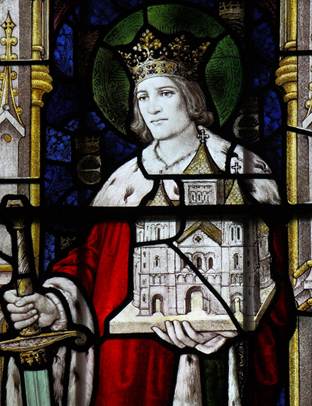
Edwin, depicted in a Victorian window at St Mary, Sledmere,
Yorkshire
Within a year Edwin and gentis suae nobilibus ac plebe,
‘all his nobles’, and a vast number of the common people, were baptised by
Paulinus and his deacons. Greogory’s ambition to install a bishop in the
ancient Roman colonia of York was fulfilled.
Paulinus then
moved north to continue his work in Bernicia and thousands were baptised at Yeavering. It has been
suggested that the magnificent grandstand at Yeavering was constructed
for Paulinus’ mass conversions, or alternatively that it was inspired by
Paulinus.
So great was then
the fervour of the faith, as is reported, and the desire for the laver of
salvation among the nation of the Northumbrians, that Paulinus at a certain
time coming with the king and queen to the royal township, which is called Ad
Gefrin, stayed there with them thirty-six days, fully occupied in catechizing
and baptizing; during which days, from morning till night, he did nothing else
but instruct the people resorting from all villages and places, in Christ's saving
Word; and when they were instructed, he washed them with the water of
absolution in the River Glen, which is close by. This township, under the
following kings, was abandoned, and another was built instead of it, at the
place called Maelmin. (Ecclesiastical
History, Bede, Book 2, Chapter
14).
Paulinus preached
and baptised in the dependent territory of Lindsey and his activities there, and
in Bernicia, if Bede is correct in placing him at Yeavering, served to
delineate where Eadwine had most effective control outside Deira (The Earliest English Kings, D P Kirby, 2000, page 65).
A royal baptism
among Anglo-Saxon kings at this time was not typical. The kings of Mercia and
East Anglia were pagan with no Christian king outside Kent, so it seems
surprising that it was the most northerly of the Anglo-Saxon kings outside Kent
to have first adopted Christianity. It was however a sign of his success
that he was in tune with the most advanced trends of contemporary political
life (The
Earliest English Kings, D P Kirby, 2000,
page 65). His marriage to Æthelburh connected him with Rome and
Continental and Merovingian ideas. Indeed it
was Edwin, according to Bede, who then persuaded Eorpwald, king of the East
Angles to Christianity (Ecclesiastical
History, Bede, Book 2, Chapter
15). Edwin thus extended his influence
to East Anglia and with close Kentish connections.
Bede
included Edwin in his list of overlord kings and added that he had the
overlordship over all the nations who inhabit Britain, both English and
British, except only the people of Kent (Ecclesiastical
History, Bede, Book 2, Chapter
5), though the wide ranging nature of this claim perhaps goes a bit
too far.
Edwin’s conversion and those which followed laid the foundation
for a Christian Anglo-Saxon state.
King Edwin’s overlordship of much of central
Britain was predicated on powerful, existing institutions enabling him to draw
wealth from, and administer, vast tracts of land through a well-established
customary system of extensive territorial lordship. His late, almost reluctant
conversion to Christianity prevented him from exploiting the full benefits of the
new, rational form of kingship exploited by his successors. But he bequeathed
to them an almost unshakeable idea of Northumbrian supremacy, the political
capital of which they spent with great energy and imagination. (Northumbria AD 367-867,
Max Adams and Colm O’Brien, 2025, page 89).
633 CE
Eventually Edwin overreached himself and the
Gwynedd-Mercian alliance that had been at play against Æthelfrith now
turned against him; Edwin’s raiding of Anglesey may have been a motivating
factor. (Northumbria AD 367-867,
Max Adams and Colm O’Brien, 2025, page 76).
Edwin was killed at Hæthfelth, the Battle of
Hatfield Chase, near Doncaster, along with his son Osfrith, on 12 October 633 CE by
the combined Mercian and Welsh forces under Cadwallon ap Cadfan of Gwynedd and
Penda of Mercia. Edwin had been fostered by Cadwallon as a child, but Cadwallon
was humiliated in Edwin’s Irish Sea campaigns of the 620s, and his revenge
seems a natural course of things. A great battle being fought in the plain
that is called Haethfelth, Edwin was killed on the 12th of October, in the year
of our Lord 633, being then forty-eight years of age, and all his army was
either slain or dispersed (Ecclesiastical History,
Bede, Book 2, Chapter 20).
There is an interpretation that Edwin died in 634 CE (see The Earliest English
Kings, D P Kirby, 2000, page 56, 66).
Edwin’s severed head was brought to
the unfinished wooden church at York and he was venerated as a saint and martyr
after his death.
This marked the end of a phase in the
history of Northumbria’s influence. Eorpwald of East Anglia had been killed by
the pagan Ricberht soon after his conversion and this marked a vulnerability of
Northumbria to the continued pagan forces. Mercia was coalescing in the early
seventh century into a powerful kingdom in the midlands.
Bede portrayed the year after Hæthfelth as the darkest days of Northumbrian history, a complete collapse of
Edwin’s imperium.
Cadwallon split Northumbria back to
Deira and Bernicia and handed Bernicia to Æthelfrith’s son Earnfrith
and Deira to Edwin’s cousin, Osric, son
of Edwin's paternal uncle Ælfric. He no doubt expected
both sub-kings to act as his puppets.
Edwin’s son, Eadfrich was captured at
Hatfield. Paulinus and Queen Æthelburh fled to Kent. The Christian flame in
Northumbria was extinguished, albeit temporarily.
The
archaeological evidence does not suggest a period of violence in the aftermath
of Hæthfelth. There is no evidence of ravaging
the land at York by Cadwallon and at West Heslerton there is limited sign of
disruption to normal community life, though Yeavering appears to have been burned to the
ground. There doesn’t appear to have been a genocidal wasting of the lands of
Northumbria in the aftermath of Cadwallon’s victory.
Penda returned satisfied with his
booty. Cadwallon was not satisfied and set up his winter quarters perhaps at
Aldborough. Over the following period, he does appear to have indulged in
looting and some attempt at control of Northumbria.
Osric reverted to paganism but was killed by Cadwallon in 634 CE after
a rash attempt to besiege Cadwallon perhaps at Aldborough (Martin Millet: Aldborough roundup, Roman Yorkshire, Newsletter of the Roman Antiquities
Section, 2026). Eanfrith was also killed by Cadwallon in about 634 CE
after demonstration of his weakness when he sued for peace. Cadwallon had
decided it was easier to rule both kingdoms as tyrant.
The only survivor of Paulinus’ mission was James the Deacon.
It was in this anarchic period that Oswald, trained in Dál Riata and
Iona, made his entrance. News of the defeat at Hæthfelth soon reached him as news
travelled fast. The investment of Dál Riata in Oswald’s upbringing was now a
card to be played. The future of Bernicia and Deira were of importance in
Argyll and Iona. Oswald’s valour in battle had attracted Bernician exiles to join
him. In the aftermath of Hæthfelth and Eanfrith’s weak response to Cadwallon, Oswald took counsel with his
lord, Domnall Brecc, and his Ionan abbot Ségéne, who also supplied his own
warrior monks.
Oswald Iding
634 CE
Oswald
appeared without warning, faster than news could travel, probably by sea via
the Solway Firth and Rheged, and defeated and killed Cadwallon at Caelestis
campus, the Battle at
Heavenfield, near the
later site of Hexham and united
Northumbria once more (Ecclesiastical History,
Bede, Book 3, Chapter 2). Bede tells of
a vision of St Columba on the night before the battle. This was a world of
miracles, where such were of significance. Oswald’s army probably approached
Cadwallon’s army along the Roman Wall at Corbridge attacking an unprepared army
at dawn, forcing them to flee until they were overwhelmed at a river crossing
where Cadwallon was cut down. He erased the shame of defeat and devastation
at Cadwallon’s hands and restored the northern kingdom to its former glory and
primacy (The Anglo Saxons, A History of the Beginnings
of England,
Marc Morris, 2021, page 77, see also Northumbria AD 367-867, Max Adams and Colm
O’Brien, 2025, page 97). Oswald was also a Christian
king, but one trained in the Celtic traditions of Iona.
The Iding dynasty of
Bernicia was restored. During the preceding year of anarchy, Cadwallan had looted
the Northumbrian lands and burnt royal estates and Edwin’s system of
overlordship had collapsed.
The church
at Heavenfield has an eighteenth
century sundial whose gnomon tracks the passing of the hours during
daylight.
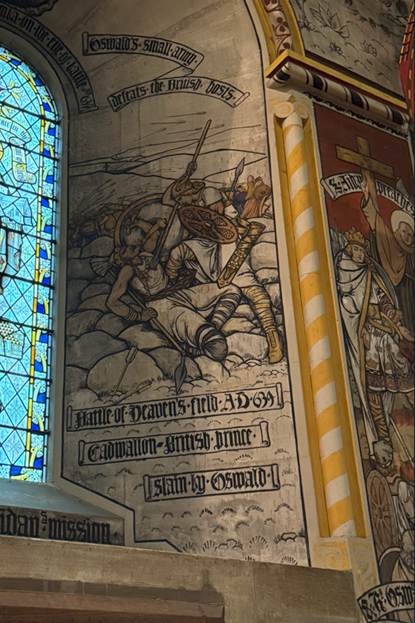
Mural at
Helmsley Parish Church
Oswald restored the Bernician line of Æthelfrith to power in Northumbria.
After this point, Æthelfrith's descendants continued to rule until the first
part of the eighth century. Edwin’s unification of the northern Kingdom had not outlasted
him. The rise of Penda and of Mercia, and the return from Irish exile of the
sons of Æthelfrith, tied the Kingdom of Northumbria into the sea connections of
the Celtic and Irish for several generations. The church in Bernicia and
Deira was now brought within the familia of Iona and subject to the authority
of the abbot of Iona (The Earliest English Kings, D P Kirby, 2000, page 75). There was no attempt
at this time to revive Paulinus’ church at York, nor to pursue Edwin’s
ambitions for a pallium for a northern archbishopric. Thus northern
England adopted idiosyncratic customs which Rome came increasingly to see as
schismatic.
That said,
Oswald did aspire to rebuild the influence of Edwin to the south, by
reestablishing control of Lindsey (Ecclesiastical History, Bede, Book 3, Chapter 11) and restoring influence in southern England
(see The Earliest English Kings, D P Kirby, 2000, page 74).
For a while too, with Bernician
leadership reasserted, the political centre of gravity shifted north from York.
However Oswald and Oswiu were also sons of the Deiran Acha, so although the
death of Edwin and his family had left a political vacuum in Deira, there was
the possibility of Deira’s assimilation into the new political order.
By the universal rules
lordship and hospitality, Oswald and his brothers owed king Domnall Brecc (629
to 642) their support as his allies in Northumbria, providing a powerful
counter to the ambitions of the British kings of Strathclyde at Dumbarton.
Equally, Iona ensured that it had a stake in the fortunes of these converts:
they would, if successful in reclaiming their father Æthelfrith's patrimony, found a new Iona in the northeast. (Northumbria
AD 367-867, Max Adams and Colm O’Brien,
2025, page 93).
If King Edwin
fashioned his kingship as a hybrid between tribal and Roman models, his nephew
and successor Oswald, son of Æthelfrith, took inspiration from the traditions
and heroic myths of the Gaels. (Northumbria AD 367-867,
Max Adams and Colm O’Brien, 2025, page 91). Ireland and its churches
had never been directly influenced by Roman popes. In the Gaelic model that
informs a new generation of Christian Northumbrian kings, there is a sense of power
held at arms length; with kings and holy men mutually supportive; mutually
threatening; their relations always contingent. Its social contract was forged
by the imaginative and moral power of the desert fathers, such as St Anthony,
under dynamic tension with the sacral, tribal potency of Ireland’s war like
kings. Even so, the model was underpinned by arrangements for the tenure of
land. By showing loyalty and service to the king, secular lords held a life
interest in land held perpetually by the king. Lordship was competitive with
the more powerful lords forming the warband who participated in cattle raids,
feasted and drank together.
Oswald was King
of Bernicia and Deira 634 to 5 August 642 CE. Oswald Iding ruled Northumbria
for eight years from AD 634 to 642. In that time he was recognised as overlord
of almost all the other kingdoms of Britain: of Wessex, Mercia, Lindsey and East
Anglia, of the Britons of Rheged, Strathclyde and Powys and Gwynedd, the Scots
of Dál Riata and the Picts of the far North. A famed warrior, the Whiteblade or
Blessed arm of legend, he won and lost his kingdom in Battle. He was the first
English king to die a Christian martyr. He is the embodiment of the romantic
hero; the righteous exiled prince whose destiny is to return triumphant to
reclaim his kingdom. (The King of the North,
the Life and Times of Oswald of Northumbria,
Max Adams, 2013, page 3). He forged a hybrid culture of Briton,
Irish, Scot and Anglo Saxon which gave rise to a glorious age of arts and
language symbolised by his foundation of the monastery on Lindisfarne and the
sumptuous manuscripts later crafted there by Northumbria’s monks. He was the
model of Tolkein’s Aragorn in the Lord of the Rings.
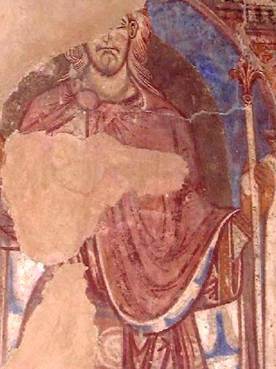
Oswald, c
12th century, Durham Cathedral
Although Edwin had first converted it was Oswald who
spread the religion widely through the northern Kingdom. Oswald spread the
Celtic form of Christianity in his traditionally pagan lands. Oswald had been
taught in Iona. Unsurprisingly therefore, once he had returned to
Northumbria in 634 and found he needed to replace the churchmen who had fled
the previous year, he looked to his own spiritual alma mater rather than to
distant Canterbury (The Anglo Saxons, A
History of the Beginnings of England,
Marc Morris, 2021, page 89).
Lindisfarne
Within months of his victory over Cadwallon, Oswald asked the
Irish monks of Dál Riata to send a bishop to help the conversion of his people.
The Irish first sent an "austere" bishop, who had little success.
They later sent Aidan, who brought a gentler approach. Aidan was probably an
already senior figure in the Irish church. On the arrival of the bishop, the
king appointed him his episcopal see in the island of Lindisfarne, as he
desired. Which place, as the tide ebbs and flows, is twice a day enclosed by
the waves of the sea like an island; and again, twice, when the beach is left
dry, becomes contiguous with the land (Ecclesiastical History, Bede, Book 3, Chapter 3).
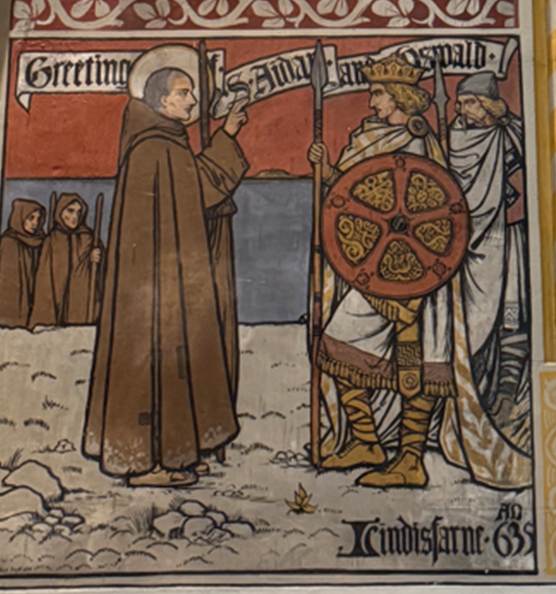
Mural at
Helmsley Parish Church
The Ionan abbot Ségéne probably travelled to Oswald’s court,
perhaps at Bamburgh, to ordain him as king on the same basis that Colm Cille
had ordained Áedán mac Gabráin
as king of Dál Riata. As Bamburgh was within site of Lindisfarne, he may have
told his Ionan guests about the magic of the place. They may have been
impressed with its resemblance to Iona and its proximity to the seat of
Bernician power.
Oswald gave the island of
Lindisfarne to Aidan as his episcopal see. This was a deliberate foundation of
a church on the Irish model, fully supported by the new King. It reflects the
ambition of the Irish form of Christianity, based on desert asceticism, among new
lands on the North Sea coast. Aidan began to construct a cluster of wooden
buildings of hewn oak comprising a small church, cells for the monks and a
guesthouse. A watchtower followed and a dormitory. The isle of Inner Farne
provided further solitude to Aidan and his fellow monks. There was enough land
on Lindisfarne to grow crops and pasture animals, with inshore and offshore
fishing. Aidan did not spend all his time on the island, but walked among scattered
settlements to spread Christianity. He was once given a horse by the Deiran sub
King Oswine but gave it away to a pauper to Oswine’s horror. (The King of the North, the Life
and Times of Oswald of Northumbria, Max
Adams, 2013, page 168 to 169). He raised a church in the modest Irish
manner, with walls of wood and a roof of reeds (The Anglo Saxons, A
History of the Beginnings of England,
Marc Morris, 2021, page 90).
Lindisfarne was
granted with an 8km wide coastal strip stretching 21 kilometres north from
Bamburgh along the coast. It has been argued that an upland estate was added to
Lindisfarne in the following decades for the raising of calves to be
slaughtered young for use in vellum making at Bromic, the Breamish
valley and that Norham was part of the Lindisfarne holdings by the mid ninth
century. The lands added to the Lindisfarne estate were not arbitrarily
selected, but existing territorial units of antiquity. The island of
Lindisfarne was very different to the treeless expanse of sand dunes and grassy
fields of today and was largely covered by hazel and birch woodland, a source
of freshwater. (Northumbria AD
367-867, Max Adams and Colm O’Brien,
2025, page 100).
When Finan
succeeded Aidan in 651 CE, he built a church after the Irish method, not of
stone but hewn oak, thatching it with reeds (Ecclesiastical
History, Bede, Book 3, chapter 25).
The
economic consequences of gifting land to the church foreshadowed by the gift of
Lindisfarne
The core of the royal property portfolio was the royal shire, with the villa
regis at its heart collecting renders and playing host to peripatetic
kings. With render came the right to dwell in the royal shire. Generally kings
gave land only as a life interest to reward their warriors. The lands were
effectively leased and returned to the King on the death of the occupier.
Estates were also conquered and redistributed. Land gifted to the church was
gifted in perpetuity. They could not readily be reclaimed. Kings appeared to trade the uncertainty of pagan mortality for
everlasting paradise in another world. This permanent alienation of land had
implications. On the positive side, the monks were able to invest in their land
by clearing scrub and woodland for fields etc. However the monastic community
did not collapse on the death of the abbot. This provided a source for economic
stability and increasing surplus. By the end of the
seventh century, this allowed the scriptoria and magnificent books of Jarrow
and Monkwearmouth and Lindisfarne to be produced. In more time this trend would
foreshadow the pomp and majesty of the medieval prince bishops of Durham.
However, it also meant that less land was available for the King’s use and to
reward their warriors. In time this would lead to a shortage of earthly
warriors. (The King of the North, the Life
and Times of Oswald of Northumbria, Max
Adams, 2013, page 180 to 184).
Only two
archaeological sites beside Yeavering and Bamburgh
of significant size have been identified in Bernicia – Sprouston near Kelso
where a crop mark site suggests a significant site; and Thirlings, with six halls (reconstructed
at Jarrow Hall), and
rectangular post built structures which may have stored grain or overwintered
animals. Yet there must have been several tribute centres, including Sprouston,
Doon Hill near Dunbar, and several others in the lands of the
Deira. Cambodunum was probably Doncaster (The
Kingdom of Northumbria AD 350 to 1100, N
J Higham, 1993, page 85 to 86) but has also been interpreted to Cleckheaton in the
West Riding and Loidis was Leeds. Both were important sites of Paulinus’
baptisms (Ecclesiastical History, Bede, Book 2, Chapter 14). Royal tribute centres focused on halls were
probably an ephemeral feature, lasting for the first half of the seventh
century.
Each shire
comprised a unit able to supply a warband leader. Bamburghshire was one of the
largest shires. Oswald would have journeyed between his royal estates
constantly. Even small estates kept back sufficient resource from its surplus
to meet appetites of Kingly visits on a large scale.
Bernician settlement in the
seventh century is probably underrepresented by the archaeology, but settlement
in Northumbria was probably nothing like the extent of Mercian settlement in
the later eighth century. For early 6th and 7th century kings like Oswald,
economic enrichment was predicated on a successful career as the leader of a
warband: raiding neighbours; rendering other kings tributary. Death in battles
of members of the comitatus promoted the careers of younger warriors eager for
glory and for land on which to settle, constantly recycling the pool of
available estates to gift as a reward for service. Oswald had a portable wealth of booty
and tribute and held feats in halls where the surplus of renders from his
estates were consumed. (Northumbria AD 367-867, Max Adams and Colm O’Brien, 2025, page 109).
A ten hide estate
according to one source supplied 10 vats of honey, 300 leaves, 32 ambers of
ale,2 full grown cows, 10 geese, 20 hens, 100 eels, 5 salmon, and an amber of
butter and some estates reached 300 hides. This was sufficient for the elite
class to live well without labouring themselves.
It was
therefore the labour of peasants and small tenant farmers whose labour provided
a surplus that supported a warrior class and, in due course, a class of monks,
abbots and abbesses. An early middle class, the drengs, were responsible
for services such as truncage, the hauling of timber to the estate
centre and paid taxes such as merchat (marriage tax), and heriot
(inheritance tax).
(The King of the North, the Life and Times of Oswald
of Northumbria, Max Adams, 2013, page 218 to 219, The Tribal
Hidage, Britain after Rome, The Fall and Rise,
400 to 1070, 2011,
Robin Fleming page 108 to 109).
Patronage came
from the kings. Their land had customarily provided the basis of obligations in
food and service to the king. When land was given to the church those services
were commuted to prayer in perpetuity. (The King
of the North, the Life and Times of Oswald of Northumbria, Max Adams, 2013, page 299).
Bede says that Oswald acted as Aidan's interpreter as Aidan
didn’t really speak English and Oswald had learned Irish during his exile.
Aidan may have had his own cell and church built at Yeavering, allowing him to associate with
royal power, but avoid its excesses. The journey from Bamburgh to Yeavering could probably be undertaken in a day.
Oswald’s
relatively brief reign was a busy one, of intense military, political and
diplomatic activity. Despite a pagan
heritage, he was Irish in upbringing and outlook. Yet unlike Gaul, Britain
still had no functioning towns nor civil service, no professional judiciary, standing
army, nor coinage.
Oswald had
inherited a kingdom ravaged by a year of anarchy and rape, but within a year of
his victory, he was acknowledged as overlord of much of Britain.
635 CE
Oswald married Cyniburh, probably the daughter of
Cynegisl king of the Gewisse, or West Saxons. They had a son Œthelwald.
Wood and stone
Oswald completed
Paulinus’ wooden church in York in stone in the later 630s. Until that time
there was no significant stone structure in Northumberland and no masons. Forty
years later the church at York was derelict and there were no stone structures
until Wilfrid repaired the York church and had the abbeys at Hexham and Ripon
built after 670 CE.
The
best wooden architecture was at Yeavering. The church on
Lindisfarne was built not of stone, but entirely of hewn oak, and covered it
with reeds.
However when
Wilfrid constructed Hexham abbey in the 670s, his biographer wrote in awe that my
feeble tongue will not allow me to enlarge here upon the depth of the
foundations in the earth, and its crypts of wonderfully dressed stone, and the
manifold buildings above the ground, supported by various columns and many side
aisles, and adorned with walls of notable length and heigh, surrounded by
various winding passages with spiral stairs leading up and down. (Vita Wilfridi,
chapter 22). In contrast to Cuthbert, Wilfrid was charismatic, ambitious
and Roman in taste.
(The King of the North, the Life and Times of Oswald of
Northumbria, Max Adams, 2013, page 295
to 297).
638 CE
Oswald is one of
those kings said to have exercised overlordship, ruling more widely than any of
his predecessors had done among all four of the language groups that Bede had
identified on the island: Britons, Picts, Scotti and English. Yet Bede gives no
insight into how this formerly exiled son of Æthelfrith achieved such imperium from
the ruined kingdom that Cadwallon had left behind, and in such a short reign of
only eight years. (Northumbria AD 367-867,
Max Adams and Colm O’Brien, 2025, page 110).
In 638 CE, the
Gododdin stronghold of Din Eidyn was besieged by Angles from the Kingdom
of Northumbria, likely under King Oswald. This pivotal event marked the end of
Brythonic Celtic control over the fortress and brought the region under
Northumbrian rule. The name Eiden was combined with the Old English word
for fort, burh, evolving into the modern name, Edinburgh. Northumbrian
dominance lasted until the region was later contested and eventually taken by
the Scots in 1018.
642 CE
Oswald was killed at the Battle of Maserfield by Penda, King of Mercia on 5 August 642 CE. It started as a fatal
campaign to strike at an alliance between Penda of Mercia and King Cynddylan of
Powys. Oswald, king of the Northumbrians, was slain by Penda, king of the
Southumbrians, at Mirfield, on the fifth day of August; and his body was buried
at Bardney (Anglo Saxon Chronicle).
Mercia was the last of the major
Anglo-Saxon kingdoms to emerge. Its name derives from mierce, or march,
suggesting a border people between the Britons and the Anglo Saxon kingdoms. The
defeat by Oswald of his ally Cadwallon in 642 CE must have been a blow to the
emergence of Mercia.
The culminating battle was at Maserfelth (possibly at Oswestry in the Welsh mountains, though this was far from Northumbrian territory)
when Oswald was killed, perhaps by Penda himself. Oswald’s army was completely
destroyed and the victory over Northumberland was absolute. There was not even anyone
left to protect the King’s dead body whose people were deprived of the
important ritual of the burial of their king. Penda celebrated by placing
Oswald’s hands and head on stakes. Mercia’s power was in the ascendancy.
Oswald was venerated as a saint after
his death. His last stand gave immediate rise to a popular cult. Oswald’s
brother Oswiu brought up Oswald’s infant son, Œthelwald, and a year after Oswald’s death,
returned to the scene of the battle with an armed force and took Oswald’s bleached
remains away with him. This was a risky enterprise deep into Mercian territory.
Oswald’s martyrdom quickly become a popular cult. Within a short time strange
events began to occur. The miraculous was part of everyday life. In time the
popular cult became a cult of royal saints.
Oswald’s death provided a fresh crisis for Northumbria. His
brother Oswiu was recognised as his successor in both Bernicia and Deira, but
Oswiu had first to establish his fitness to rule. Oswald had elevated the status
of Northumbria to the leading of the English Kingdoms, with an
institutionalised Christian church but the robustness of this northern imperium
would now be tested. The immediate risk was that the new power under Penda
would strike first. Oswiu inherited a position of weakness with most of the
Northumbrian army destroyed in battle.
Oswiu Iding
He succeeded his older brother after
Oswald’s death at Maserfelth. He ruled for 28 years until he died on
natural causes in 670 CE. Drawing on
what Oswald and Aidan had begun at Lindisfarne, he developed an astute sense of
governance and a church-state collaboration for his political diplomacy. He was the
last of the Northumbrian kings who Bede says held overlordship over southern
kingdoms and he took tribute from the Picts and Scotti. (Northumbria AD 367-867,
Max Adams and Colm O’Brien, 2025, page 127).
The first consequence of the battle of Maserfelth was that Penda was left as sole king of the
Mercians, without question the most powerful Mercian ruler so far to have
emerged in the midlands. A second consequence was that the northern Humbrian
confederacy fragmented when, as the Historia Brittonum records, Penda separated
the southumbrians from the Northumbrians, and Oswald’s brother, Oswiu was able to
assume royal power only among the Bernicians. This constituted a further major
dislocation of the northern Anglian hegemony and seriously destabilised the
dynastic situation within Deira and Bernicia. (The Earliest English Kings, D P Kirby, 2000, page 77)
Oswiu
was King of Bernicia and later also Deira from after 15 November 642 CE to 15
February 670 CE. He had previously married an Irish princess, Fina and then
Rhieinmelth, daughter of Rhun of Rheged. In about 642 CE, he married his cousin Eanflæd, Edwin’s daughter, Abbess of Whitby. This
was a first cousin marriage into the Deira line, ensuring that Oswiu’s children
by Eanflæd would inherit legitimacy in both Northumbrian kingdoms through their
father and mother. Such a dynastic strategy also, inevitably, placed his
children by Fina and by Rhieinmelth in a subordinate position: they would be
displaced as direct heirs. (Northumbria AD
367-867, Max Adams and Colm O’Brien,
2025, page 128). Rhieinmelth
was ‘retired’ to the Lindisfarne community. King Oswiu
needed a Deiran marriage for, in the early years of his reign, his position
there was not secure.
For the first thirteen years of Oswiu’s reign, Penda was able
to strike with periodic raids into Northumbria. Oswiu, who had his own warband
from his exile in Dál Riata and Iona, first had to bide his time. He lacked
Oswald’s charisma, but was a wily and ruthless politician. He was loyal to Lindisfarne and he
gave Oswald’s skull to the Lindisfarne community.
Oswiu appears
not to have been in a sufficiently strong position to challenge Penda in the
early years of his reign. There were periodic raids by Penda into Bernicia as
far as Lindisfarne between 643 to c 650 CE (Ecclesiastical
History, Bede, Book 3, Chapter 24).
644 CE
Oswiu initially struggled
to exert authority over Deira. He ruled Bernicia, but Deira was ruled independently
and indirectly with Oswine as his sub king. Perhaps the division of Northumbria
again was insisted upon by the victorious Penda and could not be resisted at
first. Oswine was sub
regulus, sub king of Deira from 644 to 651 CE (Ecclesiastical History,
Bede, Book 3, Chapter 14). Oswine was the
son of Osric, who belonged to the rival Deiran royal family. However Oswine was
a charismatic figure who built up a strong court around him.
Formerly an independent Kingdom until its
annexation by the Bernicians in the early 7th century, Deira re emerged in the
course of the mid 7th century, first under a prince of the native Deiran line,
Oswine (Ecclesiastical
History, Bede, Book 3, Chapter 14),
and then under the reigning King's nephew, Œthelwald (Ecclesiastical
History, Bede, Book 3, Chapter 23),
who appears to have opposed his uncle, Oswiu. (The
Earliest English Kings, D P Kirby, 2000,
page 8).
646 CE
Bede
gives generalised statements to the effect that Aidan travelled widely around
the kingdom and that many missionary priests came from Dál Riata; Churches were
built; land and other gifts were given by the king to established monasteries; Irish
teachers set up schools. More specifically, Aidan encouraged female religious
life. He consecrated Heiu, the first nun in the Northumbrian Kingdom, who set
up the monastery at Hartlepool on the coast just north of the Tees estuary and
he was responsible for starting Hild on her career path.
(Northumbria AD 367-867, Max Adams and Colm O’Brien, 2025, page 129).
A
monastery was founded at Heruteu (Hartlepool) with Heiu its first abbot.
Heiu soon retired to Kælcacæster (Tadcaster) and was replaced by Edwin’s
grand niece Hild. (Ecclesiastical History,
Bede, Book 4, Chapter 23).
647 CE
Hild
became abbess of another monastery on the north bank of the Wear, possibly at
Chester le Street. (Ecclesiastical
History, Bede, Book 4, Chapter 23).
648 CE
Wilfrid was another youth
of the elite class born into a well-connected Northumbrian family in about 634
CE. He had been born in the anarchic days of Cadwallon’s triumphs, and there
was a legend that the house where he was born had burst into flames to mark the
occasion. At the age of 14, Wilfrid’s connections were such that he was
presented to Queen Eanflæd. She seems to have given him the task of caring for
a disabled veteran of the royal household, Cudda, on Lindisfarne, as his pupil.
So Wilfrid began a religious life in his teens at Lindisfarne, possibly
encouraged by an opportunity to escape from an unpleasant stepmother. The
Hagiography of one of his supporters, Stephen of Ripon, the Life of Wilfrid,
provides a heavily biased record of his life.
649 CE
Penda raided deep
into Northumbria as far as Bamburgh which he tried unsuccessfully to burn,
exploiting internal tensions. (Ecclesiastical History,
Bede, Book 3, Chapter 16).
650 CE
651 CE
King Oswiu inherited from his brother a
way of governing the Kingdom in a partnership with Aidan, his Lindisfarne
Bishop, and he was able to build on this to use his church and its people in
political diplomacy, although it seems that, on a personal level, he and Aidan
had become estranged and that Aidan had attached himself to the Deiran court of
Oswine. To what extend to Aidan had developed a monastic infrastructure by the
time he died in 651 is not known in detail. (Northumbria
AD 367-867, Max Adams and Colm O’Brien,
2025, page 129).
By now Oswiu had trained priests
available to him. These were not only missionaries from Iona but, by the 640s,
Northumbrian children who had been taught in Paulinus’s churches during the
620s and had come to maturity. He sent four of them, Cedd, Adda, Betti and
Diuma, along with Paeda on his return to his own kingdom, with Diuma
establishing a bishopric there, perhaps at Leicester in Middle Anglia. He then
moved Cedd on to King Sigeberht, as bishop to the East Saxons, from where he regularly
reported back to Finan.
This was Oswiu using his ‘soft power’ to expand his influence. (Northumbria AD 367-867,
Max Adams and Colm O’Brien, 2025, page 133).
Oswiu and Oswine came into conflict in 651 CE when Oswine started
a rebellion, seven years fermenting. If Bede is to be believed, Oswine
proved an attractive ruler who gained the admiration of Aidan, which suggests
that Oswiu faced a dangerous rival in this Deiran king whom he eventually outmanoeuvred
and slew by treachery the ninth year of the latter’s reign (The
Earliest English Kings, D P Kirby, 2000,
page 78).
However Oswine was unable to maintain his army and withdrew to Wilfaresdun,
about ten miles northwest of Catræth (Catterick). He was betrayed by the
local earl Tondhere, and Oswiu had him killed on 20 August 651 CE. In order to
expiate the killing of Oswine, Oswy established a monastery at Gilling Abbey
which was probably at Gilling East, probably urged
by his queen, Eanflæd. (Ecclesiastical History,
Bede, Book 3, Chapter 14).
With kingly sponsorship of
monasteries, a new way opened for curating the memory of kings and thus for
dynastic assertiveness. In East Anglia in pre Christian and early Christian times
the ruling dynasty had achieved this through ostentatious burial rites and
monumental features in the landscape at Sutton Hoo, as long term visible
memorials. There is no evidence from archaeology or texts that Bernician or
Deiran kings had used such means. But the monastery now afforded institutional
settings for demonstrative, and possibly competitive, display and post-mortem
commemoration curated by members of their families - female members feature prominently
- occupying senior positions in the monasteries. Oswald was commemorated by cult
sites at Hexham, nearby Heavenfield, Lindisfarne and Bamburgh as well as the
site of his death. On Oswiu’s death, Eanflæd joined her daughter at Whitby, where
Oswiu was buried, the burial place of Eanflæd’s father, Edwin. (Northumbria AD 367-867,
Max Adams and Colm O’Brien, 2025, page 133).
Aidan died eleven
days after Oswine’s death on 31 August 651 CE, perhaps in the church at Ad
Gefrin, and was buried in the cemetery at Lindisfarne (Ecclesiastical
History, Bede, Book 3, Chapter 17). Aidan had played an important role in
educating the sons of Æthelfrith. Oswiu
continued to support Lindisfarne and Aidan was succeeded by the Ionan priest
Finan (possibly a brother of Oswiu’s dismissed wife Fin) and later by Colman.
Oswiu began
to use his Lindisfarne bishops to assist him in establishing overlordship in the
Mercian corelands. Christianity afforded kings a new form of patronage
through sponsoring a client king in baptism, as king Oswald had found with king
Cynegils of Wessex. Oswiu, perhaps militarily weak in his first years and
having to deploy subtle methods tools of diplomacy, summoned king Sigeberht of
the East Saxons to his hall at Ad Murum, there to be baptised by Bishop Finan.
(Ecclesiastical
History, Bede, Book 3, Chapter 22; Northumbria AD 367-867, Max Adams and Colm O’Brien,
2025, page 131).
Ad Murum, meaning at the wall in
Latin, was a 7th-century Northumbrian royal vill located on or near
Hadrian's Wall. It served as a residence for kings like Oswiu, where
significant baptisms, such as those of Peada of Mercia and Sigebert of Essex,
occurred, according to Bede (Finding
Ad Murum, Luan Hanratty, Where is Ad Murum?,
Rev J P Senior, August 1984).
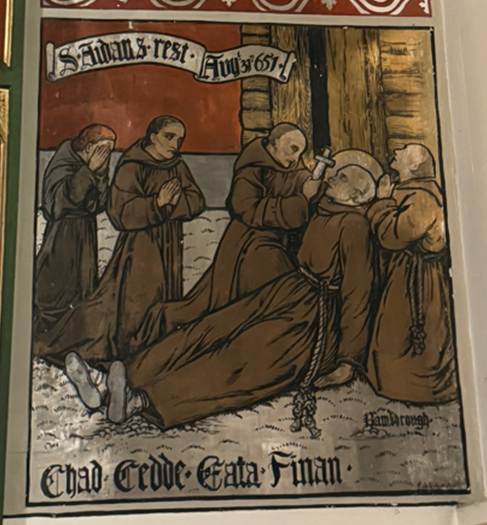
Mural at Helmsley
Parish Church
There
were at least six ecclesiastical foundations established in Northumbria by this
time. There were royal churches at Bamburgh and Yeavering. There was the monastery at Lindisfarne. The Church at the Deiran villa
regis of Campodonum (perhaps Doncaster, though this has been
debated, see Northumbria AD 367-867, Max Adams and Colm O’Brien,
2025, page 71 and 72) established by
Paulinus was destroyed by Cadwallon, but rebuilt perhaps by Oswine. There was
Paulinus’ church at York. Melrose, Mailros, was in existence by the late
640s as
was a monastery at Coldingham, established by St. Æbba around 640 CE. Cuthbert
became a monk at Mailros (Vita Sancti
Cuthberti, Bede).
On Oswine’s
death, Oswald’s son Œthelwald became King of Deira at the age of about 16, from
651 to 654 CE (Ecclesiastical
History, Bede, Book 3, Chapter 23).
653 CE
In a thawing of
relations with Mercia, Oswiu’s daughter Ealflæd had married Pæda one of Penda’s
sons, who converted to Christianity and in 653 CE Oswiu’s son Alhfrith had
married Cyneburh, Penda’s daughter, suggesting a wary truce between Mercia and
Northumbria by this time. Pæda was baptised by Finan, Aidan’s successor in Lindisfarne,
so Mercia had not turned southward to Canterbury for ecclesiastical direction.
Biscop
Baducing (known as Benedict Biscop), born into an aristocratic Northumbrian
family, visited Rome six times, first in about 653 CE at the age of 25. He
collected books and brought revolutionary ideas back to England. He travelled with
another Northumbrian nobleman, Wilfrid who later founded the monastery at
Hexham.
Wilfrid
eventually reached Rome where he admired the wonders and collected gifts and relics.
He also arrived in 653 CE, but separately to Biscop.
Since the
collapse of the Roman Empire, the population had plummeted to about 100,000,
but to the Northumbrian visitors it must have seemed a metropolis. Palaces,
baths, triumphal arches, aqueducts, fountains and other Roman relics remained.
The great Christian basilica of St Peter’s had been built by Constantine
the Great. By the late fourth century, Rome’s first bishop had started to be
known as papa, which in time evolved to Pope.
Wilfrid was
blessed by Pope Martin I before returning via Lyon, with a collection of
relics. He must have taken with him a reverence of the Roman doctrines of
Christianity. Wilfrid enjoyed the trappings of the continental bishops, who far
from Aidan’s rejection of the gift of a horse, enjoyed splendour and comforts,
would not dream of travelling other than by horse, and lauded over their own
estates, often with luxuries such as wine cellars.
Indeed Wilfrid spent
another three years in Lyon, to enjoy those comforts before returning home.
Meanwhile the
Canterbury mission of St Augustine had come to an end when his last companion,
Honorius died in 653 CE and Lindisfarne had grown in influence, with Finan its
abbot consecrating bishops including Cedd
who was sent by Oswiu to found a see in Essex at Ythancæstir (Bradwell on Sea) and Tilbury.
Wilfrid by then a
proponent of the Roman ways, quickly determined to replace Celtic with Roman
traditions, settling initially in the more Roman Wessex.
Meantime Oswiu’s
eldest son, Alhfrith, sub-king of Deira, willing to challenge his father,
increasingly came under Wilfrid’s influence.
654 CE
Lastingham was founded by Cedd for Œthelwald so he could be buried there. Bede, in his History
of the English Church and People (731 CE), recorded a small monastic
community was founded at Lastingham (some 10 km northeast of Kirkdale) under royal patronage, partly
to prepare an eventual burial place for Æthelwald, Christian king of Deira,
partly to assert the presence and lordship of Christ in a trackless moorland wilderness
haunted by wild beasts and outlaws. (Ecclesiastical History,
Bede, Book 3, Chapter 23).
655 CE
By 655 CE any thawing of relationships between Mercia and
Northumbria had ended. Penda had steadily grown in power. The Mercians attacked
Northumbria for a third time with an army of enormous scale according to Bede
comprising 30 legions, including those of kingdoms subdued to ally with Penda, such
as East Anglia. It is not clear what gave rise to the breakdown of relations
between Mercia and Northumbria, but it may have been driven by Oswiu’s
expansionist ambitions, especially to dominate the northern Britons. Penda
seems to have devastated the Northumbrian lands north to the Forth. It seems
that Oswiu sued for peace in return for a very significant hoard of treasure
which, although Bede denied it (since Oswiu later reneged on the deal), Penda
seems to have accepted since he retired to the area around Leeds. (Ecclesiastical History, Bede, Book 3, Chapter 24). It was there that Oswiu led a
surprise attack on Penda.
It is
possible that the hoard of treasure may be the
Staffordshire Hoard discovered at Hammerwich in 2009 (The Anglo Saxons, A History of the
Beginnings of England, Marc Morris, 2021, page 82 to 83).
In 655 CE, Oswiu
killed Penda at the Battle of the
Winwaed on the River
Went, which gave the Northumbrian King control the Kingdom of Mercia. The Battle of the Winwead was fought on 15 November 655 between King Penda of Mercia and Oswiu
of Bernicia, ending in the Mercians' defeat and Penda's death. The battle
took place on the River Went between Castleford and Doncaster, an area prone to
flooding. Penda’s forces considerably outnumbered Oswiu’s. Oswiu launched a
decisive attack at dawn and the Mercians were driven back to the swollen river
from where there was no escape. Hundreds drowned in a disastrous encounter for
the Mercians. (Ecclesiastical History,
Bede, Book 3, Chapter 24). Oswiu
subjected the Picts to his rule.
The
outcome was transformative for Oswiu. It removed Penda and broke the Mercian
aggression that had troubled Northumbria since the death of Edwin twenty years
previously. It also put an end to any Strathclyde or Pictish incursions from
the north and, above all, established Oswiu as the dominant force of his age. (Northumbria
AD 367-867, Max Adams and Colm O’Brien,
2025, page 136).
According
to Bede, the battle marked the effective demise of Anglo-Saxon paganism. It
marked a temporary Northumbrian ascendency.
Penda was the
last great pagan king of Anglo-Saxon England. Northumbria, Kent, Wessex,
East Anglia and now Mercia were now Christian and only minor kingdoms such as
Sussex and Essex remained pagan for a generation longer.
Œthelwald
waited to see who would win and was killed by Oswiu. Oswiu ruled over Mercia
until 658 CE, which he divided. He ruled northern Mercia directly and placed Penda’s
son Paeda as king of its southern part (Ecclesiastical History, Bede, Book 3, Chapter 24). He appointed Diuma as bishop of Mercia, Lindsey and Middle
Anglia. He also subjected the Picts to his rule. Œthelwald disappeared from the
records after the battle.
There followed
religious foundations in Deira after the Battle of Winwead in the Vale of
Pickering and in the area between York and Whitby, which appear to
have included Lastingham,
Kirkdale,
Coxwold, Hovingham
and Kirby Misperton.
Clearly
Oswiu experienced a tremendous increase in personal power and prestige
following his victory at the Winwead. First, it must have enabled him to
consolidate his hold on Anglian territories north of the Humber, establishing
himself securely now not only in Deira but also presumably over the more
outlying regions of his Kingdom. Bede also tells us that he established his
rule over the southern kingdoms for three years after Penda’s death (The Earliest English Kings, D P Kirby, 2000, page 1).
European chaos
Europe
was chaotic in this period with conflicts between Visigoth leaders in Spain
leading to the acquisition of Moorish mercenaries; and Germanic Lombards
dominating in Italy.
The
Frankish Kingdom, founded by Clovis in the early sixth century fractured in the
seventh century in wars between his successors, the Merovingian kings who
derived their name from the legendry hero of the Salian Franks, Merovech. The
Merovingian lands were divided between rival factions – an eastern branch of
Austrasia, ancestor to the Holy Roman Empire and a western branch called
Neustria. Northumbria’s
bishop Wilfrid supported the Austrasian faction and in doing so gained the
enmity of the Neustrians. Churchmen and monks regularly crossed the North Sea back
and forth during this period.
The Northumbrian Golden
Age, c 655 CE to c 793 CE
After the
Battle of Winwead in 655 CE Oswiu had become one of the
most powerful rulers in Britain. He secured control of Deira, where his son
Alhfrith served as a sub-king. For three years, Oswiu’s power over Mercia
earned him recognition as Bretwalda.
There is no record of military
conflict from 655 to 670 CE, and Oswiu was able to focus on building a
Northumbrian state.
It was in the late seventh century, with the emergence of kings
like Oswiu, that kings became heads of state who introduced a concept of
statehood and kingship that might be recognised today. As kings were
Christianised, their rights and obligations started to crystallise. Kings
became lawgivers and judges, inspirers of poets and patrons of craftsmen such
as metalsmiths. They started to select principes, praefecti, duces
and reeves. When they were able to fulfil these functions and remain alive for
more than about 7 years, they contributed to the longer-term success of their
kingdom. (The King of the North, the Life and
Times of Oswald of Northumbria, Max
Adams, 2013, page 198 to 200).
The revolution in Northumbria was driven initially by Æthelfrith, Edwin,
Oswald and Oswiu. It was also driven by ecclesiastical figures including Abbess
Hild of Streanæshealh; Cuthbert, the monk bishop and hermit; Benedict Biscop, monastic
founder and promoter of learning; Wilfrid of Ripon, an early prince-bishop on
the European stage; Bede; Archbishop Ecgberht, the King’s brother and educational pioneer
and his successor Ælbert; and Alcuin.
The
mysterious Frank’s Casket was found in the early nineteenth century in a
private house in France and later bought by Augustus Franks from whose name it
derives. It is an Anglo Saxon work of whalebone ivory, oblong in shape. It
includes illustrations of Roman, Jewish, Christian and Germanic legends and
uses runic and Latin script. It combines pagan and Christian themes. It
includes the riddle The fish beat up the sea on to the mountainous cliffs.
The king of terror became sad where he swam on to the shingle. It was
probably made in Northumbria in the eighth century. The original casket is in the British
museum and there is
a copy in the Jarrow Hall Bede Museum and the Ad Gefrin museum in Wooler.
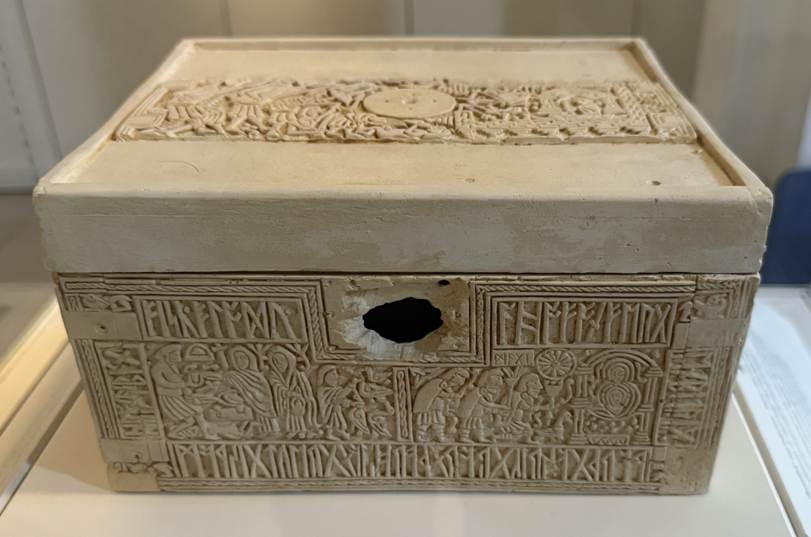
656 CE
After his success
against Penda, Oswiu replaced Œthelwald with his battle commander and son,
Alhfrith who was King of Deira from 656 to c 664 CE. Alhfrith married Cyneburh,
daughter of Penda of Mercia. Paeda was treacherously murdered by Alhflaed and
Oswiu ruled all of Mercia directly until 658 CE. (Ecclesiastical
History, Bede, Book 3, Chapter 24).
The twelve
monasteries
While
faced with Penda’s threats, Oswiu had made promises: that, should he be
victorious, he would in thanksgiving dedicate his infant daughter to God in
perpetual virginity and that he would found 12 new monasteries.
(Northumbria AD 367-867, Max Adams and Colm O’Brien, 2025, page 137).
Therefore, in
consequence of his victory over Penda, following the birth of his daughter and
the founding of Gilling Abbey after his promise of penance for the death of
Oswine, Oswiu offered twelve small estates of ten familiae,
generally interpreted as hides each for the foundation of monasteries,
six in Bernicia and six in Deira, an attempt to join two people into a single
kingdom.
The families within the gifted lands became tenants of the
monastery owing service and render as previously to the king, making the new
monasteries territorial units. This was the early stage of a process which
would lead to imbalance as royal lands came to be permanently alienated.
He gave his daughter Ælfflæd into the care of Hild at Hartlepool
and later Whitby where, in time, she became abbess.
Oswiu’s even handed gift was to fulfil his project of unification.
There
were already monasteries at Heruteu (Hartlepool) and another at Streanæshealh
(Whitby). Other early monasteries included the already established Campodonum,
Donemutha and Hexham. The new Bernician monasteries probably focused
along the Tyne valley, including Gateshead, Bywell and Tynemouth. Coldingham may
have been a Bernician monastery.
Richard Morris (Landscapes and Conversion among the Deirans: Lastingham
and its neighbours in the Seventh and Eighth Centuries, Richard Morris, in Places of Worship in Britain and Ireland,
300 to 950, P S Barnwell, 2015, pages 115 to 151) suggested that the
Deirian monasteries were focused in Ryedale along the edge of the Vale of
Pickering, with some or all of the six established there. The intensity of
royal interest in this area is striking. Texts provide evidence of at least six
kings being associated with religious houses from the mid seventh to mid eight
centuries.
· Oswiu and Oswine
had links with Gilling.
· Œthelwald had
links with Lastingham.
· Ecgfrith had
links with Crayke.
· Eadberht and Ædelwald
Moll had links with Coxwold and Stonegrave (a letter from Pope Paul I to King Eadberht
rebuked him for having taken these monasteries from Abbot Fordred and given
them to Ædelwald
Moll).
· Hovingham
may have been a royal estate centre.
· Fragments
of ecclesiastical sculpture such as crosses are found across Ryedale.
· This
area is around the northern edge of Brian Roberts’ Deiran corelands,
suggestive of lands available for granting.
Thomas Pickles (Power, Religious Patronage and Pastoral Care: Religious
communities, Mother Parishes and Local Churches in Ryedale, c 650 to c 1250, T Pickles, Kirkdale Lecture,
2009, pages 18 to 20) reconstructed the geography of the early royal
territories transferred to the church. The lands associated with Royal vills
were often referred to with the suffix, -ingas, the people of,
and Piceringas (Pickering), Læstingas (Lastingham) and Hofingas
(Hovingham) are examples.
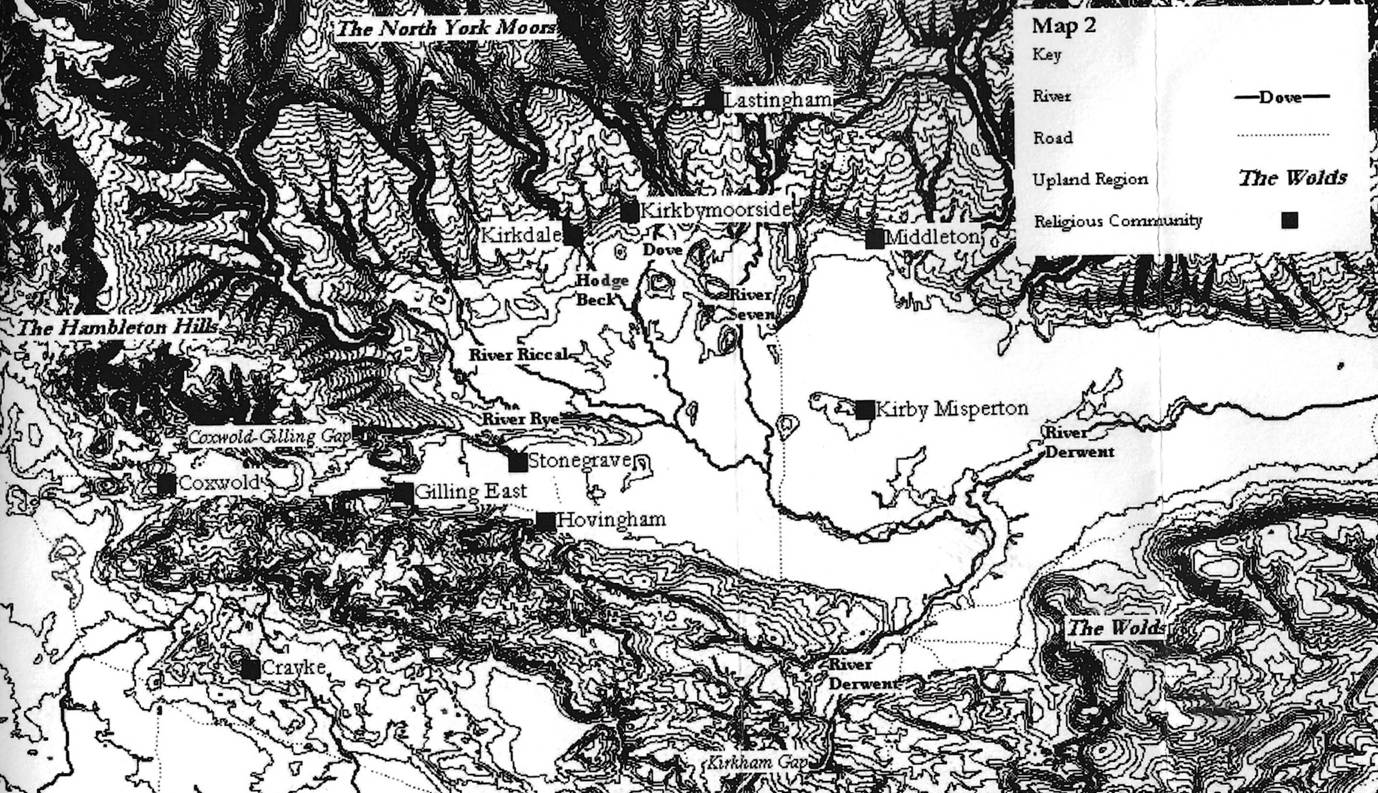
Geographical proximity;
fragments of sculptural and textual evidence interconnection between Hovingham,
Gilling, Coxwold and Stonegrave.
On the north edge
of the Vale of Pickering are Kirkdale
and Lastingham.
Ian Wood (Lastingham in its sacred landscapes, Ian Wood, Professor of Early Medieval History, The
Fifth Lastingham Lecture, 2008, pages 13 to 23) also believed that many of the foundations in Deira were in the Vale of Pickering
and may have included some of:
·
Lastingham.
·
Stonegrave (Donaemuthe) and Coxwold, both referred to in a letter
from Pope Paul I to Eadbert of Northumbria in 757 CE.
·
St Gregory’s Minster at Kirkdale, associated with Ceolfrith’s cornu vallis.
·
Crayke, referred to in Historia de
Sancto Cuthberto.
·
Hovingham, Kirkbymoorside, Middleton and Kirby Misperton, on the
evidence of early sculpture.
·
Another site where fragments of cross shafts and grave covers have
ben found is at Sherburn, 5 kilometres east of West Heslerton, a place of well
excavated medieval settlement, southeast of Pickering.
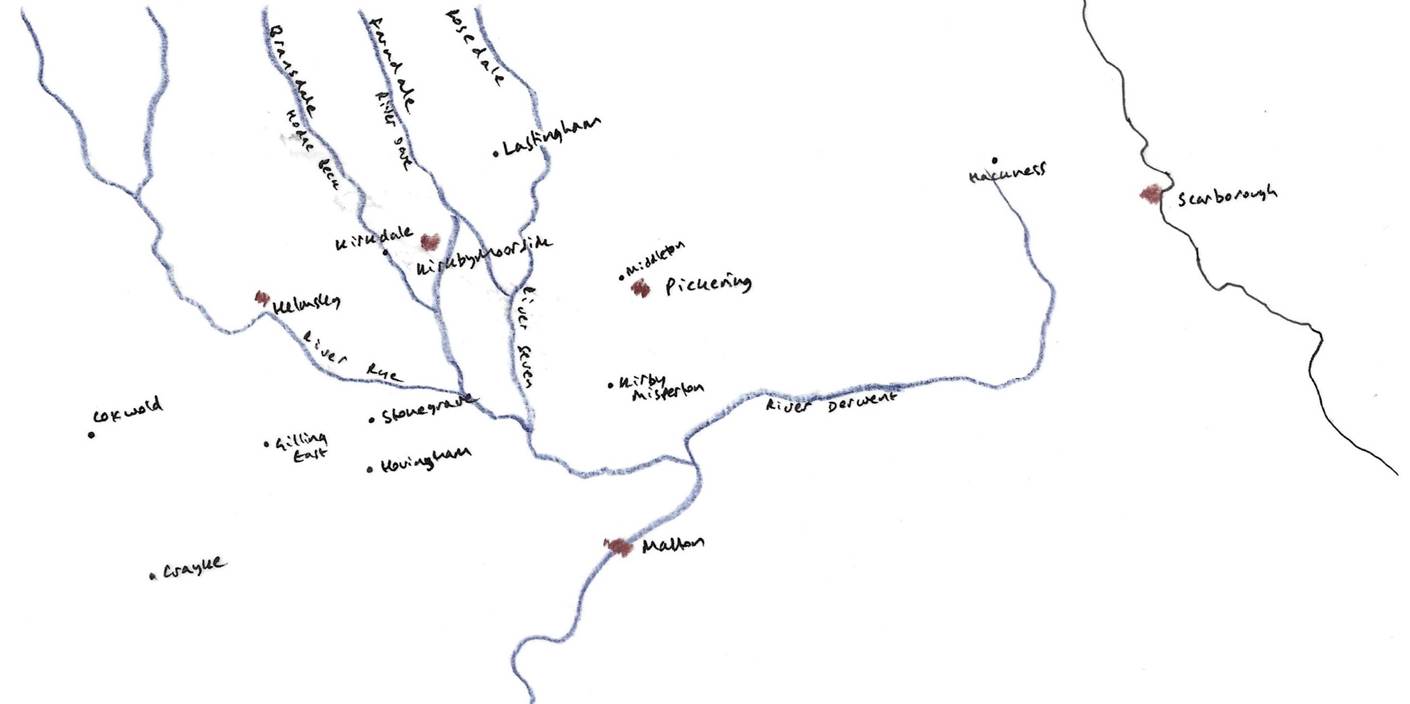
Land was invested
from the royal portfolio in a more subtle display of royal power. This laid
down extended networks of dynastic obligations and their permanence encouraged
the new institutions to put down roots. (The King of the North, the Life and Times of Oswald of
Northumbria, Max Adams, 2013, page 292
to 294).
The very early
history of the development of the ecclesiastical landscape is not particularly
clear. It consisted of Minster, ‘mother’, churches, which sat within large
parishes known by the Latin name parochiae. Both minsters and parochiae had
origins in the late seventh century and the Middle Saxon period. Parochiae and
minsters were grouped together within a diocese. After the tenth century we see
the development of smaller parishes, as opposed to parochiae, but this was part
of a much larger set of landscape rearrangements. It has been suggested that
the earliest diocese and boundaries probably coincided with the boundaries of
later seventh century and Middle Saxon kingdoms. This would make much sense if,
as seems probable, the conversion of the English to Christianity happened from
the top down: convert a king or tribal leader and his territorial boundaries
became those of the church he sponsored. (Britain in the Middle Ages, An Archaeological History, Francis Pryor, 2007, page 114).
Oswald had been
satisfied with a single royal foundation at Lindisfarne, but Oswiu’s multiple
foundations led to a multiplicity of relationships with his abbots.
The church in
Anglo-Saxon England (just as in Ireland and Pictish Scotland) was a natural
extension of the aristocracy and was dominated by men and women of high birth. (A History of Britain, At the Edge of the
World, 3,000 BC to AD 1603,
2009, Simon Schama, page 50).
657 CE
The first monastery of Streanæshealh (Whitby) was founded
in 657 CE by Oswiu. (Ecclesiastical History,
Bede, Book 3, Chapter 24) and a
noblewoman, Hild became its abbess. The abbey was a double monastery, housing
monks and nuns. Whitby continued to have an ongoing importance as a port, which
was enhanced by the foundation of a monastery there.
Oswiu had subjected
most of the land of the Picts but handed back southern Mercia below the Trent
to Paeda.
658 CE
Oswiu plundered
Mercia. A rebellion by Mercian ealdermen expelled Northumbrian governors and
made Wulfhere, son of Penda, king (Ecclesiastical
History, Bede, Book 3, Chapter 24). Although this counter coup restricted
Oswiu’s power in Mercia, Wulfhere appointed a series of Northumbrian bishops in
Mercia so Oswiu retained some influence through soft power.
660 CE
Ripon and Wilfrid
Ripon
was first established in 659 CE by Eata, Aidan’s protégé who had been trained
in the Irish manner at Lindisfarne. Cuthbert became its guest master. Yet Ripon
was far from Lindisfarne and within a short time Eata was replaced after a
coup. Wilfrid had returned to Britian at about the time Eata had been given
forty hides at Ripon to found a new monastery. Wilfrid charmed Alhfrith, Oswiu’s
son and sub king of Deira, and he was given ten hides of land to found his own
monastery at Stanforda, perhaps Stamford Bridge. The self serving and
ruthless Wilfrid, of a noble family, and favoured by Queen Eanflæd became its
abbot. Wilfrid was given Ripon with thirty hides by Oswiu’s eldest son,
Alhfrith. He expelled the community of Eata, in order to adhere to his
preferred Roman traditions. He therefore introduced the Benedictine Rule of the
sixth century Italian abbot, Benedict of Nursia. (see also in detail at Northumbria AD 367-867, Max Adams and Colm
O’Brien, 2025, page 145
which suggests Ripon was established at a place of political significance not
far from Roman Aldborough).
Ceolfrith entered the monastery of Gilling, probably in Ryedale, where his brother Cynefrith was abbot.
664 CE
Competing forms
of Christianity
There were broadly three strands of Christianity.
·
Rome’s direct connection with Britain was through Canterbury, but
Rome’s knowledge of the early Anglo-Saxon church was patchy. In Canterbury
authority was vested in the bishop and followed an established Roman hierarchy.
The Augustinian church had undertaken far less missionary work.
·
The Irish church adopted a different model where the abbot of each
monastery was supreme. Bede believed the Irish Christians to be simply wrong
but had some admiration for their ascetic virtues and their influence of the
Northumbrian kings.
·
The British church probably reflected the Irish more than the
Roman. The British Christians were dismissed by Bede as wicked and
uncompromising, refusing to follow the instructions of the papacy.
Bede wrote that it is said that in these days it sometimes
happened that Easter was celebrated twice in the same year, so that the king had
finished the fast and was keeping Easter Sunday, while the queen and her people
were still in Lent and observing Palm Sunday.
The deployment of sub Kings by Oswiu was probably not weakness,
but recognition of the need for more complex administration of a growing
kingdom. This growing and more sophisticated administration provided the
opportunity for men like Wilfrid to forge careers. Alhfrith was growing in self
confidence and more willing to challenge his father and Eanflæd shared Wilfrid’s
more Roman outlook. Oswiu probably still regarded increased Romanisation as a
threat. Although wary of the Roman influence, it may be that Oswiu did not need
a direct challenge from his son to realise a need to resolve the issues.
Eanflæd had brought Roman rituals to the royal court and James the Deacon had
been following Roman practice in celebrating Easter for thirty years.
(The King of the North, the Life and Times of Oswald of
Northumbria, Max Adams, 2013, page 306
to 309, The Anglo Saxons, A History of the Beginnings
of England, Marc Morris, 2021, page 97).
Alhfrith
apparently clashed with his father over religious policy, which came to a head
at the Synod of Whitby in 664 CE. After
the battle of Winwead, when Alhfrith was probably about 20, following which he became
sub regulus of Deira, he seems to have soon become dissatisfied with the
ecclesiastical situation in the north when he came to be influenced by Wilfrid.
It was Alhfrith who had rejected Eata, abbot of Melrose and pupil of Aidan and
Cuthbert from his new foundation at Ripon and committed it instead to Wilfrid. (The Earliest English Kings, D P Kirby, 2000, page 87).
Finan had died in
661 CE and was succeeded at Lindisfarne by Colman, another Ionan.
The Synod of Whitby
In
order to resolve religious contradictions, Oswiu presided over the Synod of Whitby at Streanæshealh in 664 CE. Streanæshealh
was situated beside a sheltered port accessible from the eastern coast of
Britain and the ports of Gaul and close to the ecclesiastical sites along the
coast. The abbey of Hild, Edwin’s grand niece, founded in the 650s bore no
resemblance to the later thirteenth century Benedictine abbey. Like Hartlepool,
Streanæshealh was a double monastery under the rule of a single female
abbess. Wilfrid would have disliked the idea of a double monastery.
Oswiu, taught in
childhood on Iona, had a natural tendency towards to Irish church. Hild’s
sympathies lay with the Irish form. Colman was a hardliner on the Irish side.
Cedd was then bishop of the East Saxons and an alumnus of Lindisfarne.
If Alhfrith lost
the debate, he would have to submit to his Bernician father and lose his
independence. Agilbert was a Gallic bishop of Wessex and senior of the Roman
party. He brought his own priest Agatho. James the Deacon was in the Roman camp.
Eanflæd’s priest Romanus attended. As Agilbert spoke English badly, Wilfrid was
asked to plead the Roman cause.
The decision
would be irrevocable. The kings of Wessex, East Anglia and Kent were not
invited. This was a Northumbrian matter, though its ramifications would impact
on the wider Anglo-Saxon world. Oswiu was perhaps portraying himself as Regis
Saxonum. Whilst Bede saw the conference as the resolution of tension
between the Irish and Roman churches, the British church may also have been represented.
Oswiu would no
longer allow two traditions to continue side by side. The debate probably
continued for days or weeks. In Bede’s summary, the King asked Colman to say
which customs he followed and from where they originated. Colman appealed to
the traditions of his forefathers and the authority of John and Colm Cille.
Wilfrid argued that Easter was universally celebrated in Rome where the
apostles Peter and Paul had lived and taught and said that the practice was adopted
across the world in Italy, Gaul, Africa, Asia, Egypt and Greece. When Colman
agreed that St Peter held the keys to heaven, the king decided that it was
unwise to contradict Peter’s approach. The decision was made in favour of the
Roman tradition.
(The King of the North, the Life and Times of Oswald of
Northumbria, Max Adams, 2013, page 314
to 320, The
Anglo Saxons, A History of the Beginnings of England, Marc Morris, 2021, page 98 to 99).
The decision that the future of England lay with the Roman rather
than the Celtic church was a most important decision because it ensured that
thenceforward British and intellectual attention would be directed towards
Europe. The medieval period was also a time when the authority of the church
played a central role in most aspects of the life of the nation. Before Whitby
the church was altogether more fragmented, and its growth more organic. After Whitby
it became a significant power in the land. The increasing importance of the
church also promoted literacy and gave rise to a greater and more widespread
use of written documents. (Britain in the Middle Ages, An Archaeological History, Francis Pryor, 2007, page 23).
Wilfrid adopted
the patronising position that Colman’s predecessors could be forgiven their
ignorance owing to their rude simplicity, but that persistence would be a sin.
Unification of
the English church
Oswiu had outflanked
his son Ahlfrith, ingratiating himself with the papacy and deflecting his son’s
attempt to isolate him from the southern kingdoms. The outcome cemented a
dominance of Northumbria in the momentum towards a unified English kingdom
which would follow centuries later and gave Oswiu the political capital to
begin a process of reform.
There is an In Our Time podcast about the history of English national identity which
examines the concept of the Nation State in an era of globalisation.
Colman refused to
accept the verdict and resigned the bishopric of Lindisfarne. His dismay was
shared on Iona who did not accept Roman orthodoxy for another two centuries.
Colman later took some but not all of Cuthbert’s remains with him. The
portability of human remains provided a focus for veneration. King Edwin’s
skull was the principal relic at York. Corporeal remains had become a
commodity. The remains of ancestors had been revered in barrows in the Bronze
Age and continued to be adopted as physical elements of ritual. (The King of the North, the Life and Times of Oswald of
Northumbria, Max Adams, 2013, page 334
to 338).
Oswiu took the
opportunity to separate the monastic from the episcopal functions of the
Northumbrian church and established a new see at York, in the centre of Deiran
territory. By separating the offices of bishop and abbot, the king established a
hierarchy whereby the king appointed an archbishop under whom bishops and
abbots owed their allegiance. A form of civil administration developed from a
hierarchy of delegation. This was the inception of administrative statehood.
By the late
seventh century evidence from excavations at Fishergate suggests that York was
minting coins and hosted a settlement of Frisian traders. Oswiu developed a
model of kingship more like that of the much later Tudor period. He established
a new hierarchy of patronage and opened new career opportunities to the growing
Northumbrian nobility. As that patronage flowed towards the church, the bishops
and abbots themselves gained increasing political capital.
(The King of the North, the Life and Times of Oswald of
Northumbria, Max Adams, 2013, page 321
to 323).
In the seventh
century CE, Frisian traders established a small, influential mercantile
community in Eoforwic, near the Fishergate area at the confluence of the
Ouse and Foss rivers. As part of a broader North Sea network, they operated as
middlemen exporting raw materials like wool while importing luxuries and
slaves, linking York directly to Continental centres like Dorestad. They were middlemen in the slave trade, sometimes
exchanging them for high-quality goods. They also traded pottery, textiles, and
metalwork.
By 627, however,
York was evidently already a royal centre in the recently united Northumbrian kingdom.
With the founding of the first Anglian church there by Edwin in 627 it began
too a long history as an ecclesiastical centre (Ecclesiastical
History, Bede, Book 2, Chapter 14). There is
historical evidence enough for the following 250 years to show that it
continued to fulfil both these roles. At times at least it was also a centre of
population, commerce, culture and learning until it passed into Danish hands at
the attack of 866 and became the capital of an Anglo-Scandinavian kingdom
following Healfdene's settlement of Northumbria in AD 876. (Hemp, Richard L. 1996. Anglian
Settlement at 46-54 Fishergate. York Archaeological Trust).
Following a solar
eclipse, there was a well recorded and devastating plague across Britain in 664
CE. There was depopulation in the south and in the north it raged far and
wide with cruel devastation, laying low a vast number of people (Ecclesiastical History,
Bede. Book 3, chapter
27; Northumbria AD 367-867, Max Adams and Colm O’Brien, 2025, page 154).
When the Bishops
of Northumbria, Essex and Rochester all died, Wilfrid had an opportunity to become
Northumbria’s new bishop, but since there were not sufficient bishops left to
formally consecrate him in Britain, he was sent by Alhfrith for Francia where,
as was his want, he stayed for some time.
On his eventual return he was blown off course to the lands of pagan
Sussex, where he escaped a mob.
666 CE
During Wilfrid’s
absence, Oswiu (who may not have approved his son Alhfrith’s despatch of
Wilfrid for consecration as a bishop) stamped his authority by nominating Cedd’s
brother Chad as bishop in Northumbria (at this stage probably still in the
process of becoming the bishop at York) in 666 CE by the Bishop of Wessex and
two bishops of the British race. Wilfrid temporarily retired to his
abbacy at Ripon.
Oswiu continued
to favour both camps.
There followed a
period when the southern kingdoms used Wilfrid’s new consecration as a bishop
to appoint new priests and Oswiu allied with the King of Kent to curb Wilfrid’s
new power by appointing the priest Wigheard, to become the new Archbishop of
Canterbury. On arrival in Rome however, Wigheard died of the plague.
After this, Alhfrith
disappeared from the historical record. Ecgfrith
was
Deira’s Sub-King from 664 to 670 CE.
670 CE
A
new archbishop was installed in Canterbury, Theodore of Tarsus, an unlikely 66
year old Greek speaking monk from Asia Minor. He was born in southeast Turkey
in about 602 CE. He would take the church and state reform to a new level in his
20 year career. He brought the English churches under a single authority
launching a programme of change and centralisation. This was the groundwork for
the Church of England. (Ecclesiastical
History, Bede, Book 4, Chapter 1)
Theodore
immediately wielded the power of the pope and Wilfrid was restored to the see
of Northumbria. Chad returned to Lastingham as abbot. Wilfrid realigned with Roman
practices and began a restoration of Paulinus’ dilapidated church at York.
Churches in
Britain had been monastic centres of monks and/or nuns. As new churches started
to be built, often of stone, they adopted a function more as a mission station
for conversion. These churches came to be known as minsters, sometimes
closed institutions for a few pious aristocrats, and sometimes serving a wider
community, though still on a small scale since parish churches for ordinary
folk were still unknown. Preaching to
ordinary folk was undertaken in the countryside, perhaps under a wooden cross,
which in time may have become places marked by carved stone crosses.
Oswiu died from illness on 15 February 670 CE, aged
58. He was the first king of his dynasty to die in his bed. He was interred at
Whitby, where his widow and daughter would become abbesses.
Wilfrid expelled monks from Ripon and built a stone
church. This was a grander project than his restoration work at York. He constructed
a building fit for a Roman bishop, comprising a basilica with a still surviving
crypt. Nothing like it had been seen in Northumbria previously. He also
commissioned a set of gospels written in gold on purple parchment likely
destroyed in 948 CE when King Eadred burned the abbey, or subsequently lost
during the tumultuous centuries of Viking and Norman destruction. Wilfrid was
able to bring masons, glaziers, scribes and jewellers from Frankia.
Queen Eanflæd retired to the abbey at Whitby.
Ecgfrith
Ecgfrith was King of Northumbria from
1 to 17 September 670 until his death in 20 May 685. He had been Sub-king of Deira under his father Oswiu, upon whose death he became king
of all Northumbria. He ruled over Northumbria when it was at the height of its
power (The Reign of King Ecgfrith of Northumbria, Kenneth Harrison, Yorkshire Archaeological Journal,
Volume 43, 1971, page 79). Ecgfrith
showed his military skill when he repelled attacks from the Picts and the
Mercians. He was a highly capable ruler and
continued his predecessor’s policy of aggressive territorial acquisition. He
maintained Northumbria’s influence over the Picts north of the Forth and won
back control of Lindsey over Mercia (The Anglo Saxons, A History of the Beginnings of England, Marc Morris, 2021,
page 108).
The 8
year old Ælfwine was Deira’s sub-king from 670 CE to 679 CE. Ælfwine, son of Oswiu of Northumbria and a brother of Ecgfrith, was
still a boy in 670 CE, and his sub-kingship might have been intended to
designate him as the heir of the childless Ecgfrith.
Ecgfrith,
son of Oswiu, came to the throne in 670 in favourable conditions, achieving
diplomatic and military successes early in his reign. But losses in his later
years, culminating in a disastrous campaign of 685 against the Picts in which
he was killed, saw the end of Northumbrian dominance North and South of its core
territories. In religious matters, however, the consequences of his father's
decision at Whitby to adopt the Roman strand of Christianity bore fruit in
spectacular developments initiated by Wilfrid and Benedict Biscop. A
distinctive and especially vibrant micro-Christendom arose in Northumbria in
the 670s and 680s. It nurtured Bede; it drew Northumbria into the learning and
culture of western Christendom; it transformed the Northumbrian countryside; and
it flourished into the time of Alcuin in the 8th century. (Northumbria
AD 367-867, Max Adams and Colm O’Brien,
2025, page 155).
As a boy, Ecgfrith had been a hostage in the
household of Queen Cynewise of Mercia, and had survived after Penda’s death,
having developed an understanding of the Mercian court and political
complexities.
Wilfrid benefited from Ecgfrith’s new acquisitions as he gained
new ecclesiastical influences. At the consecration of the new stone church at Ripon,
Wilfrid announced new lands acquired for the church by land acquired by the
suppression of British churches, which may have included lands around Sedburgh,
Preston, Craven in Lancashire and Yeadon near Otley. The suppression of the
British churches and the aggrandisement of Wilfrid’s landholdings here extended
Northumbrian interests into the Pennines beyond the watershed and on to the
coastal plain of Lancashire north of the River Ribble. (Northumbria
AD 367-867, Max Adams and Colm O’Brien,
2025, page 157).
Under the
charismatic leadership of king Ecgfrith, the Northumbrian royal house and its
rise to power seemed unstoppable. King
Ecgfrith was the fortunate one who was most able to enjoy the fruits of his
successors (sic, recte predecessors?) labour. When he took the throne, he and the kingdom
of Northumbria were in the convenient position of catapulting the English
people into a position of domination over all of Britain, including Scotland.
(The First Battle for Scottish Independence,
AD 685, Julie Fox Parsons, 2002, page 25).
672 CE
By 672 CE,
perhaps buoyed by the death of Oswiu, Ecgfrith faced rebellion by the Picts.
The rebellion was put down and Ecgfrith controlled southern Pictland from
Argyll to Aberdeenshire. The coastal zone from the Lammermuir hills to the
Firth of Forth was under Northumbrian control, centred on Dunbar, with a huge landholding
at Tyninghame. There are sites at Kirkliston near Edinburgh airport and Ratho.
The name is Northumbrian Old English, Tinangehām, and means Hamlet
on the Tyne. The original
church at Tyninghame was founded by St Baldred, an Anchorite described as
the Apostle of the Lothians. There was a chain of coastal settlements
from there to Coldingham, Lindisfarne and Bamburgh, Jarrow and Wearmouth, to
Hartlepool and Whitby. (see Northumbria AD 367-867, Max Adams and Colm O’Brien, 2025, page 165).
Oswiu’s
son and successor, Ecgfrith, rather than Oswiu himself, is far more likely to
have asserted his lordship over the Scots in the wake of his suppression of a
Pictish revolt of c 672 (The
Earliest English Kings, D P Kirby, 2000,
page 84). The implication of the evidence as a whole could be that it
was only in the reign of Ecgfrith that Northumbrian overlordship embraced the
Strathclyde Britons and the Scots (The
Earliest English Kings, D P Kirby, 2000,
page 70).
The
area of modern Lothian as well as the Borders were not as isolated from
Northumbria as the modern Borders suggest. The influence of Lindisfarne
stretched north of the Tweed. Many of the Anglian names of -ham and ingham
in southeast Scotland may have been church sites (Coldingham, Tynninghame,
Whittingehame, Smailholm (formerly Smallham), Kimmerghame (Berwickshire,
‘settlement at cow’s bridge’). There seem to have been cultural corelands in the
vicinity of the River Tweed and on the southern coast of the Firth of Forth
from Dunbar to Edinburgh/Abercorn. (Northumbria
AD 367-867, Max Adams and Colm O’Brien,
2025, page 217). There is also evidence of Northumbria’s influence in
Galloway, particularly Whithorn.
Bede
was born on lands belonging to the monastery of Monkwearmouth in the Kingdom of
Bernicia, in about 672 CE. Bede gave his birthplace as "on the lands of
this monastery" (Ecclesiastical
History, Bede, Book 5, Chapter 24).
Ecgfrith had been married at about the age of 16 in
660 CE to an East Anglian princess, Æthelthryth, a reluctant bride who maintained
her virginity. Northumbria thus retained its Kentish connections.
Needing a legitimate heir, he had the marriage dissolved in 672
CE. He took a new consort, Iurminburh. Wilfrid seems to have benefited from the
crisis when Æthelthryth left him estates in the Tyne valley and he created an
abbey complex at Hagustald, Hexham in 673 CE in even more
ambitious style than at Ripon. Hagustald was within the same territory
as Heavenfield. It was a frontier zone between the expanding lands of Bernicia
and the corelands of Rheged. There is a detailed description of the evidence
regarding the original church in Northumbria AD 367-867, Max Adams and Colm O’Brien, 2025, page 160. Hexham and Ripon are distinctive in having remarkably
similar reliquary crypts, sacred underground chambers and niches within
churches designed to house, protect, and display the relics, such as bones and
clothing, of saints, martyrs, and holy figures. They served as pilgrimage
centres for veneration. Before Æthelthryth’s grant of Hexham, Wilfrid’s Northumbrian
interests had been centred in Deira. His arrival into Bernicia and into lands
held within the Bernician ruling family could well have been seen as an
undesirable and destabilising intrusion into the politics of the realm and to
the family interests of the king.
Behind a modern wooden gate, is an opening in
the floor, from which a dozen steps descend. At the foot of this narrow
stairwell is a tiny antechamber, and beyond that, a small, windowless room,
only thirteen feet long and eight feet wide. Now evenly illuminated by electric
light, it would originally have been lit by flickering lamps placed in the two niches
in the walls on either side. This is the crypt of the Anglo Saxon church. It
was created in the 670s, and it brings us as close as is physically possible to
the world of its creator, St Wilfrid. (The Anglo Saxons, A
History of the Beginnings of England, Marc
Morris, 2021, page 85 to 86).
The church above it was over 30 metres long and rivalled the Great Halls of the
Northumbrian kings. It was built of stone, sourced from Roman sites along the
line of Hadrian’s wall, and therefore adopted a permanence that the kings had
been unable to achieve with their wooden structures.
Theodore convened the first nationwide Synod of the Church at
Hertford in 672 CE, which provided for regular further synods (Ecclesiastical
History, Bede, Book 4, Chapter 5).
The synod reaffirmed the authority of Canterbury and stamped on freelance
activities by bishops like Wilfrid.
673 CE
King Ecgfrith of Northumbria,
impressed by Benedict Biscop’s account of his travels, gave him 70 hides of
land on the north bank of the River Wear to found a monastery at Wearmouth.
At the same time
Æthelthryth left estates in the Tyne valley to Wilfrid to found Hexham (Ecclesiastical
History, Bede, Book 4, Chapter 19).
674 CE
Ecgfrith’s relations with Benedict Biscop were not so fractious as
with Wilfred. Benedict Biscop founded the monastery of St Peter’s at Wearmouth
on land endowed by King Ecgfrith, under the Pope’s protection. Biscop travelled
to Gaul to bring back craftsmen in glazing and mortar and installed Ceolfrith
as prior. The mortar mixer at Wearmouth was a technology widely used across
Western Europe. There are numerous fragments of window glass from Wearmouth and
Jarrow with vibrant colours. See Northumbria AD 367-867, Max Adams and Colm O’Brien, 2025, page 173. Biscop brought books from the Continent
which were not all wholly religious but included such topics as cosmography. He
returned from one journey with the pope’s liturgical specialist, John the
Cantor, to teach Roman practice. He acquired the single volume bible, the Codex
Grandior from Calabria. Wilfred and Biscop did not try to simulate Rome,
but to create their own micro-Christendoms, with their local distinctions.
This religious, cultural and constructional
activity depended on resources granted by the king, with 70 farms at Wearmouth
and 40 at Jarrow at their founding. These lands were also important for the
production of vellum for books from calf skins.
King Wulfhere of
Mercia invaded Northumbria, but was repelled (Vita
Wilfridi, Eddius Stephanus, 20).
676 CE
Cuthbert retired
to Inner Farne.
678 CE
Wilfrid was becoming
increasingly influential and at about this time he was involved in supporting the
return to Francia of Dagobert II from exile, soon to take the Merovingian
throne after a civil war in 675 CE. Wilfrid seems to have had sufficient power,
and warriors at his disposal, to support a successful foreign coup.
By the late 670s relations
between Wilfrid and the King, by then married to Iurminburh, had broken down.
Stephen attributes this to Iurminburh’s jealously and suggested that king and
queen persuaded Theodore to break up Wilfrid’s diocese in York.
It was at about this
time that Wilfrid learnt that Theodore intended to reform the structure of the
English church and divide Northumbria into smaller sees (close to Gregory’s
original intention of two metropolitan archbishoprics at Canterbury and York
with 12 bishops beneath each) and at this time the increasingly powerful
Wilfrid seems to have lost the King’s favour. Cuthbert was increasingly revered
and replaced Wilfrid in the King’s favour.
Theodore visited Northumbria
at Ecgfrith’s request where he convened a synod in 687 CE. Ecgfrith and
Theodore agreed that Northumberland would be divided into four dioceses of
York, Hexham, Lindisfarne and Abercorn on the Forth. Wilfrid was set to lose
75% of his domain. He travelled to Rome to appeal the decision. He returned a
year later with a papal bull in his favour, but the King ignored the
interference in what he considered to be a matter within the royal prerogative.
Wilfrid was imprisoned for a while. He was later freed into exile where he
settled among the now Christian South Saxons (Sussex). (The Anglo Saxons, A History of the Beginnings
of England,
Marc Morris, 2021, page 107 to 109, 112 to 116).
679 CE
By 679 CE
Ecgfrith influence in the Midlands was unravelling. Ecgfrith’s younger brother,
Ælfwine was killed in battle against the Mercians at the Battle of the Trent in
679. Bede wrote In the ninth year of
the reign of King Ecgfrith (in 679), a great battle was fought between him and
Æthelred, king of the Mercians, near the river Trent, and Ælfwine, brother to
King Ecgfrith, was slain, a youth about eighteen years of age, and much beloved
by both provinces; for King Æthelred had married his sister Osthryth. There was
now reason to expect a more bloody war, and more lasting enmity between those
kings and their fierce nations; but Theodore, the bishop, beloved of God,
relying on the Divine aid, by his wholesome admonitions wholly extinguished the
dangerous fire that was breaking out; so that the kings and their people on
both sides were appeased, and no man was put to death, but only the due mulct
paid to the king who was the avenger for the death of his brother; and this
peace continued long after between those kings and between their kingdoms. (Ecclesiastical
History, Bede, Book 4, Chapter 21).
Lindsey was lost to Northumbria. Theodore
oversaw a peace treaty.
There were
no further sub kings of Deira after the death of Ælfwine and Northumbria was ruled as a single
province.
Bede
was sent to the monastery of St Peter at Monkwearmouth at the age of seven as puer
oblatus. He was initially educated under Benedict Biscop.
Theodore’s second
Synod at Hatfield on 17 September 679 CE created new dioceses.
680 CE
Hild died at
Whitby and Eanflæd with her daughter Ælfflæd became abbess. (Ecclesiastical
History, Bede, Book 5, Chapter 24)
Aebbercurnig (Abercorn) was established
with a Northumbrian bishop on the Forth.
The Tribal Hidage (Cartularium saxonicum, 1885, Walter de Gray
Birch, Volume 1, Folio
297, see also the
History Files) is a list of thirty-five tribes that was compiled in
Anglo-Saxon England some time between the 7th and 9th centuries. It includes a
number of independent kingdoms and other smaller territories, and assigns a
number of hides to each one. It includes all the seven kingdoms of the
Heptarchy except Northumberland but substantiates a picture of the
evolution of kingdoms. It has been suggested that it was compiled by a
Northumbrian King drawing tribute from the other kingdoms.
The Tribal Hidage survives to us
in the form of an 11th century manuscript, now in the British Library, which,
to judge from the places mentioned, is based on much earlier information. The
term hidage refers to a hide, which was a holding of land considered sufficient
to support a family. It would seem that this document is a copy of a much
earlier list which itemises the holdings of 35 named tribes, whose whereabouts
and geography coincide with what we know about England in the late 7th century,
say 680. Andrew Reynolds suggests that the Tribal Hidage is best seen as a one
off snapshot of Middle Saxon England, rather than some sort of developing
historical document. (Britain in the Middle Ages, An Archaeological History, Francis Pryor, 2007, page 111).
Some further idea of the mosaic of territories
in pre Viking England can be gained from the document known as the Tribal
Hidage. This is a list of total assessments in terms of hides, units of
taxation, for a number of territories south of the Humber, which have been
variously dated from the mid 7th to the second-half of the 8th century. (The Earliest English Kings, D P Kirby, 2000, page 9)
681 CE
King Ecgfrith gave 40 hides of land at Jarrow to Benedict Biscop. In
681 CE a sister monastery to Monkwearmouth was founded at Jarrow by Abbot
Ceolfrith with a group of 17 or 22 brethren.
Although two different sites, they functioned as a single monastery,
although Ian Wood suggests that this may have been later (Northumbria AD 367-867, Max Adams and Colm O’Brien,
2025, page 171; Wearmouth and Jarrow Monastic Sites, Volumes 1 and 2,
Rosemary Cramp, 2006). The inscribed
stone at Jarrow recorded its dedication on 23 April 685 CE. The dedication
of the basilica of St Paul on the 9th day before the kalends of
May in the 15th year of King Ecfrid and in the 4th year
of Abbot Ceolfrid, found, by the guidance of God, of the same church.
|
|
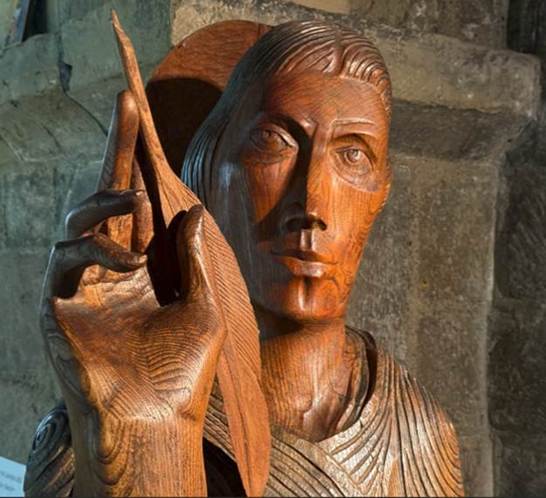
In the 680s King
Edwin’s bones were moved to Whitby, confirming Whitby’s links with the Deiran
kings. After his death in 632 CE, his skull had been taken to York and placed in
Paulinus’ church. Whitby seems to have been elevated to the principal religious
site of the Deiran royal family.
684 CE
In 684 CE
Theodore appointed Cuthbert as bishop of Hexham. Cuthbert was a native
Northumbrian who had been prior of Melrose Abbey. He was about the same age as
Wilfrid, but his opposite in character, being far more pacific. He had retired
to be a hermit on Inner Farne for about a decade before he was appointed bishop
after a personal delegation led by Ecgfrith pleaded with him to do so. He was
consecrated as Hexham’s new bishop in York.
The final years
of Ecgfrith’s reign were troubled. In 684 CE he sent an expedition to Ireland,
perhaps as a platform to reassert influence over the Picts. (Flores Historiarum,
Roger of Wendover’s Flowers of History, J A Giles 1849, page
110).
685 CE
Having been advised
by Cuthbert against an invasion of Pictland, Ecgfrith was defeated at the Battle of Nechtansmere on 20 May 685
CE, perhaps at Dunnichen near Forfar, against the Picts of Fortriu in which he
lost his life (Ecclesiastical
History, Bede, Book 4, Chapter 26). He
was defeated in narrow passes in the midst of inaccessible mountains.
This was a heavy blow to the expanding Northumbrian kingdom. Nechtansmere was a
turning point and the British to the west reversed the tide of conquest while
the Picts in the north recovered their territories to the Forth. Never again
would a Northumbrian king wield imperium over the larger part of Britain (The
King of the North, the Life and Times of Oswald of Northumbria,
Max Adams, 2013, page 373; Nechtansmere, Antiquity, Volume 22, 1948,
pages 82 to 97, The
First Battle for Scottish Independence, AD 685, Julie Fox Parsons, 2002).
A small stone cairn in the village of Dunnichen
commemorates the
battle site where Pictish forces under Bridei mac Beli defeated the
Northumbrians. The hill offers views of the landscape, including the former Dunnichen
Moss, now drained farmland to the east, which was once the lake, mere,
where many soldiers were said to have drowned. The nearby Aberlemno
churchyard stone (Aberlemno 2) features a carved, detailed scene, generally
interpreted as a depiction of the Battle of Nechtansmere, showing Pictish
horsemen against Northumbrian soldiers.
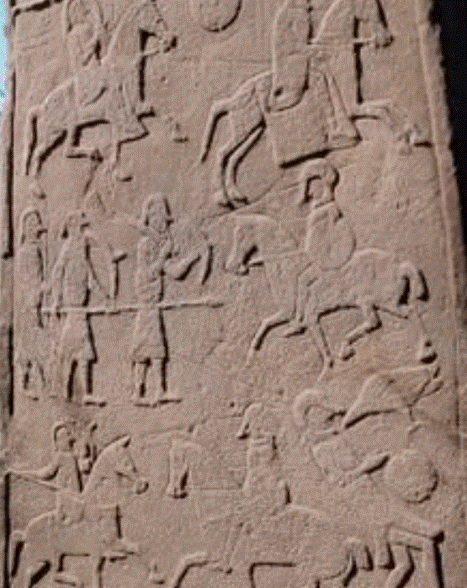
Northumbrian influence around the Forth and north
collapsed. Ecgfrith’s
brother Aldfrith returned to take the Northumbrian kingship. He restored the
kingdom but within narrower bounds (Bede),
ending an expansionist phase of Northumbrian kingship. Bede’s judgement
that after the reign of Ecgfrith Northumbria’s strength began to ebb and fall
away may have been premature; but successive historians have generally accepted
that the battle of Nechtansmere
marked the high spring tide of Northumbrian hegemony, never to be emulated in
later decades. Northumbrian ambitions to render tributary the Pictish kingdom
north of the Forth-Clyde isthmus and the kingdom of Mercia south of the Humber were
never fulfilled. There is no record
of significant victories or evidence of further military success achieved up to
the mid seventh century. (Northumbria
AD 367-867, Max Adams and Colm O’Brien,
2025, page 212).
Whilst
the significance of Nechtansmere can be
exaggerated (The Picts and the Problem in The Problem of the Picts, F T Wainwright, 1955)
it was perceived by the Northumbrians as an end to the period of northern
dominance begun by Edwin and it was obviously a significant setback. Bishop Trumwine
fled from his bishopric in Abercorn, which was never restored (Ecclesiastical
History, Bede, Book 4, Chapter 26).
Cuthbert was consecrated as bishop of Hexham (Ecclesiastical
History, Bede, Book 4, Chapter 28).
There may have
been a short interregnum between Ecgfrith’s death and Aldfrith’s arrival in Northumbria,
perhaps about nine months. Yet however weak the new regime may have been,
there’s no record of warfare north of the Humber during the first 12 years of
his reign.
There may have
been a son of either Ecgfrith or Ælfwine called Oslac who was too young to
succeed and a consultation between Ælfflæd and Cuthbert to resolve a
constitutional crisis. There is a suggestion that Oslca became a sub-king over
Northumbrian interests in the west, around Annadale and Carlisle. This suggests
a soft power influence through Northumbrian religious influence continued in
the west. (Northumbria AD
367-867, Max Adams and Colm O’Brien,
2025, page 219).
Aldfrith
Aldfrith, another
son of Oswiu, but by a different queen, was King of Northumbria from after 14
December 685 to 704 CE or 14 December 705. He was known as Flann Fina in
Iona, the son of Oswiu and Fin, with a more dubious claim to the throne. Fin
was the daughter of an Irish king. He had been on the periphery of Northumbrian
dynastic life, living on Iona when his step brother was killed, living there
for the purpose of the study of letters (Vita
Sancti Cuthberti, Bede, in Two Lives
of Cuthbert page
236). He received news of Ecgfrith’s death when studying on Iona.
Perhaps with
their minds focused after the Pictish defeat, Theodore, Wilfrid and the new
king reached a period of reconciliation.
Aldfrith was
England’s first literate king (Ecclesiastical
History, Bede, Book 5, Chapter 12), most learned in the scriptures (Ecclesiastical
History, Bede, Book 4, Chapter 26) and a scholar who recorded two great poems, Beowulf
and Widsith in writing. He was a man from the earliest years of his
life imbued with a love of sacred learning, a scholar with great power of eloquence,
of piercing intellect: a king and teacher at the same time (The bishops, kings, and saints of York, Alcuin, lines 844 to 846).
He extended the
use of coinage. He married Cuthburh. He was a man of learning. Some of his
works and some letters written to him survive. His reign was relatively
peaceful, though marred by disputes with Bishop Wilfrid.
Bede was lukewarm
about Aldfrith, though acknowledged he was most learned in the scriptures.
Historians have seen the flowering of Northumbrian culture and political and
intellectual integration with the European mainstream culture. Aldfrith’s
kingdom was one of lasting creativity, which saw the production of the
Lindisfarne Gospels, the Codex Amiatinus, and the early works of Bede.
686 CE
In 686, plague
which devastated the Anglo Saxon world and Northumbria, broke out at Jarrow. It
had wiped out the community of Lindisfarne. The Life
of Ceolfrith, written in about 710, records that only two surviving
monks at Jarrow were capable of singing the full offices. One was Ceolfrith and
the other a young boy, who according to the anonymous writer had been taught by
Ceolfrith. The two managed to do the entire service of the liturgy until others
could be trained. The young boy was almost certainly Bede. Bede survived the
plague.
687 CE
Cuthbert died having
been Lindisfarne’s prior, a reluctant bishop of Ecgfrith and later a hermit on
Inner Farne. His remains were returned to Lindisfarne after his death.
At Theodore’s
urging, Aldfrith tried to resolve the quarrel with Wilfred. Wilfrid returned to
Northumbria at about this time. He was initially restored to the diocese of
Hexham and on Cuthbert’s death given Lindisfarne, though unbeknown to him as a
temporary measure. Soon he was restored to the bishoprics of York and Ripon.
688 CE
Ceolfrith was appointed
abbot of the combined Wearmouth-Jarrow monastery. He doubled the number of
books in the libraries of the monastery. Thanks to Biscop’s generosity,
Wearmouth-Jarrow was fantastically wealthy, and boasted perhaps the finest
library in Britain. It was this unrivalled collection of imported books that
enabled Bede, who was placed in the community in 680 as a boy of seven, to
become one of the greatest historians of the Middle Ages. This was also driven
by Northumbria’s wealth in cattle. The three Bibles produced under Ceolfrith
would have required the skins of 1,500 calves. At the same time the monks of
Lindisfarne created the beautiful Lindisfarne Gospels to adorn St Cuthbert’s
tomb, now permanently housed in the
British Library in London, where they are kept as part of the Cotton
collection. Aldfrith was the sponsor of a Northumbrian Renaissance. (The
Anglo Saxons, A History of the Beginnings of England,
Marc Morris, 2021, page 122).
Meantime Aldfrith,
deciding to uphold the intentions of Theodore, had redistributed the bishoprics
of Hexham and Lindisfarne to new bishops, frustrating Wilfrid’s ambitions again
689 CE
Benedict Biscop
died.
690 CE
Archbishop
Theodore died. Wilfrid hoped he might have an opportunity to restore his former
power.
34 coins of King
Aldfrith are known, including from Whitby. This is far less than c 800 found
associated with Offa of Mercia in the second half of the eighth century, but nevertheless
Aldfrith’s coins evidence a productive economy, generally with an 89% silver
content. The coins are very light and referred to as sceattas.
They were probably a far greater issue than had appeared previously among
Northumbrian kings. (Coinage in Ninth
Century Northumbria, the Tenth Oxford Symposium on Coinage and Monetary
History, D M Metcalf, 1987, BAR British
Series 180). Currency suggests trade. There is speculation that Biscop’s
ability to travel may have come more from his activity in trading than from his
aristocratic status. The distribution map of finds is wide. The coins were
generally found at river and coast sites which is also indicative of trade. In
these decades no other English Kingdom was issuing coins carrying a King's
name. The advantage for king Aldfrith in such a large issue was that he could ensure
through his reeves and agents that at ports of entry into the kingdom – Whitby,
North Ferriby and York, perhaps Tynemouth - only royal approved trade might be
conducted. That meant exacting tolls for goods entering and leaving and, in all
probability, having a trading hall or sele, of his own. The king could also
ensure first pick of choice goods, and commissioned traders to look out for
specialist items not available locally, hawks for hunting, furs; find glassware.
(Northumbria AD 367-867, Max Adams and Colm O’Brien, 2025, page 200).
The
sceattas replaced gold coinage which was of limited circulation and
brought a reemergence of a money using economy, with centralised places of
exchange (The Earliest English Kings, D P Kirby, 2000, page 3).
Sceats or Sceattas
(pronounced Shatters) were small Anglo Saxon silver coins minted in
Britain and Frisia between about 690 and 790 CE. There were two series,
referred to as primary and secondary. They were associated with Kent,
East Anglia, Wessex and Mercia. But Northumbrian sceattas were some of
the earliest English coins to consistently name the monarch on the coin itself,
indicating royal control over the currency. Kings such as Aldfrith (685 to 705
CE), Eadberht (737 to 758 CE), and Æthelred I (774 to 779 and 790 to 796 CE)
are known to have issued them.
York was a place
of trade, particularly focused at Fishergate, possibly established by Frisian traders.
York traders benefitted from productive landscapes as far as the Tees valley,
and also in Ryedale and the Vale of Pickering and the Yorkshire Wolds. York,
the Wolds and the ancient corelands of Deira, through the Ouse and the Humber,
had access to Frisian and Scandinavian ports and the Frankish and papal courts.
Contact with the Merovingian world brought access to luxuries including wine. The
currents of power flowed along the river and coast, connecting an enthusiastically
Christian Northumbrian elite with its Continental neighbours. If Bede had
little to say about Aldfrith’s economic success, it may have been because, on
the banks of the River Tyne, his otherwise splendid Jarrow was economically
insulated from the Deiran honeypot. (Northumbria AD 367-867,
Max Adams and Colm O’Brien, 2025, page 205).
For
the first time in Northumbrian history the king’s prestige and wealth were
driven less by warfare and raiding, supported by the tribute of bullion and livestock,
than by cultural capital and by profits drawn from landed wealth.
(Northumbria AD 367-867, Max Adams and Colm O’Brien, 2025, page 208).
692 CE
Wilfrid still
refused to accept the subdivision of his massive Northumbrian diocese, which
had been mandated by Archbishop Theodore. Wilfrid, a staunch advocate for Roman
centralisation, refused to relinquish control over his monasteries,
particularly Ripon, in conflict with Aldfrith's desire for a more manageable, localised
church structure. Once again wearied by Wilfrid, King Aldfrith banished the
troublesome priest. There is no recorded evidence of Wilfrid’s movements for
the following decade. He seems to have gone to Mercia and made another appeal
to Rome.
700 CE
Ceolfrith
instructed the monks of Jarrow and Wearmouth to make three copies of the pandect
of the Bible into one great volume. Two copies made for Wearmouth and for
Jarrow have been lost but one, the Codex Amiatus (after the location where
it was later found), was delivered to Rome and survives, now in Florence. It is
permanently housed in the Biblioteca Medicea Laurenziana or Laurentian
Library in Florence. The entire manuscript has been digitised and is accessible through
the Library of Congress
website.
701 CE
Bede
wrote his first works, De Arte Metrica and De Schematibus et Tropis.
Both were intended for use in the classroom. Bede’s books are not just
marvels of scholarship but evidence of a sort of early industrial revolution,
which required animal husbandry and processing on a dramatic scale to produce
thousands of sheets of perfect vellum; inks and paints for writing and
illumination; leather for bindings; glass for windows. Bede is a fitting
legacy for the luck and achievements of the Idings, who not only forged the
first Anglo Saxon state sufficiently robust to survive the death of its kings,
but which forged a hybrid culture of Angle and Scot, Briton and Irish, whose
exuberance and craft, sophistication and heroic scale is an enduring
linguistic, architectural and literary monument. (The King of the North, the Life and Times of Oswald of
Northumbria, Max Adams, 2013, page 377).
By the end of Aldfrith’s reign Bede had compiled his short On Time, and his Commentary on the Apocalypse. Lindisfarne, Wearmouth-Jarrow, Whitby, probably also Whithorn in Galloway and Dacre in Cumbria produced manuscripts. (Northumbria AD 367-867, Max Adams and Colm O’Brien, 2025, page 187).
Cassiodorus’s
Expositio
Psalmorum (Explanation of the Psalms), written in the mid-6th century
in a Northumbrian monastery and held in Durham Cathedral library, is a
monumental, three-volume Latin commentary that served as a foundational monastic
textbook for interpreting the Psalter through allegorical, theological, and
rhetorical lenses. It functioned as a key educational tool for early medieval
monks, integrating classical grammar and rhetoric into Christian scripture
study.
Wearmouth-Jarrow
under Ceolfrith’s abbacy produced three pandects or complete copies of
St Jerome’s Vulgate bible including the Codex Amiatinus.
In
Bede’s account of Edwin’s conversion he drew on the metaphor of a sparrow flying
through a mead hall, an allegory of a brief life between the unknown darkness
and emptiness of the world outside, portraying life as fleeting. It is a grim
vision of Christian ideas where a brief spell of friendship and laughter is
ended with death and loss. Nevertheless, this was powerful imagery.
These
superbly paired antonyms, reinforcing the universal, internal bond between one
people, the gens Anglorum, and the one Church of Rome, were proof of the immensity
of the cultural investment in the permanent and material. Bede saw this and
brilliantly preserved the thought. For him, especially, writing concretised
thinking. (Northumbria
AD 367-867, Max Adams and Colm O’Brien,
2025, page 189).
By
the second decade of the eighth century, the finest surviving insular Early
Medieval manuscript, the Lindisfarne Gospels had been produced in the scriptorium.
The new stone constructions at Jarrow, Wearmouth, Hexham and Ripon were also projects
of individuals including Wilfrid and Discop who had been to Rome and saw Irish
tradition as ignorant, materially poor and not fit for religious ideals.
Jarrow
and Wearmouth evidence an integrated and productive Bernician economy. The
travel of the abbots brought craft skills in building construction, decorative
arts and book production. The systematic management of large estates stimulated
a productive farming regime and domestic economy. (Northumbria
AD 367-867, Max Adams and Colm O’Brien, 2025,
page 196).
702 CE
Bede
became a priest.
703 CE
Wilfrid fell out
with the new archbishop of Canterbury, Berhtwald. Following Theodore's death in
690, there was a vacancy of roughly two years before Berhtwald, formerly the
Abbot of Reculver, was consecrated and was archbishop from 693 to 731 CE.
Tensions with Wilfrid resurfaced when a council was summoned at Austerfield south
of Doncaster, by Berhtwald. Aldfrith and most of the other bishops of the
kingdoms were there. Wilfrid’s arrival led to immediate argument. The
frustrated Wilfrid set out once again for Rome, at the age of 70.
704 CE
Eadwulf I
Aldfrith’s son
Osred was a child when his father died in 704 CE, and the Iding dynasty did not
have a credible successor. It is assumed that Eadwulf I, whose ancestry is not
known, usurped the throne. He was King of Northumbria from 704 to 705 CE. The ætheling Osred seems to have been besieged at
Bamburgh, but within months Eadwulf was deposed and his short lived coup came
to an end.
Eadwulf seems to have been exiled to either Dál Riata
or Pictland.
This was the beginning of a more turbulent period in
Northumbria’s history, though its cultural influence and continental ties would
continue for a while.
705 CE
Osred I
The son of
Aldfrith, Osred did not directly succeed his father as Eadwulf I seized the throne
but Eadwulf held it for only a few months.
In 705 CE, the
Siege of Bamburgh was an important defence of the Northumbrian royal seat,
where the young King Osred I was protected against rebelling nobles seeking to
depose him. The siege was a struggle for stability within Northumbria following
the death of King Aldfrith, as loyalists defended the castle to keep the young
king in power.
During Osred I's
minority (c 705 to 716), Northumbria was governed by a regency dominated by the
powerful Bishop Wilfrid and key ealdormen, notably Berhtfrith, son of Berhtred.
Following the short usurpation by Eadwulf in early 705, the young king was
restored, with Wilfrid acting as his guardian and protector. Osred was King of
Northumbria from 14 December 705 to 716 CE.
Bishop Wilfrid controlled the government, and Osred was adopted as his son,
ensuring strong ecclesiastical influence over the court.
706 CE
Although another judgement
in Rome in 705 CE, was an inconclusive one, Wilfrid was restored as bishop of
Hexham under Osred, probably influenced by Abbess Ælfflæd. The Archbishop of
Canterbury travelled to Northumbria, at a place on the River Nidd, to find a
resolution. This was the Synod of Nidd at an obscure site in North Yorkshire.
At the same time Wildred was restored to Ripon, along with its wealth. He seems
to have been satisfied with his restoration to the two best monasteries.
708 CE
In 708 CE, some monks
at Hexham accused Bede
of having committed heresy in his work De Temporibus. The standard
theological view of world history at the time was known as the Six Ages of the
World. In his book, Bede calculated the age of the world for himself, rather
than accepting the authority of Isidore of Seville, and came to the conclusion
that Christ had been born 3,952 years after the creation of the world, rather than
the figure of over 5,000 years that was commonly accepted by theologians.
710 CE
Nectan Mac Der
Ilei, King of the Picts, became a monk and asked the Wearmouth-Jarrow monastery
to help him reform the Pictish Church, asking Ceolfrith for advice on the
calculation of easter and the Roman tonsure, and the building of churches in
the Roman style. Relations with the Picts across these years changed
dramatically. No later than 716 Nechtan, son of Derilei, king of the Picts, approached
Ceolfrith, abbot of the monastery of Wearmouth and Jarrow, for guidance on
Dionysian Easter tables and the Roman dating of Easter.
(The Earliest English Kings, D P Kirby, 2000, page 124; Ecclesiastical
History, Bede, Book 5, Chapter 21).
This suggests a more peaceful period in Northumbrian-Pictish relations, but
there was a conflict the following year.
Wilfrid died at the
age of 75 on 24 April 710. The epitaph on his tomb was Wilfridas magnus,
Wilfrid the Great.

Despite the
King’s youth, the government maintained stability after Wilfrid’s death in 709.
711 CE
Ealdorman
Berhtfrith defeated the Picts in 711 in the area around the upper Forth.
714 CE
In 714 CE the
Northumbrian minor nobleman Willibrord, then bishop of Utrecht, baptised
Pippin, the son of Charles Martel. Willibrord was taught by Wilfrid at Ripton and
adopted Wilfrid’s loyalty to Rome. Pippin saw religion as a tool of policy and
by supporting the Rome orientated Anglo-Saxon missions he positioned himself as
a son of the church in contrast to the dynastic loyalty of the Frankish church. Over time, as chief minister, Pippin started
to act as if he were the king himself.
715 CE
Osred reached his
majority in 715 or 716, but within a very short period he was killed.
Religious sources
describe Osred as a dissolute ruler who assaulted and seduced nuns and seized
property. Æthelwulf referred to Osred as rash, foolish, and unable to control
his desires (Aethelwulf's early ninth-century poem De Abbatibus, ll, 35 to 51) and also as a tyrant who forced
many political enemies into monastic communities (De Abbatibus, ll, 49 to 51 and
65). (see also The architectural interest
of Æthelwulf’s De Abbatibus, H M Taylor, in Anglo Saxon England, Volume 3, 1974, pages 163 to 173).
Consider, I
beseech you, how terrible was the judgement which God visited on earlier kings
who were guilty of the same fault which we rebuke in you. Ceolred, your
predecessor, who violated nuns and trampled on the privileges of the Church, an
evil spirit seized as he was feasting gloriously with his nobles, and tore his
soul from him, without confession or sacrament, while he was conversing with
the devil and blaspheming God’s law. Osred too, king of the Deiri and
Bernicians, who was guilty of the same offences, was so far driven wild that he
lost his kingdom and his life, young as he was, and came to a shameful end. (Gesta regum Anglorum: The History of the English Kings, William of Malmesbury, Book
1, Section 80).
716 CE
Coenred
King Osred was
killed to the south of the border and was succeeded by Coenred (Anglo Saxon Chronicle). Coenred descended from
Ida of Bernicia and was the first of his branch of the family to rule
Northumbria from 716 to 718 CE. This branch of the wider Iding family is generally
referred to as the Lioualdings or the Leodwaldings, the descendants of
Leodwald.
The
twelfth-century chronicler William of Malmesbury described him and his
predecessor as a draught from the same cup, implying a young...
vigorous, dissolute, cruel and bold style of leadership.
Osred’s
death coincided with the death of the Mercian King Ceolred, the childless
grandson of Penda. The Mercians chose as his successor, a grandson of Penda’s
brother, Eowa, called Ædelbald who rapidly established
his authority over a disparate people in the midlands and ruled for 41 years.
The heart of royal governing stability in England was switching southward. This
was a period of settlement and economic expansion through patronage and
coercion and when necessary by suppression and warfare. There was a period of
economic boom between 710 to 740 CE, with coinage particularly from Frisia,
reflecting international trade.
Abbot Ceolfrith
left for Rome with the Codex Amiatinus, visiting cornu
vallis en route.
718 CE
Osric
Osric was King of
Northumbria from after 23 April 718 to 9 May 729. Bede
reported little of Osric's reign, but records that comets were seen at his
death, a sign of ill omen.
c 725
CE
Bede
wrote De temporum ratione (Concerning the organisation of time). Drawing
on both ancient scholarship and his own computations and observations, he
painted a rational view of God's creation: of a spherical earth, of latitude
and its effect on daylight length; of the moon's influence on tides; of the
calculation of dates from the incarnation, which he popularised; and with
detailed instructions on how to calculate the correct date for Easter. In a
modern translation the work takes up more than 240 pages. (Northumbria AD 367-867,
Max Adams and Colm O’Brien, 2025, page 214).
Bede’s
Chronica Maiora, Greater Chronicle was also completed as Chapter 66 of De temporum
ratione. It
was a chronicle of the history of the world from the creation, mapping six ages
of the world, though a theological lens. It differs from his later Ecclesiastical
History as it is a more concise list of events on a more global scale.
729 CE
Osric died.
Ceolwulf
Ceolwulf was King
of Northumbria from on or after 9 May 729 to 737 (but in 731 or 732 he was briefly
deposed and then restored to power). Bede described him as the most glorious
king, although he wrote that the beginning of Ceolwulf’s reign was troubled and
filled with commotion.
731 CE
Bede
completed his Historia Gentis Anglorum Ecclesiastica, the Ecclesiastical
History of the English People and other historical works including History
of the Lives of the Abbots. Bede sent a first draft of the Ecclesiastical
History to Ceolwulf to review, intending his history to be didactic,
encouraging the king to make the right choices. Ceolwulf may therefore have had
literacy in Latin to be able to read it.
Bede ended his History
summarising that by 731 CE the land south of the Humber was subject to Ædelbald
of Mercia; Ceolwulf reigned in Northumbria; the Picts were at peace with the English
nations; the Scots (Irish) of Dal Riata were content with their own kingdom and
the Britons continued to oppose the English nations with their wicked lewdness.
This reflected an increasing feeling of kinship between the Anglo-Saxon folk,
and a growing sense of alienation from the Britons, which synthesised in the
writings of Bede. In these favourable times of peace and calm, many of the
Northumbrians, as well of the nobility as private persons, laying aside their
weapons, and receiving the tonsure, desire rather both for themselves and their
children to take upon them monastic vows, than to practise the pursuit of war.
What will be the end hereof, the next age will see. This is for the present the
state of all Britain; about two hundred and eighty-five years after the coming
of the English into Britain. (Ecclesiastical
History, Bede, Book 5, Chapter 23). In reality the history was a continuing
one, and not so simply signed off as by Bede.
He also compiled
a list of his books including commentaries on the books of the Bible. His works
include treatises on grammar, orthography (spelling), metrics, computus
(the mathematical and astronomical calculation of time), and natural history.
He popularised the system of dating years after the birth of Christ. He
produced handbooks on Latin grammar, spelling and composition of verse.
King Ceolwulf was
tonsured and imprisoned in a coup but recovered his kingdom.
The establishment
of the Diocese of Whithorn around 731 to 735 CE marked the formal inclusion of
the ancient Candida Casa site into the Northumbrian church hierarchy.
Initiated under King Ceolwulf of Northumbria, Pehthelm was appointed as the
first Anglo-Saxon bishop to oversee this Galloway territory, bringing it under
the Archbishop of York. (Ecclesiastical History,
Bede, Book 3, Chapter 4).
733 CE
Bede
travelled to York
to visit Ecgbert, then bishop of York. The See of York was elevated to an
archbishopric in 735, and it is likely that Bede and Ecgbert discussed the
proposal for the elevation during his visit. Bede hoped to visit Ecgbert again
in 734 CE but was too ill to make the journey.
734 CE
Bede
foresaw a moral degradation which would be blamed for the end of Northumbria’s
Golden Age and the arrival of the Vikings, when he wrote to Egbert, York’s
bishop that it is reported of some bishops that they have no men of true
religion or self control around them, but instead are surrounded by those who
give themselves to laughter, jokes, storytelling, eating, drinking and other
seductions of the soft life (Bede’s letter to Ecgbert,
section 4). He worried
that there were many folk in settlements in inaccessible mountains and dense
forests who had not seen a bishop over the course of many years (Bede’s letter to Ecgbert,
section 7). Bede also recognised
that the alienation of increasing areas of land to the church meant that in
these favourable times of peace and prosperity, many of the Northumbrian race,
both noble and simple, have laid aside their weapons and taken the tonsure,
preferring that they and their children should take monastic vows rather than
train themselves in the art of war. What the result will be, a later generation
will discover (Ecclesiastical History,
Bede, Book 5, Chapter 23). Bede worried
about the combined threat from an end of religion and an inability to defend
the homeland.
By this time Northumbria had three sees of Hexham, Lindisfarne and
York, and by about this time, Whithorn. Abercorn had been lost in Ecgfrith’s
Pictish campaign in 685 CE.
Northumbrian society had been founded on a social contract
exchanging the life interest in a gift of land for military service and food renders.
This supported a royal military elite who represented their people and defended
the land. The commutation of such renders to prayer removed these royal lands
in perpetuity. For a time this brought stability through an investment in the
church. In time however it became the basis for the avoidance of military
service and an over indulgence which would leave the kingdom unable to defend
itself. The rich but unprotected monasteries of Northumbria became an obvious
target. The grand foundations of Wilfrid may have been a portent of the problem. (The King of the North, the Life and Times of Oswald of
Northumbria, Max Adams, 2013, page 380
to 383).
735 CE
Ecgberht (cousin
of Ceolfrith) was elevated to archbishop of York.
Bede died on the Feast of the Ascension, Thursday 26 May 735, on the
floor of his cell and was buried at Jarrow (Flores
Historiarum, Roger of Wendover’s Flowers
of History, J A Giles 1849, page 140). We might have some doubt about Roger of Wendover’s claim that as
his soul was departing, the attendants smelled a wonderful odour, exceeding
that of sweet spices or precious balsam.
Bede left a fresh Anglo Saxon learning centred on the Benedictine
study of the Bible. Bede had introduced an educational system based upon
training in Latin and loosely on the liberal arts (liberalia studia),
the basic literary and numerical studies adopted from Roman education.
Pythagoras argued that there was a mathematical and geometric harmony to the
cosmos or the universe and his followers linked the four arts of astronomy,
arithmetic, geometry, and music into one area of study to form the disciplines
of the medieval quadrivium. Over time, rhetoric, grammar, and dialectic
(logic) became the educational programme of the trivium. Together they came
to be known as the seven liberal arts. Bede did not wholly embrace the Liberal
Arts himself.
Some historians suggest that Bede’s death marked a final cultural
decline and an end to the period of historical understanding marked by the Ecclesiastical
History (Northumbria AD 367-867,
Max Adams and Colm O’Brien, 2025, page 212), but this perhaps misses the
importance of the following fifty years of the ascendancy of the York school
and the influence of Alcuin.
Nevertheless the years that followed saw
the ascendancy of a rival powerhouse in Mercia, with the reigns of Ædelfrid and
Offa spanning eight decades from 716 to 796 CE, contemporary with a period of
eleven Northumbrian Kings with many of them meeting violent ends. This was a
period of significant cultural achievements in Mercia, with London emerging as
an international emporium. The Thames, Trent, and Severn emerged as principal
highways of commerce. The period saw significant achievements in the south
including Offa’s Dyke and silver coinage; and sophisticated machinery of
government; though with no surviving Chronicle, as would later narrate the rise
of Wessex
The Benedictine monasteries had become the main focus of learning
by the sixth century, following the disintegration of the Roman empire.
Benedictine monasteries were repositories of learning as they focused on
prayer, study and manual labour. Study was intended to assist an understanding of
the Bible through copying scripts alongside a learning of the liberal arts.
Roman knowledge through an understanding of Latin was an instrument to assist
Christian understanding. Over time, this became the basis of early education.
Among Bede’s pupils was Ecgbert, who urged him to raise York to an
archbishopric and Ecgbert became Archbishop of York in the year of Bede’s
death. It was at York, that Ecgbert continued Bede’s work. Ecgbert founded a school
attached to the cathedral for the sons of local nobles.
Alcuin was born in Northumbria, probably sometime in the 730s. Little is
known of his parents, family background, or origin. The Vita Alcuini suggests that Alcuin was of noble English stock.
There is an In
Our Time podcast, Alcuin, the cleric, educator and poet from York who
put learning for its own sake at the heart of the Carolingian Renaissance.
737 CE
An excessive
drought rendered the land unfruitful; and Ceolwulf, voluntarily receiving the
tonsure, left the kingdom to Eadbert (Ecclesiastical
History, Bede, Book 5, Chapter 24)
Ceolwulf abdicated
and entered the monastery at Lindisfarne, bequeathing his kingdom to his
cousin, Eadberht.
738 CE
Eadberht
Eadberht son of Eata was a
descendant of Ida of Bernicia and was King of Northumbria from
738 to 758 CE. His brother was Ecgbert, who was Archbishop of York until 766 CE
effectively acting as a sub regulus in Deira, and a teacher of Alcuin.
Under
King Eadberht and
his brother, Northumbria entered two decades of apparent political stability,
notwithstanding King Ædelbald’s incursions
across the Humber between 737 and 741, which marked a new phase of military
conflict between the two kingdoms. Some 350 silver sceattas of Eadberht are known,
and their consistency and sophistication is marked. The quantity and
distribution show an expanded penetration from king Aldfrith’s coinage, across
the south of Northumbria and beyond, contrasting with the contemporary
debasement of the coinage south of the Humber. (Northumbria AD 367-867,
Max Adams and Colm O’Brien, 2025, page 271).
By this time the wealth and
creativity of medieval Northumbria was the product of (1) a productive
landscape rooted in the corelands, an inherited Roman infrastructure allowing
the efficient exploitation of resources and natural routeways; and (2) a hybrid
culture with Irish, British, Pictish and Continental influence and inspiration.
These influences crystallised scholarship, sculpture, decorative arts and
architecture. (Northumbria AD
367-867, Max Adams and Colm O’Brien,
2025, page 235).
Ædelbald of Mercia harried
Northumbria in 738 CE (Anglo-Saxon Chronicle).
For some twenty years King
Eadberht reigned with relative stability represented by more or less regular
coin issues (A Brief History of the Anglo Saxons, The Beginnings of
the English Nation, 2006, Geoffrey
Hindle, page 85). His reign was a return to the imperial ambitions of
seventh-century Northumbria and a period of economic prosperity.
He faced internal
opposition from rival dynasties and at least two of his rivals were killed during
his reign.
740 CE
Ædelbald of Mercia brought a
warband to Northumbria while Eadberht was campaigning in Pictland and cruelly
and wrongfully laid waste to the kingdom (Bede Continuatio,
early medieval annals (731 to 767) that extend the Historia ecclesiastica
gentis Anglorum beyond Bede’s death in 735, detailing events in Northumbria).
741 CE
There was a
second drought and a further raid by Ædelbald
sacking York and burning the minster (Anglo-Saxon
Chronicle).
750s
Eadberht
conquered part of Ayrshire (the plain of Kyle) (Bede
Continuatio),
perhaps protecting Northumbrian interests in Galloway.
As Ecgbert’s
responsibilities increased, he entrusted the running of the school to his
kinsman and pupil, Æthelbert. The fame of the school grew under Æthelbert and
pupils came from across the country and from overseas. Æthelbert
travelled to the Continent to collect books and he spread knowledge of the
school. He made it his mission to collect books from across Europe and used his
own private wealth to amass a remarkable
library. Alcuin,
in his longest poem, later included a bibliography of this remarkable
library.
It was during Æthelbert’s time
that Alcuin
joined the school and became Ecgbert and Æthelbert’s
favoured pupil and a great friend of Æthelbert. The
young Alcuin therefore came to the cathedral church of York
during the golden age of Archbishop Ecgbert and his brother, the Northumbrian
King Eadberht. King Eadberht and Archbishop Ecgbert oversaw the re-energising and
reorganisation of the English church, with an emphasis on reforming the clergy
and on the tradition of learning that Bede had begun. Ecgbert was devoted to
Alcuin, who thrived under his tutelage.
York became an
exceptional centre of learning during the second half of the eighth century.
Ecgbert promoted learning for its own sake at York, beyond merely religious
learning.
751 CE
By
the mid eighth century the old Carolingian kings in Frankia had become so weak that
Pippin had sought and received the Pope’s permission to replace them, founding
the Carolingian dynasty named after Pippin’s father, Charles. The Merovingian
kings were displaced by their own chief ministers when Pippin became King of
the Franks. Pippin was the first Carolingian King from 751 CE and father of
Charles the Great. The English system of provincial church organisation brought
to England by Augustine, was introduced into the Frankish Kingdom after the
Germanic Church Council in 742 CE.
Pippin
was anointed, with holy oil poured over his head, symbolising the granting of a
divine power (Christ is a title given to Jesus and means ‘anointed
one’), a new approach to the consecration of Frankish kings. Pippin’s sons
including Charles were anointed by Pope Hadrian I in another ceremony.
756 CE
Eadberht of
Northumbria and King Oengus mac Fergusson of Pictland attacked the British
fortress of Dumbarton but there were several coup attempts on the Northumbrian throne
while he was away and Eadberht’s army was destroyed on its way home (Historia Regum,
Symeon of Durham, edited by Thomas Arnold, page
40 to 41).
757 CE
London
and Mercia
After
the Romans had abandoned Britain, London had fallen into ruin. The ruins may
not have been occupied until St Augustine’s mission in the sixth century after
which the bishop of the East Saxons, Mellitus established himself in the deserted
city, drawn by its classical associations. These were mysterious places, the
work of giants. At about this time a new settlement was established about a
kilometre west of the Roman town of Londinium, and it became known as Lundenwic.
(see map at Britain in the Middle
Ages, An Archaeological History, Francis
Pryor, 2007, page 165). This settlement had seen rapid
expansion in the mid seventh century, fuelled by international trade. By the
670s there was a new wharf along the Strand. The new settlement thrived as it
was located in a place able to capitalise on the industry of agricultural
hinterlands fed by the Thames, and a route to the Continent downstream on the
same river. By the early eighth century, Mercia was dominating its control of Lundenwic,
particularly in the time of its King Æthelbald (716 to 757 CE). This was the
source of Mercia’s dominance. Bede recorded that by 731 CE all the kings south
of the Humber were subject to Æthelbald’s authority.
In 757
CE Æthelbald was killed in a civil war and Offa (ruled 757 to 796 CE) became
king of Mercia and dominated the southern kingdoms, establishing Offa’s Dyke as
a barrier to the non Anglo-Saxon British lands of the west. His dominance never extended to Northumbria, though
he gave his daughter Ælfflæd in marriage to the Northumbrian King Æthelred I in
792 CE.
Ædelbald of Mercia was murdered
by his household guard. Beornred seized the throne but was defeated by Ædelbald’s
cousin Offa. Offa consolidated his power within the Mercian heartland of the
Midlands before expanding his influence into Kent and Sussex.
758 CE
By
the mid eighth century Mercia was growing in ascendancy.
The evolving
English identity
The
reason that Offa built his dyke as a defence against the Britons and not the
Northumbrians, East Anglians or West Saxons was that despite their differences
and occasional violent episodes, by this date the people in these Anglo-Saxon
kingdoms regarded themselves as a single ethnic group, a group that we can
reasonably start to describe as ‘English’. The word of course derives from
Angli, or Angles, which had earlier signified the settler peoples to the north
of the Thames – the East Angles, the Mercians and the Northumbrians, but
increasingly during the eighth century people were using Angli as a general
term to describe all the Germanic speaking peoples in Britain, including those who
at other times had been referred to as Saxons and Jutes. Bede, for example,
sometimes used Angli in a narrow sense, in reference to the people of
Northumbria. But he more frequently employed the phrase gens Anglorum to mean
something like ‘the English people’, not least in the title of his most famous
work, the Ecclesiastical History of the English people, completed in 731. (The
Anglo Saxons, A History of the Beginnings of England,
Marc Morris, 2021, page 165). It was not however entirely a one way
direction in the evolution of the Angle and Saxon badges and Saxon came to mean
the same thing and the phrase Anglo-Saxon therefore later evolved as a catch
all to describe the folk Germanic peoples of this period. Mercians, Saxons and
Northumbrians were increasingly feeling a sense of kinship, whilst growing less
well disposed to the Britons in the west. The barbarian Germanic incomers had
long regarded the indigenous Romano-British people as inferior with little to
copy, a people of low status. The Germanic speakers across Europe often
referred to old Roman communities as walas, or foreigners, in English waelas,
a synonym for walh meaning slave, and the name taken by Wales derived
from this root. A clear linguistic and religious divide sharpened the hostility
between the Anglo Saxons and the Britons. When Æthelfrith of Northumbria massacred the British
monks of Bangor-Is-Coed near Chester in 614 CE, Bede had little sympathy,
dismissing the Britons who oppose the English through their inbred hatred
and the whole state of the catholic church through their incorrect Easter and
their evil customs (Ecclesiastical
History, Bede, Book 2, Chapter 2).
In 758 CE Eadberht abdicated in
favour of his son Oswulf and became a monk at York, urged to do so by the
patrician Æthelwald Moll. (Historia Regum, Symeon of Durham, edited by Thomas Arnold, page
41)
Oswulf
Oswulf was King
of Northumbria from 758 to 759 CE.
759 CE
Oswulf was
murdered the year after he became King by his bodyguards at Market Weighton on
24 July 759. (Flores Historiarum, Roger of Wendover’s Flowers of History, J A Giles 1849,
page
150).
Æthelwald Moll
Æthelwald Moll seized
the throne after Oswald’s murder and was King of Northumbria from 759 to 765
CE. He was a thegn unconnected to the royal family (Historia
Regum, Symeon of Durham, edited by
Thomas Arnold, page
41) and his powerbase was probably in Deira. There was a pestilence for two
years (Bede Continuatio).
He was King for seven
years until he was deposed by Alhred. After his removal from the throne
Æthelwald became a monk, perhaps involuntarily.
Oswine, brother
of the murdered King Oswulf, who challenged the new king, was killed in a
battle against Æthelwald Moll at the Battle of Eldunum (Eildon Hills
near Melrose) (Historia Regum, Symeon of Durham, edited by Thomas Arnold, page
41). This was a period of violent instability in Northumbria even as the
school at York reached a period of extensive influence.
764 CE
During a severe
winter the abdicated king Ceolfrith died on Lindisfarne (Historia Regum,
Symeon of Durham, edited by Thomas Arnold, page
42).
765 CE
Alhred
Æthelwald Moll
was deposed in 765 CE at an unknown place called Pincanhaele and Alhred became King
of Northumbria from 765 to 774 CE (Historia
Regum, Symeon of Durham, edited by
Thomas Arnold, page
42, Anglo Saxon Chronicle, AD 765).
Little is said of his reign in the Anglo-Saxon Chronicle other than that he
became king and was then deposed and exiled in 774 CE.
766 CE
Charles
I became King of the Franks.
Ecgbert,
Archbishop of York, died.
The new king
Alhred patronised the church and its missionary activities on the Continent.
They sent embassies to the court of Charlemagne at Aachen.
767 CE
Æthelbert
succeeded Ecgbert as Archbishop on 24 April 767. He was a York insider and
genuine career monk; a pilgrim, teacher and scholar, founder of a great library
and teacher of Alcuin, whose glowing praise of him forms a set piece of his
long poem on the Bishops,
Kings and Saints of York (see paragraph
1394 onwards), composed for the visit of the papal legates in 786
(Northumbria AD
367-867, Max Adams and Colm O’Brien,
2025, page 273). He oversaw the reconstruction of the cathedral of York which had
been burned in 741 CE, to a basilica with curving arches, inlaid
ceilings, windows and many chapels, which was completed shortly before his death.
He continued to expand the York library, making it one of the largest in Europe
outside Rome, containing numerous Latin and Greek classical works.
Alcuin’s
ascendancy to the headship of the York school, the ancestor of St Peter's
School, began after Æthelbert became Archbishop of York. Around the same time,
Alcuin became a deacon in the church. He was never ordained a priest and there is
no evidence that he took monastic vows, though he lived as if he had. Religious
boundaries were fluid at that time without a sharp division between
disciplines.
Alcuin
taught the seven Liberal Arts. He stressed the correct use of Latin and wrote
textbooks in Latin. He followed Bede’s method of question and answer. He
promoted the study of the calendar, the computus, and especially the once
controversial calculation of the date of Easter. He gave elementary instruction
in music, arithmetic and geometry. He enjoyed riddles, jokes and puns in his
teaching methods. He made arithmetical
puzzles and seems to have been an excellent communicator. This was a very
Anglo-Saxon teaching technique. The BBC Discovery podcast, Alcuin of York, is an examination
by Philip Ball of Alcuin’s famous river crossing riddle. Alcuin developed a
friendly literary circle where its members had nicknames,
Alcuin was called Flacchus and a favoured pupil, Sigewulf, was known as Vetulus,
‘little old fellow”.
769 CE
Catterick was
burned by Eanred, the Tyrant (Historia Regum, Symeon of Durham, edited by Thomas Arnold, page
44).
773 CE
Alhred in a
letter to Archbishop Lul of Mainz referred to disturbances in Northumbria and
sent him twelve cloaks and a gold ring. Such letters evidence that Lul was
deeply integrated into the political and religious life of both the Continent
and Anglo-Saxon England, often exchanging letters and gifts with church
officials and royalty.
York in the early
770s was a bustling, cosmopolitan city with an established Colonia of
Frisian merchants who worked alongside the intellectual community of the
cathedral.
A Frisian
missionary, St Luidger of Utrecht (742 to 809 CE) was sent to study at York
under Alcuin where he stayed for three years. He recorded a feud with the
Frisians at York following the murder of a young Northumbrian aristocrat when
suspicion fell on Frisian merchants on the south of the Ouse. (Vita Liudgeri).
Northumbria was still
a place of influence and culture, but there were tensions showing in its fabric
and in its governorship.
774 CE
King Alhred was
expelled to Bamburgh and then sought protection in Pictland (Historia Regum,
Symeon of Durham, edited by Thomas Arnold, page
45). Archbishop Æthelbert was not afraid to oppose kings of whom he
disapproved and was involved in the deposition of Alhred in 774 CE.
The son of Æthelwald
Moll, Æthelred I was King of Northumbria from 774 to 779 and 790 to 796. (Anglo Saxon Chronicle, AD 774).
778 CE
Eanbald became
Archbishop of York and Alcuin became sole head of the school.
779 CE
Æthelred was
driven from the throne after ordering the killing of three courtiers. (Historia Regum,
Symeon of Durham, edited by Thomas Arnold, page
46, Anglo Saxon Chronicle, AD 778).
Ælfwald I
Ælfwald I was
King of Northumbria 779 to 788 CE, probably the son of Oswulf, and grandson of
Eadberht who was pious and just (Historia
Regum, Symeon of Durham, edited by
Thomas Arnold, page
47).
780 CE
Archbishop
Æthelbert of York died on 8 November 780 and was succeeded by Eanbald (Historia Regum, Symeon
of Durham, edited by Thomas Arnold, page
47).
781 CE
In 781 CE, King
Ælfwald sent Alcuin to Rome to confirm the election of the new archbishop,
Eanbald I through the collection of his vestment, pallium. Alcuin had
already been to continental Europe at least once and probably had previously
met Charlemagne. On his way home, on 15 March 781, he met Charlemagne, this time
in the Italian city of Parma. At this time Charlemagne was King Charles of the
Franks, but he later became Charlemagne, the Great, after his coronation
as Holy Roman Emperor in 800 CE. At the invitation of Charlemagne, Alcuin
became a leading scholar and teacher at the Carolingian court, where he
remained a central figure in the 780s and 790s.
There was
rebellion in Northumbria (Flores Historiarum, Roger of Wendover’s Flower’s of History, J A Giles 1849,
page
154).
782 CE
As
the eighth century progressed Charles, later Charlemagne (King of the Franks
from 768 CE; King of the Lombards from 774 CE and Holy Roman Emperor from 800
CE, died 814 CE), presided over a Carolingian renaissance, with Alcuin of York
at the heart of his cultural and educational reforms. By the later eighth
century the Pope, fearful of Lombard dominance, sought the protection of Charles
the Great of the Franks.
The
Franks were a Germanic people who had expanded west across the Rhine in the
late fifth and sixth centuries in the time of their King Clovis (died 511 CE)
and occupied central and eastern Gaul. Under Charlemagne’s leadership, the
Carolingian Empire came to occupy most of western Europe except Spain and
southern Italy. The tradition of scholarship continued under his successors
Louis the Pious and Charles the Bald but lost its momentum as Europe became less
stable and the focus shifted towards Germany by the accession of Otto I in 936
CE. (Britain in the Middle Ages, An Archaeological History, Francis Pryor, 2007, page 49).
Alcuin
left York for Charlemagne’s court in 782 CE (Alcuin
of York, AD 732 to 804: his life and
letters, Stephen Allot, 1974, page
v). There is a suggestion that he was in York for a while longer and
didn’t leave for Charlemagne’s court until 786 CE. Alcuin's joined an
illustrious group of scholars whom Charlemagne had gathered around him, the
mainsprings of the Carolingian Renaissance: Peter of Pisa (Latin
Grammarian), Paulinus of Aquileia, Rado, and Abbot Fulrad, Paul
the Deacon (a Lombard historian). Alcuin would later write, the Lord was
calling me to the service of King Charles. Alcuin became master of the
Palace School of Charlemagne in Aachen, the Urbs Regale.
786 CE
Pope Hadrian I
sent legates to Britain perhaps by a joint invitation from Offa of Mercia and
Ælfwald of Northumbria (Historia Regum, Symeon of Durham, edited by Thomas Arnold, page
51). The legation was accompanied by Alcuin. The first such Legation for a
century, it was motivated by a concern for the state of the English church and
by Frankish ambitions to refresh its knowledge of the Anglo-Saxon kingdoms,
including the emerging Mercian kingdom of Offa. The Legation started in
Canterbury and then split with legates sent to Wales and Northumbria.
787 CE
A Synod at Pincanhaele (Finchale near Durham) in Northumbria aimed at
enforcing the decrees brought by the Roman legates in 786 CE, which targeted
reforms in the Northumbrian church structure and clergy conduct. (Historia Regum,
Symeon of Durham, edited by Thomas Arnold, page
51, Anglo Saxon Chronicle, AD 788).
788 CE
King Ælfwald was assassinated by Ealderman Sicga on Hadrian’s Wall and was
buried at Hexham abbey (Historia Regum, Symeon of Durham, edited by Thomas Arnold, page
52).
Fifty years after
the death of Bede the kings of Northumbria were weak and subject to dynastic
rivals.
Osred II
789 CE
Osred II was King
of Northumbria from 789 to 790 CE. He was later exiled to the Isle of Man. (Historia Regum,
Symeon of Durham, edited by Thomas Arnold, page
52).
Alcuin wrote of the
blood of kings, princes and people shed through you and your family, during
this period.
The
first attack by three Scandinavian ships from Hordaland was recorded on the
south coast. Suddenly a not very large fleet of the Danes arrived, speedy
vessels to the number of three: that was their first arrival. At the report the
king’s reeve, who was then in the town called Dorchester, left on his horse,
sped to the harbour with a few men, for he thought they were merchants rather
than marauders, and admonishing them in an authoritative manner, gave orders
that they should be driven to the royal town. And he and his companions were
killed by them on the spot. (The
Chronicle of Æthelweard, A Campbell, 1962, page
26).
This was the start
of an Age of Viking threat.
Æthelred I
790 CE
Æthelred I was
freed from exile and ruled again from 790 to 18 April 796 CE.
Alcuin was in
England early in Æthelred’s second reign and stayed for a while hoping to
exercise some influence over him. Alcuin wrote to an Irish pupil, Joseph, that Æthelred,
son of Æthelwald [Moll] has just come from misery to majesty, from
prison to throne. The new reign keeps me here against my inclination (Alcuin of York, AD
732 to 804: his life and letters, Stephen Allot, 1974, page
14-15).
Later in the same
year he wrote to Abbot Adalhard that he found things in my country somewhat
disturbed and the new king’s attitude not as I hoped or wished (Alcuin of York, AD
732 to 804: his life and letters, Stephen Allot, 1974, page
16).
791 CE
The sons of King Ælfwald,
Oelf and Oelwine were seized at York and killed (Historia
Regum, Symeon of Durham, edited by
Thomas Arnold, page
53).
792 CE
Osred returned
from exile on the Isle of Man but was seized and killed by Æthelred at Aynburg
and buried at Tynemouth (Historia Regum, Symeon of Durham, edited by Thomas Arnold, page
53).
An early
reference to attacks on Anglo-Saxon lands from Scandinavian raiders referred to
seaborne pagans with migrating fleets (Charter
of Offa).
On 8 June 793 CE
a band of heathen men landed on Lindisfarne, plundered the monastery and
slaughtered many of the monks. Younger monks were taken away, probably to be
sold as slaves. Dire prodigies terrified the wretched nation of the English.
Indeed, abominable lightnings, and dragons were often seen to vibrate and fly through
the air, and with blows of fire; which signs showed a great famine, and the
most terrible and unspeakable slaughter of many men, which followed. In
the same year pagans from the northern climate with a naval army like stinging
crabs coming to Britain, and like the most fierce wolves running here and
there, preying, biting, killing not only cattle, sheep and oxen, but also the
priests and choirs of monks and nuns, "they come, as we have said, to the church
of Lindisfarne, they ravage with miserable plunder everything, they burn it
with holy polluted footprints, they dig up the altars, and they seize all the
treasures of the church of St. John. They kill some of the brothers, they take
some with them bound, they throw many of them naked, they drown some into the
sea, they are rightly said of them that fortune sometimes oppresses the
innocent. (Historia Regum,
Symeon of Durham, edited by Thomas Arnold, page 54) This year
came dreadful portents over the land of the Northumbrians, terrifying the
people most woefully: there were immense sheets of light rushing through the
air, and whirlwinds, and fiery dragons flying across the firmament. These
tremendous tokens were soon followed by a great famine: and not long after, on
the sixth day before the ides of January in the same year, the harrowing inroads
of heathen men made lamentable havoc in the church of God in Holy-island, by
rapine and slaughter. (Anglo Saxon Chronicle, AD 793).
It was because St Cuthbert was so passionately venerated that
before the men called ‘the wolfcoats’ and ‘the beserks’ could do his remains
harm, the Lindisfarne monks, knowing that precious shrines were a favourite
target of the Viking sea-raiders, took his body from Lindisfarne and spent seven
years wandering with it, looking for some safer place of refuge. (A History of Britain, At the Edge of the
World, 3,000 BC to AD 1603, 2009, Simon Schama, page 52).
The sack of Lindisfarne provided a shocked and
outraged Alcuin with an opportunity to declaim against the evils of
Northumbrian society, as he saw them, and the shortcomings of the king himself (The Earliest English
Kings, D P Kirby, 2000, page
130). Alcuin later wrote to
Æthelred that never before has such a terror appeared in Britain as we have
now suffered from a pagan race, nor was it thought that such an inroad from the
sea could be made. Behold, the church of St Cuthbert spattered with the blood
of the priests of God, despoiled of all its ornaments, a place more venerable
than all in Britain is given as a prey to pagan peoples. (Alcuin of York, AD
732 to 804: his life and letters, Stephen Allot, 1974, page 18 to 23). Bede’s fears
were realised and Alcuin concluded to the king at length that the assault was
the inevitable conclusion to moral degradation. He denounced the
immoralities which had prevailed in Northumbrian society since the days of king
Aelfwald and contrasted the adornments of dress and hair and the luxurious
standard of living of Aethelred's court-circle with an absence of concern for the
poor and the starving. His letters mirrored an ideal of Carolingian
kingship, obligations and responsibilities. Nevertheless the Carolingian court
remained favourably disposed to Æthelred (The Earliest English
Kings, D P Kirby, 2000, page
130).
The Northumbrian
Golden Age and its achievements of manuscript production and intellectual
weight were broken by the following years of Scandinavian disruption. Many
monks were killed on Lindisfarne and treasures lost. The archaeology suggests that
life of a sort continued on the island. The Viking onslaught had a catastrophic
impact on culture although ordinary people probably continued to go about their
lives much as before.
The term Viking became popular in the nineteenth
century and may derive from a southern stretch of Olsofjord known as the Vik,
the Old Norse word vic meaning ‘bay’, or from a Scandinavian term for
pirates. In time the phrase was replaced by terms such as heathens, Danes, pagans
or north men and as they settled from the mid ninth century they are perhaps
best simply referred to as Scandinavians. The Russian Viking settlers tended to
come from Sweden whilst the Shetlands and Orkney, Ireland, the Faroes, the
Hebrides, the Isle of Man, Iceland and Greenland were colonised from Norway.
The Scandinavians were traders with the Frankish,
Irish and Anglo-Saxon kingdoms, but from the periphery of the European stage. The
raids were probably driven primarily by opportunity for plunder, but may also
have had a religious aspect, in a clash with their Christian neighbours. Indeed
the relatively recent conversions of the Anglo-Saxons from beliefs of the same
root as the Scandinavians, may have meant that the raids stirred a resurrection
of demons from their past.
794 CE
The Scandinavian raiders ravaged the north east monasteries
including Monkwearmouth-Jarrow. The heathen armies spread devastation among the
Northumbrians, and plundered the monastery of King Everth at the mouth of the
Wear. There, however, some of their leaders were slain; and some of their ships
also were shattered to pieces by the violence of the weather; many of the crew
were drowned; and some, who escaped alive to the shore, were soon dispatched at
the mouth of the river. (Anglo Saxon Chronicle,
AD 794; Historia Regum, Symeon of Durham, edited by
Thomas Arnold, page 56).
795 CE
Iona was sacked by the Vikings in 795 CE.
796 CE
Æthelred I was murdered on 18 April 796 by Wada (Historia Regum, Symeon of
Durham, edited by Thomas Arnold, page 57), perhaps at Corbridge. The Carolingian court was furious and
Charlemagne recalled gifts which had been sent to Æthelred, angered at the murder
by Northumbrians and a loss of an opportunity Charlemagne was seeking to curb
the power of Offa of Mercia (The Earliest English Kings, D P Kirby, 2000, page
131).
In 796 CE, Alcuin was made abbot of Marmoutier Abbey, in Tours, in Western Francia,
near Orleans, where he remained until his death. Upon the death of Abbot
Itherius of Saint Martin at Tours, Charlemagne put Marmoutier Abbey into Alcuin's
care, with the understanding that he should be available if the king ever
needed his counsel.
Offa died on 29 July 796. He was succeeded by
Ceonwulf who quickly faced rebellion. Ceonwulf invaded Kent and re-established
authority in the southern kingdoms except in Wessex.
Osbald
Osbald was a violent man and most likely a murderer. He was King
of Northumbria during 796 CE. On 9 January 780, he killed Bearn, the son of
King Ælfwald by burning him to death at Selectune (possibly Over Silton, near Thirsk,
North Yorkshire).
He was a friend of Alcuin who often sent him letters of advice, urging him to give up his
extravagant way of life. Alcuin told him, disapprovingly that Luxury in
emperors means poverty for the people.
He ruled for 27 days before being abandoned by the royal household
and deserted by his people. He went into exile in Lindisfarne and then to
Pictland. (Historia Regum, Symeon of Durham, edited by Thomas Arnold, page 57). The implication is that Pictish kings were harbouring and
backing rival candidates for the Northumbrian kingship (Northumbria
AD 367-867, Max Adams and Colm O’Brien,
2025, page 278).
Alcuin continued to chastise him: My
dear friend Osbald ... I am disappointed in you for not taking my advice. I urged
you in my letter that you should give up this way of life. Do not add sin to
sin by ruining your country and shedding blood. Think how much blood of
emperors, princes, and people has been shed through you and your clan.
Eardwulf
Northumbria’s institutions continued to function however and a new
archbishop Eanbald II consecrated a new king. Eardwulf was King of Northumbria
796 to 806 (with possibly a second reign from 808 until 811). He was a dux
probably unrelated to the competing royal dynasties.
Alcuin did not approve of Eardwulf and lamented to the folk of
Kent that there was barely anyone left from the old stock of kings.
798 CE
In 798 CE, early in his reign, Eardwulf fought a battle at
Billington Moor against the nobleman called Wada, who had killed King Æthelred.
Wada was defeated and driven into exile. (Historia
Regum, Symeon of Durham, edited by
Thomas Arnold, page 59).
799 CE
The Scandinavian raiders attacked a Frankish monastery near
Nantes.
800 CE
Charlemagne became Emperor of the Holy Roman Empire
on Christmas Day 800, crowned in Rome by Pope Leo III.
The monasteries at Hartness and Tynemouth were destroyed by
Scandinavian raiders (Flores Historiarum, Roger of Wendover’s Flowers of History, J A Giles 1849,
page 169).
801 CE
In 801, Eardwulf led an army against Coenwulf of Mercia, perhaps
because of Coenwulf's support for other claimants to the Northumbrian throne. (Historia Regum,
Symeon of Durham, edited by Thomas Arnold, page 65).
Alcuin sent a letter criticising Archbishop Eanbald for his
property holdings and his retention of a retinue of soldiers. Letters to two of
his pupils suggest that the archbishop had been supporting the king’s enemies
and taking bribes. (Alcuin of York, AD
732 to 804: his life and letters, Stephen Allot, 1974, page 29)
802 CE
A Scandinavian raid landed at Portland in Dorset on
the coast of Wessex and the royal reeve who came to meet them was killed.
It was at this time that Egbert (802 to 839 CE) became
King of Wessex, as Mercian kingship started to fall apart. Egbert and Wessex
were now in the ascendancy as Mercian power which had lasted about a century
declined. Egbert advanced in the Midlands and Wales and started to dominate
over Northumbria.
There were now four dominant Anglo-Saxon kingdoms
each on their own paths of rise or fall – Mercia, Northumbria, East Anglia and
a recently enlarged Wessex.
The raids from Scandinavia continued.
804
Alcuin died on 19 May 804 and was buried at St. Martin's Church. He had
composed his own epitaph. O thou who passest by, halt here a while, I pray,
and write my words upon thy heart, that thou mayst learn thy fate from knowing
mine. What thou art, once I was, a wayfarer not unknown in this world; what I
am now, thou soon shalt be. Once was I wont to pluck earthly joys with eager hand;
and now I am dust and ashes, the food of worms. Be mindful then to cherish thy
soul rather than thy body, since the one is immortal, the other perishes. Why
dost thou make to thyself pleasant abodes? See in how small a house I take my
rest, as thou shalt do one day. Why wrap thy limbs in Tyrian purple, so soon to
be the food of dusty worms? As the flowers perish before the threatening blast,
so shall it be with thy mortal part and worldly fame. O thou who readest, grant
me in return for this warning, one small boon and say: 'Give pardon, dear
Christ, to thy servant who lies below.’ May no hand violate the sacred law of
the grave until the archangel's trump shall sound from heaven. Then may he who
lies in this tomb rise from the dusty earth to meet the Great Judge with his
countless hosts of light. Alcuin, ever a lover of Wisdom, was my name; pray for
my soul, all ye who read these words. It might almost have been an epitaph
for Northumbria’s fate.
His death marked an end to the last window into the fortunes of
the contemporary Northumbrian kings. The annals of the monastic communities,
except St Cuthbert’s were lost in Viking raids.
Yet an entirely dismal conclusion of these years, drawing on the
warnings and forebodings and Bede and Alcuin are probably misleading since the
Archaeology doesn’t suggest widespread fortification and Northumbria continued
to maintain its links with Frankia and the Continent for a while. Bamburgh continued
to be an important royal site, with excavations revealing high-status timber
buildings, metalworking areas, and specialised grain-drying kilns. Monkwearmouth and other sites shows that stone construction, such
as churches and monastic buildings, continued, though sculpture suggests a
concentration of wealth and power within church centres.
Yet the first half of the ninth century was a period of increasing
instability, and transition in north east England.
806 CE
In 806 CE Eardwulf was deposed and went into exile (Anglo Saxon Chronicle, AD 806).
68 monks of Iona were killed by the Scandinavian
raiders in a third raid on the island. After a fourth raid in 807 CE the monks
retreated from the island to re-found a monastery at Kells,
inland and within the site of an ancient hill fort. Raids were probing all round
the Irish coast.
Ælfwald II
808 CE
Ælfwald II, probably the son of Ælfwald, may have
succeeded Eardwulf (Flores Historiarum,
Roger of Wendover’s Flowers of History, J A Giles 1849, page 172).
810 CE
Ælfwald II died.
It should not be assumed that the royal and princely feuds of this
period necessarily brought the Northumbrian Kingdom into serious governmental disarray.
Some of the Northumbrian nobleman who were styled patrician were clearly very
powerful men, even potentially over-mighty subjects, but they were not peculiar
to Northumbria. The monetary system remained intact in Aethelred's first reign
and under Ælfwald, and in Aethelred's second reign a coinage with a higher
silver content was even introduced, but from the reign of Eanred in the early
9th century it persisted only at a lower silver standard which continued to
decline. (The
Earliest English Kings, D P Kirby, 2000,
page 133).
Eardwulf
Eardwulf seems to have
attracted support from an ailing Charlemagne at Nijmegan and from Pope Leo in
Rome and returned to his kingdom (Frankish annals), but his fate is then
unknown.
811 CE
Eanred
Eanred was King of Northumbria from c 811 to c 840 (Flores Historiarum,
Roger of Wendover’s Flowers of History, J A Giles 1849, page 179). There is a paucity of evidence for his reign, except for the
evidence of some 740 coins, known as stycas, which had started to appear
from the 790s.
The early 9th century is characterized by the production and
widespread use of low-value, base-metal coins called stycas. Large
quantities have been found in the region, particularly in the Bamburgh hoard (around 400), indicating a monetised economy.
Eanred's reign saw the appearance of the styca, a new style
of small coin which replaced the earlier sceat. The styca was
a small, base-metal coin that marked a
significant shift in Northumbrian currency. The previously silver-based sceatta
underwent severe debasement, eventually becoming the copper-alloy or brass styca.
The styca remained unique to
Northumbria; while other Anglo-Saxon kingdoms transitioned to the silver penny,
Northumbria continued producing these copper-alloy coins until the mid-ninth century.
These coins were minted in York in vast
quantities, estimated in the hundreds of thousands, making them one of the most
common surviving types of Northumbrian coinage.
The debasement may have arisen from external factors such as
Viking raids. It may be that the increasing political turmoil and the loss of
influence over tributary regions was also a factor.
That said, whilst the debasement may suggest an economic downturn,
it may have been a pragmatic response to the threat from Scandinavia and it
also conversely suggests continued trust in a low value currency supported by
royal authority, as paper money today. Eanred perhaps could not secure silver
supplies from the Continent for his mint, but he was nevertheless able to
continue the benefits of economic activity in his kingdom.
Such coins have been found from Aberlady on the Forth to Whithorn
in Galloway to Thanet in Kent. Although debased, the coins evidence that ninth century
Northumbria was still busy with some form of commerce. Archaeology suggests
wheat and meat surpluses and continued economic activity in textiles and books.
There is also evidence of the reactivation of the Roman lead mines in the
Pennines. The evidence of stycas along rivers and the coast suggests the
possibility that there may have been Scandinavian trade interspersed with
periods of violence. It seems overly simplistic to believe that seafarers
were exclusively either raiders or traders: traders may loot; looters may trade.
(Northumbria AD 367-867, Max Adams and Colm O’Brien,
2025, page 284)
Virtually nothing is known of either Northumbria or East Anglia in
the ninth century; whatever annals and charters were produced were lost through
Viking destruction (The Anglo Saxons, A History of the Beginnings
of England,
Marc Morris, 2021, page 196).
814 CE
Charlemagne died. Louis the Pious succeeded him.
Abbot Cellach of Iona moved Colm Cille’s relics to
Kells in County Meath.
825 CE
Raiders sacked Downpatrick and Iona again.
827 CE
The baton of Anglo-Saxon ascendancy was moving southward by the
early ninth century CE.
This year was the moon eclipsed, on mid-winter's mass-night; and
King Egbert, in the course of the same year, conquered the Mercian kingdom, and
all that is south of the Humber, being the eighth king who was sovereign of all
the British dominions.
· Ella, king of the
South-Saxons, was the first who possessed so large a territory;
· the second was
Ceawlin, king of the West-Saxons:
· the third was
Ethelbert, King of Kent;
· the fourth was
Redwald, king of the East-Angles;
· the fifth was
Edwin, king of the Northumbrians;
· the sixth was
Oswald, who succeeded him;
· the seventh was
Oswy, the brother of Oswald;
· the eighth was
Egbert, king of the West-Saxons.
This same Egbert led an army against the Northumbrians as far as Dore,
where they met him, and offered terms of obedience and subjection, on the
acceptance of which they returned home.
(Anglo Saxon Chronicle, AD 827).
830 CE
The church of Lindisfarne settled at Norham (Historia de Sancto Cuthberto, 108).
Norse forces were confident enough to win against a
Pictish army in battle.
832 CE
The abbey of Armagh, though 25 miles from the sea,
was attacked three times by Scandinavian raiders.
834 CE
Scandinavian raids were growing more ambitious by
the 830s. In 834 CE they attacked Francia’s largest wic, Dorestad.
836 CE
It was probably Vikings from Ireland who landed in
Somerset in 836 CE, reputedly with 35 ships and perhaps a force more like an
invading army. When Egbert met the army at Carhampton a great slaughter was
made there by the Danes (Anglo Saxon Chronicle, AD 837).
838 CE
Egbert of Wessex held a great council at Kingston
upon Thames to discuss the Scandinavian threat and to appoint his son,
Æthelwulf (839 to 858 CE) as his successor.
|
The Genealogy of the House Wessex
The family tree of the Kings of Wessex, the Anglo-Saxons, and the
English |
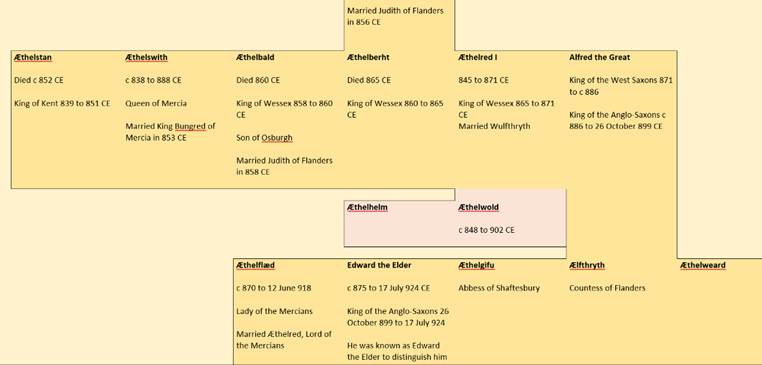
Eanred continued to rule Northumbria, perhaps jointly with his
archbishop Eanbald II. There are no records of Scandinavian raids on the east
coast of Northumbria or indeed against the western interests during the reign
of Eanred, but it seems likely that they did occur. It perhaps more
realistically reflects the gradual loss of record keeping in the north.
Nevertheless, the long reign of Eanred suggests a degree of
stability in Northumbria. Eardwulf seems to have secured a sufficient power base
to continue his dynasty through the first half of the ninth century CE in the
reigns of his son Eanred and his grandson, Æthelred II. It is likely that
connections with the Carolingian empire and the papacy continued. A silver
penny embossed Eanred Rex found at Trewhiddle, Cornwall, in 1774, is
probably a coin of the Northumbrian Eanred, and may also be enigmatic evidence
of the reign of Eanred. (The Earliest English Kings, D P Kirby, 2000, page 162, 163).
840 CE
Eanred of Northumbria is generally believed to have died in 840
CE, marking the end of an unusually long and perhaps stable reign for the
period.
Æthelred II
Æthelred II, Son of Eanred, the third generation of his dynasty,
was King of Northumbria from c 840 to c 848 CE. There is no written evidence of
his reign except in Roger of Wendover’s chronology,
but some evidence through 100 stycas.
The 840s saw a change in the intensity, perhaps in the
aspirations, of Norse raiders (Northumbria AD 367-867,
Max Adams and Colm O’Brien, 2025, page 297).
In the 840s the Viking attacks focused on Frankia
and the south coast of England, with a series of defeats against Wessex and the
south. The new thriving Lundenwic was largely abandoned for the safer Londinium
within the Roman walls.
Louis the Pious died and the Frankish empire split
between his three sons. Charles the Bald succeeded him in the west.
841 CE
Dublin became the principal longphort of the Scandinavians in Ireland and
a pirate base for control of the Irish Sea.
The Channel port of Rouen was burned by Vikings.
842 CE
There were destructive Viking raids on many places
including London, Rochester and Norwich (Anglo Saxon Chronicle).
844 CE
There was an interruption in Northumbria 844 CE when Rædwulf
usurped the throne but was killed the same year fighting against the Vikings.
Æthelred was restored. (Flores Historiarum,
Roger of Wendover’s Flowers of History, J A Giles 1849, page 179).
848 CE
Æthelred was assassinated, but nothing more is known of his murder
(Flores Historiarum, Roger of Wendover’s Flowers of History, J A Giles 1849,
page 180).
The exact chronology from the limited sources is uncertain (Northumbria
AD 367-867, Max Adams and Colm O’Brien,
2025, page 298).
Osberht
Osberht was King of Northumbria from c 848 to 862 CE. Osberht
became king after Æthelred son of Eanred was murdered.
Osberht seems to have stolen two vills from the
Cuthbert community and his interest seems to have been in Bernicia and northern
Northumbria.
By this time the communication between the English and Continental
churches was strained and discourse in intellectual ideas and the higher arts
was very limited.
849 CE
Alfred, the youngest son of Æthelwulf and grandson of
Egbert of Wessex, was born in Wantage. According to his hagiographical
biographer Asser, he surpassed all his brothers, both in wisdom and
in all good habits.
850 CE
The
Vikings began to winter in Thanet and Sheppey in Kent. A fleet of 350 ships (according to the Anglo Saxon Chronicle, AD 851) captured Canterbury and London. Norsemen had been
overwintering in Ireland since the 830s, building bases for ships or longphorts.
This was the first time they spent a winter in an English kingdom. This was
escalation.
In 850 CE the Scots of Dalriada and the Picts were
united under a single king, Kenneth MacAlpin and his foundations were built on
by his successors, including Constantine I and Donald II. The political heart
of Scotland moved from Dunadd in Argyll to Dunkeld in Perthshire. (Robert the Bruce, the Champion of
a Nation, Stephen Spinks, 2024, page 20).
851 CE
The Scandinavian raiders stormed Canterbury.
855 CE
As a child Alfred went on pilgrimage to Rome with
his father, which may have contributed to his feeling of favour over his
brothers. Pope Leo IV granted him the word and robes of a Roman consul. He
later took this investiture as a prophesy of his later Kingship.
856 CE
Æthelwulf
returned
from a pilgrimage to Rome, travelling through the lands of Charles the Bald who
welcomed him and the fifty year old Æthelwulf married Charles’ 12 year old daughter,
Judith of Flanders. He may have been spurred to a Frankish alliance because he
returned to confront a revolt by his son Æthelbald. This posed a new threat to
Æthelwulf’s sons, as a source of rival heirs.
On Æthelwulf’s return a compromise was reached, so
that Æthelwulf resumed rule over the eastern part of his kingdom: Kent, Sussex,
Surrey and Essex; previously ruled by his son Æthelberht, but was unable to
take back the Wessex heartlands from Æthelbald. Æthelwulf then sought to make this
division more permanent by arranging that after his death Æthelbald would rule
in the western kingdom of Essex and Æthelberht would rule over the eastern
lands. This was not an unusual arrangement for the ordering of a large kingdom
and equated to the sub-kings of Deira and Bernicia in Northumbria.
858 CE
Æthelwulf died in January 858 CE. Æthelbald
immediately took Æthelwulf’s 14 year old widow to be his own bride, denounced
by Alfred’s
biographer Asser as against
God’s prohibition, and Christian dignity, and also contrary to the practices of
the pagans. However the union gave Æthelbald the advantage of a Frankish
queen whose children would be in a stronger position than his brothers in
future claims to the throne.
860 CE
Æthelbald died, before he had produced any children.
Whilst it was expected that the western kingdom of Wessex would pass to
Æthelred, the fourth son, keeping the kingdom divided, Wessex was added to the
domain of Æthelberht, uniting the larger kingdom.
Raiders sacked Winchester.
By the 860s, following the debasement of the coinage fifty years
earlier, Northumbria had become increasingly isolated.
862 CE
Ælla
864 CE
A Viking army occupied the Isle of Thanet and though
bribed with money, they continued into the eastern part of the Kingdom of
Wessex.
865 CE
Æthelberht died and he was succeeded by his younger
brother Æthelred I.
The
Great Heathen Army, mycel hæþen ,
invaded the Anglo Saxon Kingdoms, posing a new threat on a scale not yet
encountered. According to the Anglo Saxon Chronicle the
army was led by Ivar, later linked to Ivar the Boneless, son of Ragnar Lothbok,
possibly the same as an Ivar in Ireland who disappeared there in the records at
about the same time. They made their winter camp in East Anglia, but made peace,
presumably extracting more bribes. They consolidated their position. (Anglo Saxon Chronicle, AD 865).
866 CE
Ragnarssona þáttr (The Tale of
Ragnar's sons) provides legendary accounts of the Viking conquest of York. This
associates the semi-legendary king of Sweden Ragnar Lodbrok and his sons,
Hvitserk, Björn Ironside, Sigurd Snake-in-the-Eye, Ivar the Boneless, and Ubbe.
867 CE
According to the
stories, Ragnar had been killed by Ælla, and the army which seized York in 866
CE, led by Ragnar's sons, avenged his death by subjecting Ælla to the blood
eagle. This was probably a legend that derived from an eleventh century verse,
which probably meant no more than that his body was left for the eagles.
This year the
army went from the East-Angles over the mouth of the Humber to the Northumbrians,
as far as York. And there was much dissension in that nation among themselves;
they had deposed their king Osbert, and had admitted Aella, who had no natural
claim. Late in the year, however, they returned to their allegiance, and they
were now fighting against the common enemy; having collected a vast force, with
which they fought the army at York; and breaking open the town, some of them
entered in. Then was there an immense slaughter of the Northumbrians, some
within and some without; and both the kings were slain on the spot. The
survivors made peace with the army. (Anglo Saxon Chronicle, AD 867).
The minting of
coins ceased in Northumbria.
A new age,
heavily influenced from Scandinavia, began in Northumbria.
The chronology
continues in the
Anglo-Saxon-Scandinavian period.
Bibliography
Primary Sources
Albertson,
Clinton, S J. 1967. The “Anonymous
Life of Ceolfrith”. In Anglo Saxon Saints and Heroes,
247-275. Bronx, NY: Fordham University Press. Internet Archive.
Allot, Stephen.
1974. Alcuin
of York, c AD 732 to 804: his Life and Letters. York: William Sessions
Limited. Internet Archive.
Asser, John.
1906. Asser’s
Life of King Alfred. Translated and edited by Albert S Cook. Boston: Ginn & Company. Project
Gutenberg.
Bede. 1907. Ecclesiastical History of England,
A Revised Translation with Introduction, Life, and Notes by A. M. Sellar.
London: G. Bell and Sons. Project Gutenberg.
Bede. 1999.
"Bede's Letter to Egbert." In The Ecclesiastical History of the
English People; The Greater Chronicle; Bede's Letter to Egbert, edited by
Judith McClure and Roger Collins, 340–357. Oxford: Oxford University Press.
Campbell, A, ed.
1962. The
Chronicle of Æthelweard. London:
Thomas Nelson & Sons. Internet Archive.
Charles,
Archbishop of Glasgow. 1887. The
History of St Cuthbert: Or, An Account of his Life, Decease and Miracles.
London: Burns & Oates. Internet Archive.
Diekamp, Wilhelm,
ed. 1881. Die
Vitae Sancti Liudgeri. Münster: Theissing. Internet Archive.
Gildas. 1978. The
Ruin of Britain and Other Works. Edited and translated by Michael
Winterbottom. Chichester: Phillimore. Internet Archive.
Henry of
Huntingdon. 1853. The
Chronicle of Henry of Huntingdon. Translated and edited by Thomas
Forester. London: Henry G Bohn. Internet Archive.
Ingram, James, and
J. A. Giles, trans. 2021. The Anglo
Saxon Chronicle. Project Gutenberg.
Nennius, 2013. Historia Brittonum: History of the Britons. Translated by J A Giles. Champaign, IL. Project
Gutenberg.
Roger of
Wendover. 1849. Roger
of Wendover's Flowers of History, Comprising the History of England from the
Descent of the Saxons to A.D. 1235, Formerly Ascribed to Matthew Paris.
Translated by J. A. Giles. Volume
1 and Volume
2. London: H. G. Bohn: Internet Archive.
Sidonius
Apollinaris. 1915. The
Letters of Sidonius. Volume 2. Book
8 Letter 6. Translated with Introduction and Notes by O M Dalton. Oxford:
Clarendon Press. Internet Archive.
Stephanus,
Eddius. 1985. The
Life of Bishop Wilfrid. Translated by Bertram Colgrave. Cambridge: Cambridge
University Press. Internet Archive. Also
Google
Books.
Symeon of Durham.
1885. Symeonis monachi opera omnia. Historia regum. Edited by Thomas
Arnold. Volume
1. London: Longman & Co. Internet Archive. Also Simeon of Durham. 1855.
History
of the Kings in The Historical works of Simeon of Durham. With
preface and notes by J Stevenson. Offord. Internet Archive.
William of Malmesbury.
1998. Gesta
regum Anglorum: The History of the English Kings. Volume 1. Edited and
translated by R.A.B Mynors, completed by R.M Thomson and M Winterbottom. Oxford:
Clarendon Press. Internet Archive.
Secondary Sources
Adams, Max. 2013.
The King in the North: The Life and Times of Oswald of Northumbria.
London: Head of Zeus.
Adams, Max, and
Colm O’Brien. 2025. Northumbria AD 367–867: Earth-Hall, Ring-Gift and
Heaven’s Field. Edinburgh: Birlinn Ltd.
Fleming, Robin.
2011. Britain after Rome: The fall and rise, 400 to 1070. London:
Penguin Books.
Hart, Cyril. 1971. The Tribal Hidage. Transactions of the Royal
Historical Society 21: 133-157. Cambridge University Press. JSTOR.
Higham, N. J.
1993. The
Kingdom of Northumbria: AD 350–1100. Dover, NH: A. Sutton. Internet
Archive.
Hindley,
Geoffrey. 2006. A Brief History of the Anglo-Saxons: The Beginnings of the
English Nation. London: Robertson.
Kirby, D. P.
2000. The Earliest English Kings. Revised ed. London: Routledge.
Morris, Marc.
2021. The Anglo-Saxons: A History of the Beginnings of England. London:
Penguin Books.
Pryor, Francis.
2007. Britain in the Middle Ages: An Archaeological History. London:
Harper Perennial.
Schama, Simon.
2009. A History of Britain: At the Edge of the World? 3000 BC–AD 1603.
London: Bodley Head.
Lucy, Sam,
Charlotte A. Roberts, and Graeme Young, eds. 2025. The
Bamburgh Bowl Hole Anglian-period Cemetery: A Bioarchaeological Study of a
Northumbrian Royal Site. Oxford: BAR Publishing. The book presents new
archaeological evidence for the stronghold of Bamburgh, an iconic site from the
Anglo-Saxon kingdom of Northumbria which offers key perspectives on the nature
and role of royal residences in Early Medieval, especially northern, Britain.
Historical Fiction
Albert, Edoardo. 2014. Edwin:
High King of Britain. Vol. 1 of The Northumbrian Thrones. Oxford: Lion Fiction.
Albert, Edoardo. 2015. Oswald:
Return of the King. Vol. 2 of The Northumbrian Thrones. Oxford: Lion
Fiction.
Albert, Edoardo. 2016. Oswiu:
King of Kings. Vol. 3 of The Northumbrian Thrones. Oxford: Lion Fiction.